N. Atlantic SST Plunging

RAPID Array measuring North Atlantic SSTs.

For the last few years, observers have been speculating about when the North Atlantic will start the next phase shift from warm to cold.

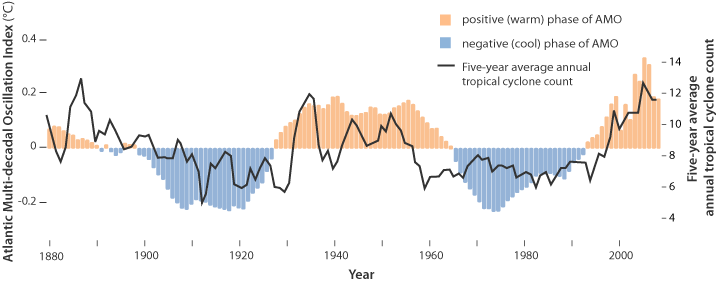
Source: Energy and Education Canada

An example is this report in May 2015 The Atlantic is entering a cool phase that will change the world’s weather by Gerald McCarthy and Evan Haigh of the RAPID Atlantic monitoring project. Excerpts in italics with my bolds.

This is known as the Atlantic Multidecadal Oscillation (AMO), and the transition between its positive and negative phases can be very rapid. For example, Atlantic temperatures declined by 0.1ºC per decade from the 1940s to the 1970s. By comparison, global surface warming is estimated at 0.5ºC per century – a rate twice as slow.

In many parts of the world, the AMO has been linked with decade-long temperature and rainfall trends. Certainly – and perhaps obviously – the mean temperature of islands downwind of the Atlantic such as Britain and Ireland show almost exactly the same temperature fluctuations as the AMO.

Atlantic oscillations are associated with the frequency of hurricanes and droughts. When the AMO is in the warm phase, there are more hurricanes in the Atlantic and droughts in the US Midwest tend to be more frequent and prolonged. In the Pacific Northwest, a positive AMO leads to more rainfall.

A negative AMO (cooler ocean) is associated with reduced rainfall in the vulnerable Sahel region of Africa. The prolonged negative AMO was associated with the infamous Ethiopian famine in the mid-1980s. In the UK it tends to mean reduced summer rainfall – the mythical “barbeque summer”.Our results show that ocean circulation responds to the first mode of Atlantic atmospheric forcing, the North Atlantic Oscillation, through circulation changes between the subtropical and subpolar gyres – the intergyre region. This a major influence on the wind patterns and the heat transferred between the atmosphere and ocean.

The observations that we do have of the Atlantic overturning circulation over the past ten years show that it is declining. As a result, we expect the AMO is moving to a negative (colder surface waters) phase. This is consistent with observations of temperature in the North Atlantic.

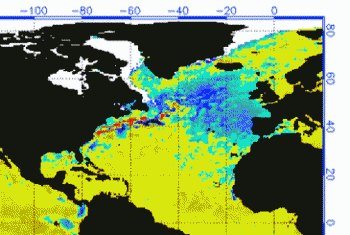
Cold “blobs” in North Atlantic have been reported, but they are usually a winter phenomena. For example in April 2016, the sst anomalies looked like this

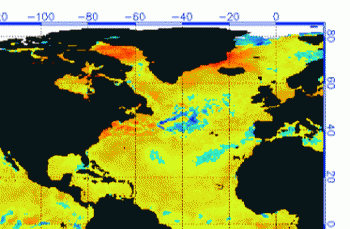
But by September, the picture changed to this

And we know from Kaplan AMO dataset, that 2016 summer SSTs were right up there with 1998 and 2010 as the highest recorded.

As the graph above suggests, this body of water is also important for tropical cyclones, since warmer water provides more energy.  But those are annual averages, and I am interested in the summer pulses of warm water into the Arctic. As I have noted in my monthly HadSST3 reports, most summers since 2003 there have been warm pulses in the north atlantic.
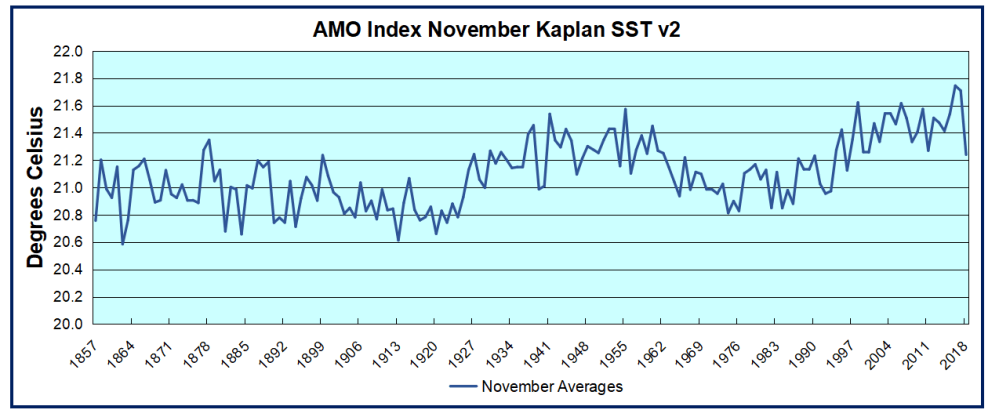
AMO November 2018The AMO Index is from from Kaplan SST v2, the unaltered and not detrended dataset. By definition, the data are monthly average SSTs interpolated to a 5×5 grid over the North Atlantic basically 0 to 70N.  The graph shows warming began after 1993 up to 1998, with a series of matching years since.  November 2016 set a record at 21.75C, but note the plunge down to 21.24C for  November 2018, the coldest since 1996.  Because McCarthy refers to hints of cooling to come in the N. Atlantic, let’s take a closer look at some AMO years in the last 2 decades.

AMO decade 112018

This graph shows monthly AMO temps for some important years. The Peak years were 1998, 2010 and 2016, with the latter emphasized as the most recent. The other years show lesser warming, with 2007 emphasized as the coolest in the last 20 years. Note the red 2018 line is at the bottom of all these tracks.  Most recently November 2018 is 0.5C lower than November 2017, and is the coolest November since 1996.

With all the talk of AMOC slowing down and a phase shift in the North Atlantic, we expect that the annual average for 2018 will confirm that cooling has set in.  Through November the momentum is certainly heading downward, despite the band of warming ocean  that gave rise to European heat waves last summer.
cdas-sflux_ssta_atl_1


Monotonic Climate Science

The Greek word for “one tone” is monotonia, which is the root for both monotone and the closely-related word monotonous, which means “dull and tedious.” Monotone is a droning, unchanging tone. A continuous sound, especially someone’s voice, that doesn’t rise and fall in pitch, is a monotone. Nothing can put you to sleep quite as effectively as a teacher talking in a monotone.

Monotonic climate science was on full display this week as journalists, pundits and tweeters freaked out over a comment by the new US ambassador to Canada.  Her offense:  saying there were two sides on the climate issue and she respects them both.

The story from CBC:  The new U.S. ambassador to Canada said Monday that she believes “both sides” of climate change science.

In an interview with Canada’s CBC News, Kelly Knight Craft said that she believes there is “accurate” science on “both sides” but did not specify what sides she was referring to.

“I believe there are sciences on both sides that are accurate,” Craft said. “Both sides have their own results from their studies, and I appreciate and respect both sides of the science.”

President Trump appointed Craft, a prominent GOP fundraiser, to the ambassadorship earlier this year.

Craft told CBC that even though Trump has pledged to pull the United States out of the Paris climate agreement, she thinks the U.S. can “absolutely” fight climate climate change.

“We all have the same goal, and that is to better our environment and to maintain the environment,” she said. “I feel like our administration has been on top of this regardless of whether or not they’d be pulling out.”

It is true Ambassador Craft had the look of a deer in the headlights.  She is from Kentucky where one doesn’t encounter sanctimonious warmists as frequently as in Ottawa, and especially not ones determined to get a “gotcha” quote from her.

All the comments at alarmist websites are dissing her for thinking the issue could have two differing points of view. Going further, they repeatedly claim “science” does not have two sides, not now, not ever. And, of course, she offends them by saying she respects people on both sides of the matter. As an Ambassador, she sought common ground without going into the specifics of how the US is actually reducing its CO2 emissions while Canada has not.

The damage here goes beyond climate science to the degradation of all scientific disciplines.  These smug journalists and their audiences know that on all kinds of issues reasonable people can disagree.  But somehow they have been brainwashed with the notion that science is a catechism with only one right answer.  That idea is false and a threat to modern civilization.

They hear only about Jim Hansen, Al Gore, Mike Mann and their ilk, and think their pronouncements are universally and eternally true.  Many, many scientists see things differently. Hard as it is to go from simplicity to complexity, let us enlighten these folks to some of the other sides of climate science .  First, meet Richard Muller who shares some concerns and not others.  Below in italics is his answer to a question raised on Quora:   What are some widely cited studies in the news that are false?

Answer by Richard Muller, Professor of Physics at UC Berkeley.

That 97% of all climate scientists accept that climate change is real, large, and a threat to the future of humanity. That 97% basically concur with the vast majority of claims made by Vice President Al Gore in his Nobel Peace Prize winning film, An Inconvenient Truth.

The question asked in typical surveys is neither of those. It is this: “Do you believe that humans are affecting climate?” My answer would be yes. Humans are responsible for about a 1 degree Celsius rise in the average temperature in the last 100 years. So I would be included as one of the 97% who believe.

Yet the observed changes that are scientifically established, in my vast survey of the science, are confined to temperature rise and the resulting small (4-inch) rise in sea level. (The huge “sea level rise” seen in Florida is actually subsidence of the land mass, and is not related to global warming.) There is no significant change in the rate of storms, or of violent storms, including hurricanes and volcanoes. The temperature variability is not increasing. There is no scientifically significant increase in floods or droughts. Even the widely reported warming of Alaska (“the canary in the mine”) doesn’t match the pattern of carbon dioxide increase–it may have an explanation in terms of changes in the northern Pacific and Atlantic currents. Moreover, the standard climate models have done a very poor job of predicting the temperature rise in Antarctica, so we must be cautious about the danger of confirmation bias.

My friend Will Happer believes that humans do affect the climate, particularly in cities where concrete and energy use cause what is called the “urban heat island effect.” So he would be included in the 97% who believe that humans affect climate, even though he is usually included among the more intense skeptics of the IPCC. He also feels that humans cause a small amount of global warming (he isn’t convinced it is as large as 1 degree), but he does not think it is heading towards a disaster; he has concluded that the increase in carbon dioxide is good for food production, and has helped mitigate global hunger. Yet he would be included in the 97%.

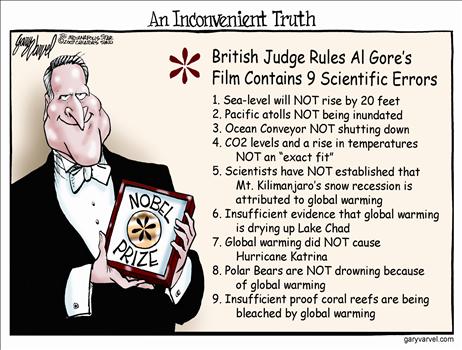
The problem is not with the survey, which asked a very general question. The problem is that many writers (and scientists!) look at that number and mischaracterize it. The 97% number is typically interpreted to mean that 97% accept the conclusions presented in An Inconvenient Truth by former Vice President Al Gore. That’s certainly not true; even many scientists who are deeply concerned by the small global warming (such as me) reject over 70% of the claims made by Mr. Gore in that movie (as did a judge in the UK; see the following link: Gore climate film’s nine ‘errors‘).

inconvenientprize9

The pollsters aren’t to blame. Well, some of them are; they too can do a good poll and then misrepresent what it means. The real problem is that many people who fear global warming (include me) feel that it is necessary to exaggerate the meaning of the polls in order to get action from the public (don’t include me).

There is another way to misrepresent the results of the polls. Yes, 97% of those polled believe that there is human caused climate change. How did they reach that decision? Was it based on a careful reading of the IPCC report? Was it based on their knowledge of the potential systematic uncertainties inherent in the data? Or was it based on their fear that opponents to action are anti-science, so we scientists have to get together and support each other. There is a real danger in people with Ph.D.s joining a consensus that they haven’t vetted professionally.

I like to ask scientists who “believe” in global warming what they think of the data. Do they believe hurricanes are increasing? Almost never do I get the answer “Yes, I looked at that, and they are.” Of course they don’t say that, because if they did I would show them the actual data! Do they say, “I’ve looked at the temperature record, and I agree that the variability is going up”? No. Sometimes they will say, “There was a paper by Jim Hansen that showed the variability was increasing.” To which I reply, “I’ve written to Jim Hansen about that paper, and he agrees with me that it shows no such thing. He even expressed surprise that his paper has been so misinterpreted.”

A really good question would be: “Have you studied climate change enough that you would put your scientific credentials on the line that most of what is said in An Inconvenient Truth is based on accurate scientific results? My guess is that a large majority of the climate scientists would answer no to that question, and the true percentage of scientists who support the statement I made in the opening paragraph of this comment, that true percentage would be under 30%. That is an unscientific guestimate, based on my experience in asking many scientists about the claims of Al Gore.

Then esteemed climate scientist Richard Lindzen, in a short video introduces you to more sides to the climate change issue:

Summary

Science in general, and climate science in particular is not monotonic, but polyphonic.  There are and have always been differing voices and tones in the search for objective truth.  Only the illiterate think otherwise.

Ocean SSTs Tepid in November

globpopThe best context for understanding decadal temperature changes comes from the world’s sea surface temperatures (SST), for several reasons:

  • The ocean covers 71% of the globe and drives average temperatures;
  • SSTs have a constant water content, (unlike air temperatures), so give a better reading of heat content variations;
  • A major El Nino was the dominant climate feature in recent years.

HadSST is generally regarded as the best of the global SST data sets, and so the temperature story here comes from that source, the latest version being HadSST3.  More on what distinguishes HadSST3 from other SST products at the end.

The Current Context

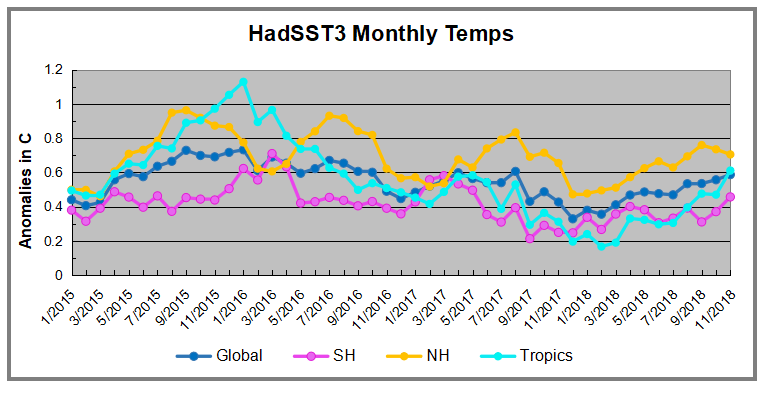
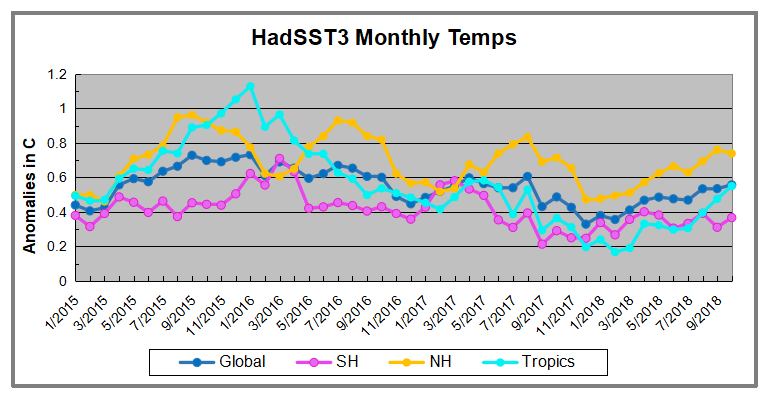
The chart below shows SST monthly anomalies as reported in HadSST3 starting in 2015 through November 2018.

Hadsst112018

A global cooling pattern is seen clearly in the Tropics since its peak in 2016, joined by NH and SH cycling downward since 2016.  2018 started with slow warming after the low point of December 2017, led by steadily rising NH, which peaked in September and cooled the last 2 months.  The Tropics have risen steadily since July, and along with a bump in SH pulled the Global anomaly up slightly the last 2 months.

The November Global anomaly is higher than 2017 but still lower than 2015.  Similarly, NH, SH and the Tropics are all slightly higher than 2017, but still lower than 11/2015. The rise in the Tropics is likely due to the weak El Nino, maybe also affecting the SH.

Note that higher temps in 2015 and 2016 were first of all due to a sharp rise in Tropical SST, beginning in March 2015, peaking in January 2016, and steadily declining back below its beginning level. Secondly, the Northern Hemisphere added three bumps on the shoulders of Tropical warming, with peaks in August of each year.  A fourth NH bump was lower and peaked in September 2018.  Also, note that the global release of heat was not dramatic, due to the Southern Hemisphere offsetting the Northern one.

A longer view of SSTs

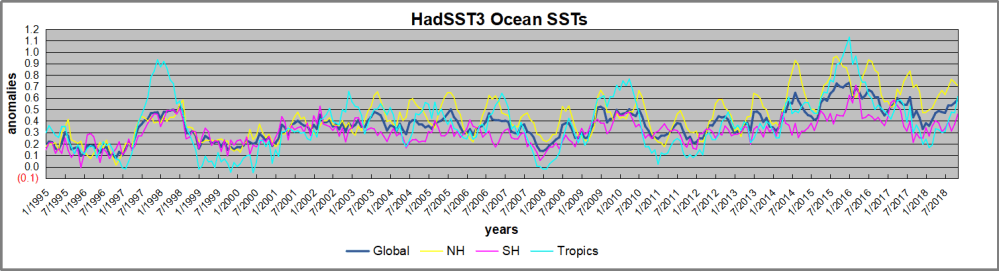
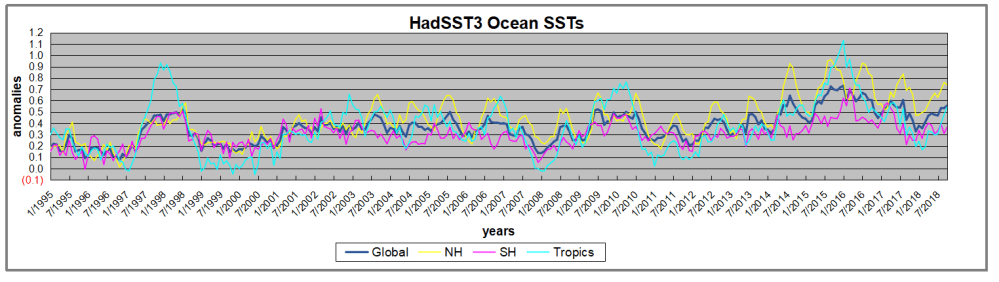
The graph below  is noisy, but the density is needed to see the seasonal patterns in the oceanic fluctuations.  Previous posts focused on the rise and fall of the last El Nino starting in 2015.  This post adds a longer view, encompassing the significant 1998 El Nino and since.  The color schemes are retained for Global, Tropics, NH and SH anomalies.  Despite the longer time frame, I have kept the monthly data (rather than yearly averages) because of interesting shifts between January and July.

Hadsst95to112018

Open image in new tab to enlarge.

1995 is a reasonable starting point prior to the first El Nino.  The sharp Tropical rise peaking in 1998 is dominant in the record, starting Jan. ’97 to pull up SSTs uniformly before returning to the same level Jan. ’99.  For the next 2 years, the Tropics stayed down, and the world’s oceans held steady around 0.2C above 1961 to 1990 average.

Then comes a steady rise over two years to a lesser peak Jan. 2003, but again uniformly pulling all oceans up around 0.4C.  Something changes at this point, with more hemispheric divergence than before. Over the 4 years until Jan 2007, the Tropics go through ups and downs, NH a series of ups and SH mostly downs.  As a result the Global average fluctuates around that same 0.4C, which also turns out to be the average for the entire record since 1995.

2007 stands out with a sharp drop in temperatures so that Jan.08 matches the low in Jan. ’99, but starting from a lower high. The oceans all decline as well, until temps build peaking in 2010.

Now again a different pattern appears.  The Tropics cool sharply to Jan 11, then rise steadily for 4 years to Jan 15, at which point the most recent major El Nino takes off.  But this time in contrast to ’97-’99, the Northern Hemisphere produces peaks every summer pulling up the Global average.  In fact, these NH peaks appear every July starting in 2003, growing stronger to produce 3 massive highs in 2014, 15 and 16, with July 2017 only slightly lower.  Note also that starting in 2014 SH plays a moderating role, offsetting the NH warming pulses. (Note: these are high anomalies on top of the highest absolute temps in the NH.)

What to make of all this? The patterns suggest that in addition to El Ninos in the Pacific driving the Tropic SSTs, something else is going on in the NH.  The obvious culprit is the North Atlantic, since I have seen this sort of pulsing before.  After reading some papers by David Dilley, I confirmed his observation of Atlantic pulses into the Arctic every 8 to 10 years.

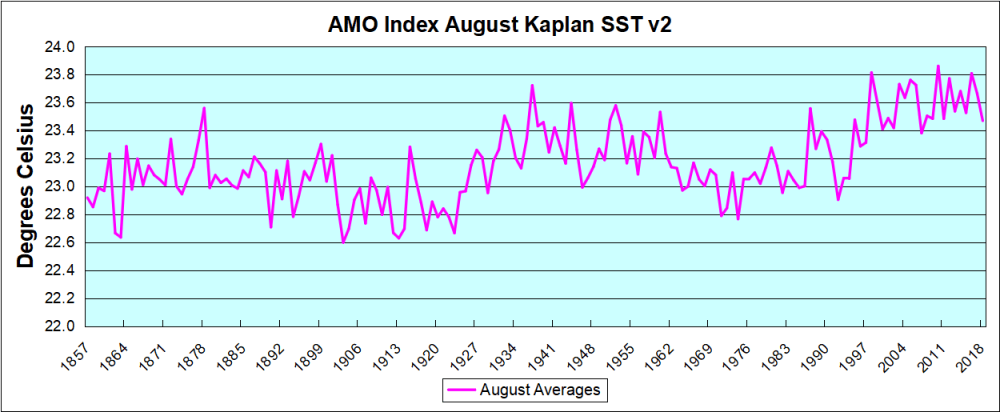
But the peaks coming nearly every summer in HadSST require a different picture.  Let’s look at August, the hottest month in the North Atlantic from the Kaplan dataset.
AMO August 2018

The AMO Index is from from Kaplan SST v2, the unaltered and untrended dataset. By definition, the data are monthly average SSTs interpolated to a 5×5 grid over the North Atlantic basically 0 to 70N. The graph shows warming began after 1992 up to 1998, with a series of matching years since. Because the N. Atlantic has partnered with the Pacific ENSO recently, let’s take a closer look at some AMO years in the last 2 decades.

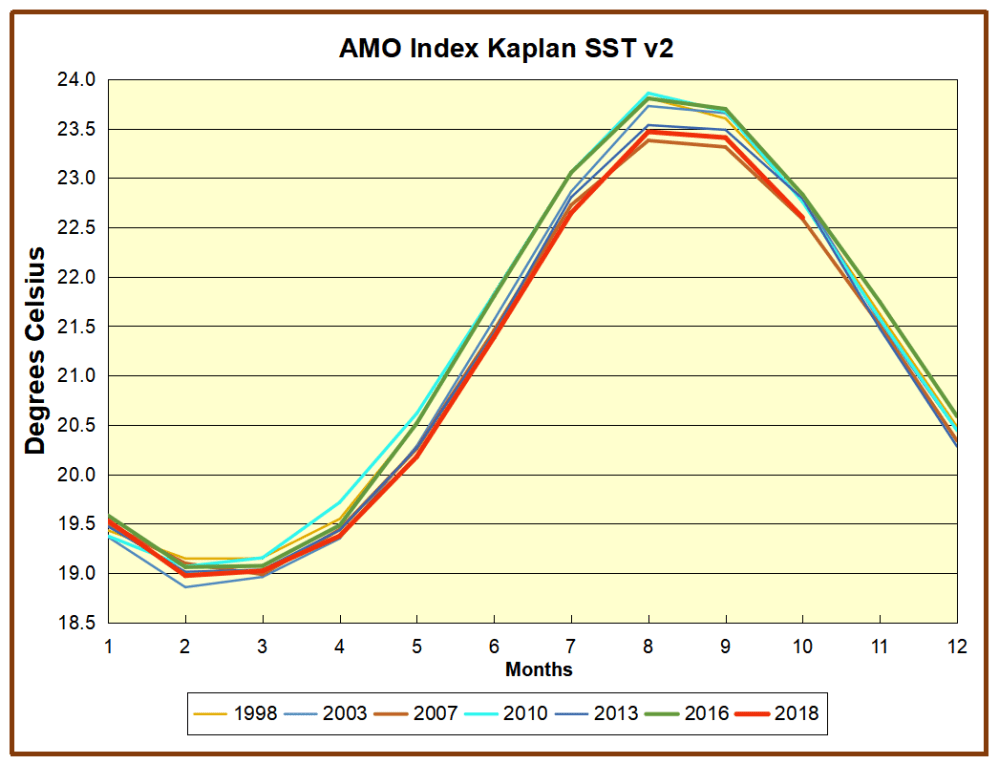
AMO decade 102018

This graph shows monthly AMO temps for some important years. The Peak years were 1998, 2010 and 2016, with the latter emphasized as the most recent. The other years show lesser warming, with 2007 emphasized as the coolest in the last 20 years. Note the red 2018 line is at the bottom of all these tracks. Most recently October 2018 is 0.29C lower than October 2016, and is the coolest October since 2011.

Summary

The oceans are driving the warming this century.  SSTs took a step up with the 1998 El Nino and have stayed there with help from the North Atlantic, and more recently the Pacific northern “Blob.”  The ocean surfaces are releasing a lot of energy, warming the air, but eventually will have a cooling effect.  The decline after 1937 was rapid by comparison, so one wonders: How long can the oceans keep this up? If the pattern of recent years continues, NH SST anomalies will likely cool in coming months.  Once again, ENSO will probably determine the outcome.

Postscript:

In the most recent GWPF 2017 State of the Climate report, Dr. Humlum made this observation:

“It is instructive to consider the variation of the annual change rate of atmospheric CO2 together with the annual change rates for the global air temperature and global sea surface temperature (Figure 16). All three change rates clearly vary in concert, but with sea surface temperature rates leading the global temperature rates by a few months and atmospheric CO2 rates lagging 11–12 months behind the sea surface temperature rates.”

Footnote: Why Rely on HadSST3

HadSST3 is distinguished from other SST products because HadCRU (Hadley Climatic Research Unit) does not engage in SST interpolation, i.e. infilling estimated anomalies into grid cells lacking sufficient sampling in a given month. From reading the documentation and from queries to Met Office, this is their procedure.

HadSST3 imports data from gridcells containing ocean, excluding land cells. From past records, they have calculated daily and monthly average readings for each grid cell for the period 1961 to 1990. Those temperatures form the baseline from which anomalies are calculated.

In a given month, each gridcell with sufficient sampling is averaged for the month and then the baseline value for that cell and that month is subtracted, resulting in the monthly anomaly for that cell. All cells with monthly anomalies are averaged to produce global, hemispheric and tropical anomalies for the month, based on the cells in those locations. For example, Tropics averages include ocean grid cells lying between latitudes 20N and 20S.

Gridcells lacking sufficient sampling that month are left out of the averaging, and the uncertainty from such missing data is estimated. IMO that is more reasonable than inventing data to infill. And it seems that the Global Drifter Array displayed in the top image is providing more uniform coverage of the oceans than in the past.

uss-pearl-harbor-deploys-global-drifter-buoys-in-pacific-ocean

USS Pearl Harbor deploys Global Drifter Buoys in Pacific Ocean


Katawice COP24 Briefing for Realists

czestochowska

The Black Madonna of Częstochowa is just nearby.

The upcoming COP24 will be dramatic with the host country Poland resolute on continuing to burn coal.  Comments by the Polish Minister of Environment have been aimed at lowering expectations in advance of the meeting, in stark contrast to the recent over-the-top IPCC SR15 climate horror movie.  See UN Horror Show

Polish coal miners 2015 protest against liquidation of Polish coal mines. Note the vests like those now seen all over France.

In addition, Brazil is canceling their invitation to host next year’s COP 25.  Considering the obstacles along with the location, COP24 could be considered a “Hail Mary” gathering.  Three years ago French Mathematicians spoke out prior to COP21 in Paris, and their words provide a rational briefing for COP24 beginning in Katawice this weekend. In a nutshell:

Fighting Global Warming is Absurd, Costly and Pointless.

  • Absurd because of no reliable evidence that anything unusual is happening in our climate.
  • Costly because trillions of dollars are wasted on immature, inefficient technologies that serve only to make cheap, reliable energy expensive and intermittent.
  • Pointless because we do not control the weather anyway.

The prestigious Société de Calcul Mathématique (Society for Mathematical Calculation) issued a detailed 195-page White Paper that presents a blistering point-by-point critique of the key dogmas of global warming. The synopsis is blunt and extremely well documented.  Here are extracts from the opening statements of the first three chapters of the SCM White Paper with my bolds and images.

Sisyphus at work.

Chapter 1: The crusade is absurd
There is not a single fact, figure or observation that leads us to conclude that the world‘s climate is in any way ‘disturbed.’ It is variable, as it has always been, but rather less so now than during certain periods or geological eras. Modern methods are far from being able to accurately measure the planet‘s global temperature even today, so measurements made 50 or 100 years ago are even less reliable. Concentrations of CO2 vary, as they always have done; the figures that are being released are biased and dishonest. Rising sea levels are a normal phenomenon linked to upthrust buoyancy; they are nothing to do with so-called global warming. As for extreme weather events — they are no more frequent now than they have been in the past. We ourselves have processed the raw data on hurricanes….

Chapter 2: The crusade is costly
Direct aid for industries that are completely unviable (such as photovoltaics and wind turbines) but presented as ‘virtuous’ runs into billions of euros, according to recent reports published by the Cour des Comptes (French Audit Office) in 2013. But the highest cost lies in the principle of ‘energy saving,’ which is presented as especially virtuous. Since no civilization can develop when it is saving energy, ours has stopped developing: France now has more than three million people unemployed — it is the price we have to pay for our virtue….

Chapter 3: The crusade is pointless
Human beings cannot, in any event, change the climate. If we in France were to stop all industrial activity (let’s not talk about our intellectual activity, which ceased long ago), if we were to eradicate all trace of animal life, the composition of the atmosphere would not alter in any measurable, perceptible way. To explain this, let us make a comparison with the rotation of the planet: it is slowing down. To address that, we might be tempted to ask the entire population of China to run in an easterly direction. But, no matter how big China and its population are, this would have no measurable impact on the Earth‘s rotation.

Full text in pdf format is available in English at link below:

The battle against global warming: an absurd, costly and pointless crusade
White Paper drawn up by the Société de Calcul Mathématique SA
(Mathematical Modelling Company, Corp.)

cg565e788a82606

A Second report was published in 2016 entitled: Global Warming and Employment, which analyzes in depth the economic destruction from ill-advised climate change policies.

The two principal themes are that jobs are disappearing and that the destructive forces are embedded in our societies.

Jobs are Disappearing discusses issues such as:

The State is incapable of devising and implementing an industrial policy.

The fundamental absurdity of the concept of sustainable development

Biofuels an especially absurd policy leading to ridiculous taxes and job losses.

EU policy to reduce greenhouse gas emissions by 40% drives jobs elsewhere while being pointless: the planet has never asked for it, is completely unaware of it, and will never notice it!

The War against the Car and Road Maintenance undercuts economic mobility while destroying transportation sector jobs.

Solar and wind energy are weak, diffuse, and inconsistent, inadequate to power modern civilization.

Food production activities are attacked as being “bad for the planet.”

So-called Green jobs are entirely financed by subsidies.

The Brutalizing Whip discusses the damages to public finances and to social wealth and well-being, including these topics:

Taxes have never been so high

The Government is borrowing more and more

Dilapidated infrastructure

Instead of job creation, Relocations and Losses

The wastefulness associated with the new forms of energy

Return to the economy of an underdeveloped country

What is our predicament?
Four Horsemen are bringing down our societies:

  • The Ministry of Ecology (climate and environment);
  • Journalists;
  • Scientists;
  • Corporation Environmentalist Departments.

Steps required to recover from this demise:

  • Go back to the basic rules of research.
  • Go back to the basic rules of law
  • Do not trust international organizations
  • Leave the planet alone
  • Beware of any premature optimism

Conclusion

Climate Lemmings

The real question is this: how have policymakers managed to make such absurd decisions, to blinker themselves to such a degree, when so many means of scientific investigation are available? The answer is simple: as soon as something is seen as being green, as being good for the planet, all discussion comes to an end and any scientific analysis becomes pointless or counterproductive. The policymakers will not listen to anyone or anything; they take all sorts of hasty, contradictory, damaging and absurd decisions. When will they finally be held to account?


Footnote:

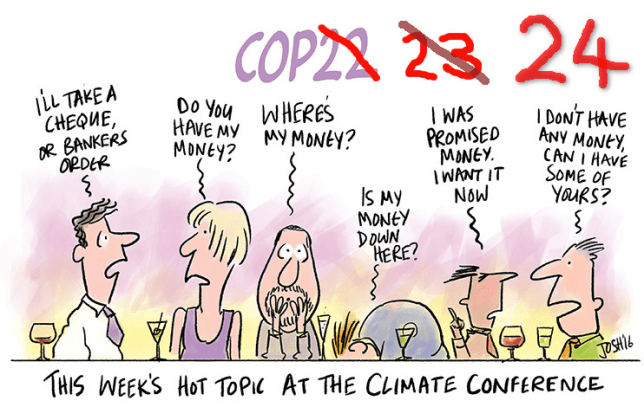
The above cartoon image of climate talks includes water rising over politicians’ feet.  But actual observations made in Fiji (presiding over talks last year in Bonn) show sea levels are stable (link below).

Fear Not For Fiji

In 2016 SCM issued a report Global Temperatures Available data and critical analysis

It is a valuable description of the temperature metrics and issues regarding climate analysis.   They conclude:

None of the information on global temperatures is of any scientific value, and it should not
be used as a basis for any policy decisions. It is perfectly clear that:

  • there are far too few temperature sensors to give us a picture of the planet’s temperature;
  • we do not know what such a temperature might mean because nobody has given it
    any specific physical significance;
  • the data have been subject to much dissimulation and manipulation. There is a
    clear will not to mention anything that might be reassuring, and to highlight things
    that are presented as worrying;
  • despite all this, direct use of the available figures does not indicate any genuine
    trend towards global warming!

cop-wheres-my-money

Latest Results from First-Class Climate Model INMCM5

Update February 14, 2021

Forecasts to 2100 based on IPCC scenarios required for CMIP6 models.

IPCC Scenarios Ensure Unreal Climate Forecasts

Update February 4, 2020

A recent comparison of INMCM5 and other CMIP6 climate models is discussed in the post
Climate Models: Good, Bad and Ugly

Updated with October 25, 2018 Report

A previous analysis Temperatures According to Climate Models showed that only one of 42 CMIP5 models was close to hindcasting past temperature fluctuations. That model was INMCM4, which also projected an unalarming 1.4C warming to the end of the century, in contrast to the other models programmed for future warming five times the past.
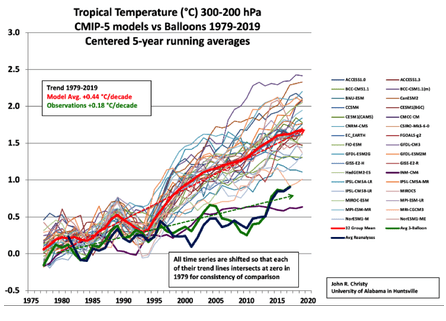
In a recent comment thread, someone asked what has been done recently with that model, given that it appears to be “best of breed.” So I went looking and this post summarizes further work to produce a new, hopefully improved version by the modelers at the Institute of Numerical Mathematics of the Russian Academy of Sciences.


A previous post a year ago went into the details of improvements made in producing the latest iteration INMCM5 for entry into the CMIP6 project.  That text is reprinted below.

Now a detailed description of the model’s global temperature outputs has been published October 25, 2018 in Earth System Dynamics Simulation of observed climate changes in 1850–2014 with climate model INM-CM5   (Title is link to pdf) Excerpts below with my bolds.
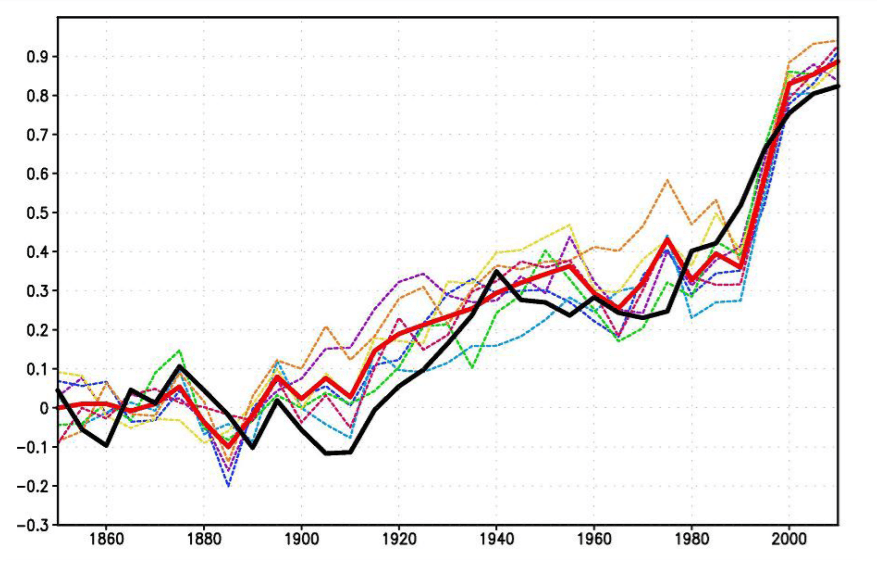
Figure 1. The 5-year mean GMST (K) anomaly with respect to 1850–1899 for HadCRUTv4 (thick solid black); model mean (thick solid red). Dashed thin lines represent data from individual model runs: 1 – purple, 2 – dark blue, 3 – blue, 4 – green, 5 – yellow, 6 – orange, 7 – magenta. In this and the next figures numbers on the time axis indicate the first year of the 5-year mean.

Abstract

Climate changes observed in 1850-2014 are modeled and studied on the basis of seven historical runs with the climate model INM-CM5 under the scenario proposed for Coupled Model Intercomparison Project, Phase 6 (CMIP6). In all runs global mean surface temperature rises by 0.8 K at the end of the experiment (2014) in agreement with the observations. Periods of fast warming in 1920-1940 and 1980-2000 as well as its slowdown in 1950-1975 and 2000-2014 are correctly reproduced by the ensemble mean. The notable change here with respect to the CMIP5 results is correct reproduction of the slowdown of global warming in 2000-2014 that we attribute to more accurate description of the Solar constant in CMIP6 protocol. The model is able to reproduce correct behavior of global mean temperature in 1980-2014 despite incorrect phases of  the Atlantic Multidecadal Oscillation and Pacific Decadal Oscillation indices in the majority of experiments. The Arctic sea ice loss in recent decades is reasonably close to the observations just in one model run; the model underestimates Arctic sea ice loss by the factor 2.5. Spatial pattern of model mean surface temperature trend during the last 30 years looks close the one for the ERA Interim reanalysis. Model correctly estimates the magnitude of stratospheric cooling.

Additional Commentary

Observational data of GMST for 1850-2014 used for verification of model results were produced by HadCRUT4 (Morice et al 2012). Monthly mean sea surface temperature (SST) data ERSSTv4 (Huang et al 2015) are used for comparison of the AMO and PDO indices with that of the model. Data of Arctic sea ice extent for 1979-2014 derived from satellite observations are taken from Comiso and Nishio (2008). Stratospheric temperature trend and geographical distribution of near surface air temperature trend for 1979-2014 are calculated from ERA Interim reanalysis data (Dee et al 2011).

Keeping in mind the arguments that the GMST slowdown in the beginning of 21st 6 century could be due to the internal variability of the climate system let us look at the behavior of the AMO and PDO climate indices. Here we calculated the AMO index in the usual way, as the SST anomaly in Atlantic at latitudinal band 0N-60N minus anomaly of the GMST. Model and observed 5 year mean AMO index time series are presented in Fig.3. The well known oscillation with a period of 60-70 years can be clearly seen in the observations. Among the model runs, only one (dashed purple line) shows oscillation with a period of about 70 years, but without significant maximum near year 2000. In other model runs there is no distinct oscillation with a period of 60-70 years but period of 20-40 years prevails. As a result none of seven model trajectories reproduces behavior of observed AMO index after year 1950 (including its warm phase at the turn of the 20th and 21st centuries). One can conclude that anthropogenic forcing is unable to produce any significant impact on the AMO dynamics as its index averaged over 7 realization stays around zero within one sigma interval (0.08). Consequently, the AMO dynamics is controlled by internal variability of the climate system and cannot be predicted in historic experiments. On the other hand the model can correctly predict GMST changes in 1980-2014 having wrong phase of the AMO (blue, yellow, orange lines on Fig.1 and 3).

Conclusions

Seven historical runs for 1850-2014 with the climate model INM-CM5 were analyzed. It is shown that magnitude of the GMST rise in model runs agrees with the estimate based on the observations. All model runs reproduce stabilization of GMST in 1950-1970, fast warming in 1980-2000 and a second GMST stabilization in 2000-2014 suggesting that the major factor for predicting GMST evolution is the external forcing rather than system internal variability. Numerical experiments with the previous model version (INMCM4) for CMIP5 showed unrealistic gradual warming in 1950-2014. The difference between the two model results could be explained by more accurate modeling of stratospheric volcanic and tropospheric anthropogenic aerosol radiation effect (stabilization in 1950-1970) due to the new aerosol block in INM-CM5 and more accurate prescription of Solar constant scenario (stabilization in 2000-2014) in CMIP6 protocol. Four of seven INM-CM5 model runs simulate acceleration of warming in 1920-1940 in a correct way, other three produce it earlier or later than in reality. This indicates that for the year warming of 1920-1940 the climate system natural variability plays significant role. No model trajectory reproduces correct time behavior of AMO and PDO indices. Taking into account our results on the GMST modeling one can conclude that anthropogenic forcing does not produce any significant impact on the dynamics of AMO and PDO indices, at least for the INM-CM5 model. In turns, correct prediction of the GMST changes in the 1980-2014 does not require correct phases of the AMO and PDO as all model runs have correct values of the GMST while in at least three model experiments the phases of the AMO and PDO are opposite to the observed ones in that time. The North Atlantic SST time series produced by the model correlates better with the observations in 1980-2014. Three out of seven trajectories have strongly positive North Atlantic SST anomaly as the observations (in the other four cases we see near-to-zero changes for this quantity). The INMCM5 has the same skill for prediction of the Arctic sea ice extent in 2000-2014 as CMIP5 models including INMCM4. It underestimates the rate of sea ice loss by a factor between the two and three. In one extreme case the magnitude of this decrease is as large as in the observations while in the other the sea ice extent does not change compared to the preindustrial ages. In part this could be explained by the strong internal variability of the Arctic sea ice but obviously the new version of INMCM model and new CMIP6 forcing protocol does not improve prediction of the Arctic sea ice extent response to anthropogenic forcing.

Previous Post:  Climate Model Upgraded: INMCM5 Under the Hood

Earlier in 2017 came this publication Simulation of the present-day climate with the climate model INMCM5 by E.M. Volodin et al. Excerpts below with my bolds.

In this paper we present the fifth generation of the INMCM climate model that is being developed at the Institute of Numerical Mathematics of the Russian Academy of Sciences (INMCM5). The most important changes with respect to the previous version (INMCM4) were made in the atmospheric component of the model. Its vertical resolution was increased to resolve the upper stratosphere and the lower mesosphere. A more sophisticated parameterization of condensation and cloudiness formation was introduced as well. An aerosol module was incorporated into the model. The upgraded oceanic component has a modified dynamical core optimized for better implementation on parallel computers and has two times higher resolution in both horizontal directions.

Analysis of the present-day climatology of the INMCM5 (based on the data of historical run for 1979–2005) shows moderate improvements in reproduction of basic circulation characteristics with respect to the previous version. Biases in the near-surface temperature and precipitation are slightly reduced compared with INMCM4 as  well as biases in oceanic temperature, salinity and sea surface height. The most notable improvement over INMCM4 is the capability of the new model to reproduce the equatorial stratospheric quasi-biannual oscillation and statistics of sudden stratospheric warmings.
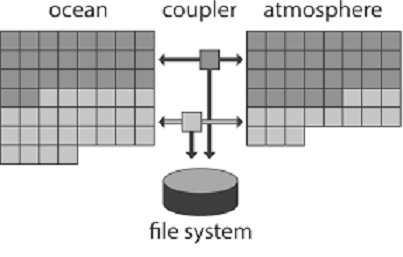
Climate model blocksThe family of INMCM climate models, as most climate system models, consists of two main blocks: the atmosphere general circulation model, and the ocean general circulation model. The atmospheric part is based on the standard set of hydrothermodynamic equations with hydrostatic approximation written in advective form. The model prognostic variables are wind horizontal components, temperature, specific humidity and surface pressure.

Atmosphere Module

The INMCM5 borrows most of the atmospheric parameterizations from its previous version. One of the few notable changes is the new parameterization of clouds and large-scale condensation. In the INMCM5 cloud area and cloud water are computed prognostically according to Tiedtke (1993). That includes the formation of large-scale cloudiness as well as the formation of clouds in the atmospheric boundary layer and clouds of deep convection. Decrease of cloudiness due to mixing with unsaturated environment and precipitation formation are also taken into account. Evaporation of precipitation is implemented according to Kessler (1969).

In the INMCM5 the atmospheric model is complemented by the interactive aerosol block, which is absent in the INMCM4. Concentrations of coarse and fine sea salt, coarse and fine mineral dust, SO2, sulfate aerosol, hydrophilic and hydrophobic black and organic carbon are all calculated prognostically.
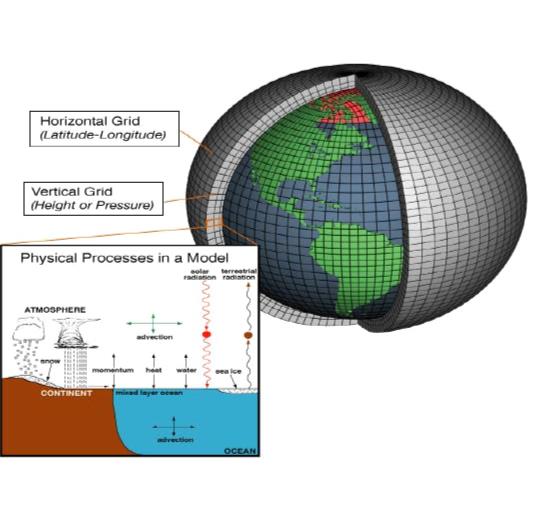
Ocean Module

The oceanic module of the INMCM5 uses generalized spherical coordinates. The model “South Pole” coincides with the geographical one, while the model “North Pole” is located in Siberia beyond the ocean area to avoid numerical problems near the pole. Vertical sigma-coordinate is used. The finite-difference equations are written using the Arakawa C-grid. The differential and finite-difference equations, as well as methods of solving them can be found in Zalesny etal. (2010).

The INMCM5 uses explicit schemes for advection, while the INMCM4 used schemes based on splitting upon coordinates. Also, the iterative method for solving linear shallow water equation systems is used in the INMCM5 rather than direct method used in the INMCM4. The two previous changes were made to improve model parallel scalability. The horizontal resolution of the ocean part of the INMCM5 is 0.5 × 0.25° in longitude and latitude (compared to the INMCM4’s 1 × 0.5°).

Both the INMCM4 and the INMCM5 have 40 levels in vertical. The parallel implementation of the ocean model can be found in (Terekhov etal. 2011). The oceanic block includes vertical mixing and isopycnal diffusion parameterizations (Zalesny et al. 2010). Sea ice dynamics and thermodynamics are parameterized according to Iakovlev (2009). Assumptions of elastic-viscous-plastic rheology and single ice thickness gradation are used. The time step in the oceanic block of the INMCM5 is 15 min.
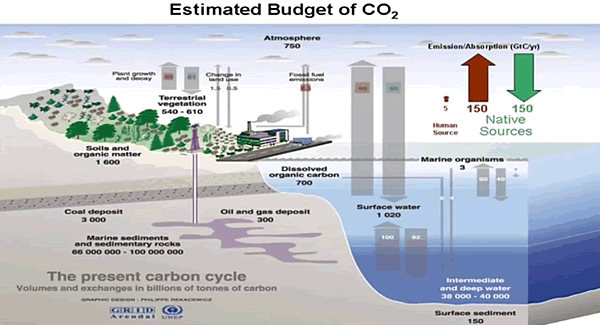
Note the size of the human emissions next to the red arrow.

Carbon Cycle Module

The climate model INMCM5 has а carbon cycle module (Volodin 2007), where atmospheric CO2 concentration, carbon in vegetation, soil and ocean are calculated. In soil, а single carbon pool is considered. In the ocean, the only prognostic variable in the carbon cycle is total inorganic carbon. Biological pump is prescribed. The model calculates methane emission from wetlands and has a simplified methane cycle (Volodin 2008). Parameterizations of some electrical phenomena, including calculation of ionospheric potential and flash intensity (Mareev and Volodin 2014), are also included in the model.

Surface Temperatures

When compared to the INMCM4 surface temperature climatology, the INMCM5 shows several improvements. Negative bias over continents is reduced mainly because of the increase in daily minimum temperature over land, which is achieved by tuning the surface flux parameterization. In addition, positive bias over southern Europe and eastern USA in summer typical for many climate models (Mueller and Seneviratne 2014) is almost absent in the INMCM5. A possible reason for this bias in many models is the shortage of soil water and suppressed evaporation leading to overestimation of the surface temperature. In the INMCM5 this problem was addressed by the increase of the minimum leaf resistance for some vegetation types.

Nevertheless, some problems migrate from one model version to the other: negative bias over most of the subtropical and tropical oceans, and positive bias over the Atlantic to the east of the USA and Canada. Root mean square (RMS) error of annual mean near surface temperature was reduced from 2.48 K in the INMCM4 to 1.85 K in the INMCM5.

Precipitation

In mid-latitudes, the positive precipitation bias over the ocean prevails in winter while negative bias occurs in summer. Compared to the INMCM4, the biases over the western Indian Ocean, Indonesia, the eastern tropical Pacific and the tropical Atlantic are reduced. A possible reason for this is the better reproduction of the tropical sea surface temperature (SST) in the INMCM5 due to the increase of the spatial resolution in the oceanic block, as well as the new condensation scheme. RMS annual mean model bias for precipitation is 1.35mm day−1 for the INMCM5 compared to 1.60mm day−1 for the INMCM4.

Cloud Radiation Forcing

Cloud radiation forcing (CRF) at the top of the atmosphere is one of the most important climate model characteristics, as errors in CRF frequently lead to an incorrect surface temperature.

In the high latitudes model errors in shortwave CRF are small. The model underestimates longwave CRF in the subtropics but overestimates it in the high latitudes. Errors in longwave CRF in the tropics tend to partially compensate errors in shortwave CRF. Both errors have positive sign near 60S leading to warm bias in the surface temperature here. As a result, we have some underestimation of the net CRF absolute value at almost all latitudes except the tropics. Additional experiments with tuned conversion of cloud water (ice) to precipitation (for upper cloudiness) showed that model bias in the net CRF could be reduced, but that the RMS bias for the surface temperature will increase in this case.
A table from another paper provides the climate parameters described by INMCM5.

Climate Parameters Observations INMCM3 INMCM4 INMCM5
Incoming solar radiation at TOA 341.3 [26] 341.7 341.8 341.4
Outgoing solar radiation at TOA   96–100 [26] 97.5 ± 0.1 96.2 ± 0.1 98.5 ± 0.2
Outgoing longwave radiation at TOA 236–242 [26] 240.8 ± 0.1 244.6 ± 0.1 241.6 ± 0.2
Solar radiation absorbed by surface 154–166 [26] 166.7 ± 0.2 166.7 ± 0.2 169.0 ± 0.3
Solar radiation reflected by surface     22–26 [26] 29.4 ± 0.1 30.6 ± 0.1 30.8 ± 0.1
Longwave radiation balance at surface –54 to 58 [26] –52.1 ± 0.1 –49.5 ± 0.1 –63.0 ± 0.2
Solar radiation reflected by atmosphere      74–78 [26] 68.1 ± 0.1 66.7 ± 0.1 67.8 ± 0.1
Solar radiation absorbed by atmosphere     74–91 [26] 77.4 ± 0.1 78.9 ± 0.1 81.9 ± 0.1
Direct hear flux from surface     15–25 [26] 27.6 ± 0.2 28.2 ± 0.2 18.8 ± 0.1
Latent heat flux from surface     70–85 [26] 86.3 ± 0.3 90.5 ± 0.3 86.1 ± 0.3
Cloud amount, %     64–75 [27] 64.2 ± 0.1 63.3 ± 0.1 69 ± 0.2
Solar radiation-cloud forcing at TOA         –47 [26] –42.3 ± 0.1 –40.3 ± 0.1 –40.4 ± 0.1
Longwave radiation-cloud forcing at TOA          26 [26] 22.3 ± 0.1 21.2 ± 0.1 24.6 ± 0.1
Near-surface air temperature, °С 14.0 ± 0.2 [26] 13.0 ± 0.1 13.7 ± 0.1 13.8 ± 0.1
Precipitation, mm/day 2.5–2.8 [23] 2.97 ± 0.01 3.13 ± 0.01 2.97 ± 0.01
River water inflow to the World Ocean,10^3 km^3/year 29–40 [28] 21.6 ± 0.1 31.8 ± 0.1 40.0 ± 0.3
Snow coverage in Feb., mil. Km^2 46 ± 2 [29] 37.6 ± 1.8 39.9 ± 1.5 39.4 ± 1.5
Permafrost area, mil. Km^2 10.7–22.8 [30] 8.2 ± 0.6 16.1 ± 0.4 5.0 ± 0.5
Land area prone to seasonal freezing in NH, mil. Km^2 54.4 ± 0.7 [31] 46.1 ± 1.1 48.3 ± 1.1 51.6 ± 1.0
Sea ice area in NH in March, mil. Km^2 13.9 ± 0.4 [32] 12.9 ± 0.3 14.4 ± 0.3 14.5 ± 0.3
Sea ice area in NH in Sept., mil. Km^2 5.3 ± 0.6 [32] 4.5 ± 0.5 4.5 ± 0.5 6.1 ± 0.5

Heat flux units are given in W/m^2; the other units are given with the title of corresponding parameter. Where possible, ± shows standard deviation for annual mean value.  Source: Simulation of Modern Climate with the New Version Of the INM RAS Climate Model (Bracketed numbers refer to sources for observations)

Ocean Temperature and Salinity

The model biases in potential temperature and salinity averaged over longitude with respect to WOA09 (Antonov et al. 2010) are shown in Fig.12. Positive bias in the Southern Ocean penetrates from the surface downward for up to 300 m, while negative bias in the tropics can be seen even in the 100–1000 m layer.

Nevertheless, zonal mean temperature error at any level from the surface to the bottom is small. This was not the case for the INMCM4, where one could see negative temperature bias up to 2–3 K from 1.5 km to the bottom nearly al all latitudes, and 2–3 K positive bias at levels of 700–1000 m. The reason for this improvement is the introduction of a higher background coefficient for vertical diffusion at high depth (3000 m and higher) than at intermediate depth (300–500m). Positive temperature bias at 45–65 N at all depths could probably be explained by shortcomings in the representation of deep convection [similar errors can be seen for most of the CMIP5 models (Flato etal. 2013, their Fig.9.13)].

Another feature common for many present day climate models (and for the INMCM5 as well) is negative bias in southern tropical ocean salinity from the surface to 500 m. It can be explained by overestimation of precipitation at the southern branch of the Inter Tropical Convergence zone. Meridional heat flux in the ocean (Fig.13) is not far from available estimates (Trenberth and Caron 2001). It looks similar to the one for the INMCM4, but maximum of northward transport in the Atlantic in the INMCM5 is about 0.1–0.2 × 10¹⁵ W higher than the one in the INMCM4, probably, because of the increased horizontal resolution in the oceanic block.

Sea Ice

In the Arctic, the model sea ice area is just slightly overestimated. Overestimation of the Arctic sea ice area is connected with negative bias in the surface temperature. In the same time, connection of the sea ice area error with the positive salinity bias is not evident because ice formation is almost compensated by ice melting, and the total salinity source for these pair of processes is not large. The amplitude and phase of the sea ice annual cycle are reproduced correctly by the model. In the Antarctic, sea ice area is underestimated by a factor of 1.5 in all seasons, apparently due to the positive temperature bias. Note that the correct simulation of sea ice area dynamics in both hemispheres simultaneously is a difficult task for climate modeling.

The analysis of the model time series of the SST anomalies shows that the El Niño event frequency is approximately the same in the model and data, but the model El Niños happen too regularly. Atmospheric response to the El Niño vents is also underestimated in the model by a factor of 1.5 with respect to the reanalysis data.

Conclusion

Based on the CMIP5 model INMCM4 the next version of the Institute of Numerical Mathematics RAS climate model was developed (INMCM5). The most important changes include new parameterizations of large scale condensation (cloud fraction and cloud water are now the prognostic variables), and increased vertical resolution in the atmosphere (73 vertical levels instead of 21, top model level raised from 30 to 60 km). In the oceanic block, horizontal resolution was increased by a factor of 2 in both directions.

The climate model was supplemented by the aerosol block. The model got a new parallel code with improved computational efficiency and scalability. With the new version of climate model we performed a test model run (80 years) to simulate the present-day Earth climate. The model mean state was compared with the available datasets. The structures of the surface temperature and precipitation biases in the INMCM5 are typical for the present climate models. Nevertheless, the RMS error in surface temperature, precipitation as well as zonal mean temperature and zonal wind are reduced in the INMCM5 with respect to its previous version, the INMCM4.

The model is capable of reproducing equatorial stratospheric QBO and SSWs.The model biases for the sea surface height and surface salinity are reduced in the new version as well, probably due to increasing spatial resolution in the oceanic block. Bias in ocean potential temperature at depths below 700 m in the INMCM5 is also reduced with respect to the one in the INMCM4. This is likely because of the tuning background vertical diffusion coefficient.

Model sea ice area is reproduced well enough in the Arctic, but is underestimated in the Antarctic (as a result of the overestimated surface temperature). RMS error in the surface salinity is reduced almost everywhere compared to the previous model except the Arctic (where the positive bias becomes larger). As a final remark one can conclude that the INMCM5 is substantially better in almost all aspects than its previous version and we plan to use this model as a core component for the coming CMIP6 experiment.
climatesystem_web

Summary

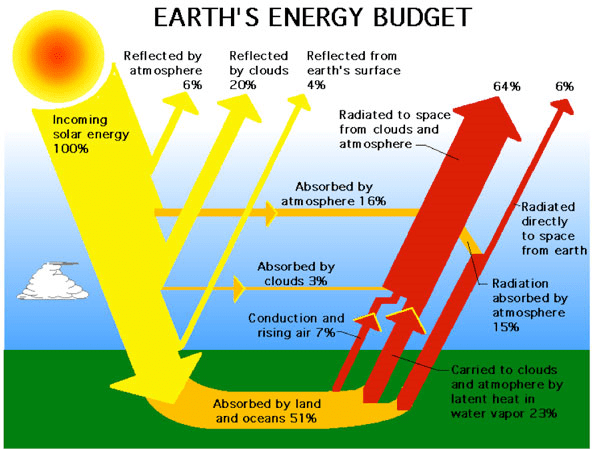
One the one hand, this model example shows that the intent is simple: To represent dynamically the energy balance of our planetary climate system.  On the other hand, the model description shows how many parameters are involved, and the complexity of processes interacting.  The attempt to simulate operations of the climate system is a monumental task with many outstanding challenges, and this latest version is another step in an iterative development.

Note:  Regarding the influence of rising CO2 on the energy balance.  Global warming advocates estimate a CO2 perturbation of 4 W/m^2.  In the climate parameters table above, observations of the radiation fluxes have a 2 W/m^2 error range at best, and in several cases are observed in ranges of 10 to 15 W/m^2.

We do not yet have access to the time series temperature outputs from INMCM5 to compare with observations or with other CMIP6 models.  Presumably that will happen in the future.
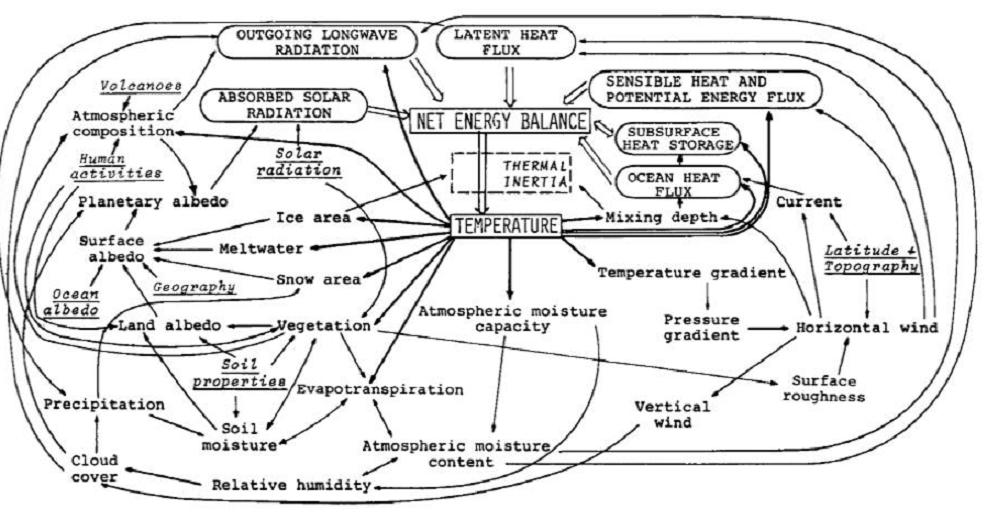
Early Schematic: Flows and Feedbacks for Climate Models

Ocean SSTs Keep Cool

globpopThe best context for understanding decadal temperature changes comes from the world’s sea surface temperatures (SST), for several reasons:

  • The ocean covers 71% of the globe and drives average temperatures;
  • SSTs have a constant water content, (unlike air temperatures), so give a better reading of heat content variations;
  • A major El Nino was the dominant climate feature in recent years.

HadSST is generally regarded as the best of the global SST data sets, and so the temperature story here comes from that source, the latest version being HadSST3.  More on what distinguishes HadSST3 from other SST products at the end.

The Current Context

The chart below shows SST monthly anomalies as reported in HadSST3 starting in 2015 through October 2018.

Hadsst102018

A global cooling pattern is seen clearly in the Tropics since its peak in 2016, joined by NH and SH cycling downward since 2016.  2018 started with slow warming after the low point of December 2017, led by steadily rising NH, which may have peaked in September.  The Tropics have risen steadily since July, and along with a small bump in SH pulled the Global anomaly up slightly.

NH is now slightly higher than 2017, but is still nearly 0.2C lower than 10/2015. The rise in the Tropics is likely due to the weak El Nino, maybe also affecting the SH. Both are still much cooler than 2015 and 2016.

Note that higher temps in 2015 and 2016 were first of all due to a sharp rise in Tropical SST, beginning in March 2015, peaking in January 2016, and steadily declining back below its beginning level. Secondly, the Northern Hemisphere added three bumps on the shoulders of Tropical warming, with peaks in August of each year.  Also, note that the global release of heat was not dramatic, due to the Southern Hemisphere offsetting the Northern one.

A longer view of SSTs

The graph below  is noisy, but the density is needed to see the seasonal patterns in the oceanic fluctuations.  Previous posts focused on the rise and fall of the last El Nino starting in 2015.  This post adds a longer view, encompassing the significant 1998 El Nino and since.  The color schemes are retained for Global, Tropics, NH and SH anomalies.  Despite the longer time frame, I have kept the monthly data (rather than yearly averages) because of interesting shifts between January and July.

Hadsst95to102018

Open image in new tab to enlarge.

1995 is a reasonable starting point prior to the first El Nino.  The sharp Tropical rise peaking in 1998 is dominant in the record, starting Jan. ’97 to pull up SSTs uniformly before returning to the same level Jan. ’99.  For the next 2 years, the Tropics stayed down, and the world’s oceans held steady around 0.2C above 1961 to 1990 average.

Then comes a steady rise over two years to a lesser peak Jan. 2003, but again uniformly pulling all oceans up around 0.4C.  Something changes at this point, with more hemispheric divergence than before. Over the 4 years until Jan 2007, the Tropics go through ups and downs, NH a series of ups and SH mostly downs.  As a result the Global average fluctuates around that same 0.4C, which also turns out to be the average for the entire record since 1995.

2007 stands out with a sharp drop in temperatures so that Jan.08 matches the low in Jan. ’99, but starting from a lower high. The oceans all decline as well, until temps build peaking in 2010.

Now again a different pattern appears.  The Tropics cool sharply to Jan 11, then rise steadily for 4 years to Jan 15, at which point the most recent major El Nino takes off.  But this time in contrast to ’97-’99, the Northern Hemisphere produces peaks every summer pulling up the Global average.  In fact, these NH peaks appear every July starting in 2003, growing stronger to produce 3 massive highs in 2014, 15 and 16, with July 2017 only slightly lower.  Note also that starting in 2014 SH plays a moderating role, offsetting the NH warming pulses. (Note: these are high anomalies on top of the highest absolute temps in the NH.)

What to make of all this? The patterns suggest that in addition to El Ninos in the Pacific driving the Tropic SSTs, something else is going on in the NH.  The obvious culprit is the North Atlantic, since I have seen this sort of pulsing before.  After reading some papers by David Dilley, I confirmed his observation of Atlantic pulses into the Arctic every 8 to 10 years.

But the peaks coming nearly every summer in HadSST require a different picture.  Let’s look at August, the hottest month in the North Atlantic from the Kaplan dataset.
AMO August 2018

The AMO Index is from from Kaplan SST v2, the unaltered and untrended dataset. By definition, the data are monthly average SSTs interpolated to a 5×5 grid over the North Atlantic basically 0 to 70N. The graph shows warming began after 1992 up to 1998, with a series of matching years since. Because the N. Atlantic has partnered with the Pacific ENSO recently, let’s take a closer look at some AMO years in the last 2 decades.

AMO decade 102018

This graph shows monthly AMO temps for some important years. The Peak years were 1998, 2010 and 2016, with the latter emphasized as the most recent. The other years show lesser warming, with 2007 emphasized as the coolest in the last 20 years. Note the red 2018 line is at the bottom of all these tracks. Most recently October 2018 is 0.29C lower than October 2016, and is the coolest October since 2011.

Summary

The oceans are driving the warming this century.  SSTs took a step up with the 1998 El Nino and have stayed there with help from the North Atlantic, and more recently the Pacific northern “Blob.”  The ocean surfaces are releasing a lot of energy, warming the air, but eventually will have a cooling effect.  The decline after 1937 was rapid by comparison, so one wonders: How long can the oceans keep this up? If the pattern of recent years continues, NH SST anomalies will likely cool in coming months.  Once again, ENSO will probably determine the outcome.

Postscript:

In the most recent GWPF 2017 State of the Climate report, Dr. Humlum made this observation:

“It is instructive to consider the variation of the annual change rate of atmospheric CO2 together with the annual change rates for the global air temperature and global sea surface temperature (Figure 16). All three change rates clearly vary in concert, but with sea surface temperature rates leading the global temperature rates by a few months and atmospheric CO2 rates lagging 11–12 months behind the sea surface temperature rates.”

Footnote: Why Rely on HadSST3

HadSST3 is distinguished from other SST products because HadCRU (Hadley Climatic Research Unit) does not engage in SST interpolation, i.e. infilling estimated anomalies into grid cells lacking sufficient sampling in a given month. From reading the documentation and from queries to Met Office, this is their procedure.

HadSST3 imports data from gridcells containing ocean, excluding land cells. From past records, they have calculated daily and monthly average readings for each grid cell for the period 1961 to 1990. Those temperatures form the baseline from which anomalies are calculated.

In a given month, each gridcell with sufficient sampling is averaged for the month and then the baseline value for that cell and that month is subtracted, resulting in the monthly anomaly for that cell. All cells with monthly anomalies are averaged to produce global, hemispheric and tropical anomalies for the month, based on the cells in those locations. For example, Tropics averages include ocean grid cells lying between latitudes 20N and 20S.

Gridcells lacking sufficient sampling that month are left out of the averaging, and the uncertainty from such missing data is estimated. IMO that is more reasonable than inventing data to infill. And it seems that the Global Drifter Array displayed in the top image is providing more uniform coverage of the oceans than in the past.

uss-pearl-harbor-deploys-global-drifter-buoys-in-pacific-ocean

USS Pearl Harbor deploys Global Drifter Buoys in Pacific Ocean


Atmospheric Observations Contradict Global Warming Theory

Update Nov. 13, 2018  H/T Yonason for linking to Blair Macdonald’s discussion of CO2 behavior in the atmosphere.  At the end is a video and link to his paper and website.

This paper just published Has global warming already arrived? by C.A.Varotsos and M.N.Efstathiou (H/T Dennis Bird) Excerpts in italics with my bolds.

Highlights
•  The global warming during 1978–2018 was not more enhanced at high latitudes near the surface.

•  The intrinsic properties of the lower stratospheric temperature are not related to those in the troposphere.

•  The results obtained do not reveal the global warming occurrence.

Abstract

The enhancement of the atmospheric greenhouse effect due to the increase in the atmospheric greenhouse gases is often considered as responsible for global warming (known as greenhouse hypothesis of global warming). In this context, the temperature field of global troposphere and lower stratosphere over the period 12/1978–07/2018 is explored using the recent Version 6 of the UAH MSU/AMSU global satellite temperature dataset.

Our analysis did not show a consistent warming with gradual increase from low to high latitudes in both hemispheres, as it should be from the global warming theory. In addition, in the lower stratosphere the temperature cooling over both poles is lower than that over tropics and extratropics. To study further the thermal field variability we investigated the long-range correlations throughout the global lower troposphere-lower stratosphere region. The results show that the temperature field displays power-law behaviour that becomes stronger by going from the lower troposphere to the tropopause.

This power-law behaviour suggests that the fluctuations in global tropospheric temperature at short intervals are positively correlated with those at longer intervals in a power-law manner. The latter, however, does not apply to global temperature in the lower stratosphere. This suggests that the investigated intrinsic properties of the lower stratospheric temperature are not related to those of the troposphere, as is expected by the global warming theory.

Conclusions

From the analysis presented above the following conclusions could be drawn:

•  The temperature trend shows a decreasing warming from the lower troposphere up to the tropopause level and then reverses to cooling in the lower stratosphere. This trend at the tropopause can be considered almost zero. The latter can not support the increase in the height of tropopause, a fingerprint of global warming.

•  At the lower stratosphere there is a negative temperature trend which is lower over both poles (compared to tropics and extra-tropics) with the lowest value over the North Pole.

•  In the lower and mid-troposphere the temperature trend decreases with height and latitude

The above-mentioned three results do not agree with the global warming theory, namely, the gradual increase of tropospheric warming with latitude.

The DFA and MDFA analyses conducted on the possible association of warming in the global troposphere with cooling in the global lower stratosphere showed the following:

•  The temperature fluctuations in the global troposphere exhibit power-law behaviour with an exponent gradually increasing with altitude reaching the unity at the tropopause.

•  The global lower stratospheric temperature anomalies do not exhibit long-range correlation behaviour. In particular, the lower stratospheric temperature anomalies over tropics obey power-law behaviour, while it is not the case for the low stratospheric temperature anomalies over both poles. This may be attributed to the ozone dynamics in this region.

The two above-mentioned results lead to the main conclusion that the intrinsic properties of the thermal regime in the lower stratosphere are not associated with the thermal regime in the troposphere.In summary, the tropospheric temperature has not increased over the last four decades, in both hemispheres, in a way that is more amplified at high latitudes near the surface. In addition, the lower stratospheric temperature did not decline as a function of latitude. Finally,the intrinsic properties of the tropospheric temperature are different from those of the lower stratosphere.

Based on these results and bearing in mind that the climate system is complicated and complex with the existing uncertainties in the climate predictions, it is not possible to reliably support the view of the presence of global warming in the sense of an enhanced greenhouse effect due to human activities.

Update Nov. 13, 2018

MacDonald’s paper is Reinterpreting and Augmenting John Tyndall’s 1859 Greenhouse Gas Experiment with Thermoelectric Theory and Raman Spectroscopy 

Climate science’s fundamental premise – assumed by all parties in the great climate debate – says the greenhouse gases – constituting less than 2% of Earth’s atmosphere, first derived by John Tyndall‘s in his 1859 thermopile experiment, and demonstrated graphically today by infrared spectroscopy – are special because of their IR (heat) absorbing property. From this, it is – paradoxically – assumed the (remaining 98%) non-greenhouse gases N2 nitrogen and O2 oxygen are non-heat absorbent.

This paper reveals, by elementary physics, the (deceptive) role thermopiles play in this paradox. It was found: for a special group substances – all sharing (at least one) electric dipole moment – i.e. CO2, and the other greenhouse gases – thermopiles – via the thermoelectric (Seebeck) effect – generate electricity from their radiated IR. Devices using the thermopile as a detector (e.g. IR spectrographs) discriminate, and have misinterpreted IR absorption for anomalies of electricity production – between the sample gases and a control heat source.

N2 and O2 were found to have (as all substances) predicted vibrational modes (derived by the Schrodinger quantum equation) at 1556cm-1 and 2330cm-1 respectively – well within the IR range of the EM spectrum and are clearly observed – as expected – with Raman Spectroscopy – IR spectroscopy’s complement instrument. The non-greenhouse gases N2 and O2 are relegated to greenhouse gases, and Earth’s atmospheric thermoelectric spectrum was produced (formally IR spectrum), and was augmented with the Raman observations.

It was concluded the said greenhouses gases are not special, but typical; and all substances have thermal absorption properties, as measured by their respective heat capacities.

No, CO2 Doesn’t Drive the Polar Vortex

Simulation of jet stream pattern July 22. (VentuSky.com)

We are heading into winter this year at the bottom of a solar cycle, and ocean oscillations due for cooling phases. The folks at Climate Alarm Central (CAC) are well aware of this, and are working hard so people won’t realize that global cooling contradicts global warming. No indeed, contortionist papers and headlines are warning us all that CO2 not only causes hothouse earth, overrun with rats and other vermin. CO2 also causes ice ages when it feels like it.

For example, a recent article by alarmist Jason Samenow at Washington Post is Study: Freak summer weather and wild jet-stream patterns are on the rise because of global warming. Excerpts in italics with my bolds

In many ways, the summer of 2018 marked a turning point, when the effects of climate change — perhaps previously on the periphery of public consciousness — suddenly took center stage. Record high temperatures spread all over the Northern Hemisphere. Wildfires raged out of control. And devastating floods were frequent.

Michael Mann, climate scientist at Pennsylvania State University, along with colleagues, has published a new study that connects these disruptive weather extremes with a fundamental change in how the jet stream is behaving during the summer. Linked to the warming climate, the study suggests this change in the atmosphere’s steering current is making these extremes occur more frequently, with greater intensity, and for longer periods of time.

The study projects this erratic jet-stream behavior will increase in the future, leading to more severe heat waves, droughts, fires and floods.

The jet stream is changing not only because the planet is warming up but also because the Arctic is warming faster than the mid-latitudes, the study says. The jet stream is driven by temperature contrasts, and these contrasts are shrinking. The result is a slower jet stream with more wavy peaks and troughs that Mann and his study co-authors ascribe to a process known as “quasi-resonant amplification.”

The altered jet-stream behavior is important because when it takes deep excursions to the south in the summer, it sets up a collision between cool air from the north and the summer’s torrid heat, often spurring excessive rain. But when the jet stream retreats to the north, bulging heat domes form underneath it, leading to record heat and dry spells.

The study, published Wednesday in Science Advances, finds that these quasi-resonant amplification events — in which the jet stream exhibits this extreme behavior during the summer — are predicted to increase by 50 percent this century if emissions of carbon dioxide and other greenhouse gases continue unchecked.

Whereas previous work conducted by Mann and others had identified a signal for an increase in these events, this study for the first time examined how they may change in the future using climate model simulations.

“Looking at a large number of different computer models, we found interesting differences,” said Stefan Rahmstorf from the Potsdam Institute for Climate Impact Research and a co-author of the study, in a news release. “Distinct climate models provide quite diverging forecasts for future climate resonance events. However, on average they show a clear increase in such events.”

Although model projections suggest these extreme jet-stream patterns will increase as the climate warms, the study concluded that their increase can be slowed if greenhouse gas emissions are reduced along with particulate pollution in developing countries. “[T]he future is still very much in our hands when it comes to dangerous and damaging summer weather extremes,” Mann said. “It’s simply a matter of our willpower to transition quickly from fossil fuels to renewable energy.”

Mann has been leading the charge to blame anticipated cooling on fossil fuels, his previous attempt claiming CO2 is causing a slowdown of AMOC (part of it being the Gulf Stream), resulting in global cooling, even an ice age. The same idea underlay the scary 2004 movie Day After Tomorrow.

Other scientists are more interested in the truth than in hype. An example is this AGU publication by D.A Smeed et al. The North Atlantic Ocean Is in a State of Reduced Overturning Excerpts in italics with my bolds.

Figure 3
Indices of subsurface temperature, sea surface height (SSH), latent heat flux (LHF), and sea surface temperature (SST). SST (purple) is plotted using the same scale as subsurface temperature (blue) in the upper panel. The upper panel shows 24 month filtered values of de‐seasonalized anomalies along with the non‐Ekman part of the AMOC. In the lower panel, we show three‐year running means of the indices going back to 1985 (1993 for the SSH index).

Changes in ocean heat transport and SST are expected to modify the net air‐sea heat flux. The changes in the total air‐sea flux (Figure S4, data obtained from the National Centers for Environmental Prediction‐National Center for Atmospheric Research reanalysis; Kalnay et al., 1996) are almost all due to the change in LHF. The third panel of Figure 3 shows the changes in LHF between the two periods. There is a strong signal with increased heat loss from the ocean over the Gulf Stream. That the area of increased heat loss coincides with the location of warming SST indicates that the changes in air‐sea fluxes are driven by the ocean.

Whilst the AMOC has only been continuously measured since 2004, the indices of SSH, heat content, SST, and LHF can be calculated farther back in time (Figure 3, bottom). Over this longer time period, all four indices are strongly correlated with one another (Table S5; correlations were calculated using the nonparametric method described in McCarthy et al., 2015). These data suggest that measurement of the AMOC at 26°N started close to a maximum in the overturning. Prior to 2007 the indices show variability on a time scale of 8 to 10 years and no trend is evident, but since 2014 all indices have had values lower than any other year since 1985.

Previous studies have shown that seasonal and interannual changes in the subtropical AMOC are forced primarily by changing wind stress mediated by Rossby waves (Zhao & Johns, 2014a, 2014b). There is growing evidence (Delworth et al., 2016; Jackson et al., 2016) that the longer‐term changes of the AMOC over the last decade are also associated with thermohaline forcing and that the changed circulation alters the pattern of ocean‐atmosphere heat exchange (Gulev et al., 2013). The role of ocean circulation in decadal climate variability has been challenged in recent years with authors suggesting that external, atmospheric‐driven changes could produce the observed variability in Atlantic SSTs (Clement et al., 2015). However, the direct observation of a weakened AMOC supports a role for ocean circulation in decadal Atlantic climate variability.

Our results show that the previously reported decline of the AMOC (Smeed et al., 2014) has been arrested, but the length of the observational record of the AMOC is still short relative to the time scales of important decadal variations that exist in the Atlantic. Understanding is therefore constantly evolving. What we identify as a changed state of the AMOC in this study may well prove to be part of a decadal oscillation superposed on a multidecadal cycle. Overlaying these oscillations is the impact of anthropogenic change that is predicted to weaken the AMOC over the next century. The continuation of measurements from the RAPID 26°N array and similar observations elsewhere in the Atlantic (Lozier et al., 2017; Meinen et al., 2013) will enable us to unravel and reveal the role of ocean circulation in the changing Atlantic climate in the coming decades.

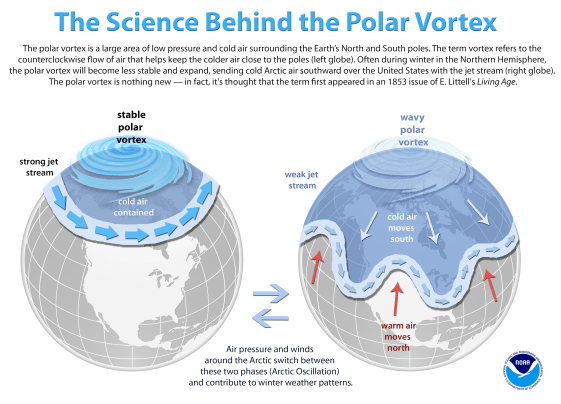
graphic20-20polarvortex_explained_updated2001291920-204034x2912-1Regarding the more recent attempt to link CO2 with jet stream meanderings, we have this paper providing a more reasonable assessment.  Arctic amplification: does it impact the polar jet stream?  by Valentin P. Meleshko et al.  Excerpts below in italics with my bolds.

Analysis of observation and model simulations has revealed that northward temperature gradient decreases and jet flow weakens in the polar troposphere due to global climate warming. These interdependent phenomena are regarded as robust features of the climate system. An increase of planetary wave oscillation that is attributed to Arctic amplification (Francis and Vavrus, 2012; Francis and Vavrus, 2015) has not been confirmed from analysis of observation (Barnes, 2013; Screen and Simmonds, 2013) or in our analysis of model simulations of projected climate. However, we found that GPH variability associated with planetary wave oscillation increases in the background of weakening of zonal flow during the sea-ice-free summer. Enhancement of northward heat transport in the troposphere was shown to be the main factor responsible for decrease of northward temperature gradient and weakening of the jet stream in autumn and winter. Arctic amplification provides only minor contribution to the evolution of zonal flow and planetary wave oscillation.

It has been shown that northward heat transport is the major factor in decreasing the northward temperature gradient in the polar atmosphere and increasing the planetary-scale wave oscillation in the troposphere of the mid-latitudes. Arctic amplification does not show any essential impact on planetary-scale oscillation in the mid and upper troposphere, although it does cause a decrease of northward heat transport in the lower troposphere. These results confound the interpretation of the short observational record that has suggested a causal link between recent Arctic melting and extreme weather in the mid-latitudes.

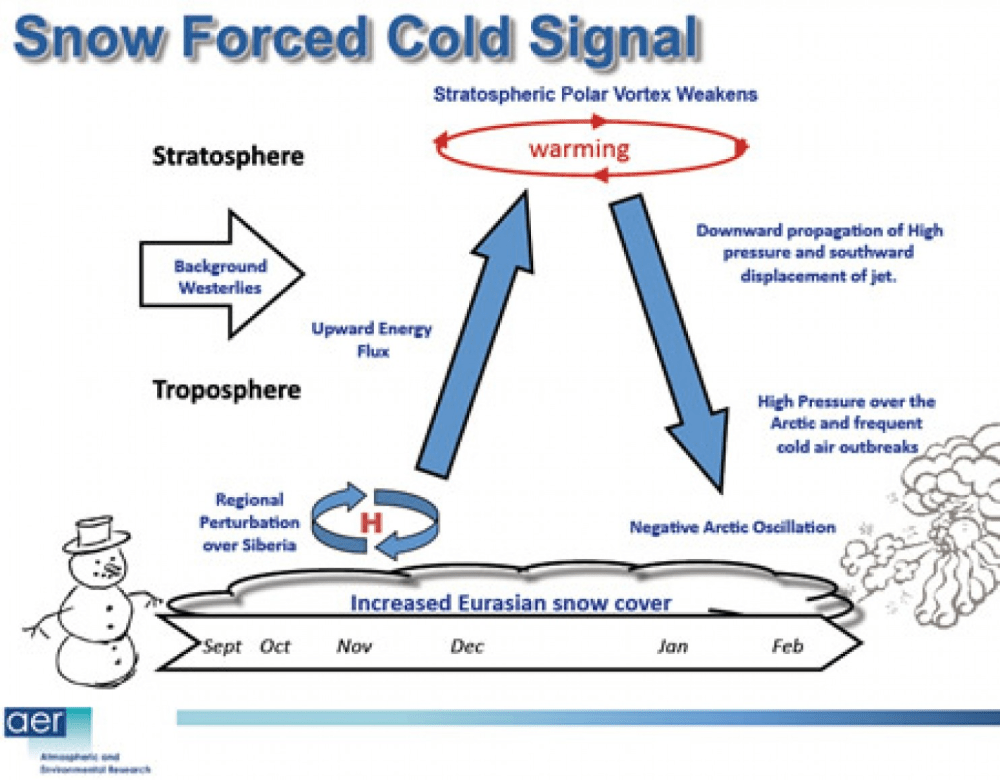
There are two additional explanations of factors causing the wavy jet stream, AKA Polar Vortex.  Dr Judah Cohen of AER has written extensively on the link between Autumn Siberian snow cover and the Arctic oscillation.  See Snowing and Freezing in the Arctic  for a more complete description of the mechanism.

Finally, a discussion with Piers Corbyn regarding the solar flux effect upon the jet stream at Is This Cold the New Normal?

Video transcript available at linked post.

October Cooling by Land, or Cooling by Sea?

banner-blog

With apologies to Paul Revere, this post is on the lookout for cooler weather with an eye on both the Land and the Sea.  UAH has updated their tlt (temperatures in lower troposphere) dataset for October.   Previously I have done posts on their reading of ocean air temps as a prelude to updated records from HADSST3. This month I will add a separate graph of land air temps because the comparisons and contrasts are interesting as we contemplate possible cooling in coming months and years.

Presently sea surface temperatures (SST) are the best available indicator of heat content gained or lost from earth’s climate system.  Enthalpy is the thermodynamic term for total heat content in a system, and humidity differences in air parcels affect enthalpy.  Measuring water temperature directly avoids distorted impressions from air measurements.  In addition, ocean covers 71% of the planet surface and thus dominates surface temperature estimates.  Eventually we will likely have reliable means of recording water temperatures at depth.

Recently, Dr. Ole Humlum reported from his research that air temperatures lag 2-3 months behind changes in SST.  He also observed that changes in CO2 atmospheric concentrations lag behind SST by 11-12 months.  This latter point is addressed in a previous post Who to Blame for Rising CO2?

The October update to HadSST3 will appear later this month, but in the meantime we can look at lower troposphere temperatures (TLT) from UAHv6 which are already posted for October. The temperature record is derived from microwave sounding units (MSU) on board satellites like the one pictured above.

The UAH dataset includes temperature results for air above the oceans, and thus should be most comparable to the SSTs. There is the additional feature that ocean air temps avoid Urban Heat Islands (UHI).  The graph below shows monthly anomalies for ocean temps since January 2015.

UAH Oceans 201810

Open image in new tab to enlarge.

The anomalies over the entire ocean dropped to the same value, 0.12C  in August (Tropics were 0.13C).  Warming in previous months was erased, and September added very little warming back. In October, NH and the Tropics rose, while SH cooled, resulting in slight warming.

Taking a longer view, we can look at the record since 1995, that year being an ENSO neutral year and thus a reasonable starting point for considering the past two decades.  On that basis we can see the plateau in ocean temps is persisting. Since last October all oceans have cooled, with offsetting bumps up and down.

UAHv6 TLT 
Monthly Ocean
Anomalies
Average Since 1995 Ocean 10/2018
Global 0.13 0.17
NH 0.16 0.30
SH 0.11 0.08
Tropics 0.12 0.32

As of October 2018, NH ocean air temps as well as the Tropics are twice the long term average, SH is slightly cooler, and the Global anomaly slightly warmer.   In the Tropics and SH, 2018 is the coolest October since 2014. The Global and NH ocean air temps are the coolest October since 2013.

Land Air Temperatures Plunged in September, then Rose in October

We sometimes overlook that in climate temperature records, while the oceans are measured directly with SSTs, land temps are measured only indirectly.  The land temperature records at surface stations record air temps at 2 meters above ground.  UAH gives tlt anomalies for air over land separately from ocean air temps.  The graph updated for October is below.UAH Land 201810

The greater volatility of the Land temperatures is evident, and also the dominance of NH, which has twice as much land area as SH.  Note how global peaks mirror NH peaks.  In October air over NH and the Tropical land surfaces rose, and SH followed suit.  A table for Land temperatures is below, comparable to the one for Oceans.

UAHv6 TLT 
Monthly Land
Anomalies
Average Since 1995 Land 10/2018
Global 0.21 0.33
NH 0.23 0.33
SH 0.19 0.33
Tropics 0.18 0.39

In September land air temps were below the average since 1995.  As the table shows, in October the land air anomalies jumped up well above average, demonstrating the higher volatility of these measures.  Still last month was much cooler than October 2017 in all regions.

Summary

TLTs include mixing above the oceans and probably some influence from nearby more volatile land temps.  It is striking to now see NH and Global land temps dropping rapidly.  TLT measures started the recent cooling later than SSTs from HadSST3, but are now showing the same pattern.  It seems obvious that despite the three El Ninos, their warming has not persisted, and without them it would probably have cooled since 1995.  Of course, the future has not yet been written.


2018 N. Atlantic the Coolest

RAPID Array measuring North Atlantic SSTs.

For the last few years, observers have been speculating about when the North Atlantic will start the next phase shift from warm to cold.

Source: Energy and Education Canada

An example is this report in May 2015 The Atlantic is entering a cool phase that will change the world’s weather by Gerald McCarthy and Evan Haigh of the RAPID Atlantic monitoring project. Excerpts in italics with my bolds.

This is known as the Atlantic Multidecadal Oscillation (AMO), and the transition between its positive and negative phases can be very rapid. For example, Atlantic temperatures declined by 0.1ºC per decade from the 1940s to the 1970s. By comparison, global surface warming is estimated at 0.5ºC per century – a rate twice as slow.

In many parts of the world, the AMO has been linked with decade-long temperature and rainfall trends. Certainly – and perhaps obviously – the mean temperature of islands downwind of the Atlantic such as Britain and Ireland show almost exactly the same temperature fluctuations as the AMO.

Atlantic oscillations are associated with the frequency of hurricanes and droughts. When the AMO is in the warm phase, there are more hurricanes in the Atlantic and droughts in the US Midwest tend to be more frequent and prolonged. In the Pacific Northwest, a positive AMO leads to more rainfall.

A negative AMO (cooler ocean) is associated with reduced rainfall in the vulnerable Sahel region of Africa. The prolonged negative AMO was associated with the infamous Ethiopian famine in the mid-1980s. In the UK it tends to mean reduced summer rainfall – the mythical “barbeque summer”.Our results show that ocean circulation responds to the first mode of Atlantic atmospheric forcing, the North Atlantic Oscillation, through circulation changes between the subtropical and subpolar gyres – the intergyre region. This a major influence on the wind patterns and the heat transferred between the atmosphere and ocean.

The observations that we do have of the Atlantic overturning circulation over the past ten years show that it is declining. As a result, we expect the AMO is moving to a negative (colder surface waters) phase. This is consistent with observations of temperature in the North Atlantic.

Cold “blobs” in North Atlantic have been reported, but they are usually a winter phenomena. For example in April 2016, the sst anomalies looked like this

But by September, the picture changed to this

And we know from Kaplan AMO dataset, that 2016 summer SSTs were right up there with 1998 and 2010 as the highest recorded.

As the graph above suggests, this body of water is also important for tropical cyclones, since warmer water provides more energy.  But those are annual averages, and I am interested in the summer pulses of warm water into the Arctic. As I have noted in my monthly HadSST3 reports, most summers since 2003 there have been warm pulses in the north atlantic.
AMO October 2018The AMO Index is from from Kaplan SST v2, the unaltered and untrended dataset. By definition, the data are monthly average SSTs interpolated to a 5×5 grid over the North Atlantic basically 0 to 70N.  The graph shows warming began after 1993 up to 1998, with a series of matching years since.  October is the fourth hottest month in the dataset, and note the considerable drop from 2017 to October 2018.  Because McCarthy refers to hints of cooling to come in the N. Atlantic, let’s take a closer look at some AMO years in the last 2 decades.
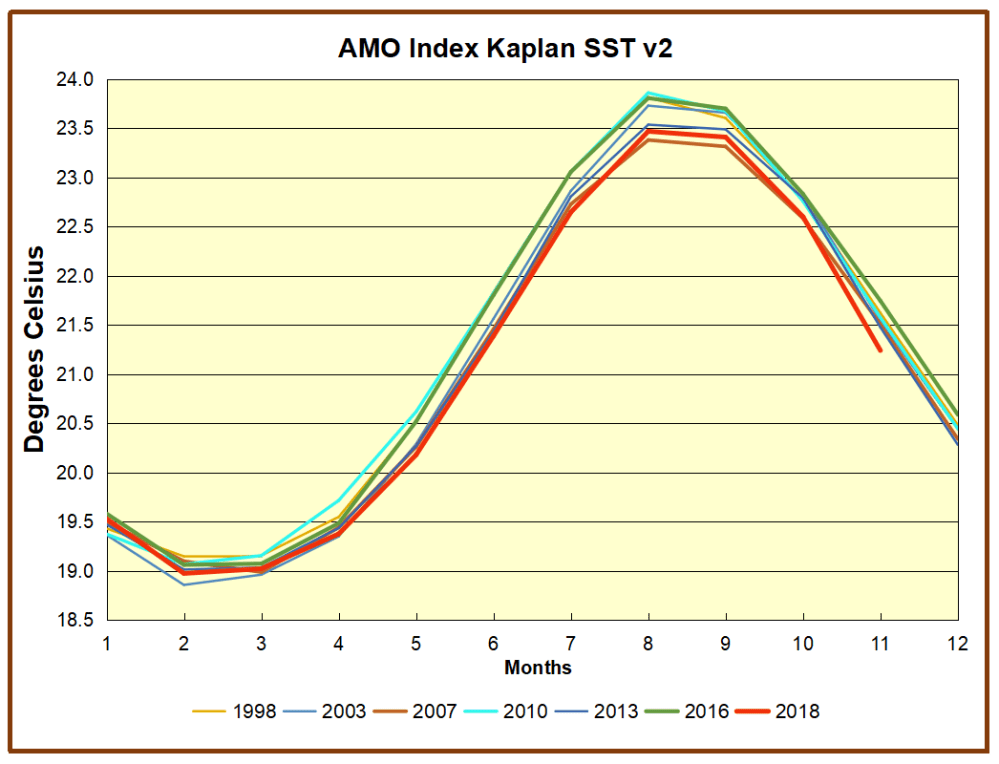
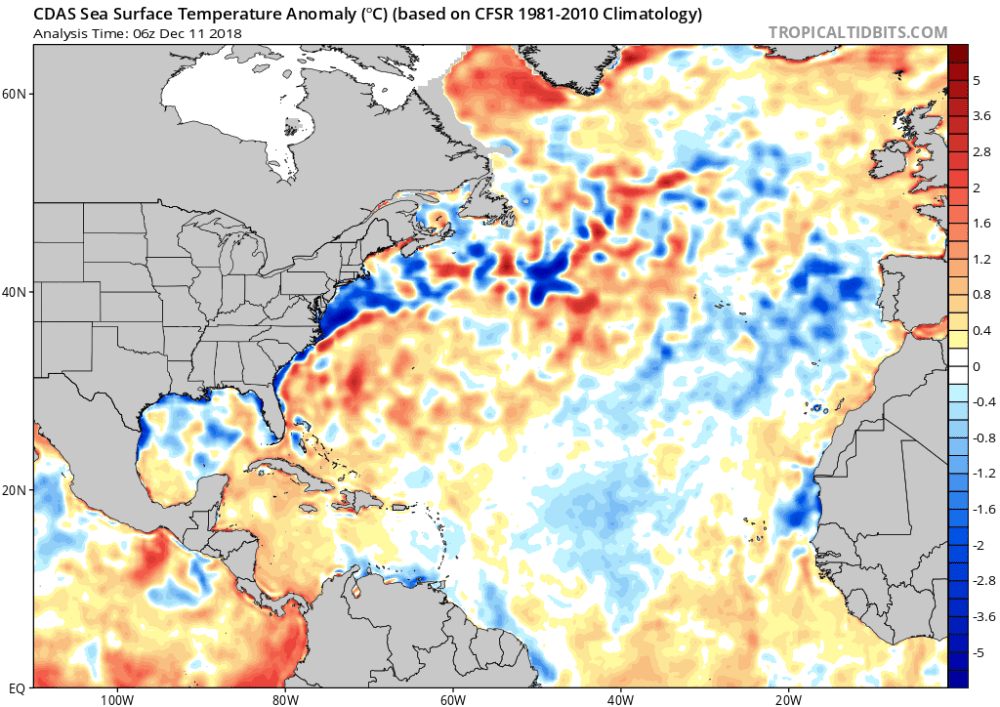

AMO decade 102018

This graph shows monthly AMO temps for some important years. The Peak years were 1998, 2010 and 2016, with the latter emphasized as the most recent. The other years show lesser warming, with 2007 emphasized as the coolest in the last 20 years. Note the red 2018 line is at the bottom of all these tracks.  Most recently October 2018 is 0.29C lower than October 2017, and is the coolest October since 2011.

With all the talk of AMOC slowing down and a phase shift in the North Atlantic, we expect that the annual average for 2018 will confirm that cooling has set in.  Through October the momentum is certainly heading downward, despite the band of warming ocean  that gave rise to European heat waves last summer.cdas-sflux_ssta_atl_1