Climate Debate Is On

Senator Malcolm Roberts:
ON CLIMATE, CSIRO LACKS EMPIRICAL PROOF

H/t Jo Nova

Finally, a public airing of empirical flaws in consensus climate science. Senator Malcolm Roberts is doing Australia and the entire world a service by applying critical intelligence to IPCC climate science as espoused by CSIRO, Australia’s climate agency.

The scientific debate between Roberts et al. and CSIRO is documented in depth for all to peruse at Climate Change – One Nation’s response to CSIRO  (here).

Overview:

Senator Malcolm Roberts in his maiden speech asserted that CSIRO had no empirical evidence that human emissions of CO2 caused any significant global warming.  A meeting was arranged between CSIRO and Senator Roberts’ staff where CSIRO presented their empirical evidence.  The linked document is a detailed review of that empirical evidence and has raised many questions, as well as indicating some points of agreement.

Excerpts below with images suggest that finally we have an intensive and worthwhile debate about the state of climate science, and a reasonable assessment of uncertainties in our present levels of human understanding of climate operations. Statements and images below are only examples of the extensive commentary and numerous exhibits provided.

CSIRO: Carbon dioxide is a greenhouse gas.

The natural greenhouse effect makes the planet habitable: the average temperature of the earth is 33°C warmer than it would be in the absence of greenhouse gases.

The laws of physics and direct measurements confirm that carbon dioxide is a greenhouse gas.

Roberts: Accepted that CO2 is a Greenhouse Gas if that just means it absorbs long wave infra-red radiation.

We will not contest the use of the term greenhouse effect but are unaware of any evidence that the atmosphere behaves similarly to a physical greenhouse. Some reasons for our hesitation follow.

The Greenhouse effect, as a product of back radiation heating against the thermal gradient and in violation of Fourier’s Law, is yet to be confirmed by explicitly relevant and controlled experiment.

CSIRO: Carbon dioxide concentrations in the atmosphere have increased.

Atmospheric carbon dioxide levels have increased by more than 40% since pre-industrial times

Roberts: Accepted that CO2 levels have risen since 1800 but this benefits plants and animals.

Annual atmospheric CO2 background level from 1856 to 2008 compared to SST (Kaplan, KNMI); red line, CO2 MBL reconstruction from 1826 to 1959 (Beck 2010); CO2 1960-2008: (Mauna Loa); blue line, annual SST (Kaplan) from 1856 -2003; SST= sea surface temperature

Increase in dry weight of major crop plants when atmospheric CO2 concentrations are raised. The data presented is based on large numbers of scientific studies.

CSIRO: The extra carbon dioxide in the atmosphere comes from human activities.

CO2 in the atmosphere has increased as human emissions have increased (the two are correlated).

Roberts: It is accepted that much of the recent extra CO2 probably comes from human activities but the CSIRO evidence does not seem to support the implied certainty.


These estimates of CO2 sinks are not empirical evidence and will more likely be revised as more data comes in from the Orbiting Carbon Observatory 2 satellite system

Deriving an average CO2 concentration for the whole world may be as controversial as the temperature average.

CSIRO: The additional carbon dioxide added to the atmosphere by human activities has enhanced the greenhouse effect: less energy is leaving the top of the atmosphere in the wavelengths absorbed by carbon dioxide and other greenhouse gases.

Roberts: The evidence provided doesn’t seem to support the stated conclusion.

The IRIS instrument was 1970 and the IMG instrument 1997. There is only the slightest change in methane and no significant change in CO2. [link]. This would seem be be empirical evidence that CO2 has no effect on brightness temperature.

Decadal variations in atmospheric water vapor.

Even a two percent variation in atmospheric water vapor will equal the total amount of supposed greenhouse effect of all human CO2 production.

CSIRO: The earth has warmed.

Graph: Global Surface temperature vs Time 1900 – 2015 increasing 1°C per century

Roberts: independent replication of experiment, observation and analysis is a vital part of the scientific method.

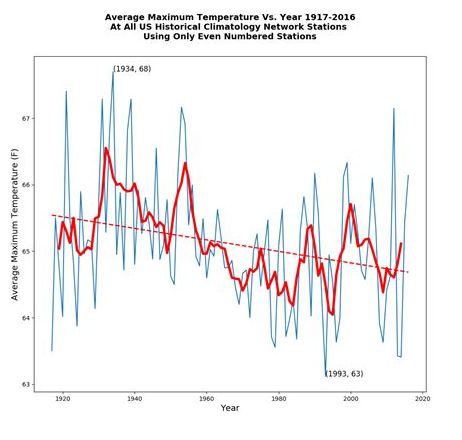
Maximum temperature is generally considered a better measure of regional temp variability and this allows better comparison with the following graph.

A trend of 0.44°C per century is indicated.
The reanalysis tried to be free of arbitrary adjustments and the trend per century was reduced from 0.88°C to 0.44°C.  The methodology of the reanalysis is explained in the attachment to this point.

CSIRO Graph: Ocean Heat Content increasing since 1975

Roberts: Accepted that the earth has warmed since the Little Ice Age but is still cooler than the Roman Warm Period and much cooler than the Holocene Thermal Maximum.

Pacific Ocean Heat Content is at the lowest for 8,000 years


We show that water masses linked to North Pacific and Antarctic intermediate waters were warmer by 2.1°C and 1.5°C, respectively, during the middle Holocene Thermal Maximum than over the past century. Both water masses were ~0.9°C warmer during the Medieval Warm period than during the Little Ice Age and ~0.65° warmer than in recent decades.”

CSIRO: Observed changes in the climate system are consistent with an enhanced greenhouse effect. Other forcings (e.g. volcanoes, the sun, internal variability) cannot explain the magnitude, timing and distribution of observed trends.

Roberts:  While there is strong correlation between CO2 and temperature when looking at the four last ice ages, CO2 does not appear to lead temperature. Looking at shorter timescales the correlation disappears and in the short satellite age data there appears to be no correlation with any greenhouse effect, enhanced or otherwise.

CO2 and temperature swings post 1850 show some correlation and some divergence

CO2 and temperature swings in the satellite age show little short term correlation


El Nino temperatures correlate well with satellite temperatures

CSIRO: Models can reproduce the record of global averaged temperature if we include the effects of increased greenhouse gas forcing, but cannot do so with natural forcings alone.


Roberts: It is the model predictions that seem to be inconsistent with the observed changes which rather disqualifies the models as a basis for expensive action.

Only the Russian model INM-CM4.0 can approximately reproduce the record of global averaged temperatures since 1977.

Summary — On the topic of dangerous warming from fossil fuel emissions

MR: Well, Greg Hunt – and I’m looking at Alex here, not for an explanation but just to emphasise that Greg Hunt in particular has said that his climate policies rely entirely on the CSIRO, the Bureau of Meteorology and the IPCC. And so he’s saying, we will end up in danger unless we do something to cut the use of hydrocarbon fuels. And so, if he relies upon the CSIRO’s advice, is that where he’s getting his imminent danger from?
CSIRO said that the interpretation of danger is up to the Australian public, and the Minister

MR: So, the Minister has drawn those conclusions. ….. independent of the CSIRO. You’ve presented him with the temperature changes and the causal analysis and he’s gone: Oh my God, we’ve got to do something.
CSIRO said it’s probably best to ask the Minister if he’s done that.

MR: Okay.
Ministerial Adviser indicated that the Minister would be happy to have a conversation about that and advised that’s definitely a conversation for the Minister not for the CSIRO.

MR: Sure. Okay. So, the CSIRO just presents the data and leaves the policy decisions to the Ministers?
CSIRO confirmed that is correct.


El Nino’s Hottest Year

With just 2 months to go, it could well be that 2016 replaces 1998 as the “hottest year ever.” With the Pacific Blob only now dissipated, and La Nina delaying her appearance, it is becoming likely that the inevitable cooling will come only next year. That may result in an annual GMT surpassing 1998 in the satellite record.

Fossil fuel activists and consensus climate scientists will claim this proves CO2 is causing global warming, but knowledgeable people know they are once again dissing the Ocean in order to push their agenda.

Actual data, rather than computer models, show that ocean oscillations, not CO2 have produced the bulk of warming in the temperature record. ENSO (El Nino Southern Oscillation) produces sea surface temperature anomalies (SSTa) resulting in most of the variability in global averages.

Climatists will blame the rise on so-called “greenhouse gases” asserting several unproven notions:

  • CO2 induces atmospheric warming which raises SSTs;
  • Higher SSTs increase evaporation and clouds that trap LW radiation, thereby further raising surface temperatures;
  • ENSO warming and cooling cycles cancel out each other leaving CO2 as the sole warming agent.

As the final results for 2016 come in, expect the media to bombard the masses with declarations along these lines. The purpose of this post is inoculation (like a flu shot) to protect against the feverish reporting ahead.

How El Nino Affects Surface Temperatures

Roy Spencer and William Braswell looked at the data in their 2014 published article (here)
The Role of ENSO in Global Ocean Temperature Changes during 1955-2011

Roy Spencer May 13, 2014 on WUWT (here):

Based on global area-average ocean signatures, the observational evidence regarding the *global oceanic* signature of El Nino is this:

1) El Nino involves a decrease in the overturning in the 0-200 m layer, which leads to warming of the upper 100 m and cooling of the 100-200m layer. We calculate this is 2/3 of the source of surface warming.

2)El Nino surface warmth is partly driven by a decrease in cloud cover letting more sunlight in…This is 1/3 of the surface warming, and it also appears to contribute to longer-term deep ocean warming if there are stronger El Ninos and weaker La Ninas than average..

In the same thread Bob Tisdale comments:

ENSO impacts when and where sunlight reaches the surface of the oceans and penetrates into the oceans. . . ENSO also impacts how energy is released from the oceans to the atmosphere which further impacts the energy balance.

Keep in mind that the majority (about 90%) of the heat released from the ocean is through evaporation. During an El Nino, more of the surface of the tropical Pacific is covered with warm water, which yields more evaporation. And the opposite holds true during a La Nina.

Ocean Heat Also Rises

When there are super-El Nino years such as 1998 and 2016, climatists insist on attributing warming to fossil fuel emissions. Obsessed with CO2 and radiative energy flows, they are unable to see and affirm this oceanic climate driver. An extended discussion at Climate Etc. (here) included a series of comments by Kristian that provide a synopsis of El Nino’s role in global warming.

This is what the data consistently shows: surface temps up (or down) > tropospheric temps up (or down) > OLR at ToA up (or down).

This is how the heat from the sun actually flows through the earth system. Surface warms first, then the troposphere, then, as a consequence of this, the radiative output to space increases. There is NO observational evidence anywhere for the opposite process to occur: OLR at ToA down >tropospheric temps up > surface temps up.

Radiatively active gases in the atmosphere do not enable it to WARM. It would’ve warmed with or without them, simply by being directly convectively coupled with the solar-heated surface. This connection is never broken as long as there is air present, a gravity field and sunshine heating the surface.

Radiatively active gases, however, DO enable the atmosphere to adequately COOL to space. Because this can only be done through radiation.

So an atmosphere without radiatively active gases would still WARM from the surface up, but wouldn’t be able to adequately COOL to space.

It’s not the so-called ‘GHGs’ that trap the surface heat. It’s the 99.5% of the atmosphere NOT being significantly radiatively active at ‘earthly’ temperatures that would do that. Because this part can STILL be warmed conductively, convectively and latently, but it can’t to any real extent radiate it away again.

ENSO Discharges and Recharges Ocean Heat Content

Image: La Niña is characterized by unusually cold ocean temperatures in the central equatorial Pacific. The colder than normal water is depicted in this image in blue. During a La Niña stronger than normal trade winds bring cold water up to the surface of the ocean. Credit: NASA

Image: La Niña is characterized by unusually cold ocean temperatures in the central equatorial Pacific. The colder than normal water is depicted in this image in blue. During a La Niña stronger than normal trade winds bring cold water up to the surface of the ocean. Credit: NASA

As a rule of thumb, El Niños cause global warming but drain global heat (actually, ‘energy’) content. El Niño: global surface/troposphere temps UP, global internal energy DOWN.

Why the distinction? Because most of the stored-up (solar) energy of the earth system is to be found at depth in the oceans, that is, AWAY FROM the surface. What an El Niño does is to pull a significant amount of this energy up from its hiding place in the deep and instead spreads it out across a huge area on the surface, raising its temperature in the process, laying the energy bare, so to speak, to be lost from the ocean to the atmosphere (and ultimately to space) through evaporation (deep/moist convection) and conduction. Radiation also occurs but to a much lesser degree.

So, the depths of the ocean – well, basically of the IPWP (the Indo-Pacific Warm Pool) – is drained of energy during an El Niño, it ‘cools’, while the surface in the tropics of the Central and East Pacific (where the NINO3.4 region is located), warms up immensely, the SST here shoots up.

Following this significant tropical Central and East Pacific surface warming, the troposphere above it warms from the vastly increased transfer and freeing of latent heat. The warming of the tropical Pacific also affects the atmospheric circulation over the rest of the tropics through so-called ‘atmospheric bridges’, indirectly inducing a lagged warming also in the Atlantic and Indian ocean basins.

From the tropics/subtropics, part of the El Niño released ocean heat is then transported (mostly via the atmosphere) out to the extratropics, eventually ending up in the polar regions (well, in reality it mostly ends up in the Arctic, not in the Antarctic, the reason being a profound difference between northern and southern hemisphere extratropical circulation.)

The massive amount of energy released onto the world during an El Niño event is neither generated by nor absorbed during the event itself. The energy of course originally came from the sun and it was stored up during the La Niña normally preceding the El Niño.

It’s the La Niñas (and often also during neutral ENSO conditions, much more resembling the cool events than the warm events) that builds ‘global heat content’. They soak up the solar energy and store it at depth. The El Niños subsequently release it again.

Global Warming Since 1970 Due to Major El Ninos

Since 1970 we have seen four ENSO sequences where a strong and solitary El Niño is surrounded by (preceded AND succeeded by) La Niña-events. In each sequence, the storing up of energy during the often extended/prolonged La Niña periods has far outdone the energy depletion during the strong, but mostly short El Niño-events.

1. During the period 1970-76 only one year saw an El Niño (1972/73). The rest of the years, 1970-72 and 1973-76, were mostly La Niña-dominated.

2. During the period 1983-89, two years back-to-back saw El Niño-conditions (1986-88). The years 1983-86 saw either cold neutral or La Niña-conditions and the year 1988/89 saw one of the strongest La Niñas of modern history.

3. During the period 1995-2001 only one year saw an El Niño (1997/98). The rest of the years, 1995-97 and 1998-2001, were mostly La Niña-dominated.

4. During the period 2007-14 only one year saw an El Niño (2009/10). The rest of the years, 2007-09 and 2010-14, were mostly La Niña-dominated.

5. Beginning in 2015 another major El Nino event occurred, peaking mid 2016.  From past experience, we expect a La Nina to follow in coming months.  Over the next few years it will be evident whether or not a new step level results from this event.

The periods in between these sequences of clustered distinct cool and warm ENSO events, 1976-83, 1989-95 and 2001-07, were all neutral to warmish, with much smaller variations from the mean state and prominently without any clear extended cold events, lacking the strength to create a global signal.

El Nino temperatures correlate well with satellite global temperatures

temperature_el_nino_satellite-b

The oceans are not some passive reservoir where the solar energy just comes and goes as it wants and always in complete balance. No, they are quite dynamic and the absorbed energy is held back or is released, according to their own internal processes. If the climatic conditions (the coupled ocean/atmosphere system) in the Pacific basin are such that they promote net storage of solar energy over several decades, well, then that is what will happen. Quite naturally. That doesn’t mean that these conditions will prevail forever.

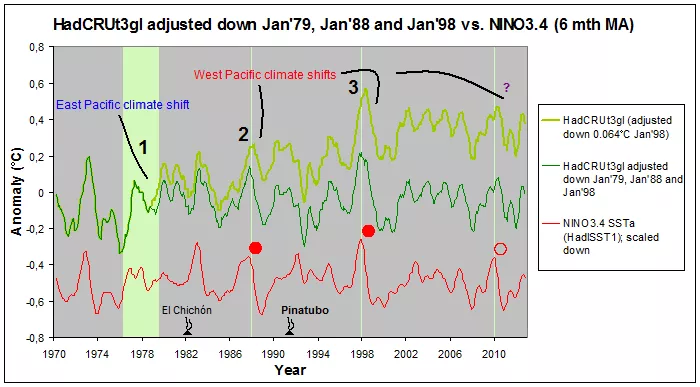
We KNOW that large-scale and fairly abrupt climate shifts occur in the (pan-)Pacific basin at certain intervals. In fact, there has been no additional global warming OUTSIDE of these sudden hikes, from 1970 till today. That means, the ENTIRE modern global warming seen since 1970 is contained within the steps up during the Great Pacific Climate Shift of the late 70s and the two following ones in 1988/89 and 1998/99.

The ENTIRE modern global warming is found in these three sudden hikes alone, all occurring within the time-span of less than a year.

El Nino Spreads Warming From Sea to Sea

How did global warming progress from 1975/76 to 2001/02? Follow the data. No preconceived ideas about mechanisms.

First of all, there is no question that there is a definite East Pacific signal plastered all over the global temperature series. Compare with NINO3.4:

nino-kristian-1

In fact, global temperatures tend to lag NINO3.4 SSTa by several months. And everyone knows that this particular correlation also speaks causation. Not just from the consistent and tight lead-lag relation, but from the thoroughly explicated oceanic/atmospheric mechanisms by which we know the large-scale and integrated ENSO process creates global warming and cooling. I’m talking here about the major swings up and down that we see all along from 1970 till today.

What went on in 1978/79, in 1988 and in 1998? What was so special about these three short time segments? Why is the ENTIRE ‘modern global warming’ contained within them?

Bob Tisdale:
Those upward shifts are the long-term responses to the discharge phases of ENSO that occurs during strong El Niños. As part of the discharge phase of ENSO, the El Niño takes warm water from below the surface of the western tropical Pacific and places it on the surface (warm water that was created by the increased sunlight during the prior recharging La Niña). The discharged warm water floods into the East Pacific, where it temporarily raises sea surface temperatures during the El Niño, but causes little long-term trend there.

And at the end of the El Niño, the warm water is redistributed by the renewed trade winds, ocean currents and the downwelling Rossby wave into the West Pacific, Indian Ocean and eventually the South Atlantic. The East Pacific represents about 33% of the surface of the global oceans, and the South Atlantic-Indian-West Pacific covers another 52%. That leaves the North Atlantic, which has another mode of natural variability called the Atlantic Multidecadal Oscillation. The Atlantic Multidecadal Oscillation, according to NOAA, can contribute to or suppress global warming. And so far, the only global surface warming we’ve seen was in the South Atlantic-Indian-West Pacific subset and that warming was caused by discharge of sunlight-created warm water released from below the surface of the West Pacific Warm Pool during El Niño events.

For data on ocean-air heat exchanges see: Empirical Evidence: Oceans Make Climate

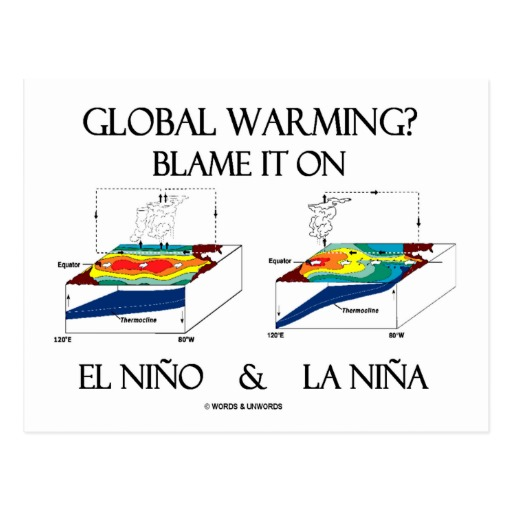
blame-it-on-enso


Carbon Recycling

Clive Best has done a great (the Best?) post on a complicated topic: Earth’s cycling of carbon, especially CO2 through natural sinks and sources, including humans burning fossil fuels. I have read many posts and papers on this, along with long argumentative threads, hoping against hope I could understand and write something half as clear as he has done.

The article is Carbon Recyling at his blog (here)

Some Excerpts to encourage you to go and read the whole thing:

If you sum up all the sources and sinks then you find that about half man-made emissions are being absorbed each year. That means that only about half of the CO2 emitted by humans remains in the atmosphere. The strange thing is that this ratio hasn’t changed at all in 50 years, despite rapid increases in emissions.

Today we are emitting about twice as much carbon dioxide as we did 30 years ago, yet only half of it survives a full year. That means that currently, an amount of carbon dioxide equal to the total annual emissions of 30 years ago is being absorbed each year. Why is this and what does it mean? Part of the answer lies with the greening of the earth, but far more importantly the answer lies in how the oceans are responding.

There are 3 independent Carbon cycles which in total must balance.
1. Dissolution/Absorption of CO2 at  Ocean surfaces.
2. Biological re-cycling of CO2
3. Geological re-cycling of CO2

Increasing the carbon dioxide concentration of the atmosphere therefore causes the oceans to take up (inhale) more carbon dioxide. Because the oceans surface layer mixes slowly with the deep ocean (hundreds of years) the increased carbon dioxide content of the surface ocean will be mixed very slowly into the large carbon reservoir of the deep ocean. The rate of our adding carbon dioxide to the atmosphere is too fast for the deep ocean to be a significant reservoir. So as the carbon dioxide content of the atmosphere rises, so too does the concentration in the ocean surface.

The total mass of living plants and animals and carbon in soil, at any given time represents a temporary store of carbon. This is comparable to the mass of CO2 in the atmosphere. Life thrives in warmer climates with higher CO2 levels and suffers during colder more arid glacial periods with  low CO2.

SiO2 and CaCO3 are insoluble and will settle to the ocean floor where they are moved by plate tectonics to subduction zones, carried deep into the Earth and heated converting them back into metamorphic rocks and releasing carbon dioxide. When these rocks and their associated carbon encounter Volcanic eruptions or Mid Ocean vents they return the CO2 to the atmosphere, thus ending the cycle.

Just how confident  are climate scientists that they really understand the carbon cycle? Can they, for example, explain why lower levels of CO2 occurred during ice ages? This is what AR5 says on the matter.

AR5: “All of the major drivers of the glacial-to-interglacial atmospheric CO2 changes (Figure 6.5) are likely to have already been identified. However, Earth System Models have been unable to reproduce the full magnitude of the glacial-to-interglacial CO2 changes. Significant uncertainties exist in glacial boundary conditions and on some of the primary controls on carbon storage in the ocean and in the land. These uncertainties prevent an unambiguous attribution of individual mechanisms as controllers of the low glacial CO2 concentrations.”

So the simple answer is no they don’t really understand the carbon cycle. Nor can they determine why CO2 levels in the atmosphere are naturally so low at <0.03%. A proper understanding of the carbon cycle should at least be able to determine why 280ppm is the natural level for today’s climate. I think this is the fundamental challenge for Carbon Cycle modellers.

Conclusion

In my opinion the BERN model has a logical flaw. It assumes that a fixed 22% of the Anthropogenic increase in CO2 will remain in the atmosphere for hundreds of thousands of years, waiting for  geological weathering – but why would it?  What possible justification is there to image that  it is a fixed percentage,  independent of amplitude?

It is only when the partial pressures of carbon dioxide between the atmosphere and the ocean re-balances that a new ‘geological’ balance of CO2 be reached. That happens rather fast and the net increase is small compared to glacial cycle variations, which as we have seen, climate scientists don’t yet understand.
 
See Also  Carbon Sense and Nonsense (Viv Forbes), and
Much Ado about CO2 (Murry Salby)


Overview: Seafloor Eruptions and Ocean Warming

Global heat flux of the Earth combining heat flux measurements on land and continental margins with a thermal model for the cooling of the oceanic lithosphere. The Earth loses energy as heat flows out through its surface. The total energy loss of the Earth has been estimated at 46 ± 2 TW, of which 14 TW comes through the continents and 32 TW comes from the seafloor. By Jean-Claude Mareschal

From the Unsettled Science File (h/t to Paul Homewood for posting on this subject recently)

Little attention is paid to geothermal heat fluxes warming the ocean from below, mostly because of limited observations and weak understanding about the timing and extent of eruptions.

The existence of heat rising through earth’s crust is evident to all, and the large majority of vents are under the ocean. Consider the image above, and notice at the top center is the small black island off the east coast of Greenland, right on top of the orange mid-ocean ridge. Iceland produces more than 50% of its electricity from geothermal, as well as heating numerous buildings from the same source.

In addition, farther up under the north pole, scientists discovered an eruption of intense seismic activity beginning in Gakkel Ridge in January of 1999 and continuing for seven months.  That happens to be about the time Arctic ice extent took a nosedive, stabilizing after 2007.
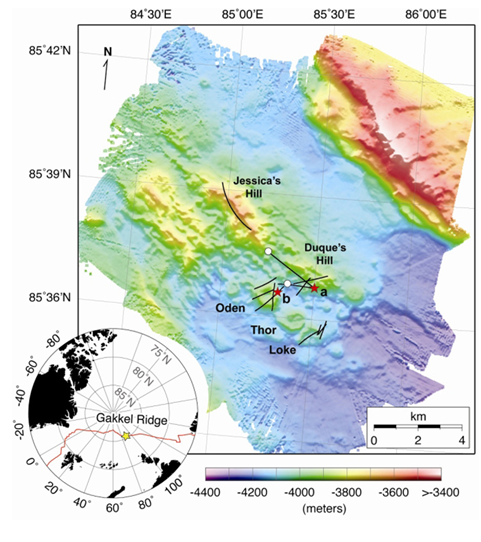
Researchers have considered the importance of this source of energy into the climate system from various points of view. Some abysmal studies (pun intended) were motivated to look in the ocean depths for the missing heat not appearing in the surface temperature records since 1998. Some warming was found but the case was weak since the Argo records showed no passage of heat between upper and lower ocean strata. Of course no thought was given to the seafloor being the warming source.  However, much more serious and extensive research has been done by marine geologists wanting to better understand the cooling of the earth itself.
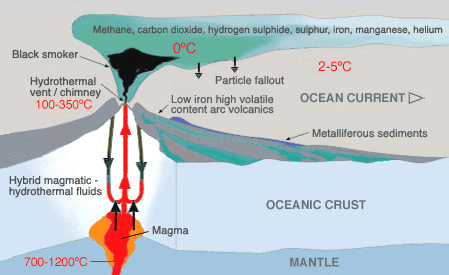
There appear to be three major issues around heating of the ocean from below through the seafloor:

1.  Is geothermal energy powerful enough to make a difference upon the vast ocean heat capacity?
2.  If so, Is geothermal energy variable enough to create temperature differentials?
3.  Most of the ocean floor is unexplored, so how much can we generalize from the few places we  have studied?

1. Some researchers conclude that geothermal heating of the oceans can not be ignored as trivial.

J. G. Sclater et al (here)

The total heat loss of the earth is 1002 × 10^10 cal/s (42.0 × 10^12 W), of which 70% is through the deep oceans and marginal basins and 30% through the continents and continental shelves. The creation of lithosphere accounts for just under 90% of the heat lost through the oceans and hence about 60% of the worldwide heat loss. Convective processes, which include plate creation and orogeny on continents, dissipate two thirds of the heat lost by the earth. Conduction through the lithosphere is responsible for 20%, and the rest is lost by the radioactive decay of the continental and oceanic crust.

Maqueda et al. (here)

Without geothermal heat fluxes, the temperatures of the abyssal ocean would be up to 0.5 C lower than observed, deep stratification would be reinforced by about 25%, and the strength of the abyssal circulation would decrease by between 25% and 50%, substantially altering the ability of the deep ocean to transport and store not only heat but also carbon and other climatically important tracers (Adcroft et al., 2001, Hofmann and Morales Maqueda, 2009, Mashayek et al., 2013). It has been hypothesised that interactions between the ocean circulation and geothermal heating are responsible for abrupt climatic changes during the last glacial cycle (Adkins et al, 2005).

Matthias Hofmann et al. (here)

Geothermal heating of abyssal waters is rarely regarded as a significant driver of the large-scale oceanic circulation. Numerical experiments with the Ocean General Circulation Model POTSMOM-1.0 suggest, however, that the impact of geothermal heat flux on deep ocean circulation is not negligible. Geothermal heating contributes to an overall warming of bottom waters by about 0.4◦C, decreasing the stability of the water column and enhancing the formation rates of North Atlantic Deep Water and Antarctic Bottom Water by 1.5 Sv (10% ) and 3 Sv (33% ), respectively. Increased influx of Antarctic Bottom Water leads to a radiocarbon enrichment of Pacific Ocean waters, increasing ∆14C values in the deep North Pacific from -269◦/◦◦when geothermal heatingis ignored in the model, to -242◦/◦◦when geothermal heating is included. A stronger and deeper Atlantic meridional overturning cell causes warming of the North Atlantic deep western boundary current by up to 1.5◦C
7f649a28fd11f9a721dd999cb3cd9c9d

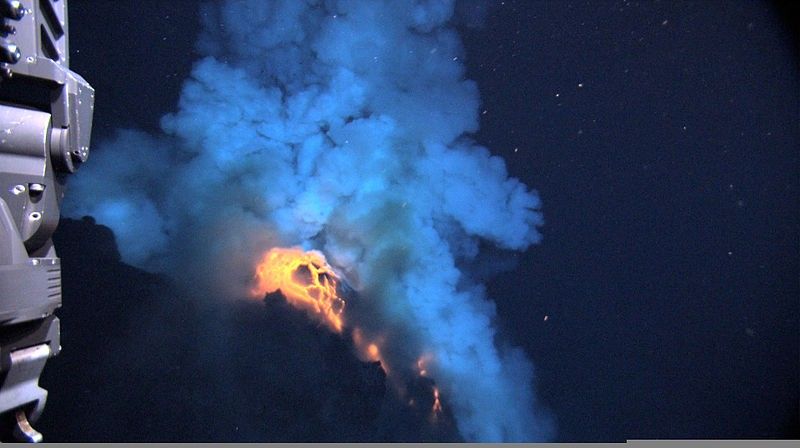
During the 2009 expedition, superheated molten lava, about 1,204ºC (2,200ºF) erupts, producing a bright flash as hot magma that is blown up into the water before settling back to the sea floor. Notice the front of the remotely operated vehicle (foreground, left). High resolution (Credit: Image courtesy of NSF and NOAA)

2.  Seafloor eruptions are quite variable and unpredictable, and while localized, can influence ocean circulation patterns.

Jess F. Adkins et al. (here)

The solar energy flux of 200 W/m2 at the ocean’s surface (Peixoto and Oort, 1992) is much larger than the next largest potential source of energy to drive climate changes, geothermal heating at the ocean’s bottom (50–100 mW/m2 ) (Stein and Stein, 1992), but this smaller heat input might still play an important role in rapid climate changes.

It is clear that variations in the solar flux pace the timing of glacial cycles (Hays et al., 1976), but these Milankovitch time scales are too long to explain the decadal transitions found in the ice cores. Another, higher frequency, source of solar variability that would directly drive the observed climate shifts has yet to be demonstrated. Therefore, mechanisms to explain the abrupt shifts all require the climate system to store potential energy that can be catastrophically released during glacial times, but not during interglacials (Stocker and Johnsen, 2003).

At the Last Glacial Maximum (LGM), when the deep ocean was filled with salty water from the Southern Ocean, geothermal heating may have been an important source of this potential energy.

In modern ocean studies there is an increasing awareness of the effect of geothermal heating on the overturning circulation. As an alternative to solar forcing, Huang (1999) has recently pointed out that geothermal heat, while small in magnitude, can still be important for the modern overturning circulation because it warms the bottom of the ocean, not the top. Density gradients at the surface of the ocean are not able to drive a deep circulation without the additional input of mechanical energy to push isopycnals into the abyss (Wunsch and Ferrari, 2004). Heating from below, on the other hand, increases the buoyancy of the deepest waters and can lead to large scale overturning of the ocean without additional energy inputs. Several modern ocean general circulation models have explored the overturning circulation’s sensitivity to this geothermal input. In the MIT model a uniform heating of 50 mW/m2 at the ocean bottom leads to a 25% increase in AABW overturning strength and heats the Pacific by 0.5 1C (Adcroft et al., 2001; Scott et al., 2001). In the ORCA model, applying a more realistic bottom boundary condition that follows the spatial distribution of heat input from Stein and Stein (1992) gives similar results (Dutay et al., 2004). In both models, most of the geothermal heat radiates to the atmosphere in the Southern Ocean, as this is the area where most of the world’s abyssal isopycnals intersect the surface.

The area of the modern ocean is 350×10^6 km2 . The area of the Southern Ocean between 80–85S (the region around Antarctica) is 0.4×10^6 km2 . This factor of 1000 means that the focused geothermal heating of 50 mW/m2 is locally of the same order as the total heat exchange at high southern latitudes. The focusing effect of geothermal heating can cause this heat flux to be a significant fraction of the total heat loss in the crucial deep-water formation zones in the glacial Southern Ocean. This suggests that the geothermal heat is potentially relevant for determining the heat content of the abyssal waters.
seamount-map

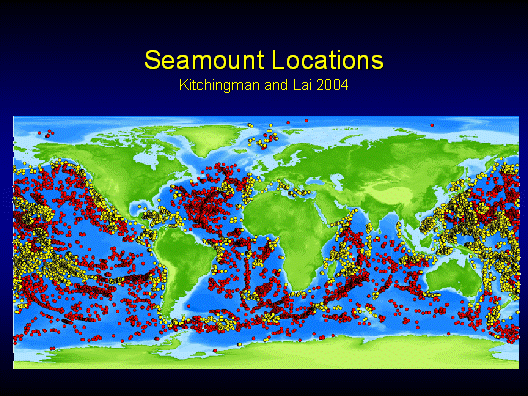
3. The number of hydrothermally active seamounts is estimated to be somewhere between 100,000 and 10,000,000.

Andrew T. Fisher and C. Geoffrey Wheat (here)

Thus, most of the thermally important fluid exchange between the crust and ocean must occur where volcanic rocks are exposed at the seafloor; little fluid exchange on ridge flanks occurs through seafloor sediments overlying volcanic crustal rocks. Seamounts and other basement outcrops focus ridge-flank hydrothermal exchange between the crust and the ocean. We describe the driving forces responsible for hydrothermal flows on ridge flanks, and the impacts that these systems have on crustal heat loss, fluid composition, and subseafloor microbiology.

Earth’s geothermal heat output is about 44 TW, with most heat loss occurring through ocean basins (e.g., Sclater et al., 1980; Pollack et al., 1993). Seafloor hydrothermal heat output is on the order of 10 TW, ~ 25% of Earth’s total geothermal heat output, and ~ 30% of the oceanic lithospheric heat output (Figure 1A). Only a small fraction of this advective heat output occurs at high temperatures at mid-ocean ridges; the vast majority occurs at lower temperatures (generally 5–20°C) on ridge flanks, suggesting an associated fluid discharge of ~ 10^16 kg yr-1 (Figure 1B) (C. Stein et al., 1995; Mottl, 2003; Wheat et al., 2003). This low-temperature flow rivals the discharge of all rivers to the ocean (4 x 10^16 kg yr-1), and is about three orders of magnitude greater than the sum of high-temperature hydrothermal discharges at mid-ocean ridges (~ 10^13 kg yr-1).

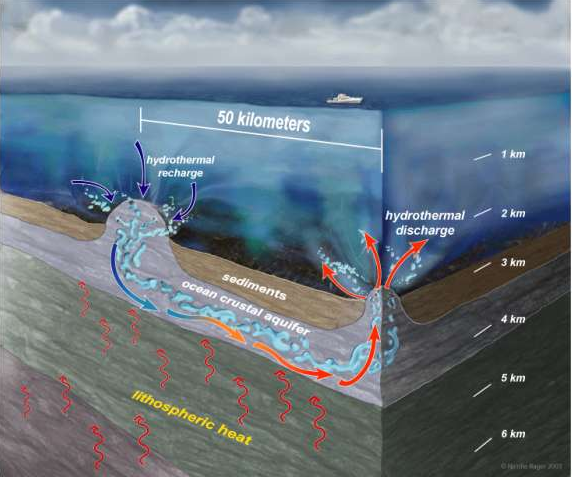
Networks of seamounts permit rapid fluid circulation to bypass thick and relatively continuous sediment across much of the deep seafloor. Fluid recharges into the crust as oceanic bottom seawater, being relatively cold and dense. As the fluid penetrates more deeply into the crust, it warms and reacts with the surrounding basalt, and interacts with the overlying sediments through diffusive exchange across the sediment-basalt interface. Fluid can flow laterally for tens of kilometers through the oceanic crust, with the extent of heating and reaction dependent on the flow rate, crustal age, and other factors. Weaker circulation systems can result in significant local rock alteration and heat extraction, but are unlikely to have a large impact on lithospheric heat loss on a regional scale.

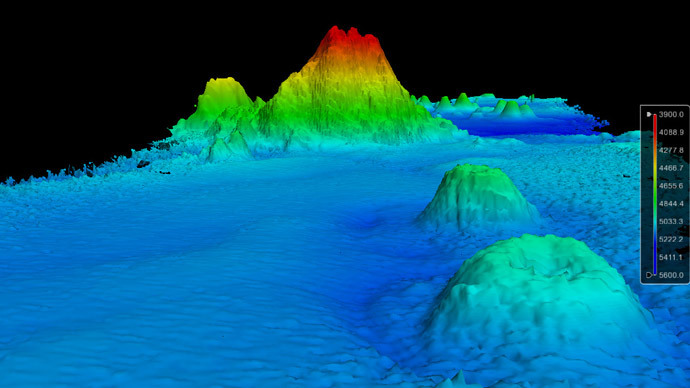
The number of hydrothermally active seamounts is estimated to be somewhere between 100,000 and 10,000,000 , based on mapping and seamount population estimates by Wessel (2001) and Hillier and Watts (2007), and the observation that, of the seamounts and outcrops that have been surveyed, a significant fraction appear to be hydrothermally active (Fisher et al., 2003a, 2003b; Hutnak et al., 2008; Villinger et al., 2002).
Monster mountain discovered lurking in depths of Pacific Ocean

Monster mountain discovered lurking in depths of Pacific Ocean

Without seamounts and other basement outcrops, it would not be possible for ridge-flank hydrothermal circulation to mine a significant fraction of lithospheric heat once sediments become thick and continuous on a regional basis. Thus, ridge-flank hydrothermal activity would be very different on an Earth without seamounts

Analyses of satellite gravimetric and ship track data suggest that there could be as many as 1,000,000 seamounts having a radius of ≥ 3.5 km and height ≥ 2 km (Wessel, 2001), and perhaps 10^6 to 10^7 features > 100 m in height (Hillier and Watts, 2007). Given the ubiquity of these features on ridge flanks, it is surprising how little we know about which seamounts are hydrologically active—how many recharge and how many discharge.

The thermobaric capacitor has enough energy to overturn the water column, can be triggered by regular oceanic processes, and charges over a time scale that is relevant to the climate record.

Conclusion

This source of heat has been dismissed because it is poorly known, and because its eruptive events are unpredictable and can not therefore be represented in climate models.  Despite geothermal eruptions having only localized effects, the impact on ocean circulations is significant.

John Reid (here)

Volcanic activity does not fit this neat picture. Volcanic behaviour is random, i.e. it is “stochastic” meaning “governed by the laws of probability”. For fluid dynamic modellers stochastic behaviour is the spectre at the feast. They do not want to deal with it because their models cannot handle it. We cannot predict the future behaviour of subaqueous volcanoes so we cannot predict future behaviour of the ocean-atmosphere system when this extra random forcing is included.

To some extent, chaos theory is called in as a substitute, but modellers are very reticent about describing and locating (in phase space) the strange attractors of chaos theory which supposedly give their models a stochastic character. They prefer to avoid stochastic descriptions of the real world in favour of the more precise but unrealistic determinism of the Navier-Stokes equations of fluid dynamics.

This explains the reluctance of oceanographers to acknowledge subaqueous volcanism as a forcing of ocean circulation.  Unlike tidal forcing, wind stress and thermohaline forcing, volcanism constitutes a major, external, random forcing which cannot be generated from within the model. It has therefore been ignored.
But the science is advancing.

Maya Tolstoy (here)

Vast ranges of volcanoes hidden under the oceans are presumed by scientists to be the gentle giants of the planet, oozing lava at slow, steady rates along mid-ocean ridges. But a new study shows that they flare up on strikingly regular cycles, ranging from two weeks to 100,000 years—and, that they erupt almost exclusively during the first six months of each year. The pulses—apparently tied to short- and long-term changes in earth’s orbit, and to sea levels–may help trigger natural climate swings. Scientists have already speculated that volcanic cycles on land emitting large amounts of carbon dioxide might influence climate; but up to now there was no evidence from submarine volcanoes. The findings suggest that models of earth’s natural climate dynamics, and by extension human-influenced climate change, may have to be adjusted. The study appears this week in the journal Geophysical Research Letters .

The idea that remote gravitational forces influence volcanism is mirrored by the short-term data, says Tolstoy. She says the seismic data suggest that today, undersea volcanoes pulse to life mainly during periods that come every two weeks. That is the schedule upon which combined gravity from the moon and sun cause ocean tides to reach their lowest points, thus subtly relieving pressure on volcanoes below. Seismic signals interpreted as eruptions followed fortnightly low tides at eight out of nine study sites. Furthermore, Tolstoy found that all known modern eruptions occur from January through June. January is the month when Earth is closest to the sun, July when it is farthest—a period similar to the squeezing/unsqueezing effect Tolstoy sees in longer-term cycles. “If you look at the present-day eruptions, volcanoes respond even to much smaller forces than the ones that might drive climate,” she said.

We are left with a philosophical conundrum:

If heat comes from the seafloor and no one is around to measure it, does it make the ocean warmer?

The classic form of this question was first posed by Bishop George Berkeley (1685 – 1753), one of the Top Ten Philosophical Questions:

“If a tree falls in a forest and no one is around to hear it, does it make a sound?”

Updated by Steven Wright
If a tree falls in the forest and no one is around to see it, do the other trees make fun of it?

A variation from my personal experience:
If a man says something and his wife is not around to hear it, is he still wrong?

Steven Wright (on the urban cooling effect)
I turned my air conditioner the other way around, and it got cold out. The weatherman said, ‘I don’t understand it. It was supposed to be 80 degrees out today.’ I said, ‘Oops … ‘

Reference:

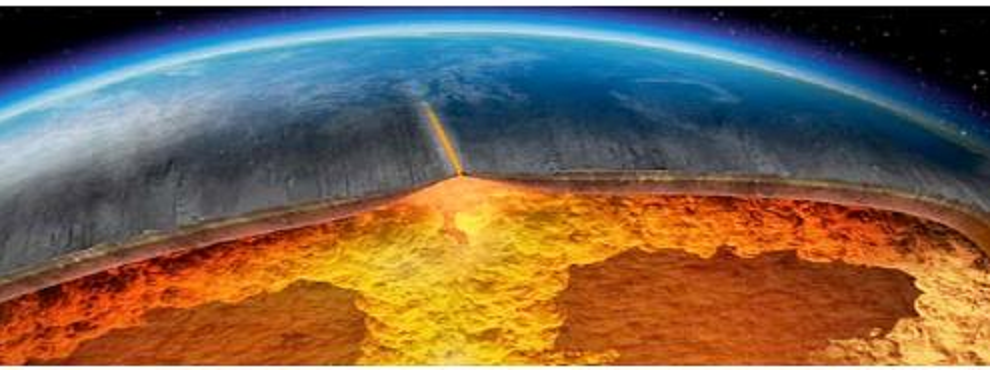
A complete presentation of Plate Tectonics Theory of Climatology is by James Edward Kamis (here)
plateclimatologytheory2


The Climate Story (Illustrated)

October 3, 2016

In this overheated political season, this post may be a useful reminder of the facts as protection against lots of unproven claims flying around.

801761

The captions and most comments below come from Mike van Biezen in his recent essay published at the Daily Wire (here). To illustrate his points, I added images collected from various internet addresses. Michael van Biezen teaches physics and earth sciences at Loyola Marymount University, Los Angeles, and his many lectures are available on Youtube at his website (here).

Temperature records from around the world do not support the assumption that today’s temperatures are unusual.

giss-gmt-to-2018-w-co2

Many people experience the range of temperatures on this scale on a daily and seasonal basis.

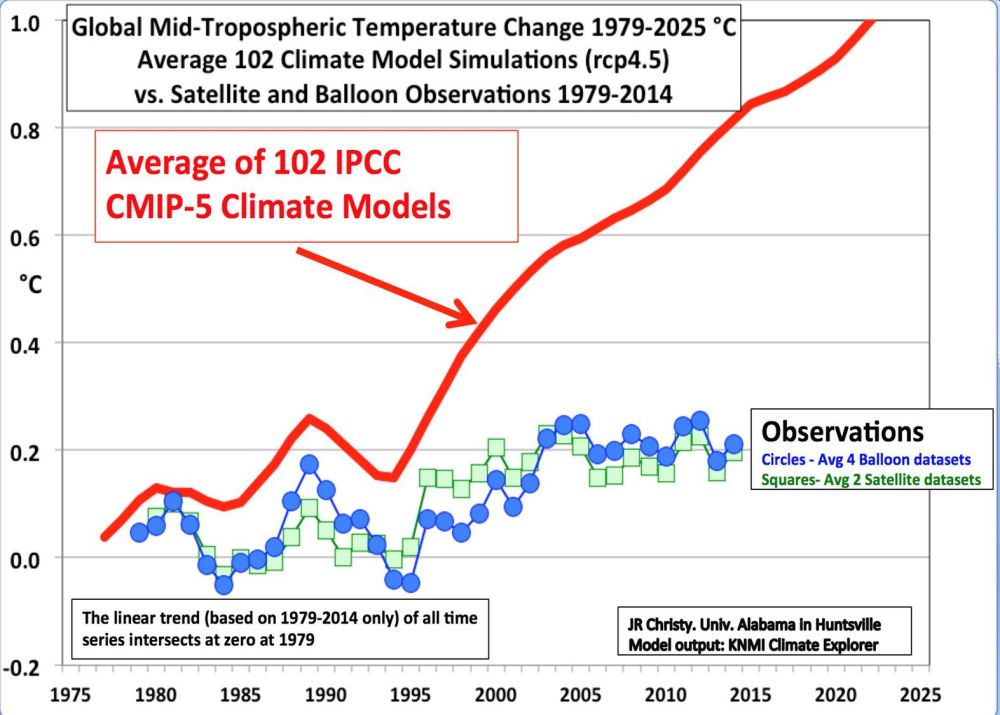
Satellite temperature data do not support the assumption that temperatures are rising rapidly.

john-christy-climate-change-chart-0a201a1637955761

The world experienced a significant cooling trend between 1940 and 1980. CO2 levels do not correlate consistently with temperatures.

Urban heat island effect skews the temperature data of a significant number of weather stations.

There is a natural inverse relationship between global temperatures and atmospheric CO2 levels.

On the graph above, the past is on the right side, time goes to the left. You can see that the Antarctic temperature starts to change first, and CO₂ responds with a 800-year lag. The explanation is obvious: oceans are large and it simply takes centuries for them to warm up or cool down before they release or absorb gases.

Higher temperatures increase atmospheric CO2 levels and lower temperatures decrease atmospheric CO2 levels, not the other way around.

The CO2 cannot, from a scientific perspective, be the cause of significant global temperature changes

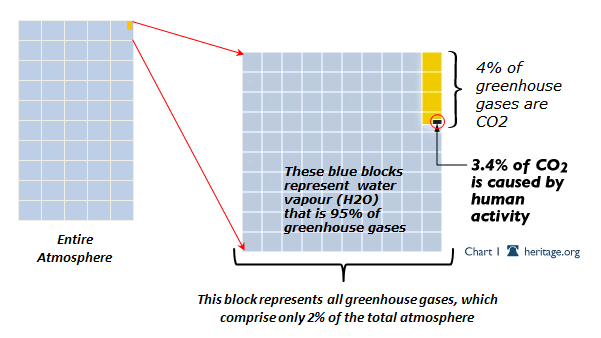
ghg-blocks-1

The H2O molecule which is much more prevalent in the Earth’s atmosphere, and which is a bend molecule, has many more vibrational modes, and absorbs many more frequencies emitted by the Earth, including to some extent the radiation absorbed by CO2. It turns out that between water vapor and CO2, nearly all of the radiation that can be absorbed by CO2 is already being absorbed.

Many periods during our recent history show that a warmer climate was prevalent long before the industrial revolution.

Glaciers have been melting for more than 150 years.

post-glacial_sea_level

“Data adjustment” is used to continue the perception of global warming.

The Moral of The Climate Story:

Global warming alarm is not supported by temperature data.

We all have a choice:  Listen to the facts, or listen to the fears:

e482d6b8-ed49-446a-9878-bb999f510ae01

Michael Crichton (2002)

Like a bearded nut in robes on the sidewalk proclaiming the end of the world is near, the media is just doing what makes it feel good, not reporting hard facts. We need to start seeing the media as a bearded nut on the sidewalk, shouting out false fears. It’s not sensible to listen to it.

Autumn Climate Change


geese-in-v-formation

Originally posted September 2015

Seeing a lot more of this lately, along with hearing the geese  honking. And in the next month or so, we expect that trees around here will lose their leaves. It definitely is climate change of the seasonal variety.

Interestingly, the science on this is settled: It is all due to reduction of solar energy because of the shorter length of days (LOD). The trees drop their leaves and go dormant because of less sunlight, not because of lower temperatures. The latter is an effect, not the cause.

Of course, the farther north you go, the more remarkable the seasonal climate change. St. Petersburg, Russia has their balmy “White Nights” in June when twilight is as dark as it gets, followed by the cold, dark winter and a chance to see the Northern Lights.

And as we have been monitoring, the Arctic ice has been melting from sunlight in recent months, but will now begin to build again in the darkness to its maximum in March.

We can also expect in January and February for another migration of millions of Canadians (nicknamed “snowbirds”) to fly south in search of a summer-like climate to renew their memories and hopes. As was said to me by one man in Saskatchewan (part of the Canadian wheat breadbasket region): “Around here we have Triple-A farmers: April to August, and then Arizona.” Here’s what he was talking about: Quartzsite Arizona annually hosts 1.5M visitors, mostly between November and March.

Of course, this is just North America. Similar migrations occur in Europe, and in the Southern Hemisphere, the climates are changing in the opposite direction, Springtime currently. Since it is so obviously the sun causing this seasonal change, the question arises: Does the sunlight vary on longer than annual timescales?

The Solar-Climate Debate

And therein lies a great, enduring controversy between those (like the IPCC) who dismiss the sun as a driver of multi-Decadal climate change, and those who see a connection between solar cycles and Earth’s climate history. One side can be accused of ignoring the sun because of a prior commitment to CO2 as the climate “control knob”.

The other side is repeatedly denounced as “cyclomaniacs” in search of curve-fitting patterns to prove one or another thesis. It is also argued that a claim of 60-year cycles can not be validated with only 150 years or so of reliable data. That point has weight, but it is usually made by those on the CO2 bandwagon despite temperature and CO2 trends correlating for only 2 decades during the last century.

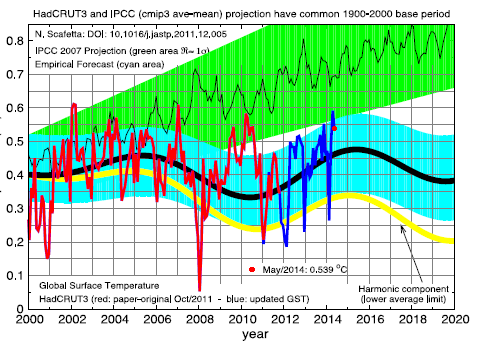
One scientist in this field is Nicola Scaffeta, who presents the basic concept this way:

“The theory is very simple in words. The solar system is characterized by a set of specific gravitational oscillations due to the fact that the planets are moving around the sun. Everything in the solar system tends to synchronize to these frequencies beginning with the sun itself. The oscillating sun then causes equivalent cycles in the climate system. Also the moon acts on the climate system with its own harmonics. In conclusion we have a climate system that is mostly made of a set of complex cycles that mirror astronomical cycles. Consequently it is possible to use these harmonics to both approximately hindcast and forecast the harmonic component of the climate, at least on a global scale. This theory is supported by strong empirical evidences using the available solar and climatic data.”

He goes on to say:

“The global surface temperature record appears to be made of natural specific oscillations with a likely solar/astronomical origin plus a noncyclical anthropogenic contribution during the last decades. Indeed, because the boundary condition of the climate system is regulated also by astronomical harmonic forcings, the astronomical frequencies need to be part of the climate signal in the same way the tidal oscillations are regulated by soli-lunar harmonics.”

He has concluded that “at least 60% of the warming of the Earth observed since 1970 appears to be induced by natural cycles which are present in the solar system.” For the near future he predicts a stabilization of global temperature until about 2016 and cooling until 2030-2040.

https://tallbloke.wordpress.com/2014/07/28/nicola-scafetta-global-temperatures-and-sunspot-numbers-are-they-related-yes-but-non-linearly/

A Deeper, but Accessible Presentation of Solar-Climate Theory

I have found this presentation by Ian Wilson to be persuasive while honestly considering all of the complexities involved.

The author raises the question: What if there is a third factor that not only drives the variations in solar activity that we see on the Sun but also drives the changes that we see in climate here on the Earth?

The linked article is quite readable by a general audience, and comes to a similar conclusion as Scaffeta above: There is a connection, but it is not simple cause and effect. And yes, length of day (LOD) is a factor beyond the annual cycle.

Click to access IanwilsonForum2008.pdf

It is fair to say that we are still at the theorizing stage of understanding a solar connection to earth’s climate. And at this stage, investigators look for correlations in the data and propose theories (explanations) for what mechanisms are at work. Interestingly, despite the lack of interest from the IPCC, solar and climate variability is a very active research field these days.

A summary of recent studies is provided at NoTricksZone: Already 23 papers in 2015 Supporting Sun as Major Climate Factor

Ian Wilson has much more to say at his blog: http://astroclimateconnection.blogspot.com.au/

Once again, it appears that the world is more complicated than a simple cause and effect model suggests.

For everything there is a season, a time for every purpose under heaven.

What has been will be again, what has been done will be done again;
there is nothing new under the sun.
(Ecclesiastes 3:1 and 1:9)

Update Sept. 17: Commentary with Dr. Arnd Bernaerts

ArndB comments:

Fine writing, Ron, well done!
No doubt the sun is the by far the most important factor for not living on a globe with temperatures down to minus 200°C. That makes me hesitating to comment on „solar and climate variability” or “the sun drives climate” (currently at NTZ – link above), but today merely requesting humbly that the claimed correlation should be based at least on some evidence showing that the sun has ever caused a significant climatic shift during the last one million years, which was not only a bit air temperature variability due to solar cycles that necessarily occur in correlation with the intake and release of solar-radiation by the oceans and seas.

Interestingly the UK MetOffice just released a report (Sept.2015, pages 21) titled:
“Big Changes Underway in the Climate System?”
by attributing the most possible and likely changes to the current status of El Niño, PDO, and AMO, and – of course – carbon dioxide -, and a bit speculation on less sun-energy (see following excerpt at link)

Click to access Changes_In_The_Climate_System.pdf

From p. 13: “It is well established that trace gases such as carbon dioxide warm our planet through the “greenhouse effect”. These gases are relatively transparent to incoming sunlight, but trap some of the longer-wavelength radiation emitted by the Earth. However, other factors, both natural and man-made, can also change global temperatures. For example, a cooling could be caused by a downturn of the amount of energy received from the sun, or an increase in the sunlight reflected back to space by aerosol particles in the atmosphere. Aerosols increase temporarily after volcanic eruptions, but are also generated by pollution such as sulphur dioxide from factories.
These “external” factors are imposed on the climate system and may also affect the ENSO, PDO and AMO variations……

My Reply:

Thanks Arnd for engaging in this topic.

My view is that the ocean makes the climate by means of its huge storage of solar energy, and the fluctuations, oscillations in the processes of distributing that energy globally and to the poles. In addition, the ocean is the most affected by any variation in the incoming solar energy, both by the sun outputting more or less, and also by clouds and aerosols blocking incoming radiation more or less (albedo or brightness variability).

https://rclutz.wordpress.com/2015/04/21/the-climate-water-wheel/

The oscillations you mention, including the present El Nino (and Blob) phenomenon, show natural oceanic variability over years and decades. Other ocean cycles occur over multi-decadal and centennial scales, and are still being analyzed.

At the other end of the scale, I am persuaded that the earth switches between the “hot house” and the “ice house” mainly due to orbital cycles, which are an astronomical phenomenon. These are strong enough to overwhelm the moderating effect of the ocean thermal flywheel.

The debate centers on the extent to which solar activity has contributed to climate change over the last 3000 years of our current interglacial period, including current solar cycles.

Update September 19

Additional studies showing a solar-climate connection are here: https://translate.google.com/translate?hl=&sl=de&tl=en&u=http%3A%2F%2Fwww.kaltesonne.de%2Fsonne-macht-klima-neues-aus-europa%2F

Hammer and Nail

This is a reblog of a post from dedicated environmentalist Michael Lewis which I am happy to put here following his comments. He does not agree with me on some matters and thinks I am too hard on environmental activists, ascribing nefarious motives that they do not have, in his opinion and experience.

At the same time, we seem to share a view that the Global Warming bandwagon is detrimental to the environment by diverting time, effort and resources to fight an imaginary problem, while real and serious environmental and social degradations and threats are not adequately addressed.

I appreciate his position particularly because it discredits the lie that global warming skeptics are all uncaring capitalists and big oil shills. I especially like the quote from Maslow, whose hierarchy of human needs contributed much to organizational sociology and motivational management. In the interest of singing from the same hymnbook, here is Between the Hammer and Nail from Michael Lewis.

Yes, I know everyone has jumped aboard the Global Warming bandwagon, hammered together the climate change apartment house and moved in lock stock and barrel to the CO2-causes-Climate-Change studio apartment. It’s a shame that such a ramshackle edifice dominates the climate science skyline.

“If all you have is a hammer, everything looks like a nail.” Abraham Maslow, The Psychology of Science, 1966

Part One

Climate change has become the cause celebre of modern thought and action, the hammer employed to bang on almost everything else. Every Progressive cause from highway congestion to homelessness simply must be cast in the glare of Climate Change and/or Global Warming. Every organization from the United Nations to my local County Board of Supervisors is invested in the concept as the source of funding for addressing all social ills.

The basis for this totalitarian acceptance of human caused climate change, aka Anthropogenic Global Warming (AGW) is the theory of radiative forcing of atmospheric warming, the so-called Greenhouse Effect. As we’ll see later, this is an instance of an attempt to prove an experiment by invoking a theory, rather than the accepted scientific process of proving a theory by experimentation and hypothesis testing.

Carbon dioxide radiative forcing was first proposed by Joseph Fourier in 1824, demonstrated by experiment by John Tyndall in 1859, and quantified by Svante Arrhenius in 1896. The unfortunate and inaccurate descriptor “Greenhouse Effect” was first employed by Nils Gustaf Ekholm in 1901.

The basic premise of the “Greenhouse Gas” theory is that greenhouse gases raise the temperature at the surface of the Earth higher than it would be without them (+33º C). Without these gases in the atmosphere (water vapor (0 to 4%), Carbon dioxide (0.0402%), Methane (0.000179%), Nitrous oxide (0.0000325%) and Fluorinated gases (0.000007%) life on this planet would be impossible.

This basic theory is deployed to buttress the assumptions that increased atmospheric greenhouse gas concentrations (mainly CO2) cause increased global average surface temperature, and, therefore lowering atmospheric CO2 concentrations will reduce or even reverse increases in global average surface temperature.

Let’s look at the observations and assumptions that have led to this erroneous conclusion.

Observations and Assumptions

  1. Observation – Humans produce greenhouse gases through industrial activity, agriculture and respiration, increasing the atmospheric concentration of CO2 from ~300 ppmv to ~400 ppmv over the past 58 years
  2. Observation – The calculated measure of global average surface temperature has increased by about 0.8° Celsius (1.4° Fahrenheit) since 1880.
  3. Assumption – Adding more CO2 to the atmosphere causes an increase in global average surface temperature.
  4. Assumption – Increase in global average surface temperature will cause changes in global climates that will be catastrophic for all life on Earth.
  5. Conclusion – Therefore, reducing human CO2 production will result in a reduction in atmospheric CO2 concentration and a consequent reduction in increase of global average surface temperature, stabilizing global climates and preventing catastrophic climate change.

Items 1 and 2 are observations with which few climate scientists disagree, though there may be quibbles about the details. CO2 and temperature have both increased, since at least 1850.  Items 3 and 4 are assumptions because there is no evidence to support them. The correlation between global average surface temperature and atmospheric CO2 concentration is not linear and it is not causal. In fact, deep glacial ice cores record that historical increases in CO2 concentration have lagged behind temperature rise by 200 to 800 years, suggesting that, if anything, atmospheric CO2 increase is caused by increase in global average surface temperature.

Nevertheless, the “consensus” pursued by global warming acolytes is that Svante Arrhenius’ 1896 “Greenhouse Gas” theory proves that rising CO2 causes rising temperature.

However, in the scientific method, we do not employ a theory to prove an experiment. Since we have only one coupled ocean/atmosphere system to observe, the experiment in this case is the Earth itself, human CO2 production, naturally occurring climate variation, and observed changes in atmospheric CO2 and global average surface temperature. There is no control with which to compare observations, thus we can make no scientifically valid conclusions as to causation. If we had a second, identical planet earth to compare atmospheric changes in the absence of human produced CO2, we would be able to reach valid conclusions about the role of CO2 in observed climate variation, and we would have an opportunity to weigh other causes of climate variation shared by the two systems.

To escape from our precarious position between the hammer and the nail, we should understand all possible causal factors, human caused, naturally occurring, from within and from without the biosphere in which all life lives.

Based on our current cosmology, it is my conclusion that we live in a chaotic, nonlinear, complex coupled ocean/atmospheric adaptive system, with its own set of naturally occurring and human created cycles that interact to produce the climate variation we observe. This variation is not the simple linear relationship touted by the IPCC and repeated in apocalyptic tones by those who profit from its dissemination, but rather is a complex interplay of varying influences, that results in unpredictable climate variation.

More about chaos and complexity in the next installment.

IPCC thinks life is linear, but in fact it looks more cyclical.

Footnote:  Maslow’s Hierarchy of Human Needs

Could it be that climate activists are working on their own needs at the top two tiers, and want to impose their projects onto billions of people struggling with the most fundamental needs?

CO2 and Climate Change For the Ages

An Historical, not Hysterical Perspective

Much of the hysteria over atmospheric CO2 arises from dismissing the past, and thus losing the context for interpreting the present.  Recently, one scientist suggested that climate researchers should be schooled in geology before commenting on climate change.  Instead of that, of course, most of them are based in environmentalism.  So as a public service this post presents some excellent and time-tested evidence produced by Dr Guy LeBlanc Smith.  h/t Jeff Hayes

This graph, compiled by Ex-CSIRO scientist Dr Guy LeBlanc Smith PhD, AIG, AAPG, from data obtained from deep core drilling on the Greenland Ice Sheet, shows that all life on earth now, including polar bears, coral reefs and humans, have survived massive sea level changes and rapid and dramatic changes in earth’s temperature. There were no coal fired power stations and no gas guzzling cars to cause these changes then, and the same natural forces will change the future. Humans will need wits and resources to cope with future changes and every diversion of our resources to nonsense like Cap-n-Tax will reduce the chances that we will survive future changes.

The real danger to all life on earth is NOT warming and abundant aerial plant food (carbon dioxide) – the real threat is ICE and plant starvation.

Climate Activists are like Ambulance Chasers

Taxing carbon dioxide under the misguided perception that it causes temperature change is like placing a tax on ambulances because they cause vehicle accidents. Like CO2, ambulances arrive after the event.

Vehicle accidents occur and some time later ambulances arrive.

Temperature goes up and some time later CO2 goes up.

Clearly there is a parallel… Using the logic of many misguided politicians and their advisers, it would seem feasible through careful assumption-based computer modelling to show this… and build a scenario for taxing ambulances and thereby reducing vehicle accidents.

I am a concerned professional research scientist with over 30 years experience, latter part with CSIRO as a Principal Research Scientist. As my funding no longer depends on politicians, I am free to make my information and conclusions public.

We are now in the closing stages of the Cap-n-Tax debate. We need to rely on evidence and facts, not propaganda, before such crucial decisions are taken.

The real world evidence such as revealed in the ice cores suggests that the Carbon Pollution Reduction Scheme is built on fraud. 

The Really Long View: How Does the Modern Warming Period Compare

Dr. Smith’s high res graph was blocked by both Facebook and Tinypic, so this is the best I can show now.

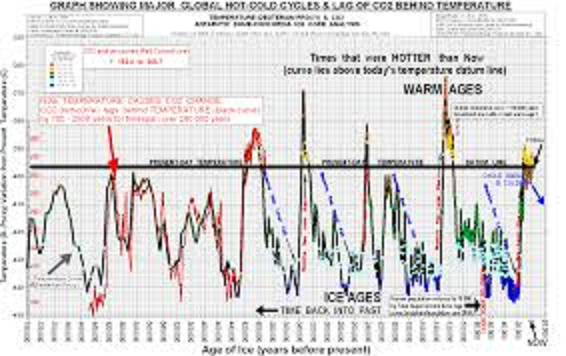
Dr. Smith produced an additional graph to display how temperatures have changed over the ages compared to the present and how measured CO2 varies in response to measured temperature changes. Of course, these estimates come from proxies since the timescale goes back through several ice ages.

But the message from the ice cores is clear: Through the ages, CO2 responds to temperatures and not the other way around.  The other message is also clear: Climates change between warm and cool, and warm has always been good for humans and the biosphere. We should concern ourselves with preparing for the cold times with robust infrastructure and reliable, affordable energy.

Summary

H/t to Jeff Hayes, who recently posted this letter from Dr. Smith (here)

Dr. LeBlanc Smith’s letter:

Jeff,

Thanks for using my chart.

I too have been fighting this fraudulent ‘human-caused & CO2 driven’ climate variation issue for decades.

I have used this graphic (with others) to counter teaching this fraud in our Australian education system, who started teaching the AGW fraud to school kids, mine particularly, and I wanted information that would be seen in context easily by kids and the less illiterate, so they would not get lost in text.

Being a scientist, I further wanted to see the climate information from source, to check its veracity, hence downloading the data from NOAA at Boulder all those years back, and making my own graphic to show context. Al Gore would not have got started if he had overlaid his temperature and CO2 graphics on a common timeline… where the temperature driver is clearly exposed. I am truly surprised these ‘green terrorists’ are still free to prosecute this fraud.

I am a retired Principal Research Scientist with Australian government CSIRO (Commonwealth Scientific and Industrial Research Organisation).

I fought against this from within the organisation for years. There are still those there who like the gravy train funding resulting from supporting the erroneous but politically convenient mantra of humans and CO2 climate alarm, despite it flying in the face of decades of empirical science showing AGW is a myth and fraud.

I would draw your attention to the Clexit campaign, which I am a signatory and founding member…

To view this release with all images intact click:

Click to access clexit.pdf

I would also draw your attention to the information compilations at the Carbon Sense website…

I have other graphics there… http://carbon-sense.com/2013/11/30/nothing-new-about-climate-change/

I still enjoy the video graphics at CO2 science.org website, of the pea growing in CO2 enriched atmosphere…

Also their detailed demonstration of the agricultural production increases from rising CO2 levels, all at no cost.

Gratifying broadly that doubling CO2 will increase crop production by more than half again, whilst using 20% less water whilst doing this, and further increasing resilience of plants to heat stress by an additional 10 degrees celsius – all for free! Why are we trying to tax this?

Anyway, thanks for the response to my graphic.

best regards

Guy

Dr Guy LeBlanc Smith, PhD, MAIG, MAAPG

Director Rock Knowledge Services Pty Ltd

Queensland Australia

The stone-age didn’t end because we ran out of stones…think smart!

Fear Not CO2: The Real Chemistry

David Ellard provides a thorough and timely explanation of the carbon cycle from first principles. His essay meets the standard for all speeches or papers: “A presentation should be like a woman’s dress–long enough to cover the subject but short enough to be interesting.” (OK I’m dated and not PC: the long enough part is passé).

Since the subject is to describe the carbon dioxide fluxes and atmospheric residence timescales, the essay is necessarily long. It is made more lengthy by the need to untangle confusions, deceptions and obfuscations of CO2 science by IPCC partisans pushing CO2 alarms. To completely remove the wool from your eyes takes a full reading and pondering. I will attempt a synopsis here to encourage interested parties to take the lesson for themselves. The experience reminded me of college classes I took majoring in Organic Chemistry, though in those days CO2 was anything but contentious.

Several posts here (links below) have danced around Ellard’s subject, but his exposition is the real deal. Getting to the bottom of this issue, he explains how Henry’s law works regarding CO2 in the real world, makes an important distinction between CO2 molecules and ions, and factors in an accounting of the CO2 output from rising populations of humans and animals.

Some Highlights from Carbon Dioxide, A tale of two timescales from the blog Energy Matters

From the Executive Summary

One of the most controversial topics in understanding the build-up of carbon dioxide in the atmosphere is the question of timescales – the effect of the build-up depends not only on the amounts being released by human(-related) activities but also on how long the gas stays in the atmosphere.

In fact much of the controversy/confusion stems from the fact that there are two relevant timescales, one which determines how the amount of carbon dioxide in the atmosphere equilibrates with other reservoirs (notably physical exchange with the oceans, and biological exchange via photosynthesis and respiration), and another which determines the exchange of carbon atoms.

By analysing the amounts of a marker carbon isotope (carbon-13) it is possible to calculate these two timescales. The timescale for the amount of carbon dioxide is approximately twenty years, a significantly shorter timescale than often claimed (e.g. by the IPCC). From these figures, we can also deduce that the increased carbon dioxide in the atmosphere since the industrial revolution has led to a noticeable increase in the photosynthetic rate of the Earth’s plants and green algae (about 8%). This has clear implications for the on-going discussions on the costs, and indeed benefits, of increasing carbon dioxide levels.

The reasons why the IPCC’s (and others’) estimates of carbon dioxide timescales in the atmosphere are overestimated are analysed – notably because no account is taken of changes in net respiration rates (ever more people, and domesticated animals, and animal pests that depend on them), because hydrocarbon usage by UN member states is underreported (quite possibly for reasons of political prestige), and finally because the models ignore the key empirical evidence (the carbon-13 isotope measurements).

Excerpts from Ellard’s Article

The purpose of this post is to try and explain the nature of the two timescales, and pin down using actual physical measurements (rather than computer games) the size of both.

What Henry’s Law is telling us, then, is that when we add molecules of carbon dioxide to the atmosphere, these molecules will ultimately partition themselves (leaving aside the effects of the biota) in an approximately fixed ratio between atmosphere and ocean (the solvent).

Three questions arise: what is the dilution of carbon dioxide in the oceans? what does ‘ultimately’ mean? and what actually is the value of the fixed ratio?  In order of asking: very dilute (the oceans are approximately 500 times undersaturated in molecular carbon dioxide), it depends on the mixing processes both within and between the atmosphere and ocean (discussed further on), and:

To rephrase then, for every six molecules of CO2 that are introduced into the atmosphere, five of the six (again ignoring biological processes) will end up in the oceans, only one of them will hang around in the air.  Not only that but, as noted above, molecular CO2 is a very dilute solute in the oceans. At current rates, it would take tens of thousands of years for mankind to achieve saturation.The partition ratio 1:5 will continue to apply for the foreseeable future!

The basic take home fact is that the ‘dissolved inorganic carbon’ or DIC in the world’s oceans is, in principle, a mixture of molecular carbon dioxide and dissolved carbonates. What is the ratio of molecular to ionic carbon dioxide? The smart among you will already have guessed: there is approximately 9 times as much ionic CO2 dissolved in the oceans as molecular. Only the latter is in Henry’s Law equilibrium with CO2 in the atmosphere. Hence the different ratios of 1:5 (atmospheric:molecular dissolved CO2) and 1:50 (atmospheric:molecular plus ionic dissolved CO2 i.e. DIC).

[fig.2 Schematic of ocean-atmosphere physical exchange]

So we can now recap. Before the exchange the atmosphere contained ten surplus marked molecules of carbon dioxide. After the exchange, there were still nine surplus molecules in the atmosphere, but none of them contained the marker! The ocean gained a single extra molecule of carbon dioxide but gained an extra nine atoms of marked carbon (and lost nine unmarked ones).

Since the industrial revolution, the human population of this planet has exploded. Not just humans though. We also have caused an explosion in the number of domestic animals, sheep, pigs, cows and chickens and the like. And not just the intended results of human food production. There are a myriad rats, cockroaches, potato blight funguses and the like out there which depend for their existence on our (unintended) generosity. They are also all busy respiring carbon dioxide into the atmosphere, thanks to us.

We have to take this into account, as well as any changes in photosynthetic fluxes (which have the opposite tendency, to reduce atmospheric carbon dioxide). I would need a whole other post to discuss this in detail, but I am simply going to assume that one third of the ‘excess’ carbon dioxide is not of hydrocarbon origin. The crucial point is that this excess CO2 will not have the distinctive carbon-13 marking. Its carbon-13 profile will be almost identical to (well, pretty similar to, we will ignore the difference for simplicity) that already in the atmosphere.

So we are going to calculate the carbon dioxide adjustment timescale as a function of the deep ocean-surface mixing timescale but reduce the result by a third to take into account non-hydrocarbon anthropogenic CO2 emissions. If you object to this piece of fudging, by all means feel free to do the calculation without it.

If you plot a graph of this using values of the deep ocean-surface mixing timescale of between, say, 0 and 100 years (which really should cover all eventualities), the value of the adjustment timescale varies between 16 and 23 years. Let’s take a happy median, thus:

The current concentration of carbon dioxide in the atmosphere is 400 ppmv and is increasing by 2 ppmv/year. If the atmospheric adjustment timescale is 20 years then it means the oceans and biota are together absorbing 5 ppmv/year of the excess. Three quarters of this absorption is due to the increase in productivity of the biota and one quarter to the Henry’s Law re-equilibration in the oceans.

So we can say that for every seven molecules of CO2 put into the air by mankind, of which just under five are from burning hydrocarbons, two accumulate there, one and a bit is dissolved into the oceans and just under four are reabsorbed by the biota via increased photosynthetic productivity.

Conclusion

But to my mind the most striking result, if we bring the carbon-13 isotope evidence fully to bear, is the increase in photosynthesis that must have taken place over the course of the twentieth century. The Henry’s Law equilibration between atmosphere and oceans is simply too slow to get rid of much of mankind’s excess CO2. The fact that there is not a lot more of this CO2 still lingering in the atmosphere (and therefore that the proportion which is hydrocarbon-derived is not even smaller) shows us that the donkey work of mopping up (most of) the excess has been carried out by the biota – all the phytoplankton, trees, grasses and algae that give wide areas of our planet’s surface its distinctive green colour.

Bio – David Ellard

David Ellard studied Natural Sciences at Kings College Cambridge with specialisations in mathematical and atmospheric chemistry.

Since then he has worked over twenty years in the European Commission in Brussels in various science/technology/law-related areas, notably responsible for the Commission’s proposed directive on the patentability of computer-implemented inventions.

My Footnote

Many thanks to David Ellard for this clear and readable treatise on established CO2 science, which still applies despite climate activists attempting to unsettle it.  Before anyone takes a stand on CO2 and global warming, be sure to remove the wool from over your eyes.

Other Reading on CO2 and the Carbon Cycle

Much Ado About CO2

Carbon Sense and Nonsense

Basics of Ocean Acidification


It’s not Hotter, it’s Milder.

Again this week I got an email from a friend linking to an alarmist website claiming (among other things) 2015 the Hottest Year Ever, August 2016 the Hottest Month Ever, 16 Hottest Months in a row, The Earth is Burning!

My reply:
Calm down and breathe through your nose. Be not afraid.
You have been misinformed, and I will tell you how and why.

1. “Hotter” does not describe a long period when daily highs are falling, not rising. That’s right, generally the temperature records are showing a decline over time in the maximums recorded at the weather stations.

For example look at results from USHCN (US Historical Climate Network) for the trend of daily maximums since 1930.

Source: Tony Heller, Real Climate Science

It is clear that measurements of actual afternoon highs are trending down in most places, and lower much more strongly than the few increases.  Below the same results displayed geographically.


2. Temperature averages over decades show great climate stability, not change. The calculated trends are in fractions of a degree Celsius, well within the error range of the instruments.

Alarmists favor the dataset from GISS, a part of NASA. They fabricate estimates of an hypothetical Global Mean Temperature not from satellites, but by taking weather station records and performing various statistical manipulations, including adjusting, deleting, infilling, gridding, weighting, homogenizing, and averaging.

Out of all that processing they produce estimates of annual GMTs, which can not be attributed to any actual observation. More importantly, the dataset is unstable–past history, for example the 1930s, appears in GISS graphs with different values this year than last, and different again from 5 and 10 years ago. As Dr. Ole Humlum commented: A temperature record which keeps on changing the past hardly can qualify as being correct.

Below is shown GISS estimates in the context of human experience of daily and seasonal temperature variability.

3. The planet has a vast array of climates, each of which has it’s own experience of changing weather and longer term patterns. That is evident in the first chart above. It is also the case that generally as daily highs have been falling, daily lows (minimums) have been rising more strongly, resulting in slightly increasing daily averages. That is the basis for claiming hottest years and months.

This phenomenon is widespread around the world, as demonstrated by studies reported here at this blog under the category Temperature Trend Analysis. For example, Analyzing Temperature Change using World Class Stations.

In addition, 70% of the GISS surface temperatures are from SSTs (sea surface temperatures), meaning that ocean cycles like El Nino dominate the results. Short-term variations recently derive from changes in the Pacific basin, the largest of the world’s oceans.

Because climates are local and plural, any general statement about warming or cooling does not necessarily apply to the place where you live.

Summary

The next time you read or are told the world is getting hotter, you should respond along these lines.

“You have been misinformed. It is not getting hotter, it has become milder. The temperature records show fewer extremes of highs and lows, milder Winters, earlier Springs and later Autumns. The longer growing seasons are producing bumper crops almost every year.

Instead of complaining about hotter weather, we should enjoy the bounty of harvests Nature is providing to us.”


The 2016 harvest is shaping up to be a whopper, according to Western Canada’s largest elevator companies.

The 2016 harvest is shaping up to be a whopper, according to Western Canada’s largest elevator companies.

Footnote:

Another post Arctic Warming Unalarming reports on in depth analysis of 118 weather stations around the Arctic Circle, where so-called “Arctic amplification” should be evident.  The conclusions:

The Arctic has warmed at the same rate as Europe over the past two centuries. . . The warming has not occurred at a steady rate. . .During the 1900s, all four (Arctic) regions experienced increasing temperatures until about 1940. Temperatures then decreased by about 1 °C over the next 50 years until rising in the 1990s.

For the period 1820–2014, the trends for the January, July and annual temperatures are 1.0, 0.0 and 0.7 °C per century, respectively. . . Much of the warming trends found during 1820 to 2014 occurred in the late 1990s, and the data show temperatures leveled off after 2000. (my bold).

So, consistent with statements above: No increase in July temperatures, some warming overall due mostly to January.