Elitist Lies About Inflation

The editors at Issues and Insights reveal false and misleading statements by a leading elitist spokesperson, US Treasury Secretary Janet Yellen.  The article is  See If You Can Follow Yellen’s Bouncing Inflation Ball.  Excerpts in italics with my bolds.

Treasury Secretary Janet Yellen said over the weekend that we’re going to have to “put up with inflation for a while longer,” which means that she has now held just about every possible — and almost always wrong — position on an issue about which she is supposedly an expert. Is it any wonder nobody trusts elites anymore?

Yellen was on CNBC over the weekend and, when asked whether inflation had peaked, said:

“Well, it may have peaked, but … I think the shocks emanating from this unjustified attack on Ukraine will prolong inflationary pressures. So, the outlook is uncertain. As you know, the Fed is taking steps to bring inflation down, but I think we will have to put up with high inflation for a while longer.”

Let’s leave aside Yellen’s dubious claim that Russia’s invasion of Ukraine has had any meaningful impact on inflation. Why would it? Iraq’s invasion of Kuwait, which was far more disruptive to the global oil market, bumped oil prices up for a short period but had no broader inflationary effect.

The Putin-is-to-blame for skyrocketing prices is one of team Biden’s big lies
meant to deflect blame. But the press never calls them on it.

No, what’s really troubling is the fact that Biden’s Treasury secretary has been so utterly clueless about inflation since joining his cabinet.

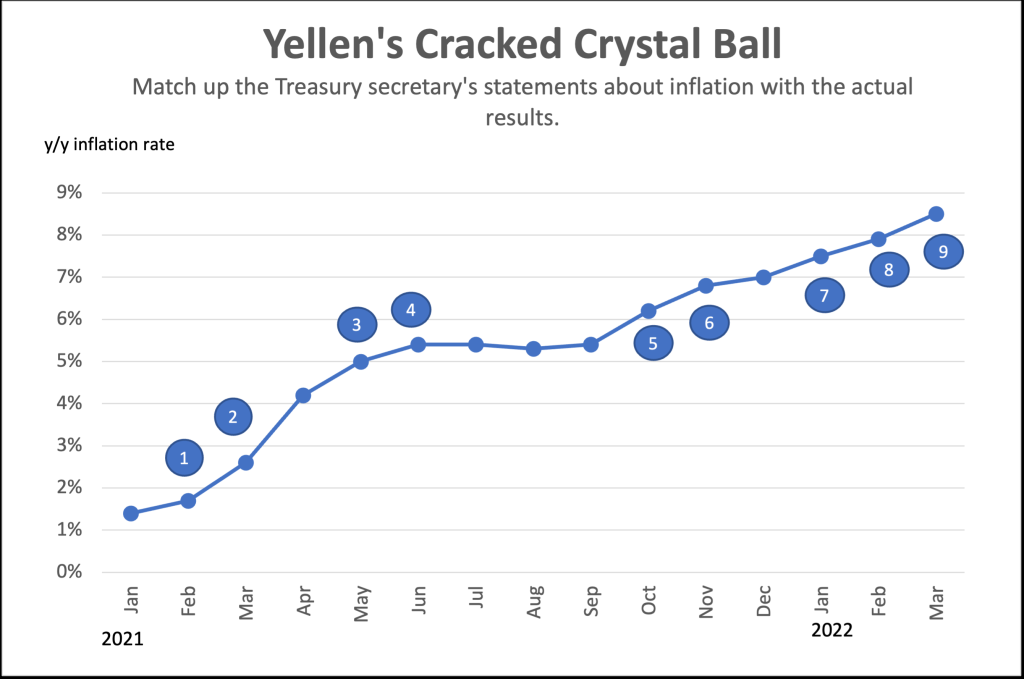
Let’s look at what Yellen has claimed about inflation since early last year and the actual results. The chart shows what inflation was doing when she made these statements.

  1. February 2021: “I’ve spent many years studying inflation and worrying about inflation, and I can tell you, we have the tools to deal with that risk if it materializes.”
  2. March 2021: “I don’t think it’s a significant risk. And if it materializes, we’ll certainly monitor for it, but we have tools to address it.”
  3. May 2021: “I don’t think there’s going to be an inflationary problem, but if there is, the Fed can be counted on.”
  4. June 2021: “Supply bottlenecks have developed that have caused inflation. I believe that they’re transitory, but that doesn’t mean they’ll go away over the next several months.”
  5. October 2021: “I don’t think we’re about to lose control of inflation.
  6. November 2021: “If we want to get inflation down, I think continuing to make progress against the pandemic is the most important thing we can do.”
  7. January 2022: “If we’re successful in controlling the pandemic, I expect inflation to diminish over the course of the year and hopefully revert to normal levels by the end of the year around 2%.”
  8. February 2022: “I think people heard ‘transitory,’ and to them it meant a couple of months. Maybe a better word could have been chosen.”
  9. March 2022: “We’re likely to see another year in which 12-month inflation numbers remain very uncomfortably high.”

Keep in mind who we are talking about here. Yellen has a sterling resume. A doctorate in economics from Yale. Professorships at Harvard and the University of California, Berkeley. On the faculty of the London School of Economics. President of the Western Economic Association and vice president of the American Economic Association. Head of the Council of Economic Advisors under President Bill Clinton. President of the Federal Reserve Bank of San Francisco. Chairwoman of the Federal Reserve.

So how in the world can her pronouncements about inflation under President Joe Biden be as reliable as the weather forecast? Is her understanding of economics tainted by liberal ideology? Is she just doing the bidding of an incompetent and desperate Biden administration?

Does it matter? Yellen is a shining example of why so many in this country
feel betrayed by the people who claim lordship over them.


Seeking Climate and Energy Security

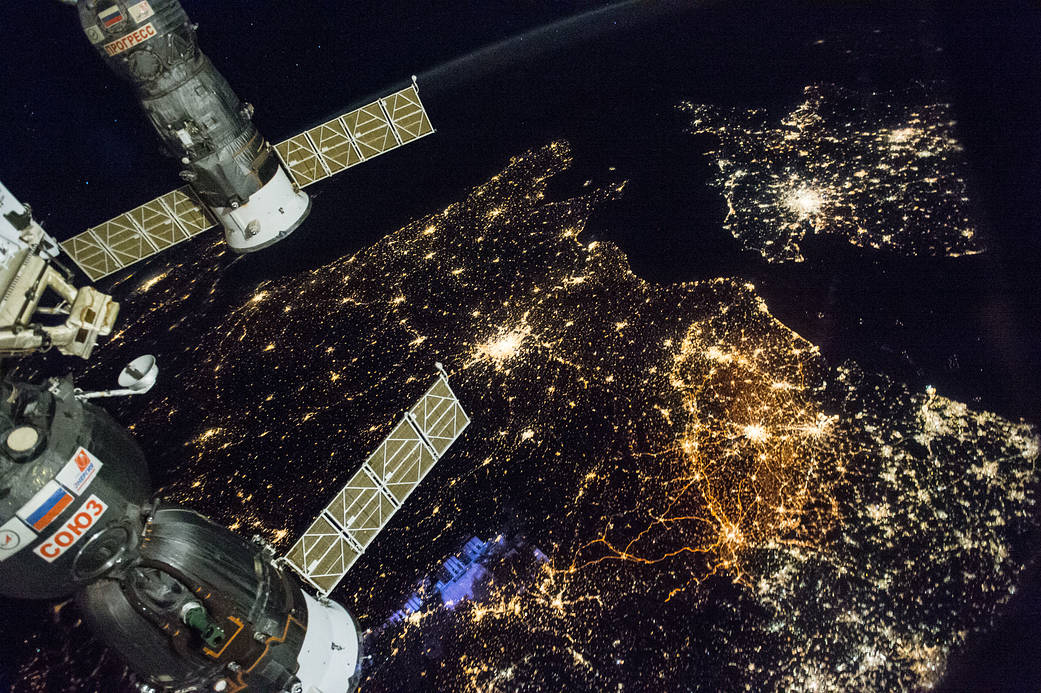
Europe at night from space NASA 2016

News is out that US Senators are meeting in search of (using Sen. Joe Manchin’s words)  “a bipartisan climate and energy security package.” . . .  “It’s urgent to find out if there is a pathway.”

The principals should attend to Dieter Helm’s expert March 2022 analysis of Climate and Energy Security entitled Energy policy  Some excerpts are below in italics with my bolds, suggesting the thrust of his wisdom in this regard.

Introduction

Energy policy is not rocket science. It is about achieving core objectives – security of supply and decarbonisation – and achieving them at the lowest cost. Neither will be met by purely private markets, since the former is a public good and carbon is an externality not properly integrated in competitive markets. Furthermore, energy is a primary good for citizens: not to have energy deprives people and businesses from access to the wider economy and to society. It is a core USO: a Universal Service Obligation. That is why energy cannot be treated like any other commodity, as some of the architects of the “privatisation, liberalisation and competition” paradigm believed. Citizens are more than just consumers.

Security of supply requires a capacity margin: “just in case” rather than “just in time”. Decarbonisation requires more renewables, possibly nuclear, and maybe hydrogen, carbon capture and storage (CCS) and an active demand side. Security of supply sits in this decarbonisation context, and because many of the options on the generation side are intermittent, security of supply takes on a much more demanding dimension – not just the old question of access to fuels and power, but the ability to handle large-scale intermittency.

The Policy Mess We Are In

This pressure to “do something” is most intense in a “crisis”, and what is happening right now is a classic example. Lots of interventions currently being proposed by all the lobbyists are likely to make things worse.

Complexity is a lobbyist’s utopia. Engaged in each consultation, clear about the single aims of its vested interest, able to engage in each and every consultation, able to brief MPs, the media and the ministers, and sow doubt where interests are threatened, it is no wonder that the energy sector is now close to resembling that of agriculture, captured by the core interests. Spending (and it is very large-scale spending) on lobbying keeps going up as the government is more and more engaged in the details of all the main contracts.

These lobby interests have been very successful in getting subsidies and convincing government that the transition to net zero is going to be cheap (just not yet), and that there is no threat to security. Just go for net zero, they argue – on a territorial carbon production basis – sign up for lots and lots of targets and then, once the fish is hooked, play in the threat of failures and hence the case for more and more subsidies. (If it was all so cheap, we could of course abolish the subsidies – but no vested interest is demanding the end to subsidies.)

The facts –not only that decarbonisation is essential, but it is going to cost a lot – remain, and they are increasingly emerging. Each time they do, the lobbyists turn to the Treasury and ask the taxpayer to bail them out.

At its simplest, the government has been pursuing decarbonisation without addressing in parallel the security of supply implications. The failures are multiple. It is not just the gas price and the collapse of suppliers; it is also about the balancing market, and the distribution companies.

Behind all of these is the lack of a coherent market design
fit for the decarbonising purposes.

Exposure to the spot markets, with no storage and no special relationship to North Sea producers, is only one reason why the gas price increases hit the UK particularly hard. A second reason is that the UK has built a lot of intermittent wind capacity without thinking through how to manage the intermittency. In the UK (for good reasons) there is very little coal generation capacity left – except DRAX. For all the hype about batteries and smart demand management, the fact is that gas (and small diesel generators) is almost all that is currently left to do the heavy lifting.

In a renewables energy system, there needs to be a lot more capacity
to meet any given demand.

In theory, if there was no wind, then there would need to be another complete system to be on standby. As demand keeps going down – in part because of de-industrialisation (industry demand is down 20% since 2000) – capacity has been going up towards the 100GW mark, an increased requirement of over 20GW for a significantly lower total demand. It will need to go up a lot more with 40GW of offshore wind as planned. It seems to have escaped the notice of all those projecting that the costs of the transition would be very low, and claiming that renewables are cost-competitive with fossil fuels, that all this capacity has to earn a reasonable rate of return. It is a cost of renewables.

Needing the gas capacity is only one dimension of the problem. The other is how to deliver it, given that the wind has a marginal cost close to zero. Whereas a conventional gas power station could rely on running most of the time when first built, now it is itself intermittent, depending on whether the wind is blowing. This breaks the conventional back of the economics of gas investment. Hence there is no merchant gas investment. Gas shifts from being driven by a normal wholesale market towards a strategic reserve of capacity. The market design has not caught up with this. Gas now needs a capacity payment to make its reasonable return, and hence a capacity contract, which only the government can underpin.

Back to Basics

The very concept of a competitive retail energy supply market cuts across the basic idea that energy is a USO. Some think that goes beyond the pure commodity to an essential service necessary for a citizen to participate in society. Without electricity and gas, citizens can die of hyperthermia (quite a lot do each winter), they cannot access the internet, phones may not work, and the freezer thaws out. Any decent society recognises that energy cannot be simply about price, supply and demand. Yet that is precisely what the architects of the privatisation and liberalisation paradigm thought they were doing. The current crisis is not just about whether people can or will pay: it is also about all those voluntary actions to stop using the heating and the electricity, with all the consequences for the poor that this implies. Paying the electricity bill can be a trade-off with food.

The supply market is now broken, and it is unlikely that many customers will now want to switch – especially amongst the poorer ones. The government has had to step in to bail out Bulb. All electricity customers are now going to pay more than £60 each in their bills to pick up the tab for the costs of sorting out all the company failures. We have come full circle, back to an oligopoly again, and one that will need proper regulation.

The right way to address supply is to start with what customers want, to ensure that the companies serve the customers, not that the customers serve the interests of the suppliers.

How It Could Be Different

Though it is true that we are where we are, it is worth considering how it could be different by looking at what is happening elsewhere. Recall the reasons why the gas price increases have hit so hard are that the UK has lots of intermittent wind, and the electricity price is determined by the (marginal) wholesale price. Intermittency reads across to greater demand for gas, and that translates straight into the electricity price. The gas and electricity price paths match each other remarkably closely in the UK.

To see how it could be different, consider what is happening in France. It is around 70% nuclear and has a lot of hydropower. As the gas prices have shot up, the cost of nuclear and hydropower has not changed at all. Similarly in the UK, the cost of wind, solar and nuclear generation has not gone up. But now the difference. In France, the price increases are being limited to 4%. This reflects the costs. EDF understandably protests that this will lose it money (around €8 billion), because it could have sold its power into the EU markets at the spot price.

But the €8 billion is not a loss, but rather an additional profit that would go to EDF. Since EDF is largely owned by the French state, the €8 billion would be a taxpayer gain, and stands against a customer gain if the benefits of a stable nuclear power supply go to the French citizens and industry. Quite why Germans should benefit from French nuclear at this point of the gas price crisis, when it has closed its own nuclear fleet, is hard to fathom.

The building blocks of a sensible energy policy

Energy policy is all about setting a system framework within which markets operate to deliver what citizens and customers want. It starts with setting the objectives, and then ensures that these are met by a set of institutions, interventions, regulations, licences and auctions and so on.

The objectives

There are two primary objectives: security of supply and decarbonisation. Unless these are clearly and appropriately specified, no amount of ingenuity about the development of policies will be anything other than inefficient.

Security of supply includes price and costs, as does decarbonisation. Setting either independently of prices and costs make them unlikely to be attainable. In both cases higher prices have an impact on demand and hence the required supply-side infrastructure, reserves, capacity margins and the total envelope of investments. For example, gas security is always possible if the price is high enough. Supply equals demand at a clearing price. Security of supply has to be at reasonable costs, as must decarbonisation.

Both objectives are currently set as if they are independent of prices and costs. Hence they are in doubt: market participants need to try to guess the reaction function of government if and when customers and voters rebel or are simply unable to pay. In particular, there is an assumption as noted above that decarbonisation will be very low cost (perhaps 1% GDP per annum), but this is hopelessly unrealistic – it assumes as noted, for example, not only that the costs of renewables and low-carbon technologies will keep falling, but also that government policy will be perfect. There will be no government failure.

This is nonsense. Pretending that the costs are low to get governments signed up is a classic NGO trick, but the unfortunate reality is that the costs do not go away by assumption. In the current circumstances, few can bank on getting the net zero for the electricity sector by 2035. The uncertainty raises risk and hence the cost of capital.

The security of supply objective is also ill-defined, if defined at all. How much risk does the government want the economy and its companies and citizens to take that they will face price shocks? It is easy to be very secure, provided the economy can withstand the costs of a range of policies, including strategic stocks, reinforced networks and large capacity margins. We could, for example, agree to pay whatever it takes to secure LNG cargoes by agreeing to outbid every other country in the world. The costs of all of this would be beyond those that the economy could withstand.

The task of government in general, and BEIS in particular, is to set out serious and sensible objectives, and then delegate their achievement in a credible way.

Stakes in the ground

There are a number of decisions which cannot be taken by the private sector, or at least not without a very high cost of capital. The government is already the central buyer for almost everything in the electricity sector – directly or indirectly. Almost all new generation comes with a government-backed contract: a capacity contract or a CfD or a RAB. All the networks are regulated, and the regulator has a duty to finance functions in one form or another. The government controls the North Sea licences for oil and gas, and The Crown Estate runs the seabed licences.

The first stake in the ground concerns nuclear.

It can never be a purely private investment, for multiple reasons. Waste is an intergenerational liability. The political nature of nuclear means that investors always face the risk that government performs the sorts of U-turns made in Germany. Limited liability of private sector firms leaves the government with the unlimited liabilities. These considerations trump the further worries about the length of the project, cost and construction overruns, and changing regulatory requirements. Every major incident globally at a nuclear facility leads to a review of safety regulators, and safety regulators usually come up with new tighter regulations as a result.

Having a nuclear capability is part and parcel of having a robust nuclear programme, as it is of a military nuclear deterrence. Looking ahead, it is possible to envisage a joint UK– France nuclear programme, adding France’s six to say four to six in the UK, making a programme of at least ten. This would yield a supply chain. But it would need a UK company as part of the deal and a joint political framework. All of this, in the current context, is fantasy. If the UK does nuclear, it will be far less ambitious, less joined-up, and probably much more costly.

The conclusion that follows is that it is very hard to think of any worse way of taking nuclear decisions than the recent past in Britain. It maximises the cost of capital without complete risk transfer, and it minimises the supply chain efficiencies. Opting for more nuclear now as part of a security and decarbonising strategy requires the ambition to be matched by a more coherent and joined-up commitment, sustained over more than a decade.

A second stake in the ground is offshore and onshore wind.

The key point about wind is its difficult economics: it is low-density, disaggregated, intermittent and remote from consumers. Nevertheless, its lobbyists claim that wind is the cheapest form of electricity generation. Sadly this is not true once the full costs are taken into account, and that means that it is government that has to decide how much offshore and onshore wind and has to provide the subsidies to the full costs to make it happen. The regulator has to instruct the network companies to build an interconnected system between the offshore wind farms and then between the wind farms and the mainland grids. Offshore wind – the main play – differs from nuclear in all the above respects. It also differs in having shorter lead times and its components can be manufactured, currently primarily in China.

The stake in the ground decisions about the volume of offshore and onshore wind are conditional on deciding about the system infrastructure to collect and distribute the energy, and how to deal with the intermittency.

This is a system question that depends not only on the quantity in GWs of offshore wind in particular, but also on what else is on the system at the same time. It is rarely observed that the decision about wind needs to be taken in conjunction with the decision about gas – at least until there is a largescale alternative storage technology that can cope with longer periods of low wind, notably in winter (but increasingly in summer, too, as the air conditioning loads grow). Given the 2035 target for decarbonising electricity, the gas decision depends in turn on the CCS decision, since more wind means more gas, which means more CCS if the gas is to meet the net zero requirement by 2035.

This leads to the third stake in the ground – CCS.

Successive governments have stalled on CCS (Carbon Capture and Storage) investments and decisions. As noted, a Treasury paper in 2007 promised £1 billion of support to develop CCS. Fifteen years later, and despite there being even a competition for the £1 billion, CCS remains largely on the drawing board. It requires a regulatory and licences framework, a liability insurance regime, a pipeline system, and a price of carbon sequestrated.

Though all of this is reasonably straightforward, these ancillary stakes in the ground are not yet in place, and the clock is ticking both as the offshore wind develops and the 2035 deadline gets ever closer.

The fourth stake is the new kid on the block – hydrogen and green ammonia.

It is unlikely to be the last “new kid”. The promise of hydrogen is that it can be manufactured by using excess wind and perhaps even solar, thereby being truly “green”. (Nuclear could do this too, though it is unlikely to be surplus unless on a French scale.) In the meantime, hydrogen is “blue”, made from natural gas, which brings us back to CCS. Blue hydrogen is inconsistent with the net zero targets without CCS. The hydrogen decision differs from the nuclear and wind stakes in the ground because it is very much at the R&D and demonstration stage. R&D is a public good and hence there is an obvious role here for government support.

There are several other stakes in the ground, though they tend to be more about the frameworks and less the technology per se. Solar falls into this category, and targets are particularly inappropriate given the major differences between rooftop, household, farmland and other variants. In an ideal world with perfect foresight, governments might want to go further, but there are corollary dangers as the lobbyists get their teeth into government and regulators, and getting the really big decisions right on the above stakes in the ground would be a major achievement. All of the above are decisions which cannot be taken by markets.

Governments should resist the temptation to do everything. Just doing a few things well would be a massive improvement on the current policy mess described above.

Delivering the plan – guidance and the system operator and regional system operators

Government can and indeed has to take the decisions about the major stakes in the ground. What then is required is a plan to deliver the energy system within which these stakes are embedded.

These objectives will not be achieved without a plan. If, for example, the government seriously intends to get to net zero for the electricity sector by 2035, then with 13 years to go, it needs to radically up its game and set out a plan to get from here to there. To give some examples, if part of the plan is to build lots more offshore wind and to increase electricity capacity to tackle transport and some heating, then as noted it will need a lot of gas capacity to back it all up. That in turn will need CCS, since electricity will not be net zero if there is a lot of gas on the system unless the gas is net zero and the only plausible way of doing this is to use very large-scale CCS. Similarly, it makes a lot of difference to the networks and the capacity requirement whether there is more nuclear or not. To get more nuclear in just 13 years on the system requires a lot of actions now. The stakes in the ground are for government: the delivery of the system to meet these is an evolving and detailed matter. Things will change. Nuclear might be late, wind costs may increase, and so on.

Someone has to manage this process, and whilst the government and BEIS can and should issue guidance – notably in respect of the overall objectives and the stakes in the ground – there need to be a system architect. The obvious place to start is with the SOs at the national and also at the regional level too. The Cost of Energy Review sets out how these should be separated from National Grid and the distribution network operators (DNOs) and details some of the consequences for Ofgem and system regulation. Five years later, the government is still prevaricating about how to do this. Every year means that the system plan remains incomplete, which means that it is harder and harder to meet the 2035 target and the costs of doing so goes up. It has an impact on the generation investment decisions, notably because without a network system in place, uncertainty increases and hence the costs of capital goes up.

Creating a market fit for the purposes of the twenty-first century

Critical to rebasing energy policy now is a series of decisions – stakes in the ground – that have been fudged in recent years. Either do nuclear properly or not at all. Recognise the security implications of lots of intermittent wind on the system and plan the system architecture to deal with this. Integrate the offshore and onshore electricity grids. Do not ignore the gas that will be a part of the back-up for at least a decade to come. Do not pretend that stopping new gas production in the North Sea solves the problem of UK consumers consuming a lot of gas by importing it instead.

Get on with separating out the regional SOs and the national SO. Evolve quickly to an EFP market to supersede the fossil-fuel-driven wholesale markets of the twentieth century. Take longer term contracts seriously rather than relying overwhelmingly on spot markets, and extend the price cap periods to a year. Get on with designing and implementing an integrated CCS system offshore.

Do these things, and spend less on perverse subsidies, and the UK can have secure energy at a reasonable cost and decarbonise at the same time. Ignore all these, and not only will the UK lack security, but it will pay higher prices and the 2035 target will fade, and possibly with it the willingness of the public to support the vital objective of decarbonisation.

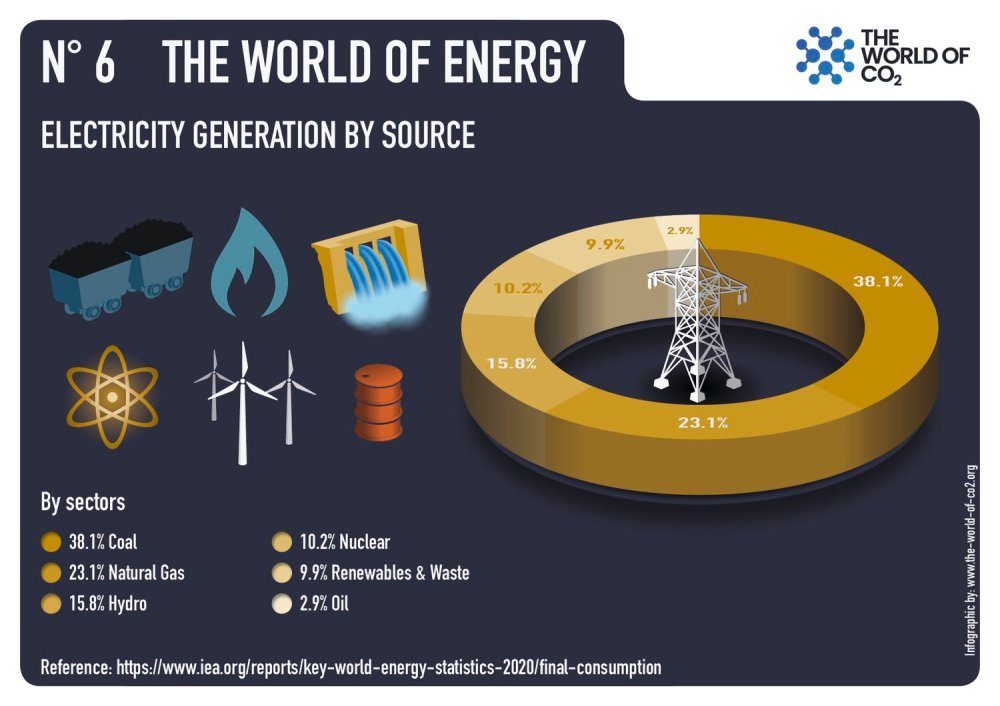
See also World of Energy Infographics


Fake Virtue Demeans Us All

Explained at Peak Prosperity For The Narrative-Creators, The Play Is You… And You Are Not Real.  Excerpts in italics with my bolds and added images.  H/T Tyler Durden

If, like me, you’ve been wondering about why things are the way they are in today’s world, and how this relates, this is my explanation: For the actors, writers and directors who create real world narratives, the play is you. And you are not real.

Actors and Reality

Much has been made of the jarring dissonance between the heroic stand of the president and the people of Ukraine and the facile signaling of the Social Justice crowd. Feel free to pick your favorite exemplar, from the merely stupid banning of Russian cats and renaming of White Russian cocktails to the more sinister cancelling of Russian performers, or the horrific threats and vandalism to places serving Russian food. There’s no shortage of content here. And, as we’ll get to shortly, that’s the point.

Ukraine’s policy goals do not map fully to those of the United States (think Azov Battalion, for starters), and we can and should carefully consider our response with that awareness. But this does not change Ukrainian heroism. Zelensky wants planes, a no-fly zone, and he would no doubt love NATO boots on the ground. Prudence may dictate we provide him none of these, but it is worth noting that any of us in his circumstances would likely be asking for the same things. Any of us who stayed during the onslaught, that is.

Clearly, Putin’s bet from the beginning included Zelensky on the first plane out to serve as the leader of the Ukrainian government in (comfortable) exile, after which the dismemberment of that nation would rapidly become a fait accompli. Zelensky was having none of it. He stayed, and continues to stay, at great personal risk to himself and his family. He is, unquestionably, a hero.

It is the contrast between these two extremes (the banning of Russian-themed menus et al vs. Zelensky’s stand) that provides ample opportunity to reflect on the idea that many Americans are just not serious people. Unsurprisingly, their response to events in Ukraine has been to simply cut and paste from the outrage-of-the-week playbook: change profile picture, use a hashtag, find some people to cancel, and congratulate oneself on how virtuous one is. In the real world, rational people are tempted to say, “None of this ‘support’ matters”. It’s just empty signaling. So why is it happening, why has it become so pervasive, and how should we contend with it? Examination of a few high-salience topics can shed some light.

Covid and Wuhan Lab Leak Theory

Consider this first in the context of Covid and the by now well-known case of the Lab Leak Theory. Peter Daszak of the Eco-Health Alliance was the prime mover behind the infamous Lancet Letter branding any lab leak speculation uninformed conspiracy. This makes perfect sense when considering his incentives. Daszak (and Fauci, and others) had something to lose here. Perhaps a lot to lose. U.S. funding of Gain of Function research in Chinese labs resulting in a global pandemic is, to put it mildly, not a very good look and could be costly both financially and criminally.

And that’s where those laws, norms, and standards come in. In an environment with many disinterested actors, those entities without skin in the game would easily out-produce the relatively small number of individuals invested in a particular narrative. In that environment, the idea that zoonotic transmission and escape from a biolab in the same city where researchers were known to be working on bat viruses were both very real possibilities would be obvious.
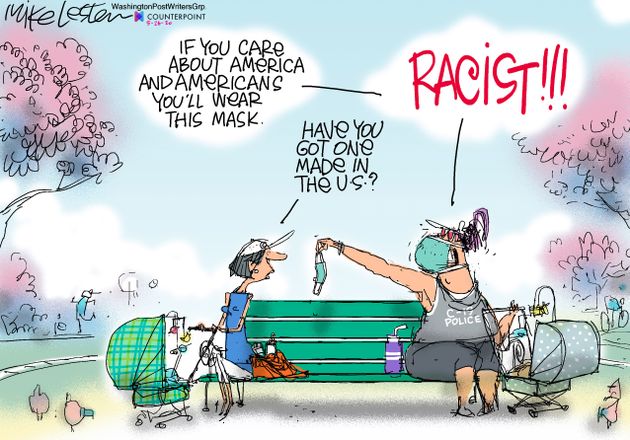

But that is not at all how it went down.

Instead, the idea that it might be prudent to investigate what role the lab in Wuhan may have played in the pandemic became roughly equivalent to arguing Flat Earth Theory. What the hell was going on here? Did everyone in the American media landscape owe Daszak a favor? Did Fauci have a secret cache of compromising emails and photos to dangle J. Edgar Hoover style over the heads of troublesome journalists? Why on earth would hundreds or thousands in the media run cover for these guys and for the Chinese government to the extent of making claims that mere investigation of the possibility of a lab leak was racist?

More puzzling still is the idea that there is nothing about either potential source of the pandemic that presupposes an explicitly liberal or conservative position. Indeed, one could easily flip the script and imagine a campaign urging people to “follow the science” rather than resorting to xenophobic tropes about savages in wet markets. Until, that is, Donald Trump and other conservatives brought it up, which was like Christmas came early for Daszak and his co-conspirators. For the progressive left, the endorsement of anything by President Trump was more than sufficient cause to oppose it, and thus the wheels began to turn.

None of this should be surprising to anyone who’s been paying attention. At its heart, this is an expression of the luxury of operating without consequences. The luxury of not having to think operationally. To be clear, what I am saying is that Daszak and his cronies were able to leverage a system in which those with the loudest megaphones literally did not and do not care where and how Covid originated. For them, it just doesn’t matter. The pandemic is just background noise. That may seem like a strong statement. So, why and in what sense did they not care?

Personal Gain Not Public Trust

In a recent episode of Bari Weiss’ podcast Honestly, journalist and academic Yuval Levin articulated a theory of the change from institutions-as-formational to institutions-as-platforms. In his view, institutions of all types formerly served to develop the individuals inside them. If for example, you worked at the New York Times as a young journalist, you would be shaped by the ethos of that institution, informed by the repository of values developed over time within that structure.

According to Levin, this has been replaced by the notion of institution-as-platform,
the idea  that these structures exist as a launching pad for one’s personal brand.

Understood from this perspective, the great Lab Leak crackdown suddenly makes a great deal of sense. One of the baseline branding positions operating was “not-Trump.” I am completely persuaded that if Trump had spoken out in favor of the wet market theory, we’d all have been loudly advised to “follow the science” in precisely the opposite direction.

It is also worth noting that these personal brands are rivalrous goods. Having a “take,” even the right one, is necessary, but not sufficient. Your take must outcompete the other signals in the marketplace in order to claim disproportionate attention. And this explains why the Lab Leak Theory had to be, “conspiracist,” “anti-science,” and eventually, of course, “racist.”

The more extreme the position is,
the more effective it is in gaining audience-capture.

And this is not part of the story; it’s the entire story. There is effectively nothing behind the curtain. Because of these powerful incentives, what has happened without us realizing it is the creation of a public dialogue between a small, privileged elite that is fixed on in-group signaling and status-capture. The policy concerns or post-pandemic reforms that should differentially apply depending upon the origin of the disease diminish in importance to the extent that they functionally do not matter at all.

And people impacted by those decisions by extension do not matter either.
They are extras and scenery.

The Damaging Script

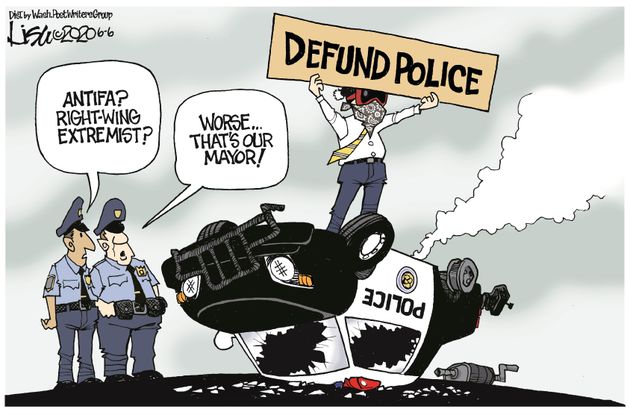
This goes a long way toward explaining the persistence of the otherwise bewildering advocacy that has permeated American life. Democratic New York Mayor Eric Adams noted that the Defund the Police crowd “are a lot of young white affluent people.” Of course they are. Poll after poll reveals that those who live in high-crime neighborhoods want more police, not less.

Like any other sane person, those citizens also want their police officers to be professional and not corrupt, but “I want my police officers to fight crime and be professional” is just not an exciting take. From this perspective, insanity like Defund the Police isn’t surprising, but rather inevitable. It is the position pushed to its logical extreme. And that is why arguing with this group is useless.

Perhaps nothing is more indicative of this trend than the increasingly unhinged claims emerging from the trans-activist community, as LGB became LGBT and now for some is properly expressed as LGBTQQIP2SAA, in order to be “inclusive” to intersex, pansexual, asexual, and two-spirit people.

For an outsider, it can all seem like satire.
How could anyone engage in these abbreviation acrobatics unironically?

For outsiders, the criticism seems insane. That is because, once again, we are not the audience. What we are seeing is a process of in-group jousting for status, where increasingly bizarre formulations become predictable and indeed necessary to gain attention. “I disagree with J.K. Rowling” is hardly a winning message, especially compared with “J.K. Rowling threatens my right to exist!” Thus, once again, appeals to reason, biology, or even compassion for a generation of children we are harming irrevocably do not and will not work.

No one affected by these positions exists in any meaningful way
because, again, they are not real.

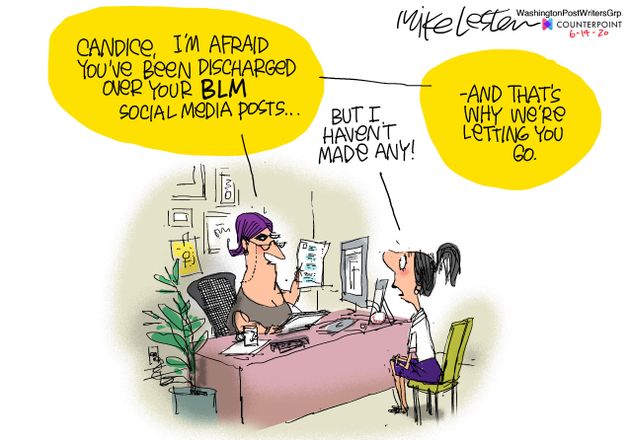
By far the best example of this phenomenon is Black Lives Matter, a marketing triumph that proved beyond all doubt that these tactics can work, work well, and most importantly, be monetized. The familiar script is here, but no one has ever executed it better, as activists turned their rallying cry into a movement indistinguishable from religion. No nuance or difference of opinion was tolerated. Even to remain silent was proof of apostacy.

The net result? More than $60 million, most of which remains unaccounted for, and a series of high-end real estate purchases by the activists behind the whole thing. No policy achievements of any kind, because of course those were never the point from the beginning, as was obvious to anyone paying attention.

The response to this from BLM? Condemn the black reporter who exposed their murky finances and questionable real estate transactions as racist, smear the black Harvard economist as a sexual predator, and suggest that even the financial reporting required of non-profits is, you guessed it, racist. It’s not that hard to parse this: BLM activists are not friends or allies of black communities whatsoever. Instead, we come back to the same point: everyone outside of the in-group are just extras and scenery. Including those for whom they purport to advocate. None of them are real.

Luxury Beliefs

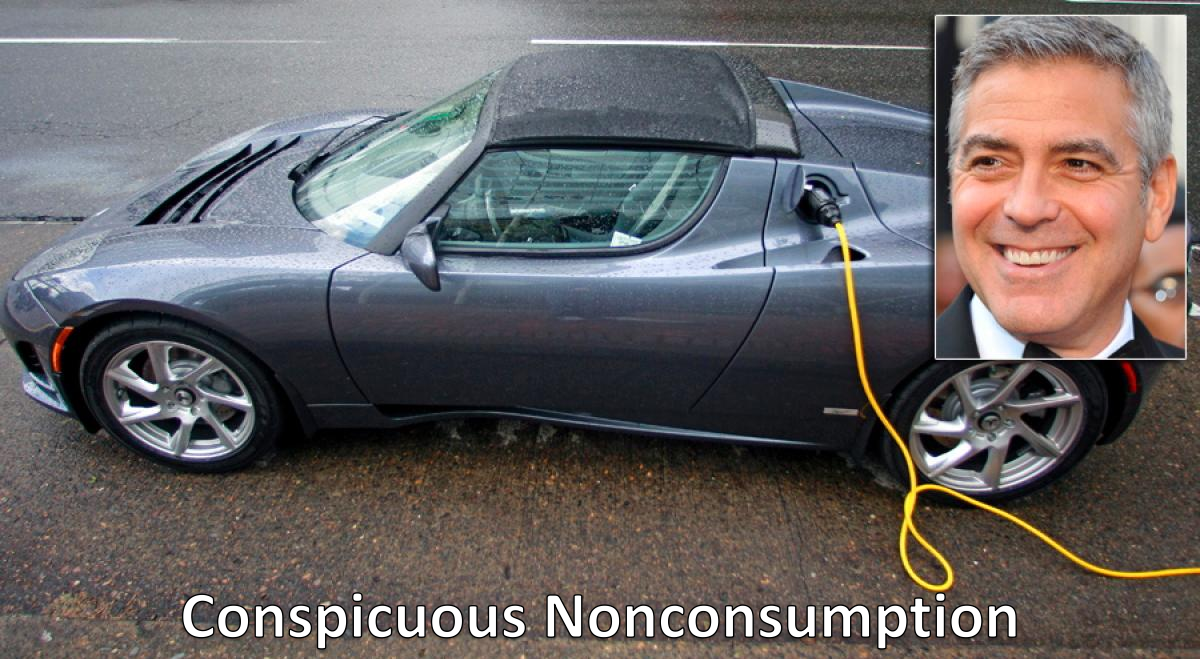
Rob Henderson calls all of this a symptom of “Luxury Beliefs.” According to Henderson, these are “ideas and opinions that confer status on the rich at very little cost while taking a toll on the lower class.” What we have is a catechism, a portfolio of dogma that operates as a signaling mechanism among the elite. And so, in addition to “Follow the Science” on Covid, “Trans Women are Real Women”, and “Black Lives Matter”, we have a host of other statements expressed as moral imperatives, including things like “Healthy at Any Size”, “All Family Structures are Equal”, “Open Borders”, etc.

All of this can be considered an unexpected and unwelcome consequence of our own success. The complex, exquisitely-tuned supply chains that funnel us goods and services have become so remarkably effective they are essentially invisible. Elites don’t have to worry about how things get done, how X leads to Y, or how thing A gets to place B.

It just happens. Magically. Invisibly.
How the sausage is made is a question for smaller minds.

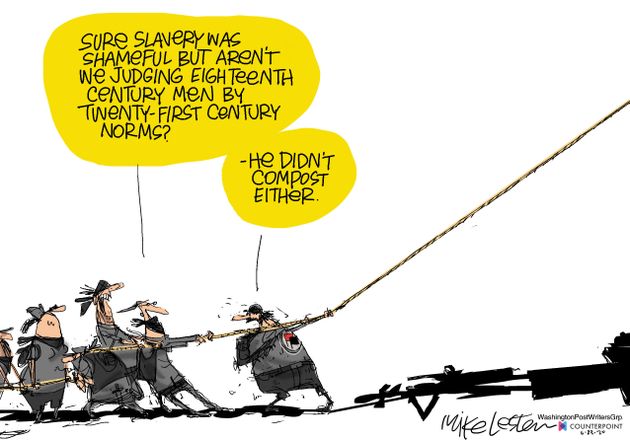
In my view, Henderson gets one thing wrong about his theory. Luxury Beliefs are not in fact, the provenance of the rich, but rather of the educational elite, some of whom are also rich in the bargain. Journalists, other media members, academics, and activists typically have little to no experience in actual business and even less incentive to ever gain any. The effortless flow of goods and services they experience allows them the freedom from having to think operationally or consequentially.

Over the past two years, COVID revealed and supercharged the insular status of these elites. If you talk to business owners, no matter how wealthy they may be, who vitally need to think operationally and consequentially every day, you find considerably less support for these elitist notions.

All of this is bad enough when locked in some academic ivory tower, but as we’ve seen, this has escaped into the American Wild with terrifying effect. Crime, inflation, record border crossings, education, and more. Pick your topic, as the list goes on and on.

The Final Act

Which brings us back to Ukraine as the setting for the ridiculous virtue signaling and posturing by these same luxury elites. It is jarring when juxtaposed against actual tanks and soldiers, but it is just more of the same.

I stated earlier that these are not serious people, but that is not entirely accurate. They are extremely serious, just not about anything other than their own internal conversations.  These people will not change, and they will not be persuaded by your arguments, your statistics, and your facts.

Because the people who make any of the things elites consume and the people elites purport to stand up for are all equally irrelevant. Performance is the point. The performance is the whole thing, and the actors, playwrights and directors aren’t taking suggestions from you, the extras and the scenery.

Which leads us to the final act: maybe it’s time to think about shutting down the whole play.


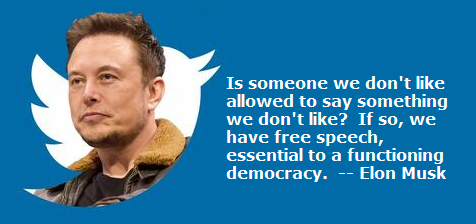
Free Speech (Musk) or Curated Speech (Obama)?

The alternative attitude was recently put forth by Obama exercising his free speech rights in front of a Stanford audience who both like him and like what he says.  In effect he said he is all for free speech but tech companies need to censor some speech to protect democracy.  Seems like a semi-pregnant posture.  It reminds me a Rodney Dangerfield scene portraying a business executive: He tells his secretary, “Hold some of my calls!”

Jenin Younes explains the issue and its import in her Brownstone Institute article The Federal Government Forces Social Media Companies to Censor Americans.  Excepts in italics with my bolds and added images.

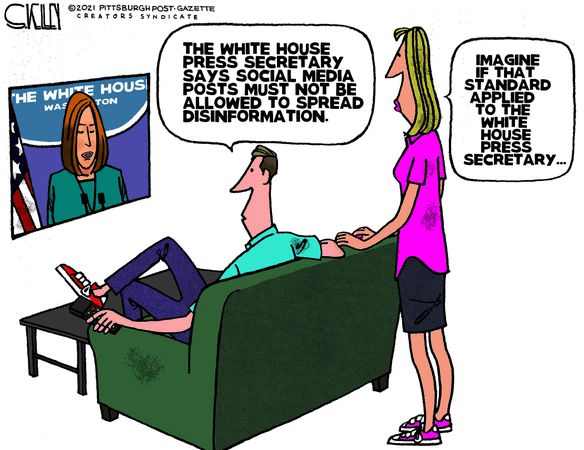
In May of 2021, the Biden Administration began a public, coordinated campaign to combat the dissemination of “health misinformation” related to Covid, especially across social media platforms.

Members of the Administration, including Surgeon General Vivek Murthy and the President himself, often through White House Press Secretary Jen Psaki, have made clear that they blame Big Tech for American deaths from the virus, and insist that these platforms have an obligation to censor those who articulate views that depart from the Government’s messaging on Covid-related matters.

The Administration has stated that it supports “a robust anti-trust program,” a not-so-subtle warning that if the Twitters and Facebooks of the world do not do the Government’s bidding, they will suffer the consequences.

The campaign has been increasing in intensity for nearly a year.

Ms. Psaki and Dr. Murthy have subsequently stated that the government is flagging problematic posts for social media platforms to censor and commanded them to elevate the voices of those who promote the approved messaging through algorithms while banning those whose perspectives conflict with the government.

The President has affirmed his belief that social media platforms “should be held accountable” for misinformation circulated on them. On March 3, Dr. Murthy announced an initiative, wherein he demanded that tech companies provide the government with “sources of misinformation,” including the identity of specific individuals, by May 2.

Like many others around the world, Michael P. Senger of California, Mark Changizi of Ohio, and Daniel Kotzin of Colorado, operated Twitter accounts that centered around criticizing government and public health Covid restrictions. All three accounts rapidly became popular.

Starting last spring, right around the time the Biden Administration’s efforts became public, the three were subject to temporary suspensions. Mere days after Dr. Murthy’s March 3 statement, Mr. Kotzin was suspended for a week, and Mr. Senger permanently. This means he is never permitted to create another Twitter account. He has lost his 112,000 followers, and in his own words, been “silenced and completely cut off from” the network he developed over two years.

According to Twitter, the suspensions were for spreading Covid “misinformation.” Mr. Senger, Mr. Changizi, and Mr. Kotzin had, in the cited tweets, expressed opposition to vaccine mandates and suggested that the vaccines do not slow the spread of Covid. They also argued that government-imposed restrictions do not work to mitigate viral spread, the risks Covid poses to children are sufficiently low to disfavor vaccination for them given the long-term unknowns, and naturally acquired immunity is superior to that attained through vaccination.

None of these claims is outside the realm of legitimate scientific discourse.

In fact, figures like CDC Director Rochelle Walensky, Anthony Fauci, and President Biden, who a mere six or eight months ago expressed absolute confidence that, for example, the vaccines stop transmission and confer better protection than naturally acquired immunity, have now been confronted with unequivocal evidence that they were wrong.

A meta-study out of Johns Hopkins University concluded that lockdowns did not reduce Covid deaths, while causing quite a bit of harm, corroborating observational data from around the world. Several Scandinavian countries recommend against vaccinating healthy young children based on an objective risk assessment, and study after study has proven that naturally acquired immunity is superior to vaccine-induced immunity.

Following nearly two years of insistence that community masking is effective, many prominent public health officials have changed course. It is a great irony that those who have been so wrong throughout the pandemic now seek to silence dissenters, particularly those who have proven prescient on many topics.

And even if they were expressing flatly incorrect views, the First Amendment gives them the right to voice those opinions. The concept of free speech was embraced by the Framers of the Constitution, who were clearly wiser than many who govern us today. They recognized that censorship does not work practically: rather, it encourages people to operate covertly, often exacerbating the problem, and that the cure to bad speech is good speech.

But most of all, they understood that giving government the authority to determine which ideas should be heard and which should be suppressed is a dangerous game.

Of course, many will argue that Twitter and other tech companies censored Mr. Senger, Mr. Changizi, and Mr. Kotzin of their own volition, and as they are private actors, the First Amendment is inapplicable.

That argument should be rejected. When the government commandeers, coerces, or utilizes private companies to accomplish what it cannot do directly, courts recognize that is state action. In a mid-20th century version of this case, Bantam Books v. Sullivan, the Supreme Court held that a state government commission consigned with reprimanding sellers of pornography and advising them of their legal rights (a veiled threat) “deliberately set about to achieve the suppression of publications deemed ‘objectionable’ and succeeded in its aim.” The Court looked “through forms to the substance” and concluded that this program violated the First Amendment.

That is similar to what is happening here. The Biden Administration knows that it cannot get away with issuing orders directly prohibiting people from articulating views about Covid-related matters that differ from the government’s, or from obtaining users’ private information, so it is coercing companies into doing this on the government’s behalf.

Fearing reprisal from the government—reprisal that the government has publicly contemplated—the companies are ramping up censorship. These companies are also likely to turn over information about users that Dr. Murthy demanded, a violation of the Fourth Amendment’s prohibition against warrantless searches.

Not only are individuals like Mr. Senger being silenced outright. Mr. Changizi, Mr. Kotzin, and millions of others are afraid to say what they really think because they do not want to suffer Mr. Senger’s fate. Courts should “look through forms to the substance” and recognize what is going on.

The Government is deciding what speech is acceptable and may be heard, and what speech is not acceptable and must be silenced, on the most hotly debated political topics of our time. This strikes at the heart of what the First Amendment is supposed to protect.

See also Weaponized Claims of Disinformation


Earth Day 2022: Gladness Expels Gloom

Cameron English explains in his ACSH article Earth Day 2022: Doomsday Isn’t Around The Corner.  Excerpts in italics with my bolds and added images.

As earth day approaches, activist groups have amplified their predictions of an impending environmental disaster. A brief survey of the evidence shows that the situation isn’t nearly as dire as they claim.

Earth Day is just around the corner. Activists outfits like Environmental Working Group (EWG) are using the run-up to this annual celebration to promote fear of pesticides and, for some reason, the musings of Michelle Pfeiffer. Let’s use the time a little more wisely and consider just two examples that illustrate how much progress we’ve made in promoting human flourishing and protecting the environment.

The point of this exercise, to plagiarize myself from this time last year, is to remind the world that doomsday isn’t inevitable. As we deploy more resources to solve the very real environmental problems we face, life on this planet gets better.

Let’s start with a well-established theory from economics known as the Environmental Kuznets Curve (EKC): economic growth is initially accompanied by increased pollution. Over time, however, we acquire enough resources to invest in technologies that promote sustainability. As the authors of a 2020 study noted:

The EKC literature suggests that economic growth may affect environmental welfare through three different channels: scale effects, composition effects and technique effects. The growth of the economic scale would result in a proportional growth in environmental pollution, and the changes in the industrial structure would lead to the reduction of pollution intensity.

Further economic growth causes technological progress through which dirty and obsolete technologies are replaced by upgraded and cleaner technologies that improve environmental quality.

That’s a foundational point worth remembering because EWG and its ideological allies would have you believe the opposite conclusion, that our “exploitation” of earth’s resources is inherently destructive.

Evidence from all over the world exposes the folly of such thinking.
Let’s consider some examples.

Cleaner air than ever before

To enlarge, double-click image or open in new tab.

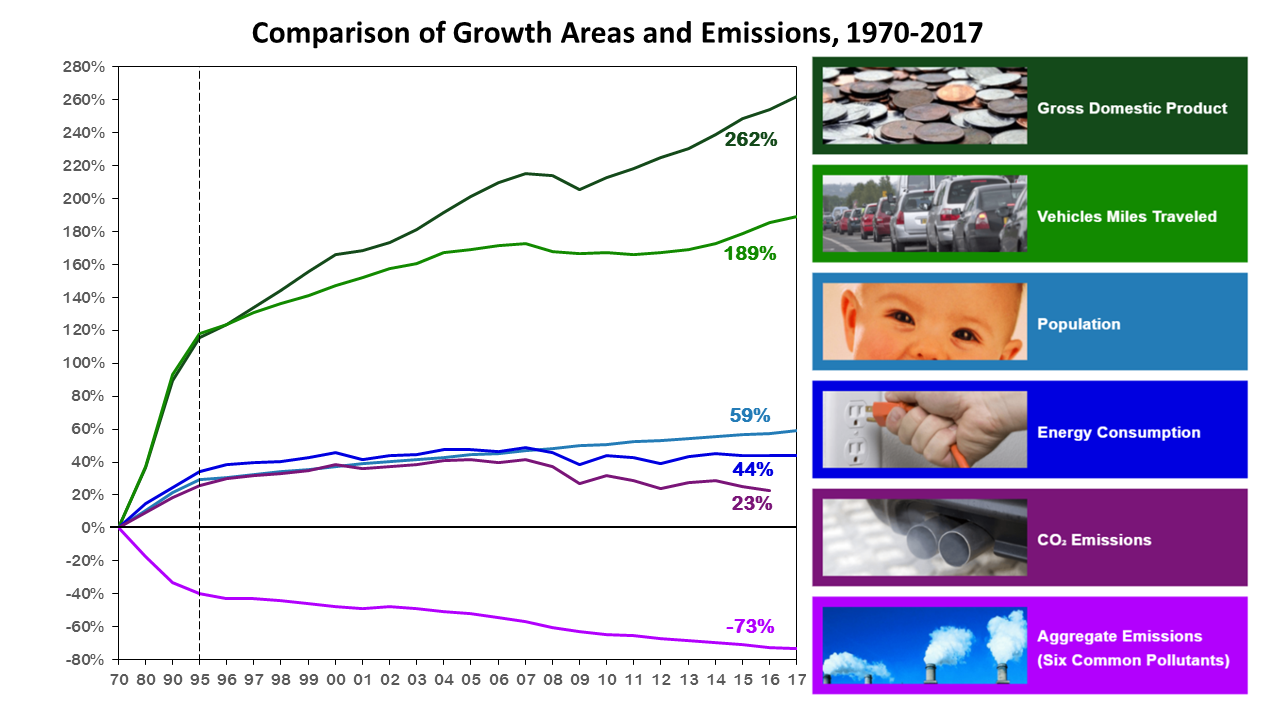
Since 1970, the EPA notes, the combined emissions of six common pollutants have plummeted by almost 80 percent, facilitating “dramatic improvements in the quality of the air that we breathe,” the agency added. To get more specific:

Between 1990 and 2020, national concentrations of air pollutants improved 73 percent for carbon monoxide, 86 percent for lead (from 2010), 61 percent for annual nitrogen dioxide, 25 percent for ozone, 26 percent for 24-hour coarse particle concentrations, 41 percent for annual fine particles (from 2000), and 91 percent for sulfur dioxide.

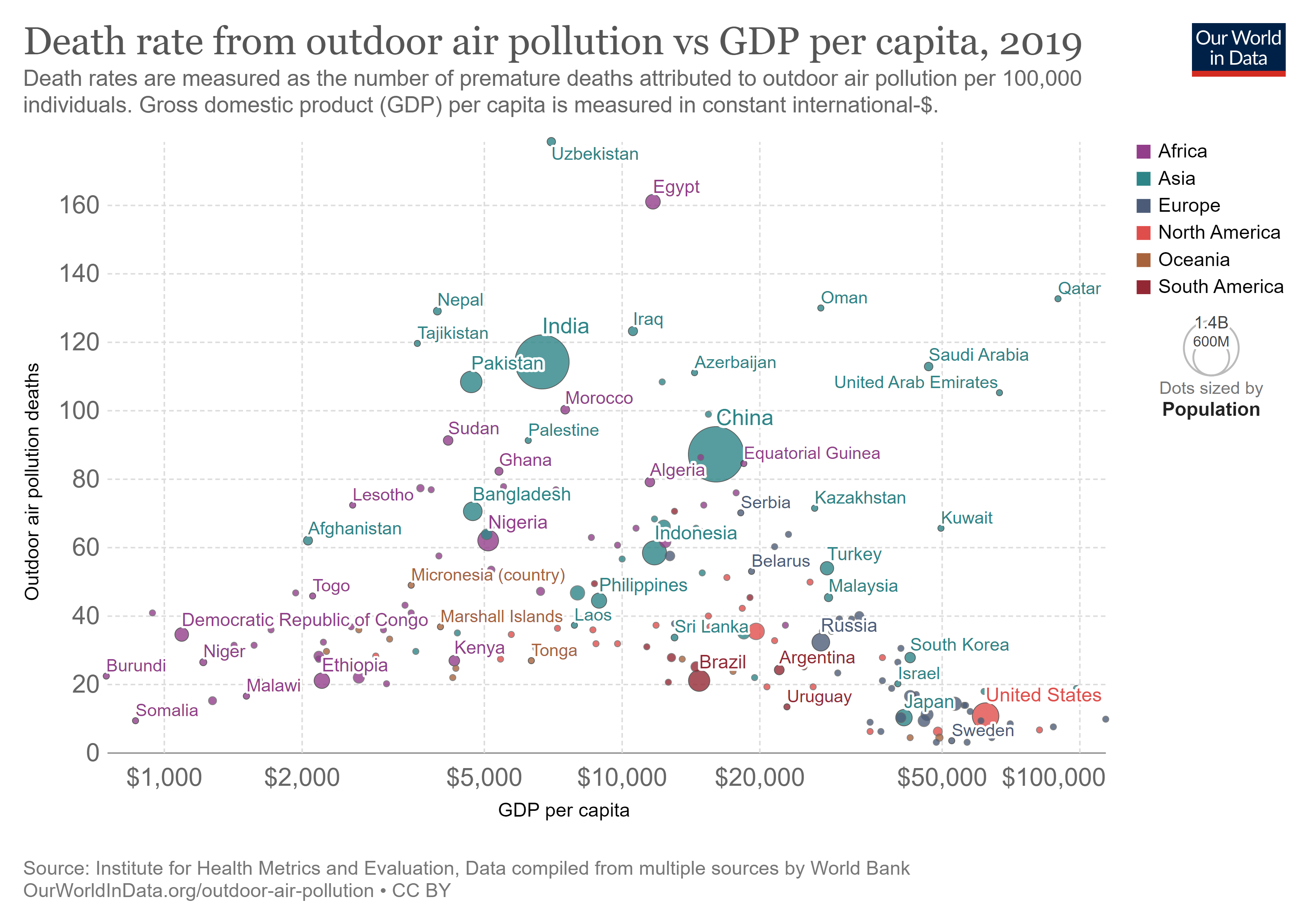
The EPA attempted to pat itself on the back by attributing these declines to its regulatory actions. But that analysis is incomplete. [Unmentioned was the fact consumption of clean-burning natural gas increased 23% during the same period these pollutants declined.] Meaningful environmental protection efforts don’t come cheap; wealthy countries are usually the only ones with the resources to reduce pollution. There’s a tight correlation between a nation’s GDP and the number of deaths attributed to outdoor pollution.

To enlarge, double-click image or open in new tab.

Our World in Data drew two very important observations out of these numbers; both point to the importance of economic growth as a weapon against pollution. Death rates tend to be lowest in the poorest and wealthiest countries. Nations with higher death rates, India, for instance, are often emerging economies that haven’t yet turned their attention to pollution reduction. There are some outliers to this trend, of course. Certain countries have high rates of pollution but low rates of respiratory mortality, Our World Data also explained:

Countries such as Qatar, Saudi Arabia, Oman, Kuwait, and the UAE have a comparably lower risk of premature death, despite high levels of pollution. They do, however, have a significantly higher GDP per capita than their neighbors … Overall health, wellbeing and healthcare/medical standards in these nations significantly reduce the risk of mortality from respiratory illness.

Sustainable food production increasing

In response to critics of animal agriculture, I’ve recently noted that the environmental footprint of food production is significantly smaller in developed countries. The trend is similar whether we consider the amount of land dedicated to farming or the use of inputs like fertilizers and pesticides. Even looking at agricultural carbon emissions, the ultimate boogeyman these days, we can see that economic growth fuels important reductions. Our World in Data helpfully noted that.

We see a very strong rich-poor country divide. High-income countries tend to have energy-intensive industry or service-based economies. Food systems can contribute as little as 10% to total emissions.

Another way to verify this trend is to consider the environmental impacts of local vs. global food production. The latter invites the use of technological innovations and economies of scale that offset the emissions farmers inevitably generate. Policies that unnecessarily restrict access to tools like biotech crops depress crop yields and force more land into food production, further boosting carbon emissions.

Conclusion

There are more examples of economic growth driving increases in sustainability, but the point is clear: our planet gets “greener” as we get wealthier. The warnings that we’re running out of time “to restore nature and build a healthy planet” will grow more shrill as Earth Day approaches. Just remember to take the doomsday predictions with a grain of salt and reflect on the tremendous progress we’ve made in living sustainably.


#1 Security Threat: Net Zero Asset Managers

Rupert Darwall writes at Real Clear Energy Woke Investors Threaten the West’s Security.  Excerpts in italics with my bolds and added images.

In an era of rising geopolitical tensions, it is folly
to let Wall Street determine the nation’s energy policy.

As the West grapples with the energy implications of a hostile Sino-Russian alliance, the steering group of the Net-Zero Asset Owner Alliance, whose members manage over $10.4 trillion of assets, issued a statement urging Western governments not to sacrifice climate goals for energy security. “The world is still heading for an excess of fossil fuel-based energy use that will vastly exceed the carbon budget needed to meet the 1.5° Celsius Paris agreement goal. This trend must be halted,” the United Nations-backed alliance said in its April 8 statement, arguing that “the national security argument for accelerating the net-zero transition has strengthened considerably.”

What, one might ask, is the standing of asset managers to opine on national security matters? They have no expertise in this domain. It turns out that their understanding of the economics of energy policy is defective, too.

The Net-Zero Asset Owner Alliance claims that development of new oil and gas reserves will lock in fossil fuel subsidies, exacerbating market distortions. In fact, the International Energy Agency (IEA) in its 2021 net-zero report states that under its net-zero pathway, tax revenues from oil and gas retail sales fall by about 40% over the next twenty years. “Managing this decline will require long-term fiscal planning and budget reforms,” the IEA warns. Similarly, Britain’s Office of Budget Responsibility estimates that net zero policies will result in the loss of tax receipts representing 1.6% of GDP. So much for the fossil fuel subsidy myth.

If fossil fuels were heavily subsidized, eliminating them would mean fossil fuel subsidies disappear. Instead, it’s tax revenues that would melt away to zero.

The net-zero investors cite figures for the decline in solar and wind energy costs. These numbers are based on so-called levelized cost of energy (LCOE), a metric that aims to measure a plant’s lifetime costs. Wind and solar power are intermittent, but LCOE metrics exclude the costs of intermittency, which increase the more wind and solar are put on the grid. Because wind and solar output responds to weather and not to demand, the value of this output declines the more installed wind and solar capacity is available. It was for these reasons that MIT professor of economics Paul Joskow concluded in a foundational 2011 paper that using LCOE metrics to compare intermittent and dispatchable generating technologies, such as coal and natural gas, is a “meaningless exercise.”  [ See proper energy costing here: Cutting Through the Fog of Renewable Power Costs ]

Wind and solar investors don’t need to understand the economics of the grid to make money – they are shielded from the intermittency costs their investments inflict on the rest of the grid, which is one reason why their views on energy policy can be taken with a pinch of salt. Their economic illiteracy does, however, make it easy for them to subscribe to the green fairy tale of 100% renewables. They’re not responsible for keeping the lights on – that depends on traditional power plants staying fueled up and ready to spin, which is what Germany can’t do without Russian gas. Adopt the net-zero alliance’s call for no new fossil-fuel investment, and the cost of energy is bound to spiral. And if the lights go out, politicians – not woke investors – get the blame.

Investors’ opinions on energy and national security would matter less if they didn’t have political power. Bloomberg opinion writer Matt Levine argues that asset managers of giant funds form a parallel system of government that exercises overlapping legislative powers with those of governments. These government-by-asset-managers, as Levine calls them, tell companies to do things they think are good for society as a whole, “making big collective decisions about how society should be run, not just business decisions but also decisions about the environment and workers’ rights and racial inequality and other controversial political topics.”

Foremost among these areas is climate policy. Although the Biden administration has set a net-zero goal, Congress has not legislated it, and it lacks the force of law. The absence of legislation passed by democratically accountable legislators, however, presents no barrier to government-by-asset-managers legislating climate policy for the companies in which they invest. “Investors are making net zero commitments for themselves and demanding that companies issue greenhouse gas reduction targets and transition plans for meeting those targets,” says the Reverend Kirsten Snow Spalding of the not-for-profit Ceres Investor Network on Climate Risk and Sustainability.

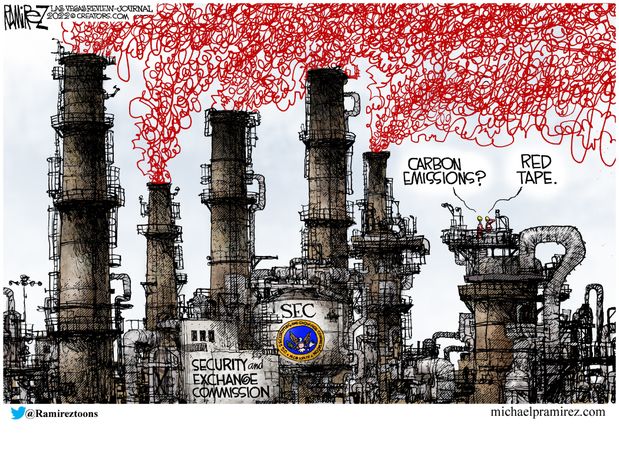
Neither Spalding nor the Net-Zero Asset Owner Alliance make a case that forcing net-zero targets on companies will boost investor returns, demonstrating that this is not about investors’ traditional concerns – making money – but about pursuing politics by other means. In this, the Securities and Exchange Commission (SEC) is working hand in glove with woke climate investors. Commenting on the SEC’s newly proposed rule on climate-risk disclosure, Spalding says that for investors who have committed zero emissions by 2050, “this draft rule is absolutely critical.”

Unlike elected politicians, woke climate investors are not accountable for the effects of their climate policies: They exercise power without responsibility. This arrangement weakens America’s ability to respond to the geopolitical challenges of a revanchist Russia and an expansionist China. “We are on a war footing – an emergency,” Energy Secretary Jennifer Granholm declared at the CERA energy conference in Houston last month. “We have to responsibly increase short-term supply where we can right now to stabilize the market and to minimize harm to American families.” Addressing oil executives in the audience, Granholm told them: “I hope your investors are saying these words to you as well: In this moment of crisis, we need more supply . . . right now, we need oil and gas production to rise to meet current demand.”

As Granholm suggested, woke investors have been trying to do the opposite. Despite the war in Ukraine, there has been no let-up in investor pressure on oil and gas companies to scale down their operations. Whatever criticisms might be made of the Biden administration’s handling of the war in Ukraine, it is responsible for taking the awesome decisions that war involves. Investors, by contrast, have no responsibility for the nation’s security and America’s ability to lead the West. By helping investors impose their desired energy policies on American oil and gas companies, the SEC is undermining the national security prerogatives of the Biden administration and eroding America’s ability to meet the challenges of a dangerous world. The SEC is playing in a domain that it has no business being in.

Hey Groomers, Leave Those Kids Alone!

Today’s topsy turvy world has turned the classic Pink Floyd admonition inside out, with teachers and others grooming kids for inappropriate sexual behavior without any moral context.  Helen Roy explains at American Mind Groomergate.  Excerpts in italics with my bolds and added images.

Say the word. Scare the establishment.

When I was a child, there was a girl I knew whose father was well-known amongst us girls to show his penis at sleepovers. In retrospect, even aside from our loud murmuring, signs of abuse were everywhere. But the man was fairly prominent in evangelical circles, and a talented musician. Other adults cheered him on in public. Other adults permitted and promoted the idea that his house was a good place for sleepovers. Maybe these other adults were completely ignorant, maybe they were in denial, maybe they didn’t care, maybe they thought it was normal, or maybe they were playing a popularity game in a toxic social system of their own.

Either way, prepubescent girls were being molested for years. And those who weren’t being molested were learning their sexual dignity didn’t matter, which undoubtedly paved the way for poor sexual decisionmaking in the future. Perhaps if these parents would have been called out by other parents for their active participation in the grooming exercise, they would have realized their culpability in the matter.

But back then, much like today, many people didn’t like to call groomers out.

Abuse remained in the shadows, under the cover of adult reputation. The difference now is that the culture of harm and perversity has been institutionalized across America. What was once seen as an indiscretion is now an industry.

And so, last week, as if triggered by some kind of underground bat signal, several familiar faces of Conservative Inc. simultaneously released op-eds and Twitter threads insisting that use of the term “groomer” in the context of fighting LGBT indoctrination in schools was very, very bad indeed.

In their view, the epithet is unfair, even immoral, because some take it as an unsubstantiated accusation of active pedophilia. “You may not be aware,” as David French lectured, “but right-wing media is swarming with allegations that anyone who, for example, opposes Florida’s House Bill 1557 (the bill misleadingly termed the ‘Don’t Say Gay’ bill by Democrats and many in the media) is either a ‘groomer’ or in league with groomers.”

Why any self-identified conservative would make defending groomers’ honor their first priority in this debate is a mystery for another day. But strictly on the merits, their conclusion is wrong because their premise is wrong. Grooming is a complicated system of behavior. What is it?

Most basically, to groom is to prepare or train someone else for a particular activity.

In the current political context, “grooming” certainly—and accurately—connotes sexually inappropriate ends, especially as its most recent usage was entirely swept up in the #MeToo movement. Even as grooming discourse reached its apparent zenith a few years ago, rape was not always the intended or actual end of the story. Rather, it was understood that to be a groomer was to actively participate in the broader system of manipulation. Ghislaine Maxwell and similar “recruiters” may not have been doing the raping, but they were all certainly engaged in grooming. Active participation does not imply full knowledge of the system itself; whether you’re a groomer or not does not rely on your own self-awareness. Orchestrated by the ill-intentioned, grooming is often facilitated by good country people, unaware that the cliches they’ve adopted as life mantras are actually deeply damaging to themselves and the people around them.

Love is love, Miss Whatever exclaims, as she caringly simulates anal sex on a teddy bear to a classroom full of five-year-olds.

In the David French version of reality, where drag queen story hour is considered a blessing of liberty, a rainbow flag in preschool is merely a neutral object, misplaced by well-intentioned people who definitely don’t have any negative intentions for your children whatsoever. How do we know this? Because they’ve never explained their intentions. We must give everyone, especially our self-proclaimed enemies, the benefit of the doubt. Stated aims are to be believed as true intentions despite any evidence to the contrary. So, conservatives should bite their tongues. It’s just not fair to suggest that their behavior, no matter how thoroughly it greases the wheels for sexual misconduct and confusion, is grooming. Don’t believe your lying eyes, and definitely don’t say groomer.

I’d like to offer some encouragement for anyone who, as a result of has-been NeverTrump countersignalling, now finds themselves reticent about using the term “groomer” in the general political sense that current usage implies: use it.

Use it because it’s true. As I’ve just explained, people can be groomers without themselves wanting to rape children.
Use it because it’s effective. The culture war is a real war, and a very particular type of war at that: an insurgency.

On one side, you have the institutions; on the other, a merry band of loosely organized rebels. Insurgency is characterized by asymmetry. Because they lack the institutional power, insurgents must rely on guerilla tactics in order to make any progress whatsoever. These tactics, in a war of language and law, boil down to political incorrectness. Political incorrectness, especially the word “groomer,” offends the enemy while galvanizing friends. Powerful memes such as this rarely conform to the tastes of bourgeois sensibilities.

Use it because they disapprove.

One of the first requirements of submission to transgender ideology (or any totalitarian regime, really) is mandated speech. Recall the Jordan Peterson phenomenon circa 2015: Canadian professor comes under fire for resisting the enactment of a bill requiring the use of preferred pronouns; failure to comply was punishable by termination of employment. Fundamentally, the modus operandi of this movement is in the manipulation of reality through language. “Here’s a more palatable way to say this,” has become a favored tactic of those who manage the decline into unreality. If only as an act of resistance to this familiar tendency, this slippery slope we’ve been gaslit into denying, say the unspeakable words. The moment we stop is the moment we lose them forever.

And if we don’t use “groomer”, we lose this moment, too—and all that comes after. Midwit middle managers, bureaucrats, and journalists, whose life mission is to keep the establishment and their establishment career afloat, know that forcing their opposition to adopt their own sensibilities is an act of political castration.

If you want to win on parents right, you must refuse
to be groomed for establishment’s eunuch class.

Stella Paul adds at American Thinker Confessions of a Disney writer

For many years, I made my living writing TV shows for Disney. I was proud of my work, considering it a privilege to make kids laugh all over the world. But in light of Disney’s disastrous embrace of pro-pedophilia policies, I’m glad that I grew disillusioned with kids’ TV and walked away from the field.

Every kids’ TV writer knows that when crafting a story, you have to be careful about “modeling behavior.”

Whatever kids see, they imitate, so you should “model” positive traits in your scripts, particularly when writing for pre-schoolers. Imagine inserting a pint-size Larry David character in your story who is obnoxious, argumentative, and sneaky. Inevitably, you’d get back notes from the story editor telling you to revamp the script to avoid modeling negative behavior.

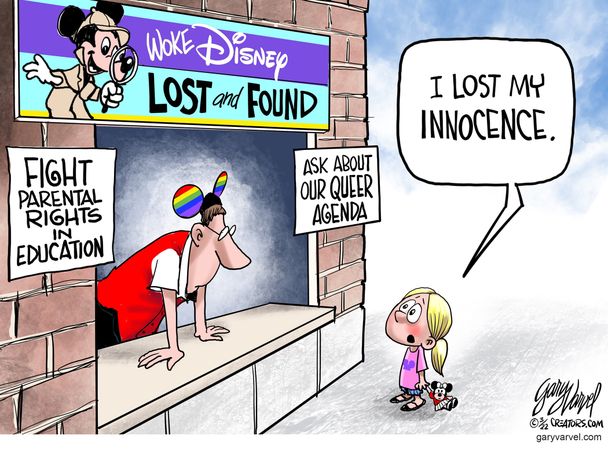
So Disney’s recent commitment to “add queerness” wherever possible can’t be explained as just trying to teach tolerance and inclusivity. The executives know that by showing “queerness,” they are modeling queerness and encouraging kids to imitate that behavior.

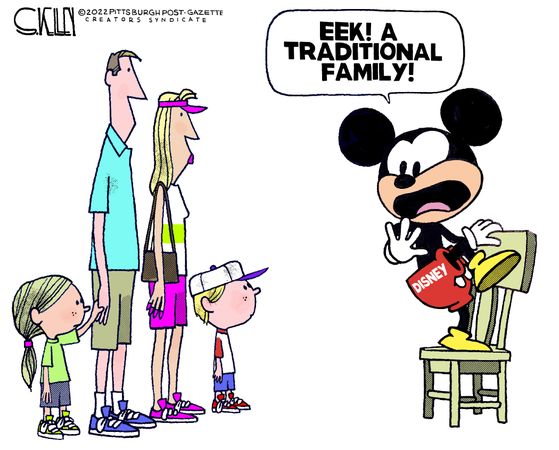
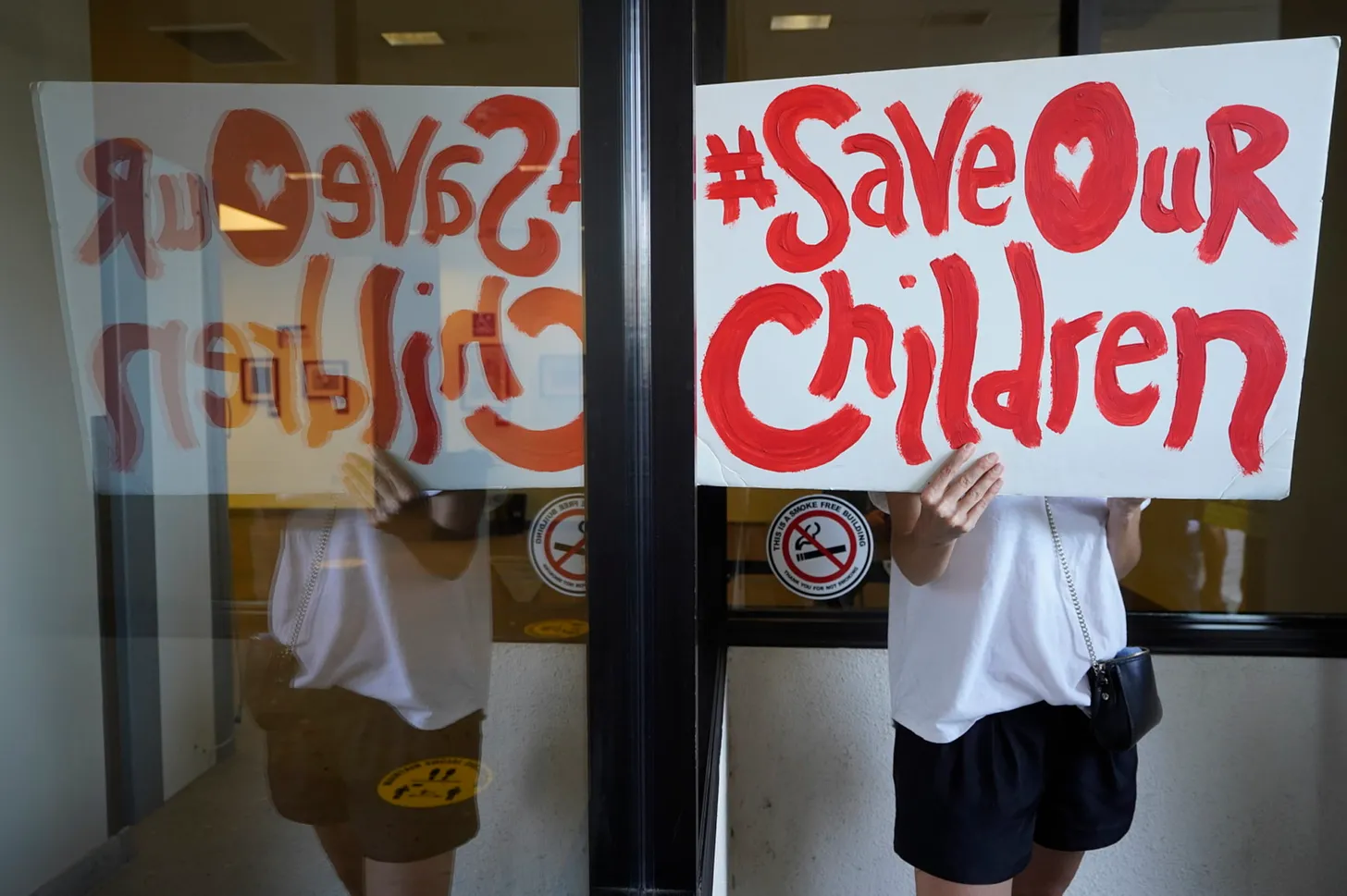
Parents are now furious about Disney’s woke agenda to sexualize children, and they’re organizing and protesting. Will their consumer boycotts of Disney’s products and theme parks have a long-term impact on Disney’s bottom line? It’s too soon to tell, but Disney’s hostility to traditional family values is not winning it friends, and its brand magic seems to be evaporating.

Footnote: Math Homework in Missouri


China Demos Big Time Covid Tyranny

Todd Jaquith reports at BizPac Review Fauci touts China’s COVID protocol when confronted on Shanghai lockdown: ‘Better than almost anybody else’.  Excerpts in italics with my bolds.

The horrific events in Shanghai continue to shock the world with images of a beleaguered population entirely at the mercy of a soulless bureaucratic regime.

But the medical bureaucrats closer to home refuse to draw the unavoidable conclusions from that terrible example, while continuing to suggest that lockdowns remain a vital tool in the federal government’s bag of tricks. As a case in point, Dr. Anthony Fauci recently spoke with MSNBC’s Andrea Mitchell to discuss the latest developments involving the COVID-19 pandemic.

When asked by Mitchell about the situation in Shanghai, Fauci waffled, refusing to condemn the lockdowns and even seeming to repeat the discredited canard that China’s draconian lockdowns had somehow enabled them to handle the pandemic “better than almost anybody else.”

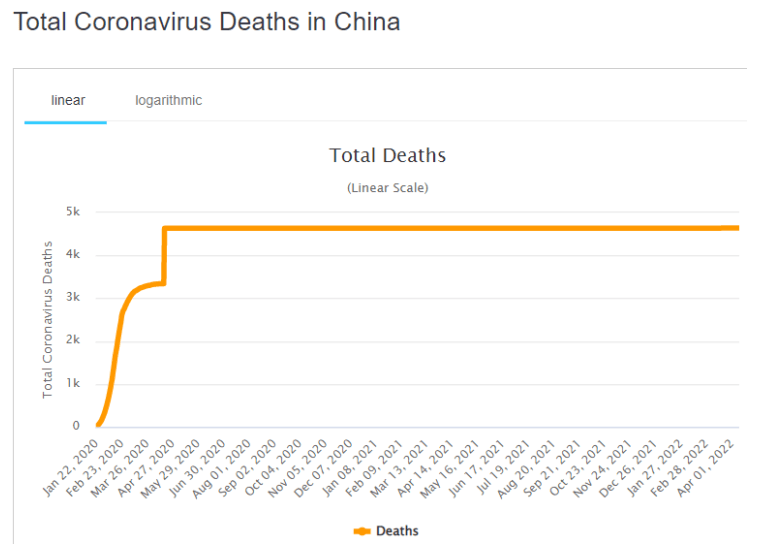
[Note:  That assertion rests on obviously bogus China statistics.  Example from China Also Abuses Covid Statistics ]

“How concerning is the outbreak in China?” Mitchell asked. “We see the lockdown in Shanghai and the State Department now ordering families out, all non-essential workers out of Shanghai.”

“Well, China has a number of problems,” Fauci replied, “two of which are that their complete lockdown, which was their approach, the strictest lockdown that you’d never be able to implement in the United States, although that prevents the spread of infection, and remember early on they were saying—and, I think, accurately—that they were doing better than almost anybody else. But lockdown has its consequences. You use lockdowns to get people vaccinated, so that when you open up, you won’t have a surge of infections, because you’re dealing with an immunologically naive population to the virus.”

That lockdowns were meant to be used to get people vaccinated must come as a surprise to most of us, given that lockdowns were implemented for nearly a year before a vaccine even existed, and were originally sold as a means to “slow the spread.” Regardless, although observing that lockdowns do indeed have “consequences,” Fauci would not condemn the practice, and even seemed to lament that China’s draconian quarantine practices could not be implemented here at home. He also refused to comment on the moral odiousness and human toll of such measures.

Meanwhile, the situation in Shanghai, a city of 25 million that has been forced into strict lockdown since mid-March, is reaching a boiling point. The terrified, starving population has displayed a rare spirit, taking to the streets by the thousands to protest the government quarantines and the lack of food.

In something that seems lifted straight from a dystopian science fiction film, like 1984 or Blade Runner, videos on social media show how drones patrol the skies, imploring the people to stay inside and “control [their] soul’s desire for freedom,” and people are reportedly even fined directly from their CBDC digital yuan accounts (a kind of state-controlled cryptocurrency) if they venture onto their balconies without a mask. Meanwhile, “dog robots” patrol the streets, barking orders at civilians to stay inside as seen in posted videos.


Shanghai has been reporting north of 20,000 new COVID cases a day, and the situation has strained the local authorities’ ability to find space for quarantine centers. Worse, reports indicate that people are required to wait for the delivery of water and food supplies, which is overwhelming the food distribution and delivery networks as supplies run low. Anger is widespread, and people have taken to the streets against the strict orders of the ruling Communist Party to demand redress of their myriad wrongs—prompting Shanghai to promise to ease restrictions.

In what are perhaps the most disturbing images from Shanghai, what seem to be police forces in hazmat suits can be seen assaulting and arresting angry civilians on the streets.

As the apocryphal Chinese curse says: “May you live in interesting times.” The people of Shanghai are learning this the hard way. We can only hope that those American admirers of the CCP’s “Zero COVID” policy are unable to enforce the same tactics here in the United States.

Footnote:

Remember that the Truckers demand was to end the “covid emergency.”  This kind of tyranny is still possible when a new “emergency” can be declared at any time without legal recourse.

Note also: China is moving to lockdown Hong Kong and Guangzhou, places known for political dissidents.


Pipe Dreams: How America Is Energized

Kite and Key Media provides a primer on America’s Energy supply in the above video and transcript below in italics with my bolds.

Pipe Dreams: How America Gets Energy.
The Backbone of America’s Energy Infrastructure

In the winter of 2022, the world watched in horror as Russian forces invaded Ukraine.  The question on everyone’s mind: “How did they think they could get away with this?”

One very good answer to that question: Because over 40% of the natural gas Europe relies on to keep itself warm during the winter … comes from Russia.  And standing up to the people who are keeping you from freezing … is a tall order.

Now, if you’re an American, this scenario might seem unthinkable. After all, the U.S. produces more natural gas than any other nation in the world.   We’d never have to rely on a hostile nation to keep ourselves warm.

Or at least that’s what you’d think…
…unless you were there the day that Russian gas pulled into Boston harbor.

Here’s a simple test to determine whether you live in a prosperous society: Do you ever worry about where you’re going to get the necessities of life?

Do you ever pull up to the gas station and worry that the pumps might be empty? Do you ever go to switch on the lights and worry that nothing will happen?

Most of the time, the answer is ‘no’ … which is why it’s so terrifying when the answer is ‘yes.’

Blackouts in Texas in early 2021. Over 10,000 gas stations running dry after a cyberattack only a few months later.   What do those incidents have in common?

They demonstrate what happens when pipelines aren’t working.

If America’s energy supplies are the lifeblood of our economy, then we can think of pipelines as something like the nation’s circulatory system.

In the U.S., pipelines are used to bring us about 90% of our petroleum and virtually all of our natural gas — which is pretty significant, given that those two power sources alone make up about 70% of the country’s entire energy use.

That’s why America has over 2.6 million miles worth of pipelines. Because without them … the whole country gets very Amish very fast.

But, as you may have noticed … not everyone is thrilled about this. In recent years, legal challenges have led to the cancellation of several major pipelines and delays for many others. From 2009 to 2018, the time it takes to get pipelines approved increased by more than 50%. 

So, what’s happening here? The objections to pipelines rest primarily on two critiques. The first is that they’ll contribute to carbon emissions. The second is that pipeline accidents could lead to oil spills.

And both of those claims … really require context to understand.

When it comes to carbon emissions, it’s important to know that the pipelines themselves aren’t really the issue. They’re just a mode of transportation.

The carbon emissions come from the petroleum and natural gas that flow through the pipelines. But here’s the catch: Getting rid of the pipelines … doesn’t mean getting rid of the emissions.

Cancelling the Keystone XL pipeline, for instance, may have felt like a win for the environment — but it’s not like that oil is gonna stay in the ground as a result. In fact, much of it is likely to be shipped to China — which isn’t exactly a low-emissions trip.

And we can probably expect to see more of that. Current government projections are that, even with a steep increase in the use of renewable fuels, we’ll still be getting about 2/3 of our energy from natural gas and petroleum … 30 years from now.

Refusing to build pipelines won’t change that reality …
but it will make the system we actually have much harder to operate.

Which gets to those concerns about safety. Do accidents occur with pipelines? Yes. It happens. However, accidents occur with all forms of energy transportation. So, the real question is what’s safest among the available options.

And on that front … pipelines do pretty well. Because if you’re not going to move fuel through the ground, you only have three other options: put it on trains, put it on trucks, or put it on boats.

Now, none of those methods is especially dangerous, but pipelines spill a lower percentage of the oil they transport than any method except boats.  And boats have … limited utility on this front. Because they still need fuel in Nebraska … and America’s 26 other land-locked states. 

So, what does a world without pipelines look like?
We already sorta know the answer.

The reason that Boston was getting gas from Russia, for instance, was because the state of Massachusetts refused to allow a pipeline to bring it from Pennsylvania. That’s the same reason, by the way, that, in January of 2022, the citizens of Boston … were paying 400% more for natural gas than those Pennsylvanians only 200 miles away — in the middle of a New England winter.

Here’s the reality: None of us are willing to live in a world where the lights don’t reliably come on or gas doesn’t reliably come out of the pump. We can aspire to a future powered by cleaner energy sources, but until that day comes … we’re going to be relying on fuel sources like petroleum and natural gas.

Which means we either rely on pipelines…

…or rely on places like Moscow…

…or get very comfortable with horses.


Critical Gender Theory Wreaking Havoc

This is an update adding to a previous post reprinted below Ruckus Over Classroom Genderism.  C. Bradley Thompson provides a detailed and disturbing accounting of the gender transition  movement operating inside the US school system. His substack article is Sex and the Schools, or, An Essay You Don’t Want to Read.  A few excerpts are in italics with my bolds.

In this new series of essays, I’d like to show you what is being taught in America’s twenty-first-century government schools and the philosophy behind it. The portrait that I will present here is not a pretty one, but it is the reality. The simple truth of the matter is that America’s government schools are intellectually bankrupt and morally corrupt. To suggest otherwise is either disingenuous or a form of head-in-the-sand-ism.

Officially, America’s schools claim to teach no moral values per se. But that claim is contradicted by the fact that they constantly push moral values such as “diversity,” “equity,” “inclusion,” “tolerance,” moral relativism, and egalitarianism. Such “values” are intended to strip children of any standards or principles they may have previously embraced, so that the teachers can replace the sometimes conservative cultural values of the kids’ parents with the political values of today’s postmodern, cultural Left—namely, egalitarianism, multiculturalism, feminism, environmentalism, transgenderism, “social justice,” socialism, etc.

The curricula in America’s K-12 government schools (and in many of the most elite private schools) is now dominated by two offshoots of Critical Theory known as Critical Gender Theory (CGT) and Critical Race Theory (CRT). Developed in America’s “ed” schools and law schools, CGT and CRT seek to deconstruct and reinvent all traditional gender categories and racial relationships. The primary delivery mechanism for inciting this social revolution is America’s government school system.

The ultimate aim of Critical Gender Theory is to deconstruct the family and replace it with the State as the primary vehicle for educating children.

The specific political goal is to create a new class of the “oppressed.” From this new class of victims will come the new revolutionaries who will keep the revolution alive and move it to the next stage of development. This is the ultimate means by which capitalism is to be dismantled and the State is to become the final arbiter of the principle, “From each according to his ability, to each according to his need.”

The battlefront comes down to two core questions: first, who shall determine the sexual mores taught to America’s young children—parents or government teachers, and, second, what sex- and gender-related values should be taught to children in America’s government schools?

And yet these fundamental questions still don’t quite capture what’s at stake in this conflict. There’s an even deeper, metaphysical question that represents the new battleground between parents and America’s Education Establishment: What is the sex-gender “identity” of each and every child? To put the issue in even simpler terms, the question is: what is a boy and what is a girl?

For tens of thousands of years, the answers to these two questions were self-evidently obvious the moment a child was born. Today, however, the answers are uncertain until the child answers them with the assistance of government schoolteachers and administrators. The question is no longer settled by nature and science and nurtured by parents.

To put a sharper edge on the matter, the question might be: how is it that 9-year-old girls can be encouraged by school officials to take puberty blockers and 15-year-old girls can be encouraged to begin a course of testosterone treatments and 17-year-old girls can be encouraged to ready themselves for double mastectomies without their parents’ knowledge and permission?

The following newspaper headline from 2022 sums up the current state of our world: “Texas Teacher Claims 20 Fourth Graders Out of 32 Students Identify as LGBTQ”![8] The teacher was proud to share this information with reporters during the school’s well publicized “pride” march. (The teachers’ pride in this “fact” no doubt raises her professional social status.) Just so we’re clear, the teacher’s claim means that almost 63 percent of students in her fourth-grade classroom in Texas—I repeat, Texas—identify as LGBTQ. Now think about what this means (statistically, it is virtually impossible)—it basically means that this teacher is either lying, engaging in wish fulfillment, or grooming. I can see no other options.

We have entered a Brave New World. This is penultimate stage of western nihilism.

.Ruckus Over Classroom Genderism.

The best overview I’ve seen comes from a veteran teacher in California. Peter Laffin writes in American Thinker The Truly Remarkable Thing about Florida’s Anti-Grooming Law.  Excerpts in italics with my bolds and added images.

It is difficult to remain objective over the Florida education fracas. So much of the episode fires up the amygdala. The innocence of children. The rights of parents. The sovereignty of individual identity. The never-ending scandal of humans and sex. To feign “neutrality” in this conflict is a sort of moral suicide. If none of this matters, what possibly could?

As someone who taught school in progressive enclaves for 14 years, I can attest that there are many good people who oppose this law for fear that it will diminish the humanity of loved ones and reverse the tide of social progress. Although I do not believe that this law will have that effect, I respect the sincerity of those who do.

Nonetheless, it remains urgent to speak the truth plainly and oppose the ever-intensifying spread of radical social theory being taught to ever-younger students.

Instances of ideological excess in American classrooms are well chronicled and widespread. We have seen enough to know that the time to act has long since passed. The Florida anti-grooming law is a necessary tool to blunt this advance, even though it seems conspicuously tame upon closer inspection. Its most controversial aspect, from which the clever but disingenuous “don’t say gay” moniker was derived, would have been uncontroversial in any other era:

“Classroom instruction by school personnel or third parties on sexual orientation or gender identity may not occur in kindergarten through grade 3 or in a manner that is not age appropriate or developmentally appropriate for students in accordance with state standards.”

The key term for those still attempting to comprehend this law is “instruction.” The target is not the casual reference, but rather the systematic instruction of academic gender theory to prepubescent children. For instance, it has become common for teachers to utilize resources like “The Genderbread Person” in SEL (social-emotional learning) curricula, as well as other ideologically tinged materials that do not reflect settled science, let alone objective reality.

Further, such instruction materials necessarily force teachers to operate beyond their professional depth and predetermined range of responsibility. Teachers are not psychologists. This was pointedly demonstrated by a mother who spoke at a PTA meeting in Spreckles, California after her daughter’s teacher admitted to stalking her online in order to recruit her into an LGBTQA+ club. “Do you have a doctorate in psychiatry that I don’t know about?” she asked. Also, teachers are not paid by taxpayers to be activists involved in recruiting 5- to 8-year-olds into political causes. Too many teachers have departed the realm of education and entered into the realm of indoctrination, and often with a creepy, messianic air. As such, they must be reined in.

The Florida law prohibits teachers from formally instructing students on these matters before the 4th grade. Until then, the situation will remain in the hands of the students’ families and their doctors.

It would be difficult to contrive a more sensible demand in reaction to the current climate. This is perhaps the most stunning aspect of the entire controversy. Beneath the wailing and screeching is an utterly reasonable request.

And as such, it is no surprise that the vast majority of Floridians support the new law, along with the vast majority of the U.S. voting population. Nor is it a surprise that voters who have read the actual text of the law support it in even greater numbers. Even a majority of Democrats back the legislation. And yet, outlets like NPR and CNN, and subsequently their audiences, have reacted to its passage as though it were an edict from the pope. The cultural left’s blind spot here is profound. At this point, the DNC and its media allies should be charging Ron DeSantis consulting fees. No one is working harder to elect him president.

“The fundamental cause of trouble in the modern world,” philosopher Bertrand Russell once said, “is that the stupid are full of certainty, while the intelligent are full of doubt.” For years, the cultural left has taken the Democrat party hostage and forced it to abandon any pretense of intellectual humility, let alone electoral realism. Both parties have undergone bouts of dangerous self-certainty in recent times. The Republican Party was guilty of this during the Iraq war. But it is obvious that today’s Democratic Party has claimed pathological self-certainty as its banner. While even the most egalitarian countries in the West retreat from pushing gender ideology on prepubescent children, American liberals appear bent on doubling down.

Because of the emotional component, it is understandably difficult to zoom out and gain perspective. But the current environment beggars belief. Can the cultural left really be so certain of an academic theory — so certain that sex is “assigned” at birth as opposed to “observed” in the same manner as eye and hair color, weight, and length — that they will continue to demand its presence in early childhood curriculum? Even at the cost of looming political catastrophe?

It’s still possible that it will relent. But it will require a good dose of humility.

Peter Laffin is a teacher and writer in Laguna Niguel, California. His work has appeared in the American Spectator.

For more on SEL, see Why the Classroom Activists Never Give Up

Social-Emotional Learning supposedly arose out of the COVID-19 pandemic and a need to attend to the emotional psyches of fragile youth. It is a shift in the role of a teacher from an educator to a therapist and places a high value on a child’s emotional competency over academic performance. After locking kids in their homes, isolating them from their peers, muzzling them with ineffective face diapers, and pounding them with fear and doom for 2 years, activists have swooped in to provide emotional support in the classroom once they were permitted to return. In typical government fashion, it seems like a solution looking for a problem. They didn’t create SEL to mend the fragile psyches of youth, they damaged the fragile psyches of youth to push SEL.”

“In a recent Twitter thread by podcaster Josh Daws of the Great Awokening Podcast, Daws lays out in 23 tweets how CRT and gender ideology have been deployed sequentially and their effect on the minds of America’s youth. Based on the work of postmodern critic James Lindsey, Daws suggests that the opening salvo of CRT was to tear down approved identity in the youth. It imparts guilt, shame, and social rejection of majority identities like whiteness, maleness, a binary gender paradigm, or even heterosexuality. Once a person has been made to reject their own race, gender, or sexuality, it is followed up with an approved list of identities from which they can choose in order to be socially accepted.”