The Phishy Election

The age of distributed computers and internet connectivity results in everyone from time to time receiving phishing emails.  Just opening the link can get malware installed on your notebook, and can even generate a ransom demand from those who kidnapped your device.  The same kind of criminals working 24/7 to steal from you are suspected of using their methods to steal the Office of the President of the US.

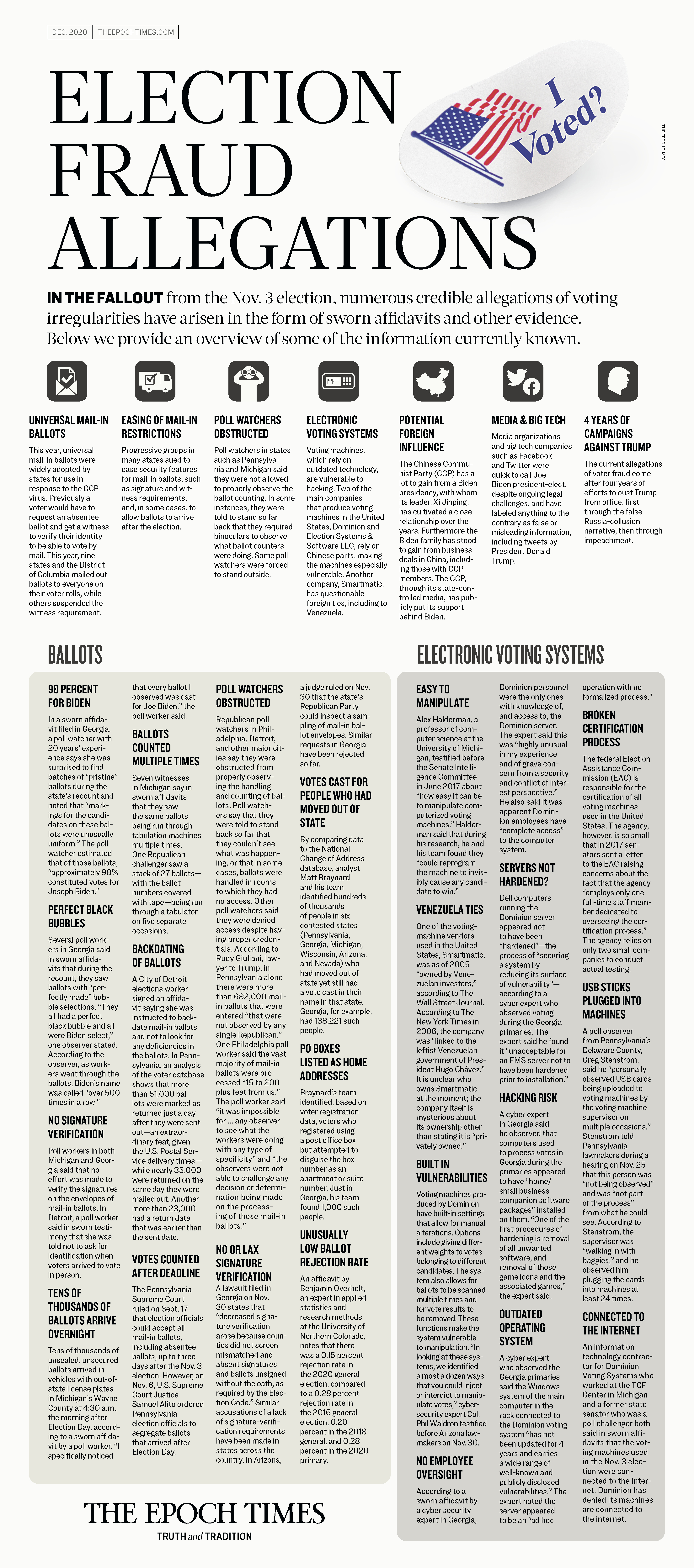
As we know from TV shows and reading crime novels, any criminal investigation seeks to prove the perpetrators possessed three factors:  Motive, Opportunity, and Means.  No one doubts the Democrats had plenty of Motive, as evidenced by a four-year slow-moving coup against Trump from the moment the 2016 results were confirmed.  As we now see, the Opportunity came in Democratic control over big city strongholds in the large battleground states.  And as the legal affidavits confirm, the Means consisted of both Old School ballot stuffing fraud (ballot harvesting and overwriting) and New School counting fraud (using computer algorithms to warp the results). The allegations summarized in the exhibit below show how perpetrators added votes in big cities and suppressed votes in the countryside.

There is a short timetable for exposing these illegal tactics, and the media is looking to play out the clock, after having already declared Biden the winner.  An example is the recent Washington Post article Swing-state counties that used Dominion voting machines mostly voted for Trump.  At least they are finally admitting that the election results are questionable.  But like all the MSM, they are resolutely averting their eyes from anything that could sour the Biden victory they so covet. Excerpts in italics with my bolds.

A review of 10 key states (Arizona, Colorado, Florida, Georgia, Michigan, Minnesota, Nevada, North Carolina, Pennsylvania and Wisconsin) finds that Dominion systems were used in 351 of 731 counties. Trump won 283 of those counties, 81 percent of the total. He won 79 percent of the counties that didn’t use Dominion systems.

The idea that Trump only lost, say, Pennsylvania, because of Dominion voting systems has to reconcile with the fact that Trump actually won more votes in counties that used Dominion systems (beating Biden by about 74,000 votes in those counties) but lost the state because he was beaten by 154,000 votes in non-Dominion counties. That same pattern holds in Wisconsin as well.

In other words, there’s nothing to suggest that counties using Dominion systems looked significantly different from counties that didn’t. The idea that Biden is president-elect because of some nefarious calculations simply doesn’t match the reality of the county-level vote results.

The WP conclusion ignores the analyses that show how the algorithms effects show up in the results.  In order to shift votes from Trump to Biden, the perpetrators needed to identify large pools of Trump-only votes (ballots cast only for the President race) that could be switched to Biden-only votes.  By skimming in this way, Trump wins those counties as expected, but by enough fewer votes to lose the state. As well, it appears that forensic testing of seized ballot machines will confirm that vote tabulations are converted from whole numbers to decimals so that weighting can be applied.  In one example, Biden votes were weighted 1.3 while Trump votes weighted at 0.7.  Thus the race results effectively shift votes from Trump to Biden.

See: Inside the Election Black Box

Meanwhile in the big city precincts, large Biden margins are already organized through production of mail-in ballots stuffed into the machines.

From Previous Post:  Election Fraud Too Big to Fail?

Rx for Covid-fighting Politicians

Elected officials have become one-trick ponies.  All they know is locking people down for the sake of social distancing.  That was a reasonable strategy when the outbreak began, before the disease and its treatment was understood, and in order to protect the health care system from overload.  But now a different prescription is required, if leaders have the courage and wisdom to adapt.  Here are three recommendations that will stop the damage being done in the name of “fighting Covid19.”

1.  Do not prevent school children from training their immune systems.

Shutting schools and/or applying social distancing protocols to children are not only unnecessary, but harmful.  Stopping normal social interaction among children takes away the exposure they need to develop immunity for future outbreaks.  Donna L. Farber and Thomas Connors and Columbia University wrote Quarantine May Negatively Affect Kids’ Immune Systems. H/T Jeffrey Tucker at AIER (here).  Excerpts in italics with my bolds.

During the Covid-19 pandemic, the world is unwittingly conducting what amounts to the largest immunological experiment in history on our own children. We have been keeping children inside, relentlessly sanitizing their living spaces and their hands and largely isolating them. In doing so, we have prevented large numbers of them from becoming infected or transmitting the virus. But in the course of social distancing to mitigate the spread, we may also be unintentionally inhibiting the proper development of children’s immune systems….Immunological memory and tolerance learned during childhood serves as the basis for immunity and health throughout adulthood.

[The article then continues and actually invokes the great taboo word of our age: exposure. It’s good. Exposure is good. It is necessary. It is needed. Not bad. Good.]

However, for memory T cells to become functionally mature, multiple exposures may be necessary, particularly for cells residing in tissues such as the lung and intestines, where we encounter numerous pathogens. These exposures typically and naturally occur during the everyday experiences of childhood — such as interactions with friends, teachers, trips to the playground, sports — all of which have been curtailed or shut down entirely during efforts to mitigate viral spread. As a result, we are altering the frequency, breadth and degree of exposures that are crucial for immune memory development.

[Okay, now it is time for the writer to invoke a bit of memorable scientific knowledge. It’s a beautiful paragraph with a stunning opening sentence.]

Failing to train our immune systems properly can have serious consequences. When laboratory mice raised in nearly sterile conditions were housed together in the same cage with pet mice raised in standard conditions, some of the laboratory mice succumbed to pathogens that the pet mice were able to fight off. Additional studies of the microbiome — the bacteria that normally inhabit our intestines and other sites — have shown that mice raised in germ-free conditions or in the presence of antibiotics had reduced and altered immune responses to many types of pathogens. These studies suggest that for establishing a healthy immune system, the more diverse and frequent the encounters with antigens, the better.

Summary:  The kids are all right, let them get on with their lives for their own sakes.

2.  Count people as cases only if they are sick from a viral load.

Public health officials need to stop confusing and scaring the public with positive PCR tests.  As noted in previous posts here, PCR tests amplify a viral trace up to 35 or 40 doublings, which is too small a viral load to make the person sick or to transmit to others.  The rapid tests now available do not amplify and the protocol now should be to do antigen tests on people with symptoms to identify actual patients needing treatment and isolation.

Background posts: COVID Fearmongering With ‘Cases’ of Perfectly Healthy People

Fake Wave of False Positives

Summary:  The BinaxNOW test detects antigens — proteins unique to the virus that are usually detectable whenever there is an active infection.

3.  Implement practical effective measures to protect the vulnerable nursing home residents and staff.

Kevin Pham, MD, explains in his essay If We’re Going to Control COVID, We Need to Make This Crucial Change.  Excerpts in italics with my bolds.

According to an Associated Press report, there has been a four-fold rise in nursing home-related cases of COVID-19 since June. And CDC data shows there has been an increase of nearly 1,000 COVID-related deaths in nursing homes from September to October.

There are three ways for COVID-19 to enter a nursing home: 1.) through staff and faculty working at the facility, 2.) through visitors who enter the premises, and 3.) through forcing nursing homes to admit patients with active infections.

The disastrous effects of the latter policy is one reason that Gov. Andrew Cuomo’s New York has contributed a disproportionate share of American COVID-related deaths. Thankfully, his order was finally reversed in May.

The more recent increase in nursing home cases are likely a function of the former two ways that COVID enters a nursing home. This is where we need to focus our efforts, with refined policies.

Test nursing home visitors.

Current guidance from the Centers for Medicare and Medicaid Services restrict the number of visitors in ways that are lacking. The focus is temperature checks and screening questionnaires, as well as observing for signs or symptoms of illness.

This may have been reasonable early on in the pandemic, when any sort of a screen was better than no screen, but it’s insufficient now. We have had point-of-care testing for months now, and more recently, rapid antigen tests that require no special lab equipment, no specialized storage, not even refrigeration.

No effort should be spared in procuring what is needed to test everyone going into a nursing home, whether visitor or staff. Key to making this work: the FDA should lift restrictions requiring all tests to reviewed at a lab, so rapid tests that don’t need lab equipment can truly live up to their promise.

Stronger mitigation measures for nursing home staff.

It is likely that infected staff are driving the rise in cases, as visitations are relatively restricted. The AP report shows a proportionate increase in the number of staff cases and resident cases. This is naturally difficult to control because the staff live in the community and work in the nursing homes. Their job is vital.

The latest CMS guidance on staff testing frequency are intended to test often enough to detect cases early enough to stop transmissions, from staff to residents.

Clearly that hasn’t been enough. We need more targeted testing to detect early cases, and that has to be done every time someone leaves and reenters the nursing home. This may be difficult for some facilities, especially rural ones, that lack either financial or human resources, but again, no effort should be spared to enable nursing homes to test everyone going to visit or who works with our elders.

Ensuring a steady and abundant supply of tests is one solution, but nursing home leadership should consider providing for housing for staff for several days at a time to obviate the need to go into the community where there may be high levels of COVID-19. Such an isolation “bubble” was good enough for the National Basketball Association, so it ought to be good enough for older Americans.

If a facility cannot manage these steps on their own, they should receive help, post haste. Every mayor and governor should immediately ask nursing home leaders for their plans, and to identify any barriers. If helped is needed, they need to arrange for its provision.

Summary:  The primary focus of our COVID response should center on helping those known to be most at risk from the virus—nursing homes, the elderly and the vulnerable, and those who work with them. Anything else, especially now, would be unconscionable.


America’s Future: Market or Jungle?

This post is about the US at a junction, dramatized by the crisis of a flawed federal election.  The change point is also demonstrated by dictatorial behavior of elected officials claiming to protect the citizenry from coronavirus. As explained below, there are in principle two ways of organizing a society:  a market based on free choices by individuals, or a jungle where the powerful decide and the weak conform.  The US was conceived and operated for 2 centuries upon the market paradigm, but is now facing an activist minority seeking to overthrow that model in favor of autocracy in the form of one-party rule.

Many people have heard of Jordan Peterson due to his battles against post modernism and progressive social justice warfare. Bruce Pardy is another outspoken Canadian professor, belonging to the Faculty of Law, Queen’s College, Kingston, Ontario. This post will provide excerpts from several of Pardy’s writings to give readers access to his worldview and its usefulness making sense of current cultural struggles, and the US on the brink of a socio-political revolution.

In 2009 Pardy wrote Climate Change Charades: False Environmental Pretences of Statist Energy Governance
The Abstract:
Climate change is a poor justification for energy statism, which consists of centralized government administration of energy supplies, sources, prices, generating facilities, production and conservation. Statist energy governance produces climate change charades: government actions taken in the name of climate change that bear little relationship to the nature of the problem. Such actions include incremental, unilateral steps to reduce domestic carbon emissions to arbitrary levels, and attempts to choose winners and losers in future technology, using public money to subsidize ineffective investments. These proffered solutions are counter-productive. Governments abdicate their responsibility to govern energy in a manner that is consistent with domestic legal norms and competitive markets, and make the development of environmental solutions less likely rather than more so.

Pardy also spoke out in support of Peterson and against the Canadian government legislation proscribing private speech between individuals. His article in National Post was Meet the new ‘human rights’ — where you are forced by law to use ‘reasonable’ pronouns

Human rights were conceived to liberate. They protected people from an oppressive state. Their purpose was to prevent arbitrary arrest and detention, torture, and censorship, by placing restraints on government. The state’s capacity to accommodate these “negative rights” was unlimited, since they required only that people be left alone.

If only arm twisting were prohbited beyond the ring.

But freedom from interference is so 20th century. Modern human rights entitle. We are in the middle of a culture war, and human rights have become a weapon to normalize social justice values and to delegitimize competing beliefs. These rights are applied against other people to limit their liberties.

Freedom of expression is a traditional, negative human right. When the state manages expression, it threatens to control what we think. Forced speech is the most extreme infringement of free speech. It puts words in the mouths of citizens and threatens to punish them if they do not comply. When speech is merely restricted, you can at least keep your thoughts to yourself. Compelled speech makes people say things with which they disagree.

Some senators expressed the view that forcing the use of non-gendered pronouns was reasonable because calling someone by their preferred pronoun is a reasonable thing to do. That position reflects a profound misunderstanding of the role of expression in a free society. The question is not whether required speech is “reasonable” speech. If a statute required people to say “hello,” “please” and “thank you,” that statute would be tyrannical, not because “hello,” “please” and “thank you” aren’t reasonable things to say, but because the state has dictated the content of private conversation.

Traditional negative human rights give people the freedom to portray themselves as they wish without fearing violence or retribution from others. Everyone can exercise such rights without limiting the rights of others. Not so the new human rights. Did you expect to decide your own words and attitudes? If so, human rights are not your friend.

These positions derive from bedrock reasoning by Pardy on the foundations of law and legitimacy. An insight into his thinking is his rebuttal of a critic The Only Legitimate Rule: A Reply to MacLean’s Critique of Ecolawgic Dalhousie Law Journal, Spring 2017

Ecosystem as One model of Society

An ecosystem is not a thing. It does not exist as a concrete entity. “Ecosystem” is a label for the dynamics that result when organisms interact with each other and their environment. Those dynamics occur in infinite variation, but always reflect the same logic: Competition for scarce resources leads to natural selection, where those organisms better adapted to ecosystem conditions survive and reproduce, leading to evolutionary change. All participants are equally subject to their forces; systems do not play favourites.

In ecosystems, the use of the word “autonomy” does not mean legally enforced liberty but the reverse: no externally imposed rules govern behaviour. In ecosystems unmanaged by people, organisms can succeed or fail, live or die, as their genetically determined physiology and behaviour allow. Every life feeds on the death of others, whether animal or plant, and those better adapted to their circumstances survive to reproduce. Organisms can do anything that their genes dictate, and their success or failure is the consequence that fuels evolution.

When an antelope is chased by a lion and plunges into a river to escape, that action allows the antelope to survive and thus to reproduce. The offspring may carry a genetic disposition to run into water when chased by predators. There are no committees of either antelopes or humans deciding how antelopes will behave. Autonomy in ecosystems is not a human creation. It is not based upon human history or culture and is not a human preference.

Market as a Different Model of Society

A market is not a thing either. Nor is it a place. Markets, like ecosystems, do not exist as concrete entities. “Market” is a label for the dynamics that result when people exchange with each other. Bargains may be commercial in nature, where things are bought and sold, but they also occur in other facets of life. For example, in Ecolawgic I suggested that marriage is a kind of exchange that is made when people perceive themselves better off to enter into the bargain than not to.

As I said in Ecolawgic, “Laws and governments can make markets more stable and efficient, such as by enforcing contracts and creating a supply of money, but they create neither the activity of trading nor the market dynamics that the transactions create.”  A market is not a place or a legal structure but the dynamics of a collection of transactions. It does not exist before or independently of the transactions within it. The transactions make the market. Transactions are not created by governments but by the parties who enter into them.

People transact whether they are facilitated by governments or not. The evidence is everywhere. If it were not so, human beings would not have bartered long before there were governments to create money and enforce contracts. During Prohibition, no alcohol would have been produced and sold. Citizens of the Soviet Union would not have exchanged goods. Today there would be no drug trade, no black market and no smuggling. Cigarettes would not be used as currency inside jails. People would not date, hold garage sales or trade hockey cards. There would be no Bitcoin or barter. Try prohibiting people from transacting and see that they will transact anyway. They will do so because they perceive themselves as better off. Sometimes the benefit is concrete and sometimes it is ethereal. The perception of benefit is personal and subjective.

Ecosystems are Coercive, Markets are Voluntary

Ecosystems and markets share many features but they differ in one important respect. Violence plays an important role in ecosystems but is not a part of voluntary market exchange. Ecosystems are arenas for mortal combat. Lions eat antelopes if they can catch them. Nothing prevents taking a dead antelope from a lion except the lion’s response. There are no restrictions on survival strategies, and organisms do not respect the interests, habitats or lives of other organisms.

Markets, in contrast, proceed upon the judgment of the transacting parties that they are better off to trade than to fight. The hunter did not shoot the woodworker to get chairs, and the woodworker traded for meat instead of stealing it. They chose to trade because it made them better off than fighting. The reasons are their own. Perhaps they were friends, colleagues or allies. Perhaps they believed that harming other people is wrong. Perhaps they hoped to have an ongoing trading relationship. Perhaps fighting carried risks that were too high and they feared injury or retribution. Perhaps trading was less work than fighting.

For whatever reason, they chose to trade. This choice is not universal. People have traded throughout human history, but they have also fought. I do not maintain that trading is any more “natural” or inbred than fighting, but neither is it is less so. When people choose to fight, they are no longer part of a market. Markets are like ecosystems with the violence removed.  They are the kinder, gentler version of ecosystems.

There are only two models for legal governance and only one legitimate rule.

The logic is as follows:
1. In the wild, organisms compete for scarce resources. Those organisms better adapted to conditions survive and reproduce. Their interactions constitute ecosystems. No legal rules govern behaviour and might is right.

2. Human beings trade spontaneously. Parties enter into transactions when they perceive themselves as better off to trade than to fight. Their transactions constitute markets.

3. Moral values and policy goals are preferences whose inherent validity cannot be established. They are turtles all the way down. Therefore laws based upon those preferences lack legitimacy.

4. When governments use might to impose laws and policies that are illegitimate, they unintentionally imitate ecosystems, where might is right. Political constituencies use whatever means necessary to impose their preferences, and their opponents use whatever means necessary to resist. They are “autonomous” in the ecosystem sense: there are no inherently valid restrictions on behaviour. The result is a social order of division and conflict.

5. The alternative is to model human governance on the other system that exists independently of state preference: markets. If the model for human governance is markets, interactions between people are voluntary. People are “autonomous” in the market sense: they may pursue their own interests without coercion. Instead of imposing illegitimate rules and policies, the state uses force only to prohibit people from imposing force on each other. A plethora of sub-rules follow as corollaries of the rule against coercion: property, consent, criminal offences that punish violence and so on.

6. There is no third choice. Coercion is not right or wrong depending upon the goals being pursued since those goals are merely preferences. Their advocates cannot establish that their goals have inherent validity to those who do not agree. Therefore, giving priority to those objectives is to assert that might is right. If might is right, we are back to ecosystems, where any and all actions are legitimate.

7. If might is right, anything goes, and the model is ecosystems. If might is not right, force is prohibited, and the model is markets. Choose one and all else follows.

When I claim that a prohibition on force is the only legitimate rule, I mean the only substantive rule to govern relations between competent adults. No doubt the administration of a legal system, even a minimalist one, would require other kinds of laws to function. Constitutional rules, court administration, the conduct of elections and procedures to bring legal proceedings are a few of the other categories that would be necessary in order to give effect to the general rule.

No Property, No Market

But the existence of property rights must follow from a general rule prohibiting coercion. If it does not, the general rule is not what it purports to be. When people trade, they recognize the property interest held by the other party. It is that interest that they wish to obtain. When the woodworker trades chairs for the hunter’s meat, she trades “her” chairs for “his” meat. The trade would not occur without a mutual understanding of the possession that both hold over their respective stuff.

Sometimes those interests are recognized and protected by the law, which according to Bentham created the property. However, since markets arise even where no property is legally recognized, the notion of property must be prior to the law. Above I gave examples of markets that have arisen where no legal regime has protected property rights: prehistorical trade, alcohol sales during Prohibition, black markets in the Soviet Union, the modern day drug trade, smuggling of illicit goods, and the internal markets of prisons. Since trading occurs even in the absence of an approving legal regime, the notion of property must exist independently as well.

No Consent, No Market

Autonomy in the market sense means to be able to pursue your own interests and control your own choices without coercion. Consent is part and parcel of autonomy. Without the ability to consent, no trades can be made. Without trades, no markets exist. If one cannot consent to be touched, to give up property, to make bargains, to mate, to arm wrestle, to trade chairs for meat, to sell labour for money, and so on, then one is not autonomous.

If force is prohibited, then corollaries are laws that protect people from having force imposed upon them. Laws apply the force of the state to prevent or punish the application of force. A criminal law that prohibits assault is an extension of the general rule. A tax to finance the police department is legitimate if its purpose is to investigate and prosecute violent crimes. Traffic laws prevent people from running each other over.  Civil liability compensates for physical injuries caused by the force of others.

Illegitimate Laws, No Market

Illegitimate laws use state coercion to seek other ends such as enforcing moral standards, pursuing social goals or saving people from themselves. A criminal law that prohibits the use of drugs uses state force to prevent an activity in which there is no coercion. A tax to fund the armed forces to protect the peace may be legitimate, but one to take wealth from Peter to give to Paul is not. The legal regimes of modern administrative states consist largely of instrumentalist laws and policies that are inconsistent with the general rule, including tax laws, economic development programs, bankruptcy, patent regimes, mandatory government-run pension plans and MacLean’s version of environmental regulation, in which each decision turns on a political determination of the values to be applied.

It is either ecosystems or markets. Either might is right or it is not. If it is, then human society is subject to the law of the jungle where people are at liberty to fight like animals if they choose to do so. If it is not, then human society is a marketplace where people may enter into transactions voluntarily and the state may justifiably use force only to prevent or punish the application of force.

There is no third choice. Some might insist that coercion is not categorically wrong but that it can be right or wrong depending upon the other goals to be pursued. Those goals are merely preferences. They are turtles all the way down. I do not maintain that other rules will not be passed and enforced using the established machinery of government but only that they have no claim to legitimacy, any more than other rules that might have been chosen instead. If force is used to pursue those preferences, why would others not use force to resist? Such a choice results in a free-for-all. If state force is right only because it cannot be resisted, that means that might is right. The administrative welfare state prevails not because it is justified morally or socially but because it has managed to secure a monopoly on violence. The imposition of government preferences is an invitation to those opposed to an arbitrary policy agenda to take up force against it.

Summary

In  a way, Pardy is warning us not to take for granted the free market social democracies to which we were accustomed.  Post modern progressive social justice warriors have decided that society is essentially an endless power struggle, that one group’s rights are gained only at the expense of another group.  In other words, it’s a dog-eat-dog, might makes right ecosystem.  Pardy says there is another way, which has been the basis for the rise of civilization, but can be reversed by governance that destroys the free market of ideas and efforts by imposing values favored by the rich and powerful.

Footnote about Turtles.  Pardy explains the metaphor:

In Rapanos v. United States, Justice Antonin Scalia offered a version of the traditional tale of how the Earth is carried on the backs of animals. In this version of the story, an Eastern guru affirms that the earth is supported on the back of a tiger.  When asked what supports the tiger, he says it stands upon an elephant; and when asked what supports the elephant he says it is a giant turtle.  When asked, finally, what supports the giant turtle, he is briefly taken aback, but quickly replies “Ah, after that it is turtles all the way down.”

Postscript on Climate Change and the Paris Accord:

Let the Paris climate deal die. It was never good for anything, anyway
Opinion: Paris is a climate fairy tale. It has always been more about money and politics than the environment.  Excerpts below with my bolds.

Paris is more a movement than a legal framework. It imagines the world as a global community working in solidarity on a common problem, making sacrifices in the common good, reducing inequality and transcending the negative effects of market forces. In this fable, climate change is a catalyst for revolution. It is the monster created by capitalism that will turn on its creator and bring the market system to the end of its natural life. A new social order will emerge in which market value no longer determines economic decisions. Governments will exercise influence over economic behaviour by imposing “market-based mechanisms” such as carbon taxes and cap-and-trade systems. Enlightened leaders will direct energy use based upon social justice values and community needs. An international culture will unite peoples in a cause that transcends their national interests, giving way to the next stage of human society. Between the lines of the formal text, the Paris agreement reads like a socialist nightmare.

The regime attempts to establish an escalating global norm that requires continual updating, planning and negotiation. To adhere, governments are to supervise, regulate and tax the energy use and behaviour of their citizens (for example, the Trudeau government’s insistence that all provinces impose a carbon tax or the equivalent, to escalate over time.) Yet for all of the domestic action it legitimizes, Paris does not actually require it. Like the US$100-billion pledge, reduction targets are outside the formal Paris agreement. They are voluntary; neither binding nor enforceable. Other countries have condemned Trump’s withdrawal and reaffirmed their commitment to Paris but many of them, including Canada, are not on track to meet even their initial promises. Global emissions are rising again.

If human action is not causing the climate to change, Paris is irrelevant. If it is, then Paris is an obstacle to actual solutions. If there is a crisis, it will be solved when someone develops a low-carbon energy source as useful and cheap as fossil fuels. A transition will then occur without government interventions and international declarations. Until then, Paris will fix nothing. It serves interests that have little to do with atmospheric concentrations of greenhouse gases. Will America’s repudiation result in its eventual demise? One can hope.

Inside the Election Black Box

Readers can now access the deposition by a reputable election fraud analyst at Court Listener King v. Whitmer Exhibit 105 — Document #1, Attachment #15  Excerpts in italics with my bolds

4. Whereas the Dominion and Edison Research systems exist in the internet of things, and whereas this makes the network connections between the Dominion, Edison Research and related network nodes available for scanning,

5. And whereas Edison Research’s primary job is to report the tabulation of the count of the ballot information as received from the tabulation software, to provide to Decision HQ for election results,

6. And whereas Spiderfoot and Robtex are industry standard digital forensic tools for evaluation
network security and infrastructure, these tools were used to conduct public security scans of the aforementioned Dominion and Edison Research systems,

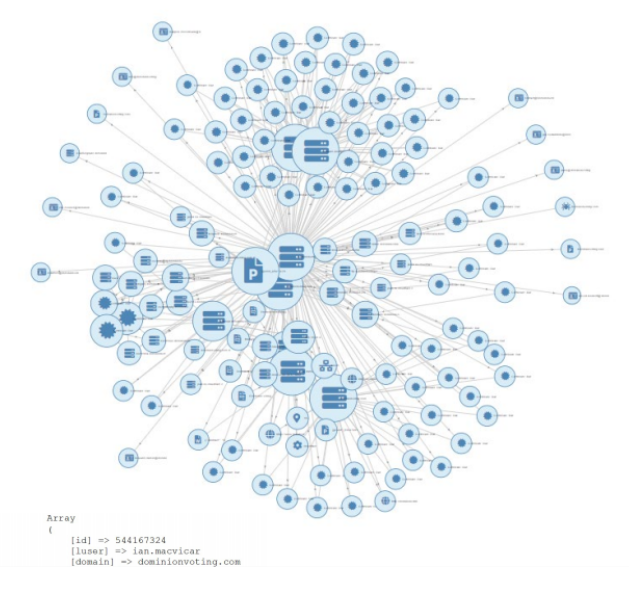
7. A public network scan of Dominionvoting.com on 2020-11-08 revealed the following interrelationships and revealed 13 unencrypted passwords for dominion employees, and 75
hashed passwords available in TOR nodes:

[The deposition then describes devices with two-way access to servers in this network, especially in Serbia, Iran and China.  A search also showed a subdomain which evidences the existence of scorecard software in use as part of the Indivisible (formerly ACORN) political group for Obama.]

14. Beanfield.com out of Canada shows the connections via co-hosting related sites, including
dvscorp.com. 

This Dominion partner domain “dvscorp” also includes an auto discovery feature, where new in-network devices automatically connect to the system. The following diagram shows some of the related dvscopr.com mappings, which mimic the infrastructure for Dominion and are an obvious typo derivation of the name. Typo derivations are commonly purchased to catch redirect traffic and sometimes are used as honeypots. The diagram shows that infrastructure spans multiple different servers as a methodology.

The above diagram shows how these domains also show the connection to Iran and other places, including the following Chinese domain, highlighted below.

15. The auto discovery feature allows programmers to access any system while it is connected to the internet once it’s a part of the constellation of devices (see original Spiderfoot graph).

16. Dominion Voting Systems Corporation in 2019 sold a number of their patents to China (via HSBC Bank in Canada)

Of particular interest is a section of the document showing aspects of the nature of the patents dealing with authentication (at the ballot level).

17. Smartmatic creates the backbone (like the cloud). SCYTL is responsible for the security within the election system.

18. In the GitHub account for Scytl, Scytl Jseats has some of the programming necessary to support a much broader set of election types, including a decorator process where the data is smoothed, see the following diagram provided in their source code:

20. As seen in included document titled “AA20-304A Iranian_Advanced_Persistent_Threat_Actor_Identified_Obtaining_Voter_Registration_Data
” that was authored by the Cybersecurity & Infrastructure Security Agency (CISA) with a Product ID of AA20-304A on a specified date of October 30, 2020, CISA and the FBI reports that Iranian APT teams were seen using ACUTENIX, a website scanning software, to find vulnerabilities within Election company websites, confirmed to be used by the Iranian APT teams buy seized cloud storage that I had personally captured and reported to higher authorities. These scanning behaviors showed that foreign agents of aggressor nations had access to US voter lists, and had done so recently.

21. In my professional opinion, this affidavit presents unambiguous evidence that Dominion Voter Systems and Edison Research have been accessible and were certainly compromised by rogue actors, such as Iran and China. By using servers and employees connected with rogue actors and hostile foreign influences combined with numerous easily discoverable leaked credentials, these organizations neglectfully allowed foreign adversaries to access data and intentionally provided access to their infrastructure in order to monitor and manipulate elections, including the most recent one in 2020. This represents a complete failure of their duty to provide basic cyber security. This is not a technological issue, but rather a governance and basic security issue: if it is not corrected, future elections in the United States and beyond will not be secure and citizens will not have confidence in the results. 

Footnote:  On the Anomalies in US 2020 Election

How all of this played on election night in the US is described in an article Anomalies in Vote Counts and Their Effects on Election 2020. Excerpts in italics with my bolds.

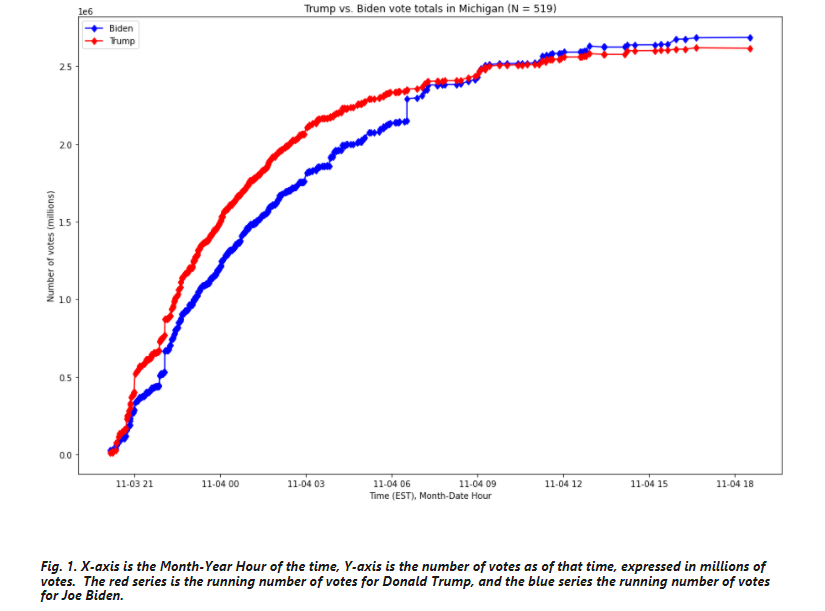
A Quantitative Analysis of Decisive Vote Updates in Michigan, Wisconsin, and Georgia on and after Election Night

In particular, we are able to quantify the extent of compliance with this property and discover that, of the 8,954 vote updates used in the analysis, these four decisive updates were the 1st, 2nd, 4th, and 7th most anomalous updates in the entire data set. Not only does each of these vote updates not follow the generally observed pattern, but the anomalous behavior of these updates is particularly extreme. That is, these vote updates are outliers of the outliers.

The four vote updates in question are:

  1. An update in Michigan listed as of 6:31AM Eastern Time on November 4th, 2020, which shows 141,258 votes for Joe Biden and 5,968 votes for Donald Trump

2. An update in Wisconsin listed as 3:42AM Central Time on November 4th, 2020, which shows 143,379 votes for Joe Biden and 25,163 votes for Donald Trump

3. A vote update in Georgia listed at 1:34AM Eastern Time on November 4th, 2020, which shows 136,155 votes for Joe Biden and 29,115 votes for Donald Trump

4. An update in Michigan listed as of 3:50AM Eastern Time on November 4th, 2020, which shows 54,497 votes for Joe Biden and 4,718 votes for Donald Trump

We further find that if these updates were only more extreme than 99% of all updates nationally in terms of their deviation from this generally-observed pattern, that, holding all else equal, Joe Biden may very well have lost the states of Michigan, Wisconsin, and Georgia, and that he would have 42 fewer Electoral votes — putting Biden below the number required to win the Presidency. Either way, it is indisputable that his margin of victory in these three states relies on four most anomalous vote updates identified by the metric developed in this report.

8b424037f1f7ba6306049bbb00dbb8f52051d3d8361bcec421388a60ad31126e

Not Paranoia If They Really Are Out to Get You

trump_derangement_syndrome

There is zero doubt the entrenched establishment is out to get Trump banished.  Their animus is not a figment of anyone’s imagination, as evidenced by four long years of odious behavior by political, media and academic elites, including a fake Russia collusion investigation (against Trump instead of Clinton) and a fake impeachment (against Trump instead of Biden).  There were also numerous district judges blocking perfectly legal federal orders, just because it was the Trump administration.

So a mountain of salt must be added to all of the caterwauling over challenges to the recent election results.  Presently TDS victims are claiming there is no evidence of voter fraud, as if journalists are the judge and jury who must be persuaded a crime has been committed. That denial is absurd, since there are always some illegal votes cast, the issue being how many and if the amount is material to the result.  A presidential crusade for clean energy can not emanate from a dirty election.

It is no stretch to suspect Trump’s enemies of conspiring to deny him a second term by any means necessary.  What we await is to see if they have been well and truly caught in a pre-meditated, national organized criminal project to violate the 2020 US presidential election.  If proven that will be the logical conclusion to the crescendo of attempts to remove him from office.

See also The Trapdoor US Election

Say It Ain’t So, Joel

The reference is to the public dismay when beloved baseball player “Shoeless” Joe Jackson was accused as one of the 1919 Chicago White Sox participating in a conspiracy to fix the World Series.   One day historians may look back upon the 2020 election in this way; or not if it is the victors who write the record.

In any case this post is actually about a timely article by Joel Kotkin at Real Clear Energy.  I have posted a number of his insightful essays in the past, but have mixed feelings about this one.  He expresses a number of things I fear are true, but the effect is so discouraging as to suggest throwing in the towel.  Judge for yourself: The article is The End Game.  Excerpts in italics with my bolds and images.

With the election of Joe Biden, the environmental movement has now established suzerainty over global economics. Gone not only is the troublesome Donald Trump but also the Canadian skeptic Steven Harper. Outside of those dismissed as far right, there is virtually no serious debate about how to address climate change in the U.S. or Western Europe outside the parameters suggested by mainstream green groups.

In reality, though, few electorates anywhere are ready for extreme policies such as the Green New Deal, which, as its widely acknowledged architect, Saikat Chakrabarti, has acknowledged, is really a redder, more openly anti-capitalist version of the Great Depression-era original.

Yet getting hysterical about the likes of Alexandria Ocasio-Cortez is a waste of emotional energy. The real power of the environmental movement derives from those who occupy “the commanding heights” of our society – at the corporate, media, and academic realms. Though arguably not holding views as economically ludicrous as AOC’s, mainstream corporate greens are far more likely to successfully impose their version of environmental justice on the rest of us.

A finer shade of green

The modern environmental movement was launched from the top of the economic food chain. The Rockefeller Brothers, for example, funded some of the earliest environmental work, notably on population control. Today, these depositories of old money built on fossil fuels, including not just the Rockefellers but also the Fords, have become leading advocates of radical climate policies.

In 1972, the influential book Limits to Growth was published with backing from major corporate interests, led by Aurelio Peccei of Fiat. The book’s authors suggested that the earth was running out of natural resources at a rapid pace and called for establishing “global equilibrium” through restrictions on growth and “a carefully controlled balance” of population and capital. These conclusions, mostly accepted in top media, academic, and political circles, turned out to be almost comically off target, as production of food, energy, and raw materials accompanied not the predicted mass starvation but arguably the greatest rise of global living standards in history.

Yet despite this record, a growing and powerful faction of the corporate aristocracy still embraces the ideals of the Club of Rome, seeking to cut human consumption and limit economic progress. Like religious prelates in the Middle Ages, today’s environmentalists – who The Nation’s Alexander Cockburn has aptly named “greenhouse fearmongers” – see no contradiction between imposing austerity on the masses and excusing the excesses of their ultra-rich supporters. Like sinful aristocrats and merchant princes in medieval times, our “green rich” can even buy a modern version of indulgences through carbon credits and other virtue-signaling devices. This allows them to save the planet in style. In 2019, an estimated 1,500 GHG-spewing private jets were flown to Davos carrying attendees to a conference to discuss the environmental crisis. Few high-profile climate activists, including celebrities, seem willing to give up their multiple houses, yachts, or plethora of cars.


The de-growth solution

These worthies likely don’t share the notion advanced by Barry Commoner, a founding father of modern environmentalism, that “capitalism is the earth’s number one enemy.” Today’s green elites have no interest in breaking up tech oligarchies, limiting Wall Street’s financial power, or lessening the burdens of green policies on the poor and working class. Nor are they likely, at least for now, to embrace such things now bandied about by extreme green academics and activists, such as considering an insect diet, restricting meat, curbing procreation, or even advocating total human extinction.

Rather, many elites have embraced the concept of “degrowth,” which foresees less economic expansion, a declining population, and a radical end to upward mobility. One set of proposals from the IPCC endorses this notion and openly rejects “a capital-oriented culture“ seeing a more centralized approach as critical to saving the planet.” The World Economic Forum’s founder Klaus Schwab, the lord of Davos, for example, envisions the rise of a new business class motivated by “virtuous instincts” that include such things as eliminating fossil fuels. This woke corporate mindset is sold as a form of “stakeholder capitalism,” while following the progressive cultural agenda on gender and race as well.

Though couched in laudable intentions, this agenda also is remarkably self-serving. The British Marxist historian James Heartfield suggests that “Green capitalism” provides a perfect opportunity to maximize return on artificially scarcer resources, like land and agricultural products, notably through mandates and tax breaks for renewable energy. The green economy has already spawned its first mega-billionaire, Elon Musk, whose core businesses benefited enormously on regulatory and tax policies that favor his products. In the future, expect other, less innovative oligarchs happy to take advantage of centrally imposed scarcity, making money under the pretext of “human survival.”

Who pays when things don’t work

The wealthy, such as Jeff Bezos – who earlier this year gave $10 billion to environmental groups – can demand strict policies to curb climate change because they can afford the effect of these policies. It won’t restrict their ability to make billions, maintain mansions in the style of Hapsburg royalty, or fly in private jets. By contrast, oil riggers, factory employees, or construction workers who drive old trucks to work will be seriously harmed by bans on fossil fuels. For them, the forced march to a prearranged green utopia won’t be so sweet, and the promise of “green jobs” no substitute for the real thing,

For these workers and their families, the price of green piety is reduced resources for schooling, medical bills, or even food. California, with its lion’s share of multibillionaires, suffers the highest poverty rate, adjusted for costs, of any state and a widespread expansion of energy poverty. These policies are already threatening to raise costs on the east coast, where wind energy prices are estimated to be five times conventional electrical generation. Similarly, as many as one in four Germans, and three-fourths of Greeks, have cut other spending to pay their electricity bills, which is the economic definition of “energy poverty.”

To date, these negatives have done little to slow California’s madcap attempt to go “all electric.” This policy is doomed to fail as it seeks to boost electricity use while removing the most affordable and reliable ways to supply it. Worse yet, these policies will also have damaging environmental effects, forcing the creation of massive new solar plants in the state’s most vulnerable agricultural areas and open space. A 2015 study by the Carnegie Institution for Science and Stanford University suggests that building enough solar power to reduce U.S. emissions by 80 percent in 2050 could require upwards of more than 27,500 square miles, destroying both farmland and unique natural habitats along the way.

California is seeking similar emissions cuts by mandating building and transport electrification using solar and wind power, but state climate leaders have yet to disclose the location or scale of devastated land that their policies require. According to a 2019 report by The Nature Conservancy and the state’s own technical experts, as much as 3 million acres – nearly 4,700 square miles – could be sacrificed by 2050, including much of the state’s Central Valley and, if neighboring states agree, sprawling industrial development throughout the western U.S. Overall, electric-car production and solar plants pose their own, though rarely reported, environmental problems, particularly connected to mining for rare-earth materials.

The “Test run”

The tragic, and relentlessly disruptive, coronavirus lockdowns can be justified as a real response to a clear, present, and sometimes-lethal danger. But some greens also see the lockdowns as a “test run” for the kinds of regulations we may face under future green regimes. The “visionary” Davos mogul Schwab, for example, sees the pandemic as an opportunity for a major “reset,” one preliminary to a post-growth regime based on the more enlightened values of the economic elect.

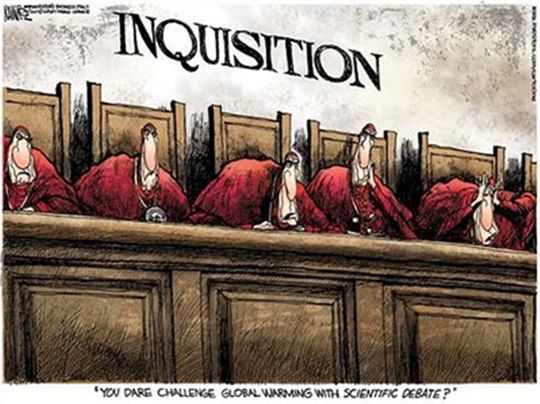
This new order would follow the Davos script, locking down whole parts of the economy and restricting consumer choice, notably for housing and transportation. To sell this somewhat unpalatable agenda, greens and their elite allies have imposed an orthodoxy that excludes dissent. Today, open rational discussion about how to best protect the planet is about as rare as open debate over God’s existence would have been in the Catholic Church of the eleventh century. There’s even a movement, already adopted in France and Belgium, to make what’s called “ecocide” a crime.

Today even veteran climate scientists – such as Roger Pielke, Judith Curry, or Greenpeace co-founder Patrick Moore, are treated as heretics for questioning global-warming orthodoxy. Longtime activists such as Michael Shellenberger and even radical propagandist Michael Moore, whose recent documentary “Planet of Humans” exposed the ecological impact and corporate profiteering of “green” power, have suffered de-platforming for offending the sensibilities of green activists and their billionaire patrons. 

This is a poor way to tackle a complex scientific issue, where open inquiry and debate are needed, observes Steve Koonin, President Obama’s undersecretary of energy for science.

Are there better, fairer solutions?

What the green end game is likely to produce is an increasingly static and hierarchical society, perhaps torn apart by raging class conflict between the oligarchs and their allies, on one side, and the beleaguered middle and working classes, on the other. We can already see signs of this in California, where Latino and African-American activists object to paying for the fantasies of the green grandees, a phenomenon also seen in grassroots movements in France, the Netherlands, and Norway. The impact on developing countries, in particular, could be severe, with potentially gruesome consequences.

But, ultimately, we may not have to choose between a better economy and a better environment.

For example, we could encourage, not ban, the substitution of cheap and plentiful natural gas for higher emission fuels, such as coal or diesel, a strategy that has already proven to substantially reduce U.S. emissions, and that could become even more effective if carbon capture or renewable gas technologies mature. We also could encourage the current trend to online dispersion of work, which could hold terrific opportunities not only for reducing emissions but also for reviving family life and encouraging entrepreneurialism.

We must not let our lives be constrained by the concentrated power of an unelected ruling class, whose agenda would reinstate a version of the hierarchical society of feudal times.

On Stopping Biden’s Deadly Energy Policies

Clarice Feldman writes at Climate Change Dispatch How Biden’s Deadly Plan For American Energy Can Be Stopped.  Excerpts in italics with my bolds and images.

It’s perfectly understandable for anyone concerned about energy production in the U.S. to be uneasy that Joe Biden appears to be winning this year’s contest for the White House.

Whether he makes it to 1600 Pennsylvania Ave. remains in doubt, but what is not in doubt is that, should that happen, he would have no substantial mandate.

The climate change part of the platform–like much of his party’s platform–seems to have little purchase other than the coastal bien pensants and the left-wing corporatists dreaming of yet another boondoggle financed by the taxpayers on the same pie-in-the-sky swindle as was Solyndra and California’s train to nowhere.

Of course, my ability to read the future is limited, but let me explain why I think much of what Biden has promised the far Left of his party to secure the nomination and their support, is unlikely to take shape.

At the moment the election in six states is still either still being counted, being challenged in court, or subject to a recount. Excluding those states, President Trump leads Biden 232 to 227 in the Electoral Vote totals. (270 electoral votes of 538 are needed to win the electoral college vote in January).

It is impossible in this fast-changing circumstance to keep track of all the litigation challenges in the various state-run elections. So far this compendium by OSU seems the most accurate.

I’ve seen some of the complaints filed or about to be in Michigan and Pennsylvania and they include numerous credible affidavits documenting substantial illegality. [See The Trapdoor US Election]

If the Supreme Court meant it when they said this twenty years ago in Bush v. Gore, 531 U.S. 98, 105 (2000), I have to believe that the counts in both those states simply do not meet the constitutional standard in Gore.

It must be remembered that “the right of suffrage can be denied by a debasement or dilution of the weight of a citizen’s vote just as effectively as by wholly prohibiting the free exercise of the franchise.” Reynolds v. Sims, 377 U. S. 533, 555 (1964).

If these recounts and challenges are not resolved by the December 14 cut-off date, the House of Representatives can choose the interim president and the Senate the interim vice president until the results are certified by the states.

In the House, the vote is by state and the Republicans hold the majority there, as they do in the Senate. If the matter is not resolved to the satisfaction of the state legislatures, they may under the constitution select their own slate of electors.

Republicans hold the majority in the legislatures of Pennsylvania, Georgia, and Michigan, the three states with the most electoral votes among the still disputed contests.

Given the uncertain outcomes, at this time it is preposterous to call Biden “president-elect.”

Nevertheless, there certainly is a reason for concern in the Democratic platform Biden ran on.

The platform reads like a prose version of the Russian film “Battleship Potemkin” substituting only the film’s motif of all forces of the population joining hands in revolution with everyone joining hands to keep the climate from changing. (It misses only scenes of fracking and gas rigs shooting at wounded veterans and orphans.)

Among the specifics are these:

  • A pledge to achieve “zero-net greenhouse gas emissions as soon as possible, and no later than 2050.”
  • Eliminating “carbon pollution from power plants through technology-neutral standards for clean energy and energy efficiency.
  • “Dramatically” expanding solar and wind energy deployment.”

The program specifics are even more sophomoric and fanciful, involving retrofitting buildings, setting even higher emissions standards for cars and trucks, including 500,000 school buses, and more in a program “to ensure racial and socioeconomic equity in federal climate, energy, and infrastructure programs.”

(My guess is this was written somewhere else besides California which the document says should again be allowed to set its own vehicle emission standards. I say that because rolling blackouts related to a similar set of juvenile energy policies in that state’s programs would seem to put something of a leash on these overweening goals.)

Biden also has pledged to kill the Keystone pipeline. On that score, Alberta Premier Jason Kenney indicates confidence he can change Biden’s mind, and perhaps he would be successful — pledges from Biden do seem to have a short life span.

He promised during the debates that he would not claim victory until all the state contests were certified. He already has done so when we are far from that point.

He’s also promised to crack down on “climate cheats” whoever they are; push the world on climate change, and invest $1.7 trillion to reduce global warming. At the same time, his team is advocating further coronavirus lockdowns and payouts to those unemployed because of them.

Now I could be wrong. He could have a secret invention to generate trillions of new dollars and is keeping it a secret along with a never-revealed way to fuel this economy without fossil fuels, but I’m suspicious of the ability to fund these grandiose plans or carry the platform’s promises out.

Even if he were crazy enough to try it, he will do so without a great deal of support. At the moment, the Democrats are hanging on to an even thinner majority in the House, having lost a number of seats they expected to win, and jeopardized more who in these weird times are labeled “moderates”.

The party is splintered and recriminations against the left are legion. It seems increasingly likely that the Blue Wave the media promised didn’t materialize and in fact, a Red Wave washed a lot of the Democrats out to sea.

There will be at least 50 Republican senators in the Senate with the likely prospect of two more once the Georgia runoffs are complete in January.

Without a majority in the Senate, Biden can’t revoke the industry-friendly fuel tax; he can’t restore or expand the federal tax credit for purchases of electric vehicles, he can’t repeal the Halliburton provision permitting fracking in the Safe Drinking Water Act, he can’t amend the renewable fuel standard post-2022, he can’t alter the Jones Act, and he can’t change the carbon price, etc.

Some have suggested he can achieve these goals simply through executive orders, and there are a few things he can achieve via this route, beginning with an area in which he has the freest hand — rejoining the Paris climate agreement.

Some of the others, more troublesome to be sure, are regulatory actions like blocking oil and gas drilling on federal lands, allowing California to set independent standards for auto emissions and fuel economy, restricting access to low-cost capital for the fossil fuel industry, and setting fuel economy standards.

For these, judicial and public resistance are greater checks on his authority.

Chief Justice Roberts has displayed a penchant for fine-tooth-combing executive orders and rejecting them. The public — reeling from the devastation of the lockdowns, pleased with lower gas prices and anticipating a continued v-shaped recovery — are likely to find Biden’s extremism unwanted and make their opposition known.

Biden may squeak out an election victory. If so, it will have been a Pyrrhic one.

See also US Conflicted over Green Energy


The Trapdoor US Election

An article at the Citizens Journal explains Whistleblowers Reveal How Software Manipulates Votes to Change Election Results.  Excerpts in italics with my bolds.

WASHINGTON—Trump campaign lawyer and former federal prosecutor Sidney Powell released an explosive affidavit on Nov. 16, from a whistleblower who purports to have witnessed how election software secretly manipulates votes without leaving a trace.

The whistleblower—whose background is with the Venezuelan military, including the national security guard detail of the Venezuelan president—outlines a conspiracy between Smartmatic software executives, former Venezuelan dictator Hugo Chavez, and that country’s election officials, to ensure Chavez won reelections and retained power for years. The whistleblower said he was present at multiple meetings.

“I was witness to the creation and operation of a sophisticated electronic voting system that permitted the leaders of the Venezuelan government to manipulate the tabulation of votes for national and local elections and select the winner of those elections in order to gain and maintain their power,” the affidavit states.

From that point on, Chavez never lost any election. In fact, he was able to ensure wins for himself, his party, Congress persons and mayors from townships.”

According to a U.S. intelligence professional who handled global telecommunications and participated in the investigation of the Smartmatic voting software, the software, regardless of any upgrade or branding differences, was used in multiple different voting machine companies during the 2020 election for the president and various down-ballot races.

The whistleblower said the “software and fundamental design of the electronic electoral system and software of Dominion and other election tabulating companies relies upon software that is a descendant of the Smartmatic Electoral Management System.”

“In short, the Smartmatic software is in the DNA of every vote tabulating company’s software and system, “the whistleblower said.

The affidavit states that Dominion is one of three major companies that tabulates votes in the United States.

Powell said in a Nov. 15 interview, “We’re getting ready to overturn election results in multiple states.” She claimed that the U.S. election software switched “millions of votes” from Trump to Biden

The whistleblower said Smartmatic created a system that anonymized the voters’ choices inside the machine and then spat out the desired income by the end of the election day. No vote could be traced back to an individual voter.

In the April 2013 Venezuelan election, the affidavit states, the conspirators had to take the internet down for two hours to reset the machines, as Nicolás Maduro was losing by too many votes to Capriles Radonsky.

The whistleblower said Chavez eventually exported the software to Bolivia, Nicaragua, Argentina, Ecuador, and Chile.

Time for a cabinet meeting!

Inside the United States

A second whistleblower, who came forward to The Epoch Times on Nov. 15, explained more about how the voter machine software works in the United States and how it can be programmed to predetermine the outcome.

Tore Maras said she’s a private contractor who worked for a conglomerate of private companies that were all created under the purview of former CIA Director John Brennan.

Maras alleges that the voting machine software used in U.S. elections was developed by one of Brennan’s companies, and allows “full control of the electoral process.” Her role during the 2012 federal election was to ensure evidence of vote manipulation had been erased after the vote tallies were complete at the end of the night.

She said the type of voter machine is irrelevant as they all carry the same software that can be tapped into and an algorithm sets the results. As a paper ballot is fed through the machine, the information goes into an area called a trapdoor, which is where the manipulation occurs. Only with a master key can the trapdoor be seen.

The trapdoor is ostensibly set up, Maras explained, to preserve voter anonymity. However, she alleges that’s where the software decides on the outcome. The machines are programmed to feed out a vote tally report at set times or as a certain number of votes is reached. For example, every time 500 votes, or 30 minutes has been reached, the results will leave the trapdoor and be sent to election reporting company Scytl, and then The Associated Press.

Maras said the algorithms are set to match the expected turnout and voter outcome in the county each machine is in. In battleground counties, for example, it could be preset that Democratic presidential nominee Joe Biden would receive 50.9 percent of the overall votes, and Trump would receive 48.1 percent, and a third candidate 1 percent.

“They make it a little bit more believable, like there’s a race. They input it, and then as the people vote, the algorithm regulates that,” she said. “We don’t care if you voted for Mickey Mouse, the software is going to tell you what you voted for. You’re never voting.”

Maras predicts that Trump won in 2016 because the turnout for him exceeded the expected amount, which the software had been capped at. She alleges that, because of 2016, a turnout cap wasn’t likely set in 2020, and again, when Trump voters exceeded predicted numbers, some states stopped counting in the middle of the night and waited for more Biden ballots to be shipped in, to cover a possible recount scenario.

Maras said the software has been used in many countries including Ukraine—”that’s how we helped usher in their elections”—as well as Iraq, Afghanistan, Macedonia, Albania, Germany, the UK, and Greece.

Beware, lest once again computers suck us into an alternate reality.


How Superficial Policies Destroy Character and Cohesion

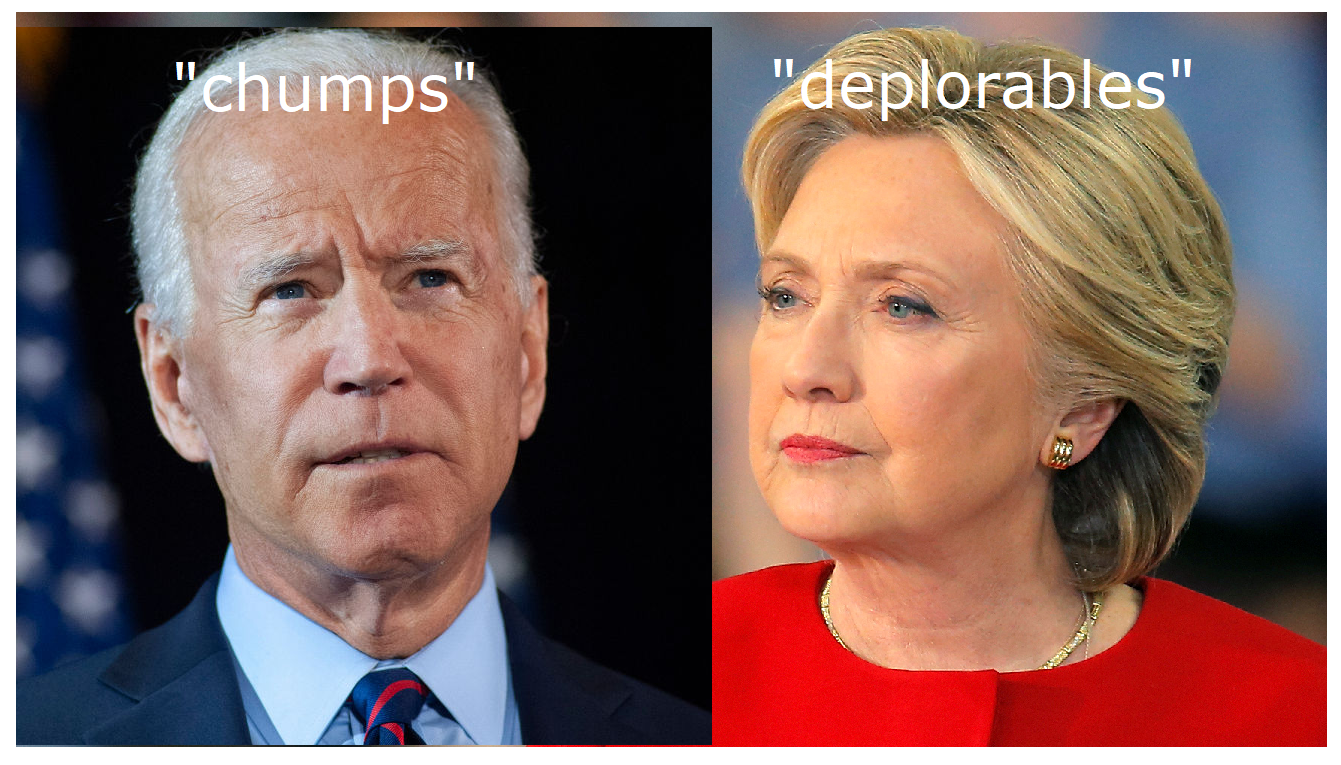
The 2020 campaign saw Biden label Trump voters as “chumps”, adding this trash talk to Clinton’s 2016 calling them “deplorables.” This article digs into how subversive and destructive is the progressive drive to have government policies deliver outcomes regardless of individual effort and talent.  James B. Meigs explains in his article at City Journal The Chump Effect.  Excerpts in italics with my bolds.

Progressive policies penalize those who play by the rules and shower benefits on those who don’t.

Last January, a small but telling exchange took place at an Elizabeth Warren campaign event in Grimes, Iowa. At the time, Warren was attracting support from the Democratic Party’s left flank, with her bulging portfolio of progressive proposals. “Warren Has a Plan for That” read her campaign T-shirts. The biggest buzz surrounded her $1.25 trillion plan to pay off student-loan debt for most Americans.

A man approached Warren with a question. “My daughter is getting out of school. I’ve saved all my money [so that] she doesn’t have any student loans. Am I going to get my money back?”

“Of course not,” Warren replied.

“So you’re going to pay for people who didn’t save any money, and those of us who did the right thing get screwed?”

A video of the exchange went viral. It summed up the frustration many feel over the way progressive policies so often benefit select groups, while subtly undermining others. Saving money to send your children to college used to be considered a hallmark of middle-class responsibility. By subsidizing people who run up large debts, Warren’s policy would penalize those who took that responsibility seriously. “You’re laughing at me,” the man said, when Warren seemed to wave off his concerns. “That’s exactly what you’re doing. We did the right thing and we get screwed.”

That father was expressing an emotion growing more common these days: he felt like a chump. Feeling like a chump doesn’t just mean being upset that your taxes are rising or annoyed that you’re missing out on some windfall. It’s more visceral than that. People feel like chumps when they believe that they’ve played a game by the rules, only to discover that the game is rigged. Not only are they losing, they realize, but their good sportsmanship is being exploited. The players flouting the rules are the ones who get the trophy.

Like that Iowa dad, the chumps of modern America feel that the life choices they’re most proud of—working hard, taking care of their families, being good citizens—aren’t just undervalued, but scorned.

Thousands of norms, rules, and traditions make civilized life possible. Some, like paying taxes or not littering, are enshrined in law. Others are informal. Most of us take pride in adhering to basic standards of etiquette and fairness, to say nothing of following the law. And we have a deep emotional investment in having the people around us follow these norms as well. There’s a reason that we call selfish, disruptive, or criminal behavior “antisocial.” We know that if everyone stopped paying their taxes, or started running red lights and shoplifting, our society would be on its way to collapse.

It’s bad enough when some random jerk makes you feel like a chump; it’s much worse when government policies create entire classes of chumps. Warren fizzled as a presidential candidate, but her activist positions remain very much in play, promoted by far-left Democrats and party leaders. Many of these plans would penalize people who follow traditional norms and shower benefits on those who don’t. Joe Biden’s platform includes many similar proposals, including a scaled-down college-debt plan. And, across the country, progressive governors, mayors, and district attorneys are pushing local policies—including ultra-lenient treatment of lawbreakers—that turn responsible citizens into chumps, too. The economic and ideological disruptions brought on by the Covid-19 pandemic and Black Lives Matter protests have only intensified this ongoing bifurcation of America. Call it the Chump Effect.

Both types of Chump-Effect policies—those that unfairly distribute benefits and those that normalize transgressive behavior—are dismissive of what many call bourgeois norms. Policies that selectively favor the needs, or tolerate the misdeeds, of certain groups often have the perverse corollary of undermining the norm followers. When disruptive students remain in the classroom, it’s their attentive classmates who suffer. If a big business games federal programs for an unfair advantage, smaller businesses and consumers pay the price. What’s particularly galling about such policies isn’t just that they reward norm violators—it’s that they’re predicated on the assumption that everyone else will continue adhering to the norms. That’s wishful thinking, of course. Over time, policies that excuse lax behavior by the few will begin to influence the many, corroding the standards that keep a society healthy.

Politicians ignore such primal forces at their peril. On the right, free-market advocates have long downplayed the social tensions caused by rising income inequality. Today, many young people, facing poor job prospects despite heavy education debts, see American society—and capitalism itself—as fundamentally unfair. That’s one reason the initial outrage over George Floyd’s death ballooned into a much broader protest movement. But policies promoted on the left can also lead to backlashes. Under Barack Obama, many heartland Americans believed that government policies were biased toward helping undocumented immigrants and educated elites, while undermining opportunities for the middle class. That frustration led to the Tea Party movement and, later, the stunning rise of Trump.

Democrats believe we must embed environmental justice, economic justice, and climate justice at the heart of our policy and governing agenda,” the party platform states, using the coded jargon of the modern Left. In progressive circles, “justice” doesn’t mean fairness or evenhandedness; it describes a world in which every problem is the fault of some entrenched power group. Therefore, every solution should involve both special aid for the victims and some sort of punishment for those who created the problem.

The Democratic platform promises a root-and-branch overhaul of federal programs to ensure that they operate according to elaborate calculations of race, gender, sexual orientation, and other metrics. As the country struggles through the Covid recession, for example, the party promises that funds supporting small businesses will flow preferentially to companies owned by women and minorities and promises to “combat gentrification” and offer relief from “exorbitant” rents. (Under the “justice” paradigm, landlords are guilty until proven innocent.) A Biden Department of Education would bring back Obama-era rules forbidding “disparate disciplinary treatment” of students based on race. In practice, that means that students will be disciplined not based on the frequency of their misbehavior but according to racial quotas.

Even Biden’s $2 trillion climate plan seems designed more to spread wealth among favored groups than to reduce greenhouse-gas emissions.

You’d think anyone who believes that climate change is an existential threat would want to build green infrastructure as quickly and as cheaply as possible—the faster it’s deployed, the quicker emissions come down, right? But in announcing his plan, Biden said, “When I think about climate change, the word I think of is ‘jobs.’” His platform proposes obligating green contractors to hire union workers, which would drive up costs dramatically. “And we will do all this with an eye towards equity, access, benefits, and ownership opportunities for frontline communities,” the platform says. In other words, expect every green project to be bogged down in endless reviews to ensure that contractors and workers represent the prescribed racial and gender mix. The plan is a recipe for high costs, slow progress—and sweetheart deals. Who pays for this? Ordinary consumers—the chumps—who will see their energy, food, and other expenses skyrocket, all for surprisingly little environmental benefit.

The platform offers sticks along with carrots. Some far-left climate advocates tend to focus more on their desire to drag energy companies into court than on the need to develop alternatives to fossil fuels. “These are criminals,” Bernie Sanders has said of fossil-fuel executives. Warren uses similar language. Biden’s platform also threatens legal action against companies that “put profit over people.” For these politicians, the top priority seems to be ensuring that the right villains are punished and the correct “frontline communities” get their subsidies. They are less interested in how much their policies will actually help the climate or how deeply they will disrupt the lives of ordinary Americans.

California is a test case in how environmental programs can wind up burdening the poor and middle class while benefiting the affluent.

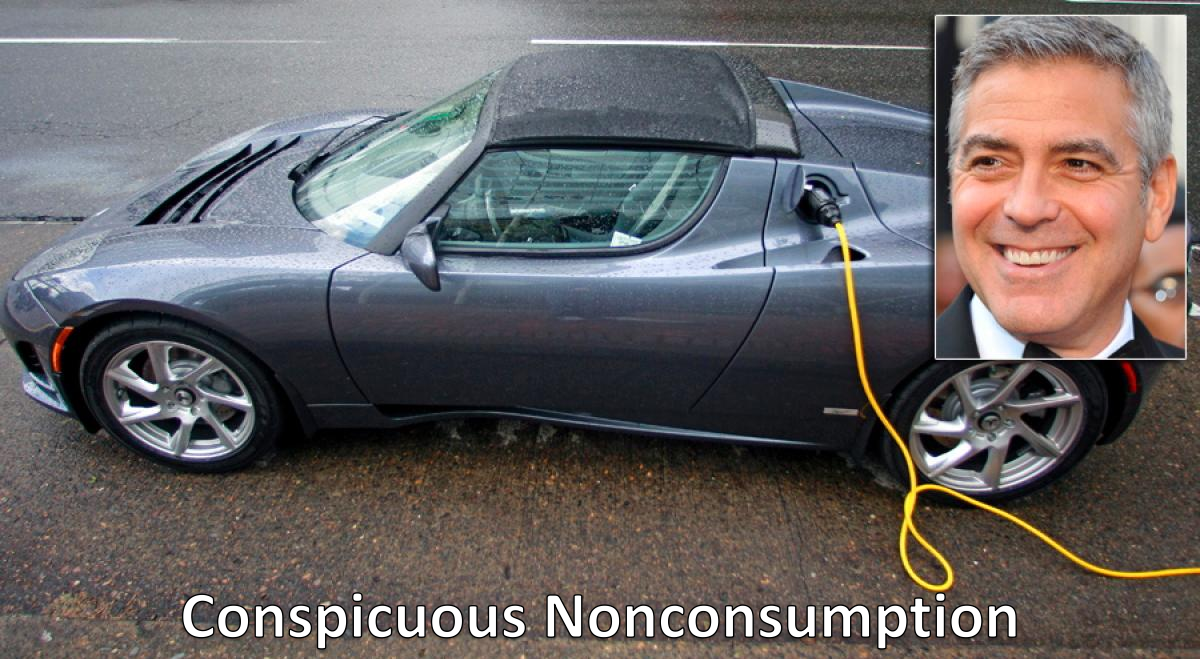
For example, people who purchase electric cars in California receive a state rebate of up to $4,500 per vehicle. Given that the most popular EV in California is the luxury Tesla, with an average price of over $50,000, we can assume that few lower-income people are cashing these checks. EV owners also get the right to drive—alone—in the coveted high-occupancy vehicle lanes on the state’s crowded freeways. The upshot: while working-class chumps stew in traffic, rich Tesla owners sail by in their own special “diamond lane,” serenely isolated from the gas-burning hoi polloi.

In 2010, University of Tennessee law professor Glenn Reynolds made an offhand comment on his Instapundit blog. The government often tries to expand the middle class by subsidizing the things that middle-class people have, he observed:

If middle-class people go to college and own homes, then surely if more people go to college and own homes, we’ll have more middle-class people. But homeownership and college aren’t causes of middle-class status; they’re markers for possessing the kinds of traits—self-discipline, the ability to defer gratification, etc.—that let you enter, and stay, in the middle class. Subsidizing the markers doesn’t produce the traits; if anything, it undermines them.

Since then, that insight has been cited so often that it’s become known as Reynolds’s Law. It’s based on a deep truth: success in life isn’t determined by owning things, or even having a high income. It is largely the result of certain habits that lead to lifelong advancement—what economists call “cultural capital.”

Sadly, the values that lifted generations of immigrants out of poverty have been under thoroughgoing attack for at least two generations. In an effort not to stigmatize the poor, social-welfare reformers overshot the target and also dismantled the stigmas against behaviors that keep people poor. It became considered unseemly to criticize unwed childbearing, drug use, or even petty crime. Under the social-justice paradigm, those behaviors were reframed—not as choices but as symptoms of an unjust social structure.

In a weird revival of racist stereotypes, today’s critical-race theorists see dysfunctional behaviors occasionally found among minority groups as being emblematic of those groups. In turn, traits that help people succeed—ones shared by cultures around the world—are stigmatized as typically “white.” Earlier this year, the Smithsonian’s National Museum of African American History & Culture explained this bizarre framework on its website. A handy chart summarized some of those “Aspects & Assumptions of Whiteness,” including “self-reliance,” “the nuclear family,” and the idea that “hard work is the key to success.” Reliance on the scientific method, mathematics, and “rational linear thinking” were also identified as instruments of white dominance.

If a secret arm of the KKK created a doctrine designed to undermine the advancement of minority communities, it could hardly do a better job than the Smithsonian’s woke theorists.

Chump-Effect policies don’t just undermine societal values; they also typically fail at their stated goals. One reason they so often backfire is that they rely on present-tense thinking. Lawmakers—and the voters they answer to—tend to look at issues in the current moment, rather than seeing them as evolving conditions. So they create policies to solve a problem for a particular group of people right now, without considering the perverse incentives that their program puts in place.

Rent control is a classic example: a ceiling on rent hikes certainly helps current tenants. But years pass; family incomes climb; children grow up. Decades later, a well-off widow might be paying minimal rent to stay in an apartment much bigger than she needs. With many people like her staying put in underutilized apartments, the price of unregulated units soars, making it hard, if not impossible, for the next generation of low-income families to find housing. Landlords, the chumps in this scenario, adjust by cutting back on maintenance, and sometimes by simply walking away from money-losing buildings. “Rent control appears to be the most efficient technique presently known to destroy a city,” writes Swedish economist Assar Lindbeck, “except for bombing.” Somehow, this reality always takes progressives by surprise. True to form, Representative Alexandria Ocasio-Cortez last year proposed a federal rent control law, and she has joined in the campaign to #CancelRent in the wake of the Covid crisis.

Eliminating penalties for petty crimes is another example of present-tense thinking. Reduced penalties for “minor” offenses in several states have led to huge spikes in shoplifting and other crimes. In Chicago, Portland, San Francisco, and other cities, progressive DAs have cut back on prosecutions of many low-level crimes. The University of Chicago’s Charles Lipson calls the new policy “‘Go ahead, break our windows’ policing.” And, just as the Broken Windows theory would predict, the resulting upswing in lawbreaking goes beyond petty crime. According to the Wall Street Journal, homicides have spiked in 36 of the nation’s 50 largest cities.

Nonetheless, progressives see tolerance for transgressive behavior as a kind of moral duty. If the perpetrators are poor, or perceived as targets of injustice, the plight of their victims is a secondary concern. After all, the progressive project focuses on structural inequities—that is, the status of entire groups of people as being part of either oppressive or oppressed classes. If a particular crime—say, an unjustified police shooting of a minority suspect—seems to embody that power dynamic, it becomes the focus of national attention. There’s nothing wrong with that, in itself. Unjustified police shootings should merit calls for reform. But if crimes don’t fit the framework—say, gang-related killings, vastly more common—they get little notice. In the end, the large majority of people in poor communities who actually do follow the law are treated as chumps.

This selective focus has been on dramatic display during the months of protests following the Floyd killing. It’s true that only a small fraction of protests turned violent, but those incidents still added up to thousands of cases of looting and arson and dozens of shootings. Most didn’t make the national news. And, while the peaceful protesters have mostly returned to their lives, the violent minority is growing more emboldened.

Independent journalist Michael Tracey, who spent weeks touring overlooked riot zones in cities like Fort Wayne, Indiana, and Olympia, Washington, was shocked by the scale of the destruction. Minority and immigrant communities “bore the brunt of the damage,” he reports. Even as the violence has spread, calls to “defund the police”—even “abolish the police”—are being heeded in many cities. Budgets were being slashed even as riots continued. In Portland, the district attorney is declining to prosecute hundreds of protesters arrested for “nonviolent” crimes. (One such quickly released suspect allegedly stabbed two people to death a week later.) In short, one of the most destructive crime waves in U.S. history is being met with a collective yawn from the media and a mild scolding, at best, from some representatives of law enforcement. It wasn’t until polls started showing rising voter concern that Biden and other Democrats began cautiously criticizing the violence.

In North Minneapolis, Tracey talked with Flora Westbrooks, a black woman who had owned a hair salon there for 34 years. The business helped her earn enough to buy a house and send her son to law school. On May 29, arsonists burned it down. “Sometimes I’m like, OK, I gotta go to work,” she told Tracey. But then she remembers: “I don’t own anything anymore. Everything’s burned to the ground. I have nothing no more. Everything I worked for.” The tragedy of the Chump Effect is in stories like these. People devote their lives to making things better for themselves, their children, and their communities. They follow the bourgeois norms so disdained by the Left. Then, when our society stops defending those norms, they’re the ones who suffer.