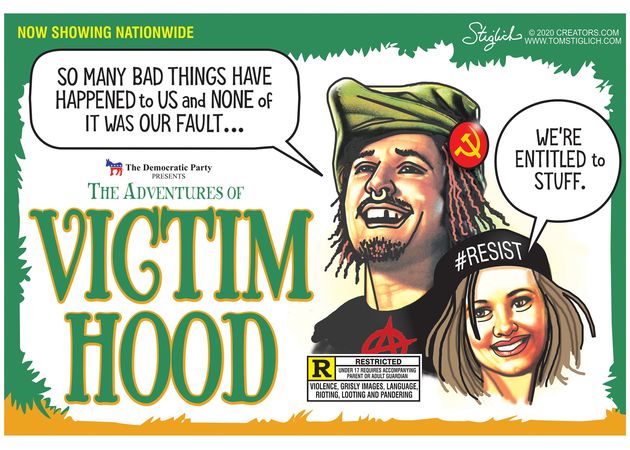
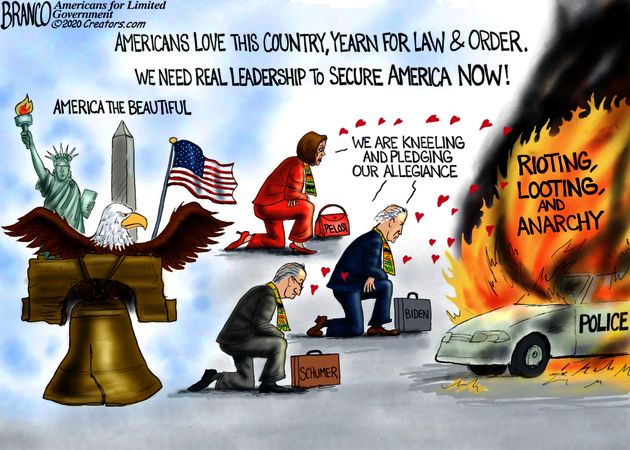
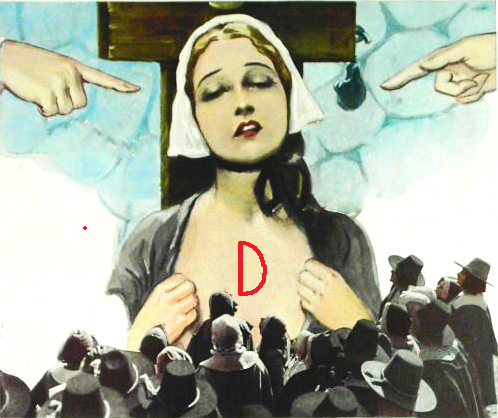
Resisting the PC “Karens”

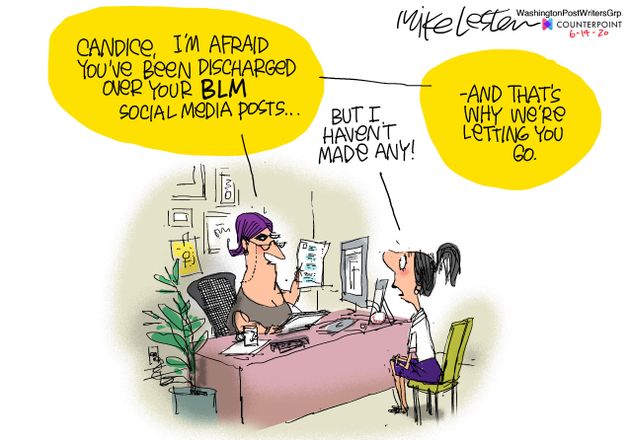
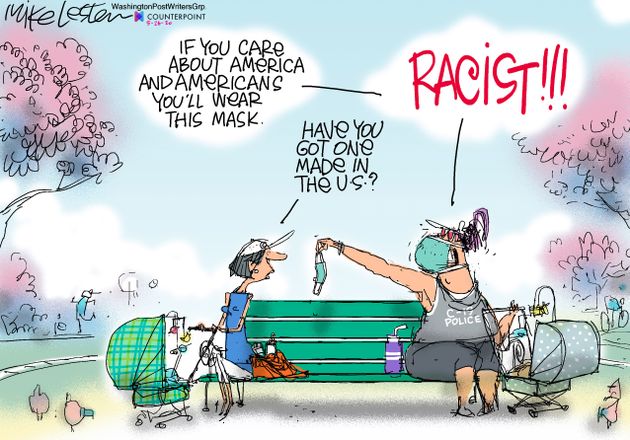
In the social media it has become common to refer to someone who scolds or punishes you for your behavior as “Karen being Karen.” It started with a stereotype of arrogant entitled white women who put down others lacking their privileged refinement. Since the return of the BLM movement many are using the label for a racist tone dismissive of white people generally.

Leaving aside the racist connotation, I am focusing on the Karen role of enforcing politically correct behavior. For example, consider the recent Central Park incident in which a woman called Amy Cooper called the cops on a black man called Christian Cooper (no relation) and claimed that he was harassing her when in truth he was reprimanding her for letting her dog off its leash in a part of the park where you’re not meant to do that. Amy behaved badly in this incident. But as Robert A George argued in the New York Daily News: ‘[Christian] is the “Karen” in this encounter, deciding to enforce park rules unilaterally and to punish “intransigence” ruthlessly.’ Amy Cooper’s life has been shattered by this Karen-shaming incident: she lost her job and her dog.

Regardless of racial or gender identity, the “Karenness Quality” is this self-righteous public shaming of others for not behaving according to Karen’s Rules. For example, note the flip-flop of the mayor of Olympia, Washington. She was fine with the Black Lives Matter protests that followed George Floyd’s death in police custody. But that was until vandals damaged her home, according to reports. Changing her mind about the BLM protests when she was damaged personally, Mayor Cheryl Selby of Olympia now refers to the protests as “domestic terrorism,” according to The Olympian. “I’m really trying to process this,” Selby told the newspaper Saturday, after the rioters’ Friday night spree left her front door and porch covered with spray-painted messages. “It’s like domestic terrorism. It’s unfair.”

Karenism has this moral purity abstracted from personal experience with the hardships involved. Karen exemplar Marie Antoinette famously responded to the plight of breadless peasants with her “Let them eat cake.”

Karens are having a field day with The Wu Flu pandemania, such that I am in violation just for referring to the Chinese origin of this contagion. The media weaponizing the virus fear factor triggers the inner Karens to confront, denounce and denigrate others as threats to personal health and well being. You can see it when in a store, another customer scolds you for not wearing your mask properly, or going the wrong direction in the aisle. Or when Governor Karen Cuomo of NY denounces Florida or Georgia for their policies, while his state sets records for Wu Flu deaths per million.

There are various ways of responding to the Karens of this world. Comedian Steve Martin was famous for his reply to PC critics.

When the scolding is related to trivial procedural details, it’s appropriate to respond with: “Whatever.”

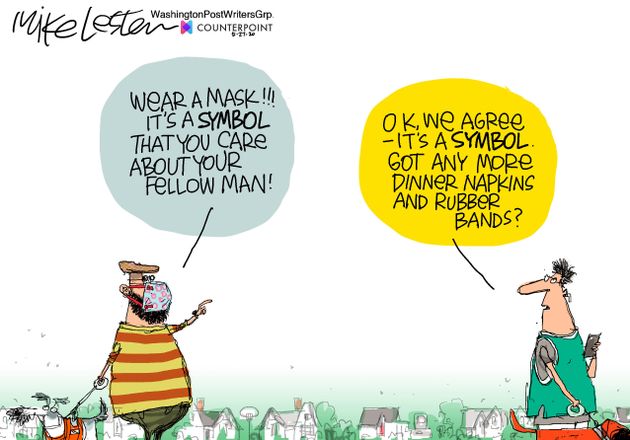
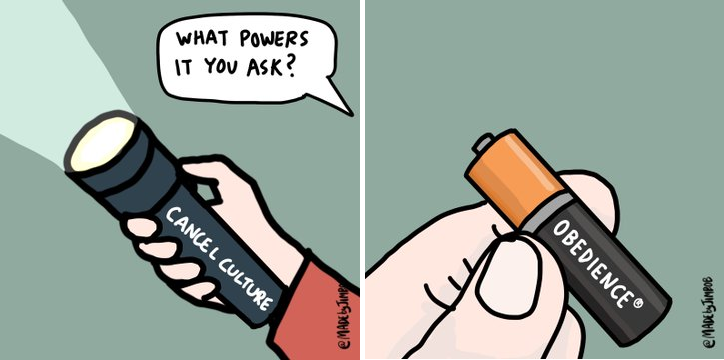
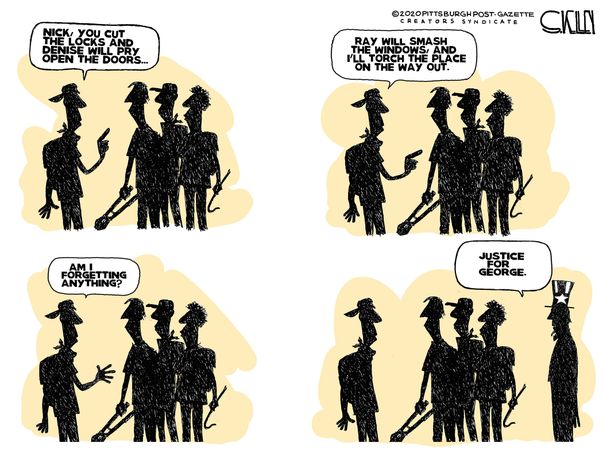
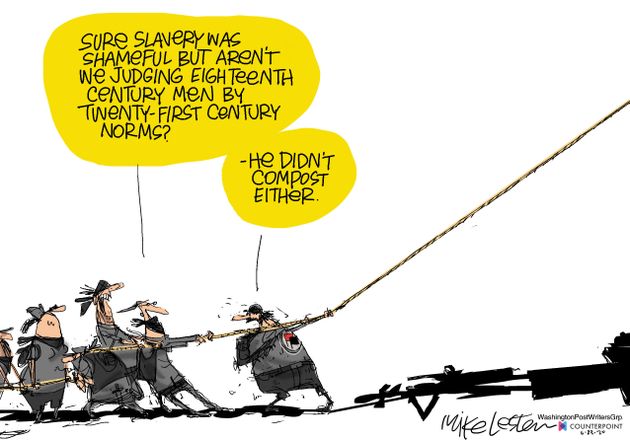
Then there’s Jimbob’s approach which involves switching the context to expose the absurdity of Karen’s challenge.

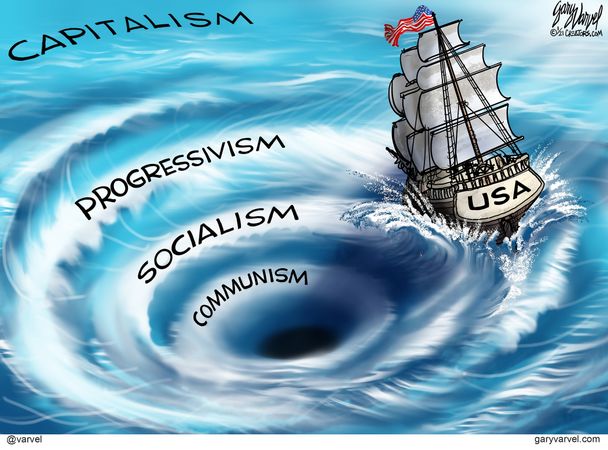
Four Steps to Take Down a Free Society


Update at end:  July 23, 2020 China Takes the Lead

The process is under way most obviously in the USA, but also in Europe, Australia and elsewhere. Scott McKay helpfully writes at American Spectator Four Stages of Marxist Takeover: The Accuracy of Yuri Bezmenov. Excerpts in italics with my bolds.

The journalist and Soviet defector long ago pegged the current left-wing moment.

But it’s also important to understand that the revolution taking place in America is not yet a “kinetic” one. That may come soon, or it may not. The battle taking place presently is a war of information — or disinformation, as the case may be.

And the revolution is a Marxist revolution. You should make no mistake about that. The groups fomenting it, the intellectuals promoting it, and the money financing it are all quite open about who they are.

This playbook was written long ago. If you think that Bernie Sanders or Kshama Sawant or Alicia Garza are smart enough to dream up a plan for taking down the greatest society the world has ever known, you are out of touch with reality. The only way they could have been as effective as they have so far is to follow somebody else’s plan. Which they are doing.

There is a video interview from a long time ago that you should see if you haven’t already seen it. It’s one of those things that many of our readers may have seen years ago and then forgot about — but all of a sudden it’s incredibly relevant again. The interview dates back to 1984, and it was conducted by the author, filmmaker, and John Birch Society gadfly G. Edward Griffin with a Soviet defector and former KGB operative named Yuri Bezmenov. (Below is a synopsis video)

Forget about Griffin’s background. He was something of an Alex Jones of his time, and he’s still around in his dotage, obsessing about things that cost him his relevance. It’s Bezmenov who matters. The Russian was involved at relatively high levels as a propagandist par excellence before leaving the USSR for Canada, and he laid out in excruciating detail the process by which a free society might be brought to collapse.

Khrushchev and the Soviets weren’t just bragging. What he was talking about was an entire system of Marxist indoctrination and takeover they had perfected and executed in country after country during the 20th century. Eastern Europe. North Korea. North Vietnam, then all of Vietnam. Cuba. Nicaragua. Later, Venezuela. Various African countries, including South Africa, the communist bloom of which has only recently come to pass. Some of those countries went communist because the Soviets rolled the tanks in; most went communist because the pre-communist society collapsed for various reasons. All went communist after they had been infiltrated with Marxist revolutionaries.

The point being that there was a template in place for how to penetrate a society with Marxist ideals and implode it so that the revolutionaries would control the ruins.

Bezmenov, whose father was a high-ranking Soviet military official and who was trained to be an elite KGB overseas operative, was taught the template and put to work in India attempting to infiltrate that country and bring it into the Warsaw Pact. He also worked at the Soviet RIA Novosti news organization, editing and planting propaganda materials into foreign media. The man knew exactly what he was talking about when he outlined how a Marxist revolution might bring America down without firing a shot, just as Khrushchev had predicted.

Bezmenov warned us in 1984 that a free society collapses in four stages, and the first is demoralization.

What he meant by demoralization is a process by which students in schools controlled by disciples of leftist thought would be indoctrinated into a set of values and beliefs foreign to those of the American tradition. Bezmenov said, in 1984, mind you, that this would happen when the 1960s and 1970s student radicals began to control the educational institutions, and their project would be to throw out traditional Judeo-Christian morality, classical education, and American patriotism. Is there any doubt this has happened?

Our young people are the least patriotic in our nation’s history, and the most ignorant of the cultural, intellectual, and ideological patrimony of which they are heirs.

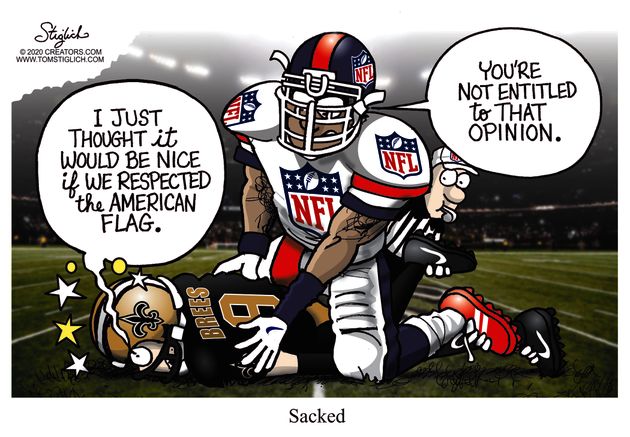
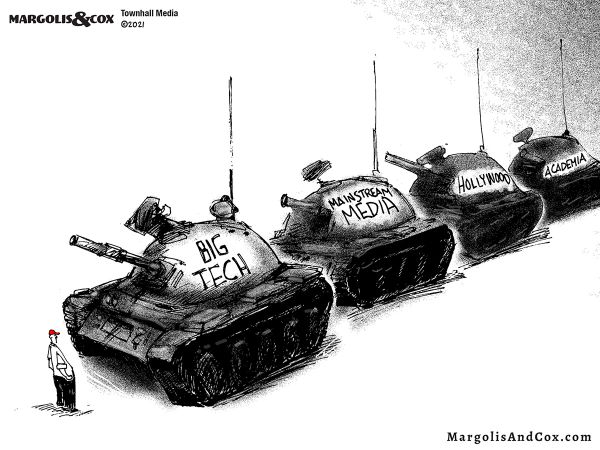
It’s even worse than that, because the cultural Marxist project not just in our schools but in our media and entertainment institutions has poisoned those against the country. Remember when the NFL was an escape from politics? Remember when the movies Hollywood made extolled American values and made viewers feel good about their country?  When was the last time you saw anything from American education or corporate media that made you feel good about your country?

stg072220dapr20200721034602

What’s the second step? Destabilization.

Bezmenov describes that as a rapid decline in the structure of a society — its economy, its military, its international relations. We’ve discussed in this space the unquestionable impetus on the part of Democrats to keep the economy as hamstrung as possible with COVID-19 shutdowns, and those continue despite a precipitous decline in death rates as testing ramps up across the country. It’s clear the virus is no longer a significant threat to the health of Americans who don’t already have serious medical issues, and yet COVID hysteria is increasing, rather than decreasing. Just Wednesday the Ivy League shut down all its sporting events planned for the fall semester, an absurd decision that is nonetheless likely to be copied by other universities dominated by leftist political activists (the Big Ten, ACC, and SEC are all in various stages of planning conference-only schedules this fall, which makes no sense whatsoever).

The virus is the perfect platform by which to impose the economic destabilization the Left has wanted all along.

No, that isn’t a conspiracy theory. They’re telling you it’s what they’re after. Do you believe Ilhan Omar was off-script when she suggested dismantling America’s economy as a system of oppression earlier this week? Ilhan Omar, who paid a political consultant $900,000 in fees last year, money that came from somewhere, isn’t smart enough to say these things without having the script written for her. She’s being trotted out to introduce them because she’s already radioactive and a lightning rod for criticism, and also because she’s (1) black, (2) Muslim, and (3) an immigrant, and even an illegal one. To criticize her statements as cracked bears the signature not of incisive reasoning but rather racism. So when other Democrats join her call you are no longer allowed to object.

That’s destabilization. They’re fully engaged in it, whether you believe they’ve been successful or not. But ask Mark McCloskey, for example, whether or not he thinks it’s outlandish to suggest the American order has been destabilized. McCloskey told Tucker Carlson that after the police told him they couldn’t protect him after the incident where he and his wife used guns to protect their property from a mob of Black Lives Matter trespassers, he called around to private security firms for help and was given advice to get out of his house and let the mob do what they would. Does that sound like a stable society to you?


The third stage is crisis, the catalyzing event that builds on the first two stages to bring on the change the revolutionaries are looking for.

Looking for a crisis? Take your pick. We barely even remember the fact that we just had only the third presidential impeachment in American history half a year ago, a constitutional crisis that was wholly and completely manufactured directly out of thin air. We progressed immediately from that to COVID-19, which was unquestionably a manufactured crisis — not that the virus itself isn’t deadly to a certain portion of the population, but if you think the panic and destruction it’s caused doesn’t smack of manufacture then it’s clear you’ve been demoralized.

And then the George Floyd riots and the paroxysms of violence and virtue-signaling those have brought on, complete with the current campaign to bowdlerize American history and culture in an increasingly indiscriminate fashion. That’s a crisis, everybody, and it’s a completely manufactured one. The speed of the cultural collapse that followed Floyd’s death — when the legal system moved very swiftly against the police officers responsible for it — makes it undeniable this was planned and only needed a catalyst.

What’s the fourth stage? Normalization. As in, a “new normal.”

The statues and monuments are gone, the ball games are out, or at least you aren’t allowed in the stadium to watch them (and you’ve got to watch them on TV interspersed with commercial spots and in-game messaging pushing whatever memes and narratives the ESPNs and NBCs of the world and their Madison Avenue partners wish to implant in your mind), the schools have purged American history and culture, the Universal Basic Income checks have replaced your job, which you can’t do because the small business where you used to work has gone under thanks to the virus.

And Biden is president. For a little while, until it’s clear he’s incapacitated per the 25th Amendment, and then somebody else that you didn’t vote for is in charge of the country.

Out goes Kerensky. In comes … who knows what?

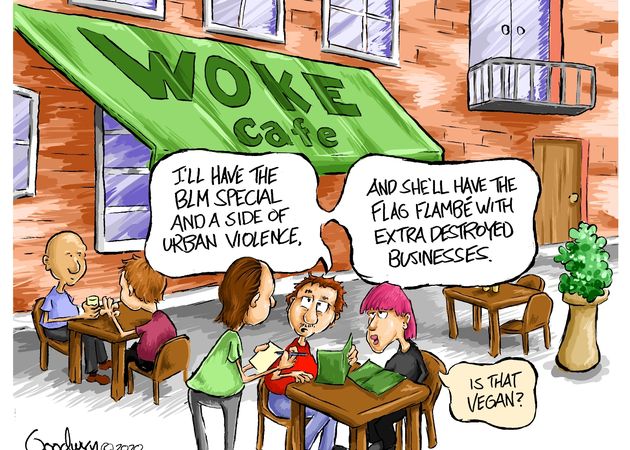
goodwyn_woke_cafe_lr_07272020200727102305

Let’s hope your confidence none of this can happen is well-placed. Let’s hope Bezmenov was a crank like people think G. Edward Griffin is.

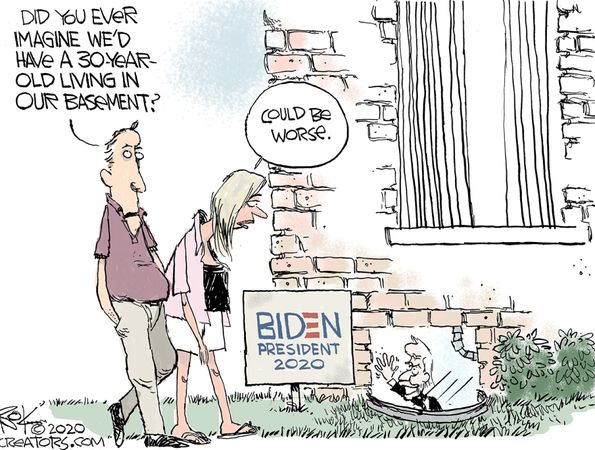
But just to be sure, let’s make damned sure Biden and the Democrats take an historic beating in November. We don’t want to find out what’s behind the curtain in Biden’s basement. Too many nasty things are already peeking out at us from there.

Update July 23, 2020: China Takes the Lead

Of course the leading proponent of this geopolitical strategy is China, and they are effectively applying it to the USA. Brian Kennedy writes in his book:

China’s goal is demoralizing the United States to the point where America believes that further resistance is futile.” They can’t succeed without the help of America’s elite.

From Robert Curry’s review: The Chinese are confident that America has grown corrupt, and that its political, financial, and cultural elites are in near-complete sympathy with the globalist project of an interdependent world, with the P.R.C. [the People’s Republic of China] at its head.

I have a story from my own life that illustrates Kennedy’s point. Recalling what it was like before the pandemic panic took total control of American life will help to set the stage. Back then, the media, the celebrities, and the politicians had not yet mastered the talking points of the COVID-19 narrative. During one of those early days, a local radio news personality announced with great excitement that she had secured an interview with a prominent epidemiologist from the most prestigious university in our region. After thanking the professor profusely for granting the interview, the reporter asked the obvious question, the one that was on my mind at that time: “What is the difference between this flu and the Spanish flu of 1918?”

The professor was greatly offended by the question. She admonished the reporter never to use the term “Spanish” with regard to the flu of 1918 and never to use the word “Chinese” with regard to the flu of 2020. The professor simply would not answer the question and, for that matter, she would not address any other question having to do with epidemiology. She confined herself to scolding and reeducating the reporter, making it clear to the reporter and her listeners what was and what was not politically correct to say about the virus.

It was an astonishing performance. The professor did not speak as an epidemiologist; instead, she spoke as a globalist. When she said, in effect, “Don’t you ever call this flu that came from China ‘Chinese,’” she was acting as a spokesperson for the ideology of globalism.

See also: Patriotism Vs. Multiculturalism

Kneeling to Experts Not Advisable

Taking an opinion “under advisement” means seriously considering it but retaining the independence to weigh it against other considerations.  Charles Lipson explains the importance of not bowing to expert recommendations in his article Reopening Schools and the Limits of Expertise.  Excerpts in italics with my bolds.

The last thing you want to hear from your brain surgeon (aside from “Oops”) is “Wow, I’ve always wanted to do one of these.” You’ll feel a lot better hearing, “I’ve done 30 operations like this over the past month and published several articles about them.”

Expertise like that is essential for brain surgery, building rockets, constructing skyscrapers, and much, much more. Our modern world is built upon it. We need such expert advice as we decide whether to open schools this fall, and we should turn to educators, physicians, and economists to get it. But ultimately we, as citizens and the local officials we elect, should make the choices. These are not technical decisions but political ones that incorporate technical issues and projections.

We should hold our representatives, not the experts, responsible for the choices they make.

When we listen to experts, we should remember Clint Eastwood’s comment in “Magnum Force”: “A man’s got to know his limitations.” Even the best authorities have them, and one, ironically, is that they seldom admit them, even to themselves. It is important for us both to appreciate expert advice and to recognize its limits every time we’re told to “be quiet and do what they say.” We should listen, think it over, and then make our own decisions as citizens, parents, teachers, business owners, workers, retirees — and voters.

The best way to understand why we need experts but also why we need to weigh their advice, not swallow it whole and uncooked, is to consider this illustration: Should we build a hydroelectric dam in a beautiful valley? If we construct it, we certainly need the best engineers and construction workers. We need engineering firms to project the cost and economists to project the price of its energy and potable water. Their expertise is essential.

But they cannot tell us whether it is wise to destroy California’s Hetch Hetchy Valley to build that dam. The world’s top experts on wildlife conservation and regional economic growth cannot give us the definitive answer, either. They would give us, at best, different answers, reflecting their different expertise. The conservationist would tell us it is a terrible idea to destroy such beautiful, irreplaceable habitat and kill endangered species. The economist would tell us we need the energy and fresh water if Northern California is to grow. What no economist could have predicted, decades ago, is that the entire world’s income would vastly increase because of technological advances from Silicon Valley, which had the resources needed to grow.

The hydroelectric example illustrates a more general point: complex questions involve experts in multiple fields, but there is no supra-expert to aggregate their differing advice. Even if we assume all experts within a field give similar advice, who can aggregate it across fields? No one. There is no “expert of experts.” In the example of the hydroelectric dam, the policy decision depends on how much we weigh conservation versus growth and how well we can predict future options and alternatives, such as the price of solar power or prospective growth from Palo Alto to San Jose.

Sorting out the answers is ultimately a question for voters and their representatives, not for experts in hydroelectric engineering, wildlife conservation, or regional economics. We need the best advice, but only we, as citizens, can weigh it and make a final decision. In a representative democracy, we elect officials to make those decisions. If democracy is to work, we must hold them accountable. One criticism of the growing regulatory state is that it is impossible to hold the decision makers accountable. Some of that criticism should be directed at legislators, who avoid responsibility by writing vague laws and then off-loading hard decisions onto bureaucrats and judges.

We should be especially skeptical when experts predict distant outcomes.

Their record is none too impressive. We should be skeptical, too, when laws and regulations set one definitive criterion, such as preserving the endangered snail darter, at the expense of all other considerations. That might be the best decision, or it might not, but it is ultimately a political choice. Right now, federal judges have awarded themselves extensive — and unilateral — power to make it.

These problems, which combine technical expertise and political judgment, are essential to understanding our dilemmas about reopening K-12 schools during the COVID-19 pandemic. Epidemiologists are saying, “Resuming in-person instruction too soon could spread the disease. Although children are at low risk, they will bring it home to parents and grandparents.” Pediatricians, by contrast, say it is important for children’s overall health to get them back in school. Online learning is not very effective, they say, and losing a year’s classroom instruction and socialization will be extremely harmful. Economists focus on different issues, such as parents who cannot return to full-time employment because they must care for children at home. That constraint is especially harmful to one-parent households and low-income, hourly workers, whose children also have less access to computers and fast internet connections. Notice that these experts are not the self-interested voices of interest groups such as teachers’ unions or small businesses. They are specialists in economics, education, and public health. Each has its own “silo of expertise.” Each silo produces a different answer because its experts focus on their own subset of issues and weigh them most heavily.

As we listen to these experts, we need to remember that even the best, most disinterested advice has its limitations. Reopening schools, like other big policy questions, involves multiple silos and hundreds of moving parts. It is impossible to predict what all those parts will do, how much weight to give each one, or what effects they might have, now and in the distant future. It was only from trial-and-error that we learned how inadequate online instruction really is. We entered this massive national experiment with some optimism and trudge forward with pessimism.

We should be humble about what we still don’t know.

Our success in reopening schools and businesses depends on things we cannot know with certainty. How quickly will our biotechnology companies discover effective therapeutics and vaccines? How quickly will the American population develop “herd immunity?” How soon will customers return, en masse, to shopping malls, indoor dining, and cross-country travel?

Predicting the secondary and tertiary effects of policy choices is especially hard.

Keeping businesses closed, for instance, sharply reduces local tax revenues, which probably means reducing essential services such as garbage collection and local policing. Those cuts harm public health and safety. But how much? No expert is smart enough to predict all these knock-on effects, much less aggregate them and give an overall conclusion. As it happens, experts are no better at predicting these effects than well-informed laymen. The main difference, according to studies, is that experts are more confident in their (often-wrong) predictions.

The point here is not that experts are irrelevant. We need them, and we need to pay attention to their data, logic, and conclusions. But we also need to remember that

  • Even the best current knowledge has its limits, and
  • There are no “supra-experts” to weigh the best advice from different fields and aggregate them to reach the “definitive” answer.

Sorting out this expert advice is not a technological question. It is a political one. Mayors, governors, and school boards across the country understand that crucial point as they decide whether to open schools this fall for in-person instruction. The voters understand it, too. They should listen to the experts, see what other jurisdictions decide, and check out their varied results. Then, they should walk into the voting booth and hold their representatives to account.

Charles Lipson is the Peter B. Ritzma Professor of Political Science Emeritus at the University of Chicago, where he founded the Program on International Politics, Economics, and Security.

Teachers Beware Your Cultural Revolution Turning on You

The protests in city streets of developed countries are coordinated and led by Social Justice Warriors indoctrinated in Western academies of higher education, after elementary school slanted teaching. If neo-Marxist progressive post-moderns take pride in this as accomplishing their agenda, consider what happened in China’s cultural revolution in the 1960s and is repeating itself in 2020.

Background:

It all started in China with educational reform implemented by teachers and administrators. That history is summarized in an article China’s Cultural Revolution: Reforms in the Education System at UK Essays. Excerpts in italics with my bolds.

The implementation of educational reforms was carried out via a decentralized process, as most schools were placed under local management. In fact each school had its own “Revolution in Education’ Committee responsible not only for implementing reforms but also for part of the planning process within its own institution.”[7] So it would seem that local experimentation within the general framework of the new educational policies was encouraged. Experimentation was seen as necessary primarily because of the emphasis on adopting flexible methods to meet the diverse needs of different schools and regions. We will identify below the major guidelines regarding the implementation of the educational reforms, as well as describe some of the different ways the reforms were implemented.

In order to elevate the “political consciousness” of the students, the curriculum was heavily stocked with political education courses. The major texts used were drawn from the works of Mao. Aside from increasing the number of political course, other courses also drew upon Mao’s thoughts to explain various approaches to the analysis of whatever phenomenon was involved.[8] This reliance on Mao’s thoughts was essentially the concept of “putting politics in command of knowledge.” At the same time, “revolutionary mass criticism” and “class struggles” were actively promoted to bring into sharp relief the various contradictions in society from a more personal perspective. The principal means of linking theory and practice in the educational process were to make production labor a major part of the students’ curriculum and to direct research to meet local needs. These methods were based on the concept of “practical training,” although their implementation in China seems to have gone far beyond that practiced by other countries.

What Happened to the Educators

The fate of the teachers is revealed in research conducted by Youqin Wang In her paper Student Attacks Against Teachers: The Revolution of 1966. Excerpts in italics with my bolds.

The author investigated the so-called “Red August” of 1966, the start of large-scale violent persecution during China’s Cultural Revolution. She interviewed hundreds of teachers and students from ninety-six schools and reviewed all available written materials. This article provides a detailed description of how educators were insulted, tortured, and even killed by their students. Mobilized as members of a new youth organization named “Red Guards,” the students attacked the educators for being “capitalist intellectuals.” In those schools, twenty-seven educators were murdered; more committed suicide subsequent to torture. Cruel oppression silenced resistance. Stories about bloody campus persecutions were too politically sensitive following the Cultural Revolution, so have heretofore received scant attention in the historical narrative. As the author shows, given the high regard China has traditionally held for education, the brutalizing of educators in China was an unprecedented act. The objective of this article is to reveal the texture and significance of this underreported and underappreciated part of China’s history.

Not only were the stories of violence not reported by the media at the time of their occurrence, but thirteen years later, in 1979, with the repudiation of the Cultural Revolution reaching the highest circles of the Chinese Communist Party (CCP), the Chinese media only cautiously began to mention the victims as a way of “restoring” their reputation. This sort of publicity was limited to a small number of purged high-ranking cadres, victimized celebrities, and a few ordinary people who were considered “heroes” or “heroines” for resisting the “Gang of Four” (四人幫). The teachers who were victimized in 1966 were not so much as mentioned. None of the three published general histories of the Cultural Revolution (printed in 1986, 1988, and 1995 respectively) covers the brutality against teachers in the summer of 1966.

In general, the brutality of students in colleges and in elementary schools was not as severe as in middle schools, but it was nevertheless serious. At Beijing University, hundreds of people on the “labor reform team of ox-ghosts and snake-demons” were forced to clean the campus with irregularly shaved heads, while wearing boards with their name and title (such as “member of the black gang” or “reactionary academic authority”) around their necks and receiving gratuitous insults from many students who came to “learn revolutionary experiences from Beijing University.”

On August 24, 1966, the Red Guards of the Middle School attached to Qinghua University transported truckloads of Red Guards from twelve middle schools to Qinghua campus, where they beat the administrators and professors. After several persons at the Department of Electronic Engineering were beaten, their blood stained the ground. Someone marked a circle around the blood and wrote “dog blood.” That day Red Guards ordered those on the “ox-ghost and snake-demon team,” under the lashes of whip, kicks, and punches, to pull down a white marble monument which was built in 1905 to commemorate the founding of the school. That night, all school-level cadres at both the university and the attached middle school were detained in the Science Building, and there in a small room, a beating was inflicted upon each of them. No one escaped without serious injury.

Even kindergarten teachers could not escape the violence. Some teachers of Beijing Zhongshan Gongyuan Kindergarten and several kindergartens in Beijing’s Dongcheng District (東城區) were denounced and beaten in the Zhongshan Concert Pavilion; there, students from middle schools beat them and shaved their heads

The “working groups” organized sessions to expose and to criticize teachers and divided all teachers into four categories: good, fair, those with serious errors, and anti-party/anti-socialist “rightists” (右派份子). For example, the working group at the Girls Middle School attached to Beijing Teachers University led an “exposing and denouncing meeting” against vice-principal Bian Zhongyun on June 21 at which all students attended. According to the working group’s record of July 3, 1966, the group put two out of six leading cadres of this school into category IV (the worst one), two in category III, and two in category II. Some teachers, unable to bear the pressure and insults, committed suicide.

When their parents were denounced by the new student organizations, the Red Guards fell victim to the movement that they had started. However, the decline of the original Red Guards did not mean the end of the philosophy of violent attacks. On the contrary, the massive violent persecution that the Red Guards promoted in the so-called “Red August” (紅八月) period of 1966 continued in the following years. In late 1966 and 1967, students in the mass organizations that had dominant status during that period physically attacked the “capitalistroaders with powerful positions in the party.” For example, students beat Peng Dehuai (彭德 懷), the former defense minister, at the “struggle meeting” in Beijing in July of 1967. Two of Peng’s ribs were broken during the beating.47

On June 18, 1968, at Beijing University, about two hundred teachers and cadres, who had been imprisoned on campus for months, were beaten and tortured in very brutal ways during a school-wide action. This date was chosen to celebrate the violent event that had occurred two years previous, on June 18 of 1966, mentioned twice above. In the attack of June 18, 1968, more educators were beaten more viciously than in the previous attack of June 18, 1966. From 1966 to 1968, it was in part this increasing violent persecution that fueled enthusiasm for the Cultural Revolution.

Cultural Tyranny Continues in 2020 China

The present direction in China is not encouraging as reported at Reuters(Beijing) by Huizhong Wu In echo of Mao era, China’s schools in book-cleansing drive. Excerpts in italics with my bolds.

As schools reopened in China after the COVID-19 outbreak, they have thrown themselves into a nationwide exercise to remove books deemed politically incorrect, deepening Chinese President Xi Jinping’s push to instill patriotism and ideological purity in the education system.

A directive from the Ministry of Education last October called on elementary and middle schools to clear out books from their libraries including “illegal” and “inappropriate” works. Now teachers have removed books from schools in at least 30 of mainland China’s 33 provinces and municipalities, according to a Reuters review of social media posts, publicly available school and local government documents, and interviews with teachers.

From western Gansu province to Shanghai, the review of publicly announced measures pointed to books being cleared by the hundreds of thousands.

Censorship in China has been intensifying under Xi, but analysts say this is the first national campaign aimed at libraries in decades. It comes as government employees in Hong Kong last week removed books by pro-democracy activists from public libraries to see whether they violate a new national security law.

“This is the first movement targeted at libraries since the Cultural Revolution,” said Wu Qiang, a political analyst based in Beijing and former political science lecturer at Tsinghua University. In the late 1960s, zealous teenagers driven by Mao Zedong carried out a nationwide campaign targeting libraries and destroying or burning what they could get their hands on, as part of a wider destruction of traditional culture.

My Comment

An old Soviet joke has an university professor of history addressing his students at the end of the term. “Regarding the final exam, I have good news and bad news. The good news is that all the the questions are the same as last year. The bad news: Some of the correct answers have changed.”

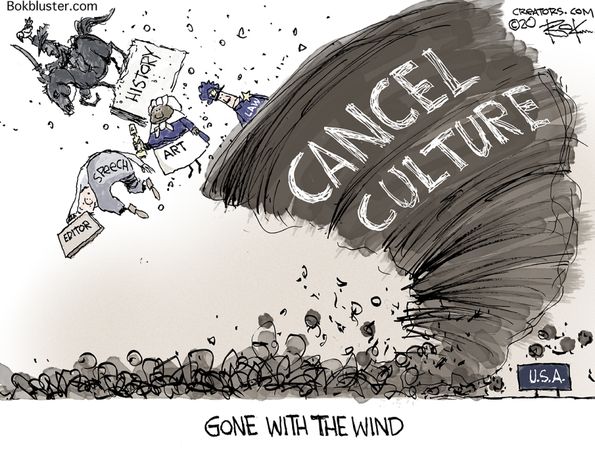
The story was shared among the proles as an example of the slogan of the times: The future is certain; only the past keeps changing. I never thought we’d see such thought control appearing in Western democracies in the 21st century. But here it is, demonstrated by the 1619 project promoted by the New York Times, former newspaper of record in the USA. Further the Red Guard, now wearing Black, are roaming and destroying monuments honoring heroes of the past, who though flawed paved the way for our freedoms and prosperity. People guilty of wrongthink are insulted, their reputations denigrated and driven from their livelihoods, just a shade from beatings and murders.

Of course there are differences in 2020 USA from 1966 China. The charismatic Mao called the shots for the purge of dissenters in China, while the woke leadership is more diffuse and hides behind names like “Sunrise Movement.”. “Black Lives Matter,” and “Anti-Fascists.” Clearly the media are broadcasting the “Resistance” playbook, but the directors and financiers are in the shadows. The slow-moving coup is reaching a crescendo, but the citizenry still have a choice to be heard.

Footnote: Summary from the UK Essay at the top

While the drastic educational reform measures have given peasants opportunities to attain basic education in rural areas, as well as agricultural production and political gains, it naturally came with lasting negative impacts that promoted many post-modernist’s critiques. In the beginning of the Cultural Revolution, values like collaboration, diligence, modesty, and respect for elders and teachers were discarded as a result of the purge of the old Chinese cultures and traditions. Many have failed to retain the virtues during the revolution. Second, due to political struggle and line drawn between working classes and intellectuals, as well as political and violent nature of the social revolution, substantial innocent teachers and professionals were subjected to personal attacks and humiliation, some even executed. Third, specific strategies of the reformed curriculum and examination system proved to be misguided and wasted the schooling of many young people. The disconnection between academic achievement and students’ future career, the emphasis on political correctness over academic achievement, and the neglecting of theory learning and over-emphasis on hands-on experiences were all examples of poor decisions. Fourth, the Cultural Revolution both liberated students and dominated them. It liberated students and people because it opened their eyes to the inequality existing in education and society; However, it imposed political control and dominated them because it did not allow real democratic, independent and critical thinking ability.[12] As Freire (1970) put it, “If teachers help students from oppressed communities to read the word but do not also teach them to read the world, students might become literate in a technical sense but will remain passive objects of history rather than active subjects.”

See Also Modern Educayshun

Bari Weiss Resigns from NYT

For a thorough understanding of what is wrong with US media, read this resignation letter by Bari Weiss. Excerpts in italics with my bolds.

Dear A.G.,

It is with sadness that I write to tell you that I am resigning from The New York Times.

I joined the paper with gratitude and optimism three years ago. I was hired with the goal of bringing in voices that would not otherwise appear in your pages: first-time writers, centrists, conservatives and others who would not naturally think of The Times as their home. The reason for this effort was clear: The paper’s failure to anticipate the outcome of the 2016 election meant that it didn’t have a firm grasp of the country it covers. Dean Baquet and others have admitted as much on various occasions. The priority in Opinion was to help redress that critical shortcoming.

I was honored to be part of that effort, led by James Bennet. I am proud of my work as a writer and as an editor. Among those I helped bring to our pages: the Venezuelan dissident Wuilly Arteaga; the Iranian chess champion Dorsa Derakhshani; and the Hong Kong Christian democrat Derek Lam. Also: Ayaan Hirsi Ali, Masih Alinejad, Zaina Arafat, Elna Baker, Rachael Denhollander, Matti Friedman, Nick Gillespie, Heather Heying, Randall Kennedy, Julius Krein, Monica Lewinsky, Glenn Loury, Jesse Singal, Ali Soufan, Chloe Valdary, Thomas Chatterton Williams, Wesley Yang, and many others.

But the lessons that ought to have followed the election—lessons about the importance of understanding other Americans, the necessity of resisting tribalism, and the centrality of the free exchange of ideas to a democratic society—have not been learned.

Instead, a new consensus has emerged in the press, but perhaps especially at this paper: that truth isn’t a process of collective discovery, but an orthodoxy already known to an enlightened few whose job is to inform everyone else.

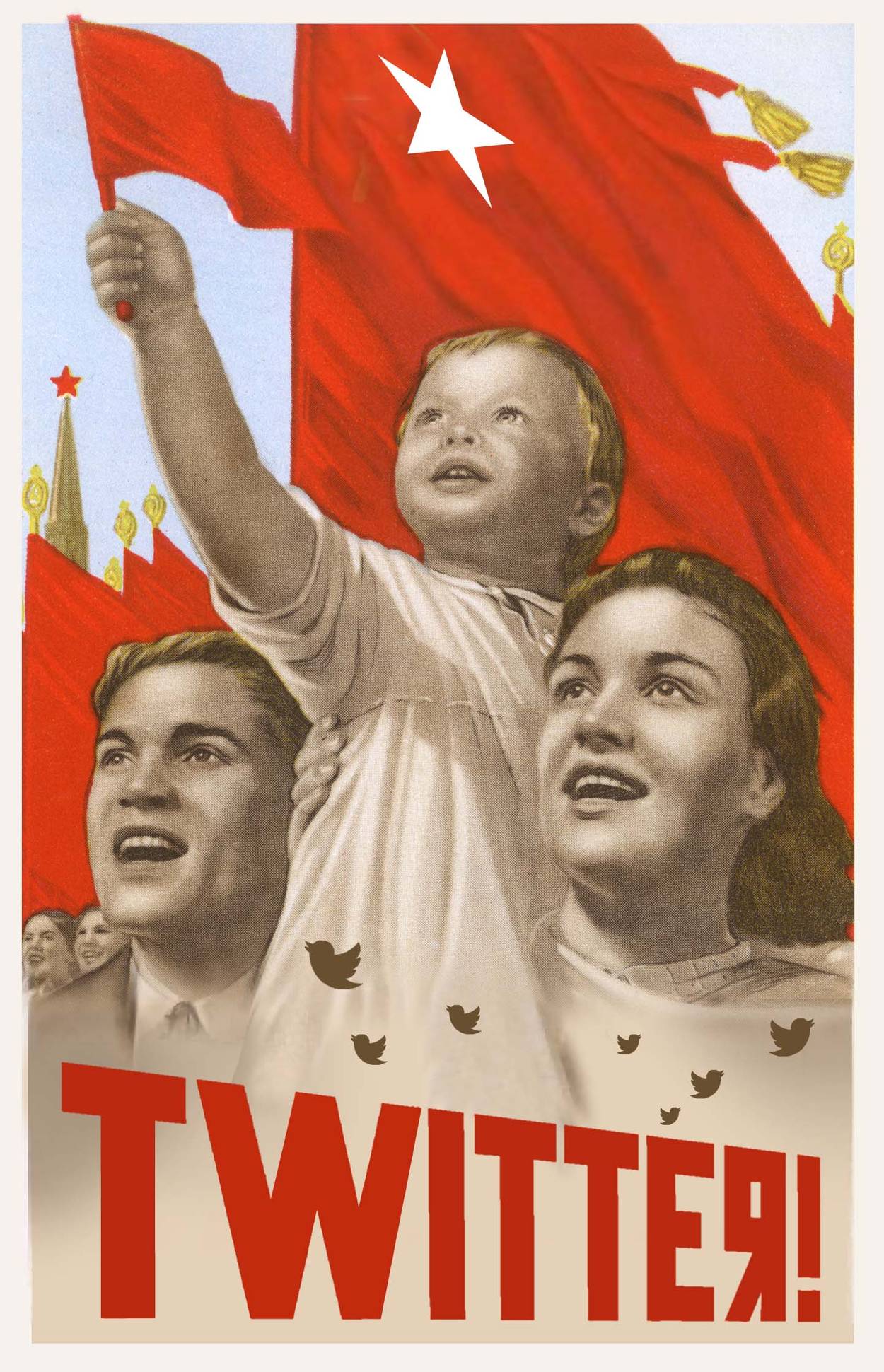
Twitter is not on the masthead of The New York Times. But Twitter has become its ultimate editor. As the ethics and mores of that platform have become those of the paper, the paper itself has increasingly become a kind of performance space. Stories are chosen and told in a way to satisfy the narrowest of audiences, rather than to allow a curious public to read about the world and then draw their own conclusions. I was always taught that journalists were charged with writing the first rough draft of history. Now, history itself is one more ephemeral thing molded to fit the needs of a predetermined narrative.

My own forays into Wrongthink have made me the subject of constant bullying by colleagues who disagree with my views. They have called me a Nazi and a racist; I have learned to brush off comments about how I’m “writing about the Jews again.” Several colleagues perceived to be friendly with me were badgered by coworkers. My work and my character are openly demeaned on company-wide Slack channels where masthead editors regularly weigh in. There, some coworkers insist I need to be rooted out if this company is to be a truly “inclusive” one, while others post ax emojis next to my name. Still other New York Times employees publicly smear me as a liar and a bigot on Twitter with no fear that harassing me will be met with appropriate action. They never are.
There are terms for all of this: unlawful discrimination, hostile work environment, and constructive discharge. I’m no legal expert. But I know that this is wrong.

I do not understand how you have allowed this kind of behavior to go on inside your company in full view of the paper’s entire staff and the public. And I certainly can’t square how you and other Times leaders have stood by while simultaneously praising me in private for my courage.

Showing up for work as a centrist at an American newspaper should not require bravery.

Part of me wishes I could say that my experience was unique. But the truth is that intellectual curiosity—let alone risk-taking—is now a liability at The Times. Why edit something challenging to our readers, or write something bold only to go through the numbing process of making it ideologically kosher, when we can assure ourselves of job security (and clicks) by publishing our 4000th op-ed arguing that Donald Trump is a unique danger to the country and the world? And so self-censorship has become the norm.

What rules that remain at The Times are applied with extreme selectivity. If a person’s ideology is in keeping with the new orthodoxy, they and their work remain unscrutinized. Everyone else lives in fear of the digital thunderdome. Online venom is excused so long as it is directed at the proper targets.

Op-eds that would have easily been published just two years ago would now get an editor or a writer in serious trouble, if not fired. If a piece is perceived as likely to inspire backlash internally or on social media, the editor or writer avoids pitching it. If she feels strongly enough to suggest it, she is quickly steered to safer ground. And if, every now and then, she succeeds in getting a piece published that does not explicitly promote progressive causes, it happens only after every line is carefully massaged, negotiated and caveated.

It took the paper two days and two jobs to say that the Tom Cotton op-ed “fell short of our standards.” We attached an editor’s note on a travel story about Jaffa shortly after it was published because it “failed to touch on important aspects of Jaffa’s makeup and its history.” But there is still none appended to Cheryl Strayed’s fawning interview with the writer Alice Walker, a proud anti-Semite who believes in lizard Illuminati.

The paper of record is, more and more, the record of those living in a distant galaxy, one whose concerns are profoundly removed from the lives of most people. This is a galaxy in which, to choose just a few recent examples, the Soviet space program is lauded for its “diversity”; the doxxing of teenagers in the name of justice is condoned; and the worst caste systems in human history includes the United States alongside Nazi Germany.

Even now, I am confident that most people at The Times do not hold these views. Yet they are cowed by those who do. Why? Perhaps because they believe the ultimate goal is righteous. Perhaps because they believe that they will be granted protection if they nod along as the coin of our realm—language—is degraded in service to an ever-shifting laundry list of right causes. Perhaps because there are millions of unemployed people in this country and they feel lucky to have a job in a contracting industry.

Or perhaps it is because they know that, nowadays, standing up for principle at the paper does not win plaudits. It puts a target on your back. Too wise to post on Slack, they write to me privately about the “new McCarthyism” that has taken root at the paper of record.

All this bodes ill, especially for independent-minded young writers and editors paying close attention to what they’ll have to do to advance in their careers. Rule One: Speak your mind at your own peril. Rule Two: Never risk commissioning a story that goes against the narrative. Rule Three: Never believe an editor or publisher who urges you to go against the grain. Eventually, the publisher will cave to the mob, the editor will get fired or reassigned, and you’ll be hung out to dry.

For these young writers and editors, there is one consolation. As places like The Times and other once-great journalistic institutions betray their standards and lose sight of their principles, Americans still hunger for news that is accurate, opinions that are vital, and debate that is sincere. I hear from these people every day. “An independent press is not a liberal ideal or a progressive ideal or a democratic ideal. It’s an American ideal,” you said a few years ago. I couldn’t agree more. America is a great country that deserves a great newspaper.

None of this means that some of the most talented journalists in the world don’t still labor for this newspaper. They do, which is what makes the illiberal environment especially heartbreaking. I will be, as ever, a dedicated reader of their work. But I can no longer do the work that you brought me here to do—the work that Adolph Ochs described in that famous 1896 statement: “to make of the columns of The New York Times a forum for the consideration of all questions of public importance, and to that end to invite intelligent discussion from all shades of opinion.”

Ochs’s idea is one of the best I’ve encountered. And I’ve always comforted myself with the notion that the best ideas win out. But ideas cannot win on their own. They need a voice. They need a hearing. Above all, they must be backed by people willing to live by them.

Sincerely,

Bari
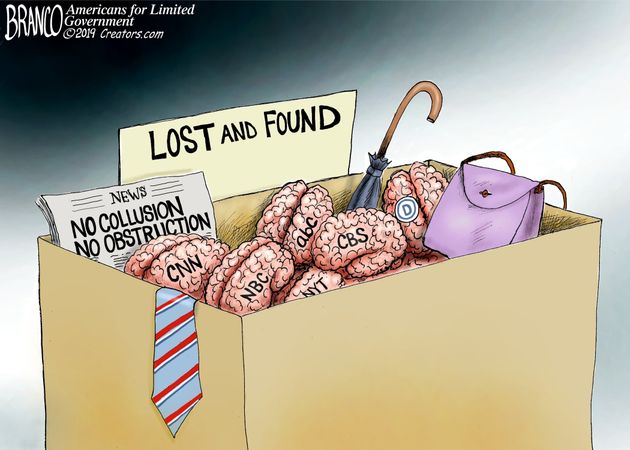
Addendum:  Some more words of wisdom from Jason Whitlock (he’s on the left)

The theory driving the importance of a “a free press” is that journalists will deliver truthful information to the public and the public will make good decisions based on that information.

Feed the public social media-friendly, clickbait narrative lies disguised as racial-justice truth and you provoke the kind of unrest currently sweeping this nation. Media black lies matter. They agitate old wounds, sow discord and distrust, undermine patriotism and prevent us from addressing real problems.

The annual murder of thousands of black men is a legitimate problem. Social media has us fixated on the annual murder of a half dozen. Black lies matter, especially when they’re used to conceal a political agenda detached from the advancement of freedom.

Journalists should not be political partisans. We’re supposed to be arbiters and discoverers of truth. Nothing in Sen. Hawley’s email should’ve triggered Wojnarowski. Nothing in Woj’s two-word rebuke should’ve triggered other journalists to support him.

Under the pretense of resisting the Trump presidency, journalists joined the mob and dropped their ethics. We became everything we accuse the president of being. Rude, emotional, arrogant, irrational, dishonest, vain, racist, elitist and obsessed with our social media feeds.

There is no lie we won’t tell in pursuit of smearing President Trump. The Resistance acts as religion, washing away the sins of its congregants and labeling non-believers as heathens unworthy of America’s kingdom.

But President Trump is merely a smokescreen, a beard justifying the mob’s dismantling of truth and destruction of freedom. The enemies of the American way use the Orange Man as bait for the abandonment of our founding values, principles and pillars —Jesus and Journalism, the belief in the liberating power of truth.

In rejecting those values, we also must reject and demonize the founders of this country. Their flaws nullify their truths, good works and all the documents they created that led to a level of freedom envied by the world. The revision of history and establishment of a new worldview requires an evisceration of the historymakers who valued religion and a search for truth above all else.
 

Braving Today’s Cultural Minefield

Lionel Shriver provides guidance on what’s going on in our social spaces lately, writing at the Spectator The vanity of ‘white guilt’.  Excerpts in italics with my bolds.

We’re making a spectacle of shame

Though the concept of collective ‘white guilt’ has been with us since at least the 1960s, it’s seen quite the fashionable resurgence in the wake of the George Floyd protests last month. As universities, businesses and celebrities fall all over themselves to banner their racial blameworthiness, pale-faced mea culpas gather into a deafening chorus.

The issues are two. First, one of this column’s running themes: emotional fraudulence.

Clarion declarations of moral dereliction do not have the texture of guilt. They are prideful. They have the texture of preening. Elaborate racial apologies are a form of showing off. When last month the actress Jenny Slate resigned from the animated Netflix show Big Mouth because voicing a half-black character was ‘an example of white privilege’ and ‘an act of erasure of black people’ within ‘a system of societal white supremacy’, she wasn’t making a career sacrifice, but bidding for elevated status.

Bet it works, too. Bet the lady isn’t short of work for long. FYI, a backhanded boast of my own: my latest novel anticipates white audiobook readers and voice-over artists being forbidden the ‘mimicry’ of speaking as non-white characters. The prescience is depressing.

We’re witnessing the spectacle of white people frantically competing with other white people over who can appear more self-excoriating, more self-loathing. But these people don’t hate themselves. They hate other people — mythical other people, for the most part, all those terrible racist white folks to whom they can feel vastly superior. Now that ‘white silence = violence’, they can also feel superior to regular going-about-their-business white people who haven’t managed to get prostrate pronouncements of self-disgust on Buzzfeed.

These confessions are also defensive. They’re diversionary, and an attempt to opt out. They translate as: ‘You don’t want to come for us! We’re on your side! We’re allies! We’re the nice white people, and because there’s no such thing as nice white people, that means we’re not really white after all! So you don’t want to burn down our premises, right? You want to go for those horrible white people, over there! Here, take some petrol and matches, on us! And we won’t call the cops, honest!’

Yet ask Adam Rapoport, forced to resign as editor of Bon Appétit over an ancient ‘brown face’. The opt-out doesn’t work. You get cancelled anyway, when your unseemly Black Lives Matter grovelling is deemed insufficiently pious.

Proper guilt feels bad. Its emotional cousin, shame, feels even worse. Whenever I leaked a bit because I didn’t want to come in from playing outside, my mother forced me to wash out my panties by hand in the sink, in front of my brothers. Behold: shame. Adult examples of shame in my life I’d be reluctant to share here. Shame is soul-destroying, the stuff of suicide. You don’t parade shame in public; you’re unlikely to leave the house. So none of last month’s white protestors was ashamed.

Issue two: We’re in danger of installing heritable guilt as morally valid.

Now that we’re to embrace the concept of an ineradicable ‘systemic racism’ while employees take mandatory courses on ‘unconscious bias’, bigotry is no longer a sin we choose or refuse to perpetuate, but a stain handed down through the generations that’s just as indelible as the peach juice on my pink dress. Is this what we want? Really? Will we stick modern Mongolians with the rampages of Genghis Khan? Hold some 19-year-old Muscovite today responsible for Stalin’s gulags? Force Germans to keep expiating their little hearts out over the second world war in the year 3000?

Maybe we should enlarge the lens. Frankly, I’m weary of the whole category ‘white people’, which throws folks of wildly different backgrounds, from Russians to Jews to Scots, into one big indiscriminate pot. So let’s talk about people, full stop. As a species, we’ve been treating each other like shit from the year dot. The horrors to which we’ve subjected one another, including slavery but a great deal else, are so incomprehensibly dreadful that no one, as an individual, could conceivably bear the crushing weight of all that torture, mass murder and sadism. If guilt is inherited, then every last one of us should be condemned to Dante’s nine circles of hell.

None of us chose the world in which we emerged. We didn’t pick our race, sex or natal nationality; any inbuilt leg-up or disadvantage these traits conferred at birth was not of our making. We didn’t select which awful history soaks the ground at our feet. It’s insensible to feel ‘guilty’ or ‘ashamed’ about something you didn’t do. It’s entirely sensible to feel regret, sorrow and abhorrence about the likes of slavery. It’s commendable to be informed about the past and to try to understand the nature of its wretchedness, as it’s also commendable to strain to leave the world a little better than you found it.

But claiming that what happened before you were born is all your fault is not only ridiculous. It’s vain.

See also American Soviet Mentality

Chancey Biden

For those who are unfamiliar with either the book or the 1979 movie starring Peter Sellers, “Being There” is an allegory about a simple-minded man — Chance, the gardener — whose world is defined by what he has seen in the garden and on TV. Through various twists of fate, Chance the gardener becomes Chauncey Gardiner, and is catapulted to the upper echelons of society, business and government.

His advice is sought by the president and other world leaders, who interpret Chauncey’s simple statements about the garden as pithy metaphors about the economy.

For example, asked if the government can stimulate economic growth with temporary incentives, Chauncey replies: “As long as the roots are not severed, all is well. And all will be well in the garden.”

He explains that “growth has its seasons.” And, yes, “there will be growth in the spring.”

Compare those comments with these Bidenisms:

“As my father says, Don’t tell me what you value, show me your budget. I’ll tell you what you value.”

“My wife has an expression: Any country that out educates us will out compete us.

“If my mother were here, she’d say, ‘Joe, hush up and start taking some questions.’ ”

Without your word, you’re not a man” (his dad); “As long as a person’s alive, they have the obligation to strive” (his mom); or “The greatest gift God gave to mankind was the ability to forget” (his first wife, who died in a car accident).

‘Joey, don’t compare me to the Almighty, compare me to the alternative.’ ’’

“I shouldn’t have started this because it was too complicated, I know

My dad would “say, ‘Joe, remember, never argue with your wife about anything that is going to happen more than a year from now.’ ”

Those anecdotes from Chancey Joe are folksy, for sure, but other ones are more disturbing:

“Unless we do something about this, my children are going to grow up in a racial jungle, with tensions so high that it is going to explode.

“If you have a problem figuring out if you’re for me or Trump, then you ain’t black.”

I know nothing about those moves to investigate Michael Flynn,”

“I told Ukraine, if the prosecutor is not fired, you’re not getting the billion dollars.”

If Trump loses and won’t leave, I’m convinced the Military will escort him from the White House with great dispatch.”

“We would make sure Coal and Fracking are eliminated, and no more subsidies for either one of those, period.’”

“I would immediately rejoin the Paris climate accord, which I helped put together.”

When a woman comes forward with claims of sexual violence “at least the essence” of what she is saying should be presumed true.

“I would do everything possible to make it required that people have to wear masks in public.

Get a Grip: Street Theater vs. Real Life

In the past era of honest mass media, journalists took seriously their responsibility to not only report news but to place events in an historical context.  When the reporting is limited to a few facts, the audience becomes trapped in the writers’ narrative, lacking the big picture to interpret for themselves the meaning and implications of happenings.  Perpetrating a myopic view of situations gives rise to criticisms of media bias and “fake news.”

The most recent example is the uprisings in US cities since the death of George Floyd.  Kurt Schlichter provides the bigger picture in his insightful assessment of the BLM-led protests in US city streets in his Townhall article This Leftist Tantrum Is an Information Operation and Trump Is Winning It. Excerpts in italics with my bolds

It’s certainly frustrating to watch a pack of reeking leftist scumbags declare a portion of an American city an “autonomous zone” – what is it with Democrats and their secession fetish? – but do not get frustrated because Donald Trump has not sent the 101st Airborne in to powerwash the human grunge from Seattle’s feces-bedecked streets.

That’s what the Democrats want. And Trump – a better strategic thinker than all the media geniuses, hack politicians, and Afghan War-losing generals who cry about him – is not only not going to give them the victory they crave. He’s going to jam their cheesy plan down their throats.

The libs’ plan to win in November corresponds to Trump’s plan to crush them yet again. Skeptical? Consider this. In the five years since he rode down that escalator bringin’ hell with him, how many times have they come at Trump and won? Zero. He’s spent half a decade on the edge of doom and he’s still here. Why would you think that the walls are suddenly closing in now? You shouldn’t.

Let’s understand the strategic scenario. The long-term strategic objective of the leftists is to turn the United States into Venezuela, and they want to be Maduro. The major strategic objective that will put them in position to do so is victory in the November elections. Everything happening right now is part of their overall strategy to achieve that objective. But what kind of operation are they using to achieve that objective? There are two types of operations relevant here – kinetic and information. A kinetic operation is actual warfare. It’s violence designed to defeat the enemy and cause his surrender by either physically destroying him or occupying his territory and compelling surrender. An information operation is designed to affect the perceptions, and thereby the actions, of the target.

Kinetic ops tend to do something to the enemy;
an info op tends to get the target to do something to himself.

Elections are usually information operations. They attempt to build a narrative and play on perceptions and cause the target to take the action that will lead to victory. That is, get the target (the electorate) vote for the candidate the info operator wants elected.

Okay, so what is the 2020 elections, with the rioting, vandalism, violence and occupations?

This still an information operation, not a kinetic one.

They want to convince us we are powerless, that everyone else supports their commie agenda, that we cannot win. Their tactics are designed to create that impression and crush our morale. These include the 24/7 media hype, the outright media lies, the movie stars with their dumb PSAs, the staged statue attacks, the corporate solidarity proclamations, the social media cancellations, and the craven kneeling by people who are supposed to stand up for us. But another tactic, familiar to any student of insurgencies, is to provoke an overreaction by those in power in order to undermine its moral authority. They want is to make us (including the president) think this is a kinetic operation, and get our side to make fundamental strategic errors by failing to recognize the true nature of the threat. They hope that such a mismatch between perception and reality will then lead to gravely damaging blunders. One of those would be Trump succumbing to his legit frustration and sending in a bunch of federal troops to crack skulls in Seattle.

Defining this insurgency as a kinetic operation supports the leftists’ information operation goal of making Americans perceive the situation as out of control, of there being chaos, and of making the election of Grandpa Badfinger being the only thing that will resolve the situation. But there is no kinetic situation to resolve – at least none that is strategically significant in a kinetic sense. Despite the hype, the protests may have involved a peak of 2 million people across the country – out of 330 million. That’s nothing kinetically; it’s significant informationally because it is pushed by so many cultural influencers. The scurvy scumbags of Antifa hold essentially no ground except the turf they are physically standing on at the moment, and that is minuscule. Even the hilarious Road Warrior Republic of Seattle is not even a rounding error of a rounding error in terms of US territory. It’s significant only in the context of an information operation.

Many of us cons are furious that Trump is “doing nothing.” This is the wrong thing to think. Trump is only doing nothing if this is a kinetic operation; because this is an information operation, not going kinetic (sending in the troops) is doing something. And in fact, Trump is employing the law enforcement component of his kinetic assets by having the feds wait and arrest Antifa types after the protests end, and hitting them with hardcore federal rioting-related charges. Previously, they would get ticketed and released; now, looking at a five-to-ten stretch, the lawyers their daddies hired to get these sunshine anarchists out of their beefs are going to be advising them to roll over so they can start back up at Cornell in September and not at Leavenworth.

Trump can and should let Seattle’s problem be Seattle’s problem.

Understand that the leftist establishment would like nothing better than for Trump to go kinetic. That’s why it is baiting him, and hoping that those of us who are sick of these Lil’ Red Guards will pressure him into dropping in the paratroopers to bust some heads and – oh please, oh please, oh please – get caught on video Kent Stating up a batch of fresh new martyrs. Trump’s too smart for that, and frankly the establishment is too dumb and undisciplined to carry it out. The media shot its wad on the hyperbolic reaction to clearing out the park in front of the White House, demonstrating that even the most gentle and restrained of kinetic actions was going to get transmogrified into Hitler’s blitz across the Low Countries. And those generals screwed-up too, bad. They should have waited to wring their hands over Trump’s violent and dangerous employment of the military until he actually violently and dangerously employed the military. A bunch of allegedly (but not actually) neutral and nonpartisan military figures with heaps of establishment street cred coming down on POTUS in the wake of a bloodbath could have had a devastating political effect, but they pulled the trigger too early. Mattis and Milley and the rest of the medal men we’re supposed to think are superb strategic operators, but who still haven’t won the war against a pack of turbaned banditos after about 20 years, screwed-up yet again. They were supposed to deliver an info op kill shot to define Trump to the masses as a bloody tyrant and instead got just one news cycle of play with the Twitter blue checks. The only casualty was not Trump’s rep, but their own credibility with anyone outside of the Beltway.

Right now, the American people are seeing chaos. But chaos does not necessarily play against Trump in the long term. Biden is trapped, trying to nuance his unsteady carcass through the conflict between the Democrats’ “’Defund the Police’ means ‘Reform the Police’” faction and the “No, ‘Defund the Police’ really means ‘Defund the Police’” faction. All the while, Trump is tweeting “LAW AND ORDER!”

Do you think this is all helping the Dems? If you do, stop watching MSNBCNN. Except among Hollywood jerks, urban hipsters and whiny woke wine women from Westchester, the attack on order means “Advantage: Trump.” You can see the results if you look behind the media curtain. Remember how the media had a collective panty-wetting over the meaningless Georgia primary and the GOP’s alleged voter suppression? Did you wonder why the media felt it was such a big deal? The answer is in the actual results, which you did not hear about if you listen to the garbage mainstream media. Trump, who had the nomination sewn up, crushed Biden and the rest of the Dems combined in votes. Wait, didn’t all the smart people tell us that Georgia, under the carb-curious leadership of Governor Stacy Abrams, was turning blue?

Yeah, right.

Trump is winning this information battle. Conservative Americans – and moderate Americans who want law and order – can’t wait to vote against defunding the police, rioting and appeasement. The Silent Majority is being roused again.

American Soviet Mentality

Izabella Tabarovsky draws on her experience of Soviet Russia to expose the cultural revolution currently attacking the roots of American civil society.  Her article at the Tablet is The American Soviet Mentality. Excerpts in italics with my bolds.

Collective demonization invades our culture

Russians are fond of quoting Sergei Dovlatov, a dissident Soviet writer who emigrated to the United States in 1979: “We continuously curse Comrade Stalin, and, naturally, with good reason. And yet I want to ask: who wrote four million denunciations?” It wasn’t the fearsome heads of Soviet secret police who did that, he said. It was ordinary people.

Collective demonizations of prominent cultural figures were an integral part of the Soviet culture of denunciation that pervaded every workplace and apartment building. Perhaps the most famous such episode began on Oct. 23, 1958, when the Nobel committee informed Soviet writer Boris Pasternak that he had been selected for the Nobel Prize in literature—and plunged the writer’s life into hell. Ever since Pasternak’s Doctor Zhivago had been first published the previous year (in Italy, since the writer could not publish it at home) the Communist Party and the Soviet literary establishment had their knives out for him. To the establishment, the Nobel Prize added insult to grave injury.

None of those who joined the chorus of condemnation, naturally, had read the novel—it would not be formally published in the USSR until 30 years later. But that did not stop them from mouthing the made-up charges leveled against the writer. It was during that campaign that the Soviet catchphrase “ne chital, no osuzhdayu”—“didn’t read, but disapprove”—was born: Pasternak’s accusers had coined it to protect themselves against suspicions of having come in contact with the seditious material. Days after accepting the Nobel Prize, Pasternak was forced to decline it. Yet demonization continued unabated.

Some of the greatest names in Soviet culture became targets of collective condemnations—composers Dmitry Shostakovich and Sergei Prokofiev; writers Anna Akhmatova and Iosif Brodsky; and many others. Bouts of hounding could go on for months and years, destroying people’s lives, health and, undoubtedly, ability to create. (The brutal onslaught undermined Pasternak’s health. He died from lung cancer a year and a half later.) But the practice wasn’t reserved for the greats alone. Factories, universities, schools, and research institutes were all suitable venues for collectively raking over the coals a hapless, ideologically ungrounded colleague who, say, failed to show up for the “voluntary-obligatory,” as a Soviet cliché went, Saturday cleanups at a local park, or a scientist who wanted to emigrate. The system also demanded expressions of collective condemnations with regards to various political matters: machinations of imperialism and reactionary forces, Israeli aggression against peaceful Arab states, the anti-Soviet international Zionist conspiracy. It was simply part of life.

Twitter has been used as a platform for exercises in unanimous condemnation
for as long as it has existed.

Countless careers and lives have been ruined as outraged mobs have descended on people whose social media gaffes or old teenage behavior were held up to public scorn and judged to be deplorable and unforgivable. But it wasn’t until the past couple of weeks that the similarity of our current culture with the Soviet practice of collective hounding presented itself to me with such stark clarity. Perhaps it was the specific professions and the cultural institutions involved—and the specific acts of writers banding together to abuse and cancel their colleagues—that brought that sordid history back.

On June 3, The New York Times published an opinion piece that much of its progressive staff found offensive and dangerous. (The author, Republican Sen. Tom Cotton, had called to send in the military to curb the violence and looting that accompanied the nationwide protests against the killing of George Floyd.) The targets of their unanimous condemnation, which was gleefully joined by the Twitter proletariat, which took pleasure in helping the once-august newspaper shred itself to pieces in public, were New York Times’ opinion section editor James Bennet, who had ultimate authority for publishing the piece, though he hadn’t supervised its editing, and op-ed staff editor and writer Bari Weiss (a former Tablet staffer).

Weiss had nothing to do with editing or publishing the piece. On June 4, however, she posted a Twitter thread characterizing the internal turmoil at the Times as a “civil war” between the “(mostly young) wokes” who “call themselves liberals and progressives” and the “(mostly 40+) liberals” who adhere to “the principles of civil libertarianism.” She attributed the behavior of the “wokes” to their “safetyism” worldview, in which “the right of people to feel emotionally and psychologically safe trumps what were previously considered core liberal values, like free speech.”  See Update: Stories vs. Facts

It was just one journalist’s opinion, but to Weiss’ colleagues her semi-unflattering description of the split felt like an intolerable attack against the collective. Although Weiss did not name anyone in either the “woke” or the older “liberal” camp, her younger colleagues felt collectively attacked and slandered. They lashed out. Pretty soon, Weiss was trending on Twitter.

As the mob’s fury kicked into high gear, the language of collective outrage grew increasingly strident, even violent.

Goldie Taylor, writer and editor-at-large at The Daily Beast, queried in a since-deleted tweet why Weiss “still got her teeth.” With heads rolling at the Times—James Bennet resigned, and deputy editorial page editor James Dao was reassigned to the newsroom—one member of the staff asked for Weiss to be fired for having bad-mouthed “her younger newsroom colleagues” and insulted “all of our foreign correspondents who have actually reported from civil wars.” (It was unclear how she did that, other than having used the phrase “civil war” as a metaphor.)

Mehdi Hasan, a columnist with the Intercept, opined to his 880,000 Twitter followers that it would be strange if Weiss retained her job now that Bennet had been removed. He suggested that her thread had “mocked” her nonwhite colleagues. (It did not.) In a follow-up tweet Hasan went further, suggesting that to defend Weiss would make one a bad anti-racist—a threat based on a deeply manipulated interpretation of Weiss’ post, yet powerful enough to stop his followers from making the mistake.

All of us who came out of the Soviet system bear scars of the practice of unanimous condemnation, whether we ourselves had been targets or participants in it or not. It is partly why Soviet immigrants are often so averse to any expressions of collectivism: We have seen its ugliest expressions in our own lives and our friends’ and families’ lives. It is impossible to read the chastising remarks of Soviet writers, for whom Pasternak had been a friend and a mentor, without a sense of deep shame. Shame over the perfidy and lack of decency on display. Shame at the misrepresentations and perversions of truth. Shame at the virtue signaling and the closing of rank. Shame over the momentary and, we now know, fleeting triumph of mediocrity over talent.

In a collectivist culture, one hoped-for result of group condemnations is control—both over the target of abuse and the broader society. When sufficiently broad levels of society realize that the price of nonconformity is being publicly humiliated, expelled from the community of “people of goodwill” (another Soviet cliché) and cut off from sources of income, the powers that be need to work less hard to enforce the rules.

For the regular people—those outside prestigious cultural institutions—participation in local versions of collective hounding was not without its benefits, either. It could be an opportunity to eliminate a personal enemy or someone who was more successful and, perhaps, occupied a position you craved. You could join in condemning a neighbor at your cramped communal flat, calculating that once she was gone, you could add some precious extra square meters to your living space.

The mobs that perform the unanimous condemnation rituals of today do not follow orders from above. But that does not diminish their power to exert pressure on those under their influence.

Those of us who came out of the collectivist Soviet culture understand these dynamics instinctively. You invoked the “didn’t read, but disapprove” mantra not only to protect yourself from suspicions about your reading choices but also to communicate an eagerness to be part of the kollektiv—no matter what destructive action was next on the kollektiv’s agenda. You preemptively surrendered your personal agency in order to be in unison with the group. And this is understandable in a way: Merging with the crowd feels much better than standing alone.

Americans have discovered the way in which fear of collective disapproval breeds self-censorship and silence, which impoverish public life and creative work. The double life one ends up leading—one where there is a growing gap between one’s public and private selves—eventually begins to feel oppressive. For a significant portion of Soviet intelligentsia (artists, doctors, scientists), the burden of leading this double life played an important role in their deciding to emigrate.

Those who join in the hounding face their own hazards. The more loyalty you pledge to a group that expects you to participate in rituals of collective demonization, the more it will ask of you and the more you, too, will feel controlled. How much of your own autonomy as a thinking, feeling person are you willing to sacrifice to the collective? What inner compromises are you willing to make for the sake of being part of the group? Which personal relationships are you willing to give up?

From my vantage point, this cultural moment in these United States feels incredibly precarious.

The practice of collective condemnation feels like an assertion of a culture that ultimately tramples on the individual and creates an oppressive society. Whether that society looks like Soviet Russia, or Orwell’s Nineteen Eighty-Four, or Castro’s Cuba, or today’s China, or something uniquely 21st-century American, the failure of institutions and individuals to stand up to mob rule is no longer an option we can afford.

Comment:  Precarious, indeed.  For Background, See Patriotism vs. Multiculturalism