Will Americans Resist Progressive Revolution?

Joel Kotkin explores the public response to the leftist socialist cultural revolution fronted by mass and social media these days.  His article at City Journal is Will the Cultural Revolution Be Canceled?  Excerpts in italics with my bolds and images.

The challenge to our civilization is real, but most Americans aren’t sympathetic to social radicalism.

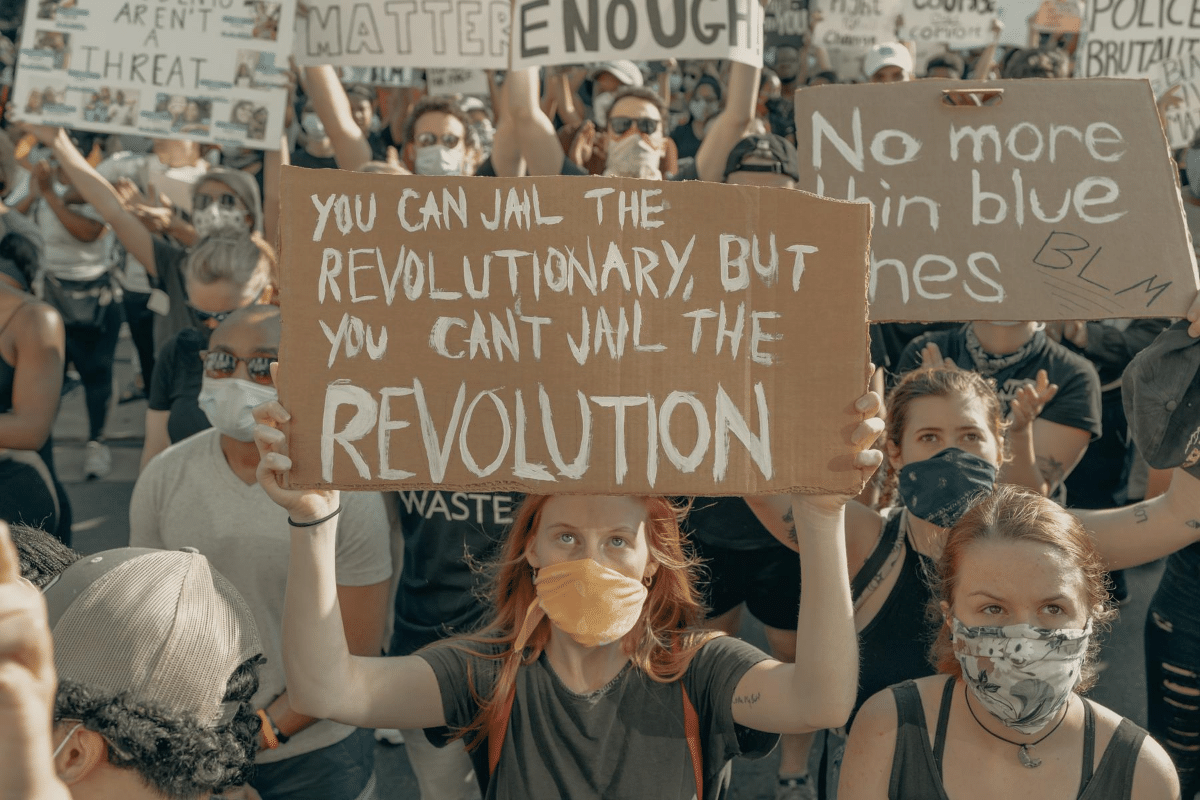
It’s an article of faith among many conservatives, and some liberals, that we’re being swept by a Maoist cultural revolution destined to transform American society into a woke collective. Yet before surrendering basics like equality of opportunity, social order, and free speech to leftist authoritarians, we should consider whether they’re the ones who will wind up getting canceled.

Most Americans don’t favor defunding police or instituting race quotas; they are wary of the costs connected with the Green New Deal and of allowing Washington to control local zoning. Many are already voting with their feet, fleeing places that promote these ideas and seeking out areas aligned with more recognizable American values. Over the past 20 years, virtually all the most progressive large states—New York, New Jersey, Illinois, and California—have suffered massive outmigration, while red or purplish states like Florida, Texas, the Carolinas, or Arizona welcome more and more Americans to resettle there. On the metropolitan level, even before Covid-19 accelerated the trend, a steady, largely unacknowledged, movement from the deep-blue core to the less progressive suburbs or exurbs has been underway.

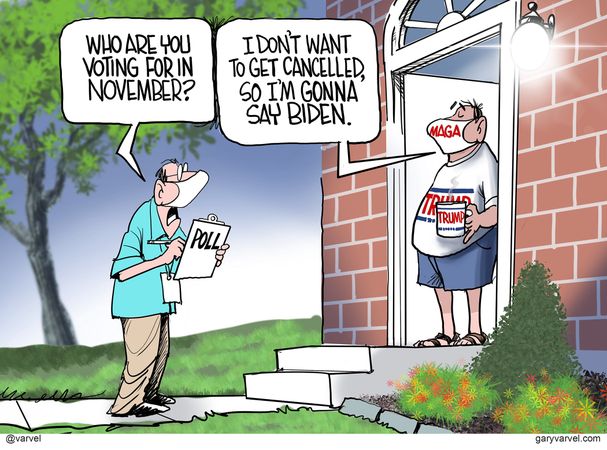
Political correctness—the secular religion of elite liberal society—turns out to be enormously unpopular, something President Trump has exploited politically.

Some 80 percent of Americans, notes one recent survey, including most millennials and minorities, see political correctness as “a problem,” not a solution for the future. Progressive social activists, a survey by the liberal research organization More in Common found, account for barely 8 percent of the adult population, less than a third of the number who identify as traditional conservatives.

The fact that most Americans—Democrat and Republican—fall between these two categories suggests that social attitudes may be far less polarized, and less susceptible to political correctness, than has been widely assumed. As seen in the reaction to the George Floyd case, most Americans generally back the police but also embrace the notion of police reform; they are increasingly hostile, however, to the wave of violence that has accompanied some of the protests. Rather than support growing attempts to limit free speech, almost four in five Americans, according to Pew, support protecting it. These attitudes extend well beyond the base of Trumpian conservatives to include most Americans, regardless of ethnic background.

Media Not Trustworthy

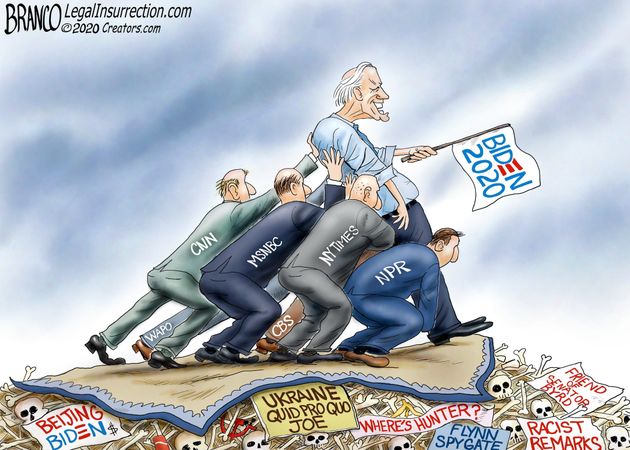
The media epitomize the gap between the public and the nation’s dominant institutions. Subjectivity, notes a recent Rand study, has replaced the world of shared facts with approaches that lead to “truth decay.” Reporters once believed that their mission was to inform the public, but now many journalism schools, including Columbia, embrace progressive groupthink, openly advancing a leftist social-justice agenda in which reporters are advocates. Even Teen Vogue has taken a neo-Marxist tack. “Moral clarity” replaces objectivity. Free speech is somehow linked to white privilege.
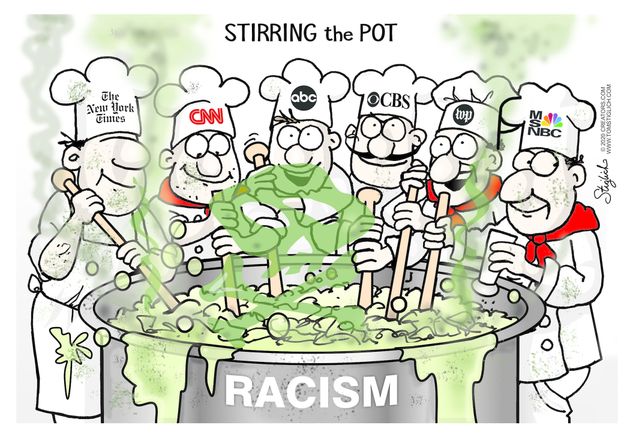
These partisan attitudes have dramatically eroded trust in media, according to a new Knight Foundation study. Public trust in most large media has declined steadily over the past four years, with the biggest drops among Republicans; the New York Times, the publisher of the 1619 Project takedown of American history, is trusted by less than half of the public, compared with almost 60 percent in 2016. Gallup reports that, since the pandemic, the news media has suffered the lowest ratings of any major institution, performing even worse than Congress or President Trump.

Certainly, the shift leftward has not helped the progressive-dominated newspaper business. Between 2001 and 2017, the publishing industry (books, newspapers, magazines) lost 290,000 jobs, a decline of 40 percent. Endless partisan sniping and countless crises have boosted CNN, but the network lags well behind right-wing Fox. NPR has seen its ratings drop as many listeners gravitate to less predictable, livelier voices like Joe Rogan.
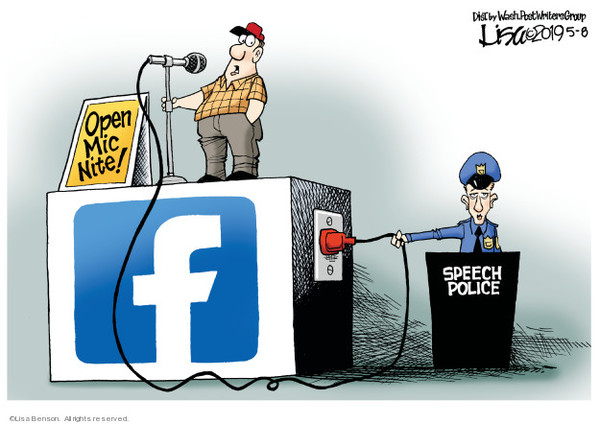
The new media also suffer from a credibility crisis. Controllers like those at Facebook, Google, Apple, and Twitter are increasingly determined to curate “quality content” on their sites, or even eliminate views they find objectionable, which tend to be conservative, according to employees. The idea that managers of huge social-media platforms aim to control content is more than conservative paranoia. Over 70 percent of Americans, according to a recent Pew study, believe that such platforms—as demonstrated in the case of Reddit, Facebook, and Google—“censor political views.” In California, the center of Big Tech, people express more trust in the marijuana industry than they do in social media, according to a 2019 survey.
Decaying Arts and Entertainment

A similar trend is at work in arts and entertainment, where partisanship has rapidly become the standard. Once divided between conservatives and liberals, Hollywood, in the words of liberal journalist Jonathan Chait, now exhibits “a pervasive, if not total, liberalism.” This tilt reflects the political views of the executives: over 99 percent of all political donations by major entertainment executives in 2018 went to Democrats.

In the past, however, many filmmakers, liberal and conservative, tried to separate politics from the business of art; today, priority often goes to gender issues and racial grievance. Quality films with broad popularity—in the vein of the The Sound of Music, The Godfather, or, more recently, Lord of the Rings—rarely win the top prizes anymore. Instead, award-winning films largely are chosen for their appeal to insiders, even as they generally do at best modest box office. To make money, Hollywood resorts to producing superhero movies.

This phenomenon is likely to get worse before it gets better. Just recently, the Academy announced that applicants for Best Picture must fulfill quotas for minorities, women, the disabled, and gays. Under these conditions, some suggest, even as brilliant a film as the Oscar-nominated 1917—set in World War I trenches—would face tough barriers since its cast, and directors, were all white men.

8beb4f6474f7d81edc172d6f4f620f1d971a3aebc67aae8cfb3bdd7b79b6abf6

Americans are not enthusiastically embracing the new cultural orthodoxy. Many may share progressive views on gender and the environment, but they don’t necessarily want to spend their free time being reeducated.

Before Covid, the audience for awards shows such as the Emmys and Oscars, increasingly disconnected from the values and tastes of many Americans, had already dropped to record lows. And since the pandemic, the ratings, as seen in the Emmys, have headed down still further. Attendance at theaters plunged even before Covid, and the prospects for a strong recovery—given an unappealing product for many—seem limited.

stg060820dapc20200607044508

Political Corruption of Sports

Much the same can be said about television and sports. Ratings for politicized media like ESPN have plummeted. The decision by A&E to drop its popular Live PD show—made to appease anti-police sentiment—cost it roughly half its viewers. The industry may be thriving in its progressive lane, but it’s clearly out of touch with much of its market.
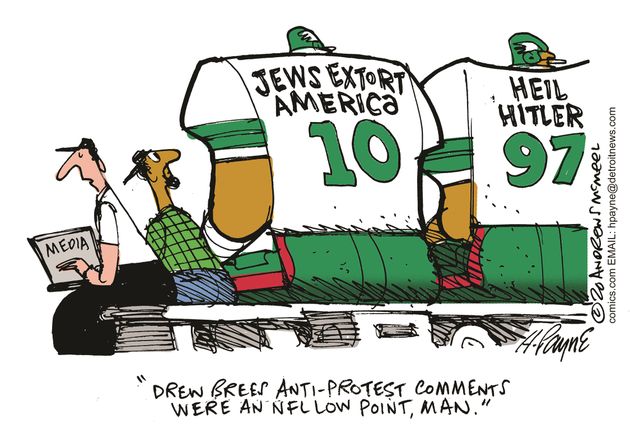
Even sports are losing their allure. Even as much of the population remains quarantined at home, ratings for the National Basketball Association—the wokest league of them all—have cratered, falling behind Fox’s Tucker Carlson, not someone who appeals beyond the right. With players “taking the knee” and threatening walkouts after reported police incidents, the numbers are also way down for Major League Baseball and the National Football League. Perhaps Americans would prefer some entertainment in these hard times, and not to have to listen to “social justice” rhetoric from the likes of LeBron “Peking” James, a multimillionaire and passionate defender of the league’s Chinese sponsors.

college grad by jimbob

Educational Malaise

Higher education has served as master instructor and amplifier for the new orthodoxy, but impatience is growing with the performance of our schools. College students are graduating with fixed ideas about racial politics but few real-world skills. One recent study of American college students found that more than one-third “did not demonstrate any significant improvement in learning” over four years of college. The products of today’s universities maintain rigid positions on various issues, confident of their superior intelligence and perspicuity. Employers also report that recent graduates are short on critical-thinking skills.
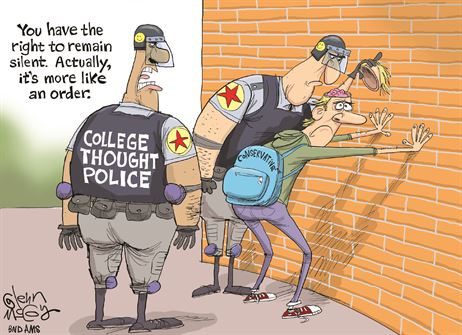
Many colleges were hurting before Covid-19, with a growing percentage of enrollees engaged in online learning. Many students and parents, particularly at less prestigious schools, are questioning the cost of higher education. And universities have been losing confidence with a majority of Americans, according to Gallup. Employers—including Google and Elon Musk—are more willing to challenge the validity of degrees. If this trend continues, the whole university structure faces a challenging future. In examining some 442 American universities, NYU marketing professor Scott Galloway estimates that more than 20 percent could fail because of the lockdowns, and that another 30 percent will struggle to stay afloat.
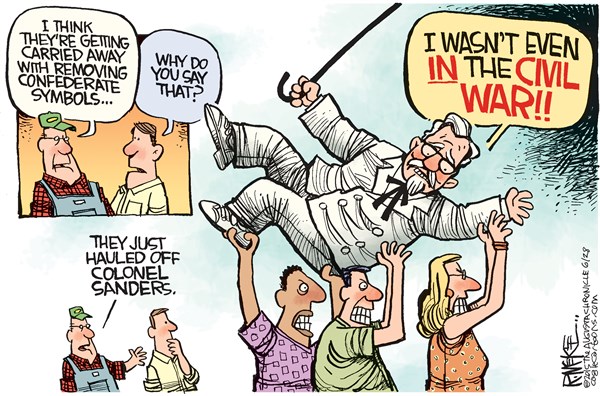
It would be overly optimistic to imagine that the cultural revolution will fade away of its own accord. A taste for authoritarian solutions, Right or Left, is usually acquired. This is not a liberal or conservative struggle; it is a civilizational one. If nearly 40 percent of young Americans think that the country lacks “a history to be proud of,” they won’t see anything precious to protect. A civilization can survive only if its members, particularly those with the greatest influence, believe in its basic values.

Unfortunately, we can’t count on our elites in the academy, the media, the corporate hierarchy, or even the clergy to support the core values of American democracy.

Not anymore. Only stubborn resistance from the middle and working classes can push back against an assault being largely directed from above. “Happy the nation whose people have not forgotten how to rebel,” wrote British historian R. H. Tawney. It’s up to Americans everywhere, regardless of their party registration, to put a halt to a cultural revolution that our children may otherwise inherit.

Halloween Cancelled: Things Already Too Scary

Jay Ambrose explains in his article at the Record-Courier (Kent, Ohio) Trump has the virus and Democrats have their faults.  Excerpts in italics with my bolds.

President Donald Trump has been infected by the COVID-19 virus, and no doubt there are thousands out there saying it serves him right, that he has shrugged his shoulders at the pandemic, even refused to wear face masks and has caused thousands of deaths.

I would say something different, that this is still another event marking 2020 as one of the strangest years in American history, one that signals good reasons to shake and shiver, and not only because of a frightful pandemic and an ultra-bizarre president.

Have you noticed principle-shattering leftists, bureaucratic rot, a racial justice movement overtaken by unjust riots, the war on law enforcement, congressional extremism, media degeneration, social media mayhem, and that some of the science deniers about climate change are the totalitarian alarmists?

Yes, Trump has been a helter-skelter messenger on the pandemic, an occasional absurdity promoter and a misleading dueler with a gotcha press. In the early going, he seemed almost as unconcerned as Gov. Andrew Cuomo of New York, Joe Biden and half of everyone else. But the administration was up to all kinds of meaningful, media-neglected actions early on, with some of the goofs actually coming from the CDC.

Trump was definitively instructed by critics that he had no authority over the states. That is correct, and it is the states that have made the mistakes in resolving this deadly medical mystery, not him.

The Washington Free Beacon recently ran a list of Biden’s phony campaign assertions about Trump and the virus, and keep them in mind in assessing how miswrought his own leadership could be. He said Trump silenced a CDC expert when he didn’t, that he called the virus a “hoax” when he was referring to Democratic shenanigans, that he eliminated a pandemic office that had instead been reconstituted, that he put no pressure on China when he did, that he reduced our CDC scientists in China when he didn’t and that he refused virus test kits from the World Health Organization that never said we could have them.

I know, only Trump “lies” are important, but he is not lying when he says it is crucial to get the economy started again. If you think that doesn’t matter as much as virus dangers, look at the white working class in which 150,000 people have long been dying of alcohol, drugs and suicide each year at least partly in reaction to economic shifts taking away jobs. We could have years of struggle if we don’t get started while at least being as careful as Sweden that has handled the virus pretty well without a shutdown.

Trump helped put together an outstanding economy before the virus while Biden wants debt more than Trump does and taxes and more regulations that would in effect be another shutdown that he says he might call for anyway.

Biden also says he might favor packing of the Supreme Court, an extreme leftist position that could lead to parties rearranging the court and thereby destroying it whenever they resumed control of the White House and Senate. This is the Democrats today, the party that worked with the FBI to indulge in a farcical investigation of the Trump campaign coordinating with the Russians in illegal means of winning in 2016. Information is mounting about the connivance in all of this.

It’s no small thing to try to unseat a president illegitimately and intimidate governance for more than two years, and the current treatment of Biden’s conflicts of interest as nothing much shows a morally twisted prejudice.

My point in all of this is that the election-year issues aren’t as straightforward as some pretend, that, while Trump is scary, the other side is in some ways far scarier, that preserving Republican control of the Senate is imperative and that the public should consider varied points of view. Meanwhile, I wish Trump, his wife and other virus victims the best while hoping he may return for another debate with a touch of humility.

What Happened at That Debate Last Night

The First Take:

At least for now, the debate strategies seem clear.  On one side, let’s troll Trump with fake news and then pretend he is a clown when he objects.  On the other side, let’s bait Biden and see if he loses control and goes off the script beamed into his ears.

The Second Take:

A deeper reflection is provided by Chris Buskirk at The Critic  Trump is waging asymmetric warfare – and it’s working. Excerpts in italics with my bolds.

Biden came in for some rough treatment in the first presidential debate

One of the most interesting and telling exchanges came about an hour into the debate. In some ways each man showed himself in his purest form. Joe Biden delivered what was very obviously a well-rehearsed, set-piece attack on President Trump. You could see the windup, like a boxer pulling his arm way back, fist clenched, preparing to deliver the knockout blow. Biden started by repeating the accusation that Trump disrespectfully criticises the military, calling them losers and suckers. The story has been debunked repeatedly by multiple sources including those hostile to the president like John Bolton. But it’s part of the Biden campaign’s strategy. So he levels the accusations and then begins to eulogise his son, Beau Biden, who served in Iraq, and later died of brain cancer. This makes it all personal to Joe, you see. He’s defending his dead son against a mythical slander from the bad orange man. Biden even points a finger at Trump, “My son is not a loser!”

Trauma mining to score points in a debate is a desperately cynical piece of political theatre. But, I suppose they calculate that if it works you get to be president. (I’ll pass, thanks.) It was pure Biden: scripted, saccharine, playing by the rules of a game that has long since ended. In case you think I’m too cynical, that surely this couldn’t have been orchestrated, Joe Biden’s official Twitter account posted a photo of Joe and Beau with the caption, “Beau was not a loser” just as the debate ended.

And just so, Trump. He looked at his podium and quietly, respectfully, asked, which son Biden was talking about. Of course, he knew, but he played the game forcing Biden to respond, Beau. “Oh, I don’t know him. I know Hunter.”

And then listed the accusations against Hunter: he took a $1.5 billion investment from China into the fledgling investment company he ran with John Kerry’s son while his father was Vice President and en route to China. He received $3.5 million from the mayor of Moscow. He had a sinecure from a Ukranian energy company while his father was Obama’s pointman on Ukraine policy. (NB: Hunter had no experience in business let along the energy business.) It was as sweet a move as I’ve ever seen. The knockout punch was coming with all the force Joe Biden could muster and Trump simply sidestepped it and counterpunched.

It was an impressive display of natural animal cunning. And it could make the difference in the election. Trump was agile, aggressive, and vigorous, taking what he wanted when he wanted it. This offends some people’s sensibilities. He’s transgressive.

He doesn’t play according to the rules. But for others, that’s part of the appeal.

It’s no secret that the ruling class in America despises the country class. If you’re one of those people who don’t live in coastal cities and subscribe to the same worldview as the elite aspirants hoping for a job at a billionaire-backed NGO or an internship that might lead to a job at McKinsey then you’re a deplorable, a CHUD, and definitely racist and whatever bad things are happening to you, your family, and your inland town are your just deserts.

One of Trump’s main functions and biggest appeals is that he exposes the occupational elites that are credentialed but not expert in much of anything.

gv062919dapc20190628084511

Everyone knows it. Imposter syndrome is rampant. And Trump preys on their insecurities which is what provokes such outrageous reactions from his enemies. But a lot of Americans who live in interior America and get unglamorous jobs at slowly declining wages, raise their families want nothing more than to be left alone by the credentialed but unaccomplished strivers who hate them.

For those people, Trump is their champion.

They probably don’t aspire to be like Trump, but they like the fact that he exposes the bankruptcy of the undeserving ruling class. And for them, Trump’s debate tonight was a tour de force. It was aggressive, it was funny, he said the quiet part out loud, he broke the rules in public that are normally only broken in private. That won him the election in 2016. It won him the debate last night. And it might just get him re-elected in November.

Note: The debate began with Trump and Biden each making one uninterrupted comment. Biden then talked over Trump’s second comment without intervention by the moderator. And so the game was on.

Left and Right on Climate (and so much else)

I just happened upon the video above, which explains so clearly the Left and Right orientations of people in society.  Transcript below in italics with my bolds.

Jordan Peterson Responds to Question about Social Issues like Climate

Q: So what is your advice to young people, when you talk about you need to be individually responsible, but when they’re things that are so far out of our control, like climate catastrophe, like the precarious job economy, like, what is your answer?

JP: Things are not so far out of control as you think. Do you think that you’re worse off than your grandparents?
(I think they’re a different challenge.)
Do you think you’re worse off than your grandparents?

Q: The argument, I think, is that individual responsibility does not fix some things.  The climate problem needs global collective responsibility. So I think that’s the core of the question. Do you have a theory about that?

JP: Well, fundamentally, I’m a psychologist. And my experience has been that people can do a tremendous amount of good for themselves, and for the people who are immediately around them, by looking to their own inadequacies and their own flaws and the things that they’re not doing in their lives. By starting to build themselves up as more powerful individuals, and if they’re capable of doing that, then they’re capable of expanding their career.

JP: And if they’re capable of expanding their career and their competence, then they’re capable of taking their place in the community as effective leaders. And then they’re capable of making wise decisions instead of unwise decisions when it comes to making collective political decisions. I’m not suggesting in the least, and have never suggested that there’s no domain for social action.

I’m suggesting that people who don’t have their own houses in order should be very careful before they go about reorganizing the world, which happens in many ways.

Q: If a young person believes that the climate the global warming problem on the climate is something that needs to be tackled quickly, and they can’t wait until they grow up and become prime ministers to do it, do you think collective responsibility overrides individual responsibility in a huge issue like that?

JP: No. I don’t think that is generally the case. I think generally people have things that are more within their personal purview that are more difficult to deal with and that they’re avoiding. And generally, the way they avoid them is by adopting pseudo moralistic stances on large scale social issues so that they look good to their friends and their neighbors.

Commentary by Dennis Prager

That’s a major difference between the right and the left, concerning the way each seeks to improve society. Conservatives believe that the way to a better society is almost always through the moral improvement of the individual by each person doing battle with his or her own weaknesses, and flaws. It is true that in violent and evil society such as fascist Communist or Islam is tyrannies, the individual must be preoccupied with battling outside forces. Almost everywhere else, though, certainly in a free and decent country such as America, the greatest Battle of the individual must be with inner forces, that is with his or her moral failings.

The left on the other hand, believes that the way to a better society is almost always through doing battle with society’s moral failings. Thus, in America, the left concentrates its efforts on combating sexism, racism, intolerance, xenophobia, homophobia, Islamophobia, and the many other evils that the left believes permeate American society.

One important consequence of this left right distinction is that those on the left are far more preoccupied with politics than those on the Right. Since the left is so much more interested in fixing society than in fixing the individual, politics inevitably becomes the vehicle for societal improvement. That’s why whenever the term activist is used, we almost always assume that the term refers to someone on the left.

Another consequence of this left right difference is that since conservatives believe society has changed one person at a time, they accept that change happens gradually. This isn’t fast enough for the left, which is always in everywhere focused on social revolution. An excellent example of this was a statement by the then presidential candidate Barack Obama, just days before his first election in 2008. To our rapturous audience, he declared, we are five days away from fundamentally transforming the United States of America.

Conservatives not only have no interest in fundamentally transforming the United States of America, they are strongly opposed to doing so. Conservatives understand that fundamentally transforming any society that isn’t fundamentally bad, not to mention transforming what is one of the most decent societies in history can only make the society worse. Conservatives believe that America can be improved, but should not be transformed, let alone fundamentally transformed.

The founders of the United States recognized that the transformation that every generation must work on is the moral transformation of each citizen. Thus, character development was at the core of both child rearing and of young people’s education from elementary school through college. As John Adams, the second president said, our constitution was made only for a moral and religious people, it is wholly inadequate to the government of any other. And in the words of Benjamin Franklin, only a virtuous people are capable of freedom. Why is that? Because freedom requires self control, the free or the society, the more self control is necessary. If the majority of people don’t control themselves, the state, meaning an ever more powerful government, will have to control them.

From the founding of the United States until the 1960s, schools and parents concentrated on character education. But with the ascent of left wing ideas, character education has all but disappeared from American schools. Instead, children are taught not to focus on their flaws, but on America’s social issues have replaced character education. An example is a new K through 12 science curriculum, the next generation of science standards, which will teach young Americans starting in kindergarten about global warming. And when they get to college, American young people will be taught about the need to fight economic inequality, white privilege, and the alleged rape culture on their campuses.

Ironically, if there really is a rape culture that permeates American college campuses, the only reason would have to be that there was so little character education in our schools, or for that matter at home. Fathers and religion, historically the two primary conveyors of self control, are non existent in the lives of millions of American children. We are now producing vast numbers of Americans who are passionate about fixing America while doing next to nothing about fixing their own character.

The problem, however, is that you can’t make society better unless you first make its people better.

Footnote:  Background Resource Cosmic Evil: Peterson’s Pearls (4)

Or take note of Bob Dylan’s advice:

Separate Stories and Solitudes

Rod Dreher writes at American Conservative about the chasm opening and dividing the previous United States.  His article is titled Joe Rogan World Vs. NPR World, but those words don’t reveal the importance or depth of his insights.   He starts with a familiar experience of hearing newscasting perverted by an agenda.  Excerpts in italics with my bolds.  

Yesterday when I drove up to the country to visit my mother, I listened to NPR until I couldn’t take it anymore. There was a story about black Mormons. Normally I would have found that compelling, given my interest in religion. The Mormon religion used to be formally racist, but changed its teaching. What is it like to live as a black Mormon? That’s a story that interests me. Or normally would, but I swear, I turned off the radio. Why?

It had nothing to do with the black Mormons. It had to do with NPR. I thought: they’re only interested in Mormons so they can find some new way to talk about American racism.

It feels like every time I get in the car and turn on the radio, I don’t have to wait long before I hear a story that highlights in some new way what a racist country America is, or how hard illegal immigrants have it in America, or how put-upon sexual minorities are, and so forth. I don’t know if NPR’s liberalism has always been like this, or if it has gotten worse — or if I have simply become thin-skinned about these issues. I have always known NPR was liberal, but that didn’t stop me from being a big fan, and even a contributing member. I feel that my NPR — the NPR that I cherished, even though it was liberal and I am conservative — has gone away, and I don’t know why. I used to love listening to it in the car, and not conservative talk radio, because I don’t want to have a voice on the radio rubbing my nose into some political narrative. NPR used to stand out because it proposed new ways of seeing the world, or at least ways that seemed new to me as a conservative. Now listening to NPR is giving oneself over to hosts who seek to impose a worldview that constantly says, about people who don’t fit the progressive narrative, that you aren’t worthy of our consideration or attention. That you are what’s wrong with America.

I don’t mean to beat up NPR alone. I have the same experience reading The New York Times. Most conservatives I know don’t listen to NPR or read the Times, and could not care less about them. They assume that NPR and the NYT hate them, so they have no agony over failed expectations. But I have been listening to NPR and reading the NYT long enough to know that something has changed with those two institutions — again, institutions that I’ve always known were liberal, but loved anyway. If I had never learned to care about them, I wouldn’t get so wound up about it now.

That, and the fact that those institutions are such important bellwethers of elite opinion. You may not care what’s in the Times or on NPR, but the people who do are those who ultimately control a lot of things in your life. Never, ever forget the lessons in these two passages from Live Not By Lies:

It’s possible to miss the onslaught of totalitarianism, precisely because we have a misunderstanding of how its power works. In 1951, poet and literary critic Czesław Miłosz, exiled to the West from his native Poland as an anti-communist dissident, wrote that Western people misunderstand the nature of communism because they think of it only in terms of “might and coercion.”

“That is wrong,” he wrote. “There is an internal longing for harmony and happiness that lies deeper than ordinary fear or the desire to escape misery or physical destruction.”

In The Captive Mind, Miłosz said that communist ideology filled a void that had opened in the lives of early twentieth-century intellectuals, most of whom had ceased to believe in religion.

This is why NPR sounds like Vatican Radio from the Church of Secular Progressivism, and this is why The New York Times reads like L’Osservatore Romano of the same pseudo-religion. More from Live Not By Lies:

In our populist era, politicians and talk-radio polemicists can rile up a crowd by denouncing elites. Nevertheless, in most societies, intellectual and cultural elites determine its long-term direction. “[T]he key actor in history is not individual genius but rather the network and the new institutions that are created out of those networks,” writes sociologist James Davison Hunter.

Though a revolutionary idea might emerge from the masses, says Hunter, “it does not gain traction until it is embraced and propagated by elites” working through their “well-developed networks and powerful institutions.”

This is why it is critically important to keep an eye on intellectual discourse. Those who do not will leave the gates unguarded. As the Polish dissident and émigré Czesław Miłosz put it, “It was only toward the middle of the twentieth century that the inhabitants of many European countries came, in general unpleasantly, to the realization that their fate could be influenced directly by intricate and abstruse books of philosophy.

This is how Your Working Boy gets from, “Black Mormons — hey, that’s interesting. I’d like to know more about what they went through” — which would be my stance in normal times — to “Black Mormons? Just one more NPR story about what a racist, oppressive, worthless country this is” to

“NPR continues to tell the elites a narrative that they will use to tear this country down and rebuild it according to their ideological values.”

All of that is prelude to Douglas Murray’s recent piece in Unherd, in which he observes that America really does look like a country that is coming apart, because it lacks a shared story. Excerpts:

But while it’s certainly arguable that Trump has aggravated America’s problems and divisions, he certainly didn’t create them. The divide long pre-dates him and has grown and grown in recent years, to the point where the different parties look increasingly irreconcilable. That is because these divisions go right to the core of what it means to be American.

When Eric Kaufmann recently carried out opinion polls on self-described “liberals” in the US, the results were startling but not surprising. For instance, around 80% of respondents said that they would approve of the writing of a new American constitution “that better reflects our diversity as a people”. A similar number said that they would approve of a new national anthem and flag, for the same reason.

And over the last few months, some of the more activist section of the American “liberal” tribe have taken matters into their own hands, with statues pulled down across the country, not just of Confederate generals or people associated with the divisive elements of American history, but men who once united the American public. Who once represented and defined their shared history as a great nation.

When statues of Thomas Jefferson and George Washington are pulled down, this no longer looks like a critique of certain aspects of American culture: it looks like an attack on the American Founding story. When senior Democrats like Tammy Duckworth — who has served in her country’s military — refuse to condemn attacks on statues of the Founding Fathers it becomes clear that this attitude is not confined to some street-protest fringes.

More:

It is becoming harder to communicate across the gulf, as, increasingly, the two Americas cannot consort or discuss with each other. And if there is one reason above all why that should be the case it is because they no longer have a shared story.

A portion of the American people still revere their history, the Founding Fathers, the constitution, flag, anthem and much more. They see it as symbols of a glorious past, a country which has fought for its own and others’ liberty, and the once-admired idea of American exceptionalism.

Another portion believe that America is exceptional only in being exceptionally bad. Rather than thinking well of their country or their forebears they see the whole American experiment as unusually unfair and uncommonly unequal.

What’s more, I am associated, via my writing here and in The Benedict Option, with a pessimistic view of our liberal democracy’s sustainability. I think that Patrick Deneen is basically correct in his Why Liberalism Failed: it failed because it succeeded so very well in creating a hyper-individualist society.

Liberal democracy cannot work without a metastory to set its boundaries.

We had that story when America was more or less Christian, but we are now moving out of the secularized Christianity of the Enlightenment, and into Nietzsche’s dark prophecy of what would happen once we realized that we have killed God. There will be no clinging to Christian morality, with its claims of human rights, without the Christian god.

What we have, with the woke, is a pseudo-religion that tries to ape Christianity without Christianity’s sense of mercy, and without its tragic awareness that, in Solzhenitsyn’s memorable phrase, the line between good and evil passes not between peoples, classes, and nations, but down the middle of every human heart.

See Also:  Democracy in Peril

The most basic thing one needs to know about a democratic regime, then, is this: You need to have at least two legitimate political parties for democracy to work. By a legitimate political party, I mean one that is recognized by its rivals as having a right to rule if it wins an election. For example, a liberal party may grant legitimacy to a conservative party (even though they don’t like them much), and in return this conservative party may grant legitimacy to a liberal party (even though they don’t like them much). Indeed, this is the way most modern democratic nations have been governed.

But legitimacy is one of those traditional political concepts that Marxist criticism is now on the verge of destroying.

From the Marxist point of view, our inherited concept of legitimacy is nothing more than an instrument the ruling classes use to perpetuate injustice and oppression. The word legitimacy takes on its true meaning only with reference to the oppressed classes or groups that the Marxist sees as the sole legitimate rulers of the nation. In other words, Marxist political theory confers legitimacy on only one political party—the party of the oppressed, whose aim is the revolutionary reconstitution of society. And this means that the Marxist political framework cannot co-exist with democratic government. Indeed, the entire purpose of democratic government, with its plurality of legitimate parties, is to avoid the violent reconstitution of society that Marxist political theory regards as the only reasonable aim of politics.

Simply put, the Marxist framework and democratic political theory are opposed to one another in principle.

Background from a previous post, American Soviet Mentality

Izabella Tabarovsky draws on her experience of Soviet Russia to expose the cultural revolution currently attacking the roots of American civil society.  Her article at the Tablet is The American Soviet Mentality. Excerpts in italics with my bolds.

Collective demonization invades our culture

Russians are fond of quoting Sergei Dovlatov, a dissident Soviet writer who emigrated to the United States in 1979: “We continuously curse Comrade Stalin, and, naturally, with good reason. And yet I want to ask: who wrote four million denunciations?” It wasn’t the fearsome heads of Soviet secret police who did that, he said. It was ordinary people.

Collective demonizations of prominent cultural figures were an integral part of the Soviet culture of denunciation that pervaded every workplace and apartment building. Perhaps the most famous such episode began on Oct. 23, 1958, when the Nobel committee informed Soviet writer Boris Pasternak that he had been selected for the Nobel Prize in literature—and plunged the writer’s life into hell. Ever since Pasternak’s Doctor Zhivago had been first published the previous year (in Italy, since the writer could not publish it at home) the Communist Party and the Soviet literary establishment had their knives out for him. To the establishment, the Nobel Prize added insult to grave injury.

None of those who joined the chorus of condemnation, naturally, had read the novel—it would not be formally published in the USSR until 30 years later. But that did not stop them from mouthing the made-up charges leveled against the writer. It was during that campaign that the Soviet catchphrase “ne chital, no osuzhdayu”—“didn’t read, but disapprove”—was born: Pasternak’s accusers had coined it to protect themselves against suspicions of having come in contact with the seditious material. Days after accepting the Nobel Prize, Pasternak was forced to decline it. Yet demonization continued unabated.

Some of the greatest names in Soviet culture became targets of collective condemnations—composers Dmitry Shostakovich and Sergei Prokofiev; writers Anna Akhmatova and Iosif Brodsky; and many others. Bouts of hounding could go on for months and years, destroying people’s lives, health and, undoubtedly, ability to create. (The brutal onslaught undermined Pasternak’s health. He died from lung cancer a year and a half later.) But the practice wasn’t reserved for the greats alone. Factories, universities, schools, and research institutes were all suitable venues for collectively raking over the coals a hapless, ideologically ungrounded colleague who, say, failed to show up for the “voluntary-obligatory,” as a Soviet cliché went, Saturday cleanups at a local park, or a scientist who wanted to emigrate. The system also demanded expressions of collective condemnations with regards to various political matters: machinations of imperialism and reactionary forces, Israeli aggression against peaceful Arab states, the anti-Soviet international Zionist conspiracy. It was simply part of life.

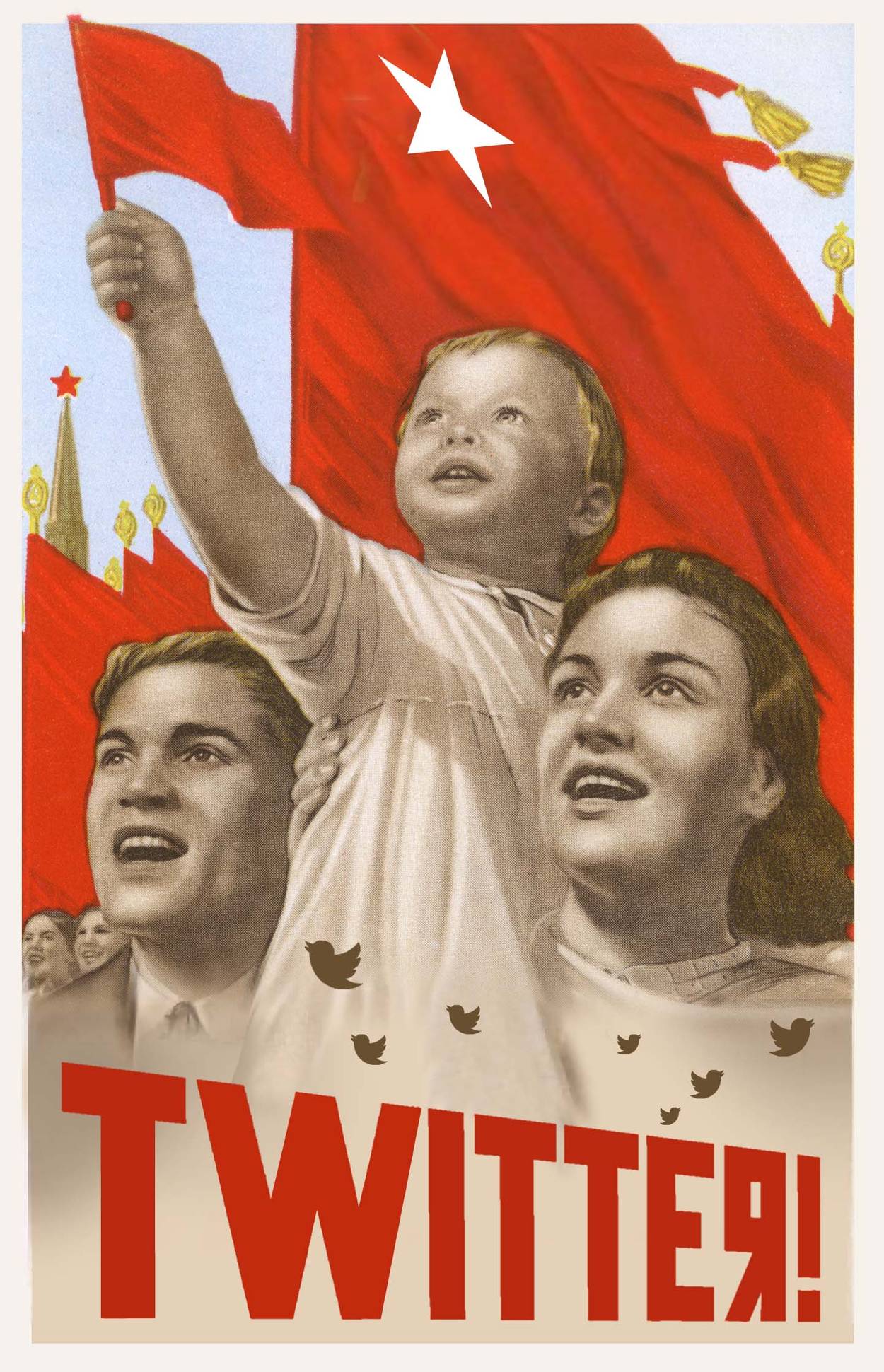
Twitter has been used as a platform for exercises in unanimous condemnation
for as long as it has existed.

Countless careers and lives have been ruined as outraged mobs have descended on people whose social media gaffes or old teenage behavior were held up to public scorn and judged to be deplorable and unforgivable. But it wasn’t until the past couple of weeks that the similarity of our current culture with the Soviet practice of collective hounding presented itself to me with such stark clarity. Perhaps it was the specific professions and the cultural institutions involved—and the specific acts of writers banding together to abuse and cancel their colleagues—that brought that sordid history back.

On June 3, The New York Times published an opinion piece that much of its progressive staff found offensive and dangerous. (The author, Republican Sen. Tom Cotton, had called to send in the military to curb the violence and looting that accompanied the nationwide protests against the killing of George Floyd.) The targets of their unanimous condemnation, which was gleefully joined by the Twitter proletariat, which took pleasure in helping the once-august newspaper shred itself to pieces in public, were New York Times’ opinion section editor James Bennet, who had ultimate authority for publishing the piece, though he hadn’t supervised its editing, and op-ed staff editor and writer Bari Weiss (a former Tablet staffer).

Weiss had nothing to do with editing or publishing the piece. On June 4, however, she posted a Twitter thread characterizing the internal turmoil at the Times as a “civil war” between the “(mostly young) wokes” who “call themselves liberals and progressives” and the “(mostly 40+) liberals” who adhere to “the principles of civil libertarianism.” She attributed the behavior of the “wokes” to their “safetyism” worldview, in which “the right of people to feel emotionally and psychologically safe trumps what were previously considered core liberal values, like free speech.”  See Update: Stories vs. Facts

It was just one journalist’s opinion, but to Weiss’ colleagues her semi-unflattering description of the split felt like an intolerable attack against the collective. Although Weiss did not name anyone in either the “woke” or the older “liberal” camp, her younger colleagues felt collectively attacked and slandered. They lashed out. Pretty soon, Weiss was trending on Twitter.

As the mob’s fury kicked into high gear, the language of collective outrage grew increasingly strident, even violent.

Goldie Taylor, writer and editor-at-large at The Daily Beast, queried in a since-deleted tweet why Weiss “still got her teeth.” With heads rolling at the Times—James Bennet resigned, and deputy editorial page editor James Dao was reassigned to the newsroom—one member of the staff asked for Weiss to be fired for having bad-mouthed “her younger newsroom colleagues” and insulted “all of our foreign correspondents who have actually reported from civil wars.” (It was unclear how she did that, other than having used the phrase “civil war” as a metaphor.)

Mehdi Hasan, a columnist with the Intercept, opined to his 880,000 Twitter followers that it would be strange if Weiss retained her job now that Bennet had been removed. He suggested that her thread had “mocked” her nonwhite colleagues. (It did not.) In a follow-up tweet Hasan went further, suggesting that to defend Weiss would make one a bad anti-racist—a threat based on a deeply manipulated interpretation of Weiss’ post, yet powerful enough to stop his followers from making the mistake.

All of us who came out of the Soviet system bear scars of the practice of unanimous condemnation, whether we ourselves had been targets or participants in it or not. It is partly why Soviet immigrants are often so averse to any expressions of collectivism: We have seen its ugliest expressions in our own lives and our friends’ and families’ lives. It is impossible to read the chastising remarks of Soviet writers, for whom Pasternak had been a friend and a mentor, without a sense of deep shame. Shame over the perfidy and lack of decency on display. Shame at the misrepresentations and perversions of truth. Shame at the virtue signaling and the closing of rank. Shame over the momentary and, we now know, fleeting triumph of mediocrity over talent.

In a collectivist culture, one hoped-for result of group condemnations is control—both over the target of abuse and the broader society. When sufficiently broad levels of society realize that the price of nonconformity is being publicly humiliated, expelled from the community of “people of goodwill” (another Soviet cliché) and cut off from sources of income, the powers that be need to work less hard to enforce the rules.

For the regular people—those outside prestigious cultural institutions—participation in local versions of collective hounding was not without its benefits, either. It could be an opportunity to eliminate a personal enemy or someone who was more successful and, perhaps, occupied a position you craved. You could join in condemning a neighbor at your cramped communal flat, calculating that once she was gone, you could add some precious extra square meters to your living space.

The mobs that perform the unanimous condemnation rituals of today do not follow orders from above. But that does not diminish their power to exert pressure on those under their influence.

Those of us who came out of the collectivist Soviet culture understand these dynamics instinctively. You invoked the “didn’t read, but disapprove” mantra not only to protect yourself from suspicions about your reading choices but also to communicate an eagerness to be part of the kollektiv—no matter what destructive action was next on the kollektiv’s agenda. You preemptively surrendered your personal agency in order to be in unison with the group. And this is understandable in a way: Merging with the crowd feels much better than standing alone.

Americans have discovered the way in which fear of collective disapproval breeds self-censorship and silence, which impoverish public life and creative work. The double life one ends up leading—one where there is a growing gap between one’s public and private selves—eventually begins to feel oppressive. For a significant portion of Soviet intelligentsia (artists, doctors, scientists), the burden of leading this double life played an important role in their deciding to emigrate.

Those who join in the hounding face their own hazards. The more loyalty you pledge to a group that expects you to participate in rituals of collective demonization, the more it will ask of you and the more you, too, will feel controlled. How much of your own autonomy as a thinking, feeling person are you willing to sacrifice to the collective? What inner compromises are you willing to make for the sake of being part of the group? Which personal relationships are you willing to give up?

From my vantage point, this cultural moment in these United States feels incredibly precarious.

The practice of collective condemnation feels like an assertion of a culture that ultimately tramples on the individual and creates an oppressive society. Whether that society looks like Soviet Russia, or Orwell’s Nineteen Eighty-Four, or Castro’s Cuba, or today’s China, or something uniquely 21st-century American, the failure of institutions and individuals to stand up to mob rule is no longer an option we can afford.

Comment:  Precarious, indeed.  For Background, See Patriotism vs. Multiculturalism

stg060220dapr20200531064508


Demise of Journalism Is Confirmed

Glenn Greenwald explains in his Intercept article Journalism’s New Propaganda Tool: Using “Confirmed” to Mean its Opposite.  Excerpts in italics with my bolds.

Outlets claiming to have “confirmed” Jeffrey Goldberg’s story about Trump’s troops comments are again abusing that vital term.

The same misleading tactic is now driving the supremely dumb but all-consuming news cycle centered on whether President Trump, as first reported by the Atlantic’s editor-in-chief Jeffrey Goldberg, made disparaging comments about The Troops. Goldberg claims that “four people with firsthand knowledge of the discussion that day” — whom the magazine refuses to name because they fear “angry tweets” — told him that Trump made these comments. Trump, as well as former aides who were present that day (including Sarah Huckabee Sanders and John Bolton), deny that the report is accurate.

So we have anonymous sources making claims on one side, and Trump and former aides (including Bolton, now a harsh Trump critic) insisting that the story is inaccurate. Beyond deciding whether or not to believe Goldberg’s story based on what best advances one’s political interests, how can one resolve the factual dispute? If other media outlets could confirm the original claims from Goldberg, that would obviously be a significant advancement of the story.  Other media outlets — including Associated Press and Fox News — now claim that they did exactly that: “confirmed” the Atlantic story.

But if one looks at what they actually did, at what this “confirmation” consists of, it is the opposite of what that word would mean, or should mean, in any minimally responsible sense.

AP, for instance, merely claims that “a senior Defense Department official with firsthand knowledge of events and a senior U.S. Marine Corps officer who was told about Trump’s comments confirmed some of the remarks to The Associated Press,” while Fox merely said “a former senior Trump administration official who was in France traveling with the president in November 2018 did confirm other details surrounding that trip.”

In other words, all that likely happened is that the same sources who claimed to Jeffrey Goldberg, with no evidence, that Trump said this went to other outlets and repeated the same claims — the same tactic that enabled MSNBC and CBS to claim they had “confirmed” the fundamentally false CNN story about Trump Jr. receiving advanced access to the WikiLeaks archive. Or perhaps it was different sources aligned with those original sources and sharing their agenda who repeated these claims. Given that none of the sources making these claims have the courage to identify themselves, due to their fear of mean tweets, it is impossible to know.

But whatever happened, neither AP nor Fox obtained anything resembling “confirmation.”

They just heard the same assertions that Goldberg heard, likely from the same circles if not the same people, and are now abusing the term “confirmation” to mean “unproven assertions” or “unverifiable claims” (indeed, Fox now says that “two sources who were on the trip in question with Trump refuted the main thesis of The Atlantic’s reporting”).

It should go without saying that none of this means that Trump did not utter these remarks or ones similar to them. He has made public statements in the past that are at least in the same universe as the ones reported by the Atlantic, and it is quite believable that he would have said something like this (though the absolute last person who should be trusted with anything, particularly interpreting claims from anonymous sources, is Jeffrey Goldberg, who has risen to one of the most important perches in journalism despite (or, more accurately because of) one of the most disgraceful and damaging records of spreading disinformation in service of the Pentagon and intelligence community’s agenda).

But journalism is not supposed to be grounded in whether something is “believable” or “seems like it could be true.” Its core purpose, the only thing that really makes it matter or have worth, is reporting what is true, or at least what evidence reveals. And that function is completely subverted when news outlets claim that they “confirmed” a previous report when they did nothing more than just talked to the same people who anonymously whispered the same things to them as were whispered to the original outlet.

Quite aside from this specific story about whether Trump loves The Troops, conflating the crucial journalistic concept of “confirmation” with “hearing the same idle gossip” or “unproven assertions” is a huge disservice. It is an instrument of propaganda, not reporting. And its use has repeatedly deceived rather than informed the public. Anyone who doubts that should review how it is that MSNBC and CBS both claimed to have “confirmed” a CNN report which turned out to be ludicrously and laughably false. Clearly, the term “confirmation” has lost its meaning in journalism.

School’s Back: Indoctrination Resumes

“Say what you want about the Liberal Arts, but they have found a cure for common sense.”

Walter E. Williams explains in his article Back To College, Back To Academic Brainwashing Excerpts in italics with my bolds. H/T IceCap

Parents, legislators, taxpayers, and others footing the bill for college education might be interested in just what is in store for the upcoming academic year.

Since many college classes will be online, there is a chance to witness professors indoctrinating their students in real time. So, there’s a chance that some college faculty might change their behavior. To see recent examples of campus nonsense and indoctrination, visit the Campus Reform and College Fix websites.

Jonathan Turley, a law professor at George Washington University, warned congressional lawmakers “that Antifa is ‘winning’ and that much of academia, whether wittingly or unwittingly, is complicit in its success,” reported Campus Reform.

In his testimony before Congress Turley said:

To Antifa, people like me are the personification of the classical liberal view of free speech that perpetuates a system of oppression and abuse. I wish I could say that my view remains strongly implanted in our higher educational institutions. However, you are more likely to find public supporters for restricting free speech than you are to find defenders of free speech principles on many campuses.

The leftist bias at our colleges and universities has many harmful effects. A mathematics professor at University of California, Davis, faced considerable backlash over her opposition to the requirement for “diversity statements” from potential faculty.

Those seeking employment at the University of California, San Diego, are required to admit that “barriers” prevent women and minorities from full participation in campus life.

At American University, a history professor wrote a book calling for the repeal of the Second Amendment. A Rutgers University professor said: “Watching the Iowa Caucus is a sickening display of the overrepresentation of whiteness.”

A Williams College professor has advocated the inclusion of social justice in math textbooks. Students at Wayne State University are no longer required to take a single math course to graduate; however, they may soon be required to take a diversity course.

Maybe some students will be forced into sharing the vision of Laurie Rubel, a math education professor at Brooklyn College. She says the idea of cultural neutrality in math is a “myth,” and that asking whether 2 plus 2 equals 4 “reeks of white supremacist patriarchy.”

Rubel tweeted: “Y’all must know that the idea that math is objective or neutral IS A MYTH.”

Math professors and academics at other universities, including Harvard and the University of Illinois, discussed the “Eurocentric” roots of American mathematics. As for me, I would like to see the proof, in any culture, that 2 plus 2 is something other than 4.

Rutgers University’s English department chairwoman, Rebecca Walkowitz, announced changes to the department’s graduate writing program emphasizing “social justice” and “critical grammar.”

Leonydus Johnson, a speech-language pathologist and libertarian activist, says Walkowitz’s changes make the assumption that minorities cannot understand traditional and grammatically correct English speech and writing, which is “insulting, patronizing, and in itself, extremely racist.”

Then there is the nonsense taught on college campuses about white privilege. The idea of white privilege doesn’t explain why several historically marginalized groups outperform whites today.

For example, Japanese Americans suffered under the Alien Land Law of 1913 and other racist, exclusionary laws legally preventing them from owning land and property in more than a dozen American states until the Immigration and Nationality Act of 1952.

During World War II, more than 120,000 Japanese Americans were interned. However, by 1959, the income disparity between Japanese Americans and white Americans had almost disappeared.

Today, Japanese Americans outperform white Americans by large margins in income statistics, education outcomes, and test scores, and have much lower incarceration rates.

According to Rav Arora, writing for the New York Post, several black immigrant groups such as Nigerians, Trinidadians, Tobagonians, Barbadians, and Ghanaians all “have a median household income well above the American average.”

We are left with the question whether the people handing out “white privilege” made a mistake. The other alternative is that Japanese Americans, Nigerians, Barbadians, Ghanaians, Trinidadians, and Tobagonians are really white Americans.

The bottom line is that more Americans need to pay attention to the miseducation of our youth and that miseducation is not limited to higher education.

Walter E. Williams, a columnist for The Daily Signal, is a professor of economics at George Mason University.
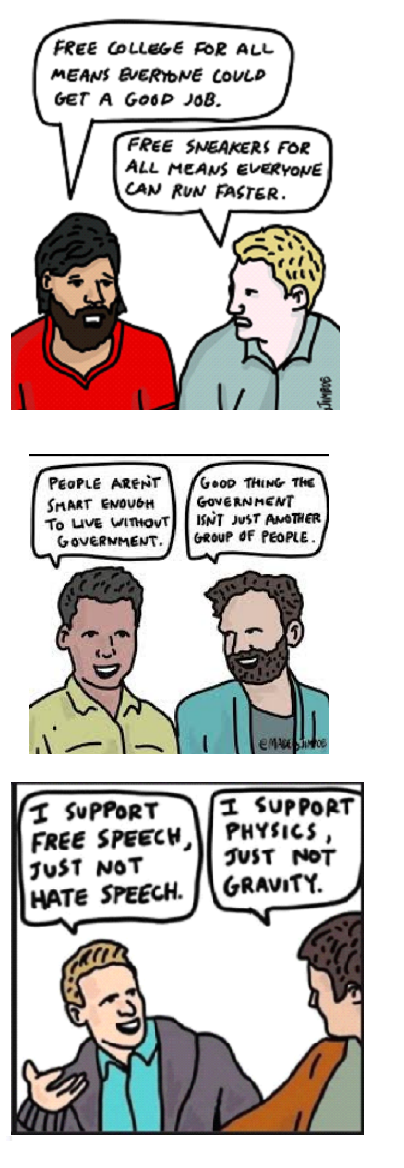
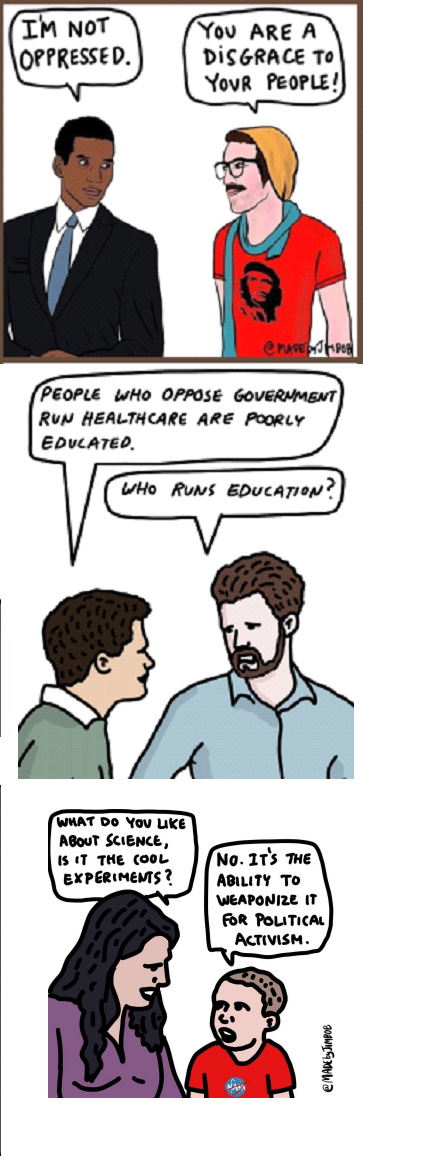
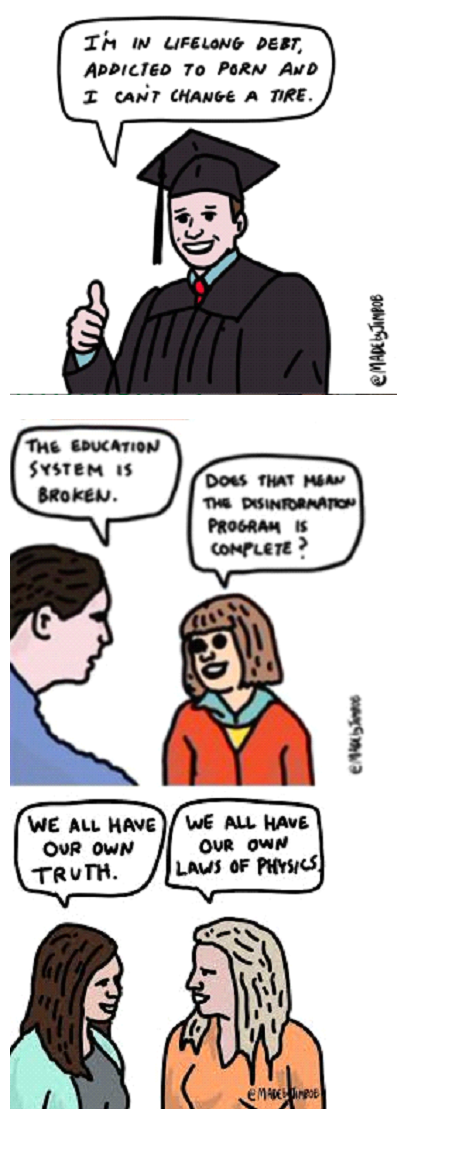


JimBob weighs in on “progressive” education.


And a final word from Dilbert:

Democracy in Peril

Yoram Hazony explains the dire situation in USA, with global implications in his essay The Challenge of Marxism at The Quillette.  Excerpts in italics with my bolds.

We don’t know what will happen for certain. But based on the experience of recent years, we can venture a pretty good guess. Institutional liberalism lacks the resources to contend with this threat. Liberalism is being expelled from its former strongholds, and the hegemony of liberal ideas, as we have known it since the 1960s, will end. Anti-Marxist liberals are about to find themselves in much the same situation that has characterized conservatives, nationalists, and Christians for some time now: They are about to find themselves in the opposition.

This means that some brave liberals will soon be waging war on the very institutions they so recently controlled. They will try to build up alternative educational and media platforms in the shadow of the prestigious, wealthy, powerful institutions they have lost. Meanwhile, others will continue to work in the mainstream media, universities, tech companies, philanthropies, and government bureaucracy, learning to keep their liberalism to themselves and to let their colleagues believe that they too are Marxists—just as many conservatives learned long ago how to keep their conservatism to themselves and let their colleagues believe they are liberals.

This is the new reality that is emerging. There is blood in the water and the new Marxists will not rest content with their recent victories. In America, they will press their advantage and try to seize the Democratic Party. They will seek to reduce the Republican Party to a weak imitation of their own new ideology, or to ban it outright as a racist organization. And in other democratic countries, they will attempt to imitate their successes in America. No free nation will be spared this trial. So let us not avert our eyes and tell ourselves that this curse isn’t coming for us. Because it is coming for us.

In this essay, I would like to offer some initial remarks about the new Marxist victories in America—about what has happened and what’s likely to happen next. (See article at red link above for parts I to V)

VI. The Marxist endgame and democracy’s end

The most basic thing one needs to know about a democratic regime, then, is this: You need to have at least two legitimate political parties for democracy to work. By a legitimate political party, I mean one that is recognized by its rivals as having a right to rule if it wins an election. For example, a liberal party may grant legitimacy to a conservative party (even though they don’t like them much), and in return this conservative party may grant legitimacy to a liberal party (even though they don’t like them much). Indeed, this is the way most modern democratic nations have been governed.

But legitimacy is one of those traditional political concepts that Marxist criticism is now on the verge of destroying.

From the Marxist point of view, our inherited concept of legitimacy is nothing more than an instrument the ruling classes use to perpetuate injustice and oppression. The word legitimacy takes on its true meaning only with reference to the oppressed classes or groups that the Marxist sees as the sole legitimate rulers of the nation. In other words, Marxist political theory confers legitimacy on only one political party—the party of the oppressed, whose aim is the revolutionary reconstitution of society. And this means that the Marxist political framework cannot co-exist with democratic government. Indeed, the entire purpose of democratic government, with its plurality of legitimate parties, is to avoid the violent reconstitution of society that Marxist political theory regards as the only reasonable aim of politics.

Simply put, the Marxist framework and democratic political theory are opposed to one another in principle.

A Marxist cannot grant legitimacy to liberal or conservative points of view without giving up the heart of Marxist theory, which is that these points of view are inextricably bound up with systematic injustice and must be overthrown, by violence if necessary. This is why the very idea that a dissenting opinion—one that is not “Progressive” or “Anti-Racist”—could be considered legitimate has disappeared from liberal institutions as Marxists have gained power. At first, liberals capitulated to their Marxist colleagues’ demand that conservative viewpoints be considered illegitimate (because conservatives are “authoritarian” or “fascist”). This was the dynamic that brought about the elimination of conservatives from most of the leading universities and media outlets in America.

But by the summer of 2020, this arrangement had run its course. In the United States, Marxists were now strong enough to demand that liberals fall into line on virtually any issue they considered pressing. In what were recently liberal institutions, a liberal point of view has likewise ceased to be legitimate. This is the meaning of the expulsion of liberal journalists from the New York Times and other news organisations. It is the reason that Woodrow Wilson’s name was removed from buildings at Princeton University, and for similar acts at other universities and schools. These expulsions and renamings are the equivalent of raising a Marxist flag over each university, newspaper, and corporation in turn, as the legitimacy of the old liberalism is revoked.

Until 2016, America sill had two legitimate political parties. But when Donald Trump was elected president, the talk of his being “authoritarian” or “fascist” was used to discredit the traditional liberal point of view, according to which a duly elected president, the candidate chosen by half the public through constitutional procedures, should be accorded legitimacy. Instead a “resistance” was declared, whose purpose was to delegitimize the president, those who worked with him, and those who voted for him.

I know that many liberals believe that this rejection of Trump’s legitimacy was directed only at him, personally. They believe, as a liberal friend wrote to me recently, that when this particular president is removed from office, America will be able to return to normal.

But nothing of the sort is going to happen.

The Marxists who have seized control of the means of producing and disseminating ideas in America cannot, without betraying their cause, confer legitimacy on any conservative government. And they cannot grant legitimacy to any form of liberalism that is not supine before them. This means that whatever President Trump’s electoral fortunes, the “resistance” is not going to end. It is just beginning.

With the Marxist conquest of liberal institutions, we have entered a new phase in American history (and, consequently, in the history of all democratic nations). We have entered the phase in which Marxists, having conquered the universities, the media, and major corporations, will seek to apply this model to the conquest of the political arena as a whole.

How will they do this? As in the universities and the media, they will use their presence within liberal institutions to force liberals to break the bonds of mutual legitimacy that bind them to conservatives—and therefore to two-party democracy. They will not demand the delegitimization of just President Trump, but of all conservatives. We’ve already seen this in the efforts to delegitimize the views of Senators Josh Hawley, Tom Cotton, and Tim Scott, as well as the media personality Tucker Carlson and others. Then they will move on to delegitimizing liberals who treat conservative views as legitimate, such as James Bennet, Bari Weiss, and Andrew Sullivan. As was the case in the universities and media, many liberals will accommodate these Marxist tactics in the belief that by delegitimizing conservatives they can appease the Marxists and turn them into strategic allies.

But the Marxists will not be appeased because what they’re after is the conquest of liberalism itself—already happening as they persuade liberals to abandon their traditional two-party conception of political legitimacy, and with it their commitment to a democratic regime. The collapse of the bonds of mutual legitimacy that have tied liberals to conservatives in a democratic system of government will not make the liberals in question Marxists quite yet. But it will make them the supine lackeys of these Marxists, without the power to resist anything that “Progressives” and “Anti-Racists” designate as being important.

And it will get them accustomed to the coming one-party regime, in which liberals will have a splendid role to play—if they are willing to give up their liberalism.

I know that many liberals are confused, and that they still suppose there are various alternatives before them. But it isn’t true. At this point, most of the alternatives that existed a few years ago are gone. Liberals will have to choose between two alternatives: either they will submit to the Marxists, and help them bring democracy in America to an end. Or they will assemble a pro-democracy alliance with conservatives. There aren’t any other choices.

See also: Post at The Reference Frame (Prague) Klaus: a progressive victory in the US is a more serious worry than the Chinese politburo

Four Steps to Take Down a Free Society


Heisenberg Uncertainty Appears in Socio-Political Research

Background:  Heisenberg Uncertainty

In the sub-atomic domain of quantum mechanics, Werner Heisenberg, a German physicist, determined that our observations have an effect on the behavior of quanta (quantum particles).

The Heisenberg uncertainty principle states that it is impossible to know simultaneously the exact position and momentum of a particle. That is, the more exactly the position is determined, the less known the momentum, and vice versa. This principle is not a statement about the limits of technology, but a fundamental limit on what can be known about a particle at any given moment. This uncertainty arises because the act of measuring affects the object being measured. The only way to measure the position of something is using light, but, on the sub-atomic scale, the interaction of the light with the object inevitably changes the object’s position and its direction of travel.

Now skip to the world of governance and the effects of regulation. A similar finding shows that the act of regulating produces reactive behavior and unintended consequences contrary to the desired outcomes. More on that later on from a previous post.

This article looks at political and social research attempts to describe the electorate’s preoccupations and preferences ahead of 2020 US Presidential voting in November.

John McLaughlin explains in his article Biased Polls Suppress Vote  Excerpts in italics with my bolds.

McLaughlin noted among the 220 million eligible voters in the U.S., only around 139 million voted in 2016, which is considered the most all-time.

“Even if it goes up to 140-150 million, the polls of adults are going to be skewed against Republicans,” McLaughlin told Monday’s “Greg Kelly Reports,” especially “since President Trump gets over 90% support from Republicans.”

McLaughlin noted CNN’s poll among adults featured just 25% registered Republicans, where as around one-third of the electorate that voted in 2016 were Republicans.

He added to host Greg Kelly, it costs more to run focused polls of likely voters from actual voter registration lists.

“It’s cheaper for them to do,” in addition to being advantageous to the Democratic candidate, McLaughlin told Kelly. “They don’t have to buy a sample of voters, that campaign pollsters – whether Republican or Democrat – are going to have to do.”

Also, per McLaughlin, reporting a blowout lead ultimately can cause voter suppression, a frequent rally cry of Democrats against Republicans in election.

Politico notes that there is nothing nefarious going on to skew these polls toward Biden. But they do have the same issue the 2016 polls had: They’re not reaching all of the Trump supporters.

At the center of the issue are white voters without college degrees; in 2016, Trump earned 67% of this demographic’s support, while Democrat Hillary Clinton got just 28%. Current polls, according to Politico, are not capturing enough of this voting bloc, which unintentionally skews the results toward Biden.

My Comment:  This post was inspired by a Flynnville Train song that captures the sentiment of working class Americans alienated from the political process.  Disrespected as “deplorables” they turned out for Trump and made the difference in 2016.  Now with arbitrary pandemic restrictions and random urban rioting, these folks are even more incensed about the political elite.  Lest anyone think them inconsequential, remember that many of them get up and go to watch the most popular US spectator sport.  I refer to stock car racing, not the kneeling football or basketball athletes.

Lyrics:

IF YOU’RE HANDS ARE HURTIN’ FROM A WEEK OF WORKIN’
AND HOLDING YOUR WOMAN IS THE ONLY THING THEY’RE GOOD FOR
YOU’RE PREACHING TO THE CHOIR
IF THE PRICE OF GAS IS BREAKIN’ YOUR BACK
AND THAT DRIVE TO WORK IS KILLIN’ YOUR PAYCHECK
YOU’RE PREACHING TO THE CHOIR
IF YOU’RE WORRIED ‘BOUT WHERE THIS COUNTRY’S HEADED
AND YOU DON’T BELIEVE ONE POLITICIAN GETS IT

CHORUS
YOURE PREACHIN’ TO THE CHOIR
A FELLOW WORKIN’ MAN
THERE’S A WHOLE LOT OF STUFF MESSED UP
CAN I GETTA AMEN
SOMETHING’S GOTTA GIVE
CAUSE WE’RE ALL GETTING TIRED
SO GO ON BITCH AND MOAN
YOU’RE PREACHING TO THE CHOIR

IF THE GOOD BOOK SITS BESIDE YOUR BED
AND UNDER YOUR ROOF WE’RE STILL ONE NATION UNDER GOD
YOU’RE PREACHING TO THE CHOIR
IF YOU LIKE THE CHANCE TO WRAP YOUR HANDS
ROUND THAT S.O.B. THAT HURT THAT KID ON THE EVENIN’ NEWS
YOU’RE PREACHING TO THE CHOIR
IF YOU KNOW THERE AIN’T NO HERO LIKE A SOLDIER
BUT YOU HATE TO EVER HAVE TO SEND ‘EM OVER

CHORUS

IF THE GOLDEN RULE STILL MEANS SOMETHING TO YA
WELL HALLELUJAH

CHORUS

PREACHING TO THE CHOIR

Previous Post: Regulatory Backfire

An article at Financial Times explains about Energy Regulations Unintended Consequences  Excerpts below with my bolds.

Goodhart’s Law holds that “any observed statistical regularity will tend to collapse once pressure is placed upon it for control purposes”. Originally coined by the economist Charles Goodhart as a critique of the use of money supply measures to guide monetary policy, it has been adopted as a useful concept in many other fields. The general principle is that when any measure is used as a target for policy, it becomes unreliable. It is an observable phenomenon in healthcare, in financial regulation and, it seems, in energy efficiency standards.

When governments set efficiency regulations such as the US Corporate Average Fuel Economy standards for vehicles, they are often what is called “attribute-based”, meaning that the rules take other characteristics into consideration when determining compliance. The Cafe standards, for example, vary according to the “footprint” of the vehicle: the area enclosed by its wheels. In Japan, fuel economy standards are weight-based. Like all regulations, fuel economy standards create incentives to game the system, and where attributes are important, that can mean finding ways to exploit the variations in requirements. There have long been suspicions that the footprint-based Cafe standards would encourage manufacturers to make larger cars for the US market, but a paper this week from Koichiro Ito of the University of Chicago and James Sallee of the University of California Berkeley provided the strongest evidence yet that those fears are likely to be justified.

Mr Ito and Mr Sallee looked at Japan’s experience with weight-based fuel economy standards, which changed in 2009, and concluded that “the Japanese car market has experienced a notable increase in weight in response to attribute-based regulation”. In the US, the Cafe standards create a similar pressure, but expressed in terms of size rather than weight. Mr Ito suggested that in Ford’s decision to end almost all car production in North America to focus on SUVs and trucks, “policy plays a substantial role”. It is not just that manufacturers are focusing on larger models; specific models are also getting bigger. Ford’s move, Mr Ito wrote, should be seen as an “alarm bell” warning of the flaws in the Cafe system. He suggests an alternative framework with a uniform standard and tradeable credits, as a more effective and lower-cost option. With the Trump administration now reviewing fuel economy and emissions standards, and facing challenges from California and many other states, the vehicle manufacturers appear to be in a state of confusion. An elegant idea for preserving plans for improving fuel economy while reducing the cost of compliance could be very welcome.

The paper is The Economics of Attribute-Based Regulation: Theory and Evidence from Fuel-Economy Standards Koichiro Ito, James M. Sallee NBER Working Paper No. 20500.  The authors explain:

An attribute-based regulation is a regulation that aims to change one characteristic of a product related to the externality (the “targeted characteristic”), but which takes some other characteristic (the “secondary attribute”) into consideration when determining compliance. For example, Corporate Average Fuel Economy (CAFE) standards in the United States recently adopted attribute-basing. Figure 1 shows that the new policy mandates a fuel-economy target that is a downward-sloping function of vehicle “footprint”—the square area trapped by a rectangle drawn to connect the vehicle’s tires.  Under this schedule, firms that make larger vehicles are allowed to have lower fuel economy. This has the potential benefit of harmonizing marginal costs of regulatory compliance across firms, but it also creates a distortionary incentive for automakers to manipulate vehicle footprint.

Attribute-basing is used in a variety of important economic policies. Fuel-economy regulations are attribute-based in China, Europe, Japan and the United States, which are the world’s four largest car markets. Energy efficiency standards for appliances, which allow larger products to consume more energy, are attribute-based all over the world. Regulations such as the Clean Air Act, the Family Medical Leave Act, and the Affordable Care Act are attribute-based because they exempt some firms based on size. In all of these examples, attribute-basing is designed to provide a weaker regulation for products or firms that will find compliance more difficult.

Summary from Heritage Foundation study Fuel Economy Standards Are a Costly Mistake Excerpt with my bolds.

The CAFE standards are not only an extremely inefficient way to reduce carbon dioxide emission but will also have a variety of unintended consequences.

For example, the post-2010 standards apply lower mileage requirements to vehicles with larger footprints. Thus, Whitefoot and Skerlos argued that there is an incentive to increase the size of vehicles.

Data from the first few years under the new standard confirm that the average footprint, weight, and horsepower of cars and trucks have indeed all increased since 2008, even as carbon emissions fell, reflecting the distorted incentives.

Manufacturers have found work-arounds to thwart the intent of the regulations. For example, the standards raised the price of large cars, such as station wagons, relative to light trucks. As a result, automakers created a new type of light truck—the sport utility vehicle (SUV)—which was covered by the lower standard and had low gas mileage but met consumers’ needs. Other automakers have simply chosen to miss the thresholds and pay fines on a sliding scale.

Another well-known flaw in CAFE standards is the “rebound effect.” When consumers are forced to buy more fuel-efficient vehicles, the cost per mile falls (since their cars use less gas) and they drive more. This offsets part of the fuel economy gain and adds congestion and road repair costs. Similarly, the rising price of new vehicles causes consumers to delay upgrades, leaving older vehicles on the road longer.

In addition, the higher purchase price of cars under a stricter CAFE standard is likely to force millions of households out of the new-car market altogether. Many households face credit constraints when borrowing money to purchase a car. David Wagner, Paulina Nusinovich, and Esteban Plaza-Jennings used Bureau of Labor Statistics data and typical finance industry debt-service-to-income ratios and estimated that 3.1 million to 14.9 million households would not have enough credit to purchase a new car under the 2025 CAFE standards.[34] This impact would fall disproportionately on poorer households and force the use of older cars with higher maintenance costs and with fuel economy that is generally lower than that of new cars.

CAFE standards may also have redistributed corporate profits to foreign automakers and away from Ford, General Motors (GM), and Chrysler (the Big Three), because foreign-headquartered firms tend to specialize in vehicles that are favored under the new standards.[35] 

Conclusion

CAFE standards are costly, inefficient, and ineffective regulations. They severely limit consumers’ ability to make their own choices concerning safety, comfort, affordability, and efficiency. Originally based on the belief that consumers undervalued fuel economy, the standards have morphed into climate control mandates. Under any justification, regulation gives the desires of government regulators precedence over those of the Americans who actually pay for the cars. Since the regulators undervalue the well-being of American consumers, the policy outcomes are predictably harmful.