Where Did Okhotsk Sea Ice Go?
A post last month noted that Arctic ice extent in February unusually exceeded 15M km2 (15 Wadhams).  This was despite slower than usual recovery of ice in Sea of Okhotsk.  That early 2022 peak ice extent has passed and will now stand as 2022 annual maximum. One wonders why the large ice deficit in that basin.  The graph below shows the anomaly.
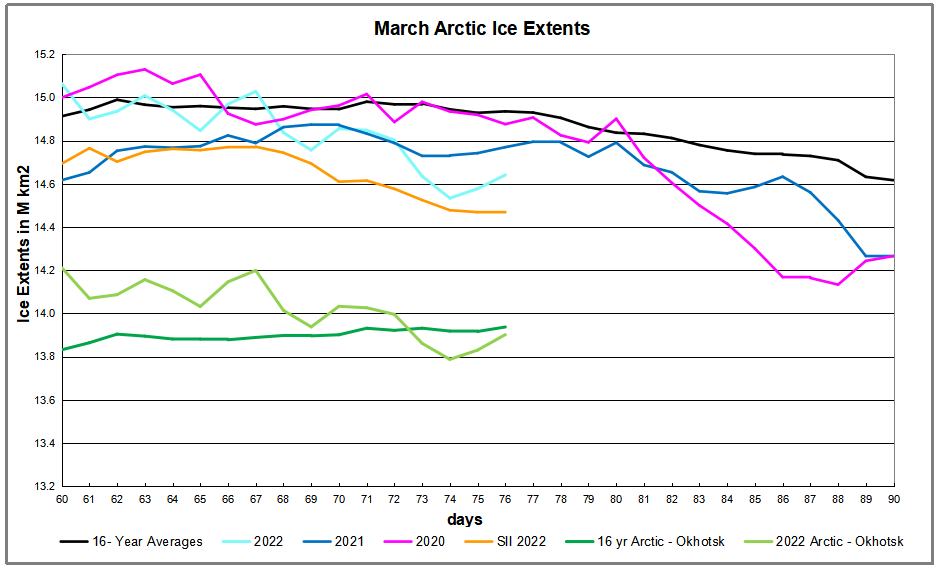
The 2022 cyan line started March above 15M km2, then declined to day 76 (March 17), ~300k km2 lower than the 16 yr. average.  The dark green line shows Arctic ice extent average after Okhotsk is excluded, while the light green is 2022 Arctic extent without Okhotsk. The table below shows that Okhotsk deficit to average on day 76 is 260k km2, almost the entire Arctic deficit.

Region 2022076 Day 76 Average 2022-Ave. 2021076 2022-2021
 (0) Northern_Hemisphere 14641084 14935497 -294413 14769906 -128822
 (1) Beaufort_Sea 1070776 1070247 529 1070689 87
 (2) Chukchi_Sea 966006 965877 129 966006 0
 (3) East_Siberian_Sea 1087137 1087107 30 1087120 17
 (4) Laptev_Sea 897845 897837 8 897827 18
 (5) Kara_Sea 905846 923576 -17730 935006 -29160
 (6) Barents_Sea 554036 648194 -94158 849221 -295185
 (7) Greenland_Sea 572046 618979 -46934 601423 -29377
 (8) Baffin_Bay_Gulf_of_St._Lawrence 1784542 1534462 250080 1288815 495727
 (9) Canadian_Archipelago 854685 853020 1665 854597 88
 (10) Hudson_Bay 1260691 1258149 2542 1260471 220
 (11) Central_Arctic 3153037 3223013 -69976 3222708 -69671
 (12) Bering_Sea 729277 755358 -26081 547775 181502
 (13) Baltic_Sea 59785 81419 -21634 62626 -2841
 (14) Sea_of_Okhotsk 739183 998164 -258981 1117615 -378432

Most places are close to average, with a large surplus in Baffin Bay offsetting small deficits elsewhere.  The exception is Okhotsk making up most of the total deficit to average, and even a larger deficit to last year

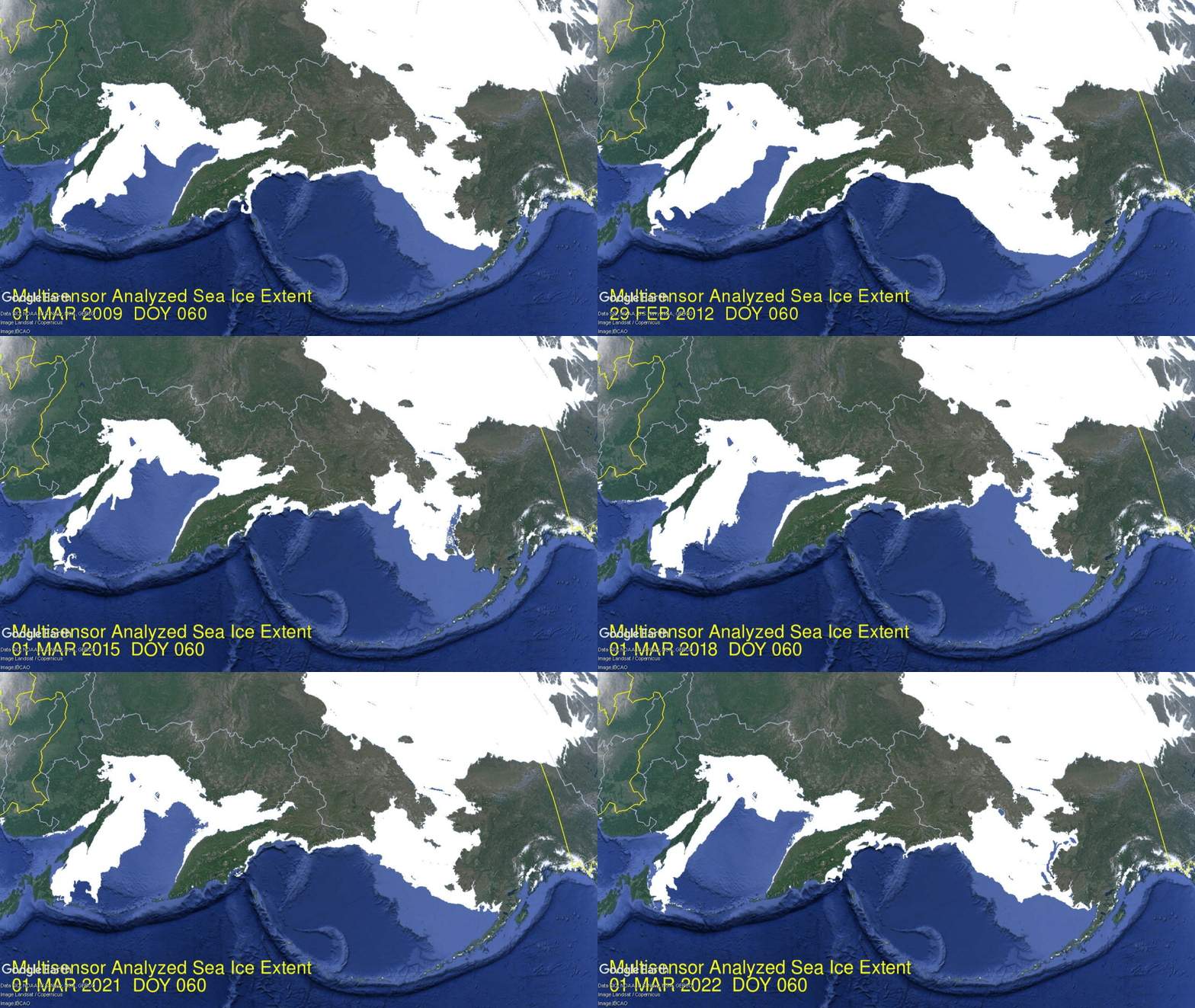
IOW, had Okhotsk extent been average on day 60 (1.08M km2) instead of 852k km2, the surplus would have been even higher.  So why was ice missing in Okhotsk this year?

Firstly, the animation above shows that Okhotsk (and also Bering) sea ice is quite variable year over year. The MASIE record for day 60 shows Okhotsk at 880k km2 in 2006, up to 1230k km2 in 2012, down to 770k km2 in 2015, up to 1080k km2 in 2018, down to  850k km2 in 2022. Notice Okhotsk 2022 is quite similar to 2015, while Bering is about average this year.  What causes these fluctuations on annual, decadal and longer time scales?

The answer illustrates the complexity of natural factors interacting to produce climatic patterns we observe and measure. In Okhotsk in particular, and in the Arctic generally, changes in ice extents are a function of the 3 Ws: Water, Wind and Weather. More specifically, water changes in temperature (SST) and salinity (SSS); wind changes with changes in sea level pressures (SLP); and stormy weather varies between cyclonic and anticyclonic regimes. Below is discussion of these natural mechanisms.

Background on Okhotsk Sea

NASA describes Okhotsk as a Sea and Ice Factory. Excerpts in italics with my bolds.

The Sea of Okhotsk is what oceanographers call a marginal sea: a region of a larger ocean basin that is partly enclosed by islands and peninsulas hugging a continental coast. With the Kamchatka Peninsula, the Kuril Islands, and Sakhalin Island partly sheltering the sea from the Pacific Ocean, and with prevailing, frigid northwesterly winds blowing out from Siberia, the sea is a winter ice factory and a year-round cloud factory.

The region is the lowest latitude (45 degrees at the southern end) where sea ice regularly forms. Ice cover varies from 50 to 90 percent each winter depending on the weather. Ice often persists for nearly six months, typically from October to March. Aside from the cold winds from the Russian interior, the prodigious flow of fresh water from the Amur River freshens the sea, making the surface less saline and more likely to freeze than other seas and bays.
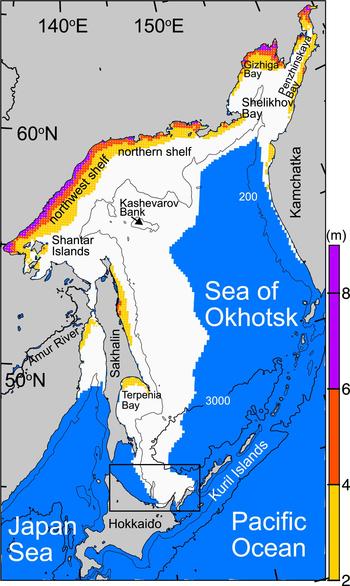

Map of the Sea of Okhotsk with bottom topography. The 200- and 3000-m isobars are indicated by thin and thick solid lines, respectively. A box denotes the enlarged portion in Figure 5. White shading indicates sea-ice area (ice concentration ⩾30%) in February averaged for 2003–11; blue shading indicates open ocean area. Ice concentration from AMSR-E is used. Color shadings indicate cumulative ice production in coastal polynyas during winter (December–March) averaged from the 2002/03 to 2009/10 seasons (modified from Nihashi and others, 2012, 2017). The amount is indicated by the bar scale. Source: Cambridge Core

Basics of Weather and Ice Dynamics

Wind directions are named by which point on the compass the prevailing wind hits you in the face.  Thus, a southerly wind comes from the south toward the north, typically bringing warmer air north, and displacing colder northern air.

Winds arise from differences in surface pressures. Above every square inch on the surface of the Earth is 14.7 pounds of air. That means air exerts 14.7 pounds per square inch (psi) of pressure at Earth’s surface. High in the atmosphere, air pressure decreases.

Pressure varies from day to day at the Earth’s surface – the bottom of the atmosphere. This is, in part, because the Earth is not equally heated by the Sun. Areas where the air is warmed often have lower pressure because the warm air rises. These areas are called low pressure systems. Places where the air pressure is high, are called high pressure systems.
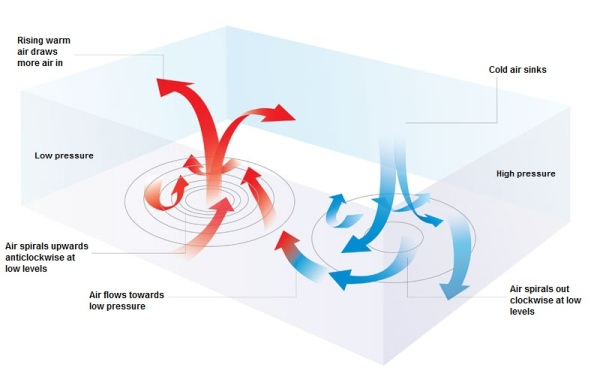
A low pressure system has lower pressure at its center than the areas around it. Winds blow towards the low pressure, and the air rises in the atmosphere where they meet. As the air rises, the water vapor within it condenses, forming clouds and often precipitation. Because of Earth’s spin and the Coriolis effect, winds of a low pressure system swirl counterclockwise north of the equator and clockwise south of the equator. This is called cyclonic flow. On weather maps, a low pressure system is labeled with red L.

A high pressure system has higher pressure at its center than the areas around it. Winds blow away from high pressure. Swirling in the opposite direction from a low pressure system, the winds of a high pressure system rotate clockwise north of the equator and counterclockwise south of the equator. This is called anticyclonic flow. Air from higher in the atmosphere sinks down to fill the space left as air is blown outward. On a weather map, you may notice a blue H, denoting the location of a high pressure system.

High and low pressure indicated by lines of equal pressure called isobars.

When the suns shines on land the air is warmed and rises. And because the earth is rotating, an upward spiral forms. Additionally, over wetlands and the oceans there is evaporation, which also rises, H2O being lighter than N2 or O2. When the water is warmer, the rising air intensifies and resulting in a lower pressure than surrounding areas.  Arctic cyclones disrupt drift ice, creating more open water, and impede freezing.  Arctic anticyclones (HP cells) facilitate cooling and freezing.

The vertical direction of wind motion is typically very small (except in thunderstorm updrafts) compared to the horizontal component, but is very important for determining the day to day weather. Rising air will cool, often to saturation, and can lead to clouds and precipitation. Sinking air warms causing evaporation of clouds and thus fair weather.

The closer the isobars are drawn together the quicker the air pressure changes. This change in air pressure is called the “pressure gradient”. Pressure gradient is just the difference in pressure between high- and low-pressure areas.

The Okhotsk Sea Ice Connection

Toyoda et al. (2022) explain in their paper Sea ice variability along the Okhotsk coast of Hokkaido based on long-term JMA meteorological observatory data.  Excerpts in italics with  my bolds.

Abstract

Long-term sea ice observation data at the Japan Meteorological Agency observatories along the
Okhotsk coast of Hokkaido were analyzed. The observations at the Abashiri Local Meteorological
Observatory largely explained the variations at other sites along much of the Okhotsk coast on a time scale longer than a few days. Interannually, variations of the maximum sea ice areas in the whole and southern Sea of Okhotsk were largely reflected in the yearly accumulated sea ice concentration (SIC) and sea ice duration variations at the observatories.
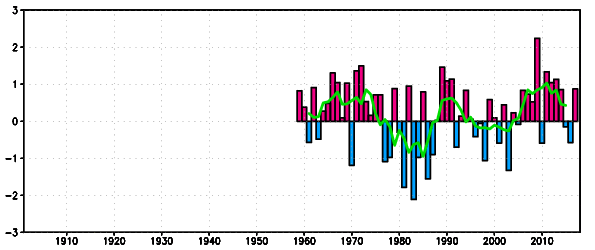
NPI time series The bars represent five-month mean ( November – March ) NPI values. The green line represents five-year running means of five-month mean NPI values. Positive (negative) NPI values indicate that the Aleutian Low is weaker (stronger) than its normal. For comparison with the PDO index, the period of the graph is adjusted to that of the PDO index.

A comparison with several indices for the North Pacific climate variability suggested that the North Pacific Index (NPI) is a robust indicator of the recent (after the 1980s) sea ice variations in the Sea of Okhotsk on a decadal time scale. Specifically:

♦  variations in the first sea ice appearance date at the observatories resulted from variations in the Aleutian Low with meridional wind anomalies over the Sea of Okhotsk and the air temperature around Japan in January;

♦  variations in the final disappearance date resulted from the Aleutian Low variations, and,

♦  the resulting sea ice cover variations in the Sea of Okhotsk except for the Siberian coast affected the air temperatures in April. These factors influenced the sea ice duration.

A strong linkage was found between variations in the local sea ice (along the Hokkaido coast) and large-scale fields, which will help improve our understanding of the sea ice extent and retreat variability over the Sea of Okhotsk and its linkage to the North Pacific climate variability.
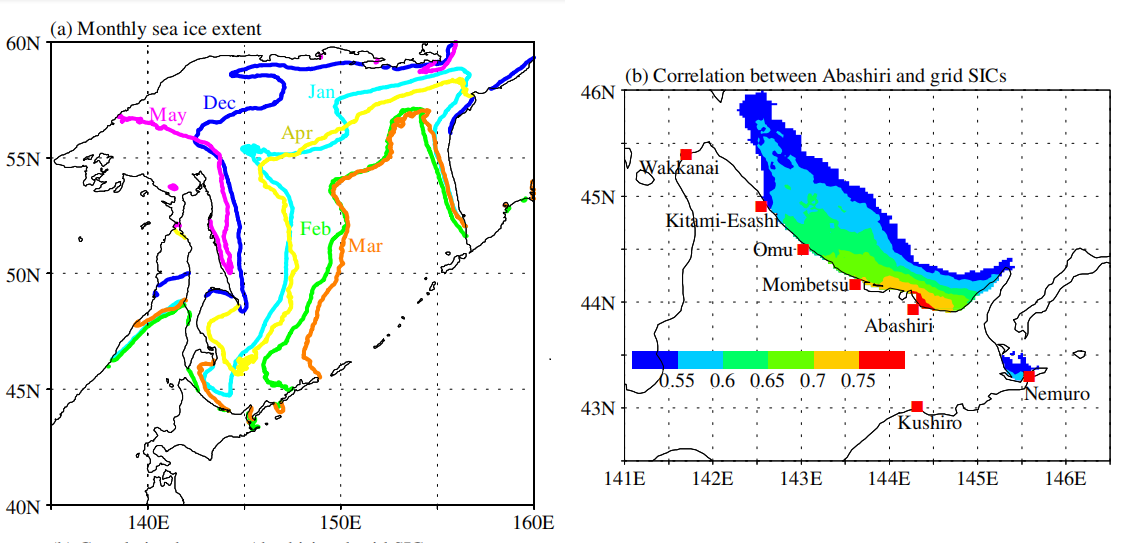
Fig. 1 (a) Monthly sea ice extent (contours of grid SIC = 0.3) averaged over 1977–2019. (b) Locations of JMA observatories and distribution of dailybasis correlation coefficients between the Abashiri and grid SICs. (N = 700–800 approximately).
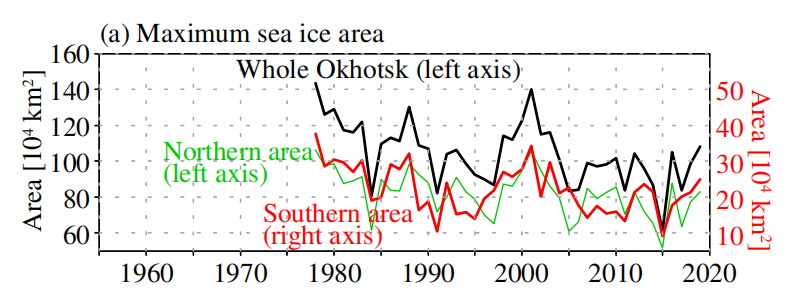
Fig. 2 (a) Yearly maximum sea ice areas in the Sea of Okhotsk from the grid SIC data for the whole (black; left axis), northern (>50°N; green; left axis), and southern (<50°N; red; right axis) areas.

Among several climate indices, the NPI is a robust indicator of recent (after the 1980s) sea ice
variations in the Sea of Okhotsk. We also examined the differences between the start and end date variations, which determine the durations. Variations in the start date at the Okhotsk coast sites resulted from the variations in the Aleutian Low strength, the air temperature around Japan in January, and partly the SST along the Soya warm current in December. Variations in the end date resulted from the Aleutian Low variations; the sea ice cover variations affected the air temperatures over the Sea of Okhotsk in April, in contrast to the sea ice cover variations in January resulting from the air temperature variations.

Sea Ice Tourism from Hokkaido, Japan

Taking a boat trip from Hokkaido Island to see Okhotsk drift ice is a big tourist attraction, as seen in the short video below.  Al Gore had them worried back then, but hopefully not now.

Drift ice in Okhotsk Sea at sunrise.

‘C’mon Man’ Stop Sabotaging American Energy

Kevin Mooney writes at Real Clear Energy ‘C’mon Man’ Stop Sabotaging American Energy. Excerpts in italics with my bolds and added images.

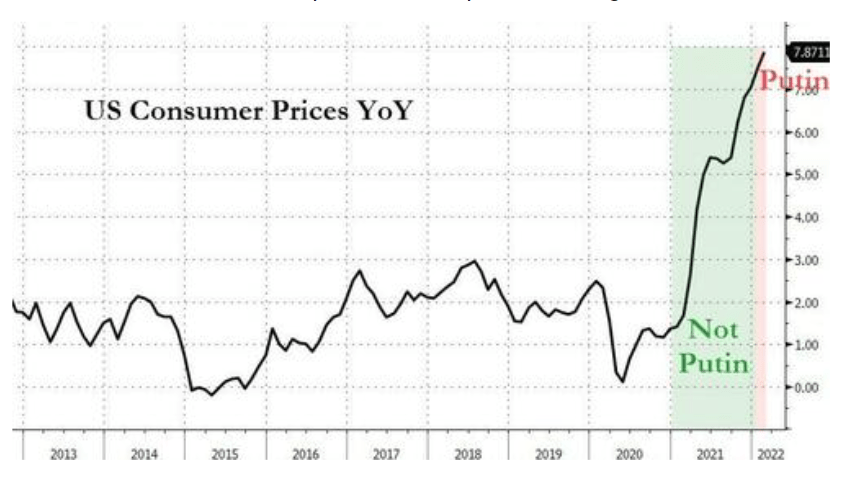
Ask Joe Biden a question about rising energy costs and he’ll be quick to fix the blame on Russian dictator Vladimir Putin while sidestepping any responsibility for his own policy failures.

But Putin’s authoritarian regime has only accelerated a process that was already in motion prior to the Russian invasion of Ukraine. After mismanaging the U.S. economy for the past year, Biden’s incessant “C’mon Man” routine is not playing well with the public. A broad cross section of polls shows Biden’s job approval ratings remain underwater.

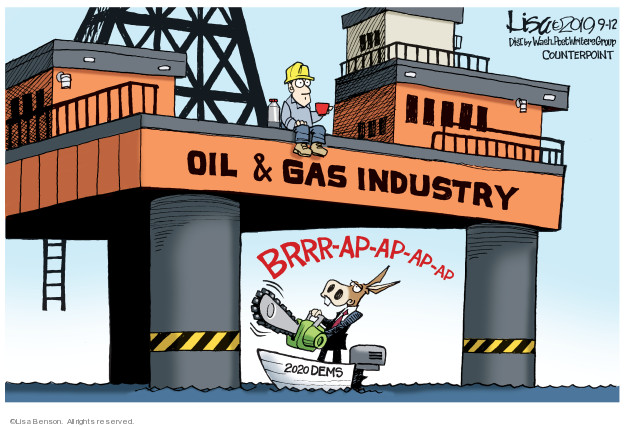
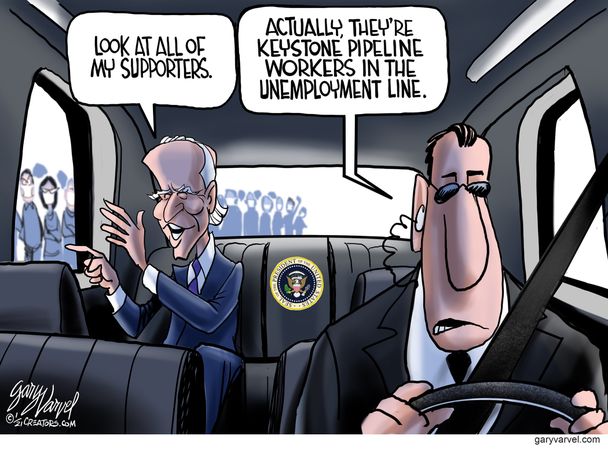
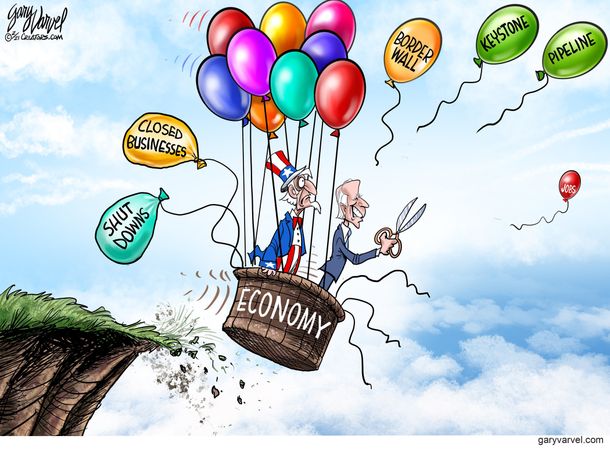
The soaring inflation and rising gas prices that have been evident to American consumers long before the Russian invasion are at least partly responsible for Biden’s negative numbers. As a career politician who has been in Washington D.C. for more than 50 years, Biden has always stood on the wrong side of history exercising poor judgment at every turn. America would be in a stronger position today to resist Putin’s aggression if the Biden administration has not advanced heavy handed regulatory policies that discourage oil and gas development. The same is true of European leaders who have made themselves overly dependent on Russian energy.

That was one of the central messages Tom Pyle, president of the Institute for Energy Research, delivered during his March 8 testimony before the House Committee on Energy and Commerce.

“Unfortunately, but not surprisingly, in the wake of the 2020 election, President Biden made it clear that he intended to be an energetic advocate against the oil, coal, and natural gas that makes modern life possible,” Pyle said in his testimony. “Oil markets, now faced with an existential threat, responded as one might expect. The price of oil went up. In response, Mr. Biden inexplicably asked Russia and OPEC for more oil. National Security Advisor Jake Sullivan issued a statement calling on OPEC Plus (the most important part of the “Plus” is Russia) to produce more oil.”

From here, Team Biden’s self-inflicted wounds only became worse, Pyle explained, as the administration took “numerous actions designed to reduce the enthusiasm of energy companies to find, produce, and transport, domestic oil and natural gas.”

Pyle also expressed concern about the “propaganda” attached to the utility of so called “renewable energy” such as wind and solar. Despite several decades of subsidies and mandates aimed at increasing their use, renewables produced just 12.4% of American energy consumed, Pyle told lawmakers.

“A significant part of our current problem is the endless repetition of the propaganda about the utility of alternative sources of energy, the possibility of net zero greenhouse gas emissions, and the inevitability of an energy transition,” Pyle said. “These foundational myths have led directly to higher energy prices for Americans.”

But the policy missteps are not limited to the Biden administration. The European Union has also failed to sufficiently invest in oil and natural gas while chasing after renewable energy, Pyle observed in his testimony. He cited figures showing that in the past 15 years, natural gas production in Europe has fallen by 30% while natural gas consumption has only declined by 13%.

“This was driven by government policy, not market forces,” Pyle said. “Consequently, Russian natural gas has become more critical to European energy security. At the moment, the EU consumes about 540 billion cubic meters of natural gas a year.Over 40% of that originates in Russia. It is no surprise, therefore, that the European and the American governments have hesitated to impose strong sanctions against Russian-sourced energy and Russian energy companies either before or after the invasion.”

Then there’s China, which dominates the market for the mining, production, and processing of critical minerals that help power electric cars. These include: copper, lithium, nickel, and cobalt.

That’s a problem since Biden’s EPA is hot to trot for implementing new rules crafted with an eye toward coercing Americans into buying electric cars. During his testimony, Pyle discussed the EPA’s new greenhouse gas emission standards for passenger cars and light trucks through model year 2026. “This rule essentially mandates that 17% of new vehicles in model year 2026 be fully electric or plug-in hybrids,” he said.

As electrification grows, so will reliance on China.

“It is challenging to believe that Americans would be in favor of trading energy independence – which we currently enjoy despite the best efforts of some in the Administration – for dependence on a genocidal regime (and identified as such by both the current and previous Administrations) marked by international hooliganism,” Pyle said.

Even if a future administration were to abruptly reverse course from the damage done under Biden’s watch, there’s an opportunity cost associated with current efforts to discourage domestic and oil and gas development.

Energy executives and their investors are understandably hesitant to begin exploratory efforts in an environment where federal officials from Biden on down have expressed hostility toward their products. Never mind Putin.

The problem is not just one of poor judgment at the Biden White House, but also a fundamental misunderstanding of what it takes to reinvigorate American energy. That’s why American Petroleum Institute President and CEO Mike Sommers recently took White House Press Secretary Jen Psaki to school when she said there are 9,000 approved oil leases that the oil companies are not currently tapping into. Psaki was responding to media questions about Biden’s ban on new oil and natural gas leases on public lands.

“Just because you have a lease doesn’t mean there’s actually oil and gas in that lease, and there has to be a lot of development that occurs between the leasing and then ultimately permitting for that acreage to be productive,” Sommers told Bloomberg News.

“I think that they’re purposefully misusing the facts here to advantage their position.”
C’mon Lady.

As IER points out in a blog post, the oil industry has to pay the government fees for renting leases whether or not oil and gas is ultimately found and produced. Moreover, it takes anywhere from 7 to 10 years for oil companies to know if a lease will become productive. It’s not hard to understand why they aren’t rushing in at a time when the clown act that is the Biden White House is pressuring banks to refrain from investing in the oil and gas industry

A paid agent of either China or Russia could not do a better job of sabotaging American energy at a time when it’s needed most.

Big Oil Embraces Its Demise for the Honor of Saving the Planet.

Robert Romano asks and answers the pressing energy question in his Daily Torch article Why aren’t oil companies drilling more? Look no further than the ESG goals in their corporate annual reports. Excerpts in italics with my bolds and added images.  H/T John Ray

The largest oil producers in the U.S. do not appear to have major plans to increase production through 2025, a review of U.S. Energy Information Agency (EIA) data and corporate reports of U.S.-based oil companies reveals, despite oil prices being over $100 per barrel and inflation raging at 7.9 percent the last twelve months.

According to EIA, U.S. oil production will reach 12 million barrels per day in 2022 and 12.6 million barrels per day in 2023, a return to pre-Covid production levels that peaked at 12.9 million barrels per day in Nov. 2019.

But what about over the long term? A look at top U.S. oil producers reveals that these companies have been pivoting away from carbon-based energy for years. In short, they’re going green.

[ExxonMobil and Chevron are two examples where] explicit Environmental, Social and Governance (ESG) goals are being pursued by the largest oil companies in the U.S., particularly goals to support the Paris Climate Accords and to reduce carbon emissions to zero.

In both companies’ cases, the strategies short-term include deploying carbon capture technologies as well as reducing onsite carbon emissions on existing production facilities, and more investment in green energies.

Long term, however, they are sealing the fate of carbon-based energies, by embracing an investment model that calls for their extinction.

Ultimately, that will mean almost no oil production or consumption, a goal that would be contrary to an oil company’s continued existence and profitability.

ESG investing has increased dramatically the past decade via private retirement funds regulated under the Employment Retirement Income Security Act (ERISA) thanks to a regulation by the Obama Labor Department in 2015.

In addition, the $762 billion federal Thrift Savings Plan (TSP) for federal employee retirees will begin investing in ESG funds in 2022, following state government employee retirement funds in California, New York, Colorado, Connecticut, Maine, Maryland and Oregon.

The combination of these incentives and subsidies has led to an unprecedented rise of ESG investment: $38 trillion out more than $100 trillion global assets under management, will grow to $53 trillion by 2025, according to Bloomberg News. That’s about one-third of all assets under management, not necessarily seeking profitability, but to save the world.

BlackRock, a hedge fund with more than $9 trillion of assets under management, have placed green activists onto the board of Exxon to make it a “not-oil” company, thanks to ESG. Other hedge funds like Vanguard also make significant ESG investments.

But it has led to catastrophe. Besides making Europe and the West increasingly dependent on energy from adversaries like Russia, inflation is on fire. Thanks to the energy crisis, even major ESG beneficiaries like Tesla CEO Elon Musk are calling for an increase in oil and gas production in a bid to offset Russia, writing on Twitter on March 8: “Hate to say it, but we need to increase oil & gas output immediately. Extraordinary times demand extraordinary measures.”

Musk is right. It’s time to expand production dramatically. But ESG won’t let us. That’s a big problem.

The net result of these policies incentivizing and subsidizing ESG investments has been to restrict capitalization and financing to carbon-based oil, coal and natural gas energies in favor of green energies such as solar, wind and electric vehicles — and endangering the West.

As it turns out, energy security is national security, and with ESG, we do not have energy security.

See also Wake Up and Smell the Fossil Fuel Insanity

In Celebration of Our Warm Climate

Legacy and social media keep up a constant drumbeat of warnings about a degree or two of planetary warming without any historical context for considering the significance of the alternative.  A poem of Robert Frost comes to mind as some applicable wisdom:

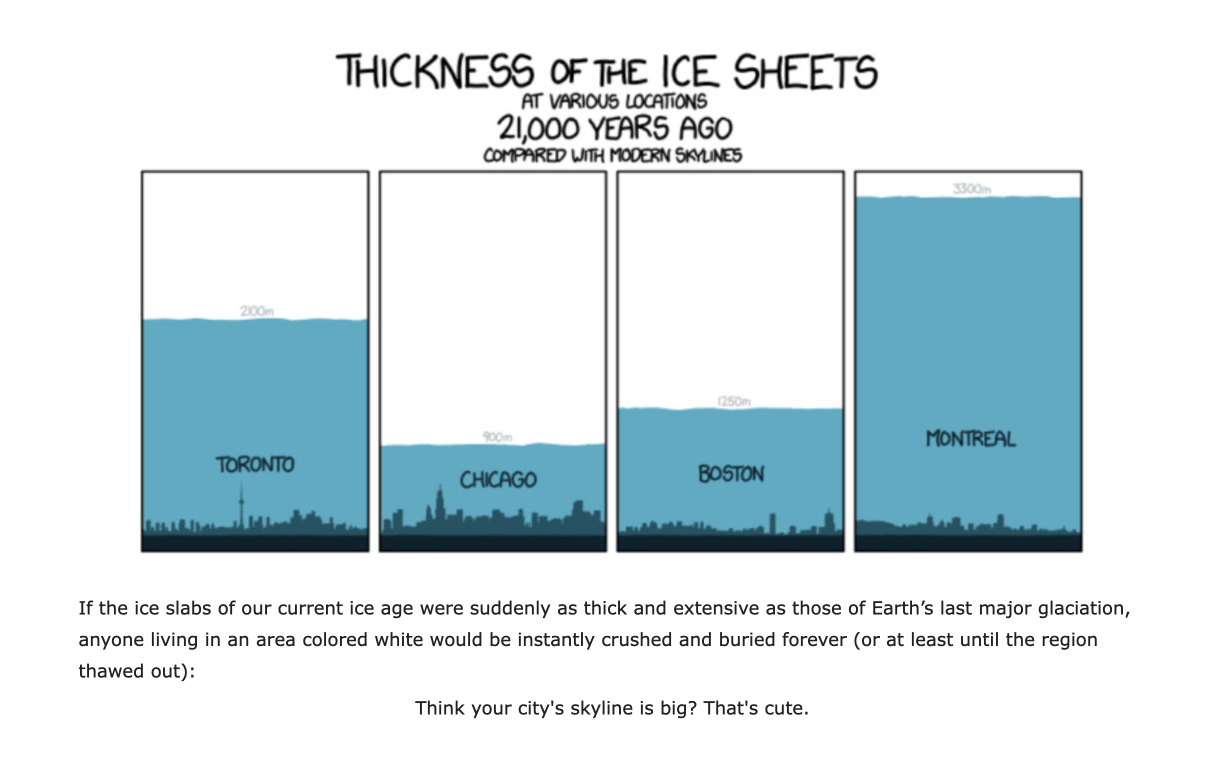
The diagram at the top shows how grateful we should be for living in today’s climate instead of a glacial icehouse. (H/T Raymond Inauen)  For most of its history Earth has been frozen rather than the mostly green place it is today.  And the reference is to the extent of the North American ice sheet during the Last Glacial Maximum (LGM).

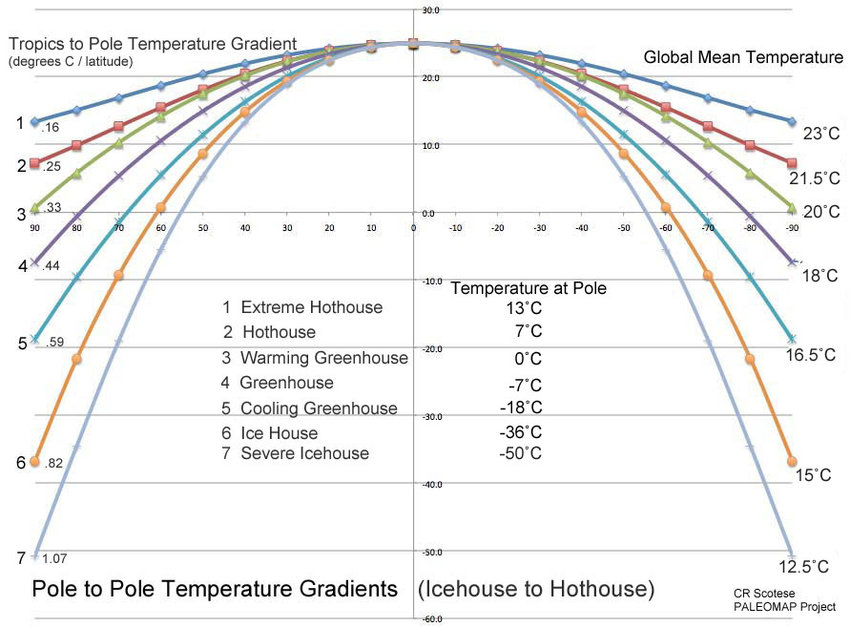
For further context consider that geologists refer to our time as a “Severe Icehouse World”, among the various conditions in earth’s history, as diagramed by paleo climatologist Christopher Scotese. Referring to the Global Mean Temperatures, it appears after many decades, we are slowly rising to “Icehouse World”, which would seem to be a good thing.

Instead of fear mongering over a bit of warming, we should celebrate our good fortune, and do our best for humanity and the biosphere.  Matthew Ridley takes it from there in a previous post.

Background from previous post The Goodness of Global Warming

LAI refers to Leaf Area Index.

As noted in other posts here, warming comes and goes and a cooling period may now be ensuing. See No Global Warming, Chilly January Land and Sea.  Matt Ridley provides a concise and clear argument to celebrate any warming that comes to our world in his Spiked article Why global warming is good for us.  Excerpts in italics with my bolds and added images.

Climate change is creating a greener, safer planet.

Global warming is real. It is also – so far – mostly beneficial. This startling fact is kept from the public by a determined effort on the part of alarmists and their media allies who are determined to use the language of crisis and emergency. The goal of Net Zero emissions in the UK by 2050 is controversial enough as a policy because of the pain it is causing. But what if that pain is all to prevent something that is not doing net harm?

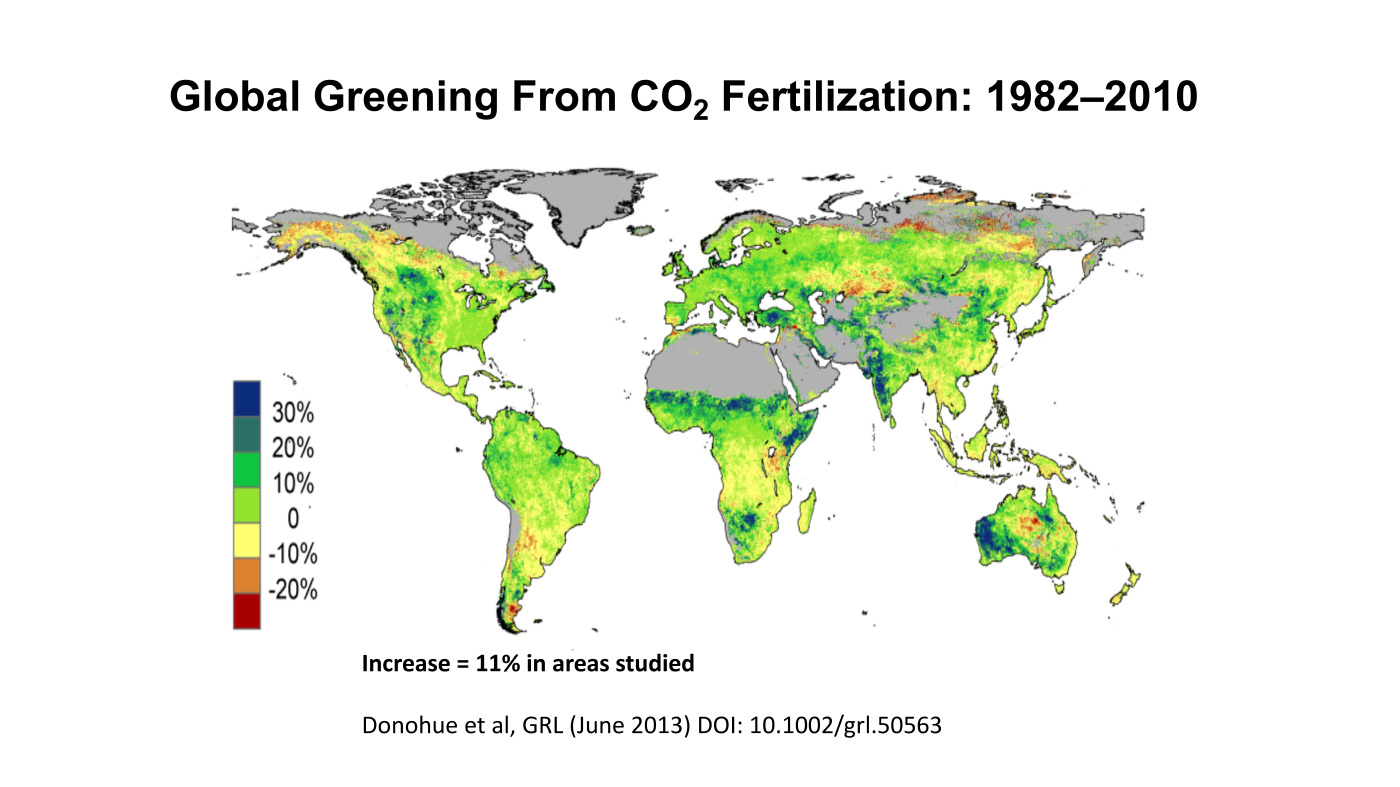
The biggest benefit of emissions is global greening, the increase year after year of green vegetation on the land surface of the planet. Forests grow more thickly, grasslands more richly and scrub more rapidly. This has been measured using satellites and on-the-ground recording of plant-growth rates. It is happening in all habitats, from tundra to rainforest. In the four decades since 1982, as Bjorn Lomborg points out, NASA data show that global greening has added 618,000 square kilometres of extra green leaves each year, equivalent to three Great Britains. You read that right: every year there’s more greenery on the planet to the extent of three Britains. I bet Greta Thunberg did not tell you that.

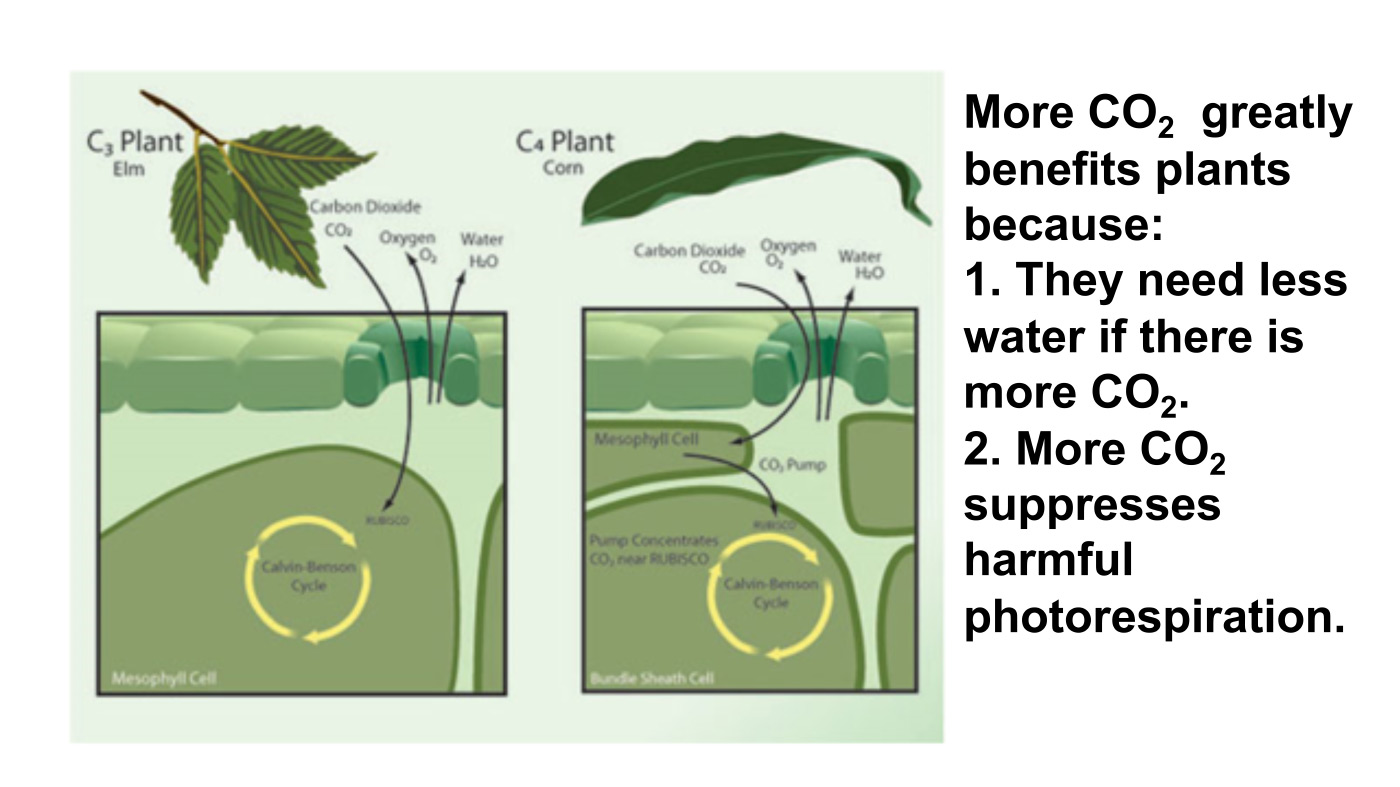
The cause of this greening? Although tree planting, natural reforestation, slightly longer growing seasons and a bit more rain all contribute, the big cause is something else. All studies agree that by far the largest contributor to global greening – responsible for roughly half the effect – is the extra carbon dioxide in the air. In 40 years, the proportion of the atmosphere that is CO2 has gone from 0.034 per cent to 0.041 per cent. That may seem a small change but, with more ‘food’ in the air, plants don’t need to lose as much water through their pores (‘stomata’) to acquire a given amount of carbon. So dry areas, like the Sahel region of Africa, are seeing some of the biggest improvements in greenery. Since this is one of the poorest places on the planet, it is good news that there is more food for people, goats and wildlife.

But because good news is no news, green pressure groups and environmental correspondents in the media prefer to ignore global greening. Astonishingly, it merited no mentions on the BBC’s recent Green Planet series, despite the name. Or, if it is mentioned, the media point to studies suggesting greening may soon cease. These studies are based on questionable models, not data (because data show the effect continuing at the same pace). On the very few occasions when the BBC has mentioned global greening it is always accompanied by a health warning in case any viewer might glimpse a silver lining to climate change – for example, ‘extra foliage helps slow climate change, but researchers warn this will be offset by rising temperatures’.

Another bit of good news is on deaths. We’re against them, right? A recent study shows that rising temperatures have resulted in half a million fewer deaths in Britain over the past two decades. That is because cold weather kills about ’20 times as many people as hot weather’, according to the study, which analyses ‘over 74million deaths in 384 locations across 13 countries’. This is especially true in a temperate place like Britain, where summer days are rarely hot enough to kill. So global warming and the unrelated phenomenon of urban warming relative to rural areas, caused by the retention of heat by buildings plus energy use, are both preventing premature deaths on a huge scale.

Summer temperatures in the US are changing at half the rate of winter temperatures and daytimes are warming 20 per cent slower than nighttimes. A similar pattern is seen in most countries. Tropical nations are mostly experiencing very slow, almost undetectable daytime warming (outside cities), while Arctic nations are seeing quite rapid change, especially in winter and at night. Alarmists love to talk about polar amplification of average climate change, but they usually omit its inevitable flip side: that tropical temperatures (where most poor people live) are changing more slowly than the average.

My Mind is Made Up, Don’t Confuse Me with the Facts. H/T Bjorn Lomborg, WUWT

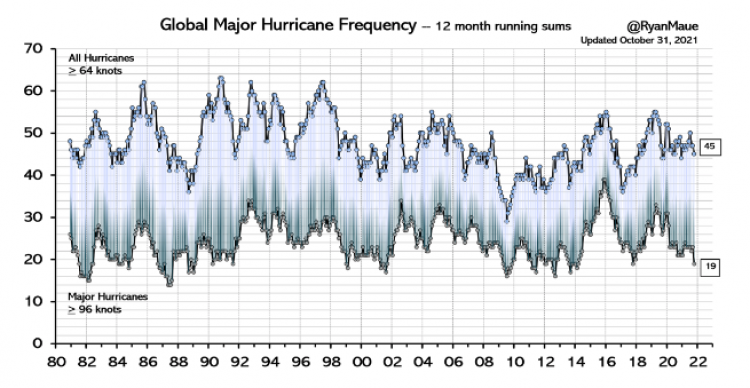
But are we not told to expect more volatile weather as a result of climate change? It is certainly assumed that we should. Yet there’s no evidence to suggest weather volatility is increasing and no good theory to suggest it will. The decreasing temperature differential between the tropics and the Arctic may actually diminish the volatility of weather a little.

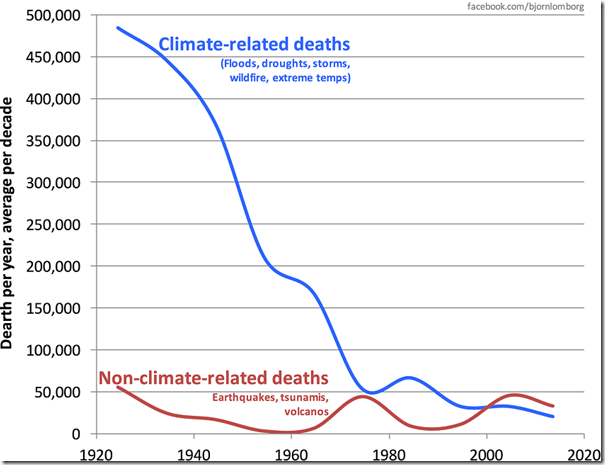
Indeed, as the Intergovernmental Panel on Climate Change (IPCC) repeatedly confirms, there is no clear pattern of storms growing in either frequency or ferocity, droughts are decreasing slightly and floods are getting worse only where land-use changes (like deforestation or building houses on flood plains) create a problem. Globally, deaths from droughts, floods and storms are down by about 98 per cent over the past 100 years – not because weather is less dangerous but because shelter, transport and communication (which are mostly the products of the fossil-fuel economy) have dramatically improved people’s ability to survive such natural disasters.

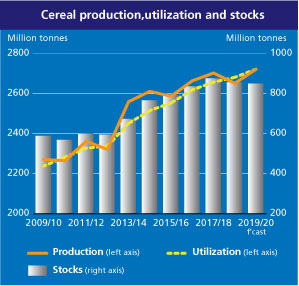
The effect of today’s warming (and greening) on farming is, on average, positive: crops can be grown farther north and for longer seasons and rainfall is slightly heavier in dry regions. We are feeding over seven billion people today much more easily than we fed three billion in the 1960s, and from a similar acreage of farmland. Global cereal production is on course to break its record this year, for the sixth time in 10 years.

Nature, too, will do generally better in a warming world. There are more species in warmer climates, so more new birds and insects are arriving to breed in southern England than are disappearing from northern Scotland. Warmer means wetter, too: 9,000 years ago, when the climate was warmer than today, the Sahara was green. Alarmists like to imply that concern about climate change goes hand in hand with concern about nature generally. But this is belied by the evidence. Climate policies often harm wildlife: biofuels compete for land with agriculture, eroding the benefits of improved agricultural productivity and increasing pressure on wild land; wind farms kill birds and bats; and the reckless planting of alien sitka spruce trees turns diverse moorland into dark monoculture.

Meanwhile, real environmental issues are ignored or neglected because of the obsession with climate. With the help of local volunteers I have been fighting to protect the red squirrel in Northumberland for years. The government does literally nothing to help us, while it pours money into grants for studying the most far-fetched and minuscule possible climate-change impacts. Invasive alien species are the main cause of species extinction worldwide (like grey squirrels driving the red to the margins), whereas climate change has yet to be shown to have caused a single species to die out altogether anywhere.

Of course, climate change does and will bring problems as well as benefits. Rapid sea-level rise could be catastrophic. But whereas the sea level shot up between 10,000 and 8,000 years ago, rising by about 60 metres in two millennia, or roughly three metres per century, today the change is nine times slower: three millimetres a year, or a foot per century, and with not much sign of acceleration. Countries like the Netherlands and Vietnam show that it is possible to gain land from the sea even in a world where sea levels are rising. The land area of the planet is actually increasing, not shrinking, thanks to siltation and reclamation.

Environmentalists don’t get donations or invitations to appear on the telly if they say moderate things. To stand up and pronounce that ‘climate change is real and needs to be tackled, but it’s not happening very fast and other environmental issues are more urgent’ would be about as popular as an MP in Oliver Cromwell’s parliament declaring, ‘The evidence for God is looking a bit weak, and I’m not so very sure that fornication really is a sin’. And I speak as someone who has made several speeches on climate in parliament.

No wonder we don’t hear about the good news on climate change.


Ukraine Crisis Works Against Woke Politics

Grady Means writes at The Hill Ukraine crisis: Unexpected weapon against woke politics. Excerpts in italics with my bolds.

When Russian President Vladimir Putin blasted his way into Ukraine, he thought he was simply reassembling the great Russian Empire. What he actually did was reverse the global tide toward authoritarianism under the banner of woke politics.

For years, the would-be New Illuminati of global elites have trekked to the World Economic Forum (WEF) to be fed a diet of woke politics under the banner of “stakeholder rights” and “The Great Reset,” a rebranded version of Marxism designed to defeat neo-liberalism, i.e., capitalism, and its spiritual partner, individual freedom. For the most part, these pretentious “leaders” are what Karl Marx and Vladimir Lenin would have called “dupes” and “useful idiots,” selling their own hangman the rope to hang them.

Four major fronts in this global war to destroy liberal democracies and free-market systems have been decarbonization, COVID response, baseless accusations of racism, and corrosion of the rule of law — all efforts to undermine key foundations of civil society.

As outlined by the leaders of the WEF, the COVID pandemic provided the opportunity to increase the authoritarian role of government, albeit unconstitutionally, and replace individual liberty with state mandate — the “great reset,” leading to the increased power of the state (and the elite) to control citizens. The WEF simulated this strategy well in advance of COVID, including the role of “authoritative spokesmen” and traditional and social media to promote the state view and suppress dissent and free speech as “disinformation.”

Also central to the strategy is rapid decarbonization — federal, state and local laws and mandates to shut down the use of fossil fuels and transition to solar and wind power — promoted as answers to the climate crisis. Most serious analyses suggest they will fail. Solar and wind are unreliable. They require a doubling of the grid, which itself has proven to be unreliable across the country with blackouts. They require battery backups to store and supply energy when solar and wind are down. Current battery backup capacity in America is less than 10 quads. To support American industrial and consumer usage at 2022 levels, it would require between 60 to 90 quads to sustain our economy and standard of living.

Expanding and strengthening the grid and installing the battery capacity will take decades. It will require bridge energy — i.e., natural gas and nuclear — to be used as the transition takes place. But government policies are shutting down fossil fuels and nuclear power as quickly as possible.

It will be a disaster. And, it is intentional. The point is to have skyrocketing energy prices and shortages. It enshrines government power. It is cynical to an Olympian degree.

Of course, it will have no effect on the climate at all. China will continue to build coal-fired generators (at least 1,000 are planned) and use the full range of fossil fuels. Russia, of course, is wedded to fossil fuels. The only result of decarbonization in the West is the destruction of our economies and democracies.

“Defunding the police” and not enforcing urban or border laws undercut civil society and weaken social cohesion. It creeps toward anarchy. Calling out these obvious attacks on social foundations is deemed to be “racism,” a strategy that has silenced many and intimidated our political and corporate “leadership.”

The speed and success that woke politics has had in redefining the political debate in America and Western democracies has been remarkable. The rapid shift toward authoritarianism has been alarming. The corrosion of the rule of law is depressing. The cowardice and opportunism among the political and corporate elite is expected, but sickening.

Putin should have just pulled up a comfortable chair, eaten popcorn, and watched the West self-destruct. But, he’s an impatient guy — a would-be “man of history.” Impulsively, he has, in a single stroke, managed to reverse the Western woke political tidal wave and set the stage for destroying his own energy-based economy.

Almost instantly, everyone in the West has become aware of the central importance of energy to national security and the overall economy.

It is obvious that America cannot be held hostage to foreign sources of oil and gas and must return to energy independence. It is obvious that Germany made a colossal error in precipitously shutting down its nuclear power generation and becoming dependent on Russian gas — not unlike California, which has done the same, only to be forced to import energy from other states. It is obvious that European energy prices are skyrocketing because of policy mistakes. It is obvious that America can best support NATO by producing and exporting oil and gas to Europe. But American energy prices — and the prices of everything else — are skyrocketing because of poor economic decisions, especially in regard to energy production.

And this brings us to Joe Biden. Will the president continue to allow the price of energy to soar to squeeze the American people into accepting his flawed, woke vision of rapid decarbonization? Or, will he understand that he has undercut our national security, NATO, and our economy and quickly move America back to energy independence?

If not, the midterm elections will present a stark choice between the woke and destructive authoritarian vision of the Democrats, or a strong economy, true freedom and strong democracy.

Thank you, Vlad, for the great reset — let’s hope you woke us all up.


Time to Get Real About Ukraine

Kurt Schlichter writes at Town Hall Can We Have Some Real Talk About Ukraine? Excerpts in italics with my bolds.

Time to get real. Ukraine is an equal opportunity crisis because it provides politicians of both parties a chance to be wrong, although it allows the Democrats the opportunity to do what they do best and be much, much more wrong. For the Republicans, it lets them indulge the desire of some to return to a time when America could focus its moral firepower – if not its firepower firepower – upon a readily-identifiable baddie like it did during the Cold War or the War on Terror. For the left, it allows them to create a moral panic to replace COVID, which, naturally, requires that we Americans “sacrifice” even more of our freedom and money.

From the perspective of someone who actually trained Ukrainian troops in Ukraine, commanded US forces, and attended the US Army War College – though it’s kind of the Chico State of war colleges – the whole way our elite is approaching the crisis is an epic clusterfark. Don’t believe anything anyone tells you – and certainly, sanity check whatever I’m telling you, too – most of these insta-experts on intra-Slavic conflict know absolutely squat-ski. Moreover, their remarkably dumb observations and credulous acceptance of conventional wisdom, which has proven long on conventional and short on wisdom, are being presented without any kind of strategic context. They don’t know where this crisis came from and certainly have no clear notion of where they want it to go beyond the vague and unhelpful idea that they want Putin (which they use interchangeably with Russia) to “lose” without knowing what that even means.

Biases are important, and here are mine. I sympathize with the Ukrainian people, partly because I worked with them and partly because I was an end-stage Cold Warrior who came up training to fight Russians. I understand that this mess is not merely the result of Putin being bad or Trump being insufficiently anti-Putin, like LTC Sausage and the rest of the failed foreign policy elite and regime media insist. Putin’s badness plays a part, but he’s merely exploiting thousands of years of bloody history, of ethnic hatred, and of Orthodox mysticism, as well as totally misguided and poorly-considered Western interference. The idea that we could just make Ukraine part of NATO and the Russians would just lump it is remarkable for its dumbness, but it is fully in keeping with our foreign policy elite’s unbroken track record of failure since the old-school military’s victory in the Gulf War – something I discuss in-depth in my upcoming Regnery book “We’ll Be Back: The Fall and Rise of America.”

My bottom line is that the Ukrainians are imperfect, and regardless of whether the Russians have some quasi-legit beefs in some cosmic sense, you don’t solve them by sending in a couple hundred thousand mechanized soldiers.

The expectation was that the Russian forces would smash through, surround the Ukrainian forces pinned down facing the Russians in the occupied regions to the east, and isolate the main cities. I did not expect them to go into the cities immediately since Russians 1) generally bypass hard defenses; 2) they have bad experiences with city fighting (Stalingrad, Grozny); and 3) that would not necessarily be necessary. It would not be necessary if the idea was to neutralize the main Ukrainian combat formations and force the government in the cities to capitulate, then have the West pressure the Ukrainians to accept a ceasefire and “peace” that recognized Russian gains and ended the idea of Ukrainian allying with the West. In fact, that is pretty much what the Russian “peace plan” consists of.

But that did not work for a couple of reasons.

First, the Russians did not fight as well as expected. You should always treat the enemy as if it is the best possible enemy. We did in the Gulf. We prepared to fight elite Republican Guard divisions of highly trained and motivated soldiers using top-shelf Soviet equipment and tactics. None of that was so; we crushed an entire national army in 100 hours.

The Russians are poorly-led, with very weak synchronization among maneuver forces and fires. Their plan is okay – in fact, you look at a map, and it’s obvious what they would do. But their gear is badly-maintained, and their troops are unsuited to the task of supporting a rapid advance. Look at all the evidently intact gear simply abandoned by the side of the road. Lots of it looks like it broke down (note all the flat tires). Much of it seems to have run out of gas. And, of course, lots of stuff had been blasted apart.

That’s the second part of the equation – the Ukrainians fought back hard. If you are a Lord of the Rings nerd, think of the Ukrainians as the dwarves. Not super-sophisticated but tough and ready to fight, and also often drunk.

If you want to see the future of this war, look at videos of Ukrainian infantry patrolling near the front. Every second guy has an anti-tank weapon, like a Javelin or some other system, and the rest are carrying spare missiles. Mechanized forces unprotected by infantry are vulnerable to ambush by anti-tank teams. The Russian armor outstripped its ground pounders and is getting pounded itself. Further, Ukrainians seem to have success with drones firing anti-tank weapons.

The war is not going to be won by conventional battalions of Ukrainians operating with conventional aircraft. It will win with light infantry and drones armed with missiles.

This is why the whole Polish MiG thing is so silly and why Republicans are so wrong to get behind it. So, the Poles will (in return for F-16s and F-15s) give up their 30-year-old MiG-29s to the US, which will then give them to Ukraine, which will then fly them to victory. No. Let’s leave the escalation part aside – and that’s a pretty big consideration. Putin has nukes, and escalation is not in our interest. If America is using a base in Germany to assemble a bunch of fighters that will be attacking Russians, are they a target and thereby a trigger for WW3? Yeah, I know the argument that it’s not an escalation, but guess what? We don’t get a vote. Putin – who we have been told is an amalgam of crazy, stupid, and evil (the third is undeniable; the first two wishful thinking) gets to decide. He’s the guy with the finger over a button, and it doesn’t say “Reset.”

Let’s look at the practical part. Fighters are part of a conventional war, which Ukraine should not fight since Russian conventional forces are so much larger. A couple of dozen hand-me-downski fighters are going to turn the tide? If the Ukrainians’ own jets flown by their top pilots got shot down already by Russia’s formidable air defenses, which is probably true (don’t buy the “Ghost of Kyiv” stuff), what’s going to happen to a bunch of planes that – assuming they are even flyable – are being flown by the Ukrainian equivalent of Randy Quaid in “Independence Day”? It’s the Bad News Bears squadron; they might as well plaster “Sponsored by Chico’s Bail Bonds” on the tails.

This war gets won by cheap drones and little groups of armed Ukrainians packing AKs and plinking tanks and IFVs with portable missiles.

But what does “won” mean? Has anyone in the US government articulated what conditions we are seeking to achieve? Is it to “beat the Russians?” What’s that mean? Our establishment is gung-ho to help, and I don’t mind, but what are we helping to do? Ukraine’s interests involve pushing Russia out of its territory. But time for some hard truth – continuing this economically disastrous war until every boot is off Ukrainian soil is not necessarily in America’s interest, and America’s interests need to come first. We could live with resolutions that the Ukrainians might not want to live with.

And if our elite can’t articulate a short-term end-state, it sure can’t articulate one for five years from now. It is in America’s interest to wean Russia from China over the long term, but are we aiming at that? Do we want to do such damage to Russia that we can never hope to recover it from China’s orbit? After all, China is the big enemy. Russia is just a Shell station guarded by Paul Blart, except instead of a whistle, he’s got H-bombs.

“Putin bad” is true, but it’s insufficient. It’s time for some real talk about America’s interests, which may not be Ukraine’s interests, and how we are pursuing them. Except no one wants to talk about that because that’s not fun. Moral panics are, and stopping for a second to think strategically spoils the party for many in both parties.

Wake Up and Smell the Fossil Fuel Insanity

Terry Etam writes a BOE Report Column: The world faces both a hydrocarbon shortage and a divest fossil fuels movement. What next, oil patch? Excerpts in italics with my bolds and added images.

Today’s question is one only the hydrocarbon crowd can answer:  What’s your game plan from here forward?

 There are a thousand occupations and situations, each with its own decision tree.  Despite the potential variance, it’s still a valid question, because we globally we are at a crossroads of some major significance. The well-being of much of the world’s population depends on what the hydrocarbon industry does over the next few years. At the same time, the pressure is building for the hydrocarbon industry to shrink and wither (as in the wildly successful divest fossil fuels campaign, or banks cutting back on oil/gas loans to curry favour with Those That Matter).

The question is not an easy one given the dramatic reframing of the hydrocarbon industry over the past few years. We used to be the good guys, the world’s fuel providers, a dynamic and entrepreneurial and fast-moving assembly of doers.

Then the narrative changed, and the industry went from relative obscurity to Public Enemy Number One. By 2019, public animosity towards it reached a peak, with orchestrated mass protests around the globe. 2020 brought a near-death experience as Russia and OPEC decided to decimate prices in a battle for market control, and all the anti-hydrocarbon protesters switched from protesting to cheering, famously claiming that “oil was dead”, that oil prices would never recover because EVs were causing rapid demand destruction, and that the humane thing to do now was to justly transition all hydrocarbon workers to other industries.

Even typing that stuff now sounds like an alien experience, like walking around in a crowd without a mask.

The reason those conversations feel so outdated is because, today, it is clear that oil is about as dead as the internet. Some will of course say that high oil prices will hasten a transition to renewables, and that is true that it will make renewables more cost competitive (though still no match on the reliability front).

But consider that a rapid transition to renewables is impossible from a mining perspective alone.

The IEA has said that a global Net Zero 2050 transition would require four times the number of critical mineral mines by 2040 (a virtual impossibility when governments are making mining harder everywhere).  And the Geological Society of Finland calculated that a full transition via renewables/EVs would require more critical metals and minerals than there are known global reserves.

If you are still on the fence as to whether hydrocarbons’ days are numbered, consider that Germany, the world’s most advanced energy-transition country, just days ago mused that drilling for new oil/gas deposits in the arctic sounds like a pretty good idea.

Consider also that this is the new-ish Green-led government saying this. Keep in mind also that any arctic development takes years at a minimum, so these developments have nothing to do with this immediate crisis. If Germany is plotting decade-length oil/gas developments, that tells you all you need to know about the demise of hydrocarbons. There isn’t one.

But that doesn’t answer the question at hand. What will people in the industry do? Will they bolt and get retrained in something else? There are a variety of situations of course, but one is far more ominous than the others. Here’s a bit of a dissection.

Process people will most likely keep processing; any occupations that are in perpetual flow states will likely not stop because of a lack of employees. If you are a gas marketer or pipeline scheduler or refinery manager, there isn’t a visible break point in the continuity of business.

But producers are different. Much different. Next year’s barrel of production won’t necessarily and automatically appear as part of a continuous flow. A lot of very capable brain power needs to be enacted, crews hired and managed, etc. Finding and developing new oil/gas flows is a choice.

If no one chooses to find and produce more petroleum, the flow slows, then stops. If geological talent dries up/retires/moves on, new production doesn’t just happen. Same with drilling crews or completions experts or – dare I say it – truckers.

Anti-hydrocarbon sentiment rums deep in academic institutions, yet it is those very institutions new employees will have to navigate if they are to land in the oil patch. It is no longer “just another option”. There is stigma attached to petroleum programs.

There is venom coming your way from complete strangers. It should then be no surprise that students are acting accordingly; they are going elsewhere. In one US study, from 2016-19, the US petroleum engineering student count fell by 60 percent, and no doubt has fallen further since. Even here in the heart of the Canadian oil patch, the University of Calgary has suspended the petroleum engineering program after the student count fell to an all time low of 10 – and that’s over a two year period.

What if no one chooses to look for oil anymore? Yes, ten thousand western elites will cheer wildly, but billions of trucker-grade people around the world that need that fuel for survival will say WTF, or some such local equivalent.

Those ten thousand western elites will tell all the global plebeians Hey, don’t worry! Solar panels are on the way. And the billions will say Yeah…but can I get a fridge that has power for more than six hours a day? And western elites will say Nope! But don’t worry batteries are on the way. And billions of those plebeians will say Great! When? And western elites will say Battery storage is cheaper than its ever been! And the plebes will say Great! When? And western elites will say Death to fossil fuels! And the plebes will ponder in awe the presumed mysticism and superiority of elite non-sequiturs, little conversational re-directs that the great unwashed masses simply aren’t worthy of comprehending, and then they will starve to death.

And the hydrocarbon producers will be sitting there wondering what to do next. They’ll answer the phone and second cousin Moonbeam from Toronto or San Francisco will be shrieking about how you’re killing the planet.  But you’ll turn on the news and hear that it is a moral imperative to produce more oil since all you oil guys are rolling in money which will be true.  But then the politicians will be saying ‘We’ll take that windfall money btw and then whatever is left better be going into green projects.  But yes you had better increase production right now and we mean right now but only for this year and then everyone should divest fossil fuels.  And we’ll see you in court for all the emissions you’ve unilaterally created over the past century, and maybe the fines will be deductible from the windfall tax and maybe not.  We’ll let you know when we’re good and ready.’.

If this sounds melodramatic it isn’t. In fact, the situation is far more critical than it sounds, in terms of global impact: there is a multi-trillion dollar behemoth of a fuel system that keeps humanity alive. It is 80 per cent hydrocarbon-based. There is at present no substitute. Most parts of that system function conditionally – they require a non-stop flow of hydrocarbons.

The various components of this huge system have “something to do” because, and only because, a relatively small group of people and entities at the origin of that system, the upstream, choose to keep it full. This small group looks at seismic, looks at well logs, drills wells, does production plans, builds small scale infrastructure to bring this energy life-blood on stream. Without those few people the system withers just as does a plant pulled from the ground.

A lack of expertise and/or interest in bringing new hydrocarbons to market will mean that the world’s supply dries up. Good, the ten thousand activists will say. Good, you might say, let’s see who needs who. But these other seven-plus billion won’t be too thrilled at all. No fuel, no fertilizer, no food. All because of choices we’ve made here in the west.

So? Will you continue to power the world or not? A lot of hungry mouths are desperate to hear a yes. Those in power here in the west, the ones that control your economic destiny, have a crazed and volatile look in their eyes as they try to figure it all out, but are publicly unable to support you because they’ve been kicking you in the ribs for a long time and it’s kind of hard at that point to stop and call all the other kickers bullies.

Don’t look at me, I have no idea what happens next. All I can say is that at the point it becomes optional, I will choose not to put my head in the vise any longer. I suspect I am not alone.

Postscript on Petroleum Companies \Outlook and Viability

Outlook 2022: Oil Industry from Proshare

Chart 22: Global oil demand (mb/d) 2019 -2022

Source: OPEC, Proshare Research * OPEC’s Predictions

In the OECD countries, there were larger-than-expected oil demands in H1 2021. However, oil demand struggled to recover to the pre-pandemic level due to lower demand for industrial and transportation fuels for the rest of the year. Oil demand within the OECD for 2021 mirrored the slow phase of economic growth due to supply chain disruptions and the uptick in COVID-19 cases.

Meanwhile, non-OECD’s oil demand in 2021 fluctuated for the better part of the year on demand swings from China and India. China’s crude imports started the year relatively high but fell to an average of 8.9 mb/d in October, the lowest since February, as refiners lacked import quotas and mobility remained limited on the back of the Zero-Covid-19 policy implemented in the country. India’s crude imports also fell to an average of 4.0 mb/d in October, following 2 months of successive gains. Thus, the Covid-19 and supply chain induced soft patches in H2 2021 across Asia impacted considerably on the global oil demand in 2021.

Illustration 30: Determinants of Crude Demand in 2021

Oil Supply

The global oil supply for the year 2021 was driven mainly by the decision of OPEC+, which strived to achieve balance in the oil market.

The share of OPEC in global oil production stood at about 27.7% in 2021, with an average production of about 26.32 mb/d (see chart 24 below).

Chart 24: Global Oil Supply (mb/d) 2019 – 2022

Source: OPEC, Proshare Research * OPEC’s Predictions

Oil Prices

The tightness in the market kept oil prices elevated in 2021. Despite the lingering Covid-19 pandemic, demand had more robust fundamentals while supply was constrained by underinvestment, low spare capacity, and outages. The global oil market began the new year 2021 with a price rally above the 2020 average, and both benchmark contracts reached their 2021 highest in October, with Brent at US$86.70 and WTI at US$85.41 per barrel. Brent price averaged US$71.2 per barrel in 2021, up by 63.3% Y-o-Y above the US$43.6 per barrel average in 2020. Brent increased from about US$51 per barrel in January 2021 to about US$79 per barrel in December 2021, representing a gain of about +55% YTD (see chart 25 below).

Chart 25: Brent Crude Price in 2021 (US$/barrel)

Source: Oilprice, Proshare Research


How Wokeness Divides and Destroys

A.J. Rice explains in his American Greatness article BrokeBatch Mountain.  Excerpts in italics with my bolds.

Sam Elliott is not a conformist. The Hollywood legend still thinks for himself and isn’t afraid to say so. How very American.

What exactly is “toxic masculinity?” Is there a corresponding “toxic femininity?” Or is it just another shape-shifting cudgel used against men in the tedious culture wars?

Sam Elliott certainly isn’t toxic. For years, the actor has been a meme representing manliness. Dry humor, courtesy, and gallantry, slow to wrath but by God get out of his way if you stir him to seek justice or vengeance. Everybody loves Sam Elliott.

Most movie fans also love Benedict Cumberbatch from his days as Sherlock Holmes through his turns as Dr. Strange in the Marvel Cinematic Universe. Cumberbatch can portray thoughtful weirdness better than anyone else. These are two great and very different actors. They don’t have to agree on everything, or even anything, just because they’re two men at the top of their craft.

Elliott recently appeared on Marc Maron’s podcast and slammed Cumberbatch’s latest film for Netflix, “The Power of the Dog,” for what he calls homosexual themes deconstructing the archetype of the American cowboy. Cumberbatch does play a repressed gay rancher in the 1920s, in a film about the American West that was actually filmed in totalitarian New Zealand. “They’re running around in chaps and no shirts. There’s all these allusions of homosexuality throughout the movie,” Elliott said of the film.

“The Power of the Dog” was nominated for an astounding 12 Oscars this year. But that doesn’t mean a thing about artistic merit anymore. Recall that during the great moral panic of 2020, the Academy announced that films will not even be considered for awards unless they meet certain racial and gender quotas. With that news, Oscars are no longer signs of quality. They are signs of conformity. They are a super expensive United Colors of Benetton ad.

Elliott is a Democrat but he’s not a conformist. Prior to the Twitter-mob-years, nonconformity was a sign of individuality and strength in a man or woman. His recent comments reveal that the Hollywood legend still thinks for himself and isn’t afraid to say so. How very American.

Cumberbatch, who is a British man playing an American gay cowboy on a movie filmed in New Zealand written and directed by New Zealand’s kooky Jane Campion, has lashed out at Elliott for criticizing the film.

“These people still exist in our world,” Cumberbatch told the British Academy of Film and Television Arts about his “Power of the Dog” character.

“Whether it’s on our doorstep or whether it’s down the road or whether it’s someone we meet in a bar or pub or on the sports field, there is aggression and anger and frustration and an inability to control or know who you are in that moment that causes damage to that person and, as we know, damage to those around them. . . . [There is] no harm in looking at a character to get to the root causes of that.”

“This is a very specific case of repression, but also due to an intolerance for that true identity that Phil is that he can’t fully be,” Cumberbatch added. “The more we look under the hood of toxic masculinity and try to discover the root causes of it, the bigger chances we have of dealing with it when it arises with our children.”

Thank God we didn’t try to win World War II with this mindset.

There is also no harm in criticizing a film for its story choices, its costume choices, its themes, or its lead actor’s failed attempt to come up with a convincing Western American accent. It’s all fair game.

Then there’s the question of authorship and direction. Of late, the Twitter mob has suggested Gal Gadot can’t portray Cleopatra because she isn’t Egyptian. Neither was Cleopatra—she was Macedonian Greek—but why is no one questioning whether Campion can be allowed to write about American cowboys? She certainly isn’t American by any stretch. The mob says non-trans actors are not permitted play trans roles, but here we have a straight man playing a gay American cowboy in a country that’s thousands of miles from America. Hello, double standards.

Is any of what Cumberbatch describes above confined to repressed gay men, or men, at all? Can women not lash out in rage? Can they not stir up trouble and be toxic, too? Ever heard of “Mean Girls” or watched Alexandria Ocasio-Cortez snark at the capitalism that makes her free and rich? And again, just what is “toxic masculinity,” especially if a fictitious gay rancher can exhibit it and end up winning a trophy for the actor who got richer portraying him while taking swipes at his critics?

Cumberbatch is entitled to promote and defend his film, though the dozen Oscar nominations will do the heavy lifting for him. Elliott is entitled to criticize the film and question why Hollywood keeps deconstructing and destroying icons in the name of pushing its toxic politics on everyone else, under the pen and direction of someone who clearly hates the archetype. No one should be forced to like a movie if it doesn’t suit them, for whatever reason.

As for the film itself, Kirsten Dunst is underused and stares a lot. The color grading is muddy, wasting the power of your 4K HDR television. The pacing is slow. The spare score is reminiscent of a 1960s “Twilight Zone” episode. Cumberbatch’s cowboy speech is uneven. But go ahead and hand it a bunch of trophies for sticking to Hollywood’s political script.


Federal Climatists Target US Personal Pension Funds

The green tentacles of global warming/climate change activism are closing in on personal retirement funds. Rupert Darwall writes at Tennessee Star The Biden Administration’s ERISA Work-Around. Excerpts in italics with my bolds and added images.

Rising inflation threatens the value of Americans’ retirement savings. Now the Biden administration is finalizing a rule to loosen safeguards under the Employee Retirement Income Security Act of 1974 (“ERISA”) that protect private retirement savings. The new rule, “Prudence and Loyalty in Selecting Plan Investments and Exercising Shareholder Rights,” stems from President Biden’s May 20, 2021, Executive Order on Climate-Related Financial Risk, which directed senior White House advisers to develop a strategy for financing the administration’s net-zero climate goals, including the use of private savings.

Predictably, Wall Street is cheering the prospect of undoing ERISA safeguards. According to one analysis, 97% of comment letters support the proposal. But as I show in my RealClear Foundation report The Biden Administration’s ERISA Work-Around, it’s the remaining three percent that should give the Department of Labor (DOL) cause to rethink its deeply flawed approach.

Under ERISA, retirement savings must be invested for the exclusive purpose of providing retirement benefits.

The May 2021 executive order illustrates the very danger that ERISA’s exclusive-purpose rule is designed to guard against. To achieve the goals set out in the order, DOL is instructed to “suspend, revise or rescind” two Trump-era rules designed to uphold ERISA’s exclusive-purpose rule.

The stratagem adopted by DOL to carry this out is breathtaking in its audacity. The effect of the rule—if finalized as proposed—is to embed ESG investing in retirement plans and nullify the clear, unambiguous intent of ERISA’s exclusive-purpose rule. It’s audacious—and it’s high risk. In December, GOP senators Pat Toomey, Mike Crapo, Richard Burr, and Tim Scott warned the Secretary of Labor, Martin Walsh, against the proposed rule’s use of “inchoate” ESG terminology and reminded him that in 2020, DOL had been convinced by its review of public comments that the term is “not a clear or helpful lexicon for a regulatory standard.”

ESG—environmental, social, and governance—investing embodies two incompatible propositions.

The first is that investing should be about more than financial returns and have regard to wider societal concerns. In a January 2022 interview with Barron’s, Amy Domini, who cofounded KLD Research & Analytics in 1984, objected to rules that require investing based solely on economic value. “We have got to get rid of this concept of economic value,” Domini told Barron’s. “I don’t care if I’ve got an extra 50 bucks in my pocket if it’s dangerous to walk down the sidewalk, or if my grandson has leukemia because the water system is so polluted.”

The second ESG proposition contradicts the first. Far from sacrificing financial returns, ESG investing boosts them. “Our investment conviction,” BlackRock states in its comment letter to DOL, “is that incorporating sustainability-related factors—which are often characterized and grouped into ESG categories—can provide better risk-adjusted returns to investors over the long-term” (emphasis added).

BlackRock’s corporate strategy is to market ESG-style investment products to millennials, who, BlackRock believes, are less interested in financial returns than boomers. In his 2019 letter to CEOs, BlackRock CEO Larry Fink cited a survey of millennials. When asked what the primary purpose of businesses should be, 63% more said “improving society” than said “generating profit.” Three years later, in his 2022 letter to CEOs, Fink was pivoting away from ESG and undercutting BlackRock’s special pleading to DOL. “Make no mistake,” Fink wrote, “the fair pursuit of profit is still what animates markets; and long-term profitability is the measure by which markets will ultimately determine your company’s success.”

According to Jonathan Berry, DOL’s former Acting Assistant Secretary for Policy under the previous administration, career staff at DOL’s Employee Benefits Security Administration (EBSA) initiated secretive private meetings after the November 2020 election to build support and find cause to overturn the 2020 rules. Who were these parties? In its comment letter on the proposed rule, BlackRock lets the cat out of the bag in praising DOL for its “thoughtful analysis of the challenges presented by the 2020 rules” and for incorporating feedback from a “wide range of stakeholders.”

The outcome was a DOL press release on March 10, 2021, announcing the nonenforcement of the two 2020 rules. “These rules have created a perception that fiduciaries are at risk if they include any environmental, social and governance factors in the financial evaluation of plan investments,” said Ali Khawar, EBSA Principal Deputy Assistant Secretary. In fact, references to ESG had been removed from the text of the 2020 Financial Factors rule. Far from ruling out consideration of any ESG factor, its preamble accepted that “ESG considerations may present issues of material business risk or opportunities.” Why hasn’t DOL issued a FAQ and held a public meeting to dispel misperceptions about the 2020 rule?

Because the White House has instructed DOL to nix the rule.

The proposal also seeks to rewrite the December 2020 DOL rule on proxy voting in order to push fiduciaries to outsource their voting to the proxy-advisory duopoly of Institutional Shareholder Services and Glass, Lewis and their bias in support of ESG-type goals in proxy votes. Furthermore, the proposed replacement rule doesn’t tackle the vexed issue of “empty voting,” when, for example, the likes of three big index-tracker providers vote proxies in respect of shares that they don’t have an economic interest in. Shouldn’t DOL be clarifying that ERISA fiduciaries have a duty to investigate the voting policies of firms to which they delegate voting authority?, asks RealClear Foundation senior fellow Bernard Sharfman and Manhattan Institute’s James Copland.

Failure to do so, they suggest, could constitute grounds for a legal challenge under the Administrative Procedure Act.

In their letter to Secretary Walsh, the four GOP senators also invoke the specter of the rule having its fate decided by the courts. “The use of such [ESG] terminology in the proposal is arbitrary and capricious under the Administrative Procedure Act,” the senators warn. As drafted, the proposed rule would invert the primacy of statute law over executive-agency rulemaking.

It would also fundamentally alter the nature of American capitalism, corralling capital for political ends, enabled by multitrillion-dollar investment advisers eyeing the prospect of higher fees.

Will the rule of law prevail?


Truckers Better Representatives Than Congress People

Sarabeth Matilsky writes at the The Brownstone Institute What the Truckers Want: An Explanation for the Confused.  Excerpts in italics with my bolds.

There are many legitimate reasons to be cynical in this world, but I’ve decided to assume that my fellow Americans are generally really smart people. And for those of you who are very intelligent yet still “confused” about “What the truckers want,” I offer you this simple essay. My seven-year-old now understands the nuances, so please trust me, you can understand too! Lots of our politicians are in the dark, so this essay is also for them.

The People’s Convoy (not to be confused with various other rallies and truckers’ protests both related and unrelated) left Adelanto, CA, over two weeks ago. They are men and women, Democrats and Republicans and Independents, religious and non-religious, gay and straight, black and white, of many ethnicities. They represent working-class persons in the transportation sector and many others who have been maligned and in many cases lost their jobs due to Covid policies and vaccine mandates.

They represent all Americans, who deserve the rights that our Constitution and Bill of Rights confer.

These truckers and others drove from California to Hagerstown, MD, over a week and a half – and all across the country, from overpasses, at evening rallies, and all along the highways, Americans turned out to cheer them on. Hundreds of thousands if not millions of Americans turned out to show their support for the truckers, and hundreds of thousands if not millions more cheered them on from their homes, unable to be there in person.

All across the country, the truckers drove courteously, cleaned up all their litter and messes, and have requested the attention of our elected officials to correct some simple issues. (There are MANY other problems worthy of our attention, of course, but those presented by the Convoy are basic and simple ones, and must be considered high priority).

Since arriving in the DC area, the People’s Convoy has been working respectfully with law enforcement, circling the DC Beltway at particular times in peaceful protest, and all the time they have been requesting the attention of our elected officials. So far, two small press conferences have yielded mainstream media reporters as confused as our elected officials seem to be.

Here is what the truckers want:

— All Covid Mandates Should Be Rescinded.

— Federal Emergency Powers Should Be Revoked.

Lots of pundits wonder: “Vaccine Mandates are falling everywhere – so why the protests?”

Not to get too technical, but you need to know that the USA “State of Emergency” that authorizes Emergency Powers at various levels of government was signed into place by Trump, and has been renewed by Biden twice now – most recently a few days ago, for another entire year.

The truckers demand that this emergency order be revoked, because while it is in place, some of our Constitutional rights are suspended, and there is no guarantee that the government will stay within bounds; lockdowns in theory could happen at any time again, for similar or different reasons.

And of course, these orders should be rescinded for the obvious reason that there is no emergency.

Additionally, as long as the emergency orders are in effect, there are tens of thousands of American men and women whose jobs have been lost due to unconstitutional vaccine mandates, and they have no legal standing to get them back until we exit this “State of Emergency.” Many of the people who have lost their jobs are skilled professionals in the healthcare, transportation, education and many other sectors.

For example: 1,200 teachers in NYC alone have lost their jobs, and thousands of doctors and nurses and healthcare professionals are similarly out of work, as are tens of thousands of firefighters, pilots, sanitation workers, military members, police officers, and others, all across the country.

Politicians are beginning to admit that the vaccine mandates are and were not at all evidence-based, and this is a step in the right direction toward admitting the wrongdoing perpetuated by our elected and unelected leaders upon the American people. However, it is necessary – in order for us to get back to even a baseline of representative government – to end the State of Emergency.

Ted Cruz rode shotgun in the lead truck for a circuit of the DC beltway yesterday. Just prior to that, he became the first politician to actually show up to meet with the truckers – he joined them in Hagerstown, MD, and spoke to an enormous crowd. I have to say, that although it is important to start somewhere (a politician finally showed up!), the moment that man began his stump speech, he spoke in platitudes, and displayed an understanding of the situation that was entirely focused on his own political aims.

The adults can see through your posturing too! We DO want to be heard, but the very first thing you just tried to do, after two weeks of truckers explaining patiently that this is about freedom for ALL and not partisan politics, is to draw your own partisan lines in the sand and divide us! THEN what did you do? You conveniently forgot that it’s not only mandates we want rescinded, but the State of Emergency that remains in effect, which gives you and all other politicrats unprecedented power.

It made me feel a bit hopeless, that out of all the politicians who are supposed to represent the people of this country, only this one would even show up, and NONE have so far shown any potential for leading us out of this mess even remotely like the leadership displayed by the truckers themselves over the past couple of weeks.

Truckers for Congress! And Senate! And President! Plus, no corporate money of any kind is ever allowed to seep into any politicians’ pockets ever again? I think that would be a start.

I called all of my federal elected officials today, to urge them: be the first Democrat to stand up! Go talk to the truckers! They are right in Hagerstown, less than an hour outside of DC. Do what we elected you to do: go listen to the people. And then you all need to give us our rights back, the ones that should never have been taken from us in the first place, back two years ago this week. Give my kids some reason to hope that by the time they are voting, they will have somebody to vote FOR.