Biden Has the Destructive Touch

Victor Davis Hanson explains in his American Greatness article The Drossy Touch of Joe Biden.  Excerpts in italics with my bolds and images.

A cognitively challenged Biden is pulled in every direction, by left-wing politicos collecting their debts,
by his own spite, by his trademark narcissism, and by his hatred of all things Trump.

Almost everything Joe Biden has touched since entering office has turned to dross. None of his blame-gaming, none of his distortions, none of his fantasies and unreality can mask that truth.  

The Afghan Catastrophe

Seven months ago, Afghanistan was relatively quiet—with about 10,000 vestigial NATO troops, including 2,500 Americans, anchored by the Bagram Airfield. They were able to provide air superiority for the coalition and Afghan national army. With air power, NATO forces, if and when they so wished, could have very slowly and gradually withdrawn all its remnant troops—but only after a prior departure of all American and European civilians, coalition contractors, and allied Afghans.

The transient calm abruptly imploded as soon as Joe Biden recklessly yanked all U.S. troops out in a matter of days. Many left in the dead of night, leaving no one to protect contractors, dependents, diplomats, and Afghan allies. In Biden’s world, civilians protect the last Western enclave while soldiers flee.

Three weeks ago, Joe Biden and a woke and politicized Pentagon were assuring us that Afghanistan was “stable.” Now the country is reverting to its accustomed premodern, theocratic, and medieval chaos. It will likely soon reopen as the world’s pre-9/11-style terrorist haven—an arms mart of over $50 billion in abandoned U.S. military equipment. Thanks to the president of the United States, terrorists and nation-state enemies can now shop for arms and train there without hindrance.

The NATO coalition-builder Biden also dry-gulched his European allies, whose soldiers outnumbered our own. The humanitarian “good ole Joe from Scranton” deprecated the thousands of Afghan military dead who had helped the Americans. The families of the American fallen and wounded of two decades were all but told by Biden that the catastrophe in Kabul was inevitable—no other way out but chaos and dishonor.

Why did he not tell us that earlier, when he was vice president, so many dead and wounded ago?

“Get over it,” was Biden’s messaging subtext. If Americans want to hear the blame game, he told us to scapegoat Barack Obama, or all prior presidents, or especially Donald Trump, or the intelligence services and military, or the Afghan army, or we naïfs who somehow think things are a mess right now in Kabul—or anything and everyone but Joe Biden.

The Inflation Fiasco

In January, Biden inherited a rebounding economy that was fueled by $1 trillion in stimulatory federal red ink. Given natural pent-up consumer demand, why did Biden need to print yet another $1 trillion, seek to green-light another $2 trillion for “infrastructure,” and raise even higher unemployment compensation to the point of discouraging employees from returning to work?

At the same time, he has alarmed employers with braggadocio threats that higher capital gains, income, payroll, and estate taxes are all on the way. More lockdowns only further eroded small businesses. The result was price inflation of all the stuff of life—homes, lumber, gas, food, appliances—as well as historic shortages of everything from cars and houses to the work of contractors and electricians. Any increase in wages due to labor shortages was soon erased by spirals in the consumer price index.

So, what was Biden thinking or, rather, not thinking? By paying workers not to work he would be evening out the ancient score with employers? Did workers need a vacation from the quarantine? Printing money was a way to spread the wealth—and diminish what the rich possessed? Was a $2 trillion deficit and $30 trillion in aggregate debt a way of bragging to Trump that he doubled the Trump red ink in less than a year? Would he pile up more debt than both Barack Obama and George W. Bush in half the time?

The Border Disaster

Biden took a secure border, along with increasingly legal-only immigration, and then destroyed both. He stopped construction of the border wall, encouraged an expected 2 million illegal entries over the current fiscal year, promised amnesties, and resumed “catch and release.” He did all that at a time of a pandemic, exempting illegal aliens from all the requirements of COVID testing and mass vaccinations that he had hectored his own citizens about getting. With planned mass amnesties and millions more invited to cross illegally in the next three years, was Biden seeking to found a new American nation within the now passé old American nation?

Did he believe that Americans did not deserve their citizenship and newcomers from south of the border were somehow more worthy? Did he see the 2 million new residents as instant voters under new relaxed rules of balloting? Did he think in a labor-deprived economy they would supply nannies, gardeners, and cooks to bicoastal elites? We strain to imagine any explanation because there is no logic to any.

Energy Insufficiency

Biden did his best in just seven months to explode the idea of American self-sufficiency in natural gas and oil. He canceled the Keystone Pipeline, froze new federal energy leases, put the Anwar oil field off limits, and warned frackers their end days were near.

So, what drove Biden? Did he object that motorists were saving too many billions of dollars per year in decreased commuting costs? Or was the rub that we had slashed too many imports of oil from the volatile Middle East and no longer would launch preemptive wars? Or perhaps the transition to clean natural gas instead of coal as a fuel for power generation had too radically curtailed carbon emissions? Did Biden feel that Middle East producers, the Russians, or the Venezuelans could better protect the planet while extracting oil and gas than could American drillers?

The Race Calamity

Biden blew up race relations by greenlighting the new hunt for the mythical “whiteness” monster. Were a few buffoonish white rioters who stormed the Capitol the tip of the spear of a previously unknown massive white supremacy movement, the most dangerous, he swore, since the Civil War?

Biden took affirmative action and the Civil Rights-era “disparate impact” and “proportional representation” ideas and turned them into disproportionate representation and reparations on the cheap. Biden made it acceptable to damn “whiteness,” as if all 230 million white Americans are guilty of something or other in a way that the other 100 million “nonwhite” are not.

The Crime Explosion

After Biden entered office, violent crimes ignited from the embers of the 120 days of mostly unpunished looting, arson, and organized violence in the streets of America’s major cities during summer 2020. Under Biden, jails were emptied. Federal attorneys and emulative local DAs exempted offenders. Police were defamed and defunded. Punishing crime was considered a racist construct.

The result is that Americans now avoid the Dodge City downtowns of most of America’s crime-ridden blue cities. They accept that any urban pedestrian, any driver after hours, any commuter on a bus or subway can be assaulted, robbed, beaten, raped, or shot—without any assurance that the media will fairly report the crime, or that the criminal justice system will punish the perpetrators. In Biden’s America looters prance into drug stores and walk out with shopping bags of stuff, under the terrified gaze of security guards who guesstimate at least they did not steal more than $950 of loot.

So why does Biden so willfully exercise this destructive touch that blows up anything he taps?

There are several possible theories:

1) Biden is non compos mentis. He has no idea of what he is doing. But to the degree he is alert, Biden listens—sort of—only to the last person with whom he talks. And then he takes a nap. When Afghanistan blows up or inflation roars or the border becomes an entry door, his eyes open, and he becomes bewildered and snarly—like an irritable and snappy Bruce Dern waking up in “Once Upon a Time in Hollywood.”

Biden has no clue about the actual destructive implementation of his toxic policies, and no concern upon whom these destructive agendas fall. He vaguely assumes a lapdog left-wing media will repackage every Biden incoherence as Periclean, and every daily “lid” as Biden’s escape for presidential research, deep reading, and intensive deliberation. Biden appears to be about where Woodrow Wilson was in November 1919.

2) Or is Biden a rank opportunist and thinking he will ride woke leftism as the country’s new trajectory? He resents his prior subservience to Obama, and now feels he can trump past signature leftist administrations as the one true and only socialist evolutionary. He is not so much the manipulated as the manipulator.

Biden fantasizes himself as a hands-on dynamic leader who bites at reporters, snaps from the podium, and issues his customary interjections. He is therefore “in command” for four or five hours a day. He enjoys acting more radical than Elizabeth Warren, Kamala Harris, Bernie Sanders, or “the squad.”—and especially being far more leftwing than his old and now passé boss Barack Obama. Joe is in control and that explains the dross touch. For the first time in his life, such an incompetent has complete freedom—to be powerfully incompetent. Biden is then not demented as much as delusionally running things.

3) Biden is unfortunately what he always was: a rather mean-spirited plagiarist, liar, and nihilist, from his Clarence Thomas character assassination infamy and Tara Reade groping to his foul racist talk and his monumental habitual grifting. His disasters are the same old, same old Biden trademark, performance-art screw-ups.

Biden likes the idea of conservative outrage, of chaos, of barking at everyone all the time. Biden accepts that no omelets can be made without broken eggs, and sort of enjoys screwing up things, as Robert Gates and Barack Obama both warned. “Wokening” the Joint Chiefs of Staff, encouraging hundreds of thousands to pour across the border, and abandoning our NATO allies in Afghanistan—who cares when tough guy, brash-talking Joe on the move jumbles stuff up? The disasters in the economy, foreign policy, crime, energy, and racial relations? Biden is just shaking things up, stirring the pot, baiting people to watch Mr. “Come On, Man” in action, as he blusters and preens and leaves a trail of destruction in his wake.

4) Biden is nothing much at all. He’s just a cardboard-cut out, a garden-variety Democratic Party hack, who is against anything conservatives are for. He assumes he will undo all that Trump did, on the theory it is simple and easy for him in his lazy, senior moments. And he is tired anyway of thinking much beyond such Pavlovian rejectionism. A closed border is bad; presto, open borders are good. Improving race relations is bad; deteriorating relations must be good. Energy independence bad; dependency good. Biden works on autopilot in his minimalist day job: just cancel anything that Trump did and worry nothing about the effects on the American people

5) Biden is a hostage of both the Left and Hunter Biden. His task is to ram down a hard Left agenda, in the fashion of a torpedo that itself blows up when it hits the target. The Left ensured the base would not bolt in 2020. So, he owes them. Biden, more or less, signed his presidency over to the squad, Nancy Pelosi, Bernie Sanders, and the Obama holdovers. They hand him a script; he tries to read it; and they follow up with the details. He is the old “Star Trek’s” tottering John Gill.

The Left may hope their own nihilist agenda sort of works. When it inevitably does not, then Joe, the delivery man, is blamed: so much more quickly, then, will be Biden’s necessary exit. They kept their part of the bargain by getting the basement denizen elected. Now he keeps the deal by handing over the presidency. Biden’s utility had about a six-month shelf life.

Now ever so slowly the leaks, the West Wing backstabbing, the furrowed anchor brows, and the unnamed sources will gently ease him out with 25th Amendment worries (e.g., “Perhaps President Biden might find taking the Montreal Cognitive Assessment of some value after all, for his own benefit, of course.”) Kamala Harris is not so inert as we are led to believe.

A cognitively challenged Biden then is pulled in every direction, by his own senility, by left-wing politicos collecting their debts, by his own spite, by his trademark narcissism, and by his neanderthal hatred of everything Trump was and did.

The problem for America is that theories one through five are not always mutually exclusive, but more likely force multipliers of the present insanity. At some point, some brave congressional representative or Senator will finally have to say to Biden, in the spirit of Oliver Cromwell and Leo Amery:

“You have sat too long here for any good you have been doing. Depart, I say, and let us have done with you. In the name of God, go!”
Arctic Ice Hockey Stick August 2021

Arctic2021235 w HS

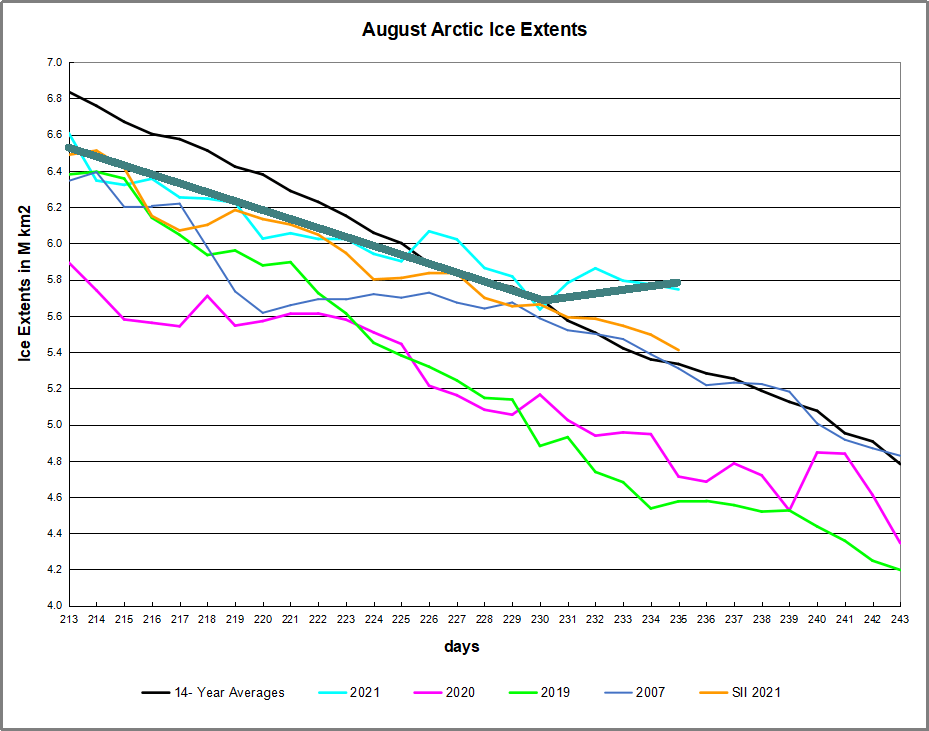
The graph above shows August daily ice extents for 2021 compared to 14 year averages, and some years of note.

The black line shows during this period on average Arctic ice extents decline ~2M km2 from ~6.8M km2 down to ~4.8M km2.  The Hockey Stick shape refers to the 2021 cyan MASIE line starting ~227k km2 below average but matching average by day 230, and in the last five days produced a surplus of 414k km2.  The Sea Ice Index in orange (SII from NOAA) started with the same deficit and also matched MASIE average day 230, but tracking the downward average since.  2019 and 2020 were well below average at this stage of the summer melt.

Why is this important?  All the claims of global climate emergency depend on dangerously higher temperatures, lower sea ice, and rising sea levels.  The lack of additional warming is documented in a post Adios, Global Warming

The lack of acceleration in sea levels along coastlines has been discussed also.  See USCS Warnings of Coastal Flooding

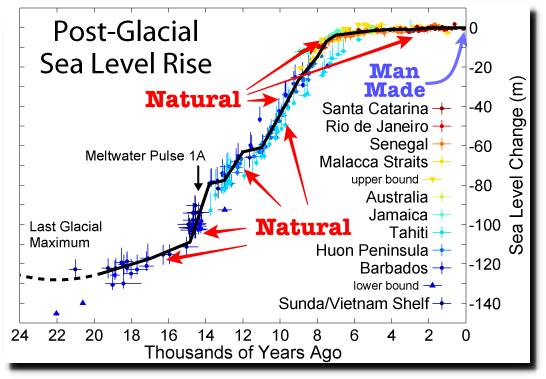
Also, a longer term perspective is informative:

post-glacial_sea_levelThe table below shows the distribution of Sea Ice across the Arctic Regions, on average, this year and 2007.

Region 2021235 Day 235 Average 2021-Ave. 2007235 2021-2007
 (0) Northern_Hemisphere 5745634 5331499 414135 5309870 435765
 (1) Beaufort_Sea 872981 605537 267444 730813 142168
 (2) Chukchi_Sea 539676 329819 209856 178493 361182
 (3) East_Siberian_Sea 508990 445221 63769 63523 445468
 (4) Laptev_Sea 61548 205077 -143529 295384 -233836
 (5) Kara_Sea 136181 58898 77283 155754 -19573
 (6) Barents_Sea 6047 24071 -18025 17998 -11951
 (7) Greenland_Sea 84815 202922 -118108 334622 -249808
 (8) Baffin_Bay_Gulf_of_St._Lawrence 40877 33602 7275 50303 -9426
 (9) Canadian_Archipelago 465781 354257 111524 323329 142452
 (10) Hudson_Bay 64148 35761 28387 61078 3070
 (11) Central_Arctic 2964500 3035379 -70879 3097316 -132816

The overall surplus to average is 414k km2, (8%).  Note large surpluses of ice in BCE (Beaufort, Chukchi and East Siberian seas).  Meanwhile Laptev on the Russian coast melted out early, as has Greenland Sea.  Kara and CAA (Canadian Arctic Archipelago) are holding considerable ice.  We are about a month away from the annual minimum mid September, but at this point it appears that extents will be greater than the last two years.

bathymetric_map_arctic_ocean


Illustration by Eleanor Lutz shows Earth’s seasonal climate changes. If played in full screen, the four corners present views from top, bottom and sides. It is a visual representation of scientific datasets measuring Arctic ice extents.

What’s in a Name? Power.

5a1johntennielhumptydumpty

Johathan Turley writes at The Hill The FBI comes up empty-handed in its search for a Jan. 6 plot. Excerpts in italics with my bolds and images.

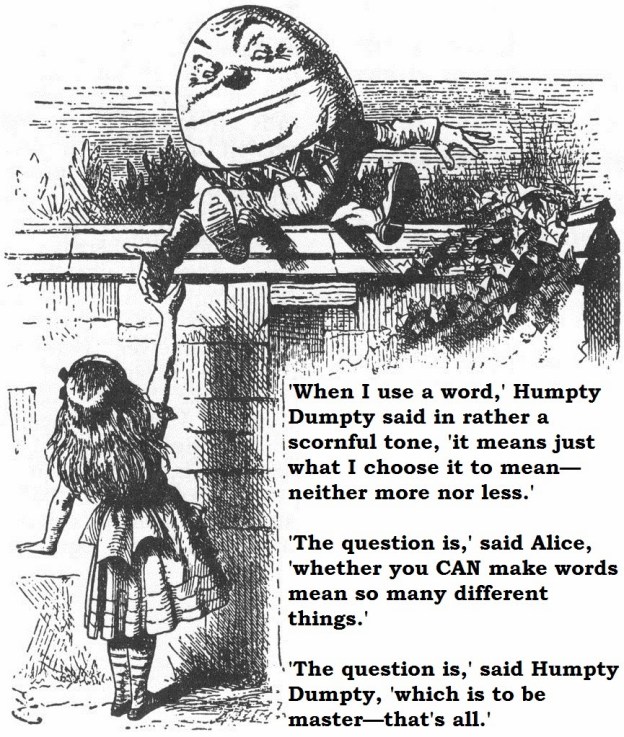
It may be true, as Confucius said, that “the beginning of wisdom is to call things by their proper name,” but it can also be the end of politics. For politicians, labeling controversies is often more important than addressing the controversies themselves. Even well-defined terms used in legislation must change to fit political needs, such as like “infrastructure.” When its real meaning proved too restrictive, Sen. Kirsten Gillibrand (D-N.Y.) simply tweeted, “Paid leave is infrastructure. Child care is infrastructure. Caregiving is infrastructure.” Done.

sbr040921dapr20210409024516

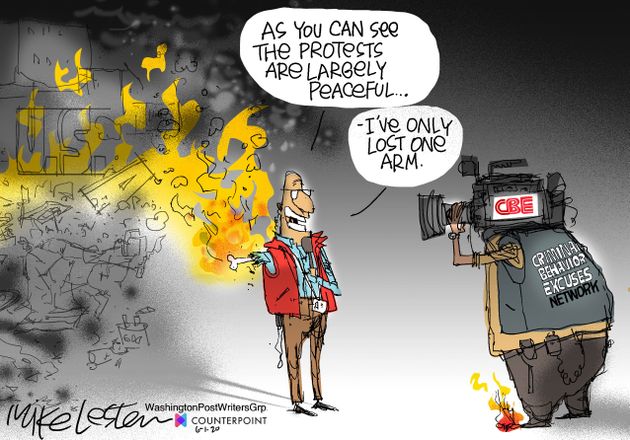
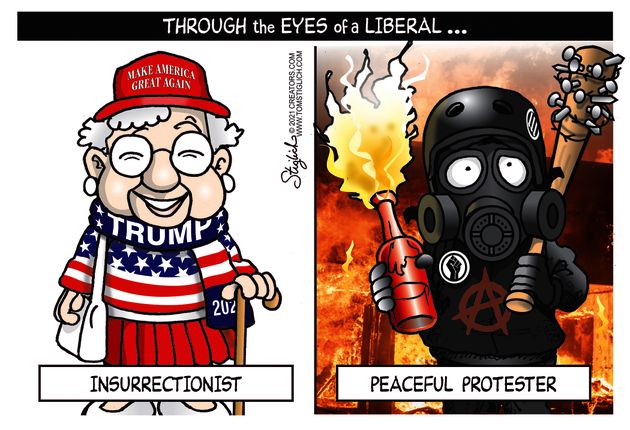
The same is true with labeling political violence. When protests by Black Lives Matter and other groups turned violent last summer, some media employees were expressly told not to refer to “rioters” but rather “protesters.” Riots causing massive property damage were described by CNN as “fiery but mostly peaceful protests.”

mle200601c20200601035617

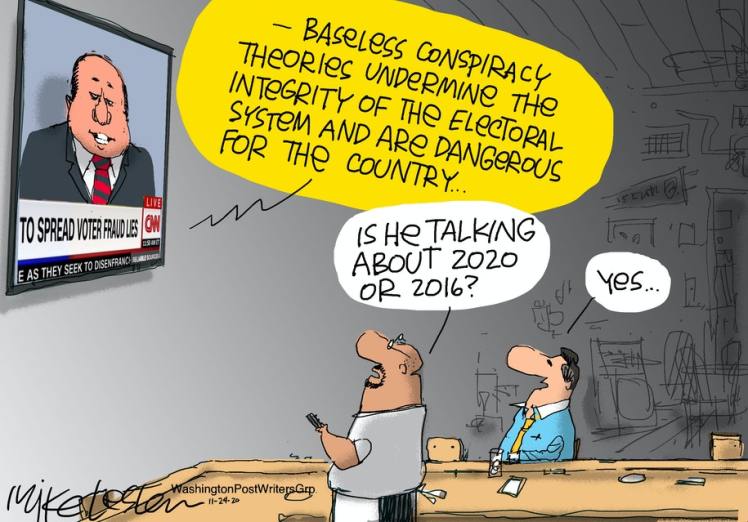
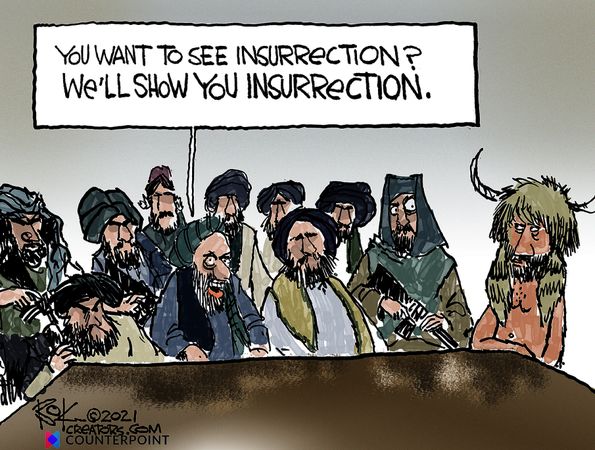
Conversely, the Jan. 6 attack on the Capitol could not be just a riot, let alone a “fiery” protest, but only an “insurrection.” Many in the media continue referring to “the insurrectionists” rather than the rioters. National Public Radio even ran a running account of the “Capitol insurrection.” The term was further driven home by House Democrats by impeaching former President Trump for “incitement to insurrection” despite undermining any chance for an actual conviction. Members of Congress such as Rep. Eric Swalwell (D-Calif.) are still in federal court claiming a conspiracy of “armed and organized insurrectionists.”

The characterization of the attack as an insurrection served myriad political and personal purposes. First, it painted anyone associated with challenging the 2020 election results as supporting sedition and the country’s overthrow. Second, if this was a protest allowed to turn into a riot, there would be more questions about the failure to properly protect the Capitol.

8b424037f1f7ba6306049bbb00dbb8f52051d3d8361bcec421388a60ad31126e

It is easier to excuse a response to an insurrection than a violent protest. That point was expressly made by former U.S. Capitol Police Chief Steven Sund, who insisted, “This was not a demonstration. This was not a failure to plan for a demonstration. This was a planned, coordinated attack on the United States Capitol.”

Despite the adoption of the term by many in the media, there has been a growing disconnect with the actual cases in court. Indeed, a new report from Reuters disclosed that the FBI has apparently struggled to support the account of a coordinated “insurrection” on Jan. 6. Reuters’s FBI sources said that, despite months of intense investigation, they could find “scant evidence” of any “organized plot” and instead found that virtually all of the cases are “one-offs.” One agent explained, “Ninety to 95 percent of these are one-off cases. Then you have 5 percent, maybe, of these militia groups that were more closely organized. But there was no grand scheme with Roger Stone and Alex Jones and all of these people to storm the Capitol and take hostages.”

In other words, they found a protest that became a runaway riot as insufficient security preparations quickly collapsed. While there clearly were those set upon trashing the Capitol, most people were shown milling about in the halls; many took selfies and actively described the scene on social media.

More than 570 people have been arrested, but only 40 face conspiracy charges. Those charges are often based on prior discussions about trying to enter Congress or bringing material to use in the riot; some clearly came prepared for rioting with ropes, chemical irritants and other materials. Those cases, however, are a small group among the hundreds charged and an even smaller percentage among the tens of thousands of protesters on that day.

cb081821dapc20210817054522

After five months of dragnet arrests nationwide, a few reporters have noted that no one was actually charged with insurrection or sedition. The vast majority of people face charges such as simple trespass. For example, the latest guilty plea is from San Francisco real estate broker Jennifer Leigh Ryan, who posted an account on social media of how “we’re gonna go down and storm the capitol.” She pleaded guilty this week to “parading, demonstrating, or picketing in a Capitol building” and faces a maximum sentence of six months in prison and a fine of $5,000.

Yet the characterization of the “insurrection” has continued as a virtual article of faith for those reporting on or writing about Jan. 6. Moreover, the treatment of many has remained severe, if not draconian by design. Justice official Michael Sherwin proudly declared in a television interview that “our office wanted to ensure that there was shock and awe. … It worked because we saw through media posts that people were afraid to come back to D.C. because they’re like, ‘If we go there, we’re gonna get charged.’ … We wanted to take out those individuals that essentially were thumbing their noses at the public for what they did.”

stg071921dapc20210718064517

That “shock and awe” included holding people without bail and imposing “restrictive housing” for no obvious reason. That includes some of the most notable figures from that day, such as Jacob Chansley (aka Jake Angeli), better known as “Chewbacca man” or the “QAnon shaman” for the distinctive horned headdress he wore during the riot. Angeli, 33, is not accused of attacking anyone while parading around the Senate floor in his bear skin. He always insisted he was not trying to overthrow the nation with his decorative outfit and spear-topped flagpole. While the government did not find that he engaged in sedition, it did learn that he has an array of mental illnesses, including transient schizophrenia, bipolar disorder, depression and anxiety. Yet he has been held since the riot and is charged with six crimes, including violent entry, trespass and parading, which collectively could yield up to 28 years in prison.

There is a fair distinction between those who tried to stop the certification of a presidential election and those who burn police stations or businesses during protests.

Yet there remains a striking contrast in how other riots are characterized or prosecuted. Most of those arrested for violent protests after the death of George Floyd saw their charges dropped by state prosecutors. For months, rioters sought to burn federal buildings or occupy state capitals and in some cases seized police stations and sections of cities or even a city hall. They were not declared insurrectionists; they were rioters before being set free after brief arrests.

Many of us remain disgusted and angered by the Jan. 6 riot — but it was a riot. It also was a desecration. These people deserve to be punished, particularly those who went with an intent to try to enter the Congress. The question is whether you can have an insurrection without anyone actually insurrecting. That Zen-like question may find its way into the hearings of some pending cases.

Calling these people “rioters” does not minimize what they did — or undermine the legitimacy of their punishment. However, there is wisdom and even the chance for resolution when we “call things by their proper name.”

Jonathan Turley is the Shapiro Professor of Public Interest Law at George Washington University.

For a tutorial in winning the naming game, see “I am Non-racial”

sk071821dapc20210716084507

Family Doctor’s Plain Advice about Covid Vaccines

Amazing Vax Race

Buzz Hollander MD writes at Real Clear Science Let’s Stop Pretending About the Covid-19 Vaccines.  Excerpts in italics with my bolds and images.

As a family physician, I spend my days dispensing advice. I mean, there’s the occasional cast, skin biopsy, or shot, but most of my patients are seeing me for medical counsel. Never have I been asked about one subject so much as the Covid-19 vaccines, and never have I seen so much doubt and confusion among a group of smart, well-educated people. Interpreting the reality of the effectiveness of these vaccines is complicated: it is waning with time, weakened against delta, unknown when coupled with prior infection, and may not be improved with a booster – but there is new, often murky, data emerging every day. Speaking the truth about the vaccines, however, should not be that hard.

We have to be willing to adapt to new data, even when it does not fit neatly into prior messaging.

That’s where our institutions went astray. I understand the desire of our public health officials, spearheaded by the CDC, to instill confidence in the Covid-19 vaccines; they remain the most expedient path to minimize the suffering inflicted by this pandemic. However, by taking on the role of no-nuance vaccine cheerleaders, they left everyone in a worse situation.

Patients and doctors looking to the CDC for guidance in decision-making receive low quality or dated information. The mainstream media is stuck between reporting public health dictates as valid, while being unable to resist doom-and-gloom reports of vaccine “failures” that sell ad space. The obvious gap between “what the CDC says” and “what we see, hear and read” has left a large space for grifters, self-styled experts, and conspiracy theorists to thrive, especially among the large group of vaccine-hesitant (often vaccine-terrified) Americans. The whole thing might have gone better had we stuck to telling the truth as we knew it.

What follows is the truth about the Covid-19 vaccines, as I see it, from the data in hand right now. It is often inconvenient, especially for someone like me, who preferred the easy days of being a vaccine cheerleader when the initial trial data emerged. Do I still recommend a Covid-19 vaccine for the vast majority of my patients? Yes. It just takes a couple extra minutes to discuss now. Most importantly, if I speak the truth now, my patients will be more inclined to trust me later. So let’s see where we really stand:

Let’s stop pretending the vaccines are 90% effective and breakthrough cases are “uncommon.”

The real world effectiveness of the Moderna and Pfizer (mRNA) vaccines appears to be sinking like a stone. We started at 94+% within 2 months of vaccination and against the original SARS-CoV-2 strain. The Israel Pfizer data roughly confirmed this degree of effectiveness in initial real world studies. But, then… waning happened, and delta happened. Pre-delta, we see that Pfizer final efficacy data from their trials dropped from 97% at two months to 84% by 5-6 months after full vaccination; Moderna, with its higher doses, dipped more modestly to 92%, although we might expect this number to fall soon enough, since Moderna tells us their neutralizing antibodies are sagging by the 6 month point. Unfortunately, the real world data is far more damning.

Right now, we have two widely-cited studies claiming 87-88% effectiveness for Pfizer against symptomatic infection: from Canada and the UK. Both studies, however, ended in May, in countries that spaced their two doses out by 2-3 months, leading to a short window after full vaccination.

What about studies of total infection rates (including asymptomatic infections, so we are a bit apples-to-oranges here) concluding in July in places with only a 3 week lag between Pfizer shots? Qatar: 56%. Mayo Clinic/US: 42%. Israel: 39%. Interestingly, the Qatar (85%) and Mayo (76%) data for Moderna were more positive, and time will tell us more about Moderna’s durability. It’s important to note that real world data is inherently messy – vaccinated people might just be different than their unvaccinated “case controls” in a study – but when the same pattern crops up with different investigators in multiple countries, it’s probably real.

Some of this is likely due to the delta variant’s modest ability to evade immunity. Neutralizing antibody responses among both those with prior infection and vaccination are several fold less to delta than the original SARS-2-CoV strain. However, I suspect the dramatic drop in effectiveness now being seen is a product of this immune evasion being amplified by waning immunity.

The truth here matters. For one, on a personal level, if you went from hiding in your house in March, to cheering on the local hockey team in June after your second Pfizer shot, it’s time to re-assess. Look at the recent UK REACT data: vaccinated people in mid-July were three times less likely than unvaccinated people to test positive for Covid-19. Great. But… they were almost twice as likely to test positive as unvaccinated people did just a month before, in mid-June! If you reduce your odds of infection by a factor of three with vaccination, but increase your risk of exposure by a factor of five, either due to rising prevalence or shifting your behaviors, you’re still more likely to catch a case of Covid-19 than if you had skipped the vaccine and stayed fixed in time. Put simply, regular high-risk exposures to SARS-CoV-2 can overwhelm a very good but imperfect vaccine.

Remarkably, the CDC is still proclaiming that vaccine breakthrough infections are rare – but when normal people hear that their barber, their cousin’s husband, and seemingly half the New York Yankees’ starters have experienced breakthrough infections, they might assume the CDC is lying.

Let’s stop pretending that vaccinated people are far less likely to spread SARS-CoV-2.

We have made pariahs of the unvaccinated as menaces to the public good. Even if this might not be the most effective form of public health messaging, perhaps this made statistical sense, at least, when we believed the mRNA vaccines to reduce all infections (including asymptomatic) by some 90%. Coupled with limited data from a UK study which showed household contacts of someone with a vaccine breakthrough infection were about half as likely to develop covid-19 as contacts of an unvaccinated person who became infected, it was reasonable to estimate that vaccinated people were almost 20 times less likely to transmit SARS-CoV-2 than unvaccinated people. This assumption led to the CDC’s recommendation that vaccinated people could drop their masks.

Unfortunately, the times, they are a-changing. The CDC famously reversed course on masks for the vaccinated. Data has been mixed, but several recent reports suggest the viral loads of those with vaccine breakthrough infections are akin to the unvaccinated. A thorough study from Singapore showed that vaccinated cases dropped their viral load faster — but viral loads were identical in days 1-5, when, logically, we might think most transmission takes place. Lacking a proper household transmission study post-delta, it’s simply not good science to assume the vaccinated spread less Covid-19 once they get infected.

From a societal perspective, is it reasonable to discriminate between the vaccinated and unvaccinated given this data? My second Pfizer shot was 7 months ago. An unvaccinated person without prior immunity is probably now only twice as likely to be infected as I am, but I can walk into a bar in New York City or Paris for a drink, and a VA hospital or Mayo Clinic for work — and they cannot.

Vaccine mandates and vaccine “passports” are often justified as necessary to reduce transmission of contagious diseases, but I don’t think the evidence is adequate at this point to make this claim for the Covid-19 vaccines. The substantial outbreaks in exceptionally well-vaccinated places like Israel, Malta and Vermont make it clear that pushing up vaccination rates does not guarantee control of Covid-19. Of course, the other justification for requiring Covid-19 vaccines is to limit the suffering and strain on society by reducing severe disease. Here, the legal and ethical questions are complex; and we must ask ourselves: is a potentially modest increase in vaccination rates worth the stress vaccine requirements entail?

Let’s stop pretending that it’s rare for vaccinated people to develop severe Covid-19 or die.

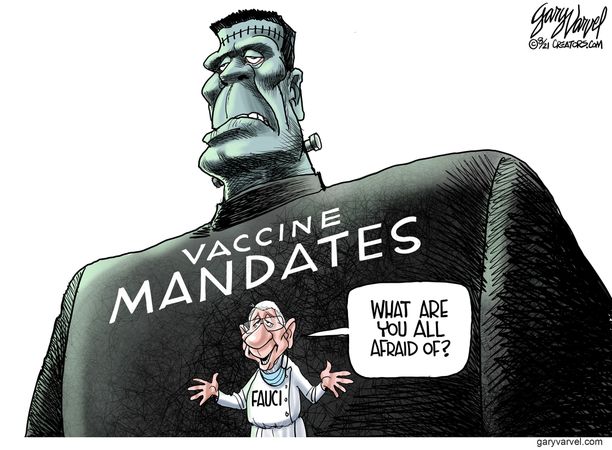
I cringe when I read Dr Anthony Fauci, CDC Director Rochelle Walensky, or Surgeon General Vivek Murthy remind us that 97% of new covid-19 hospitalizations or 99% of covid-19 deaths are among the unvaccinated. I know the message is well-intentioned: “Vaccines will protect you from severe disease, so go get vaccinated!” The problem is when the message is not quite true.

We saw this in the UK, where deaths among the vaccinated went from “rare” to two-thirds of all delta variant deaths by July. We saw this in Israel, where literally no fully vaccinated people died of covid-19 for entire weeks in June, but by August over 60% of the severely ill were fully vaccinated.

This is not evidence of vaccine failure; but those commentators who willfully misunderstand the base rate fallacy like to portray it as such. The reality is that Israel is so heavily vaccinated, especially among the elderly, that severe illnesses and death among the vaccinated will not be “rare” or even “uncommon” during a heavy, high-prevalence wave like they are having now. They will, however, be less common on a per capita basis than among the unvaccinated; about six times less common, as I write this.

Here in the US, there should be no shock value to reports of fully vaccinated people falling gravely ill with Covid-19. No vaccine is perfect, and half our population is fully vaccinated. However, many vaccine cheerleaders helped create an aura of perfection when it came to their touting of the vaccine trials: “Not a single death or hospitalization in the vaccine arms due to Covid-19 in over 75,000 participants!” Even without the arrival of delta and the recognition of waning immunity, no reasonable person would imply that there would be no deaths or hospitalizations once applied to 200 million participants.

From this expectation of bulletproof immunity, much of the public now feels betrayed.

Should they, though? When it comes to preventing severe infection or death, this is the great promise of the vaccines, and the clear basis for why I recommend them to almost all my patients. In all the studies I cited above with worrisome vaccine effectiveness against infection, virtually all still showed 90% or better effectiveness against hospitalization; the Mayo study was the outlier at 75%. So, to the best of our knowledge right now, if you get vaccinated you will be about 10 times less likely to be hospitalized with covid-19!

However, in the interest of truthfulness, there might be one substantial exception to that claim.

Let’s stop pretending that prior infection should not influence the decision to vaccinate.

Much has already been written about the CDC’s willful decision to ignore the relevance of prior infection, as if natural immunity simply did not exist. Most are aware that prior Covid-19 infection allows some degree of protection from future infection, with most studies suggesting this protection is north of 80% relative to someone with no immunity. It also leads to a greater immune response with first vaccination, which, in theory at least, could lead to better long-term protection, but also a higher rate of adverse effects. We are often told to “follow the science.” In this regard, there really is not much “science” to follow to endorse vaccination after infection.

Real world data is mixed; a recent study from Kentucky found two-fold additional protection to those with prior infection after full vaccination, while a larger study from the Cleveland Clinic showed no difference in re-infection rates between vaccinated and unvaccinated health care workers with prior infection.

Fortunately, we do have randomized controlled trial evidence to help shed light on the question. Unlike Johnson&Johnson, both Pfizer and Moderna tracked outcomes in their trials of those who had a history of Covid-19 infection before entering the placebo or vaccine arms. Moderna efficacy could not be evaluated due to having only one case in the placebo arm, while Pfizer showed a very modest 19% vaccine efficacy in the immunized group (vs 95% overall).

So – what does the science say? It says: barring new evidence, there is no clear benefit to immunizing those with confirmed prior infection. Common sense suggests there is a good chance these people would benefit from at least one (and possibly only one) shot as a “booster,” especially after 6 months or more have passed since the time of infection, especially with a more transmissible variant on the loose – but that’s common sense, not good quality data.

As a physician, I do think all but my lowest risk individuals with prior infection would have appreciable benefit from a single man-made “booster,” especially if they did not show evidence of antibodies, given the fairly robust correlation between a negative antibody test and risk of infection. However, I would not push if a previously infected patient opted to pass. As a citizen, I find it troubling that someone with prior infection could face an employer mandate to undergo vaccination against their will, given the slender evidence available.

Since we’re wading into divisive waters now, let’s dig into an even more charged subject: kids and vaccines.

Let’s stop pretending that the vaccines are a no-brainer for adolescents and children.

We parents are a sensitive bunch. Throw politics and heaps of fear-mongering into the equation, and talk of required vaccinations for school or sports quickly turns the volume up to 11. Lost in the noise, though, is that once again, evidence-based science is lacking that universal vaccination is appropriate for kids.

Virtually every American by now knows that Covid-19 severity drops with age. What no one knows is how well a Pfizer vaccine given to an adolescent today will reduce transmission by winter, and the adult data already discussed is concerning. So, are mostly left considering whether the risks of covid-19 to the lowest risk segment of our population outweigh the risks of the vaccine (and future boosters).

Just as no vaccine is perfectly effective, no vaccine is perfectly safe. The world has watched the adenovirus vector vaccines (AstraZeneca and Jansen/J&J) lead to serious thrombosis events mostly in younger women, and the mRNA vaccines trigger myocarditis mostly in younger men, roughly in the 1/10,000-20,000 range. To clarify: not 1%, not 0.1%, but <0.01%. These adverse reactions need to be acknowledged openly, however, as they are terrifying, and lead to chilling newspaper headlines and social media posts that make the possibility seem very real for your own child.

I explain the numbers to concerned parents like this: about 35 per 100,000 kids <18 in the US required hospitalization with Covid-19 in the first year of the pandemic. Even if half those hospitalizations truly were “with” and not “because of” Covid-19, that is still around 1 in 5-6000 of every American under 18. Could we be missing so much myocarditis, thrombosis, and whatever other vaccine-triggered illnesses are severe enough to lead to hospitalization, that the risk from vaccination could actually exceed the disease? It certainly seems unlikely, although that has not stopped some from twisting data to make this claim.

I also observe that these Covid-19 hospitalization rates are unlikely to stay this low, given the arrival of delta and it’s markedly higher transmission rates. What’s more, this calculation neglects the real concern for persistent disease from a covid-19 infection, aka “long covid,” which appears, very roughly, to affect somewhere in the 2-10% range of infected kids.

We must allow for some very small chance the mRNA vaccines will be the first vaccines in history to have a hidden adverse effect we missed in their first eight months of study. However, we must also allow for the chance that the virus itself might have some yet-unknown future harm, like the ability of Human Papilloma Virus and Epstein-Barr Virus to trigger certain cancers later in life.

All in all, I do think honest consideration of risk and benefit favors kids getting the Pfizer vaccine, and especially those with risk factors like obesity, asthma or diabetes, who make up the majority of hospitalized children. However, I think it’s important to remember that we are talking about 0.05%-type risks of serious disease versus 0.01%-type risks of severe vaccine reactions here – slim margins of benefit versus harm. I would rather the trial for the 12-15 year old age group had been larger than 1131 subjects in the vaccine arm to help us quantify those risks better.

A rational parent — especially the parent of a healthy boy, given the far higher rates of myocarditis in boys with the mRNA vaccines — could decide against giving their child the Pfizer vaccine, especially given the utter lack of certainty as to how soon and how often boosters will be required. Sensibly, I think, the UK took this approach: optional for those over 15, recommended for those 12-15 only with immunocompromised health status or high-risk family members, and gathering evidence for future decisions. My home state of Hawaii is taking rather the opposite approach, in mandating vaccination for all student-athletes. This is the unfortunate playbook for how to maximize vaccination in the lowest risk population group (athletes) half of whom are at the highest risk for requiring hospitalization for vaccine-mediated myocarditis (high school boys).

I don’t want to appear dismissive about the potential importance of vaccination for kids. While pediatric cases are rising and still roughly only half their prior peak levels from January, hospitalizations are already approaching that January peak, and we hear reports of pediatric ICUs filling, especially those under the strain of the current high rates of serious RSV cases. However, sometimes “do everything possible” is not the best long-game response to a short-term crisis. I question whether the reward of adolescent vaccination is so great and conclusively demonstrated that we should shame parents opting against this vaccine, or take schooling options away from their children.

Let’s stop pretending that a third booster is definitely going to help.

With recent approval for booster doses for the immunocompromised, they are today’s hot topic. While I am asked many questions about them, the truth is: I don’t have many answers. Pfizer has finally started a trial in in the past few weeks with 10,000 prior vaccine recipients. Once we get that data, perhaps in just a few months, we will move out of the theoretical realm.

Right now, theories are all we have. Perhaps one more dose of the original vaccine, by boosting overall antibodies, will help fight off the large infectious doses of delta. Or perhaps, by only stimulating the same imperfect antibodies, it won’t. Maybe the delta-specific boosters Pfizer and Moderna are developing will be ready for arms before the next variant arrives — and maybe not. Maybe we find new adverse effects with repeat doses of boosters. Maybe the extra protection lasts 4 months, or maybe years. Little is clear now.

Given their muted responses, on average, to their initial vaccine doses, the immunocompromised are most likely to benefit, and the most obvious candidates for a booster. Again though, this is based on laboratory studies of improved immune response, not actual trial data. As to the rest of us, I suspect the benefit will be modest, and/or quite possibly fleeting (remember, our annual flu shot’s efficacy fades about 10% per month, too). Until we see more definitive evidence that protection against severe disease truly is waning, I will be reluctant to recommend a booster except for my highest risk patients.

Let’s stop pretending that these vaccines are “kill-shots,” cause sterility, spread disease, etc.

Obviously, this is not directed at the public health community, but rather those who have built their social media brand by alarming the masses about the covid-19 vaccines. Everyone should have the right to raise their doubts and concerns about a new medical intervention. However, it is an abuse of that right to cherry-pick or deliberately misrepresent data while pretending to be impartial, or to sensationalize case reports without giving their context, with the sole purpose of breeding fear.

I try to read everything my patients and friends send me from these misinformers. They sprinkle into their missives bits and pieces of truth — generally the bits and pieces the CDC and WHO failed to mention — which lend them currency with their followers as “the only ones telling it like it is.” They don’t help their followers make rational decisions about vaccination, unfortunately.

Let’s stop pretending that the vaccines are the only way to reduce the burden of Covid-19.

No, I am not going to talk about Ivermectin here, having already said more than enough on the subject elsewhere. Our federal fascination with vaccination, however, has led to a frustrating lack of definitive research into potential treatments for covid-19, especially early in the disease course. We know HCQ failed; and that Regeneron’s monoclonal antibody treatments appear effective but are hard to access, costly and untested against delta; and that remdesivir only works a bit, and dexamethasone a bit more, but only for the very ill. Whatever happened to colchicine, famotidine, inhaled steroids, quercetin, fluvoxamine, and all the other potential agents which had an appealing study or two but never a large, definitive RCT? Perhaps a small diversion of some of the billions spent on vaccines could have led to an actual, evidence-based recommendation for physicians like me after our patients have a Covid-19 exposure or positive test. We literally have no CDC/NIH-endorsed treatments to offer that do not involve a trip to the hospital.

It’s also time to get real about obesity in this country. The US has an obesity rate of 36%, highest among “large” nations; for comparison sake, European nations generally fall in the 20-25% range, and Japan, South Korea, and China are all under 7%. At what point in the “pandemic era” does this become a national security risk? Studies of overweight/obesity on covid-19 hospital and ICU admissions suggest a 2- to 5-fold increased risk for the obese. That makes a normal BMI about a 65-85% effective “vaccine” against severe infection – one that keeps people out of the hospital from a variety of diseases, including the flu, and probably the next pandemic virus. Approaches to slimming down Americans come in many shapes and sizes, from Blue Zones concepts to soda taxes – which could be extended to all sweetened, calorie-dense processed and fast foods.

This pandemic has been an utter disaster. The next one might be worse. Bolstering our national capacity to fight off viruses would be a wise investment.

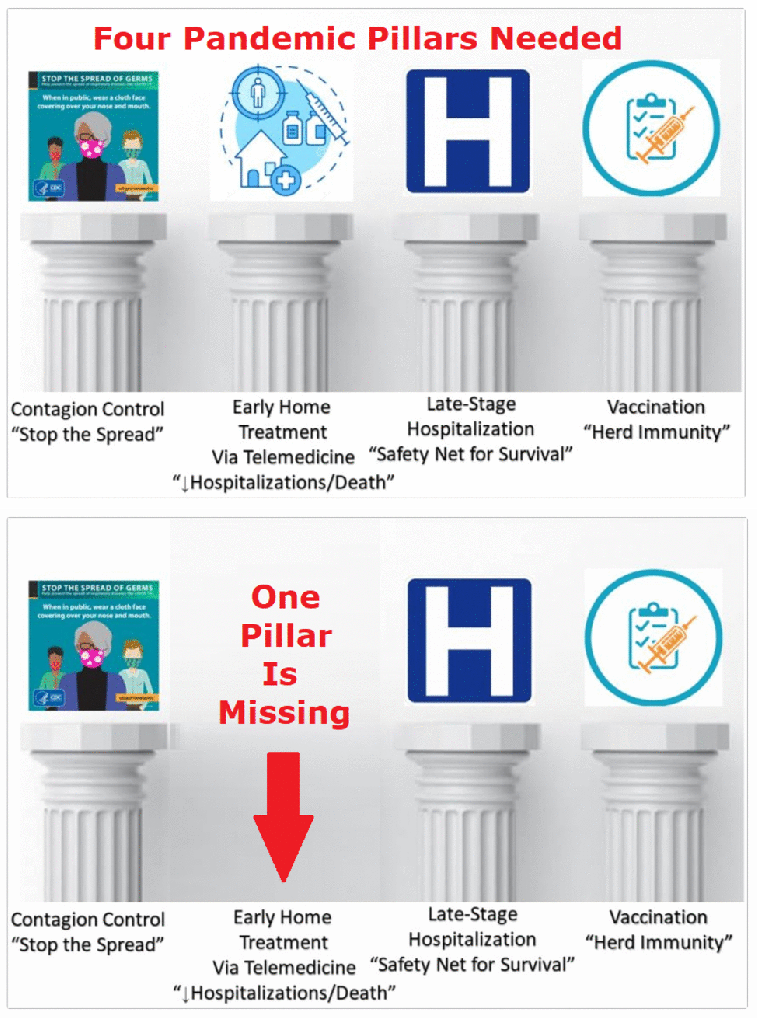
[My Comment:  Hollander’s statement about HCQ is incomplete and thus misleading.  “We know HCQ failed when given as a last resort to Covid patients on their death beds.” (There, Fixed.)  No anti-viral works at that stage.  Treatment with HCQ or Ivermectin is very effective early after infection to prevent a viral load able to cause severe illness.  See Yes, HCQ Works Against Covid19 and Ivermectin Invictus: The Unsung Covid Victor    Let’s stop pretending there are no effective early home treatments against Covid-19]

And, finally, let’s stop pretending that vaccines alone will bring an end to Covid-19.

Predictions have largely been useless in this pandemic. However, some basic principles are likely to hold true. We do not get to go back to alpha or the original strain of SARS-CoV-2; we are stuck with delta, likely until a variant even more transmissible mutates along and outcompetes it. That next variant will not have much evolutionary pressure to be either more or less severe; but imagining a variant able to spread even more rapidly than delta is dispiriting enough.

As more and more people gain immunity from infection and vaccination, there will be more pressure for SARS-CoV-2 to find its next host by evading immune defenses. It’s not hard to envision an eternal cat-and-mouse game in which reinfections are a commonplace event for all of us, and trying to avoid them will involve either a cycle of ever-shifting boosters, or acceptance that most 3rd, 4th or 5th SARS-CoV-2 infections will be mild enough to deal with.

The inconvenient truth is that neither natural immunity nor vaccines are likely to protect well enough, long enough, to shift this disease from pandemic to endemic and have it look the way most of us would prefer: partying like it’s 2019, and free of worry about hospital capacity. That, unfortunately, is probably a fantasy in the immediate future. So, too, is the idea that if we could only convince a few more stubborn vaccine hold-outs to get one set of shots that this will all be over and New Zealand can open its borders.

No, the way forward is going to be choppier than that. The “Covid long game” will involve uncertainty, surprises, and many hard choices, both for individuals and society as a whole. I hope we can be honest with ourselves as we make them.

Buzz Hollander MD is a family physician on the Big Island of Hawaii with no ideological axes to grind. He tweets @buzzhollandermd.

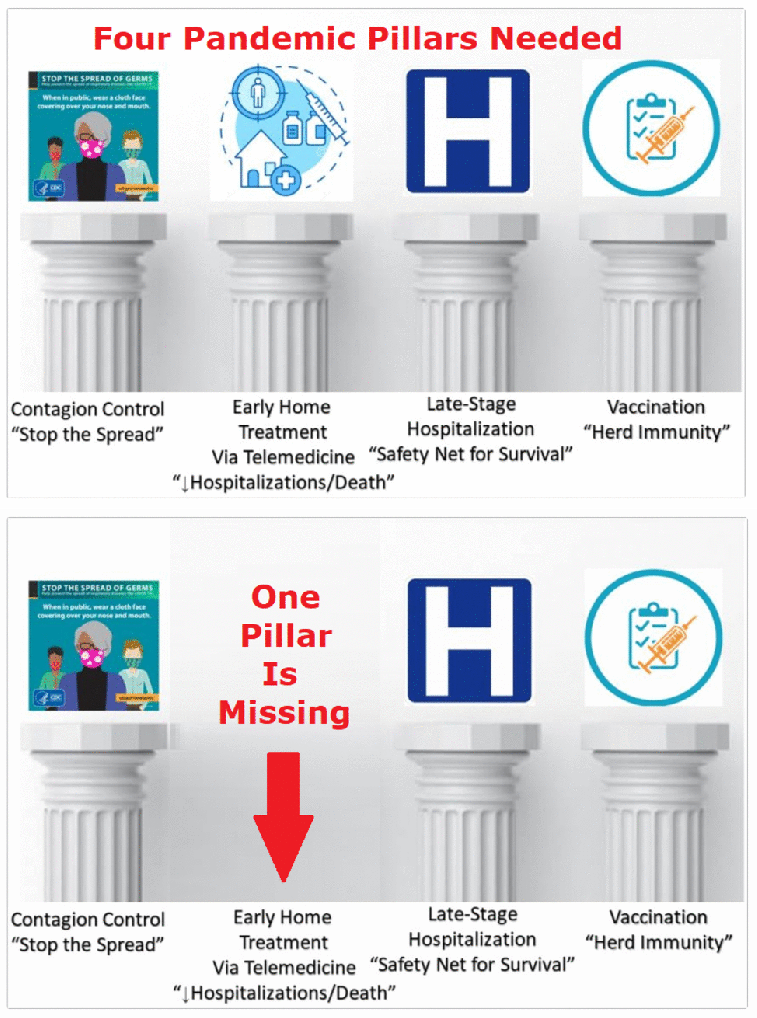
pillars-needed-missing-1

Protocols with HCQ or Ivermectin plus nutritional supplements fill the need for early home treatment

Biden Plan for Pharma Profit Booster Shots a Bad Idea, Scientists Say

50a56897-facd-4169-9150-81826146c845

The politics and profits of the covic booster shot promotion is summarized by Tyler Durden at zerohedge in an article.  Excerpts in italics with my bolds.

“The Scientific Process Is Short-Circuited By Politics” – Startling Admission From Scientists Jeopardizes Biden’s Boosters

Dr. Anthony Fauci and his colleagues on President Biden’s panel of White House COVID advisors spend a lot of time talking about “the science”, but as the delta variant has spread across the US, most of their recent policymaking has been more focused on creating the illusion of safety: Like demanding everybody in the country get vaccinated when studies show natural antibodies already offer protection, while new evidence continues to emerge about dangerous side effects associated with the jabs (especially the mRNA jabs).

But apparently, the Biden Administration’s decision to do a complete 180 on approving a third booster jab, pushing them not just on the most vulnerable, but on every American, like they did with the first round of jabs, has finally prompted mainstream scientists in the field of epidemiology to speak up. Yesterday, we shared details from a Reuters report where several scientists questioned the societal benefits of doling out booster shots to Americans before most people in the emerging world have even had time to get one.

The Reuters report is Scientists question evidence behind U.S. COVID-19 booster shot drive.  Quotes below in italics.

“Endorsing boosters before FDA changes the EUA or grants full approval is actually endorsing something that is not currently permissible under the law,” said Holly Fernandez Lynch, a University of Pennsylvania bioethicist. “Any use beyond the specific terms of the EUA would be unauthorized.”

It would be very strange for the Biden administration to be the one calling the shots on boosters, according to Dorit Reiss, a professor who studies vaccine policy at the University of California Hastings College of the Law.  “This is not something that’s generally done by the administration or by political actors,” Reiss said. “If they are going to circumvent the process, then I’m very concerned.”

Stephen Hahn, who served under President Trump as FDA last commissioner, said that data on the vaccine boosters should decide who should get one, and that it’s possible that may not be immediately available for all populations.

While the Biden administration could be right to offer boosters widely, there isn’t enough convincing data to suggest that everyone needs one, according Michael Osterholm, a University of Minnesota epidemiologist and former Biden adviser. The concern of waning immunity is associated with the elderly and immunocompromised, he said.  “This isn’t about yes or no,” Osterholm said. “It’s about whether we need this for everyone.”

gv081621dapr20210816054503

Durden continues:

Well, as it turns out, one day later, Bloomberg has followed up with a similar report quoting a different group of scientists and their reservations about Biden’s plan. And for the first time, it seems that the growing pushback from the scientific community might derail the Biden Administration’s push for booster jabs (which, remember, is contingent on the FDA giving its blessing).

It’s possible the backlash could even delay (or derail) approval of the vaccines, especially as new data about side effects continues to emerge.

Because Bloomberg has learned that a meeting of CDC advisors to discuss the benefits of booster jabs – a meeting that was supposed to have taken place last week – has been postponed until Aug. 30. Meanwhile, new reports have emerged suggesting the FDA could fully approve the Moderna and Pfizer jabs as soon as Monday.  But one scientist warned that it’s starting to feel like the Biden Administration’s political priorities have been “short circuited” by political concerns.

“This is what is really concerning to many of us,” said Celine Gounder, an infectious disease specialist at Bellevue Hospital in New York. “Because it feels like the scientific process is being short circuited by political concerns… It is almost science by popular demand.”

The problem is that the meeting of CDC advisors includes many voices who haven’t already been working closely with the Administration…and are thus less likely to simply go along with their plans. As another scientist pointed out, doling out booster jabs might ultimately be self-defeating. “The math doesn’t work,” they added.

While the U.S. has vaccinated just over half its population, the virus has been gaining in infectiousness. The two trends essentially cancel one another out, putting the country’s virus control efforts back to where they were in March 2020, according to Ellie Murray, a Boston University School of Public Health epidemiologist who said she has reviewed the data and is skeptical of the current need for boosters. 

“From a population level it, it doesn’t help us in controlling the pandemic,” she said. “The math doesn’t work.”

Another scientist added that doling out booster jabs likely won’t make much of a difference in states where vaccination levels are already low.

“If we give everybody third doses now,” he said, “Mississippi will still be hellish.”

Then there is the question of what is really behind the waning efficacy seen in some studies: Several other factors besides declining immunity over time may be driving the change. For example, the delta variant itself may reduce vaccine protection against mild disease, as it multiplies in the nose much faster, even as protection remains strong against severe disease.

Changes in public behavior and the opening of society may have exposed more people to higher doses of virus. And some people who got vaccinated early on, such as health-care workers, may be more likely to have heavier viral exposures through their jobs, further muddling comparisons.

“My worry is that all a booster might do is just prevent asymptomatic or mild symptomatic breakthrough cases in people whose immune systems would get the disease under control in a few days anyway,” said Jeffrey Morris, a biostatistician at the University of Pennsylvania’s Perelman School of Medicine, “thus not affecting health outcomes in a meaningful way.”

And as more studies show a decline in vaccine efficacy, some scientists are questioning whether the issue is actually related to the vaccines themselves, or changes in behavior, like going out more.

Ultimately, the takeaway is this: resistance to President Biden’s booster jab push is building. We wouldn’t be surprised to see the FDA scuttle it entirely, knocking the wind out of Pfizer and Moderna, which have already promised their shareholders blockbuster profits on the back of more federally mandated jabs.

graph_showing_rise_in_profit-8955

Reality Check on Extreme Weather Claims

heat-dome-graphic

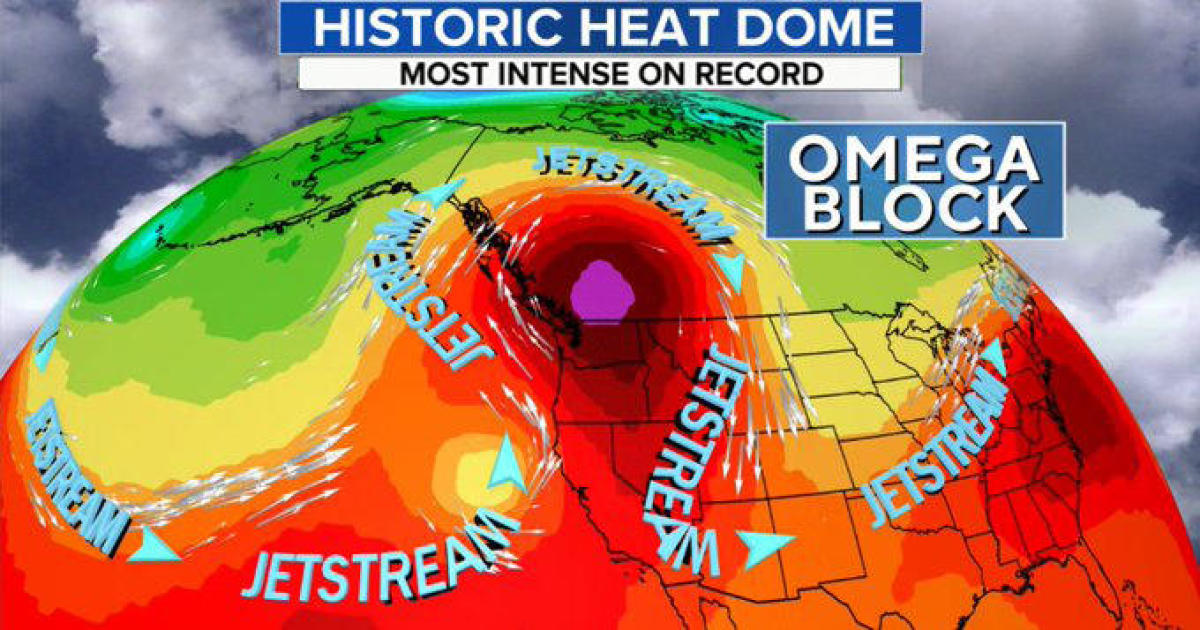
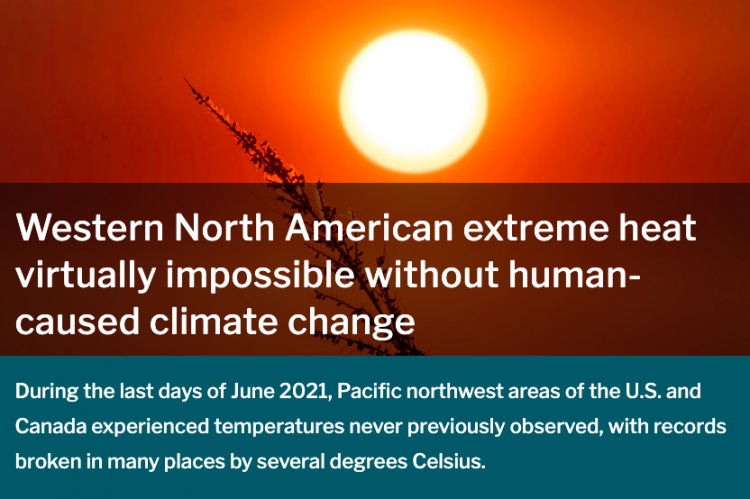
CBS News headline was:  ‘Pacific Northwest heat wave would have been “virtually impossible” without climate change, experts say.’

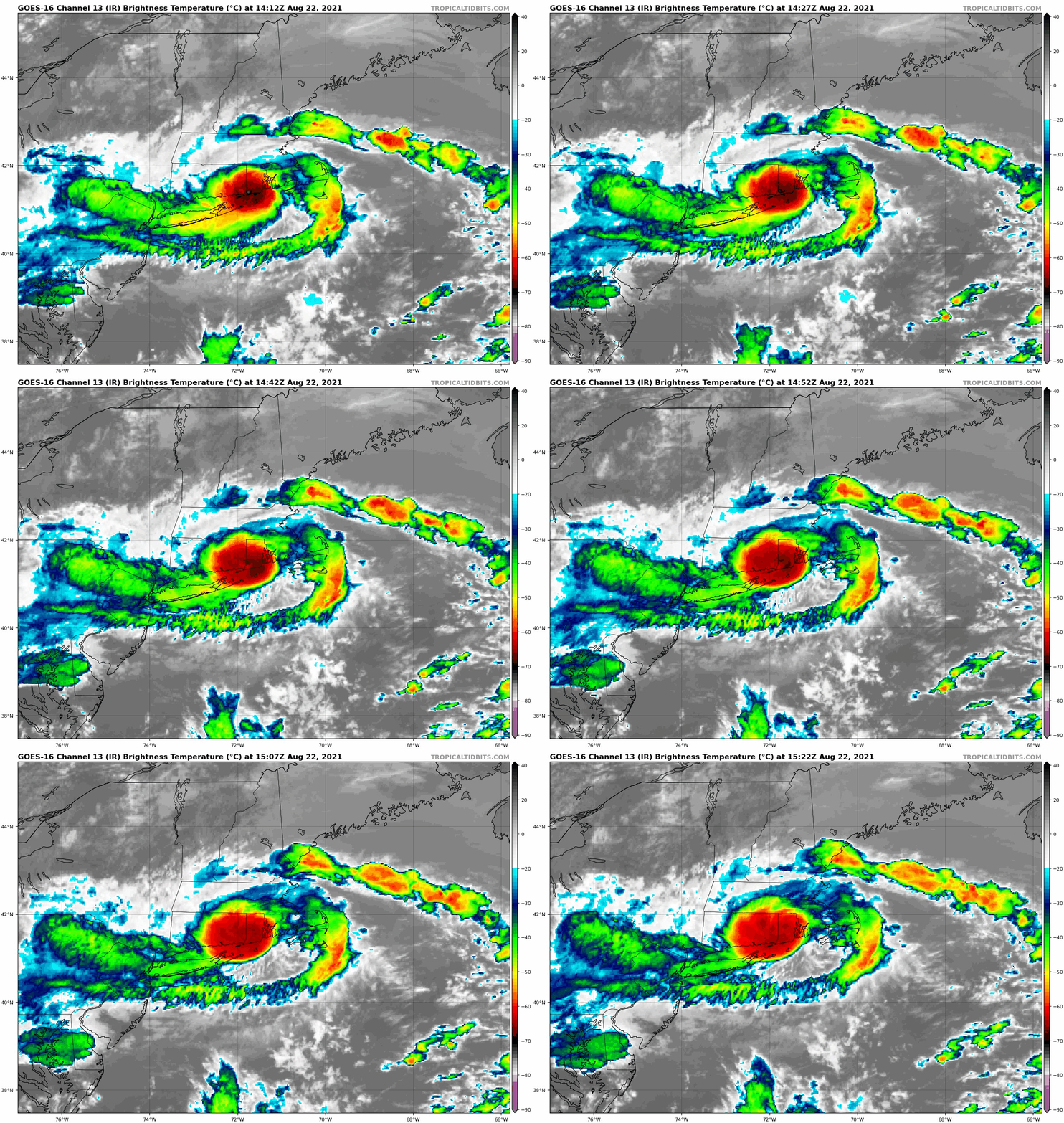
Eric Felton provides a useful reprise of the campaign to exploit a recent Washington State heat wave for climate hysteria mongering.  His article at Real Clear Investigations is Does Climate Change Cause Extreme Weather Now? Here’s a Scorcher of a Reality Check.  This discussion is timely since you can soon expect an inundation of hype saying our SUVs caused whatever damage is done by Hurricane (or Tropical Storm) Henri, shown below approaching Long Island and New England. Excerpts from Felton’s article are below in italics with my bolds.

Henri 20210822

The Pacific Northwest was hit with a record-shattering heat wave in June, with temperatures over 35 degrees higher than normal in some places. On June 28, Portland, Ore., reached 116 degrees. Late last week the region suffered another blast of hot weather, with a high in Portland of 103 degrees. The New York Times didn’t hesitate to pronounce the region’s bouts of extreme weather proof that the climate wasn’t just changing, but catastrophically so.

To make that claim, the Times relied on a “consortium of climate experts” that calls itself World Weather Attribution, a group organized not just to attribute extreme weather events to climate change, but to do so quickly. Within days of the June heat wave, the researchers released an analysis, declaring that the torrid spell “was virtually impossible without human-caused climate change.”

World Weather Attribution and its alarming report were trumpeted by Time magazine, touted by the NOAA website Climate.gov , and featured by CBS News, CNBC, Scientific American, CNN, the Washington Post, USAToday, and the New York Times, among others.

The group’s claim that global warming was to blame was perhaps less significant than the speed with which that conclusion was provided to the media. Previous efforts to tie extreme weather events to climate change hadn’t had the impact scientists had hoped for, according to Time, because it “wasn’t producing results fast enough to get attention from people outside the climate science world.”

“Being able to confidently say that a given weather disaster was caused by climate change while said event still has the world’s attention,” Time explained, approvingly, “can be an enormously useful tool to convince leaders, lawmakers and others that climate change is a threat that must be addressed.” In other words, the value of rapid attribution is primarily political, not scientific.

550856_5_

World Weather Attribution was organized to quickly attribute extreme weather events to climate change.  World Weather Attribution

Inconveniently for World Weather Attribution, an atmospheric scientist with extensive knowledge of the Pacific Northwest climate was actively running weather models that accurately predicted the heatwave. Cliff Mass rejected the notion that global warming was to blame for the scorching temperatures. He calculated that global warming might have been responsible for two degrees of the near 40-degree anomaly. With or without climate change, Mass wrote, the region “still would have experienced the most severe heat wave of the past century.”

Mass has no shortage of credentials relevant to the issue: A professor of atmospheric sciences at the University of Washington, he is author of the book “The Weather of the Pacific Northwest.”

Mass took on the World Weather Attribution group directly: “Unfortunately, there are serious flaws in their approach.” According to Mass, the heatwave was the result of “natural variability.” The models being used by the international group lacked the “resolution to correctly simulate critical intense, local precipitation features,” and “they generally use unrealistic greenhouse gas emissions.”

WWA issued a “rebuttal” calling Mass’ criticisms “misleading and incorrect.” But the gauntlet thrown down by Mass did seem to affect WWA’s confidence in its claims. The group, which had originally declared the heatwave would have been “virtually impossible without human-caused climate change,” altered its tone. In subsequent public statements, it emphasized that it had merely been making “best estimates” and had presented them “with the appropriate caveats and uncertainties.” Scientists with the attribution group did not respond to questions about Mass’s criticisms posed by RealClearInvestigations.

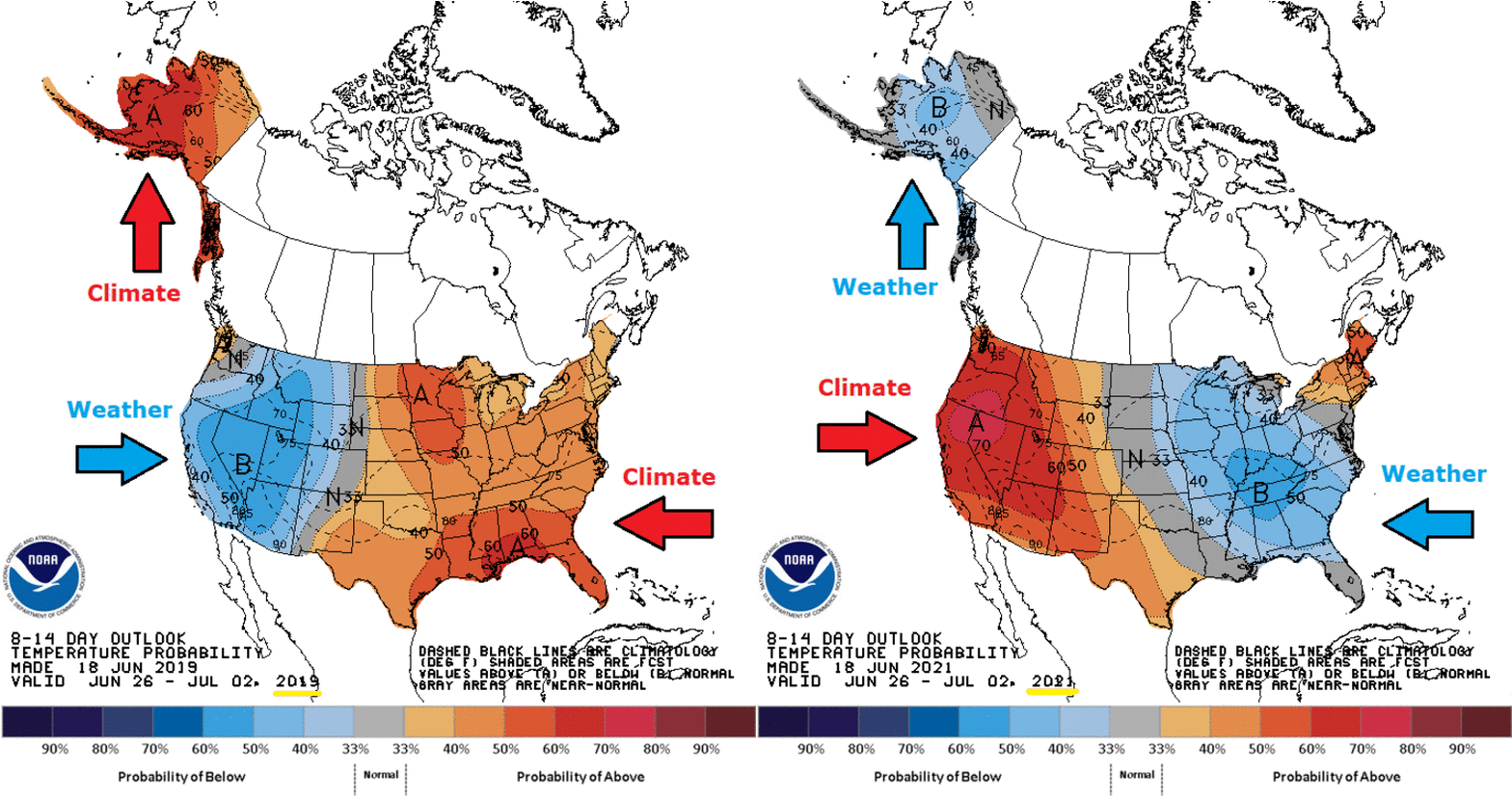
But what of the group’s basic mission, the attribution of individual weather events to climate change? Hasn’t it been a fundamental rule of discussing extreme temperatures in a given place not to conflate weather with climate? Weather, it is regularly pointed out, refers to conditions during a short time in a limited area; climate is said to describe longer-term atmospheric patterns over large areas.

Until recently, at least, climate scientists long warned against using individual weather events to ponder the existence or otherwise of global warming. Typically, that argument is used to respond to those who might argue a spate of extreme cold is reason to doubt the planet is warming. Using individual weather events to say anything about the climate is “dangerous nonsense,” the New Scientist warned a decade ago.

noaa-us-temp-2019-2021

Perhaps, but it happens all the time now that climate advocates have found it to be an effective tool. In 2019, The Associated Press-NORC Center for Public Affairs Research and the Energy Policy Institute at the University of Chicago found that three-fourths of those polled said their views about climate change had been shaped by extreme weather events. Leah Sprain, in the book “Ethics and Practice in Science Communication,” says that even though it may be legitimate to make the broad claim that climate change “may result in future extreme weather,” when one tries “arguing weather patterns were caused by climate change, things get dicey.” Which creates a tension: “For some communicators, the ultimate goal – mobilizing political action – warrants rhetorical use of extreme weather events.” But that makes scientists nervous, Sprain writes, because “misrepresenting science will undermine the credibility of arguments for climate change.”

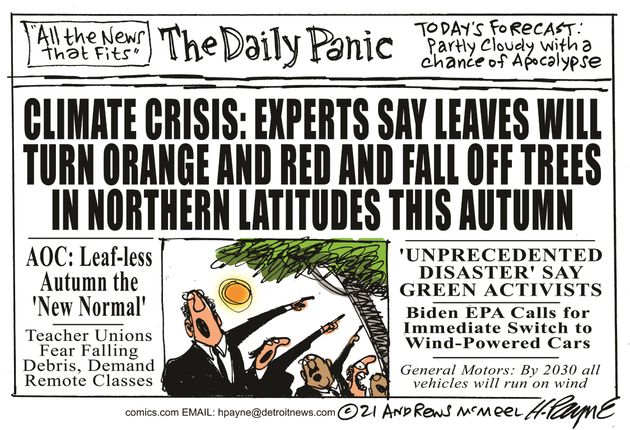
Which is exactly what happened with the World Weather Attribution group, according to Mass: “Many of the climate attribution studies are resulting in headlines that are deceptive and result in people coming to incorrect conclusions about the relative roles of global warming and natural variability in current extreme weather,” he wrote at his blog. “Scary headlines and apocalyptic attribution studies needlessly provoke fear.”

The blogging professor laments that atmospheric sciences have been “poisoned” by politics. “It’s damaged climate science,” he told RCI.

payn_c18450120210819120100

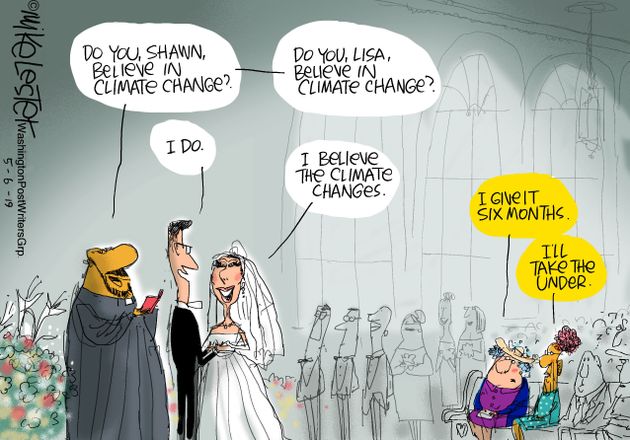
And not just politics – Mass also says that the accepted tenets of global warming have become a sort of religion. Consider the language used, he says, such as the question of whether one “believes” in anthropogenic climate change. “You don’t believe in gravity,” he says. The religious metaphor also explains why colleagues get so bent out of shape with him, Mass says: “There’s nothing worse than an apostate priest.”

That goes even for those who are merely mild apostates. Mass doesn’t dispute warming, he merely questions how big a problem it is. “We need to worry about climate change,” he has said. “But hype and exaggeration of its impacts only undermine the potential for effective action.”

mle190506c20190506011552

July 2021 Oceans Warm Slightly


The best context for understanding decadal temperature changes comes from the world’s sea surface temperatures (SST), for several reasons:

  • The ocean covers 71% of the globe and drives average temperatures;
  • SSTs have a constant water content, (unlike air temperatures), so give a better reading of heat content variations;
  • A major El Nino was the dominant climate feature in recent years.

HadSST is generally regarded as the best of the global SST data sets, and so the temperature story here comes from that source, the latest version being HadSST3.  More on what distinguishes HadSST3 from other SST products at the end.

The Current Context

The year end report below showed 2020 rapidly cooling in all regions.  The anomalies then continued to drop sharply well below the mean since 1995.  This Global Cooling was also evident in the UAH Land and Ocean air temperatures ( See Adios, Global Warming)

The chart below shows SST monthly anomalies as reported in HadSST3 starting in 2015 through July 2021. After three straight Spring 2020 months of cooling led by the tropics and SH, NH spiked in the summer, along with smaller bumps elsewhere.  Then temps everywhere dropped the last six months, hitting bottom in February 2021.  All regions were well below the Global Mean since 2015, matching the cold of 2018, and lower than January 2015. Then the spring brought more temperate waters and a return to the mean anomaly since 2015.  June Global SST anomaly cooled off back to April due to dropping temps in SH and the Tropics. Now in July warming in all regions reversed the June cooling and brought the Global temp anomaly slightly above the mean since 2015.

Hadsst072021A global cooling pattern is seen clearly in the Tropics since its peak in 2016, joined by NH and SH cycling downward since 2016.  
Note that higher temps in 2015 and 2016 were first of all due to a sharp rise in Tropical SST, beginning in March 2015, peaking in January 2016, and steadily declining back below its beginning level. Secondly, the Northern Hemisphere added three bumps on the shoulders of Tropical warming, with peaks in August of each year.  A fourth NH bump was lower and peaked in September 2018.  As noted above, a fifth peak in August 2019 and a sixth August 2020 exceeded the four previous upward bumps in NH.

In 2019 all regions had been converging to reach nearly the same value in April.  Then  NH rose exceptionally by almost 0.5C over the four summer months, in August 2019 exceeding previous summer peaks in NH since 2015.  In the 4 succeeding months, that warm NH pulse reversed sharply. Then again NH temps warmed to a 2020 summer peak, matching 2019.  This has now been reversed with all regions pulling the Global anomaly downward sharply, tempered by warming this year in March to May.  June dropped below the global mean anomaly since 2015, and July has reversed that.

Note that in previous years the global release of heat was not dramatic, due to the Southern Hemisphere offsetting the Northern one. However, in 2021 the warming pattern appears in all regions, resulting in a return from cooling to the mean.  The typical NH summer pulse at this point resembles 2017 rather than the much warmer 2019 and 2020.

A longer view of SSTs

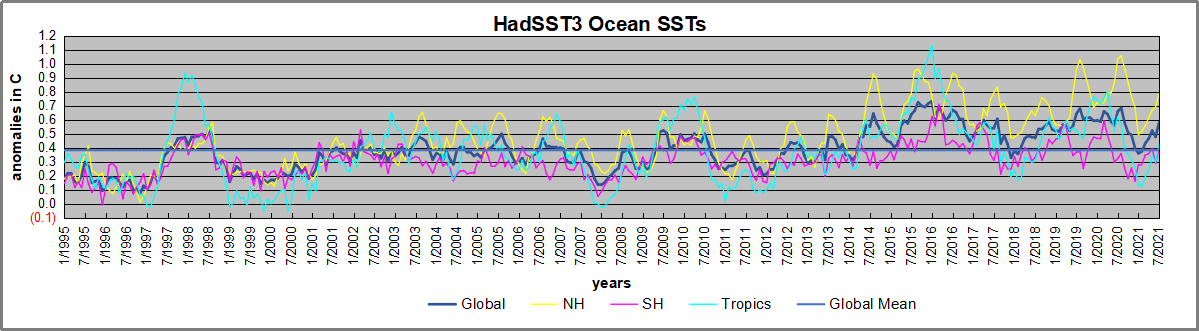
The graph below  is noisy, but the density is needed to see the seasonal patterns in the oceanic fluctuations.  Previous posts focused on the rise and fall of the last El Nino starting in 2015.  This post adds a longer view, encompassing the significant 1998 El Nino and since.  The color schemes are retained for Global, Tropics, NH and SH anomalies.  Despite the longer time frame, I have kept the monthly data (rather than yearly averages) because of interesting shifts between January and July.

Hadsst1995 to 0720211995 is a reasonable (ENSO neutral) starting point prior to the first El Nino.  The sharp Tropical rise peaking in 1998 is dominant in the record, starting Jan. ’97 to pull up SSTs uniformly before returning to the same level Jan. ’99.  For the next 2 years, the Tropics stayed down, and the world’s oceans held steady around 0.2C above 1961 to 1990 average.
Then comes a steady rise over two years to a lesser peak Jan. 2003, but again uniformly pulling all oceans up around 0.4C.  Something changes at this point, with more hemispheric divergence than before. Over the 4 years until Jan 2007, the Tropics go through ups and downs, NH a series of ups and SH mostly downs.  As a result the Global average fluctuates around that same 0.4C, which also turns out to be the average for the entire record since 1995.

2007 stands out with a sharp drop in temperatures so that Jan.08 matches the low in Jan. ’99, but starting from a lower high. The oceans all decline as well, until temps build peaking in 2010.

Now again a different pattern appears.  The Tropics cool sharply to Jan 11, then rise steadily for 4 years to Jan 15, at which point the most recent major El Nino takes off.  But this time in contrast to ’97-’99, the Northern Hemisphere produces peaks every summer pulling up the Global average.  In fact, these NH peaks appear every July starting in 2003, growing stronger to produce 3 massive highs in 2014, 15 and 16.  NH July 2017 was only slightly lower, and a fifth NH peak still lower in Sept. 2018.

The highest summer NH peaks came in 2019 and 2020, only this time the Tropics and SH are offsetting rather adding to the warming. (Note: these are high anomalies on top of the highest absolute temps in the NH.)  Since 2014 SH has played a moderating role, offsetting the NH warming pulses. After September 2020 temps dropped off down until February 2021, then all regions rose to bring the global anomaly above the mean since 1995  June 2021 backed down before warming again in July 2021.  The present level compares with 2017.

What to make of all this? The patterns suggest that in addition to El Ninos in the Pacific driving the Tropic SSTs, something else is going on in the NH.  The obvious culprit is the North Atlantic, since I have seen this sort of pulsing before.  After reading some papers by David Dilley, I confirmed his observation of Atlantic pulses into the Arctic every 8 to 10 years.

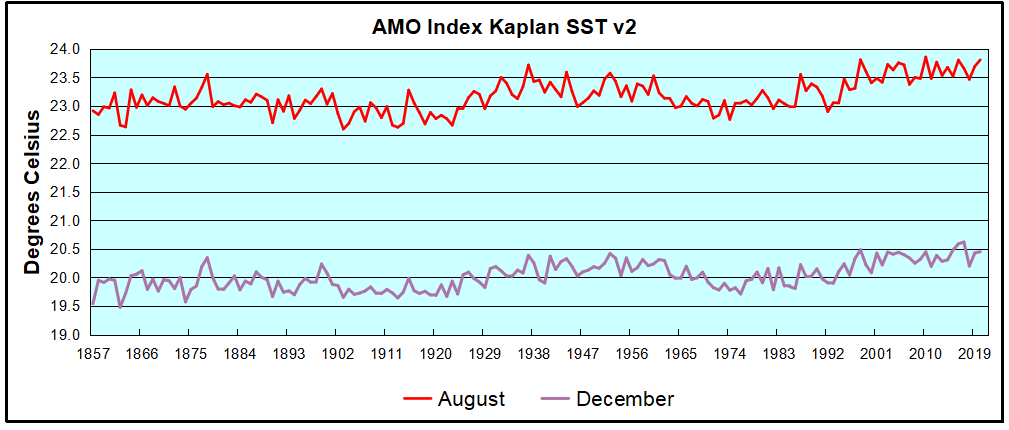
But the peaks coming nearly every summer in HadSST require a different picture.  Let’s look at August, the hottest month in the North Atlantic from the Kaplan dataset.
AMO Aug and Dec 2021The AMO Index is from from Kaplan SST v2, the unaltered and not detrended dataset. By definition, the data are monthly average SSTs interpolated to a 5×5 grid over the North Atlantic basically 0 to 70N. The graph shows August warming began after 1992 up to 1998, with a series of matching years since, including 2020.  Because the N. Atlantic has partnered with the Pacific ENSO recently, let’s take a closer look at some AMO years in the last 2 decades.
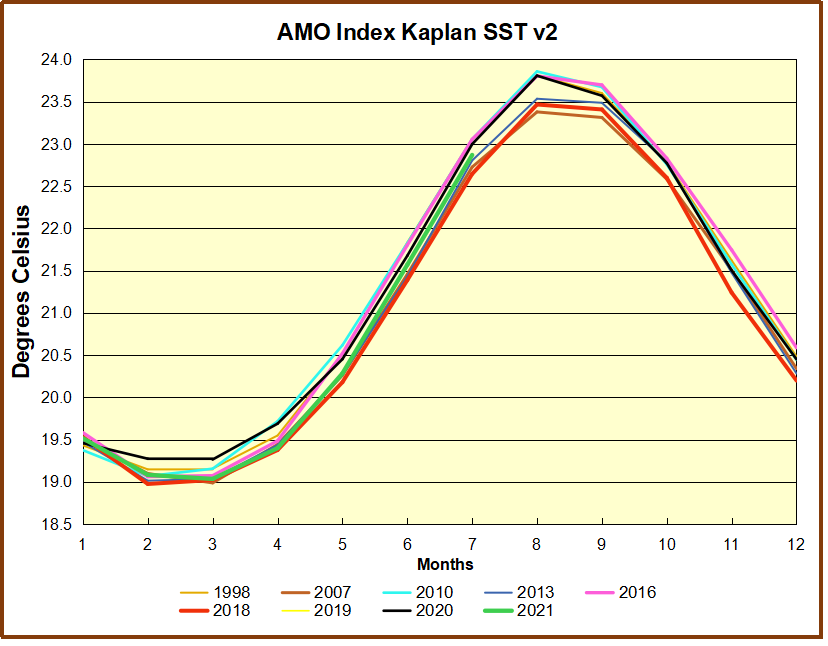
AMO decade 072021This graph shows monthly AMO temps for some important years. The Peak years were 1998, 2010 and 2016, with the latter emphasized as the most recent. The other years show lesser warming, with 2007 emphasized as the coolest in the last 20 years. Note the red 2018 line is at the bottom of all these tracks. The black line shows that 2020 began slightly warm, then set records for 3 months. then dropped below 2016 and 2017, peaked in August ending below 2016. Now in 2021, AMO is tracking the coldest years, warming slightly in June and July.

Summary

The oceans are driving the warming this century.  SSTs took a step up with the 1998 El Nino and have stayed there with help from the North Atlantic, and more recently the Pacific northern “Blob.”  The ocean surfaces are releasing a lot of energy, warming the air, but eventually will have a cooling effect.  The decline after 1937 was rapid by comparison, so one wonders: How long can the oceans keep this up? If the pattern of recent years continues, NH SST anomalies may rise slightly in coming months, but once again, ENSO which has weakened will probably determine the outcome.

Footnote: Why Rely on HadSST3

HadSST3 is distinguished from other SST products because HadCRU (Hadley Climatic Research Unit) does not engage in SST interpolation, i.e. infilling estimated anomalies into grid cells lacking sufficient sampling in a given month. From reading the documentation and from queries to Met Office, this is their procedure.

HadSST3 imports data from gridcells containing ocean, excluding land cells. From past records, they have calculated daily and monthly average readings for each grid cell for the period 1961 to 1990. Those temperatures form the baseline from which anomalies are calculated.

In a given month, each gridcell with sufficient sampling is averaged for the month and then the baseline value for that cell and that month is subtracted, resulting in the monthly anomaly for that cell. All cells with monthly anomalies are averaged to produce global, hemispheric and tropical anomalies for the month, based on the cells in those locations. For example, Tropics averages include ocean grid cells lying between latitudes 20N and 20S.

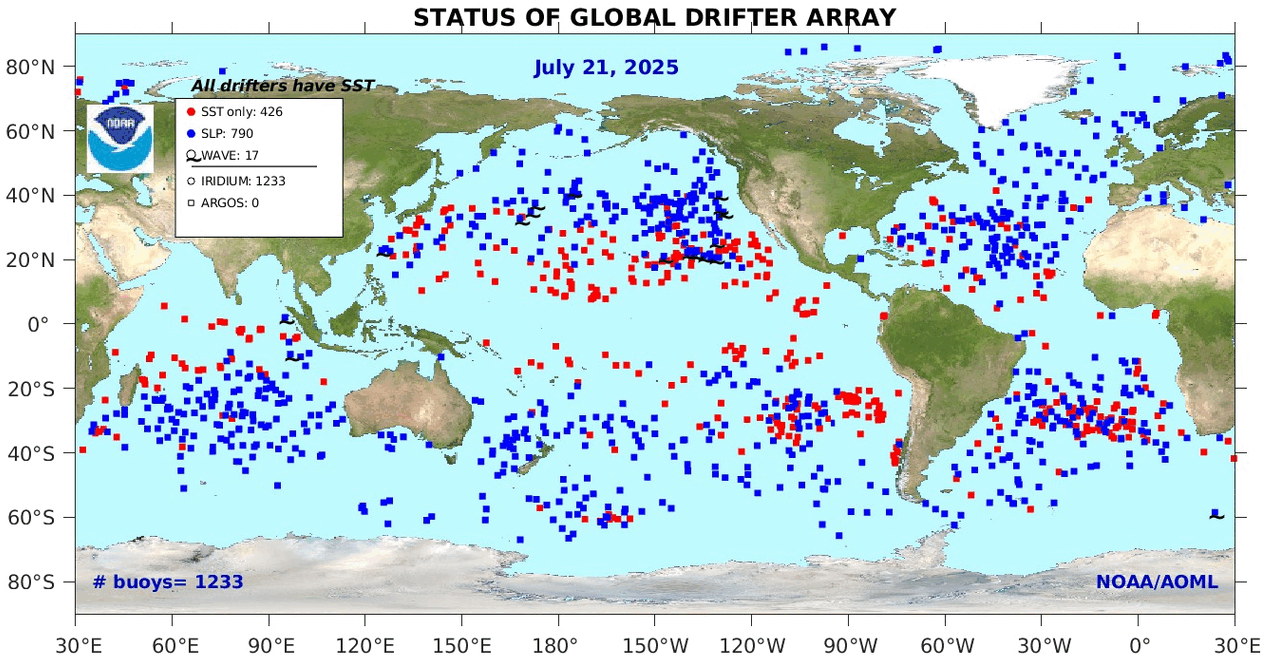
Gridcells lacking sufficient sampling that month are left out of the averaging, and the uncertainty from such missing data is estimated. IMO that is more reasonable than inventing data to infill. And it seems that the Global Drifter Array displayed in the top image is providing more uniform coverage of the oceans than in the past.

uss-pearl-harbor-deploys-global-drifter-buoys-in-pacific-ocean

USS Pearl Harbor deploys Global Drifter Buoys in Pacific Ocean


Greenlight for Ivermectin in Japan

787-1-shutterstock_1709837872_1

Article at gnews reports on announcement by Dr. Ozaki, chairman of the Tokyo Metropolitan Medical Association Greenlight for Ivermectin in Japan.  Excerpts in italics with my bolds.

Since Tokyo summer Olympic Game ended on August 8, 2021, the urgent status of the pandemic as Japan is now in its worst surge of the COVID-19 pandemic since the onset of the crisis in such a megacity of 14 million. Most recently, a record number of new cases were reported at 20,140 on August 14. Deaths aren’t as high as successive waves of the pandemic from February 2021 to the end of May, but nerves are frayed with record numbers of infections. Dr. Ozaki, The chairman of the Tokyo Metropolitan Medical Association, recently led an emergency press conference on August 13, Dr. Haruo Ozaki shared those 18,000 new infections are reported daily. However, the death count has eased as compared to previous surges.

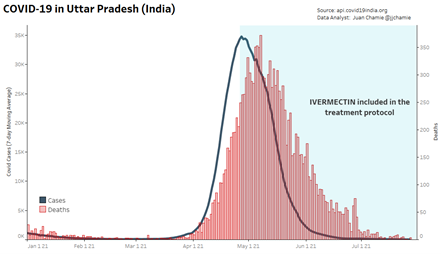
How to deal with the current dilemma is a huge challenge to Japanese government and medical agencies? Fortunately, India has an excellent testimonial. Since April 28, India medical officials started providing Hydroxychloroquine and ivermectin to its massive population. As India is the major pharmaceutical manufacture in the world, they were ready for this massive drug distribution. Miraculously, COVID cases have plummeted quickly since then thanks to the new rules.

786-2-1

Much like what was successfully accomplished in India, parts of Bangladesh, and places like Argentina and Mexico,
Chairman Ozaki calls for the immediate use of ivermectin as cases surge in Japan.

Dr. Ozaki declared that ivermectin has demonstrated significant benefits in reducing infections and deaths where the regimen is prophylactically administered for another indication. With the encouraging medical data from ivermectin clinical trials’ reports worldwide, especially the one from FLCCC of US and BIRD of UK, the head of the Metropolitan Medical Association declared that while clinical trials were important, it was time to greenlight doctors to prescribe ivermectin in association with giving the patient informed consent.

Finally, greenlight for Ivermectin is on in the first developing country since the start of the COVID-19 pandemic, giving hope to all countries and regions. Perhaps this time because Japan did not have the big Pharma entering the COVID vaccine market, the government did not get much pressure.  So the Japanese government’s anti-epidemic policy basically reflects a normal democratic regime should do, that is, to protect the health of the people. Expect the miracle of ivermectin in India to happen again.

pillars-needed-missing

Protocols with HCQ or Ivermectin plus nutritional supplements fill the need for early home treatment.

Footnote: Many people are confused about the fact that IVM has long been approved for human use, 

The FDA approval is here  The issue is that the list of infections does not include Covid19.

The same thing is true for HCQ:

Chloroquine and hydroxychloroquine are both FDA-approved to treat or prevent malaria. Hydroxychloroquine is also approved to treat autoimmune conditions such as chronic discoid lupus erythematosus, systemic lupus erythematosus in adults, and rheumatoid arthritis. Both drugs have been prescribed for years to help patients with these debilitating, or even deadly, diseases, and FDA has determined that these drugs are safe and effective when used for these diseases in accordance with their FDA-approved labeling. Of note, FDA approved products may be prescribed by physicians for off-label uses if they determine it is appropriate for treating their patients, including during COVID.  

Source:  FDA NEWS RELEASE

What If It’s Global Cooling, Not Warming?

IOGP oil and gas plumbing

Chris MacIntosh has an article at zerohedge Global warming or cooling? Excerpts in italics with my bolds.

Wouldn’t it be ironic that instead of the planet-warming over the next 30 years, it actually went into a cooling phase?

When we first heard of sunspot activity and forecasting climate based on the level of solar spot activity we thought this was pixyland stuff.

However, when we “opened our minds” and started to dig deeper we realized there was something going on here. Make your own minds up. We aren’t trying to change anyone’s view but rather encourage you to open your perspectives.

You might like to read this:
“THE NEXT 30 YEARS WILL BE COLD,” SAYS CLIMATE SCIENTIST DR. WILLIE SOON

And this:
NEW PAPER USES AI TO PREDICT THE SUNSPOT CYCLES: LOW SOLAR ACTIVITY UNTIL 2050

Frankly, I’m no scientist but I ran a VC firm for some years, and I’ll tell you what. You are presented with such a ton of “opportunities” that it will make your head spin.

Sorting the wheat from the chaff is quite literally a full time role, and one thing that gets honed like a sword on an anvil is the skeptical critical thinking part of our brain.

Trust but verify is so very important. And what I do know is that the entire global warming narrative, together with “the science is settled,” is complete utter nonsense. It has been extraordinarily successful, too.

Kids these days are being taught it. Mind you, my daughter, who had to present a project on it at school, provided a shocking red pill (Dad helped her on her project) to the class and her teacher.   We literally have a class of people in the world today who are successful as professional hysterics.

However, what we do know is that global energy markets (and a whole host of other second order consequences) are not priced for a cooling of the planet over the next 30 years.

That is why we can get a payback of our investment in coal assets after about 5 years but it will take 100 years to get a payback from investing in Tesla.

What would happen to energy prices (natgas, coal, oil) if the world did in fact get colder over the next 30 years?

Well, the world would start using more fossil fuels and ditch the renewable thing faster than that crazy ex girlfriend/boyfriend that stalks you.

But after years of under investment in fossil fuels (particularly outside of shale), the supply would not be able to be increased meaningfully (i.e. prices would rocket higher and stay there for as long as it takes to bring on more supply), and given the underinvestment and treatment of anyone who would suggest doing so as if they’ve committed mortal sin… well, it’s not coming back in a hurry.

Now, think of every good and service that is tied to the price of fossil fuels. This picture should illustrate the point — life as we know it.

IOGP oil and gas plumbingHmmm… isn’t the rising price of all the “stuff” mentioned above a good definition of inflation? But isn’t the world perfectly positioned for deflation?

Global cooling and inflation… what a toxic cocktail. But we are perfectly positioned for both. Ah, such poetry. Bring it on!

See also Worst Threat: Greenhouse Gas or Quiet Sun?

Elite Consensus Opinion Minority Contrary Opinion
Expect +1C Warmer from now to 2050 Expect -1C Colder from now to 2050
Mitigate Warming by Stopping Fossil Fuels Adapt to Cooling from Quiet Sun
Goal is Net Zero CO2 Emissions by 2050 Goal Robust Energy supply and Infrastructure Now