Sun and Ice


The warm March sun is melting the snow and ice in our neighborhood, so it seems like a good time to talk about the sun and Arctic climate change.
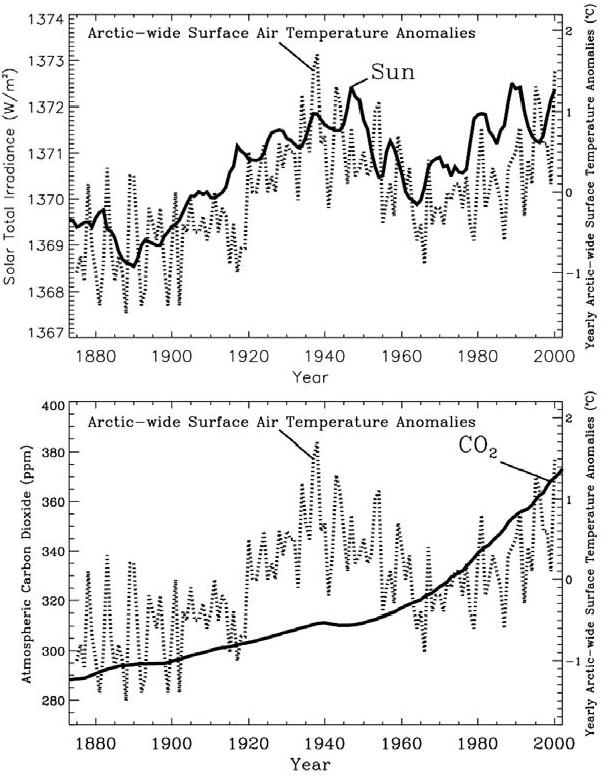
Figure 6.5. Annual-mean Arctic-wide air temperature anomaly time series (dotted line) correlated with estimated total solar irradiance (solid line in the top panel) from the model by Hoyt and Schatten, and with the mixing ratio of atmospheric carbon dioxide (solid line in the bottom panel) From Frovlov et al. 2009

Figure 6.5. Annual-mean Arctic-wide air temperature anomaly time series (dotted line) correlated with estimated total solar irradiance (solid line in the top panel) from the model by Hoyt and Schatten, and with the mixing ratio of atmospheric carbon dioxide (solid line in the bottom panel) From Frovlov et al. 2009

Again, I am relying on a book by Frolov et al. Climate Change in Eurasian Arctic Shelf Seas, Centennial Ice Cover Observations (with some additional more recent material below).

Of course, the most direct effect of the sun on ice is in the summer:

Short-wave solar radiation is the most significant summer-season forcing, or, more precisely, the part of it that depends on albedo and absorption by the ice cover and the sea. Due to changes in albedo not related to greenhouse gases of anthropogenic origin, this heat balance constituent can vary by several dozen W/m2 in polar regions, or one order of magnitude greater than the most optimistic assessments of the influence of greenhouse gases. P 121

And the internal oscillations of the ocean-ice-atmosphere system were discussed extensively in a previous post here:

It was noted in Sections 4.1 and 4.2 that air temperature at mid and high latitudes primarily depends on dynamic processes in the atmosphere (Alekseev, 2000; Alekseev et al., 2003; Vorobiev and Smirnov, 2003). They influence air temperature due to both advective processes and the impact of cloudiness, which depend on the type of baric system in play. In winter, this influence is particularly high in areas where anticyclones are common. Weakening of anticyclones results in increasing temperature and cloudiness. Variation in cloudiness is one of the main causes of climate change is indicated by Sherstyukov (2008). p 119

Frolov et al. explore the connection between solar activity and these atmospheric processes. They are not jumping to conclusions and recognize that uncertainty surrounds the mechanisms between Solar Activity (SA) and Arctic ice variability.

The variation of temperature matches the TSI curve far better than it matches the CO2 curve. However, the Hoyt and Schatten model for TSI is just one of many, and other models lead to very different patterns for TSI vs. year. Furthermore, climate modelers would argue that the temperature curve in the second warming epoch represents the continuation of the first warming epoch, interrupted by a period from about 1940 to about 1980 when increasing aerosol concentrations outweighed the effect of increasing greenhouse gases. Therefore, Figure 6.5 is just one representation of many that could be derived. Nevertheless, if Figure 6.5 were taken at face value, the temperature and TSI variation charts would suggest the presence of both a positive “100-year” trend and quasi 60-year cyclic oscillations.

While Figure 6.5 is suggestive, the fact remains that we really do not know how TSI varied prior to the advent of satellite measurements around 1980. Figure 6.5 demonstrates that the form of the variability of Arctic surface temperatures during the 20th century resembles the variability of the Hoyt and Schatten model for TSI. This is suggestive that variations in TSI may have been an important factor in 20th century climate change. Though the total variance of TSI from 1880 to 2000 according to Hoyt and Schatten was 384 W/m2, the simple spreading of this flow over the spherical area of the Earth is incorrect. As we show in this work, a significant part of TSI variance influences the high-latitude regions. Furthermore, as was noted in Section 5.4, Budyko (1969) concluded by calculations that solar constant variations of several tenths of % are sufficient to induce essential climate changes.

In seeking a relationship between solar variability and climate change, we may consider TSI and SA (Solar Activity). The connection between TSI and climate is direct; TSI represents the fundamental heat input from the Sun that drives our climate. However, although SA represents fundamental aspects of the dynamics of the Sun, its connection to the total power emitted by the Sun is not quite clear. SA includes energetic particle emission, electromagnetic emission in the UV and higher frequency ranges and magnetic fields. It is manifested in the Earth’s phenomena in the form of polar lights, magnetic storms, radio-communication blackouts, etc. A number of different indices are used to measure the level of SA, particularly sunspot indices (Wolf number, etc.), the intensity of solar wind, and various magnetic indices. Even though variations in TSI associated with changes in SA may be small, the impact on higher latitudes is significantly amplified by the interaction of charged solar wind particles with the Earth’s magnetic field. As shown in our work, evidence exists that variability of SA is connected to Arctic climate variations. Frolov et al. 2009 pp. 124

Conclusion

The Earth’s climate is affected by internal and external factors. The internal factors include natural hydro-meteorological, geological, and biological processes, as well as self-oscillation phenomena related to interactions in the ocean-sea ice-atmosphere-glaciers system. In addition, anthropogenic impacts are also considered to be internal factors; they are caused by the increase in concentration of greenhouse gases in the atmosphere because of human activity. External factors include solar activity, tidal and nutation phenomena, variability of the Earth’s rotation speed, fluctuations in the solar constant, fluxes of energy and charged particles from space, and other astronomical factors. p.133

Addendum

Some may claim the Hoyt and Schatten model is outdated, so I provide recent comparable results from Jan Erik Solheim October 2014 here.
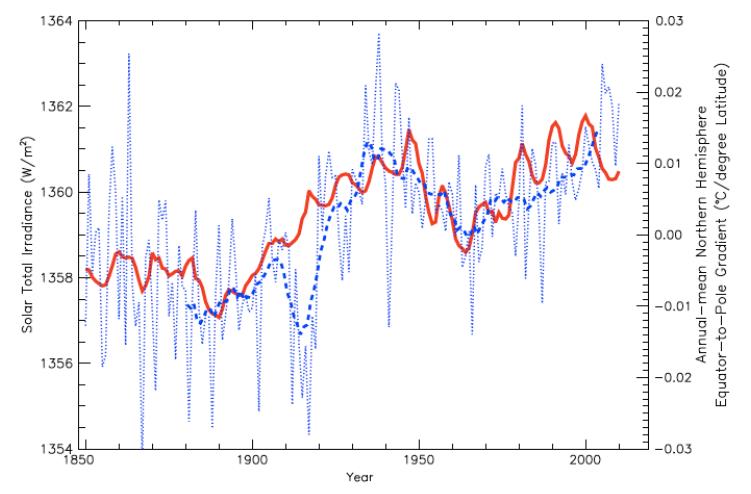
Figure 4: Annual-mean EPTG over the entire Northern Hemisphere (°C/latitude; dotted blue line) and smoothed 10-yr running mean (dashed blue line) versus the estimated TSI of Hoyt and Schatten (Soon and Legates, 2013)

Figure 4: Annual-mean EPTG over the entire Northern Hemisphere (°C/latitude; dotted blue line) and smoothed 10-yr running mean (dashed blue line) versus the estimated TSI of Hoyt and Schatten (Soon and Legates, 2013)

The reconstruction by D. Hoyt and K. Schatten (1993) updated with the ACRIM data (Scafetta, 2013) gives a remarkable good correlation with the Central England temperature back to 1700. It also shows close correlation with the variation of the surface temperature at three drastically different geographic regions with the respect to climate: USA,  Arctic and China.

The excellent relationship between the TSI and the Equator-to-Pole (Arctic) temperature gradient (EPTG) is displayed in figure 4. Increase in TSI is related to decrease in temperature gradient between the Equator and the Arctic. This may be explained as an increase in TSI results in an increase in both oceanic and atmospheric heat transport to the Arctic in the warm period since 1970.

White sea ice in the Arctic melting from the sun, and also reflecting back solar energy.

 

Arctic Ocean and Ice Race March 10


The finals of the CMQ Canoe Race were held on Feb. 7, 2016 Over 50 teams from Quebec, Canada, France and the United States navigated the frozen waters of the Saint-Lawrence River between Quebec City and Lévis.

The annual contest between the ocean and the ice is about to heat up.
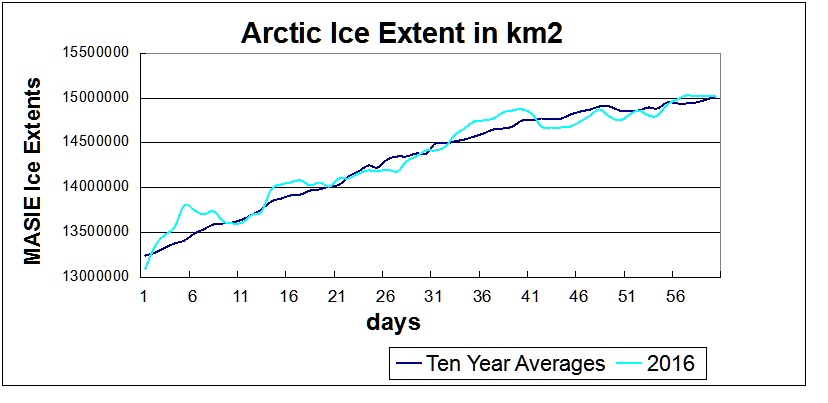
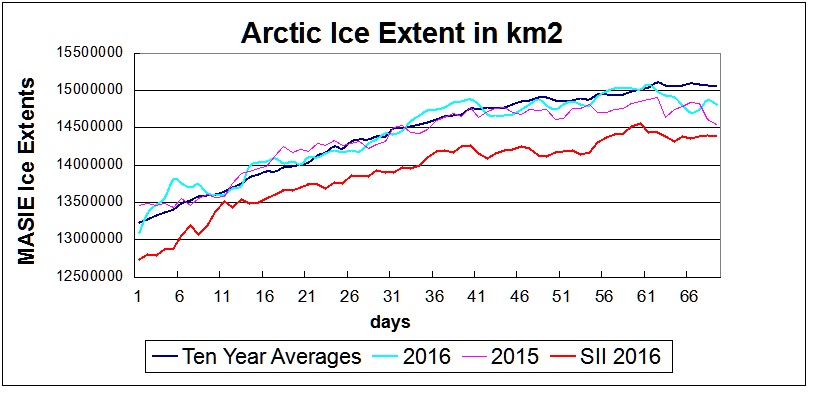
March is the peak month for Arctic ice extent, and the daily max may already be in the books. MASIE shows these maximum extents:

2016 day 61 15.08 M km2
2015 day 62 14.91 M km2
Ave.  day 62 15.10 M km2

OLYMPUS DIGITAL CAMERA

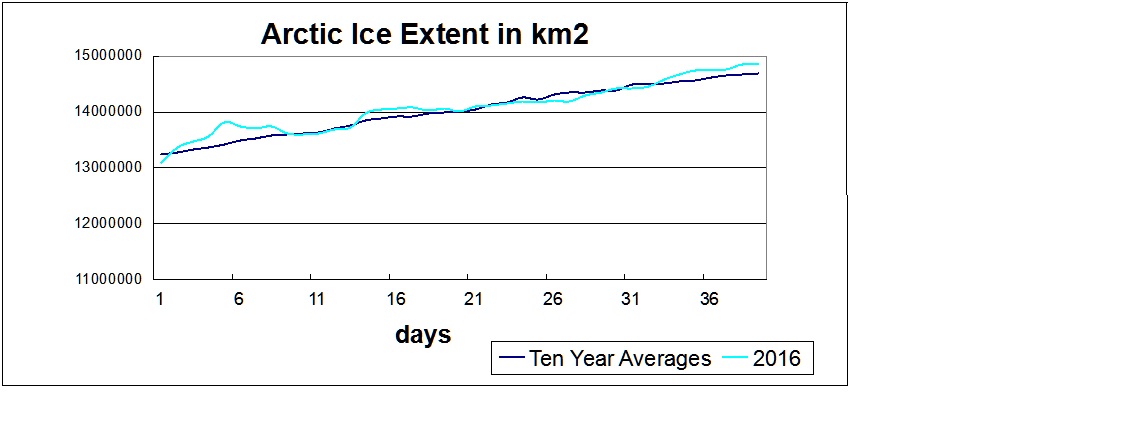
As the graph shows, 2016 is trending below the 10 yr. Average and higher than last year. Comparing the estimates with SII (Sea Ice Index from NOAA) shows how much lower are extents from that source. SII max was 14.56 on day 60. So far, SII March average is about 500k km2 behind MASIE. Since March on average is quite flat over the month, SII has time to catch up, provided it starts showing some increases or a slower decline.

For more on discrepancies between MASIE and SII see here.

This table looks in detail at day 69 km2 extent this year and last:

Region 2015069 2016069 km2 Diff.
 (0) Northern_Hemisphere 14542121 14816687 274566
 (1) Beaufort_Sea 1070445 1070445 0
 (2) Chukchi_Sea 966006 965989 -17
 (3) East_Siberian_Sea 1087137 1087120 -17
 (4) Laptev_Sea 897845 897809 -36
 (5) Kara_Sea 916436 904761 -11675
 (6) Barents_Sea 449499 479659 30160
 (7) Greenland_Sea 591426 589934 -1492
 (8) Baffin_Bay_Gulf_of_St._Lawrence 1915854 1644582 -271272
 (9) Canadian_Archipelago 853214 853178 -36
 (10) Hudson_Bay 1260903 1260854 -49
 (11) Central_Arctic 3228809 3184280 -44529
 (12) Bering_Sea 561278 641530 80252
 (13) Baltic_Sea 15672 64882 49210
 (14) Sea_of_Okhotsk 721406 1168782 447376

Overall, 2016 is 275k km2 higher. The main difference is in Baffin Bay, which is more than offset by Sea of Okhotsk and Bering Sea. Barents is slightly higher than last year, which is still much lower than average. Comparing the two years, last March had a double dip from Okhotsk and Barents low extents, along with early melting from Bering. Only one of them is low this year, though we must watch out for Baffin Bay.  Baltic Sea has a lot of ice, though a smaller basin.

Reminder: All of the marginal seas will typically melt out by September.


MASIE: “high-resolution, accurate charts of ice conditions”
Walt Meier, NSIDC, October 2015 article in Annals of Glaciology.


seal-of-approval-seal


The Great Arctic Ice Exchange

This post concerns our paradigm of the Arctic Ocean and its Sea Ice. My view, despite years of watching the waxing and waning of ice extents was subconsciously wrong, and others may share the same misconception.

I owe my enlightenment to a great book by Russian scientists from the Arctic and Antarctic Research Institute (AARI) in St. Petersburg. It’s entitled Climate Change in Eurasian Arctic Shelf Areas, by Ivan Frolov et al. The ebook is behind a paywall, but Dr. Bernaerts graciously provided me a hard copy from his library.

The book is small in volume, but rich in information and insights, so I am taking the time to digest. In reading Chapter 4 I came upon a section entitled: Changes in ice exchange between the Arctic basin, marginal seas and the Greenland Sea. Now I was well aware the export of ice through the Fram Strait and knew of the great 2012 storm that so affected extents that year. But then I read this:

There is extensive sea ice exchange between the Arctic Basin and its marginal seas, which are the major sources of new ice for the Arctic Basin. The Arctic Basin serves as a reservoir for the marginal seas; it both receives large ice masses exported from the seas and supplies the seas with thicker multiyear ice. The direction and intensity of ice exchange depends to a great extent on the wind regime. However, local winds alone do not completely determine this exchange of ice. Ice export from the ice cover of marginal seas depends on sea ice conditions in the central Arctic because the sea ice originating from the marginal seas must have some ability to replace the central Arctic ice cover. Thus, the marginal seas depend to some degree on the intensity of ice export from the Arctic Basin to the Greenland and other subarctic seas. However, ice flow from the basin to the seas during onshore winds is strongly restricted by the shoreline and landfast ice, and ocean circulation also influences this ice exchange.

The Great Arctic Cyclone August 2012

It’s Not an Ice Cap, It’s an Ice Blender

Frolov et al made me realize that all our observations of Arctic ice are in fact snapshots of an ice blender constantly moving ice around the Arctic ocean. When we observe and measure extent in one of the seas, that particular ice was not there previously, and will be gone in the near future, replaced to some extent by ice coming from elsewhere. That is the full implication of Arctic ice lacking a land anchor (like Greenland or Antarctica) and existing as “drift ice”.

Figure 4.12. Mean resulting ice-drift pattern for summer (a) and winter (b) during the warm epoch and the difference between ice-drift vectors during the warm and cold epochs for summer (c) and winter (d).

Figure 4.12. Mean resulting ice-drift pattern for summer (a) and winter (b) during the warm epoch and the difference between ice-drift vectors during the warm and cold epochs for summer (c) and winter (d).

Frolov et al. Provide the statistics regarding the annual dynamics. In the wintertime the shelf seas form “fast ice”, that is ice locked onto the coastlines. Additional ice has nowhere to go but go with the flow north toward the pole or to the neighboring sea. In the summer the flow reverses and the Arctic basin, which received ice from the marginal seas, now sends ice back to replace losses there.

rarebelugada

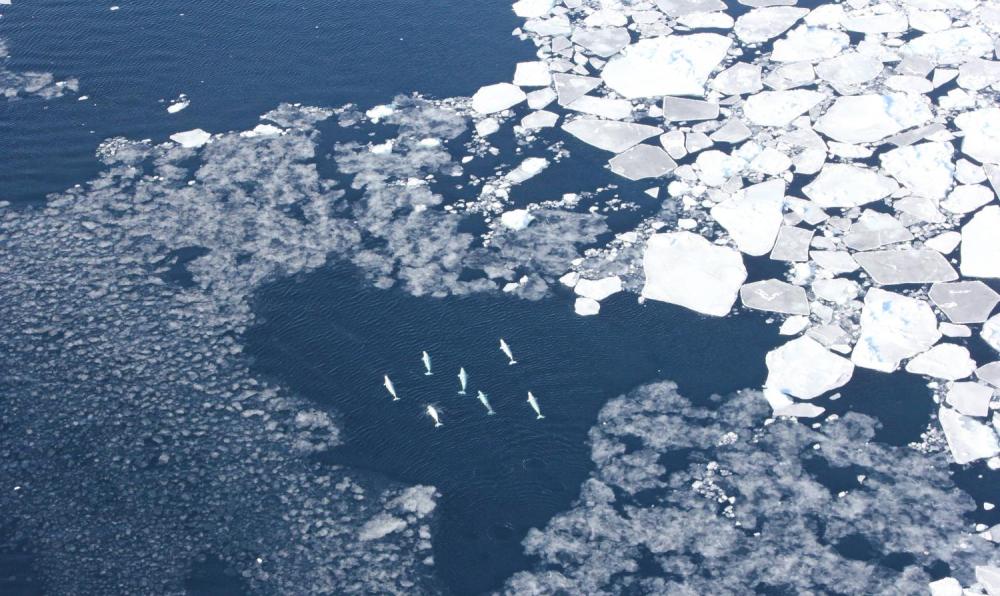
Belugas were observed among West Greenland sea ice. Credit: Kristin Laidre/University of Washington

Which seas get more ice and which get less ice depends mostly on whether the prevailing circulation is cyclonic or anticyclonic. The diagrams show that where there is a strong low pressure area, a cyclonic air flow develops, which moves water and drift ice in a counter-clockwise direction (seen from above). A strong high-pressure system acts in the opposite direction. I like this image the best, but the labels are in French

Considering the Arctic as a whole, a large-scale cyclone such as the massive one in August 2012, breaks up ice, moves it away from western Russian seas, and flushes great chunks of ice south through the Fram Strait into Greenland Sea where they melt. That storm was exceptional in its strength and size, but storms are always at work in the Arctic, and over multiyear periods, we can observe regimes favoring one or the other type of storm.

Frolov et al. point out:

Recent analyses of wind-driven circulation in the Arctic Ocean show that wind-driven ice motion and upper ocean circulation alternate between anticyclonic and cyclonic regimes. Shifts between regimes occur at 5-year to 7-year intervals, resulting in 10-year to 15-year periods. Based on these analyses, these authors proposed an Arctic Ocean Oscillation (AOO) index showing alternation of the cyclonic and anticyclonic regimes.

Table 4.2. Changes in the ice cover area in August from the beginning to the
end of the circulation cycles in Arctic Ocean regions (in 10^3 km2)

Circulation regime Years North European Siberian Arctic
Anticyclonic 1946-1952 +5 —259
1958-1962 +44 —24
1972-1979 +60 —87
1984-1988 +23 —308
Average +34.5 170
Cyclonic 1953-1957 —37 +209
1963-1971 —52 +144
1980-1983 +36 +39
1989-1997 —4 —10
Average 14.2 +95

Table 4.2 shows that in 88% of cases during anticyclonic regimes, sea ice extent increases in the North European Basin and decreases in the Siberian Arctic Seas, while cyclonic circulation has the opposite effect. The absolute value of changes in the Siberian Arctic Seas is more than 5 times higher than in the North European Basin.

Frolov et al. Summarize:

An increase in the recurrence of cyclonic pressure fields over the Arctic Basin at the transition from a cooling to a warming epoch leads to changes in ice cover deformation processes. The cyclonic systems of the multiyear ice drift contribute to ice cover divergence. This process is most prevalent in summer, whereas in winter, especially in relatively thin ice zones, ice compacting is usually observed. Anticyclonic SLP fields have the opposite effect.

According to Gudkovich and Nikolayeva (1963), in a year that westerly and southwesterly winds increase over the eastern Barents Sea during October— December, the setup they create in the Kara Sea increases ice export from this sea toward the north. Dominant easterly and northeasterly winds produce the opposite result. This study also shows that ice export from the eastern East Siberian Sea and the southwestern Chukchi Sea during the period considered is strongly influenced by wind field vorticity in the vicinity of Wrangel Island. Anticyclonic vorticity increases the ice export, and cyclonic vorticity results in additional ice flow from the north.

Ice transported through the Fram Strait.

Frolov et al:

Table 4.4. Correlation coefficients between the long period fluctuations of the
area of ice exported through Fram Strait (October-August) and total ice area of the Arctic Seas Asian shelf in August for the period 1931-2000 at different time lags.

Time lag (years)

Correlation

  0

.43

  1

.56

  2

.67

  3

.75

  4

.80

  5

.81

  6

.80

  7

.77

  8

.72

  9

.66

10

.58

11

.49

12

.39

As shown in Figure 4.14, ice export fluctuations slightly precede corresponding sea ice extent changes in the Arctic Seas. The cross correlation function between the smoothed values of ice export and total sea ice extent exhibits the highest correlation coefficients at time lags (sea ice extent after export) of 4, 5, and 6 years (Table 4.4). Following decreased ice export through Fram Strait in the early 1990s, a tendency for its increase was observed. Based on the time lags shown in Table 4.4, a transition to the phase of increased sea ice extent in the Arctic Seas would be expected at the beginning of the twenty-first century, as confirmed by Figure 4.14a.

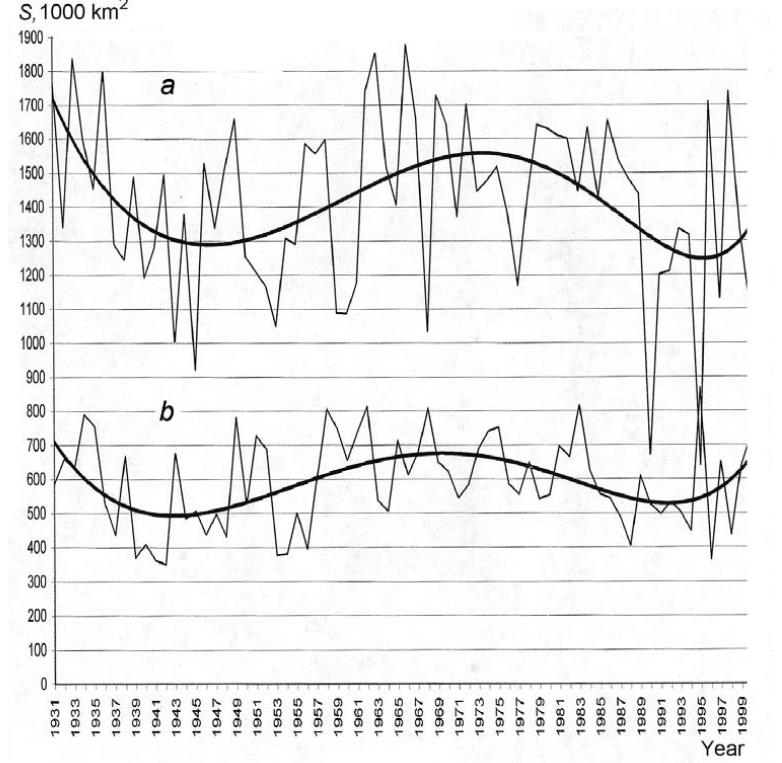
figure 4.14. (a) Interannual fluctuations of the total ice area of the Siberian shelf seas in August, and (b) areas of ice exported from the Arctic Basin through Fram Strait. The values of the bold curves are smoothed by a polynomial to the power of 6.

figure 4.14a (a) Interannual fluctuations of the total ice area of the Siberian shelf seas in August, and (b) areas of ice exported from the Arctic Basin through Fram Strait. The values of the bold curves are smoothed by a polynomial to the power of 6.

Figure 4.14a shows long-period changes in the total area of ice export through Fram Strait from October of one year to August of the next year for 1931-2000. An approximation of data by a polynomial to the power of 6 (bold curve) indicates the cyclic character of these changes, with the cycle lasting about 60 years. Figure 4.14a shows that the fluctuations of total sea ice extent of the Arctic Seas of the Siberian shelf (from the Kara to the Chukchi Seas) have a similar character.

It is remarkable that increased ice export through Fram Strait is accompanied by increased sea ice extent in the Arctic Seas, contrary to the opinions of those who assume that ice export to the Greenland Sea increases during climate warming, accompanied by a decrease in sea ice extent in the Arctic Seas.

The average drift and current speed in Fram Strait for the preceding year influences the ice exchange between the Arctic Basin and the Laptev, East Siberian, and Chukchi Seas in winter (October—March). The increased ice export to the Greenland Sea contributes to the increased ice export from these seas to the Arctic Basin, and its decrease results in the opposite effect (Gudkovich and Nikolayeva, 1963).

Summary

The estimates above show that, on average, about 1 million km2 of the ice cover is transported annually from the Arctic Seas to the Arctic Basin, which is comparable to current estimates of the area of ice exported annually from the Arctic Basin to the Greenland Sea. (e.g., Koesner, 1973; Mironov and Uralov, 1991; Vinje, 1986). Given a typical ice thickness value, we can estimate the volume of ice exported to the Arctic Basin during a winter to be approximately 1500-2000 km3. This value is about half as large as the available estimates of ice export to the Greenland Sea in winter (Vinje and Finnekasa, 1986; Alekseev et al., 1997), which can be accounted for by ice growth, ice ridging, and other processes that occur during transport of the ice to Fram Strait.

It is a mistake to think of the Arctic as an ice cap that shrinks and grows in extent.  In fact Arctic ice is constantly in flux, more like a kalidiscope than an solid sheet. And the natural forces within the climate system cause fluctuations on a quasi-60yr oscillation


NASA’s Aqua satellite captured this natural-color image of the storm in the Arctic on August 7, 2012. The storm – which appears as a swirl – is directly over the Arctic in this image. NASA image by Jeff Schmaltz, LANCE/EOSDIS Rapid Response.

Resurging Arctic Ice March 1

It’s official–This leap year February is complete and we can now look at the annual Arctic Ice Extent situation at day 60 with two months in the books.

The Resurgence of Arctic ice is continuing in MASIE, the most accurate dataset, but in SII, the remote sensing dataset, not so much.

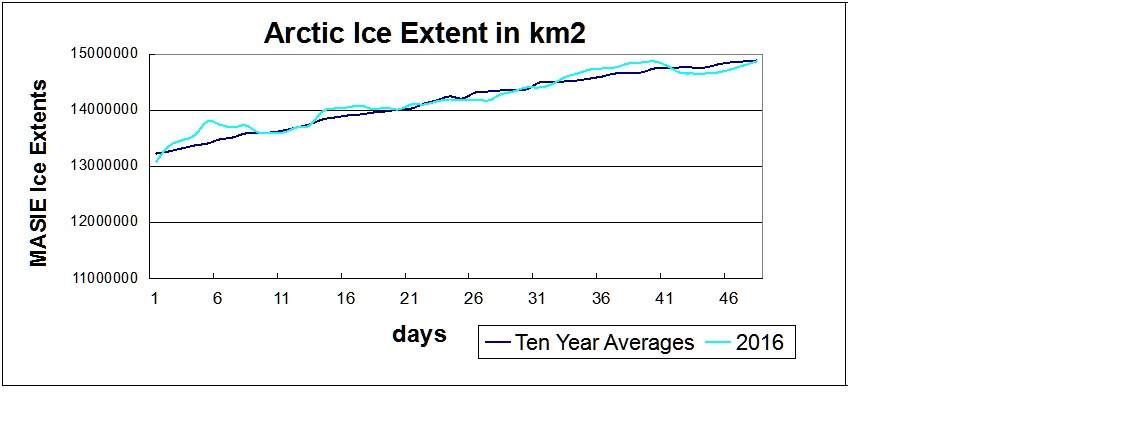
The MASIE graph shows an extent matching the ten-year average. At 15.02 M km2, 2016 exceeds 2015 annual maximum of 14.91 recorded on day 62, and this year’s peak ice may well go higher.

This table shows comparisons between MASIE and SII

 Months MASIE
2016
SII
2016
MASIE
2016-2015
SII
2016-2015
 SII – MASIE
Jan 13.922 13.472 -0.019 -0.131 -0.450
Feb 14.804 14.210 0.121 -0.199 -0.593

It is readily shown that SII is severely underestimating this year’s growth of ice compared both to SII 2015 and to MASIE. A monthly differential of nearly 600k km2 has opened up due to SII showing a large decline while MASIE shows a gain compared to last year.

Below is a comparison from MASIE regarding the NH seas comprising the NH statistics.

Ice Extents Ice Extent
Region 2015060 2016060 km2 Diff.
 (0) Northern_Hemisphere 14856201 15018131 161930
 (1) Beaufort_Sea 1070445 1070445 0
 (2) Chukchi_Sea 966006 965989 -17
 (3) East_Siberian_Sea 1087137 1087120 -17
 (4) Laptev_Sea 897845 897809 -36
 (5) Kara_Sea 935023 933890 -1133
 (6) Barents_Sea 701064 529545 -171519
 (7) Greenland_Sea 677415 582658 -94757
 (8) Baffin_Bay_Gulf_of_St._Lawrence 1828321 1588399 -239922
 (9) Canadian_Archipelago 853214 853178 -36
 (10) Hudson_Bay 1260903 1260854 -49
 (11) Central_Arctic 3246891 3208216 -38675
 (12) Bering_Sea 508062 623647 115585
 (13) Baltic_Sea 22187 86770 64583
 (14) Sea_of_Okhotsk 768839 1308697 539858
 (15) Yellow_Sea 0 14137 14137
 (16) Cook_Inlet 5303 3505 -1798

In the table 2016 shows two seas on the Atlantic side lower than this date last year, Barents and Greenland Seas, while the Baltic is much higher, though a smaller size sea.  Barents had grown to almost 600k km2 by day 20, then lost 150k up to day 55, but has now regained half of that loss.

Baffin Bay is down some, but not a large %, while CAA is the same extent.

On the Pacific side, Okhotsk which was the lowest in the last 10 years in 2015 has much more ice now, nearly the highest in 10 years. Bering is also up, so it may be a case of “Goodbye Blob, Hello Normal.”

So is the Winter ending and stopping the ice growth?

Here is my local observation:

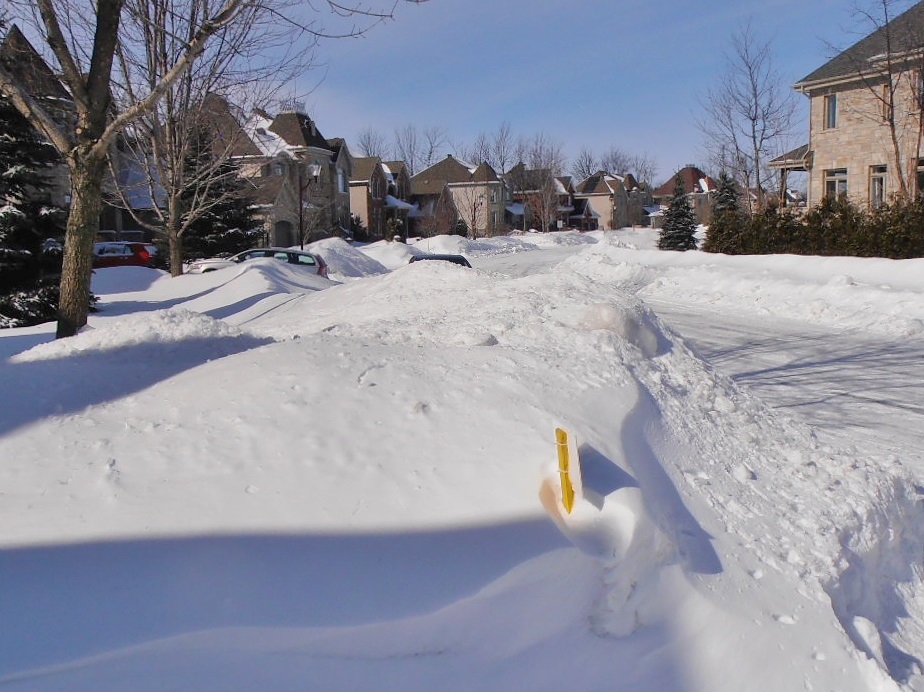
Montreal Suburb Street on March 1, 2016

Montreal Suburb Street on March 1, 2016

That’s the snowpack on our street seen from my driveway. And I went cross-country skiing today, an activity normally precluded in March by lack of snow cover and temperatures above freezing. With fresh snowfall last night and -13C this morning, it was one of the best days this season. With a blizzard warning and more snow expected tonight, I’m likely to be back out later this week.

So the report from here: The Siberian Express is on time and going strong.

What’s happening with Arctic ice?

It depends on whose measurements you look at. Before you decide, make sure you have read NOAA is Losing Arctic Ice.

NOAA Is Losing Arctic Ice

MASIE: “high-resolution, accurate charts of ice conditions”
Walt Meier, NSIDC, October 2015 article in Annals of Glaciology.

Something strange is happening in the reporting of sea ice extents in the Arctic. I am not suggesting that “Something is rotten in the state of Denmark.” That issue about a Danish graph seems to be subsiding, though there are unresolved questions. What if the 30% DMI graph is overestimating and the 15% DMI graph is underestimating?

The MASIE record from NIC shows an average year in progress, with new highs occurring well above the 2015 maximum:

MASIE 2016 to day 56r

Meanwhile from NOAA’s Sea Ice Index (SII) dataset we get this:
The monthly average January 2016 sea ice extent was the lowest in the satellite record, 90,000 square kilometers (35,000 square miles) below the previous record low in 2011.

Why the Discrepancy between SII and MASIE?

The issue also concerns Walter Meier who is in charge of SII, and as a true scientist, he is looking to get the best measurements possible. He and several colleagues compared SII and MASIE and published their findings last October. The purpose of the analysis was stated thus:

Our comparison is not meant to be an extensive validation of either product, but to illustrate as guidance for future use how the two products behave in different regimes.

The Abstract says:
Passive microwave sensors have produced a 35 year record of sea-ice concentration variability and change. Operational analyses combine a variety of remote-sensing inputs and other sources via manual integration to create high-resolution, accurate charts of ice conditions in support of navigation and operational forecast models. One such product is the daily Multisensor Analyzed Sea Ice Extent (MASIE). The higher spatial resolution along with multiple input data and manual analysis potentially provide more precise mapping of the ice edge than passive microwave estimates. However, since MASIE is based on an operational product, estimates may be inconsistent over time due to variations in input data quality and availability. Comparisons indicate that MASIE shows higher Arctic-wide extent values throughout most of the year, largely because of the limitations of passive microwave sensors in some conditions (e.g. surface melt). However, during some parts of the year, MASIE tends to indicate less ice than estimated by passive microwave sensors. These comparisons yield a better understanding of operational and research sea-ice data products; this in turn has important implications for their use in climate and weather models.

http://www.igsoc.org/annals/56/69/a69a694.pdf

The whole document is informative and worth the read.
For instance MASIE is described thus:

Human analysis of all available input imagery, including visible/infrared, SAR, scatterometer and passive microwave, yields a daily map of sea-ice extent at a 4 km gridded resolution, with a 40% concentration threshold for the presence of sea ice. In other words, if a gridcell is judged by an analyst to have >40% of its area covered with ice, it is classified as ice; if a cell has <40% ice, it is classified as open water.

The fact that MASIE employs human judgment is discomforting to climatologists as a potential source of error, so Meier and others prefer that the analysis be done by computer algorithms. Yet, as we shall see, the computer programs are themselves human inventions and when applied uncritically by machines produce errors of their own.

The passive microwave sea-ice algorithms are capable of distinguishing three surface types (one water and two ice), and the standard algorithms are calibrated for thick first-year and multi-year ice (Cavalieri, 1994). When thin ice is present, the algorithms underestimate the concentration of new and thin ice, and when such ice is present in lower concentrations they may detect only open water. The underestimation of concentration and extent of thin-ice regions has been noted in several evaluation studies. . .Melt is another well-known cause of underestimation of sea ice by passive microwave sensors.

The paper by Meier et al. is a good analysis, as far as it goes. In this post I will show the gory details and bring the comparison up to date.

Detailed Comparison between SII and MASIE

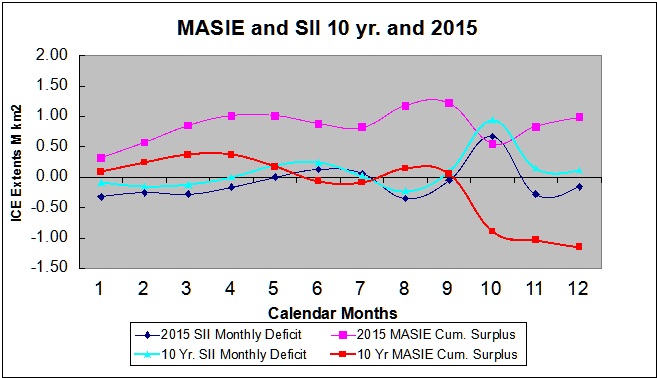
Here is a graph comparing SII and MASIE over the last decade and in the last year:


MASIE and SIIr

The green line shows the SII deficit to MASIE each month averaged over the last 10 years. The red line shows a cumulative surplus of ice reported by MASIE running through the 12 months, averaged over the last 10 years. Clearly, the graph shows SII underestimates ice extent most of the year, but by September the discrepancy is minimal. Then a huge surplus of ice is reported by SII each October, which results in SII reporting a higher annual extent than MASIE.

But look at what is happening recently.

The blue line shows the SII monthly deficit to MASIE in 2015, while the purple line shows the MASIE surplus during 2015. SII last year underestimated extents more than previously, and with a smaller correction in October, MASIE shows an annual surplus, the cumulative divergence for 2015 is about 2M km2 above the 10 year average.

And in 2016, SII results are increasingly untrustworthy. January 2016 is 450k km2 down, and February (so far) is 600k km2 less than MASIE.

Conclusions

It is unwise to rely on NOAA’s Sea Ice Index as a sole measurement of Arctic ice extent.

The October SII readings are unbelievable, and resemble an adjustment applied to bring the annual results into line.

The MASIE record is good enough for Walter Meier to analyze it with the objective of making SII closer to MASIE’s accuracy.


seal-of-approval-seal

Addendum:

Here are the tables so you can see the numbers:

2006-2015 2006-2015 2006-2015 2006-2015 MASIE Surplus
Averages MASIE SII SII Deficit
January 13.87 13.78 -0.09 0.09
February 14.79 14.63 -0.15 0.25
March 15.01 14.89 -0.12 0.37
April 14.31 14.31 0.00 0.37
May 12.77 12.96 0.19 0.17
June 10.95 11.19 0.24 -0.07
July 8.40 8.42 0.02 -0.08
August 6.07 5.84 -0.23 0.14
September 4.79 4.88 0.09 0.05
October 6.74 7.69 0.94 -0.89
November 9.98 10.12 0.15 -1.04
December 12.24 12.35 0.11 -1.15
12 month Ave. 10.83 10.92 -0.10
2015 2015 2015 MASIE Surplus
Averages MASIE SII SIIDeficit
January 13.94 13.62 -0.32 0.32
February 14.68 14.43 -0.25 0.57
March 14.67 14.39 -0.28 0.85
April 14.12 13.96 -0.16 1.01
May 12.65 12.65 0.00 1.01
June 10.84 10.97 0.13 0.88
July 8.71 8.77 0.06 0.82
August 5.96 5.61 -0.35 1.17
September 4.68 4.63 -0.05 1.22
October 7.05 7.72 0.67 0.55
November 10.34 10.06 -0.28 0.83
December 12.43 12.27 -0.16 0.99
12 month Ave. 10.84 10.757 0.08
2016 2016 2016
MASIE SII MASIE-SII
January 13.92 13.47 0.45
February 14.77 14.17 0.60

Speak Up for MASIE

Recently when accessing MASIE for the daily ice extent update, I noticed this statement in the left margin of the home page:

NSIDC has received support to develop MASIE ice extent but not to maintain MASIE. We are actively seeking support to maintain the product over the long term. If you find MASIE helpful, please let us know with a quick message to NSIDC User Services.

So I sent them a message of appreciation:

To: nsidc@nsidc.org<nsidc@nsidc.org>;

Your dataset is invaluable since it represents multiple sources, including satellite passive microwave sensors, and is more precise in defining ice edges. I have been following MASIE for years, and was pleased to see the dataset for the last ten years released in November 2015. This ice extent record based on navigational observations is a vital resource for comparisons, not only with the satellite measurements, but also with the longer-term history of ice charts from Russia, Denmark, Norway and Canada.

Thank you, and please keep up the excellent work.

Ron Clutz
Blogsite: Science Matters
https://rclutz.wordpress.com/category/arctic-sea-ice/

I received a nice reply and word that my message was forwarded to the team leader.

Any others wanting to see this dataset maintained might also want to communicate their interest.

“If you see something, Say something.”

Icy Arctic Mid February

Update below February 22, 2016

Needless to say, “Ice Free” never happened.  It is true that in the last ten years, August and September monthly extents declined slightly, but the other ten months have increased more than twice as much.  So the over all trend has been slightly upward.

Here is the current image from NASA:

Figure 2: Color-coded map of the daily sea ice concentration in the Northern Hemisphere for the indicated recent date along with the contours of the 15% edge during the years with the least extent of ice (in red) and the greatest extent of ice (in yellow) during the period from November 1978 to the present. The extents in km2 for the current and for the years of minimum and maximum extents are provided below the image. The different shades of gray over land indicate the land elevation with the lightest gray being the highest elevation. Source: NASA


For comparison, here is the ice chart from MASIE:


The comparable MASIE image is showing about 500k km2 more ice than the NASA image. Through mid February, 2016 is following the average winter ice growth over the last ten years, and is greater than 2015 which had a maximum below average. The NSIDC Ice Index is running behind MASIE by about 600k km2.

masie 2016 jan and feb to 48It remains to be seen in March how this year’s maximum will compare to other years.

Update February 22, 2016

Some additional information on the MASIE ice product:

MASIE: Human analysis of all available input imagery, including visible/infrared, SAR, scatterometer and passive microwave, yields a daily map of sea-ice extent at a 4 km gridded resolution, with a 40% concentration threshold for the presence of sea ice. In other words, if a gridcell is judged by an analyst to have >40% of its area covered with ice, it is classified as ice; if a cell has <40% ice, it is classified as open water.

The passive microwave sea-ice algorithms are capable of distinguishing three surface types (one water and two ice), and the standard algorithms are calibrated for thick first-year and multi-year ice (Cavalieri, 1994). When thin ice is present, the algorithms underestimate the concentration of new and thin ice, and when such ice is present in lower concentrations they may detect only open water. The underestimation of concentration and extent of thin-ice regions has been noted in several evaluation studies

Melt is another well-known cause of underestimation of sea ice by passive microwave sensors.

Meier et al. How do sea-ice concentrations from operational data compare with passive microwave estimates? Implications for improved model evaluations and forecasting

Click to access a69a694.pdf


Arctic Not a Refrigerator

People are duped by false alarms about Arctic sea ice because they have (subliminally) bought into the notion likening the Arctic to their home refrigerator. This post is to dissuade you from taking on board that false analogy.

Inside Your Fridge
When you put liquid water into your fridge, it releases heat, both sensible and latent, the air in the compartment warms and the heat engine extracts the warming to maintain a constant temperature.

The energy is substantial: it takes 417 kj per kilogram of water to go from room temperature (20C) to ice or vice-versa. The math from Wikipedia is:

To heat ice from 273.15 K to water at 293.15 K (0 °C to 20 °C) requires:

(1) 333.55 J/g (heat of fusion of ice) = 333.55 kJ/kg = 333.55 kJ for 1 kg of ice to melt
PLUS
(2) 4.18 J/(g·K) × 20K = 4.18 kJ/(kg·K) × 20K = 83.6 kJ for 1 kg of water to increase in temperature by 20 K
= 417.15 kJ

And of course if you leave the door open, the refrigeration unit is unable to remove the heat efficiently, the freezing process slows and less ice is produced. Also when electric power is lost, everything frozen starts melting and perishable food spoils.

Alarmists sometimes say that when the jet stream wanders south from the Arctic (“the polar vortex”), it is like leaving the fridge door open and sea ice will be lost as a result. This is upside down and backwards, since the Arctic does not at all resemble a refrigerator.

Inside the Arctic
In the Arctic (and also at the South Pole), the air is in direct contact with an infinite heat sink: outer space. The tropopause (where radiative loss upward is optimized) is only 7 km above the surface at the poles in winter, compared to 20 km at the equator. There is no door to open or close; the air is constantly convecting any and all energy away from the surface for radiation into space.

Instead of an open door, Arctic ice melts when the sun climbs over the horizon. Both the water and air are warmed, and the ice cover retreats until sundown in Autumn.

Most people fail to appreciate the huge heat losses at the Arctic pole. Mark Brandon has an excellent post on this at his wonderful blog, Mallemaroking.

By his calculations the sensible heat loss in Arctic winter ranges 200-400 Wm2.

The annual cycle of sensible heat flux from the ocean to the atmosphere for 4 different wind speeds.

As the diagram clearly shows, except for a short time in high summer, the energy flow is from the water heating the air.

“Then the heat loss over the 2×10⁹ m2 of open water in that image is a massive 600 GW – yes that is Giga Watts – 600 x 109 Watts.

If you want to be really inappropriate then in 2 hours, that part of the ocean lost more energy than it takes to run the London Underground for one year.

Remember that is just one component and not the full heat budget – which is partially why it is inappropriate. For the full budget we have to include latent heat flux, long wave radiation, short wave radiation, energy changes through state changes when ice grows and decays, and so on. Also large heat fluxes lead to rapid sea ice growth which then insulates the ocean from further heat loss.”

The Key Difference
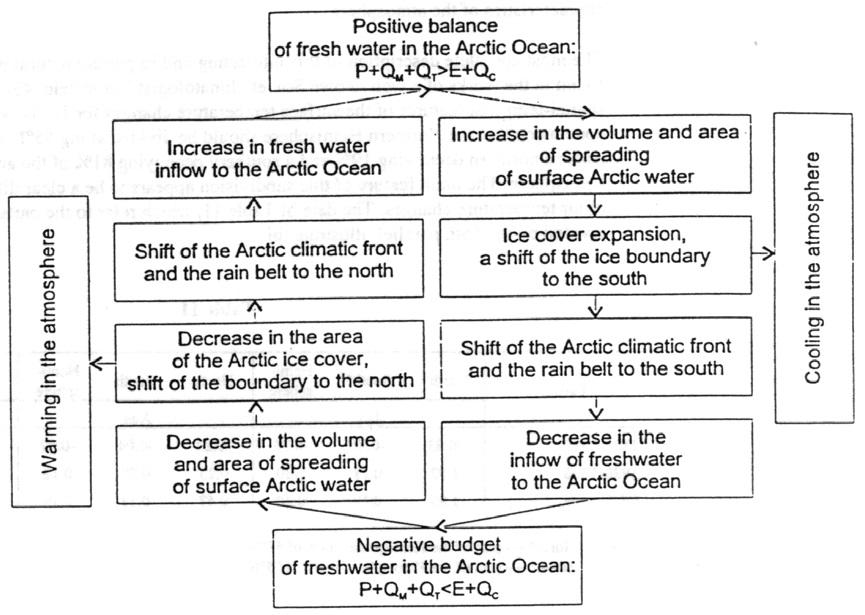
The really big paradigm shift is to understand that the sea ice extent itself regulates the periods of warming and cooling air temperatures, and not the other way around. Of course, there is a considerable lag, on the order of several decades, as you would expect in any system with massive capacity and momentum. Zakharov (here) shows how Arctic ice functions as a self-oscillating system:

Zacharov fig.24

Zacharov fig.24

Summary: Why the Arctic is not a Refrigerator

1.  A fridge makes ice by keeping the air below freezing.
The Arctic makes ice by keeping warmer water away.

2.  Ice melts in a fridge when warmer air is allowed in.
Ice melts in the Arctic when the sun shines.

3. The fridge is regulated by an air temperature sensor.
The Arctic is regulated by the ice extent itself.


Arctic Ice Rebuilding

The media and warmists ignore Arctic ice in wintertime because they are obsessed with the summer melt, and hoping for lots of open water.  In fact, ice extent trends are basically driven by the freezing this time of year, while Sept. extents vary greatly due to summer weather events, not climate change.

The press has been reporting some storm activity in the North Atlantic, and tossing words like “unprecedented” into the stories.  But keeping things in perspective, we can say that the freezing is going normally with the usual day to day fluctuations.

January and February show an average year in progress:

masie 2016 jan and feb to 39


Conclusion:

Do not trust mass media for unbiased reporting of climate news.

Some people don’t like the unalarming patterns of ice extents displayed by MASIE, and hang onto obsolete comments about times in the past when ice charts were inconsistent.  Today’s MASIE dataset is accurate and reliable, according to NSIDC who expressed confidence when releasing it in 2015.

About MASIE produced by NIC (from NSIDC)

The NSIDC Sea Ice Index ice extent is widely used, but the edge position can be off by 10s or in some cases 100s of kilometers. NIC produces a better ice edge product, but it does not reach the same audience as the Sea Ice Index.

In June 2014, we decided to make the MASIE product available back to 2006. This was done in response to user requests, and because the IMS product output, upon which MASIE is based, appeared to be reasonably consistent.
Note:  Presently, NSIDC Sea Ice Index is showing ~700,000 km2 less ice extent than MASIE.

Sea Ice and Sea Level Update

Post Paris sea level alarms are ramping up:
As global temperatures rise, scientists know that sea levels will follow suit. Today, global sea level is the topic of two new papers, both published in Nature Climate Change. Source: Carbon Brief, today’s date.

Fortunately, antidotes for this feverish reporting are available. Some recent research reports published this year update our knowledge of sea ice and sea level dynamics.  Two papers below are by Australians  A.Parker and C. D. Ollier. They obviously are not employed by CSIRO, since they are working hard on understanding how the climate system actually works.

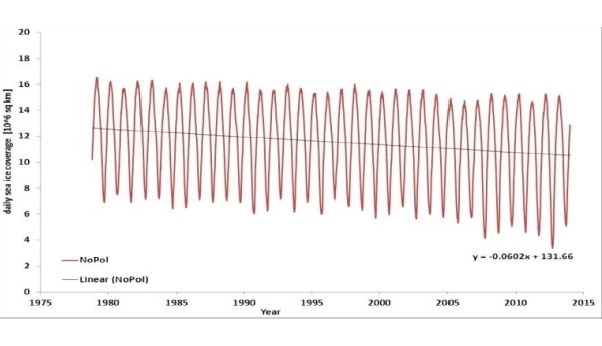
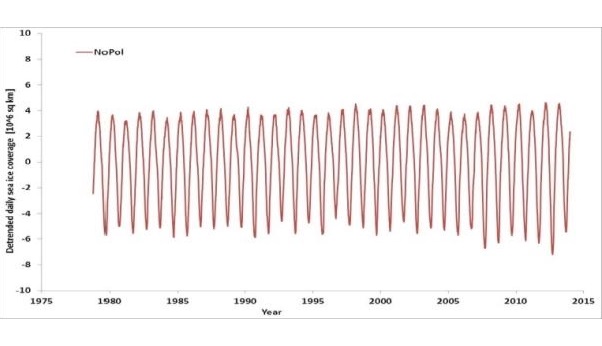
Is there a Quasi-60 years’ Oscillation of the Arctic Sea Ice Extent?
A.Parker and C. D. Ollier

Satellite sea ice extent North Pole since 1979, the sea ice coverage anomalies. Data from NSIDC

Satellite sea ice extent North Pole since 1979, the sea ice coverage anomalies. Data from NSIDC. The shrinking of ice is consistent with the warming temperature of Fig. 3.

From the Abstract:
The Arctic sea ice experienced a drastic reduction that was phased with warming temperatures 1923 to 1940. This reduction was followed by a sharp cooling and sea ice recovery. This permits us to also conclude that very likely the Arctic sea ice extent also has a quasi-60 years’ oscillation. The recognition of a quasi-60 year’s oscillation in the sea ice extent of the Arctic similar to the oscillation of the temperatures and the other climate indices may permit us to separate the natural from the anthropogenic forcing of the Arctic sea ice. The heliosphere and the Earth’s magnetosphere may have much stronger influence on the climate patterns on Earth including the Arctic sea ices than has been thought.

Satellite sea ice extent North Pole since 1979, the values de-trended to the linear fitting line. Data are from NSIDC. The shrinking of ice is consistent with the warming temperature of Fig. 3.

Satellite sea ice extent North Pole since 1979, the values de-trended to the linear fitting line. Data are from NSIDC.

http://sciencedomain.org/abstract/8837

This finding is entirely consistent with Zakharov’s work at AARI, (here) and with analyses (here) of fluctuating Barents and Arctic Sea Ice.


Discussion of Foster & Brown’s Time and Tide: Analysis of Sea Level Time Series
A.Parker and C. D. Ollier

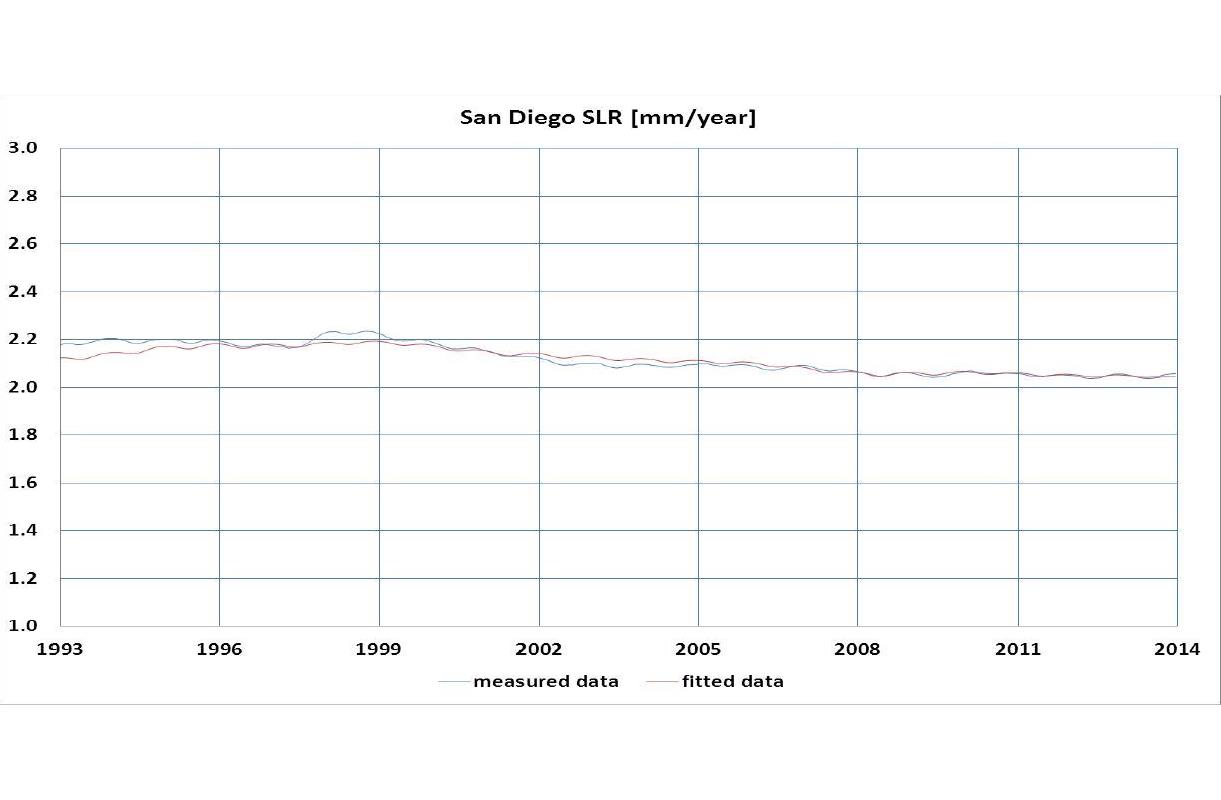
Sea level patterns in San Diego: SLR over the last 20 years.

Sea level patterns in San Diego: SLR over the last 20 years.

From the Abstract:
The recognition of the non-accelerating, periodic pattern of sea levels as described by the tide gauges measurements does not require any special mathematical tool. Providing enough data of sufficient quality have been recorded, If the classical linear fitting is used to compute the rate of rise at any time, then the acceleration is simply the time rate of change of this velocity. By using this technique, the lack of any acceleration over the last few decades is evident in the naturally oscillating, slow rising, tide gauges of appropriate quality and length.

If the sea levels have to rise 1 meter by 2100 and not only 21.5 millimeters at the worldwide average tide gauge, there is a problem of orders of magnitude difference in the sea levels computed (by climate models) and measured (by tide gauges).
http://sciencedomain.org/abstract/8091

Postscript:

It has come to my attention that both Albert Parker and Cliff Ollier have been vilified on alarmist websites, and will likely be attacked again for their latest papers, which are continuing to favor observations over projections from climate models.  For reference I provide additional responses from the two scientists to past critiques.

Cliff Ollier summarizes his views on sea ice and sea levels here:
Floating sea ice and the Archimedes principle
http://www.climatescienceinternational.org/index.php?option=com_content&id=312

In Ice shelf break-up and sea level change, Ollier says this:

In a piece in the December 11 issue of NRC/Handelsblad, Rotterdam’s counterpart to the New York Times, Wilco Hazeleger, a senior scientist in the global climate research group at KNMI (the Royal Netherlands Meteorological Institute) wrote: “In the past century the sea level has risen twenty centimetres. There is no evidence for accelerated sea-level rise. It is my opinion that there is no need for drastic measures. … Fortunately, the time rate of climate change is slow compared to the life span of the defense structures along our coast. There is enough time for adaptation.”

It would be much better if our politicians (and some scientists) based their opinions on what we can actually observe about sea level, instead of alarming us with dreams of catastrophic sea level rise based on false models of what might be happening to ice caps. Of course even if we believed sea level is rising, it takes another leap of faith to think it is caused by miniscule increases in atmospheric carbon dioxide caused by human activity.

Parker replied to defenders of consensus climate science in 2013:

It is demonstrated that the IPCC models do not reproduce the natural harmonics as the quasi-60 years cycle and overestimate the effect of the anthropic forcings. The IPCC models are shown compatible with the 1999 Mann hockey stick but unfortunately for the IPCC also incompatible with the recent temperature reconstructions. The global warming and sea level predictions for the 21st century may be consequently equally wrong. The increased heat uptake or the rising temperatures of the oceans or the accelerating seas all have similar lack of sound scientific bases.