Heat Wave AGW Hysteria Not So Much. Why?

An editorial at Investor’s Business Daily poses the question: Why Hasn’t The California Heat Wave Sparked The Usual Global Warming Hysteria?  Excerpts in italics with my bolds.

It wasn’t long ago when the mainstream press took every opportunity, no matter how weak the connection, to blame bad things on global warming. So far, at least, we haven’t found one major story using the heat wave gripping the southwest to sound the alarm about global warming.

This lack of alarmism has not gone unnoticed.

Writing at the New Republic this week, Emily Atkin complained that despite record-breaking heat and a wildfire season that, she says, is already worse than usual, “there’s no climate connection to be found in much news coverage, even in historically climate-conscious outlets like NPR and The New York Times.”

When Atkin contacted NPR for an explanation, the network’s science editor said “You don’t just want to be throwing around, ‘This is due to climate change, that is due to climate change.‘”

Wow.

Also this week, Chris Hayes of the uber-liberal MSNBC responded to a complaint on Twitter that his network wasn’t clanging the global warming alarm bells loudly enough or regularly enough with this tweet:

“every single time we’ve covered it’s been a palpable ratings killer. so the incentives are not great.”

So why this sudden outburst of common sense among the mainstream press?

Perhaps they’ve come to the realization that after decades of end-of-the-world predictions and oversaturation coverage, during which time global temperatures have barely budged, the public has stopped paying attention. You can only predict the end of the world so many times, after all, before people start to get skeptical.

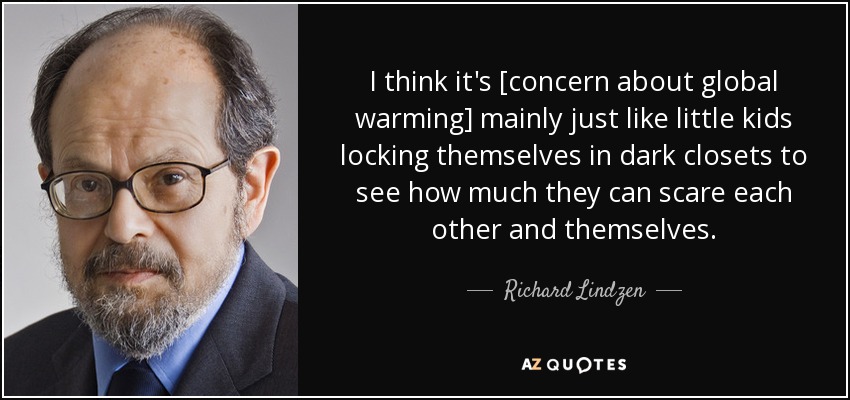
The attempts by scientists and environmental activists to blame everything on global warming has probably increased public skepticism as well. Case in point is a video running on the Weather Channel app about a study that claims to have found a link between suicides and climate change. Even an uninformed public will start to question the validity of all these wild claims.

The public may also have noticed that the most vocal preachers of climate change doom — Al Gore, Leonardo DiCaprio, etc. — don’t act like there’s any crisis whatsoever. They still own huge energy sucking mansions and party on massive gas guzzling yachts.

They aren’t the only global warming hypocrites. A survey earlier this year by researchers at the University of Michigan and Cornell University found that those who said they were “highly concerned” about global warming were the least likely to take individual action. Skeptics were more likely to do the things the alarmist demand: recycle, use public transportation and so forth.

How big a crisis can climate change be if those who scream the loudest about it can’t be bothered to change their own behavior?

Whatever the cause of the climate ennui, it’s clear that years of proselytizing about the “existential threat” posed by a warmer planet has failed to win many converts.

In fact, a recent Gallup survey asked people to name the most important problems facing the country today. Neither “climate change” nor “global warming” even showed up on the list of more than 45 items. Just 2% named “environment/pollution.”

We’d say the public has it right. But don’t be surprised if the media returns to its climate change obsession, if only to take a break from its Trump obsession.

Update July 28:

As if on cue the mainstream media is now awash with headlines claiming AGW is causing heat waves and forest fires.

Summary

The editors are referring to major mainstream media not rising to the bait as usual.  Of course, the activist alarmist websites and blogs have been going crazy with this momentary weather situation.  I noticed, however, on one of the twitter threads comments from a few climate researchers confiding that they don’t speak out lest they be branded as Alarmists.

Now that is progress if scientists are taking to heart the need to be balanced and objective conveying information.  Fame and fortune may still await a breakthrough scary climate finding, but now responses will include skeptical voices. The public is not as naive and gullible as before, having been spoofed too often.

See Also:  On climate polling trickery The Art of Rigging Climate Polls

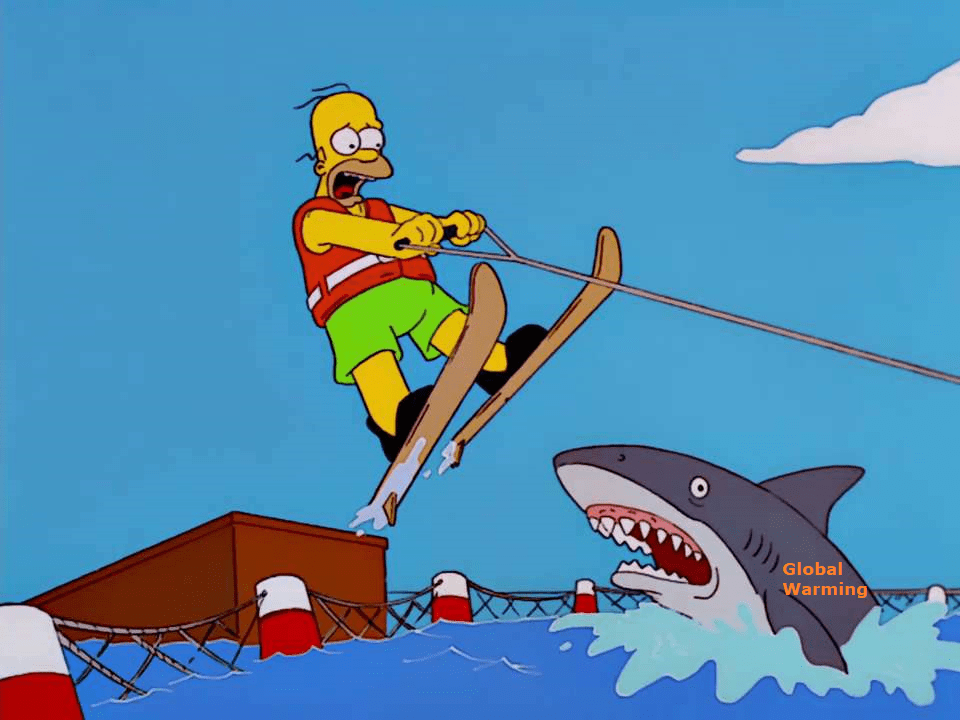
And why climate and suicides do not mix Stanford Jumps Suicide Climate Shark

Preschool Alarmist Brainwashing


Review from Newsbusters New Magic School Bus to Kids: Use Clean Energy or Monsters Will Eat You Excerpts in italics with my bolds.

The Magic School Bus is back in the new Netflix series The Magic School Bus Rides Again! Overall, it’s still a nice, fun 13-episode series like we remember from when we were kids, but with some left turns. There is a pretty predictable take on climate change propaganda for little kids, but that wasn’t the worst. That dubious honor goes to the episode that teaches kids that a monster will eat them if they don’t use alternative clean energy sources.

Of course, conserving energy is a good thing and we should be kind to the earth, but this climate change hysteria is taking over. Usually, somebody will say that 97 percent of climate scientists agree that humans are causing global warming, and I was surprised that figure didn’t come up in this episode. Could it be that they know how easily debunked that number is? Given the way Dorothy Ann presented man-made climate change as fact, I doubt it.

This issue tends to play incredibly well in the mainstream media, as they use climate change as the universal bad-guy, so I’m sure there were plenty of parents who actually thought this episode was a good idea. I find it hard to believe any parents were happy about this next one, though.

Espisode 12: Monster Power. Click on link below to play short excerpt video.

https://www.mrctv.org/embed/518271

Episode 12, “Monster Power,” teaches kids that a monster will eat them if they don’t use alternative clean energy sources. Albert, one of the students, has seen a movie in which the evil monster loves pollution and is “coming for us next for what we’ve done to this planet!” With the class camping in the woods, Miss Frizzle and the other students help him come up with clean energy alternatives (wind, water, etc) so they won’t be eaten. Instead, Miss Frizzle could tell him that monsters aren’t real, but I guess that didn’t occur to her.

While it makes sense to teach kids the science of pollution and about all kinds of energy (I wouldn’t have minded some talk about oil in the dinosaur episode, to be honest), why would they tell kids that a monster will eat them for using the wrong energy source? I may not have the teaching credentials of Miss Frizzle, but I’m pretty sure that’s not scientifically accurate. They must really hate fossil fuels as much as their friends on the left. Keeping in mind that the TV-Y rating for this series means it’s for kids 2-6, I’m sure there are going to be some parents pretty irked at bedtime when kids are scared of the blot monster.

Overall, this is a cute series and fun bit of nostalgia for those of us who enjoyed the original books (or TV series) as kids, but I could have done without the climate change propaganda, and telling kids that traditional energy sources attract monsters is way over the top. Can’t kids just learn without an anti-scientific social agenda?


The Art of Rigging Climate Polls

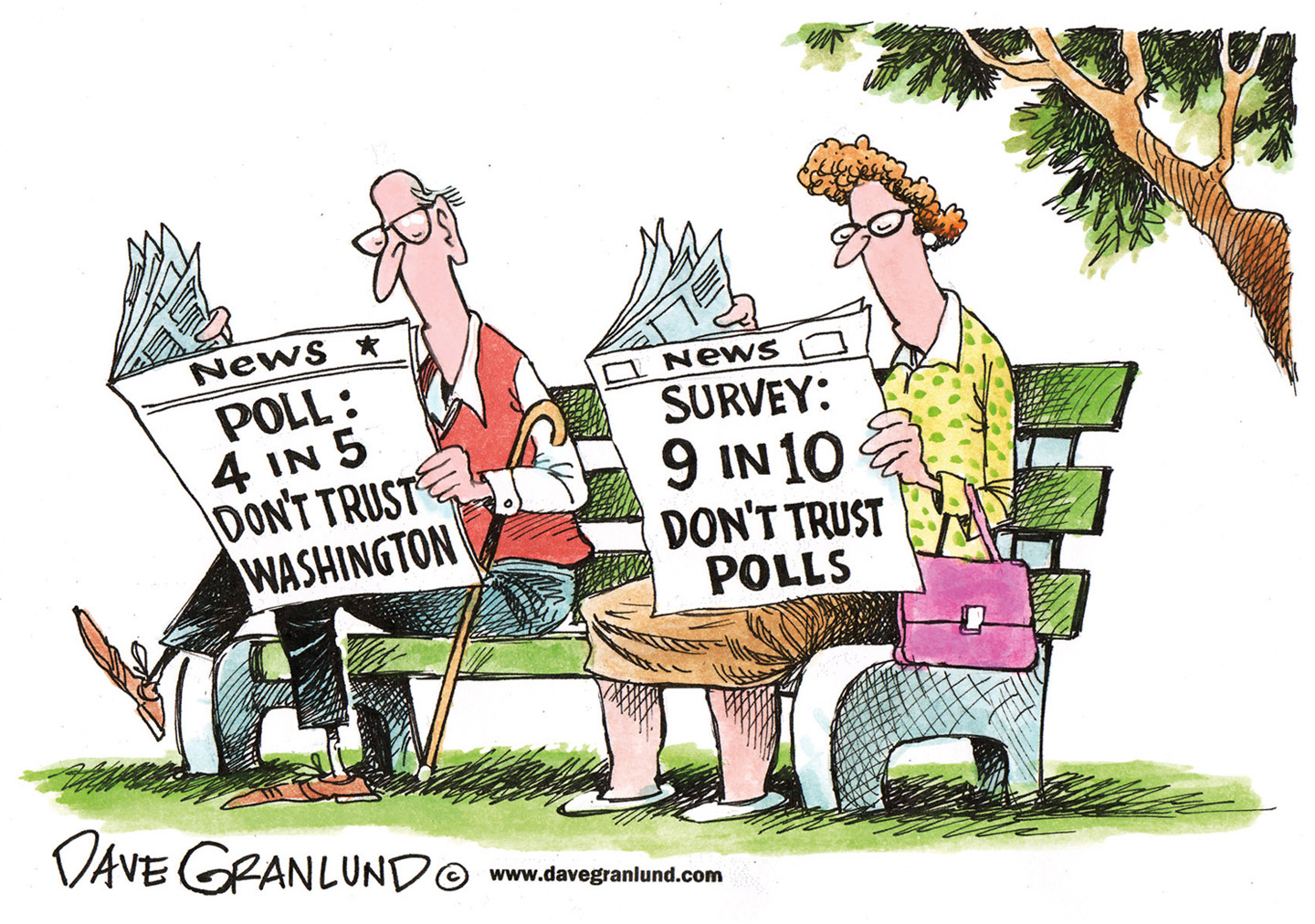
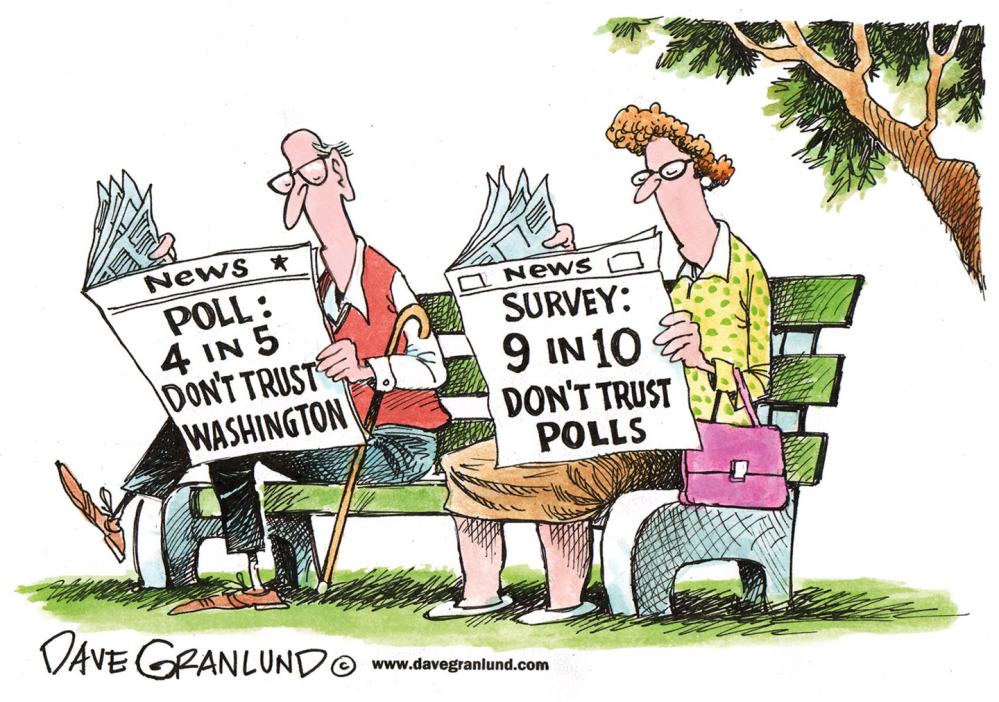
Marketing and social influence makers have used opinion surveys extensively to promote awareness, interest and motivation to engage with their products or preferred policies. I have written before on how this ploy is used regarding global warming/climate change (links at bottom). This post is prompted by a fresh round of climate polls and some further insight into how results are created to support a socio-political agenda.

Of course, any opinion poll on climate as a public policy matter is indicating how much of the blather in the media has penetrated public consciousness, and softened them up for political pitches and financial support. And the continuing samplings and reports need to show progress to keep activist hopes alive.

Just yesterday we had an announcement along these lines. Poll shows consensus for climate policy remains strong is published at Phys.org from Stanford U. (where else, home of the belated Stephen Schneider, among many other leading alarmists). Stanford also happens to be my alma mater, but when I was studying organic chemistry there, we knew life on earth was carbon-based and did not think CO2 was a pollutant.

Climate Public Opinion is a Program of Research by the Stanford Political Psychology Research Group (website link) and has done frequent surveys on the question: What do the residents of the United States believe about global warming?

From psy.org article (excerpts in italics with my bolds):

While the United States is deeply divided on many issues, climate change stands out as one where there is remarkable consensus, according to Stanford research.

“But the American people are vastly underestimating how green the country wants to be,” said Jon Krosnick, a professor of communication and of political science at Stanford, about new findings from a poll he led on American attitudes about climate change.

The study was conducted with ABC News and Resources for the Future, a Washington, D.C.-based research organization. A representative sample of 1,000 American adults nationwide were polled from May 7 to June 11, 2018. The margin of error is +/- 3.5 percentage points.

The poll showed that Americans don’t realize how much they agree about global warming: Despite 74 percent of Americans believing the world’s temperature has been rising, respondents wrongly guessed 57 percent.

“The majority doesn’t realize how many people agree with them,” said Krosnick. “And this may have important implications for politics: If people knew how prevalent green views are in the country, they might be more inclined to demand more government action on the issue.”

Public belief in the existence and threat of global warming has been strikingly consistent over the last 20 years, even in the face of a current administration skeptical about climate change,” said Krosnick, who has been tracking public opinion about global warming since 1995.

Krosnick has learned from his 20 year experience with this topic, and shares with us some of the tricks of the trade. For example, one paper provides their finding regarding the wording of questions.

1. “What do you think is the most important problem facing the country today?”

In this traditional MIP question, about 49 percent answered the economy or unemployment, while only 1 percent mentioned the environment or global warming.

2. “What do you think is the most important problem facing the world today?”

Substituting the word “country” with “world” produced a significant change: 7 percent mentioned environmental issues, while 32 percent named the economy or unemployment.

3. “What do you think will be the most important problem facing the world in the future?”

When asked to consider the future of the planet, 14 percent chose the environment or global warming, while economic issues slipped to 21 percent.

4. “What do you think will be the most serious problem facing the world in the future if nothing is done to stop it?”

This time, 25 percent said the environment or global warming, and only 10 percent picked the economy or unemployment.

“Thus, when asked to name the most serious problem facing the world in the future if nothing is done to stop it, one-quarter of all Americans mentioned either global warming or the environment,” Krosnick said. “In fact, environmental issues were cited more often in response to question 4 than any other category, including terrorism, which was only mentioned by 10 percent of respondents.”

Thus it is that survey results are influenced greatly by the design of the questioning process. Helpfully, the Stanford program provides this history of the questions put to participants over the years. Below are the result categories, some showing the evolving form of questioning, and others just the most recent form for brevity. I will comment on the first few, and leave the others for your reflection (my bolds)

1. Global warming is happening. 2012-2013: What is your personal opinion? Do you think that the world’s temperature probably has been going up over the past 100 years, or do you think this probably has not been happening? 2012: What is your personal opinion? Do you think that the world’s temperature probably has been going up slowly over the past 100 years, or do you think this probably has not been happening? 1997-2011: You may have heard about the idea that the world’s temperature may have been going up slowly over the past 100 years. What is your personal opinion on this? Do you think this has probably been happening, or do you think it probably has not been happening?

Fair question with both responses equally acceptable. The earlier form referred to what they may have heard, but wisely dropped that later on. One does wonder what evidence people use for 100 years of reference.

In a separate study Krosnick tested the effect of asking about “global warming” or “climate change” and concluded:
In the full sample, global warming, climate change, and global climate change were all perceived to be equally serious on average. These findings seem to be inconsistent with the claim that people view climate change or global climate change as less serious than global warming. In addition, the distribution of seriousness ratings were equivalent for global warming, climate change, and global climate change.

IMO it is to his credit that he asks about global warming rather than the vacuous “climate change”.

2.Warming will continue in the future. 2012: If nothing is done to prevent it, do you think the world’s temperature probably will go up slowly over the next 100 years, or do you think the world’s temperature probably will not go up slowly over the next 100 years?

Here comes the phrase:  If nothing is done to prevent it . . . The participant gets the suggestion that rising temperatures have human agency, that we can do something to prevent them. As Krosnick explained above, this phrase will help respondents identify the issue as “environmental” and tap their instinct to protect nature. Implanting this subliminal suggestion sets them up for the next question.

3. Past warming has been caused by humans. 2012: Do you think a rise in the world’s temperature is being caused mostly by things people do, mostly by natural causes, or about equally by things people do and by natural causes? 2012: Assuming it’s happening, do you think a rise in the world’s temperature would be caused mostly by things people do, mostly by natural causes, or about equally by things people do and by natural causes?

Now we have some serious distortions inserted into the findings. The end results will reported as “The % of Americans that believe past warming has been caused by humans.” Note that participants have been primed to think warming is preventable by humans, so obviously humans have caused it (logical connection). Moreover, there are the 50-50 responses that will be counted as human causation. The problem is, people who are mostly uncertain and unwilling to say “don’t know” will fall back to the “equally human, equally nature” response.  It is a soft, not affirmative response.

And a further perversion: Those who have said temperatures are not rising are now told to “Assume it is happening.” What? This is no longer an opinion, it is out-and-out speculation. It appears that “Don’t know” and “Not Happening” are disallowed to force a choice with a 67% chance of getting the right answer: “Caused by Humans.”

4.Warming will be a serious problem for the U.S. 2012: If nothing is done to reduce global warming in the future, how serious of a problem do you think it will be for THE UNITED STATES – very serious, somewhat serious, not so serious, or not serious at all? 2012: Assuming it’s happening, if nothing is done to reduce global warming in the future, how serious of a problem do you think it would be for THE UNITED STATES – very serious, somewhat serious, not so serious, or not serious at all?

Again the phrase “If nothing is done to reduce global warming. . .” signaling participants that this is a serious issue, so don’t come with “not so serious” or (God forbid) “not serious at all.” And again, global warming must be assumed to be happening by anyone still unconvinced of it.

5. Warming will be a serious problem for the world. 2012: If nothing is done to reduce global warming in the future, how serious of a problem do you think it will be for THE WORLD – very serious, somewhat serious, not so serious, or not serious at all? 2012: Assuming it’s happening, if nothing is done to reduce global warming in the future, how serious of a problem do you think it would be for THE WORLD – very serious, somewhat serious, not so serious, or not serious at all?

Same comments regarding #4 apply here, only as Krosnick explained, elevating the issue to a “world problem” triggers even more seriousness in responses.

6. Five degrees of warming in 75 years will be bad. 2011-2012: If the world’s average temperature is about five degrees Fahrenheit higher 75 years from now than it is now, overall, would you say that would be good, bad, or neither good nor bad? 1997-2010: Scientists use the term “global warming” to refer to the idea that the world’s average temperature may be about five degrees Fahrenheit higher in 75 years than it is now. Overall, would you say that if the world’s average temperature is five degrees Fahrenheit higher in 75 years than it is now, would that be good, bad, or neither good nor bad?

In the past, interviewers told participants that global warming is defined as 5 degrees warmer, which triggered “bad” as a response. Fortunately, that obvious bias was dropped, and now people are free to say good, bad or neither. Interestingly, this question is not emphasized in the reports, perhaps because it only gets around 50% “Bad”, even in alarmist places like New York and California.

7. The government should limit greenhouse gas emissions. 2012: As you may have heard, greenhouse gasses are thought to cause global warming. In your opinion, do you think the government should or should not limit the amount of greenhouse gasses that U.S. businesses put out? 2008-2011: Some people believe that the United States government should limit the amount of air pollution that U.S. businesses can produce. Other people believe that the government should not limit air pollution from U.S. businesses. What about you? Do you think the government should or should not limit air pollution from U.S. businesses?

Here the older form of the question was more balanced: Some people believe X, some people believe Y, what do you believe? However, the older question was about air pollution which confuses CO2 (natural plant food) with artificial chemicals. The recent question targets “greenhouse gases”, a term nowhere defined. Now the biased question: Greenhouse gases cause global warming, should the government reduce them? Duh!
8.U.S. federal government should do more to address global warming. 2012: How much do you think the U.S. government should do about global warming? A great deal, quite a bit, some, a little, or nothing? 2009-2011: How much do you think the U.S. government is doing now to deal with global warming? A great deal, quite a bit, some, a little, or nothing? 2008: Do you think the federal government should do more than it’s doing now to try to deal with global warming, should do less than it’s doing now, or is it doing about the right amount?

Note the shift from asking about Whether government should do more than now, to How much is government doing now, to present form: How much more should government do.  Compares with: “Have you stopped beating your wife?”

9. U. S. should take action regardless what other countries do. Do you think the United States should take action on global warming only if other major industrial countries such as China and India agree to do equally effective things, that the United States should take action even if these other countries do less, or that the United States should not take action on this at all?

IOW, Should the US wait for others and be a follower, not a leader? Duh!

Series of Government Policy Questions

The real reason for the survey is to develop support for government officials to impose climate policies upon the population. The flavor of these is below with few comments from me until the end.

10. For the next items, please tell me for each one whether it’s something the government should require by law, encourage with tax breaks but not require, or stay out of entirely. Each of these changes would increase the amount of money that you pay for things you buy.

Reduce greenhouse gas emissions by power plants. Favor lowering the amount of greenhouse gases that power plants are allowed to release into the air?

Favor a national cap and trade program. There’s a proposed system called “cap and trade.” The government would issue permits limiting the amount of greenhouse gases companies can put out. Companies that did not use all their permits could sell them to other companies. Companies that need more permits can buy them, or these companies can pay money to reduce the amount of greenhouse gases that other people or organizations put out. This will cause companies to figure out the cheapest way to reduce greenhouse gas emissions. This type of permit system has worked successfully in the past to reduce the air pollution that companies put out. For example, in 1990, the federal government passed a law like this, called the Clean Air Act, which caused companies to put out a lot less of the air pollution that causes acid rain. Would you favor or oppose a cap and trade system to reduce the amount of greenhouse gases that companies put out?

Tax breaks to produce renewable energy. Do you favor or oppose the federal government giving companies tax breaks to produce more electricity from water, wind, and solar power?

Tax breaks to reduce air pollution from coal. Do you favor or oppose the federal government giving tax breaks to companies that burn coal to make electricity if they use new methods to reduce the air pollution being released from their smokestacks?

Increase CAFE standards for cars. Favor building cars that use less gasoline?
Build electric vehicles. 2012: Building cars that run completely on electricity?

Build appliances that use less electricity. Favor building air conditioners, refrigerators, and other appliances that use less electricity?

Build more energy-efficient buildings. Favor building new homes and offices that use less energy for heating and cooling?

Tax breaks to build nuclear power plants. Do you favor or oppose the federal government giving companies tax breaks to build nuclear power plants?

Who Pays for all this? It is time for the turkeys to face the pilgrim with the hatchet. How willing are you to pay increased taxes to “fight global warming?”

Increase consumption taxes on electricity. Do you favor or oppose the federal government increasing taxes on electricity so people use less of it?

Most places, majorities of respondents were favorable, up to 80% in some states. Perhaps a tribute to relatively cheap electricity in the U. S.  They are blissfully unaware of what can happen to electricity rates, having been spared so far the “Ontario Experience.”

Increase consumption taxes on gasoline. Do you favor or oppose the federal government increasing taxes on gasoline so people either drive less, or buy cars that use less gas?

Nowhere does this get a majority favorable response. It ranges from 15% to 40%, with most places around 30% in favor of higher gasoline taxes.

And finally, how much do you care and how much do you know?

Warming is extremely important personally (and is likely to influence voting). How important is the issue of global warming to you personally – extremely important, very important, somewhat important, not too important, or not at all important?

Less than 17% of people say global warming is personally extremely important, and most places are under 10%

Highly knowledgeable about global warming. How much do you feel you know about global warming – a lot, a moderate amount, a little, or nothing?
Americans rate their global warming knowledge higher than other countries, going up to 60-70% claiming “Highly Knowledgeable.” Other country surveys would report 25% more typically.

Conclusion

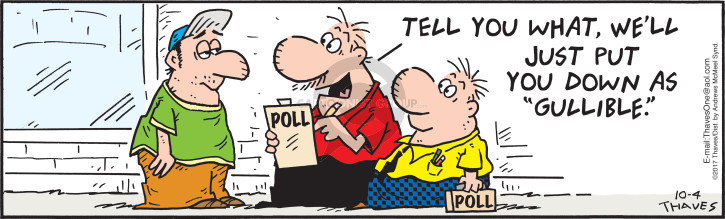
An opinion poll is a mirror claiming to show us ourselves. All polls have error margins, and some are purposely bent to a desired distorted outcome.

In modern social democracies, polls and media are used to shape and report public opinions required by ruling elites to impose laws and policies unwanted by the people. A recent example was the distorted Canadian survey on carbon pricing used by Trudeau government to justify a carbon tax. That poll is deconstructed in a post Uncensored: Canadians View Global Warming.

Krosnick said that people taking his climate poll were surprised that the responses were not more skeptical of global warming claims. After seeing how the survey is put together, I am inclined to believe that participants and their neighbors are actually more skeptical than depicted in the results.  This showed up in the low numbers saying global warming is an important personal issue.  Despite agreeing with alarmist talking points, people seem to know this is about virtue signaling and tribal politics.  It is an “everywhere elsewhere” problem.

Finally, in the survey, Americans rate themselves as highly knowledgeable about global warming, up to 60-70% in some states. Other countries doing such climate surveys typically get about 25% of people saying that. For so many to be taken in by such a survey suggests that Americans’ actual knowledge of global warming is highly overrated.

Background:  Another Climate Push Poll

Climate Is a State of Mind
Sloppy Science + Bad Reporting = Fake Scare


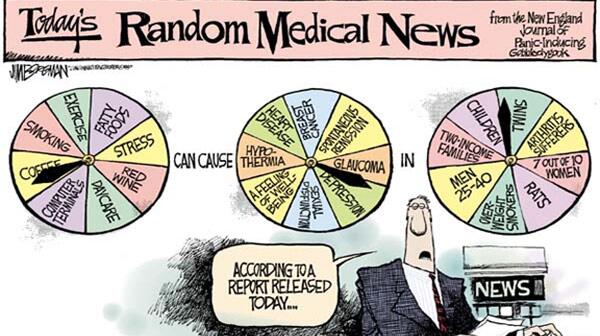
Abusing science to incite fear is not confined to global warming/climate change. Medical science has also been debased by taking up the appeal to public alarm. The current example being exploitation of ovarian cancer, as explained by Warren Kindzierski writing in Financial Post How weaselly science and bad reporting consistently find cancer links that don’t exist  (Weaselly: Stretching facts with the use of such words as ‘this could,’ ‘can,’ ‘may,’ ‘might,’ ‘probably,’ ‘likely’ cause cancer)

Last month, the Quebec court authorized a class-action suit against two brands of baby powder that alleges that regular use of talc powder by women in their genital area is linked to a higher risk of ovarian cancer. Part of the allegations relate to claims that an ovarian cancer risk from powdered talc use is demonstrated by nearly four decades of scientific studies. Cosmetic talc has certainly been the subject of much scientific debate, study and, increasingly, legal challenge.

However, the cosmetic talc-ovarian cancer link is commonly misunderstood. Published biomedical studies cover both sides, suggesting a talc-ovarian cancer link and showing no link. Even today in prominent journals, letters to the editor — penned by scientists — rage back and forth, defending their studies or attacking the other side’s studies.

Now this is civilized, real science.

This bouncing back and forth of positive versus negative effects between talc and ovarian cancer is referred to as “vibration of effects” by John Iaonnidis, a professor of medicine and of health research and policy at Stanford University. Studies vary depending on how they are done. Why is this? Well, getting scientists to agree on important things like methods, what data to use and how to analyze and interpret effects from subtle human exposures is next to impossible. It would be no problem if one were studying cancer risks in populations receiving large exposures over long durations; but such situations are non-existent.

The truth is that the ability of any biomedical method, epidemiology included, to discriminate cancer risks in people from small exposures to a physical or chemical agent does not exist.

Most cancers are caused by a number of factors. As a result, establishing cancer causation is complex — unless a particular risk factor is overwhelming. Epidemiology studies cannot and do not realistically replicate this complexity, at least not very well. That is why the U.S. National Institutes of Health and the National Cancer Institute lists a number of key risk factors for ovarian cancer and talc is not one of them.

The institute states that it is not clear whether talc affects ovarian cancer risk. An expert U.S. cosmetic-ingredient review panel assessed the safety of cosmetic talc in 2015. It thoroughly analyzed numerous studies investigating whether or not a relationship exists between cosmetic use of talc in the perineal area and ovarian cancer. The panel determined that these studies do not support a causal link. They also agreed that there is no known physiological mechanism by which talc can plausibly migrate from the perineum to the ovaries. The news coverage of the lawsuit has been silent on that evidence.

Part of the public’s misunderstanding about talc comes from scientists offering opinions about cancer from small exposures. Too many scientists use weasel words to stretch facts: “This could,” “can,” “may,” “might,” “probably,” “likely” cause cancer. Flimsy so-called evidence from their studies that suffer from vibration of effects and their speculations are voraciously inhaled by naïve journalists. Stretched facts miraculously get reported as facts to the public — or worse, misused for litigation purposes.

The woman’s bathroom is a chemical exposure chamber with literally dozens of cosmetic products used at various times. Both skin contact and inhalation regularly occur with grooming products. However, repeated uses of small amounts of cosmetic talc or any other cosmetic product do not amount to overwhelming exposures despite the claims of some scientists and media. Overwhelming exposures — the ones that cause effects — are those that occur with laboratory rats and mice. Underwhelming exposures are what occur to people in the real world.

It is highly speculative that repeated use of small amounts of cosmetic talc is a definitive cause of ovarian cancer. It is not a definitive cause; it is only suggestive. Prominent organizations such as the U.S. National Cancer Institute and expert panels should make clear statements about such cancer risks, but they do not. Selective methods in epidemiology studies, speculation by scientists and inaccurate reporting by news media are ingredients used to transform weak suggestive evidence from underwhelming cosmetic talc exposure into something that is mistakenly claimed to be harmful for the public.

And that is why we end up with class action suits against cosmetic companies.

Warren Kindzierski is an associate professor in The School of Public Health at the University of Alberta.

More Civil Climate Discourse

As discussed in Coercive PC Discourse, there is a lot of insulting and shouting when it comes to climate change.  As the summary of the post said:

But there is a way to reduce needless division over the countless disagreements that are inevitable in a pluralistic democracy: get better at accurately characterizing the views of folks with differing opinions, rather than egging them on to offer more extreme statements in interviews; or even worse, distorting their words so that existing divisions seem more intractable or impossible to tolerate than they are. That sort of exaggeration or hyperbolic misrepresentation is epidemic—and addressing it for everyone’s sake is long overdue.

In the interest of demonstrating how climate realists can deal in a civil manner with disagreeable others, I provide some further helpful examples from Alex Epstein, author of The Moral Case for Fossil Fuels. Excerpts from his recent emails with my bolds.

1. Promoting Dialectic rather than Debate

Late last week I got this email from reader Peter Conley. I hope you find it as motivating I do. Peter is proof that with enough study and practice it’s possible to get amazing results in your energy conversations. At the end I’ll tell you a new technique I learned from Peter’s email.

***READER COMMENT***

Hello Alex,

I use [your framework] to discuss the issue of energy every opportunity I get and it is highly effective at promoting dialectic rather than debate. I had an experience with a schoolteacher on a Southwest flight recently that illustrates its effectiveness:

Teacher: “Do you believe in climate change?”

Me: “That is a very interesting and complex topic. It’s obviously very important to you. What are your thoughts on the subject?”

Teacher: “We need to stop it!”

Me: “And why is that?”

Teacher: “Because the ice caps are melting!!”

Me: “And why do you care about that?”

Teacher: “Because sea levels will rise!”

Me: “And why is that alarming?”

Teacher: “Because coastal cities and entire countries will be underwater!!”

Me: “So, you’re concerned about the negative impacts it will have on people?”

Teacher: “Of course, I don’t want to leave such a dangerous world to my grandkids.”

Me: “Of course not, neither do I. Would you agree then that when we think about this issue, we should use human flourishing as our standard of value?”

Teacher: “Yes, definitely!”

Me: “Do you know, then, if human deaths because of climate-related factors such as extreme hot, extreme cold, and drought are increasing annually or decreasing?

Teacher: “Well, I’d imagine they are increasing.”

Me: “What if I told you that the number of such deaths worldwide have decreased from over 3 million one year in the early 30s, to under 30,000 in this decade?”

Teacher: “Wow! Why is that?”

Me: “Because of technology. Because we are so much better at protecting ourselves from the naturally dangerous environment than our ancestors were. So, what would you say the most basic human need is?

Teacher: “Food, shelter, water, security.”

Me: “Those are all actually products of fulfilling one basic need, one basic necessity; the most basic human need is energy.”

He agreed, and further agreed that we must look at all costs and benefits and had a two-hour discussion about those. He was able to understand my thinking and said “I didn’t know that” far more times than he said “I don’t know about that.”

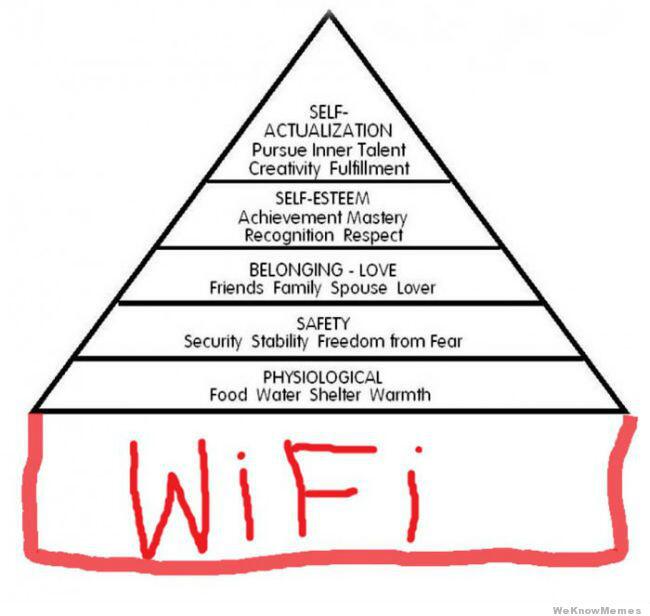
I like your point that the energy industry is the industry that powers all other industries. I have found it highly effective to explain that point after first asking “What is the most basic human need?” Most of the time I get answers like the teacher gave, or references to Maslow’s Hierarchy of Needs. Helping the person conclude that energy is the most basic human need helps to frame the conversation in terms of human flourishing . . .
I appreciate all the work that you do, and you have inspired me to do what I can to correct the conversations people are having.

Sincerely,

Peter

>>>MY COMMENTS

As I said at the outset, you’re doing an amazing job.

Here are two tactics I want to experiment with myself after reading your note.

Getting agreement on a pro-human standard by asking “Why” to their value statements. I usually get another person to agree on a common, pro-human standard by asking something like “Would you agree that the best decision is the one that most advances human life?” But your way is intriguing. When they say they care about something, you keep asking “Why” until you get down to the level of an ultimate standard—and then you offer “human flourishing” as your view. One reason this is effective is because it quickly introduces the idea that there need to be reasons (standards) for caring about things. Another reason it’s effective is that you’re challenging the idea that environmental change—ice caps melting—is inherently bad. I imagine that you need to strike a careful tone while asking these questions. If you come across as completely indifferent to the thing they claim to care about it could backfire. But if you ask the question earnestly, indicating that you’re looking to clarify not contradict, I can see how it would work well.

How you explain that energy is a fundamental need. The question “What do you think the most basic human need is?” Is an engaging question to ask. By getting the other person to state what they think are the most important needs you’re connecting them very concretely to the requirements of human flourishing. And then you show how energy is fundamental to those needs, connecting energy to human flourishing. This ensures that access to energy doesn’t become anything resembling optional or derivative—it stands as fundamental.

2. What to do when someone calls you the devil

***READER COMMENT***

I’ve been listening to some of your interviews on YouTube and I sincerely appreciate your effort to make the case for fossil fuels. I am about to graduate with a degree in chemical engineering and I have a job lined up to work for a major oil company at their largest US refinery.

On my college campus I encounter people that seem to be so clueless as to the benefits of fossil fuels that I don’t even know where to begin to try to convince them. I talked to one young freshman girl and when I told her that I want to go work in oil and gas, she responded with “you mean Satan?” I was so stunned at her hostility that I didn’t know how to respond. I just said “yeah sure,” so that I didn’t have to engage in a combative conversation. What do you think I should have done in this situation?

Best regards,

Zachery Baker

>>>MY COMMENTS

Great question, Zachary.

Imagine that you had told the freshman not “I want to go work in oil and gas,” but “I want to go work for a hospital.” And she had responded “You mean Satan?”

How would you react?

Here’s my guess:

  1. You would find her response hypocritical; you would be sure she and certainly those she cares about have taken advantage of the life-and-death benefits of hospitals.
  2. You would find her response offensive; she is assuming you would work for an evil enterprise.

I think the exact same reaction is warranted in the case of fossil fuels. Fossil fuels, like hospitals, have risks (hospitals have more) but are indispensable to human flourishing. If someone condemns us for pursuing a career providing energy that billions of people need and request, they are being hypocritical and offensive.

In my experience you can profitably point out either of these if you do so politely and calmly.

Express curiosity about hypocrisy

In the case of hypocrisy, I like to take a tone of curiosity and/or confusion, not condemnation.

F: “You mean Satan?”

You: “I’m curious why you think they’re Satan. Just looking at you right now you appear to be a major user of their products…”

She’ll either acknowledge that she’s a user or not—either way you can transition into why we all use products of the oil industry.

Be offended (but calm)

You: I’m curious, would you ever work for an industry you believed was evil?

F: No, of course not.

You (gravely): Neither would I. (Don’t break eye contact.) And I find it offensive that you think I would without asking me why I chose to work in this industry.

This will give the other person the opportunity to apologize and express sincere interest in your thought process—or to be rude and prove unworthy of your time.

Let me know how it goes!

Bravo Alex for engaging people constructively in the battle for hearts and minds as we perhaps enter a cooling period where our energy needs will be even more pronounced.

Previous Post with different examples: Civil Climate Discourse

Footnote:  For more on how green zealots are poisoning the social environment, read the poignant story of Tisha Schuller, an environmentally responsible energy consultant writing in the Breakthrough Institute Journal:  Reclaiming Environmentalism  How I Changed My Mind Without Changing My Values

Schuller on where she is today:

For several years, I stopped calling myself an environmentalist. After five years of threats, extremism, and misinformation from a community I’d once considered myself a part of, I simply couldn’t use the term anymore.

It’s easier, now, to unwind my complex relationship with environmentalism and environmentalists. I’m no longer a target of constant criticism and threats, for one, and I have the mental leisure to dissect my own experiences and prejudices. With the benefit of hindsight, I’ve become passionate about reclaiming the term. I am an environmentalist.

But I can no longer embrace many of the totems that have come to define environmentalism for many people.


Civil Climate Discourse

The issue of global warming/climate change has been used to polarize populations for political leverage. People like myself who are skeptical of alarmist claims find it difficult to engage with others whose minds are made up with or without a factual basis. In a recent email Alex Epstein gives some good advice how to talk about energy and climate. At the end I provide links to other material from Alex supporting his principle message regarding human benefits from using fossil fuels. Text below is his email with my bolds.

Two simple-but-powerful tactics

1. Opinion Stories

Unless I have some specific reason for wanting to have a long conversation I like to keep my conversations short, with the end goal of getting the other person to consume some high-impact resource.

One way to make this even more effective is to offer to email/mail the person a resource. Then you’ll have their contact info and can follow up in a few weeks.

The last paragraph of your message is really important. You’re telling the story of how you came to your opinion. I call this device “the opinion story.”

Here’s how it works.

Imagine you’re trying to persuade someone to read your favorite book. My favorite book is Atlas Shrugged, by Ayn Rand.

I used to say: “Atlas Shrugged is the best book you’ll ever read. You have to read it.”

That’s an opinion statement. If you haven’t read the book I’ll bet that statement makes you resistant. “Oh really? You’re telling me what the best book I’ll ever read is? You’re telling me what I have to read?”

Opinion statements often breed resistance and reflexive counter-arguments. So now I try to persuade people differently.

I might say: “My favorite book is Atlas Shrugged by Ayn Rand. I read it when I was 18 and the way the characters thought and approached life motivated me to pursue a career I love and give it everything I have.”

How do you react to that statement?

Probably better. You’re probably not resistant. You may well be intrigued. And you can’t disagree with me–because I didn’t tell you what to think, I told you my opinion story. I respected your independence.

While statements breed resistance and counter-argument, stories often breed interest and requests for more.

You can use opinion stories for anything, no matter how controversial.

For example, if someone asks me about my book, The Moral Case for Fossil Fuels, I don’t need to say “I prove that we should be using more fossil fuels, not less.” I can just say “I researched the pros and cons of different forms of energy and was surprised to come to the conclusion that we should be using more fossil fuels, not less.”

I like to have an opinion story for every controversial opinion I hold.

2. Introducing Surprising Facts

Reader Comment: “The problem I always run into is that they really believe Germany is a success.”

I’ve had the same experience, too! On many issues.

Often in conversation the phenomenon of conflicting factual claims on an issue—such as the impact of solar and wind on Germany’s economy—leads to an impasse.

One way to deal with this is to focus on establishing an explicit framework, with human flourishing (not minimum impact) as the goal and full context analysis (not bias and sloppiness) as the process. Most disputes stem from conflicting frameworks, not conflicting facts. And if you offer a compelling framework you’ll be more trustworthy on the facts.

That said, here’s a tactic I discovered a few years ago to make certain factual points much more persuasive in the moment..

I’ll start with how I discovered it.

I was walking through the Irvine Spectrum mall with a good friend when we ran into two young women working to promote Greenpeace.

My friend found one of the women attractive and said he wanted to talk to her. I thought, given my experiences with (paid) Greenpeace activists, that this was unlikely to be an edifying experience, and encouraged him to instead record a conversation between me and one of the women. Unfortunately for posterity, I was unpersuasive and what follows was never recorded.

I decided to talk to the other Greenpeace woman. She quickly started “educating” me on how Germany was successfully running on solar and wind.

Me: “Really? I’m curious where you’re getting that because I research energy for a living–and Germany is actually building a lot of new coal plants right now.”

Greenpeace: “No, that can’t be true.”

Me: “Okay, how about this? I’ll email you a news article about Germany building new coal plants. If I do, will you reconsider your position?” [Note: This is an example of the technique I recommended above.]

Greenpeace: Hesitates.

Me: “Actually, wait, we have smartphones. I’m going to Google Germany and coal. Let’s see what comes up.”

Displaying on my iPhone is a recent news story whose headline is something very close to: “Germany to build 12 new coal plants, government announces.”

Me: “So what do you think?”

Greenpeace: “I don’t know,” followed by—very rare for a Greenpeace activist—having nothing to say.

Had this been a normal person I am confident the live confirmation of the surprising fact would have made a lasting impression.

I think this tactic works best for news stories about surprising facts. Vs. an opinion story about some issue of analysis, like what Germany’s GDP is.

Summary

Alex Epstein is among those who demonstrate from public information sources comparisons between societies who use carbon fuels extensively and those who do not. The contrast is remarkable: Societies with fossil fuels have citizens who are healthier, live longer, have higher standards of living, and enjoy cleaner air and drinking water, to boot. Not only do healthier, more mobile people create social wealth and prosperity, carbon-based energy is heavily taxed by every society that uses it. Those added government revenues go (at least some of it) into the social welfare of the citizenry. By almost any measure, carbon-based energy makes the difference between developed and underdeveloped populations.

A previous post Social Benefits of Carbon referenced facts and figures from Alex’s book which can be accessed here

Other Resources:
Two Page Overview of The Moral Case for Fossil Fuels — What it is and why it matters 
main points are:
How to think about our energy future
Fossil fuels & human flourishing: the benefits
Fossil fuels & human flourishing: environmental concerns

11 page Introduction to The Moral Case for Fossil Fuels

Maslow’s hierarchy of human needs updated.

How’s Your CCIQ?


H/T David Wojick and CFACT

Doctors for Disaster Preparedness are concerned to be ready for real disasters and not be distracted by irrational fears like global warming/climate change. They have provided a useful resource for people to test and deepen their knowledge of an issue distorted for many people by loads of misinformation and exaggerations.

From David Wojick:

A new lesson set called the Climate Change IQ (CCIQ) provides a good skeptical critique of ten top alarmist claims. The format is succinct and non-technical. Each alarmist claim is posed as a question, followed by a short skeptical answer, which is highlighted with a single telling graphic.

Then there is a link to a somewhat longer answer, which in turn includes links to a few online sources of more information. Each lesson is also available in a printable PDF version, suitable for classroom use. This compact format is potentially very useful.

CCIQ comes from a long-standing skeptical group called the Doctors for Disaster Preparedness (DDP). Despite the name, DDP gives attention to pointing out scares that are not disasters waiting to happen. Not surprisingly climate alarmism gets a lot of this attention.

The ten topic questions are wide ranging, including the following. Each speaks to a popular pro-alarmist news hook.

Is climate change the most urgent global health threat?

Are government-sponsored climate scientists the only credible sources of information relating to climate-change policy?

Is the increase in atmospheric CO2 making wildfires worse?

Why can’t all States emulate California’s proposed “clean” energy standards?

What would happen if atmospheric CO2 concentration dropped by half, say to less than 200 ppm?

Are human CO2 emissions acidifying the oceans and endangering shell-making animals?

Will Manhattan and Florida soon be under water if humans do not curtail use of “fossil fuels”?

Do 97% of climate scientists agree that catastrophic climate change will result if humans do not curtail use of “fossil fuels”? (This one includes the dynamite John Christy graph showing the rapidly growing divergence of climate model global temperature forecasts with real world observations.)

Is Arctic ice disappearing?

And the number 1 CCIQ question: Would lowering atmospheric CO2 prevent or mitigate hurricanes?

Check it out. Inquiring minds want to know.


Alarmists Anonymous

The latest example of arctic hysteria comes from the usual suspects published at the usual venue, Inside Climate News. Polar Ice Is Disappearing, Setting Off Climate Alarms

Excerpts below with my bolds: The short-term consequences of Arctic (and Antarctic) warming may already be felt in other latitudes. The long-term threat to coastlines is becoming even more dire.

“When you’re taking out 30, 40, almost 50 percent of the ice cover, that’s a big change in the environment,” Meier said. “Whether we’re seeing it yet, there’s still some debate, but whether there will be an effect as we continue to lose ice, I think that’s pretty obvious.”

“There’s no evidence that anything is recovering here,” said Mark Serreze, the director of the NSIDC. “What we’ve seen historically is a downward trend in ice extent in all months. Superimposed on that are the ups and downs of natural variability. We’re going to continue to head downward.

“We are looking at an ice-free Arctic Ocean sometime in the 2040s,” said Serreze. “There’s no evidence that we’ve seen anything like this before.”

Ted Scambos, lead scientist with the National Snow and Ice Data Center, said that while the current pace of melting is not alarming, a series of papers “has led to a realization that the West Antarctic Ice Sheet may already be in an irreversible retreat.

Greenland is melting, too—for now, it’s the biggest threat. “Greenland has become Loserville,” said Jason Box, who tracks ice for the Geological Survey of Denmark and Greenland.

“New observations from many different sources confirm that ice-sheet loss is accelerating,” the United States Global Change Research Program said in its comprehensive special report on climate science. “Up to 8.5 feet of global sea level rise is possible by 2100” in a worst-case emissions scenario. That’s almost 2 feet more than scientists expected just a few years ago.

“So we’re guaranteed significant sea level rise no matter what we do, even under the optimistic Paris scenario,” Box said. “We had better prepare.”

These warnings of wolves are starting to sound the same: “It never happened before, is not happening now, but it will surely destroy us in the future if we don’t do something.”

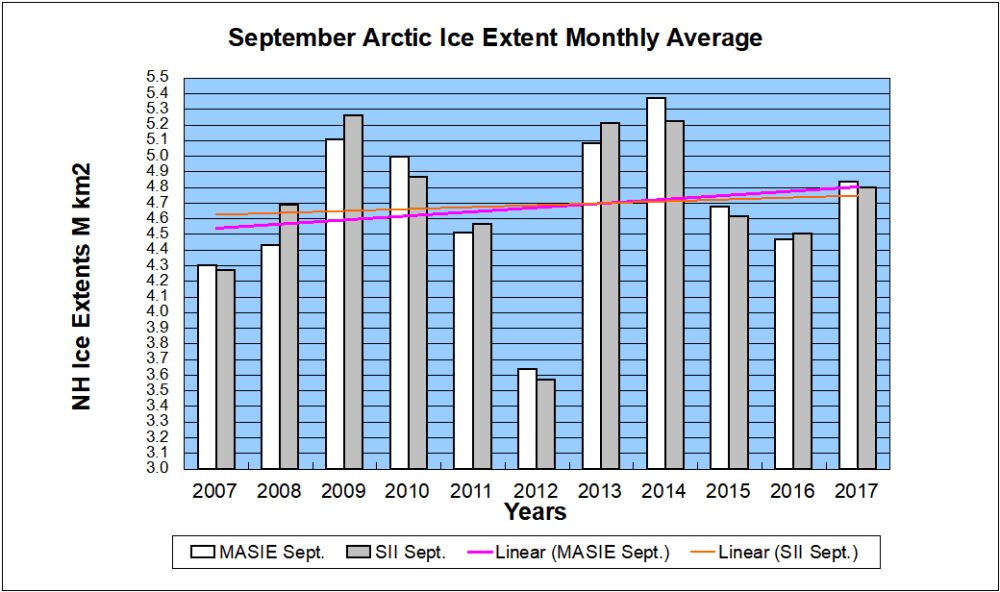
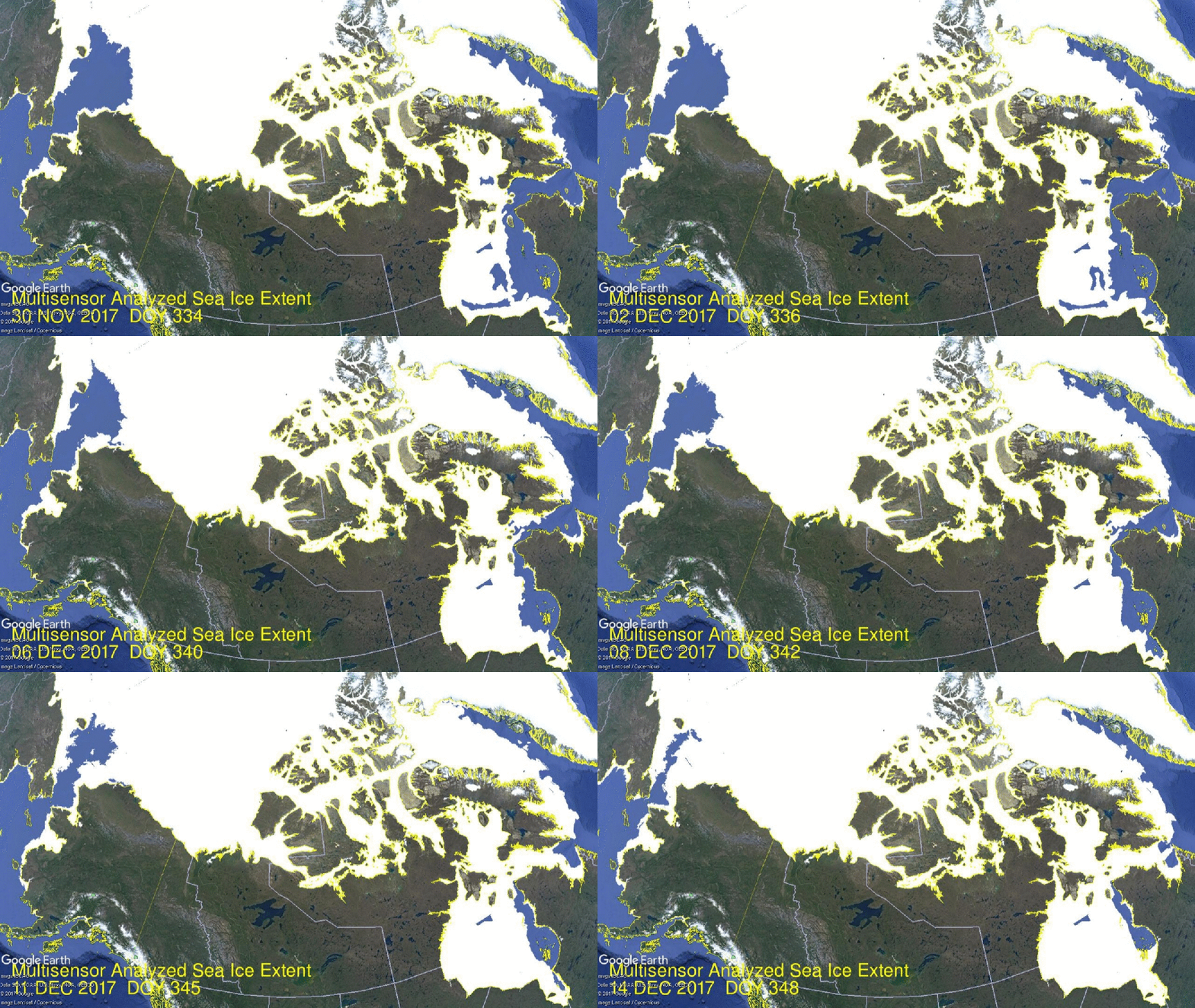
Meanwhile the facts on the ground are not alarming: For example September minimums:
More details at Overachieving September Arctic ice

And the refreezing is not at all unusual:
The AAs (Arctic Alarmists) are putting their faith in the BBs (Barents and Bering), the only two basins below average this year. Both are marginal to the Arctic Ocean and both are heavily affected by human marine activities, including shipping, navies, fishing, tourism and sea floor extraction.


These outrageous appeals by alarmists in the face of contrary facts remind me of the story defining the term “chutzpuh.” A young man is convicted of killing his parents, and later appears before the judge for sentencing. Asked to give any last words, he replies: “Go easy on me, your Honor, I’m an orphan.”
alcoholics-anonymous-logo-e1497443623248

Fortunately, there is help for climate alarmists. They can join or start a chapter of Alarmists Anonymous. By following the Twelve Step Program, it is possible to recover and unite in service to the real world and humanity.

Step One: Fully concede (admit) to our innermost selves that we were addicted to climate fear mongering.

Step Two: Come to believe that a Power greater than ourselves causes weather and climate, restoring us to sanity.

Step Three: Make a decision to study and understand how the natural world works.

Step Four: Make a searching and fearless moral inventory of ourselves, our need to frighten others and how we have personally benefited by expressing alarms about the climate.

Step Five: Admit to God, to ourselves, and to another human being the exact nature of our exaggerations and false claims.

Step Six: Become ready to set aside these notions and actions we now recognize as objectionable and groundless.

Step Seven: Seek help to remove every single defect of character that produced fear in us and led us to make others afraid.

Step Eight: Make a list of all persons we have harmed and called “deniers”, and become willing to make amends to them all.

Step Nine: Apologize to people we have frightened or denigrated and explain the errors of our ways.

Step Ten: Continue to take personal inventory and when new illusions creep into our thinking, promptly renounce them.

Step Eleven: Dedicate ourselves to gain knowledge of natural climate factors and to deepen our understanding of nature’s powers and ways of working.

Step Twelve: Having awakened to our delusion of climate alarm, we try to carry this message to other addicts, and to practice these principles in all our affairs.

Summary:

With a New Year close at hand, let us hope that many climate alarmists take the opportunity to turn the page by resolving a return to sanity. It is not too late to get right with reality before the cooling comes in earnest.

This is your brain on climate alarm.  Just say No!

Suicidal Climatist Narrative

Micheal Walsh published The Suicidal Narrative of the Modern Environmental Left, November 16, 2017.

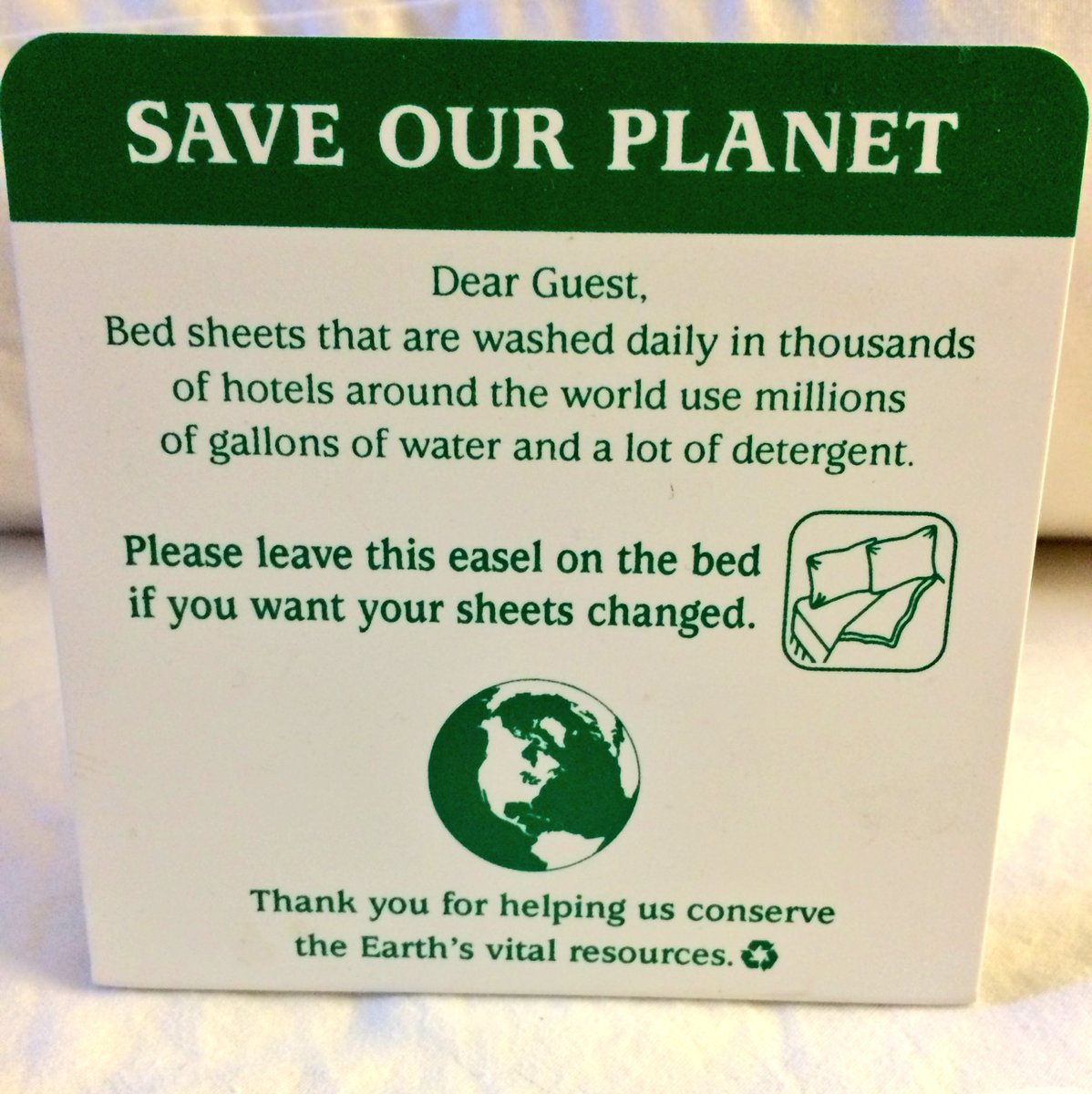
Walsh presents two recent experiences showing how environmental concerns are embedded everywhere including plane trips and merchandising, then gets into the implications. His text with my bolds and images.

It’s all just advertising, of course, and thus harmless enough. It also goes to reinforcing the narrative: that selfish man is the cause of species endangerment, that primitive societies are superior to developed ones (but then who would buy the locally sourced cocoa beans and moringa leaves?), and that traditional medicine—which is to say, no medicine at all—is somehow superior to what those pill-pushing quacks foist on you before they climb in their BMWs and head out to the links for a round or two of golf. Were that true, the ancient Greeks and Romans might all have lived into their 80s, instead of dying in their 20s and 30s, as unsustainable folks tended to do back then.

Which brings us, ineluctably, to “climate change” and this piece in the Times: “The More Education Republicans Have, the Less They Tend to Believe in Climate Change.” Yes, you read that right:

“Climate change divides Americans, but in an unlikely way: The more education that Democrats and Republicans have, the more their beliefs in climate change diverge.  About one in four Republicans with only a high school education said they worried about climate change a great deal. But among college-educated Republicans, that figure decreases, sharply, to 8 percent.”

The author’s underlying assumption is that the more you know about “man-made climate change,” the more eager you should be to chow down on Endangered Species Chocolate or shovel some women’s-collective moringa into your smoothie before you leave your ant-farm apartment to hop on the mass-transit system on your way to a day job that somehow involves you, personally, saving the planet—not so much by what you do, but by what you don’t do.

But that’s not a future we on the Right want to embrace. I take this poll as a heartening sign that the more you educate yourself about the transparent fraud of “man-made climate change,” the less you’re likely to believe in their genteel fictions of peaceful, happy villages in Liberia or their apocalyptic notions of the End of the World as We Know It, just about any day now. As we’ve learned time and again, mountebanks and charlatans are always promising that the end of days is just around the corner, if only we will repent; find Jesus; join their cult; give away all our possessions; or at least sign up for a lifetime supply of snake oil, delivered by Amazon drones right to our doorsteps.

We’ve seen this movie before, of course. In April, Mark J. Perry of the American Enterprise Institute detailed 18 different instances when “[t]he prophets of doom were not simply wrong, but spectacularly wrong.”

Never mind that the Earth’s climate is always changing; we wouldn’t be here at all if it hadn’t. Never mind that there’s little humans can do to interfere with planetary processes, most of which are beyond our ken. Never mind that we flatter ourselves if we think so. Never mind that to characterize carbon dioxide—which we exhale so that the Amazon rain forest and those West African moringa plants might inhale—as a dangerous “greenhouse gas” is profoundly anti-human.

It’s what you’d expect from a political philosophy that denies God and sees itself as its own worst enemy: a narrative that must end in suicide, and all in the name of the greater good. All we ask our friends on the Left is not to take us with you.

Climate lemmings on the move.

Suppressing Climate

The above video is how I first heard of PragerU.  Now the nonprofit organization is suing Google and Youtube for their ideological bias in suppressing Prager’s videos.

PragerU Sues YouTube For Discriminating Against Conservative Videos
is an article by Ben Weingarten at The Federalist.  Excerpts below with my bolds.

Those blackballed from social media platforms for sharing views dissenting from prevailing progressive Silicon Valley orthodoxy have to date had little recourse against the tech speech police. That is why PragerU’s newly filed suit against Google and Google-owned YouTube alleging unlawful censorship and free speech discrimination based on the educational video purveyor’s conservative political viewpoint has the potential to be groundbreaking.

The lawsuit, filed in federal court in California, details upwards of 50 PragerU educational videos that YouTube has, in PragerU’s view, unjustifiably slapped with “restricted mode” or “demonetization” filters, violating its First Amendment right to free speech. These filters limit or otherwise prevent viewers, based on characteristics like age, from consuming content deemed “inappropriate.”

More arguably provocative videos touch on topics such as Islamic terrorism, campus rape, and gender identity. According the suit, “The videos do not contain any profanity, nudity, or otherwise inappropriate ‘mature’ content. The censored videos fully comply with the letter of YouTube’s Terms of Use and Community Guidelines.” Moreover, PragerU illustrates that comparable videos from non-conservative sources like BuzzFeedVideo, CNN, and “Real Time with Bill Maher” have not been subjected to such filters.

Leaving aside the inherent subjectivity for a moment, if PragerU’s content is “appropriate,” and other publishers are able to upload similar content without being penalized, then what better explanation is there for YouTube’s censorship than viewpoint discrimination? PragerU’s dealings with YouTube over its content restrictions only strengthen the validity of this question.

As PragerU summarizes it:

Google/YouTube seek to justify…[its] animus and bias [towards PragerU’s political identity and viewpoint] not by claiming that PragerU has violated YouTube’s restricted content guidelines or criteria, but by arguing that they retain unfettered discretion to censor any video content that they deem “inappropriate,” no matter how subjective, baseless, or arbitrary that decision is…For over one year, PragerU has worked patiently and cooperatively to try to resolve the censorship issues that comprise this Lawsuit. In response, Google/YouTube have provided vague, misleading, confusing, and often contradictory information that not only has prevented resolution of the issues, but constitutes further evidence and indicia that their restricted mode filtering applied to PragerU is based on Defendants’ [Google/YouTube’s] intentional discrimination and animus

That as unimpeachable a source as the video-producing nonprofit PragerU is challenging YouTube should serve as a powerful signal that conservatives and others whose views social media companies deem unworthy will no longer permit their rights to be trampled upon. This is significant regardless of the case’s outcome.

PragerU’s efforts are essential, and may serve as the vanguard of a successful lawfare effort. But while legal action is necessary, it is by no means a sufficient and sure safeguard of our rights. As we have seen time and time again, judges routinely permit our liberties to erode, and sometimes actively assist. Preserving free speech, like all of our cherished freedoms, requires constant vigilance and persistent defense.

More on biased public and social media:

Media Duping Scandal

Ideological Fault Lines

Yellow Climate Journalism