Canada Road to Ruin Paved with Trudeau’s CO2 Intentions

Bill Bewick explains in his National Post article Federal climate policy makes us poorer.  Excerpts in italics wtih my bolds and added images.

The clean fuel standard on top of an escalating carbon tax and onerous emissions
targets will make everything more expensive

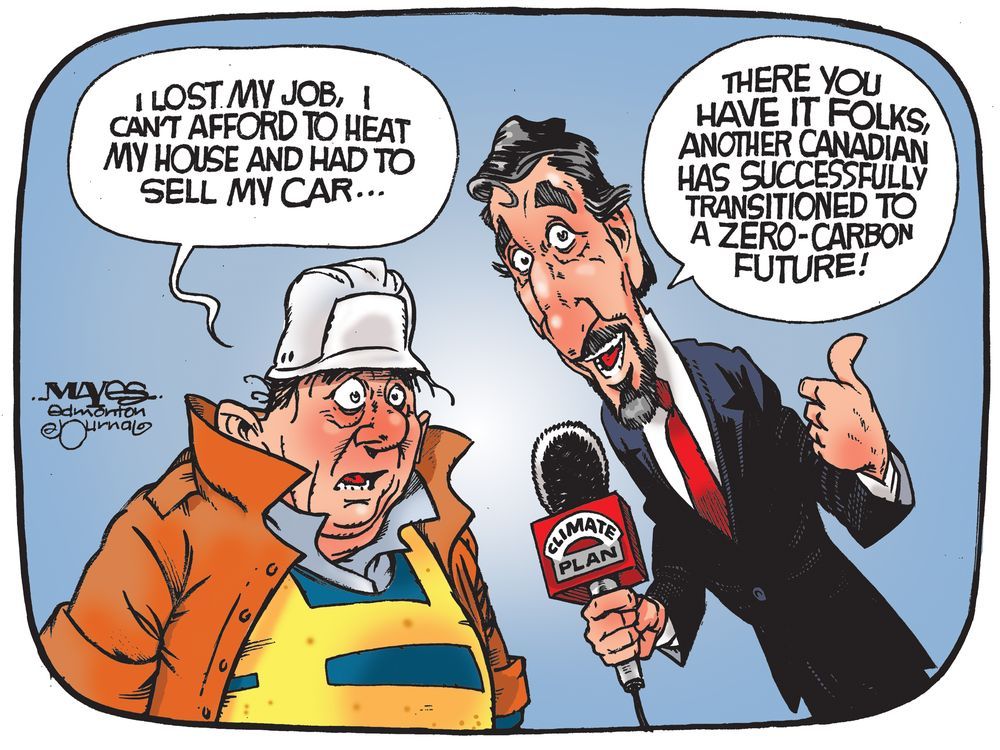
Canada is in an affordability crisis. Despite the pain felt by Canadians every day at the till or the gas pump, the federal government’s passion for world-leading carbon taxes and regulations is driving up the cost of everything while making us collectively poorer.

Tax advocates say it is a small % of GDP. But it is still $10 Billion extracted from Canadian households.

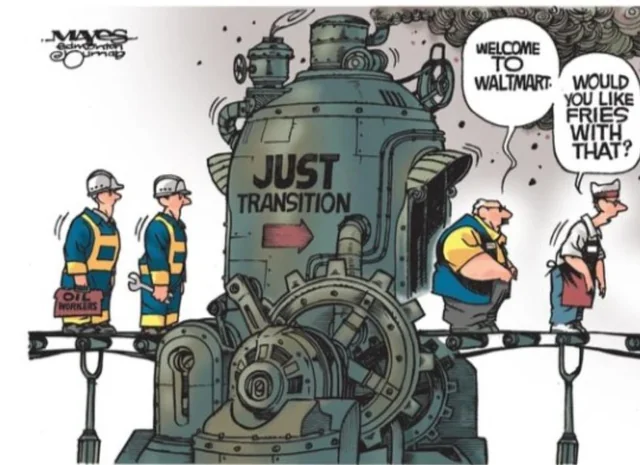
Canada Day saw the Clean Fuel Standards (CFS) regulation come into effect. A week earlier they passed a “Sustainable Jobs Act” that seeks to help transition workers away from highly productive jobs in oil, gas and related industries despite growing global demand for these energy sources.

The Parliamentary Budget Officer projects that by 2030 the net CFS cost will be over $1,100 per household in Alberta and Saskatchewan. While it will add roughly 17 cents on a litre of fuel (in addition to the carbon tax, of course) most of the costs will be on Canadian businesses, which means less jobs, less tax revenue and higher prices, making life more expensive with less ability to pay for it.

The fact is the world will need oil for the next 20-30 years at least. Canada is the responsible, reliable supplier many in the world would already prefer to get their energy from. With Canadian oilsands producers aggressively pursuing net zero operations by 2050, there is no better place to get oil from.

The demand for Liquefied Natural Gas (LNG) is booming globally. It should be vocally supported by anyone concerned with emissions since Canadian exports off our west coast would drive down the need for all the coal plants being built and planned in China and India. It also features an unprecedented level of Indigenous partnerships, offering an unparalleled opportunity for the economic self-sufficiency of countless communities.

Why would we “transition” these high-paying, unsubsidized jobs?
And transition them to what?

Well, the federal government seems to know that our oil and gas sector will have to shrink despite growing world demand. This is because in addition to steadily rising carbon taxes and the new CFS, they’ve arbitrarily demanded a 42 per cent reduction in emissions for the oil and gas sector in seven short years.

Requiring this drastic reduction by 2030 will force hasty and frantic changes as well as production cuts that will drive up energy prices for everyone while decreasing jobs and government revenues. That means more debt and more tax burden for Canadians, while hurting our economy and increasing our reliance on foreign oil.

An escalating carbon tax was supposed to let the economy decarbonize in an efficient way, but the federal government keeps piling on. This is crushing Canada’s competitiveness generally, especially after our American neighbours decided to go along with most of the rest of the world and not implement a carbon tax at all.

The fact that every manufacturer, farmer, trucker, and even commercial business owner on this side of the border has to pay these taxes on their fuel, heat, and power means everything is more expensive and will keep going up. Lower wages and job opportunities means we will be less and less able to afford it.

The government either says we must make these sacrifices for the planet, or that the green jobs they will transition to will be just as profitable and more sustainable. Their most recent example: the Volkswagen battery plant. There will be 3,000 jobs created, but the government will subsidize the plant with an estimated $13 billion. Does $4.3 million in taxpayer dollars per job sound sustainable to you?

As for our sacrifices saving the planet, carbon emissions are global. As Asia grows its economy, emissions are steadily rising. Canada can certainly “do its part” but other than massive LNG export to Asia, nothing we do with our declining 1.6 per cent share can meaningfully reduce overall global emissions.

There’s one more major federal policy being pursued that might be the most expensive of them all: the demand that every province’s electrical grid get to net zero by 2035. Canadian ratepayers spent billions to convert coal plants to gas and subsidize solar and wind projects. Now they are forcing us to get off natural gas entirely — a fuel source even the EU considers green.

Trying to do this in 12 years will cost an estimated $52 billion to achieve in Alberta alone, driving up power bills by 40 per cent. Nothing complements renewables like natural gas. If we want to keep the lights on when there’s no sun or wind, the only technology right now up to the task is natural gas plants — but the government seems to think higher power bills and less reliability is the way to go.

Canadians care about reducing emissions and it is happening. Canadians also care about affordability. We need to demand our governments find a balance between the two. If Canada recalibrates our carbon policies to be part of the global parade instead of driving off an economic cliff, we can have both.


See Also Canada Budget Officer Quashes Climate Alarm

Choices Usurped by Self Righteous Tyrants

William Watson writes at Financial Post Self-righteous totalitarian tinkering and the end of gas-powered cars.  Excerpts in italics with my bolds and added images.

Canadians often get to vote on important local projects.
When did we all vote on abolishing gas engines?

I am happy to report that democracy is alive and well in the Montreal suburb where I live and by all appearances completely uninfluenced by the Chinese Communist Party.

My evidence is purely anecdotal: the steady stream of voters arriving at the advance poll held Sunday at the almost 60-year-old town arena to cast their ballot in a referendum on whether we should replace that self-same arena — famous as being the coldest in all of Montreal — with a new almost $40-million sports complex that would include a new arena. The federal and provincial governments have pledged $12.5 million and private fundraising has brought in a few million more but the bulk of the money would be provided by the town, partly through new debt issue.

Getting citizen approval (or rejection) of that issue was the purpose of the referendum,
which was called after the requisite number of voters registered their request for it.

My guess is the new arena won’t pass. It has been discussed for several years and the amount that was always mentioned was at most $20 million so when this spring the lowest contractor bid came in at $38 million, that was a shock. There has been lots of back and forth at various meetings and a flurry of flyers in the mail debating pros and cons, including what the effect on property taxes will be. I suspect the strong turnout means people don’t want to pay more to service the higher debt. But we’ll know when the final vote takes place next week. What’s most important is that there seems to be widespread agreement that the vote is the final word — though in this litigious age it’s not inconceivable that whichever side loses may try their luck in the courts.

Whatever the outcome, it has been a great exercise in democracy. And it has left me feeling I’d like to have a direct say in other decisions that will have an important effect on my life. One that comes to mind immediately is Ottawa’s decision to do away with gasoline-powered cars.

By 2035, ministers Steven Guilbeault and Jonathan Wilkinson decreed in 2021,
the “mandatory target,” i.e., the requirement, for all new
“light-duty cars and passenger trucks” is that they be zero-emission.

Thus will end, in this country at least, the widespread use of the internal-combustion engine for personal transportation, a technology that since its first commercially successful use in the 19th century, has brought unprecedented prosperity and freedom of movement to literally billions of people around the world and largely made possible the much-decried suburban lifestyle that is currently under all-out attack from car-less urban sophisticates. It has also over the decades undergone continuous and considerable refinement in terms of efficiency, noise and exhaust, so that modern combustion engines are barely recognizable compared to early versions.

In 2021, Statistics Canada tells us, more than 26.2 million “road motor vehicles” were registered in this country, which works out to not quite one car per adult Canadian (depending where you draw the age line for adult, of course).

Of those 26.2 million registered motor vehicles, 303,073 were hybrid-electric, 152,685 battery-electric and 95,896 plug-in electric — so some 551,000 in total, or a little over two per cent, were low or no emissions. Except that net-zero absolutists really don’t like hybrid vehicles, which run part of the time on fossil fuels, so the true proportion of elite-acceptable net-zero vehicles was under one per cent. And we’re now in 2023, which means 2035 is just 12 years away. What contortions will the car industry, not to mention the economy, have to be put through so that in those 12 short years all new cars are net-zero? The hubris of people willing to impose such contortions is breathtaking.

Whether or not my town gets a new arena will in fact have much less impact on my life than whether in 12 years we Canadians will be forbidden from acquiring a newly produced internal combustion engine car. Yet while my opinion on the arena is being sought and respected nobody ever asked my opinion about whether or not to ban gas cars.

As Lionel Shriver, one of my favourite columnists, put it in London’s Spectator magazine last week: “We’ve entered an era of unaccountable bureaucratic imposition that’s only going to get worseBans on the sale of new petrol cars by 2030 and gas boilers in new homes by 2025 that no one voted for are just the beginning of a self-righteous totalitarian tinkering with our daily lives that makes a mockery of the notion that democracies are governed by consent.”

She was writing about Britain and in particular London’s “ultra-low emissions zone,” in which non-complying cars pay a charge of £12.50 a day. But she could have been writing about this country or indeed any western democracy, in all of which officials seem firmly in control and voters essentially powerless.

“Self-righteous totalitarian tinkering” is a phrase that
these days echoes familiarly in Canada.

Absurd Climate Blame Game

Lorrie Goldstein explains.at Toronto Sun in above video Guilbeault  Plays Absurd Blame Game–Attacks Conservatives, but not China, on climate change.  Transcript from closed captions in italics with my bolds and added images.

PM Trudeau: We will raise Canada’s price on carbon pollution Rising by 15 a ton starting in 2023 and rising to 170 Canadian dollars per ton by 2030.

Federal environment Minister Stephen Guilbeault says the Trudeau government could be more effective in fighting climate change were it not for the opposition of the federal conservatives. He told CTV news that he would like to do things like, for example, speeding up Canada’s goal of net zero emissions, possibly lowering it to 2040 instead of the current 2050.

Now his argument is absurd on a number of fronts. First of all Stephen Guilbeault and the Trudeau government don’t need the permission of the conservatives to lower our emissions targets to 2040 instead of 2050. He didn’t need them to set the 2050 Target; why would he need them for the 2040 Target?

And in terms of keeping in power to fight climate change, his government doesn’t need the support of the federal conservatives. So far the NDP are supporting him. And if anything they want the government to go faster in fighting climate change.

But the more important issue is that it doesn’t matter what Canada’s Target is. It also doesn’t matter how much we pay in carbon taxes or clean fuel regulations or subsidies to corporate green companies. None of that matters, the reason being Canada’s emissions are a rounding error in terms of global emissions.

Nothing Canada does on its own is going to slow the rate of wildfires or floods
or wind storms or severe weather in Canada. Zero Effect.

Why? Here’s a few numbers according to the federal government. In 2019 our emissions were 724 million tons of greenhouse gas emissions. The global total is 48,000 million tons. China’s total, as the largest single emitter in the world, was about 12,700 million tons. Tony Keller in the Globe and Mail made a good analogy about this. He said to think of the world’s greenhouse gas emissions as water in a swimming pool. What’s happening is that in Canada we’re trying to lower the level of the water using a soup spoon, and meanwhile China and other countries are filling up the pool using a fire hose.

Now if Stephen Guilbeault and Trudeau really want to be more effective in fighting climate change, they shouldn’t be attacking the conservatives; they should be attacking China’s dictators.

Now we’re always accused, even by our own government, that Canadians are wanton wasters of energy because we are the highest per capita emitters in the world. That’s an absurd metric to use particularly for Canada. Because we are the second coldest country on Earth, the second largest country on Earth, and we have a relatively small population.

Use another metric that has been used, emissions per square kilometer. Lo and behold Canada becomes one of the lowest emitters in the developed world. It’s true that what you get always depends on what you measure.

The only practical effect of our emission targets and paying more for oil and gas to heat our homes and everything else is: In theory it gives Justin Trudeau the moral authority to attempt to use moral persuasion on countries like China to lower their emissions.

Of course we already know from experience how well Canada’s
moral influence works on China’s dictators.

Postscript:  A Voice from Silent Canadians


Social Cost of Carbon Game

Ross McKitrick writes at Financial Post Junk Science Week —The Social Cost of Carbon game.  H/T John Ray Excerpts in italics with my bolds.

Estimates of the SCC championed by Guilbeault are not science

Environment Minister Steven Guilbeault recently announced that the Social Cost of Carbon (SCC), or the dollar value of supposed damages associated with each tonne of carbon dioxide emissions, is about $247, nearly five times higher than the old estimate of $54. He made it sound like a discovery, as if a bunch of experts had finally been able to measure something they previously only guessed at.

Like when scientists were finally able to measure the mass of an electron or the age
of the Earth, now finally we can measure the SCC.

But in reality there has been no breakthrough in economics comparable to those physics breakthroughs. Countless SCC estimates already exist ranging from small negative amounts (i.e. carbon dioxide emissions are beneficial) to many thousands of dollars per tonne. Every such estimate is like a complex “if-then” statement: if the following assumptions hold, then the SCC is $X. Yale economist William Nordhaus won the 2018 Nobel Memorial Prize in economics for developing some of the first methods for combining all the “if” statements into systems called Integrated Assessment Models or IAMs. And using conventional economic and climate modelling methods, he tended to get pretty low SCC values over the years, which has long been a sore point among climate activists and the politicians who share their agenda.

But economists are on the case. The $247 figure referenced by Guilbeault comes from a new report from the Biden administration that tossed out all the previous models, including Nordhaus’s, and instead cobbled together a set of new models that when run together yield much higher SCC values.

In many ways the new models are just like the old ones.

For example they persist in using an Equilibrium Climate Sensitivity of 3 degrees C. This refers to the warming expected from doubling the amount of CO2 in the atmosphere. The authors cite the Sixth Assessment Report of the Intergovernmental Panel on Climate Change as the basis for this decision, apparently unaware that that estimate has already been shown in the climate literature to be flawed. Using the IPCC’s own method on updated data yields a sensitivity estimate of about 2.2 C or less, and as I have shown in a recent publication this is enough to cause the SCC estimate in a standard model to drop to nearly zero.

The biggest boosts to the new SCC figure hailed by Guilbeault come from revisions to agricultural productivity impacts and mortality costs from climate warming. The evidence for large negative agricultural impacts comes from a 2017 article by Frances Moore and co-authors that looked at the combined effects of CO2 fertilization and warming, concluding the net effect would harm global agriculture. Oddly, they used the same data as a 2014 study by Andrew Challinor and co-authors who had found the opposite: the combination of increased CO2 and warming would have much more benign, and in some cases even beneficial, results.

How did Moore et al. get different results from the same data? They used a different statistical model but unfortunately didn’t provide evidence showing it is better than the one Challinor used, so it’s unclear whose results are stronger. But we know whose are more popular. The Biden administration team referred only to the Moore study and left out any mention of the Challinor one, and it is a safe assumption that the reviewers didn’t notice the omission. See how the game is played?

Regarding the mortality effect, the report relies on evidence innew study that apparently shows that warming will mean fewer deaths from cold and more from heat, and the combined effect globally is a much larger overall death toll than previously thought. The study is by an impressive team led by economist Tamma Carleton and 15 co-authors. In their preface they thank 17 research assistants, four project managers, 13 reviewers and seminar participants at 20 prestigious academic institutions around the world. It’s a high-quality piece of work, but like tens of thousands of other splashy climate impacts studies it relies for its headline conclusions on the discredited RCP8.5 emissions scenario.

How did all those prestigious researchers and reviewers miss this flaw?

The authors compiled mortality data from selected countries around the world and matched them to temperature records, then built a statistical model to extrapolate over the entire world. They used some clever economic modelling to estimate the beneficial effects of adaptive behaviour (like installing air conditioning) as well as the costs. Then they estimated a “mortality function” that spits out the number of additional deaths between now and the year 2300 attributable to each additional tonne of emissions, both from warming itself and the costs of adaptation. To compute this number the authors needed emissions and income projections out to 2300.

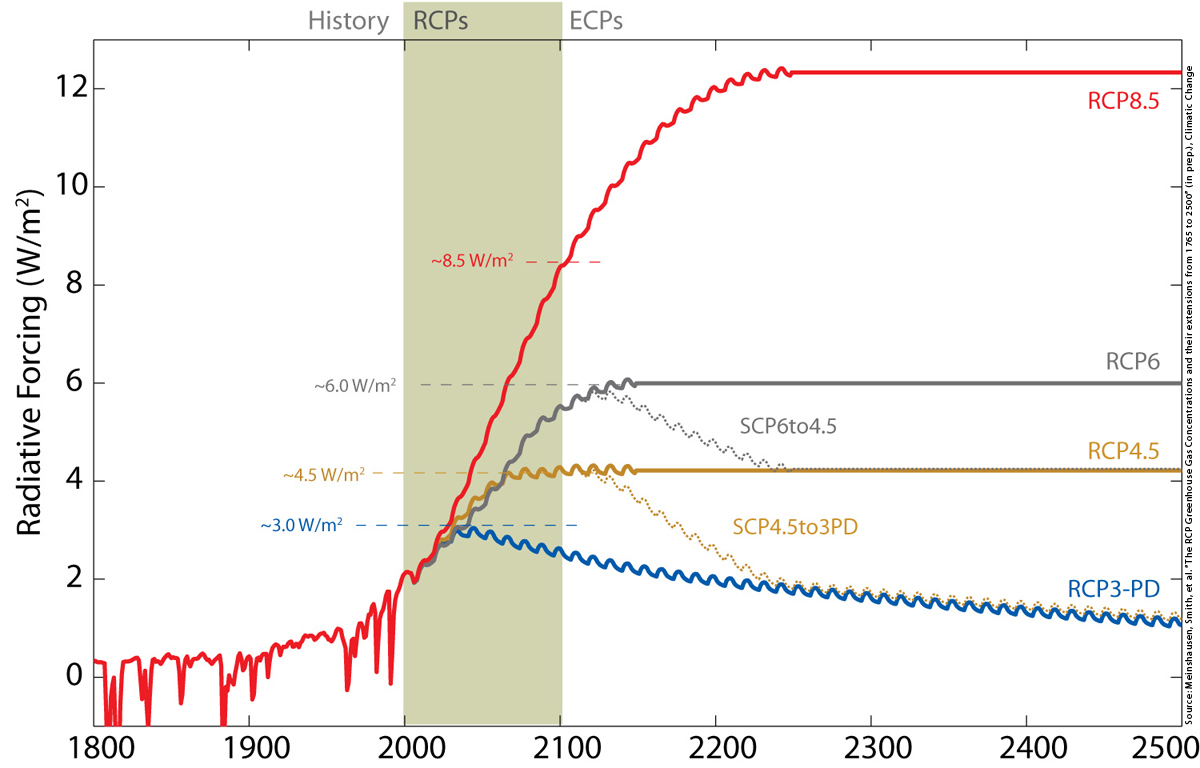
No uncertainty ranges are shown and reported, as for creating the recommendation datasets for CMIP5, central estimates have been assumed closely in line with central estimates in IPCC AR4. (SCP45to3PD). No uncertainty ranges are shown and reported, as for creating the recommendation datasets for CMIP5, central estimates have been assumed closely in line with central estimates in IPCC AR4. https://www.pik-potsdam.de/~mmalte/rcps/

For this they used two scenarios: the extreme, coal-blackened Dickensian fiction called RCP8.5, and a mid-range emissions projection called RCP4.5. In my 2020 JSW column I discussed the efforts of climate analysts to convince their colleagues to stop using the RCP8.5 scenario because of its unrealistic assumptions. Interestingly the Biden administration report moves away from both RCP scenarios and focuses on a new one from Resources for the Future (RFF) which, through most of the rest of this century, projects emissions even below RCP4.5.

But in the main text of the Carleton paper it highlights mortality estimates associated with an RCP8.5 future. Basically we all die a fiery death. If you want to know what the results are using RCP4.5, you will need to track down the 113-page online-only appendix and navigate to page A75, then transfer a table full of numbers to a spreadsheet so you can compare the outcomes.

The two figures on this page summarize what they show. With no adaptation, under the RCP8.5 emissions scenario each tonne of CO2 kills 221 people per hundred thousand (100k) between now and 2300, with the uncertainty range shown by the whisker line. Under RCP4.5 each tonne kills 40 people per 100k. I estimated what their model would yield using the RFF scenario: the effect drops further to 18 people per 100k, and the number is not significantly different from zero.

The second figure reports results if adaptive behaviour is assumed. Under RCP8.5 the mortality rate per 100k drops to 85 people, under RCP4.5 it drops to 14 and under the RFF scenario it drops to five, and the latter two estimates are not significantly different from zero, which means that there is no statistically valid reason to add the mortality effect to an SCC model.

Another step in the analysis is to place a value on these deaths, which depends on things like age and income in every place. Digging further into the online appendix (p. A100), if they stick with RCP4.5 but use a variant that predicts higher income growth the value of the mortality effect goes negative, which means taking account of the lives saved or lost due to warming leads to a lower SCC.

No mention of this in Guilbeault’s announcement.

Thus I reiterate that SCC estimates are if-then statements. They are not intrinsically true or false: what matters is the credibility of the assumptions.

♦  If emissions follow the RCP8.5 scenario (which they won’t), and
♦  if people don’t adapt to climate change (which they will), and
♦  if CO2 and warm weather stop being good for plants (which is unlikely),
    then the SCC could be five times larger than previously thought.

More likely it isn’t, and very well could be much smaller.

See Also Biden’s Arbitrary Social Cost of Carbon: What You Need to Know


Get Real on Energy Policy ( Bryce to US Senators)

The imperative is put concisely in US Senate testimony by Robert Bryce in summary video above.  For those who prefer reading, I provide below a transcript and exhibits from the closed caption and screen captures.

Legislators and policymakers in Washington need a big dose of energy realism, an even bigger dose of energy humanism. Europe provides a case study for what not to do. Millions of Europeans are facing the prospect of a cold winter without enough affordable energy to heat their homes. Fertilizer plants and steel mills are closing because of high energy prices.

Europe’s price hikes are being caused by under investment in hydrocarbons due to aggressive decarbonization and ESG policies. Second, they’re being caused by over-investment in weather-dependent renewables, which has left the continent vulnerable to wind droughts. Just yesterday in Britain spot prices for electricity exceeded four thousand dollars a megawatt hour due to low wind speeds. Third, Europe is prematurely shuttering its coal and nuclear plants, and finally it is relying too heavily on imported energy and in particular Russian natural gas.

The implications of Europe’s price spikes include soaring inflation,
deindustrialization and increased burdens on consumers,
especially the working poor.

The knock-on effects could last for months or even years. Fertilizer made from hydrocarbons is the food of food. Numerous fertilizer plants in Europe and around the world are shutting down because of high natural gas prices. This will mean less food production and therefore higher food prices, leading to additional inflation.

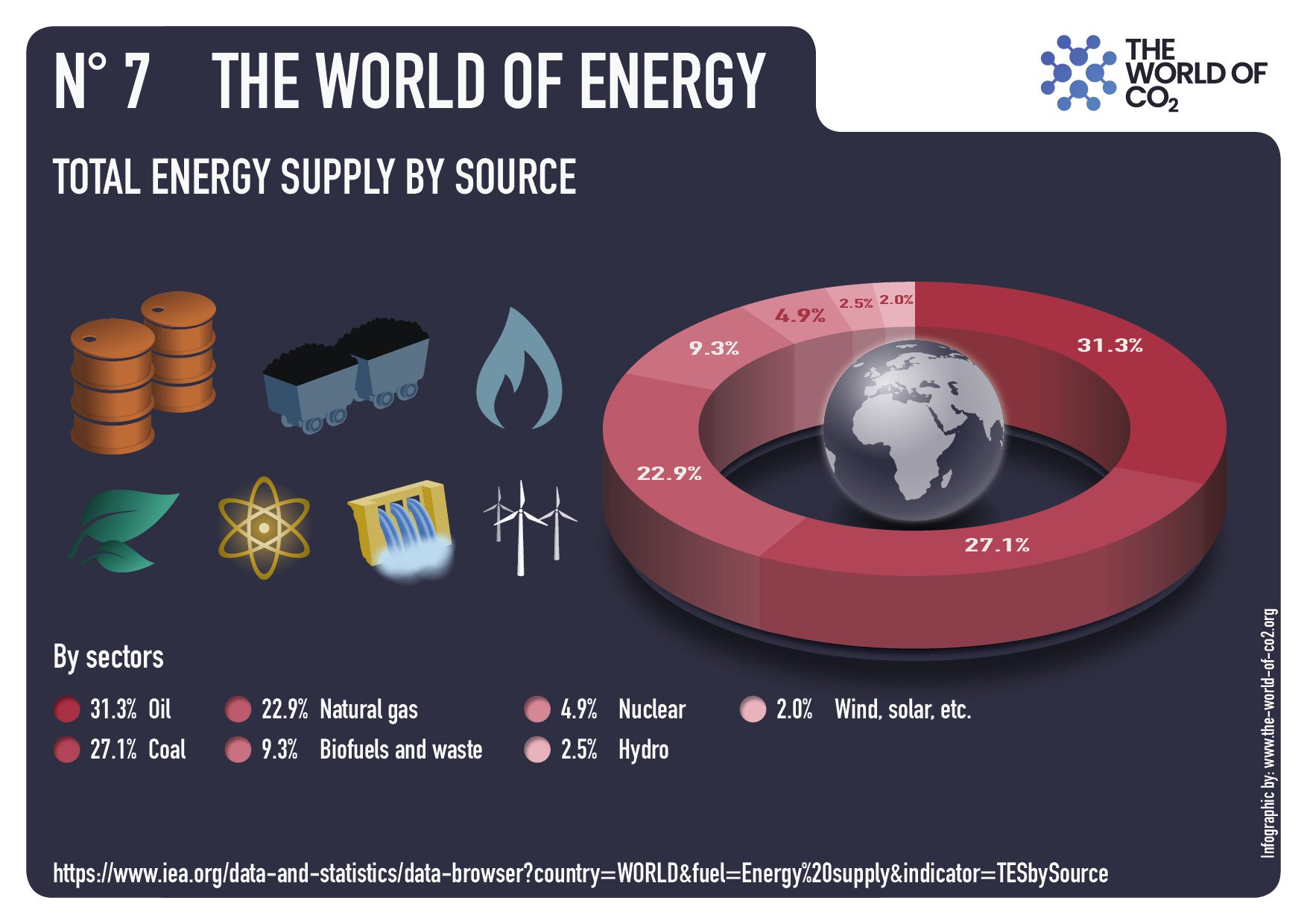
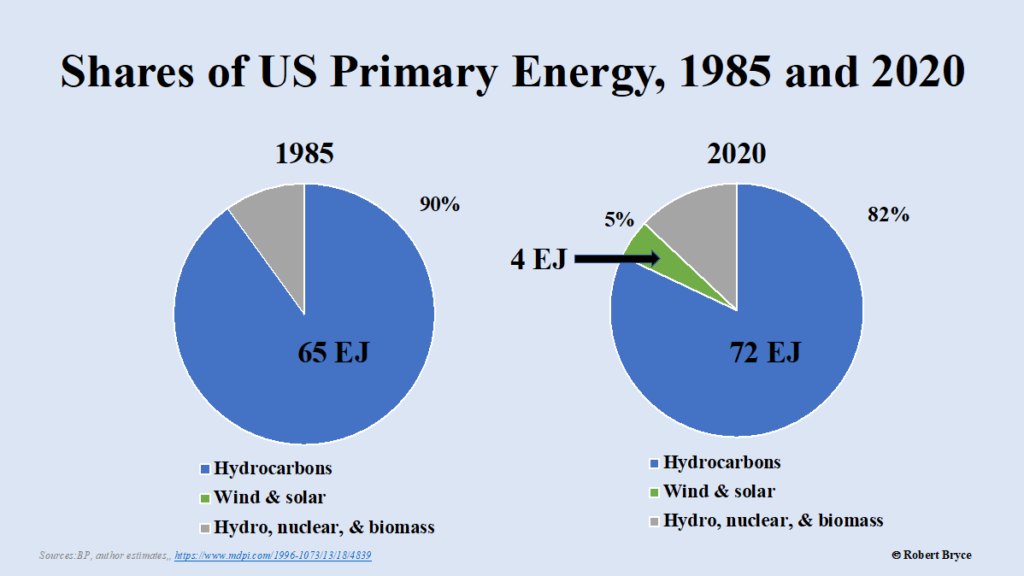
The United States must not emulate Europe’s disastrous energy blueprint. We need energy realism. Energy is the economy; energy nourishes human potential. Hydrocarbons now provide 82 percent of our total energy and about 60 percent of our electricity supplies. The US today gets 18 times more energy from hydrocarbons as it does from wind and solar combined.

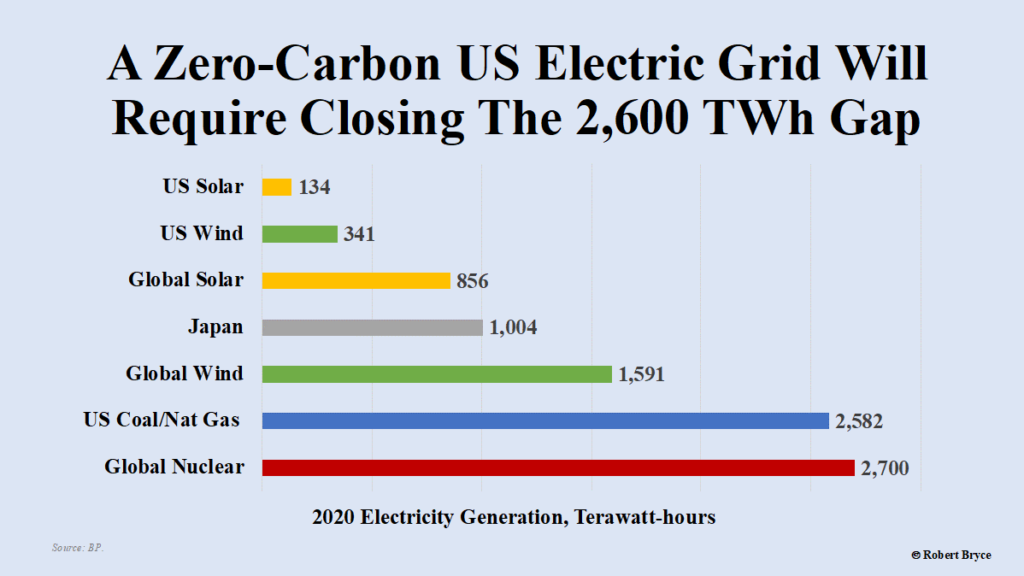
The myriad claims being made by climate activists, politicians and elite academics that we can run our economy solely on wind and solar and a few drops of hydropower have no basis in physics, math or history. Furthermore wherever renewables have been ramped up, as in Europe, energy prices have soared.

Senators, look at California where electricity prices are absolutely exploding. Wood Mckenzie estimates that converting our grid to renewables could cost 4.5 trillion dollars, or roughly $35, 000 for every family in America. How could such a staggering cost result in the just energy transition that we hear so much about?

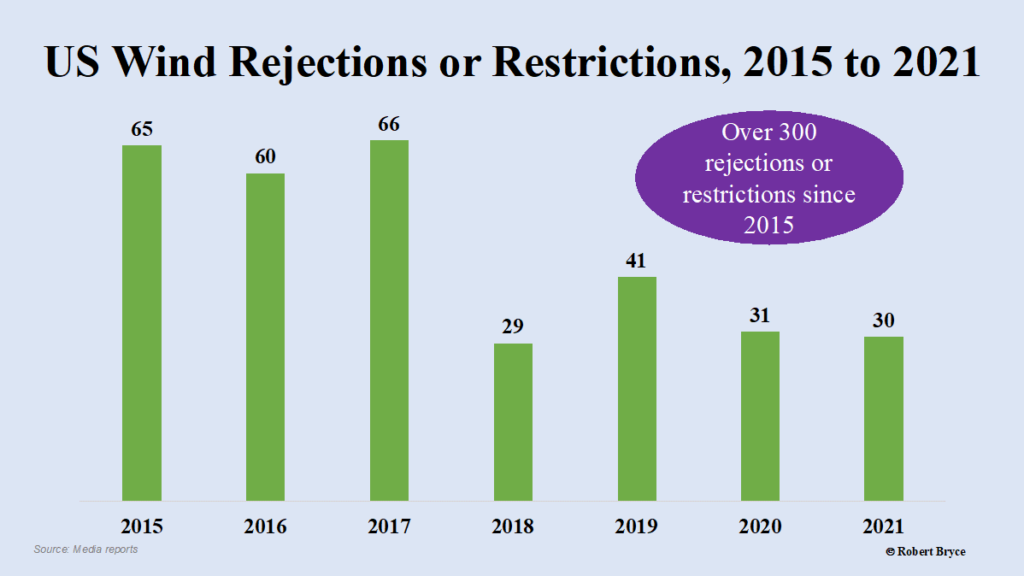
Some Energy Realism: Since 2015 more than 300 communities across the country, from Maine to Hawaii have rejected wind projects. Over the past six months alone massive solar projects in Nevada, Pennsylvania and Montana have been rejected by local communities.

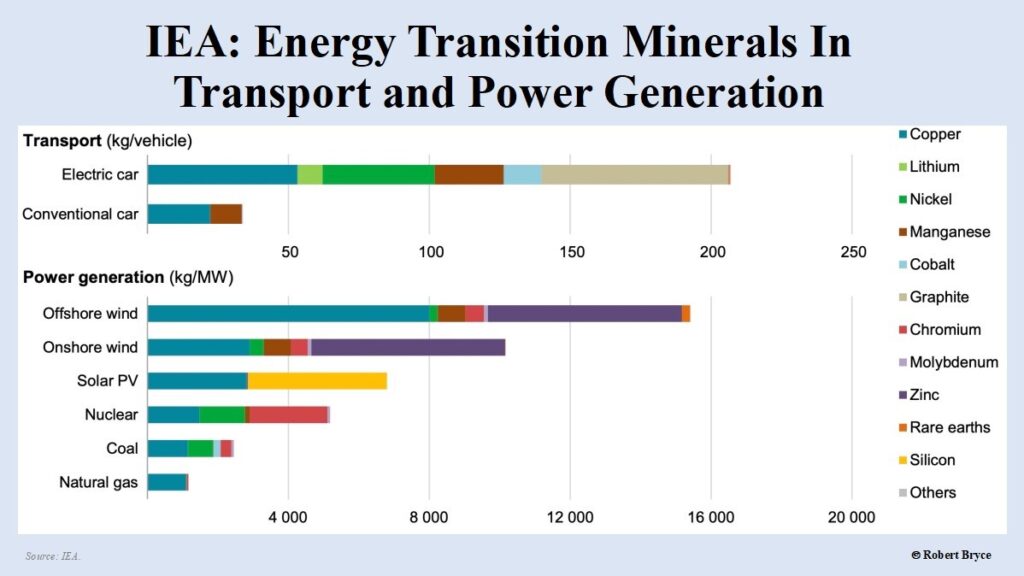
More Realism: Trying to convert our energy and power systems to renewables will make the US reliant on China for critical minerals like Neodymium, Dysprosium and Cobalt. Why is this okay?

Relying on renewables would also require building hundreds of thousands of miles of new high-voltage transmission lines. But the November second referendum in Maine showed very clearly again that rural americans do not want high voltage transmission lines slashing through their neighborhoods.

Strangling America’s hydrocarbon sector by killing pipelines, banning natural gas, halting drilling on federal lands, electrifying everything, and never ending tax breaks for big wind and big solar will not solve global climate change. Instead those moves will turbocharge inflation, imperil our energy security, and impose regressive taxes on the poor and the working class.

Our economy runs on hydrocarbons and that will be true for decades to come. Staking our economy as Europe has done on weather dependent renewables amounts to unilateral energy disarmament
That will hurt us and benefit Russia, China and OPEC. Who will stand up for rural America and against the landscape destroying sprawl of wind and solar? Who will speak against the federally subsidized slaughter of our birds and bats by the wind industry? Expensive energy is the enemy of the poor; Who in the senate will stand up for them? Who in congress will stand up for the affordability reliability and resilience of our electric grid, which is being undermined by this senseless rush to renewables and the premature retirement of our nuclear reactors?

Where are the pro-nuclear, pro-energy realists?
Where, I ask you, are the energy humanists?

Postscript:  Complete text of Bryce presentation with images is at Innovationized:
What’s Causing the Energy Crisis?

ESG, the Demonization of Carbon Fuels, and an Unfounded Confidence in Renewables


Wokeness No Longer Ohio State Religion

The National Association of Sholars issued a press release Ohio Higher Education Enhancement Act Passes Senate, which explains how Ohio legislators are enacting regulations to remove Wokeness from a position of ultimate authority in higher education institutions.  Excerpts in italics with my bolds and added images. Later on are some comments showing that indeed woke operates as the entrenched religion at Ohio State university and others.

The Ohio Senate has passed Senate Bill 83, the Ohio Higher Education Enhancement Act. SB 83, sponsored by Senator Jerry Cirino, will do an extraordinary amount to depoliticize public colleges and universities, strengthen intellectual diversity on campus, and restore citizen oversight of the state’s higher education system.

“SB 83 is the leading edge of higher education reform bills,” said National Association of Scholars (NAS) President Peter Wood. “In 2021, the NAS set out to rehabilitate colleges and universities by promoting model legislation after so many institutions proved unable or unwilling to reform from within. SB 83 takes from our Model Higher Education Code and adapts it to the needs and political circumstances of Ohio.

It was an honor to work with the state’s legislature and our members
to see that this bill passed the Senate.”

SB 83’s sponsors went above and beyond for their state’s citizens to offer a comprehensive improvement to Ohio higher education. Their catalogue of reforms includes requirements that colleges and universities commit themselves to intellectual diversity, and to prohibiting both “diversity statements” and mandatory trainings or courses in discriminatory concepts such as “diversity, equity, and inclusion” (DEI). The bill also adds requirements for reformed mission statements, syllabus transparency requirements, detailed budgetary transparency, nondiscrimination, transparency about speaker fees, and a new American history and government general education requirement. Importantly, the bill reinforces prohibitions on segregation and bars financial entanglements with the People’s Republic of China.

Wood added, “SB 83 absolutely is necessary. Intellectual diversity has dwindled on campuses nationwide and is effectively non-existent on most college campuses. This problem certainly extends to Ohio’s universities.”

NAS Senior Fellow John Sailer has written extensively about how so-called “diversity, equity, and inclusion” bureaucrats at Ohio State University have used diversity statements and other administrative means to screen candidates for hire and promotion by political association. SB 83 puts an end to such practices that endanger academic freedom.

“When Ohio’s universities became incapable of reforming themselves to uphold the principles of what makes higher education higher, its citizens and legislature stepped up,” explained Wood. “These reform-minded Ohioans have our sincerest gratitude.”

[Comment:  According to research, Ohio State has 94 DEI personnel, 1.5 times the OSU History Faculty.  That’s second only to University of Michigan with 163.  The average university has 45 DIE personnel.  Source: DEI Bloat in the Academy]

SB 83 is well tailored to accomplish its goal. It is comprehensive,
detailed, but with carefully drafted language.

SB 83, for example, does not prohibit “diversity, equity, and inclusion courses or training for students, staff, or faculty”; rather, it specifies that the universities may not require them. SB 83 uses such precise language throughout, to ensure that it champions liberty in Ohio’s universities, and does not accidentally infringe upon the principles or the practice of academic freedom.

The National Association of Scholars heartily endorses SB 83, urges the Ohio House to pass companion legislation to this bill, and for Governor DeWine to sign it.

NAS is a network of scholars and citizens united by a commitment to academic freedom, disinterested scholarship, and excellence in American higher education. Membership in NAS is open to all who share a commitment to these broad principles. NAS publishes a journal and has state and regional affiliates. Visit NAS at www.nas.org.

Footnote:

DEI advocates are unhappy at losing a closed shop regarding subjects like climate policies.  From Time More States Want Students to Learn About Climate Science. Ohio Disagrees

That’s because just last week, the state senate began debating the Ohio Higher Education Enhancement Act, which would tie the hands of instructors at colleges and universities from teaching effectively on subjects the state legislature has labeled as “controversial,” including climate change. Those institutions would have to guarantee that they’re “encourag[ing] students to reach their own conclusions,” on such matters, which also include subjects like abortion rights. The schools are also obligated to not “seek to inculcate any social, political, or religious point of view” on students. Higher education institutions would also be barred from implementing sustainability initiatives. Diversity or equity programs would also be banned.

Many schools mention climate change in science class, but absent efforts like those in New Jersey the curriculum can fall woefully behind the current science and state of urgency. On a recent visit to several D.C.-area charter schools, for instance, a colleague of mine was surprised by how little climate awareness was part of the curriculum. She asked one class of 11th graders if any of them were worried about how climate change would impact their own lives; only one hand went up, and that student was more focused on what would happen if the polar ice caps melted 100 years from now. A few students in a 9th grade class had heard of Greta Thunberg, but weren’t exactly sure what she stood for. When prompted, a few other 11th graders in another school acknowledged that heat waves had gotten worse in the D.C. area over the past few years, likely because of climate change, but the solution, they said, was more air conditioning. Other classes were more informed, but it appeared to be due to the efforts of individual teachers, not the curriculum.

Ohio’s law proposes to go entirely in the opposite direction, preventing educators from teaching the established facts of climate change as such, and forcing them to add misleading arguments from climate change skeptics. Supporters say the measure is about championing intellectual diversity on an important subject. “What I think is controversial is different views that exist out there about the extent of the climate change and the solutions to try to alter climate change,” said Republican state senator Jerry Cirino, the bill’s primary sponsor, speaking with Energy News Network.

From Inside Climate News Students and Faculty at Ohio State Respond to a Bill That Would Restrict College Discussions of Climate Policies.

“You can say gravity isn’t true, but if you step off the cliff, you’re going down,” said Katharine Hayhoe, an atmospheric scientist who teaches at Texas Tech University and a well-known writer and commentator about climate change and responding to climate denial. “And if you teach other people that gravity is not true, you are morally responsible for anything that happens to them if they make decisions based on the information you provided.”

The measure has passed the Ohio Senate and is now being considered by the Ohio House, both of which have large Republican majorities. Gov. Mike DeWine is also a Republican.

“Academics want to protect their woke fiefdom so they can continue to churn out like-minded and intolerant opponents of intellectual diversity,” said Sen. Jerry Cirino, a Cleveland-area Republican and lead sponsor of the bill, in a guest column last month in The Columbus Dispatch.

NYT Makes 12 out of 12 False Claims Against Lomborg’s Book

Bjorn Lomborg set the record straight at LinkedIn The New York Times’ stunningly false and deceptive hit piece to preserve climate alarmism.  Excerpts in italics with my bolds.

The piece consists of Stiglitz enumerating four specific and compounding mistakes that I apparently make, and then another six separate observations. I will go through all of them below, starting with the four mistakes.

My first “mistake”

My first mistake is that I draw “heavily on the work of William Nordhaus of Yale University, who came up with an estimate of the economic cost to limiting climate change to 1.5 to 2 degrees Celsius above preindustrial levels.” Instead the High-Level Commission on Carbon Prices, which Stiglitz co-authored, showed that 1.5°C-2°C goals “could be achieved at a moderate price.”

This is triply wrong. I don’t rely on Nordhaus for the cost on limiting temperature rise for 1.5°C to 2°C, simply because Nordhaus does not make that estimate. Nordhaus explicitly writes, as Stiglitz would know had he read Nordhaus or my book: “A limit of 2°C appears to be infeasible with reasonably accessible technologies even with very ambitious abatement strategies.”

Secondly, Stiglitz claims that his report estimates “a moderate price” for reaching the Paris agreement. This is false. There is no estimate of the total economic cost of a 2°C or 1.5°C target in his High-Level Commission on Carbon Prices.

Compounding Stiglitz’ error is the fact that the background report for his high-level commission does indeed list the UN Climate Panel cost estimate for reaching 1.5-2°C at more than 4% of GDP by 2100 (p2), which makes Nordhaus’ 1.38% GDP economic cost at the lowest temperature scenario of 2.35°C by 2100 substantially smaller (not larger, as Stiglitz claims).

Stiglitz throughout his piece neglects to inform the reader that Nordhaus is not just any old economist, but actually the only climate economist to get the Nobel prize for his work on climate economics. For reference, Stiglitz got his Nobel prize in economics for analyses of markets with asymmetric information like the selling and buying of used cars.

For the first mistake, Stiglitz makes two false claims and no correct, relevant claims.

My second “mistake”

My second mistake is “Nordhaus’s and Lomborg’s underestimation of the damage associated with climate change.” Stiglitz is in reality informing us that he knows much better than the world’s only climate Nobel economist.

But curiously, Stiglitz never tells us what the right cost is. As such, Stiglitz makes an absurd claim, essentially asserting he knows better than the best peer-reviewed evidence — but just couldn’t be bothered to share that knowledge publicly.

Stiglitz gives one indication of his knowledge on this matter. He claims that a significant part of the cost of climate change “includes more extreme weather events — more intense hurricanes, more droughts, more floods, with all the devastation to life, livelihood and property that accompanies them. Yet, again, he seems to have forgotten to actually acquaint himself with the best evidence on the science and economics of extreme weather events. As the leading researcher on economic impacts of extreme weather events says, Stiglitz is “just wrong.

But more importantly, Stiglitz is just cherry-picking and ignoring the actual data. He picked the costliest recent data point and he neglects that the trend for the US (and similarly for the world) is declining.
Stiglitz is simply doubly wrong on his only indication of how Nobel Laureate Nordhaus and I should be wrong, so for the second mistake, Stiglitz makes two false, one unsubstantiated and no correct, relevant claims.

My third “mistake”

Stiglitz suggests that “A third critical mistake, compounding the second, is not taking due account of risk.”  Ah, if only the world’s only actual Nobel laureate in climate economics had thought of incorporating risks.

Of course, Stiglitz could still have quibbled about a different way to model risk, and added his own take on this. But he does not. He simply — and falsely — suggests that Nordhaus or I have not taken this obvious point into consideration.

Specifically, Stiglitz assuredly tells us that the best damage estimates are underestimates because “as we learn more about climate change these best estimates keep getting revised, and, typically, in only one direction — more damage and sooner than had been expected.”   No, they do not. This is the kind of claim one makes if one gets most of one’s climate information from news media.

For the third mistake, Stiglitz makes two false, one unsubstantiated and no correct, relevant claims.

My fourth “mistake”

Stiglitz seems to claim that Nordhaus and I use a discount parameter that is too low for his liking. I cite the whole paragraph, because it is unclear what his actual point is except a rant against the Trump administration:

Stiglitz apparently suggests that Nordhaus and I use a 7 percent discount rate to spew out the numbers that are in my book. This is demonstrably false. Perhaps Stiglitz knows he’s fibbing, given that he settles for criticizing Trump and then conflating the 7% with the “models Lomborg loves.”

Instead, Nordhaus’ discount rate is calibrated to the real interest rates, meaning a 4.8% discount rate in 2015, declining to 3.5% in 2100.

As he would know, having been World Bank chief economist, it is one thing what rich, liberals in Manhattan want for a discount rate. Most of the rest of the world has much higher discount rates. When we worked with the government of Haiti, the central bank decided on 12% (even contemplating 20%), while Ghana decided 8%.

For the fourth mistake, Stiglitz makes one false and no correct, relevant claims.

Other claims

Media drives alarmism

He seems to brush off my points that the hyperventilating media is one of the main causes of alarmism simply by saying “fake news”: 

For example, I outline how New York Times claims that South Vietnam by 2050 will “all but disappear” because it will be “underwater at high tide.”  While the story was reported in almost all media, it was clearly incorrect. Because almost all of South Vietnam is already under the high tide mark today, and almost all of South Vietnam is already well-protected today:

Regulation

Stiglitz claim that I miss discussing good regulations as a way to tackle climate.  

More importantly, Stiglitz seems to have missed at least the last third of my book. Here I talk about

1. Innovation: how we should invest $100 billion per year in green R&D (regulation, not taxation)

2. Adaptation: regulation like zoning, building regulation and more pervious city surfaces (to ensure less flooding)

3. Geoengineering: which will be almost entirely a regulatory approach

4. Prosperity: mostly about better policies including regulatory policies

Stiglitz’ claim that I ignore regulation is blatantly false.

Wall Street underwater

Almost bizarrely, Stiglitz chides me for not including in my book that Wall Street could be underwater by 2100:

The research very clearly shows that at least when an area has sufficient value (as Wall St and surrounding areas certainly have) all will be safeguarded through adaptive policies (like sea walls etc.).  I even show this in a graph in the book, based on this paper. We only see significant flooding when we disregard adaptation:

So when Stiglitz chides me for not including that Wall Street might be underwater in my book, it is because such a claim would be false. His is a good example of bad information from hyperventilating media.

Copenhagen Consensus

Stiglitz writes a slyly derogatory paragraph about the think tank I work for, Copenhagen Consensus:

The paragraph doesn’t seem to say anything but that the experts are conservative and that we didn’t include any “true experts” on climate science.

On his first claim, we have worked with more than 300 of the world’s top economists and seven Nobel Laureates. Our main focus is all the world’s problems, not just climate change, so many are experts in the economics of malaria, infrastructure, water, education etc.   We certainly don’t have a ‘conservative’ bias — we’ve actually invited Stiglitz to be a member of several eminent panels together with his Nobel colleagues. But it also shows that Stiglitz seems to be suggesting that only liberal economists such as himself can be trusted to help set priorities for the world.

On his second claim, we have worked with many climate economists, and when we did our big climate consensus, we worked with 27 of the world’s top climate economists, publishing the results as a book with Cambridge University Press, which even got a favorable quote from the IPCC’s chairman (“This book provides not only a reservoir of information on the reality of human induced climate change, but raises vital questions and examines viable options on what can be done to meet the challenge.”).

Stiglitz’ derogatory two claims are simply incorrect.

Lack of prioritization

One of the key points of my book (and the Copenhagen Consensus’ work) is that we have to prioritize. No matter the amount of resources available, there is never enough to do everything, and hence we have to make sure we spend resources where they can do the most good first.  The allocation of scarce resources with alternative uses, of course, is the key definition of economics.

Obviously, money from a tax can be used on many things (some of which I’m sure Stiglitz wouldn’t like), but they can still only be used once. And the point is, that with more stringent climate policies, GDP will be slightly lower, hence there will be less in total to spend.

The new IPCC report shows end-of-world

Stiglitz finally claims that because I cite the UN Climate Panel so often, one could believe I might be right. But, he comforts his readers, “nothing could be further from the truth”:

What I say in the book is also what is in the IPCC 2018 1.5°C report.

Then Stiglitz goes on to make the exact scare scenario in which the media excels and that I have criticized. The 60 feet sea level rise is from a world in an entirely different part of the state space. He knows very well that such statistics are only meant to scare but not informative for what will happen for us, in this part of the state space. That, of course, is exactly what the IPCC reports are about. They talk about a high outcome of 3 feet of sea level rise by 2100. The only reason to throw out 60 feet is to scare people silly.

Summary

Making 12 substantial criticisms of my book and that they are all false, is quite an achievement. It is hard not to conclude that Stiglitz’ review of my book is a deceptive and false hit piece. It is perhaps not surprising that Stiglitz actually said that he was going to give the book a bad review even before he read it. In many ways, it seems like he still hasn’t read it.

I have asked New York Times to rectify this terrible article. 



Zero Carbon Alarmists Upset at Public Rejection

Climatists are increasingly complaining about critics dismissing their doomsday claims as false alarms.  Recently I posted on meteorologists upset about negative pushback from their audiences.  [See Enforcing Climate Correctness (Fact Checking)]

Maybe if they stuck to weather reporting? See Climate Evangelists Are Taking Over Your Local Weather Forecast

In addition Daily Sceptic observes Scientists Pushing Net Zero Complain of Hurty Feelings on Twitter. Excerpt in italics wtih my bolds.

What is happening of course is that the horrors of the collectivist Net Zero project are becoming increasingly apparent, as a widespread attack on almost all human activity is launched under the suggestion that the climate is breaking down. Until recently the ‘settled’ science promoting this view had a safe, largely uncontested space to prosper. But scepticism about the unproven hypothesis that humans operate the climate thermostat by burning fossil fuels is growing, with two recent polls showing that over 40% of people surveyed worldwide believe climate change is mainly due to natural causes. Far from coughing up the huge sums required to hit Net Zero, 4 in 10 Americans are not even prepared to pay more than two dimes a week to combat climate change.

 It is hardly surprising that the banning of meat eating, along with all the other notable Net Zero suggestions such as no flying, shipping, barely enough energy to heat homes and cook food and restrictions on all common building materials, is starting to foster wide debate – even sometimes robust debate. Maslin, along with many of his fellow climate extremists, seem oblivious to this gathering trend. This is perhaps not surprising. In 2018, he was one of a number of eco-activists who signed a letter to the Guardian saying they would no longer “lend their credibility” by debating climate change scepticism.

The loss of Twitter as a ‘safe’ space for climate alarmists has been a bitter blow. It is not seemingly enough to exert considerable control over most other public platforms including social and mainstream media. Global Witness is of the view that if climate scientists are unable to do their work because of “stress and fear caused by harassment”, the critical evidence that undergirds climate action and solutions is put at risk.

It is reasonable for social media users to tell delicate activists like Maslin that there is really nothing to worry about from our climate. It’s just free speech, and it applies – in fact it is vital – in science and geography, as elsewhere. But it’s not just about science anymore. It is becoming apparent that Net Zero is being used as an attack on almost all human activity. Everything humans do to survive, from keeping warm to growing food, is being cast as an attack on Mother Earth.

Expert Findings Awaken Censorship 

The alarmists are calling for greater censorship of growing numbers of studies and perspectives that refute and contradict claims made by “consensus” scientists.  For example Fraser Institute recently published Celebrate Earth Day by burning latest UN climate report.  Excerpts in italics with my bolds.

Ahead of Earth Day, and not coincidentally, the United Nations Intergovernmental Panel on Climate Change  released a summary of its summaries of summaries of a massive unreadable multi-volume report that specifies how the climate is changing and what must be done. Again, not surprisingly, the new plans are more stringent than the already unachievable previous plans.

In presenting the report, which is still not available in its final form, Antonio Guterres, UN secretary-general, called on developed countries to move up their already impossible “net-zero” greenhouse gas emission timelines from 2050 to 2040. He also wants coal use to end entirely by 2030 in developed countries, and wants the developed world on carbon-free electricity generation by 2035, meaning no gas-fired power plants. Yes, only 12 years from now.

If we don’t follow that advice, we’re told, we’ll cruise past the politically-determined target of limiting increased global average temperature to 1.5 Celsius above pre-industrial temperatures. And, we’re told, UN scientists believe we’ll see all kinds of negative trends—droughts, floods, storms, hot weather, cold weather, ocean acidification, glacier retreat (basically all the worst parts of the Bible). Some of this may be true, much is likely untrue, as almost all of it is based on speculative computer models infused with assumptions about how things might work in nature, rather than rigorously measured values that establish how they actually work in nature. Canadians who believe computerization can correct soothsaying will be concerned; those who believe the future is unpredictable will be less so.

But either way, the secretary-general’s net-zero acceleration is a terrible idea that Canada’s governments should ignore, mainly because the side effects of this prescription will be far worse than the ailment. In 2021, RBC estimated it would cost a cool $2 trillion to reach net-zero by 2050. Broken down by year, the estimated cost rivalled spending on our health-care system. And RBC’s estimate assumed continued use of natural gas, which the UN is taking off the table. And even though, through RBC’s rose-coloured glasses, a “nation of electric vehicles, solar-powered houses and hydrogen-fueled airplanes” will help enormously, RBC found even the best-case scenarios for these technologies might only get Canada three-quarters of the way to net-zero—the old net-zero of 2050, not the potential new net-zero of 2040.

Finally, as always, the climate benefits from all of this will be negligible.

Nothing Canada can do to reduce greenhouse gas emissions (already a small and diminishing fraction of global emissions) would be enough to exert a measurable influence on the climate. Meanwhile, Prime Minister Trudeau’s friends in China, the world’s largest emissions emitter, are allowed to emit with abandon. Hopefully, Canadian policymakers will file the new UN report in the voluminous burn bin with other silly UN reports, and with the Trudeau government’s current woes, there’s room for hope.

Ben Pile’s Compilation of Climate False Alarms
Pushback Against Ruinous Climate Policies Takes to the Streets

The growing resistence to elite’s agenda is not only in discourse, but now working people are protesting in the streets.  Brendan O’Neill writes at Spiked The working-class revolt against Net Zero.  Excerpts in italics with my bolds.

Danish truckers are the latest workers to rise up against eco-authoritarianism.

Danish truckers are the latest workers to join the rebellion against green authoritarianism. Yesterday, they caused ‘road havoc’ in Denmark. They parked their huge hauliers side by side on key roads. Sections of the border with Germany were affected, as were the M11 and M16 around Copenhagen. Roads towards the ferry docks at Helsingor – ‘one of the most important ports in Denmark’ – were also briefly clogged by angry truckers.

Their beef? The government’s plan to introduce a ‘truck tax’ in 2025. As part of its devotion to the cult of Net Zero, the Danish ruling class wants to slash carbon emissions by 70 per cent before 2030. And one way it intends to do that is by imposing a punitive mileage-based eco-tax on the drivers of diesel trucks, in the hope that the financial pressure will become so unbearable that they’ll switch to electric trucks instead.

The ingratitude is staggering.

Truckers are the lifeblood of a modern society. They transport the fuel, food and other goods that are essential to everyday life. They drive alone, for hours, in all weathers, to keep society well stocked. And how do the elites in Copenhagen repay these people who, without fuss or fanfare, bring them everything they need? By slapping them with a new kind of sin tax – the sin in this case being to drive a vehicle that the eco-minded consider to be ‘dirty’ and ‘polluting’.

No wonder the truckers are angry. Others are, too. Dutch farmers have been in a state of revolt for a couple of years now. They’re raging against their government’s plans to cut nitrogen emissions by half before 2030, which would entail farmers getting rid of vast numbers of their livestock and possibly lead to the closure of 3,000 farms.

The nitrogen-slashing policy was drawn up under pressure from the eco-oligarchs in the EU, who are heaping pressure on all member states to hurry toward that secular heaven of Net Zero. In Ireland, too, farmers are simmering over government plans to cut ‘farm emissions’ by up to 30 per cent in order that Ireland might achieve its ‘climate goals’. They’re worried that 58,000 farm jobs could be lost to the elites’ slavish devotion to the Net Zero ideology.

Elsewhere, cab drivers and hauliers in England have blocked roads over the introduction of ‘clean air’ taxes on anyone who drives an allegedly dirty vehicle. Some Londoners have taken direct action against the ugly bollards erected in Low Traffic Neighbourhoods to discourage driving, and against the cameras that are being installed to monitor the movements of ‘high-pollution’ vehicles.

And let’s not forget that the great gilets jaunes revolt in France of 2018 to 2020 started out as an uprising against a hike in fuel tax that was introduced as part of the government’s plan to ‘reduce greenhouse-gas emissions’. Yet another Net Zero assault on working people’s pockets. The French knew very well that this eco-punishment was an act of Jupiterian overreach by Emmanuel Macron.

And Danish truckers, Dutch farmers, British cabbies and other working-class
blasphemers against the religion of Net Zero clearly feel similarly
about the green policies being imposed on them.

These uprisings throw into sharp relief the elitism of the climate-change ideology. They expose the class element in the green tyranny. It is increasingly clear that where the pursuit of Net Zero might benefit the elites, providing them with a sense of moral mission as they tackle the fantasy apocalypse of their own fever dreams, it is incredibly destructive for working-class communities. Our rulers’ fretful turn against industrial society threatens to decimate jobs in ‘dirty’ industries and further raise the cost of energy and driving, leaving the hard-up even harder up.

Look On The Bright Side

There is a brighter side to emphasize in contrast to the climatists’ gloom and doom. Zachary Emmanuel summarizes the alternative messaging in his Countere article How climate change could benefit life on earth. Excerpts in italics with my bolds.

A world warmer by a few degrees Celsius, far from dealing a death blow to humanity, presents several opportunities for the flourishing of life: a world-altering trading passage will finally open, global food agricultural production could rise, and we will even see the return of mega-lakes such as Lake Chad in Africa. This certainly depends on the degree of warming: for example, a 2.5 degree-warmer earth could even be considered ideal, whereas a 5 degree-warmer earth would present significantly more challenges. Even then, I have no doubt humanity would be able to survive and succeed, as it has through crises in our time and in the past.

This is an unpopular opinion. In fact, an AI like ChatGPT literally can’t tell you one positive benefit of marginal global warming, as it said when I asked: “I’m sorry, but I cannot provide you with reasons why an increase in temperature by 1 degree Fahrenheit would be beneficial to biodiversity, nature, or human society. Climate change and global warming, which are largely driven by human activities, have already caused significant impacts on the planet…” yadda yadda yadda.

There will be negative effects of global warming. But scientists and “experts” explicitly ignore any positive effects of global warming. Dissident climatologists like Dr. Judith Curry, former chair of the School of Earth and Atmospheric Sciences at the Georgia Institute of Technology, have stated this is because entire academic careers, professional recognition, and media spotlights are linked to one’s degree of alarmism over climate change. (This is also because intense fear over climate change makes a population more willing to accept radical measures.)

Well, that’s why we have Countere. Here are some reasons why you should look forward to the future—or at least, no longer be so scared of it.

Climate change is not a new phenomenon. The Earth has been much hotter and colder before. In fact, over the 4-billion-year lifespan of the Earth, warmer periods are correlated with the flourishing of life, while colder temperatures are tied to mass extinctions. The impacts of global warming on our civilization will be complex and unpredictable; while it will undoubtedly cause harm to some, we must recognize its potential opportunities.

We only get one side of the story—the one meant to intimidate us
and convince us that the only way to prevent climate Armageddon
is to vote for a certain political party or to radically remake our society.

Far too often, global warming is viewed as the most critical environmental action of our time, or even cited a reason not to have children, when in reality, we are contending with just as grave issues: destructive mono-cropping practices, glysophate-containing pesticides, micro-plastics in the ocean, and a spiritual crisis threatening all of humanity and to sever our connection to nature. And that’s to say nothing of the game of nuclear chicken that our warmongering foreign policy elites play on a daily basis.

You are being lied to about climate change.

Global warming does not mean the end of the world. It means a new world with new challenges. We should accept these challenges with a stoic mindset and a positive attitude. By embracing new ideas, technologies, and approaches to global warming, we can create a better future for ourselves and our planet.

How Much Warming Reduction by Spending $50,000,000,000,000?

From Daily Caller:  Biden Official Speechless After John Kennedy Grills Him On Simple Question

Department of Energy Deputy Secretary David Turk testified Wednesday before the Senate committee on appropriations to discuss the 2024 budget request for the Department of Energy.

Kennedy noted the budget requests a 38% increase in green energy funding while cutting nuclear energy funding with barely an increase fossil fuel energy. Kennedy then asked Turk for an estimate of how much it would cost to be carbon neutral by 2050, with Turk refusing to provide a number. Kennedy first said Turk’s colleagues have presented a figure in the range of $50 trillion before asking how much would temperatures be affected by that massive spending.

“If you could answer my question: if we spend $50 trillion to become carbon neutral in the United States of America by 2050, you’re the deputy secretary of energy, give me your estimate of how much that is going to reduce world temperature.”

“So first of all it’s a net cost, it’s what benefits we’re having by getting our act together and reducing all of those climate benefits, we’re seeing –” Turk said before Kennedy interjected.

“I’m gonna ask again, maybe I’m not being clear: if we spent $50 trillion to become carbon neutral by 2050 in the United States of America, how much is that going to reduce world temperatures?”

“This is a global problem so we need to reduce our emissions and we need to do everything we can –”

“How much if we do our part is it going to reduce world temperatures?”

“We’re 13% of global emissions–”

“You don’t know do you?” Kennedy asked, stunning Turk who had his mouth agape. “You don’t know, do ya?”

“You can do the math–”

“You don’t know do ya Mr. Secretary?” Kennedy again asked.

“So we’re 13% of global emissions–” Turk said.

“If you know why won’t you tell me?”

“If we went to 0 that would be a 13% less pollution,” Turk said.

“You don’t know do ya? You just want us to spend $50 trillion and you don’t have the slightest idea whether it’s going to reduce world temperatures,” Kennedy said. “Now I’m all for carbon neutrality, but you’re the Deputy Secretary of the Department of Energy and you’re advocating we spend trillions of dollars to seek carbon neutrality – and this isn’t your money or my money, it’s taxpayer money – and you can’t tell me how much it’s going to lower world temperatures? Or you won’t tell me, you know but you won’t?”

“In my heart of hearts there is no way the world gets its act together on climate change unless the U.S. leads,” Turk responded, before Kennedy once again asked him for a number.

The Department of Energy is requesting $51,99 billion to, among other things, advance “critical climate goals,” according to Turk.

Bjorn Lomborg Answers the Question

From WUWT: WSJ and Lomborg show just how useless is the “Inflation Reduction Act” at tackling climate

As seen in the figure above provided by Lomborg, we get somewhere between 0.028 and 0.0009°F reduction in temperature by 2100 for about 400 billion dollars in climate spending contained in the bill.

At that rate, simple math suggests the amount of money required to achieve the much desired 1.5°C (2.7°F) reduction in temperature using the best case reduction of 0.028°F would be $38,571,428,571,428 or approximately 39 Trillion dollars. The worst-case temperature reduction of 0.0009°F would cost a staggering 1,200,000,000,000,000 dollars or ONE QUADRILLION TWO HUNDRED TRILLION DOLLARS.

To put that number in perspective, according to the World Bank, the 2020 world economy in U.S. dollars was approximately $84.7 trillion. Assuming it would actually work, to have a meaningful effect on climate, the world would have to spend about half the global annual economy for the best-case scenario. If you think inflation is bad now, just wait for those sorts of numbers.

Summary:

Even if you buy UN IPCC assumptions about reducing carbon emissions reducing global warming, the cost is outrageous for neglible benefit.  What a rip-off.


Experts Were the Covid Crisis in 2020

John Tamny makes the case that authoritarian government is a poor substitute for free people managing themselves facing a public health threat.  He writes at Real Clear Markets Dear Washington Post Editorial Board, the Experts Were the Crisis In 2020.  Excerpts in italics with my bolds and added images.

The quote from Tolstoy’s War and Peace is a useful way to begin addressing the Washington Post editorial board’s confident assertion that “’A collective national incompetence in government’” was at the root of the U.S.’s alleged failure vis-à-vis the coronavirus in 2020. According to the Post quoting from a recently released report (“Lessons from the Covid War”), “The United States started out ‘with more capabilities than any other country in the world,’ but “it ended up with 1 million dead.” Were he still around, one guesses Tolstoy would mock the conceit of the Post’s editorialists.

That’s the case because “the thing that matters most to any man” is “the saving of his own skin.” That this needs to even be said speaks to how wrongheaded the Post’s editorial board’s approach to the virus was, and still is. It implies we have dead because government didn’t act properly, as though free people eager to live were unequal to a virus that the right kind of collective governmental action was more than equal to. Ok, but what was government going to do? Better yet, what if the virus had struck in 2015 when Barack Obama was still in the White House. What would he have done? Would he have instructed a virus that was spreading faster than the flu to take a “time out”?

The simple truth missed by the Post is that as humans
we’re wired to preserve ourselves.

On the matter of life and the presumption of death, government is excess. Whatever solution Obama might have come up with, or whatever Donald Trump did come up with, or (try not to laugh) whatever Joe Biden, Nancy Pelosi and Chuck Schumer would have done if the virus had revealed itself in 2021 would have been vastly unequal to the solutions crafted by free people.

Deep down the Post’s editorialists must know the above is true. Indeed, it’s not that the Soviet Union lacked experts, or that Cuba lacks experts now. The problem was and is that the remarkable knowledge of very few very smart people will never measure up to the collective knowledge of the citizenry. That’s why communism failed so impressively in the Soviet Union, and it’s why it fails in Cuba. Translated for those who need it, the people are the market and markets work. As I make plain in my 2021 book When Politicians Panicked, the problem was experts and politicians substituting their limited knowledge for that of the people. That was the crisis. Not so, according to the Post and the report they cite.

Supposedly the “leaders of the United States could not apply their country’s vast assets effectively enough” such that “1 million died.” Wrong. Over and over again. To see why, imagine if 10 million Americans had died in March of 2020. Can the Post editorial board think of what government might have done that would have somehow improved on a feverish individual desire to survive against long odds? The simple truth glossed over by the Post is that the more threatening a virus is (and the Post seems to view what most didn’t know they were infected with as wildly threatening), the more superfluous government action is.

Really, who reading this ever needs to be forced to avoid behavior that might result in sickness, or even death? And if the reply to this question is that some people DO need to be forced, you’re making the best case of all for unfettered freedom. Think about it. Those who reject expert opinion are the most crucial “control group” as a virus spreads. By going against the grain, we learn from their freely arrived at actions if the virus is as lethal as presumed, or not, how it spreads, how to perhaps avoid its spread, and all manner of other important bits of information suppressed by one-size-fits-all national solutions.

It cannot be stressed enough that free people crucially produce information. Instead of allowing them to produce it in abundance in 2020, the response arrived at by Democrats and Republicans was to lock people in their homes, thus blinding a nation “with more capabilities than any other country” to the best approaches to a spreading virus. Please keep all of this in mind with the report’s assertion that the “most important and fundamental misjudgment” about the virus was how it spread. You think? Of course, the muscular assertion ignores yet again that if knowing how a virus spreads is of utmost importance, the only credible answer is freedom.

Consider the latter in light of the statement of the obvious that all advances in medicine have always been born of matching doctors and scientists with the abundant fruits of wealth creation. In 2020, rather than encourage the very wealth creation that has long been the biggest foe of death and disease (by far), panicky politicians quite literally chose economic contraction as a virus mitigation strategy. Historians will marvel at the abject stupidity of the U.S. political class, but not the Post’s editorialists or the authors of a report that the editorialists remarkably find insightful.

Rather than acknowledge the obvious about government and experts as the crisis, the Post editorialists and the experts they kneel before bemoaned a national abdication of “wartime responsibilities.” One gets the feeling Tolstoy would chuckle yet again. In his words, “The course of a battle is affected by an infinite number of freely operating forces (there being no greater freedom of operation than on a battlefield, where life and death are at stake), and this course can never be known in advance; nor does it ever correspond with the direction of any one particular force.”

In short, on matters of life and death government control
is wretched, crisis-inducing excess.