Climate Reparations a Lose-Lose-Lose Deal

https://video-api.wsj.com/api-video/player/v3/iframe.html?guid=E6B05E12-0E60-4B80-A8A2-565460ABABF5

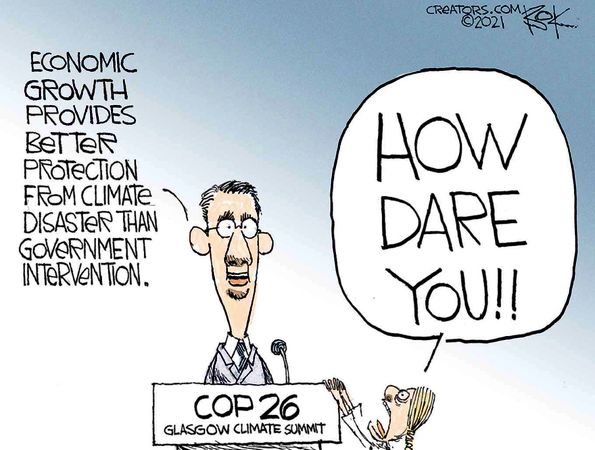
At the recently concluded UN climate summit, wealthy nations agreed to pay climate reparations to poor countries. Unfortunately, this could ultimately be a bad deal even for the recipients, if the West expects developing nations to forego fossil fuels that would help them to develop and get more resilient towards natural disasters. Bjorn Lomborg also discussed the topic on The Journal Editorial Report with Wall Street Journal editor Paul Gigot.

The link to the video clip of the interview is in red above, and below a lightly edited transcript of the conversation.  PG refers to Paul Gigot and BL to Bjorn Lomborg.  Transcript is in italics with my bolds and added images.

PG: The COP27 conference in Egypt wrapped up last week with President Biden signing on to a climate reparations plan. Under the agreement wealthy countries would pay into a new fund to compensate poor countries for supposed damage caused by rich country use of fossil fuels. The move represents a major reversal in U.S. policy with the Biden administration’s climate envoy John Kerry dismissing the idea just weeks ago, saying that a compensation fund was “just not happening.”

Let’s bring in Bjorn Lomborg, President of the Copenhagen Consensus Center and a visiting fellow at the Hoover Institution. He’s also author of the book False Alarm: How Climate Change Panic Costs Us Trillions, Hurts the Poor and Fails to Fix the Planet.

Welcome back, Bjorn. So first of all, what do you make of climate reparations fund idea? Is it a good idea, or not?

BL: No it’s mostly a bad idea. Look, there’s a lot of different things you can think about it. But first and foremost, if you step back, we’ve been trying to solve climate, which is a real issue, for what, 30 years now. It’s the 27th Conference. And now we’re basically moving from fixing climate–Which would obviously entail, How do we get technologies out so people actually cut their carbon emissions–to now saying, no, let’s just make it about money.

The second part is, of course, this is payback for the incredible amount of exaggeration that’s been going on for the last 30 years. If you tell everyone that this is terribly dangerous and it’ll endanger basically the survival of the human race. Don’t be surprised when most people are gonna say, “Well then, you know, give me some money, for putting me in this dangerous situation.” That’s not the right way to look at this. The economic estimates show that global warming will be a problem; we’re talking about perhaps 4% of GDP by the end of the century, not a wipe out.

And then the really damaging thing is that much of this money, if it at all materializes, it will be spent on rich countries paying poor countries not to use fossil fuels. Which essentially means not developing. And of course that will leave them undeveloped. That will leave them in poverty. And why is it that these countries like Pakistan are vulnerable to flooding? Remember most of Pakistani floods came from bad governance, lots of bad infrastructure and lots of people. It’s because they’re vulnerable, because they’re poor. So leaving them poor is the worst way to help fix the problem of climate change.

So this will leave the world worse off, and of course leave rich countries with a huge bill.

PG: I find your arguments compelling, Bjorn, but then why did the Europeans decide, in the first instance, to change their minds on this, to go ahead and endorse this reparations fund. And that isolated the U.S., which I gather felt then they couldn’t be isolated and had to go along. Why did the Europeans insist on this?

BL: It’s hard to tell. My gut feeling, and I wasn’t there, my gut feeling is they realized that nothing was coming out of the Sharm El-Sheikh meeting of the COP 27. So we need to have some sort of success. So let’s say yes to this, which the developing world was very strongly pushing. Look if you go to all of these meeting, and virtually nothing comes out of it; if there’s the possibility of getting trillions out of it, I can understand why a lot of leaders would sign up for basically free money.

But the reality is, much of this could end up not happening, because remember the U.S. Congress has to appropriate: That does not seem plausible. The New York Times said, “We now have a fund but there is no money in it. So it seems likely this will not come true. Most countries are not feeling very flush right now. I can’t imagine most countries saying, “ Sure, let ‘s pay another couple of trillion dollars to the developing world.

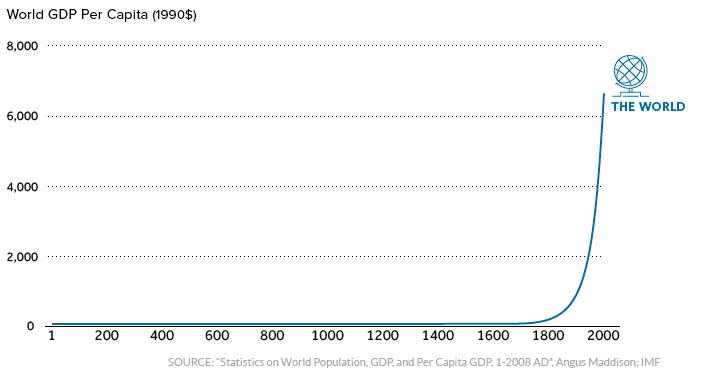
First and foremost let’s remember that if this actually happened, it would likely prevent poor countries from using fossil fuels, which is one of the key ways to get out of poverty. Remember China dramatically industrialized by using lots and lots of fossil fuels, and almost lifted a billion people out of poverty. That’s an amazing achievement. And most people in the developing world want to do the exact same thing. So in a sense, we are setting all of ourselves up for really bad outcomes in the future.

PG: There’s kind of a guilt tax quality to this, where the West is supposed to pay for the sin of having actually developed first, and for being prosperous in part by using fossil fuels. But China isn’t tapped to pay into this fund at all. And it’s building coal plants at a rapid pace, to the point where its projected new plants are going to dwarf all of the U.S. current coal production by 2025. How can China remain out of all of this?

BL: Well, first of all, because that would be really convenient for China. They are categorized as a developing country in the UNFCCC agreement that encompasses the COP negotiations. And of course, it you’re China, you wanna stay that way. I think it’s also fair to say that China has still only historically emitted only about half of what the U.S. or Europe has done. So there is some justification to this. But we have to very clearly separate the fact that you could make the argument that a little bit of reparations make philosophical sense.

But if you start in letting that genie out of the bottle, you’ll make the whole conversation about that, and forgetting to actually fix climate change.

Which is about making green energy much cheaper in the future through innovation. That’s what we should be focusing on if we actually want to fix this. And secondly, you’ll also have this situation where India, China and almost everyone else is not going to pay into this potentially enormous cost.

Summation

Climate reparations is a move in which rich nations lose, poor nations lose and energy innovation loses,  And as noted previously, the winners will be lawyers and accountants, as well as sovereign hydrocarbon producers.

Climate Loss and Damage, Legal House of Cards


With These Climate Policies, Doing Nothing is the Good

Matthew Lau writes at Financial post When climate policy is all error, doing nothing could be good.  Excerpts in italics with my bolds and added images.

It may not be a bad thing for Canadians that Pierre Poilievre
has been largely quiet on climate and environmental policy

Conservative leader Pierre Poilievre has not proposed much in the way of climate and environmental policy beyond scrapping the carbon tax, but if he is searching for policy ideas, one place he best not look — except for examples of what not to do — is across the pond to the U.K.’s Conservative government. Its environmental agenda is a shambolic mishmash of impoverishing energy policies, climate alarmism, excess spending, and virtue-signalling regulations that afflict consumers and businesses without any compensating environmental benefit.

If all this sounds familiar, it is because Canadians are already suffering
from the same policy agenda under the Liberals.

The British government’s latest regulatory effort is a ban on plastic utensils, plates and cups. It follows a 2020 ban on plastic straws, stir sticks and cotton swabs. The latest ban applies only to restaurants and cafes, as the government is planning a separate policy for grocery store sales of the same products next year. It is a little inconsistent that people can still buy bulk packages of plastic forks at the grocery store while not being allowed to access a single fork at a restaurant, where they might actually want to use it. But having two sets of policies implemented a year apart lets the government maximize bureaucrat-hours and so keep the public sector happy.

The problems with plastic bans are well documented.

First, plastic pollution is overwhelmingly caused by waste management problems, primarily in Asia, not single-use products in developed countries. As reported in Reason, the U.K. accounts for only 0.05 per cent of global marine plastic waste.

Second, the alternatives to single-use plastics are more expensive and of lower quality.

Third, despite decomposing more quickly, the alternatives are also often worse for the environment overall. A 2018 Danish Environmental Protection Agency study found that in order to be better for the environment than a plastic bag a conventional cotton bag would have to be re-used 7,100 times.

The environmental policy madness pursued by the U.K. Conservatives and similarly hopeless governments, like the Liberals in Canada, extends past the war on plastic to the war on gasoline-powered cars. In Canada, the federal government plans to mandate that at least 60 per cent of new vehicles sold must be electric by 2030, and by 2035 the sale of all new gasoline-powered vehicles will be banned. The U.K.’s mandate is even worse, as in 2020 then-prime minister Boris Johnson, for reasons unknown, decided to advance the date for banning gasoline-powered cars from 2035 (the year selected by the EU) to 2030. Hybrids will be banned by 2035.

As the Telegraph reports, government enthusiasm for switching to electric vehicles is not matched by consumer enthusiasm: higher price tags and rising electricity prices have flattened demand. A green energy group that three months ago forecast 360,000 electric vehicles would be manufactured in the U.K. by 2025 has just slashed its estimate to 280,000. Unfortunately, consumer reluctance has not stopped the government from trying to control motorists’ behaviour in order to achieve its climate ambitions. A report earlier this month from the U.K. Parliament’s Environmental Audit Committee on accelerating the transition away from fossil fuels proposed such measures as a public information campaign to lecture motorists on driving more efficiently, cutting speed limits, imposing “car-free Sundays” in large cities and car-sharing.

Philip Dunne, the Conservative MP who chairs the committee, declared the U.K. needs “a national war effort” to cut greenhouse gas emissions. Thus, in addition to the hassling of motorists there will be many more billions in spending, “green mortgages,” a call for all housing developers to fit solar panels on new houses as standard and other governmental interventions, all in pursuit of the “guiding star” of net-zero emissions by 2050. The 99-page report is not entirely bereft of reason, but as National Review’s Andrew Stuttaford concludes, it appears to be written by people who learned too little “from the economic and geopolitical disaster that Europe’s climate policy-makers have done so much to enable” and its overall direction is to push Britain faster down the path of more poverty and less freedom.

In view of all this, it may not be a bad thing for Canadians that Pierre Poilievre has been largely quiet on climate and environmental policy. A children’s book of Winnie-the-Pooh-inspired wisdom once offered the suggestion, “Don’t underestimate the value of doing nothing.”

Given the climate-policy disasters of governments of all stripes in Europe, the U.K., and Canada seeking to do something, doing nothing may not be bad advice.

Footnote

Time for a GOP Rational Climate Policy


Recently in a post called Silence of Conservative Lambs I wrote:

The 1991 blockbuster movie revolved around meek, silent victims preyed upon by malevolent believers in their warped, twisted view of the world. A comparison can be drawn between how today’s conservative thinkers and politicians respond to advocates of the pernicious global warming/climate change ideology. Instead of challenging and pushing back against CO2 hysteria, and speaking out with a rational climate perspective, Republicans in the US, and Conservatives in Canada and elsewhere are meek and silent lambs in the face of this energy slaughter. Worse, when they do speak it is to usually to pander and try to appease offering proposals for things like carbon taxes or other non-remedies for a non-problem, essentially ceding the case to leftists.

So to be more constructive, let’s consider what should be proposed by political leaders regarding climate, energy and the environment.  IMO these should be the pillars:

♦  Climate change is real, but not an emergency.

♦  We must use our time to adapt to future climate extremes.

♦  We must transition to a diversified energy platform.

♦  We must safeguard our air and water from industrial pollutants.


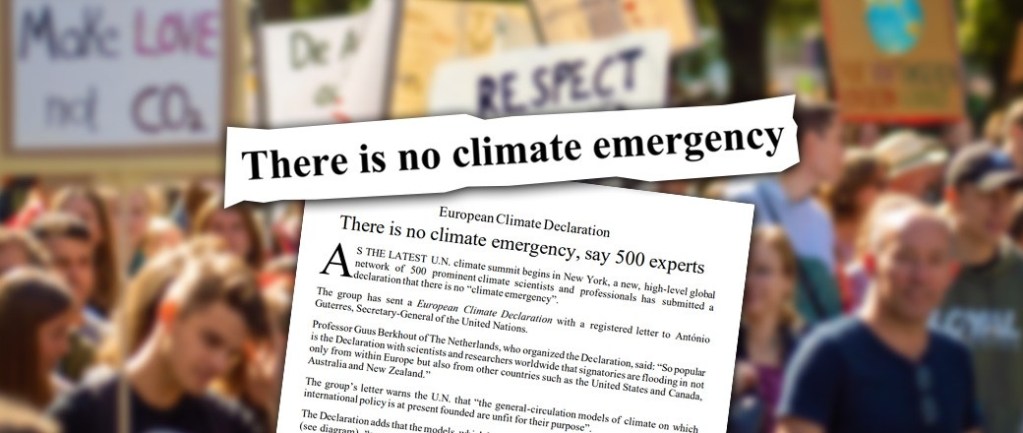
For those not familiar, Climate Intelligence (CLINTEL) is an independent foundation that operates in the fields of climate change and climate policy. CLINTEL was founded in 2019 by emeritus professor of geophysics Guus Berkhout and science journalist Marcel Crok.  Their 1000+ members are signatories of a declaration There is No Climate Emergency

A global network of 900 scientists and professionals has prepared this urgent message. Climate science should be less political, while climate policies should be more scientific. Scientists should openly address uncertainties and exaggerations in their predictions of global warming, while politicians should dispassionately count the real costs as well as the imagined benefits of their policy measures.

One example of a national energy and environment strategy is provided by Clintel for The Netherlands.  The document is Clintel’s Integrated Energy Vision.  Excerpts in italics with my bolds.

Preamble

We all agree in CLINTEL that:
– There is no climate emergency. We have ample time to improve our climate models (for a better understanding of the factors that regulate the climate) and to search for better adaptation technologies.

– The influence of CO2 on global warming is overestimated and its influence on greening is underestimated (even worse, it is often ignored). Nobody knows what the optimum value of atmospheric CO2 concentration is, but from a geological point of view we may conclude that we live in a time with historical low concentrations. Again, there is no climate emergency.

– There is an energy emergency.  Decarbonisation policies – in terms of the current energy transition are most destructive. They do much more harm than good. These energy policies must be terminated immediately.

– The new generation (III and IV) nuclear power plants ought to get all our attention. These plants promise low-priced, reliable, safe and clean energy. In combination with natural gas nuclear energy is a ‘No Regret Solution’. Wind and solar energy are at most niche technologies. Their contribution is and will stay marginal.

With respect to the energy transition, CLINTEL emphasises that there exists not something as a global uniform energy system.  Every country needs a tailor-made energy system depending on its geography, mineral resources, development phase, industrial specialization, population density, etc. For instance, The Netherlands – being a very densely populated country and being severely divided on the CO2 issue – it looks like the new generation of nuclear power plants may function as a breakthrough in the political process:

Part I shows that current Dutch energy policy – having the ambition to reduce CO₂ emissions as much as 49% by 2030 – is based on panic and shall lead to immense additional costs and a drastically deteriorated living environment. Below, we will propose an inspiring long-term energy vision that fits our (and many other) country’s needs, is based on scientific facts, and aimed at a prosperous future for everyone. A positive vision that replaces the gloom and doom predictions of the climate models. A vision with a hopeful perspective for the future.

A Guiding Vision for the Future

It is well known that high-risk, capital-intensive decisions should be based on a policy that is as insensitive as possible about the way the future will unfold. We have called it a No Regret Policy. It represents a long-term policy, implemented by taking small steps, and continuously adapted to what is happening in reality. CLINTEL has drawn up a No Regret Energy Policy, especially aimed at the Dutch energy transition.

The proposed NRE policy is insensitive for the impact that CO₂ might or might not have on climate change (dominant or marginal). In addition it is insensitive for what role the future electricity grid will play and for what the best mobility energy option will be. An extra bonus of the NRE policy is that the Netherlands’ energy supply will become less dependent on Russian natural gas and Middle Eastern oil.

CLINTEL’s proposal consists of three main elements:

1. Introduction of nuclear energy
If we base ourselves on the most up-to-date insights in energy supply, and we look at our four objectives as well as to our ‘no regret demands’, then nuclear energy is the only choice that meets these needs:

• No CO₂ emissions (mandatory requirement in the climate policy in force) as well as excellent controlled waste treatment (pollution requirement)
• High safety level (safety requirement)
• Demand-driven, reliable and affordable (prosperity requirement)
• High energy density (environmental requirement)

About the last entry, please compare a medium-sized 500 MW nuclear power plant with a medium wind turbine park of 4 MW full load. For this reactor, we will need a terrain of approximately 1 km², for the wind farm approx. 300 km². In addition, a nuclear power plant delivers guaranteed for at least 60 years power with low operational costsWind turbines on the other hand deliver unreliable power with high operational costs for a maximum of 25 years.  Solar panels aren’t performing any better. Moreover, the corresponding inverter (from direct current to alternating current) only lasts about 10 years.

2. Transforming green electrons into green molecules

Transport and storage of much larger than the current quantities of electrical energy is
technically difficult and economically unattractive. Every physicist will say: Don’t do it!
The real alternative is that with a large supply of cheap and reliable electrical energy we can afford to transform this energy into any desired molecular clean energy carrier, in the form of synthetic gas and synthetic oil.

There are attractive candidates with an appropriate energy density, such as methanol (CH3OH), ammonia (NH3) and hydrogen (H2), or a combination. These truly green energy carriers can be used safely and affordably be stored and transported using the existing infrastructure (bear in mind that 100% H2 is very aggressive and highly flammable, so there is still a lot of work to be done before this energy carrier can be implemented safely at a large scale).

Oil companies should not be tempted by substantial public subsidies to participate in solar fields and wind farms. Instead, they should concentrate on production, transport and distribution of green molecules (green gas, green oil), so do what they are good at.  Plans to store surplus CO₂ underground may turn out to be a silly activity. Oil companies, be critical before starting such an activity at a large scale.

3. Hybrid applications

With the supply of truly clean electricity and truly clean energy carriers, optimal choices can be made without large and expensive  grid reinforcements and polluting battery packs. Examples:

• Clean high-efficiency boilers (green gas)
• Clean road traffic (green petrol, green diesel)
• Clean aviation (green kerosene)
• Clean industrial production (green gas)
• Clean desalination of seawater (green potable water)

Interestingly, for each application there also is a hybrid solution (fossil-fuel molecules combined with green molecules and/or green molecules combined with green electrons). Here are also great opportunities to meet the ever-growing need for potable water. After all, it is bad for the soil if we keep on pumping up groundwater (e.g. soil desiccation, and soil subsidence). This can be done much better if we link our energy policy to our drinking water policy.

NRE policy excludes burning of biomass (‘the most stupid policy of all times’) and includes sun and wind as niches only. Batteries are only used for low-power applications, as in the information sector. Natural gas and natural oil are primarily still raw materials for the industry. ‘Saying goodbye to ‘natural’ gas, is utterly silly. Any CO₂ tax is even more silly.

Nuclear energy is proposed as the only truly sustainable solution.  To start with, nuclear power will have to take over the energy and heat supply from existing power plants that have almost reached the end of their technical and/or economic lifespan. Next are the energy applications proposed by CLINTEL being part of this vision. The present nuclear technology works with enriched uranium. Breeder reactors on uranium and thorium will in the long run take over the role of these traditional nuclear reactors. Hopefully, nuclear fusion will follow. The Netherlands will, together with other countries, have to participate in research and development efforts, thus acknowledging the importance of a 100% clean, reliable and affordable global energy supply for the foreseeable future. 

Footnote:  US Republicans Get Behind a Six-Point Plan

ClearPath Action

♦  Leverage American Innovation

Innovation and creating jobs is just part of who we are. And thanks to innovation, America has reduced its emissions by more than any other country in the last 20 years. We did this through new American technology, research at the Department of Energy, and strong bipartisan support.

We need to double down and get more American innovations to market.

♦  Modernize Permitting

We need to build cleaner, faster. Clean energy and grid modernization present tremendous economic opportunities, but burdensome and outdated regulations mean that new projects take five years on average to come online.

We have to move faster by enacting common sense reforms to the permitting process.

♦  Bring American Industry Back

American manufacturing is the cleanest in the world with the highest environmental standards. Unfortunately, countries like China and Russia don’t have the same standards.

We can restore American manufacturing leadership in industries like steel and concrete by strengthening our own supply chains and eliminating dependence from countries that don’t meet our environmental standards.

♦  Unleash American Resource Independence

A new industrial revolution is going to require an enormous amount of resources like lithium, copper, cobalt, graphite, and nickel. Currently, we are too dependent on countries like China to supply our needs.

This dependence increases emissions and handicaps American businesses. We have to make it easier to safely supply manufacturers with American-made materials and employ American workers.

♦  Make Our Communities More Resilient

As conservatives, we plan ahead. When it comes to natural disasters, an ounce of prevention is worth a pound of cure. One dollar invested now equals six dollars after the disaster.

We can help take common sense measures and make sound investments that make our communities and farms more resistant to natural disasters like floods, fires and droughts.

♦  Use Natural Solutions

Crop production depends on access to healthy soil, adequate water supplies and predictable weather conditions, all of which are more difficult to manage as the climate changes.

Natural climate solutions – planting trees and farming practices that improve soil health – have a major impact on reducing carbon emissions while making forests and farms more resilient to floods and fires. They are also profitable.

Toward a Congressional Resolution

The current world political climate is shame-and-blame in order to gain approvals for drastic reduction of CO2. Thus pressure is applied to political officials at every level to show their colors on acting to “fight climate change.”  The so-called Zero Carbon notion is widely and naively proclaimed as the way forward.  It seems timely to propose an alternative resolution.

There is no place to hide these days, and politicians who have a rational position on climate science had better legislate on the issue. A common sense legislative motion could read something like this (followed by supporting documentation and references).

Whereas, Extent of global sea ice is within the range of historical variability;

Whereas, Populations of polar bears are generally growing;

Whereas, Sea levels have been slowly rising at the same rate since the Little Ice Age ended 150 years ago;

Whereas, Oceans will not become acidic due to buffering from extensive mineral deposits and marine life is well adapted to pH fluctuations that do occur;

Whereas, Extreme weather events have not increased in recent decades and such events are more associated to periods of cooling rather than warming;

Whereas, Cold spells, not heat waves, are the greater threat to human life and prosperity;

Therefore, This chamber agrees that climate is variable and prudent public officials should plan for future periods both colder and warmer than the present. Two principle objectives will be robust infrastructure and reliable, affordable energy.

Comment:

The underlying issue is the assumption that the future can only be warmer than the present. Once you accept the notion that CO2 makes the earth’s surface warmer (an unproven conjecture), then temperatures can only go higher since CO2 keeps rising. The present plateau in temperatures is inconvenient, but actual cooling would directly contradict the CO2 doctrine. Some excuses can be fabricated for a time, but an extended period of cooling undermines the whole global warming mantra.

It’s not a matter of fearing a new ice age. That will come eventually, according to our planet’s history, but the warning will come from increasing ice extent in the Northern Hemisphere. Presently infrastructures in many places are not ready to meet a return of 1950s weather, let alone something unprecedented.

Public policy must include preparations for cooling since that is the greater hazard. Cold harms the biosphere: plants, animals and humans. And it is expensive and energy intensive to protect life from the ravages of cold. Society can not afford to be in denial about the prospect of the current temperature plateau ending with cooling.

Climate and CO2 Hysteria Is Optional

This is your brain on climate alarm.  Just say No!

David Simon shines a light of sanity in his Real Clear Markets article To End Climate Lunacy, Stop Treating Warming & C02 Hysterically.  Excerpts in italics with my bolds and added images.

Those who oppose economically destructive “climate” policies – like those promoted by the Biden administration and at the recent United Nations COP27 conference – will continue to fail to stop the advance of these policies so long as they continue to accept the false claim that warming of the planet and carbon dioxide emissions are harmful.

They are not. On balance, global warming and CO2 emission are beneficial.

Before getting to why that is, however, it is crucial to understand why accepting the false climate claim is so harmful.

When the destructiveness of climate policies is shown, the response is that the policies nevertheless are necessary to address what President Biden refers to as the “existential threat” of global warming and increased CO2 emissions.

When it is noted that these climate policies will at most microscopically and insignificantly reduce temperatures and CO2 emissions, climate policy mandarins push for even more draconian policies.

The result has been that since the 1990s, climate policies have become increasingly destructive and wasteful. Even worse, their continued intensification appears unlikely to be stopped until the public and policymakers are persuaded that global warming and CO2 emissions are not harmful. As Margaret Thatcher famously said: First you win the argument, then you win the vote.”

To win this argument, it is necessary to focus on the scientific facts.

A warming planet saves lives. 

Analyses of millions of deaths in recent decades in numerous countries, published in the British medical journal The Lancet, show that cooler temperatures killed nine times (July 2021 study) to seventeen times (In May 2015 study) more people than warmer temperatures. The planet’s recent modest warming (by 1.00 degree Celsius on average since 1880, as calculated by NASA) thus has been saving millions of lives.

A 2015 study by 22 scientists from around the world found that cold kills over 17 times more people than heat.

CO2 emissions do not pollute and instead are environmentally beneficial. 

In 2017, over 300 scientists, including Richard Lindzen of MIT and William Happer of Princeton, signed a statement that made this point: “carbon dioxide is not a pollutant. To the contrary, there is clear evidence that increased atmospheric carbon dioxide is environmentally helpful to food crops and other plants that nourish all life. It is plant food, not poison.” Every one of us, indeed, also exhales carbon dioxide with every breath.

Spatial pattern of trends in Gross Primary Production (1982- 2015). Source: Sun et al. 2018.

Since 1920, deaths each year from natural disasters have decreased by over 90 percent. 

And this happened, data from EM-DAT – The International Disaster Database presented by The University of Oxford show, not only as the planet has warmed, but as world population has quadrupled.

Global warming has not increased hurricanes.

 A NOAA report, updated on November 28, 2022, states that “there is essentially no long-term trend in hurricane counts. The evidence for an upward trend is even weaker if we look at U.S. landfalling hurricanes, which even show a slight negative trend beginning from 1900 or from the late 1800s.”

The same report sums it up in bold: “We conclude that the historical Atlantic hurricane data at this stage do not provide compelling evidence for a substantial greenhouse warming-induced century-scale increase in: frequency of tropical storms, hurricanes, or major hurricanes, or in the proportion of hurricanes that become major hurricanes.”

Global warming also does not increase land burned by fires. 

As environmental statistician Bjorn Lomberg has shown using data from the Journal of Geophysical Research: Biogeosciences, Remote Sensing of Environment, and Earth’s Future, the percentage of global land burned per year in 1905-2021 has been declining.

Sea levels are rising – but only by a small fraction of an inch each year. 

An EPA report updated on August 1, 2022, states: “When averaged over all of the world’s oceans, absolute sea level has risen at an average rate of 0.06 inches per year from 1880 to 2013,” including a slightly increased rate since 1993 of “0.12 to 0.14 inches per year.”

The UN climate models that President Biden, John Kerry, and other climate doomsters use to predict future global temperatures are so speculative and unreliable that they have been unable even to reproduce the 20th century’s temperature changes. This is a key point in the must-read book by Obama Department of Energy Under Secretary for Science Steven Koonin, Unsettled: What Climate Science Tells Us, What It Doesn’t, and Why It Matters.

These kinds of facts should persuade the public and policymakers to stop accepting the false claim that global warming and CO2 emissions are harmful.

When this false claim is no longer widely accepted, policymakers will stop imposing climate policies that particularly impoverish the world’s poor.

They will stop holding international boondoggles like COP27 and that demand vast climate-related foreign aid programs.

They will stop spending hundreds of billions of dollars on domestic climate sinkholes.

And they will stop using purported “social cost of carbon” factors (even though the true social cost of carbon is zero) to regulatorily restrict domestic fossil fuel production, transportation, and use.

For additional climate science facts see Climate Problem? Data say no.

.

Climate Loss and Damage, Legal House of Cards

The big news out of COP27 Sharm El-Sheikh concerns funding for climate “loss and damage.”

Reuters  At COP27, climate ‘loss and damage’ funding makes it on the table

Columbia Climate School Loss and Damage: What Is It, and Will There Be Progress at COP27?

CarbonBrief COP27: Why is addressing ‘loss and damage’ crucial for climate justice?

Etc., Etc., Etc.

Mike Hulme explained the house of cards underlying the claims for compensation from extreme weather loss and damage.  He addressed this directly in his 2016 article Can (and Should) “Loss and Damage” be Attributed to Climate Change?.  Excerpts in italics with my bolds and added images.

One of the outcomes of the eighteenth negotiating session of the Conference of the Parties (COP18) to the UN Framework Convention on Climate Change, held in Doha last December, was the agreement to establish institutional arrangements to “address loss and damage associated with the impacts of climate change.” This opens up new possibilities for allocating international climate adaptation finance to developing countries. A meeting this week in Bonn (25–27 February), co-organized by the UN University Institute for Environmental and Human Security and the Loss and Damage in Vulnerable Countries Initiative, is bringing together various scholars and policymakers to consider how this decision might be implemented, possibly by as early as 2015.

At the heart of the loss and damage (L&D) agenda is the idea of attribution—that specific losses and damages in developing countries can be “associated with the impacts of climate change,” where “climate change” means human-caused alterations to climate. It is therefore not just any L&D that qualify for financial assistance under the Convention; it is L&D attributable to or “associated with” a very specific causal pathway.

Developing countries face some serious difficulties—at best, ambiguities—
with this approach to directing climate adaptation finance.

This is particularly so given the argument that the new science of weather attribution opens the possibility for a framework of legal liability for L&D, which has recently gained prominence (see here and here). Weather attribution science seeks to generate model-based estimates of the likelihood that human influence on the climate caused specific weather extremes.

Weather attribution should not, however, be used to make the funding of climate adaptation in developing countries dependent on proving liability for weather extremes.

There are four specific problems with using the post-Doha negotiations on L&D to advance the legal liability paradigm for climate adaptation. First, with what level of confidence can it be shown that specific weather or climate hazards in particular places are caused by anthropogenic climate change, as opposed to a naturally varying climate? Weather attribution scientists claim that such knowledge is achievable, but this knowledge will be partial, probabilistic, and open to contestation in the courts.

Second, even if such scientific claims were defendable, how will we define “anthropogenic?” Weather attribution science—if it is to be used to support a legal liability paradigm—needs to be capable of distinguishing between the meteorological effects of carbon dioxide emissions from fossil fuels and those from land use change, and between the effects of carbon dioxide and other greenhouse gases, black carbon (soot), and aerosol emissions. Each of these sources and types of climate-altering agents implicates different social and political actors and interests, so to establish liability in the courts, any given weather or climate hazard would need to be broken down into a profile of multiple fractional attributions. This adds a further layer of complexity and contestation to the approach.

Third, L&D may often be as much—or more—a function of levels of social and infrastructural development as it is a function of weather or climate hazard. Whether or not an atmospheric hazard is (partially) attributable to a liable human actor or institution is hardly the determining factor on the extent of the L&D. A legal liability framework based on attribution science promotes a “pollutionist approach” to climate adaptation and human welfare rather than a “developmentalist approach.” Under a pollutionist approach, adaptation is primarily about avoiding the dangers of human-induced climate change rather than building human resilience to a range of weather risks irrespective of cause. This approach has very specific political ramifications, serving some interests rather than others (e.g., technocratic and centralized control of adaptation funding over values-centered and decentralized control).

Finally, if such a legal framework were to be adopted, then what account should be taken of “gains and benefits” that might accrue to developing countries as a result of the impacts of climate change? Not all changes in weather and climate hazard as a result of human influence are detrimental to human welfare, and the principle of symmetry would demand that a full cost-benefit analysis lie at the heart of such a legal framework. This introduces another tier of complexity and contestation.

Following Doha and the COP18, the loss and damage agenda now has institutional force, and the coming months and years will see rounds of technical and political negotiation about how it may be put into operation. This agenda, however, should not place climate adaptation funding into the framework of legal liability backed by the new science of weather attribution.

Hulme goes more deeply into the Loss and Damage difficulties in his 2014 paper Attributing Weather Extremes to ‘Climate Change’: a Review.  Excerpts in italics with my bolds.

In this third and final review I survey the nascent science of extreme weather event attribution. The article proceeds by examining the field in four stages: motivations for extreme weather attribution, methods of attribution, some example case studies and the politics of weather event Attribution.

Hulme concludes by discussing the political hunger for scientific proof in support of policy actions.

But Hulme et al. (2011) show why such ambitious claims are unlikely to be realised. Investment in climate adaptation, they claim, is most needed “… where vulnerability to meteorological hazard is high, not where meteorological hazards are most attributable to human influence” (p.765). Extreme weather attribution says nothing about how damages are attributable to meteorological hazard as opposed to exposure to risk; it says nothing about the complex political, social and economic structures which mediate physical hazards.

And separating weather into two categories — ‘human-caused’ weather and ‘tough-luck’ weather – raises practical and ethical concerns about any subsequent investment allocation guidelines which excluded the victims of ‘tough-luck weather’ from benefiting from adaptation funds.

Contrary to the claims of some weather attribution scientists, the loss and damage agenda of the UNFCCC, as it is currently emerging, makes no distinction between ‘human-caused’ and ‘tough-luck’ weather. “Loss and damage impacts fall along a continuum, ranging from ‘events’ associated with variability around current climatic norms (e.g., weather-related natural hazards) to [slow-onset] ‘processes’ associated with future anticipated changes in climatic norms” (Warner et al., 2012:21). Although definitions and protocols have not yet been formally ratified, it seems unlikely that there will be a role for the sort of forensic science being offered by extreme weather attribution science.

Synopsis of this paper is at X-Weathermen are Back!

Integrated Storm Activity Annually over the Continental U.S. (ISAAC)

See also Data vs. Models #3: Disasters


Shallow Warmists Strike Again

John Tamny exposes the vapid scientism of global warmists in his Real Clear Markets article With Their Attacks On David Malpass, Global Warming Hysterics Reveal Their Shallow Ways.  Excerpts in italics with my bolds and added images.

In 2008 Nigel Lawson published An Appeal To Reason: A Cool Look at Global Warming. The Tory radical who served as Margaret Thatcher’s Chancellor of the Exchequer was promptly attacked for having the temerity to write about the theory of global warming absent scientific credentials.

Lawson thankfully didn’t cower amid the arrows directed his way. Instead, Lawson responded that he would cease talking about global warming as soon as other non-scientists like Al Gore, Tony Blair, and other self-serious hysterics did the same. Brilliant!

As readers surely know, the Al Gores of the world never took Lawson up on his offer. The non-scientist  Gore continues to express alarm about “global warming,” and he continues to attack those who disagree with him.

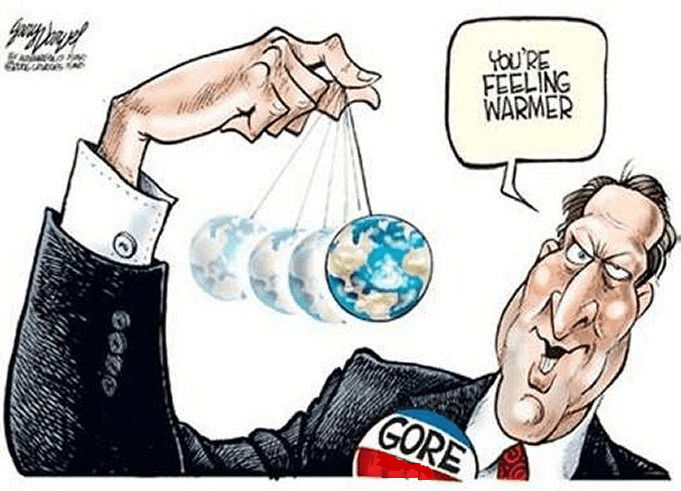
Indeed, Gore recently went after David Malpass, president of the World Bank. Gore described Malpass as a “climate denier,” only for the World Bank head to be asked his views on whether or not human progress is the cause of a warming planet. Malpass’s response was, “I’m not a scientist.”

Please think about Malpass’s response, along with the vitriol directed at Lawson fourteen years ago. For writing a book about so-called “global warming” without scientific credentials, Lawson was demonized.

In which case, Malpass’s response to the question was seemingly the correct one
for the warming nail-biters in our midst.

Not a scientist, Malpass would leave the question of warming to the scientists. Gore et al should have been thrilled, except that Malpass’s response actually brought on more frothing at the mouth from warming’s religionists.

Applied to Lawson, it’s all a reminder that warmists really don’t care about one’s scientific credentials so long as the individual being asked about a warming planet is answering the questions the right way. Translated, you can be a dog-catcher and comment about global warming so long as you conclude that human progress born of fossil fuel consumption is the cause.

It’s all a reminder of how very surface is the embrace of “science” by warmists.

Survey in 2009 first to claim “97% of scientists agree”. Participation excluded private sector and skeptical disciplines (engineering, astrophysicists, etc.), then counted only 77 published climate specialists.

Call “science” their shield. In contending that “97% of scientists believe” life defined by much greater health and exponentially greater living standards has a “warming” downside, the warmists in their delusional minds feel as though they have immunity from reasonable discussion. They’re twice incorrect.

For one, arguably the surest sign you’re in the presence of “scientists” is if they’re arguing. In which case this laughable notion that scientists near monolithically believe as warming mouth breathers do near totally ignores just how much scientists debate everything. The previous truth further reminds us that it’s not science without the doubt.

From there, we just have to be reasonable. We have to stop and think about what life was like before the discovery that planet earth had immense and seemingly endless amounts of oil, coal and surely other commodities that provide us with power. Life before uses were discovered for the earth’s plenty was nothing short of brutal.

As Alex Epstein reminds us in Fossil Future, death from extreme cold was the annual norm, and actually much greater than deaths that resulted from extreme heat. There was also the problem of highly limited drinking water that was actually potable. After which, much of life was defined by an endless pursuit of food in quantities never sufficient to feed us. An “extra mouth to feed” used to be a very real worry, versus today when eating is taken for granted.

How did we get here? Fossil fuels, plain and simple. That’s the case because the fuels powered the various machines that freed us humans to increasingly specialize our work. Thanks to the mechanization of so much that was formerly done by human hands, the human beings that populate the world were more and more able to fulfill their specialized potential. In other words, a local and eventually global division of labor revealed itself on the way to staggering abundance that those who lived in a pre-fossil fuel past could never imagine.

In the words of Epstein, “climate mastery” born of incredibly sophisticated global symmetry meant that people had the means to heat their surroundings when it was bitterly cold, and cool their surroundings when it was brutally hot. Clean water was plentiful such that the world’s population could – yes – greatly reduce consumption of liquids with alcohol in it. And then houses and buildings could be built in rapid fashion that would similarly protect us from an “environment” that wasn’t always kind.

Crucial about these advances that were and are a direct consequence of machines, the ever-widening global division of labor that I write about in my new book The Money Confusion has given the world both the means to care about planet earth along with more and more specialized, Will tomorrow’s energy replace oil and coal? It’s impossible to say. But what can be said with certainty is that without an advanced society that’s a direct consequence of fossil-fuel consumption, we would never have the means to pursue oil’s replacement; assuming there is one.

Back to Malpass, it’s not just that his knuckle-dragging critics want it both ways in criticizing his true admission that he’s not a scientist. That’s just politics. What’s really sad is that global warming fanatics can’t see that the very human progress they disdain (and that they couldn’t live happily without) is what sets the stage for even better care of the planet they claim to want to save.

And it doesn’t take a scientist to understand what the warmists do not.

McKitrick: Reckoning Coming for Climate Alarmists

Tom Nelson posted this interview with Ross McKitrick on Big problems with paleoclimate data and land temperature records.  H/T Climate-Science.press.

Ross McKitrick is a Professor of Economics at the University of Guelph where he specializes in environment, energy and climate policy. He has published widely on the economics of pollution, climate change and public policy.  His book Economic Analysis of Environmental Policy was published by the University of Toronto Press in 2010.

His background in applied statistics has also led him to collaborative work across a wide range of topics in the physical sciences including paleoclimate reconstruction, malaria transmission, surface temperature measurement and climate model evaluation.

Professor McKitrick has made many invited academic presentations around the world and has testified before the US Congress and committees of the Canadian House of Commons and Senate.

The discussion is wide-ranging, and I provide below a lightly edited transcript on the main theme, starting around minute 41. Text is in italics with my bolds and added images. TN refers to Tom Nelson’s comments and RM to Ross McKitrick.

Transcript

RM: People need to understand that for the 20th century as a whole there’s temperature data for less than 50 percent of the Earth’s surface. And a lot of stuff is just being filled in with with assumptions or or modeling work, so it’s really the output of models. And so as you go back in time back to the 1920s for instance, here in Southern Ontario we have great temperature records back to the 1920s. Here in Guelph we have temperature data that goes back to the late 1800s.

One of the first assignments I have my students do in my environmental economics courses is just to take a few locations in Ontario that have more than 100 Years of temperature data and plot the records for average daily highs back 100 years or more. That always surprises them because they just don’t see what they’re expecting to see in terms of an upward trend. There’s a visible trend up to the 1930s or so. And then after that it’s kind of up and down flat.

Summertime temperatures especially, have gone down, they’ve gone up,
but haven’t really changed much since the 1930s.

We happen to be in a part of the world where we’ve got those kinds of long temperature records. For the vast majority of the world there’s just no data at all, or there are short temperature records or fragments of temperature records over various intervals. Yet what we see are these temperature graphs going back to the 1860s that they call the observational record. There’s so many problems with those records, and unfortunately a lot of the problems are of the form that introduces an upward bias in the trend. And it’s very difficult to measure it and remove it, though I did some work on that I hope eventually to go and do some more.

TN I wish more people took an interest in that kind of topic. Have you followed the work of Tony Heller when he’s looking back at adjustments to cool the past. It seems pretty interesting.

RM: Yes. I’ve seen many of his videos and now he’s focusing on the U.S record in a lot of his videos. There I think the point that he conveys is how frustrating it is for an observer. Just this notion that you’ve got the raw temperature observations and then the adjustments and they all seem to pivot around 1960.

So that anything prior to 1960, the Adjustment goes down,
and anything after 1960 the Adjustment goes up.

They create this picture that somehow in 1960 everyone in the US knew how to measure temperature perfectly. So that’s the year we’re going to leave as it is, and prior to that everybody made the same mistake. Everybody was always overestimating temperature so we’ve got to adjust those records downward. Then ever since 1960 people haven’t known how to measure temperature so we have to raise those those measurements. The pattern of adjustment is so consistent in so many places in the U.S records that at a certain point it’s just on its face implausible that these adjustments are based on some objective algorithm.

I know the people who make the adjustments will say: Well we’ve got to deal with time of observation bias you know. But if these were the sort of standard measurement errors, you would expect a mix of positive and negative mistakes. Instead, there’s such a pattern to it. The adjustments account for all the warming.

When you look at the post-1960 U.S record the adjustments are as large as the warming itself.

Remember that the warming trend is such an important input into thinking about the policy. We really need to have absolute confidence in these adjustment processes, but the people who make the adjustments do not respond in a constructive and forthright fashion to these kinds of criticisms. In my experience, they instead take such offense that anyone would question what they’re doing. And they respond with abuse and indignation when perfectly reasonable questions are put to them.


That’s another thing that makes it frustrating to an outside observer looking at these these adjusted data sets. So Tony does a very effective job in letting people see: Okay, this is a graph you’re shown. This is what the data looked like when they first collected it, and this is what the observers wrote down. And then this is what it looks like after the adjustment process. Obviously, this whole warming Trend in the U.S record is coming through the adjustments. So we have a right to a very detailed and skeptical review of these adjustments. The the lack of constructive engagement on a question like that ignores that at a certain point, the burden of proof here is on you guys, the record keepers. It’s not on the people who look at the data to go into every station record and prove it’s wrong.

The burden of proof here is on the people making the adjustments. For a long time they would refer back to a paper that was done in the 1980s for the Department of energy by Tom Wigley as the scientific basis of the adjustments. Eventually I got a hold of that document (because it’s hard to find). It turned out it was really just a lot of: Okay we think this record here moved around 1925, they moved the station from here to there, so we’re gonna make a little few changes here and we’ll bump this stretch of the data set up by this amount. And so it wasn’t like a a detailed scientific methodology that you could subject to some testing and validation.

It was really and for the time, it was all anyone really would have expected: Which is go through the data set and discuss the potential flaws and what the ad hock adjustments were. But for a long time that was that was it as far as documenting the adjustments. Now I think they’ve got more information out online to help people understand it. But that’s a long answer to your question. I go back to point out the adjustment really matters for the overall conclusion. And so if we’re going to accept the conclusion, we need to have absolute confidence in these adjustments.

And the people who could have over the years helped us gain that kind of confidence
haven’t done so.

They’ve done the opposite by being so resistant to any questioning of of their work, and made it so difficult for people to critique it. In my experiences, when you do get stuff into print and journals, then the IPCC misrepresents it and even makes up stuff that isn’t true. So I’m quite sympathetic if people just want to dismiss the the adjusted temperature record as being the product of a process where people put their thumb on the scale to get a certain result.

TN: What do you think, do you have any predictions on where climate science is going in the next 10 or 20 years? Just more of the same, or is it eventually going to crumble? It just seems like this can’t keep going on, that the lies are so big that it can’t keep going on but what do you think?

RM: My observations began 20 years ago. When I started, if you think of where people are in the spectrum, you’ve got someone like me (whatever the opposite of the word alarmist would be). I’m not particularly worried about climate change. I think the evidence is: It’s not a big deal. And there’ll be changes and things to adapt to, but they’re on a small scale compared to the normal course of events and things that we we adapt to in life.

And then you’ve got the alarmists who are you know, throwing cans of soup at paintings and gluing themselves to the sidewalk and and having a complete emotional meltdown. In the early days the the IPCC was sort of on the alarmist camp over against the Skeptics, in the sense that they were the ones trying to pull everybody away from a viewpoint like the one I hold. It was: No, you guys have to be worried about this. Look at these charts and see what we got to be worried about.

Now the alarm side has moved so far up the scale now that I think the IPCC is having to face the fact they have to begin to pull everybody back in you know my direction, our direction. So far, they’re not very good at that. Take for instance, discussions around hurricanes. You’ll get everybody from President Biden on down to some local weather caster on the the Channel 6 Nightly News confidently declaring that your tailpipe emissions caused hurricane Ian. And it’s your fault that all those homes are blown down. And you got the experts in places like NOAA and IPCC thinking: Oh we just put out a report that doesn’t say that that; in fact says the opposite. We don’t want to draw that connection and we can’t see a trend that would be consistent with that story.

But they say it in a very quiet heavily, coached language. For a long time they were happy to intervene early on when trying to fact check or, you know, counter messages from skeptics who were saying look this isn’t a big deal. They were happy to jump up and tell world leaders: No don’t listen to those guys, we tell you this is a big problem, blah blah blah.

Now they’ve got an even bigger problem with these crazy extremists saying all kinds of stuff that isn’t true and isn’t in their reports. What they should be doing is jumping up and saying to world leaders: Don’t listen to those guys, they’re nuts we we disavow that message. They’re not doing that and at this point they’re not yet capable of doing that.

Culturally within the IPCC, meaning the mainstream various branches such as the climate modeling groups, the atmospheric science groups and and oceanography groups. These are people that are all sort of comfortable with each other in terms of an overall set of assumptions. They may disagree on all kinds of other things, but culturally they’re comfortable with each other. And I think they’re all kind of looking at each other now and saying; Well, somebody’s got to stand up here and and say that’s not actually what we are arguing.

But nobody wants to do that; nobody wants to be the one to actually speak out. Look what happened when someone like Roger Pielke Jr said, Okay I’ll do it. I’ll stand up and and debunk some of the nonsense around hurricanes and extreme weather. Then what happens: They discover they’ve got so many extremists and activists in their own ranks who then attack a guy like Roger Pielke Jr. And that sends a message to the whole rest of the climate Community:

Don’t be like Roger Pielke Jr. Or you won’t get to eat lunch with the cool kids either.

So they’ve got this police network now in the climate field who make it impossible for them to stand up and and distance the field from the kooky extremists. It’s gonna take a long time for that to get sorted out, but I think there’s a few Milestones that are coming up quickly.

One is that 2030 will be an interesting year because first of all there will not have been any major reductions in CO2 emissions between now and 2030.

Well there were some during the Covid recession but things quickly return to trend. This year’s winter in Europe their CO2 emissions will go way down. Because they’re all going to freeze to death due to their stupid policy decisions that have left them without a reliable energy supply.

But any emission reductions taking place in the West are small and sporadic, and are more than offset by emission increases in China and India and places like that. As industry just leaves the crazy places like Europe and well, Canada unfortunately, places where energy is being made prohibitively expensive. Heavy industry is just packing up and moving somewhere else so by 2030 we won’t have done the emission reductions that the extreme alarmists have been calling for but at the same time we won’t have experienced the climate changes that they’ve been warning about.


In all this language that came out a couple of years ago, we have until 2030 to prevent extreme climate damages in the apocalyptic vision that they created. We’re going to get to 2030 and people will have seen the price that they paid for climate policy, they will have experienced the harm, experienced these winters that we’re in for. Europeans especially are in for the next couple of winters where they don’t have enough fossil energy sources to get through.

And just the cost of living effects of climate policy and 2030 will come
and we won’t have experienced climate Armageddon.

And they won’t be able to turn around and say: Well yeah, but we avoided it because we cut emissions because we didn’t cut emissions either. And so that’s where I would hope there’ll be a certain Reckoning and maybe some of it will have happened up to that point.

But heading to that point we still have the problem that there are lots of people that see this narrative as unsustainable. This whole ESG movement, the climate alarmist movement, isn’t sustainable since it doesn’t make sense. But then someone like Stuart Kirk at HSBC stood up, even though he thought he had approval from his higher ups to make a speech at a finance conference that said none of us really believe in climate alarmism. And he had this great line about the previous speaker said something to the effect of that by 2030 you’re all going to die from climate extremes and none of you even looked up from your phones.

“And so you don’t believe it, I don’t believe it, our clients don’t believe it.”
And soon after he got sacked.

So we’re still at the point where the sensible people, and they’re fortunately still many of them, sensible people in positions of influence don’t yet know how to talk about this. They don’t yet know how to pull the discussion back onto sensible grounds. I’ll return to the point I was making in the beginning: The IPCC were supposed to be the objective scientific thinkers who just call it straight. I think they found it easy in the early days when they felt like their job was to up the level of alarm above what the general public felt. Well now the public has leapfrogged them and and they’re all falling for these crazy alarmist extremes. Well it’s IPCC’s job to fix that.

But culturally within the IPCC and the climate science movement, I don’t think they’re able to do it. And the few people who try seem to get their heads bitten off.

It will eventually come back on the IPCC when when it becomes clear that the alarmist message was way over the top. People will be entitled at that point to say: Well this is your job to put a the brakes on this and straighten people out. And you didn’t do it so how can we trust you now?

TN: Are there any other points you’d like to make?

RM:  Sometimes people wonder why would an economist presume to talk about these things?
It turns out climate science is a lot like economics in terms of the tools that people use. To a large extent it’s applied statistical analysis. And yes you have to know where your data comes from and you have to be able to interpret it. But the techniques are applied statistics and a lot of those techniques came out of econometrics or at least they came out of the same sources but a lot of the development of the technique has been in econometrics

It’s very hard for people in the climate field to follow those discussions because it’s a it’s econometrics it’s econometric Theory. I teach econometrics at the third year level and so I was just going through stuff I would expect my undergrads maybe the fourth year students to understand. But for a lot of people in the climate field you know this is the first time anyone’s really critiqued the theory behind that method.

It’s the kind of question Steve and I were asked with the Paleo climate stuff: Why are we doing this, why is why wasn’t it people in the field who noticed these flaws in the methods, who dug out the data figured out the method and pointed out the obvious flaws in it. So here I am 20 years after this technique was established I’m publishing a paper that says your fundamental results are invalid; you invoke the theorem incorrectly and your method does not generate unbiased and efficient results like you claimed. In fact it automatically fails the condition so you don’t know anything about what your results are.

TN: I was reading an article and a phrase in there mentioned 2100 expert climate economists. And I just thought that was mind-blowing; there’s such a thing as a climate Economist and there’s 2100 of them. Does that sound right to you? Like what would they do all day?

RM: When I started work in 1996 when I graduated from my PhD, there were only a couple of people who did anything to do with climate change. But like any field there’s a lot of money pumped into climate institutes and into universities to study climate change. So it’s not a standard field in the same sense as trade economics or labor economics or environmental economics would be. So a lot of people will call themselves climate economists now.

So a popular genre now would be impacts analysis. People will take climate model outputs at face value usually the RCP 8.5 scenario, which is garbage but they’ll use it anyway. And then they’ll look at some aspect of the economy, say that pineapple growers are going to experience a five percent reduction in output by 2100 because of climate change.

So there’s that group and among that group, kind of like the hockey stick crowd, where there was sort of an unstated prize for who can get the flattest handle the farthest back. In the climate economics group there’s an unstated prize for who can come up with a highest social cost of carbon. So you can tweak the models and get a social cost of carbon above two hundred dollars, and then above five hundred dollars. Can you get it above 800, and the higher you get, the the more likely your paper is to be into one of the nature journals.

The models that generate social cost of carbon: It’s pretty well known how they operate, and there’s a few knobs on them it’s pretty easy to adjust to get really high social cost of carbon numbers. And it’s also easy to get low social cost of carbon numbers. Then the question becomes, which of these assumptions are more defensible? That’s the part where the question typically doesn’t get asked.

I would guess that a lot of those 2100 climate economists don’t have a big picture approach to the field like they don’t necessarily see climate policy is embedded in the whole array of economic socioeconomic policies, where the ultimate question is what will make people better off on balance all things considered. Because you can get a lot of these young climate economists who will happily endorse Net Zero, even sign letters to the European Parliament encouraging them to pursue Net Zero.

And all they’ve ever studied is what would get us to Net Zero faster and more effectively. But they don’t step back and ask: Is NetZero a very good Target for us to pursue and is the cure worse than the disease? And what would be a climate policy that we could confidently say would be consistent with making people better off around the world over the next 80 years, all things considered?

There aren’t many economists that think about it in that framework. One one of them who does is William D. Nordhaus who won a Nobel Prize in 2018 for his work in climate economics. A lot of the activist crowd were jubilant, thinking finally the economists have noticed climate change. And look at William Nordhaus: He’s an advocate for carbon taxes he won the Nobel Prize. They don’t want to mention the fact that his modeling work showed that: We should do a bit of mitigation to eliminate some of the lowest value activities that generate greenhouse gas emissions, but otherwise the optimal policy is just to live with it and adapt to it. And that’s the upshot of his modeling work and it’s been a very robust result over the 20 or so years that he’s been doing this modeling work. And it convinced the profession enough that his papers are in the best journals and he won a Nobel Prize for it.

Yet as I say the implications are lost on people including a lot of people in this climate economics field that you refer to. Who somehow think the fact that William Nordhaus got the Nobel prize in economics means we should all rush to net zero, even though his own analysis would say absolutely not. That result is not defensible and would make us incomparably worse off and be worse than doing nothing; be worse than just ignoring the climate issue altogether and pursuing economic growth.

TN: I do wonder what percent of the climate economists think that it would be a great thing if we could get back to 280 PPM CO2 and whatever the temperature was in 1850 like end of the little Ice Age with shorter growing seasons etc. Because that seems completely insane to me as an outsider that we would want to spend trillions of dollars to do that, totally crazy yeah.

RM: I doubt even the most enthusiastic climate Economists, meaning the most worried about climate change and most wanting to push a net zero agenda; I think if you really pin them down, very few of them would say, yeah we should try to reverse engineer the 20th century and get back to 280 parts per million, if we could even do it.

Imagine if we could go back in time to 1800 or whatever and and present people with the choice: okay here’s here’s a future path, one where we don’t develop the use of fossil fuels, the economy stays roughly where it is now in terms of living standards, and the atmospheric concentration of CO2 stays at about 280 parts per million and it remains as cold as it is now. We could do that or here’s the other path: We develop fossil fuels, we grow our economies so by 2100 basically everyone around the world is living in a developed economy with a good standard of living and the atmospheric concentration of CO2 goes up to 500 parts per million, and we get a degree and a half or two degrees of warming.

If you presented that choice to people the answer would have been obvious. People would have chosen the path that we chose and halfway along it no one in their right mind would say, oh let’s go back to where we started and and not have all these changes. It’s literally the biggest no-brainer out there.

It was the development of industrial civilization, a net benefit to the world, and the proof is that the places where they didn’t experience that development are doing everything they can to experience it.

And all the supposed harms that people talk about, getting back to extreme weather which we talked about at the beginning: Where are people in the United States moving to? They’re all moving to the extreme weather areas, to the Florida coast and California coast and leaving behind the areas like the Midwest which have the four seasons but not exactly subject to tornadoes and hurricanes. As soon as they can retire they leave those places and go to where they they’ll either have heat waves in the desert or droughts in California or hurricanes on the Florida coast. And that’s where they want to retire to. And then when they get there they can become climate activists and protest greenhouse gases.

Iron Triangle of Public Crises

Postcript:

For more on McKitrick and McIntyre versus the Mann-made Climate hockey stick, see post:

Rise and Fall of the Modern Warming Spike

The first graph appeared in the IPCC 1990 First Assessment Report (FAR) credited to H.H.Lamb, first director of CRU-UEA. The second graph was featured in 2001 IPCC Third Assessment Report (TAR) the famous hockey stick credited to M. Mann.


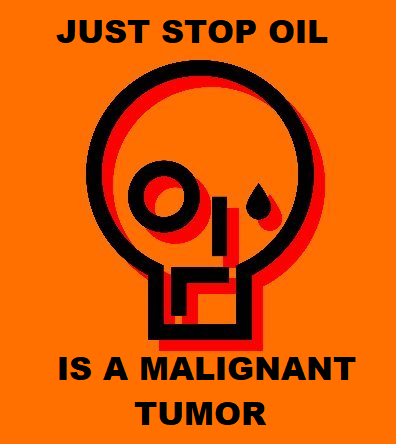
JustStopOil is a Malignant Tumor

Tom Slater reports on this social cancer and the need to excise it in his Spectator article Just stop Just Stop Oil.  Excerpts in italics with my bolds and added images.

The chasm between the protestors and the public grows wider with each demonstration

Why block roads? Why make people’s lives miserable? Who do you think this is going to convince? So go the interminable TV-news debates after each disruptive piece of direct action by eco-troupe Extinction Rebellion and the various single-issue offshoots, such as Just Stop Oil, that it has inspired.

These past two weeks, Just Stop Oil has been back in the spotlight. It is now into its 12th consecutive day of action in London, demanding the government stop all oil and gas production. Yesterday, its activists blocked roads in Knightsbridge, delaying an ambulance, a fire engine and cars carrying babies to hospital. Today, they’re sitting in the road outside parliament.

Once again, all these hi-vis-clad protestors have managed to achieve, beyond disrupting the days of ordinary people and the work of the emergency services, is to infuriate members of the public up and down the country.

But the tactics of Just Stop Oil, Insulate Britain and other groups make a lot more sense when you realise that the point of these protests is to disrupt the lives of working-class people. Indeed, the future these bourgeois irritants envisage would sacrifice ordinary people’s living standards on the altar of eco-austerity.

It’s perhaps too easy to portray Extinction Rebellion as dominated by the posh and over-educated. But only because this is a factually accurate characterisation. Academic research has shown that XR activists are overwhelmingly middle class and a whopping 85 per cent of them have degrees.

There’s a reason for this class skew. The eco agenda is essentially about making life harder for anyone who doesn’t work primarily on a laptop, who can’t cycle to work, who drives for a living, or who just isn’t convinced that soaring energy costs are the price we must pay for progress.

No wonder so few working-class people are fully paid-up members of these groups. No wonder working-class people clash with these protestors on the streets whenever these supple-handed sons of privilege decide to glue themselves to the road and bring traffic to a standstill.

In groups like Just Stop Oil we see a perfect fusion of political goals and political tactics.

Their ultimate aim is to make working-class people’s lives more difficult, insisting essentially that everyone must pay more to consume less. Their campaign to bring this about takes the form of making working-class people’s lives more difficult. It’s genius, really.

The class tensions of it all have become crystal clear in the repeated scenes of builders, delivery men and otherwise irked members of the public having to drag these activists off the road so they can go about their business – as we saw in Knightsbridge again yesterday.

‘I will start moving these people myself, I ain’t f****** about’, said one man, who told the protestors he didn’t give a ‘flying s***’ about what they had to say.

The chasm between the protestors and the public grows wider with each protest. In another clip from this week, a man says to the road-blocking activists: ‘Somebody’s sick, get off the road!’ To which a protester replies, remarkably: ‘If somebody’s sick, they shouldn’t be driving.’ The man is then forced to spell out that ‘they’ve got a passenger who is sick’. ‘Are you silly?’, he adds.

Direct action is supposed to be disruptive, of course. But the protestors’ callous indifference to the disruption they are causing speaks to something deeper about their movement. It has become so cultish and myopically obsessed with saving ‘the planet’ that it has become entirely alienated from the needs of human beings.

We glimpsed this in Just Stop Oil’s media appearances yesterday. During an interview on GB News, a young man, apparently convinced that we are on the brink of ‘societal collapse’, suggested his cause was ‘more serious actually’ than the plight of a sick person in an ambulance, stuck behind his friends’ human roadblock.

This indifference makes ordinary people all the more infuriated when the police seem incapable of dealing with these protests in a timely fashion. In some cases, officers have even appeared to indulge protestors. At an Insulate Britain roadblock last year, one officer was filmed telling the activists to let them know if they ‘need anything’.

Everyone supports the right to protest, of course. There is just no right to glue yourself to a road for hours on end. Now more and more members of the public are willing to do what the police are apparently so incapable of doing. And who could blame them?

These aren’t protests for the climate, they’re protests against ordinary people.

See also Climatism the Real Threat to Democracy

Having failed at the ballot box, millennial climate activists will
pursue any means to impose their will on society

A handout picture from the Just Stop Oil climate campaign group shows activists with their hands glued to the wall under Vincent van Gogh’s “Sunflowers” after throwing tomato soup on the painting at the National Gallery in central London on October 14, 2022.

Alarmist Climate Consensus Collapses

‘There is No Climate Emergency’ (1,107 Signatories and Counting)

The World Climate Declaration (Global Climate Intelligence Group) follows:

    • There is no climate emergency Climate science should be less political, while climate policies should be more scientific. Scientists should openly address uncertainties and exaggerations in their predictions of global warming, while politicians should dispassionately count the real costs as well as the imagined benefits of their policy measures.
    • Natural as well as anthropogenic factors cause warming. The geological archive reveals that Earth’s climate has varied as long as the planet has existed, with natural cold and warm phases. The Little Ice Age ended as recently as 1850. Therefore, it is no surprise that we now are experiencing a period of warming.
    • Warming is far slower than predicted. The world has warmed significantly less than predicted by IPCC on the basis of modeled anthropogenic forcing. The gap between the real world and the modeled world tells us that we are far from understanding climate change.
    • Climate policy relies on inadequate models Climate models have many shortcomings and are not remotely plausible as policy tools. They do not only exaggerate the effect of greenhouse gases, they also ignore the fact that enriching the atmosphere with CO2 is beneficial.
    • CO2 is plant food, the basis of all life on Earth CO2 is not a pollutant. It is essential to all life on Earth. More CO2 is favorable for nature, greening our planet. Additional CO2 in the air has promoted growth in global plant biomass. It is also profitable for agriculture, increasing the yields of crops worldwide.
    • Global warming has not increased natural disasters There is no statistical evidence that global warming is intensifying hurricanes, floods, droughts and suchlike natural disasters, or making them more frequent. However, there is ample evidence that CO2 mitigation measures are as damaging as they are costly.
    • Climate policy must respect scientific and economic realities There is no climate emergency. Therefore, there is no cause for panic and alarm. We strongly oppose the harmful and unrealistic net-zero CO2 policy proposed for 2050. Go for adaptation instead of mitigation; adaptation works whatever the causes are.

Our advice to the European leaders is that Science should strive for a significantly better understanding of the Climate System, while Politics should focus on minimizing potential climate damage by priortizing adapation strategies based on proven and affordable technologies

COP27 is several months ahead. The world is recommitting itself to fossil fuels, while only government largesse keeps the wind/solar/battery gravy train going. Global Climate Intelligence Group’s World Climate Declaration stands as a beacon light to a wholly different approach of free-market adaptation, not government mitigation.

See also CLINTEL Declaration Essay


Global Warming Groupthink

H/T to Ghengis for reminding me of this insightful analysis of the climatist ideology.  The GWPF publication is here:  GLOBAL WARMING  A case study in groupthink  My transcript of the video is below in italics with my bolds and added images.

For most of the last 30 years climate change has been called settled science. As letters, observations and scientific advances have shed more light on the problem, it became clear that many of the most alarming and urgent fears about the effects of global warming were unfounded.

These dramatic stories were not just the work of fringe activists. World leaders and internationally renowned scientists too often departed from science to speculate about how terrible the future would be.

“Heat waves, droughts, wildfires, floods all are now more frequent and more intense.” -Obama

But when the truth of these stories was discovered very few politicians attempted to bring a sense of calm or reason to the political debate.

“Global warming is man-made and it’s happening. We’re all agreed that climate change is one of the greatest and most daunting challenges of our age.”

“The scientific reality is compelling us to act. We are on the course for a very, very dangerous world over the next century.”

“The scientific evidence is stronger than ever, and science itself has been slow to correct alarmist claims.”

“Human influence on the climate system is clear.” (IPCC)

Even worse attempts to question the scientific basis of scare stories has been met with hostility.

“We don’t need another meeting of the Flat Earth Society.
We need to get on and tackle climate change.”

Given the emphasis placed on science, data and evidence in the debate, how is this possible?

One answer might be a theory formulated in 1972 by psychologist Irving Janus. He argued that groupthink occurs when a single-minded group dominates a decision-making process, excluding alternative perspectives and criticism. Janus discovered that groupthink was the cause of many catastrophic failures of military planning. Groupthink theory is the basis of a new report by Christopher Booker for the Global warming Policy Foundation

Booker looks at the history of climate change consensus building, policymaking and coverage of the issue in the media. Three rules of groupthink emerge from this historical view. Booker finds that though a consensus on the role of anthropogenic global warming did emerge, this consensus was not dominant in official thinking and coverage. Scientists as well as politicians, campaigners and journalists told stories that owed much more to speculation than to settled science.

“We have built a society, an agricultural system and cities. And everything that we do based on assumptions that basically the climate is not going to change. Eventually this is going to be a problem that is so large that we will transition . . .”

“But after damaging scandals at East Anglia University and the UN’s Intergovernmental Panel on Climate Change, it is Mr Miliband’s side who need to change their approach.”

These unfounded stories cost serious setbacks for the climate agenda.

“Or we can choose to believe in the overwhelming judgment of science and act before it’s too late.” (Obama)

Increasingly in cases where mainstream thinking was shown to be wrong, it was defended from criticism not on its scientific merits but on the basis of the scientific consensus that climate change is real, is happening and will be dangerous.

“But they’re wasting everybody’s time on a settled debate. Climate change is a fact.” (Obama)

“Of the scientists who expressed a view, ninety-seven percent said that climate change was happening and it was human-made activity.”

“Certainly of course that has been substantially discredited.” (Hugh Mathers)

“Isn’t it exactly the stifling of dissent that has got the climate scientists into this mess in the first place? Why are you going down this road again?”

“Oh, I’m not trying to stifle dissent, Krishnan, but you’ve got to make the judgment: When there’s a mistake does it undermine the basic facts about climate science?”

Even where criticism of alarmism has come from inside the consensus it was excluded from public debate rather than allowed to improve scientific understanding. Consequently without debate, climate change became the explanation for ever more things from poverty, migration, to war and even mental illness.

“There are a number of statements that have been attributed to me that are not correct. I don’t believe I called anybody here a denier, and yet that’s been stated over and over again. So I’ve been misrepresented quite a bit today by several.” (Michael Mann)

“But it’s in your written testimony. I’ll read it again.” (Judith Curry)

The growing distance between climate stories and reality led to increasingly hostile public campaigns against dissenting opinions.

Scientists openly criticizing climate change alarmism have been forced into silence under the threat of losing their jobs. Dissent in the media has led to campaigns to remove skeptics from public attention and for increasing control over the media.

“I complained about this article and have just heard from the media self regulator that they found nothing wrong at all with the newspaper article. And so I wrote to them and complained. I complained to the Press Complaints Commission there have even been calls for climate skeptics to face criminal prosecution and even the death penalty.”

“Right kids, just before you go, there’s a brilliant idea in the air that I’d like to run by you . . .”

The insistence that everyone in the public sphere must adhere to the consensus has harmed research, political debate and journalistic coverage of climate change. The result of such climate change groupthink may be the least scrutinized, most expensive and counterproductive policies ever conceived. To find out more about how groupthink has been confused for the scientific consensus on climate change download the report from the G WPF website.

Link to GWPF Publication in pdf GLOBAL WARMING  A case study in groupthink

See Also Q&A Why So Many Climate Skeptics