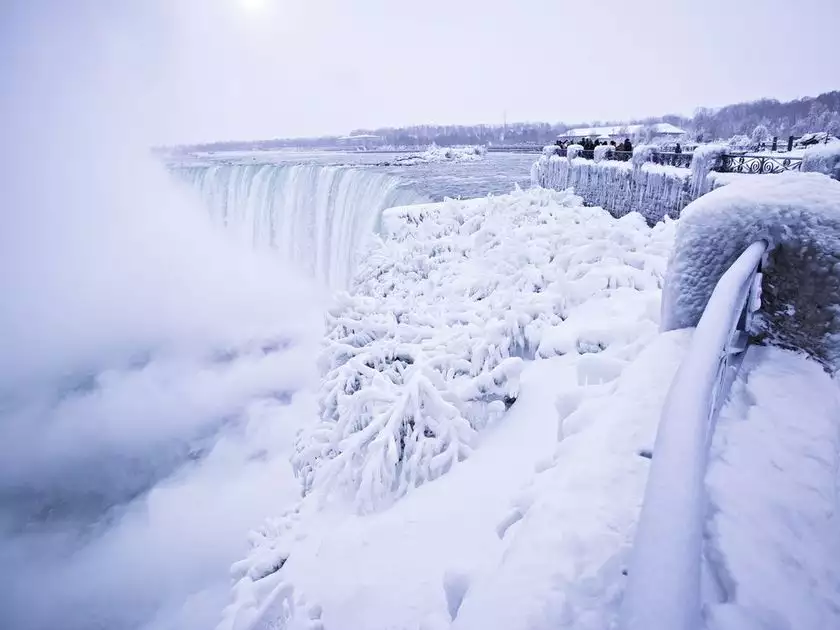
How Cold Is It? Niagara Falls Froze.

Visitors take photographs at the brink of the Horseshoe Falls in Niagara Falls, Ont., on Friday, Dec. 29, 2017. AARON LYNETT / THE CANADIAN PRESS

From the Ottawa Citizen:

The teeth-shattering temperatures threatening to put New Year’s Eve festivities on ice have even managed to freeze part of Niagara Falls.

With the bone-chilling, record-smashing temperatures, tens of millions in Canada and the northern United States are suffering through the cold snap expected to continue another week.

On New Year’s Eve day, Ottawa is to see a high of just -19 C and a low of -28. And it’s to be even colder as we ring in 2018. On New Year’s Day, it won’t get any “warmer” than -22, with the low dropping all the way to -32. That’s an actual temperature, folks, not a wind chill.

The record low for Dec. 31 (1938-2010) is listed by Environment Canada as -26.1 C in 1962, with the Jan. 1 Ottawa record (1939-2011) at -27.2 in 1947.

“2017 is about to end with the coldest air of the year,” Environment Canada said in a news release. “A fresh surge of record-breaking Arctic air is forecast to encompass the entire province in its icy grip. A trough of low pressure currently over Southern Ontario will drop south of the Great Lakes tonight, opening the door to an even colder northerly wind.”Already, New Year’s Eve events planned for Ottawa and Toronto have been curtailed because of the cold.

Ottawa 2017 organizers have moved New Year’s Eve events into city hall. The only outside event will be the torch lighting set for 8:17 p.m. Sunday..

Visitors take photographs at the brink of the Horseshoe Falls in Niagara Falls, Ont., on Friday. AARON LYNETT / THE CANADIAN PRESS

The freezing temperatures in the U.S. are being blamed on a number of deaths on the road and people exposed to the cold.

• Icy road conditions in central Michigan triggered more than 30 crashes Friday, including a pileup involving 40 cars.

• South Carolina endured a rare bout of freezing rain that shut bridges that needed to be de-iced.

• Two thresher sharks washed up near Cape Cod, Mass., frozen to death.

• In South Dakota, an 83-year-old woman died from exposure when her car crashed. Earlier, three others froze to death near Lake Erie when their car slid off the road.

• Across the Great Lakes, in Erie, Pa., help lines have “been ringing off the hook” after the city — two hours west of Buffalo — was plastered by a massive 165-cm dump of snow.

“This is a crippling snow event,” Zach Sefcovic, a meteorologist with the National Weather Service, told Reuters. “They are no strangers to snow in that part of the state, but this much snow in that short a time is just unprecedented.”

For the current winter forecast from Dr. Judah Cohen see: Arctic Fork in the Road Dec. 25

Where are we going with this?

Footnote:

h/t Paolo Macera

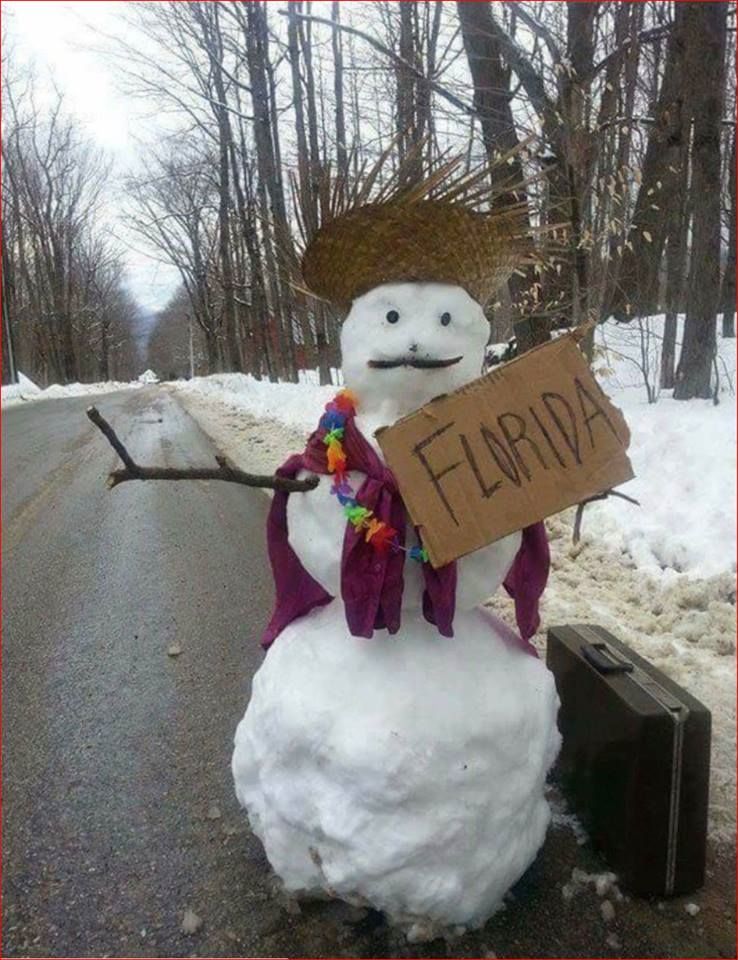
It’s so cold even this Quebec snowman is headed south.

Cold and Snowy Winter forecast Northern US

Figure i. The 2017-18 winter forecast shows below normal temperatures for the northern and eastern U.S., with above normal temperatures in the southwestern and southcentral U.S. The winter precipitation forecast shows above normal precipitation across the northern U.S. and below normal precipitation across the southern U.S.

Dr. Judah Cohen of AER, Nov. 20,2017:

In our model we have four predictors, October Eurasian snow cover extent, September sea ice concentration, El Niño/Southern Oscillation and a metric of high latitude blocking in the Eurasian sector. October Eurasian snow cover extent was above normal, Arctic sea ice extent is below normal, and there has been active blocking at high latitudes this fall. All three indicators favor a cold winter in the Eastern U.S. A La Niña is predicted for this winter, which favors a cold winter in the Northwestern U.S and a mild winter in parts of the Southern US. All four predictors together provide the forecast of cold in the Northern and Eastern US with warm in the Southwestern and Southcentral US.

Finally there seems to be the thinking (among many but certainly not all) including from the National Weather Service that La Niña favors a warm winter in the Eastern US. I am skeptical of this reasoning. I note that since 1990 there have been four warm La Niña winters and five cold Niña winters in the Eastern US. If you are familiar with my research you might understand why I am not considering winters before 1990 but I doubt that the statistics change much if previous winters are included. Therefore I remain skeptical that La Niña is a reason to confidently predict a mild winter in the Eastern US especially if La Niña remains weak.

Full Report is at Arctic Oscillation and Polar Vortex Analysis and Forecasts

Dr. Cohen’s forecasting paradigm is explained at Snowing and Freezing in the Arctic


Hurricane Science, not Fiction

We continue to see activist journalism claiming recent hurricanes prove global warming and the need for efforts like the Paris accord. People writing these articles seem oblivious to the meteorological science pertaining to tropical storms. The intentional deception is discussed more fully in the post Media Duping Scandal.

Joseph D’Aleo of WeatherBELL comes to the rescue with a primer for the public to gain literacy on this topic.

What Made This Hurricane Season So Active in the Atlantic? summarizes for all of us what is common sense weather knowledge, with graphs and images to enhance understanding of this science. Excerpts below with my bolds.

What a hurricane season! It started very early with Arlene in April but the real action held off until the last week of August, when Hurricane Harvey flooded Texas and Louisiana. Harvey was the first hurricane to make landfall in Texas since Ike in 2008 and the first Category 4 hurricane in Texas since Carla in 1961.

(D’Aleo summarizes the sequence of Irma, Jose, Maria and Nate, then digs into the issues.)

Before the landfall of two major storms on the U.S. we had gone just short of 12 years without a major hurricane landfall, the longest such lull since the 1860s.

The quiet period came after three big years. Isabel made landfall on the Mid Atlantic in 2003. Charley, Frances, Ivan and Jeanne in 2004 and Dennis, Katrina, Rita and Wilma in 2005 all made landfall on the mainland. Emily in 2005 was another major hurricane but turned west into Mexico. 2005 holds the record for five Category 4 or greater and four Category 5 impact storms. Some speculated this was the new norm for the Atlantic before nature gave us that 12-year break.

So what causes long quiet spells and then big years like 2004 and 2005 and now 2017?

(D’Aleo then describes the historical context regarding these storms.)

Okay, major hurricanes have occurred even during cold periods, but is there a trend in the modern record?

The Accumulated Cyclone Energy index measures seasonal tropical activity.

The Accumulated Cyclone Energy index takes into account the number, duration and strength of all tropical storms in a season. The ACE index is a wind energy index, defined as the sum of the squares of the maximum sustained surface wind speed (knots) measured every six hours for all named storms while they are at least tropical storm strength.

The ACE index for the Atlantic shows a cyclical behavior with no long-term trend but with spikes in 1893, 1926, 1933 and 1950 then again in 1995, 2004 and 2005. 2017 ranks 8th now with still weeks to go this season.

So what causes long breaks and then big years like 2004 and 2005 and now 2017?

OCEAN TEMPERATURE AND PRESSURE PATTERNS

The North Atlantic, like the Pacific, undergoes multi-decadal changes in ocean temperature and pressure patterns. It has long been known that when the Atlantic is in what is called its warm mode, there are more storms. Since 1995, when the current warm Atlantic mode began, we have average 14.6 named storms per year, more than five greater than the long-term 1851-2017 average.

An important factor that affects whether hurricanes affect the United States is El Niño and La Niña. When El Niños develop, more storms develop in the eastern and central Pacific, threatening Mexico, Hawaii and sometimes in weakened forms Arizona and California.

These storms enhance high-level winds that cross into the Atlantic. These winds produce shear that disrupts developing storms, causing them to weaken or dissipate and/or turn harmlessly north into the North Atlantic. Storms can still develop near the coast where the water is warm like in the Gulf and near the Gulf Stream off the southeast coast.

When La Ninas develop there are usually fewer storms in the eastern Pacific and less shear to disrupt the Atlantic storms.

In warm Atlantic years, that means trouble as the storms can track the entire basin with more time to turn into major hurricanes. Even the East Coast is more vulnerable to a landfalling hurricane. We had eight high-impact East Coast hurricanes from 1938 to 1960 and nine from 1988 to 2012.

The last important La Niña stretch was in 2010/11 to 2011/12. We avoided a major hurricane hit, though major hurricanes at sea made final landfall in the NYC metro — Irene (as a tropical storm) in 2011 and Sandy in 2012 (as a post-tropical cyclone). They caused massive flooding (from rains with Irene in upstate NY and Vermont and from a storm surge with Sandy in New York City and New Jersey).

We are still in the latest Atlantic warm period. This year, a spring attempt at an El Niño failed and La Niña-like conditions developed. Had El Niño succeeded we may have had Harvey, which developed near the Texas coast, and Nate, which came out of the bath water in the western Caribbean, but maybe Irma and Maria would have been weakened or deflected. But with La Niña conditions developing, no shear and warm Atlantic water we saw a return to big storms just as we saw in 2004 and 2005.

Summary

So when we get a year like 2017 or back-to-back bad years like 2004 and 2005, we have to accept that is how the weather works. Permadroughts ended with record wet years for Texas and California this decade. The record nearly 12-year major hurricane “drought” ended with 2017.

Joe D’Aleo is currently a senior co-chief meteorologist with WeatherBELL Analytics. Joe is a CCM, fellow of the AMS and former chair of the AMS Committee on Weather Analysis and Forecasting. He was a college professor of meteorology/climatology, the co-founder and first director of meteorology at The Weather Channel and chief meteorologist with three companies. He is the executive director of Icecap.us since 2007.

TV Monetizes Hurricane Irma

Weather reporters do a stand-up as the force of the winds caused by Hurricane Irma hit Miami. (Marcus Yam / Los Angeles Times)

Chicago Tribune on Sept. 11 published Swept away by TV coverage of Hurricane Irma by Dahleen Glanton, Contact Reporter.

It is a fine reflection piece by a media insider on how commercial media covers extreme weather events. She recounts her journey of discovery becoming critical and eventually repelled by the coverage from her own media colleagues. Excerpts below with my bolds.

I didn’t leave the house on Sunday. The hurricane story unfolding on my television set was too gripping to walk away for even a few minutes.

Television anchors kept warning us that much of Florida could be washed away by gigantic surges of ocean water in the aftermath of Hurricane Irma. The pictures coming out of Cuba and the Caribbean already had proved how devastating this storm could be. I was terrified for everyone in its path.

But that wasn’t the only reason I, and so many others, sat glued to the TV all day. Cable news television gave us a virtual front row seat to the developing storm, providing a riveting performance that was full of adventure, suspense and drama.

The show presented on the TV news was designed to be entertaining. It was meant to keep us captivated for hours, mesmerized by the “heroic” sacrifices of journalists who risked their lives to show us what it is like to stand outside in the midst of a deadly storm.

They described the predicted surge as “a killer water event” and the reporters vowed to run to safety before it occurred. But if we just kept watching — even through commercial breaks — they promised, we would see it for ourselves.

For many of us, this was an uneasy proposition. No one was excited about the possibility of people losing their homes and businesses, perhaps even lives, but the prospect of seeing a hurricane dance up close was too tempting to turn down.

Reporters went up to people who had ventured outside, including one man walking his three-legged dog, and warned them to go back inside before it was too late. The camera panned in on a bird as the reporter surmised that perhaps it had flown with the hurricane from as far away as Cuba. Birds follow hurricanes, he told us. These birds know when it’s safe to come out.

The reporters in their plastic rain slickers with the network’s logo on the back kept explaining that they were doing all this for us. Regardless of what the critics said about their reckless behavior, “We’re here so you don’t have to be,” they insisted.

The surge never happened Sunday, and we should be grateful for that. What we saw on TV was typical of a hurricane — howling winds, swaying trees and metal stop signs shaking in the distance. The anti-climatic ending left us confused.

How could a 10- to 15-foot surge hyped all day long for Florida’s west coast suddenly turn into one of about 3 feet? How could TV meteorologists presented on air as experts and reporters billed as experienced storm chasers get it so wrong?

I still don’t know the answers. But it didn’t take long to figure out that the cable news coverage from Florida on Sunday wasn’t about us at all. It was all about their ratings.

This was a new experience for me. For more than a decade, I covered hurricanes in the South for the Tribune. Hunkered down in Mississippi during Hurricane Katrina, I never had the chance to see how a big storm was covered on national TV.

What I saw on Sunday was both shocking and intriguing.

As a journalist who has covered many hurricanes and tornadoes, I know what it takes to tell a story. Standing in front of a water-splashed camera holding a limb from a fallen tree is not necessary to show the strength of a storm.

I understand that television relies on the power of optics. It is true that a TV camera can paint a picture much more vividly than I could by writing about it on a computer.

While I’m sure some people who have relatives and friends in Florida were grateful for the in-depth coverage, too much of what we saw on Sunday was manufactured drama. Networks took advantage of a heartbreaking situation and made a mockery of it.

Surfing through the channels, the visuals were all the same. Reporters, wobbling in the bristling wind, their words barely audible as they attempted to convince us that it was OK for them to do what they were warning others not to do.

In one scene, a reporter tried to convince us that the concrete wall he was standing in front of would protect him from the surge. He demonstrated how he could bend down and take refuge from the wind if he needed to.

In the same breath, he warned of flying debris — roof shingles and street signage that could transform into projectiles so fierce that they could knock you out.

On another channel, a well-known meteorologist swayed and stumbled on a sidewalk while the eye of the hurricane went through Naples, Fla. The wind nearly took his breath away and viewers could barely understand what he was saying.

When we did manage to hear a thing or two, it was nothing of importance.

“This is a mid-level Category 3. Imagine if it was a Category 4 or 5?” he boasted. “This is a story you can tell your children and grandchildren.”

The anchor watching from the studio in New York seemed somewhat embarrassed. He offered this explanation for the perilous acts.

“So we can see what this does to our natural bodies and our world,” he said.

There were no surprises, though. We saw exactly what we expected to see when someone is standing outside in a hurricane.

The irony is that the people who would perhaps benefit from such a display didn’t get to see it at all. Millions of people across Florida were without electricity during the height of the storm.

It’s probably safe to bet they weren’t using up their limited cell phone access watching a news anchor in New York explaining what was going on in their back yards.

This show wasn’t meant for them at all. It was for people like you and me who were sitting in our nice dry homes with a bag of popcorn in one hand and the TV remote control in the other.

All of us should be honest about that.

dglanton@chicagotribune.com

Conclusion:

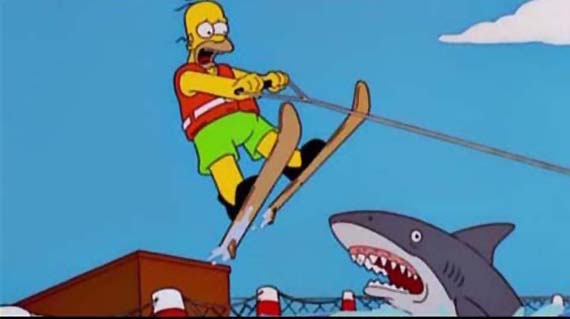
This could be a tipping point.  We may be witnessing the dawning of skeptical awareness at the Chicago Tribune, bastion of political correctness regarding all things climate related. One of their own catches them “Jumping the Shark.”

“Jumping the shark” is attempting to draw attention to or create publicity for something that is perceived as not warranting the attention, especially something that is believed to be past its peak in quality or relevance. The phrase originated with the TV series “Happy Days” when an episode had Fonzie doing a water ski jump over a shark. The stunt was intended to perk up the ratings, but it marked the show’s low point ahead of its demise.


Lomborg Warns: Don’t Be Distracted by Climate Change

A woman stands in the flood water in Sariakandi, Bangladesh, on Aug. 20.PHOTO: TURJOY CHOWDHURY/ZUMA PRESS

Lomborg lucidity is again on display in his recent WSJ article The Climate-Change Distraction
It’s confusing, causally incorrect and diverts resources from real solutions to real problems. By Bjorn Lomborg  Sept. 7, 2017. Full text with my bolds

Climate change has been blamed for a dizzying array of absurd woes, from the dwindling number of customers at Bulgarian brothels to the death of the Loch Ness monster. Most of us can see through these silly headlines, but it’s far harder to parse the more serious claims when they’re repeated in good faith by well-meaning campaigners.

Consider the recent assertion by Unicef’s Bangladesh head of mission that climate change leads to an increase in child marriages. Between 2011 and 2020 globally, more than 140 million girls under the age of 18 will become brides, leading to curtailed education and reduced lifetime earnings, more domestic violence, more deaths from complications due to pregnancy and increased mortality for the young brides’ children. By all accounts, child marriage must be taken seriously.

In Bangladesh, nearly 75% of women between the ages of 20 and 49 reported that they were married before they turned 18, giving the country the second-highest rate of child marriage in the world. As the Unicef head tells it, climate change has been a major cause, as warmer weather has worsened the flooding, pushing people to the cities, leading to more child marriages.

This entire string of logic is wrong. The frequency of extreme floods in Bangladesh has increased, it’s true, but studies show their magnitude and duration have in fact decreased. And Bangladesh is far better at adapting today than it was a generation ago. In 1974, a flood killed 29,000 people and cost 7.5% of the country’s gross domestic product. A slightly larger flood in 2004 killed 761 people and cost 3.3% of GDP.

Nor is Unicef right to claim a connection between flooding and urbanization. A study published in the Journal of Biosocial Science found that living in cities doesn’t increase the likelihood of child marriages in Bangladesh. Rather, it was “significantly higher among rural women.” According to another study, published in the Chinese Journal of Population Resources and Environment, the average age of marriage in cities is 16.15 years, compared to 15.08 years in rural areas.

This isn’t surprising. Across the world, there’s a convergence between low urbanization rates and higher child-marriage rates. In Africa, the three worst countries for child marriage—Chad, Mali and Niger—also have the lowest levels of urbanization.

Given the weak links between warming, flooding, urbanization and the contrary link between urbanization and child marriage, climate policies would be the least effective in addressing the problem. Copenhagen Consensus research shows that we need to focus instead on nutrition and education, political opportunities for girls and women, and improving women’s rights to inherit and start a business.

A program in southern Bangladesh run by Save the Children, for example, has demonstrated the significant effects of even a modest financial incentive: The program regularly gave cooking oil to parents of unmarried girls between the ages of 15 and 17, conditional upon confirmation that the girls remained unmarried. The program found that these girls were up to 30% less likely to marry before the age of 16 and up to 22% more likely to remain in school. Each dollar spent on such conditional transfer programs does about $4 of social good.

It’s these kinds of efforts that make it more likely girls will continue in school and engage in productive jobs, reducing child marriage. Talking about climate is confusing, causally incorrect and diverts important resources away from more effective interventions.

A similar argument can be made for another challenge often linked to global warming: malaria. In this case, the science is unambiguous. Rising temperatures mean that malaria-carrying mosquitoes can become endemic in more places.

But looking mainly to global-warming policies means missing the most important levers of tackling malaria. Malaria is a consequence of poverty: The worst affected are those poorer households in rural areas with less ability to purchase mosquito nets and treatment. Focusing on what we could achieve in the future through global-warming policies takes our attention away from what we could accomplish today.

Over the past 15 years, more than six million lives have been saved from malaria. This didn’t happen because we cut CO 2 and managed to marginally change temperatures.

If climate policies like the Kyoto Protocol had been fully enacted, temperature reductions would have saved just 1,400 lives from malaria each year, at a price tag of about $180 billion a year. By contrast, just $500 million spent in one year on direct antimalaria measures such as mosquito nets, sprays and treatment could save 300,000 lives.

None of this means that we should ignore climate change. But to respond properly we need to stick to the facts and maintain a sense of perspective, avoiding tenuous connections and ineffective solutions that ultimately divert resources away from fixing the real problems.

Mr. Lomborg is the president of the Copenhagen Consensus Center and the author of “The Skeptical Environmentalist” and “Cool It.”

See more at Lomborg Lucidity

Bjorn Lomborg knows what works to alleviate and address actual human suffering rather than modelled future disasters.  With his focus on the here and now, and realistic assessment of relief programs, he should be the UN spokesperson, not Dicaprio.

More from Bjorn Lomborg and the Copenhagen Consensus Center at Watching a UN Train Wreck

CO2 Also Explains Fair Weather?

Typical weather on Miami Beach

Ross McKitrick raises some interesting questions in his Washington Examiner article Despite Hurricanes Harvey and Irma, science has no idea if climate change is causing more (or fewer) powerful hurricanes  h/t GWPF

Why is global warming/climate change invoked only to explain bad weather (storms)? What about crediting CO2 for storms that didn’t happen? And how is a storm that could not be predicted proof of something after the fact? Do storms in 2017 fulfill predictions made every year since Katrina in 2005?  Excerpts below (my bolds)

After Hurricane Harvey hit Texas, it didn’t take long for climate alarmists to claim they knew all along it would happen. Politico’s Eric Holthaus declared “We knew this would happen, decades ago.” Naomi Klein stated “these events have long been predicted by climate scientists.” Joe Romm at ThinkProgress wrote, “the fact is that Harvey is exactly the kind of off-the-charts hurricane we can expect to see more often because of climate change.”

According to these and other authors, rising greenhouse gas levels are at least partly to blame for the occurrence and severity of Harvey, and probably for Hurricane Irma as well. But after-the-fact guesswork is not science. If any would-be expert really knew long ago that Harvey was on its way, let him or her prove it by predicting what next year’s hurricane season will bring.

Don’t hold your breath: Even the best meteorologists in the world weren’t able to predict the development and track of Hurricane Harvey until a few days before it hit.

This is why the idea of climate science being “settled” is so ludicrous, at least as regards the connection between global warming and tropical cyclones. A settled theory makes specific predictions that can, in principle, be tested against observed data. A theory that only yields vague, untestable predictions is, at best, a work in progress.

The climate alarmists offer a vague prediction: Hurricanes may or may not happen in any particular year, but when they do, they will be more intense than they would have been if GHG levels were lower. This is a convenient prediction to make because we can never test it. It requires observing the behaviour of imaginary storms in an unobservable world. Good luck collecting the data.

Climate scientists instead use computer models to simulate the alternative world. But the models project hundreds of possible worlds, and predict every conceivable outcome, so whatever happens it is consistent with at least one model run. After Hurricane Katrina hit New Orleans in 2005, some climate modelers predicted such storms would be more frequent in a warmer world, while others predicted the opposite, and still others said there was no connection between warming and hurricanes.

What ensued was an historically unprecedented 12-year absence of major (category 3 or higher) hurricanes making landfall in the United States, until Harvey, which ties for 14th-most intense hurricane since 1851. The events after 2005 were “consistent with” some projections, but any other events would have been as well.

The long absence of landfalling hurricanes also points to another problem when opinion writers connect GHGs to extreme weather. Science needs to be concerned not only with conspicuous things that happened, but with things that conspicuously didn’t happen. Like the famous dog in the Sherlock Holmes story, the bark that doesn’t happen can be the most important of all.

It is natural to consider a hurricane a disruptive event that demands an explanation. It is much more difficult to imagine nice weather as a disruption to bad weather that somehow never happened.

Suppose a hurricane would have hit Florida in August 2009, but GHG emissions prevented it and the weather was mild instead. The “event,” pleasant weather, came and went unnoticed and nobody felt the need to explain why it happened. It is a mistake to think that only bad events call for an explanation, and only to raise the warming conjecture when bad weather happens. If we are going to tie weather events to GHGs, we have to be consistent about it. We should not assume that any time we have pleasant weather, we were going to have it anyway, but a storm is unusual and proves GHG’s control the climate.

I am grateful to the scientists who work at understanding hurricane and typhoon events, and whose ability to forecast them days in advance has saved countless lives. But when opinion writers tacitly assume all good weather is natural and GHGs only cause bad weather, or claim to be able to predict future storms, but only after they have already occurred, I reserve the right to call their science unsettled.

Ross McKitrick is a professor of economics at the University of Guelph and an adjunct scholar of the Cato Institute.

Another claim people are making: Several major storms in a row for sure proves global warming/climate change.  Well, no.  Not according to Gerry Bell, the lead seasonal hurricane forecaster with the Climate Prediction Center, a part of the National Oceanic and Atmospheric Administration.  He explains in a NYT article First Harvey, Then Irma and Jose. Why? It’s the Season. h/t GWPF Excerpts below.

Hurricane experts say that the formation of several storms in rapid succession is not uncommon, especially in August, September and October, the most active months of the six-month hurricane season.

“This is the peak,” said Gerry Bell, the lead seasonal hurricane forecaster with the Climate Prediction Center, a part of the National Oceanic and Atmospheric Administration. “This is when 95 percent of hurricanes and major hurricanes form.”

Dr. Bell and his team at NOAA had forecast that this season would be a busy one, and that is how it is playing out, he said.

“With above normal seasons, you have even more activity mainly in August through October,” he said. “We’re seeing the activity we predicted.”

Dr. Bell said that in the late summer and early fall, conditions in the tropical Atlantic off Africa become just right for cyclonic storms to form. Among those conditions, he said, are warming waters, which fuel the growth of storms, and a relative lack of abrupt wind shifts, called wind shear, that tend to disrupt storm formation.

“There’s a whole combination of conditions that come together,” he said.

Storms that form in the Gulf of Mexico, as Katia did this week, are also not uncommon, Dr. Bell said.

Dr. Bell said his group does not consider climate change in developing its forecasts.

Instead, he said, they consider longer-term cycles of hurricane activity based on a naturally occurring climate pattern called the Atlantic multidecadal oscillation, which affects ocean surface temperatures over 25 to 40 years.

Footnote

boat-climate-change

Pleasure craft spotted in a marina near Miami.

Bret Stephens on Harvey: Wealth and Resilience

Bret Stephens again writes insightfully regarding society and climate matters, this time in his recent article Hurricanes, climate and the capitalist offset  published in NYT reprinted in Tampa Bay Times.  Entire text below.

Texans will find few consolations in the wake of a hurricane as terrifying as Harvey. But here, at least, is one: A biblical storm has hit them, and the death toll — 38 as of this writing — is mercifully low, given its intensity.

This is not how it plays out in much of the world. In 1998, Hurricane Mitch ripped through Central America and killed anywhere between 11,000 and 19,000 people, mostly in Honduras and Nicaragua. Nearly a decade later Cyclone Nargis slammed into Myanmar, and a staggering 138,000 people perished.

Nature’s furies — hurricanes, earthquakes, landslides, droughts, infectious diseases, you name it — may strike unpredictably. But their effects are not distributed at random.

Rich countries tend to experience, and measure, the costs of such disasters primarily in terms of money. Poor countries experience them primarily in terms of lives. Between 1940 and 2016, a total of 3,348 people died in the United States on account of hurricanes, according to government data, for an average of 43 victims a year. That’s a tragedy, but compare it to the nearly 140,000 lives lost when a cyclone hit Bangladesh in 1991.

Why do richer countries fare so much better than poorer ones when it comes to natural disasters? It isn’t just better regulation. I grew up in Mexico City, which adopted stringent building codes following a devastating earthquake in 1957. That didn’t save the city in the 1985 earthquake, when we learned that those codes had been flouted for years by lax or corrupt building inspectors, and thousands of people were buried under the rubble of shoddy construction. Regulation is only as good, or bad, as its enforcement.

A better answer lies in the combination of government responsiveness and civic spiritedness so splendidly on display this week in Texas. And then there’s the matter of wealth.

Every child knows that houses of brick are safer than houses of wood or straw — and therefore cost more to build. Harvey will damage or ruin thousands of homes. But it won’t sweep away entire neighborhoods, as Typhoon Haiyan did in the Philippine city of Tacloban in 2013.

Harvey will also inflict billions in economic damage, most crushingly on uninsured homeowners. The numbers are likely to be staggering in absolute terms, but what’s more remarkable is how easily the U.S. economy can absorb the blow. The storm will be a “speed bump” to Houston’s $503 billion economy, according to Moody’s Analytics’ Adam Kamins, who told the Wall Street Journal that he expects the storm to derail growth for about two months.

On a global level, the University of Colorado’s Roger Pielke Jr. notes that disaster losses as a percentage of the world’s GDP, at just 0.3 percent, have remained constant since 1990. That’s despite the dollar cost of disasters having nearly doubled over the same time — at just about the same rate as the growth in the global economy. (Pielke is yet another victim of the climate lobby’s hyperactive smear machine, but that doesn’t make his data any less valid.)

Climate activists often claim that unchecked economic growth and the things that go with it are principal causes of environmental destruction. In reality, growth is the great offset. It’s a big part of the reason why, despite our warming planet, mortality rates from storms have declined from 0.11 per 100,000 in the 1900s to 0.04 per 100,000 in the 2010s, according to data compiled by Hannah Ritchie and Max Roser. Death rates from other natural disasters such as floods and droughts have fallen by even more staggering percentages over the last century.

That’s because economic growth isn’t just a matter of parking lots paving over paradise. It also underwrites safety standards, funds scientific research, builds spillways and wastewater plants, creates “green jobs,” subsidizes Elon Musk, sets aside prime real estate for conservation, and so on. Poverty, not wealth, is the enemy of the environment. Only the rich have the luxury of developing an ethical stance toward their trash.

The paradox of our time is that the part of the world that has never been safer from the vagaries of nature seems never to have been more terrified of them. Harvey truly is an astonishing storm, the likes of which few people can easily remember.

Then again, as meteorologist Philip Klotzbach points out, it’s also only one of four Category 4 or 5 hurricanes to make landfall in the United States since 1970. By contrast, more than twice as many such storms made landfall between 1922 and 1969. Make of that what you will, but remember that fear is often a function of unfamiliarity.

Houston will ultimately recover from Harvey’s devastation because its people are creative and courageous. They will rebuild and, when the next storm comes, as it inevitably will, be better prepared for it. The best lesson the world can take from Texas is to follow the path of its extraordinary economic growth on the way to environmental resilience.

Stephens is one of a few journalists who writes lucidly about weather and climate.  Let’s see how the progressive NYT readers enjoy his clarity.

Update: What Stephens writes is largely confirmed by a news report today from the Mayor of Houston. Houston Mayor Sylvester Turner said Thursday that the city is now “mostly dry,” after having taken an aerial tour of the city.  He also said: “One year from now when people visit Houston, they will not see signs of Harvey.”

See also Climate Adaptive Cities: The Smart Way Forward

X-Weather is Back! Harvey edition

With Hurricane Harvey making landfall in Texas as a Cat 4, the storm drought is over and claims of linkage to climate change can be expected.  So far (mercifully) articles in Time and Washington Post have been more circumspect than in the past.  Has it become more respectable to look at the proof supporting wild claims?  This post provides background on X-Weathermen working hard to claim extreme weather as proof of climate change.

In the past the media has been awash with claims of “human footprints” in extreme weather events, with headlines like these:

“Global warming is making hot days hotter, rainfall and flooding heavier, hurricanes stronger and droughts more severe.”

“Global climate change is making weather worse over time”

“Climate change link to extreme weather easier to gauge”– U.S. Report

“Heat Waves, Droughts and Heavy Rain Have Clear Links to Climate Change, Says National Academies”

That last one refers to a paper released by the National Academy of Sciences Press: Attribution of Extreme Weather Events in the Context of Climate Change (2016)

And as usual, the headline claims are unsupported by the actual text. From the NAS report (here): (my bolds)

Attribution studies of individual events should not be used to draw general conclusions about the impact of climate change on extreme events as a whole. Events that have been selected for attribution studies to date are not a representative sample (e.g., events affecting areas with high population and extensive infrastructure will attract the greatest demand for information from stakeholders) P 107

Systematic criteria for selecting events to be analyzed would minimize selection bias and permit systematic evaluation of event attribution performance, which is important for enhancing confidence in attribution results. Studies of a representative sample of extreme events would allow stakeholders to use such studies as a tool for understanding how individual events fit into the broader picture of climate change. P 110

Correctly done, attribution of extreme weather events can provide an additional line of evidence that demonstrates the changing climate, and its impacts and consequences. An accurate scientific understanding of extreme weather event attribution can be an additional piece of evidence needed to inform decisions on climate change related actions. P. 112

The Indicative Without the Imperative

extreme-weather-events

The antidote to such feverish reporting is provided by Mike Hulme in a publication: Attributing Weather Extremes to ‘Climate Change’: a Review (here).

He has an insider’s perspective on this issue, and is certainly among the committed on global warming (color him concerned). Yet here he writes objectively to inform us on X-weather, without advocacy: real science journalism and a public service, really. Excerpts below with my bolds.

Overview

In this third and final review I survey the nascent science of extreme weather event attribution. The article proceeds by examining the field in four stages: motivations for extreme weather attribution, methods of attribution, some example case studies and the politics of weather event Attribution.

The X-Weather Issue

As many climate scientists can attest, following the latest meteorological extreme one of the most frequent questions asked by media journalists and other interested parties is: ‘Was this weather event caused by climate change?’

In recent decades the meaning of climate change in popular western discourse has changed from being a descriptive index of a change in climate (as in ‘evidence that a climatic change has occurred’) to becoming an independent causative agent (as in ‘climate change caused this event to happen’). Rather than being a descriptive outcome of a chain of causal events affecting how weather is generated, climate change has been granted power to change worlds: political and social worlds as much as physical and ecological ones.

To be more precise then, what people mean when they ask the ‘extreme weather blame’ question is: ‘Was this particular weather event caused by greenhouse gases emitted from human activities and/or by other human perturbations to the environment?’ In other words, can this meteorological event be attributed to human agency as opposed to some other form of agency?

The Motivations

Hulme shows what drives scientists to pursue the “extreme weather blame” question, noting four motivational factors.

Why have climate scientists over the last ten years embarked upon research to provide an answer beyond the stock phrase ‘no individual weather event can directly be attributed to greenhouse gas emissions’?  There seem to be four possible motives.

1.Curiosity
The first is because the question piques the scientific mind; it acts as a spur to develop new rational understanding of physical processes and new analytic methods for studying them.

2.Adaptation
A second argument, put forward by some, is that it is important to know whether or not specific instances of extreme weather are human-caused in order to improve the justification, planning and execution of climate adaptation.

3.Liability
A third argument for pursuing an answer to the ‘extreme weather blame’ question is inspired by the possibility of pursuing legal liability for damages caused. . . If specific loss and damage from extreme weather can be attributed to greenhouse gas emissions – even if expressed in terms of increased risk rather than deterministically – then lawyers might get interested.

The liability motivation for research into weather event attribution also bisects the new international political agenda of ‘loss and damage’ which has emerged in the last two years. . . The basic idea is to give recognition that loss and damage caused by climate change is legitimate ground for less developed countries to gain access to new international climate adaptation funds.

4. Persuasion
A final reason for scientists to be investing in this area of climate science – a reason stated explicitly less often than the ones above and yet one which underlies much of the public interest in the ‘extreme weather blame’ question – is frustration with and argument about the invisibility of climate change. . . If this is believed to be true – that only scientists can make climate change visible and real –then there is extra onus on scientists to answer the ‘extreme weather blame’ question as part of an effort to convince citizens of the reality of human-caused climate change.

Attribution Methods

Attributing extreme weather events to human influences requires different approaches, of which four broad categories can be identified.

1. Physical Reasoning
The first and most general approach to attributing extreme weather phenomena to rising greenhouse gas concentrations is to use simple physical reasoning.

General physical reasoning can only lead to broad qualitative statements such as ‘this extreme weather is consistent with’ what is known about the human-enhanced greenhouse effect. Such statements offer neither deterministic nor stochastic answers and clearly underdetermine the ‘weather blame question.’ It has given rise to a number of analogies to try to communicate the non-deterministic nature of extreme event attribution. The three most widely used ones concern a loaded die (the chance of rolling a ‘6’ has increased, but no single ‘6’ can be attributed to the biased die), the baseball player on steroids (the number of home runs hit increases, but no single home run can be attributed to the steroids) and the speeding car-driver (the chance of an accident increases in dangerous conditions, but no specific accident can be attributed to the fast-driving).

2. Classical Statistical Analysis
A second approach is to use classical statistical analysis of meteorological time series data to determine whether a particular weather (or climatic) extreme falls outside the range of what a ‘normal’ unperturbed climate might have delivered.

All such extreme event analyses of meteorological time series are at best able to detect outliers, but can never be decisive about possible cause(s). A different time series approach therefore combines observational data with model simulations and seeks to determine whether trends in extreme weather predicted by climate models have been observed in meteorological statistics (e.g. Zwiers et al., 2011, for temperature extremes and Min et al., 2011, for precipitation extremes). This approach is able to attribute statistically a trend in extreme weather to human influence, but not a specific weather event. Again, the ‘weather blame question’ remains underdetermined.

slide20

3. Fractional Attributable Risk (FAR)
Taking inspiration from the field of epidemiology, this method seeks to establish the Fractional Attributable Risk (FAR) of an extreme weather (or short-term climate) event. It asks the counterfactual question, ‘How might the risk of a weather event be different in the presence of a specific causal agent in the climate system?’

The single observational record available to us, and which is analysed in the statistical methods described above, is inadequate for this task. The solution is to use multiple model simulations of the climate system, first of all without the forcing agent(s) accused of ‘causing’ the weather event and then again with that external forcing introduced into the model.

The credibility of this method of weather attribution can be no greater than the overall credibility of the climate model(s) used – and may be less, depending on the ability of the model in question to simulate accurately the precise weather event under consideration at a given scale (e.g. a heatwave in continental Europe, a rain event in northern Thailand) (see Christidis et al., 2013a).

4. Eco-systems Philosophy
A fourth, more philosophical, approach to weather event attribution should also be mentioned. This is the argument that since human influences on the climate system as a whole are now clearly established – through changing atmospheric composition, altered land surface characteristics, and so on – there can no longer be such a thing as a purely natural weather event. All weather — whether it be a raging tempest or a still summer afternoon — is now attributable to human influence, at least to some extent. Weather is the local and momentary expression of a complex system whose functioning as a system is now different to what it would otherwise have been had humans not been active.

Results from Weather Attribution Studies

Hulme provides a table of numerous such studies using various methods, along with his view of the findings.

It is likely that attribution of temperature-related extremes using FAR methods will always be more attainable than for other meteorological extremes such as rainfall and wind, which climate models generally find harder to simulate faithfully at the spatial scales involved. As discussed below, this limitation on which weather events and in which regions attribution studies can be conducted will place important constraints on any operational extreme weather attribution system.

Political Dimensions of Weather Attribution

Hulme concludes by discussing the political hunger for scientific proof in support of policy actions.

But Hulme et al. (2011) show why such ambitious claims are unlikely to be realised. Investment in climate adaptation, they claim, is most needed “… where vulnerability to meteorological hazard is high, not where meteorological hazards are most attributable to human influence” (p.765). Extreme weather attribution says nothing about how damages are attributable to meteorological hazard as opposed to exposure to risk; it says nothing about the complex political, social and economic structures which mediate physical hazards.

And separating weather into two categories — ‘human-caused’ weather and ‘tough-luck’ weather – raises practical and ethical concerns about any subsequent investment allocation guidelines which excluded the victims of ‘tough-luck weather’ from benefiting from adaptation funds.

Contrary to the claims of some weather attribution scientists, the loss and damage agenda of the UNFCCC, as it is currently emerging, makes no distinction between ‘human-caused’ and ‘tough-luck’ weather. “Loss and damage impacts fall along a continuum, ranging from ‘events’ associated with variability around current climatic norms (e.g., weather-related natural hazards) to [slow-onset] ‘processes’ associated with future anticipated changes in climatic norms” (Warner et al., 2012:21). Although definitions and protocols have not yet been formally ratified, it seems unlikely that there will be a role for the sort of forensic science being offered by extreme weather attribution science.

Conclusion

Thank you Mike Hulme for a sane, balanced and expert analysis. It strikes me as being another element in a “Quiet Storm of Lucidity”.

Is that light the end of the tunnel or an oncoming train?
MIT False Climate Alarm


From MIT News, Deadly heat waves could hit South Asia this century
Without action, climate change could devastate a region home to one-fifth of humanity, study finds.

The key claim is:

The effects of unchecked temperature rise would extend beyond the health concerns associated with being outside in high temperatures. With workers unable to stay outdoors for extended periods of time, the region’s economy and agricultural output would decline, experts say. “With the disruption to the agricultural production, it doesn’t need to be the heat wave itself that kills people,” says study author Elfatih Eltahir, a professor of civil and environmental engineering at the Massachusetts Institute of Technology, in a press release. “Production will go down, so potentially everyone will suffer.”

Matthew E. Kahn , Professor of Economics at USC explains why climate scientists should not be trusted when doing economic forecasts. His essay is An MIT Engineer Discusses Economic Issues Related to Climate Change Adaptation

What does economics have to say about this prediction of economic outcomes out 83 years from now?
“Deadly heat waves projected in the densely populated agricultural regions of South Asia”

1. Note that there are no general equilibrium effects. If the South Asian economy (i.e India) is closed to international trade, then agriculture prices will go up as production contracts, farmers could actually be richer if demand is inelastic.

2. There is no storage and no savings in his “economy”. If heat waves are predictable, won’t people save $ for the hot summers? This paper by Donaldson et. al. shows that capital markets in India’s rural areas play a key role in allowing for consumption risk smoothing. This MIT engineer is colleagues with Rob Townsend and should talk to Rob about his 1994 Econometrica.

3. There is no urban air conditioned sector for people to migrate to.

4. If the South Asian economy is open to international trade, then urban consumers will import from other regions during hot summers and won’t face price increases. In this case, local farmers will bear the incidence of hot summers. To reduce their exposure to such income risk, they should send a child to the city to work and the child will remit $ back to the country side. Read Mobarak’s co-authored Econometrica from Bangladesh for an optimistic preview of the region’s future.

5. There is no innovation in the agricultural sector to allow the South Asian farmers to cope with extreme heat. Neither human capital increases, nor world innovations diffusing to South Asia plays a role in helping these individuals to cope.

6. I could not find a discussion of farmer choice of what to grow and the discrete choice margin of adjustment to more heat resistant crops (see Mendelsohn’s many papers).

A quick look at the 47 references of the paper reveals that no economics research is cited. That’s interesting on several levels.

Despite being out of their field Eltahir et al. went on to proclaim their activism (my bolds):

In South Asia, a region of deep poverty where one-fifth of the world’s people live, new research suggests that by the end of this century climate change could lead to summer heat waves with levels of heat and humidity that exceed what humans can survive without protection.

There is still time to avert such severe warming if measures are implemented now to reduce the most dire consequences of global warming. However, under business-as-usual scenarios, without significant reductions in carbon emissions, the study shows these deadly heat waves could begin within as little as a few decades to strike regions of India, Pakistan, and Bangladesh, including the fertile Indus and Ganges river basins that produce much of the region’s food supply.

Researchers note that the disastrous scenario could be avoided if countries meet their commitments to keep temperatures from rising more than 2°C (3.6°F) by 2100. That goal, embedded in the 2015 Paris Agreement on climate change, will likely be difficult to meet without increasingly ambitious efforts to reduce greenhouse gas emissions.

The new findings, based on detailed computer simulations using the best available global circulation models, are described this week in the journal Science Advances, in a paper by Elfatih Eltahir, a professor of civil and environmental engineering at MIT; Eun Soon Im, a former researcher at the Singapore-MIT Alliance for Research and Technology and now a professor at the Hong Kong University of Science and Technology; and Jeremy Pal, a professor at Loyola Marymount University in Los Angeles.

It is a familiar story:  Climatists can not contemplate, let alone analyze how humans adapt to changing circumstances.  They are totally focused on reducing CO2 emissions, even though these have been greening the planet in recent decades.

See Also Adapting Works, Mitigation Fails


Climate Scare in US South

A recent study published in Science predicts there will be no comfort for US southerners in the future.  As reported in the Atlantic

The American South Will Bear the Worst of Climate Change’s Costs
Global warming will intensify regional inequality in the United States, according to a revolutionary new economic assessment of the phenomenon.

The study, published Thursday in Science, simulates the costs of global warming in excruciating detail, modeling every day of weather in every U.S. county during the 21st century. It finds enormous disparities in how rising temperatures will affect American communities: Texas, Florida, and the Deep South will bleed income in the broiling heat, while some chillier northern states gain moderate benefits.

“We are really sure the South is going to get hammered,” says Solomon Hsiang, one of the authors of the paper and a professor of public policy at the University of California, Berkeley. “The South is really, really negatively affected by climate change, much more so than the North. That wasn’t something we were expecting going in.”

First of all, this comes from model projections, not from observed temperatures and precipitation.

The graph shows daily maximums, averaged annually for the southern region as defined by the National Weather Service (NWS). The rise since 1895 is less than 1F, not even noticeable. You can also clearly see a quasi-60 year cycle, and that we are coming off the warmer phase with a cooler phase likely ahead.

Precipitation over the same period of 120 years shows a slight rise, nothing dramatic, and also oscillating with scattered peaks and valleys.

Secondly, all forecasting was done using the worst-case scenario

Out of five scenarios in IPCC report RCP8.5 is the most extreme. Neither AR5 nor the paper describing RCP8.5 call it a “business as usual” scenario, because it is not. Such a scenario would assume continuation of existing trends through 2100. A worst-case scenario assumes trends change for the worse. RCP8.5 assumes population growth at the 90th percentile of the probability forecast for 2100 (i.e., not considering real-world factors) and near-stagnation of technological progress.

Thirdly the models show no skill at all at regional forecasting, never mind their deficiencies at the global scale.

Roger Pielke Sr. repeatedly points to the elephant in the room about these papers — the ignored assumption that climate models’ predictions about global climate (when fed accurate predictions about emissions) are a sufficiently skillful basis for public policy — and that downscaling these models produces regional forecasts also useful for making public policy. There is little evidence of either. See here for a discussion of the literature about model validation (see the end section here for links to the literature). He says there is even less evidence for their skill at regional levels. He reviewed the literature validating regional downsizing five years ago, and relatively little progress has been made since then.
From Larry Kummer, US Economic Damage from Climate Change

Finally, and perhaps most importantly, Adaptation by humans is not allowed.

The projections presume that humans will not adapt in response to changing conditions, even though we have always done so, and presently have unprecedented capacities.

Matthew Kahn explains this clearly in Climate Change Adaptation Economics

An econometric research team follows the following recipe. First, it takes historical data and estimates how weather conditions correlate with economic conditions. For example, when it is extremely hot in a county — do we observe based on past data that the county’s per-capita income is lower than usual. The research team takes these past correlations and takes a climate change model (that tells you a guess of what will be future climate conditions by county) to predict future economic outcomes under the assumption that the historical correlation between weather and economic outcomes persists into the future.

This bold writing violates the Lucas Critique. Robert Lucas is one of the University of Chicago’s greatest economists. I was not one of his greatest students but I learned from him that as the “Rules of the Game” change that forward looking decision makers re-optimize. He studied this issue in the context of government counter-cyclical macro policy (i.e tax cuts during recessions) but the same point applies in the case of climate change. (my bold)

Let me explain;

Suppose it has always been 90 degrees in Phoenix in April but moving forward it will now be 105 degrees on average in Phoenix in April because of climate change. This is what I mean by a change in the Rules of the Game. The key stochastic process’ core parameters have changed. The climate scientists estimate such relationship using geocoded time series data. They spread their findings (through the New York Times and through wild bloggers such as Joe Romm).

Investors (those who invest in durable buildings, businesses, families) who live and work in a specific area such as Phoenix have strong incentives to take pro-active actions to reduce their exposure to hotter Aprils. They have thousands of adaptation strategies (and richer people have even more). One of the points I argue in Climatopolis is that induced innovation will take place because of Paul Revere style forecasts of hotter summers. Demand creates supply! I haven’t even mentioned government at the local, state or federal level. While many adaptation strategies are private goods (think of air conditioners), there are also public goods (sea walls, air cooling centers). If government changes its investments because of the new “Rules of the Game”, then the poor’s well being can improve in the face of a changing climate even if they can’t afford any of the private adaptation strategies. We are not passive victims here. The greatness of capitalism is that the set of alternatives we have to choose from keeps growing due to innovation and product differentiation. Each of these private and public goods helps us to individually and collective adapt.

As these changes takes place, the historical correlations between climate and economic losses are attenuated. This is why I don’t have much confidence in the predictions reported in the new Science Paper.

Summary

Alarmist blinders could not be more obvious. Their only solution is spending many trillions of dollars attempting to prevent future warming and climate change by reducing CO2 emissions (so-called “Mitigation”). The much more rational and time-honored policy of Adaptation would mean watching for changes and challenges to actually appear then mobilizing resources in response. But that would mean waiting because nothing is yet happening outside the normal range of temperatures and precipitation.   Unacceptable to true believers.

See also Climate Gloom and Doom