Inside Barents Ice Crystal Ball

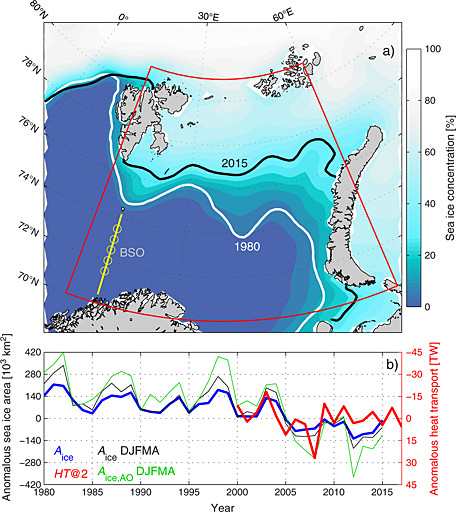
On a previous post (here), I linked to a recent study positing that variations in Barents Sea ice extent are predictive of Arctic extent for at least 1-2 years later. In other words, they concluded based upon measurements of ice extent and ocean heat transfers: As winter ice extent goes in Barents Sea, so goes annual ice extent across the Arctic ocean. The physical cause is changing fluxes of warm North Atlantic water penetrating through the Barents Sea into the rest of the Arctic. They acknowledge that other factors, especially winds are also in play, but believe that the ocean influx (also affected by winds) makes the largest influence. The full study is here.

Arctic Ice Dynamics

Here’s how researchers are connecting the dots:
NAO (North Atlantic Oscillation)► BSO(Heat transport by Atlantic Water (AW) through Barents Sea Opening)► Winter ice extent in Barents Sea► Winter ice extent in Arctic Ocean► Annual ice extents in Barents and Arctic Ocean.

A key scientist in this work is Randi Ingvaldsen of Geophysical Institute, University of Bergen, Institute of Marine Research. Several of her published articles are part of her doctoral thesis available here.  It comprises an informative look into the extensive body of research in this area.

The Barents Sea climate fluctuates between warm and cold periods. By comparing decade by decade we found that although the 1990s had high temperatures, both the 1930s and the 1950s were warmer. This indicates that the warming of the 1990s may very well be related to natural variability rather than anthropogenic effects.

The above results indicate a positive correlation between the NAO winter index and the area occupied by AW, a result clearly evident when investigating the total area across the BSO occupied by AW (Figure 6d). Earlier investigations have shown a positive correlation between the NAO winter index and the mean AW temperature in the BSO (also evident in
Figure 6e). This means that both the temperature and the extent of AW increase with increasing NAO winter index (Figure 6 a and d-e), although with different lags.

In summary, this preliminary investigation has shown that both the mean temperature and lateral extent of AW in the BSO is positively correlated to the strength of the Icelandic low, although with lags.

The extensive bibliography in the linked studies shows that these results are built upon the efforts of many researchers over decades. There are many references to empirical research efforts in recent times (e.g. an array of moorings in the NE Barents Sea):
The pathway and transformation of water from the Norwegian Sea across the Barents Sea and through the St. Anna Trough are documented from hydrographic and current measurements of the 1990s. . .The westward flow originates in the Fram Strait branch of Atlantic Water at the Eurasian continental slope, while the eastward flow constitutes the Barents Sea branch, continuing from the western Barents Sea opening.

In earlier decades, the Atlantic Water advected from Fram Strait was colder by almost 1 K as compared to the 1990s, while the dense Barents Sea water was colder by up 1 K only in a thin layer at the bottom and the salinity varied significantly. However, also with the resulting higher densities, deep Eurasian Basin water properties were met only in the 1970s. The very low salinities of the Great Salinity Anomaly in 1980 were not discovered in the outflow data. We conclude that the thermal variability of inflowing Atlantic water is damped in the Barents Sea, while the salinity variation is strongly modified through the freshwater conditions and ice growth in the convective area off Novaya Zemlya.

http://www.sciencedirect.com/science/article/pii/S0967063702001255

The evidence says Arctic ice varies from a variety of natural factors:


Based on these observational data, Polyakov et al. (2003) concluded that the “examination of records of fast ice thickness and ice extent from four Arctic marginal seas (Kara, Laptev, East Siberian, and Chukchi) indicates that long-term trends are small and generally statistically insignificant, while trends for shorter records are not indicative of the long-term tendencies due to strong low-frequency variability in these time series, which places a strong limitation on our ability to resolve long-term trends”. “Correlation analysis shows that dynamical forcing (wind or surface currents) is at least of the same order of importance as thermodynamical forcing for the ice extent variability in the Laptev, East Siberian, and Chukchi Seas. Source: http://www.climate4you.com/

Conclusion:

As with everything else in the climate system, Arctic ice dynamics are complex and our understanding is growing but still incomplete. And like the rest of the climate system, the more we learn, the more evident it is that fossil fuel emissions have little to do with it. We should take seriously other ways humans impact the climate system, be it from our use of the seas, as Dr. Bernaerts points out, or from using the land, as Dr. Pielke has documented.

There’s no denying climate change. Climate is changing: Not much; Not quickly; And not lately. (Credit: David Siegel here)

Footnote November 16:  

Some additional reflections:

This line of Arctic ice research is interesting because it challenges typical thinking about northern climates such as Barents.

Firstly, it goes beyond simplistic, value-laden notions, such as “less Arctic ice is a bad thing” (popular), or “less Arctic ice is a good thing” (not popular). These researchers are not making those judgments but are asking a purely scientific question: Why? Why is there more ice some years and less ice other years? And they know that any explanation is tested by how well it predicts future ice extents.

Secondly, this line of research requires a shift in focus from the summer melts in August-September, to pay more attention to the action in the winter, especially December-April. The proposed mechanism of heat transfer by means of Atlantic water happens almost entirely in that time frame, when most people leave the Arctic alone in the dark.

Finally, there is humility in making the predictions, recognizing the complexity of the situation, and how effects lag in time.  Certainly, the lack of ice in Barents this last April is a basis for thinking extents there and across the Arctic will be down next April. But there happens to be a cold Blob of surface water in the North Atlantic presently, and that may affect the result. That is the way of science:  make predictions, make observations and adapt the theory accordingly.
Everywhere Elsewhere Climate Claims

We often hear reports that something is occurring around the world, and then someone responds: “That’s not happening where I live.” And the rebuttal is, “Your neighborhood is not typical of the rest of the world.” In other words, the claim is: this trend is going on everywhere elsewhere despite your not observing it.

For a month now we have been reading in the media about how July was the hottest month in recorded history.

“July was Earth’s hottest month on record, NOAA says” http://www.bbc.com/news/world-us-canada-34009289

And at the same time, we read reports about how cool the summer was in Canada, in the US, in the UK, in parts of Europe and how cold was the winter in Australia.

“What a washout! A British summer to forget. In the UK July was colder than average, and we had 140% of average rainfall.” http://www.theguardian.com/uk-news/2015/aug/16/washout-british-summer-witness-holiday-experts

“The July contiguous U.S. average temperature was 73.9°F, 0.2°F above the 20th century average and ranked near the middle in the 121-year period of record.” http://www.ncdc.noaa.gov/sotc/national/201507

“Wetter than normal summer for most of Canada except B.C.” http://www.vancitybuzz.com/2015/08/wetter-than-normal-summer-canada-except-bc/

“A large swath stretching from eastern Scandinavia into western Siberia was cooler than average, with part of western Russia much cooler than average. Cooler than average temperatures were also observed across parts of eastern and southern Asia and scattered areas in central and northern North America.” (Source: NOAA)

So the question arises: Is there global warming unseen in most observations? How would we know what was observed in July and whether it was unusual or not?

NOAA provides this analysis of July 2015.

Continental Temperature Anomalies July 2015

CONTINENT ANOMALY (1910-2000) TREND (1910-2015) RANK
°C °F °C °F (OUT OF 106 YEARS)
North America 0.53 0.95 0.08 0.14 Warmest 16ᵗʰ
Coolest 90ᵗʰ
Ties: 1941
South America 1.43 2.57 0.14 0.25 Warmest 5ᵗʰ
Coolest 102ⁿᵈ
Europe 1.53 2.75 0.12 0.21 Warmest 6ᵗʰ
Coolest 101ˢᵗ
Africa 1.2 2.16 0.1 0.18 Warmest 2ⁿᵈ
Coolest 105ᵗʰ
Asia 0.7 1.26 0.07 0.13 Warmest 10ᵗʰ
Coolest 97ᵗʰ
Oceania 0.57 1.03 0.11 0.19 Warmest 26ᵗʰ
Coolest 81ˢᵗ

https://www.ncdc.noaa.gov/sotc/global-regions/201507

The table shows that no continent had the warmest July ever.  Africa came close and also South America, which means a milder mid-winter than usual in the southern hemisphere.  So how come they claim a record July?

The answer is provided by another NOAA analysis.

Global Analysis of July 2015

JULY ANOMALY RANK RECORDS
°C °F (OUT OF 136 YEARS) YEAR(S) °C °F
Global
Land +0.96 ± 0.18 +1.73 ± 0.32 Warmest 6th 1998 1.11 2
Coolest 131st 1884 -0.68 -1.22
Ocean +0.75 ± 0.07 +1.35 ± 0.13 Warmest 1st 2015 0.75 1.35
Coolest 136th 1911 -0.5 -0.9
Land and Ocean +0.81 ± 0.14 +1.46 ± 0.25 Warmest 1st 2015 0.81 1.46
Coolest 136th 1904, 1911 -0.47 -0.85


So there you have it.  Once again the ocean is making the climate, with July SSTs higher because of the Blob and the long-developing El Nino.  And we can expect that with all the heat now being released upward from the water, there will be cooling of SSTs and a La Nina in response.

Follow the Water–Arctic Ocean Flywheels

The motto of oceanography should be: “It’s not that simple.”

Dallas Murphy wrote that in a book containing his reflections from numerous voyages with ocean scientists, entitled Follow the Water: Exploring the Sea to Discover Climate. The author goes on to say:

“One reason why the ocean has been left out of the climate-change discussion is that its internal mechanisms and its interactions with the atmosphere are stunningly complex. That the ocean has been left out has helped pitch the discussion toward unproductive, distracting extremes–either global warming is bunk or sea levels are about to rise twenty feet–and to frame the issue as a matter of opinion, like the place of prayer in public schools.”

He also quotes respected Oceanographer Carl Wunsch: “One of the reasons oceanography has a flavor all it’s own lies in the brute difficulty of observing the Ocean.”

A previous post on the Climate Water Wheel referred to the metaphor of the ocean serving as a thermal flywheel in our planetary climate due to the massive storage of solar energy in bodies of water.  Another post provided some basics on the dynamics of sea ice.

Now, in keeping with the motto above, we shall see that indeed, it is not that simple when we look more closely inside the Arctic Ocean. For example, consider this map from Woods Hole Oceanographic Institution (WHOI):

“Follow the water: Cold, relatively fresh water from the Pacific Ocean enters the Arctic Ocean through the Bering Strait. It is swept into the Beaufort Gyre and exits into the North Atlantic Ocean through three gateways (Fram, Davis, and Hudson Straits). Warmer, denser waters from the Atlantic penetrate the Arctic Ocean beneath colder water layers, which lie atop the warmer waters and act as a barrier preventing them from melting sea ice.

Once in the Arctic Ocean basin, the water is swept into a mammoth circular current—driven by strong winds—called the Beaufort Gyre (BG). Mighty Siberian and Canadian rivers also drain into the gyre to create a great reservoir of relatively fresh water. Winds trap this water in a clockwise flow, but periodically, the winds shift and the gyre weakens, allowing large volumes of fresh water to leak out. This is “the flywheel,” said WHOI physical oceanographer Andrey Proshutinksy, and when it turns off, fresh water flows toward the North Atlantic.

The water exits the Arctic Ocean via several “gateways.” It can flow through the Fram Strait, between northeast Greenland and Svalbard Island, and then branch around either side of Iceland. It can flow around the west side of Greenland through Baffin Bay and out Davis Strait. It may also flow through a maze of Canadian islands and out Hudson Strait.
These gateways are two-way: They also let in the warmer Atlantic waters that—if not for the halocline—could melt Arctic sea ice.”

http://www.whoi.edu/oceanus/feature/is-global-warming-changing-the-arctic

The BG Flywheel System

The research indicates that the complexity can be imagined as a series of flywheels, interacting and combining to moderate the short term effects of weather and changes in circulations of water and winds. Note that this conception shows the ocean flywheel as having four components or layers that operate in their own patterns while being interconnected.

And, as the flywheel system depicts, the ocean components are stratified by both temperature and salinity (saltiness). When sea ice forms, it releases salt into surface waters. These waters become denser and sink to form the Arctic halocline, a layer of cold water that acts as barrier between sea ice and deeper warmer water that could melt the ice. (Illustration by Jayne Doucette, WHOI)

More from WHOI:

Summarizing several hypotheses introduced recently in the publications mentioned above we conclude that the oceanic BG is a major part of the Arctic climate system and is responsible for:

a) Stabilization of the anticyclonic circulation of sea ice and upper ocean layers
b) Accumulation and release of liquid fresh water and sea ice from the BG
c) Ventilation of the ocean in coastal polynyas and openings along shelf-break
d) Regulation of the circulation and fractional redistribution of the summer and winter Pacific waters in the Arctic Ocean
e) Regulation of pathways of the freshwater from the Arctic to the North Atlantic

The sea ice flywheel is an intermediate link between the atmosphere and ocean. Also, sea ice is a product of the atmosphere and ocean interactions. It transfers momentum from the atmosphere to the ocean modifying it depending on sea ice concentration, thickness and its surface and bottom roughness and regulates heat and mass exchange between the atmosphere and ocean. Sea ice flywheel of the system is responsible for:

a) Regulation of momentum and heat transfer between the atmosphere and ocean
b) Accumulation and release of fresh water or salt during melting-freezing cycle
c) Redistribution of fresh water sources through involvement of the first year ice from the marginal seas into the BG circulation and keeping it there for years and transforming it into highly ridged and thick multi-year ice under converging conditions of the BG ice motion.
d) Memorizing of the previous years conditions and slowing down variations in order to avoid abrupt changes
e) Protection of ocean from overcooling or overheating (the latter is extremely important for polar biology)

http://www.whoi.edu/page.do?pid=66596

Conclusion:

Our planet’s climate has changed so little over thousands of years that alarms have been sounded over less than 1 degree celsius of estimated average warming since the Little Ice Age ended 150 years ago. But actually, our Modern Warming period was preceded by the Medieval Warm period, the Roman, and the Minoan Warm periods. Each of them was slightly cooler than the previous, and all of them warmer than now.

If you are looking for explanations why our moderate climate persists over millennia and varies only within a tight range of temperatures, give a thought to the role of the Arctic flywheel system.

Postscript:

Of course, even this is far from the whole story. As the map above shows, there’s lots more than the Beaufort Gyre going on. For example, the Transpolar Current drives flows of ice and water on the European side, in addition to the Beaufort Gyre acting on the North American side.

And despite the emphasis above on the Pacific water, the Atlantic Gulf stream supplies most of the water entering the Arctic.

“The Arctic Ocean is permanently supplied with new water from the Gulf Current, which enters the sea close at the surface near Spitsbergen. This current is called the West Spitsbergen current. The arriving water is relatively warm (6 to 8°C) and salty (35.1 to 35.3%) and has a mean speed of ca. 30 cm/sec-1. The warm Atlantic water represents almost 90% of all water masses the Arctic receives. The other ~10% comes via the Bering Strait or rivers. Due to the fact that the warm Atlantic water reaches usually the edge of the Arctic Ocean at Spitsbergen in open water, the cooling process starts well before entering the Polar Sea.”

Basics of Ocean Acidification

Updates added below June 20 and 24, 2015

Update below July 2, 2015: Ocean pH is actually trending alkaline

Update below September 15, 2015: Extensive discussion of ocean chemistry

If surface temperatures don’t skyrocket soon, expect to hear a lot in the coming months about “ocean acidification.”  This sounds scary, and that is the point of emphasizing it in the runup to Paris COP.

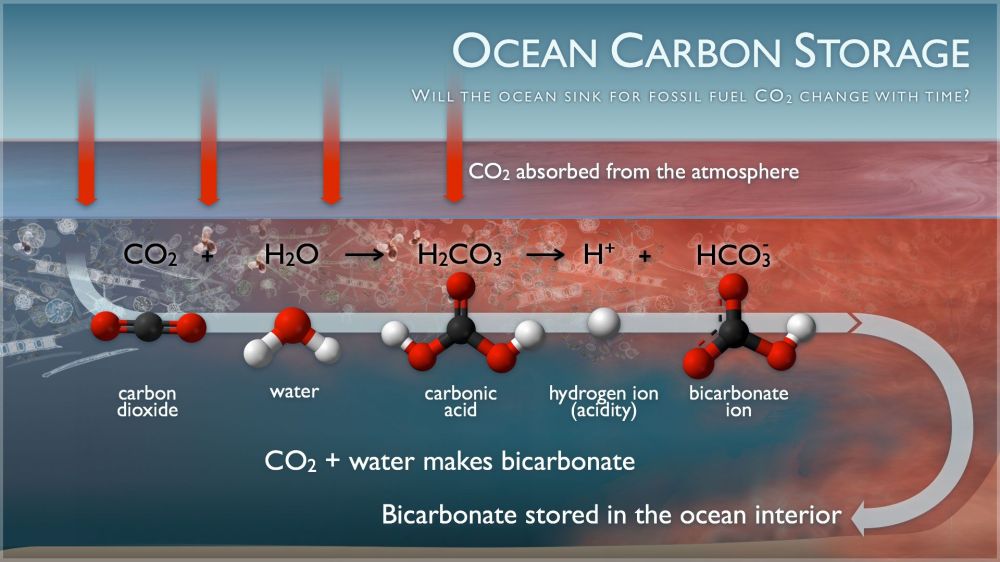
So here’s the basic chemistry of CO2 and H20:

8lrtxibuouhqy8limppbfwkc76e5k_rxa9xbrm8mssw

That seems straight forward,  So what is the problem?

That looks fairly serious.  So what does the IPCC have to say about this issue?

What does it say in the SPM (Summary for Policy Makers)?

For this issue, I looked at the topic of ocean acidification and fish productivity. The SPM asserts on Page 17 that fish habitats and production will fall and that ocean acidification threatens marine ecosystems.

“Open-ocean net primary production is projected to redistribute and, by 2100, fall globally under all RCP scenarios. Climate change adds to the threats of over-fishing and other non-climatic stressors, thus complicating marine management regimes (high confidence).” Pg 17 SPM

“For medium- to high-emission scenarios (RCP4.5, 6.0, and 8.5), ocean acidification poses substantial risks to marine ecosystems, especially polar ecosystems and coral reefs, associated with impacts on the physiology, behavior, and population dynamics of individual species from phytoplankton to animals (medium to high confidence).” Pg 17 SPM

So, the IPCC agrees that ocean acidification is a serious problem due to rising CO2 emissions from burning fossil fuels.

What does it say in the Working Group Reports?

But wait a minute.  Let’s see what is in the working group reports that are written by scientists, not politicians.

WGII Report, Chapter 6 covers Ocean Systems. There we find a different story with more nuance and objectivity:

“Few field observations conducted in the last decade demonstrate biotic responses attributable to anthropogenic ocean acidification” pg 4

“Due to contradictory observations there is currently uncertainty about the future trends of major upwelling systems and how their drivers (enhanced productivity, acidification, and hypoxia) will shape ecosystem characteristics (low confidence).” Pg 5

“Both acclimatization and adaptation will shift sensitivity thresholds but the capacity and limits of species to acclimatize or adapt remain largely unknown” Pg 23

“Production, growth, and recruitment of most but not all non-calcifying
seaweeds also increased at CO2 levels from 700 to 900 µatm Pg 25

“Contributions of anthropogenic ocean acidification to climate-induced alterations in the field have rarely been established and are limited to observations in individual species” Pg. 27

“To date, very few ecosystem-level changes in the field have been attributed to anthropogenic or local ocean acidification.” Pg 39

Ocean Chemistry on the Record

Contrast the IPCC headlines with the the Senate Testimony of John T. Everett, in which he said:

“There is no reliable observational evidence of negative trends that can be traced definitively to lowered pH of the water. . . Papers that herald findings that show negative impacts need to be dismissed if they used acids rather than CO2 to reduce alkalinity, if they simulated CO2 values beyond triple those of today, while not reporting results at concentrations of half, present, double and triple, or as pointed out in several studies, they did not investigate adaptations over many generations.”

“In the oceans, major climate warming and cooling and pH (ocean pH about 8.1) changes are a fact of life, whether it is over a few years as in an El Niño, over decades as in the Pacific Decadal Oscillation or the North Atlantic Oscillation, or over a few hours as a burst of upwelling (pH about 7.59-7.8) appears or a storm brings acidic rainwater (pH about 4-6) into an estuary.”
http://www.epw.senate.gov/public/index.cfm?FuseAction=Files.View&FileStore_id=db302137-13f6-40cc-8968-3c9aac133b16

Many organisms benefit from less alkaline water.

(Added in thanks to David A.’s comment below)

In addition, IPCC has ignored extensive research showing positive impacts on marine life from lower pH. These studies are catalogued at CO2 Science with this summary:

There are numerous observations of improvement in calcification of disparate marine life in realistic rates of PH change due to increased CO2.

“In the final graphical representations of the information contained in our Ocean Acidification Database, we have plotted the averages of all responses to seawater acidification (produced by additions of both HCl and CO2) for all five of the life characteristics of the various marine organisms that we have analyzed over the five pH reduction ranges that we discuss in our Description of the Ocean Acidification Database Tables, which pH ranges we illustrate in the figure below.”

“The most striking feature of Figure 11 is the great preponderance of data located in positive territory, which suggests that, on the whole, marine organisms likely will not be harmed to any significant degree by the expected decline in oceanic pH. If anything, in fact, the results suggest that the world’s marine life may actually slightly benefit from the pH decline, which latter possibility is further borne out by the scatter plot of all the experimental data pertaining to all life characteristic categories over the same pH decline range, as shown below in Figure 12.”

At PH decline from control of .125, calcification, metabolism, fertility, growth and survival all moved into positive territory.

http://www.co2science.org/data/acidification/acidification.php

Summary

The oceans are buffered by extensive mineral deposits and will never become acidic. Marine life is well-adapted to the fluctuations in pH that occur all the time.

This is another example of climate fear-mongering:  It never happened before, it’s not happening now, but it surely will happen if we don’t DO SOMETHING!.

Conclusion

Many know of the Latin phrase “caveat emptor,” meaning “Let the buyer beware”.

When it comes to climate science, remember also “caveat lector”–”Let the reader beware”.

Update added June 20, 2015

For additional commentary on ocean acidification:

http://www.newsmax.com/FastFeatures/ocean-acidification-global-warming-quotes-debate/2015/05/06/id/642876/

Update added June 24, 2015

Patrick Moore also provides a thorough debunking here:

“It is a fact that people who have saltwater aquariums sometimes add CO2 to the water in order to increase coral growth and to increase plant growth. The truth is CO2 is the most important food for all life on Earth, including marine life. It is the main food for photosynthetic plankton (algae), which in turn is the food for the entire food chain in the sea.”

http://news.heartland.org/editorial/2015/05/27/why-coral-reefs-and-shellfish-will-not-die-ocean-acidification

Update added July 2, 2015

Scientists have had pH meters and measurements of the oceans for one hundred years. But experts decided that computer simulations in 2014 were better at measuring the pH in 1910 than the pH meters were. The red line (below) is the models recreation of ocean pH. The blue stars are the data points — the empirical evidence.

What we have here is one of the basic foundations of the climate change scare, that is falling ocean pH levels with increased atmospheric CO2 content, being completely dismissed by the empirical ocean pH data the alarmist climate scientists didn’t want to show anyone because it contradicted their ‘increasing ocean acidity’ narrative.

http://joannenova.com.au/2015/01/oceans-not-acidifying-scientists-hid-80-years-of-ph-data/

Update added September 15, 2015

In summary, recent research publications are using a term (OA) that is technically incorrect, misleading, and pejorative; it could not be found in the oceanography literature before about 15 years ago. . .

The claim that the surface-water of the oceans has declined in pH from 8.2 to 8.1, since the industrial revolution, is based on sparse, contradictory evidence, at least some of which is problematic computer modeling. Some areas of the oceans, not subject to algal blooms or upwelling, may be experiencing slightly lower pH values than were common before the industrial revolution. However, forecasts for ‘average’ future pH values are likely exaggerated and of debatable consequences. The effects of alkaline buffering and stabilizing biological feedback loops seem to be underappreciated by those who carelessly throw around the inaccurate term “ocean acidification.”

http://wattsupwiththat.com/2015/09/15/are-the-oceans-becoming-more-acidic/

How About That Blob? (June 13 Update)

June 13, 2015

As hoped for by Paris COP promoters, and by Californians looking for El Nino precipitation, the Blob in the North Pacific has intensified and may at least partly fulfill both expectations.

HADSST3 results for May are now in, and the sea surface temperature warming anomaly is up:

Global +0.12C over last May,
NH +0.16C over last May.

That will show up also in air temperature estimates, since 71% of the earth’s surface is covered by oceans. For example, UAH TLT anomalies show Global oceans +0.06C over last May, but Global land -0.1C, so Global UAH is only up +0.02C over May 2014. (Note: UAH uses satellites to measure air temperatures many meters above land or ocean, while surface datasets like HADCRUT, BEST, GISTEMP use the measured SSTs in their global mean temperature estimates).

The Blob difference shows up in UAH in the NH results: NH anomaly is +0.07 over last year, with the same increase showing over land and ocean.  Interestingly, UAH shows the North Pole cooler than a year ago, the TLT over the Arctic being -0.06 less than a year ago.  The South Pole land air temps are a whopping -0.2C colder than last May.

As far as Arctic Ice is concerned, the Blob probably caused the Bering Sea to melt out more than one month earlier than last year.  About 10% of the water entering the Arctic Ocean comes from Bering, so there should be some impact on ice melting the immediate BCE region (Beaufort, Chukchi, East Siberian Seas). So far, in that region, 2015 is tracking last year’s melt at a slightly lower extent -4%, not yet a significant effect from the Blob.

More on Arctic Ice melt season here:

https://rclutz.wordpress.com/2015/06/02/arctic-ice-watch-june-daily/

Background on the Blob

Many have noticed the warm water anomaly in the Northern Pacific, which shows up as a weak El Nino, but somewhat unexpected and out of the ordinary pattern. The warm Pacific SST last year almost pushed 2014 to a new record average surface temperature, and fossil fuel activists are pinning their Paris hopes on this year.

So it is timely for the Meteorologist who named this event to provide a clear explanation of the natural causes of the Blob phenomenon.

From Nicholas Bond (excerpted from post linked below):

Blob 101
The development of the blob of unusually warm water can be attributed largely to an unusual weather pattern that set up shop over a large region extending from the North Pacific Ocean across North America from October 2013 into February 2014.

This pattern featured a strong and long-lasting weather pattern with higher-than-normal pressure – called a ridge – over the ocean centered offshore of the Pacific Northwest. This ridge of high pressure reduced the number and intensity of storms making landfall, leading to reduced precipitation west of the Continental Divide compared to seasonal norms.

In a study published earlier this month, my colleagues and I fingered the stubborn high-pressure ridge mentioned above, and in particular the weak winds associated with it. The result was a lower-than-normal rate in how quickly heat is transferred from the ocean to the atmosphere, and slower movement of cooler water into the formation region of the blob.
In other words, the unusual atmospheric conditions produced less cooling than typical for the season from fall 2013 through much of the following winter, yielding the sea surface temperature anomaly pattern. So we can essentially blame the ridge for the blob, but what caused the ridge in the first place?

The ocean circulation – that is, the currents – and the weather during the past year, which was unusual in its own right, combined to cause the blob to evolve into a wide strip of relatively warm water along the entire West Coast of North America (see image, below).

This happens to be a pattern that has occurred before in association with decades-long shifts in ocean temperature known as the Pacific Decadal Oscillation (PDO). Previous expressions of the PDO have had major and wide-ranging impacts on the marine ecosystem including salmon and other species of fish; recent developments are receiving a great deal of attention from fishery-oceanographers along the West Coast.

http://theconversation.com/what-is-the-warm-blob-in-the-pacific-and-what-can-it-tell-us-about-our-future-climate-40140

Spitsbergen Triangle: Ground Zero for Climate Mysteries

Credit to Dr. Bernaerts for his writings on this subject, excerpts of which appear below.

The Island Nexus for Ocean Currents

From the Dutch: spits – pointed, bergen – mountains

The largest and only permanently populated island of the Svalbard archipelago in northern Norway. Constituting the westernmost bulk of the archipelago, it borders the Arctic Ocean, the Norwegian Sea, and the Greenland Sea. Spitsbergen covers an area of 39,044 km2 (15,075 sq mi), making it the largest island in Norway and the 36th-largest in the world.

The fact is that the winter temperatures made a jump of more than eight degrees Celsius at the gate of the Arctic Basin, after 1918. Nowadays, one century later, the event is still regarded as “one of the most puzzling climate anomalies of the 20th century”.

Dr. Bernaerts:

The overriding aspect of the location is the sea; the sea around Spitsbergen, the sea between particularly the Norwegian, the Greenland, and the Barents Seas (Nordic Sea). The Norwegian Sea is a huge, 3000 metres deep basin. This huge water mass stores a great amount of energy, which can transfer warmth into the atmosphere for a long time. In contrast the Barents Sea, in the southeast of Spitsbergen has an average depth of just around 230 metres. In- and outflow are so high that the whole water body is completely renewed in less than 5 years. However, both sea areas are strongly influenced by the water masses coming from the South. The most important element is a separate branch of the North Atlantic Gulf Current, which brings very warm and very salty water into the Norwegian Sea and into the Spitsbergen region. Water temperature and degree of saltiness play a decisive role in the internal dynamics of the sea body. And what might be the role of the huge basin of the Arctic Ocean, 3000 meters depth and a size of about 15 million square kilometers?

The difference towards the other seas mentioned is tremendous. The Arctic Ocean used to be widely ice covered in the first half of the 20th Century, the other seas only partly on a seasonal basis. Only between the open sea and the atmosphere an intensive heat transfer is permanently taking place. Compact sea ice reduces this transfer about 90% and more, broken or floating ice may change the proportion marginally. In this respect an ice covered Arctic Ocean has not an oceanic but ‘continental’ impact on the climate.

The Arctic Ocean is permanently supplied with new water from the Gulf Current, which enters the sea close at the surface near Spitsbergen. This current is called the West Spitsbergen current. The arriving water is relatively warm (6 to 8°C) and salty (35.1 to 35.3%) and has a mean speed of ca. 30 cm/sec-1. The warm Atlantic water represents almost 90% of all water masses the Arctic receives. The other ~10% comes via the Bering Strait or rivers. Due to the fact that the warm Atlantic water reaches usually the edge of the Arctic Ocean at Spitsbergen in open water, the cooling process starts well before entering the Polar Sea.

A further highly significant climate aspect of global dimension is the water masses the Arctic releases back to oceans. Actually, the outflow occurs mainly via the Fram Strait between Northeast Greenland and Spitsbergen, and together with very cold water from the Norwegian Sea basin the deep water spreads below the permanent thermocline into the three oceans.

http://www.arctic-heats-up.com/pdf/chapter_2.pdf

The Spitsbergen Event 1918-1919

Beginning around 1850 the Little Ice Age ended and the climate began warming. Before that, at least since 1650 marked the first climatic minimum after a Medieval warm period, the Little Ice Age brought bitterly cold winters to many parts of the world, most thoroughly documented in the Northern Hemisphere in Europe and North America. The decreased solar activity and the increased volcanic activity are considered as causes. However, the temperature increase was remote and once again effected by the last major volcanic eruption of the Krakatoa in 1883. Up to the 1910s the warming of the world was modest.

Suddenly that changed. In the Arctic the temperatures literally exploded in winter 1918/19. The extraordinary event lasted from 1918 to 1939 is clearly demonstrated in the graph showing the ‘Arctic Annual Mean Temperature Anomalies 1880 – 2004’. But this extraordinary event has a number of facets, which could have been researched and explained. Meanwhile almost a full century has passed, and what do we know about this event today? Very little!

Studies considering the causation of the warming offer sketchy rather than well founded ideas. Here are a few examples:
• Natural variability is the most likely cause (Bengtsson, 2004);
• We theorize that the Arctic warming in the 1920s/1930s was due to natural fluctuations internal to the climate system (Johannessen, 2004).
• The low Arctic temperatures before 1920 had been caused by volcanic aerosol loading and solar radiation, but since 1920 increasing greenhouse gas concentration dominated the temperatures (Overpeck, 1997).
• The earlier warming shows large region-to-region, month-to-month, and year-to-year variability, which suggests that these composite temperature anomalies are due primarily to natural variability in weather systems (Overland, 2004).
• A combination of a global warming signal and fortuitous phasing of intrinsic climate patterns (Overland, 2008).

Arctic Regime Change

These explanations (and others such as CO2 or the AMOC) do not come to grips with how extreme and abrupt was this event. In the Spring of 1917, sea ice reached all the way to Spitsbergen, the only time in a century.

And the next year, temperatures rocketed upward, as shown by the weather station there:

A look at the SST history shows clearly an event as dramatic as a super El Nino causing a regime change. But this is the Atlantic, not the Pacific. Cooling followed, but temperatures stayed at a higher level than before.

Summary

The warming at Spitsbergen is one of the most outstanding climatic events since the volcanic eruption of Krakatoa, in 1883. The dramatic warming at Spitsbergen may hold key aspects for understanding how climate ticks. The following elaboration intends to approach the matter from different angles, but on a straight line of thoughts, namely:

  • WHERE: the warming was caused and sustained by the northern part of the Nordic Sea in the sea area of West Spitsbergen the pass way of the Spitsbergen Current.
  • WHEN: The date of the commencement of warming can be established with high precision of few months, and which was definitely in place by January 1919.
  • WHY: the sudden and significant temperature deviation around the winter of 1918/19 was with considerable probability caused, at least partly, by a devastating naval war which took place around  the British Isles, between 1914 and 1918.

There is much more evidence and analysis supporting Dr. Bernaerts’ conclusions here:

http://climate-ocean.com/arctic-book/index.html


Conclusion:  Unless your theory of climate change can make sense of the Spitsbergen Event, then it cannot inspire confidence. You may not be entirely convinced by Dr. Bernaerts’ explanation, but he at least has one–nobody else  has even tried.