Update: What is an “Invalid Vote” Anyway?

As explained in a reprinted post below:

A vote is an indication of preference cast by an eligible, registered voter.  It must be cast in the time, place, and manner prescribed by law.

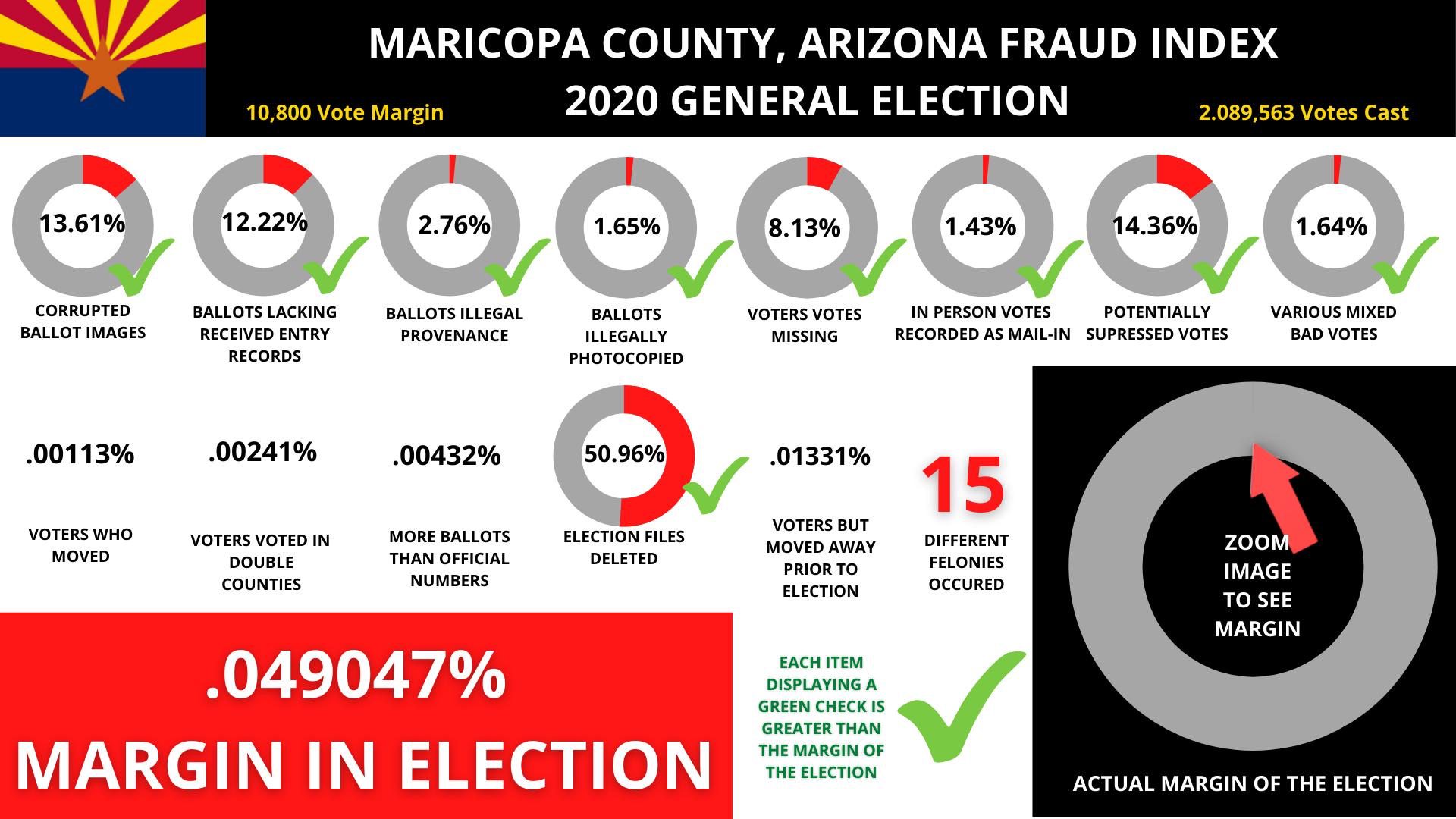
Thus a ballot cast claiming to be a vote is not in fact one to be counted if any of the conditions are not met.  The image above presents the many ways supposed “votes” failed to be valid votes in Maricopa County, Arizona, in the 2020 federal election.  The total count of ballots cast was 2,089,563 and Biden won by 10,800.  Each of the many circles depict the % of total votes that failed to meet a particular criterion.  If the top row circles are summarized, the total number of invalid votes in that county exceeded 700,000. Jovan Pulitzer explains why he made the chart:

I think people need to visually see all the errors, all the information that shows, hey, Maricopa at its worst literally should be decertified, at its best could easily be redone…

…I just charted out a very simple way to understand how bad is the bad. If they’re just pie charts, if you think here in this election was won on .049047%, right? It’s such a small margin that it could have swung any way…

…There are eight charts across the top, those are just the low hanging fruit that show this election has serious issues because any one of these would demand that it can’t be certified or it needs to be rerun. 

Background at previous post What is a Vote Anyway?

Ted Noel writes at Town Hall In the Arizona Audit, Words Matter.  Excerpts in italics with my bolds and added images.

This is one of those times when we wish that people would have used more circumspect language. Both the Arizona auditors and John Solomon committed a cardinal error that has allowed the Left to celebrate victory and ignore the fine print. Both note that Biden got more “votes” than Trump. That conclusion is incorrect, because it ignores the rest of the story.

A vote is an indication of preference cast by an eligible, registered voter.

It must be cast in the time, place, and manner prescribed by law. Anything else is not a vote. In Arizona, it is cast on paper ballots and read by machines. All the “accurate count” showed was that the machines counted the pieces of paper accurately. That’s all machines do. They do not count “ballots.”

The canvass did not answer the primary question, “How many of the pieces of paper were lawful ballots and how many should have been excluded because they were not lawful votes?” All the “accurate count” proves is that there was no outside effort to tweak the numbers by changing them by some direct internet chicanery. But it does not prove that Biden won. Or not. And that is the problem.  I won’t repeat all the details the auditors droned on through, but there are several key findings.

Over 50,000 “ballots” were unlawfully cast.

There were dead people, new addresses without re-registration, double votes, envelopes with no signatures, ballots received that were never sent out, and so on. Every one of those “ballots” were unlawful. They should have been rejected to remove them from the canvass. Since the margin between Trump and Biden was around ten thousand, this is far more than enough to cast doubt on the outcome. And then comes the drama.Maricopa County did everything it could to block the audit. If it was confident that it had done its job correctly, then one would expect that it would cooperate fully. Indeed, with the hand count matching the canvas, it seems that all should be well. But then we find that hundreds of thousands of election files were deleted from Maricopa County’s computer servers the day before the audit began. That smacks of guilty knowledge.

We also know that the servers allowed election data to be seen from the internet. Security was extremely lax, and even though it appears no votes were changed, other issues arise. Legally required signature matching on absentee ballots basically evaporated as the original tally went on.

Was someone watching from outside, then advising local officials on how to let unlawful ballots through to obtain the desired result?

At a bare minimum, the Arizona Presidential election was irretrievably tainted. The taint was large enough to make determination of the actual winner impossible. That’s why I wrote before January 6 that VP Pence should send several slates of electors back to their respective state legislatures for a final determination.

Those states, by repeated violations of their own state laws, did not hold elections. The processes they followed did not allow a tally of lawful votes.

The Arizona legislature should vote to decertify the electors for the 2020 election. This may have no legal effect, but if it leads two or three other states to the same conclusion, we may have a Constitutional crisis, and there are no guideposts for this trail. The Constitution simply did not foresee the compounding of raw power applied to prevent the proper administration of a Presidential election. The Supreme Court may deny cert based on the passage of time beyond the designated Electoral College date. Or it could decide to hear the case and ultimately find that Biden’s election is a nullity ab initio. Or something in between. Who knows?

What we do know is that we simply cannot declare who won the Arizona election with any degree of certainty. Even if that changes nothing else, it should give us a resolve to fix our elections so that they cannot be manipulated outside the law.

Pieces of paper with marks on them are not ballots until it is determined that those marks were made by a lawful voter in the time and manner prescribed by the legislature. Only after that bar is crossed for every ballot is it possible to have an election. Biden did not win the Arizona election because there was no Arizona election. It is impossible to truthfully say that he got more “votes” than Donald Trump. Nobody actually knows.


Why “Hispanics” is Wrong and Dangerous

This is an informed and timely perspective from a person attributed to be a member of the above “group” in order to join a socio-political US revolution.  Mike Gonzalez explains in an interview with Doug Blair at Daily Signal Why Hispanic Heritage Month Shouldn’t Be a Thing.  Excerpts of transcript with my bolds and images.

Overview

We’re in the first week of Hispanic Heritage Month, yet another 30 days of identity-focused celebration, following on the heels of Black History Month in February and Gay Pride Month in June.

But although the ubiquity of the terms “Hispanic” and “Latino” might make it seem that they’ve always been there, Heritage Foundation senior fellow Mike Gonzalez contends that those terms were invented by Marxist activists attempting to persuade so-called Hispanics that they were oppressed.

“I’m very proud of [my heritage], but this amalgamation, this artificial label that is created, the officiality of it is what I’m opposed to, because I know that it is done on purpose and with malice aforethought toward the country of the United States,” Gonzalez says.

The veteran journalist and communicator joins “The Daily Signal Podcast” to discuss the Marxist history of terms such as “Hispanic” and “Latino,” and to detail the radical left’s plans to use identity politics to seize power.

Doug Blair: Our guest today is Mike Gonzalez, a Heritage Foundation senior fellow for foreign policy as well as the Angeles T. Arredondo e pluribus unum fellow. He is also the author of the new book “BLM: The Making of a New Marxist Revolution,” highlighting the Marxist underpinnings of the Black Lives Matter movement. Mike, thank you so much for joining us.

Interview

Blair: I wanted to have you on the show today to discuss Hispanic Heritage Month. You’ve done a lot of really fascinating research on terms like Hispanic and Latino and where they come from. So to start off, could you explain to our listeners a brief history of the invention of these terms?

Gonzalez: So, if by Hispanic Heritage Month we were celebrating what unites, actually, all the “Hispanics” in the United States, that is the founding by the Iberian kingdoms of Portugal, Spain of their lands, I probably wouldn’t have any problem with that. I think that we should learn more about Columbus’ exploration, his brave courageous trek across the ocean to join all of humanity finally together. Leif Erikson, a Viking, is said to have done it, but Leif Erikson was not interested in uniting humanity and forging new and permanent links as Columbus did.

If we mean that, then by all means. If we mean the wondrous actions of Junípero Serra in the West to bring the promise of salvation and Christ to the natives of that land; if we mean by no means all good, but still very brave exploration of Cuba, Mexico, Peru, etc. by Velázquez and Cortes and Pizarro, and looking at all aspects of it, looking at the good things they did and the bad things they did; then yeah, I would be for that kind of Hispanic Heritage Month.

What I’m not for is for the creation of a Hispanic category by leftists—well, the instigation of the creation—because the leftist activists in the ’70s were the ones who really went all out and prodded the bureaucracy, a very reluctant bureaucracy, I must add, who did not want to do it, starting in the late ’60s and culminating in 1977, when OMB, the Office of Management and Budget, finally created the Hispanic category.

And the culmination, I guess, would’ve been when it’s placed on the 1980 census for the first time, and this very large and growing group of Americans are hauled off and counted away from the other races that are recognized by anthropologists, not by leftist activists acting on the pay of the Ford Foundation.

So that is what I’m against. And the reason I’m against it, we can go into that later on, depending on what questions you ask, because it is very clear from the beginning that it is done in order to instill grievances in the members of this category in order to transform the country.
Blair: So what it sounds like you’re saying is that these terms like Hispanic and Latino were not naturally occurring. They weren’t invented by the communities that they were invented to describe. It sounds like these were pushed by leftist academics.

So with that being said, do you consider yourself Hispanic?

Gonzalez: So, opposition came not only from the bureaucrats, it also came from the grassroots. The grassroots wanted no part of this. They were the only people that were interested in doing this. And they were very adamant that Hispanic be created. … They always say, the activists, they hate colonization, but Hispanic and Latin America are both words that are used by colonizers.

I consider myself an American, to be honest. I consider myself a father, first of all; a husband; a Catholic, that’s an affiliation that’s very important to me; an American. I consider myself a Cuban American also, although that is less important than the other things I mentioned.

First, I’m very proud of the contributions of Cuban Americans to this country. . .Very proud of my family. I love my family. I love the history of my family, what it accomplished both in Cuba and in Spain before, because I have very recent ancestors, grandparents who are Spaniards. . .My immigrant grandfather, my immigrant five great grandparents, all of whom were poor, who came from Northern Spain and made it in Cuba.

So I’m very proud of all that, but this amalgamation, this artificial label that is created, the officiality of it is what I’m opposed to, because I know that it is done on purpose and with malice and aforethought toward the country of the United States.
Blair: With that history in mind, and with the way you view yourself in mind, I’m curious, what are the views of the communities that these terms were invented to describe, South and Central Mexican nationals, on terms like Latino and Hispanic? Are these terms popular with them? And then further on, how have these terms been embraced by the wider American population? Is this something that they accept as well?

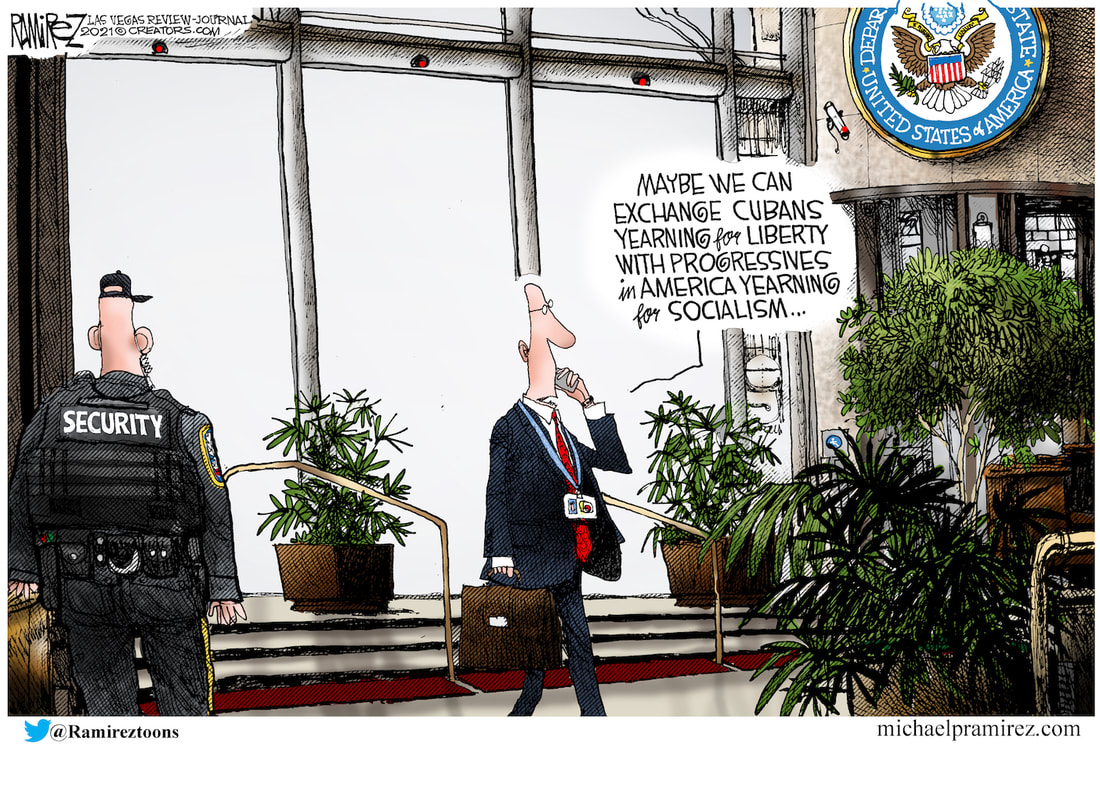
Gonzalez: Well … I don’t know 58 million of them personally. It’s funny, every time somebody says to me, “Hey, do you know this Cuban?”, it’s like, “Nah, there’s almost 2 million Cuban Americans. We don’t really know each other, all of them.”

Look, we can only look at the opinion polls. Pew Research, every poll that I’ve looked at—Pew is very good by the way. It’s center-left and the analysis is center-left, but if you look at the numbers that Pew puts out, I swear by them. And what they find is that between 20% and 25% uses Hispanic or Latino. The rest uses Dominican or Mexican or Puerto Rican or American.

So the Hispanic and Latino—I’d love to get into Latino, by the way, because that story is not known at all. And of course, Latinx, that term only known to NPR and [President] Joe Biden. I can tell you that nobody in Miami is having a cafecito thinking he’s Latinx, and nobody walks into a bodega in Manhattan thinking she’s Latinx. My goodness, my goodness.

Blair: Well, I’m really glad that you actually brought that up, because as radical leftists kind of continue their war on language, and as they decide that these terms are not far enough, Latino and Latinx are now these things. Chicanx, I’ve heard a couple of times. I mean, how does this evolution of identity-based language, like, Latinx, Chicanx, and all these other crazy ones, how does this play into the sort of Marxist underpinnings of the phrases themselves?

Gonzalez: By the way, I often tweet that I did the Ancestry test and I came back 55% Hispanix, 20% Portugex, 20% Irix, and less than 1% Indiax.

So what they do is they create these categories. … And they’re very open about this, by the way. If you listen to Maria Teresa Kumar, who is wonderful in her ability to just speak the truth, sometimes when she’s on Chuck Todd or doing a show with Nikole Hannah-Jones, she will say, “Look, it’s really, really hard.” She’s the head of Voto Latino. “It’s really, really hard to instill grievances into the members of these categories, because they’re not aware that they’re being oppressed.”

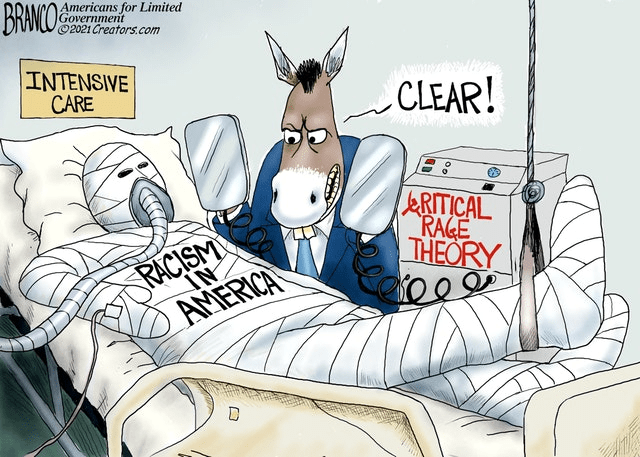
This is, of course, pure and classic critical theory and critical legal theory and critical race theory. They believe from the beginning that what happens is that the members of the population are not aware of their oppression.

[Max] Horkheimer, one of the godfathers of critical theory, writes in the 1930s that, “One cannot rely on the proletariat to overthrow the system because the proletariat will not understand that he’s suppressed. He has no idea that he’s suppressed.” His assistant, Herbert Marcuse, then writes in the 1960s that, “Liberation can only start with the consciousness of servitude.”

And so it is with these activists and the heads of these groups, who grab an immigrant from Uruguay or his progeny and say, “You might be happy here. You may have fought really hard to leave Guerrero, Mexico, and immigrate to this country, and you may think this is the land of opportunity and milk and honey, but you’re wrong. You’re enslaved. You’re oppressed. The dissatisfaction of your material needs through capitalism, even though you’re happy with your Wi-Fi and your split-level home, this is a very oppressive, superstructure.”

In fact, in order to apply for the incentives to do this, you get maybe a preference for a city contract, but in order to get a preference for a city contract, you must write down how you were discriminated against 30 years ago. You must never forget. And my goodness, you must never forgive.

So this is very well thought out, and it works if we let it work.

Blair: The question is now, why? What is the motivation here? Is it to bring a new Marxist world order? What is the end goal here?

Gonzalez: Oh, no, of course it is. It is exactly that. It’s liberation. And they say that.

By the way, notice how Marxists never really promise liberty or freedom, because they know they’re not promising liberty or freedom. What they’re promising is liberation because they believe in the oppressed/oppressor narrative. And so they say, “It’s liberation from oppression that we’re after.” And yes, very much so.

And the penny drops for Herbert Marcuse and he writes that, “It is in the ghetto population,” his words, “that you’ll have the revolutionary agents. They must continue to be guided by a communist, a Marxist intellectual class.” They need to have revolutionary consciousness, which he doesn’t believe they have, but they have revolutionary potential, and he sees that they can be prodded into violence.
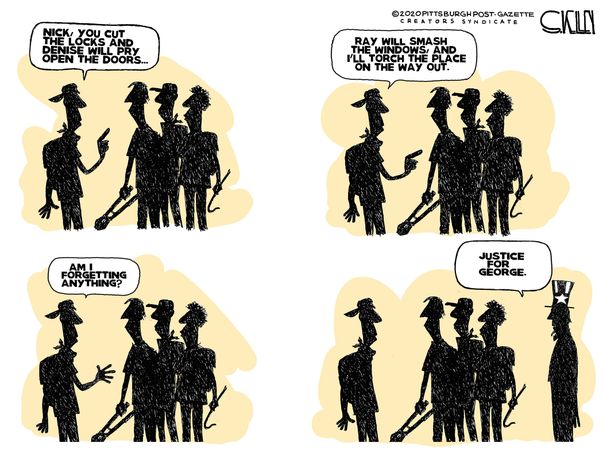
And you’re quite right, that the unique and exceptional suffering of black Americans, that suffering must be analogized to these new groups, which is wrong, it’s false. And it is in many ways just ugly because obviously, I or my family, my name is Gonzalez, famously, and nothing like what happened to African Americans happened to my family or to anybody named Gonzalez.

That’s not to say that people named Gonzalez did not experience discrimination, especially in Texas and parts of the Southwest. Earlier on in the last century, that was very real, and there’s very substantial evidence of it. And we know from the experience that they relate that that happened, but nothing ever approximates what blacks suffered in this country.

Blair: So we’ve seen some of the consequences of this kind of hyperfocalization or hyperintense scrutiny of race and identity on American politics and American social cohesion. What do you think are some of the most severe consequences of the left’s push to push everything through this lens of race, including Hispanic and black?

Gonzalez: Well, we see it today. I mean, all the polls tell us that Americans, a majority—a substantial majority, not just a plurality, but a substantial majority of Americans—today believe that race relations are the worst they’ve ever been.

We’ve had riots. 2020, we’ve had a spike in the murder rate of 30%—30%. That’s an extra 5,000 people dead in 2020, I believe mostly because of the riots and the instability, which took place mostly because of the instigation of the organization of the Black Lives Matter organizations, obviously, with an assist from Antifa, although Antifa does not have the organizing muscle or the cache or the money that Black Lives Matter has.

So we’ve seen the invasion of critical race theory into all aspects of our lives: how kids are being divided according to race; how white kids have been told that they’re racist and that they are oppressors and they have privilege and black kids are being told what Derrick Bell said, that they will never gain equality with whites, which is false and disgusting to say that to a black child. That’s a form of child abuse.

It’s also child abuse to tell a black child or a kid named Rodriguez that numeracy or literacy or punctuality or linear thinking or the use of reason are not things for them, that sitting in their desk and being quiet and following what the teacher says and paying attention and doing homework are white things.

My goodness. [These are] things that would’ve made the Grand Dragon of the KKK blush 20 years ago, and now is being repeated in our classrooms and we’re paying for it as taxpayers. We’re being trained in our places of work, under penalty of being fired.

This is all wrong and very wrong. And that’s the reason that the American people are rebelling against this.

Blair:  On that note, I’m curious, if we want to talk about issues relating to this specific subsect of people, is there a way that we can refer to these groups without using these sort of racialized terms like Hispanic or Latino? Does it make sense to talk about things, for example, like the Hispanic vote?

Gonzalez: No, that one makes absolutely no sense.

So, the largest group in America, largest nation of origin group, are Mexican Americans. I think they may be 38 million today. And it makes no sense whatsoever to talk about the Mexican American vote, just like it really makes no sense to talk about the German vote—that’s the largest group—or the Irish vote anymore. The Irish vote has been split now, I believe, since the ’60s.

The Mexican American vote in some parts like the Rio Grande Valley is going heavily conservative, heavily Republican; in the cities of Texas, especially among the young, it is going the other way. It’s going not just the Democrats or liberals, but heavily progressive. So I hesitate to talk about the Mexican American vote.

The Hispanic vote makes zero sense because you have Puerto Ricans voting differently in Florida than they do in Hartford or New York or Philadelphia; Cubans voting definitely massively one way in Miami and then that’s not the way they vote in Houston; the Mexican Americans voting in Houston or East LA.

There’s such an animal as the Cuban vote in Miami. That is part of reality. And if you are in that business, then you should talk about it and think of it that way.

I’m told that there’s even such a thing as the Irish vote in Boston. No longer do we have really the Dutch vote in the Hudson River Valley as we did in the days of Jackson, Andy Jackson.

Blair: So my final question for you is, do you think this fight against racial fragmentation and the left’s campaign to do this is a fight that conservatives are winning? And as a secondary follow-up, what are we doing well specifically and where do we need to shore up our defenses?

Gonzalez: I think conservatives have begun well by identifying the problem, talking about it, freezing it. I think the left has been caught by surprise.

By the way, the left doesn’t know what critical race theory is, obviously, or they’re just lying when they say that it is not critical race theory to talk about systemic racism. That is just a lie, that’s just ignorance.

I don’t blame them, but the majority is definitely against them. And they’re playing with fire.


Will Evergrande Sink China (and others)?

Daniel Lacalle, PhD, economist and fund manager, writes at CD Media Evergrande Isn’t China’s “Lehman Moment.” It Could Be Worse Than That. Excerpts in italics with my bolds and added images.

The bankruptcy of the Chinese real estate company Evergrande is much more than a “Chinese Lehman.” Lehman Brothers was much more diversified than Evergrande and better capitalized. In fact, the total assets of Evergrande that are on the brink of bankruptcy outnumber the entire subprime bubble of the United States.

The problem with Evergrande is that it is not an anecdote, but a symptom of a model based on leveraged growth and seeking to inflate GDP at any cost with ghost cities, unused infrastructure, and wild construction. The indebtedness chain model of Evergrande is not uncommon in China. Many Chinese companies follow the “running to stand still” strategy of piling on ever-increasing debt to compensate for poor cash flow generation and weak margins. Many promoters get into massive debt to build a promotion that either is not sold or is left with many unsold units, then efinance that debt by adding more credit for new projects using unsaleable or already leveraged assets as collateral.

The total liabilities of Evergrande account for more than double its official debt figure (more than 2 trillion yuan). Evergrande’s financial hole is equivalent to almost a third of Russia’s GDP. Its annual revenues do not reach $70 billion, and it is more than debatable whether those revenues are real, since a relevant part comes from payment commitments whose collection is doubtful. Even if they were real, these revenues are not enough to address the bond maturities, which exceed $250 billion in the short term.

Evergrande is much more dangerous than it seems.

All the “Keynesian” solutions that you are hearing these days have already been implemented. Massive liquidity injections, low interest rates, full implicit and explicit support from the Chinese government … Let’s not forget that Evergrande was the largest issuer of commercial paper in China, $32 billion issued in 2020, a 390 percent increase from 2015, according to Reuters.

Evergrande represents less than 4 percent of the overall Chinese market but its model has been used by many Chinese promoters. The ten biggest real estate developers account for 34 percent of the market and aggressive leverage practices are widespread.

The real estate sector is huge in China. Its direct and indirect weight, according to JP Morgan, is 25 percent of GDP, more than double the size of the real estate bubble in Japan or Spain. The sector has been growing with an indebted model at 15 percent per year in the last three years. The Chinese government has introduced regulations to reduce the excess, but because it benefits from the increase in GDP and job creation, it has maintained a complacent position regarding the corporate debt model.

Chinese real estate companies, according to JP Morgan, have “reduced” their indebtedness to 92 percent of total assets from a monster 140 percent in 2018, with a profit margin of 9–13 percent. But those figures still show a larger and more concerning problem than what headlines imply. Most Chinese real estate developers have total liabilities of 50 percent to total assets, according to JP Morgan.  The problem is that the value of those assets and the capacity to sell them is more than questionable.

The implications of an Evergrande collapse are far greater than what investment banks tell us.

The first risk is a domino effect in a very aggressively indebted sector. There is also a significant impact on all those banks exposed to China and emerging markets, where China has financed ruinous projects in recent years. And there is also impact on global growth and countries that export to China, because the slowdown was already more than evident. Additionally, we cannot ignore the impact on the solvency of the financial system despite billions of dollars injected by the People’s Bank of China.

A Solvency Problem Cannot Be Solved with Liquidity.

The hope that the government will fix everything contrasts with the magnitude of the financial hole. Be that as it may, we cannot overlook the negative effect on those sectors highly exposed to real estate growth, infrastructure, electricity, services, and in the hundreds of thousands of citizens who have paid an upfront fee for flats that are not going to be built.

The problem with China is that the entire economy is a huge indebted model that needs almost ten units of debt to generate one unit of GDP, three times more than a decade ago, and all this catastrophe was already more than evident months ago. With total debt of 300 percent debt to GDP according to the Institute of International Finance, China is not the strong economy swimming in with cash that it was a couple of decades ago.

The market assumed that because it is China, the government was going to hide these risks. Even worse, the Evergrande collapse only shows a dangerous reality in several Chinese sectors: excessive indebtedness without real income or assets to support it.

This episode comes at the worst possible time, after the government has launched a massive crackdown on large companies. International investors are already concerned about corporate governance and intervention in China and now the fears of credit contagion make the risk even worse.

Evergrande is not an anecdote, it is a symptom.


What is a “Vote” Anyway?

Ted Noel writes at Town Hall In the Arizona Audit, Words Matter.  Excerpts in italics with my bolds and added images.

This is one of those times when we wish that people would have used more circumspect language. Both the Arizona auditors and John Solomon committed a cardinal error that has allowed the Left to celebrate victory and ignore the fine print. Both note that Biden got more “votes” than Trump. That conclusion is incorrect, because it ignores the rest of the story.

A vote is an indication of preference cast by an eligible, registered voter.

It must be cast in the time, place, and manner prescribed by law. Anything else is not a vote. In Arizona, it is cast on paper ballots and read by machines. All the “accurate count” showed was that the machines counted the pieces of paper accurately. That’s all machines do. They do not count “ballots.”

The canvass did not answer the primary question, “How many of the pieces of paper were lawful ballots and how many should have been excluded because they were not lawful votes?” All the “accurate count” proves is that there was no outside effort to tweak the numbers by changing them by some direct internet chicanery. But it does not prove that Biden won. Or not. And that is the problem.  I won’t repeat all the details the auditors droned on through, but there are several key findings.

Over 50,000 “ballots” were unlawfully cast.

There were dead people, new addresses without re-registration, double votes, envelopes with no signatures, ballots received that were never sent out, and so on. Every one of those “ballots” were unlawful. They should have been rejected to remove them from the canvass. Since the margin between Trump and Biden was around ten thousand, this is far more than enough to cast doubt on the outcome. And then comes the drama.Maricopa County did everything it could to block the audit. If it was confident that it had done its job correctly, then one would expect that it would cooperate fully. Indeed, with the hand count matching the canvas, it seems that all should be well. But then we find that hundreds of thousands of election files were deleted from Maricopa County’s computer servers the day before the audit began. That smacks of guilty knowledge.
We also know that the servers allowed election data to be seen from the internet. Security was extremely lax, and even though it appears no votes were changed, other issues arise. Legally required signature matching on absentee ballots basically evaporated as the original tally went on.

Was someone watching from outside, then advising local officials on how to let unlawful ballots through to obtain the desired result?

At a bare minimum, the Arizona Presidential election was irretrievably tainted. The taint was large enough to make determination of the actual winner impossible. That’s why I wrote before January 6 that VP Pence should send several slates of electors back to their respective state legislatures for a final determination.

Those states, by repeated violations of their own state laws, did not hold elections. The processes they followed did not allow a tally of lawful votes.

The Arizona legislature should vote to decertify the electors for the 2020 election. This may have no legal effect, but if it leads two or three other states to the same conclusion, we may have a Constitutional crisis, and there are no guideposts for this trail. The Constitution simply did not foresee the compounding of raw power applied to prevent the proper administration of a Presidential election. The Supreme Court may deny cert based on the passage of time beyond the designated Electoral College date. Or it could decide to hear the case and ultimately find that Biden’s election is a nullity ab initio. Or something in between. Who knows?

What we do know is that we simply cannot declare who won the Arizona election with any degree of certainty. Even if that changes nothing else, it should give us a resolve to fix our elections so that they cannot be manipulated outside the law.

Pieces of paper with marks on them are not ballots until it is determined that those marks were made by a lawful voter in the time and manner prescribed by the legislature. Only after that bar is crossed for every ballot is it possible to have an election. Biden did not win the Arizona election because there was no Arizona election. It is impossible to truthfully say that he got more “votes” than Donald Trump. Nobody actually knows.


Steyn’s Situational Sensibility

Key points expressed by Mark Steyn in his address at Gatestone Institute A Hinge Moment of History.  Excerpts in italics with my bolds.  Complete text of address is at the link above.

I have lived in countries that have real domestic terrorism movements…. Any country blessed enough not to have a domestic terrorism movement should not be inventing one.

We are living in a blizzard of lies.

[W]e are more dependent on a handful of woke billionaires to tell us what reality is. They are far more open than ever that they get to determine what are the agreed facts. Google made an explicit announcement about this recently. They said that sometimes they would put warnings on things that are factually accurate because, even though they are true, they do not think it is in society’s interest for people to be seeing it.

[N]ow you will be banned or deleted or blocked or silenced simply for disagreeing with the official version of events. For example, the Great Barrington declaration, which was written by three of the most prominent epidemiologists in the world from Harvard, Oxford, and I think it was Stanford. That was basically deleted from YouTube, banned from Facebook, simply because it contradicted the WHO, CDC official version of events.

It is just groupthink enforced by a cabal of woke billionaires, who have more power than anyone else on the planet.

The other thing that emerged during this year very quickly is that we are at a hinge moment of history. We were told a generation or two back that, by doing trade with China, China would become more like us. Instead, on issues such as free speech, we are becoming more like China.

American companies are afraid of offending China. American officials are afraid of offending China. We are adopting Chinese norms on issues such as free speech and basic disagreements with the government of China.

We’re living in the early stages of a future that is the direct consequence of poor public policy over the last couple of generations. We are not even aware of that….

Right now, we are witnessing a non‑stop continuous transfer of power to a country that is serious about using that power. This is China’s moment. Take it as someone who grew up, in large part, in a great power in decline. There’s no real explicit handover day. People, in hindsight, expect to pinpoint the day that the baton was passed…. My great worry is that actually, the transfer to China has already happened. The baton has already been passed. We just haven’t formally acknowledged that yet.

I’ll say it straight out loud. I do not think that Joe Biden “won the election.” I don’t think it is a question of “widespread fraud.” I think the way the system works with the Electoral College, you only need actually to spread fraud in six key cities in six key states.

I would like some of these genius jurists, including [US Supreme Court Chief Justice] Mr. Roberts and his colleagues, to then give us a figure on what is the acceptable level of fraud in American elections. Denmark, in its history, has never actually had a plausible accusation of any kind of electoral fraud. As we know, in the United States, in cities like Philadelphia, this is a tradition that has long roots and goes back 150 years.

If you have no basic election integrity, essentially, all the other issues are irrelevant.

Big Tech has essentially wrecked the internet.

Now Facebook is working with state power. The first place these Big Tech guys learned to do this was with China…. I’m in favor of breaking these companies up as soon as we can.

Right now, in the United States we worry because Facebook is canceling some actress or pop star. In Australia right now, Facebook is trying to cancel an entire country. We have left it far too late to take serious moves against these people.

Standard Oil was broken up because of its control over the oil business. Facebook and Google and Apple have far more control over their business than Standard Oil did 110 years ago. The difference is that their business is knowledge and the access to knowledge, which is more important even than oil.

I take Iran seriously. Not so much because of the Iranians, but because of the promises and the expectations in places like Sudan that Iranian nuclear technology will basically be shared with some of the most lethal basket-case states on Earth. Iran is in some sense like Russia and China. These are all, in a certain sense, great civilizations that have become perversions of themselves in a relatively short time.

What we ought to be trying to do is connect the Iranian people with their great glorious past, which actually is a platform on which you can build a future.

At some point, if we’re not prepared to stand up… My whole thing, in all the years, is that Western civilization is sliding off a cliff and most citizens of most Western nations are not even aware of it.

There is a moral component that we are overlooking. We live in an insane world where moral narcissism attaches to whether or not you rampage around some statue of a Confederate general who died 150 years ago. The fact that you’re rampaging around the Confederate general while wearing shoes made by child labor somehow does not impact on your moral virtue at all.

We are the civilization that built the modern world. If you do not like us, we can go back to what it was 500 years ago. Basically, the world functions because of the world we built.

The war on the past is straight out in 1984, straight out of Orwell: Who controls the present, controls the past. Who controls the past, controls the future. If you blow up the past, you make social engineering so much easier because there is nothing to go back to.

I try to restrain myself from seeing obvious metaphorical geopolitical symbolism in trivial events, but that story the other day about how China was making US diplomats undergo COVID anal swabs had too much symbolic power for what China has basically done to the entire planet to let it go.

The big change over the last year is that these issues are no longer abstractions. Everyone in the Western world has had some familiarity with the core meaning of Western liberties, whether you are talking about freedom of speech, freedom of movement, freedom of association, freedom of religion, they have all become very real, even for people living the most quiet and uncontroversial lives. We have states, a few weeks ago issuing orders on who you were allowed to spend Christmas or July 4th with.

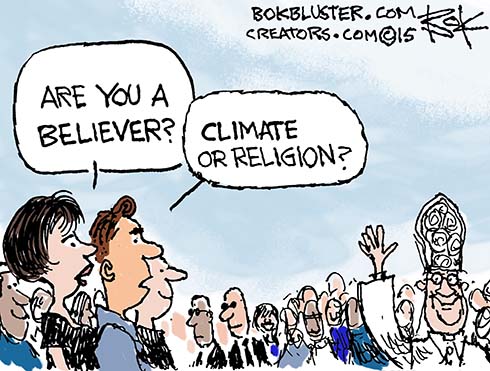
Twin Failed Projects: Afghanistan and Climate Change

Rupert Darwall explains the similarity in his Spectator article Afghanistan and climate change: the West’s twin failures. Excerpts in italics with my bolds and some added images.

Both have the same cause: a failure to accept reality

The West’s humiliation in Afghanistan has an older brother: climate change.

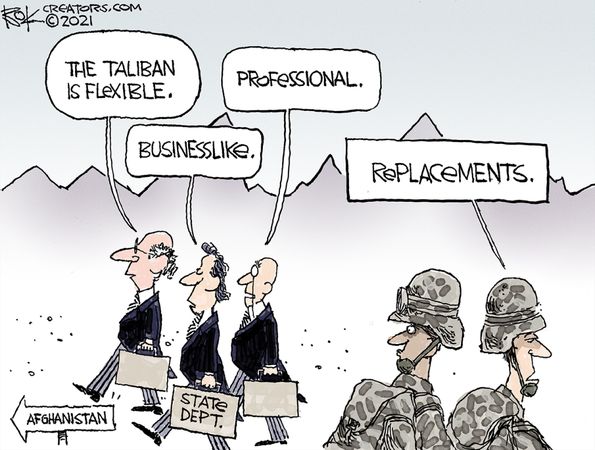
As siblings, the two share characteristics, most obviously an inability to confront unwelcome facts. In Afghanistan, there was a large constituency led by the Pentagon invested in the mantra of proclaiming progress in the fight against the Taliban. Climate has its own industrial complex of NGOs, climate scientists, renewable energy lobbyists profiting from the energy transition, eager helpers in the media, and politicians posing as world saviors.

Energy experts tell us renewable energy is cheaper than building new fossil fuel power stations. If they’re right, why did China build the equivalent of more than one large coal plant a week last year? Its slave labor camps help produce materials for Chinese solar panels, which make them the cheapest in the world. This led the Biden administration to ban their importation. In 10 years, India — a country more susceptible to Western fads — increased the amount of electricity it generated from coal nearly six times faster than from wind and solar. In 2020, fossil fuels accounted for almost 90 percent of India’s primary energy consumption.

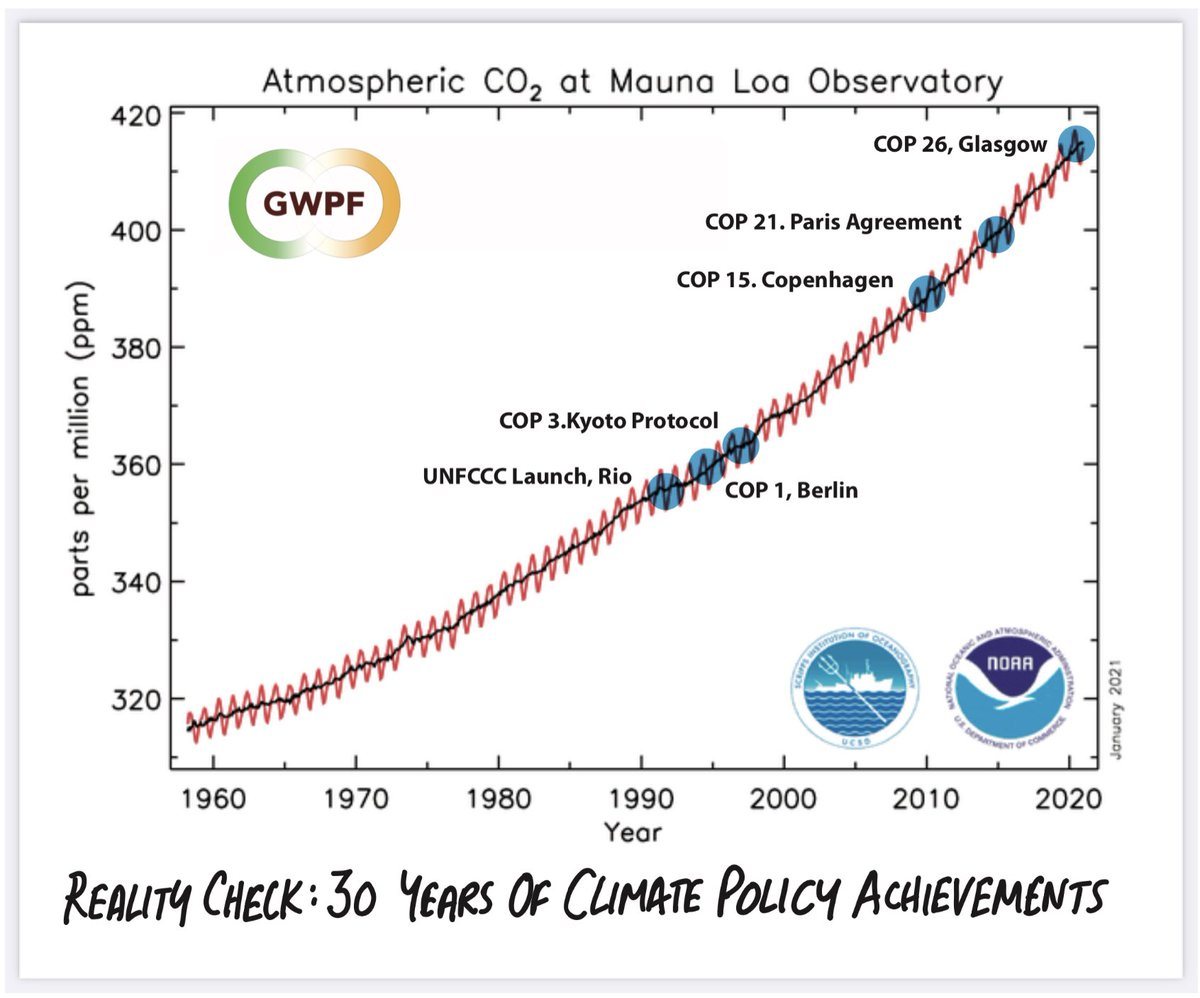
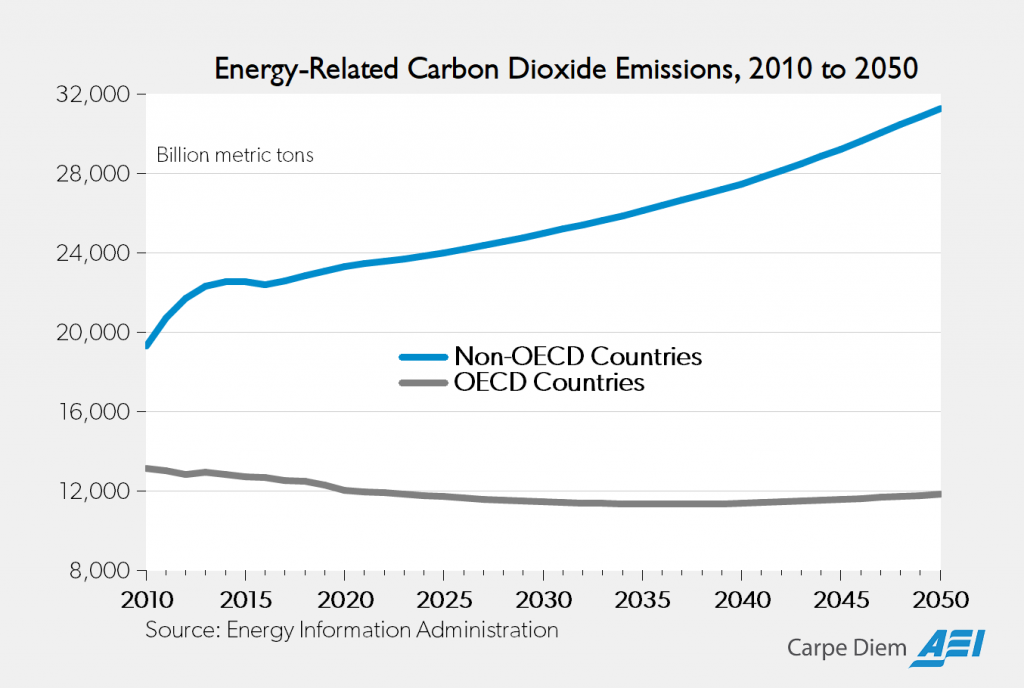
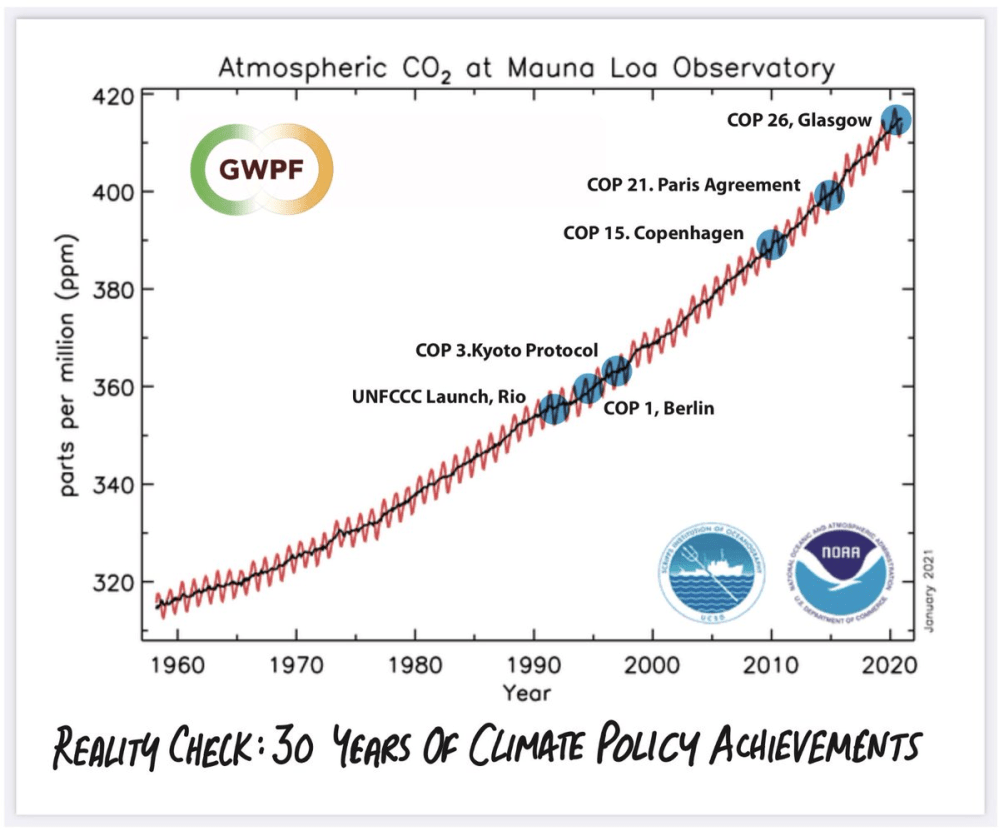
These facts help explain the biggest fact of all. The first 20 years after the 1992 United Nations Framework Convention on Climate Change saw carbon dioxide emissions rise 60 percent. From 2012 to 2019, they rose a further 5.4 percent. However this is dressed up, it’s failure. Meanwhile, the West’s energy emissions have been more or less flat for nearly three decades and on a downward trend since 2007. Emissions from the Rest of the World account for all the growth in global emissions, suddenly accelerating in 2002 from an average of around 1 percent a year to nearly 5 percent a year in the 12 years until 2014.

As a matter of simple arithmetic, the West’s declining share of global emissions means that whatever it does or doesn’t do is of diminishing relevance to the future of climate change. The West’s solipsism of ‘we’ — as in ‘we must act’ — is a profound self-deception.

Foolishly, the West swallowed the claims of small island states that they would sink beneath the waves unless the rise in global temperature was kept below 1.5°C above pre-industrial levels. This was how ‘pursuing efforts’ to meet the 1.5°C limit ended up in the Paris agreement. As the Intergovernmental Panel on Climate Change (IPCC) later confirmed, there was no scientific basis for this. ‘Observations, models and other evidence indicate that unconstrained Pacific atolls have kept pace with S[ea] L[evel] R[ise], with little reduction in size or net gain in land,’ the IPCC said. Instead, the IPCC argued that the 1.5°C target and net zero emissions by 2050 — a target set by the IPCC and not in the Paris agreement — provide the opportunity for ‘intentional societal transformation’.

Stamped all over the West’s two decades of failure in Afghanistan are the words ‘societal transformation’.

‘It has been the hubristic belief that Western values should be universally applied that has led to the folly of nation-building in Afghanistan,’ Sir Christopher Meyer, Britain’s former ambassador in Washington, has written. Climate involves a double dose of hubris. Western politicians expect other countries to turn their backs on the development paths that made the West wealthy. Yet the same politicians seek to transform their own societies in ways that will make many people — especially the middle class and working families — poorer without having won an honest, democratic mandate to do so. They will thereby invite a populist backlash.

Realism disappears on the shoreline of climate change on the presumption that other nations share the Western belief that climate transcends geopolitics.

It wasn’t a pretty sight when John Kerry, Biden’s climate envoy, met China’s gimlet-eyed realists earlier this month. In a blunt statement, they told Kerry that Washington should correct its ‘wrong policies’ on China if the US wanted a dialogue on climate. The requirement to appease China could not have been clearer.

In all likelihood, Kerry will probably get off more lightly than Boris Johnson and the British government, the hosts of this year’s UN climate conference in Glasgow. They naively built up expectations that the talks would produce a deal to save the planet. It showed great ignorance of three decades of UN climate diplomacy: there was never going to be a deal to cut emissions at Glasgow. The last time that happened was at the Kyoto climate conference 24 years ago.

The UN climate convention was a product of a different era. Nato’s Afghanistan operation occurred at the apex of the America’s unipolar moment. The short era of George H.W. Bush’s new world order is over. We live in a time of renewed great power rivalry. China and Russia act in ways Otto von Bismarck would recognize. Of the great powers, they are the principal winners from the West’s humiliation in Afghanistan and they are the biggest winners from the Paris agreement. China keeps its coal-based economy while America runs down its oil and gas industries, only recently having become the world’s largest producer of hydrocarbons.

As Europe phases out coal, so too does it becomes more dependent on the Kremlin for natural gas. The lessons of Afghanistan and climate are the same: the West won’t be defeated by its enemies, but by its refusal to see the world as it is.

Biden Preaches Climatism

Spencer Brown reports at TownHall Biden Declares Climate Change a Pressing Issue After 48 Years in Government.  Excerpts in italics with my bolds.

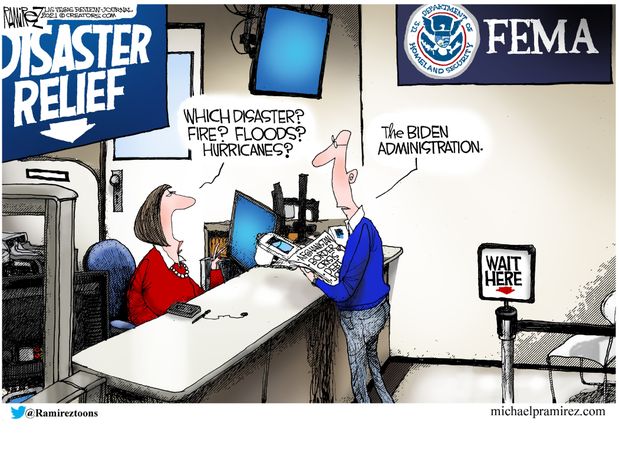
Flanked by New York Governor Kathy Hochul (D), Senate Majority Leader Chuck Schumer (D-NY), Senator Kirsten Gillibrand (D-NY), Mayor Bill de Blasio (D), and other local officials, President Biden stood atop Ida’s flotsam to call for radical policies allegedly aimed at addressing climate change.

Beginning with some confusion as to whose congressional district he was in, Biden said “It’s about time we step up” to confront climate change, despite his more than four decades serving in the Senate and White House that apparently failed to accomplish anything meaningful on the climate change front.

“People are beginning to realize this is much much bigger,” he explained of the weather that he says is the result of climate change before he criticized “a whole segment of our population” that he believes is denying climate change. “They don’t understand,” he added. “I think we’ve all seen even the climate skeptics are seeing” that so-called extreme weather is proof of climate change.

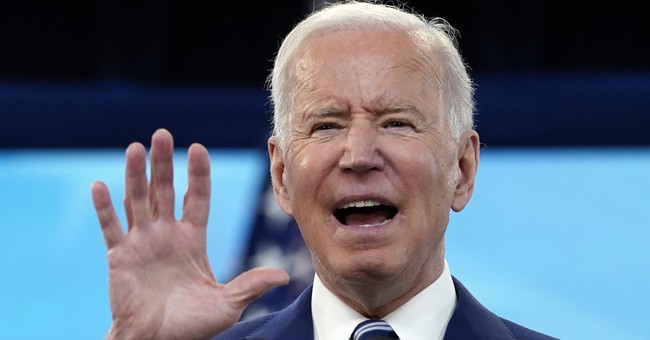
“Climate change poses an existential threat,” said Biden, raising his voice. “It’s here, it’s not going to get any better,” he added while insisting “we can stop it from getting worse.” If the Left’s climate agenda isn’t accomplished, Biden threatened, “the storms are gonna get worse and worse and worse.”

For his own record, then-Senator Biden voted against more stringent fuel efficiency standards a handful of times. And Biden’s words Tuesday suggest his time as Vice President in the Obama administration accomplished little to nothing. After all, if American policy could save the planet, wouldn’t eight years of Obama and Biden in the White House — which included negotiating the Paris Climate Agreement — have mitigated damage like that he spent Tuesday surveying?

“We’ve gotta listen to the scientists and economists,” Biden admonished. “They tell us this is code red.”  “The world is in peril,” Biden claimed, insisting “that’s not hyperbole.”

Among Biden’s recommendations to solve the climate change he lamented is to, “by 2020, make sure all of our electricity is zero emissions,” a deadline we passed nine months ago.

“We’re here, we’re not going home until this gets done, we’re not leaving,said Biden shortly before departing to board Air Force One to travel home to the White House.

Earlier during his Tuesday tour of damage from the remnants of Hurricane Ida, Biden was heckled by a local resident who yelled “Resign, you tyrant” as Biden walked nearby.


Exposed: Ballot Trafficking in Georgia and Arizona

Ballot Drop Box in Georgia, USA

Exclusive — True The Vote Conducting Massive Clandestine Voter Fraud Investigation

True The Vote organization has spent the last several months since late last year collecting more than 27 terabytes of geospatial and temporal data—a total of 10 trillion cell phone pings—between Oct. 1 and Nov. 6 in targeted areas in Georgia, Arizona, Michigan, Wisconsin, Pennsylvania, and Texas. The data includes geofenced points of interest like ballot dropbox locations, as well as UPS stores and select government, commercial, and non-governmental organization (NGO) facilities.

“From this we have thus far developed precise patterns of life for 242 suspected ballot traffickers in Georgia and 202 traffickers in Arizona,” True The Vote’s document says. “According to the data, each trafficker went to an average of 23 ballot dropboxes.

In other words, what the document says is that True The Vote was able to take cell phone ping data on a mass wide scale and piece together that several people—suspected ballot harvesters—were making multiple trips to multiple drop boxes, raising potential legal questions in a number of these states.

From there, the document continues, True The Vote gathered surveillance video on the drop boxes in Georgia and is attempting to gather similar such surveillance video from other states. The document states that True The Vote has obtained one full petabyte of surveillance footage on drop boxes—two million minutes of video—which it says is broken into 73,000 individual video files. The group is expected to begin releasing some of these videos, which purportedly show the same people going multiple times to the same drop boxes, in the coming weeks.

“We are building out video stories and have compiled videos of individuals stuffing ballot dropboxes with stacks of ballots, individuals depositing ballots in multiple dropboxes, unauthorized coordination between government workers engaged in the exchange of ballots, and several other tranches of video that capture unusual patterns such as the wearing of gloves to deposit ballots, taking pictures of ballot deposits, etc.,” True The Vote’s document says.

As for states other than Georgia, True The Vote’s document says that the status of such surveillance video is as of now unclear. “Video availability in other states is undetermined; open records requests submitted consistently since January continue to be met with conflicting communications and stalls,” True The Vote’s document says.

The group says also that it has at least three teams of analysts combing through the raw data and the surveillance video seeking out individual stories and other trends, and that it has been in contact with federal and state law enforcement in various states on what it has found and determined already.

There are several reasons why this revelation about True The Vote’s effort is significant. First and foremost, these revelations come amid several ongoing so-called “audits” in a number of states like Arizona nationally—the results of the Arizona audit are imminently expected—and other efforts by some allies of former President Donald Trump to continue the push for illuminating what happened in the 2020 presidential election. Most of the aforementioned have either not been fruitful, or perhaps have even damaged the former president’s cause by either not being factual or by being incomplete in their nature or for other reasons which cast doubt on their credibility. This self-described effort from True The Vote could change the discussion by providing proof—complete with cell phone data and surveillance video—of allegedly illegal activity that could lead to much more drastic action by law enforcement or political leaders in these various states.

These revelations could be coming amid a renewed push from national Democrats in Washington, DC, to pass some form or another of a federal election takeover plan – whether it be HR1, S1, or a new push for the John Lewis Voting Rights Act, which was HR4 in the last Congress. So far this year, such efforts by Democrats have failed and stalled out in the evenly-divided U.S. Senate as the filibuster has prevented their passage.


Biden Wrong, SCOTUS Right re Texas Fetal Heartbeat Law

The best discussion comes from Josh Blackman’s article at Newsweek The Supreme Court Could Not ‘Block’ Texas’ Fetal Heartbeat Law | Opinion. Josh Blackman is a constitutional law professor at the South Texas College of Law Houston and the co-author of An Introduction to Constitutional Law: 100 Supreme Court Cases Everyone Should Know. He explains why the ruling is more about overinflated expectations of judicial authority than about the issue of abortion itself.  Excerpts in italics with my bolds.

On Wednesday, the U.S. Supreme Court declined to intervene in a challenge to S.B. 8, Texas’ new abortion law. This unique statute empowers private citizens to sue those who perform or facilitate abortions. President Biden ripped the 5-4 decision, charging that the conservative justices followed “procedural complexities” “rather than use its supreme authority to ensure justice.”

© Kevin Dietsch/Getty Images A person walks on the steps of the U.S. Supreme Court on September 02, 2021 in Washington, DC

Biden is wrong. The Court has no sweeping, majestic power to “ensure justice.” Indeed, it is a myth that courts can “strike down” laws at all. Rather, judges have a very limited power: to enjoin specific government officials from enforcing laws against specific litigants. The judiciary cannot simply erase statutes from the book. And when the government plays no role at all in enforcing a statute—as with S.B. 8—courts cannot “block” that law from going into effect.

In future cases, the courts can assess the constitutionality of S.B. 8. For now, the Supreme Court was right to reject the premature challenge.

In recent years, abortion laws in Texas have all met a similar fate. At each session, the conservative legislature imposes a suite of new restrictions on abortion. But before the law even goes into effect, Planned Parenthood and other abortion providers sue the Texas attorney general. Federal judges in Austin agree, and prevent the attorney general from enforcing the law. And as the litigation drags on for years, all the way up to the Supreme Court, the law remains a dead letter.

But this session, Texas tried something new. S.B. 8 allows private citizens to sue those who perform abortions. The government itself is expressly barred from enforcing the law.

With a clever flip, S.B. 8 spiked Planned Parenthood’s playbook. It is now impossible to sue the attorney general, because the attorney general cannot enforce the law. The law can only be enforced by millions of Texans. And there is no way to know in advance who would sue which abortion providers. So Planned Parenthood tried a different strategy: It sued Judge Jackson of Tyler, Texas, who might one day hear a case involving S.B. 8.

This suit never made any sense. Judges do not enforce laws. They can only adjudicate specific disputes between plaintiffs and defendants. If a Texan actually sued Planned Parenthood for performing a seven-week abortion, the judge would have to dismiss that suit. After all, S.B. 8 expressly stipulates that citizens’ suits must comply with Roe v. Wade. And you don’t sue a judge to stop him from hearing a case in the first place. You let him decide and then appeal, if need be.

Despite these problems, a federal judge in Austin still ruled that Planned Parenthood could sue Judge Jackson. The Austin court was poised to block Judge Jackson from even accepting a case emanating from S.B. 8. But the U.S. Court of Appeals for the Fifth Circuit promptly put that federal court’s proceedings on hold. Planned Parenthood then filed an emergency appeal to the Supreme Court.

This appeal was doomed from the start. Because Planned Parenthood only sued one judge, the Supreme Court could only have issued an order against that single jurist. No other judge in Texas was a named party to the case. An order against Judge Jackson would have been meaningless for Planned Parenthood, as all other judges in the state would have been able to accept suits based on S.B. 8. The abortion rights group was stuck.

Late Wednesday evening, the Supreme Court split 5-4. The majority opinion was joined by Justices Clarence Thomas, Samuel Alito, Neil Gorsuch, Brett Kavanaugh and Amy Coney Barrett. The conservative quintet recognized that Planned Parenthood likely could not prevail. The justices explained that “federal courts enjoy the power to enjoin individuals tasked with enforcing laws, not the laws themselves.” In short, the justices cannot erase S.B. 8 from the statute books. They can only prevent a specific person—in this case, Judge Jackson—from hearing a case involving S.B. 8 against Planned Parenthood and other groups. That’s it. Even then, the Supreme Court recognized that the suit against Judge Jackson was on shaky ground, as “it is unclear whether” he “can or will seek to enforce the Texas law against” the abortion clinics.

The Supreme Court could not, as President Biden suggested, exercise “supreme authority to ensure justice could be fairly sought.” No such power exists. In this case, the Court could only enter an order against one state judge—and that judge had no role in actually enforcing the law. The justices were absolutely correct for declining to intervene.

Indeed, this case should have been unanimous. Alas, it was not. Chief Justice John Roberts and the Court’s three progressives each wrote separate dissents. Chief Justice Roberts would have “grant[ed] preliminary relief to preserve the status quo ante.” But a remedy to preserve the status quo ante would be impossible in this case, which only concerned Judge Jackson. Roberts wrote that he would “preclude enforcement of S.B. 8 by” Judge Jackson. But, again, Judge Jackson cannot actually enforce the law in the first place. The chief justice, usually a stickler for procedure, was willing to invent new procedural rules to stop what he saw as an “unprecedented” law.

Justice Sonia Sotomayor made similar mistakes in her own dissent. She said the “Court should have stayed implementation of” S.B. 8. But courts cannot block laws. Courts can only prevent specific parties from enforcing the law against specific litigants. None of the dissenters had any clue how to actually stop S.B. 8—not even Justice Elena Kagan, a brilliant former civil procedure professor. She had bupkus. Indeed, Chief Justice Roberts acknowledged that Texas “may be correct.”

Why, then, did the dissenters offer a remedy that simply could not be granted? This quartet endorsed President Biden’s mythical account of the Supreme Court.

At least three of the four dissenters deeply felt that this law was substantively unjust, so there must be a way to stop it. But not every alleged wrong has a remedy in federal court. In time, actual Texans will file suit against abortion clinics, and those who fund the organizations. And the courts can then decide, at that time, if those suits are consistent with Roe v. Wade and its progeny.

But for now, the Supreme Court was right to stay on the sidelines.

Footnote:

Regarding the delusion of judicial authority for social engineering, do read Francis Menton’s expose of the same mythology running rampant in Europe with respect to global warming/climate change (not to mention genderism and diversity).  More On European Climate Change Litigation: These People Are Crazy

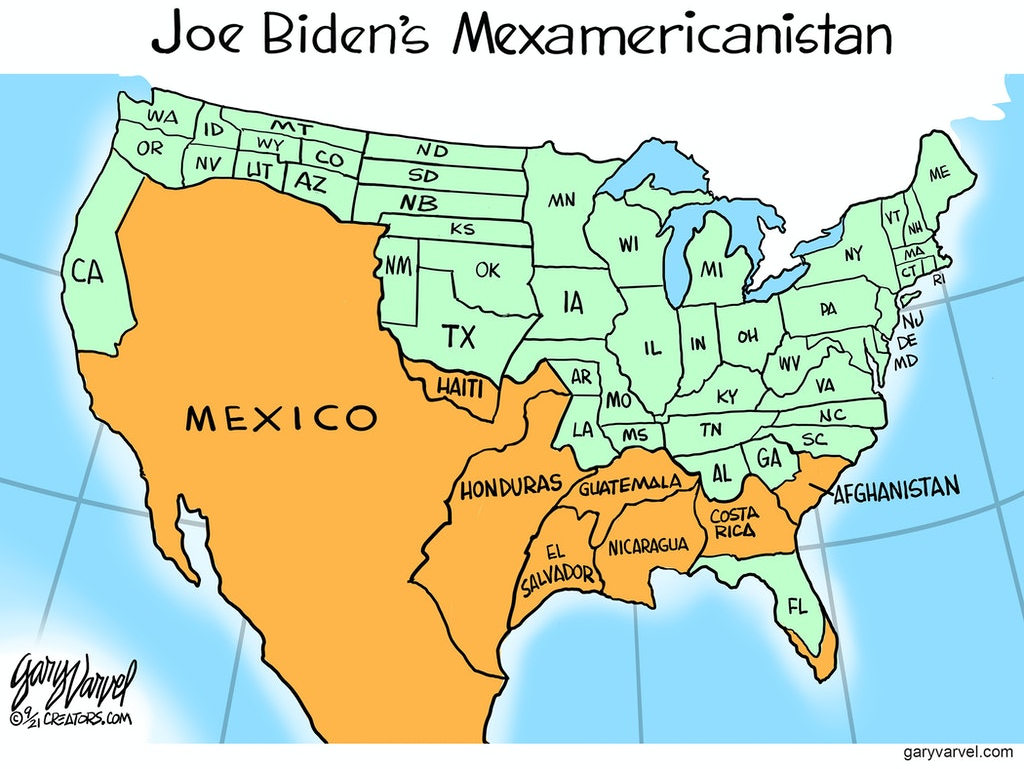
And once again Team Biden acts to divide and destroy anything they touch.  How prescient was I when creating this image a year ago.


Biden Has the Destructive Touch

Victor Davis Hanson explains in his American Greatness article The Drossy Touch of Joe Biden.  Excerpts in italics with my bolds and images.

A cognitively challenged Biden is pulled in every direction, by left-wing politicos collecting their debts,
by his own spite, by his trademark narcissism, and by his hatred of all things Trump.

Almost everything Joe Biden has touched since entering office has turned to dross. None of his blame-gaming, none of his distortions, none of his fantasies and unreality can mask that truth.  

The Afghan Catastrophe

Seven months ago, Afghanistan was relatively quiet—with about 10,000 vestigial NATO troops, including 2,500 Americans, anchored by the Bagram Airfield. They were able to provide air superiority for the coalition and Afghan national army. With air power, NATO forces, if and when they so wished, could have very slowly and gradually withdrawn all its remnant troops—but only after a prior departure of all American and European civilians, coalition contractors, and allied Afghans.

The transient calm abruptly imploded as soon as Joe Biden recklessly yanked all U.S. troops out in a matter of days. Many left in the dead of night, leaving no one to protect contractors, dependents, diplomats, and Afghan allies. In Biden’s world, civilians protect the last Western enclave while soldiers flee.

Three weeks ago, Joe Biden and a woke and politicized Pentagon were assuring us that Afghanistan was “stable.” Now the country is reverting to its accustomed premodern, theocratic, and medieval chaos. It will likely soon reopen as the world’s pre-9/11-style terrorist haven—an arms mart of over $50 billion in abandoned U.S. military equipment. Thanks to the president of the United States, terrorists and nation-state enemies can now shop for arms and train there without hindrance.

The NATO coalition-builder Biden also dry-gulched his European allies, whose soldiers outnumbered our own. The humanitarian “good ole Joe from Scranton” deprecated the thousands of Afghan military dead who had helped the Americans. The families of the American fallen and wounded of two decades were all but told by Biden that the catastrophe in Kabul was inevitable—no other way out but chaos and dishonor.

Why did he not tell us that earlier, when he was vice president, so many dead and wounded ago?

“Get over it,” was Biden’s messaging subtext. If Americans want to hear the blame game, he told us to scapegoat Barack Obama, or all prior presidents, or especially Donald Trump, or the intelligence services and military, or the Afghan army, or we naïfs who somehow think things are a mess right now in Kabul—or anything and everyone but Joe Biden.

The Inflation Fiasco

In January, Biden inherited a rebounding economy that was fueled by $1 trillion in stimulatory federal red ink. Given natural pent-up consumer demand, why did Biden need to print yet another $1 trillion, seek to green-light another $2 trillion for “infrastructure,” and raise even higher unemployment compensation to the point of discouraging employees from returning to work?

At the same time, he has alarmed employers with braggadocio threats that higher capital gains, income, payroll, and estate taxes are all on the way. More lockdowns only further eroded small businesses. The result was price inflation of all the stuff of life—homes, lumber, gas, food, appliances—as well as historic shortages of everything from cars and houses to the work of contractors and electricians. Any increase in wages due to labor shortages was soon erased by spirals in the consumer price index.

So, what was Biden thinking or, rather, not thinking? By paying workers not to work he would be evening out the ancient score with employers? Did workers need a vacation from the quarantine? Printing money was a way to spread the wealth—and diminish what the rich possessed? Was a $2 trillion deficit and $30 trillion in aggregate debt a way of bragging to Trump that he doubled the Trump red ink in less than a year? Would he pile up more debt than both Barack Obama and George W. Bush in half the time?

The Border Disaster

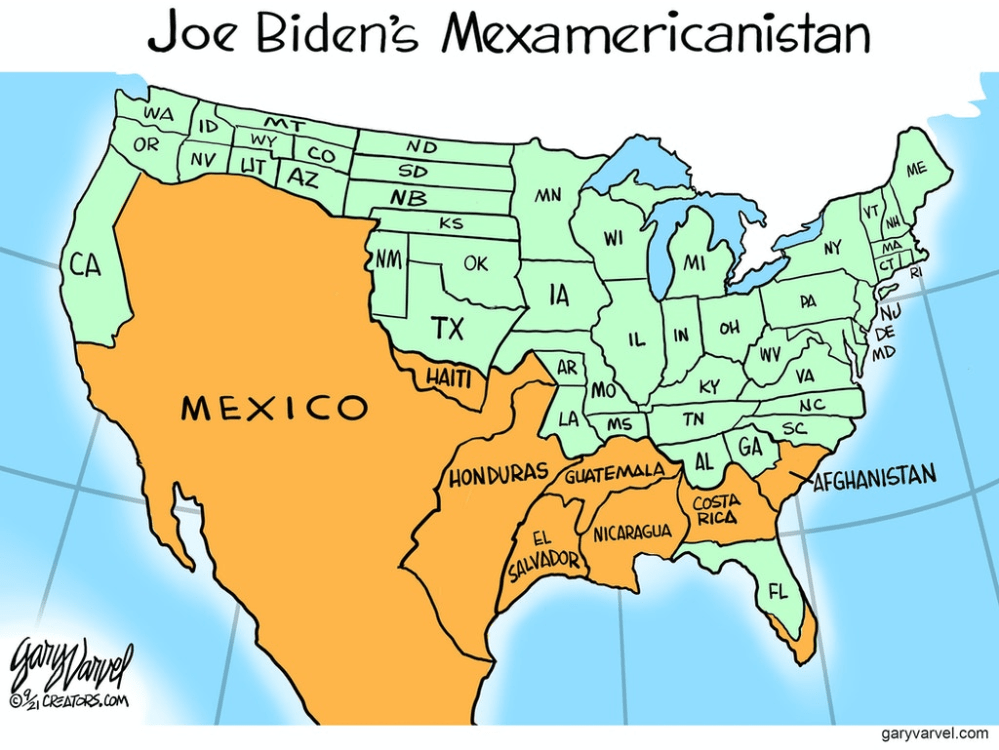
Biden took a secure border, along with increasingly legal-only immigration, and then destroyed both. He stopped construction of the border wall, encouraged an expected 2 million illegal entries over the current fiscal year, promised amnesties, and resumed “catch and release.” He did all that at a time of a pandemic, exempting illegal aliens from all the requirements of COVID testing and mass vaccinations that he had hectored his own citizens about getting. With planned mass amnesties and millions more invited to cross illegally in the next three years, was Biden seeking to found a new American nation within the now passé old American nation?

Did he believe that Americans did not deserve their citizenship and newcomers from south of the border were somehow more worthy? Did he see the 2 million new residents as instant voters under new relaxed rules of balloting? Did he think in a labor-deprived economy they would supply nannies, gardeners, and cooks to bicoastal elites? We strain to imagine any explanation because there is no logic to any.

Energy Insufficiency

Biden did his best in just seven months to explode the idea of American self-sufficiency in natural gas and oil. He canceled the Keystone Pipeline, froze new federal energy leases, put the Anwar oil field off limits, and warned frackers their end days were near.

So, what drove Biden? Did he object that motorists were saving too many billions of dollars per year in decreased commuting costs? Or was the rub that we had slashed too many imports of oil from the volatile Middle East and no longer would launch preemptive wars? Or perhaps the transition to clean natural gas instead of coal as a fuel for power generation had too radically curtailed carbon emissions? Did Biden feel that Middle East producers, the Russians, or the Venezuelans could better protect the planet while extracting oil and gas than could American drillers?

The Race Calamity

Biden blew up race relations by greenlighting the new hunt for the mythical “whiteness” monster. Were a few buffoonish white rioters who stormed the Capitol the tip of the spear of a previously unknown massive white supremacy movement, the most dangerous, he swore, since the Civil War?

Biden took affirmative action and the Civil Rights-era “disparate impact” and “proportional representation” ideas and turned them into disproportionate representation and reparations on the cheap. Biden made it acceptable to damn “whiteness,” as if all 230 million white Americans are guilty of something or other in a way that the other 100 million “nonwhite” are not.

The Crime Explosion

After Biden entered office, violent crimes ignited from the embers of the 120 days of mostly unpunished looting, arson, and organized violence in the streets of America’s major cities during summer 2020. Under Biden, jails were emptied. Federal attorneys and emulative local DAs exempted offenders. Police were defamed and defunded. Punishing crime was considered a racist construct.

The result is that Americans now avoid the Dodge City downtowns of most of America’s crime-ridden blue cities. They accept that any urban pedestrian, any driver after hours, any commuter on a bus or subway can be assaulted, robbed, beaten, raped, or shot—without any assurance that the media will fairly report the crime, or that the criminal justice system will punish the perpetrators. In Biden’s America looters prance into drug stores and walk out with shopping bags of stuff, under the terrified gaze of security guards who guesstimate at least they did not steal more than $950 of loot.

So why does Biden so willfully exercise this destructive touch that blows up anything he taps?

There are several possible theories:

1) Biden is non compos mentis. He has no idea of what he is doing. But to the degree he is alert, Biden listens—sort of—only to the last person with whom he talks. And then he takes a nap. When Afghanistan blows up or inflation roars or the border becomes an entry door, his eyes open, and he becomes bewildered and snarly—like an irritable and snappy Bruce Dern waking up in “Once Upon a Time in Hollywood.”

Biden has no clue about the actual destructive implementation of his toxic policies, and no concern upon whom these destructive agendas fall. He vaguely assumes a lapdog left-wing media will repackage every Biden incoherence as Periclean, and every daily “lid” as Biden’s escape for presidential research, deep reading, and intensive deliberation. Biden appears to be about where Woodrow Wilson was in November 1919.

2) Or is Biden a rank opportunist and thinking he will ride woke leftism as the country’s new trajectory? He resents his prior subservience to Obama, and now feels he can trump past signature leftist administrations as the one true and only socialist evolutionary. He is not so much the manipulated as the manipulator.

Biden fantasizes himself as a hands-on dynamic leader who bites at reporters, snaps from the podium, and issues his customary interjections. He is therefore “in command” for four or five hours a day. He enjoys acting more radical than Elizabeth Warren, Kamala Harris, Bernie Sanders, or “the squad.”—and especially being far more leftwing than his old and now passé boss Barack Obama. Joe is in control and that explains the dross touch. For the first time in his life, such an incompetent has complete freedom—to be powerfully incompetent. Biden is then not demented as much as delusionally running things.

3) Biden is unfortunately what he always was: a rather mean-spirited plagiarist, liar, and nihilist, from his Clarence Thomas character assassination infamy and Tara Reade groping to his foul racist talk and his monumental habitual grifting. His disasters are the same old, same old Biden trademark, performance-art screw-ups.

Biden likes the idea of conservative outrage, of chaos, of barking at everyone all the time. Biden accepts that no omelets can be made without broken eggs, and sort of enjoys screwing up things, as Robert Gates and Barack Obama both warned. “Wokening” the Joint Chiefs of Staff, encouraging hundreds of thousands to pour across the border, and abandoning our NATO allies in Afghanistan—who cares when tough guy, brash-talking Joe on the move jumbles stuff up? The disasters in the economy, foreign policy, crime, energy, and racial relations? Biden is just shaking things up, stirring the pot, baiting people to watch Mr. “Come On, Man” in action, as he blusters and preens and leaves a trail of destruction in his wake.

4) Biden is nothing much at all. He’s just a cardboard-cut out, a garden-variety Democratic Party hack, who is against anything conservatives are for. He assumes he will undo all that Trump did, on the theory it is simple and easy for him in his lazy, senior moments. And he is tired anyway of thinking much beyond such Pavlovian rejectionism. A closed border is bad; presto, open borders are good. Improving race relations is bad; deteriorating relations must be good. Energy independence bad; dependency good. Biden works on autopilot in his minimalist day job: just cancel anything that Trump did and worry nothing about the effects on the American people

5) Biden is a hostage of both the Left and Hunter Biden. His task is to ram down a hard Left agenda, in the fashion of a torpedo that itself blows up when it hits the target. The Left ensured the base would not bolt in 2020. So, he owes them. Biden, more or less, signed his presidency over to the squad, Nancy Pelosi, Bernie Sanders, and the Obama holdovers. They hand him a script; he tries to read it; and they follow up with the details. He is the old “Star Trek’s” tottering John Gill.

The Left may hope their own nihilist agenda sort of works. When it inevitably does not, then Joe, the delivery man, is blamed: so much more quickly, then, will be Biden’s necessary exit. They kept their part of the bargain by getting the basement denizen elected. Now he keeps the deal by handing over the presidency. Biden’s utility had about a six-month shelf life.

Now ever so slowly the leaks, the West Wing backstabbing, the furrowed anchor brows, and the unnamed sources will gently ease him out with 25th Amendment worries (e.g., “Perhaps President Biden might find taking the Montreal Cognitive Assessment of some value after all, for his own benefit, of course.”) Kamala Harris is not so inert as we are led to believe.

A cognitively challenged Biden then is pulled in every direction, by his own senility, by left-wing politicos collecting their debts, by his own spite, by his trademark narcissism, and by his neanderthal hatred of everything Trump was and did.

The problem for America is that theories one through five are not always mutually exclusive, but more likely force multipliers of the present insanity. At some point, some brave congressional representative or Senator will finally have to say to Biden, in the spirit of Oliver Cromwell and Leo Amery:

“You have sat too long here for any good you have been doing. Depart, I say, and let us have done with you. In the name of God, go!”