Watching this video is tricky, perhaps because it is MP4, and its original language is not english. What works for me is to click on the center arrow and then when it starts click on the youtube icon lower right. After the ads the video will play. It the language is not english click on the CC and/or settings buttons to get english audio and captions. The video has impressive imagery and is well worth watching. Below I provide a transcript with my bolds and some added exhibits on topics discussed. The title is Will the Ice Age Return? Milankovitch Cycles.
20,000 years ago, our planet looked completely different. Over the place where New York, Chicago and Berlin stand today, there were ice mountains several kilometers thick. Almost all of Canada was buried under an ice shield, which was taller than the highest mountains in Europe.

A huge glacier covered Scandinavia and descended on the plains of Eastern Europe, and its edge was not so far from present-day Moscow. The sea level was 120 meters below the present-day sea level, because a huge part of the planet’s water was trapped in the ice. Great Britain was connected to the mainland by a land bridge, and it was possible to get from Asia to America on foot. Mammoths, woolly rhinoceros and cave lions roamed the cold steppes. And then, in about 10,000 years, all this ice melted. And this is not a single case.

Over the last million years, glaciers have come and gone more than 10 times, as if the planet was breathing. What makes the Earth’s climate change so rapidly? Why do glacial periods come and go with amazing regularity, as if according to a schedule? The answer is hidden in space, in the slow fluctuations of the Earth’s orbit. Today we will find out what the Milankovitch cycles are and how tiny changes in the movement of our planet can bury half of the continent under the ice.

Let’s start with an important clarification that amazes many. Strictly speaking, we live right now in the Ice Age. Scientists call the Ice Age any period when there are large permanent ice shields on the planet. And we have them in Antarctica and Greenland. The current Ice Age began about 2.6 million years ago. Cold periods alternate inside it, when glaciers grow on huge territories. They are called glacial periods or glaciation. And warmer periods between them, interglacial periods. Now we live in one of these warm periods, which began about 11,700 years ago.

All human civilization, from the first earthlings to smartphones, arose within this short warm pause. But why did the Ice Age even begin, if orbital cycles have always existed? The role of continents is important here. For millions of years, they drift slowly along the planet’s surface, and their location determines how ocean currents flow and where ice can accumulate. When Antarctica separated from South America and Australia, a powerful ring current closed around it, which cut off the continent from warm waters, and there began to grow an ice shield. And about 3 million years ago, the Panama Strait rose, connecting North and South America. This rebuilt the Atlantic flow.

In addition, the content of carbon dioxide in the atmosphere gradually decreased. All together, it prepared a scene on which orbital cycles could start their game. And in the very distant past, hundreds of millions of years ago, the Earth, according to many geologists, could almost entirely be covered with ice, turning into a giant snow cone.
200 years ago, people did not even suspect that once Europe was covered with glaciers. Scientists identified huge boulders lying in the middle of the fields, far from the mountains, from the rocks that are not found in this area. They were called erotic, that is, wandering boulders. How did they get here? For a long time, it was believed that they were brought by a worldwide flood.
But in the 1830s, the Swiss naturalist Louis Agassiz, who studied the Alpine glaciers, proposed a bold idea. Once the glaciers were much larger and covered a significant part of Europe. It was they who, crawling slowly, dragged giant stones on themselves, and then, melting, left them in the middle of the fields. At first, people laughed at him, but the evidence was accumulating, and soon it became clear that the Earth really went through a glacial period. Later it turned out that not one, but many.

A natural question arose. Why? What could have cooled the whole planet so much, and then warmed it again? The first guesses that the cause was in space appeared in the 19th century. French mathematician Joseph Adhemar assumed that it was a matter of slow change of the position of the Earth’s axis. And then a man with an amazing fate took up this task. A Scottishman, James Crowell. He almost did not receive a formal education. He worked as a carpenter, insurance agent and tea seller. And then he became a watchman in a museum and a college in Glasgow. The main advantage of this modest position was the access to a wonderful scientific library. In the evenings, Crowell studied physics and astronomy. And in the 1860s he published a theory connecting glacial periods with changes in the Earth’s orbit. His works were so deep that a watchman without a diploma was elected a member of the Royal Society of London.
But Crowell’s theory gave incorrect predictions of the date of glaciation, and over time it was rejected. A real breakthrough was made by the Serbian scientist Milutin Milankovic. He was born in 1879 in the town of Dal on the Danube coast. He studied in Vienna as a construction engineer and worked as a bridge and dam designer using a new material at the time, reinforced concrete. But he was fascinated by a much more grandiose task. He decided to calculate how much sunlight each point of the Earth received at any time in hundreds of thousands of years.
According to his own words, he wanted to create a mathematical theory of the climate of the entire planet. Without computers, without calculators, only with a pencil, paper and logarithmic tables. The most amazing thing is that Milankovic did a significant part of this work as a prisoner of war. When the First World War began in 1914, he spent his honeymoon in his hometown, on the territory of then-Austria-Hungary. As a subject of Novo-Serbia, he was arrested and interned. But the scientist was lucky.
Thanks to his colleagues, he was released to Budapest, where he was allowed to work in the library of the Hungarian Academy of Sciences. Later, Milankovic recalled that these were some of the most productive years of his life. He sat among the books and counted. Counted. Counted. The calculations that a computer does today in a fraction of a second took him months and years.

To understand what exactly he was calculating, let’s first understand how our planet moves. We are used to thinking that the Earth rotates around the Sun in an unchanging way, and its axis is always inclined in the same way. But in fact, the Earth is not alone in the solar system. The attraction of the Moon, the Sun and other planets, especially the giants Jupiter and Saturn, is constantly acting on it. These forces are very small, but they act continuously for millions of years. And under their influence, the orbit and the Earth’s axis change slowly and smoothly.

Milankovic highlighted three major such changes, which today are called Milankovic cycles. The first cycle is the change in the orbit shape. The Earth rotates around the Sun not in an ideal circle, but in a slightly elongated ellipse. Now this elongation is very small. If you draw the Earth’s orbit on a sheet of paper on a large scale, you will not distinguish it from a circle. And yet, the distance to the Sun during the year changes by about 5 million kilometers.

Amazingly, but we are closest to the Sun in early January, in the middle of the northern winter, and further in early July. Because of this difference, the Earth in January receives about 6-7% more sunlight than in July. But the attraction of Jupiter and Saturn slightly changes the orbit shape. It either becomes almost perfectly round, or stretches out stronger than it is now. The full cycle of these changes lasts about 100,000 years. And there is an even longer cycle, about 405,000 years. When the orbit is strongly elongated, the difference between the nearest and farthest point becomes much larger, and the amount of light received during the year fluctuates more.

The second cycle is related to the tilt of the Earth’s axis. It is the tilt of the axis that creates the change of seasons. When the northern hemisphere is tilted to the Sun, we have summer. The sun’s rays fall steeper, and the day is longer. When it is tilted from the Sun, it is winter. Now the Earth’s axis is tilted by about 23.4 degrees. But this angle is not constant. In about 41,000 years, it smoothly changes from 22 to 24.5 degrees and back. It seems that the difference is only 2.5 degrees. A trifle.
But when the tilt is higher, the seasons become more contrasting. Summer is hotter, winter is colder. And when the tilt is lower, summer becomes cooler. And, as we will see soon, this is the most important thing for glaciers. Now the tilt of the Earth’s axis is gradually decreasing. Here we should say thank you to our Moon. It is very large compared to the Earth. And its attraction works as a stabilizer, keeping the tilt of the axis within narrow limits.
Look at our neighbor, Mars. It has only two small moons that look like potatoes. And they cannot stabilize its axis. Calculations show that the tilt of the axis of Mars over millions of years changes chaotically within huge limits, from almost vertical to very steep. Because of this, the climate of Mars has undergone much more dramatic changes than that of the Earth. Polar hats could move closer to the equator. Without the Moon, our planet would have a similar climatic mess. And, perhaps, it would be much more difficult for a complex life to live on it.

The third cycle is the most tricky. It is called the precession. Imagine a spinning top. When it rotates, its axis does not stand still, but slowly describes a circle. The Earth behaves in exactly the same way. Its axis rotates slowly, and the full rotation takes about 26,000 years. Because of this, even the polar star changes. Now the Earth’s axis indicates almost exactly the polar star. But about 5,000 years ago, during the construction of the Egyptian pyramids, the polar star was the star Tuban in the constellation of the dragon. And about 12,000 years later, the axis will indicate not far from the bright Vega.

But another thing is important for the climate. The precession changes the time of the year when the Earth is closest to the Sun. Now the closest position is the northern winter. This slightly softens the climate of the northern hemisphere. In winter we are a little closer to the Sun, and in summer a little further. But this was not always the case. About 11,000 years ago, on the contrary, the Earth was closest to the Sun in the midst of the northern summer. Summer in the northern hemisphere was hotter, and winter was colder. Taking into account the slow rotation of the orbit itself, such a change occurs on average every 20,000 to 23,000 years.
So, three cycles. The shape of the orbit is about 100,000 years. The slope of the axis is about 41,000 years. The precession is about 20,000 years. Each of them separately changes the climate quite a bit.
But they overlap each other like waves of different lengths. Sometimes they fade away from each other, and sometimes they overlap. And then the changes become significant.
Milankovitch calculated that the amount of sunlight that high latitudes receive in the summer due to these cycles can change by about 10% or more. And here comes the most interesting part. Why do these changes cause glacial periods at all? Milankovitch’s key idea turned out to be unexpected. Many people thought that glacial periods occur due to particularly cold winters. But Milankovitch, following the climatologist Vladimir Köppen, realized that it’s all about the summer.
In the winter, in the high latitudes of the northern hemisphere, in Canada, Scandinavia, Siberia, snow always falls. It’s dark and cold here. And this happens at any orbit. The main question is whether this snow will melt in the summer. If the summer is warm enough, the snow melts and everything starts again. But if the summer is cool, some of the snow overcomes it. The next year, a new layer is laid on top. Then another one.
The snow thickens, turns into fir, and then into ice.
Year after year, century after century, the glacier grows.
Why the northern hemisphere? Because there is much more land there. Look at the globe. Eurasia and North America spread around the northern pole. And around the southern pole, mostly the ocean, if we don’t count Antarctica itself. The land warms up and cools down quickly. And the water is slow. It works like a huge thermal battery and softens the climate. Therefore, on huge northern continents, glaciers have a place to grow.
Milankovitch believed that the amount of summer sun at a latitude of about 65 degrees of the northern latitude was especially important. This is about the width of the Northern Polar Circle, Iceland, Northern Sweden and the Archangel. It was there, in his opinion, that the fate of the glacial periods was decided. But even 10% of the change in the summer light is not enough to cover half of the continent with ice.
This is where the reverse connections come into play, which multiply the initial impetus. The main one is related to the color of the ice. Dark land, forest or ocean absorb most of the sunlight and warm up. And white snow and ice reflect most of it back into space. This is called albedo. It turns out a closed circle. It got a little colder. More snow appeared. More light is reflected. It gets even colder. Even more snow. So a small cooling starts an avalanche. And when the summer gets warmer again, the mechanism works in the opposite direction. The ice melts. Dark land is exposed. It absorbs more heat. And the melting speeds up.
In 1941, when the German troops entered Belgrade, Milankovitch completed the main work of his life.
The book, which is briefly called The Canon of Earth Insulation. It summed up 30 years of calculations. According to the stories, the book was published literally on the eve of the bombing of Belgrade in April 1941. And the typography soon suffered from the raids.
But the scientific world almost did not notice it. To prove the theory, it was necessary to have accurate data about when exactly the glaciation occurred. And there was none. Moreover, in the 1950s, new dating methods seemed to refute Milankovitch’s calculations. Many scientists decided that his theory was a beautiful, but erroneous mathematical game. Milankovitch died in 1958, never finding out that he was right.
The evidence came from the bottom of the ocean. In the 1970s, scientists began to study long cores of bottom deposits, which accumulated layer by layer for millions of years. These layers contained the shells of microscopic marine organisms, called foraminifera. The chemical composition of their shells depends on how much water was trapped in the glaciers and what was the ocean temperature. Measuring the ratio of different forms of oxygen in the shells, scientists were able to restore the history of glacial periods for hundreds of thousands of years ago.

In 1976, three researchers, James Hayes, John Imbrie and Nicholas Shackleton, published a famous article with the saying Earth’s orbit oscillation, setting the rhythm of glacial periods. They decomposed the climatic history into components and found in it exactly those cycles that Milankovitch predicted, about 100,000, 41,000 and about 20,000 years. The theory of the Serbian engineer was brilliantly confirmed.
Another important confirmation came from Antarctica, and it couldn’t be done without our country. At the Soviet, and then Russian, station Vostok, in one of the coldest places on Earth, where the temperature is below minus 89 degrees, scientists have been drilling glacial shields for decades. They raised the ice core more than 3.5 km long. Ice in Antarctica is formed from snow, which accumulates in layers, and tiny bubbles of ancient air remain in each layer. This is a real time machine. The analysis showed the history of the climate over the last 400,000 years. Four full glacial cycles.

Later, the European project drilled ice in the other part of Antarctica and extended this chronicle to 800,000 years. Also, under the station Vostok, at a depth of almost 4 km, there is a huge underwater lake with liquid water, which has been isolated from the outside world for millions of years. In 2012, Russian researchers drilled ice to its surface for the first time.

Bubbles of ancient air told another important thing. With the temperature, the content of carbon dioxide in the atmosphere changed. During the glaciation, it was about 180 parts per million, and in warm interglacial regions, about 280. Temperature and carbon dioxide rose and fell almost synchronously. Orbital cycles give the initial push. The ocean absorbs more carbon dioxide during the glaciation. The greenhouse effect weakens and becomes even colder.
During warming, everything goes the other way around. Thus, the cosmic signal, which is many times enhanced by ice, the ocean and the atmosphere, turns into a change of entire climatic eras. If you look at the temperature chart for the last half a million years, you see a strange shape, similar to the teeth of a saw. The glaciation goes slowly, unevenly, for tens of thousands of years. Glaciers grow gradually, with recesses and pauses. But warming occurs rapidly.

Huge ice shields, which have accumulated for almost 100,000 years, melt in just a few thousand years. This is explained by the fact that it is easier to destroy than to build. The melting ice launches many processes, which accelerate each other, from the darkening of the surface to the rise of the sea level, washing up the edge of the glaciers.
However, the climate does not always change smoothly. About 12,900 years ago, when the last glaciation was already retreating and the planet was warming, the cold suddenly returned in the Northern Hemisphere. In just a few decades, the temperature in Europe and Greenland dropped almost to glacial values, and such a cooling lasted for about a thousand years.

This episode was called the Younger Dryas, in honor of a small arctic flower called Dryades, whose pollen suddenly reappeared in the deposits. The most popular version connects it with the fact that a huge amount of lukewarm water from the North American glacial lakes flowed into the Atlantic and disrupted warm ocean currents.
This shows that orbital cycles set the general rhythm,
but the climatic system itself can present sharp surprises.
But the theory of Milankovitch also has riddles that scientists are still fighting over. The most famous of them is called the problem of 100,000 years. The fact is that about a million years ago, the glacial periods changed basically every 41,000 years in the rhythm of the axis slope. And then, without any noticeable changes in the orbit, the rhythm suddenly changed, and the glaciation became longer, more powerful, and began to repeat about every 100,000 years. This coincides with the cycle of the orbit, but here’s the problem. This cycle changes the total amount of sunlight least of all.
Why did it suddenly become the main one? Perhaps the ice shields became so large that they learned to survive the weak warm periods. Perhaps the soil under the glaciers changed, or the amount of How did the glacial periods affect people? Very much. Our ancestors survived the last glaciation, adapting to harsh conditions. It was in this era that the famous cave paintings with mammoths and bison appeared.

Due to the low sea level, people were able to cross the land bridge from Siberia to Alaska and settle in America. Many islands were connected to the mainland, and on the site of the present North Sea a vast plain was spread out, which scientists called Doggerland, where people hunted and fished. Fishermen still sometimes pull out the bones of mammoths and ancient tools from the bottom of the sea.
When the glaciers melted, the ocean rose and flooded
these lands, and the warmer and more stable climate
allowed people to move to agriculture.
It is interesting that Milankovitch left a mark not only in science, but also in climate. In 1923, he proposed a reform of the Julian calendar, which was more accurate than even the Gregorian calendar. It was called the New Julian calendar, and some Orthodox churches took it for the calculation of immobile holidays. His name is carried by a crater on the Moon, a crater on Mars and an asteroid, and his portrait for some time adorned the Serbian banknote. Such a modest engineer, who thought with a pencil, became one of the most famous scientists of his country.
And now the main question. When will the next glacial period come? If you look only at the cycles of Milankovitch, then our era turned out to be unusual. Now the Earth’s orbit is almost round, and in the next tens of thousands of years it will become even rounder. This means that the difference in the number of summer suns will be small and it will be difficult for glaciers to begin to grow.
According to the calculations of many climatologists, the current interglacial period could last for a very long time maybe tens of thousands of years. And with the current level of carbon dioxide in the atmosphere, which is already much higher than it has ever been in the last hundreds of thousands of years, many researchers believe that the next glacial period may be postponed even further.
So in the near future, mammoths may not return. The history of the cycles of Milankovitch is a story about how everything in our world is connected. The attraction of distant Jupiter and Saturn slightly pulls out the Earth’s orbit. The slope of the axis changes by a couple of degrees. The axis slowly describes the circle, like a top. These imperceptible changes decide whether the snow in Canada and Scandinavia will melt in the summer. And this, in turn, determines whether there will be ice mountains in the place of today’s cities and where the shores of the seas will pass. We live on a small planet that is slowly rocking in space. And its climate is the result of a subtle space dance. And all of humanity arose in a short warm pause between glaciation.
Addendum
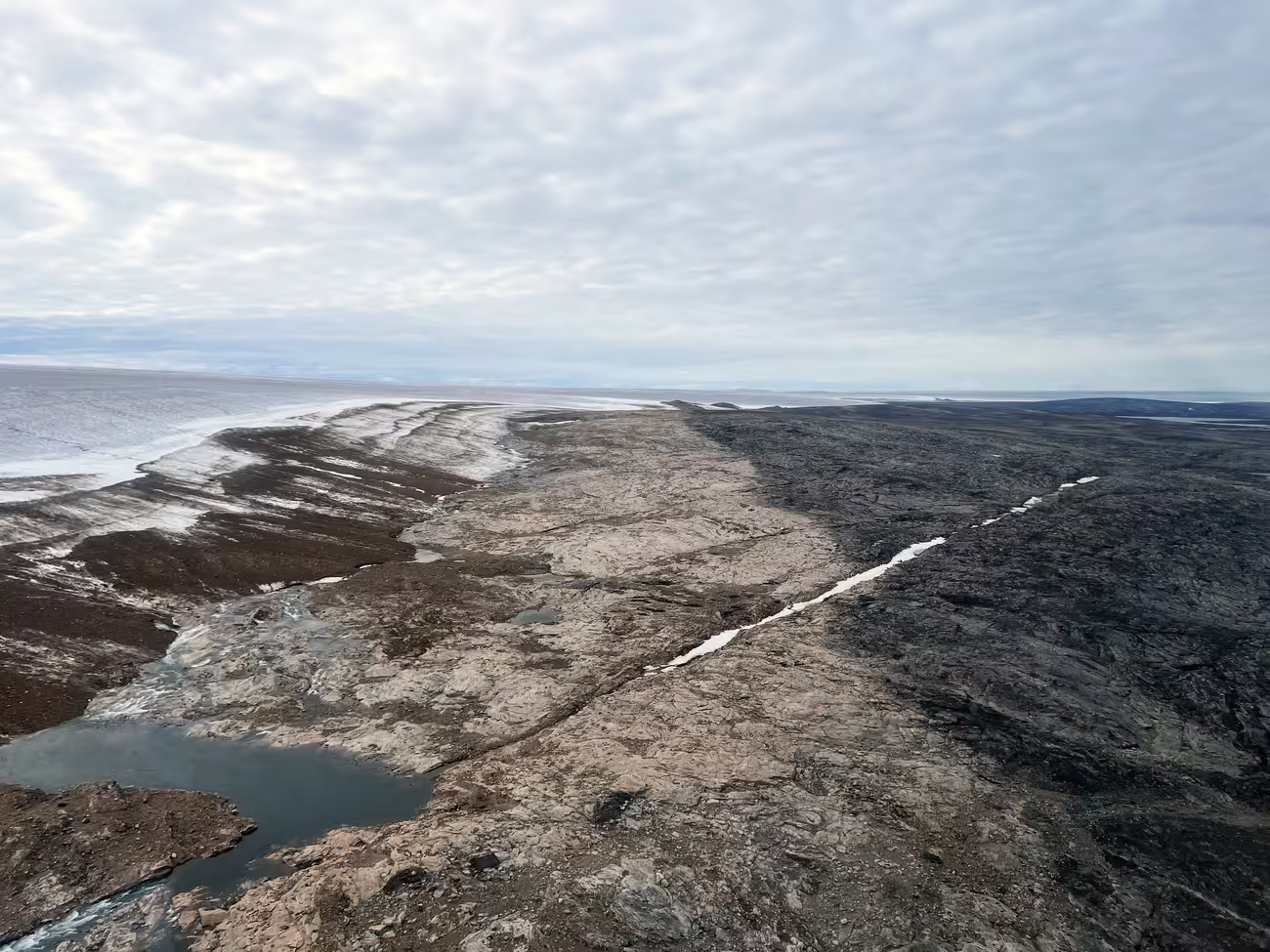
The end of a glaciation. The last vestige of the Laurentide sheet still survives as the Barnes Ice Cap, now a Delaware-sized ice cap located on central Baffin Island in the Canadian territory of Nunavut. Prominent trimline marks the 1960 extent of the Barnes Ice Cap. The dark colored landscape hosts mature vegetation and lichen cover, whereas the light-colored rock is vegetation free. Ice margin retreat from this trimline has reversed ~2,000 years of ice margin expansion. Credit: Nicolás Young
Its disappearance could change the dynamics of future glaciations and ice ages. The Laurentide served as a glacial nucleation point when Earth’s climate cooled, as its frigid mass created self-sustaining feedbacks that caused more ice to grow on it. Scientists can’t say when the next glaciation might occur in a world with elevated greenhouse gas concentrations. But if continental ice sheets eventually begin growing again, they may have to do so without the last surviving remnant of the Laurentide.
My Summary
From Earth’s ever changing climate history, we learn three things:
♦ Earth switches between greenhouse and ice house periods without any help from humans.
♦ The freezing is bad and the warming is good.
♦ The hypothetical warming from CO2 would be a good thing.
Thanks for this comprehensive summary, Ron.
Although big rocks found in fields far from glaciers might be sexy, I’m sure they’re erratic, rather than erotic!