Updated: Fears and Facts about Reservoirs and GHGs
 

A previous post explained how methane has been hyped in support of climate alarmism/activism. Now we have an additional campaign to disparage hydropower because of methane emissions from dam reservoirs. File this under “They have no shame.” Excerpts below with my bolds.

On March 5, 2018 a study was published in Environmental Research Letters Greenhouse gas emissions of hydropower in the Mekong River Basin can exceed those of fossil fuel energy sources

“The hydropower related emissions started in the Mekong in mid-1960’s when the first large reservoir was built in Thailand, and the emissions increased considerably in early 2000’s when hydropower development became more intensive. Currently the emissions are estimated to be around 15 million tonnes of CO2e per year, which is more than total emissions of all sectors in Lao PDR in year 2013,” says Dr Timo Räsänen who led the study. The GHG emissions are expected to increase when more hydropower is built. However, if construction of new reservoirs is halted, the emissions will decline slowly in time.

Another recent example of the claim is from Asia Times Global hydropower boom will add to climate change

The study, published in BioScience, looked at the carbon dioxide (CO2), methane (CH4), and nitrous oxide (N2O) emitted from 267 reservoirs across six continents. In total, the reservoirs studied have a surface area of more than 77,287 square kilometers (29,841 square miles). That’s equivalent to about a quarter of the surface area of all reservoirs in the world, which together cover 305,723 sq km – roughly the combined size of the United Kingdom and Ireland.

“The new study confirms that reservoirs are major emitters of methane, a particularly aggressive greenhouse gas,” said Kate Horner, Executive Director of International Rivers, adding that hydropower dams “can no longer be considered a clean and green source of electricity.”

In fact, methane’s effect is 86 times greater than that of CO2 when considered on this two-decade timescale. Importantly, the study found that methane is responsible for 90% of the global warming impact of reservoir emissions over 20 years.

Alarmists are Wrong about Hydropower

Now CH4 is proclaimed the primary culprit held against hydropower. As usual, there is a kernel of truth buried beneath this obsessive campaign: Flooding of biomass does result in decomposition accompanied by some release of CH4 and CO2. From HydroQuebec:  Greenhouse gas emissions and reservoirs

Impoundment of hydroelectric reservoirs induces decomposition of a small fraction of the flooded biomass (forests, peatlands and other soil types) and an increase in the aquatic wildlife and vegetation in the reservoir.

The result is higher greenhouse gas (GHG) emissions after impoundment, mainly CO2 (carbon dioxide) and a small amount of CH4 (methane).

However, these emissions are temporary and peak two to four years after the reservoir is filled.

During the ensuing decade, CO2 emissions gradually diminish and return to the levels given off by neighboring lakes and rivers.

Hydropower generation, on average, emits 50 times less GHGs than a natural gas generating station and about 70 times less than a coal-fired generating station.

The Facts about Tropical Reservoirs

Activists estimate Methane emissions from dams and reservoirs across the planet, including hydropower, are estimated to be significantly larger than previously thought, approximately equal to 1 gigaton per year.

Activists also claim that dams in boreal regions like Quebec are not the problem, but tropical reservoirs are a big threat to the climate. Contradicting that is an intensive study of Brazilian dams and reservoirsGreenhouse Gas Emissions from Reservoirs: Studying the Issue in Brazil
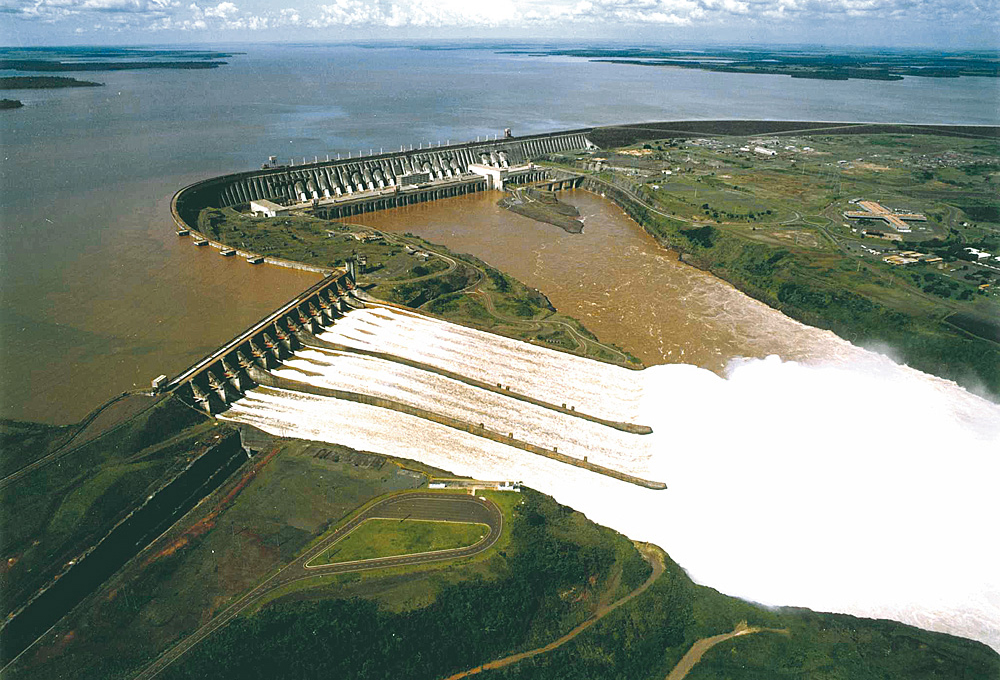
The Itaipu Dam is a hydroelectric dam on the Paraná River located on the border between Brazil and Paraguay. The name “Itaipu” was taken from an isle that existed near the construction site. In the Guarani language, Itaipu means “the sound of a stone”. The American composer Philip Glass has also written a symphonic cantata named Itaipu, in honour of the structure.

Five Conclusions from Studying Brazilian Reservoirs

1) The budget approach is essential for a proper grasp of the processes going on in reservoirs. This approach involves taking into account the ways in which the system exchanged GHGs with the atmosphere before the reservoir was flooded. Older studies measured only the emissions of GHG from the reservoir surface or, more recently, from downstream de-gassing. But without the measurement of the inputs of carbon to the system, no conclusions can be drawn from surface measurements alone.

2) When you consider the total budgets, most reservoirs acted as sinks of carbon in the short run (our measurements covered one year in each reservoir). In other words, they received more carbon than they exported to the atmosphere and to downstream.

3) Smaller reservoirs are more efficient as carbon traps than the larger ones.

4) As for the GHG impact, in order to determine it, we should add the methane (CH4) emissions to the fraction of carbon dioxide (CO2) emissions which comes from the flooded biomass and organic carbon in the flooded (terrestrial) soil. The other CO2 emissions, arising from the respiration of aquatic organisms or from the decomposition of terrestrial detritus that flows into the reservoir (including domestic sewage), are not impacts of the reservoir. From this sum, we should deduct the amount of carbon that is stored in the sediment and which will be kept there for at least the life of the reservoir (usually more than 80 years). This “stored carbon” ranges from as little as 2 percent of the total carbon output to more than 25 percent, depending on the reservoirs.

5) When we assess the GHG impacts following the guidelines just described, all of FURNAS’s reservoirs have lower emissions than the cleanest European oil plant. The worst case – Manso, which was sampled only three years after the impoundment, and therefore in a time in which the contribution from the flooded biomass was still very significant – emitted about half as much carbon dioxide equivalents (CO2 eq) as the average oil plant from the United States (CO2 eq is a metric measure used to compare the emissions from various greenhouse gases based upon their global warming potential, GWP. CO2 eq for a gas is derived by multiplying the tons of the gas by the associated GWP.) We also observed a very good correlation between GHG emissions and the age of the reservoirs. The reservoirs older than 30 years had negligible emissions, and some of them had a net absorption of CO2eq.

Keeping Methane in Perspective

Over the last 30 years, CH4 in the atmosphere increased from 1.6 ppm to 1.8 ppm, compared to CO2, presently at 400 ppm. So all the dam building over 3 decades, along with all other land use was part of a miniscule increase of a microscopic gas, 200 times smaller than the trace gas, CO2.

Background Facts on Methane and Climate Change
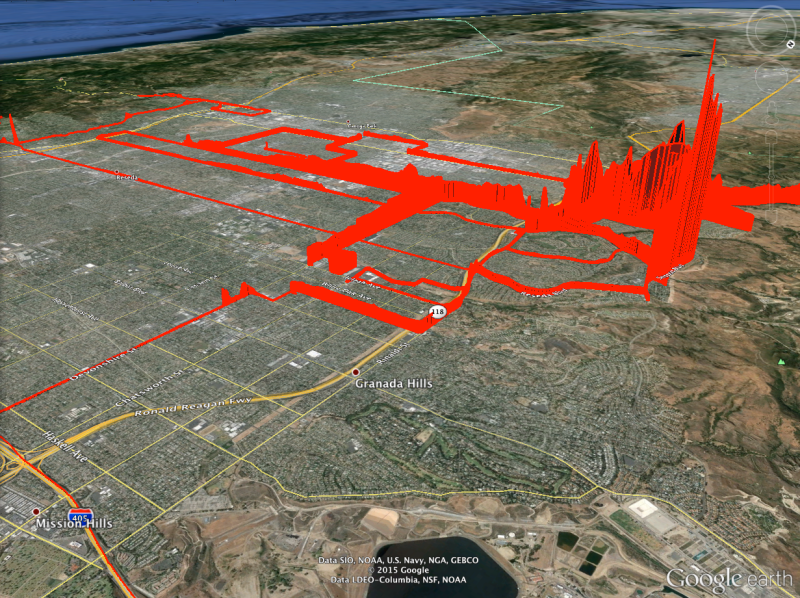
Methane pollution surrounding Porter Ranch, LA, ( Photo credit: Energy Efficiency Team)


The US Senate is considering an act to repeal with prejudice an Obama anti-methane regulation. The story from activist source Climate Central is
Senate Mulls ‘Kill Switch’ for Obama Methane Rule

The U.S. Senate is expected to vote soon on whether to use the Congressional Review Act to kill an Obama administration climate regulation that cuts methane emissions from oil and gas wells on federal land. The rule was designed to reduce oil and gas wells’ contribution to climate change and to stop energy companies from wasting natural gas.

The Congressional Review Act is rarely invoked. It was used this month to reverse a regulation for the first time in 16 years and it’s a particularly lethal way to kill a regulation as it would take an act of Congress to approve a similar regulation. Federal agencies cannot propose similar regulations on their own.

The Claim Against Methane

Now some Republican senators are hesitant to take this step because of claims like this one in the article:

Methane is 86 times more potent as a greenhouse gas than carbon dioxide over a period of 20 years and is a significant contributor to climate change. It warms the climate much more than other greenhouse gases over a period of decades before eventually losing its potency. Atmospheric carbon dioxide remains a potent greenhouse gas for thousands of years.

Essentially the journalist is saying: As afraid as you are about CO2, you should be 86 times more afraid of methane. Which also means, if CO2 is not a warming problem, your fear of methane is 86 times zero. The thousands of years claim is also bogus, but that is beside the point of this post, which is Methane.

IPCC Methane Scare

The article helpfully provides a link referring to Chapter 8 of IPCC AR5 report by Working Group 1 Anthropogenic and Natural Radiative Forcing.

The document is full of sophistry and creative accounting in order to produce as scary a number as possible. Table 8.7 provides the number for CH4 potency of 86 times that of CO2.  They note they were able to increase the Global Warming Potential (GWP) of CH4 by 20% over the estimate in AR4. The increase comes from adding in more indirect effects and feedbacks, as well as from increased concentration in the atmosphere.

In the details are some qualifying notes like these:

Uncertainties related to the climate–carbon feedback are large, comparable in magnitude to the strength of the feedback for a single gas.

For CH4 GWP we estimate an uncertainty of ±30% and ±40% for 20- and 100-year time horizons, respectively (for 5 to 95% uncertainty range).


Methane Facts from the Real World
From Sea Friends (here):

Methane is natural gas CH4 which burns cleanly to carbon dioxide and water. Methane is eagerly sought after as fuel for electric power plants because of its ease of transport and because it produces the least carbon dioxide for the most power. Also cars can be powered with compressed natural gas (CNG) for short distances.

In many countries CNG has been widely distributed as the main home heating fuel. As a consequence, methane has leaked to the atmosphere in large quantities, now firmly controlled. Grazing animals also produce methane in their complicated stomachs and methane escapes from rice paddies and peat bogs like the Siberian permafrost.

It is thought that methane is a very potent greenhouse gas because it absorbs some infrared wavelengths 7 times more effectively than CO2, molecule for molecule, and by weight even 20 times. As we have seen previously, this also means that within a distance of metres, its effect has saturated, and further transmission of heat occurs by convection and conduction rather than by radiation.

Note that when H20 is present in the lower troposphere, there are few photons left for CH4 to absorb:

Even if the IPCC radiative greenhouse theory were true, methane occurs only in minute quantities in air, 1.8ppm versus CO2 of 390ppm. By weight, CH4 is only 5.24Gt versus CO2 3140Gt (on this assumption). If it truly were twenty times more potent, it would amount to an equivalent of 105Gt CO2 or one thirtieth that of CO2. A doubling in methane would thus have no noticeable effect on world temperature.

However, the factor of 20 is entirely misleading because absorption is proportional to the number of molecules (=volume), so the factor of 7 (7.3) is correct and 20 is wrong. With this in mind, the perceived threat from methane becomes even less.

Further still, methane has been rising from 1.6ppm to 1.8ppm in 30 years (1980-2010), assuming that it has not stopped rising, this amounts to a doubling in 2-3 centuries. In other words, methane can never have any measurable effect on temperature, even if the IPCC radiative cooling theory were right.

Because only a small fraction in the rise of methane in air can be attributed to farm animals, it is ludicrous to worry about this aspect or to try to farm with smaller emissions of methane, or to tax it or to trade credits.

The fact that methane in air has been leveling off in the past two decades, even though we do not know why, implies that it plays absolutely no role as a greenhouse gas.

More information at THE METHANE MISCONCEPTIONS by Dr Wilson Flood (UK) here

Summary:

Natural Gas (75% methane) burns the cleanest with the least CO2 for the energy produced.

Leakage of methane is already addressed by efficiency improvements for its economic recovery, and will apparently be subject to even more regulations.

The atmosphere is a methane sink where the compound is oxidized through a series of reactions producing 1 CO2 and 2H20 after a few years.

GWP (Global Warming Potential) is CO2 equivalent heat trapping based on laboratory, not real world effects.

Any IR absorption by methane is limited by H2O absorbing in the same low energy LW bands.

There is no danger this century from natural or man-made methane emissions.

Conclusion

Senators and the public are being bamboozled by opaque scientific bafflegab. The plain truth is much different. The atmosphere is a methane sink in which CH4 is oxidized in the first few meters. The amount of CH4 available in the air is miniscule, even compared to the trace gas CO2, and it is not accelerating. Methane is the obvious choice to signal virtue on the climate issue since governmental actions will not make a bit of difference anyway, except perhaps to do some economic harm.

Give a daisy a break (h/t Derek here)

Daisy methane

Footnote:

For a more thorough and realistic description of atmospheric warming see:

Fearless Physics from Dr. Salby

Food, Conflict and Climate

From data versus models department, a recent study contradicts claims linking human conflict to climate change by means of food shortages. From Dartmouth College March 1, 2018 comes Food Abundance and Violent Conflict in Africa.  by Ore Koren.  American Journal of Agricultural Economics, 2018; Synopsis is from Science Daily (here) with my bolds.

Food abundance driving conflict in Africa, not food scarcity

The study refutes the notion that climate change will increase the frequency of civil war in Africa as a result of food scarcity triggered by rising temperatures and drought. Most troops in Africa are unable to sustain themselves due to limited access to logistics and state support, and must live off locally sourced food. The findings reveal that the actors are often drawn to areas with abundant food resources, whereby, they aim to exert control over such resources.

To examine how the availability of food may have affected armed conflict in Africa, the study relies on PRIO-Grid data from over 10,600 grid cells in Africa from 1998 to 2008, new agricultural yields data from EarthStat and Armed Conflict Location and Event Dataset, which documents incidents of political violence, including those with and without casualties. The data was used to estimate how annual local wheat and maize yields (two staple crops) at a local village/town level may have affected the frequency of conflict. To capture only the effects of agricultural productivity on conflict rather than the opposite, the analysis incorporates the role of droughts using the Standardized Precipitation Index, which aggregates monthly precipitation by cell year.

The study identifies four categories in which conflicts may arise over food resources in Africa, which reflect the interests and motivations of the respective group:

  1. State and military forces that do not receive regular support from the state are likely to gravitate towards areas, where food resources are abundant in order to feed themselves.
  2. Rebel groups and non-state actors opposing the government may be drawn to food rich areas, where they can exploit the resources for profit.
  3. Self-defense militias and civil defense forces representing agricultural communities in rural regions, may protect their communities against raiders and expand their control into other areas with arable land and food resources.
  4. Militias representing pastoralists communities live in mainly arid regions and are highly mobile, following their cattle or other livestock, rather than relying on crops. To replenish herds or obtain food crops, they may raid other agriculturalist communities.

These actors may resort to violence to seek access to food, as the communities that they represent may not have enough food resources or the economic means to purchase livestock or drought-resistant seeds. Although droughts can lead to violence, such as in urban areas; this was found not to be the case for rural areas, where the majority of armed conflicts occurred where food crops were abundant.

Food scarcity can actually have a pacifying effect.“Examining food availability and the competition over such resources, especially where food is abundant, is essential to understanding the frequency of civil war in Africa,” says Ore Koren, a U.S. foreign policy and international security fellow at Dartmouth College and Ph.D. candidate in political science at the University of Minnesota. “Understanding how climate change will affect food productivity and access is vital; yet, predictions of how drought may affect conflict may be overstated in Africa and do not get to the root of the problem. Instead, we should focus on reducing inequality and improving local infrastructure, alongside traditional conflict resolution and peace building initiatives,” explains Koren.

Summary:

In Africa, food abundance may be driving violent conflict rather than food scarcity, according to a new study. The study refutes the notion that climate change will increase the frequency of civil war in Africa as a result of food scarcity triggered by rising temperatures and drought.

Reading the study itself shows considerable rigor in sorting out dependent and independent variables.  It is certain that armed conflicts destroy food resources, while it is claimed that food shortages from climate events like drought cause the conflicts in the first place.  From Koren:

Moreover, in addition to illustrating the validity of this mechanism by the process of elimination—that is, by empirically accounting for a variety of alternative mechanisms— figure 2 further highlights the interactions between economic inequality, food resources, and conflict. Here, nonparametric regression plots—which do not enforce a modeling structure on the data and hence provide a more flexible method of visualizing relationships between different factors—show the correlations of local yields and conflict with respect to economic development as approximated using nighttime light levels. As shown, conflict occurs more frequently in cells with more crop productivity, but relatively low levels of economic development, where—based on anecdotal evidence at least—limitations on food access are more likely (Roncoli, Ingram, and Kirshen 2001).

Background Resource

Climates Don’t Start Wars, People Do

Cal Court to Hear Climate Tutorial

Recent events in the legal claims against oil companies for climate damages feature both a setback for anti fossil fuel activists, and also scheduling for the court to hear both sides regarding the linkage between fossil fuels and climate effects like glaciers melting. First the ruling against the cities’ attempt to take the case out of federal court into state jurisdiction. (with my bolds)

People of State of California v. BP p.l.c. (Oakland) Notice 02/27/2018

The federal district court for the Northern District of California denied Oakland’s and San Francisco’s motions to remand their climate change public nuisance lawsuits against five major fossil fuel producers to state court.

The court held that federal common law necessarily governed the nuisance claims because “[a] patchwork of fifty different answers to the same fundamental global issue would be unworkable” and “the extent of any judicial relief should be uniform across our nation.” The court stated: “Plaintiffs’ claims for public nuisance, though pled as state-law claims, depend on a global complex of geophysical cause and effect involving all nations of the planet (and the oceans and atmosphere). It necessarily involves the relationships between the United States and all other nations. It demands to be governed by as universal a rule of apportioning responsibility as is available.” The court dispensed with the cities’ three primary arguments for remanding the cases.

First, the court said the cities’ novel theories of liability based on the defendants’ sales of their product did not differentiate their claims from earlier transboundary pollution suits in which the Supreme Court (American Electric Power Co. v. Connecticut) and Ninth Circuit (Native Village of Kivalina v. ExxonMobil Corp.) applied federal common law.

Second, the court said the Clean Air Act did not displace the plaintiffs’ federal common law claims, allowing state law to govern; the court said that while the Clean Air Act spoke directly to the “domestic emissions” issues presented in American Electric Power and Kivalina, “[h]ere, the Clean Air Act does not provide a sufficient legislative solution to the nuisance alleged to warrant a conclusion that this legislation has occupied the field to the exclusion of federal common law.”

Third, the court said the well-pleaded complaint rule did not bar removal. The court also indicated in dicta that “the very instrumentality of plaintiffs’ alleged injury — the flooding of coastal lands — is, by definition, the navigable waters of the United States. Plaintiffs’ claims therefore necessarily implicate an area quintessentially within the province of the federal courts.” The court said defendants had not waived this issue.

The court certified the decision for interlocutory appeal, finding that the issue of whether the nuisance claims were removable because such claims are governed by federal common law was a controlling question as to which there is substantial ground for difference of opinion and that resolution by the court of appeals would materially advance the litigation. The court’s order also noted that six similar actions brought by other California municipalities were pending before another judge in the district and those actions asserted additional non-nuisance claims.

Federal Court Requested “Tutorial” on Climate Change.

Then we have an intriguing ruling by the court mandating a climate tutorial to educate the court on these matters. On the same day that it denied Oakland’s and San Francisco’s motions to remand their climate change lawsuits against fossil fuel producers, the court issued a “Notice re Tutorial” that invited counsel for the parties to conduct a two-part tutorial on global warming and climate change on March 21. The court gave each side an hour to “trace the history of scientific study of climate change” and an hour to “set forth the best science now available on global warming, glacier melt, sea rise, and coastal flooding.” The court indicated that counsel could either use experts to conduct the tutorial or conduct the tutorial themselves.

NOTICE RE TUTORIAL
The Court invites counsel to conduct a two-part tutorial on the subject of global
warming and climate change:

(1) The first part will trace the history of scientific study of
climate change, beginning with scientific inquiry into the
formation and melting of the ice ages, periods of historical cooling
and warming, smog, ozone, nuclear winter, volcanoes, and global
warming. Each side will have sixty minutes. A horizontal
timeline of major advances (and setbacks) would be welcomed.

(2) The second part will set forth the best science now
available on global warming, glacier melt, sea rise, and coastal
flooding. Each side will again have another sixty minutes.

The tutorial will be on MARCH 21, 2018, AT 8:00 A.M. AND RUN UNTIL ABOUT 1:00 P.M.
Experts may be used to present but counsel will also be welcome to conduct the tutorial.
IT IS SO ORDERED.
Dated: February 27, 2018. WILLIAM ALSUP
UNITED STATES DISTRICT JUDGE

Summary

Many of us have wanted to see a red and blue team confrontation, but did not see it coming in this way. As you see from the text of the ruling, it is two hours for each side, first on climate history and then on current global warming science. It has been a long time since climatists and skeptics faced off in a neutral venue. Hopefully people in the bay area will witness the proceedings.

Footnote:

Brian Potts writing in Forbes totally misinterprets the ruling, stating as a result the very thing the court prevented.

A California Court Might Have Just Opened The Floodgates For Climate Litigation

Background Resources:

On Coastal Climate Risk

Climate Hail Mary by Inept Cities

Is Global Warming A Public Nuisance?

2018 Oceans Remain Cool

The best context for understanding decadal temperature changes comes from the world’s sea surface temperatures (SST), for several reasons:

  • The ocean covers 71% of the globe and drives average temperatures;
  • SSTs have a constant water content, (unlike air temperatures), so give a better reading of heat content variations;
  • A major El Nino was the dominant climate feature in recent years.

HadSST is generally regarded as the best of the global SST data sets, and so the temperature story here comes from that source, the latest version being HadSST3.  More on what distinguishes HadSST3 from other SST products at the end.

The Current Context

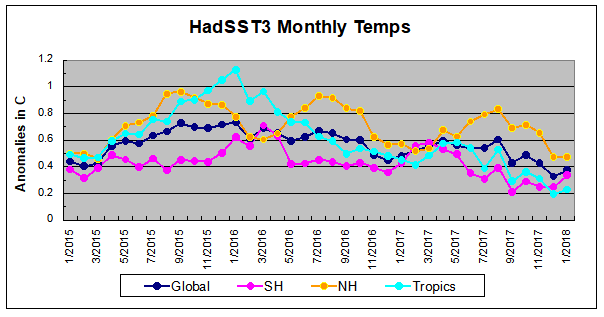
The chart below shows SST monthly anomalies as reported in HadSST3 starting in 2015 through January 2018.
Note that higher temps in 2015 and 2016 were first of all due to a sharp rise in Tropical SST, beginning in March 2015, peaking in January 2016, and steadily declining back below its beginning level. Secondly, the Northern Hemisphere added three bumps on the shoulders of Tropical warming, with peaks in August of each year. Also, note that the global release of heat was not dramatic, due to the Southern Hemisphere offsetting the Northern one.

A global cooling pattern has persisted, seen clearly in the Tropics since its peak in 2016, joined by NH and SH dropping since last August. An upward bump occurred in October, and now again in January 2018.  As will be shown in the analysis below, 0.410C has been the average global anomaly since 1995 and last month remains lower at 0.376C.  SH rose along with the Tropics, while NH held steady.  Global and NH SSTs are the lowest since 3/2014, while Tropics SSTs are the lowest since 3/2012. SH is the lowest January since 2014.

A longer view of SSTs

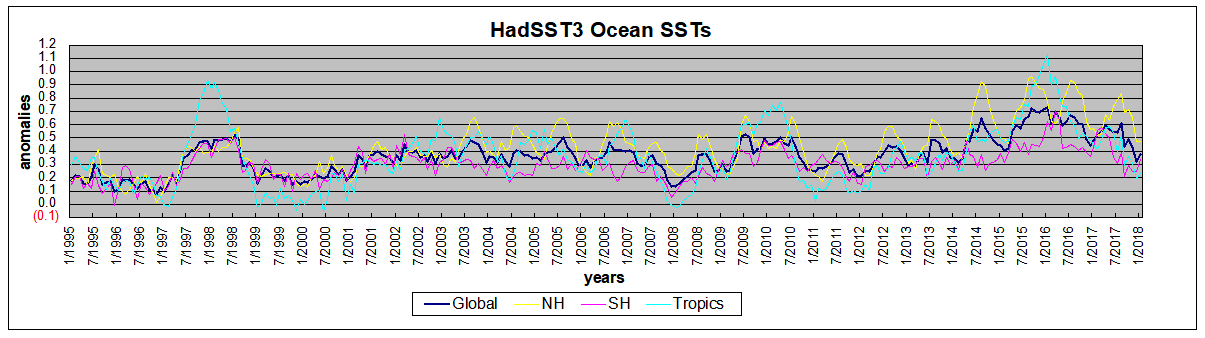
The graph below  is noisy, but the density is needed to see the seasonal patterns in the oceanic fluctuations.  Previous posts focused on the rise and fall of the last El Nino starting in 2015.  This post adds a longer view, encompassing the significant 1998 El Nino and since.  The color schemes are retained for Global, Tropics, NH and SH anomalies.  Despite the longer time frame, I have kept the monthly data (rather than yearly averages) because of interesting shifts between January and July.

Open image in new tab for sharper detail.

1995 is a reasonable starting point prior to the first El Nino.  The sharp Tropical rise peaking in 1998 is dominant in the record, starting Jan. ’97 to pull up SSTs uniformly before returning to the same level Jan. ’99.  For the next 2 years, the Tropics stayed down, and the world’s oceans held steady around 0.2C above 1961 to 1990 average.

Then comes a steady rise over two years to a lesser peak Jan. 2003, but again uniformly pulling all oceans up around 0.4C.  Something changes at this point, with more hemispheric divergence than before. Over the 4 years until Jan 2007, the Tropics go through ups and downs, NH a series of ups and SH mostly downs.  As a result the Global average fluctuates around that same 0.4C, which also turns out to be the average for the entire record since 1995.

2007 stands out with a sharp drop in temperatures so that Jan.08 matches the low in Jan. ’99, but starting from a lower high. The oceans all decline as well, until temps build peaking in 2010.

Now again a different pattern appears.  The Tropics cool sharply to Jan 11, then rise steadily for 4 years to Jan 15, at which point the most recent major El Nino takes off.  But this time in contrast to ’97-’99, the Northern Hemisphere produces peaks every summer pulling up the Global average.  In fact, these NH peaks appear every July starting in 2003, growing stronger to produce 3 massive highs in 2014, 15 and 16, with July 2017 only slightly lower.  Note also that starting in 2014 SH plays a moderating role, offsetting the NH warming pulses. (Note: these are high anomalies on top of the highest absolute temps in the NH.)

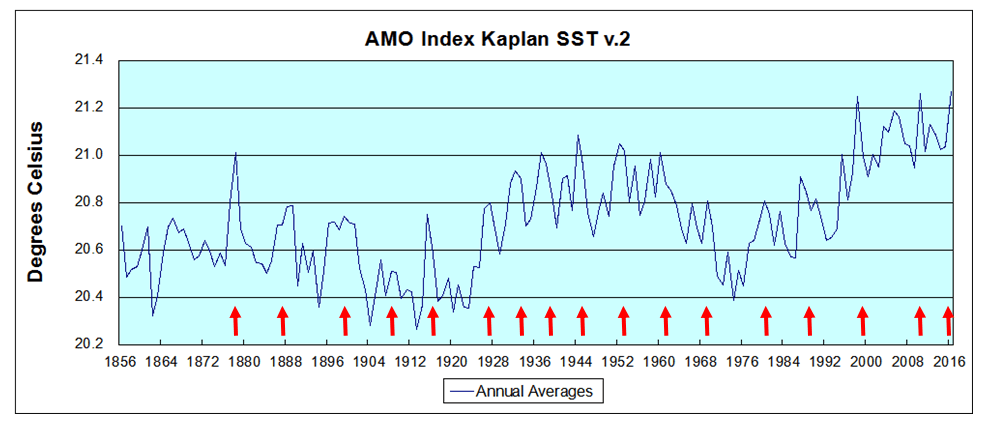
What to make of all this? The patterns suggest that in addition to El Ninos in the Pacific driving the Tropic SSTs, something else is going on in the NH.  The obvious culprit is the North Atlantic, since I have seen this sort of pulsing before.  After reading some papers by David Dilley, I confirmed his observation of Atlantic pulses into the Arctic every 8 to 10 years as shown by this graph:

The data is annual averages of absolute SSTs measured in the North Atlantic.  The significance of the pulses for weather forecasting is discussed in AMO: Atlantic Climate Pulse
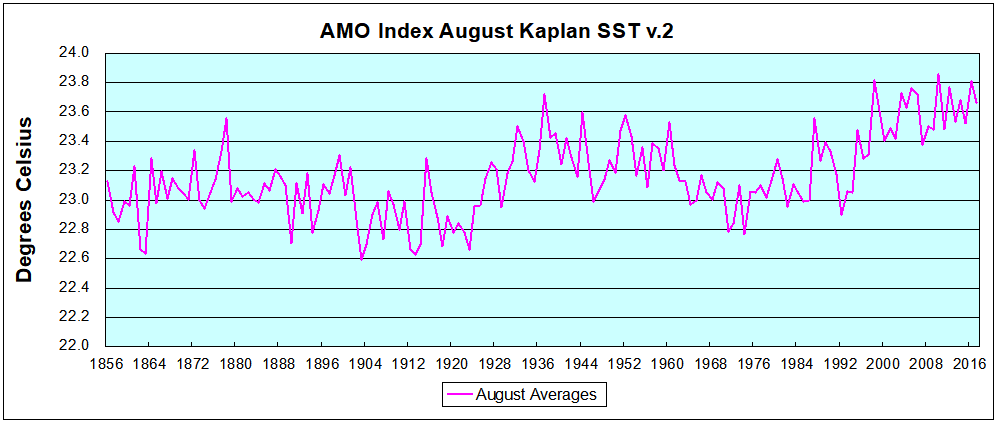
But the peaks coming nearly every July in HadSST require a different picture.  Let’s look at August, the hottest month in the North Atlantic from the Kaplan dataset.Now the regime shift appears clearly. Starting with 2003, seven times the August average has exceeded 23.6C, a level that prior to ’98 registered only once before, in 1937.  And other recent years were all greater than 23.4C.

Summary

The oceans are driving the warming this century.  SSTs took a step up with the 1998 El Nino and have stayed there with help from the North Atlantic, and more recently the Pacific northern “Blob.”  The ocean surfaces are releasing a lot of energy, warming the air, but eventually will have a cooling effect.  The decline after 1937 was rapid by comparison, so one wonders: How long can the oceans keep this up?

Footnote: Why Rely on HadSST3

HadSST3 is distinguished from other SST products because HadCRU (Hadley Climatic Research Unit) does not engage in SST interpolation, i.e. infilling estimated anomalies into grid cells lacking sufficient sampling in a given month. From reading the documentation and from queries to Met Office, this is their procedure.

HadSST3 imports data from gridcells containing ocean, excluding land cells. From past records, they have calculated daily and monthly average readings for each grid cell for the period 1961 to 1990. Those temperatures form the baseline from which anomalies are calculated.

In a given month, each gridcell with sufficient sampling is averaged for the month and then the baseline value for that cell and that month is subtracted, resulting in the monthly anomaly for that cell. All cells with monthly anomalies are averaged to produce global, hemispheric and tropical anomalies for the month, based on the cells in those locations. For example, Tropics averages include ocean grid cells lying between latitudes 20N and 20S.

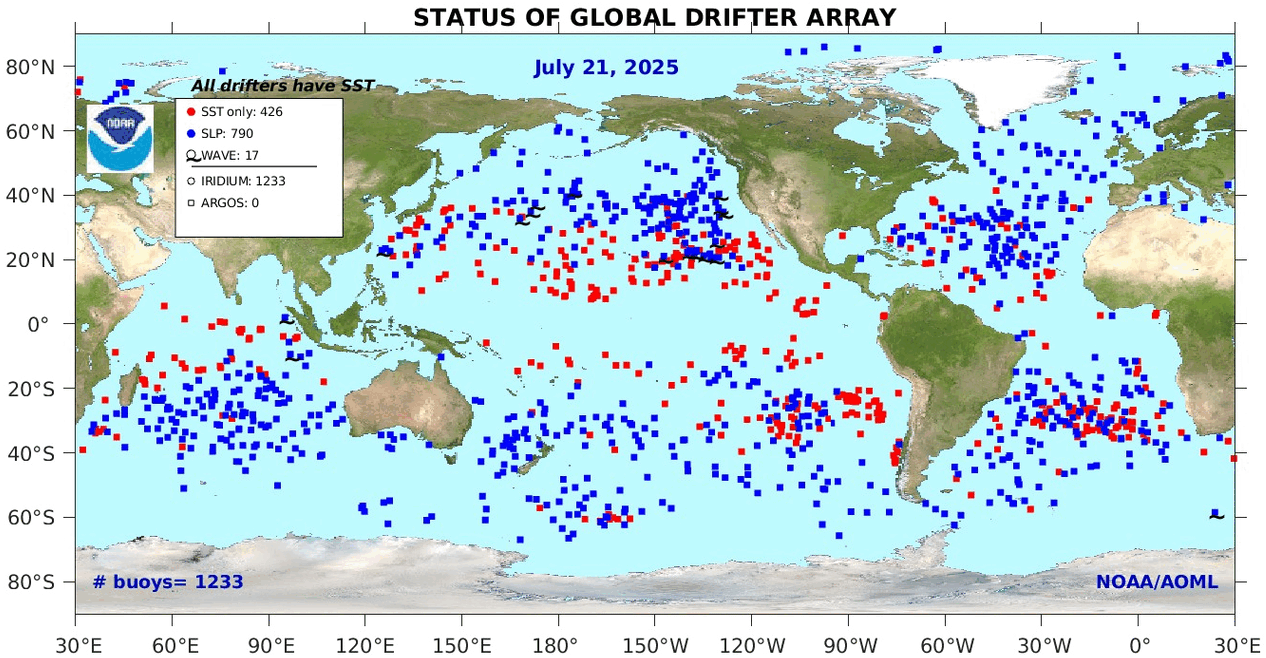
Gridcells lacking sufficient sampling that month are left out of the averaging, and the uncertainty from such missing data is estimated. IMO that is more reasonable than inventing data to infill. And it seems that the Global Drifter Array displayed in the top image is providing more uniform coverage of the oceans than in the past.

uss-pearl-harbor-deploys-global-drifter-buoys-in-pacific-ocean

USS Pearl Harbor deploys Global Drifter Buoys in Pacific Ocean


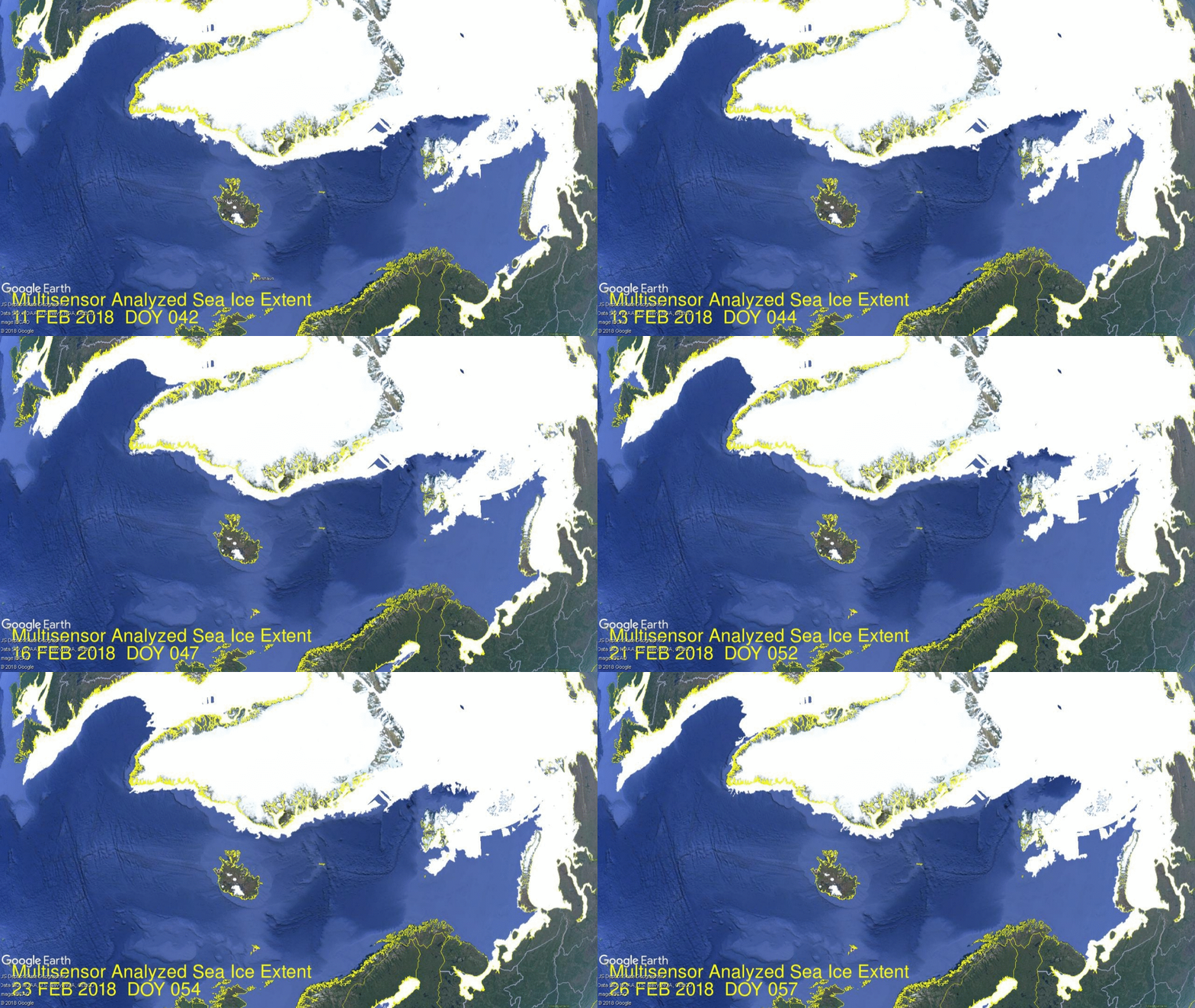
Arctic Ice Swirls End of Feb.

Click on image to enlarge.

Under the influence of a split vortex in February, Arctic ice is also a bit bi-polar.  Above image shows the Atlantic side the last two weeks.  Barents on the right has grown back to reach the 11 year average, while on the upper left Baffin Bay is above average reaching down to Newfoundland and filling in the Gulf of St. Lawrence.

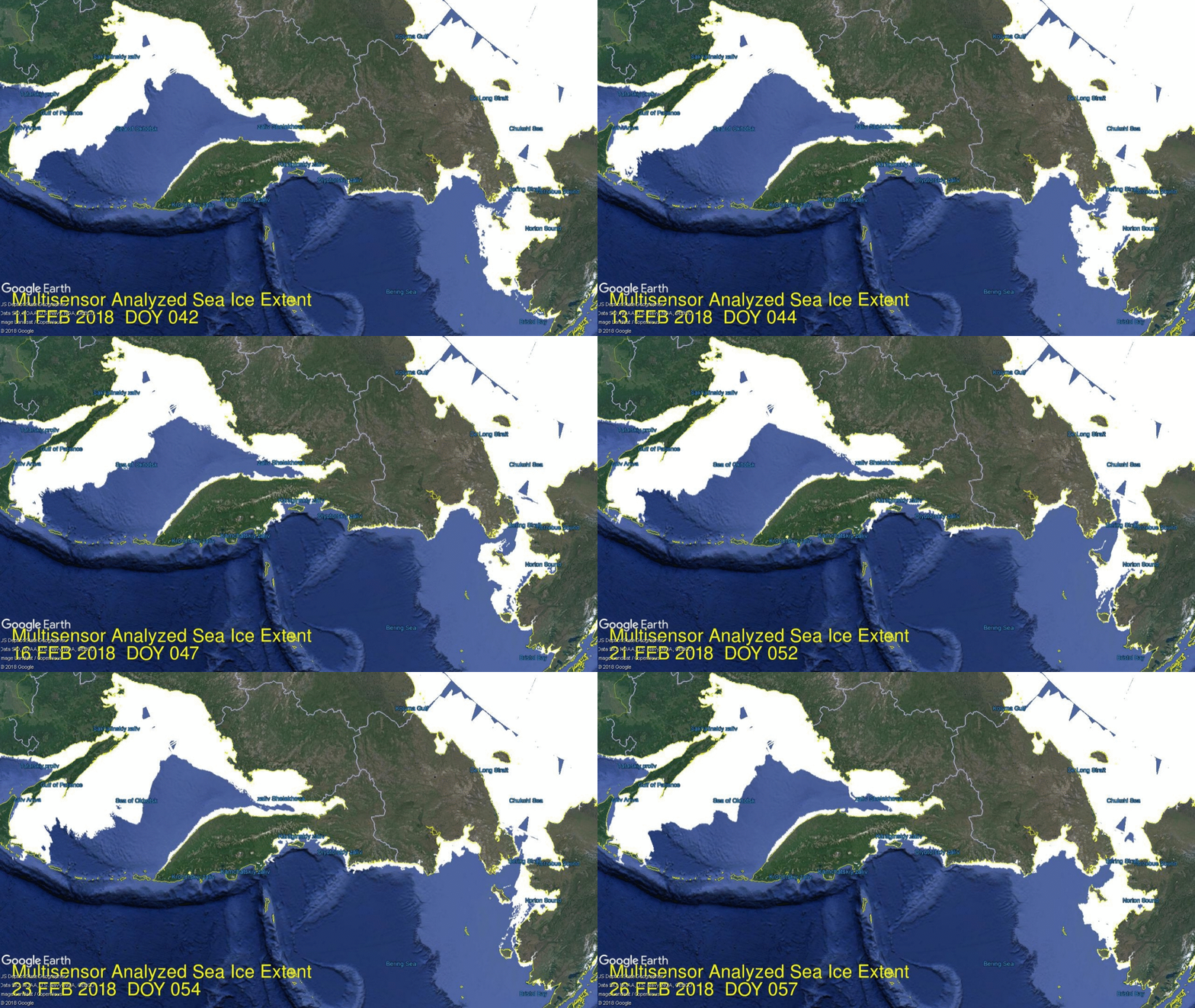
Click on image to enlarge.

Meanwhile, the ridge of high pressure over Alaska resulted in Bering on the right losing ice while Okhotsk on the left gained up to last year’s maximum.

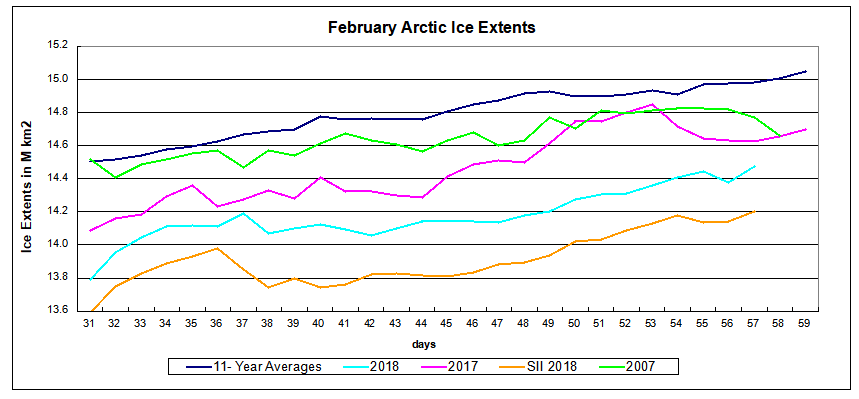
Ice extents for February appear in the graph below; 11 year average is 2007 to 2017 inclusive.
Note that ice growth slows down in February since the Arctic core is frozen and extent can only be added at the margins.  MASIE shows 2018 is drawing close to 2007 and 2017, while SII is running about 200k km2 less.  The 11 year average reached 15M km2 while this year is ~500k km2 lower at day 57.

Below is the analysis of regions on day 057.  Average is for 2007 to 2017 inclusive.

Region 2018057 Day 057 
Average
2018-Ave. 2017057 2018-2017
 (0) Northern_Hemisphere 14471633 14982823 -511189 14624988 -153354
 (1) Beaufort_Sea 1070445 1070178 267 1070445 0
 (2) Chukchi_Sea 962774 965725 -2951 966006 -3232
 (3) East_Siberian_Sea 1087120 1087134 -14 1087137 -18
 (4) Laptev_Sea 897845 897842 3 897845 0
 (5) Kara_Sea 928561 922491 6070 933003 -4442
 (6) Barents_Sea 599940 618000 -18061 535489 64451
 (7) Greenland_Sea 405456 639713 -234257 621708 -216252
 (8) Baffin_Bay_Gulf_of_St._Lawrence 1823426 1492225 331201 1490888 332538
 (9) Canadian_Archipelago 853109 852670 439 853214 -106
 (10) Hudson_Bay 1260838 1260663 175 1260903 -66
 (11) Central_Arctic 3076082 3222907 -146825 3217927 -141845
 (12) Bering_Sea 283579 737222 -453642 577660 -294081
 (13) Baltic_Sea 130666 116020 14646 64843 65822
 (14) Sea_of_Okhotsk 1063381 1049659 13722 991862 71519

The 2018 deficit to average is almost entirely due to the shortfall in Bering Sea.  Barents, Chukchi and Okhotsk are all about average.  A large surplus in Baffin Bay/Gulf of St. Lawrence offsets smaller deficits in Central Arctic and Greenland Sea.

The annual maximum usually occurs mid March.  2018 is now 2% below last year’s max and needs 3.5% more extent to reach 15M km2.

Here’s your Valentine’s Day Greeting:

And here’s your PC candy for Valentine’s Day.


Climate Kills Wildflower! (False Alarm)

This is Androsace septentrionalis (Northern rock jasmine). Credit: Anne Marie Panetta

Breathless news out of Colorado Climate warming causes local extinction of Rocky Mountain wildflower species  Excerpts below with my bolds.

New University of Colorado Boulder-led research has established a causal link between climate warming and the localized extinction of a common Rocky Mountain flowering plant, a result that could serve as a herald of future population declines.

The new study, which was published today in the journal Science Advances, found that warmer, drier conditions in line with future climate predictions decimated experimental populations of Androsace septentrionalis (Northern rock jasmine), a mountain wildflower found at elevations ranging from around 6,000 feet in Colorado’s foothills to over 14,000 feet at the top of Mt. Elbert.

The findings paint a bleak picture for the persistence of native flowering plants in the face of climate change and could serve as a herald for future species losses in mountain ecosystems over the next century.

Always the curious one, I went looking for context to interpret this report.  Thank goodness for the Internet; it didn’t take long to find information left out of the alarming news release.  From the US Wildflower Database (here) we can see the bigger picture.

Androsace Septentrionalis, Rock Jasmine

Androsace septentrionalis is a small-flowered and rather inconspicuous plant, and is the most common member of this genus in the West, out of six in the US. Plants are very variable in size, reflecting the wide range of habitats and elevations – from near sea level to over 11,000 feet. Stalkless leaves grow at the base, in a flat rosette, and often have a few teeth along the margins, and ciliate hairs. Leaf surfaces may be hairless or sparsely short hairy.

Common names: Rock jasmine, pygmyflower
Family: Primrose (Primulaceae)
Scientific name: Androsace septentrionalis
Main flower color: White
Range: The Rocky Mountain states, westwards to the Great Basin, and small areas of neighboring states
Height: Between 1 and 8 inches
Habitat: Grassland, forest, tundra; generally open areas, from sea level to 11,500 feet
Leaves: Basal, oblanceolate, up to 1.2 inches long and 0.4 inches across; entire or coarsely toothed edges
Season: March to September

Look at the range and habitat and ask yourself if this plant is adaptive, as well as the fact this species is the most common out of six in the genus.

And in Minnesota (here), on the eastern edge of the range, it is rare compared to the Western Rock Jasmine (Androsace occidentalis).

If American lotus (Nelumbo lutea) is noted as Minnesota’s largest native wildflower, Western Rock Jasmine  certainly vies for its smallest. It can have very dense populations but it takes a discerning and determined eye to pick it out of the landscape, and is only of interest to those who celebrate the diversity of nature. It is easily distinguished from its rare cousin, Northern Androsace (Androsace septentrionalis) which is larger in stature and has rather narrower bracts at the base of the flower cluster.

The preferred habitat features sun; dry sandy soil, grassy meadows, open fields, disturbed soil, which along with “rock” in the name suggests that these plants tolerate arid conditions.

Summary

Far from going extinct, these flowers abound and like humans adapt readily to their surroundings. As has been stated previously, when alarmists project large numbers of extinctions due to future climate change, always ask for the names and the dead bodies.  What the headlines claim is refuted by the facts on the ground.


Pipeline Tragedy/Comedy: Ideology and Energy Don’t Mix

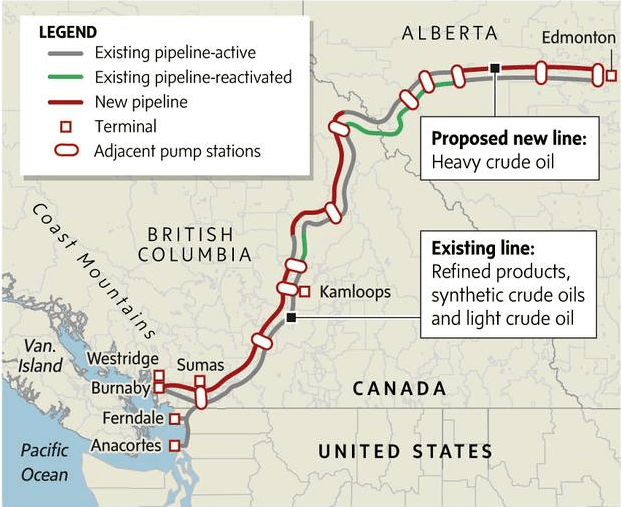
The inter provincial Canadian war over a bitumen pipeline is taking on Shakespearean drama as reported in the Globe and Mail  The symbolism of Kinder Morgan’s Trans Mountain pipeline  The article is by Arno Kopecky, an environmental journalist and author based in Vancouver.  Excerpts below with my bolds and images introducing the principle players.

Spare a thought for Rachel Notley. While you’re at it, spare another for John Horgan and Justin Trudeau. Three star-crossed allies, progressives all, steering ships through a Kinder Morgan tempest no pundit can describe without saying “collision course.” Shakespearean, ain’t it?

There’s tragedy, comedy and irony galore. Ms. Notley’s take on A Midsummer Night’s Dream with her midwinter ban on British Columbia wines – which was lifted on Thursday – lent itself so well to “Reign of Terroir” jokes that it can only end up raising the provincial wine industry’s profile. As for Alberta’s oil industry, this is more like Much Ado About Nothing. Whether the oil sands grow or shrink has much less to do with any one pipeline (even one that leads to almighty tidewater) than the global price of oil. What about all those Kinder Morgan jobs? Comedy. Anyone serious about creating oil-sector jobs for Canadians would be pushing to refine bitumen at home instead of exporting it raw. That’s why Unifor, the biggest union in the oil sands, intervened against the project in the NEB hearings.

But the notion that Kinder Morgan’s Trans Mountain pipeline expansion would add carbon to the atmosphere is comedy, too. If Kinder Morgan isn’t built, trains will keep moving the bitumen they’re already moving, at least until a higher force than pipeline capacity reduces Fort McMurray’s output. Everyone just makes less money that way.

When a country already has more than 840,000 kilometres of pipeline running through it, the fight over roughly 1,000 new kilometres is symbolic for both sides. But symbols matter. Now Trans Mountain has come to symbolize everything from the oil sands to climate change and reconciliation, and everyone’s job is at stake.

Premier Rachel Notley of oil rich, but landlocked and economically struggling Alberta.

None more than Ms. Notley’s, our likeliest candidate for tragedy. Alberta’s most progressive premier in more than 30 years, the woman who imposed a provincial carbon tax and raised royalties on oil sands operators and lifted Alberta’s minimum wage from the lowest to the highest in the country, Rachel Notley will not be replaced by someone nicer. Alberta’s profoundly oil-positive United Conservative Party, freshly merged and braying at her heels, threaten every last NDP policy with a Trumpian corrective. They’ll probably win the next election, too. Ms. Notley’s only hope is in proving to Albertans she can fight as dirty as any conservative would to protect the Symbol.

British Columbia Premier John Horgan, who recently formed a government propped up by a few Green party MPs.

Enter John Horgan, stage left. Poor guy. He’s running a province whose biggest, greenest city overwhelmingly voted against a once-in-a-generation opportunity to massively expand public transit, but has already proved itself willing to get arrested en masse in anti-Kinder Morgan protests. Mr. Horgan’s first major decision as Premier, the tortured approval of the Site C dam, earned him the condemnation of every environmentalist and First Nation leader in the province, if not the country. Now that he’s following through on his campaign promise to “use every tool in our tool box” against Kinder Morgan, fans and critics are trading placards. Never mind that Site C will keep far more carbon in the ground than any thwarted pipeline.

The thing is, pipeline battles on the coast aren’t about pipelines or even climate change. They’re about oil tankers. Want symbols? Wild salmon and orca populations are rapidly approaching extinction in southern B.C. Yes, oil tankers do already ply these waters. No, we don’t love hearing that the only way to pay for sorely lacking coastal protection is to heighten the risk of an oil spill by tripling the number of tankers.  But that’s the deal.

Canadian Prime Minister Justin Trudeau currently touring India.

Enter Justin Trudeau, our doomed and dashing Hamlet, haunted by the ghost of his father, asking not to be or not to be, but can the ends justify the means? The greater the ends, it seems, the crueler the means. For all his capacity to renege on inconvenient promises, Mr. Trudeau clearly does regard the fight against climate change as a Very Great End. He knows we’re losing the glaciers whose meltwater irrigates half of Canada’s agriculture; he’s aware of our metastasizing cycle of flood and forest fire; he’s already dealt with one wave of climate refugees, from Syria (yes – that war was largely triggered by a calamitous drought that beggared a million farmers); he knows this is just the beginning. (Note: The reporter and Trudeau believe things cited in this paragraph contrary to evidence, but ignorance and hubris are essential to any tragedy.)

Against all that, he weighs the spill risk of one new pipeline, twinned to a pre-existing condition, with a corresponding increase in tanker traffic through relatively safe waters in which oil tankers can so far boast a 100-per-cent safety rate. Without Kinder Morgan, Mr. Trudeau mutters, pacing the stage from left to right, you lose Alberta; without Alberta, you lose your national climate-change strategy, your coastal protections, your whole progressive agenda. You lose everything.

Enter, in our closing act, B.C.’s coastal First Nations. Of course, they’ve been here all along – Mr. Trudeau made them some promises, too. But so far, his definition of consultation looks a lot like the old one: a process to determine not if a project should proceed on Indigenous territory, but when. The courts may yet cancel Trans Mountain because of it, as they did Northern Gateway. That’s probably Mr. Trudeau’s best hope for a happy ending. He’s created his own Birnam Wood, an army of First Nations and their allies ready to lead the march to Dunsinane Hill, aka Burnaby Mountain and the terminus of the pipeline, for the biggest act of civil disobedience our generation’s seen.

It isn’t a question of if, but when.

This is another example of damage done by virtue signaling, further explained in Virtue Signaling as a Vicious Circle

Footnote:  Regarding the attempt to blame the Syrian conflict on drought, see Climates Don’t Start Wars, People Do

Virtue Signaling as a Vicious Circle

A recent article reveals how perverse is the trendy pattern of virtue signaling. Ron Ross observes examples of this growing substitute for ethical behavior, adding perspective and raising concerns. His essay at the American Spectator is The Power and Prevalence of Virtue Signaling  Excerpts below with my headings, bolds and images.

Puzzling Events Explained by Virtue signaling

One key to understanding much of the bewildering behavior we see around us is to recognize the power and popularity of “virtue signaling.” Keeping virtue signaling in mind will help you understand a lot of behavior that otherwise makes no sense.

What, for example, is the point of removing Confederate statues or attempting to disown the country’s Founding Fathers because some were slave owners? It makes sense if your objective is to be sanctimonious. You make yourself feel better by looking down your nose at Thomas Jefferson.

Virtue signaling is the modern version of what St. Augustine in the 5th century referred to as “outward signs of inward grace.” A major difference, however, is the kind of grace he referred to actually meant something.

First the Guilt Trip, then Superiority

A precondition to needing to virtue signal is guilt. Virtue signaling is one of the left’s package deals that typically involve two steps. Firstly, make people who have done nothing wrong feel guilty. Then, offer them ways to assuage that guilt. It’s little more than a con game but it has worked amazingly well for liberals.

It always helps to keep in mind that everything is relative. In order to feel superior, you need something to feel superior to. Virtuous relative to what? In order to feel holier than thou you need a thou.

Does virtue signaling accomplish anything outside of the individual? Anything tangible, significant? Any activity as widespread and long-lasting as virtue signaling has to have payoffs. The payoffs for virtue signaling are inner, not outer, directed.

An irony is that the need to virtue signal is an insecurity about your own virtue. An observation a psychologist friend likes to make is, “The bigger the front, the bigger the back.” Or as Ralph Waldo Emerson observed, “The louder he spoke of his honor, the faster we counted our spoons.” Virtue signaling is motivated more by insecurities than virtue.

The “signaling” part of virtue signaling means you want others to become aware of your virtue. Why is that important to you? Where does your need to signal come from? Are you so overwhelmingly virtuous that you can’t resist letting others know about it?

Symbols Instead of Substance

Virtue signaling is, of course, closely related to political correctness. Being sensitive to PC and being quick to take offense demonstrates your virtue for all to see.

Recycling is one of the left’s favorite sacraments. It helps overcome the guilt of consuming.

There is an opportunity cost to virtue signaling. Spending time on useless activities, e.g. recycling, marching, allows avoidance of useful, meaningful activities, e.g. being thoughtful and considerate of those around you, e.g. family, friends, and people you work with. Those behaviors can actually make a difference.

Maybe you’ve wondered why actors and other celebrities feel the need to publicly express their political opinions. What is their motivation? Maybe they feel guilty about how amazingly wealthy they are (they shouldn’t).

Donald Trump is the context for much of the virtue signaling we observe. It’s another two-step process. The first step is to decide that Donald Trump is a reprehensible human being. He is crude, unsophisticated, and his personality makes you cringe. The second step is making it crystal clear that you and he are polar opposites. You have absolutely nothing in common with him. You don’t need to provide details about what makes you virtuous, just the fact that you despise him is sufficient to prove you’re virtuous. He is crude, you are refined. Trump provides a backdrop for your identity. It’s ironic that hate is seen as a path to virtue.

Grandstanding Instead of Civility

Virtue signaling is a substitute for thinking, it is thinking avoidance. It is the latest variation of group think. When you latch on to group opinions you have no need to think for yourself.

Driving a Prius automobile is a popular form of virtue signaling. Driving a hybrid lets others see that you care about the planet and that you’re doing your part to prevent it from being destroyed by CO2. Driving a Prius allows to you drive rudely and carelessly. Cutting someone off or running a stop sign or two are trivial matters compared to saving the planet. Everything’s relative. It’s probably no accident that Priuses have an unusual profile. That helps assure that your virtue signal will noticed.

A favorite demand of leftists on college campuses and endowment fund boards of directors is “divestment.” What is divestment? In the investment portfolios of endowment funds and retirement portfolios are stocks of companies involved in shunned activities such as producing and selling fossil fuels. In such situations activists demand that the colleges or foundations divest, i.e. sell, any stock of such despicable companies.

Divestment is possibly the most useless behavior anyone could ever imagine. How anyone thinks it will have any impact on anything real is a mystery. Because of the way capital markets work, divesting on anything but a massive scale will have no long-term impact on a company’s share price. If they manage to drive a stock’s price down, bargain hunters will drive it back up to its underlying value, relative to other stocks. Other than stoking sanctimony divestment accomplishes absolutely nothing.

Sincerity Posing as Goodness

Showing your disapproval of the names or mascots of sports teams demonstrates your sensitivity for the supposed feelings of various minority groups. How many of those demanding that the Washington Redskins change their name are Indians? My guess is that it’s a very small fraction.

Wearing ribbons is a popular form of virtue signaling. The ostensible purpose is to “raise awareness” for such things as breast cancer (pink ribbons). Is there anyone who isn’t already” aware” of breast cancer? And once your awareness has been raised, what are you supposed to do with it? As is the case with every variation of virtue signaling, the mission statement is nowhere to be found.

Feeling Good about Caring the Most

Virtue signalers are delicate creatures who are easily offended. They wouldn’t be caught dead laughing at stereotypical humor. They are overly serious about almost everything. It only hurts when they laugh.

There is a large element of virtue signaling in environmentalism. Devout environmentalists like to think they’re the only ones who care about the environment. Relative to how much they care about the environment you don’t care much at all.

Marching and demonstrating are two popular virtue signaling activities. The next big opportunity will be June 9. It is the “March for Oceans,” or what they’re labeling “M4O.” According the organizers’ website, “This summer we will see a new blue wave of resistance — and celebration — for the other 71 percent of our environment that is the Ocean. The ocean is rising and so are we!”

Uselessness and remoteness are two of the ingredients for virtue signaling choices. Driving a hybrid automobile will make not an iota’s difference to “climate change” (whatever that is). In any case, the “climate disruption catastrophe,” as it’s sometimes called, is not predicted to occur for another fifty years. It was more than two hundred years ago when some of our founding fathers owned slaves. The past is unchangeable and irretrievable. Problems that you can’t do a damned thing about are virtue signaling favorites.

A recent Dennis Prager column, “Three Reasons the Left Wants Evermore Immigrants,” had as reason number three, “the power of feeling good about oneself. It would be difficult to overstate the significance of feeling good about oneself as a primary factor in why people adopt left-wing policies.… In their eyes, they are moral heroes protecting the stranger, the oppressed, the marginalized, the destitute.”

Until this week William McKinley thought he was home free.

Finally, this just in: The Arcata, California city council voted Wednesday night to remove the statue of President William McKinley from the town square. The statue has been in place for over a hundred years. As per usual, McKinley’s sins have not been clearly elucidated. He was assassinated in 1901. Like Matt Lauer, the statue will vanish into the ether. One of the groups demanding the statue’s removal is the Humboldt State University student group, Movimiento Estudiantil Chicanco de Aztlan, whatever that means. I’m embarrassed to admit I’m a resident of Arcata. Our neighboring town to the north is McKinleyville. The town’s name is probably not long for this world.

These are just a sampling of the ways virtue signaling is dictating behavior far and wide. Being aware of its many manifestations will reduce your confusion and increase your amusement. It’s a shame it’s doing so much damage.

Footnote:

The Darrow quote crystallized what was making me uncomfortable about the behavior of the Parkland survivors on television.  I understand they were scared out of their wits, lost friends and are angry.  But the aggressive and threatening language toward anyone not on their bandwagon smacks of self-righteousness, and worse a justification for bullying.  It makes me wonder how much of that helped send the shooter around the bend.

Rainfall Climate Paradox

A recent article displays the intersection of fears and facts comprising the climate paradox, in this case the issue of precipitation.  Rainfall’s natural variation hides climate change signal appeared today in phys.org by Kate Prestt, Australian National University.  Excerpts with my bolds.

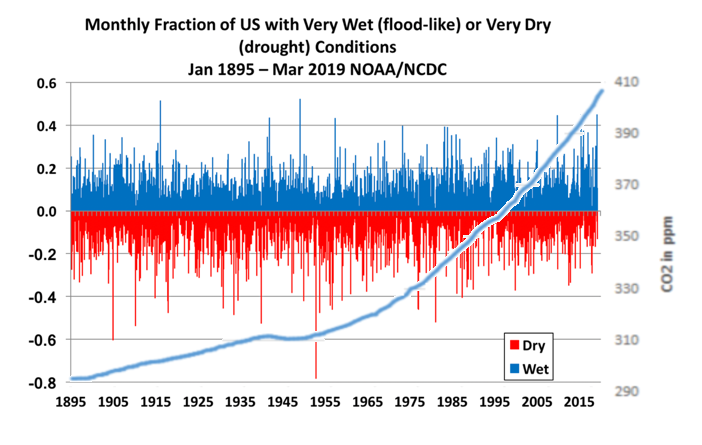
New research from The Australian National University (ANU) and ARC Centre of Excellence for Climate System Science suggests natural rainfall variation is so great that it could take a human lifetime for significant climate signals to appear in regional or global rainfall measures.

Even exceptional droughts like those over the Murray Darling Basin (2000-2009) and the 2011 to 2017 Californian drought fit within the natural variations in the long-term precipitation records, according to the statistical method used by the researchers.

This has significant implications for policymakers in the water resources, irrigation and agricultural industries.

“Our findings suggest that for most parts of the world, we won’t be able to recognise long term or permanent changes in annual rainfall driven by climate change until they have already occurred and persisted for some time,” said Professor Michael Roderick from the ANU Research School of Earth Sciences.

“This means those who make decisions around the construction of desalination plants or introduce new policies to conserve water resources will effectively be making these decisions blind.

“Conversely, if they wait and don’t act until the precipitation changes are recognised they will be acting too late. It puts policymakers in an invidious position.”

To get their results the researchers first tested the statistical approach on the 244-year-long observational record of precipitation at the Radcliffe Observatory in Oxford, UK. They compared rainfall changes over 30-year-intervals. They found any changes over each interval were indistinguishable from random or natural variation.

They then applied the same process to California, which has a record going back to 1895, and the Murray Darling Basin from 1901-2007. In both cases the long dry periods seem to fit within expected variations.

Finally, they applied the process to reliable global records that extended from 1940-2009. Only 14 per cent of the global landmass showed, with 90 per cent confidence, increases or decreases in precipitation outside natural variation.

Professor Graham Farquhar AO also from the ANU Research School of Biology said natural variation was so large in most regions that even if climate change was affecting rainfall, it was effectively hidden in the noise.

“We know that humans have already had a measurable influence on streamflows and groundwater levels through extraction and making significant changes to the landscape,” Professor Farquhar said.

“But the natural variability of precipitation found in this paper presents policymakers with a large known unknown that has to be factored into their estimates to effectively assess our long-term water resource needs.”  The research has been published in the journal Proceedings of the National Academy of Sciences.

us-wet-dry-co2rev-1

Summary

Much like sea level rise, scientists fearing the worst seek and hope to find a nanosignal inside noisy imprecise measurements of a naturally varying phenomenon.

Everything Americans Know about Science in Brief

NASA scientists at work in the 1960s.

This is a reblog of an article at Popular Science Everything Americans know about science in seven graphs. It is a report on how the country stacked up in a recent National Science Foundation quiz. Text and images below with my bolds.

Every two years, a couple thousand lucky Americans get to take a science quiz. The National Science Foundation surveys the representative sample to see how much they (and, by extension, we) all understand about science and technology. And it’s not just for fun. The NSF has a vested interest in figuring out what Americans know, think, and understand about the scientific world so they can construct policies in line with our collective reasoning. So once it’s collected, this survey data gets compiled and put it into one big report.

Of course, no survey can perfectly capture how well a person understands science. A few questions can’t distill that kind of information; scientific literacy is less about memorizing specific facts than it is understanding how to interpret evidence. But these tests can help us get a snapshot of what Americans do know, and how our understanding is changing.

Here’s how we did:

CLIMATE CHANGE Data from NSF (some totals don’t equal 100% due to rounding) Infographic by Sara Chodosh

More Americans than ever think climate change poses a real threat to the environment, though the proportion who feel it’s not that bad has stayed around 15 percent. It seems to be the undecided who have come around, not the outright deniers. And unfortunately, the survey also found that only 6 in 10 think global warming is caused by humans—though on the bright side, that’s the highest number ever. (Note: Taking the 50% who think climate change is dangerous times 60% blaming humans gives 30% with the CAGW opinion.  The number could be higher if the concerned people also blame humans at a higher rate).

SCIENTIFIC CONCEPTS Data from NSF (some totals don’t equal 100% due to rounding) Infographic by Sara Chodosh

Testing “understanding” of scientific concepts requires some careful finagling. We’ll let you be the judge of how well NSF did. Here are the two-part questions used, which respondents had to get entirely right to receive credit:

Probability A doctor tells a couple that their genetic makeup means that they’ve got one in four chances of having a child with an inherited illness. (1) Does this mean that if their first child has the illness, the next three will not have the illness? and (2) Does this mean that each of the couple’s children will have the same risk of suffering from the illness?

Answer: (1) No (2) Yes

Experiment (1) Two scientists want to know if a certain drug is effective against high blood pressure. The first scientist wants to give the drug to 1,000 people with high blood pressure and see how many of them experience lower blood pressure levels. The second scientist wants to give the drug to 500 people with high blood pressure and not give the drug to another 500 people with high blood pressure, and see how many in both groups experience lower blood pressure levels. Which is the better way to test this drug?

(2) Why is it better to test the drug this way?

Answer: The second way, because a control group is used for comparison.

**Scientific Study **(1) When you read news stories, you see certain sets of words and terms. We are interested in how many people recognize certain kinds of terms. First, some articles refer to the results of a scientific study. When you read or hear the term scientific study, do you have a clear understanding of what it means, a general sense of what it means, or little understanding of what it means? (2) (If “clear understanding” or “general sense” response) In your own words, could you tell me what it means to study something scientifically?
Answer: Formulation of theories/test hypothesis, experiments/control group, or rigorous/systematic comparison.

SCIENTIFIC FACTS Data from NSF (some totals don’t equal 100% due to rounding) Infographic by Sara Chodosh

Despite the wayward influence of Journey to the Center of the Earth, apparently the best-known fact is that the center of the Earth is hot (far too hot to be hospitable, at least). We also seem well-versed in plate tectonics, and about 3 in 4 Americans have figured out that the Earth goes around the Sun. But only 1 in 2 know that it takes a year.

Not included here are the questions about evolution and the big bang. The NSF found a small change in those questions had a huge impact on the answers. Adding “according to the theory of evolution” or “according to astronomers” increased the proportion answering correctly to each question. A 2016 study found a similar phenomenon, but substituting a question asking about elephant evolution rather than human—people seemed to understand elephant origins better than human ones. And that suggests that it’s not that people can’t or don’t grasp the theory of evolution, it’s that sometimes scientific principles conflict with a person’s beliefs—and sometimes the beliefs win out.

Note: Beliefs also pertain to socio-political movements advancing their agenda using science to persuade.  Lysenkoism in the USSR was one example, and the UNIPCC is another. Additional questions in the linked article show such influences, once you understand environmentalism as a quasi-religious construct.

How Dangerous are GMOs?
Concern over genetically modified food is on the rise, despite the fact that 88 percent of National Academies of Science, Engineering, and Medicine members think they’re safe. Other surveys suggest the public isn’t well-informed about the actual technology involved in creating these crops, which means views are shaped by general perception and worldview rather than scientific evidence.

How Dangerous are Nuclear Power Stations to the Environment?
The younger you are, the more you think nuclear power stations harm the environment. Accordingly, fewer and fewer Americans support using nuclear energy, though 30 percent still want to prioritize fossil fuel development over alternative energy. Oddly, Gallup data suggests that the nuclear accident at Fukushima didn’t change perspectives much, which could mean that other factors—like “energy prices and perceived abundance of energy sources”—are a bigger priority than safety.

How Dangerous are Air and Water Pollution?
Education doesn’t have much of an impact on understanding that water and air pollution are dangerous. And really, why would it? The vast majority of people, including adults who dropped out of high school, think that both forms of environmental damage are dangerous (though apparently a graduate degree teaches you to feel it’s more extreme danger).

How Scientific is Astrology?
Americans have been waffling about astrology for as long as the NSF has been asking about it. There is, for the record, no true scientific basis for astrology, though there is plenty of evidence that horoscopes only feel like they’re accurate, even when they aren’t. Seminal research from the ‘70s and ‘80s showed that horoscopes are so general that everyone will identify the same personality description as their own, as long as it’s labeled with their astrological sign. Take away that Libra title at the top, and your previously perfect personality description will suddenly feel alien.

Footnote:

Some time ago the Onion Magazine article New Report Finds Americans Most Interested In Science When Moon Looks Different Than Usual revealed that Americans interest in science is capricious.

ARLINGTON, VA—Explaining that readership of science-related articles and discussion of scientific concepts tends to surge at such times, a report released Thursday by the National Science Foundation confirmed that Americans are most interested in science when the moon looks different than normal. “According to our findings, citizens are never more engaged by scientific disciplines than when the moon does not look like it regularly does—for example, when it becomes big or bright,” read the report in part, which added that while the nation’s interest in science is typically fairly minimal and consistent when the moon is its usual size and color, as soon as these properties of the moon differ in a noticeable way, millions of Americans begin displaying a desire to learn and share scientific knowledge. “The moon is ordinarily white and relatively small, and science is not on most people’s minds. However, when the moon is no longer white and small, and instead happens to be large, reddish, temporarily darkened, or any combination of those things, people generally want to know more about the methodological study of natural phenomena. Of course, once the moon goes back to the way it normally looks, interest in how the universe works drops back to baseline levels.” The report went on to mention that major changes to the Earth appeared not to garner Americans’ interest at all.

For more satirical input from the Onion see US Students Improving Math