Speak Up for MASIE

Recently when accessing MASIE for the daily ice extent update, I noticed this statement in the left margin of the home page:

NSIDC has received support to develop MASIE ice extent but not to maintain MASIE. We are actively seeking support to maintain the product over the long term. If you find MASIE helpful, please let us know with a quick message to NSIDC User Services.

So I sent them a message of appreciation:

To: nsidc@nsidc.org<nsidc@nsidc.org>;

Your dataset is invaluable since it represents multiple sources, including satellite passive microwave sensors, and is more precise in defining ice edges. I have been following MASIE for years, and was pleased to see the dataset for the last ten years released in November 2015. This ice extent record based on navigational observations is a vital resource for comparisons, not only with the satellite measurements, but also with the longer-term history of ice charts from Russia, Denmark, Norway and Canada.

Thank you, and please keep up the excellent work.

Ron Clutz
Blogsite: Science Matters
https://rclutz.wordpress.com/category/arctic-sea-ice/

I received a nice reply and word that my message was forwarded to the team leader.

Any others wanting to see this dataset maintained might also want to communicate their interest.

“If you see something, Say something.”

Icy Arctic Mid February

Update below February 22, 2016

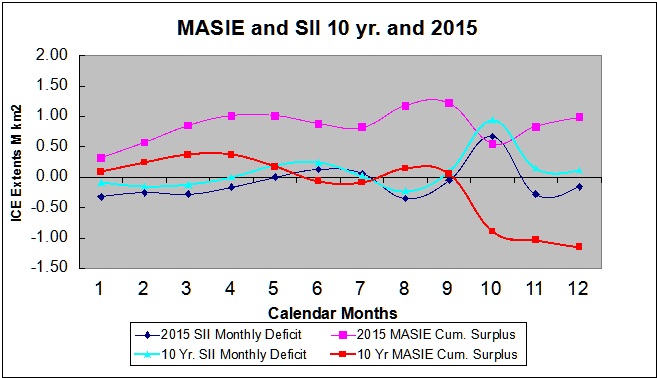
Needless to say, “Ice Free” never happened.  It is true that in the last ten years, August and September monthly extents declined slightly, but the other ten months have increased more than twice as much.  So the over all trend has been slightly upward.

Here is the current image from NASA:

Figure 2: Color-coded map of the daily sea ice concentration in the Northern Hemisphere for the indicated recent date along with the contours of the 15% edge during the years with the least extent of ice (in red) and the greatest extent of ice (in yellow) during the period from November 1978 to the present. The extents in km2 for the current and for the years of minimum and maximum extents are provided below the image. The different shades of gray over land indicate the land elevation with the lightest gray being the highest elevation. Source: NASA


For comparison, here is the ice chart from MASIE:


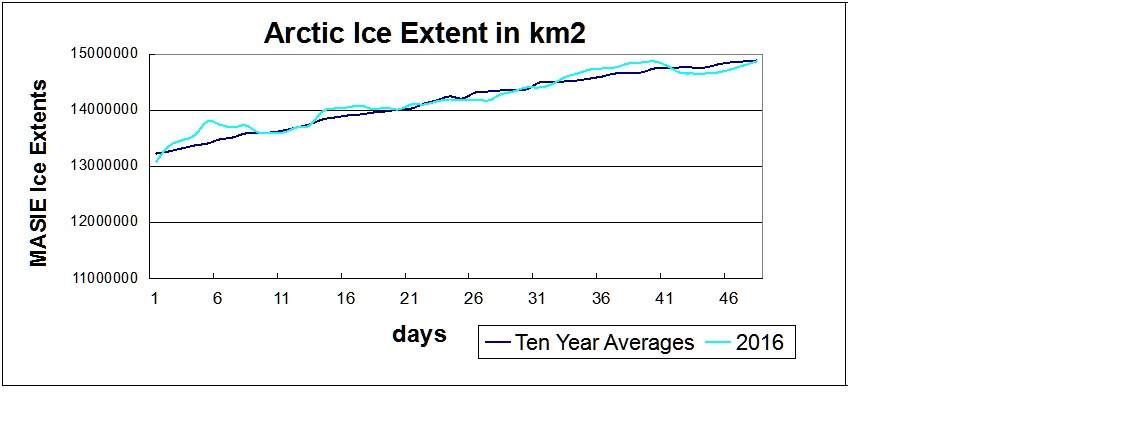
The comparable MASIE image is showing about 500k km2 more ice than the NASA image. Through mid February, 2016 is following the average winter ice growth over the last ten years, and is greater than 2015 which had a maximum below average. The NSIDC Ice Index is running behind MASIE by about 600k km2.

masie 2016 jan and feb to 48It remains to be seen in March how this year’s maximum will compare to other years.

Update February 22, 2016

Some additional information on the MASIE ice product:

MASIE: Human analysis of all available input imagery, including visible/infrared, SAR, scatterometer and passive microwave, yields a daily map of sea-ice extent at a 4 km gridded resolution, with a 40% concentration threshold for the presence of sea ice. In other words, if a gridcell is judged by an analyst to have >40% of its area covered with ice, it is classified as ice; if a cell has <40% ice, it is classified as open water.

The passive microwave sea-ice algorithms are capable of distinguishing three surface types (one water and two ice), and the standard algorithms are calibrated for thick first-year and multi-year ice (Cavalieri, 1994). When thin ice is present, the algorithms underestimate the concentration of new and thin ice, and when such ice is present in lower concentrations they may detect only open water. The underestimation of concentration and extent of thin-ice regions has been noted in several evaluation studies

Melt is another well-known cause of underestimation of sea ice by passive microwave sensors.

Meier et al. How do sea-ice concentrations from operational data compare with passive microwave estimates? Implications for improved model evaluations and forecasting

Click to access a69a694.pdf


Arctic Not a Refrigerator

People are duped by false alarms about Arctic sea ice because they have (subliminally) bought into the notion likening the Arctic to their home refrigerator. This post is to dissuade you from taking on board that false analogy.

Inside Your Fridge
When you put liquid water into your fridge, it releases heat, both sensible and latent, the air in the compartment warms and the heat engine extracts the warming to maintain a constant temperature.

The energy is substantial: it takes 417 kj per kilogram of water to go from room temperature (20C) to ice or vice-versa. The math from Wikipedia is:

To heat ice from 273.15 K to water at 293.15 K (0 °C to 20 °C) requires:

(1) 333.55 J/g (heat of fusion of ice) = 333.55 kJ/kg = 333.55 kJ for 1 kg of ice to melt
PLUS
(2) 4.18 J/(g·K) × 20K = 4.18 kJ/(kg·K) × 20K = 83.6 kJ for 1 kg of water to increase in temperature by 20 K
= 417.15 kJ

And of course if you leave the door open, the refrigeration unit is unable to remove the heat efficiently, the freezing process slows and less ice is produced. Also when electric power is lost, everything frozen starts melting and perishable food spoils.

Alarmists sometimes say that when the jet stream wanders south from the Arctic (“the polar vortex”), it is like leaving the fridge door open and sea ice will be lost as a result. This is upside down and backwards, since the Arctic does not at all resemble a refrigerator.

Inside the Arctic
In the Arctic (and also at the South Pole), the air is in direct contact with an infinite heat sink: outer space. The tropopause (where radiative loss upward is optimized) is only 7 km above the surface at the poles in winter, compared to 20 km at the equator. There is no door to open or close; the air is constantly convecting any and all energy away from the surface for radiation into space.

Instead of an open door, Arctic ice melts when the sun climbs over the horizon. Both the water and air are warmed, and the ice cover retreats until sundown in Autumn.

Most people fail to appreciate the huge heat losses at the Arctic pole. Mark Brandon has an excellent post on this at his wonderful blog, Mallemaroking.

By his calculations the sensible heat loss in Arctic winter ranges 200-400 Wm2.

The annual cycle of sensible heat flux from the ocean to the atmosphere for 4 different wind speeds.

As the diagram clearly shows, except for a short time in high summer, the energy flow is from the water heating the air.

“Then the heat loss over the 2×10⁹ m2 of open water in that image is a massive 600 GW – yes that is Giga Watts – 600 x 109 Watts.

If you want to be really inappropriate then in 2 hours, that part of the ocean lost more energy than it takes to run the London Underground for one year.

Remember that is just one component and not the full heat budget – which is partially why it is inappropriate. For the full budget we have to include latent heat flux, long wave radiation, short wave radiation, energy changes through state changes when ice grows and decays, and so on. Also large heat fluxes lead to rapid sea ice growth which then insulates the ocean from further heat loss.”

The Key Difference
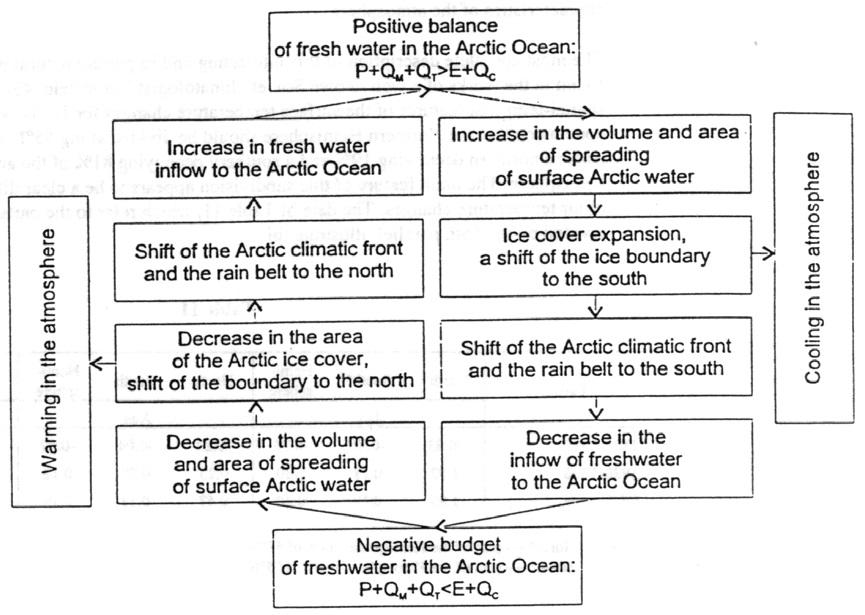
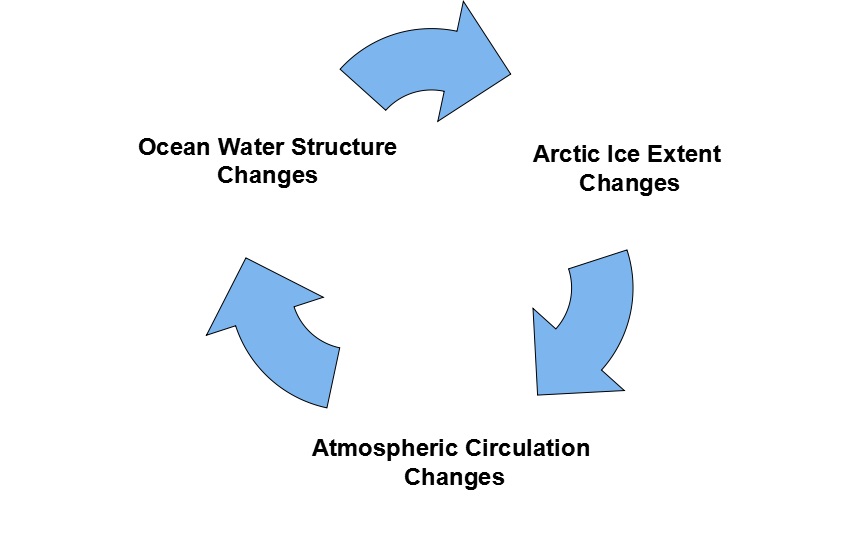
The really big paradigm shift is to understand that the sea ice extent itself regulates the periods of warming and cooling air temperatures, and not the other way around. Of course, there is a considerable lag, on the order of several decades, as you would expect in any system with massive capacity and momentum. Zakharov (here) shows how Arctic ice functions as a self-oscillating system:

Zacharov fig.24

Zacharov fig.24

Summary: Why the Arctic is not a Refrigerator

1.  A fridge makes ice by keeping the air below freezing.
The Arctic makes ice by keeping warmer water away.

2.  Ice melts in a fridge when warmer air is allowed in.
Ice melts in the Arctic when the sun shines.

3. The fridge is regulated by an air temperature sensor.
The Arctic is regulated by the ice extent itself.


Arctic Ice Rebuilding

The media and warmists ignore Arctic ice in wintertime because they are obsessed with the summer melt, and hoping for lots of open water.  In fact, ice extent trends are basically driven by the freezing this time of year, while Sept. extents vary greatly due to summer weather events, not climate change.

The press has been reporting some storm activity in the North Atlantic, and tossing words like “unprecedented” into the stories.  But keeping things in perspective, we can say that the freezing is going normally with the usual day to day fluctuations.

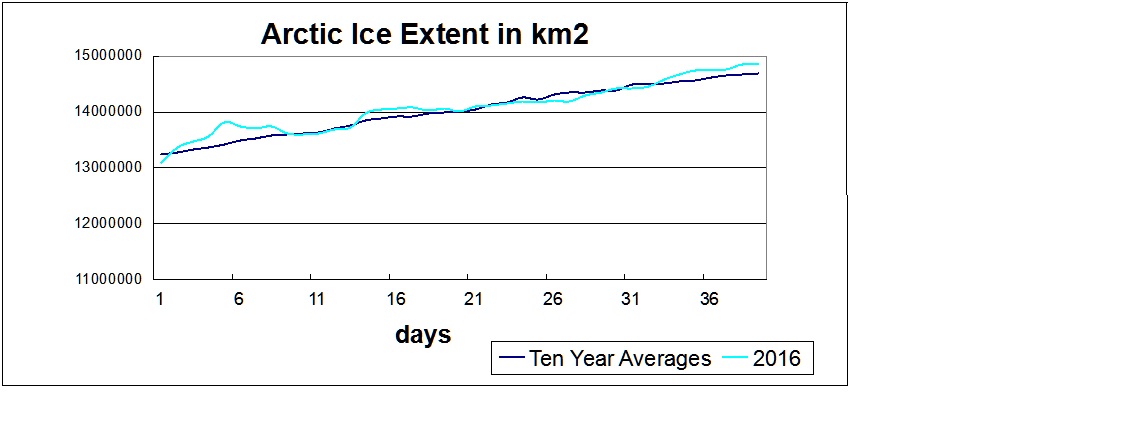
January and February show an average year in progress:

masie 2016 jan and feb to 39


Conclusion:

Do not trust mass media for unbiased reporting of climate news.

Some people don’t like the unalarming patterns of ice extents displayed by MASIE, and hang onto obsolete comments about times in the past when ice charts were inconsistent.  Today’s MASIE dataset is accurate and reliable, according to NSIDC who expressed confidence when releasing it in 2015.

About MASIE produced by NIC (from NSIDC)

The NSIDC Sea Ice Index ice extent is widely used, but the edge position can be off by 10s or in some cases 100s of kilometers. NIC produces a better ice edge product, but it does not reach the same audience as the Sea Ice Index.

In June 2014, we decided to make the MASIE product available back to 2006. This was done in response to user requests, and because the IMS product output, upon which MASIE is based, appeared to be reasonably consistent.
Note:  Presently, NSIDC Sea Ice Index is showing ~700,000 km2 less ice extent than MASIE.

Sea Ice and Sea Level Update

Post Paris sea level alarms are ramping up:
As global temperatures rise, scientists know that sea levels will follow suit. Today, global sea level is the topic of two new papers, both published in Nature Climate Change. Source: Carbon Brief, today’s date.

Fortunately, antidotes for this feverish reporting are available. Some recent research reports published this year update our knowledge of sea ice and sea level dynamics.  Two papers below are by Australians  A.Parker and C. D. Ollier. They obviously are not employed by CSIRO, since they are working hard on understanding how the climate system actually works.

Is there a Quasi-60 years’ Oscillation of the Arctic Sea Ice Extent?
A.Parker and C. D. Ollier

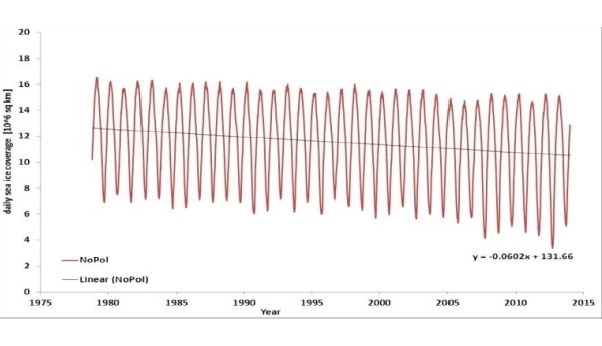
Satellite sea ice extent North Pole since 1979, the sea ice coverage anomalies. Data from NSIDC

Satellite sea ice extent North Pole since 1979, the sea ice coverage anomalies. Data from NSIDC. The shrinking of ice is consistent with the warming temperature of Fig. 3.

From the Abstract:
The Arctic sea ice experienced a drastic reduction that was phased with warming temperatures 1923 to 1940. This reduction was followed by a sharp cooling and sea ice recovery. This permits us to also conclude that very likely the Arctic sea ice extent also has a quasi-60 years’ oscillation. The recognition of a quasi-60 year’s oscillation in the sea ice extent of the Arctic similar to the oscillation of the temperatures and the other climate indices may permit us to separate the natural from the anthropogenic forcing of the Arctic sea ice. The heliosphere and the Earth’s magnetosphere may have much stronger influence on the climate patterns on Earth including the Arctic sea ices than has been thought.

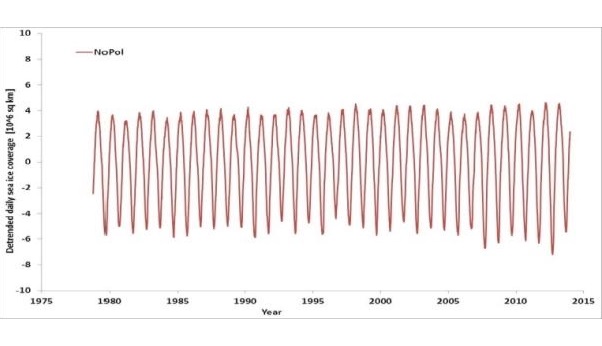
Satellite sea ice extent North Pole since 1979, the values de-trended to the linear fitting line. Data are from NSIDC. The shrinking of ice is consistent with the warming temperature of Fig. 3.

Satellite sea ice extent North Pole since 1979, the values de-trended to the linear fitting line. Data are from NSIDC.

http://sciencedomain.org/abstract/8837

This finding is entirely consistent with Zakharov’s work at AARI, (here) and with analyses (here) of fluctuating Barents and Arctic Sea Ice.


Discussion of Foster & Brown’s Time and Tide: Analysis of Sea Level Time Series
A.Parker and C. D. Ollier

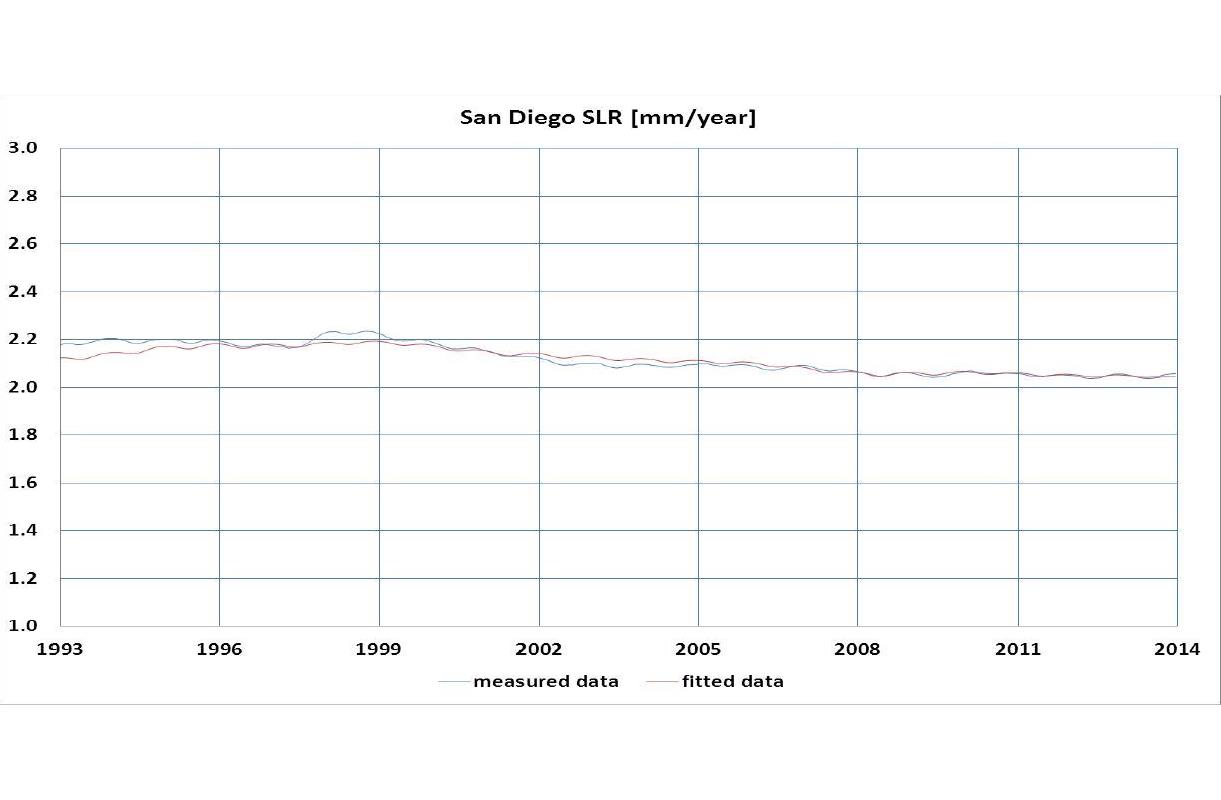
Sea level patterns in San Diego: SLR over the last 20 years.

Sea level patterns in San Diego: SLR over the last 20 years.

From the Abstract:
The recognition of the non-accelerating, periodic pattern of sea levels as described by the tide gauges measurements does not require any special mathematical tool. Providing enough data of sufficient quality have been recorded, If the classical linear fitting is used to compute the rate of rise at any time, then the acceleration is simply the time rate of change of this velocity. By using this technique, the lack of any acceleration over the last few decades is evident in the naturally oscillating, slow rising, tide gauges of appropriate quality and length.

If the sea levels have to rise 1 meter by 2100 and not only 21.5 millimeters at the worldwide average tide gauge, there is a problem of orders of magnitude difference in the sea levels computed (by climate models) and measured (by tide gauges).
http://sciencedomain.org/abstract/8091

Postscript:

It has come to my attention that both Albert Parker and Cliff Ollier have been vilified on alarmist websites, and will likely be attacked again for their latest papers, which are continuing to favor observations over projections from climate models.  For reference I provide additional responses from the two scientists to past critiques.

Cliff Ollier summarizes his views on sea ice and sea levels here:
Floating sea ice and the Archimedes principle
http://www.climatescienceinternational.org/index.php?option=com_content&id=312

In Ice shelf break-up and sea level change, Ollier says this:

In a piece in the December 11 issue of NRC/Handelsblad, Rotterdam’s counterpart to the New York Times, Wilco Hazeleger, a senior scientist in the global climate research group at KNMI (the Royal Netherlands Meteorological Institute) wrote: “In the past century the sea level has risen twenty centimetres. There is no evidence for accelerated sea-level rise. It is my opinion that there is no need for drastic measures. … Fortunately, the time rate of climate change is slow compared to the life span of the defense structures along our coast. There is enough time for adaptation.”

It would be much better if our politicians (and some scientists) based their opinions on what we can actually observe about sea level, instead of alarming us with dreams of catastrophic sea level rise based on false models of what might be happening to ice caps. Of course even if we believed sea level is rising, it takes another leap of faith to think it is caused by miniscule increases in atmospheric carbon dioxide caused by human activity.

Parker replied to defenders of consensus climate science in 2013:

It is demonstrated that the IPCC models do not reproduce the natural harmonics as the quasi-60 years cycle and overestimate the effect of the anthropic forcings. The IPCC models are shown compatible with the 1999 Mann hockey stick but unfortunately for the IPCC also incompatible with the recent temperature reconstructions. The global warming and sea level predictions for the 21st century may be consequently equally wrong. The increased heat uptake or the rising temperatures of the oceans or the accelerating seas all have similar lack of sound scientific bases.

Barents Icicles

A chart of Barents Ice Cycles looks a lot like the icicles above, except upside down since Barents Sea is usually all water by September. Notice the black lines in the graph below hitting bottom near zero.

Note also the anomalies in red are flat until 1998, then decline to 2007 and then flat again.

Why Barents Sea Ice Matters

Barents Sea is No. 1, being located at the gateway between the Arctic and North Atlantic. Previous posts (here and here) have discussed research suggesting that changes in Barents Sea Ice may signal changes in Arctic Sea Ice a few years later. As well, the studies point to changes in heat transport from the North Atlantic driving the Barents Sea Ice, along with changes in salinity of the upper layer. And, as suggested by Zakharov (here), there are associated changes in atmospheric circulations, such as the NAO (North Atlantic Oscillation).

Here we look at MASIE over the last decade and other datasets over longer terms in search for such patterns.

Observed Barents Sea Ice

Below is a more detailed look at recent years.

Barents Masierrev

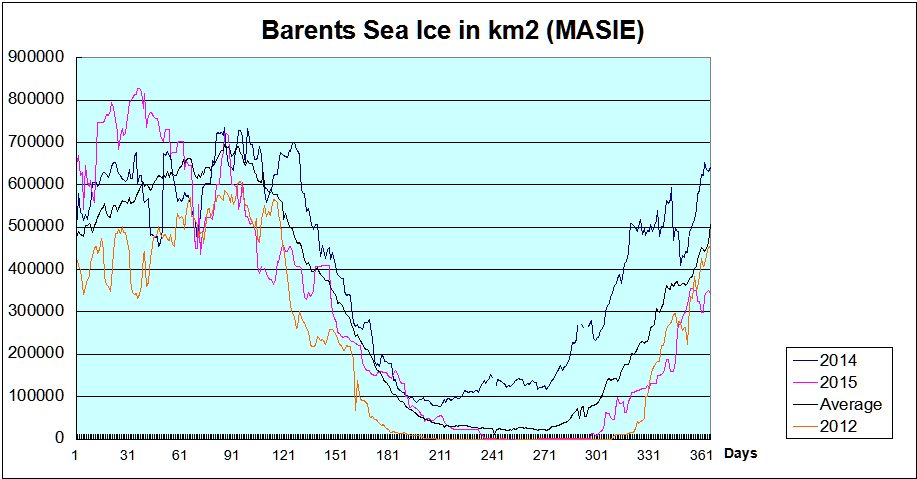
This graph shows that the last two years were outliers in opposite directions. 2014 was an exceptionally high annual average due to melting delayed until April, and then a much higher minimum and faster than average recovery. In contrast 2015 was high initially, became average by day 91, then dropped sharply to a meltout, followed by a slower recovery. 2012 shows the lowest Barents ice year contrasting with 2014, the highest annual extent in the last decade.

Annual average BSIE (Barents Sea Ice Extent) is 315k km2, varying between 250k and 400k over the last ten years. The volatility is impressive, considering the daily Maximums and Minimums in the record. Average Max is 781k, ranging from 608k to 936k. Max occurs on day 77 (average) with a range from day 36 to 103. Average Min is 11k on day 244, ranging from 0k to 77k, and from days 210 to 278.

In fact, over this decade, there are not many average years. Five times BSIE melted to zero, two were about average, and 3 years much higher: 2006-7 were 2 and 3 times average, and 2014 was 7 times higher at 77k.

As for Maxes, only 1 year matched the 781k average. Four low years peaked at about 740k (2006,07,08 and 14), and the lowest year at 608k (2012). The four higher years start with the highest one, 936k in 2010, and include 2011, 13, and 15.

Comparing Barents Ice and NAO
Barents Masierev

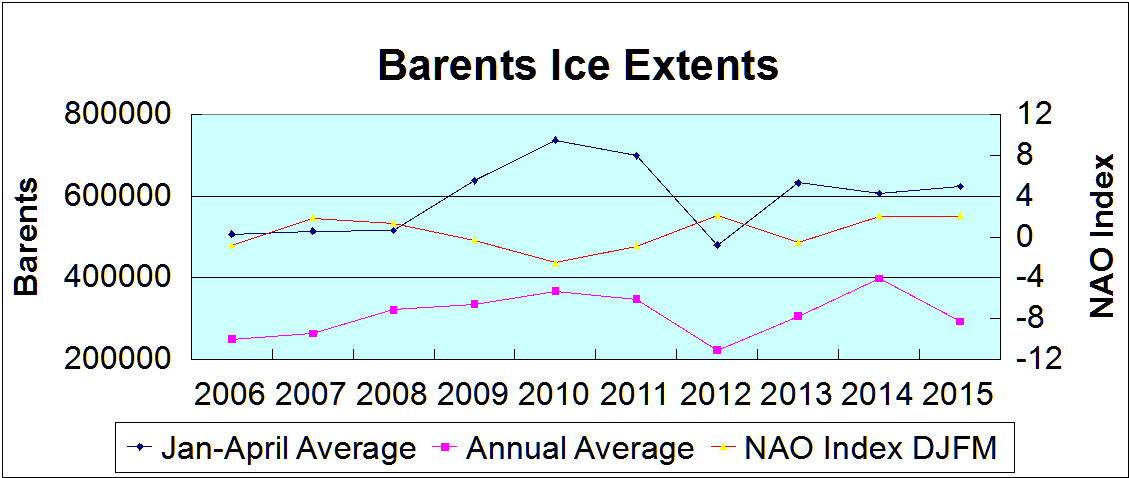
This graph confirms that Barents winter extents (JFMA) correlate strongly (0.73) with annual Barents extents. And there is a slightly less strong inverse correlation with NAO index (-0.64). That means winter NAO in its negative phase is associated with larger ice extents, and vice-versa.

Comparing Barents Ice and Arctic Annual

Barents and Arctic

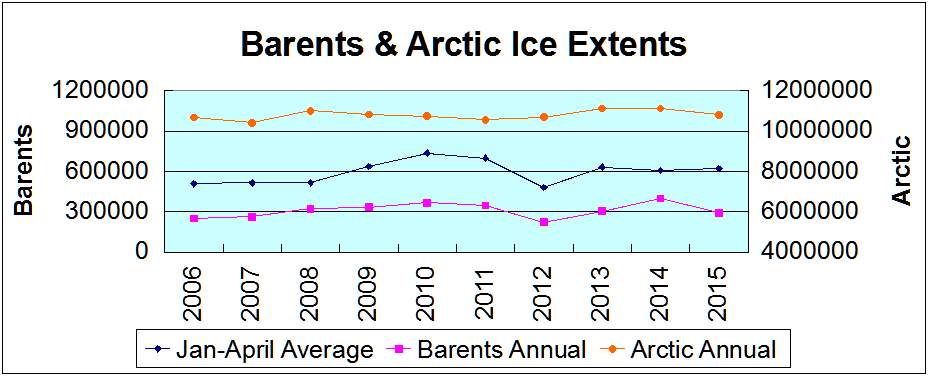
Arctic Annual extents correlate with Barents Annuals at a moderately strong 0.46, but have only weaker associations with winter NAO or Barents winter averages. It appears that 2012 and 2015 interrupted a pattern of slowly rising extents.

NAO and Arctic Ice Longer Term

Fortunately there are sources providing an history of Arctic ice longer term and overlapping with the satellite era. For example:

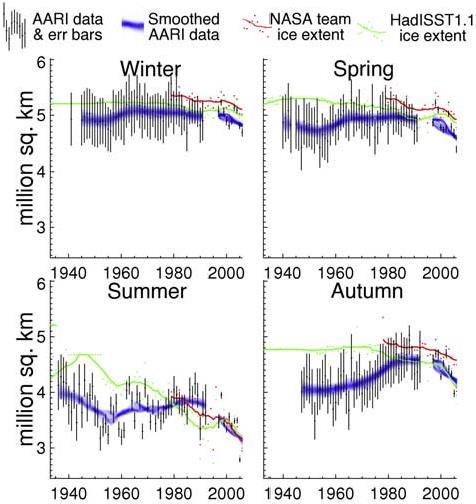
Observed sea ice extent in the Russian Arctic, 1933–2006 Andrew R. Mahoney et al (2008)
http://seaice.alaska.edu/gi/publications/mahoney/Mahoney_2008_JGR_20thC_RSI.pdf

Russian Arctic Sea Ice to 2006

Mahoney et al say this about Arctic Ice oscillations:

We can therefore broadly divide the ice chart record into three periods. Period A, extending from the beginning of the record until the mid-1950s, was a period of declining summer sea ice extent over the whole Russian Arctic, though not consistently in every individual sea. . . Period B extended from the mid-1950s to the mid- 1980s and was a period of generally increasing or stable summer sea ice extent. For the Russian Arctic as a whole, this constituted a partial recovery of the sea ice lost during period A, though this is not the case in all seas. . . Period C began in the mid-1980s and continued to the end of the record (2006). It is characterized by a decrease in total and MY sea ice extent in all seas and seasons.

Comparing Arctic Ice with winter NAO index

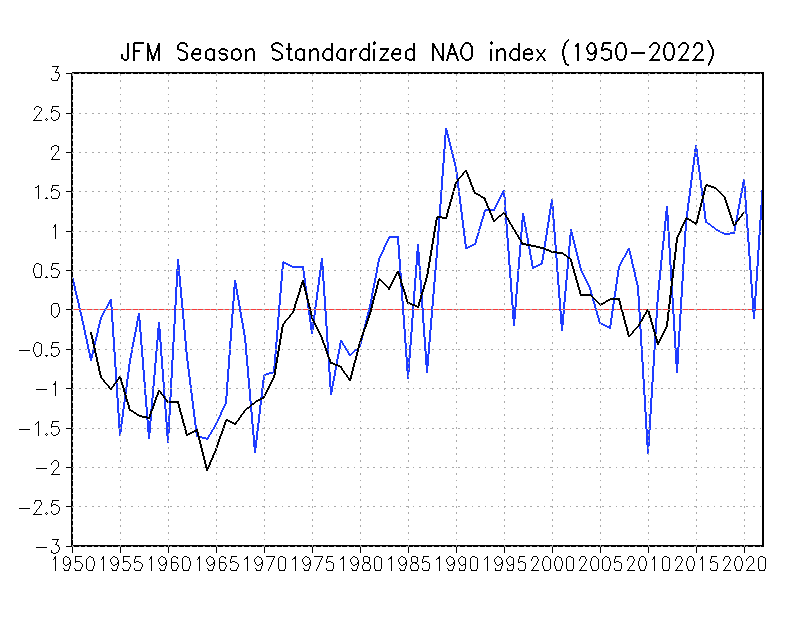
The standardized seasonal mean NAO index during cold season (blue line) is constructed by averaging the monthly NAO index for January, February and March for each year. The black line denotes the standardized five-year running mean of the index. Both curves are standardized using 1950-2000 base period statistics.

The graph shows roughly a 60 year cycle, with a negative phase 1950-1980 and positive 1980 to 2010. As described above, Arctic ice extent grew up to 1979, the year satellite ice sensing started, and declined until 2007. The surprising NAO uptick recently coincides with the anomalous 2012 and 2015 meltings.

As of January 2016 NAO has gone negative for the first time in months.

Summary

If the Barents ice cycle repeats itself over the next decades, we should expect Arctic ice extents to grow as part of a natural oscillation. The NAO atmospheric circulation pattern is part of an ocean-ice-atmosphere system which is driven primarily by winter changes in the North Atlantic upper water layer.

Self-Oscillating Sea Ice System

Self-Oscillating Sea Ice System  See here.


Hot Air about Arctic Ice

We are currently treated to another expose of the Climate Scare Machine doing its job. Perhaps you’ve seen these eyeball-grabbing headlines in the last week.

Freak storm in North Atlantic to lash UK, may push temperatures over 50 degrees above normal at North Pole @Washington Post

Arctic ‘heatwave’ hits the North Pole: Storm Frank causes temperatures to soar by 60°F taking the icy region close to melting point @Daily Mail

Arctic ‘heat wave’ sets new record low for sea ice @The Weather Network

These rumor mills start with a factoid, in this case an unusual weather event. Then some know-nothing “journalists” look for quotes from scientists who should know better, but want to grab attention with a sound-bite. Then the editors are off to the races making up headlines to raise circulations and advertising rates.

So, there was a storm called Frank, and it did push warm, moist air toward the North Pole.  From NSIDC (here)

The event was linked to the combination of a very strong low pressure system near Iceland and a somewhat less intense low pressure system located near the North Pole. . . This created a strong, deep inflow of warm, moist air into the Arctic Ocean’s high latitudes. The low near Iceland strengthened rapidly in the last days of December, reaching a minimum pressure of 935 millibars, equivalent to a hurricane. While the event was remarkable and may account for the slow ice growth during the first few days of January 2016, it was short lived and is unlikely to have any long-term effects on the sea ice cover.

And yes, there was a pause in the rate of ice growth in December.

MASIE Dec-Jan 2015 & 16

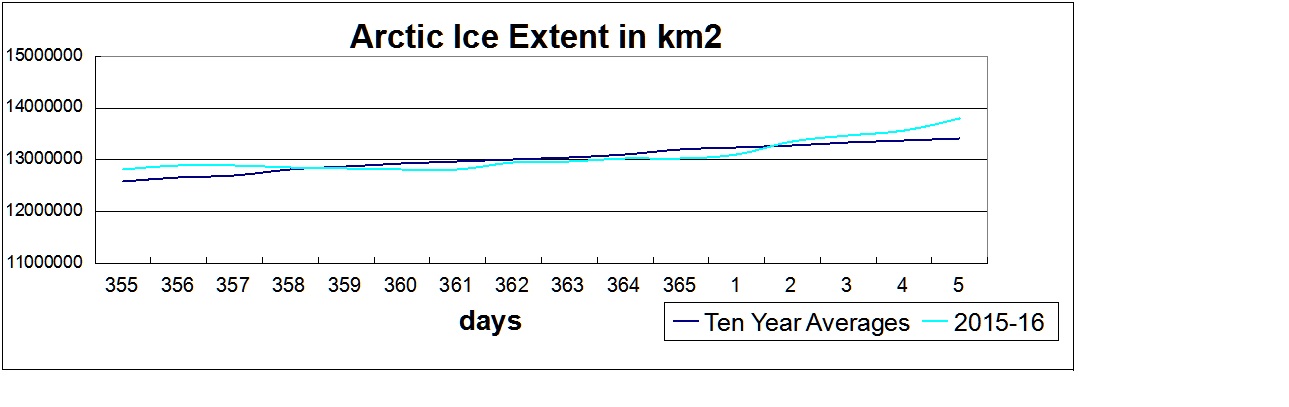
Here is MASIE data for the last 16 days (Dec. 21 through Jan. 5) compared to averages for the last decade. You can see the pause, and then the acceleration of ice growth in 2016, moving almost 400k km2 above average.

Conclusion:

Do not trust mass media for unbiased reporting of climate news.

And they are pulling the same trick, hoping to melt the Greenland ice sheet by blowing hot air over it.  What you need to know:  Greenland is Melting! Really?

About MASIE produced by NIC (from NSIDC)

The NSIDC Sea Ice Index ice extent is widely used, but the edge position can be off by 10s or in some cases 100s of kilometers. NIC produces a better ice edge product, but it does not reach the same audience as the Sea Ice Index.

In June 2014, we decided to make the MASIE product available back to 2006. This was done in response to user requests, and because the IMS product output, upon which MASIE is based, appeared to be reasonably consistent.

Footnote:

Maybe if all that hot air could be captured, it could be useful, like this:

But wait!  That hot air appears to be rising, rather descending to melt the ice. Hmmm.

Happy Arctic Ice Year!

Update January 3, below.

This year end report shows there is no reason to worry about Arctic ice melting. Against the odds, 2015 recovered from:
The blob melted Bering Sea a month early; it’s now well ahead of 2014.
An August storm pushed extent down for 28 days; it now nearly matches 2014.

masie day 2015365r

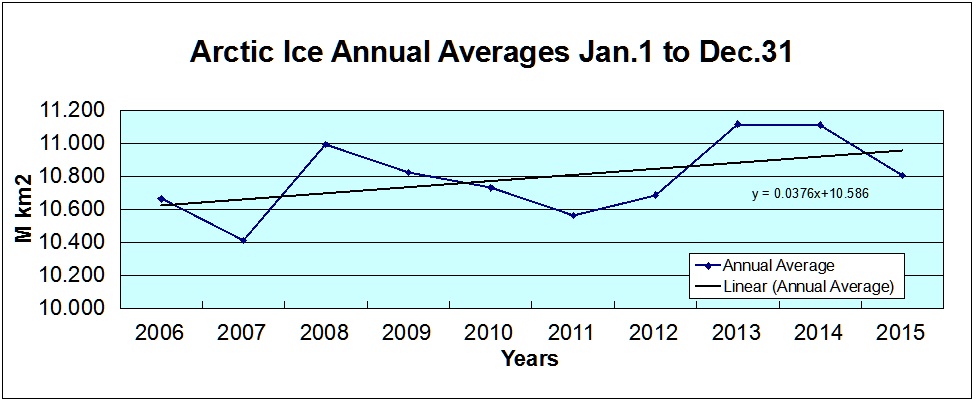
MASIE measurements show that 2007 ice extent was lower than any year since. It is now confirmed that 2015 average annual extent exceeds 2007 by about 400,000 km2. That difference arises from comparing 2007 annual average of 10.414 M km2 with 2015 average through day 365 of 10.808. That makes 2015 virtually tied with 2009 for fourth place in the last ten years.

Summary:

Arctic ice declined in the decade prior to 2007, but has not declined since.

Alarmists chafe at the words “growing” and “recovery”, and I use them poetically to counter “death spiral” terminology. What we have seen in the last decade is a plateau in Arctic ice extent, analogous to the plateau in surface temperatures. The rise since 2007 is slight and not statistically important, just as the loss of ice from 1979 to 1994 in the NOAA dataset was too slight to count as a decline.

Note:   Something unusual happened in the MASIE record.  After increasing ice extent steadily at a rate of 87k km2 per day after Dec. 10, MASIE stopped showing growth and declined a bit after Dec. 23.  Ice extent was lost in Kara, Barents and Greenland Seas.  That allowed NOAA extent to catch up and reduce its deficit.  Previously, NOAA showed ~400k km2 less than MASIE, that difference being typical historically.  For the year NOAA shows about 200k km2 less than MASIE, both at year end and for the annual average.

MASIE Comparison 2014 and 2015 Day 365

Ice Extents Ice Extent
Region 2014365 2015365 km2 Diff.
 (0) Northern_Hemisphere 13330376 13027597 -302778
 (1) Beaufort_Sea 1070445 1070445 0
 (2) Chukchi_Sea 966006 965989 -17
 (3) East_Siberian_Sea 1087137 1087120 -17
 (4) Laptev_Sea 897845 897809 -36
 (5) Kara_Sea 935023 876266 -58757
 (6) Barents_Sea 641686 342398 -299288
 (7) Greenland_Sea 619029 557954 -61075
 (8) Baffin_Bay_Gulf_of_St._Lawrence 1023477 1181297 157820
 (9) Canadian_Archipelago 853214 853178 -36
 (10) Hudson_Bay 1260903 1260723 -181
 (11) Central_Arctic 3245389 3202967 -42422
 (12) Bering_Sea 255711 373594 117883
 (13) Baltic_Sea 7527 2850 -4677
 (14) Sea_of_Okhotsk 454321 345063 -109258
 (15) Yellow_Sea 4475 4312 -163
 (16) Cook_Inlet 130 4490 4360

The small overall difference between 2014 and 2015 at this point matches the deficit in Barents Sea. The major basins have recovered: Central Arctic,  BCE (Beaufort, Chukchi, East Siberian), Canadian Archipelago.  Bering Sea is freezing well ahead of last year, as is Baffin Bay, offsetting deficits elsewhere except for Barents.

Technical Note:  Changes in Ocean Water Structure drive changes in Arctic Ice Extent, and air temperature varies as a result, not the cause.

https://rclutz.wordpress.com/2015/12/23/arctic-sea-ice-self-oscillating-system/


Melt ponds refreezing in the Arctic.

Update January 3, 2015

Neven is the first to attack this post in comments below, followed by a post at his own blog in which he says:

“misleading and embarrassing statements”
“older gentleman”
“mind set in concrete”
“taken apart by Tamino”
“data misrepresentation”

And on cue Tamino’s (Foster’s) attack dogs are coming here.  Now I responded to all of Neven’s and Foster’s bogus objections in Sept. (here). Since they either did not read or did not understand, I will repeat the salient points again.

Warmists fail to see that having two different tracking methods for a climate phenomenon is a good thing.  With temperatures they favor the land surface record and abhor the satellite temps.  With Sea Ice they like the satellite reports and abhor the navigational observations.  JAXA, DMI, NORSEX and NOAA (or NSIDC) are all using data from passive microwave sensors on satellites to estimate ice extents.  Some  differences arise from differing algorithms at each center.

Naval authorities have for centuries prepared ice charts for the safety of ships operating in the Arctic.  There are Russian, Danish, Norwegian, and Canadian charts, in addition to MASIE, the US version.  These estimates rely on multiple sources of data, including the NASA reports.  Charts are made with no climate ax to grind, only to get accurate locations and extents of Arctic ice each day.

MASIE is not the only dataset to show this lull in Arctic ice decline. It is also obvious in Foster’s final graph.  I showed how the same pattern appears in the NOAA (technically NOAA@NSIDC) dataset (here).  Those who object that a decade is too short to claim a recovery were quick to claim a decline (even a “death spiral”) based on a decade-long loss of ice ending in 2007.

Some were upset that I used the MASIE data, despite NSIDC cautions against it.  For the record, the NSIDC Background cites as support a study by Partington et al (2003).  Reading that study, one finds that the authors preferred the MASIE data and said this:
“This analysis has been based on ice chart data rather than the more commonly analyzed passive microwave derived ice concentrations. Differences between the NIC ice chart sea ice record and the passive microwave sea ice record are highly significant despite the fact that the NIC charts are semi-dependent on the passive microwave data, and it is worth noting these differences. . .In summer, the difference between the two sources of data rises to a maximum of 23% peaking in early August, equivalent to ice coverage the size of Greenland.” (my bold)  For clarity: the ice chart data show higher extents than passive microwave data.

http://digitalcommons.unl.edu/cgi/viewcontent.cgi?article=1058&context=usdeptcommercepub

In any case, NSIDC’s last word was this:  “In June 2014, we decided to make the MASIE product available back to 2006. This was done in response to user requests, and because the IMS product output, upon which MASIE is based, appeared to be reasonably consistent.”  And thus, the data appeared this September.


Settled Science: Snowflakes


Every winter day across the Northern Hemisphere millions of cross-country skiers rely on the settled science of snowflakes. The practical application involves the use of wax in order to “stride and glide” across the snow.

How does it work? You glide on the tips and tails of the skis, so you put on those spots a very hard wax, like paraffin, that makes little friction with the snow. When you put your foot down in order to stride forward, you need on the ski under your boot a more sticky wax that will grip the snow for traction.

The art and science of waxing means choosing the right wax for the existing snow conditions. Snow crystals have sharper points when cold and dry, and are more rounded when warm and damp. When snow is fresh, cold and dry, a harder wax will do the job. Snow that is older, warmer or damp, requires a softer, sticker wax for traction.

If you put on too soft a wax, you get a big clump of snow attached to your ski bottom, and you would do better with snowshoes. Norwegians have gotten quite expert at this and win a lot of Olympic medals racing cross-country, along with other Scandinavians and Russians.

Here in Quebec last century Cree natives were amazed to see a Norwegian flashing through the woods over the snow, and they gave him a nickname. Until recently you could still buy his waxes branded with his legendary name: “Jackrabbit Johannsen.” (In 1982, at the age of 107, Herman Smith-Johannsen (1875-1987) was inducted into the Canadian Sports Hall of Fame.)

Of course, when the snow gets deep and stays very cold as it does in the Arctic, it compacts into solid ice, part of the ebb and flow of Arctic Sea Ice extent. When the ice cover retreats, the air becomes moist from evaporation, snow falls and the ice grows. When extensive ice restricts open water, the dry air produces too little snow to replace ice melted by the sun, and the cycle begins again.

The science is described more fully in Arctic Sea Ice: Self-Oscillating System

Arctic Sea Ice: Self-Oscillating System

The Climate System is Self-Oscillating: Sea Ice Proves It.

Scientists have studied the Arctic for a long time at the prestigious AARI: Arctic and Antarctic Research Institute St. Petersburg, Russia. V. F. Zakharov has published a complete description supported by research findings under this title: Sea Ice In the Climate System A Russian View (here)

Below I provide excerpts from this extensive analysis to form a synopsis of their view: Component parts of the climate system interact so that Arctic Sea Ice varies within a range constrained by those internal forces.

Self-Oscillating Sea Ice System

Self-Oscillating Sea Ice System

The most probable regulator of the physical geographical process can be found from analysis of the relationships between the components of the climate system. It is not necessary to investigate the cause-effect relationships between all these components in succession. It is sufficient to choose one of them, let us say sea ice, and consider its direct interaction with the atmosphere and the ocean – in the climate system and the significance of internal mechanisms in the natural process. Pg 1

The idea that the ice area growth at present can be achieved by changes in only the haline structure of the upper ocean layer, as a result of surface Arctic water overflowing onto warmer but more saline water, is supported both by calculations and empirical data. Pg. 46

First of all, it should be noted that the signs of temperature and salinity anomalies coincide in most cases: a decreased salinity corresponds to enhanced temperature and vice versa. Such similarity in the change of these parameters is impossible to explain from the point of view of the governing role of thermal conditions in the atmosphere with regard to the ocean, as the air temperature increase and decrease can result only in the change of the thermal state of sea surface layer not its salinity. Pgs. 48-49

Thus, the presented facts suggest that the most significant cause of changes in the ice cover extent are the changes in the vertical water structure in the upper ocean layer, rather than the changes of thermal conditions in the atmosphere. These changes are induced by fluctuations in the horizontal dimensions of the halocline, which are governed in turn by the expansion or reduction of the surface Arctic water mass. Pg. 49

It follows from the above that, under present day conditions, the changes in the area of the Arctic sea ice during the colder period of the year can be induced only by the change in the haline structure of the upper ocean layer. Indirectly, this change will also affect the thermal state of the atmosphere. Pg. 56

It is important to note that the ice effect on the atmosphere is not limited to the thermal effect. That it can produce a significant effect on atmospheric circulation is already evident from the fact that the Arctic anticyclone, considered by Viese [13] as a regulator of atmospheric processes in the Northern polar region, could form as a pressure formation only in the conditions of the ice regime in the Arctic. Pg. 56


Zacharov fig.24

Zakharov fig.24

An analysis of cause-effect relationships does not leave any doubt in what direction and in what order the climate signal propagates in the atmosphere-ocean-polar ice system. This is not the direction and order usually assumed to cause present climate change. When it has become clear that the changes in the ocean, caused by disturbances of its freshwater balance, precede changes in the extent of sea ice, and the latter the changes in the atmosphere, then there was nothing left but for us to acknowledge self oscillation to be the most probable explanation for the development of the natural process. Pg. 58

Maybe the most convincing evidence of the Arctic sea ice stability is its preservation during the last 700,000 years despite vast glacial- interglacial fluctuations. The surface air temperature in the Arctic during the interglacial periods was higher by several degrees than present day temperatures. Pg. 44

Conclusion:

The remarkable stability of our planetary climate system derives from feedbacks between internal parts of the system, providing the oscillations we observe as natural variability. Arctic Sea Ice is a prime example.