Clauser’s Case: GHG Science Wrong, Clouds the Climate Thermostat

This post provides a synopsis of Dr. John Clauser’s Clintel presentation last May.  Below are the texts from his slides gathered into an easily readable format. The two principal takeways are (in my words):

A.  IPCC’s Green House Gas Science is Flawed and Untrustworthy

B.  Clouds are the Thermostat for Earth’s Climate, Not GHGs.

Part I Climate Change is a Myth.

  • The IPCC and its collaborators have been tasked with computer modeling and observationally measuring two very important numbers – the Earth’s so-called power imbalance, and its power-balance feedback-stability strength. They have grossly botched both tasks, in turn, leading them to draw the wrong conclusion.
  • I assert that the IPCC has not proven global warming! On the contrary, observational data are fully consistent with no global warming. Without global warming, there is no climate-change crisis!
  • Their computer modeling (GISS) of the climate is unable to simulate the Earth’s surface temperature history, let alone predict its future.
  • Their computer modeling (GISS) is unable to simulate anywhere near the Earth’s albedo (sunlight reflectivity). The computer simulated sunlight reflected power and associated power imbalance error, are typically about fourteen times bigger than the claimed measured power imbalance, and about twenty five times bigger than the claimed measured power imbalance error range.
  • The IPCC’s observational data are wildly self-inconsistent and/or are fully consistent with no global warming.
  • The IPCC’s observational data claim an albedo for cloudy skies that is inconsistent with direct measurements by a factor of two. Alternatively, their data significantly violate conservation of energy.
  • Scientists performing the power-balance measurements admit that the available methodologies are incapable of measuring a net power imbalance with anywhere near the desired accuracy. This difficulty is due to huge temporal and spatial fluctuations of the imbalance, along with gross under-sampling of the data.
  • The observational data they report are self-inconsistent and are visibly dishonestly fudged to claim warming. The fudged final reported values, herein highlighted and exposed, are an example of the proverbial proliferation of bad pennies.
  • NOAA’s claims that there is an observed increase in extreme weather events are bogus. Their own published data disprove their own arguments. A 100 year history of extreme weather event frequency, plotted frontwards in time is virtually indistinguishable from the same historical data plotted backwards in time.
  • In Part II, I present the cloud-thermostat feedback mechanism. My new mechanism dominantly controls and stabilizes the Earth’s climate and temperature. The IPCC has not previously considered this mechanism. The IPCC ignores cloud-cover variability.

The IPCC’s two sacred tasks – both botched!

  1. The IPCC and its collaborators have been tasked with computer modeling and observationally measuring two very important numbers – the Earth’s so-called power imbalance, and its power-balance feedback-stability strength.
  2. The Earth’s net power imbalance is its sunlight heating power (its power-IN), minus its two components of cooling power – reflected sunlight and reradiated infrared power (its power-OUT).
  3. Based on their claimed power imbalance and global-warming assertion, the IPCC and its collaborators assemble a house of cards argument that forebodes an impending climate change apocalypse/ catastrophe.
  4. Additionally, the IPCC and its contributors calculate the strength of naturally occurring feedback mechanisms that presently stabilize the Earth’s temperature and climate
  5. They claim only marginal effectiveness for these mechanisms, and correspondingly assert that there is a “tipping point”, whereinafter further added greenhouse gasses catastrophically cause what amounts to a thermal-runaway of the Earth’s temperature.
  6. The IPCC scapegoats atmospheric greenhouse gasses as the cause of global warming, and further mandates that trillions of dollars must be spent to stop greenhouse gas release into the environment with a so-called “zero-carbon” policy.
  7. The IPCC also mandates multi-trillion dollar per year geoengineering projects including Solar Radiation Management Systems to stabilize the Earth’s climate and CO2 capture projects to reduce the atmospheric CO2 levels.
  8. I assert that the IPCC and its contributors have not proven global warming, whereupon their house of cards collapses.
  9. My cloud thermostat mechanism’s net feedback “strength” (the IPCC’s 2nd sacred task to estimate) is anywhere from -5.7 to -12.7 W/m2/K (depending on the assumed cloud albedo, 0.36 vs. 0.8), compared to the IPCC’s botched best estimate for their mechanisms of -1.1 W/m2/K. My mechanism’s overwhelmingly dominant strength confirms that it is the dominant feedback mechanism controlling the Earth’s climate.
  10. Correspondingly, I confidently assert that the climate crisis is a colossal trillion-dollar hoax.

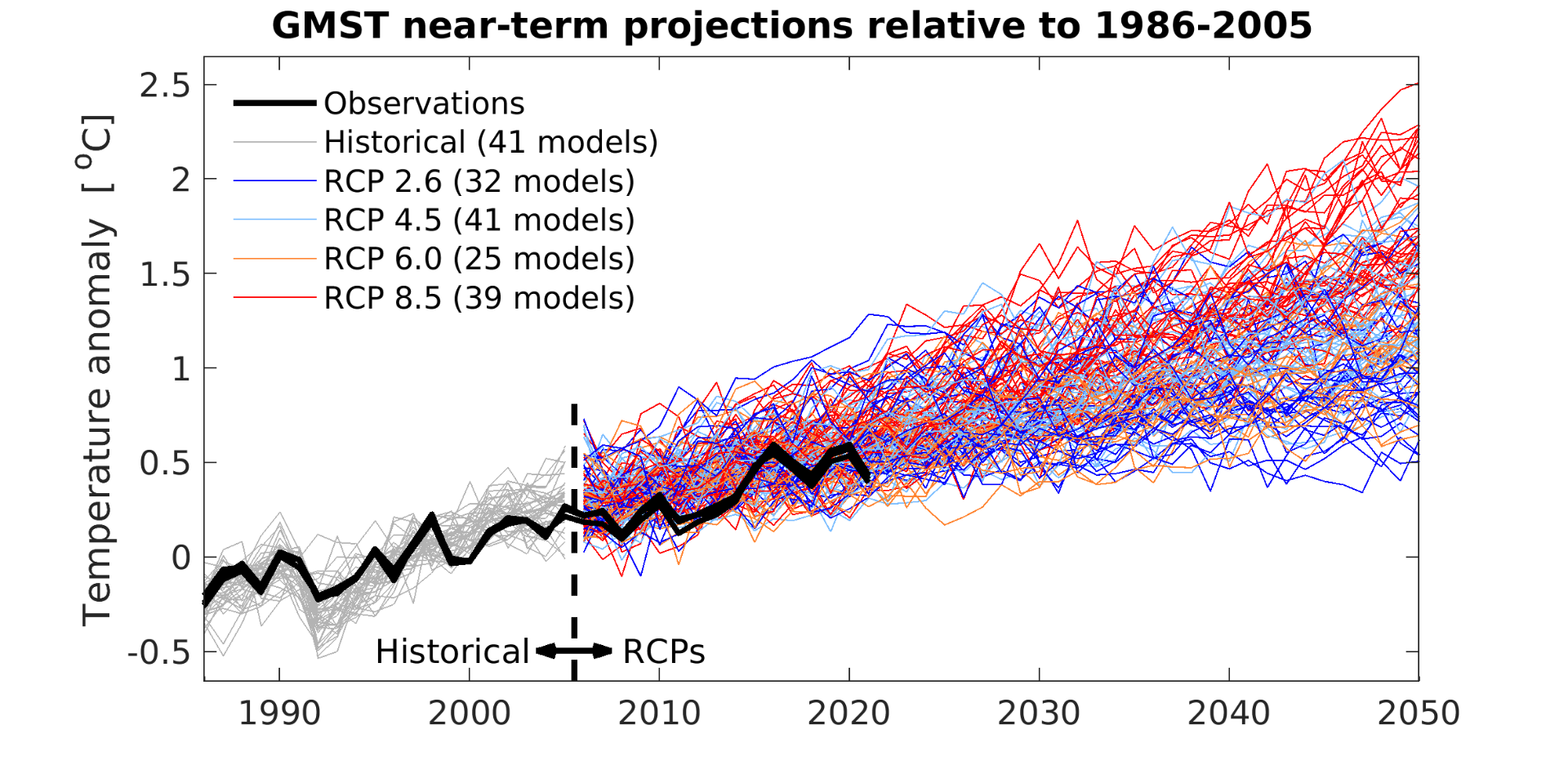
The IPCC’s computer modeling uses flawed physics to estimate the Earth’s temperature history

• The above graph is copied from [AR5, (IPCC, 2013) Fig 11.25].
• It shows the IPCC’s CMIP5 computer modeling of the Earth’s temperature “anomaly”. The various computed curves display the earth’s predicted (colored) and historical (gray) “temperature anomaly”.
• The solid black curve is the observed temperature anomaly
• Note that all 40+ models are incapable of simulating the Earth’s past temperature history. The total disarray and total lack of reliability among the CMIP5 predictions was first highlighted by Steve Koonin (former White House science advisor to Barack Obama) in his recent book- Unsettled? What climate science tells us, what it doesn’t, and why it matters.
• Something is obviously very wrong with the physics incorporated within the computer models, and their predictions are totally unreliable.
• Albedo is the fraction of sunlight power that is directly reflected by the Earth back out into space (OSR=100 W/m2 portion of power-OUT)


• The above Figure, copied from Stephens et al. (2015), shows the IPCC’s CMIP5 computer modeling (colored curves) of the Earth’s mean annual albedo temporal variation. The solid black curve is the Earth’s albedo measured by satellite radiometry. (The variation is not sinusoidal.)
• The added scale shows the associated reflected sunlight power. It assumes a constant solar irradiance – 340 W/m2
• Note that the IPCC’s computer modeling is grossly incapable of simulating the observed Earth’s reflected power, and especially incapable of simulating that power’s dramatic temporal fluctuation.
• The actual power’s annual variation is actually much greater than is shown by this Figure by about 18 W/m2, due to the ellipticity of the Earth’s orbit and the associated sinusoidal temporal variation of the so-called solar constant.
• Despite more than 10 W/m2 gross errors in the computer simulation’s calculated reflected power, as is shown on the Figure, the IPCC [AR6 (2021)] still claims that it has computer simulated and precisely measured this power, yielding an imbalance that is equal to 0.7 ± 0.2 W/m2 – Huh?

The IPCC’s observational data are consistent with NO global warming

• Power-IN is the sunlight power incident on the Earth. The IPCC and climate scientists call it Short Wavelength (SW) Radiation. It is about 340 Watts per square meter of the Earth’s surface area. (It is not actually constant, but varies ± 9 W/m2.)
• Power-OUT has two components:
• One component is the sunlight energy that is directly reflected by the Earth back out into space, whereinafter it can no longer heat the planet. That component is claimed by the IPCC to be about 100 W/m2.
• The other component is the far-infrared heat radiated into space by a hot planet. It is claimed to be about 240 W/m2. The IPCC calls the far-infrared heat radiation component, Long Wavelength (LW) Radiation.
• Measuring the power imbalance consists of measuring power-IN, measuring power-OUT and subtracting. Simple enough? Not really. The problem is that power-IN, and power-OUT are huge numbers, and that the difference between them is miniscule – 0.2% of power-IN. That miniscule difference is the net imbalance that is sought, both experimentally and theoretically.

Unfortunately, it is so small that it is very difficult, if not impossible, to measure to the desired accuracy, 0.1 W/m2, or 0.03% of power-IN. It is much tougher to measure when power-IN and power-OUT are both also hugely varying in a seemingly random irreproducible fashion. Large variations occur both in time and in space over the surface of the Earth. As noted in a previous slide, this grossly under-sampled fluctuation is about 28 W/m2, compared with the IPCC’s claimed imbalance, 0.7 ± 0.2 W/m2.
• A variety of methods has been employed to measure these powers. They include satellite radiometry, (the ERBE, and CERES Terra and Aqua satellites), ocean heat content (OHC) measured using the ARGO buoy chain and XBT water sampling by ships, and finally by ground sunlight observations using the Baseline Surface Radiation Network (BSRN).
• The various measured values are all in wild disagreement with each other. Importantly, none of the reported data actually show a convincing net warming power imbalance. Importantly, much of the reported data are totally fudged in a manner that dishonestly changes them from showing no warming to showing warming!

AR6 Power-flow Diagrams

Critiques of Power-Flow Diagrams by Trenberth et al. (2010, 2014)

• Satellites measure the Top of Atmosphere energy balance, while Ocean Heat Content data apply to the surface energy balance. One may legitimately mix power-flux data at the two different altitudes, if and only if one fully understands all of the power-flow processes in the atmosphere that occur between the surface and the Top of Atmosphere. If the latter requirement is not true, then one ends up with an “apples to oranges” comparison.
• Trenberth et al. (2010, 2014) are highly critical of Loeb, Stephens, L’Ecuyer, and Hansen’s claimed “understanding” of the associated connection between the power flows at these two altitudes.
• Trenberth and Fasullo (2010) point to a huge “missing energy” indicated by the difference between the satellite data and the OHC data power-imbalance calculations, and specifically ask “Where exactly does the energy go?”
• Hansen et al. (2011) dismiss Trenberth and Fasullo’s alleged missing energy as being simply due to satellite calibration errors.
• Trenberth Fasullo and Balmesada (2014) further note that despite various considerations of the surface power balance, significant unresolved discrepancies remain, and they are skeptical of the power imbalance claims.
• In effect, Trenberth et al. are the earliest “whistle blowers” to the above-mentioned data fudges.

Part I –The Climate Change Myth– Conclusions

1. The IPCC and its contributors claim the Earth has a net-warming energy imbalance. I show here that those claims are false.
2. The IPCC bases its claims on computer modeling of the Earth’s atmosphere, and on observational data from a variety of observational modalities. Both the computer models and the observational data are grossly flawed, and fudged.
3. The IPCC’s computer modeling and its predictions are totally unreliable. There is something clearly very wrong with the physics incorporated within these computer models. Since the computer models can’t even explain the past, why should anyone trust their prediction for the future?
4. Not one of the observational modalities for measuring the Earth’s power imbalance convincingly shows net global warming.
5. I show where various observers and the IPCC have dishonestly fudged their reported data, and have dishonestly changed it from showing No Warming, to showing Warming. Crucially important data fudges are revealed here and highlighted in red. If you don’t believe me, check my arithmetic.
6. The IPCC and NOAA further claim that the purported power imbalance has already caused an increase in dangerous extreme weather events. NOAA’s own data disprove their own claims.
7. I thus offer Great News. Despite what you may have heard from the IPCC and others, there is no real climate crisis! The planet is NOT in peril!
8. The IPCC’s (and NOAA’s) claims are a hoax. Trillions of dollars are being wasted.

Part II – The cloud thermostat 

1. So what is really happening? Why is the earth’s climate actually as stable as it really is?
2. The cloud thermostat mechanism is clearly the overwhelmingly dominant climate controlling feedback mechanism that controls stabilizes the Earth’s climate and temperature. It thereby prevents global warming and climate change.
3. The cloud-thermostat mechanism provides very powerful feedback that stabilizes the Earth’s climate and temperature. It great strength obtains from the observed large fluctuation of the Earth’s power imbalance.
4. The mechanism gains its strength from the Earth’s observed very large cloud-cover variation. The power imbalance is actually observed to be continuously strongly fluctuating by anywhere between 18 to 55 W/m2.
5. Clouds modulate the outgoing Shortwave power and therefore control the Earth’s power imbalance, minimally with a 18 W/m2 available power range (ignoring the added 18 W/m2 solar-constant variation), which is minimally 26 times the IPCC’s 0.7 W/m2 claimed power imbalance, and 45 times the IPCC’s ± 0.2 W/m2 power imbalance error range.
6. The above numbers use the IPCC’s assumed data parameters. With more realistic assumptions, the cloud-thermostat mechanism controls the Earth’s power imbalance with a 73 W/m2 available power range, which is 100 times bigger than the IPCC’s 0.7 W/m2 claimed power imbalance, and 180 times bigger than the IPCC’s ± 0.2 W/m2 power-imbalance total error range.
7. This seemingly random fluctuation of the power imbalance is not random at all, but is actually a crucial part of a thermostat-like feedback mechanism that controls and stabilizes the Earth’s climate and
temperature. It is observed by King et al. (2013) and by Stephens et al. (2015) to be quasi-periodic,
8. Just like the thermostat in your home, the power-imbalance is never zero. The furnace or AC is always either ON or OFF. The thermostat simply modulates the heating/cooling duty cycle.

Features of the cloud thermostat mechanism

1. In preparation for the introduction of this model, I first describe important, underappreciated, but conspicuous properties of clouds – their variability and their strong reflectivity of sunlight (SW radiation).
2. I show that the cloud-thermostat mechanism involves the dominant (73%) use of sunlight energy by the planet.
3. I show that when the cloud-thermostat mechanism is viewed as a form of climate-stabilizing negative feedback, it is by far the most powerful of any such mechanism heretofore considered.
4. The IPCC estimates that the net stabilizing feedback strength or the Earth’s climate, including the destabilizing feedback strength of greenhouses is about -1 W/m2/ºC.
5. I show that the cloud thermostat feedback increases the net natural stabilizing feedback strength to about anywhere between -7 W/m2/ºC and -14 W/m2/ºC, depending on the assumptions used.

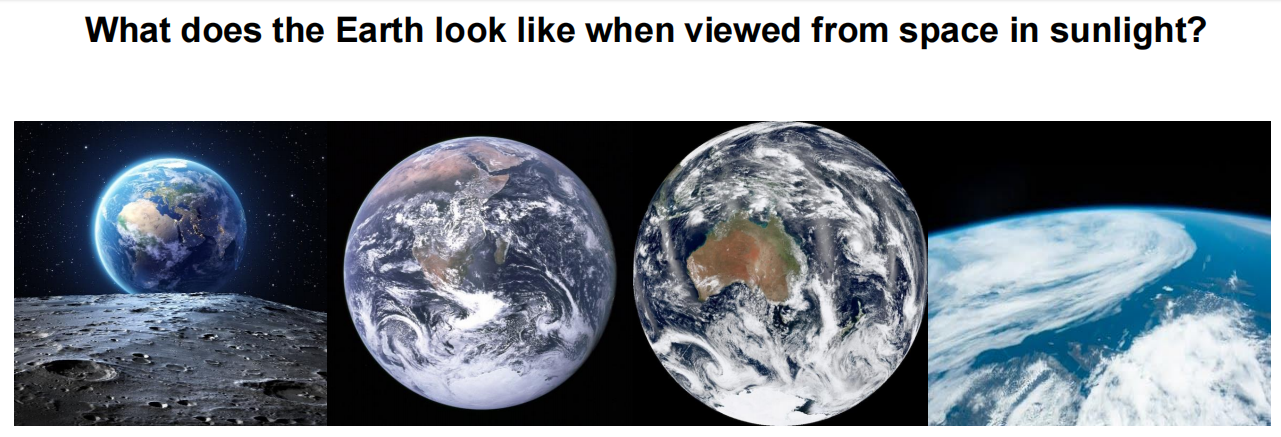
There are 5 important take-home messages to be gleaned from these satellite photographs.

1. Clouds reflect dramatically more sunlight than the rest of the planet does!
2. Clouds of all types appear bright white!
3. The photos (along with a large number of careful measurements) strongly suggest that the average cloud reflectivity (of sunlight) is about 0.8 – 0.9. (For comparison, white paper has a reflectivity of ≈ 0.99.) [Wild et al.(2019) claim that cloud reflectivity is 0.36.]
4. The rest of the planet appears much darker than the clouds. The average reflectivity of land (green and brown areas) and ocean (dark blue areas) is ≈ 0.16.
5.Cloud coverage area is highly variable over the Earth.

What does sunlight mostly do when it reaches the Earth’s surface?

• It is commonly believed that sunlight that is absorbed by the Earth’s surface simply warms the surface. That may be true over land. But land represents only about 30% of the surface.
• Oceans cover 70% of the Earth’s surface. Correspondingly, about 70% of incoming sunlight falls on the oceans. Virtually all of the Earth’s exposed water surface occurs in the oceans.
• Following the AR6 power-flow diagram, 160 W/m2is absorbed by the whole Earth, meaning that roughly 70% X 160 = 112 W/m2 is absorbed by oceans.
• The AR6 power-flow diagram indicates that 82 W/m2 is used for evaporating water, and not for heating the surface.
• Since clouds are mostly produced over the oceans (because that’s where the exposed water is), then 82/112 = 73% of the input energy absorbed by the Earth’s oceans is used, not for warming the Earth, but instead simply for making clouds.

How does the cloud thermostat work?

1. Recall that the IPCC’s AR6 power-flow map asserts that 73% of the input energy absorbed by the Earth’s oceans is used, not for warming the Earth, but instead simply for evaporating seawater and making clouds, rather than for raising the Earth’s surface temperature. Recall that the Earth has a strongly varying cloud cover and albedo.
2. Temperature control of the Earth’s surface by this mechanism works exactly the same way as does a common home thermostat. A thermostat automatically corrects a structure’s temperature in the presence of varying modest heat leaks. For the earth, the presence of significant CO2 in the earth’s atmosphere, manmade or not, provides, in fact, a very small heat leak (at most, about 2 W/m2).  Note that, just like the Earth, the power imbalance for a thermostatically controlled system is never zero. It is always fully heating or fully cooling.
3. How does the cloud thermostat work? When the Earth’s cloud-cover fraction is too high, then the earth’s surface temperature is too low. Why? Clouds produce shadows. Cloudy days are cooler than sunny days. A high cloud-cover fraction equals a highly shadowed area. With reduced sunlight reaching the ocean’s surface and lower temperature, the evaporation rate of seawater is reduced. The cloud production rate over ocean (70% of the earth) is low because sunlight is needed to evaporate seawater. The earth’s too-high cloud-cover fraction obediently starts to decrease. Very quickly, cloud-cover fraction decreases, the temperature increases. The Earth’s cloud-cover fraction is no longer too high. Equilibrium cloud cover and temperature are restored.
4. When the Earth’s cloud-cover fraction is too low, the surface temperature is then too high, then the reverse process occurs. With low cloud cover, lots of sunlight reaches the ocean surface. Increased sunlit area then evaporates more seawater. The cloud-production rate obediently increases and the cloud-cover fraction is no longer too low . Equilibrium cloud cover and temperature are again restored.
5. Depending of one’s assumption regarding cloud reflectivity (albedo), the cloud thermostat mechanism has anywhere between 18 and 55 W/m2 power available from cloud-fraction variability to overcome a wimpy 0.7 W/m2 heat leak (allegedly blamed on greenhouse gasses) and to stabilize the Earth’s temperature, no matter what the greenhouse gas atmospheric concentration is!
6. These two fluctuating opposing processes, when in equilibrium, provide an equilibrium cloud-cover fraction, and an equilibrium average temperature. The earth thus has a built in thermostat!

Feedback strength of the cloud thermostat mechanism

1. The resulting cloud-thermostat mechanism’s feedback parameter is now readily evaluated under the two scenarios associated with two choices for cloud albedo. The details of the calculation are shown in Appendix D.
2. Using the AR6 choice for cloud albedo, αClouds = 0.36, we have λClouds ≈ – 5.7 W/m2 K, which is 1.7 times larger than (the misnamed) λ Planck , heretofore the strongest feedback term.
3. Alternatively, using the more reasonable choice for cloud albedo, αClouds = 0.8, we have λClouds ≈ -12.7 W/m2 K, which is 3.8 times larger than (the misnamed) λPlanck.
4. These values are plotted as an extension of the AR6 Figure 7.1, which shows the feedback strength for various mechanisms. The total system strength is shown in the left-hand column.
5. Viewed as a temperature-control feedback mechanism, in either scenario, the cloud thermostat has the strongest negative (stabilizing) feedback of any mechanism heretofore considered.
6. It very powerfully controls and stabilizes the Earth’s climate and temperature.

Part II – Conclusions

1. I have introduced here the cloud-thermostat mechanism. It is clearly the overwhelmingly dominant climate controlling feedback mechanism that controls stabilizes the Earth’s climate and temperature. It thereby prevents global warming and climate change.
2. The IPCC’s 2021 AR6 report (p.978) claims that climate stabilizing natural feedback mechanisms have a net (total) stabilizing strength of -1.16 ± 0.6 W/m2/K. My cloud feedback mechanism has a net stabilizing strength of anywhere between -5.7 to -12.7 W/m2/K, depending of one’s assumptions regarding the albedo of clouds.
3. My cloud thermostat mechanism provides nature’s own Solar Radiation Management System. This mechanism already exists. It is built in to nature’s own cloud factory. It works very well to stabilize the Earth’s temperature on a long term basis. And, it is free!

“Recommendations for policy makers”

1. There is no climate crisis! There is, however, a very real problem with providing a decent standard of living to the world’s now enormous population. There is indeed an energy shortage crisis. The latter is being unnecessarily exacerbated by what, in my opinion, is incorrect climate science, and by
government’s associated incorrect muddled response to it.
2. Government and business are currently needlessly spending trillions of dollars on efforts to limit the greenhouse gasses, CO2 and CH4, in the Earth’s atmosphere.
3. CO2 and CH4 are not pollutants. They must be removed from every list of defined pollutants. They have a negligible effect on the climate. Trillions of dollars can be saved by this one simple measure alone! Additionally, the CO2 Coalition points out that atmospheric CO2 is actually beneficial.
4. I recommend that all efforts to limit environmental carbon should be terminated immediately! Trillions of dollars can be saved by eliminating carbon caps, carbon credits, carbon sequestration, carbon footprints, zero-carbon targets, carbon taxes, anti-carbon policies and fossil-fuel limits, in energy policy and elsewhere.

Climatists Deny Natural Warming Factors

After a recent contretemps at Climate Etc. with CO2 warmists, I was again reminded how insistent are zero carbon zealots to deny multiple natural climate factors, in order to attribute all modern warming to humans burning hydrocarbons. A large part of this blindness comes from constraints dictated by the IPCC to climate model builders.  Simply put, natural causes of warming (and cooling) are systematically excluded from CIMP models for the sake of the narrative blaming humans for all climate activity: “Climate Change is real, dangerous and man-made.”  A previous post later on analyzes how models deceive by excluding natural forcings.

Let’s start with a paper that seeks objectively to consider both internal and external climate forcings, including human and natural processes.  The paper by Bokuchava & Semenov was published last October and is behind a paywall at Springer.  An open access copy is here:  Factors of natural climate variability contributing to the Early 20th Century Warming in the Arctic.  Excerpt in italics with my bolds and added images.

Abstract

The warming in the first half of the 20th century in the Northern Hemisphere (NH) (early 20th century warming (ETCW)) was comparable in magnitude to the current warming, but occurred at a time when the growth rate of the greenhouse gas (GG) concentration in the atmosphere was 4–5 times slower than in recent decades. The mechanisms of the early warming are still a subject of discussion. The ETCW was most pronounced in the high latitudes of the NH, and the recent reconstructions consistently indicate a significant negative anomaly of the Arctic sea ice area during early warming period linked with enhanced Atlantic water inflow to the Arctic and amplified warming in high latitudes of the NH.

Assessing the contributions of internal variability and external natural and anthropogenic factors to this climatic anomaly is key for understanding historical and modern climate dynamics. This paper considers mechanisms of ETCW associated with various internal variability and external anthropogenic and natural factors. An analysis of the findings on the topic of long-term studies of climate variations in the NH during the period of instrumental observations does not allow one to attribute the ETCW to one particular mechanism of internal climate variability or external forcing of the climate.

Most likely, this event was caused by a combined effect of long-term climatic fluctuations in the North Atlantic and the North Pacific with a noticeable contribution of external radiative forcing associated with a decrease in volcanic activity, changes in solar activity, and an increase in GG concentration in the atmosphere due to anthropogenic emissions. Furthermore, this climate variation in high latitudes of the NH has been enhanced by a number of positive feedbacks. An overview of existing research is given, as are the main mechanisms of internal and external climate variability in the NH in the early 20th century. Despite the fact that the internal variability of the climate system is apparently the main mechanism that explains the ETCW, the quantitative assessment of the contribution of each factor remains uncertain, since it significantly depends on the initial conditions in the models and the lack of instrumental data in the early 20th century, especially in polar latitudes.
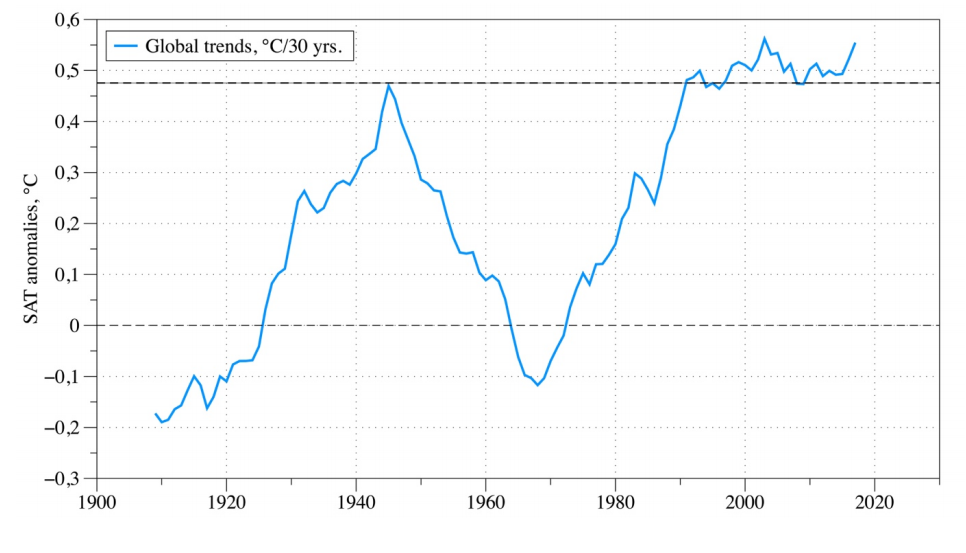
Figure 1. 30-year moving trends in global surface air temperature
(°C / 30 years) according to Berkley dataset [4]

The main cause of the recent warming is considered to be due to the anthropogenic forcing  primarily the carbon dioxide (CO2) concentration growth causing a greenhouse effect [5]. But the role of CO2 for ETCW could not be as important since this period precedes the time of the accelerating growth of radiative forcing by greenhouse gases (GHG). This GHG increase after 1950s is also inconsistent with the global SAT decline from 1940s to 1970s.

Numerical experiments with different climate model generations [6,7] show that modern warming is well reproduced when averaged over model ensembles (indicating external influence as major factor). The ETCW amplitude, despite the increasing accuracy of model simulations, still differs significantly in climate models. This may indicate the important role of internal climate variability [2], as well as the uncertainty of results of model experiments due to incorrectly specified forcing.

The majority of studies [8,9] agree that such a strong warming can be explained by a combination of internal climate system variability as quasi-periodic oscillation or random climate fluctuation with increasing global temperature in the background associated with external anthropogenic and natural forcings (increased GHGs emissions and a pause in volcanic eruptions, in particular).

This paper provides an overview of the existing hypotheses that may explain ECTW, describes the main mechanisms of internal climate variability during the twentieth century, in particular in the Arctic region.

Figure 2. Average annual SAT (°C) anomalies in the period 1900-2015,
according to Berkley observational dataset (5-year running mean), global (black curve),
Northern Hemisphere (blue curve), Southern Hemisphere (orange curve),
NH high latitudes (60°-90° N) (red curve), and NH high latitudes
without 5-yr running mean smoothing (gray curve)

Internal variability in the Arctic can be enhanced by positive radiation feedbacks [12], including surface albedo – temperature feedback, which can strongly impact the absorption of solar shortwave radiation. This mechanism manifests itself during prolonged warm periods, mainly in autumn, when a growing ice-free ocean surface with low albedo absorbs more solar radiation and warms the upper ocean layer that leads to further sea ice melting [10]. This positive radiation feedback contributes to the faster temperature increase in the Arctic. This phenomenon is now well-known as “Arctic (or Polar) Amplification”.

However, other positive feedbacks also play major roles in the Arctic Amplification. There are positive feedbacks related to long-wave radiation, for instance, an increase of water vapor content and cloud cover leads to a greenhouse effect, which is more pronounced at high latitudes [13], as well as dynamic feedbacks, which imply strengthened oceanic and atmospheric ocean heat transfer to the Arctic in the conditions of the shrinking sea ice extent [14,15].

Arctic Amplification may also be a consequence of non-local mechanisms such as enhanced northward latent heat transfer in the warmer atmosphere [16] Quasi-periodic fluctuations of North Atlantic sea surface temperature (SST) of 60-80 year time scale [17] suggest a possible role of oceanic heat transfer as a driver of long-term SAT anomalies in the Arctic that can be enhanced by positive feedbacks [18].

Thus, the amplitude of SST oscillations in the NH polar latitudes can be a combination of both regional response to global climate change and the formation of internal oscillations in the ocean atmosphere system.

Natural internal factors – ocean-atmosphere system variability
Atmosphere circulation variability

Figure 3. Winter Arctic (60°-90°N) SAT anomalies for according to
Berkley observations (5-year running mean) (black curve); NAO index (pink curve),
PNA index (blue curve) according to HadSLP2.0 dataset [25]

The North Atlantic Oscillation (NAO) and the closely related Arctic Oscillation (AO) is the dominant mode of large-scale winter atmospheric variability in the North Atlantic, characterized by sea level pressure dipole with one center over Greenland (Icelandic minimum) and another center of the opposite sign in the North Atlantic mid latitudes (Azores maximum). NAO controls the strength and direction of westerly winds and the position of storm tracks in the North Atlantic sector, thus crucially impacting the European climate [23].

During the first two decades of the 20th century, the positive phase of NAO was expressed in a stronger than usual zonal circulation over the North Atlantic (Fig. 3). The long-term dominance of these atmospheric circulation pattern led to an advection of heat to the northeastern part of the North Atlantic. However, the NAO transition to the negative phase after 1920s and in general inconsistency between NAO and Arctic SAT variations in the first half of the 20th century do not support an hypothesis of NAO contribution to the ETCW warming [24].

The Pacific North American Oscillation index (PNA) characterizes the pressure gradient between the North Pacific (Aleutian minimum) and the East of North America (Canadian maximum) and is related to fluctuations of North Pacific zonal flow. An important feature of PNA in the context of the ETCW is that both (positive and negative) PNA phases may contribute to atmospheric heat advection to the Arctic. In the 1930s and 1950s, the negative phase (Fig. 3) led to the transfer of warm air masses to the pole across the northwestern Pacific Ocean, and the positive phase of the 1940s forced increased zonal transfer to the Western coast of Canada and Alaska [8]. PNA is strongly influenced by the Pacific Southern Oscillation (El Nino Southern Oscillation – ENSO) – the positive index phase is associated with the El Nino phenomena, and the negative with La Niña events.

Atmospheric circulation in the mid-latitudes of the Pacific Ocean may also depend on fluctuations of the Pacific trade winds [28]. The trade winds weakening is manifested in the SAT growth in Pacific mid-latitudes, which coincides on the time scale with the warming of 1910-1940s in the high Arctic latitudes and in the lowering of temperatures during the cooling period between 1940s and 1970s when the strength of the trade winds had been increasing.

Ocean circulation variability

Figure 4. Winter Arctic (60°-90°N) SAT anomalies according to
Berkley dataset (5-year running mean, black curve); AMO index (pink curve),
PDO index (blue curve) according to HadiSST2.0 dataset [37]

Arctic Amplification in the 20th century, including ETCW period can be associated not only with an increase of atmospheric heat transport, but also with an enhancement of ocean heat inflow in the North Atlantic to the extratropical latitudes of the NH from its equatorial part [30].

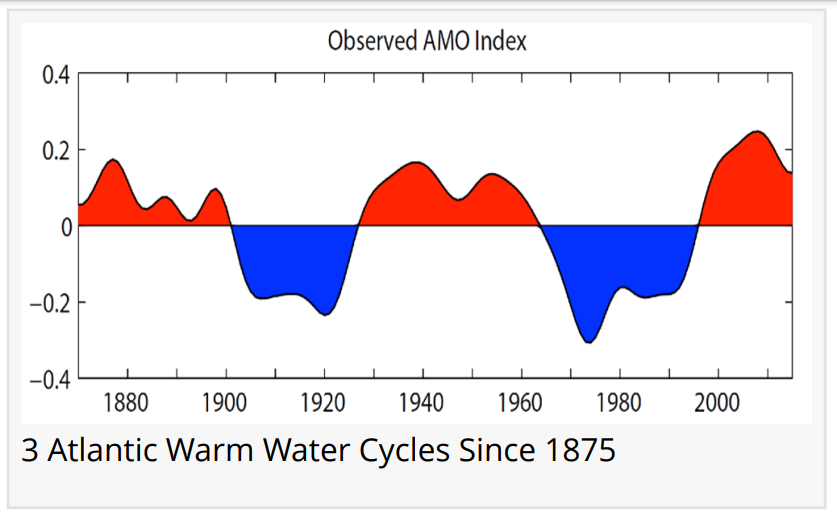
Instrumental data show that SST variability in the North Atlantic during the 20th century was dominated by cyclic fluctuations on time scales of 50-80 years, showing two warm periods in the 1930s-1940s and at the end of the 20th century and two cold periods in the beginning of the century and in the 1960s-1970s. SST oscillations in the North Atlantic are called Atlantic Multidecadal Oscillation (AMO). The observational data also indicate AMO-like cycles in the Arctic SAT (Fig. 4).

Paleo-reconstructions of AMO [33] demonstrate that strong, low-frequency (60-100 years) SSTnvariability is a robust feature of the North Atlantic climate over the past five centuries. There are also indications of a significant correlation between Arctic sea ice area and AMO index including a sharp change during ECTW period [34].

There is another pronounced internal climate variability that may act synchronously with AMO. This is the Pacific Decadal Oscillation (PDO), which reflects a variability of the Pacific SSTs north of 20° N and has 20-40 years periodicity [35]. PDO might have played an equally important role in the heat advection to the Arctic in the middle of the century. Several current studies [36,29] suggest the synchronous phase shift of AMO and PDO largely contributed to the accelerated Arctic warming, both the ongoing and ETCW.

Сonclusions

Understanding the mechanisms of ETCW and subsequent cooling is a key to determine the relative contribution of internal natural variability to global climate change on multi-decadal time scale. Studies of climate changes in high latitudes in the mid-twentieth century allows us to identify a number of possible mechanisms involving natural variability and positive feedbacks in the Arctic climate system that may partially explain ETCW.

Based on the recent literature it can be concluded that internal oceanic variability, together with additional impact of natural atmospheric circulation variations are important factors for ETCW. Recently, a number of results indicating the Pacific Ocean as a source of multidecadal fluctuation both on a global scale and in high latitudes has increased. Howewer, assessment of a relative contribution to ETCW in the Atlantic and Pacific sectors remains uncertain.

Climate model simulations [9,43,44] argue that the internal variability of the ocean-atmosphere system cannot explain the entire amplitude of temperature fluctuations in the first half of the 20th century as a single factor, and must act in combination with external forcings (solar and volcanic activity), positive feedbacks in the Arctic climate system, and anthropogenic factors. Quantifying the contribution of each factor still remains a matter of debate.

Climate Deception:  Models Hide the Paleo Incline

Figure 1. Anthropgenic and natural contributions. (a) Locked scaling factors, weak Pre Industrial Climate Anomalies (PCA). (b) Free scaling, strong PCA

In  2009, the iconic email from the Climategate leak included a comment by Phil Jones about the “trick” used by Michael Mann to “hide the decline,” in his Hockey Stick graph, referring to tree proxy temperatures  cooling rather than warming in modern times.  Now we have an important paper demonstrating that climate models insist on man-made global warming only by hiding the incline of natural warming in Pre-Industrial times.  The paper is From Behavioral Climate Models and Millennial Data to AGW Reassessment by Philippe de Larminat.  H/T No Tricks Zone. Excerpts in italics with my bolds.

Abstract

Context. The so called AGW (Anthropogenic Global Warming), is based on thousands of climate simulations indicating that human activity is virtually solely responsible for the recent global warming. The climate models used are derived from the meteorological models used for short-term predictions. They are based on the fundamental and empirical physical laws that govern the myriad of atmospheric and oceanic cells integrated by the finite element technique. Numerical approximations, empiricism and the inherent chaos in fluid circulations make these models questionable for validating the anthropogenic principle, given the accuracy required (better than one per thousand) in determining the Earth energy balance.

Aims and methods. The purpose is to quantify and simulate behavioral models of weak complexity, without referring to predefined parameters of the underlying physical laws, but relying exclusively on generally accepted historical and paleoclimate series.

Results. These models perform global temperature simulations that are consistent with those from the more complex physical models. However, the repartition of contributions in the present warming depends strongly on the retained temperature reconstructions, in particular the magnitudes of the Medieval Warm Period and the Little Ice Age. It also depends on the level of the solar activity series. It results from these observations and climate reconstructions that the anthropogenic principle only holds for climate profiles assuming almost no PCA neither significant variations in solar activity. Otherwise, it reduces to a weak principle where global warming is not only the result of human activity, but is largely due to solar activity.

Discussion

GCMs (short acronym for AOCGM: Atmosphere Ocean General Circulation Models, or for Global Climate model) are fed by series related to climate drivers. Some are of human origin: fossil fuel combustion, industrial aerosols, changes in land use, condensation trails, etc. Others are of natural origin: solar and volcanic activities, Earth’s orbital parameters, geomagnetism, internal variability generated by atmospheric and oceanic chaos. These drivers, or forcing factors, are expressed in their own units: total solar irradiance (W m–2), atmospheric concentrations of GHG (ppm), optical depth of industrial or volcanic aerosols (dimless), oceanic indexes (ENSO, AMO…), or by annual growth rates (%). Climate scientists have introduced a metric in order to characterize the relative impact of the different climate drivers on climate change. This metric is that of radiative forcings (RF), designed to quantify climate drivers through their effects on the terrestrial radiation budget at the top of the atmosphere (TOA).

However, independently of the physical units and associated energy properties of the RFs, one can recognize their signatures in the output and deduce their contributions. For example, volcanic eruptions are identifiable events whose contributions can be quantified without reference to either their assumed radiative forcings, or to physical modeling of aerosol diffusion in the atmosphere. Similarly, the Preindustrial Climate Anomalies (PCA) gathering the Medieval Warm Period (MWP) and the Little Ice Age (LIA), shows a profile similar to that of the solar forcing reconstructions. Per the methodology proposed in this paper, the respective contributions of the RF inputs are quantified through behavior models, or black-box models.

Now, Figures 1-a and 1-b presents simulations obtained from the models identified under two different sets of assumptions, detailed in sections 6 and 7 respectively.

Figure 1. Anthropgenic and natural contributions. (a) Locked scaling factors, weak Pre Industrial Climate Anomalies (PCA). (b) Free scaling, strong PCA

In both cases, the overall result for the global temperature simulation (red) fits fairly well with the observations (black).  Curves also show the forcing contributions to modern warming (since 1850). From this perspective, the natural (green) and anthropogenic (blue) contributions are in strong contradiction between panels (a) and (b). This incompatibility is at the heart of our work.

Simulations in panel (a) are calculated per section 6, where the scaling multipliers planned in the model are locked to unity, so that the radiative forcing inputs are constrained to strictly comply with the IPCC quantification. The remaining parameters of the black-box model are adjusted in order to minimize the deviation between the observations (black curve) and the simulated outputs (red). Per these assumptions, the resulting contributions (blue vs. green) comply with the AGW principle. Also, the conformity of the results with those of the CMIP supports the validity of the type of behavioral model adopted for our simulations.

Paleoclimate Temperatures

Although historically documented the Medieval Warm Period (MWP) and the Little Ice Age (LIA) don’t make consensus about their amplitudes and geographic extensions [2, 3]. In Fig. 7.1-c of the First Assessment Report of IPCC, a reconstruction from showed a peak PCA amplitude of about 1.2 °C [4]. Then later on, a reconstruction by the so-called ‘hockey stick graph’, was reproduced five times in the IPCC Third Assessment Report (2001), wherein there was no longer any significant MWP [5].

After, 2003 controversies reference to this reconstruction had disappeared from subsequent IPCC reports:it is not included among the fifteen paleoclimate reconstructions covering the millennium period listed in the fifth report (AR5, 2013) [6]. Nevertheless, AR6 (2021) revived a hockey stick graph reconstruction from a consortium initiated by a network “PAst climate chanGES” [7,8]. The IPCC assures (AR6, 2.3.1.1.2): “this synthesis is generally in agreement with the AR5 assessment”.

Figure 2 below puts this claim into perspective. It shows the fifteen reconstructions covering the preindustrial period accredited by the IPCC in AR5 (2013, Fig. 5.7 to 5.9, and table 5.A.6), compiled (Pangaea database) by [7]. Visibly, the claimed agreement of the PAGES2k reconstruction (blue) with the AR5 green lines does not hold.

Figure 2. Weak and strong preindustrial climate anomalies, respectively from AR5 (2013) in green and AR6 (2021) in blue.

Conclusion

In section 8 above, a set of consistent climate series is explored, from which solar activity appears to be the main driver of climate change. To eradicate this hypothesis, the anthropogenic principle requires four simultaneous assessments:

♦  A strong anthropogenic forcing, able to account for all of the current warming.
♦  A low solar forcing.
♦  A low internal variability.
♦  The nonexistence of significant pre-industrial climate anomalies, which could indeed be explained by strong solar forcing or high internal variability.

None of these conditions is strongly established, neither by theoretical knowledge nor by historical and paleoclimatic observations. On the contrary, our analysis challenges them through a weak complexity model, fed by accepted forcing profiles, which are recalibrated owning to climate observations. The simulations show that solar activity contributes to current climate warming in proportions depending on the assessed pre-industrial climate anomalies.

Therefore, adherence to the anthropogenic principle requires that when reconstructing climate data, the Medieval Warming Period and the Little Ice Age be reduced to nothing, and that any series of strongly varying solar forcing be discarded. 

Background on Disappearing Paleo Global Warming

The first graph appeared in the IPCC 1990 First Assessment Report (FAR) credited to H.H.Lamb, first director of CRU-UEA. The second graph was featured in 2001 IPCC Third Assessment Report (TAR) the famous hockey stick credited to M. Mann.

Rise and Fall of the Modern Warming Spike


Climate Headlines Claim, But IPCC Details Deny

The advertising proverb says it all: “The large print giveth, and the small print taketh away.”

Unfortunately, climate science is rife with this. A research announcement is released and the same text appears in media articles everywhere, the only difference being who can attach the scariest headline. One list of things claimed to be caused by global warming numbers 883, including many head scratchers. By 2012, the warmlist at numberwatch.co.uk had the better part of a thousand links to claims of disaster linked to “climate change.” The author of the website stopped adding links because the project was taking too much time.

For example: species extinctions.

WWF claims “The rapid loss of species we are seeing today is estimated by experts to be between 1,000 and 10,000 times higher than the natural extinction rate. MSNBC laments the “fact” that 100,000 species of flora and fauna will no longer be with us by next Christmas. And yet, WWF also estimates the number of identified unique species to be between 1.4 to 1.8 million, an uncertainty of 400,000. As someone said, “Anytime extinctions are claimed, ask for the names.” The debunking is done in detail here:

Another Example: Extreme Weather

Now an article published in the Australian does the fine print analysis regarding extreme weather events.  Logic leaves ‘The Science’ of climate in the dust  Thanks to John Ray for providing the text at his blog, excerpts in italics with my bolds and added images.

It is the gag order of the pseudo eco-scholar: “The Science is settled.” This is not science as we once understood it. In that discipline something could be proved false through observation and experiment. No, this is “The Science”: science as deity.

In the 20th century Karl Popper transformed the philosophy of science around the idea of falsifiability, saying: “It must be possible for an empirical scientific system to be refuted by experience.”

The first rule in Popper’s The Logic of Scientific Discovery is: “The game of science is, in principle, without end. He who decides one day that scientific statements do not call for any further test, and that they can be regarded as finally verified, retires from the game.”

So, you can spend a lifetime counting white swans, but find one black one and the thesis that all swans are white is destroyed. The black swan event happened when Europeans first encountered the impossible animal in Australia.

Prove one assumption wrong and a whole set of conclusions collapses. The Science is not real science. It is a set of beliefs, a faith. Those who demand we agree it’s settled are no different from a Catholic bishop declaring: “Roma locuta est; causa finita est” – Rome has spoken; the cause is finished.

The zealots who invoke The Science as a gag order have never read the research or wilfully ignore its infuriating uncertainty. This uncountably large group includes battalions of politicians, academics, activists, journalists and a few dozen billionaire energy-hobbyist carpetbaggers.

Case in Poiint: Claim Global Warming is Causing More Extreme Weather

Take the deeply entrenched belief that global warming is causing more extreme weather. This is so ubiquitous as to be unquestioned. It is an article of faith and there is almost no weather event nowadays that does not come with a blizzard of declarations it is proof of climate change.

Among myriad examples, let’s pick Tropical Cyclone Jasper, which hit far north Queensland in December. It dumped a massive amount of rain and none of what follows denies the fact it caused great damage and suffering. In its wake the Red Cross released an Instagram video declaring “Disasters like Ex-Tropical Cyclone Jasper in Far North Queensland are happening more often due to climate change”. Greenpeace called it a “frightening portent of what’s to come under climate change”. The Climate Council warned “climate change is making (tropical cyclones) more destructive”.

None of this is true.

If The Science of global warming has a bible then surely it must be the Intergovernmental Panel on Climate Change (IPCC) report Climate Change 2021: The Physical Science Basis. It is the latest accumulation of all the best research and it runs to a mind-numbing 2391 pages.

Cyclones

On page 1586 it says: “(Tropical cyclone) landfall frequency over Australia shows a decreasing trend in Eastern Australia since the 1800s, as well as in other parts of Australia since 1982. A paleoclimate proxy reconstruction shows that recent levels of (tropical cyclone) interactions along parts of the Australian coastline are the lowest in the past 550-1500 years.”

Pause on that. Not only does observation show there are fewer cyclones since the industrial revolution began belching extra carbon dioxide into the atmosphere, there is evidence to suggest cyclone activity in Australia is at its lowest ebb since the days of the Tang dynasty and the decline of the Western Roman Empire.

The CSIRO echoes that finding in its State of the Climate Report 2022 and adds: “The trend in cyclone intensity in the Australian region is harder to quantify than cyclone frequency, due to uncertainties in estimating the intensity of individual cyclones and the relatively small number of intense cyclones.”

Droughts

What of droughts? The IPCC finds southwestern Australia has been drying out since the 1950s and there is evidence that the length of droughts in southeastern Australia has “increased significantly”. But it says “the Millennium drought in eastern Australia was not unusual in the context of natural variability reconstructed over the past millennium” and concludes “there is currently low confidence that recent droughts in eastern Australia can be clearly attributed to human influence” (p1089).

In summary, on page 1663, it says there is low confidence in observed trends, or projected changes, to droughts in central and eastern Australia as the climate warms. In northern Australia there is medium confidence of a “decrease in the frequency and intensity of meteorological droughts”. So, more rain for the Top End then.

The report notes the major drivers of drought in Australia as well-known natural climate events: “During the last millennium, the combined effect of a positive (Indian Ocean Dipole) and El Nino conditions have caused severe droughts over Australia” (p1104).

Bushfires

What of bushfires? “Extreme conditions, like the 2019 Australian bushfires and African flooding, have been associated with strong positive (Indian Ocean Dipole) conditions” (p1104).

And, in case you were wondering, “There is no evidence of a trend in the Indian Ocean Dipole mode and associated anthropogenic forcing” and “The amplitude of the El Nino–Southern Oscillation variability has increased since 1950 but there is no clear evidence of human influence” (p1104).

World is Warming But Not in Crisis

Let’s be clear. There is plenty of evidence in the IPCC report demonstrating the climate is changing, that the world and Australia are getting warmer, and that industrial activity has played a part in forcing some of it. We should take that seriously. In response Australia should do its proportionate share in cutting greenhouse gas emissions without destroying our local ecology or impoverishing the nation.

But here is the good news: we are not facing a climate Armageddon. Again, this is not just my view but one shared by British professor Jim Skea, who was appointed chairman of the IPCC last year.

“The world won’t end if it warms by more than 1.5 degrees,” Skea told German weekly magazine Der Spiegel last year. “It will however be a more dangerous world. Countries will struggle with many problems, there will be social tensions.

Skea worries the zealots are doing their cause a grave disservice. “If you constantly communicate the message that we are all doomed to extinction, then that paralyses people and prevents them from taking the necessary steps to get a grip on climate change,” he said.

What it is also designed to do is scare people out of questioning absurd statements and bad policies.

Here there is another assault on reason by ideologues. In this game of witch burning, questioning a policy response to global warming is evidence of the crime of climate change denial. Their argument can be expressed as a syllogism.

Premise 1: Climate change is real.

Premise 2: Renewable energy combats climate change.

Conclusion: Therefore, to question renewable energy is to deny climate change.

This is the logical fallacy of a false dichotomy; it ignores the possibility of neutrality or nuance.

But logic, like science, has long since departed
in this debate. This is all about faith.

Resources

On this blog, Science Matters, several posts address specific misleading and exaggerated claims made in the media:

Arctic Sea Ice Factors

Lawrence Lab Report: Proof of Global Warming?

The Permafrost Bogeyman


IPCC the Worst Offender

But the IPCC Assessment Reports display the worst abuse of headline claims denied by statements in the details. The headlines are in the Summary for Policy Makers (SPM) while scientists write the details in the Working Group reports, in particular WGII.

We see again a familiar pattern in the latest AR5 round of IPCC releases. As previously, the SPM features alarming statements, which are then second-guessed (undermined) by the actual science imbedded in the report details.

Example Ocean Acidification

For example, I looked at the topic of ocean acidification and fish productivity. The SPM asserts on Page 17 that fish habitats and production will fall and that ocean acidification threatens marine ecosystems.

“Open-ocean net primary production is projected to redistribute and, by 2100, fall globally under all RCP scenarios. Climate change adds to the threats of over-fishing and other non-climatic stressors, thus complicating marine management regimes (high confidence).” Pg 17 SPM

“For medium- to high-emission scenarios (RCP4.5, 6.0, and 8.5), ocean acidification poses substantial risks to marine ecosystems, especially polar ecosystems and coral reefs, associated with impacts on the physiology, behavior, and population dynamics of individual species from phytoplankton to animals (medium to high confidence).” Pg 17 SPM

WGII Report, Chapter 6 covers Ocean Systems. There we find more nuance and objectivity:

“Few field observations conducted in the last decade demonstrate biotic responses attributable to anthropogenic ocean acidification” pg 4

“Due to contradictory observations there is currently uncertainty about the future trends of major upwelling systems and how their drivers (enhanced productivity, acidification, and hypoxia) will shape ecosystem characteristics (low confidence).” Pg 5

“Both acclimatization and adaptation will shift sensitivity thresholds but the capacity and limits of species to acclimatize or adapt remain largely unknown” Pg 23

“Production, growth, and recruitment of most but not all non-calcifying
seaweeds also increased at CO2 levels from 700 to 900 µatm Pg 25

“Contributions of anthropogenic ocean acidification to climate-induced alterations in the field have rarely been established and are limited to observations in individual species” Pg. 27

“To date, very few ecosystem-level changes in the field have been attributed to anthropogenic or local ocean acidification.” Pg 39


Ocean Chemistry on the Record

Contrast the IPCC headlines with the the Senate Testimony of John T. Everett, in which he said:

“There is no reliable observational evidence of negative trends that can be traced definitively to lowered pH of the water. . . Papers that herald findings that show negative impacts need to be dismissed if they used acids rather than CO2 to reduce alkalinity, if they simulated CO2 values beyond triple those of today, while not reporting results at concentrations of half, present, double and triple, or as pointed out in several studies, they did not investigate adaptations over many generations.”

“In the oceans, major climate warming and cooling and pH (ocean pH about 8.1) changes are a fact of life, whether it is over a few years as in an El Niño, over decades as in the Pacific Decadal Oscillation or the North Atlantic Oscillation, or over a few hours as a burst of upwelling (pH about 7.59-7.8) appears or a storm brings acidic rainwater (pH about 4-6) into an estuary.”
http://www.epw.senate.gov/public/index.cfm?FuseAction=Files.View&FileStore_id=db302137-13f6-40cc-8968-3c9aac133b16

Conclusion

Many know of the Latin phrase “caveat emptor,” meaning “Let the buyer beware”.

When it comes to climate science, remember also “caveat lector”–”Let the reader beware”.

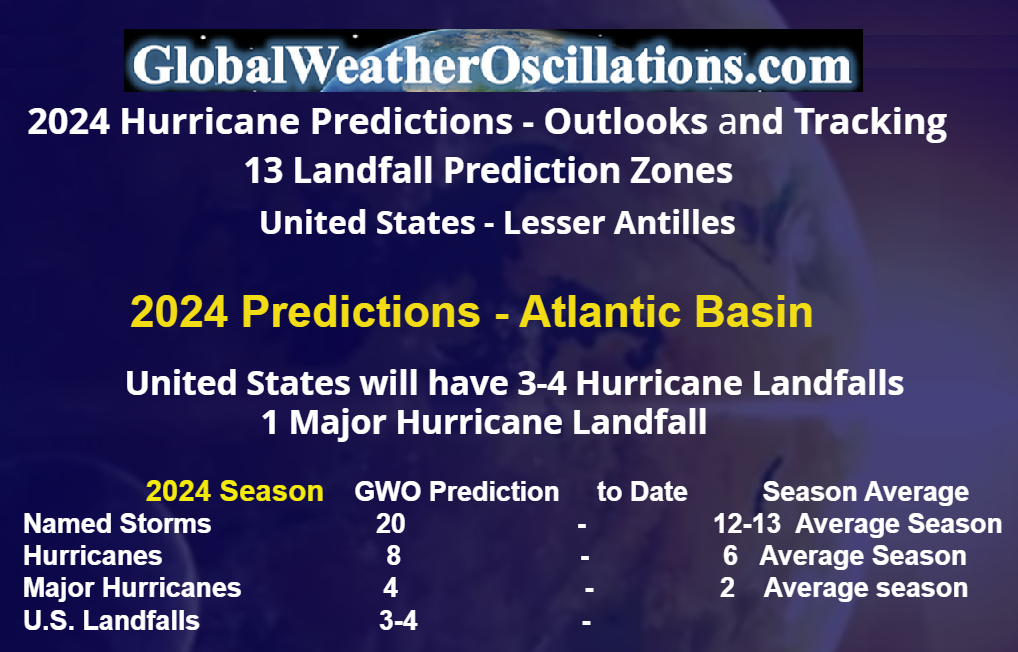
2024 Hurricane GWO Predictions

From the Press Release February 1, 2024

2024 Atlantic Hurricane Season – will be very active
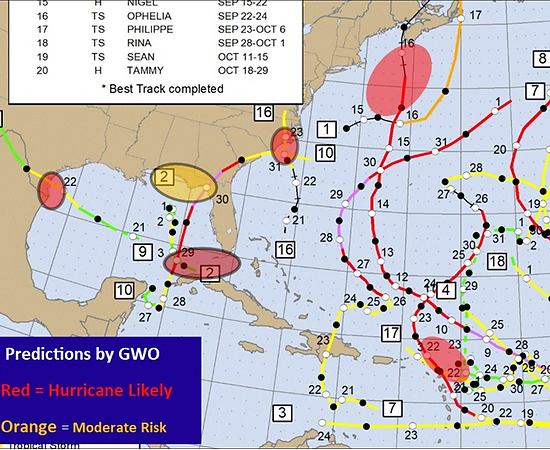
with 20 Named Storms and 6 landfall Hot-Spots.

Tampa-Ocala, Florida, United States, February 1, 2024 /EINPresswire.com/ —

The Atlantic Hurricane Seasons have been extremely active since 2016 – and will continue to be abnormally active for the next several years. This is not due to a global warming cycle – but instead– it is due to the naturally occurring Atlantic Multi-decadal Oscillation (AMO) that enhances a cyclical ClimatePulse Cycle.

During the current AMO warm ocean cycle (warmest portion in 2016), the United States has experienced 40 named storms making landfall, with 20 of them being hurricanes – 9 of which were major hurricane landfalls. This very active hurricane cycle – will likely continue for another 10 years.

What Should We Expect in 2024

An average hurricane season has 12-13 named storms and 6 hurricanes. The combination of the AMO warm ocean water cycle, favorable atmospheric conditions, and the enhanced ClimatePulse Cycle – will provide favorable conditions for a very active and destructive hurricane season in 2024.

Professor David Dilley is predicting 20 named storms, 8 hurricanes with 3 to 4 of them being major hurricanes. The United States and Caribbean will have 6 Hot-Spots with 3 to 4 United States hurricane landfalls expected, and 1 or 2 in the Caribbean. In addition, there is the potential for 1 or 2 major hurricane landfalls.

GWO’s Hot-Spot Predictions 2023

Background Post: David Dilley: Signals of Global Cooling

Tom Nelson interviewed David Dilley last month and the video is above.  For those who prefer reading I provide below a transcript from the closed captions, along with the key exhibits from the presentation.

Synopsis: Between the two oceans cooling down and the natural global cooling cycle coming down we’re going to see a big dip in the temperatures worldwide during the next 10, 15 years. The cold cycle’s going to take about 20 years to bottom out. We’re going to be in an extremely cold period during that time, colder than the 1960s and 50s here in the United States. So it’s going to be very cold.

TN: I have David Dilly here, and David could you tell us a little bit about yourself?

DD: I’m a meteorologist, climatologist, for which I have about 52 years of experience, and I’m still trying to figure that out because I’m only 30 years old. But but I’ve been in the business a long time. I was a weather officer in the Air Force in the National Weather Service. Then I left to set up my own company called Global Weather Oscillations; the easiest way to remember it is global weather cycles.com.

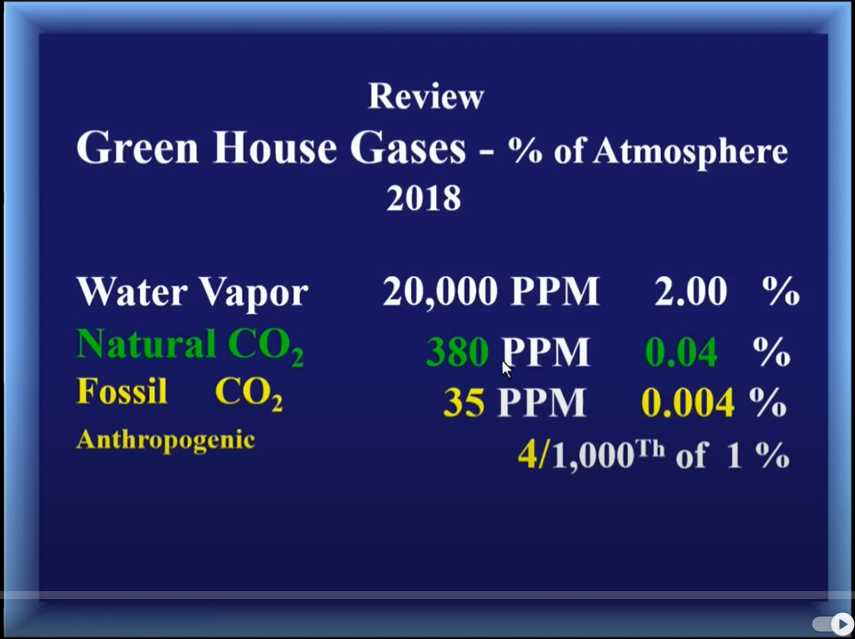
So we’re going to take a look today at something that NOAA is really talking about: the Carbon Dioxide and Climate Cycles. They’re just talking about today’s carbon dioxide values as far as the fossil fuel is concerned. You’re not going to see this out there anywhere on the web. It’s 78% of the atmospheric gases is nitrogen of all things, 21% is oxygen, 0.9 is argon that is 99.99 percent the atmospheric gases. That doesn’t leave much that’s just about all of what we call dry air. To be non-dry air includes the greenhouse gases. The greenhouse gases now are variable regarding how much of it is water vapor how much of it is carbon dioxide. Water vapor is anywhere from one to four percent of the atmospheric gases, that’s quite a bit. It can be zero percent of the Arctic and Antarctic because that’s a desert, but it can be all the way up to four percent. So one to four percent we’ll say.

Carbon dioxide of all things it’s a trace gas it’s less than .05%, a lot less than than water vapor. less than .05 now to put it in perspective, let’s just look at the greenhouse gases here and what we see is water vapor we’re gonna do the average of it two percent that’s 20 000 parts per million. Natural carbon dioxide what I’m going to show you later on in the presentation is 380 parts per million.

Now NOAA and the IPCC say it (natural CO2) is down around 285 parts per million,
we’re going to show you that’s false.

And so the natural is point zero four percent of the atmospheric gases, while fossil fuel I’m going to show you it’s only 35 parts per million; that’s point zero zero four percent or four one thousands of a one percent. And do you think that can cause climate change?

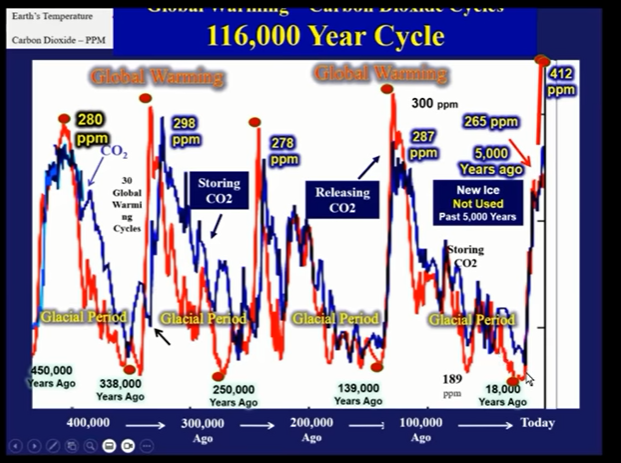
Of course not.  We go down to Vostok in the Antarctic and there is a very deep frozen lake where they drill down fifteen thousand eight five hundred and eighty eight feet down to the bottom. That’s a long ways down over 500 000 years. So I take core samples and with the core samples they figure out how how much it is carbon dioxide what the temperatures are. These are approximate, but what they they get from a core sample is a an estimate of the temperatures and carbon dioxide during the past 500 000 years.

If we go back say 450 000 years, the red line is temperature. So what happened, we came quickly just in a few thousand years out of a deep Ice Age into a interglacial warm period. You can see the temperatures really slid up and the ice cores estimate the carbon dioxide to be right around 280 parts per million. Then we slide down out of the warm period into a deep Ice Age and you can see that the carbon dioxide is actually staying up high there. If carbon dioxide caused global warming, why did the temperatures drop; it does not make sense.

Eventually the carbon dioxide goes down because it’s being absorbed by the oceans. The oceans keep absorbing it over the course of a hundred thousand years. Then when you come up on your next interglacial warm period 338 000 years ago, the temperature goes up and the carbon dioxide is released from the oceans back into the atmosphere. And you can see the carbon dioxide lags behind the temperature rise and actually when you hit the peak of the temperature back 338 000 years ago, the carbon dioxide does not Peak out until 7000 years later. It takes quite a while but carbon dioxide peaked out at 298 parts per million. But look at that temperature then dropping quickly into an ice age while carbon dioxide is at its peak.

That’s proof right there the carbon dioxide does not cause global warming.

As we come over on the right hand side of the graphic this is about 18 000 years ago. It’s 11 000 years ago we came out of the glacial period, we warmed up quickly, we got up to about to 190 parts per million.

Then we started to take records in Hawaii in the 1950s and the instruments there said: Wow, all of a sudden now we’re up to 412 parts per million. We’ve never been that high before.  This is what we’re going to investigate: what is going on with the glacial periods and also the core samples. This is a graphic of the carbon dioxide. The peak of The inter glacial warm periods is every 120 000 years ago we’re going back 800 000 years.

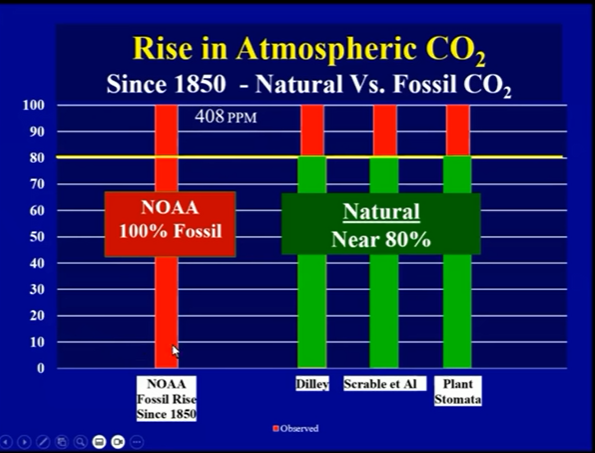
Now do we have other research that will confirm what I’m saying. This is about a year ago and they’ve been adding papers to it and this corrects NOAA’s calculations of the rise in carbon dioxide since 1850. It’s in a radiation safety Journal Health physics journal and this is the name of the paper itself. The authors are professors of radiological Sciences. They’re retired and that’s a big thing because if you’re not retired, if you’re at a university, you can’t do research like this because of federal grants and everything. You have to wait until you’re retired and then you can do real science when they were working they were at the department of physics at University of Massachusetts. It’s Kenneth Skrable, George Chabot, and Clayton French and here is what they found.

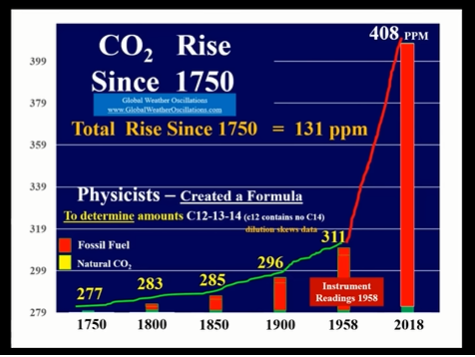
This is extremely important. Since 1850 the red here is saying the increase due to fossil fuel,  and they’re showing all of that is the increase due to fossil fuel. Now how do we determine that well up on a high mountain in Hawaii we have a infrared spectrometer since 1958 it’s been been taking measurements of atmospheric carbon dioxide. However three Isotopes of Carbon are 12, 13 and 14. and the spectrometer is taking the total of all three. It’s not separating what is natural from what is fossil fuel.

Because the ice core samples say we’ve never been above 300 parts per million
NOAA is assuming that the rise above 300 parts per million is all fossil fuel.

An assumption is all it is. It’s assumed by trying to take averages of how much CO2 is taken back in by the oceans how much of it is a given not from industry. Taking those assumptions some physicists made a formula to determine how much is fossil fuel and how much is natural going back all the way back to 1750. These red lines again are what NOAA says is the increase by fossil fuel.

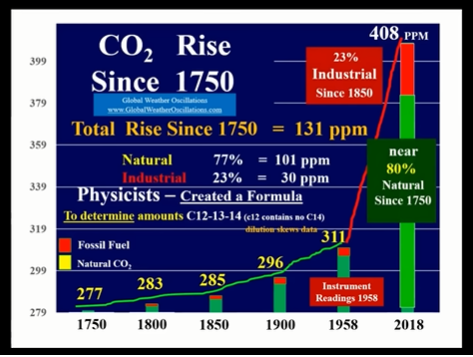
Well their formula separates the carbon 12, 13 and 14 to determine what is what and this is their findings as I switched everything over to green. Green is the natural increase in carbon dioxide all the way up to 1958. Now remember it’s a paper going back to 2018, but it says the increase has been from 280 parts per million up to 408 and NOAA says it is all from fossil fuel. This research paper says No, it is nearly 80% natural just like what I showed on my formulations, eighty percent natural, onlyabout 20% industrial. That’s not enough to cause climate change.

[Note: My synopsis of Skrable et al. is On CO2 Sources and Isotopes.]

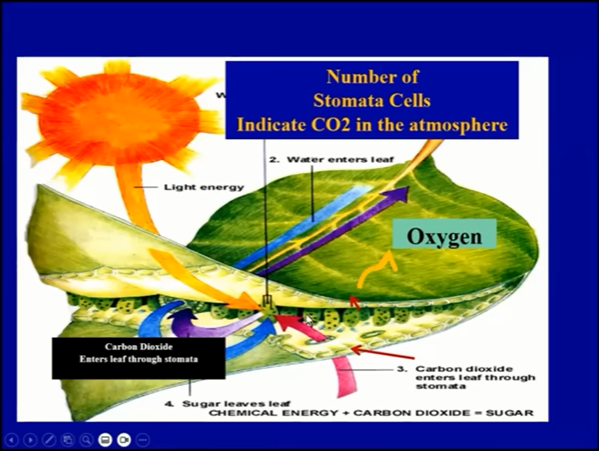
Now I’m going to show you one last paper that will also verify the findings and this is using a different method fossilized plant leaflets and as you can see in this picture there’s little cells in there they call these stomata cells which are like the lungs in a human being. So they look at the fossilized plant leaflets and unlike the ice core samples where you’re taking an average over one thousand or four thousand years, the fossilized plant leaflets can give you the exact year going back the past thousand years so you can determine each year what is going on.

So the stomata cells are like the lungs in a human being or in animals but he’d found that if the leaflet has a lot of stomata cells it means a lot less carbon dioxide in the air at that time. When CO2 is plentiful, plants don’t need more oxygen lung power to get the carbon dioxide; if it has fewer cells that means there was a lot of carbon dioxide in the air.

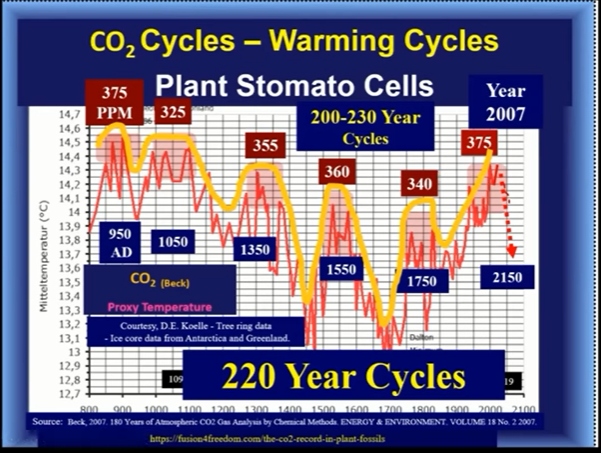
And the beautiful thing about plant life taking in carbon dioxide is the byproduct is oxygen which we drastically need. What the plant stomata cells show during the past 1200 years: back in 800 A.D it says we were way up to 375 parts per million natural carbon dioxide and then dipped way down to 325 in one thousand A.D. Then it dipped way down to 230 and it dipped up down, up down, up down up, down. In year 2010 it was up at 375 parts per million.

Let’s look at the plant stomata that could be pretty darn real and also if you take a mean value of the plant stomata over the course of a thousand years you come out 301 parts per million. The main value of ice cores over a thousand year period 297 parts per million really darn close to being the same as now. Let’s take the plant stomata readings of the atmospheric carbon dioxide and overlay it onto our global warming and cooling Cycles during the past 1200 years. We have had six global warming Cycles during the past 1200 years as noted here in the red. This is back around 850 A.D and then you can see it cools down then we warm up again, cool down warm up cool way down and so on for six global warming cycles. People don’t talk about that but we have had six of them.

When we overlay the plant stomata atmospheric carbon dioxide, guess what: We see a perfect fit. The high values in carbon dioxide peak on global warming cycles, so that brings a lot more credibility into the plants stomata cells for recording carbon dioxide.

So putting it all together we since 1850 NOAA and the IPCC say that the rise in atmospheric carbon dioxide is 100% due to fossil fuel and human activity. The three studies I just showed you and the corrections I made on the ice core samples all show it’s 80% natural rise. Far too little fossil fuel effects to cause climate change, it is almost all natural.

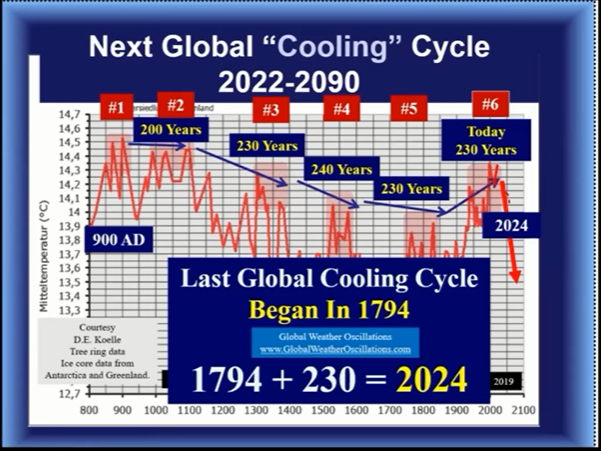
Here we are today over here on the right the average is a global cooling cycle comes about every 230 years and the global cooling cycles last for a good 100, 150 years. So here we are right now, average for the return of the global cooling cycle is 230 years and the last global cooling cycle began in 1794. Add 230 to that and you calculate the year 2024.

This is 2023. so we should be sliding into a global cooling cycle, a natural global cooling cycle.

And we have signals that it is beginning. Global warming Cycles begin in the Arctic and the Antarctic when they warm up over the course of 20, 30 years or so. And as the Arctic and Antarctic warm up there’s less cold air available through the mid-latitudes. So over time the mid-latitudes warm up so that’s where global warming spreads.

In the next phase, global cooling also begins at the Arctic and the Antarctic.

What has happened just this past year, the spring and summer in the Arctic was the coldest on record. You had that during a global warming period, so that’s a signal that the Arctic is drastically cooling down. In 2021 the Antarctic had the coldest winter on record. How you have two records like that if you’re not sliding into global cooling? There’s more cold air available and it’s going to cool down the mid-latitudes and that starts our global cooling cycle. And we’re coming into that right now. Winter 2020 was a third coldest January and February on record from Alaska through Central Northern Canada into Greenland.  Antarctica as I indicated winter of 2021 coldest on record. Arctic 2022 coldest spring and summer on record since 1958, and the most Arctic Ice extent in 8 to 16 years. 

The real main point is carbon dioxide increase is mainly natural, it is not causing a global warming cycle. It’s a natural global warming cycle and we’re sliding back into a natural global cooling cycle.

TN: If you had to make a prediction what would you think of the cooling between now and 2050. Do you think it will cool between now and 2050 are you fairly confident?

DD: Actually we’re going to see a pretty good cool down here into January. The whole atmospheric circulation is beginning to change the La Nina out in the Pacific is now fading it’s going to be gone here by mid to end of January, and we can see changes in the atmospheric circulation going on now.
The cold air in Canada is going to start making its way down more into the United States during late January.

For this year we do see the drastic change and what we’re going to see really well through 2050 or so. The IPCC and NOAA say that the oceans are going to rise anywhere from eight to 26 inches during that time period. I say it may rise an inch, maybe not even that much because we’re going into a global cooling cycle now. The poles are cooling down.

Pacific Ocean has phases going back to the year 1580. For past 500 years we’ve seen these warm phase and cold phase Cycles in the Pacific Ocean which last for anywhere from about 25 to 40 years. The Pacific has been in a 40-year warm cycle which ties the record going back uh 500 years. Pacific is sliding into a cold or a cool phase ocean water cycle, and that’s going to help to cool down ,especially up around Alaska. And the Atlantic Ocean will be going into a cool phase of its own right after 2030 or so.

Between the two oceans cooling down and the natural global cooling cycle coming in
we’re going to see a big dip in the temperatures worldwide during the next 10 to 15 years.

The global warming cycle took about a 20-year period to peek out warming from about the year 2000 up to about 2021 so it took 20 years to hit the peak; the cold cycle is going to take about 20 years to bottom out also at the coldest and that’s going to be around 2040 or so. Unitil the late 2030s so we’re going to be in an extremely cold period during that time, colder than the 1960s and 50s here in the United States.

TN: Is there any sort of a simple explanation as to what causes that 230 year cycle that you mentioned?

DD: The simple explanation is our glacial periods and interglatial periods become about every 120 000 years are due to the Earth path around the Sun; where the Earth swings out further away from the Sun and also the tilt of the earth also changes.

New data out is showing that we’ve actually been cooling down during the past five to six years. So this is all looking like we are already going gradually into a global cooling Cycle. But we’re going to see a more dramatic change in the cooling cycle.

What NOAA and IPCC are doing, their science is political science while we’re looking here today at real science. There’s a huge difference. Keep your eyes open the next few years and all of a sudden in a few years people are going to be saying: Wait a minute, what are we doing here? We’re down the wrong path we need to wake up.

Comment:

The underlying issue is the assumption that the future can only be warmer than the present. Once you accept the notion that CO2 makes the earth’s surface warmer (an unproven conjecture), then temperatures can only go higher since CO2 keeps rising. The present plateau in temperatures is inconvenient, but actual cooling would directly contradict the CO2 doctrine. Some excuses can be fabricated for a time, but an extended period of cooling undermines the whole global warming mantra.

It’s not a matter of fearing a new ice age. That will come eventually, according to our planet’s history, but the warning will come from increasing ice extent in the Northern Hemisphere. Presently infrastructures in many places are not ready to meet a return of 1950s weather, let alone something unprecedented.

Public policy must include preparations for cooling since that is the greater hazard. Cold harms the biosphere: plants, animals and humans. And it is expensive and energy intensive to protect life from the ravages of cold. Society can not afford to be in denial about the prospect of the current temperature plateau ending with cooling.

Background Post: By the Numbers: CO2 Mostly Natural

See Also: What If It’s Global Cooling, Not Warming?

Climatism Substitutes for Solving Problems

Cambridge professor Mike Hulme explains in an interview with Daily Mail Why climate change ISN’T going to end the world and why we need to stop obsessing about net-zero.  Excerpts in italics with my bolds and added images.  H\T John Ray

Young people are terrified that climate change will destroy Earth by the time they grow up, but the world is not actually ending, argues Cambridge professor Mike Hulme.

Humanity is not teetering on a cliff’s edge, he says,
at risk of imminent catastrophe if we don’t reach
net-zero carbon emissions by a certain date.

And he has made it his mission to call out the people who claim we are. In his most recent book, Climate Change Isn’t Everything, Hulme argued that belief in the urgent fight against climate change has shot far past the territory of science and become an ideology.

Hulme, a professor of human geography at the University of Cambridge, dubs this ideology ‘climatism,’ and he argues that it can distort the way society approaches the world’s ills, placing too much focus on slowing Earth from warming.

The problem, he said, is this narrow focus takes attention away from
other important moral, ethical, and political objectives –
like helping people in the developing world rise out of poverty.

DailyMail.com spoke with Hulme about why he thinks climatism is a problem, how it should be balanced out, and what keeps him hopeful about the future of humanity.

As with other ‘isms’ – like cubism or romanticism – ideologies provide a way of thinking about things, explained Hulme.  ‘They’re like spectacles that help us to make sense of the world, according to a predefined framework or structure,’ he said

To be clear, Hulme does not claim that all ideologies are wrong.  ‘We all need ideologies, and we all have them – whether you’re a Marxist or a nationalist, you’re likely to hold an ideology of some form or other,’ he added.

As Hulme sees it, many journalists, advocates, and casual observers of climate change have become devotees of climatism, inaccurately attributing many events that happen in the world as being caused by climate change.

He gives the examples of a fire, flood, or damaging hurricane.  ‘No matter how complex a particular causal chain might be, it’s a very convenient shorthand to say, ‘Oh, well, this was caused by climate change,” Hulme said.

‘It’s a very shallow and simplistic way, I would argue,
to try to describe events that are happening in the world.’

Researchers have shown that warming oceans do lead to more frequent and more severe storms: Twice as many cyclones now become category 4 or 5 as they did in the 1970s, scientists have found, and Atlantic storms are three times as likely to become hurricanes.

Hulme doesn’t argue that the effects of climate change are not happening, though, just that stopping climate change won’t stop disasters from happening altogether.

‘Fundamentally, we’re going to have to deal with hurricanes, and
we’re not going to deal with them just by cutting our carbon emissions.’ 

The solutions, he argues, will include better forecasting, better early warning systems, better emergency plans, and better infrastructure.  ‘There are all sorts of things that we can do to minimize the risks and dangers of hurricanes, that are way more effective in the short term than trying to cut our carbon emissions,’ said Hulme.

The danger of climatism, he pointed out, is that it leads people down a false chain of events: If all of these things happening in the world are caused by climate change, then all we have to do is stop climate change, and all the other things will stop themselves.

‘And that clearly is a very inadequate way of thinking about the complexities of most of the problems we we face in the world today.’  This distorted thinking can make people forget about other important concerns, he argues.

As an example, Hulme points to the UN Sustainable Development Goals (SDGs): 17 areas that the world’s governments have identified as top priorities for humanity.  The SDGs include building peace and justice, eradicating poverty, reducing child mortality, and ensuring clean sanitation and water for billions of people on the planet.

If society were to put climate change priorities into their proper proportions then, Hulme said it would still be on the list.  It just wouldn’t be the only item on the list, and it wouldn’t be at the top.  ‘There’s 17 SDGs, and two of them are related to climate. So that begins to rebalance, or re-proportion, the amount of effort and attention we might wish to pay,’ said Hulme.

Beyond these mixed up priorities, Hulme also takes issue with what he sees as an obsession with deadlines: ‘There’s this idea of the ticking clock counting down to Ground Zero – we’ve only got five years, 10 years, two years – however long different commentators put the deadline.’

Doomsday was predicted but failed to happen at midnight.

Hulme disputed the idea that he is over-egging the pudding on climatism – after all, the whole basis of his argument is that climatists are the ones making a bigger deal out of it than they should be.  ‘I’ve been observing concerns about how climate change is talked about, framed, and reacted to in public for many, many years.’  And this public framing has led to a phenomenon called ‘eco-anxiety,’ which Hulme said he sees among his students at Cambridge University

‘They have absorbed these claims of tipping points, and they take these things literally, and feel that there is no future for them because the climate is going to go out of control,’ he said. ‘They feel that it will be too late, and everything will collapse.’

See Also Climate Delusional Disorder

Climate Delusional Disorder (CDD) 2021 Update

IPCC Still Deceiving with the Hockey Stick

Fig. 1: Common Era temperature reconstructions
featured in IPCC reports since 2001.

Source Esper et al 2024  Note:  In each graph, instrumental global annual mean land and marine temperatures are shown in a red spike, while lower resolution proxy estimates are in blue.

Just published today at Nature Communications is this paper  The IPCC’s reductive Common Era temperature history  by Esper et al.  Excerpts in italics with my bolds and added images.

Abstract

Common Era temperature variability has been a prominent component in Intergovernmental Panel on Climate Change reports over the last several decades and was twice featured in their Summary for Policymakers. A single reconstruction of mean Northern Hemisphere temperature variability was first highlighted in the 2001 Summary for Policymakers, despite other estimates that existed at the time. Subsequent reports assessed many large-scale temperature reconstructions, but the entirety of Common Era temperature history in the most recent Sixth Assessment Report of the Intergovernmental Panel on Climate Change was restricted to a single estimate of mean annual global temperatures. We argue that this focus on a single reconstruction is an insufficient summary of our understanding of temperature variability over the Common Era. We provide a complementary perspective by offering an alternative assessment of the state of our understanding in high-resolution paleoclimatology for the Common Era and call for future reports to present a more accurate and comprehensive assessment of our knowledge about this important period of human and climate history.

Fig. 5: Standard deviations in observed temperature data
and Common Era temperature reconstructions.

Estimates for the observed and reconstructed temperatures are determined over the 1878-2000 CE (blue), 1001-1877 CE (orange) and 1-1000 CE (gray) periods. Instrumental records shown on the left side include mean annual temperatures averaged over 90°S-90°N land and marine areas (global), mean annual temperatures averaged over 0°−90°S land and marine areas (SH), and mean summer (JJA) temperatures averaged over 30°−90°N land-only areas (NH).

While interpretations of the similarities and differences across the various domains and reconstructions, as shown in Fig. 5, remains the subject of important and interesting research, diagnosing the differences is not the focus of our commentary herein. Our primary concern is that substantial uncertainty exists. The consequence is that there are notable differences in the representation of large-scale estimates of CE temperature variability, as shown in Figs. 2 and 3, that were overlooked and poorly communicated by the 2021 IPCC WGI report. Both the different summary of the global P2k19 ensemble provided in Figs. 2b and 3c, and the inclusion of the additionally available NH and SH temperature reconstruction estimates in Fig. 3, imply substantial uncertainties in large-scale temperature reconstructions that better summarize the existing challenges associated with the science.

Fig. 3: Reconstructions of large-scale temperature variability
over the last 2000 years published since AR5 of the IPCC.

Reconstructions variably target seasonal to annual mean temperatures in the (a) Northern Hemisphere (Sch15, Sto15, Wil16, Xin16, Gui17, Bün20), and annual temperatures for the (b) Southern Hemisphere (Neu14) and (c) globally (P2k19; as shown in Fig. 2) over varying periods of the Common Era (see Table 1 for details). All reconstructions were smoothed using a 20-year low-pass filter and temperatures are shown as anomalies from their 1850–1900 means. Hemispheric and global means of land and ocean temperatures derived from HadCRUT5 instrumental analysis1 are also shown in each respective panel from 1850-2020 (red). Instrumental temperatures were also referenced to zero mean in the 1850–1900 interval and filtered with a 20-year lowpass filter. These instrumental representations are all consistent with the 2021 IPCC report.

Conclusions and future priorities

We propose that a visualization of the contemporary research, as in Fig. 3, offers a more accurate depiction of the uncertainty and temporal evolution of CE temperature variability compared to any single reconstruction. A general feature of Fig. 3 is that long-term trends during the second millennium CE are more coherent and robust, but major discrepancies still exist during the first millennium CE. These uncertainties in the first millennium are the product of severe reductions in the availability of high-resolution proxy records, which affects all large-scale temperature reconstructions. The SH also remains grossly under-sampled.

It is therefore premature, and possibly incorrect, to conclude that
the first millennium was free of centennial-scale temperature trends
and that the decadal variations were systematically smaller
than during subsequent centuries, as detailed in the 2021 SPM.

Regarding global temperature reconstructions specifically, we also highlight the following limitations that must continue to be contextualized in consensus reports on CE temperature reconstructions:

(i) warm season biases due to the dominance of tree-ring records during the CE,
(ii) spatial biases in proxy sampling, with a persistent lack of high-resolution proxy records from the tropics and SH, which are needed for accurately representing lower-latitude and SH temperatures over the past 2000 years,
(iii) the likely loss of variability when including time-uncertain and smoothed proxies in a large-scale reconstruction,
(iv) the potential limited ability of conventional tree-ring records to capture millennial-scale trends in climate, and
(v) the need to more accurately estimate reconstruction uncertainties that reflect changes in replication and statistical model fidelity of the underlying proxy network back in time (a constant uncertainty range back in time is unlikely to accurately represent the increasing uncertainties that exist).

With any set of methods, however, their outcome is ultimately dependent on the data that they incorporate and the assumptions that underpin the statistical model. A major initiative to produce new high-resolution proxy records that span the entire CE is therefore necessary if we are to fundamentally improve our understanding of pre-instrumental temperature variations at policy-relevant timescales. It otherwise remains uncertain how warm and cold first millennium CE temperatures actually were and what caused these earlier changes at hemispheric to global scales, with implications for our understanding of the true range of externally and internally forced variability.

My Comment:

Among the references in the paper is that of Moberg et al (2005) Highly variable Northern Hemisphere temperatures reconstructed from low- and high-resolution proxy data.  The graph below shows one example of how more recent high quality reconstructions contradict the Mann depiction of a flat hockey stick handle during the centuries prior to the 20th.

Background of the Mann Hockey Stick Saga

Rise and Fall of the Modern Warming Spike
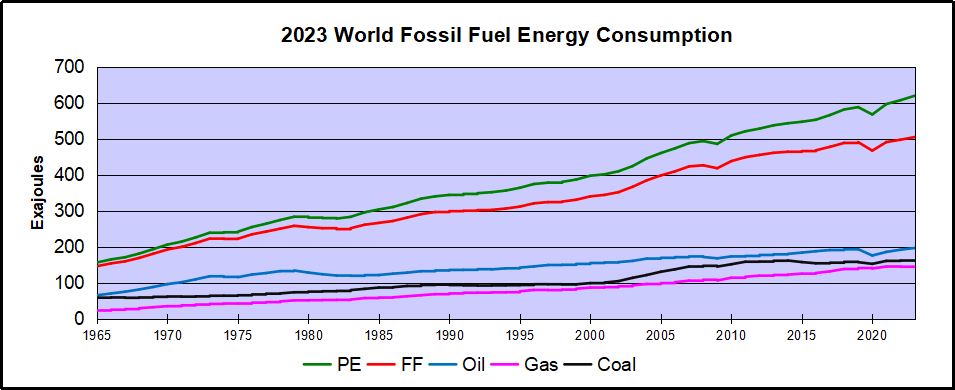
The first graph appeared in the IPCC 1990 First Assessment Report (FAR) credited to H.H.Lamb, first director of CRU-UEA. The second graph was featured in 2001 IPCC Third Assessment Report (TAR) the famous hockey stick credited to M. Mann.

Why So Obsessed with Decarbonizing?

How did the current obsession with decarbonization arise?

Part of a lecture given by Prof. R, Lindzen to MIT Students for Free Inquiry on March 6, 2024 is posted by John Ray at his blog Greenie Watch.  Excerpts in italics with my bold and added images.

Currently, there is great emphasis on the march through the educational institutions: first the schools of education and then higher education in the humanities and the social sciences and now STEM.

What is usually ignored is that the first institutions to be captured were professional societies. My wife attended a meeting of the Modern Language Association in the late 60’s , and it was already fully ‘woke.’ While there is currently a focus on the capture of education, DEI was not the only goal of the march through the institutions. I think it would be a mistake to ignore the traditional focus of revolutionary movements on the means of production.

The vehicle for this was the capture of the environmental movement.

Prior to 1970, the focus of this movement was on things like whales, endangered species, landscape, clean air and water, and population. However, with the first Earth Day in April of 1970 , the focus turned to the energy sector which, after all, is fundamental to all production, and relatedly, involves trillions of dollars. This was accompanied by the creation of new environmental organizations like Environmental Defense and the Natural Resources Defense Council. It was also accompanied by new governmental organizations like the EPA and the Department of Transportation.
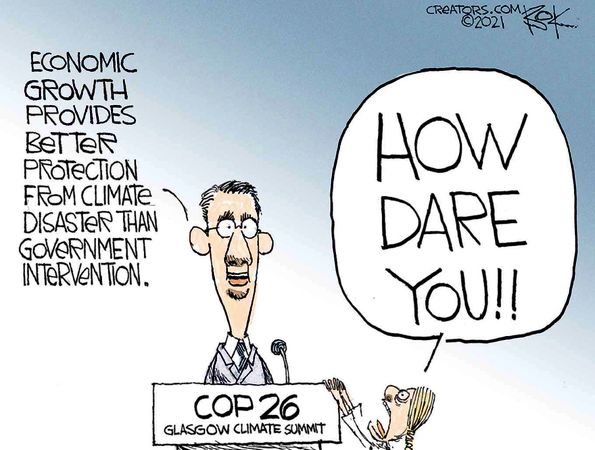
Once again, professional societies were easy pickings: the American Meteorological Society, the American Geophysical Union, and even the honorary societies like the National Academy of Science, the American Academy of Arts and Sciences, etc. There was a bit of floundering to begin with. The movement initially attempted to focus on global cooling due to the reflection of sunlight by sulfate aerosols emitted by coal fired generators . After all, there seemed to have been global cooling between the 1930’s and the 1970’s. However, the cooling ended in the 1970’s.

There was an additional effort to tie the sulfates to acid rain which was allegedly killing forests. This also turned out to be a dud. In the 70’s, attention turned to CO2 and its contribution to warming via the greenhouse effect. The attraction of controlling CO2 to political control freaks was obvious. It was the inevitable product of all burning of carbon – based fuels. It was also the product of breathing.

However, there was a problem: CO2 was a minor greenhouse gas compared to the naturally produced water vapor. Doubling CO2 would only lead to warming of less than 1°C. A paper in the early 70’s by Manabe and Wetherald came to the rescue. Using a highly unrealistic one – dimensional model of the atmosphere, they found that assuming (without any basis) that relative humidity remained constant as the atmosphere warmed would provide a positive feedback that would amplify the impact of CO2 by a factor of 2. This violated Le Chatelier’s Principle that held that natural systems tended to oppose change, but to be fair, the principle was not something that had been rigorously proven.

Positive feedbacks now became the stock in trade of all climate models
which now were producing responses to doubling CO2 of 3°C
and even 4°C rather than a paltry 1°C or less.

The enthusiasm of politicians became boundless. Virtue signaling elites promised to achieve net zero emissions within a decade or 2 or 3 with no idea of how to achieve this without destroying their society. Ordinary people, confronted with impossible demands on their own well – being, have not found warming of a few degrees to be very impressive. Few of them contemplate retiring to the arctic rather than Florida.

Excited politicians, confronted by this resistance, have frantically changed their story. Rather than emphasizing miniscule changes in their temperature metric, they now point to weather extremes which occur almost daily some place on earth, as proof not only of climate change but of climate change due to increasing CO2 (and now also to the even more negligible contributors to the greenhouse effect like methane and nitrous oxide) even though such extremes show no significant correlation with the emissions.

From the political point of view, extremes provide convenient visuals
that have more emotional impact than small temperature changes.

The desperation of political figures often goes beyond this to claiming that climate change is an existential threat (associated with alleged ‘tipping points’) even though the official documents produced to support climate concerns never come close to claiming this, and where there is no theoretical or observational basis for tipping points .

I should note that there was one exception to the focus on warming, and that was the ozone depletion issue. However, even this issue served a purpose. When Richard Benedick, the American negotiator of the Montreal Convention which banned Freon passed through MIT on his way back from Montreal, he gloated over his success, but assured us that we hadn’t seen anything yet; we should wait to see what they would do with CO2 . In brief the ozone issue constituted a dry run for global warming.

Yes, they are projecting more than 100 Trillion US$.

To be sure, the EPA ’ s activities still include conventional pollution control, but energy dominates. Of course, the attraction of power is not the only thing motivating politicians. The ability to award trillions of dollars to reorient our energy sector means that there are recipients of these trillions of dollars, and these recipients must only share a few percent of these trillions of dollars to support the campaigns of these politicians for many election cycles and guarantee the support of these politicians for the policies associated with the reorientation.

Background History from Richard Lindzen


Climate Science Was Broken

By taking a few minutes to read his text (here), you can learn from Lindzen some important truths:

  • How science was perverted from a successful mode of enquiry into a source of authority;
  • What are the consequences when fear is perceived to be the basis for scientific support rather than from gratitude and the trust associated with it;
  • How incentives are skewed in favor of perpetuating problems rather than solving them;
  • Why simulation and large programs replaced theory and observation as the basis of scientific investigation;
  • How specific institutions and scientific societies were infiltrated and overtaken by political activists;
  • Specific examples where data and analyses have been manipulated to achieve desired conclusions;
  • Specific cases of concealing such truths as may call into question gobal warming alarmism;
  • Examples of the remarkable process of “discreditation” by which attack papers are quickly solicited and published against an undesirable finding;
  • Cases of Global Warming Revisionism, by which skeptical positions of prominent people are altered after they are dead;
  • Dangers to societies and populations from governments, NGOs and corporations exploiting climate change.


There is no charge for content at this site, nor for subscribers to receive email notifications of postings.

Time for Billionaires to Fund Climate and Social Realism

Wallace Manheimer provides the advice in his Daily Caller article Here’s A Better Way For Billionaires To Give Their Money.  Excerpts in italics with my bolds and added images. In the second part of this post Dr. Manheimer explains how philantropists and many others have been duped by Net Zero claims.

Many of your fellow billionaires contribute large sums to “cure” a
nonexistent climate crisis, falsely naming it an “existential threat.”

They wrongly claim that wind and solar can support modern civilization. For instance, Michael Bloomberg has proudly committed $500 million to eliminate coal. Jeffery Bezos has committed $10 billion to a variety of climate causes and “clean energy” efforts. These billions dwarf resources available to small groups fighting, for instance, degradation of their land by gigantic wind companies.

Furthermore, these philanthropists direct many dollars into foolishness like Critical Race Theory and a fabricated division of the world into oppressors and the oppressed. In addition to unnecessary climate panic, college campuses harbor harmful notions of “gender fluidity” and dangerous divisiveness among students that manifest as rampant antisemitism and hostility toward the deplorables du jour.

You know this is wrong but, despite your wealth, may feel powerless to stem the societal degradation. You make your own large contributions to hospitals, museums, medical schools, etc. Of course, that is very commendable. Still, you may be looking for other avenues for your generosity – perhaps actions that could not only help people but also challenge the promotion of negative forces.

Well, we have a few suggestions.

Let’s first consider possibilities within the U.S. As a private citizen or group of citizens, you can certainly place ads into major media to expose the fraudulence of scientifically invalid claims of a climate crisis. You could cite the mountain of scientific evidence that contradicts the popular apocalyptic narrative as well as the tens of thousands of prominent scientists attesting that there is no climate crisis. Sources include the CO2 CoalitionGlobal Warming Petition Project and CLINTEL’s World Climate Declaration. Furthermore, you could partially balance the scales by financially supporting local groups fighting installation of hundreds of gigantic wind turbines, each the size of the Washington Monument; or square miles and miles of solar panels, which will permanently scar their land.

If you’re more inclined to support universities, then we suggest financing a faculty position about Washington, Jefferson, Hamilton, Madison, and Lincoln. Their accomplishments and documents are sources of inspiration worldwide. Alternatively, you might consider supporting nuclear science and engineering departments, or initiating an interdepartmental organization, for domestic and international students, in the disciplines of petroleum geology, engineering, and industry.

Internationally, there are many countries that suffer from a lack of energy. The less developed world is not giving up on fossil fuels regardless of pompous calls from the climate industrial complex for them to do so.  “I firmly believe that no African country can be asked to halt the exploration of its natural resources, including fossil fuels,” says Kenyan President William Ruto. 

Even the head of the United Nations’ most recent climate summit, Sultan Al-Jaber of the United Arab Emirates, said that use of fossil fuels cannot be discontinued “unless you want to take the world back into caves.”

Perhaps nobody exhibited resentment of meddling in Third World energy policy more than did Indian Prime Minister Narendra Modi: “The colonial mindset hasn’t gone. We are seeing from developed nations that the path that made them developed is being closed to developing nations.” 

Lesser developed countries will continue to advance in ways they see fit, employing fossil fuels (and hopefully also nuclear power). China and India are building coal-fired power plants at a furious pace, and Africa and other regions will soon as well. There is no stopping it! Rather than utter hypocritical and futile pieties, let’s help them and, while doing so, also help promote sensible, clean energy technologies developed in the U.S.

Coal promises to be the salvation of more than half of sub-Saharan Africans — the number who labor daily with inadequate supplies of electricity. Cooking, heating and lighting are done with a combination of wood, charcoal and dried animal dung. The World Health Organization estimates that about half a million die each year from the resulting indoor air pollution.

Ultra-super critical coal-fired generating facilities, recently developed in the United States, are cleaner and more efficient than traditional plants. American billionaires investing in these sources of clean, affordable, reliable electricity could save the lives of untold numbers of sub-Saharan Africans.  

Nigeria, once an important oil producer, never instituted effective pollution controls and, with the advent of hydrofracturing technology in the U.S., is hardly competitive on the world market. In fact, Exxon Mobil is considering pulling out of the country. The right investments could restore both Nigeria’s environment and oil industry.

There are many new things for rational, public-spirited billionaires to support.
Why leave the field to those pursuing the climate fetish
and promoting destructive ideologies and fads?

Dr. Wallace Manheimer is a life fellow of the American Physical Society, the Institute of Electrical and Electronic Engineers and is a member of the CO2.Coalition. He is the author of more than 150 refereed papers.

Background:  Manheimer Steamrolls Net Zero Claims

Accomplished and distinguished physicist Wallace Manheimer published a crushing argument against the rationale for Net Zero claims and policies.  His paper is While the Climate Always Has and Always Will Change, There Is no Climate Crisis. published in the Journal of Sustainable Development.  In italics with my bolds and added images.

Abstract

The emphasis on a false climate crisis is becoming a tragedy for modern civilization, which depends on relible, economic, and environmentally viable energy. The windmills, solar panels and backup batteries have none if these qualities.

This falsehood is pushed by a powerful lobby which Bjorn Lomborg has called a climate industrial complex, comprising some scientists, most media, industrialists, and legislators. It has somehow managed to convince many that CO2 in the atmosphere, a gas necessary for life on earth, one which we exhale with every breath, is an environmental poison.

Multiple scientific theories and measurements show that there is no climate crisis. Radiation forcing calculations by both skeptics and believers show that the carbon dioxide radiation forcicng is about 0.3% of the incident radiation, far less than other effects on climate. Over the period of human civilization, the temperature has oscillated between quite a few warm and cold periods, with many of the warm periods being warmer than today. During geological times, it and the carbon dioxide level have been all over the place with no correlation between them.

A useful synopsis is written by Chris Morrison at the Daily Sceptic  Net Zero Will Lead to the End of Modern Civilisation, Says Top Scientist.  Excerpts in italics with my bolds and added images.

A damning indictment of the Net Zero political project has been made by one of the world’s leading nuclear physicists. In a recently published science paper, Dr. Wallace Manheimer said it would be the end of modern civilisation. Writing about wind and solar power he argued it would be especially tragic “when not only will this new infrastructure fail, but will cost trillions, trash large portions of the environment, and be entirely unnecessary”. The stakes, he added, “are enormous”.

Dr. Manheimer holds a physics PhD from MIT and has had a 50-year career in nuclear research, including work at the Plasma Physics Division at the U.S. Naval Research Laboratory. He has published over 150 science papers. In his view, there is “certainly no scientific basis” for expecting a climate crisis from too much carbon dioxide in the atmosphere in the next century or so. He argues that there is no reason why civilisation cannot advance using both fossil fuel power and nuclear power, gradually shifting to more nuclear power.

There is of course a growing body of opinion that points out that the Emperor has no clothes when it comes to all the fashionable green technologies. Electric cars, wind and solar power, hydrogen, battery storage, heat pumps – all have massive disadvantages, and are incapable of replacing existing systems without devastating consequences.

Manheimer points out that before fossil fuel became widely used, energy was provided by people and animals. Because so little energy was produced, “civilisation was a thin veneer atop a vast mountain of human squalor and misery, a veneer maintained by such institutions as slavery, colonialism and tyranny”.

This argument hints at why so many rich, virtue-signalling celebrities argue not just for Net Zero but ‘Real’ Zero, with the banning of all fossil fuel use.

King Charles said in 2009 that the age of consumerism and convenience was over, although the multi-mansion owning monarch presumably doesn’t think such desperate restrictions apply to himself. Manheimer notes that fossil fuel has extended the benefits of civilisation to billions, but its job is not yet complete. “To spread the benefits of modern civilisation to the entire human family would require much more energy, as well as newer sources,” he adds.

In Manheimer’s view, the partnership among self-interested businesses, grandstanding politicians and alarmist campaigners, “truly is an unholy alliance”. The climate industrial complex does not promote discussion on how to overcome this challenge in a way that will be best for everyone. “We should not be surprised or impressed that those who stand to make a profit are among the loudest calling for politicians to act,” he added.

Perhaps one of the best voices to cast doubt on an approaching climate crisis, suggests the author, is Professor Emeritus Richard Lindzen of MIT, one of the world’s leading authorities on geological fluid motions:

“What historians will definitely wonder about in future centuries is how deeply flawed logic, obscured by shrewd and unrelenting propaganda, actually enabled a coalition of powerful special interests to convince nearly everyone in the world that CO2 from human industry was a dangerous planet-destroying toxin. It will be remembered as the greatest mass delusion in the history of the world – that CO2, the life of plants, was considered for a time to be a deadly poison.”

Figure 16. The geological history of CO2 level and temperature proxy for the past 400 million years. CO2 levels now are ~ 400ppm

Much of Dr. Manheimer’s interesting paper debunks many of the fashionable nostrums surrounding politicised ‘settled’ climate science. It is an excellent read. Discussing some of the contrary opinions that debunk obviously false claims, he says it is “particularly disheartening” to see learned societies make definitive claims when so much contrary information is readily available. He points out that over the last 10,000 years, the Earth has almost certainly been warmer. There have been warmer and colder periods, just like today.

To find the off-narrative information, even Google can be used, Manheimer says – though he does note that the company warns it will not provide information on “claims denying that long-term trends show that the global climate is warming”.

Figure 18. Per capita food production in kcal/(per-capita per day) from 1961 to 2009. Notice that there is a steadily increasing production, with no sign of any ‘slowly escalating but long-enduring global threat to food supplies.’

Net Zero Not Only Inhuman, It’s Also Ecocidal

Roger Palmer speaks quietly, but with the force of knowledge and logic on the subject of global warming/climate change.  Two expressions of his perspective are presented here: firstly a brief video and transcript, and secondly excerpts from his 2024 paper. Transcript in italics with my bolds and added images.  H/T Raymond Inauen

1. Trust Climate History, Not Hysteria

I’m Roger Palmer, a retired engineer living in Victoria, British Columbia. Today I want to talk about climate change hysteria. The popular press is overflowing with sensational but scary headlines: the hottest day on record, sea levels are rising, climate catastrophe. It’s never been like this before, climate change is an existential threat, we are declaring a climate emergency, it’s man’s fault.

These hysterical messages are reinforced at disruptions organized by career demonstrators and professional protesters. Politicians are falling over themselves to agree with these claims and position themselves as the only viable saviors of mankind who are able to stop the climate from changing. You can’t get elected if you are perceived as being soft on climate change.

The authors of all this spurious noise unfortunately do not have a good understanding of science or the historical paleoclimatic record. These people are so arrogant and self-centered that they believe that man can control the solar system and somehow cancel the naturally occurring climate cycles, so that the earth’s climate stays just the way they want it.

Let’s start the discussion by outlining a difference between weather and climate. When a person speaks about weather they are referring to how the atmosphere is behaving over the short term hours or days and usually over a small area. The term climate refers to the statistics of weather over a defined large region over a long period of time, decades or more. the atmospheric characteristics being described include temperature, winds, moisture, clouds and precipitation.

But it is the temperature that most people seem to focus on. In the 1970s the concern was about global cooling, but it has now shifted to global warming. An example of a weather statement is: “It will be cooler and windy in downtown Ottawa tomorrow.” An example of a climate statement is: “North America will be warmer over the next two decades.”

Reliable equipment for measuring temperature has been available since the early 1800s, but unfortunately the number and placement of temperature recording stations has changed considerably over time. So it is often difficult to get a complete and consistent record for a specific area temperature history. The period preceding the 19th century must be inferred by analyzing ice cores, tree growth rings, sediments and corals. Ice cores typically from Greenland, Antarctica or the Arctic are the most commonly used proxies. And it is possible to infer temperatures from thousands or millions of years ago. It is also possible to use ice cores to estimate the historical composition of the atmosphere.

Although surface temperature is what humans actually feel on a day-to-day basis, that data can be contaminated by urban heat islands. So it is sometimes more meaningful to talk about the temperature of the troposphere, which is the lowest layer of the earth’s atmosphere about 20 kilometers thick and is where all the weather takes place; the clouds, precipitation, storms, winds etc.  Temperatures in the troposphere can be directly measured by balloon-borne radiosondes or inferred from satellite radiometry.

Geological records show that the earth’s average temperature has varied cyclically for many millions of years. Sometimes it has been much hotter than today and sometimes much cooler. This graph estimates variations in temperature during the last 500 million years. The earth is approximately four and a half billion years old; predecessors of man have been on earth for about two and a half million years; and modern homo sapiens have been around for about two hundred thousand years.

Here is what the earth’s temperature has been doing over the past five hundred thousand years and here is the temperature record for more recent times; the last 11, 000 years otherwise known as the Holocene era.

The earth would be a much cooler place if it did not have an atmosphere. The atmosphere contains a number of gases that warm the earth by what is called the greenhouse effect. Which is when solar radiation from the sun can easily pass through the gases to the earth, but outgoing infrared radiation from the earth’s surface is partially blocked from radiating off into space by these same gases. Further details of this mechanism are given in the references.

There are several different greenhouse gases but everyone seems to focus on just one of them: carbon dioxide known as CO2. The concentration of carbon dioxide in the atmosphere is sometimes thought to be the driver of the earth’s temperature, but the geological record shows that there has been no correlation.

The absolutely dominant greenhouse gas is water vapor. The earth’s glaciers and ice caps have grown and shrunk cyclically over time. The earth recently exited the Little Ice Age and is currently warming just as in previous cycles. There is definitely a new ice age coming, but none of us will live to experience it. We are currently in an interglacial, which is a period between ice ages.

As shown by the earlier graphs the earth’s climate is not being driven by changes in the co2 level. Indeed changes in the atmospheric CO2 concentration are probably a result of changes in the earth’s temperature as oceans and land masses release stored CO2 resulting from long-term temperature changes. As the glaciers and ice caps cyclically build and recede, there are corresponding changes in the sea level. The sea level has cyclically varied from today’s levels by as much as plus or minus 200 meters. And these fluctuations are expected to continue for thousands of years to come.

So what is causing these long-term cyclical changes in the earth’s average temperature? A recently posted youtube series entitled Paleoclimatology parts one through three gives an in-depth analysis of the factors at work. Here is a summary of just some of the main factors:

♦  Continental drifts as result of plate tectonics has caused very long-term climate changes as the ocean’s heat carrying currents have been forced to take different paths;

♦  Milankovitch cycles due to changes in the earth’s tilt, precession and orbital eccentricity and cyclical changes in the solar system’s orbital alignments have demonstrably produced corresponding changes in the earth’s climate over both the long term and the short term;

♦  Cyclical changes in the sun’s total output radiated power. cyclical changes in the sun’s output spectral distribution especially the ultraviolet component

♦  Variations in the earth’s magnetic field resulting in changes in the magnitude and position of the earth’s magnetosphere which shields us from incoming cosmic particles and the solar wind

♦  Variations in upper level bacteria which serve as nucleation sites for clouds and precipitation

♦  Changes in the earth’s average cloud cover as a result of changes in many of the factors just mentioned

♦  Changes in the earth’s upper atmospheric wind currents that are used to distribute heat energy throughout the pallet of the planet

Note that carbon dioxide concentration is not a significant cause of these natural cyclical changes. CO2 has some effect on long-term climate changes but it is not the dominant determinant of global temperature. Then why are the agitators and politicians so obsessed with this and why are they arbitrarily blaming man-made CO2 emissions from the combustion of fossil fuels as threatening disruptions to their climate nirvana?

Perhaps there’s a hidden agenda. Current proposals to decarbonize the earth by eliminating fossil fuels will have a minor effect on climate, but will cause extraordinary economic harm. Maybe the true goal of the protesters is to destroy capitalism in the western world.

CO2 is a clear odorless gas. Atmospheric CO2 levels have been much higher in the past and were sometimes much lower. CO2 is not a pollutant–it is essential to life. If the atmospheric CO2 concentration were to drop below 150 parts per million, the earth’s vegetation would not be able to survive and the earth would become a barren wasteland.  There have been proposals to use large-scale geoengineering to alter the earth’s climate, such as by surrounding the earth with orbiting reflective particles or mirrors. But such schemes are fraught with political as well as technical dangers.

The Intergovernmental Panel on Climate Change known as the IPCC is often identified as the final authority when it comes to questions about the earth’s climate.  However the IPCC does not conduct research; it merely reviews papers in the field. And the IPCC should not be considered as unbiased. Because when they were created by the United Nations they were specifically charged to investigate how mankind is causing the earth’s climate to change.

In other words the conclusion had already been reached that man was to blame before any investigations were performed. The IPCC is a political animal; nothing is published before it has been approved by the representatives of all the participating countries to make sure that it aligns with their governments’ objectives and policies. IPCC has published numerous forecasts of ever increasing global temperatures being driven by rising atmospheric CO2 concentrations. But these are based on incomplete and inaccurate computer models and they have all drastically overestimated the forthcoming temperature rise.

These computer models ignore or inadequately account for many factors, including clouds and solar variations. It is claimed that 97 % of scientists agree that man-made emissions of CO2 are having significant negative effects on the earth’s climate. However consensus is not a valid way to conduct scientific research. Group think is a major problem in this field. Remember Galileo was able to prove that the earth orbited the sun rather than the other way around. But public opinion and the church forced him to recant his findings. Consensus overruled scientific evidence just like it appears to be doing today.

The earth is getting warmer and it will continue to do so until the temperature trend reverses sometime in the future and we head into the next ice age. Mankind needs to recognize that we are an observer of naturally occurring climate cycles. There is very little that we can do to stop, change or influence these cycles. The best thing that man can do is learn to adapt to these natural cycles. Stop wasting our money and damaging our economy on futile and inefficient schemes to reduce man’s CO2 emissions, appearing to be trying to thwart what are perfectly natural cyclical changes of the earth’s climate.

Learn to live with these changes. Mankind has to adapt. Have a nice day and enjoy the warmth while we have it. Here are links to references providing more details on many of these points

2. Net Zero is Both Suicidal and Ecocidal

Source: Roger Palmer publication  Understanding Climate Change.  Excerpts in italics with my bolds and added images.

Net Zero

As mentioned above, many governments have decided to pursue the goal of becoming “Net Zero” by 2050 (or possibly later). This means that they want all CO2 emitted by man’s activities either to be eliminated or somehow compensated for by 2050 in the belief that this will slow the current rise in global temperatures, and limit the rise to 1.5°C above pre-industrial levels.

As discussed in previous sections, CO2 concentration is not the primary driver of global temperature, and indeed, rising CO2 levels might actually be a result of warming due to entirely natural factors. Despite the dubious scientific justification, politicians and special-interest groups have embraced the “Net Zero” battle cry, and are falling over themselves with announcements, proclamations, and protests as they attempt to destroy the world’s economy.

The concept of Net Zero is that any continuing emissions of CO2 need to be “offset” by actions to remove the same amount of CO2 from the atmosphere. These “offsets” could be the planting of trees that absorb CO2, or they could involve operating actual equipment that removes CO2 from the atmosphere, and then sequesters it in a safe storage facility (this is called CCS, which stands for Carbon Capture and Sequestration). A marketplace has now developed whereby “carbon credits” are bought and sold, and some rather flimsy schemes have been created.

As an example of how ludicrous this churning process is, consider the example of the DRAX power plant that is located in the U.K. This power plant was built in 1974, and burned coal to generate electricity (in a conventional steam turbine system). Starting in 2013, this power plant was converted to burn compressed wood pellets. The pellets are manufactured in Canada, and shipped to the UK from the port of Prince Rupert, BC. The pellets were originally supposed to use scrap wood left over from existing logging operations, but demand eventually required that trees be specifically grown to feed the process. It was claimed that the entire process (growing trees, converting the wood to pellets, transporting them between continents, and then burning them in a thermal power plant) was “sustainable”, because new trees were planted to replace those that were cut down!

Direct Carbon Capture(DCC)

There are several companies developing technology and equipment for actually extracting (“capturing”) CO2 from the air. The CO2 is then stored (“sequestered”) either as a gas, or converted to some other form. The justification for doing this is that governments and agencies mistakenly believe that CO2 emissions from human activities is causing the world to warm, and that not only must these emissions stop, but some of the CO2 must be removed in order to lower the concentration in the atmosphere, thereby supposedly preventing future temperature rises.

The processes used for DCC are complex, and require large amounts of energy to operate. It is claimed that the energy will come from “sustainable” sources (hydro, solar, wind, nuclear), so the whole process will help a country reach the goal of “net zero”. Funding for these projects effectively comes from selling “carbon credits”, because governments have inadvisably placed a dollar value on CO2.  If these proposed projects go ahead, the scale and costs involved will be enormous. And remember, lowering the CO2 concentration in the atmosphere by 1 ppm will only potentially reduce the temperature by between 9 and 15 thousandths of a degree C!

Energy and Transortation

As part of the charge toward the Holy Grail of “Net Zero”, the entire transportation infrastructure is being forced to dispense with the burning of fossil fuels. Governments apply so-called “Carbon Taxes” on the sale of hydrocarbon fuels, and the tax rates are methodically being increased as time goes by, in an effort to get users to switch to another type of energy.

Oil has been a major energy source for over two centuries. It has a high energy density (ie: a small and light weight amount of the substance has the potential to create a large amount of energy). A few decades ago, there was worldwide concern that we were running out of these fuels and only had a limited supply, but new exploration/extraction techniques, combined with more efficient energy use have allayed those concerns.

Fossil fuels are converted to energy by the process of combustion. Almost 40% of the material’s potential energy is extracted in modern gasoline or diesel engines, and almost 55% in modern combined-cycle gas-fired power plants. The remaining energy is turned into waste heat. In building heating applications, the fossil fuel is burned to directly create heat: this process can have efficiencies of over 95%. All of these combustion processes generate CO2, and this is the main focus of politicians, scientists, and environmentalists, despite evidence (as outlined earlier) that climate change is not being primarily driven by increases in CO2 concentration.

Wind turbines and solar cells have received most of the publicity in recent years as large arrays of these devices have been installed around the world. The biggest problem is the intermittent nature of their output. To compensate for this, excess generating capacity has to be installed, and very large energy storage devices (batteries, pumped water, etc) have to be included to ensure a reliable source of supply. If electricity is produced by techniques (such as hydro, solar, wind, or nuclear) that do not emit any greenhouse gases, there is strong political motivation to convert existing consumers of fossil fuels to use electricity as their energy source. Transportation has been a major user of fossil fuels, and the sector is highly visible to the public, so there is considerable pressure to electrify it.

Fossil fuels are an ideal way to power mobile devices (especially road vehicles, aircraft, and ships): the energy density (KW-h per Kg) is very high, and it is easy to quickly refuel as required. There has been much development in electrical technology for road vehicles, but the major problem has been the availability of electrical energy storage devices (primarily batteries) that are small and light enough to fit into the vehicle, and that have sufficient capacity to provide decent range between charges. The energy density (KW-h per Kg) of modern Li-ion batteries is about 2% that of gasoline or diesel fuel. Some electric cars have met with market success, but battery technology needs to develop a major increase in battery energy density before they are considered viable for mainstream applications, and then the problem will be one of installing enough charging infrastructure to allow for unimpeded travel without the drivers suffering from “range anxiety”.

Ships, highway trucks and airliners pose their own problems, and are unlikely to be weaned off of fossil  fuels for some time to come. These applications need energy storage devices that have much higher density (both by volume and by weight) than batteries – the use of hydrogen (produced by electrolysis of water) and fuel cells is being vigorously pursued. Hydrogen can also be burned directly in modified jet engines or even reciprocating engines, but hydrogen has storage issues that need to be addressed.

Hydrogen’s energy density (KW-h per Kg) is quite high, but it occupies a large volume, so must be stored at very high pressures if storage tanks are to be kept to a reasonable size. Hydrogen can also be stored in a liquid form, but the extremely low cryogenic temperatures required (-253°C) present significant
challenges.

If it were possible to convert all power generation, heating, and transportation applications to non fossil fuel technology, it would be possible to reduce the total amount of man-made CO2 emissions by over 50%, but this would have a negligible effect on global temperature. It would of course still be required to extract oil and natural gas from the ground for the manufacture of synthetic materials, plastics, asphalt, lubricants, and pharmaceuticals.

Summary and Conclusions

The material reviewed so far in this paper confirms that there are a large number of factors that affect the earth’s climate. Many of these are poorly understood by man, and there are some factors that probably haven’t even been discovered yet. A number of conclusions can be taken away from the information presented so far in this document:

a) Climate change is a naturally-occurring, cyclic phenomena, and it has been going on for millions of years.
b) Climate change is primarily driven by changes in the energy of the sun that impinges on the earth. The dominant factors driving this are variations in the sun (total output power, spectral distribution, sunspot cycles) Milankovitch Cycles, variations in ocean currents (ENSO, PDO, and AMO). Other factors include the effect of varying cosmic particle influx and high altitude bacteria, causing changes in cloud cover.
c) The primary greenhouse gas is water vapour. The effect of atmospheric CO2 on global temperature change is much less. Because of the non-linear effect of CO2 concentration, increases beyond the current level will have a decreasing effect on the earth’s climate.
d) Man-made CO2 does have a minor effect on global temperature changes, but it is not the dominant factor. A reduction of man-made CO2 emissions would have a negligible effect on global temperature.
e) Man’s understanding of the various climate-influencing factors is very limited.
f) Climate models are not effective at forecasting future long-term global temperatures.
g) There is very little that mankind can do to affect global temperature change. It does not make sense to introduce regulations that will have a negative impact on Western economies in a pointless attempt to change the natural rate of global climate change.
h) Mankind will have to learn to adapt to future climate changes. If mankind is still around in a few thousand years, they will then have to adapt to global cooling and glaciations!

Any legislative efforts to limit man-made carbon dioxide emissions at the local, regional, provincial, or federal levels may be well-intended, but are ultimately futile, and potentially dangerous. These efforts will harm the economy, waste resources, and not significantly affect the naturally-occurring cyclic climatic changes.


Real Science Guy: Climate Crisis Imaginary

Daniel W. Nebert writes at American Thinker Today’s ‘Climate Crisis’ Is a Fairy Tale.  Excerpts in italics with my bolds and added images.

For the past 35 years, the United Nations’ Intergovernmental Panel on Climate Change (IPCC) has warned us that emissions from the burning of fossil fuels, predominantly carbon dioxide (CO2), are causing dangerous global warming. This myth is blindly accepted — even by many of my science colleagues who know virtually nothing about climate. As a scientist, my purpose here is to help expose this fairy tale.

The global warming story is not a benign fantasy. It is seriously damaging Western economies. In January 2021, the White House ridiculously declared that “climate change is the most serious existential threat to humanity.” From there, America went from energy independence back to energy dependence. Another consequence has been the appearance of numerous companies whose goal is to “sequester CO2” as well as “sequester carbon” from our atmosphere. However, this so-called “solution” is scientifically impossible. Life on Earth is based on carbon! CO2 is plant food, not a pollutant!

Generations have been brainwashed for decades into believing this imaginary “climate crisis,” from kindergarten through college, and in mainstream media and social media. Indoctrinated young teachers feel comfortable teaching this misinformation to students. Dishonest climate scientists feel justified in spreading disinformation because they need governmental support for salaries and research.

The evidence contradicting the climate apocalypse is vast.

Some comes from analysis of Greenland and Antarctica ice, in which air trapped at various depths reveals CO2 levels of past climate. Proxy records from marine sediment, dust (from erosion, wind-blown deposition of sediments), and ice cores provide a record of past sea levels, ice volume, seawater temperature, and global atmospheric temperatures.

From his seminal work while a prisoner of war during WWI, Serbian mathematician Milutin Milankovitch explained how climate is influenced by variations in the Earth’s asymmetric orbit, axial tilt, and rotational wobble — each going through cycles lasting as long as 120,000 years.

It is widely recognized that Glacial Periods of about 95,000 years, interspersed with Interglacial Periods of approximately 25,000 years, correspond with Milankovitch Cycles. Multiple incursions of glaciers occurred during the Pleistocene, an epoch lasting from about 2.6 million to 11,700 years ago, when Earth’s last Glacial Period ended. Around 24,000 years ago, present-day Lake Erie was covered with ice a mile thick.

Within each Interglacial Period, there’ve been warming periods, or “Mini-Summers.” For example, within the current Holocene Interglacial, there have been warmer periods known as the Minoan (1500–1200 B.C.), Roman (250 B.C.–A.D. 400), and Medieval (A.D. 900–1300). Our Modern Warming Period began with the waning of the Little Ice Age (1300–1850). Today’s Mini-Summer is colder so far than all previous Mini-Summers of the last 8,500 years.

How did CO2 get blamed for global warming? French physicist Joseph Fourier (1820s) proposed that energy from sunlight must be balanced by energy radiated back into space. Irish physicist John Tyndall (1850s) performed laboratory experiments on “greenhouse gases” (GHGs), including water vapor; he proposed that CO2 elicited an important effect on temperature. However, it’s impossible to do appropriate experiments — unless the roof of your laboratory is at least six miles high. Swedish chemist Svante Arrhenius (1896) proposed that “warming is proportional to the logarithm of CO2 concentration.” Columbia University geochemist Wallace Broecker (1975) and Columbia University adjunct professor James Hansen (1981) wrote oft-cited articles in Science magazine, both overstating the perils of CO2 causing dangerous global warming — without providing scientific proof.

Most of Earth’s energy comes from the sun. Absorption of sunlight causes molecules of objects or surfaces to vibrate faster, increasing their temperature. This energy is then re-radiated by land and oceans as longwave, infrared radiation (heat). Princeton University physicist Will Happer defines a GHG as that which absorbs negligible incoming sunlight but captures a substantial fraction of thermal radiation as it is re-radiated from Earth’s surface and atmospheric GHGs back into space.

The gases of nitrogen, oxygen and argon — constituting 78%, 21%, and 0.93%, respectively, of the atmosphere — show negligible absorption of thermal radiation and therefore are not GHGs. Important GHGs include water (as high as 7% in humid tropics and as little as 1% in frigid climates), CO2 (0.042%, or 420 parts per million [ppm] by volume), methane (0.00017%), and nitrous oxide (0.0000334%, or 334 ppm). Water vapor (clouds) has at least a hundred times greater warming effect on Earth’s temperature than all other GHGs combined.

As atmospheric CO2 increases, its GHG effect decreases: CO2’s warming effect is 1.5°C between zero and 20 ppm, 0.3°C between 20 and 40 ppm, and 0.15°C between 40 and 60 ppm. Every doubling of atmospheric CO2 from today’s levels decreases radiation back into space by a mere 1%. For most of the past 800,000 years, Earth’s atmospheric CO2 has ranged between about 180 ppm and 320 ppm; below 150 ppm, Earth’s plants could not exist, and all life would be extinguished.

Today’s global atmospheric CO2 levels are ~420 ppm. Even at these levels, plants are “partially CO2-starved.” In fact, standard procedures for commercial greenhouse growers include elevating CO2 to 800­–1200 ppm; this enhances growth and crop yield ~20–50%. As shown by satellite since 1978, increased atmospheric CO2 has helped “green” the Earth by more than 15 percent, substantially enhancing crop production.

Spatial pattern of trends in Gross Primary Production (1982- 2015). Source: Sun et al. 2018.

If global atmospheric CO2 was ~280 ppm in 1750, and it’s ~420 ppm today, what’s the source of this 140-ppm increase? Scientists estimate that human-associated industrial emissions might have contributed 135 ppm — with “natural causes” accounting for the remaining 5 ppm.

But did processes throughout earth’s history stop
when humans began burning hydrocarbons?

In Earth’s history, the highest levels of atmospheric CO2 (6,000–9,000 ppm) occurred about 550–450 million years ago, which caused plant life to flourish. CO2 levels in older nuclear submarines routinely operated at 7,000 ppm, whereas newer subs keep CO2 in the 2,000- to 5,000-ppm range. Meanwhile, ice core data over the last 800,000 years show no correlation between global warming or cooling cycles and atmospheric CO2 levels.

CO2 in our lungs reaches 40,000–50,000 ppm, which induces us to take our next breath. Each human exhales about 2.3 pounds of CO2 per day, which means Earth’s 8 billion people produce daily 18.4 billion pounds of CO2. But humans represent only 1/40 of all CO2-excreting life on Earth. Multiplying 18.4 billion pounds by 40 gives us 736 billion pounds of CO2 per day. This approximates the overall CO2 excreted by the total animal and fungal biomass on the planet.

Daily emissions from worldwide industry in 2020 were estimated to be 16 million metric tons of CO2 equivalents. If one metric ton is 2,200 pounds, then “total industrial emissions” amount to 35,200,000,000 (35.2 billion) pounds of CO2 per day. This means that the entire animal and fungal biomass (736 billion pounds) puts out more than 20 times as much CO2 as all industrial emissions (35.2 billion pounds)!

Can any clear-thinking person comprehend the facts above and still create a company with idiotic plans to “sequester CO2” or “sequester carbon”? Scientifically, “net zero” and “carbon footprint” are meaningless terms. There is no “climate crisis.”

If you try to find these facts on the web, good luck! Out of every 10 hits on any climate topic, you’ll be lucky to find one or two sites with truthful scientific data.

The door of a nearby classroom displays a poster of Abraham Lincoln with the caption: “Don’t believe everything you read on the internet.” It is advice that our 16th president surely would have offered — had he lived to see the rise of this global warming quasi-religion.

Daniel W. Nebert is professor emeritus in Gene-Environment Interactions at the University of Cincinnati. He thanks Professor Will Happer (one of the CO2 Coalition directors) for valuable discussions.

See Also

Ian Plimer Asks, “What Climate Crisis?”

Climatists Deniers of Reality