A Rational Climate Policy

Recently in a post called Silence of Conservative Lambs I wrote:

The 1991 blockbuster movie revolved around meek, silent victims preyed upon by malevolent believers in their warped, twisted view of the world. A comparison can be drawn between how today’s conservative thinkers and politicians respond to advocates of the pernicious global warming/climate change ideology. Instead of challenging and pushing back against CO2 hysteria, and speaking out with a rational climate perspective, Republicans in the US, and Conservatives in Canada and elsewhere are meek and silent lambs in the face of this energy slaughter. Worse, when they do speak it is to usually to pander and try to appease offering proposals for things like carbon taxes or other non-remedies for a non-problem, essentially ceding the case to leftists.

So to be more constructive, let’s consider what should be proposed by political leaders regarding climate, energy and the environment.  IMO these should be the pillars:

♦  Climate change is real, but not an emergency.

♦  We must use our time to adapt to future climate extremes.

♦  We must transition to a diversified energy platform.

♦  We must safeguard our air and water from industrial pollutants.
 

For those not familiar, Climate Intelligence (CLINTEL) is an independent foundation that operates in the fields of climate change and climate policy. CLINTEL was founded in 2019 by emeritus professor of geophysics Guus Berkhout and science journalist Marcel Crok.  Their 1000+ members are signatories of a declaration There is No Climate Emergency

A global network of 900 scientists and professionals has prepared this urgent message. Climate science should be less political, while climate policies should be more scientific. Scientists should openly address uncertainties and exaggerations in their predictions of global warming, while politicians should dispassionately count the real costs as well as the imagined benefits of their policy measures.

One example of a national energy and environment strategy is provided by Clintel for The Netherlands.  The document is Clintel’s Integrated Energy Vision.  Excerpts in italics with my bolds.

Preamble

We all agree in CLINTEL that:
– There is no climate emergency. We have ample time to improve our climate models (for a better understanding of the factors that regulate the climate) and to search for better adaptation technologies.

– The influence of CO2 on global warming is overestimated and its influence on greening is underestimated (even worse, it is often ignored). Nobody knows what the optimum value of atmospheric CO2 concentration is, but from a geological point of view we may conclude that we live in a time with historical low concentrations. Again, there is no climate emergency.

– There is an energy emergency.  Decarbonisation policies – in terms of the current energy transition are most destructive. They do much more harm than good. These energy policies must be terminated immediately.

– The new generation (III and IV) nuclear power plants ought to get all our attention. These plants promise low-priced, reliable, safe and clean energy. In combination with natural gas nuclear energy is a ‘No Regret Solution’. Wind and solar energy are at most niche technologies. Their contribution is and will stay marginal.

With respect to the energy transition, CLINTEL emphasises that there exists not something as a global uniform energy system.  Every country needs a tailor-made energy system depending on its geography, mineral resources, development phase, industrial specialization, population density, etc. For instance, The Netherlands – being a very densely populated country and being severely divided on the CO2 issue – it looks like the new generation of nuclear power plants may function as a breakthrough in the political process:

Part I shows that current Dutch energy policy – having the ambition to reduce CO₂ emissions as much as 49% by 2030 – is based on panic and shall lead to immense additional costs and a drastically deteriorated living environment. Below, we will propose an inspiring long-term energy vision that fits our (and many other) country’s needs, is based on scientific facts, and aimed at a prosperous future for everyone. A positive vision that replaces the gloom and doom predictions of the climate models. A vision with a hopeful perspective for the future.

A Guiding Vision for the Future

It is well known that high-risk, capital-intensive decisions should be based on a policy that is as insensitive as possible about the way the future will unfold. We have called it a No Regret Policy. It represents a long-term policy, implemented by taking small steps, and continuously adapted to what is happening in reality. CLINTEL has drawn up a No Regret Energy Policy, especially aimed at the Dutch energy transition.

The proposed NRE policy is insensitive for the impact that CO₂ might or might not have on climate change (dominant or marginal). In addition it is insensitive for what role the future electricity grid will play and for what the best mobility energy option will be. An extra bonus of the NRE policy is that the Netherlands’ energy supply will become less dependent on Russian natural gas and Middle Eastern oil.

CLINTEL’s proposal consists of three main elements:

1. Introduction of nuclear energy
If we base ourselves on the most up-to-date insights in energy supply, and we look at our four objectives as well as to our ‘no regret demands’, then nuclear energy is the only choice that meets these needs:

• No CO₂ emissions (mandatory requirement in the climate policy in force) as well as excellent controlled waste treatment (pollution requirement)
• High safety level (safety requirement)
• Demand-driven, reliable and affordable (prosperity requirement)
• High energy density (environmental requirement)

About the last entry, please compare a medium-sized 500 MW nuclear power plant with a medium wind turbine park of 4 MW full load. For this reactor, we will need a terrain of approximately 1 km², for the wind farm approx. 300 km². In addition, a nuclear power plant delivers guaranteed for at least 60 years power with low operational costsWind turbines on the other hand deliver unreliable power with high operational costs for a maximum of 25 years.  Solar panels aren’t performing any better. Moreover, the corresponding inverter (from direct current to alternating current) only lasts about 10 years.

2. Transforming green electrons into green molecules

Transport and storage of much larger than the current quantities of electrical energy is
technically difficult and economically unattractive. Every physicist will say: Don’t do it!
The real alternative is that with a large supply of cheap and reliable electrical energy we can afford to transform this energy into any desired molecular clean energy carrier, in the form of synthetic gas and synthetic oil.

There are attractive candidates with an appropriate energy density, such as methanol (CH3OH), ammonia (NH3) and hydrogen (H2), or a combination. These truly green energy carriers can be used safely and affordably be stored and transported using the existing infrastructure (bear in mind that 100% H2 is very aggressive and highly flammable, so there is still a lot of work to be done before this energy carrier can be implemented safely at a large scale).

Oil companies should not be tempted by substantial public subsidies to participate in solar fields and wind farms. Instead, they should concentrate on production, transport and distribution of green molecules (green gas, green oil), so do what they are good at.  Plans to store surplus CO₂ underground may turn out to be a silly activity. Oil companies, be critical before starting such an activity at a large scale.

3. Hybrid applications

With the supply of truly clean electricity and truly clean energy carriers, optimal choices can be made without large and expensive  grid reinforcements and polluting battery packs. Examples:

• Clean high-efficiency boilers (green gas)
• Clean road traffic (green petrol, green diesel)
• Clean aviation (green kerosene)
• Clean industrial production (green gas)
• Clean desalination of seawater (green potable water)

Interestingly, for each application there also is a hybrid solution (fossil-fuel molecules combined with green molecules and/or green molecules combined with green electrons). Here are also great opportunities to meet the ever-growing need for potable water. After all, it is bad for the soil if we keep on pumping up groundwater (e.g. soil desiccation, and soil subsidence). This can be done much better if we link our energy policy to our drinking water policy.

NRE policy excludes burning of biomass (‘the most stupid policy of all times’) and includes sun and wind as niches only. Batteries are only used for low-power applications, as in the information sector. Natural gas and natural oil are primarily still raw materials for the industry. ‘Saying goodbye to ‘natural’ gas, is utterly silly. Any CO₂ tax is even more silly.

Nuclear energy is proposed as the only truly sustainable solution.  To start with, nuclear power will have to take over the energy and heat supply from existing power plants that have almost reached the end of their technical and/or economic lifespan. Next are the energy applications proposed by CLINTEL being part of this vision. The present nuclear technology works with enriched uranium. Breeder reactors on uranium and thorium will in the long run take over the role of these traditional nuclear reactors. Hopefully, nuclear fusion will follow. The Netherlands will, together with other countries, have to participate in research and development efforts, thus acknowledging the importance of a 100% clean, reliable and affordable global energy supply for the foreseeable future. 

Footnote:  US Republicans Get Behind a Six-Point Plan

ClearPath Action

♦  Leverage American Innovation

Innovation and creating jobs is just part of who we are. And thanks to innovation, America has reduced its emissions by more than any other country in the last 20 years. We did this through new American technology, research at the Department of Energy, and strong bipartisan support.

We need to double down and get more American innovations to market.

♦  Modernize Permitting

We need to build cleaner, faster. Clean energy and grid modernization present tremendous economic opportunities, but burdensome and outdated regulations mean that new projects take five years on average to come online.

We have to move faster by enacting common sense reforms to the permitting process.

♦  Bring American Industry Back

American manufacturing is the cleanest in the world with the highest environmental standards. Unfortunately, countries like China and Russia don’t have the same standards.

We can restore American manufacturing leadership in industries like steel and concrete by strengthening our own supply chains and eliminating dependence from countries that don’t meet our environmental standards.

♦  Unleash American Resource Independence

A new industrial revolution is going to require an enormous amount of resources like lithium, copper, cobalt, graphite, and nickel. Currently, we are too dependent on countries like China to supply our needs.

This dependence increases emissions and handicaps American businesses. We have to make it easier to safely supply manufacturers with American-made materials and employ American workers.

♦  Make Our Communities More Resilient

As conservatives, we plan ahead. When it comes to natural disasters, an ounce of prevention is worth a pound of cure. One dollar invested now equals six dollars after the disaster.

We can help take common sense measures and make sound investments that make our communities and farms more resistant to natural disasters like floods, fires and droughts.

♦  Use Natural Solutions

Crop production depends on access to healthy soil, adequate water supplies and predictable weather conditions, all of which are more difficult to manage as the climate changes.

Natural climate solutions – planting trees and farming practices that improve soil health – have a major impact on reducing carbon emissions while making forests and farms more resilient to floods and fires. They are also profitable.

Finland’s Self-imposed Climate Lockdown

You’d think that politicians had learned to forego climate virtue-signaling after seeing the lawfare tactics that they will suffer.  And yet, Finland bravely goes where smarter angels fear to tread.  As the Helsinki Times reports New Climate Change Act into force in July.  Excerpts in italics with my bolds.

The Climate Change Act lays the foundation for national work on climate change in Finland. The reformed Act sets emission reductions targets for 2030, 2040 and 2050. Now the target of a carbon-neutral Finland by 2035 has for the first time been laid down by law.

The Government submitted the bill for approval on 9 June. The President of the Republic is to approve the Act on 10 June and it will enter into force on 1 July 2022.

“The new Climate Change Act is vital for Finland. The Climate Change Act ensures that ambitious climate work will continue across government terms. The Act shows the world how we can built a carbon-neutral welfare state by 2035. It is also a strong signal for companies that in Finland clean solutions are well worth investing in,” says Minister of the Environment and Climate Change Maria Ohisalo.

Minister of the Environment and Climate Change Maria Ohisalo at a press event in Helsinki. LEHTIKUVA

The Act lays down provisions on the climate change policy plans. The scope of the Act will be extended to also cover emissions from the land use sector, i.e. land use, forestry and agriculture, and it will for the first time include the objective to strengthen carbon sinks.

“Including land use in the Climate Change Act is a significant improvement. We have a lot of opportunities to reduce emissions and strengthen carbon sinks in the land use sector – in forests, construction and agriculture,” Minister Ohisalo says.

The previous Climate Change Act entered into force in 2015, and it set an emission reduction target only for 2050. The new Climate Change Act will include emission reduction targets for 2030 and 2040 that are based on the recommendations of the Finnish Climate Change Panel, and the target for 2050 will be updated.

The emission reduction targets are -60% by 2030, -80% by 2040 and at least -90% but aiming at -95% by 2050, compared to the levels in 1990.

Finns have lost any room to maneuver, or to walk back ill-advised policies should the future be cooler rather than the warming of which they are so certain.  The lawyers will be all over them to prevent any escape.  To use another metaphor, they are lobsters who put themselves into the pots; there will be no getting out or going free.


See Also Dutch Judges Dictate Energy Policy

See Also Climate Tyranny By Way of Criminal Law


Silence of Conservative Lambs

The 1991 blockbuster movie revolved around meek, silent victims preyed upon by malevolent believers in their warped, twisted view of the world.  A comparison can be drawn between how today’s conservative thinkers and politicians respond to advocates of the pernicious global warming/climate change ideology. Instead of challenging and pushing back against CO2 hysteria, and speaking out with a rational climate perspective, Republicans in the US, and Conservatives in Canada and elsewhere are meek and silent lambs in the face of this energy slaughter.  Worse, when they do speak it is to usually to pander and try to appease offering proposals for things like carbon taxes or other non-remedies for a non-problem, essentially ceding the case to leftists.

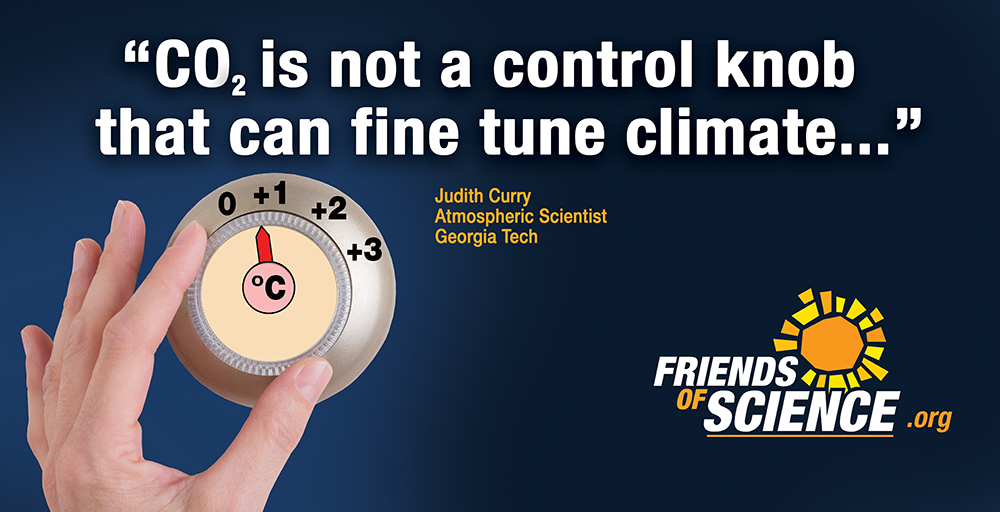
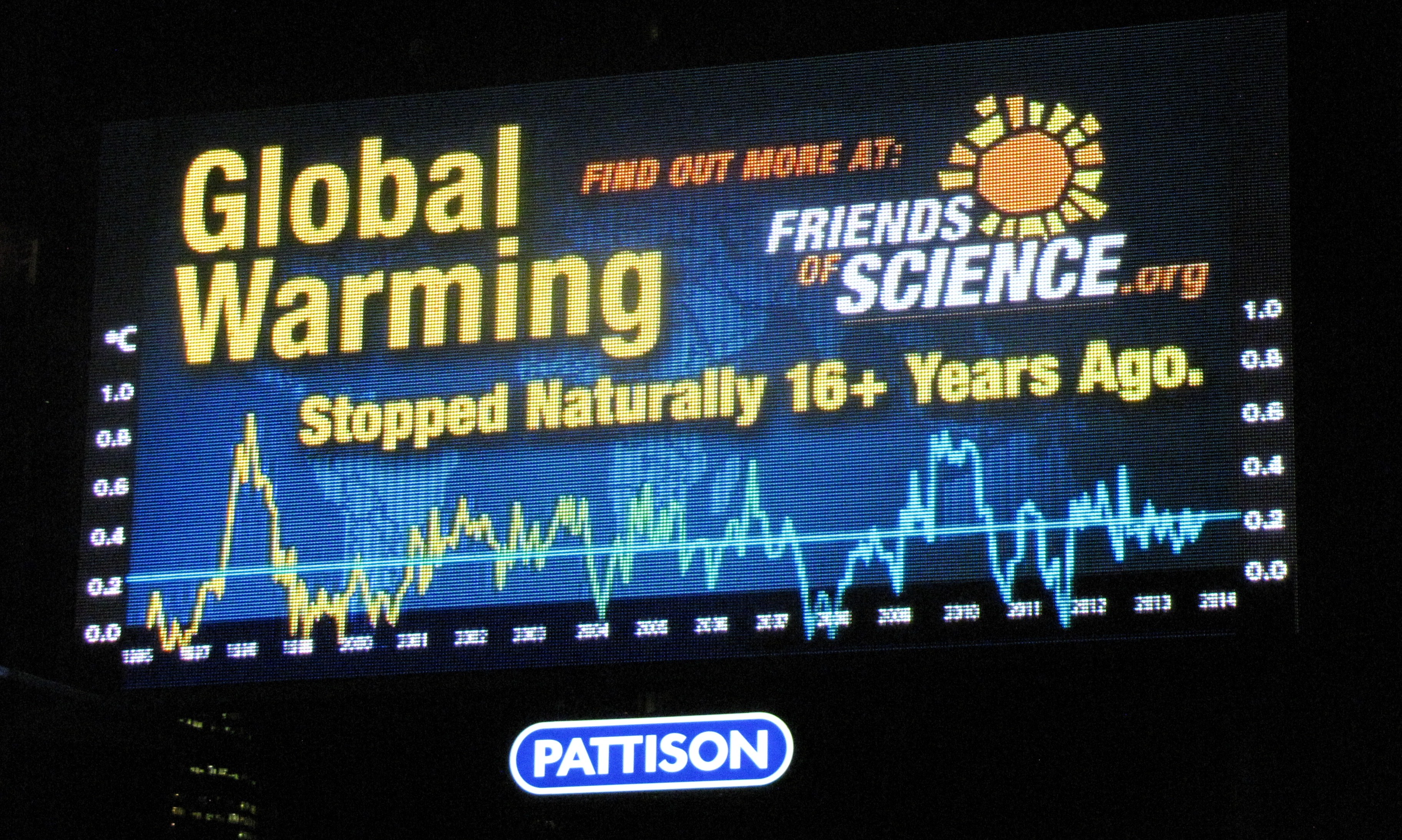
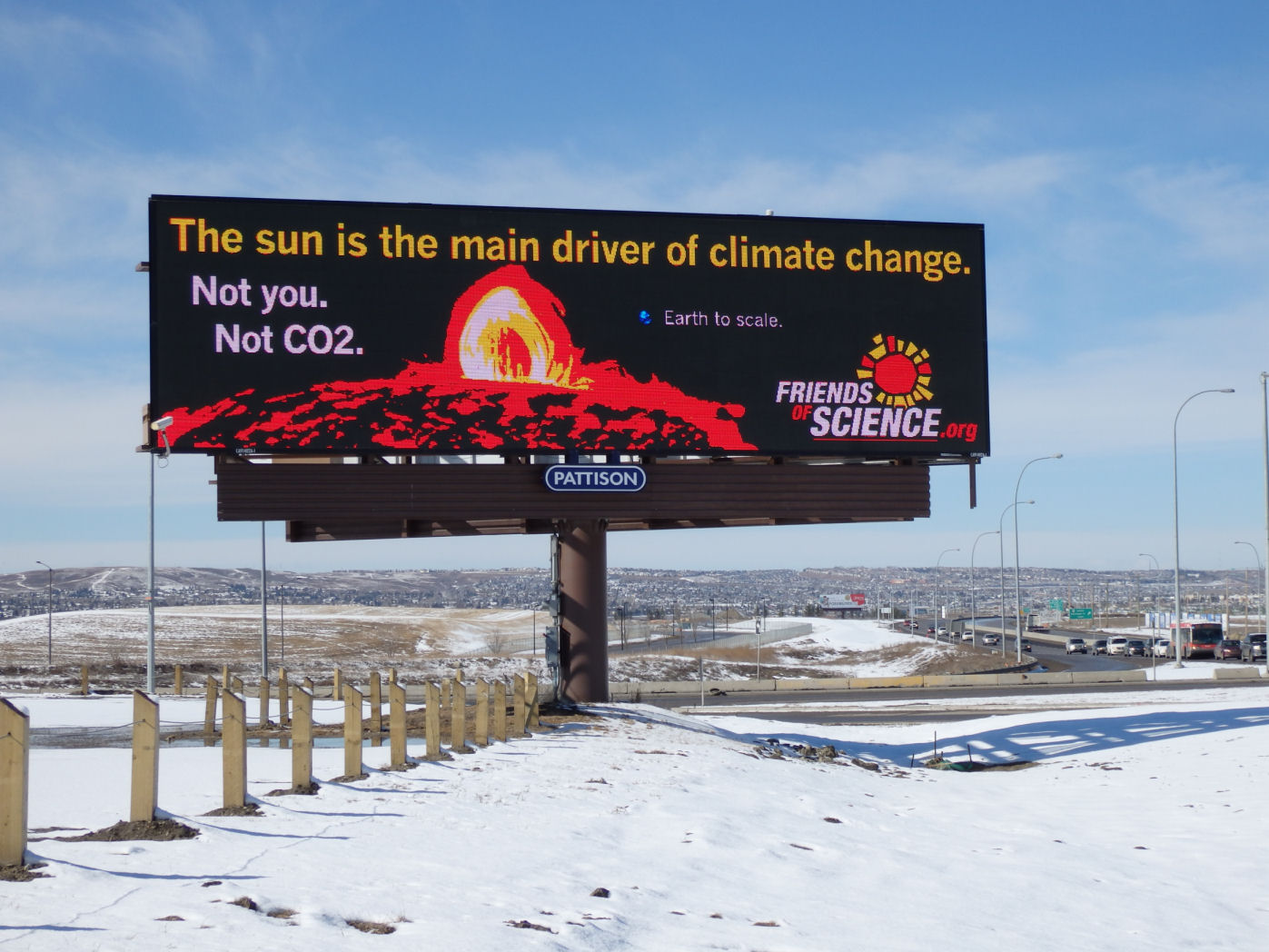
Tom Harris of International Climate Science Coalition – Canada explains in his Financial Post article Tom Harris: The Tories should shape climate opinion, not just respond to it.  Excerpts in italics with my bolds and added images from Friends of Science billboard campaign.

Grassroots conservatives need to ask CPC leadership candidates why, if they really support Canadian energy, they don’t contest climate alarmism

When CPC leadership candidates defend Canadian oil and gas, they either support, acquiesce to, or say nothing about the climate scare. PHOTO BY JOE RAEDLE/GETTY IMAGES

The common wisdom among candidates for leadership of the Conservative Party of Canada (CPC) is that the party must have a credible plan to reduce greenhouse gas emissions if it is to have a fighting chance to form the next government. As former Quebec premier Jean Charest said in the Edmonton debate on May 11, “we will not be elected as a political party if we’re not credible” about putting a price on carbon for large emitters.

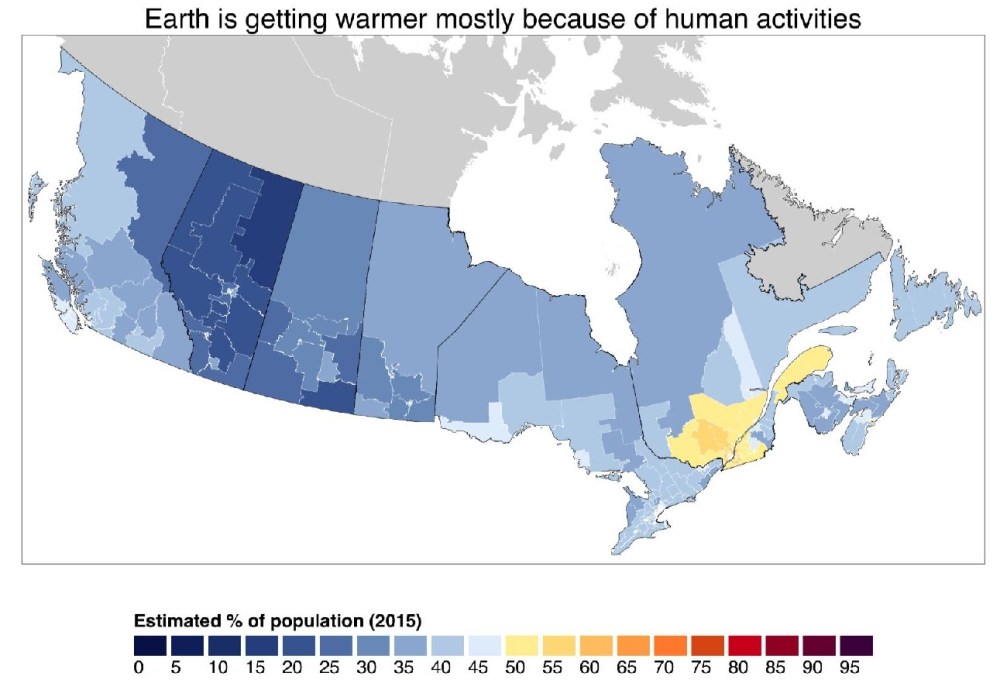
The strategists’ thinking is that, given current public support for reducing emissions to “stop climate change,” the CPC has no choice but to follow along or risk electoral defeat. And public opinion polls, like one from Abacus Data last October, do typically find that a majority of Canadians, in that poll 66 per cent, “would like to see governments in Canada put more emphasis on reducing emissions.”

[For the politics of climate polling see Uncensored: Canadians View Global Warming]

But the strategists are wrong. The candidates are giving up a golden opportunity to win the votes, not just of the many grassroots conservatives who oppose the climate scare,
but of Canadians at large in the next election.

A 2012 paper published in the journal Climatic Change suggests why. Three scholars — Robert J. Brulle of Drexel University, Jason Carmichael of McGill and J. Craig Jenkins of Ohio State — looked at 74 separate surveys over a nine-year period to try to figure out which factors had the greatest influence on public views on climate change. They considered five possibilities: extreme weather events, scientific information, media coverage, advocacy, and what politicians and political parties were saying on the subject. Surprisingly, they found that neither extreme weather events nor the promulgation of scientific information had a significant impact. Media coverage did, but the strongest effect came from the positions of competing politicians and political parties.

When politicians across the political spectrum supported the narrative
of man-made climate change, the public’s demand for action rose.

We see that today in Canada, with all major political parties supporting action on greenhouse gas emissions. On the other hand, when politicians questioned the narrative, as Congressional Republicans frequently did, the public’s demand for action dropped — substantially. The scholars’ analysis supported the 2009 conclusion of Harvard University’s Susan McDonald that: “When elites have consensus, the public follows suit and the issue becomes mainstreamed.

When elites disagree, polarization occurs, citizens rely on other indicators
to make up their minds.”

These findings are consistent with other studies that have demonstrated the leading role politicians and political parties play in shaping public opinion on issues. It’s a little like the tail wagging the dog but public opinion supporting government climate policy seems at least partly due to the lack of coherent opposition to the policy on the part of opinion-makers — especially elected officials.

If that’s true, then instead of citing public opinion polls that support climate policies they may be skeptical of, why don’t politicians and political strategists work to change public opinion? As conservative strategist and former policy aide to Stephen Harper, Joseph Ben-Ami, put it in a 2021 study for ICSC-Canada: “The answer may come down to inexperienced politicians and their advisers not understanding their power to influence public opinion. They look at polls and conclude that they have no hope of getting elected unless they climb onto the current public opinion bandwagon.

They fail to understand that the reason the public believes what it does is largely because they (politicians) aren’t making the opposite case.”

This phenomenon is widespread in Canada, and on many topics, not just climate change. At all levels of government, politicians use language and promote policies they very likely disagree with because they think public opinion leaves them no choice. As Ben-Ami argues, the result is a “feedback loop” where politicians’ “response” to public opinion is in reality the principal driver of the public opinion to which they are supposedly responding. The more obsequious their responses, the more entrenched that public opinion becomes, which then results in even more obsequious responses from even more frightened politicians.

Climate activists don’t pull their punches. They want an end
to all of Canada’s oil and gas development as soon as possible.

And, sadly, they are being helped by many in the press, government and other institutions. But a fast phase-out would be immensely costly. Besides contributing $105 billion to Canada’s GDP in 2020, oil and gas provided $10 billion in average annual revenue to governments between 2017 and 2019. Yet, when CPC leadership candidates defend Canadian oil and gas, they either support, acquiesce to, or say nothing about the climate scare.

Grassroots conservatives need to ask the candidates why, if they really support Canadian energy, they don’t contest climate alarmism, which is by far the greatest threat to that energy.

Tom Harris is executive director of International Climate Science Coalition – Canada.

Footnote: 

The billboards are from a campaign to inform the public by Friends of Science, not to be confused with the predatory Fiends  Friends of the Earth in the UK.

Calgary Climate Change Billboard campaign shows
Five Key Points of Cli-Sci Uncertainty says Friends of Science


Hard Facts Puncture Anti-Fossil Fuel Fantasies

Gwyn Morgan explains at Financial Post Hard facts puncture anti-fossil fuel fantasies.  Excerpts in italics with my bolds and added images.

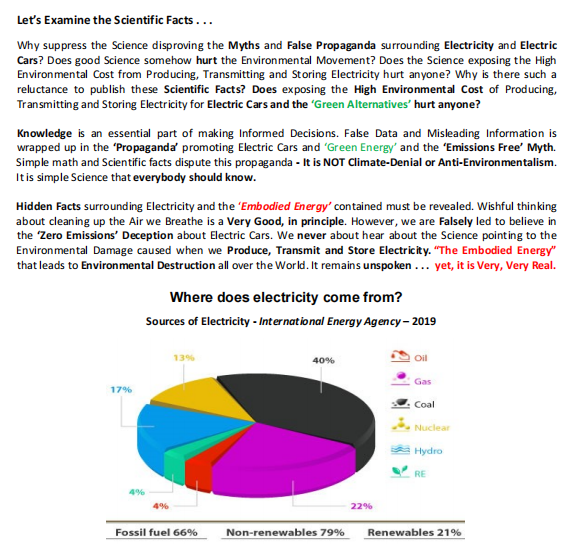
The belief that 84% of global energy supplied by oil and gas can be replaced by so-called ‘green energy’ is a fantasy

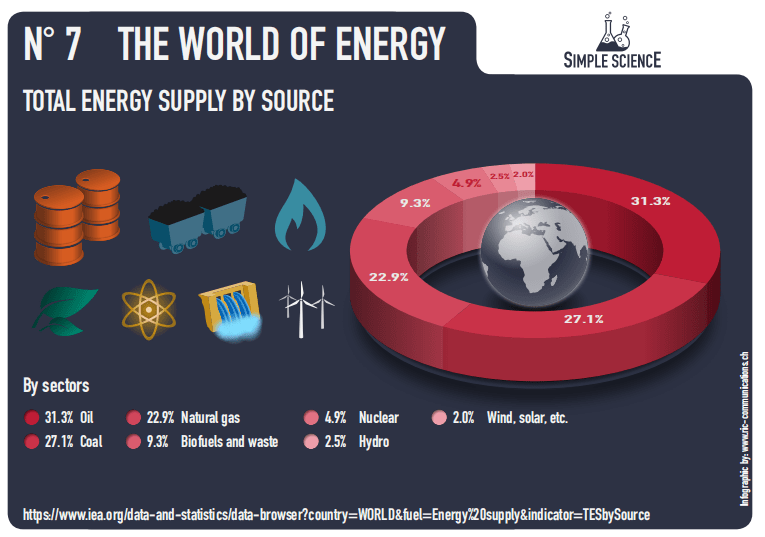
The marvelous Christmas movie Polar Express, starring the inimitable Tom Hanks, ends with the words “anything is possible, if you only believe.” Except, as adults understand, many things aren’t possible, not even if some people do believe them. An obvious example is the fantasy that the 84 per cent of global energy supplied by oil and gas can be replaced by so-called “green energy.”

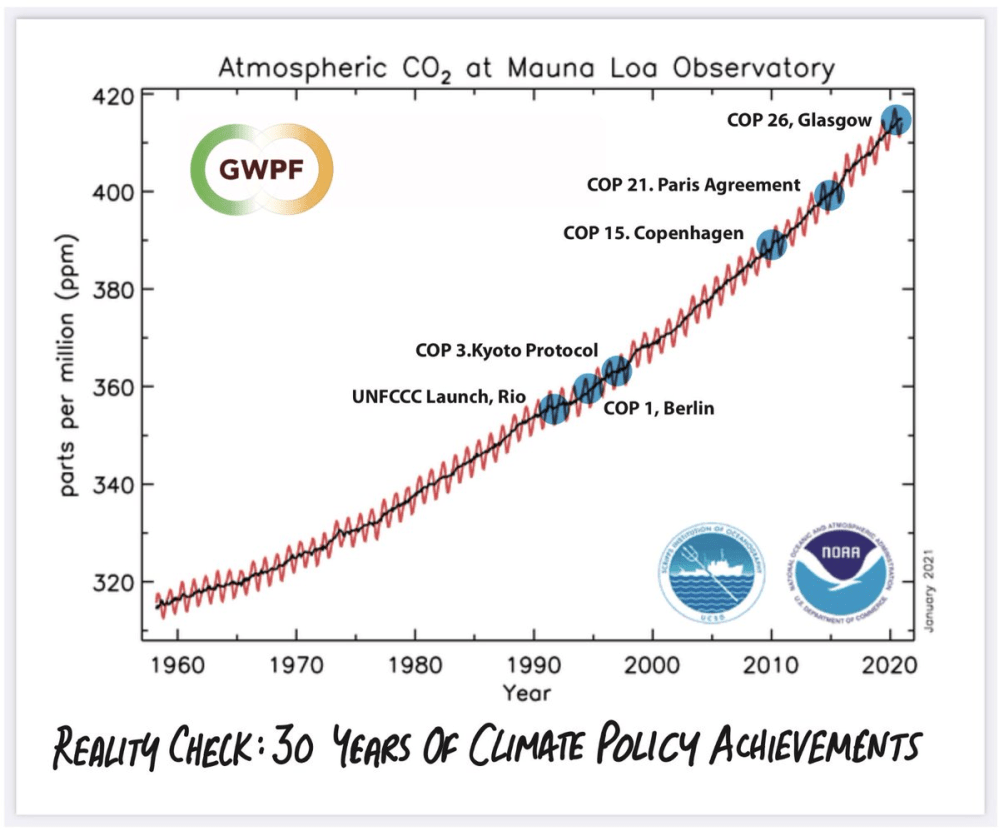
Since the first UN COP (“Conference of the Parties”) meeting in 1995, world oil demand has increased from 64 to 100 million barrels per day. But even as demand increased, the “environmental, social and governance” (ESG) movement encouraged investors to unload their oil industry holdings. Faced with share valuations reflecting their perceived status as a “sunset Industry,” the rational course for oil company leaders was to pay out large dividends rather than reinvest in production growth. As demand grew, supply therefore stagnated. The Ukraine crisis revealed just how narrow the supply margin has become. Regrettably, most of that margin is in the hands of Vladimir Putin, leaving European countries that depend on Russian oil no choice but to continue to provide the funds with which he ravages the Ukrainian people.

This is the tragedy sanctimonious ESG zealots have wrought.

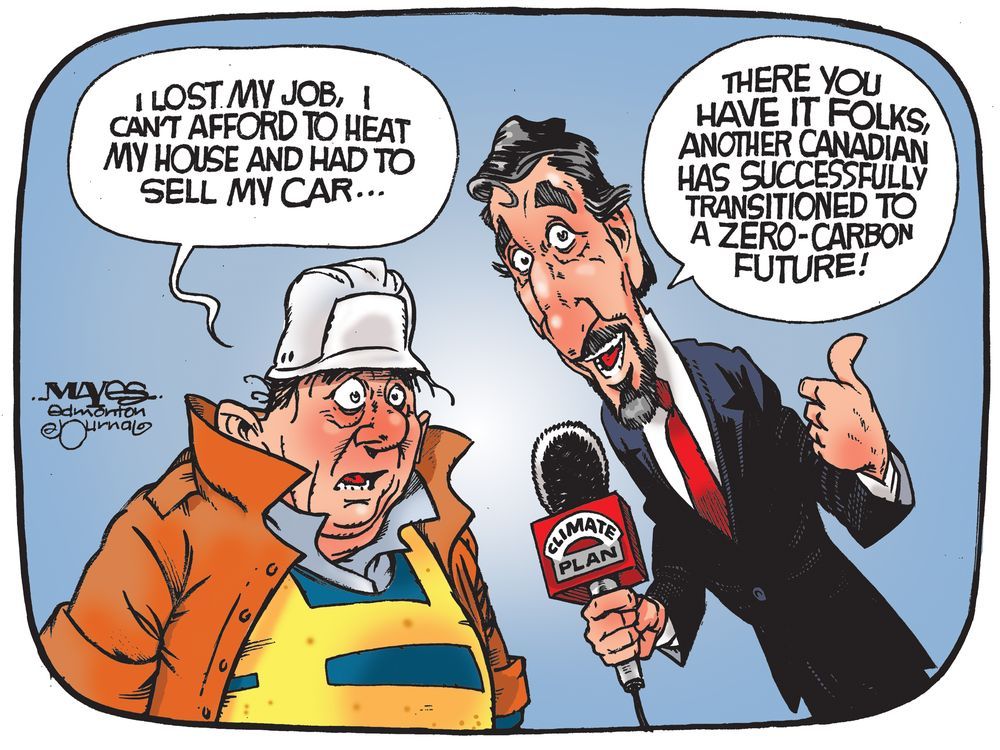
Meanwhile, back in the world capital of “if you only believe” fantasies, the prime minister of a country endowed with one of the world’s largest reserves of oil has presided over a seven-year long anti-oil industry scourge, thwarting multiple proposed export pipelines that could now have been supplying those captive market countries.

Sharing his anti-oil zealotry seems to be a necessary qualification for Mr. Trudeau’s cabinet. Alberta Premier Jason Kenney recently went to Washington to present the Senate Energy Committee with plans to increase Canadian oil exports, thereby freeing-up more U.S. oil to help Europe reduce Russian oil purchases. The idea received a warm reception. Unfortunately, Kenney’s message was promptly contradicted by Federal Resources Minister Jonathan Wilkinson, who told the same committee that shifting to renewables and hydrogen “will provide true energy and national security to Europe.” In other words, don’t count on Canada to help de-fund Putin’s murderous war unless it lasts five or ten more years.

It’s incomprehensible that during a global oil and gas shortage brought on by the wanton destruction of a civilized democracy, our prime minister thinks all will be well if only Canada rids itself of fossil-fueled vehicles. Deep in delusion, he considers this a perfect time to announce a plan to have 60 per cent of new cars and light duty trucks be “zero emission” by 2030.

When you live in a perennial state of fantasy, facts don’t matter. But here are facts that do matter to Canadians forced to face the real-world impact.

Fact 1: High cost. The federal budget promises a $5000/vehicle rebate. There are 24 million gasoline and diesel-powered vehicles in Canada. Subsidizing replacement of just one million would cost $5 billion. The budget also contains $900 million for new charging stations. That’s helpful in urban centres but providing a charging station network necessary to allow e-vehicles to travel interurban highways would cost tens of billions more.

Fact 2: Revenue needs. The Trudeau government’s longer-term plan is to get rid of all fossil-fueled vehicles. Federal and provincial fuel taxes now total a stunning $22 billion each and every year. These revenues fund the cost of building and maintaining urban streets and highways. How long can it be before governments are forced to regain those revenues from electrical vehicle charging levies?

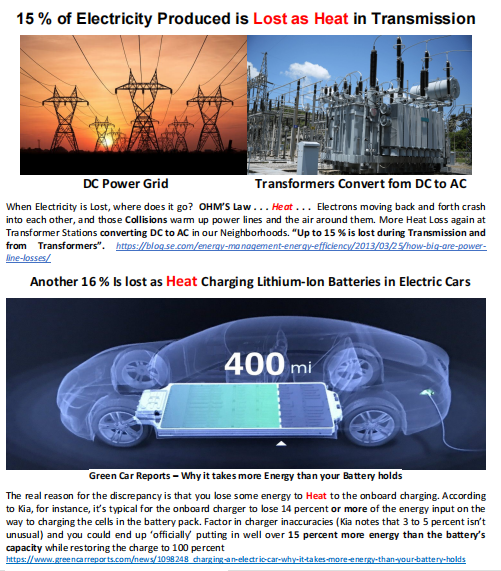
Fact 3: Grid stress. The average Canadian motorist drives 15,000 km per year and the average electric passenger vehicle uses 19 kw/hr per 100 km. That works out to 2,850 kw/hr per year, more than 25 per cent of current Canadian household consumption. Many of the country’s electrical generation and distribution grids are already near capacity. Electric vehicle advocates say the problem will be mitigated by mandating low amperage during off-peak, late-night hours. But most highway drivers travel during the day when the grid is near capacity. And they will need high-amperage DC quick-chargers during these already supply-tight hours.

Fact 4: Land demand. Refueling with gasoline or diesel takes around five minutes. But even rapid chargers need 30 minutes. That means six times more land occupied by charging stations. How much of that land will be taken from agricultural production?

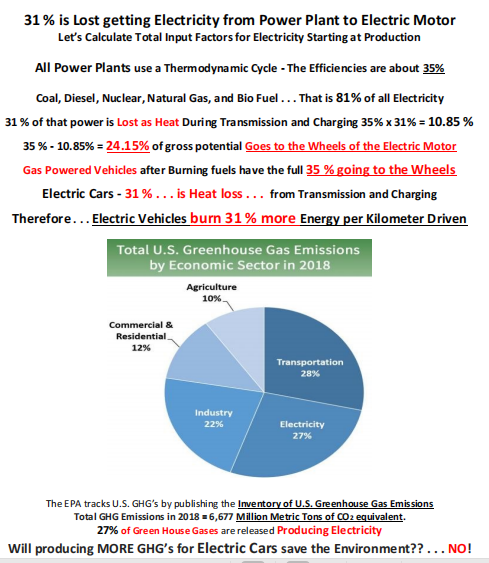
Fact 5: More emissions, not fewer. Canada’s 24 million fossil-fueled cars and pickup trucks emit 14 per cent of the country’s 1.5 per cent share of global emissions. If all 24 million were converted to battery power, global emissions would be reduced by just two-tenths of one per cent. Emissions growth from China’s coal-fired power plants would offset that in just a few days. And that two-tenths of a per cent doesn’t count emissions produced from mining and transporting the materials that go into all those batteries. Nor does it consider that 20 per cent of Canada’s electricity is generated with fossil fuels.

Those factors clearly wipe out any benefit, unless we include the benefit that living a fantasy allows people, our leader included, not to have to think about all those Ukrainians we could have saved by helping Europe say “no” to Russia’s oil — if only our oil industry hadn’t been hamstrung.


The Looming Energy Catastrophe

Ron Stein provides a briefing from California on the energy debacle imposed by clueless political leaders on ordinary Americans.  Excerpts in italics with my bolds H/T CFACT

The Looming Energy Catastrophe

Please enjoy and share this educational energy literacy briefing, a 5-minute video by Costa Mesa Brief at a California Chevron gas station. The video talks about the outrageous gas prices and tells us what is behind the increases, where it is heading and what, if anything, we can do about it. I think you will find his no-nonsense approach and perspective unique, sobering and very informative.

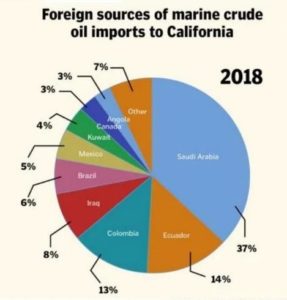
The video explains the impact on fuel prices from California government-imposed reductions in the supply chain of crude oil has increased imported crude oil from foreign countries from 5% in 1992 to more than 60% today of total consumption. Biden’s pledge stating, “we are going to get rid of fossil fuels,” is impacting fuel prices.

At today’s price of crude oil well above $100 per barrel, the imported crude oil costs California more than $150 million dollars a day, yes, everyday, being paid to oil-rich foreign countries, depriving Californians of jobs and business opportunities, and forcing drivers to pay premium prices for fuel.

Californians are consuming more than 50 million gallons of fuel daily for its 35 million vehicles, which is slightly more than one gallon per day per vehicle.

Californians continue to pay more than $1.00 more per gallon of fuel than the rest of the country primarily for the State, Federal and Local taxes, and the Government environmental compliance programs such as the Low Carbon Fuel Standard (LCFS), Cap and Trade, Renewable Fuel Standard (RFS), and the Underground Storage Tax. Those costs ‘dumped” onto the posted price at the pump are not transparent to the public.

The demand for fuels to move the heavy-weight and long-range needs of more than 50,000 jets for the military, commercial, private and the President’s Air Force One, and the more than 50,000 merchant ships that move products throughout the world are also manufactured from the supply of crude oil.

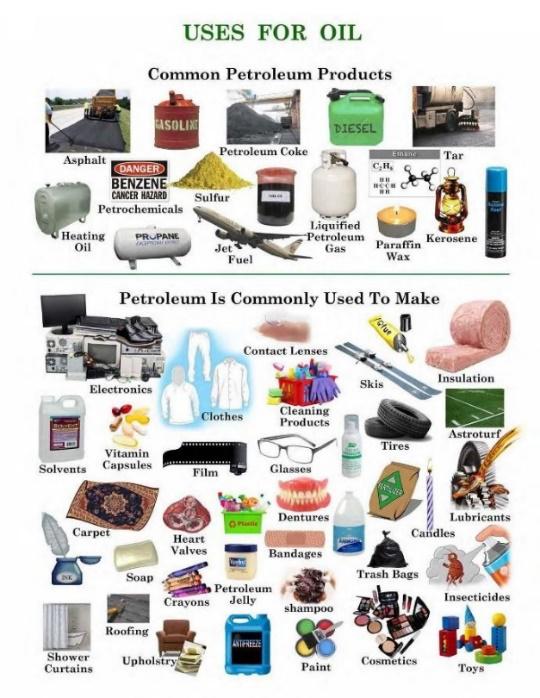
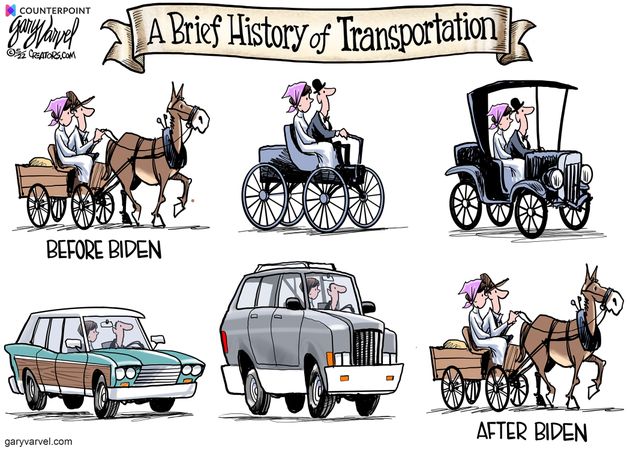
Life Without Oil is NOT AS SIMPLE AS YOU MAY THINK as renewable energy is only intermittent electricity from breezes and sunshine as NEITHER wind turbines nor solar panels can manufacture anything for society. Climate change may impact humanity, but being mandated to live without the more than 6,000 products and the various fuels manufactured from crude oil will necessitate lifestyles being mandated back to the horse and buggy days of the 1800’s.

When the public continues to demand increasing needs for the transportation fuels and the products made from crude oil, limiting its supply by governments and the Environmental, Social and Governance (ESG) movement to manufacture those items is a guarantee for today’s shortages and inflation.

Life without crude oil could be the greatest threat to civilization’s eight billion residents, resulting in billions of fatalities from diseases, malnutrition, and weather-related deaths.

G7 Ministers Pledge Energy Hari-Kari

G7 Climate, Energy and Environment Ministers’ Communiqué, Berlin, May 27th, 2022

Excerpts in italics with my bolds

Recognising that accelerating the international clean energy transition and phasing out continued global investment in the unabated fossil fuel sector is essential to keep a limit of 1.5 °C temperature rise within reach, we commit to end new direct public support for the international unabated fossil fuel energy sector by the end of 2022, except in limited circumstances clearly defined by each country that are consistent with a 1.5 °C warming limit and the goals of the Paris Agreement. (pg. 33)

We note with concern the scale of private finance currently still supporting non-Paris aligned activities especially in the fossil fuel sector. (pg. 22)

We are thus further strengthened in our resolve to accelerate the clean energy transition towards a net zero emissions future by 2050, while also keeping energy security and affordability at the core of our action, including through the rapid expansion of low-carbon and renewable energies and an increase in energy efficiency.  (pg. 29)

In this regard, we acknowledge the IEA net zero scenario which suggests that G7 economies
invest at least US$1.3 trillion in renewable energy including tripling investments in clean
power and electricity networks between 2021 and 2030. (pg. 31)

We confirm our strong financial commitments for the market ramp-up of low-carbon and renewable hydrogen and its derivatives, thereby signalling an irreversible shift towards a world economy based on low carbon and renewable energy sources. (pg. 31)

In view of the Russian attack on Ukraine, financial support for companies and citizens affected by severely rising prices for fossil fuels is now on the political agenda for several countries. Nevertheless, we aim for our relief measures to be temporary and targeted and we reaffirm our commitment to the elimination of inefficient fossil fuel subsidies by 2025. (pg. 32)

We also highlight that we have ended new direct government support for unabated international thermal coal-fired power generation by the end of 2021, including through Official Development Assistance, export finance, investment, and financial and trade promotion support. (pg. 33)

We commit to increase national efforts to decarbonise building heating and cooling systems by using appropriate policy tools, including regulations and incentives, with the ultimate objective of transitioning away from fossil fuels. (pg. 37)

This will also guide our approach in public finance institutions and on the boards of MDBs and bilateral DFIs. We therefore call on other major economies, the MDBs and bilateral DFIs, multilateral funds, public banks and relevant agencies to also adopt these commitments. We commit to review our progress against our commitments. (pg. 33)

(Note: Multilateral Development Banks (MDBs), Development finance institution (DFIs)

See also Michael Kelly on Energy Utopias and Engineering Realities synopsis Kelly’s Climate Clarity

And Dieter Helm Seeking Climate and Energy Security

West’s Obsession with EV Tech Puts China in World Driver Seat

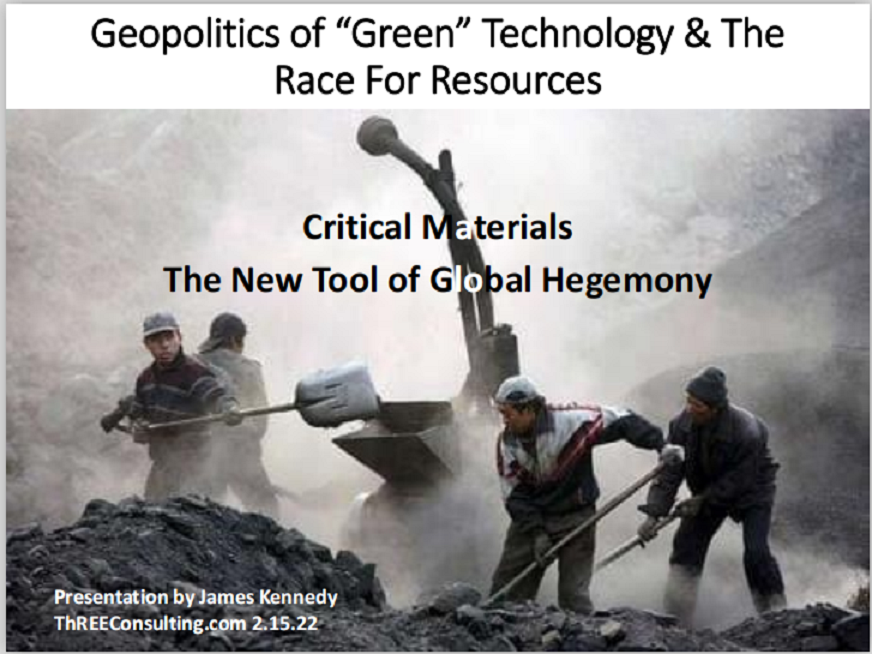
James Kennedy explains the dangerous slide in his presentation Critical Materials
The New Tool of Global Hegemony.  Excerpts in italics with my bolds.  H/T Mark Krebs

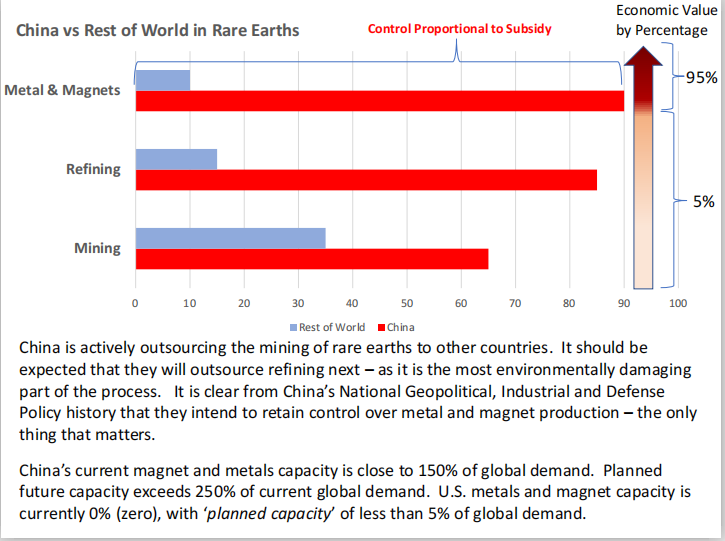
This presentation outlines the vast disconnect between green technology goals and the anticipated compounding economic consequences of finite resources.
♦  Begin by assessing resources and the challenges associated with the Administration’s             limited goal of replacing the internal combustion engine.
♦  Expose who leads in resource production
♦  Reveal who leads in research, IP, control over finished materials and estimated
resource demand

♦  Consider the asymmetric geopolitical consequences
♦  Consider the consequences of compounding renewables (wind & solar), energy                   distribution and grid-storage demand on these limited resources.

To enlarge, open image in new tab.

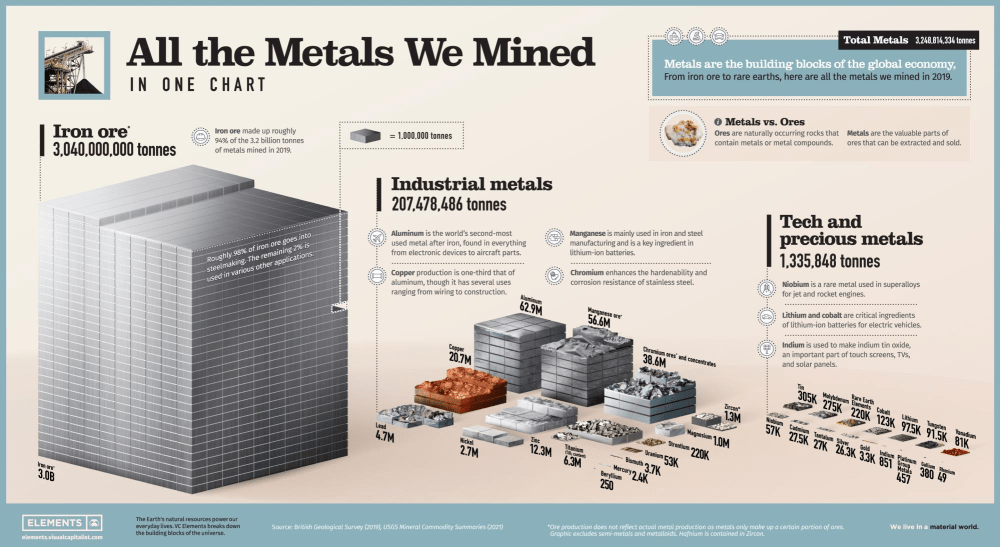
♦ Most of the critical technology metals make up less than .003% of the earth’s crust.
♦ They tend to be present in measurements of parts per million.
♦ They tend to be tied up in much more complex mineralization’s.
♦ Extracting them requires mining and refining facilities that cost billions of dollars.
♦ The extraction process requires lots of energy and complex chemical processes.
♦ These processes pose environmental problems of their own.

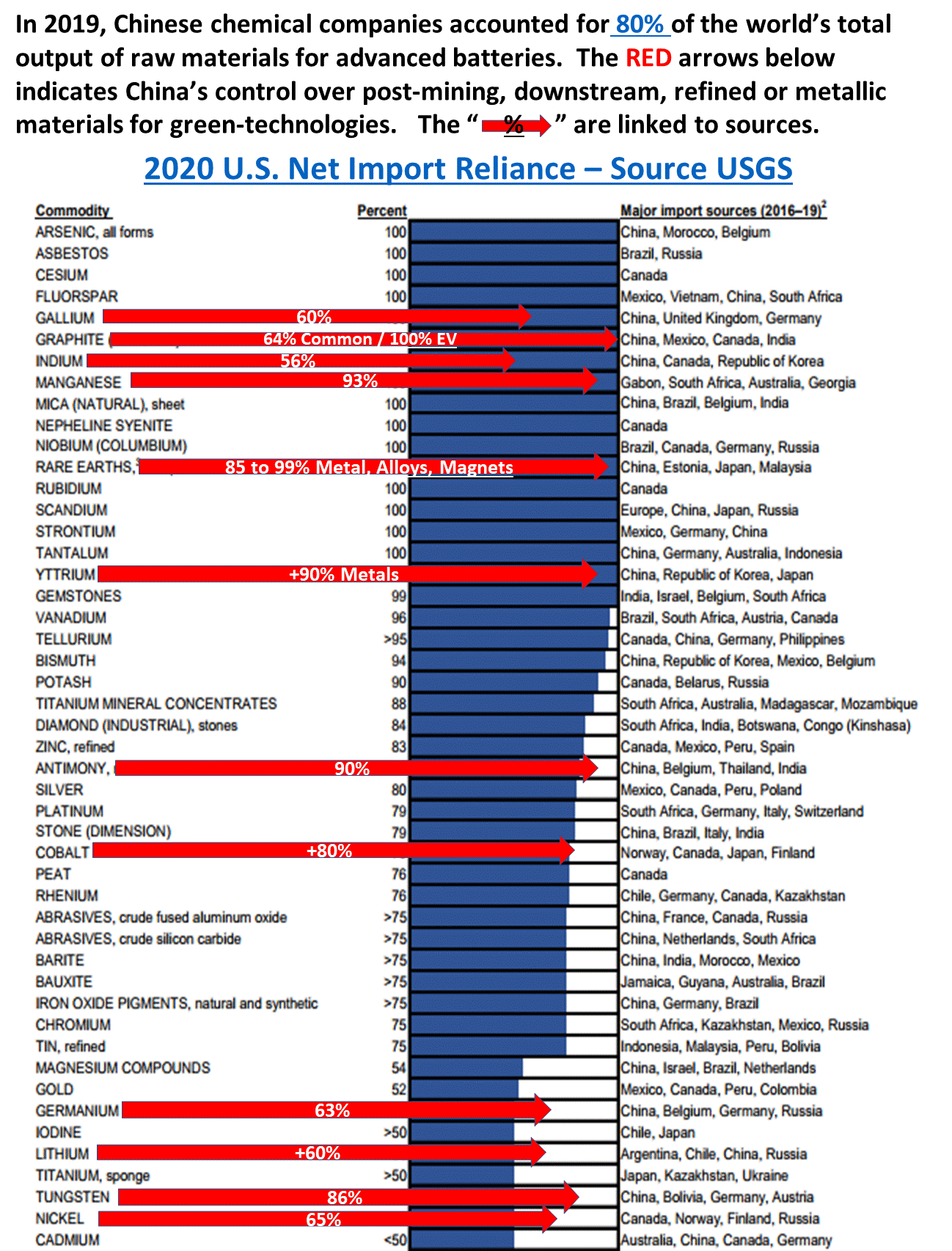
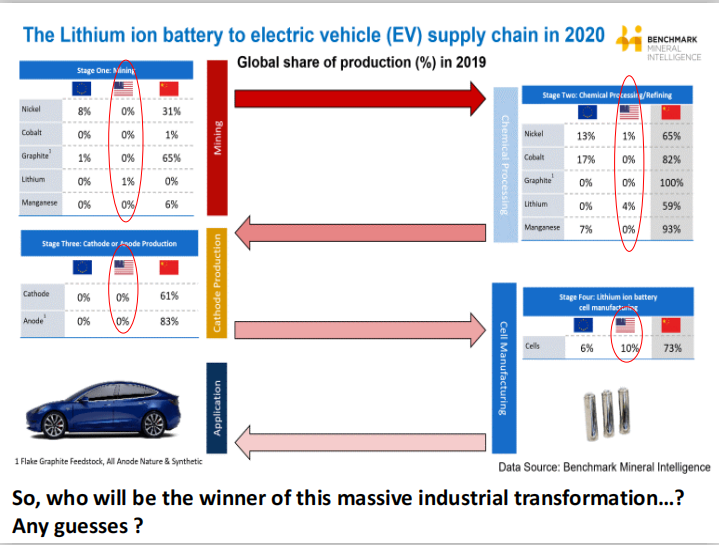
As you can see from the red arrows,  China controls most of these elements and critical materials at the point of refined materials, metals, alloys and magnets.  Recent production from California’s Mt. Pass mine goes to China for refining and metal / magnet production.

China’s state sponsored subsidies and internal tax advantages make U.S. production of rare earth metals and magnets non-competitive. This is also true for refined cobalt and many other critical materials and components like anodes and cathodes for batteries.

China’s production capacity for these materials and components dwarfs the rest of the world – exceeding global demand in many cases.

Conclusion:

This rush to zero carbon is driven by short term private interests leveraging fears of global warming that conflate with larger ideological agendas.
Things will go wrong, there will be multiple train wrecks.

Potential Winners: China, natural gas producers, mining companies that supply China, flim-flam renewable / green tech / green energy project promoters, 1% or less of the U.S. & EU population.

Potential Losers: 99% of U.S. & EU population, legacy and residual manufacturing industries, the financial system and the U.S. dollar as its status as world reserve currency evaporates.

Potential Black Swan Outcomes
Upside: Material Science Breakthroughs solve the problem
Downside: Forfeiture of Western Economic Relevance

My Comment:

As posted previously, this drive to reduce carbon-based energy is absurd, costly and pointless.

Absurd, because there is no reliable data showing anything in our climate or weather outside historical ranges of variation.

Costly, because proposed remedies including “green energy” and electric vehicles serve only to make affordable reliable energy expensive and intermittent.  In addition  as demonstrated above, the tech depends on the rarest, most precious and environmentally damaging materials.

Pointless, because we do not control the weather anyway.

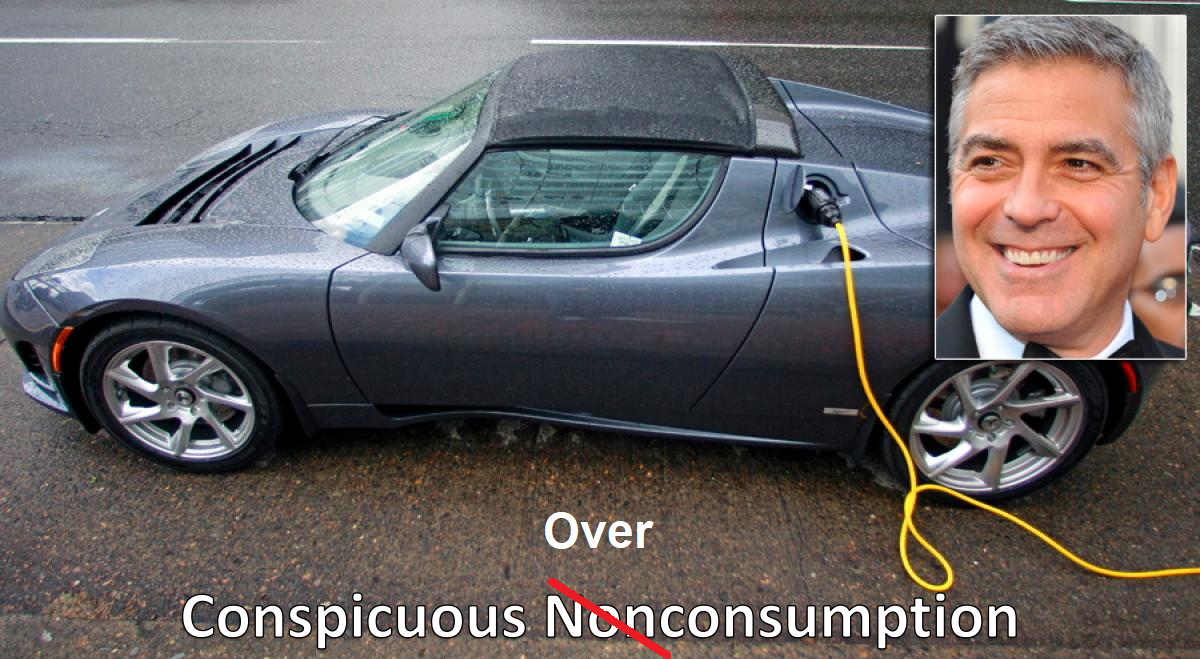
High time to unplug the EV illusion and back away from the social and economic cliff.

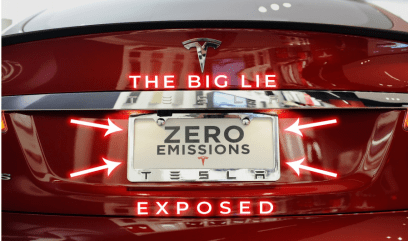
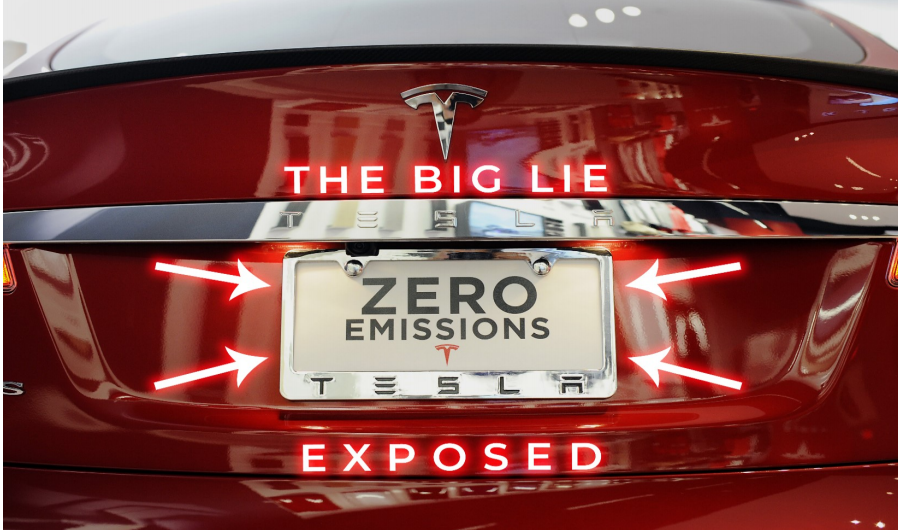
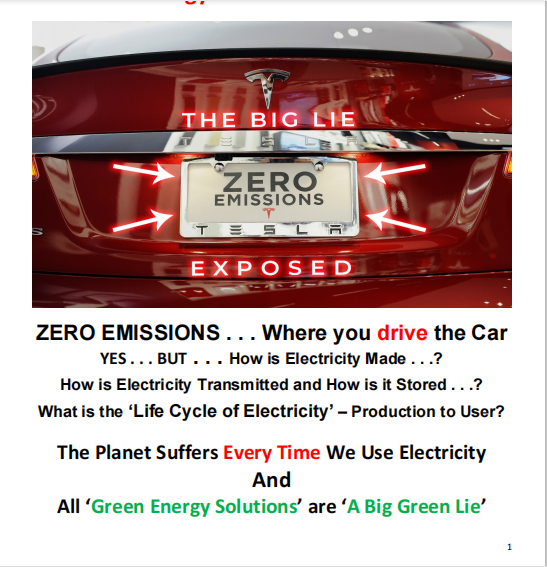
See also: Electric Car Lie Exposed

If That Tesla Battery Could Talk


DOJ Office of Environmental Justice: What’s Wrong?

I can think of five major things wrong with this initiative  But first the announcement news from various sources:

AG Garland:  “Consistent with the President’s Executive Order on Tackling the Climate Crisis at Home and Abroad, we are issuing a comprehensive environmental justice enforcement strategy,” Garland said. “I am pleased to announce that we are launching the Justice Department’s first-ever Office of Environmental Justice to oversee and help guide the Justice Department’s wide-ranging environmental justice efforts. Like all parts of government, it will get its own acronym: OEJ.”

On Thursday, Garland said the department will prioritize cases that create the greatest impact on communities “most overburdened by environmental harm.”

“Although violations of our environmental laws can happen anywhere, communities of color, indigenous communities, and low-income communities often bear the brunt of the harm caused by environmental crime, pollution, and climate change,” Garland said.

According to The Hill, the Office of Environmental Justice will work with “communities that have been the victims of environmental crimes and requires all 93 U.S. attorneys across the country to designate an environmental justice coordinator to find ‘areas of concern’ in their communities.”

Since taking office, President Biden has launched the “Justice40” initiative, which aims to provide 40% of the benefits of government climate and clean energy investments to “historically disadvantaged communities.”  

What’s wrong with this?  Let’s count five ways.

Distracts from More Pressing Priorities

How about stopping the flood of illegal immigration through the wide-open border controlled by drug cartels?
What about reducing the worst rates of crime in US cities since the 1990s?
Shouldn’t DOJ focus on ending the cruel and unusual punishment of people expressing their free speech rights on January 6, 2020?

Just three examples of widespread injustices ignored or exacerbated by this DOJ.  We could add treating parents of school children as “domestic terrorists”.  Also firing workers and discharging soldiers for their vaccine status.  And so on, and so on.

Actually Enforcing Existing Laws Solves the Stated Problem 

Garland:  “Although violations of our environmental laws can happen anywhere, communities of color, indigenous communities, and low-income communities often bear the brunt of the harm caused by environmental crime, pollution, and climate change”

Garland’s remarks represent contemptible propaganda. As if smog and air pollution are wafting through cities, only affecting citizens with darker skin pigmentation. And, as if the communities referenced by Garland aren’t interspersed with other groups, at all, living exclusively in homogeneous neighborhoods. Such total nonsense and rubbish.

Every state already has an environmental state protection agency and access to the EPA. Anyone who finds or thinks they have discovered an environmental problem, can call these agencies, and the agencies will send some one to investigate. Currently the EPA investigates & gives evidence to the U.S. Attorneys Office in their District. It is examined & determined if there is enough evidence for a case to be brought against the individuals involved.

If what he says about “anywhere” is true, how about just enforcing the existing laws, with the existing agencies and offices, and without the expansion, expense, and bloat that he proposes? Such enforcement would, by its nature, address these problems in minority communities in proportion to their spatial distribution and criticality.

I have absolutely no idea what this new agency will do, except using more taxpayer money to fund it. What I suspect is that they’ll give more money to low income areas, for what exactly, will never be explained.

Covers for an Agenda to Cancel Climatist Dissenters

A naïve person might think is that this would “merely” be some kind of ecological jihad against “dirty” things like power lines, gas lines, and other things that prop up the modern world and keep America’s economy humming. But of course this is thinking too small,  underestimating the awfulness Garland and minions have in store for us.

So instead we have another paean to Gaia with the old “Climate Change” nonsense, thus bringing the DOJ into obviously redistributionist grounds, and turf that you’d expect would be the purview of the EPA. Because what we really needed in Current Year with political prisoners from Jan 6th still rotting away is yet another batch of heretics to harass and disappear.

There is no coherent definition of “environmental justice”. That is deliberate. It provides a means by which the government can act against any citizen for any reason it wants. It is the establishment of yet another department of the American Stasi, just like biden’s ministry of “truth”.

WOTUS (Waters of the US) EPA rule is still murky after all these years. And what, pray tell, is the definition of “environmental crime” and “environmental justice”, what is the legal and judicial rationale for establishing such an agency and why is such a redundant agency an imperative now when no such need has ever been identified and implemented before?

Be warned, ESG (environmental, social and governance) standards for corporations are being developed as we speak. They are being worked on internationally and created out of thin air. The DOJ and our government will beat us all – organizations and individuals – into submission with this.

Turns a Blind Eye to Real Environmental Degradation by Wind and Solar Farms

I am assuming the penalty for killing a tree will be harsher then the penalties for robbery and assault by Dem AGs. So will hunting and fishing be listed as crimes against the environment. Things just keep getting more and more weird. I hope the silent majority is paying attention and votes like their life depends on it this November.

Even if wind power curbs CO2 emissions, wind installations injure, maim, and kill hundreds of thousands of birds each year in clear violation of federal law. Any marginal reduction in emissions comes at the expense of protected bird species, including bald and golden eagles

To put this in perspective, powering the entire nation with wind and solar would require over 42 million acres — 18 times the size of Yellowstone National Park! This is at least 10 times the land footprint of our current energy system. The environmental destruction this effort would cause cannot be overstated.

But wait, there’s more! Both wind and solar generation also require massive amounts of elements like lithium, cobalt, and neodymium that are difficult and environmentally hazardous to mine. The tales of rare earth mines leaving behind lakes of toxic sludge in China and children as young as four mining cobalt in the Congo are chilling.

Unfortunately, most wind turbines and solar panels are expected to last only 20 to 30 years, and recycling them is still prohibitively expensive. A recent study estimates a whopping 8 million tons of solar panels will be sent to landfills by 2030, ballooning to 80 million tons by 2050. If renewable energy use grows at the projected scale, solar panels alone will represent 10% of global electronic waste — potentially leaching toxic chemicals all the while.

Another Excuse to Expand Governmental Social Control and Bureaucracy

This new office is nothing but wasting more money of the taxpayer. It appears Biden is creating more government jobs for his democrat friends.

But the real danger of an “environmental justice” office is, as with anything having to do with the enforcement of environmental laws, the government’s tendency to wildly overregulate with no means for private citizens or companies to correct the overreach.  It won’t be long before we’re writing about some OEJ idiocy that demonstrates why fanatics and ideologues should never be put in any position where they can exercise power.

With an Office for Environmental Justice, we are one step closer to a chinese-style social credit system. This is worse the the Ministry Of Truth down the street at Homeland Security because they can sue. 

FERC Aims to Decarbonize, Shoots Down Energy Security

Marlo Lewis explains the Biden regime push to undermine critical energy supply in pursuit of climate virtue in his CEI article Why FERC’s Greenhouse Gas Regulatory Policy Cannot Pass a Cost-Benefit Test.  Excerpt in italics with my bolds.

Today, the Competitive Enterprise Institute (CEI) filed comments on the Federal Energy Regulatory Commission’s (FERC) proposal to consider climate change impacts in reviews of infrastructure projects under the Natural Gas Act (NGA). The comments were jointly submitted by my CEI colleague Patrick Michaels; Heritage Foundation Chief Statistician, Data Scientist, and Senior Research Fellow Kevin Dayaratna (commenting as an independent scholar rather than as a representative of any organization); and yours truly.

We submitted comments back in January on FERC’s November 2021 technical conference on the same issues. We advised FERC to steer clear of climate policy, for three main reasons.

1.  Decarbonizing Goals Conflict with Natural Gas Act Purpose

First, the Biden administration’s NetZero agenda to decarbonize and degasify the U.S. electric power sector cannot lawfully be aligned with the Natural Gas Act. Biden’s goals conflict with the NGA’s “principal purpose,” which is to:

 “encourage the orderly development of plentiful supplies
of electricity and natural gas at reasonable prices.”

In addition, climate change is not a factor Congress authorized FERC to consider. The words “climate,” “carbon,” “greenhouse,” “global,” “warming,” “mitigate,” or any of their cognates do not occur in the Act.

2.  Infrastructure Emissions Do Not Threaten the Environment

Second, although the direct and indirect emissions of natural gas infrastructure may be “reasonably foreseeable,” the climate effects are not. FERC’s project reviews are governed by the National Environmental Policy Act (NEPA), which requires scrutiny of major federal actions “significantly affecting the human environment.” Even the emissions of the largest natural gas projects are too small to discernibly affect global climate, and no project’s “carbon footprint” is big enough to influence the fate or fortunes of any community, business, or human being anywhere in the world.

3.  Social Cost of Carbon Is Speculative and Subjective

Third, the social cost of carbon (SCC)—an estimate of the present value of the cumulative climate damages of an incremental ton of carbon dioxide equivalent (CO2e) greenhouse gas (GHG) emissions—is too speculative and subjective, and too easily manipulated for political purposes, to be weighed in the same scales with an infrastructure project’s estimated economic benefits. The Biden administration’s SCC estimates are egregiously biased in favor of climate alarm and regulatory ambition, rendering any agency action that relies on them arbitrary and capricious.

Unsurprisingly, FERC did not take our advice, and proceeded in February to adopt an “interim” policy statement on NGA project review and greenhouse gas (GHG) emissions. That stirred up controversy, including pushback by Senate Energy and Natural Resources Chairman Joe Manchin (D-WV) and Ranking Member John Barrasso (R-WY). As a result, FERC in March demoted its GHG policy statement from “interim” to “draft,” and extended the comment period until today, April 25.

Unlike several presenters at FERC’s November 2021 technical conference, the draft GHG policy statement does not advocate requiring SCC analysis in NGA determinations of public convenience and necessity. Neither, however, does FERC disavow an intent to require it in later policy statements. The Commission may simply be waiting for the Biden administration’s Interagency Working Group (IWG) to finalize its interim SCC estimates, or for courts to resolve Louisiana’s challenge to federal agencies’ use of those metrics.

The Commission’s draft GHG policy statement establishes a “rebuttable presumption that proposed projects with 100,000 metric tons per year of carbon dioxide equivalents (CO2e) emissions will be deemed to have a significant impact on climate change.” FERC also implies that it may condition project approval on the sponsor’s plans to “mitigate all or a portion of the project’s climate change impacts.”

The camel’s nose is already under the tent.

It is not hard to guess where this is going if FERC does not quickly reverse course. The usual suspects will pressure the Commission to:

(1) progressively lower climate significance thresholds,
(2) monetize undetectably small project-related climate “impacts” using agenda-driven SCC estimates, and
(3) either reject needed natural gas infrastructure projects outright or impose mitigation requirements that render them uneconomic.

This is bad policy, as Michaels, Dayaratna, and I explained in our January 7 comments. If an infrastructure project is commercially viable and helps ensure plentiful supplies of electricity and natural gas at reasonable prices (the NGA’s principal purpose), the Commission knows in advance that the project’s economic benefits far exceed its climate-related externalities. Therefore, no further investigation of the project’s GHG emissions is required, nor does it make sense to condition the certificate of public convenience and necessity on the project’s adoption of mitigation measures.

Conclusion

New research by Dayaratna (hereafter “Heritage analysis”) further confirms that conclusion. Using the U.S. government’s leading energy and climate policy models, the Heritage analysis demonstrates that banning construction of new U.S. pipelines would have a negligible effect on U.S. annual CO2 emissions through 2050 and, thus, a similarly negligible effect on global temperatures through 2100. The policy implication for FERC is clear. No level of overregulation or prohibition that regulators might apply to the development of U.S. natural gas pipelines could meaningfully affect the Earth’s climate.

Consequently, no regulation or prohibition of new natural gas pipelines could possibly be worth the economic losses imposed on construction companies, natural gas producers, and energy consumers.

See Also Seeking Climate and Energy Security