Fossil Fuels ≠ Global Warming Updated

Note: This Analysis was updated with 2019 statistics in the post 2020 Update: Fossil Fuels ≠ Global Warming

Previous posts addressed the claim that fossil fuels are driving global warming. This post updates that analysis with the latest (2016) numbers from BP Statistics and compares World Fossil Fuel Consumption (WFFC) with three estimates of Global Mean Temperature (GMT). More on both these variables below.

WFFC

2016 statistics are now available from BP for international consumption of Primary Energy sources. Statistical Review of World Energy.  2017 numbers should be available this summer.

The reporting categories are:
Oil
Natural Gas
Coal
Nuclear
Hydro
Renewables (other than hydro)

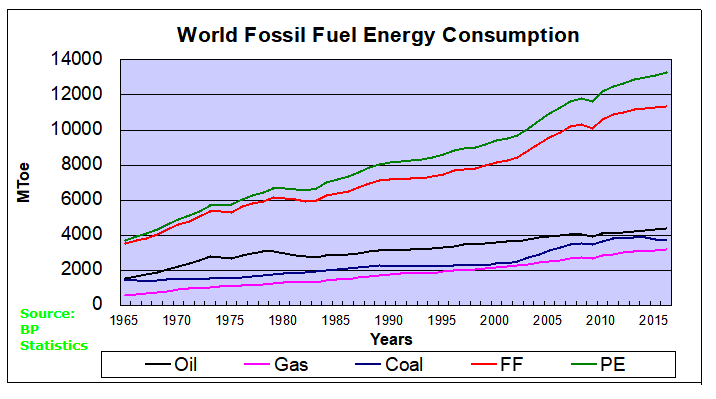
This analysis combines the first three, Oil, Gas, and Coal for total fossil fuel consumption world wide. The chart below shows the patterns for WFFC compared to world consumption of Primary Energy from 1965 through 2016.

WFFC 2016 BP

The graph shows that Primary Energy consumption has grown continuously for 5 decades. Over that period oil, gas and coal (sometimes termed “Thermal”) averaged 90% of PE consumed, ranging from 94% in 1965 to 86% in 2016.  MToe is millions of tons of oil equivalents.

Global Mean Temperatures

Everyone acknowledges that GMT is a fiction since temperature is an intrinsic property of objects, and varies dramatically over time and over the surface of the earth. No place on earth determines “average” temperature for the globe. Yet for the purpose of detecting change in temperature, major climate data sets estimate GMT and report anomalies from it.

UAH record consists of satellite era global temperature estimates for the lower troposphere, a layer of air from 0 to 4km above the surface. HadSST estimates sea surface temperatures from oceans covering 71% of the planet. HADCRUT combines HadSST estimates with records from land stations whose elevations range up to 6km above sea level.

Both GISS LOTI (land and ocean) and HADCRUT4 (land and ocean) use 14.0 Celsius as the climate normal, so I will add that number back into the anomalies. This is done not claiming any validity other than to achieve a reasonable measure of magnitude regarding the observed fluctuations.

No doubt global sea surface temperatures are typically higher than 14C, more like 17 or 18C, and of course warmer in the tropics and colder at higher latitudes. Likewise, the lapse rate in the atmosphere means that air temperatures both from satellites and elevated land stations will range colder than 14C. Still, that climate normal is a generally accepted indicator of GMT.

Correlations of GMT and WFFC

The next graph compares WFFC to GMT estimates over the five decades from 1965 to 2016 from HADCRUT4, which includes HadSST3.

WFFC HadGMT 2016

Over the last five decades the increase in fossil fuel consumption is dramatic and monotonic, steadily increasing by 223% from 3.5B to 11.4 B oil equivalent tons.  Meanwhile the GMT record from Hadcrut shows multiple ups and downs with an accumulated rise of 0.9C over 51 years, 7% of the starting value.

The second graph compares to GMT estimates from UAH6, and HadSST3 for the satellite era from 1979 to 2016, a period of 37 years.

WFFC HadSST UAH 2016

In the satellite era WFFC has increased at a compounded rate of nearly 2% per year, for a total increase of 84% since 1979. At the same time, SST warming amounted to 0.55C, or 3.9% of the starting value.  UAH warming was 0.72, or 5.5% up from 1979.  The temperature compounded rate of change is 0.1% per year, an order of magnitude less.  Even more obvious is the 1998 El Nino peak and flat GMT since.

Summary

The climate alarmist/activist claim is straight forward: Burning fossil fuels makes measured temperatures warmer. The Paris Accord further asserts that by reducing human use of fossil fuels, further warming can be prevented.  Those claims do not bear up under scrutiny.

It is enough for simple minds to see that two time series are both rising and to think that one must be causing the other. But both scientific and legal methods assert causation only when the two variables are both strongly and consistently aligned. The above shows a weak and inconsistent linkage between WFFC and GMT.

Going further back in history shows even weaker correlation between fossil fuels consumption and global temperature estimates:

wfc-vs-sat

Figure 5.1. Comparative dynamics of the World Fuel Consumption (WFC) and Global Surface Air Temperature Anomaly (ΔT), 1861-2000. The thin dashed line represents annual ΔT, the bold line—its 13-year smoothing, and the line constructed from rectangles—WFC (in millions of tons of nominal fuel) (Klyashtorin and Lyubushin, 2003). Source: Frolov et al. 2009

In legal terms, as long as there is another equally or more likely explanation for the set of facts, the claimed causation is unproven. The more likely explanation is that global temperatures vary due to oceanic and solar cycles. The proof is clearly and thoroughly set forward in the post Quantifying Natural Climate Change.

Background context for today’s post is at Claim: Fossil Fuels Cause Global Warming.

The cosmoclimatology theory


An article at GWPF provides a concise description linking solar activity to earth’s climate. It pulls together several strands of observations and thought presented in recent posts, which are referenced at the end.

The GWPF article (here) is from Deepak Lal and focuses on why India should follow the US out of the Paris accord, but I am more interested in the scientific rationale. The author nicely summarizes an alternative explanation for climate fluctuations to that of IPCC “consensus” scientists. Excerpts below with my bolds.

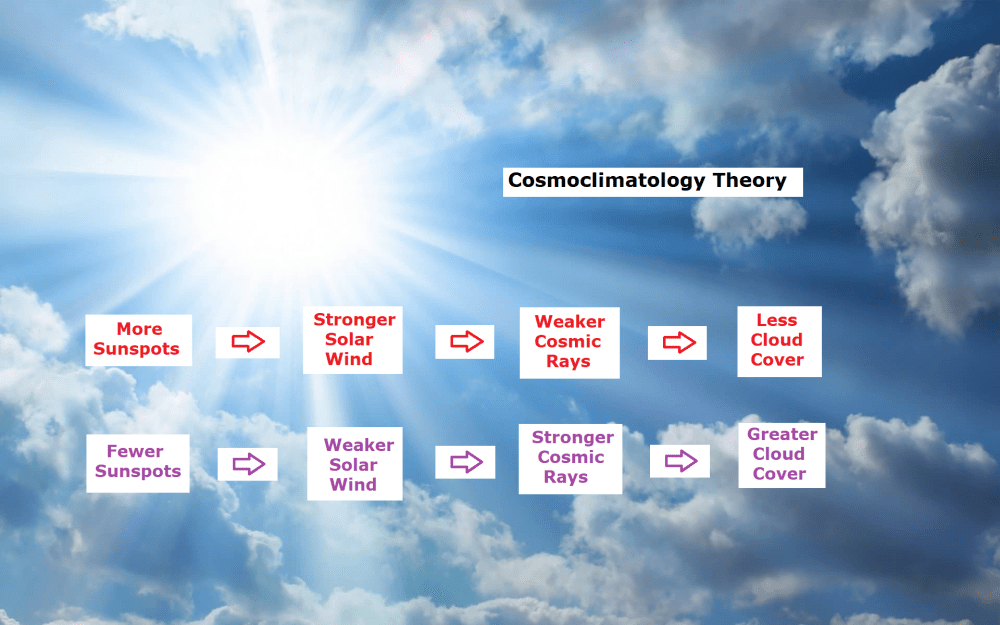
Propounded by Danish physicist Henrik Svensmark and his associates, the cosmoclimatology theory states that climate is controlled by low cloud cover, which when widespread has a cooling effect by reflecting solar energy back into space and vice versa. These low clouds, in turn, are formed when sub-atomic particles called cosmic rays, emitted by exploding stars, combine with water vapour rising from the oceans.

The constant bombardment of the planet by cosmic rays is modulated by the solar wind, which when it is blowing prevents cosmic rays from reaching the earth and creating low clouds. The solar wind in turn is caused by the varying sunspot activity of the sun.

When, as recently, sunspot activity decreases we get the global ‘cooling’ observed during the recent ‘pause’ in global warming. Furthermore, as noted by the Princeton physicist William Happer (see my column “Clouds of Climate Change”, September 2011), the millennial ‘ice core’ records of the correlation between CO2 and temperature show “that changes in temperature preceded changes in CO2 levels, so that CO2 levels were an effect of temperature changes.

Much of this was probably due to outgassing of CO2 from the warming oceans or the reverse in cooling” (“The truth about greenhouse gasses”). For the oceans are the primary sinks as well as emitters of CO2. Given their vastness relative to the earth’s surface, it takes a long time for the ocean to warm from rises in terrestrial temperatures (and vice versa), hence the lag between temperature and CO2 levels.

cern-cloud

The CLOUD experiment is studying whether cosmic rays play a role in cloud formation. Maximilien Brice / CERN

The missing piece in the cosmoclimatology theory was the physical link between cosmic rays and cloud formation. The first confirmation of the basic hypothesis that “ions [cosmic rays] are fundamental for the nucleation of aerosols [tiny liquid or solid particles that provide a nucleus around which droplets can form from water vapour in the air]” was confirmed by the CLOUD experiment at CERN — the particle physics laboratory in 2011. (See Kirby et al, Nature, (2011), 476, 429-433: Cloud formation may be linked to cosmic rays  Experiment probes connection between climate change and radiation bombarding the atmosphere.

But there was still a problem with the hypothesis. It was that, even if as the CLOUD experiment showed ions helped aerosols to form and become stable against evaporation — a process called nucleation — these small aerosols “need to grow nearly a million times in mass in order to have an effect on cloud formation.”

The latest research by Svensmark and his associates (reported in H Svensmark et al. “Increased ionisation supports growth of aerosols into cloud condensation nuclei” Nature Communications 2017;8(1) shows“ both theoretically and empirically and experimentally, how interactions between ions and aerosols can accelerate the growth by adding material to the small aerosols and thereby help them survive to become cloud condensation nuclei” (David Whitehouse: “Cosmic Rays Climate Link Found”). This implies, Prof Svensmark argues, that the effect of the sun on climate could be “5-7 times stronger than that estimated due to changes in the radiant output of the sun alone.”

It also explains why over geological time, there have been much larger variations in climate correlated with changes in cosmic rays. He adds that “it also negates the idea that carbon dioxide has been controlling the climate on the se timescales. ”Thus, the Medieval Warm period around 1000 AD and the subsequent Little Ice Age between 1300AD and 1900AD fit with changes in solar activity.

It also explains climate change observed over the 20th century. Similarly, coolings and warmings around 2 degrees Celsius have occurred repeatedly over the last 10,000 years with variations in the Sun’s activity and cosmic ray influx. While over longer time periods there are much larger variations of up to 10 degrees Celsius as “the Sun and Earth travel through the Galaxy visiting regions with varying numbers of exploding stars”. Svensmark concludes that ‘finally we have the last piece of the puzzle explaining how particles from space affect climate on Earth. It gives an understanding of how changes caused by solar activity or by supernova activity can change climate”.

Surely with this confirmation of the cosmo-climatology theory a Nobel Prize in physics for Svensmark and his associates cannot be far off, and with that the end of the hubristic theory of anthropogenic CO2 generated climate change.

CC Theory1

Last word to Svensmark from his December 2017 publication

The missing link between exploding stars, clouds, and climate on Earth  Breakthrough in understanding of how cosmic rays from supernovae can influence Earth’s cloud cover and thereby climate

Summary: The study reveals how atmospheric ions, produced by the energetic cosmic rays raining down through the atmosphere, helps the growth and formation of cloud condensation nuclei — the seeds necessary for forming clouds in the atmosphere.

screenshot-2017-12-19-09.20.33

Cosmic rays interacting with the Earth’s atmosphere producing ions that helps turn small aerosols into cloud condensation nuclei — seeds on which liquid water droplets form to make clouds. A proton with energy of 100 GeV interact at the top of the atmosphere and produces a cascade of secondary particles who ionize molecules when traveling through the air. One 100 GeV proton hits every m2 at the top of the atmosphere every second.

The hypothesis in a nutshell

  • Cosmic rays, high-energy particles raining down from exploded stars, knock electrons out of air molecules. This produces ions, that is, positive and negative molecules in the atmosphere.
  • The ions help aerosols — clusters of mainly sulphuric acid and water molecules — to form and become stable against evaporation. This process is called nucleation. The small aerosols need to grow nearly a million times in mass in order to have an effect on clouds.
  • The second role of ions is that they accelerate the growth of the small aerosols into cloud condensation nuclei — seeds on which liquid water droplets form to make clouds. The more ions the more aerosols become cloud condensation nuclei. It is this second property of ions which is the new result published in Nature Communications.
  • Low clouds made with liquid water droplets cool the Earth’s surface.
  • Variations in the Sun’s magnetic activity alter the influx of cosmic rays to the Earth.
  • When the Sun is lazy, magnetically speaking, there are more cosmic rays and more low clouds, and the world is cooler.
  • When the Sun is active fewer cosmic rays reach the Earth and, with fewer low clouds, the world warms up.

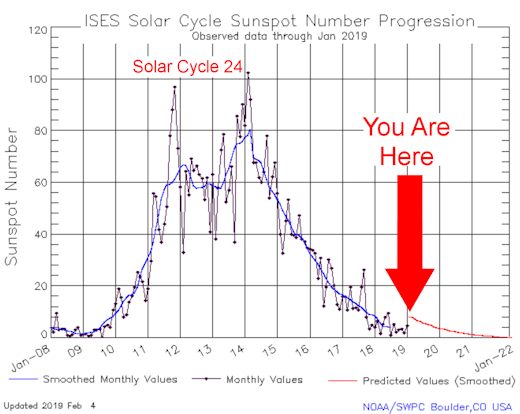
Figure 2 It is crucial to look at the baseline closely that in 2009 actually touched zero for months on end. This is not normal for the low point of the cycle. Figure 3 shows how cycle 24 was feeble compared with recent cycles. And it looks like it will have a duration of ~10 years (2009-2019) which as the low end of the normal range which is 9 to 14 years with mean of 11 years. Chart adapted from SIDC is dated 1 January 2018.

Update March 2019

sunspotcycle_strip

Additional Resources:

Nature’s Sunscreen

Magnetic Pole Swapping and Cooling

Autumnal Climate Change

Magnetic Pole Swapping and Cooling

The Earth’s North magnetic pole has been wandering at 10-year intervals from 1970 to 2020, as seen in this animation from the National Centers for Environmental Information.

This post discusses solar and geologic magnetic pole swapping (not with each other of course) and the implications for humans. First the earth and later on the sun.

What On Earth?

Newsweek chose to report yesterday on earth’s meandering north pole as shown in the cool graphic above. That article (here) aims at sensational possible calamities, including high energy radiation, space particles, ozone depletion and electrical blackouts. A more sober assessment is provided by the conversation Why the Earth’s magnetic poles could be about to swap places – and how it would affect us By Phil Livermore and Jon Mound of U. Leeds.Excerpts below with my bolds.

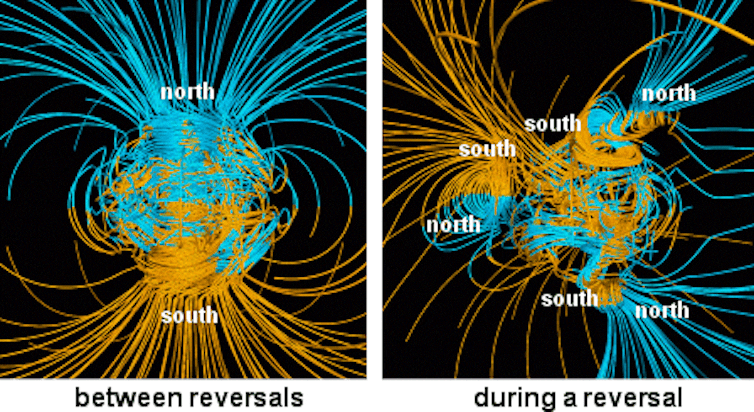
The Earth’s magnetic field surrounds our planet like an invisible force field – protecting life from harmful solar radiation by deflecting charged particles away. Far from being constant, this field is continuously changing. Indeed, our planet’s history includes at least several hundred global magnetic reversals, where north and south magnetic poles swap places. So when’s the next one happening and how will it affect life on Earth?

During a reversal the magnetic field won’t be zero, but will assume a weaker and more complex form. It may fall to 10% of the present-day strength and have magnetic poles at the equator or even the simultaneous existence of multiple “north” and “south” magnetic poles.

Geomagnetic reversals occur a few times every million years on average. However, the interval between reversals is very irregular and can range up to tens of millions of years.

There can also be temporary and incomplete reversals, known as events and excursions, in which the magnetic poles move away from the geographic poles – perhaps even crossing the equator – before returning back to their original locations. The last full reversal, the Brunhes-Matuyama, occurred around 780,000 years ago. A temporary reversal, the Laschamp event, occurred around 41,000 years ago. It lasted less than 1,000 years with the actual change of polarity lasting around 250 years.


In 2003, the so-called Halloween storm caused local electricity-grid blackouts in Sweden, required the rerouting of flights to avoid communication blackout and radiation risk, and disrupted satellites and communication systems. But this storm was minor in comparison with other storms of the recent past, such as the 1859 Carrington event, which caused aurorae as far south as the Caribbean.

The simple fact that we are “overdue” for a full reversal and the fact that the Earth’s field is currently decreasing at a rate of 5% per century, has led to suggestions that the field may reverse within the next 2,000 years. But pinning down an exact date – at least for now – will be difficult.

Since 2014, Swarm—a trio of satellites from the European Space Agency—has allowed researchers to study changes building at the Earth’s core, where the magnetic field is generated.

Historically, Earth’s North and South magnetic poles have flipped every 200,000 or 300,000 years—except right now, they haven’t flipped successfully for about 780,000 years. But the planet’s magnetic field is at long last showing signs of shifting.

The Earth’s magnetic field is generated within the liquid core of our planet, by the slow churning of molten iron. Like the atmosphere and oceans, the way in which it moves is governed by the laws of physics. We should therefore be able to predict the “weather of the core” by tracking this movement, just like we can predict real weather by looking at the atmosphere and ocean. A reversal can then be likened to a particular type of storm in the core, where the dynamics – and magnetic field – go haywire (at least for a short while), before settling down again.

The difficulties of predicting the weather beyond a few days are widely known, despite us living within and directly observing the atmosphere. Yet predicting the Earth’s core is a far more difficult prospect, principally because it is buried beneath 3,000km of rock such that our observations are scant and indirect. However, we are not completely blind: we know the major composition of the material inside the core and that it is liquid. A global network of ground-based observatories and orbiting satellites also measure how the magnetic field is changing, which gives us insight into how the liquid core is moving.

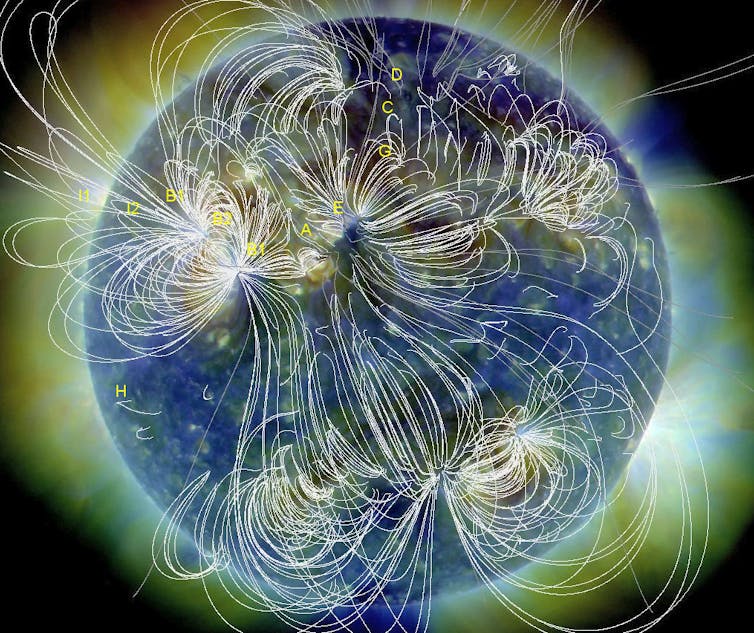
Solar Pole Swapping Puts Earth to Shame

White lines show the magnetic field emanating from the sun’s surface. NASA

Background:

The sun as a whole also has a “global” magnetic field, oriented more or less north-south. So we can think of the sun as a large N-S magnet, like our Earth, but with smaller variously (but not randomly) oriented and continually evolving mini-magnets distributed over its photosphere (visible surface) and throughout its corona (extended atmosphere).

However, unlike our Earth, the sun’s large scale magnetic field flips over on a regular basis, roughly every 11 years. (Actually, Earth’s flips too, very irregularly. The last time was 780,000 years ago. But that’s another story.) Solar magnetic reversals occur close to solar maximum, when the number of sunspots is near its peak, though it is often a gradual process, taking up to 18 months.

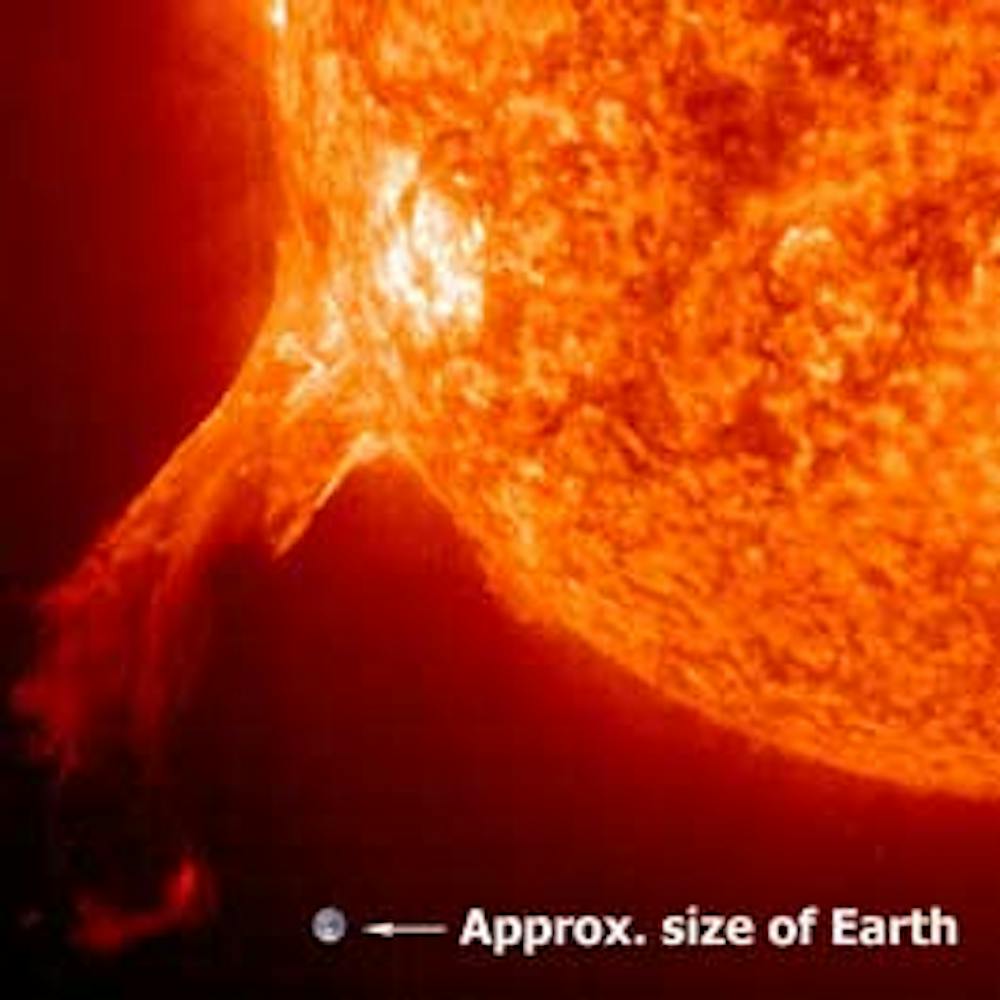
A solar flare (the white patch on the sun), and an erupting prominence reaching into space, are features of our active sun, and place the size of Earth in context. NASA

Paul Cally solar physicist Monash U (here)

About the Current Quiet Sun

Euan Mearns considers the implications at Energy Matters The Death of Sunspot Cycle 24, Huge Snow and Record Cold  Excerpts below with my bolds.

8 meter snow depth in Chamonix in the shadow of Mont Blanc in the French Alps January 2018

It looks like the snow in this drift is ~ 8m deep. And this is in the valley, not in the high basins where the snow fields that feed the glaciers lie. Now it’s obviously far too early to begin to draw any conclusions. But IF we get a run of 3 or 4 winters that dump this much snow, it is not inconceivable for me to imagine Alpine glaciers once again beginning to advance. I’m totally unsure how long it takes for pressure in the glacier source to feed through to advance of the snout.

So what is going on? We’ve been told by climate scientists that snow would become a thing of the past. We’ve also been told that global warming might lead to more snow and less snow. And we’ve been told that warming might even lead to cooling. The competing theory to the CO2 greenhouse is that the Sun has a prominent role in modulating Earth’s climate that was so eloquently described by Phil Chapman in his post earlier this week. This theory simply observes a strong connection between a weak solar wind (that is expressed by low sunspot numbers) and cold, snowy winters in the N hemisphere. Uniquely, most of those who argue for a strong solar influence also acknowledge the overprint of anthropogenic CO2. The IPCC effectively sets the Sun to zero. The Sun is entering a grand solar minimum already christened the Eddy Minimum by the solar physics community.

Figure 2 It is crucial to look at the baseline closely that in 2009 actually touched zero for months on end. This is not normal for the low point of the cycle. Figure 3 shows how cycle 24 was feeble compared with recent cycles. And it looks like it will have a duration of ~10 years (2009-2019) which as the low end of the normal range which is 9 to 14 years with mean of 11 years. Chart adapted from SIDC is dated 1 January 2018.

Mearns provides this summary of his article Cosmic Rays, Magnetic Fields and Climate Change

Cosmic rays are deflected by BOTH the Sun’s and Earth’s magnetic fields and there may also be variations in the incident cosmic ray background. Cosmogenic isotope variations, therefore, do not only record variations in solar activity.

This has two significant implications for me: 1) when I have looked into cosmogenic isotopes in the past I have been perplexed by the fact that in parts you see a wonderful coherence with “climate” (T≠climate) while else where, the relationship breaks down, and 2) my recent focus has been on variations in spectrum from the Sun (which may still be important) but to the extent that the Laschamp event (Earth’s magnetic field) may also be implicated in climate change then the emphasis needs to shift to cosmic rays themselves i.e. what Svensmark has been saying for years.

For readers not familiar with Earth’s magnetic field. It periodically flips but on a time-scale of millions of years. The N pole moves to the S pole and in the process of doing so the magnetic field strength collapses as evidenced by “Figure 7” in Phil’s post. The last time this happened was during the Laschamp event ~ 41,000 years ago. There was a full but short lived reversal, but the Earth’s magnetic field did collapse.

Now here’s the main point. We know that the glacial cycles beat to a 41,000 year rhythm that is the obliquity (tilt) of Earth’s axis. The magnetic field originates in Earth’s liquid mainly iron core. This raises the question, can changes in obliquity affect the geo-dynamo. You have to read what Phil has written closely:

Since we absolutely know (don’t we?) that the interglacial to glacial transitions of the current ice age are caused by Milankovitch forcing, the usual interpretation is that there must be some unknown mechanism by which changes in the orbit of the Earth and/or the tilt of the polar axis affect the geodynamo, triggering the excursions.

For decades to centuries, Earth’s N magnetic pole was pretty well fixed to a point in northern Canada. Not much in the news, but it has recently begun to migrate, quite rapidly.

For a more complete description of solar effects effects on earth’s climate see
The cosmoclimatology theory


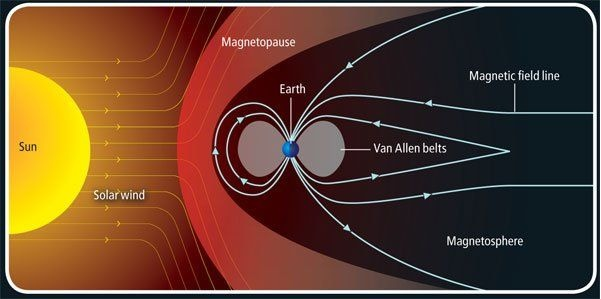
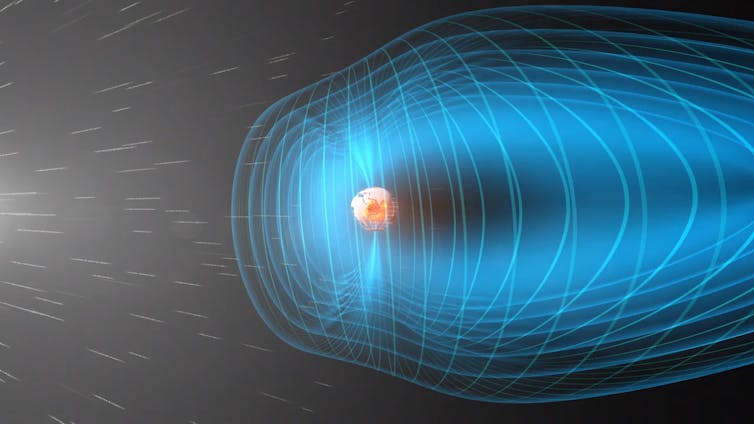
Earth’s magnetic field, in blue, shields the planet from the solar wind. NASA

Civil Climate Discourse

The issue of global warming/climate change has been used to polarize populations for political leverage. People like myself who are skeptical of alarmist claims find it difficult to engage with others whose minds are made up with or without a factual basis. In a recent email Alex Epstein gives some good advice how to talk about energy and climate. At the end I provide links to other material from Alex supporting his principle message regarding human benefits from using fossil fuels. Text below is his email with my bolds.

Two simple-but-powerful tactics

1. Opinion Stories

Unless I have some specific reason for wanting to have a long conversation I like to keep my conversations short, with the end goal of getting the other person to consume some high-impact resource.

One way to make this even more effective is to offer to email/mail the person a resource. Then you’ll have their contact info and can follow up in a few weeks.

The last paragraph of your message is really important. You’re telling the story of how you came to your opinion. I call this device “the opinion story.”

Here’s how it works.

Imagine you’re trying to persuade someone to read your favorite book. My favorite book is Atlas Shrugged, by Ayn Rand.

I used to say: “Atlas Shrugged is the best book you’ll ever read. You have to read it.”

That’s an opinion statement. If you haven’t read the book I’ll bet that statement makes you resistant. “Oh really? You’re telling me what the best book I’ll ever read is? You’re telling me what I have to read?”

Opinion statements often breed resistance and reflexive counter-arguments. So now I try to persuade people differently.

I might say: “My favorite book is Atlas Shrugged by Ayn Rand. I read it when I was 18 and the way the characters thought and approached life motivated me to pursue a career I love and give it everything I have.”

How do you react to that statement?

Probably better. You’re probably not resistant. You may well be intrigued. And you can’t disagree with me–because I didn’t tell you what to think, I told you my opinion story. I respected your independence.

While statements breed resistance and counter-argument, stories often breed interest and requests for more.

You can use opinion stories for anything, no matter how controversial.

For example, if someone asks me about my book, The Moral Case for Fossil Fuels, I don’t need to say “I prove that we should be using more fossil fuels, not less.” I can just say “I researched the pros and cons of different forms of energy and was surprised to come to the conclusion that we should be using more fossil fuels, not less.”

I like to have an opinion story for every controversial opinion I hold.

2. Introducing Surprising Facts

Reader Comment: “The problem I always run into is that they really believe Germany is a success.”

I’ve had the same experience, too! On many issues.

Often in conversation the phenomenon of conflicting factual claims on an issue—such as the impact of solar and wind on Germany’s economy—leads to an impasse.

One way to deal with this is to focus on establishing an explicit framework, with human flourishing (not minimum impact) as the goal and full context analysis (not bias and sloppiness) as the process. Most disputes stem from conflicting frameworks, not conflicting facts. And if you offer a compelling framework you’ll be more trustworthy on the facts.

That said, here’s a tactic I discovered a few years ago to make certain factual points much more persuasive in the moment..

I’ll start with how I discovered it.

I was walking through the Irvine Spectrum mall with a good friend when we ran into two young women working to promote Greenpeace.

My friend found one of the women attractive and said he wanted to talk to her. I thought, given my experiences with (paid) Greenpeace activists, that this was unlikely to be an edifying experience, and encouraged him to instead record a conversation between me and one of the women. Unfortunately for posterity, I was unpersuasive and what follows was never recorded.

I decided to talk to the other Greenpeace woman. She quickly started “educating” me on how Germany was successfully running on solar and wind.

Me: “Really? I’m curious where you’re getting that because I research energy for a living–and Germany is actually building a lot of new coal plants right now.”

Greenpeace: “No, that can’t be true.”

Me: “Okay, how about this? I’ll email you a news article about Germany building new coal plants. If I do, will you reconsider your position?” [Note: This is an example of the technique I recommended above.]

Greenpeace: Hesitates.

Me: “Actually, wait, we have smartphones. I’m going to Google Germany and coal. Let’s see what comes up.”

Displaying on my iPhone is a recent news story whose headline is something very close to: “Germany to build 12 new coal plants, government announces.”

Me: “So what do you think?”

Greenpeace: “I don’t know,” followed by—very rare for a Greenpeace activist—having nothing to say.

Had this been a normal person I am confident the live confirmation of the surprising fact would have made a lasting impression.

I think this tactic works best for news stories about surprising facts. Vs. an opinion story about some issue of analysis, like what Germany’s GDP is.

Summary

Alex Epstein is among those who demonstrate from public information sources comparisons between societies who use carbon fuels extensively and those who do not. The contrast is remarkable: Societies with fossil fuels have citizens who are healthier, live longer, have higher standards of living, and enjoy cleaner air and drinking water, to boot. Not only do healthier, more mobile people create social wealth and prosperity, carbon-based energy is heavily taxed by every society that uses it. Those added government revenues go (at least some of it) into the social welfare of the citizenry. By almost any measure, carbon-based energy makes the difference between developed and underdeveloped populations.

A previous post Social Benefits of Carbon referenced facts and figures from Alex’s book which can be accessed here

Other Resources:
Two Page Overview of The Moral Case for Fossil Fuels — What it is and why it matters 
main points are:
How to think about our energy future
Fossil fuels & human flourishing: the benefits
Fossil fuels & human flourishing: environmental concerns

11 page Introduction to The Moral Case for Fossil Fuels

Maslow’s hierarchy of human needs updated.

How’s Your CCIQ?


H/T David Wojick and CFACT

Doctors for Disaster Preparedness are concerned to be ready for real disasters and not be distracted by irrational fears like global warming/climate change. They have provided a useful resource for people to test and deepen their knowledge of an issue distorted for many people by loads of misinformation and exaggerations.

From David Wojick:

A new lesson set called the Climate Change IQ (CCIQ) provides a good skeptical critique of ten top alarmist claims. The format is succinct and non-technical. Each alarmist claim is posed as a question, followed by a short skeptical answer, which is highlighted with a single telling graphic.

Then there is a link to a somewhat longer answer, which in turn includes links to a few online sources of more information. Each lesson is also available in a printable PDF version, suitable for classroom use. This compact format is potentially very useful.

CCIQ comes from a long-standing skeptical group called the Doctors for Disaster Preparedness (DDP). Despite the name, DDP gives attention to pointing out scares that are not disasters waiting to happen. Not surprisingly climate alarmism gets a lot of this attention.

The ten topic questions are wide ranging, including the following. Each speaks to a popular pro-alarmist news hook.

Is climate change the most urgent global health threat?

Are government-sponsored climate scientists the only credible sources of information relating to climate-change policy?

Is the increase in atmospheric CO2 making wildfires worse?

Why can’t all States emulate California’s proposed “clean” energy standards?

What would happen if atmospheric CO2 concentration dropped by half, say to less than 200 ppm?

Are human CO2 emissions acidifying the oceans and endangering shell-making animals?

Will Manhattan and Florida soon be under water if humans do not curtail use of “fossil fuels”?

Do 97% of climate scientists agree that catastrophic climate change will result if humans do not curtail use of “fossil fuels”? (This one includes the dynamite John Christy graph showing the rapidly growing divergence of climate model global temperature forecasts with real world observations.)

Is Arctic ice disappearing?

And the number 1 CCIQ question: Would lowering atmospheric CO2 prevent or mitigate hurricanes?

Check it out. Inquiring minds want to know.


Rise and Fall of CAGW


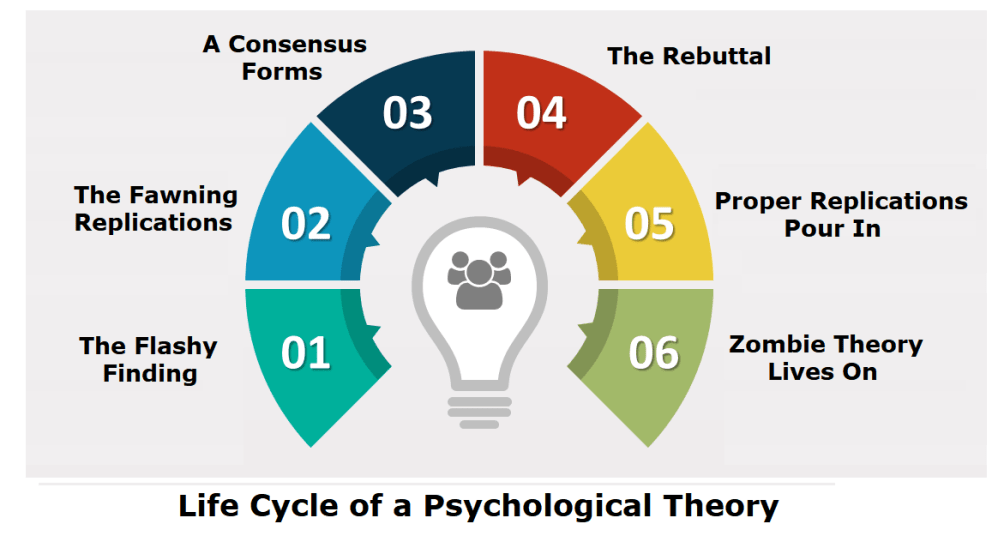
On January 8, 2018 Ross Pomeroy published  at RealClearScience an interesting article The Six Stages of a Failed Psychological Theory

The Pomeroy essay focuses on theories in the field of psychology and describes stages through which they rise, become accepted, challenged and discarded. It has long seemed to me that global warming/climate change theory properly belongs in the field of social studies and thus should demonstrate a similar cycle.

Formerly known as CAGW (catastrophic anthropogenic global warming), the notion of “climate change” is logically a subject of social science rather than physical science. “Climate Change” is a double abstraction: it refers to the derivative (change) in our expectations (patterns) of weather. Thus studies of “Climate Change” are properly a branch of Environmental Sociology.

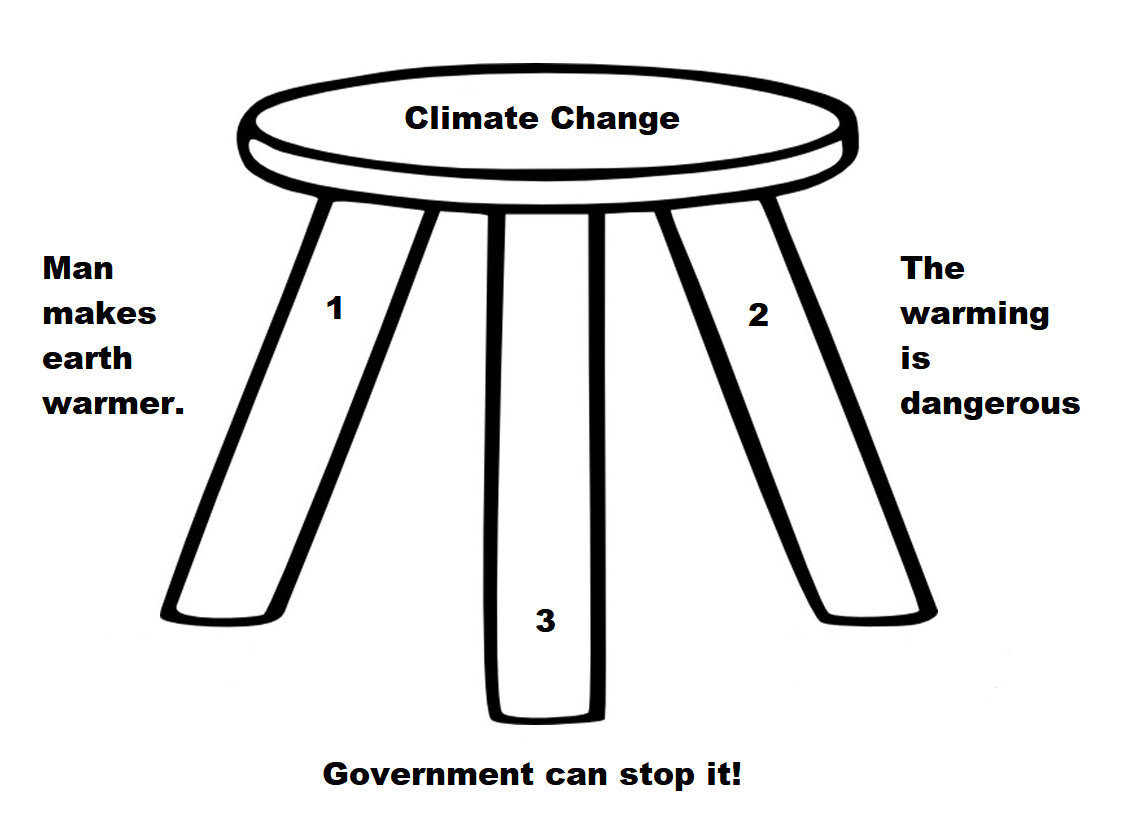
As a social psychology theory, CAGW/climate change bundles together three interdependent assertions.

From the beginning the claimed science, impacts and policies were bundled, which makes CAGW theory unusual. Psychological theories do not typically give rise to activism for changes in social and political policies. Thus the six stages above focus on the rise and fall of a scientific conclusion, with little or no reference to impacts and policies. At the end of this post are links to resources regarding these latter two points.

Examples of Failed Psychology Theories: The “Backfire Effect” and others

Ross Pomeroy (my bolds):
With the publication of his exhaustingly researched and skillfully reported article, “LOL Something Matters,” science writer Daniel Engber convincingly demonstrated that the “backfire effect,” the notion that contradictory evidence only strengthens entrenched beliefs, does not hold up under rigorous scientific scrutiny. Bluntly stated, the “backfire effect” probably isn’t real.

The debunking of this longstanding psychological theory follows similar academic takedowns of ego depletion, social priming, power posing, and a plethora of other famous findings. Indeed, much of what we “know” in psychology seems to be false.

There’s a good reason for this: psychology, as a discipline, is a house made of sand, based on analyzing inherently fickle human behavior, held together with poorly-defined concepts, and explored with often scant methodological rigor. Indeed, there’s a strong case to be made that psychology is barely a science.

How Theories Advance and Collapse

Seeing how disarray defines psychology, it makes perfect sense that the field’s leading theories are vulnerable to collapse. Having watched this process play out a number of times, a clear pattern has emerged. Let’s call it the “Six Stages of a Failed Psychological or Sociological Theory.”

Stage 1: The Flashy Finding. An intriguing report is published with subject matter that lends itself to water cooler conversation, say, for example, that sticking a pen in your mouth to force a smile makes things seem funnier. Media outlets provide gushing coverage.

Stage 1 CAGW Theory

For Climate Change, by many accounts the flashy finding was James Hansen’s famous 1988 testimony in the US Senate. Hansen’s claim to detect global warming was covered by all the main television network news services and it won for him a New York Times front page headline: “Global warming has begun, expert tells Senate.”
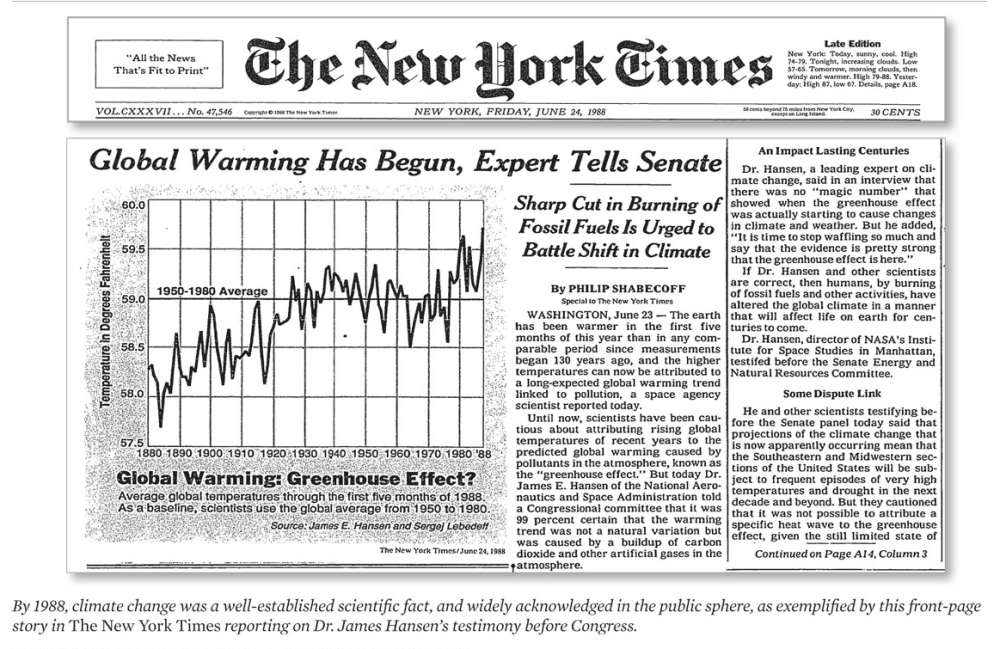
While Hansen’s appearance was a PR coup, he actually jumped the gun.  By 1995 IPCC scientists had not yet agreed that humans are causing global warming.  The story of that problem and the subsequent claim of first detection by John Houghton and Ben Santer is described in detail in Bernie Lewin’s fine historical account. (My synopsis is linked at the end.)

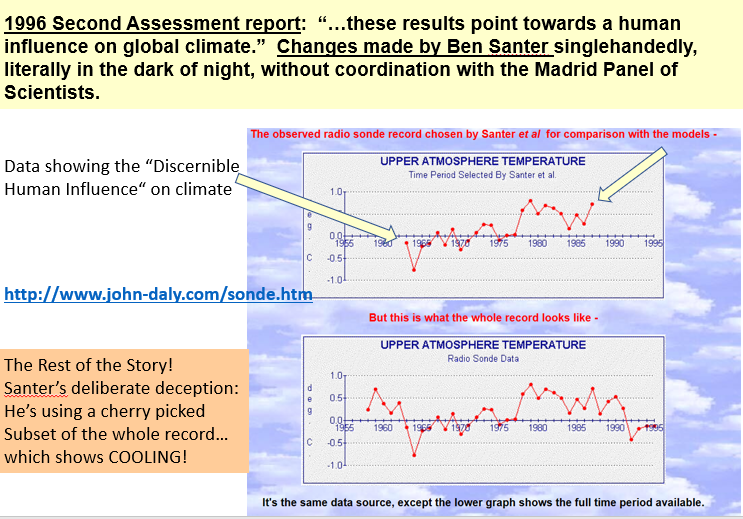
So in this sense, the actual Flashy Finding was published by Santer et al. just before Rio COP in Nature July 1996 entitled: A search for human influences on the thermal structure of the atmosphere
B. D. Santer, K. E. Taylor, T. M. L. Wigley, T. C. Johns, P. D. Jones, D. J. Karoly, J. F. B. Mitchell, A. H. Oort, J. E. Penner, V. Ramaswamy, M. D. Schwarzkopf, R. J. Stouffer & S. Tett  From the abstract:

The observed spatial patterns of temperature change in the free atmosphere from 1963 to 1987 are similar to those predicted by state-of-the-art climate models incorporating various combinations of changes in carbon dioxide, anthropogenic sulphate aerosol and stratospheric ozone concentrations. The degree of pattern similarity between models and observations increases through this period. It is likely that this trend is partially due to human activities, although many uncertainties remain, particularly relating to estimates of natural variability.

An article published the same month in World Climate Report was entitled:“Clearest Evidence” For Human “Fingerprint?” Results clouded if more complete data used  The WCR essay concluded:

We are frankly rather amazed that this paper could have emerged into the refereed literature in its present state; that is not to say that the work is bad, but that there are serious questions—similar to ours—that the reviewers should have asked.

The inescapable conclusions:

1. The vast majority of the “fingerprints” of the greenhouse effect are found way up in the atmosphere, especially in the stratosphere.

2. The “detection” models that were used either don’t predict very much future warming or were run with the wrong greenhouse effect and produce absurd results when the right numbers are put in.

3.And finally, down here in the lower atmosphere, the evidence is much more smudged and is based upon a highly selected set of data that, when viewed in toto, shows something dramatically different than what the paper purports.

The period that Santer et al. studied corresponds precisely with a profound warming trend in this region. But when all of the data (1957 to 1995) are included, there’s no trend whatsoever! We don’t know what to call this, but we believe that at least one of the 13 prestigious authors on this paper must have known this to be the case.
Stage 2: The Fawning Replications. Other psychologists, usually in the early stages of their careers, leap to replicate the finding. Most of their studies corroborate the effect. Those that don’t are not published, perhaps because the researchers don’t want to step on any toes, or because journal editors would prefer not to publish negative findings.

Stage 2 CAGW Theory

Following the human detection claim, the media increasingly filled its time and pages with reports of “multiple lines of evidence” proving CAGW.  Typically these consisted of :

Global temperature rise
Warming oceans
Shrinking ice sheets
Glacial retreat
Decreased snow cover
Sea level rise
Declining Arctic sea ice
Extreme events
Ocean acidification

However, all of these are equivocal, involving signal and noise issues.  And in any case, the fact of any changes does not in itself prove human causation.

Overview of the structure of a state-of-the-art climate model. From the NOAA website.

As suggested by the Santer et al. flashy finding, the claim of human causation was based upon climate models.  And the effort to substantiate that claim was primarily a campaign to construct and experiment with GCMs.  From History of climate modeling by Paul N. Edwards .

Like ripples moving outward from the three pioneering groups (GFDL, UCLA, and NCAR), modelers, dynamical cores, model physics, numerical methods, and GCM computer code soon began to circulate around the world. By the early 1970s, a large number of institutions had established new general circulation modeling programs. In addition to those discussed above, the most active climate modeling centers today include Britain’s Hadley Centre, Germany’s Max Planck Institute, Japan’s Earth Simulator Centre, and the Goddard Institute for Space Studies in the United States..

How many GCMs and climate modeling groups exist worldwide? The exact number can be expanded or contracted under various criteria. About 33 groups submitted GCM output to the Atmospheric Model Intercomparison Project (AMIP) in the 1990s.A few years later, however, only about 25 groups contributed coupled AOGCM outputs to the Coupled Model Intercomparison Project (CMIP)—reflecting the greater complexity and larger computational requirements of coupled models.  Notably, while the AMIP models included entries from Russia, Canada, Taiwan, China, and Korea, all of the CMIP simulations came from modeling groups based in Europe, Japan, Australia, and the USA, the historical leaders in climate modeling.

The difficulties and uncertainties with climate models have been long understood, and have not been overcome  through the decades, as indicated by the failure to reduce the range estimates of climate sensitivity to CO2.  From Modeling climatic effects of anthropogenic carbon dioxide emissions: unknowns and uncertainties Willie Soon et al.

Specifically, we review common deficiencies in general circulation model (GCM) calculations of atmospheric temperature, surface temperature, precipitation and their spatial and temporal variability. These deficiencies arise from complex problems associated with parameterization of multiply interacting climate components, forcings and feedbacks, involving especially clouds and oceans. We also review examples of expected climatic impacts from anthropogenic CO2 forcing.

Given the host of uncertainties and unknowns in the difficult but important task of climate modeling, the unique attribution of observed current climate change to increased atmospheric CO2 concentration, including the relatively well-observed latest 20 yr, is not possible. We further conclude that the incautious use of GCMs to make future climate projections from incomplete or unknown forcing scenarios is antithetical to the intrinsically heuristic value of models. Such uncritical application of climate models has led to the commonly held but erroneous impression that modeling has proven or substantiated the hypothesis that CO2 added to the air has caused or will cause significant global warming.
Christy 2019 fig7

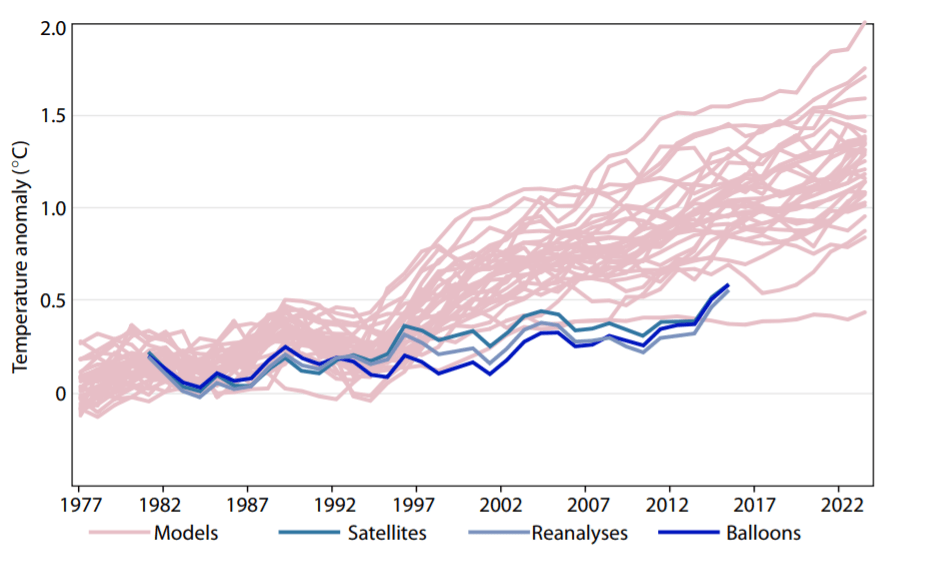
Figure 7 (Christy 2019): Tropical mid-tropospheric temperatures, models vs. observations.
Models in pink, against various observational datasets in shades of blue. Five-year averages
1979–2017. Trend lines cross zero at 1979 for all series.

Stage 3: A Consensus Forms. The finding is now taken for granted, regularly appearing in pop psychology stories and books penned by writers like Malcolm Gladwell or Jonah Lehrer. Millions of people read about it and “armchair” explain it to their friends and family.

Stage 3 CAGW Theory  

The Claims of 97% Consensus of scientists on the question of CAGW stem from five papers, conveniently referenced on NASA’s website (though none of them were written by NASA scientists).

The first claim of 97% came from a survey sample of 77 climate scientists who said “Yes” to 2 statements: “It has warmed since 1850.”; “Human activity has contributed to the warming.” That survey questionnaire was deliberately not sent to those known to be skeptical: scientists not employed by government or universities; astronomers; solar scientists; physicists; meteorologists.

Another paper noted by NASA on their website is by W. R. L. Anderegg, at the time a PhD student in the department of Biology at Stanford University. He went on to become a professor at Princeton and Utah Universities in the field of ecology and biological sciences, studying the effects of global warming on forests.

Two papers were produced by John Cook  who has an undergraduate education in physics from the University of Queensland and a post-graduate honors year studying solar physics, worked as a self-employed cartoonist before founding a website pushing climate alarmism. For this he was given the title of the Climate Communication Fellow for the Global Change Institute at the University of Queensland. He is currently completing a PhD in cognitive psychology, researching how people think about climate change.

Finally, a key paper was from Naomi Oreskes who received her PhD degree in the Graduate Special Program in Geological Research and History of Science at Stanford in 1990. Her fields are History of Science and Economic Geology, and she is a prominent activist for IPCC activities.

All five of these papers have been extensively criticized in the peer-reviewed literature for their poor quality. For example:

Regarding Anderegg et al. and climate change credibility, PNAS, Dec. 28, 2010 by Lawrence Bodenstein

The study by Anderegg et al. (1) employed suspect methodology that treated publication metrics as a surrogate for expertise.

In the climate change (CC) controversy, a priori, one expects that the much larger and more “politically correct” side would excel in certain publication metrics. They continue to cite each other’s work in an upward spiral of self-affirmation.

Here, we do not have homogeneous consensus absent a few crackpot dissenters. There is variation among the majority, and a minority, with core competency, who question some underlying premises. It would seem more profitable to critique the scientific evidence than count up scientists, publications, and the like.

Regarding purely scientific questions, it may be justified to discount nonexperts. However, here, dissenters included established climate researchers. The article undermined their expert standing and then, extrapolated expertise to the more personal credibility. Using these methods to portray certain researchers as not credible and, by implication, to be ignored is highly questionable. Tarring them as individuals by group metrics is unwarranted.

Publication of this article as an objective scientific study does a true disservice to scientific discourse. Prominent scientific journals must focus on scientific merit without sway from extracurricular forces. They must remain cautious about lending their imprimatur to works that seem more about agenda and less about science, more about promoting a certain dogma and less about using all of the evidence to better our understanding of the natural world.

A more complete list of published papers refuting these studies is here: All “97% Consensus” Studies Refuted by Peer-Review

More inclusive surveys with more pointed questions show much more diverse opinions. Most scientists agree it has warmed since 1850, the end of the Little Ice Age. Geologists have evidence that the earth was warmer than now during the Medieval Warm Period, more warm during the Roman Warm Period, warmer still in the Minoan period. So the overall trend is a cooling over the last 11,500 years.

Most agree that human land use, such as making dams, farming, building cities, airports and highways, all affect the climate in those locations. The idea that rising CO2 is causing dangerous warming is controversial, with dissenters a large minority.

Stage 4: The Rebuttal. After a few decades, a new generation of researchers look to make a splash by questioning prevailing wisdom. One team produces a more methodologically-sound study that debunks the initial finding. Media outlets blare the “counterintuitive” discovery.

Stage 4 CAGW Theory  

There have been many rebuttals of CAGW theory and in the blogosphere they are proclaimed and shared among skeptics.  But it is still rare for mass media outlets to acknowledge any finding that contradicts the prevailing “consensus” view of CAGW.  On the multiple lines of evidence, the NIPCC series of reports provide references to a trove of peer-reviewed literature that do not support CAGW.  The most recent report is Climate Change Reconsidered II and the list of scientists, authors and reviewers includes people who have objected to CAGW over the years.

An important proof against the CO2 global warming claim was included in John Christy’s testimony 29 March 2017 at the House Committee on Science, Space and Technology. The text below is from that document which can be accessed here.

Figure 5. Simplification of IPCC AR5 shown above in Fig. 4. The colored lines represent the range of results for the models and observations. The trends here represent trends at different levels of the tropical atmosphere from the surface up to 50,000 ft. The gray lines are the bounds for the range of observations, the blue for the range of IPCC model results without extra GHGs and the red for IPCC model results with extra GHGs.The key point displayed is the lack of overlap between the GHG model results (red) and the observations (gray). The nonGHG model runs (blue) overlap the observations almost completely.

Main Point: IPCC Assessment Reports show that the IPCC climate models performed best versus observations when they did not include extra GHGs and this result can be demonstrated with a statistical model as well.

More discussion on this rebuttal is at Warming from CO2 Unlikely

But the mass media is still in thrall of the catastrophic theory (bad news is good for business).

Stage 5: Proper Replications Pour In. Research groups attempt to replicate the initial research with the skepticism and precise methodology that should’ve been used in the first place. As such, the vast majority fail to find any effect.

Stage 5 CAGW Theory

In the case of climate change, the rewards are all skewed in favor of CAGW.  Not only is that bundle of beliefs politically correct, the monopoly of research funding for consensus projects leaves contrarian scientists high and dry.  And to the degree that the case rests on complex and expensive computer climate models, few centers are in a position to challenge the conventional wisdom, and almost none would be rewarded for doing so.

Despite this, every year there are hundreds of new research papers published challenging CAGW.  Kenneth Richard at No Tricks Zone has done yeoman work compiling and summarizing and linking to such studies. His most recent review is  485 Scientific Papers Published In 2017 Support A Skeptical Position On Climate Alarm

The papers are sorted into four categories of views questioning climate alarm.

N(1) Natural mechanisms play well more than a negligible role (as claimed by the IPCC) in the net changes in the climate system, which includes temperature variations, precipitation patterns, weather events, etc., and the influence of increased CO2 concentrations on climatic changes are less pronounced than currently imagined.

N(2) The warming/sea levels/glacier and sea ice retreat/hurricane and drought intensities…experienced during the modern era are neither unprecedented or remarkable, nor do they fall outside the range of natural variability, as clearly shown in the first 150 graphs (from 2017) on this list.

N(3) The computer climate models are not reliable or consistently accurate, and projections of future climate states are little more than speculation as the uncertainty and error ranges are enormous in a non-linear climate system.

N(4) Current emissions-mitigation policies, especially related to the advocacy for renewables, are often ineffective and even harmful to the environment, whereas elevated CO2 and a warmer climate provide unheralded benefits to the biosphere (i.e., a greener planet and enhanced crop yields).

As for climate models, there is a single center (the Russian Institute of Numerical Mathematics), working on GCMs that produce unalarming results.  Out of 33 CMIP5 generation models the INMCM4 appears in the earlier graph above as the only one tracking close to temperature observations.  And reports of the upgrade to INMCM5 appear promising.  For more on this topic:

Climate Model Upgraded: INMCM5 Under the Hood

Stage 6: The Theory Lives On as a Zombie. Despite being debunked, the theory lingers on in published scientific studies, popular books, outdated webpages, and common “wisdom.” Adherents in academia cling on in a state of denial – their egos depend upon it.

Stage 6 CAGW Theory 

Clearly, we are still a long ways from CAGW going to zombie status.  There is still way too much money and fame attached to climate advocacy. But it is fair to say that the position of CAGW has become more precarious.  The presence of a skeptical US President, and the withdrawal of funding and political support for alarmists makes it possible for others to express doubts and explore flaws in the consensus theory.  The collapse of green energy schemes in places like Germany and Australia may also portend the onset of stage six.

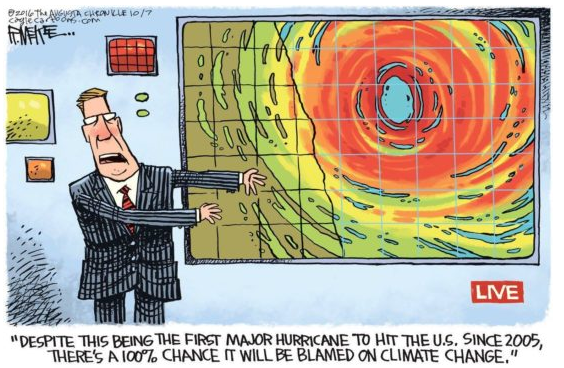
Of course, the only sure sign of a theory’s failure is when it becomes the butt of jokes and ridicule in mainstream media.  For that I do appreciate the work of cartoonist Rick McKee of the Augusta Chronicle:


More humor at Cavemen Climate Comics for Sunday

Background Articles

The Flashy Finding: Progressively Scaring the World (Lewin book synopsis)

The Fawning Replications: Climate Models Explained

A Consensus Forms: Talking ClimateNASA and Climate Dogma

The Rebuttal: Fossil Fuels ≠ Global Warming

Proper Replications: Climate Reductionism

Zombie CAGW:  Climate Policies Failure, the Movie

Postscript: Charles MacKay on Collective Delusions

Of course the classical masterwork in this field is the book Extraordinary Popular Delusions And The Madness Of Crowds By Charles MacKay 1841.  Title is link to full pdf text.  Excerpts below with my bolds.

In the present state of civilization, society has often shown itself very prone to run a career of folly from the last-mentioned cases. This infatuation has seized upon whole nations in a most extraordinary manner. France, with her Mississippi madness, set the first great example, and was very soon imitated by England with her South Sea Bubble. At an earlier period, Holland made herself still more ridiculous in the eyes of the world, by the frenzy which came over her people for the love of Tulips. Melancholy as all these delusions were in their ultimate results, their history is most amusing. A more ludicrous and yet painful spectacle, than that which Holland presented in the years 1635 and 1636, or France in 1719 and 1720, can hardly be imagined.

Some delusions, though notorious to all the world, have subsisted for ages, flourishing as widely among civilized and polished nations as among the early barbarians with whom they originated, — that of duelling, for instance, and the belief in omens and divination of the future, which seem to defy the progress of knowledge to eradicate entirely from the popular mind. Money, again, has often been a cause of the delusion of multitudes. Sober nations have all at once become desperate gamblers, and risked almost their existence upon the turn of a piece of paper. To trace the history of the most prominent of these delusions is the object of the present pages. Men, it has been well said, think in herds; it will be seen that they go mad in herds, while they only recover their senses slowly, and one by one.

MacKay’s study was exhaustive for its time, comprising three volumes;

VOL I. Considered National Delusions, including:
THE MISSISSIPPI SCHEME
THE SOUTH SEA BUBBLE
THE TULIPOMANIA.
RELICS.
MODERN PROPHECIES.
POPULAR ADMIRATION FOR GREAT THIEVES.
INFLUENCE OF POLITICS AND RELIGION ON THE HAIR AND BEARD.
DUELS AND ORDEALS
THE LOVE OF THE MARVELLOUS AND THE DISBELIEF OF THE TRUE.
POPULAR FOLLIES IN GREAT CITIES
THE O.P. MANIA.
THE THUGS, or PHANSIGARS.

VOL. II described Peculiar Follies, including:
THE CRUSADES
THE WITCH MANIA.
THE SLOW POISONERS.
HAUNTED HOUSES.

VOL. III compiled more general popular madnesses under three categories:
BOOK I: Philosophical Delusions, down through history with particular recent attention to Alchemists
BOOK II: Fortune Telling
BOOK III: The Magnetisers, a fad only subsiding when the book was written.

Alarmists Anonymous

The latest example of arctic hysteria comes from the usual suspects published at the usual venue, Inside Climate News. Polar Ice Is Disappearing, Setting Off Climate Alarms

Excerpts below with my bolds: The short-term consequences of Arctic (and Antarctic) warming may already be felt in other latitudes. The long-term threat to coastlines is becoming even more dire.

“When you’re taking out 30, 40, almost 50 percent of the ice cover, that’s a big change in the environment,” Meier said. “Whether we’re seeing it yet, there’s still some debate, but whether there will be an effect as we continue to lose ice, I think that’s pretty obvious.”

“There’s no evidence that anything is recovering here,” said Mark Serreze, the director of the NSIDC. “What we’ve seen historically is a downward trend in ice extent in all months. Superimposed on that are the ups and downs of natural variability. We’re going to continue to head downward.

“We are looking at an ice-free Arctic Ocean sometime in the 2040s,” said Serreze. “There’s no evidence that we’ve seen anything like this before.”

Ted Scambos, lead scientist with the National Snow and Ice Data Center, said that while the current pace of melting is not alarming, a series of papers “has led to a realization that the West Antarctic Ice Sheet may already be in an irreversible retreat.

Greenland is melting, too—for now, it’s the biggest threat. “Greenland has become Loserville,” said Jason Box, who tracks ice for the Geological Survey of Denmark and Greenland.

“New observations from many different sources confirm that ice-sheet loss is accelerating,” the United States Global Change Research Program said in its comprehensive special report on climate science. “Up to 8.5 feet of global sea level rise is possible by 2100” in a worst-case emissions scenario. That’s almost 2 feet more than scientists expected just a few years ago.

“So we’re guaranteed significant sea level rise no matter what we do, even under the optimistic Paris scenario,” Box said. “We had better prepare.”

These warnings of wolves are starting to sound the same: “It never happened before, is not happening now, but it will surely destroy us in the future if we don’t do something.”

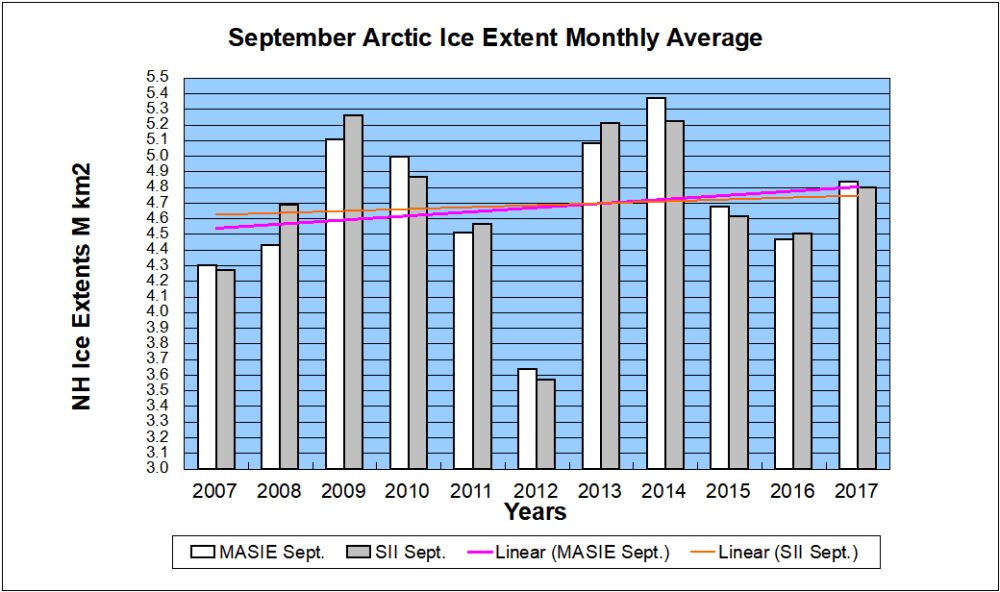
Meanwhile the facts on the ground are not alarming: For example September minimums:
More details at Overachieving September Arctic ice

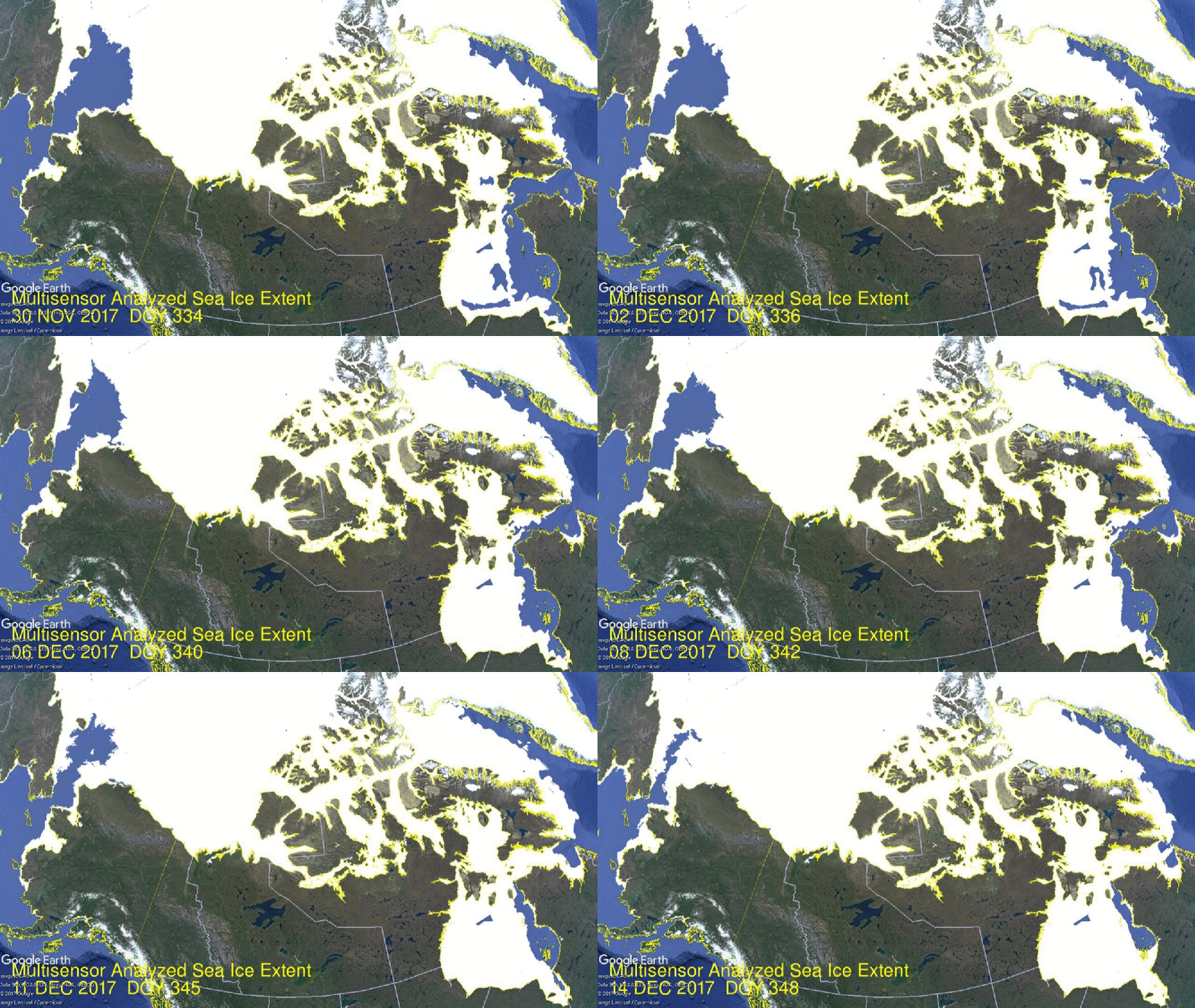
And the refreezing is not at all unusual:
The AAs (Arctic Alarmists) are putting their faith in the BBs (Barents and Bering), the only two basins below average this year. Both are marginal to the Arctic Ocean and both are heavily affected by human marine activities, including shipping, navies, fishing, tourism and sea floor extraction.



These outrageous appeals by alarmists in the face of contrary facts remind me of the story defining the term “chutzpuh.” A young man is convicted of killing his parents, and later appears before the judge for sentencing. Asked to give any last words, he replies: “Go easy on me, your Honor, I’m an orphan.”
alcoholics-anonymous-logo-e1497443623248

Fortunately, there is help for climate alarmists. They can join or start a chapter of Alarmists Anonymous. By following the Twelve Step Program, it is possible to recover and unite in service to the real world and humanity.

Step One: Fully concede (admit) to our innermost selves that we were addicted to climate fear mongering.

Step Two: Come to believe that a Power greater than ourselves causes weather and climate, restoring us to sanity.

Step Three: Make a decision to study and understand how the natural world works.

Step Four: Make a searching and fearless moral inventory of ourselves, our need to frighten others and how we have personally benefited by expressing alarms about the climate.

Step Five: Admit to God, to ourselves, and to another human being the exact nature of our exaggerations and false claims.

Step Six: Become ready to set aside these notions and actions we now recognize as objectionable and groundless.

Step Seven: Seek help to remove every single defect of character that produced fear in us and led us to make others afraid.

Step Eight: Make a list of all persons we have harmed and called “deniers”, and become willing to make amends to them all.

Step Nine: Apologize to people we have frightened or denigrated and explain the errors of our ways.

Step Ten: Continue to take personal inventory and when new illusions creep into our thinking, promptly renounce them.

Step Eleven: Dedicate ourselves to gain knowledge of natural climate factors and to deepen our understanding of nature’s powers and ways of working.

Step Twelve: Having awakened to our delusion of climate alarm, we try to carry this message to other addicts, and to practice these principles in all our affairs.

Summary:

With a New Year close at hand, let us hope that many climate alarmists take the opportunity to turn the page by resolving a return to sanity. It is not too late to get right with reality before the cooling comes in earnest.

This is your brain on climate alarm.  Just say No!

CO2 Fluxes, Sources and Sinks

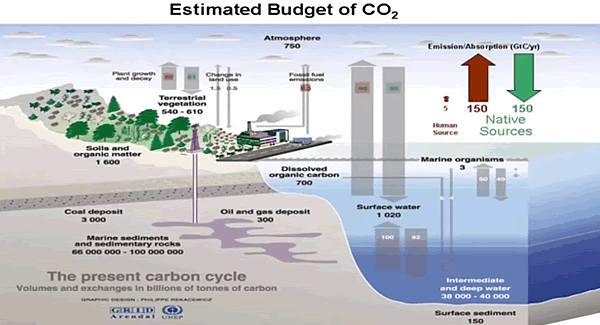
A recent post Obsessed with Human CO2 pointed out how small is the amount of CO2 emissions from fossil fuels compared to natural sources. Human emissions fall within the error ranges around the estimates from land, oceans and biosphere. This post looks deeper into the issue and our current state of knowledge about attributing CO2 concentrations in the atmosphere.

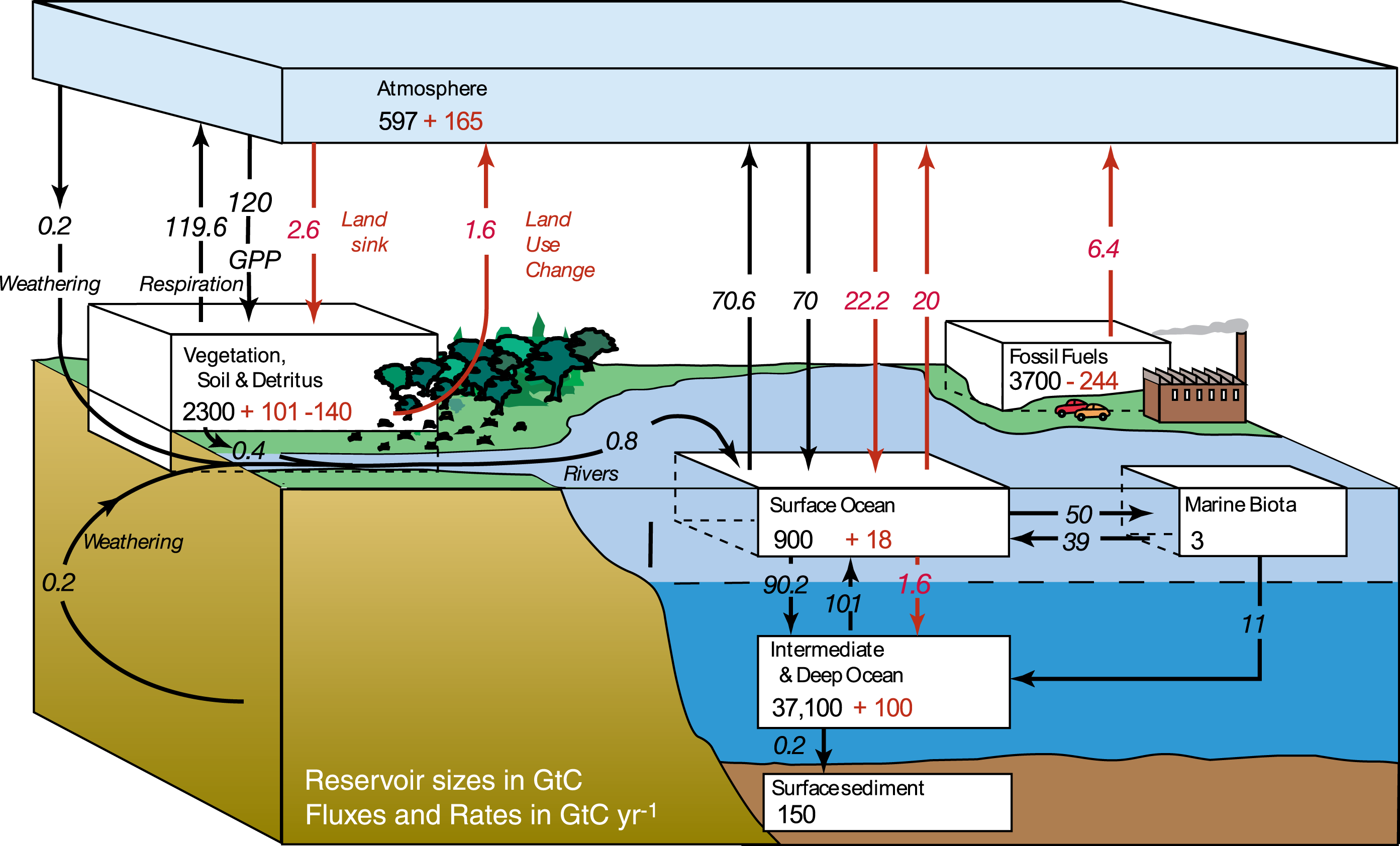
Note the size of the human emissions next to the red arrow. (Units are in GT)

Alarming Claims by IPCC Followers

From Chapter 6 Working Group 1 AR5 with my bolds.

With a very high level of confidence, the increase in CO2 emissions from fossil fuel burning and those arising from land use change are the dominant cause of the observed increase in atmospheric CO2 concentration. About half of the emissions remained in the atmosphere (240 ± 10 PgC) since 1750. The rest was removed from the atmosphere by sinks and stored in the natural carbon cycle reservoirs. The ocean reservoir stored 155 ± 30 PgC. Vegetation biomass and soils not affected by land use change stored 160 ± 90 PgC. {6.1, 6.3, 6.3.2.3, Table 6.1, Figure 6.8}

Since the beginning of the Industrial Era (1750), the concentration of CO2 in the atmosphere has increased by 40%, from 278 ± 5 ppm to 390.5 ± 0.1 ppm in 2011 (Figure 6.11; updated from Ballantyne et al. (2012), corresponding to an increase in CO2 of 240 ± 10 PgC in the atmosphere. Atmospheric CO2 grew at a rate of 3.4 ± 0.2 PgC yr–1 in the 1980s, 3.1 ± 0.2 PgC yr–1 in the 1990s and 4.0 ± 0.2 PgC yr–1 in the 2000s (Conway and Tans, 2011) (Table 6.1).

Coupled carbon-cycle climate models indicate that less carbon is taken up by the ocean and land as the climate warms constituting a positive climate feedback. Many different factors contribute to this effect: warmer seawater, for instance, has a lower CO2 solubility, so altered chemical carbon reactions result in less oceanic uptake of excess atmospheric CO2. On land, higher temperatures foster longer seasonal growth periods in temperate and higher latitudes, but also faster respiration of soil carbon.

The removal of human-emitted CO2 from the atmosphere by natural processes will take a few hundred thousand years (high confidence). Depending on the RCP scenario considered, about 15 to 40% of emitted CO2 will remain in the atmosphere longer than 1,000 years. This very long time required by sinks to remove anthropogenic CO2 makes climate change caused by elevated CO2 irreversible on human time scale. {Box 6.1}

Alarmist Summary: All of the rise in atmospheric CO2 is caused by humans, is increasing and will last for 1000 years.

Sobering Facts from Scientific Observations

Fact 1. The Carbon Cycle System is estimated with uncertainties greater than human emissions.

Carbon fluxes describe the rate of exchange of carbon between the various carbon sinks / reservoirs.

There are four main carbon sinks – lithosphere (earth crust), hydrosphere (oceans), atmosphere (air), biosphere (organisms).

The rate at which carbon is exchanged between these reservoirs depends on the conversion processes involved:

Photosynthesis – removes carbon dioxide from the atmosphere and fixes it in producers as organic compounds
Respiration – releases carbon dioxide into the atmosphere when organic compounds are digested in living organisms
Decomposition – releases carbon products into the air or sediment when organic matter is recycled after death of an organism
Gaseous dissolution – the exchange of carbon gases between the ocean and atmosphere
Lithification – the compaction of carbon-containing sediments into fossils and rocks within the Earth’s crust (e.g. limestone)
Combustion – releases carbon gases when organic hydrocarbons (coal, oil and gas) are burned as a fuel source

It is not possible to directly measure the size of the carbon sinks or the fluxes between them – instead estimates are made.

Global carbon fluxes are very large and are therefore measured in gigatonnes (1 gigatonne of carbon = 1 billion metric tonnes).

Because carbon fluxes are large and based on measurements from many different sources, estimates have large uncertainties.

A good summary description of carbon fluxes and reservoirs is at University of New Hampshire (here). This figure from IPCC AR4 shows how estimates have been developed. Explanation below with my bolds.

IPCC AR4WG1 Figure 7.3. The global carbon cycle for the 1990s, showing the main annual fluxes in GtC yr–1: pre-industrial ‘natural’ fluxes in black and ‘anthropogenic’ fluxes in red (modified from Sarmiento and Gruber, 2006, with changes in pool sizes from Sabine et al., 2004). The net terrestrial loss of –39 GtC is inferred from cumulative fossil fuel emissions minus atmospheric increase minus ocean storage. The loss of –140 GtC from the ‘vegetation, soil and detritus’ compartment represents the cumulative emissions from land use change (Houghton, 2003), and requires a terrestrial biosphere sink of 101 GtC (in Sabine et al., given only as ranges of –140 to –80 GtC and 61 to 141 GtC, respectively; other uncertainties given in their Table 1). Net anthropogenic exchanges with the atmosphere are from Column 5 ‘AR4’ in Table 7.1. Gross fluxes generally have uncertainties of more than ±20% but fractional amounts have been retained to achieve overall balance when including estimates in fractions of GtC yr–1 for riverine transport, weathering, deep ocean burial, etc. ‘GPP’ is annual gross (terrestrial) primary production. Atmospheric carbon content and all cumulative fluxes since 1750 are as of end 1994.

The diagram shows that anthropogenic emissions of CO2 from burning of fossil fuels cannot be the reason for the increase in atmospheric CO2.

Fact 2. Land-based Carbon Pools Behave Diversely, Defying Global Averaging.

It should be clear from the observational data that Earth’s biosphere is exerting a powerful brake on the rate of rise of the air’s CO2 content, such that the large increases in anthropogenic CO2 emissions of the past two decades have not resulted in any increase in the rate of CO2 accumulation in the atmosphere. The IPCC has yet to acknowledge the existence and sign of this negative feedback, choosing to rely on projections from the Coupled Model Intercomparison Project Phase 5 (CMIP5) models. Those models “consistently estimate a positive carbon cycle feedback, i.e. reduced natural sinks or increased natural CO2 sources in response to future climate change.” The models further find “in particular, carbon sinks in tropical land ecosystems are vulnerable to climate change” (p. 21 of the Technical Summary, Second Order Draft of AR5, dated October 5, 2012).

Fluxnet Observation Sites around the world.

Soils are the largest carbon reservoir of the terrestrial carbon cycle. Worldwide they contain three or four times more organic carbon (1500 Gt to 1 m depth, 2500 Gt to 2 m) than vegetation (610 Gt) and twice or three times as much carbon as the atmosphere (750 Gt, see Figure 1) [71]. Carbon storage in soils is the balance between the input of dead plant material (leaf, root litter, and decaying wood) and losses from decomposition and mineralization of organic matter (‘heterotrophic respiration’). Under aerobic conditions, most of the carbon entering the soil returns to the atmosphere by autotrophic root respiration and heterotrophic respiration (together called ‘soil respiration’ or ‘soil CO2 efflux’). The mineralization rate is a function of temperature and moisture levels and chemical environment with factors such as pH, Eh, nitrogen level and the cation exchange capacity of the minerals in the soil affecting the mineralization rate of soil organic carbon (SOC) [72, 73, 74, 75, 76, 77, 78]. Under anaerobic conditions, resulting from constantly high water levels, part of the carbon entering the soil is not fully mineralized and accumulates as peat.

Today, eddy covariance measurements of carbon dioxide and water vapor exchange are being made routinely on all continents.  The flux measurement sites are linked across a confederation of regional networks in North, Central and South America, Europe, Asia, Africa, and Australia, in a global network, called FLUXNET.  This global network includes more than eight hundred active and historic flux measurement sites, dispersed across most of the world’s climate space and representative biomes (Figure 1, 2). Fluxnet portal is here Excerpts with my bolds.

The flux network has also been pivotal in refining the functional response of net and gross carbon dioxide exchange with climatic drivers. One notable observation relates to the sensitivity of ecosystem respiration to temperature. That is, respiration is constant across climate and ecological space and increases by a factor of 1.4 with a ten degree increase in temperature. Another emergent property is the plasticity of the timing of the initiation of the growing season, and how it is triggered by when soil temperature matches mean annual air temperature.

Lessons learned from FLUXNET

One of the first and overarching things we have learned is “what is the net and gross annual carbon fluxes, at sites across the globe?” A collation of data has enabled the community to produce a probability distribution of net carbon exchange that is occurring across the network. We see that the central tendency of net carbon exchange is: −157±285 g C m−2 y−1 (Figure 1), representing a sink of carbon to the terrestrial biosphere from the atmosphere. We are also able to document the range of carbon uptake by terrestrial ecosystems. We find that the most negative tail of the histogram is about -1000 g C m−2 y−1. The most positive tail of the histogram, representing sites acting as carbon sources can be as large as +1000 g C m−2 y−1. Of course these values do not consider net biome exchange that would release pulses of carbon from fires or anthropogenic combustion of fossil fuels.

Fact 3. Fluxes are Dynamic and Difficult to Estimate Reliably.

This summary comes from Helge Hellevanga and Per Aagaard in Making Constraints on natural global atmospheric CO2 fluxes from 1860 to 2010 using a simplified explicit forward model (2015) Excerpt with my bolds.

The relative contribution of the emissions and the efficiency of the biosphere and the ocean to mitigate the increase in atmospheric CO2-concentrations, remain highly uncertain. This is demonstrated in chapter six of the latest IPCC report5, where we can read that the net land-atmosphere carbon flux in the 1980s was estimated to −0.1 ± 0.8 Gt C/a (negative numbers denote net uptake). These numbers were partly based on estimates of net CO2 releases caused by land use changes (+1.4 ± 0.8 Gt C/a), and a residual terrestrial sink estimated to −1.5 ± 1.1 Gt C/a.

There are globally much data supporting increased uptake of carbon by the ocean mixed layer (shallow surface water), but the global gross ocean-atmosphere fluxes, partly influenced by annual and inter-annual processes, such as El Niño/La Niña events, are nevertheless not easy to estimate. Obtaining global values of the carbon fluxes are further complicated by large local and regional variations in carbon releases and uptake by the terrestrial biosphere.

Because of the close coupling between oxygen and carbon fluxes during photosynthesis and respiration, the tracer APO (Atmospheric Potential Oxygen), in combination with atmospheric CO2 data, is used to obtain the net amount of CO2 being taken up by the oceanic sink. The net amount of carbon being taken up by the terrestrial biosphere can then be found from the residual (difference between carbon accumulated in the atmosphere and amount taken up by the global oceans).

APO values are however not straightforward to estimate, and a recent study suggests that the strength of the terrestrial sink may be significantly lower than found earlier. Moreover, current measurements of the atmospheric O2/N2 ratio and CO2 concentrations may suggest that the amount of oxygen is dropping at a faster rate than calculated from the APO tracer values.

Fact 4. The Carbon Cycle is driven by Temperature more than Human Emissions.

Global warming, human-induced carbon emissions,and their uncertainties
FANG JingYun, ZHU JiangLing, WANG ShaoPeng, YUE Chao & SHEN HaiHua. Excerpts with my bolds.

However, the current global carbon balance is disturbed by two factors: one is anthropogenic carbon emissions from fossil fuel combustion and land use change, which are 9–10 Pg C per year [74], i.e. equal to 1/22–1/26 of the natural emissions from terrestrial and oceanic biospheres; and the other is that increasing temperature can result in a positive feedback of carbon emissions caused from a greater soil heterotrophic respiration and from oceanic ecosystems [77, 78]. This increased emission will be reserved in atmosphere and contribute to the increase of atmospheric CO2 concentration if it cannot be absorbed by ecosystems. In this sense, in addition to the anthropogenic carbon emissions, the positive feedback of terrestrial and marine ecosystems to global warming may be another important source of the increasing atmospheric CO2 concentration. The estimation of global carbon budget indicates that a total of the natural and anthropogenic emissions are 250 Pg C per year, whereas the total of absorption by the natural ecosystems and the atmosphere is estimated as 230 Pg C per year (Table 2). This generates a gap of 20 Pg C between the global emissions and absorptions, which is twice the current total anthropogenic emissions (9–10 Pg C/yr). Therefore, there is a great uncertainty in the sources of the increased atmospheric CO2, and we may not reach to the conclusion that elevating atmospheric CO2 concentration is mainly from human activities.

Fact 5. CO2 Residence Times are Far Shorter than IPCC Imagines.

Tom Segalstad describes how alarmist dogma evolved in order to explain away contradictory facts. His paper is Carbon cycle modelling and the residence time of natural and anthropogenic atmospheric CO2 : on the construction of the “Greenhouse Effect Global Warming” dogma. Excerpts with my bolds.

Both radioactive and stable carbon isotopes show that the real atmospheric CO2 residence time (lifetime) is only about 5 years, and that the amount of fossil-fuel CO 2 in the atmosphere is maximum 4%. Any CO level rise beyond this can only come from a much larger, but natural, carbon reservoir with much higher 13-C/12-C isotope ratio than that of the fossil fuel pool, namely from the ocean, and/or the lithosphere, and/or the Earth’s interior.

The apparent annual atmospheric CO level increase, postulated to be anthropogenic, would constitute only some 0.2% of the total annual amount of CO exchanged naturally between the atmosphere and the ocean plus other natural sources and sinks. It is more probable that such a small ripple in the annual natural flow of CO would be caused by natural fluctuations of geophysical processes.

13-C/12-C isotope mass balance calculations show that IPCC’s atmospheric CO2 residence time of 50-200 years make the atmosphere too light (50% of its current CO2 mass) to fit its measured 13-C/12-C isotope ratio. This proves why IPCC’s wrong model creates its artificial 50% “missing sink”. IPCC’s 50% inexplicable “missing sink” of about 3 giga-tonnes carbon annually should have led all governments to reject IPCC’s model.

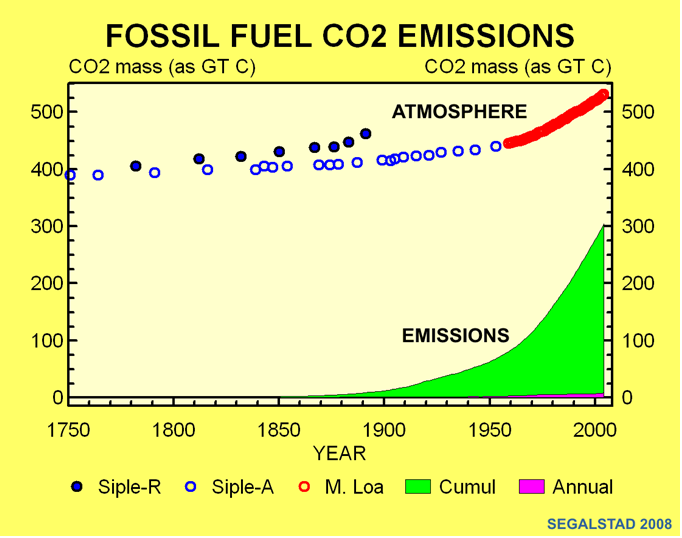
Tom V. Segalstad has conducted university research, publishing, and teaching in geochemistry, mineralogy, petrology, volcanology, structural geology, ore geology, and geophysics at the University of Oslo, Norway, and the Pennsylvania State University, USA.  Some images here are from Tom Segalstad’s presentation Carbon isotope mass balance modelling of atmospheric vs. oceanic CO2

Segalstad was a reviewer for IPCC assessment reports in the early days before observational facts were set aside in favor of the agenda and climate models tuned to suit the narrative. His whimsical comment on the experience:

Footnote:

For more on CO2 interchange between ocean and air, see Fear Not CO2: The Real Chemistry

For more on atmospheric CO2 processes, see Fearless Physics from Dr. Salby

For more on temperature impacting terrestrial CO2 sources, see Not Worried About CO2


Obsessed with Human CO2

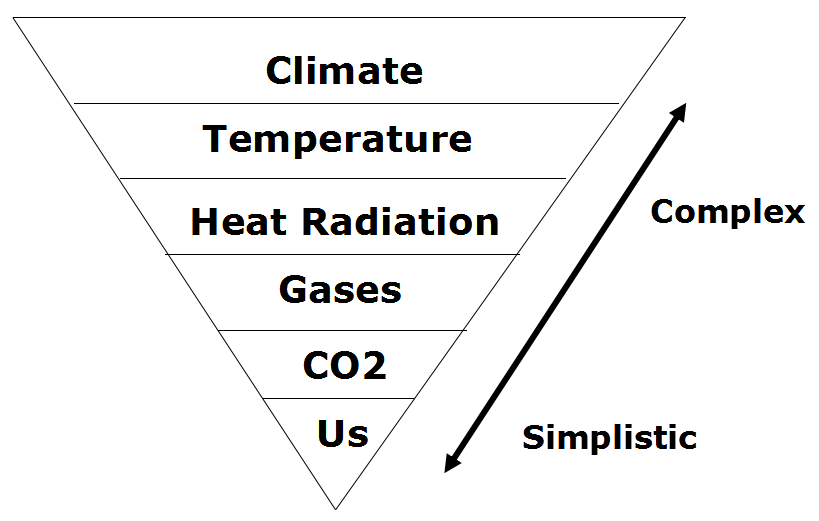
A previous post described how alarmists make their case by radically reducing the climate reality down to a false simplicity, as shown in this diagram:
The full discussion of this all too common reductionism is reprinted later on.  This post focuses on the final step at the triangle bottom where all of the increase in atmospheric CO2 is attributed to us humans.

In the news last week were reports of climate scientists surprised that CO2 rose faster in 2015 and 2016 despite flat human emissions.  That should have been a wake-up call regarding their mistaken paradigm of the carbon cycle.  Fortunately there is an excellent resource to correct any such misconceptions.

Recently I was pointed to a great website and the analytical work by Dr. Edwin Berry.  (H/T NZ Climate Science Coalition) Dr. Ed has written a thorough, yet very readable explanation on the issue of human emissions vs. CO2 fluxes from natural sources and sinks.  He has a paper currently in review Why human CO2 does not change climate and I am respecting his request not to repost from it until it is published.  The link does allow you to read his convincing analysis and conclusions, supported by basic principles and math.

Dr. Berry has been working on this for some time, and I will provide excerpts from another post showing his train of thought.  The fork in the road of the climate change debate is his most recent essay aiming for a general audience.

Neither nature’s emissions nor human emissions stay in the atmosphere. They merely flow through the atmosphere. The atmosphere is like a lake where a river flows in and lake water flows out over a dam. The lake’s water level will rise or fall until the outflow over the dam equals the inflow from the river.

If the inflow increases, the level will rise until the outflow equals the inflow and the level becomes constant. Conversely, if inflow decreases, the level will decrease until, once again, outflow equals inflow. The faster the inflow, the higher the level to balance the inflow. Fig. 1 illustrates the simple physics model for both the lake and the atmosphere.

systembalanceb-665x255-1

Fig. 1. The Model shows the rate of change of the level equals the difference between Inflow and Outflow. This model applies to both the lake model and the atmosphere model.

The ratio of natural to human carbon dioxide in the atmosphere is the ratio of their inflows. Nature produces more than 95 percent of the carbon dioxide in our atmosphere and human emissions produce less than 5 percent.

In terms of the often-quoted ppm (or parts per million), these percentages show that human emissions cause an 18-ppm rise, and nature’s emissions cause a 392-ppm rise, in atmospheric carbon dioxide. The total of each inflow is today’s carbon dioxide level of 410 ppm.

edberry fig.5

The IPCC reports are clear. While the IPCC correctly assumes nature’s emissions of about 100 ppm per year balance outflow to inflow, the IPCC incorrectly assumes human emissions do not balance. The IPCC assumes 1.5 ppm per year of human emissions gets stuck in the atmosphere and stays there. That 1.5 ppm is coincidently just enough to support their claim that human emissions have caused all the increase in atmospheric carbon dioxide since 1750.

The Paris Climate Agreement proposed to reduce worldwide human emissions by 28 percent. Twenty-eight percent of 18 ppm is 5 ppm. The Paris Agreement would have reduced atmospheric carbon dioxide by only 5 ppm, which is insignificant. Even 18 ppm is insignificant. The alarmists have no case.

Thank you Dr. Berry for taking IPCC data and showing the correct analysis and conclusion to draw.  A more technical description of his paradigm is A Model for Atmospheric Carbon Dioxide: Abstract

Note the size of the human emissions next to the red arrow. (Units are in GT)


Background:  Climate Reductionism

Reductionists are those who take one theory or phenomenon to be reducible to some other theory or phenomenon. For example, a reductionist regarding mathematics might take any given mathematical theory to be reducible to logic or set theory. Or, a reductionist about biological entities like cells might take such entities to be reducible to collections of physico-chemical entities like atoms and molecules.
Definition from The Internet Encyclopedia of Philosophy

Some of you may have seen this recent article: Divided Colorado: A Sister And Brother Disagree On Climate Change

The reporter describes a familiar story to many of us.  A single skeptic (the brother) is holding out against his sister and rest of the family who accept global warming/climate change. And of course, after putting some of their interchanges into the text, the reporter then sides against the brother by taking the word of a climate expert. From the article:

“CO2 absorbs infrared heat in certain wavelengths and those measurements were made first time — published — when Abraham Lincoln was president of the United States,” says Scott Denning, a professor of atmospheric science at Colorado State University. “Since that time, those measurements have been repeated by better and better instruments around the world.”

CO2, or carbon dioxide, has increased over time, scientists say, because of human activity. It’s a greenhouse gas that’s contributing to global warming.

“We know precisely how the molecule wiggles and waggles, and what the quantum interactions between the electrons are that cause everyone one of these little absorption lines,” he says. “And there’s just no wiggle room around it — CO2 absorbs heat, heat warms things up, so adding CO2 to the atmosphere will warm the climate.”

Denning says that most of the CO2 we see added to the atmosphere comes from humans — mostly through burning coal, oil and gas, which, as he puts it, is “indirectly caused by us.”

When looking at the scientific community, Denning says it’s united, as far as he knows.

A Case Study of Climate Reductionism

Denning’s comments, supported by several presentations at his website demonstrate how some scientists (all those known to Denning) engage in a classic form of reductionism.

The full complexity of earth’s climate includes many processes, some poorly understood, but known to have effects orders of magnitude greater than the potential of CO2 warming. The case for global warming alarm rests on simplifying away everything but the predetermined notion that humans are warming the planet. It goes like this:

Our Complex Climate

Earth’s climate is probably the most complicated natural phenomenon ever studied. Not only are there many processes, but they also interact and influence each other over various timescales, causing lagged effects and multiple cycling. This diagram illustrates some of the climate elements and interactions between them.

Flows and Feedbacks for Climate Models

The Many Climate Dimensions

Further, measuring changes in the climate goes far beyond temperature as a metric. Global climate indices, like the European dataset include 12 climate dimensions with 74 tracking measures. The set of climate dimensions include:

  • Sunshine
  • Pressure
  • Humidity
  • Cloudiness
  • Wind
  • Rain
  • Snow
  • Drought
  • Temperature
  • Heat
  • Cold

And in addition there are compound measures combining temperature and precipitation. While temperature is important, climate is much more than that.  With this reduction, all other dimensions are swept aside, and climate change is simplified down to global warming as seen in temperature measurements.

Climate Thermodynamics: Weather is the Climate System at work.

Another distortion is the notion that weather is bad or good, depending on humans finding it favorable. In fact, all that we call weather are the ocean and atmosphere acting to resolve differences in temperatures, humidities and pressures. It is the natural result of a rotating, irregular planetary surface mostly covered with water and illuminated mostly at its equator.

The sun warms the surface, but the heat escapes very quickly by convection so the build-up of heat near the surface is limited. In an incompressible atmosphere, it would *all* escape, and you’d get no surface warming. But because air is compressible, and because gases warm up when they’re compressed and cool down when allowed to expand, air circulating vertically by convection will warm and cool at a certain rate due to the changing atmospheric pressure.

Climate science has been obsessed with only a part of the system, namely the atmosphere and radiation, in order to focus attention on the non-condensing IR active gases. The climate is framed as a 3D atmosphere above a 2D surface. That narrow scope leaves out the powerful non-radiative heat transfer mechanisms that dominate the lower troposphere, and the vast reservoir of thermal energy deep in the oceans.

As Dr. Robert E Stevenson writes, it could have been different:

“As an oceanographer, I’d been around the world, once or twice, and I was rather convinced that I knew the factors that influenced the Earth’s climate. The oceans, by virtue of their enormous density and heat-storage capacity, are the dominant influence on our climate. It is the heat budget and the energy that flows into and out of the oceans that basically determines the mean temperature of the global atmosphere. These interactions, plus evaporation, are quite capable of canceling the slight effect of man-produced CO2.”

The troposphere is dominated by powerful heat transfer mechanisms: conduction, convection and evaporation, as well as physical kinetic movements.  All this is ignored in order to focus on radiative heat transfer, a bit player except at the top of the atmosphere.

There’s More than the Atmosphere

Once the world of climate is greatly reduced down to radiation of infrared frequencies, yet another set of blinders is applied. The most important source of radiation is of course the sun. Solar radiation in the short wave (SW) range is what we see and what heats up the earth’s surface, particularly the oceans. In addition solar radiation includes infrared, some absorbed in the atmosphere and some at the surface. The ocean is also a major source of heat into the atmosphere since its thermal capacity is 1000 times what the air can hold. The heat transfer from ocean to air is both by way of evaporation (latent heat) and also by direct contact at the sea surface (conduction).

Yet conventional climate science dismisses the sun as a climate factor saying that its climate input is unvarying. That ignores significant fluctuations in parts of the light range, for example ultraviolet, and also solar effects such as magnetic fields and cosmic rays. Also disregarded is solar energy varying due to cloud fluctuations. The ocean is also dismissed as a source of climate change despite obvious ocean warming and cooling cycles ranging from weeks to centuries. The problem is such oscillations are not well understood or predictable, so can not be easily modeled.

With the sun and the earth’s surface and ocean dismissed, the only consideration left is the atmosphere.

The Gorilla Greenhouse Gas

Thus climate has been reduced down to heat radiation passing through the atmosphere comprised of gases. One of the biggest reductions then comes from focusing on CO2 rather than H20. Of all the gases that are IR-active, water is the most prevalent and covers more of the spectrum.

The diagram below gives you the sense of proportion.

The Role of CO2

We come now to the role of CO2 in “trapping heat” and making the world warmer. The theory is that CO2 acts like a blanket by absorbing and re-radiating heat that would otherwise escape into space. By delaying the cooling while solar energy comes in constantly, CO2 is presumed to cause a buildup of heat resulting in warmer temperatures.

How the Atmosphere Processes Heat

There are 3 ways that heat (Infrared or IR radiation) passes from the surface to space.

1) A small amount of the radiation leaves directly, because all gases in our air are transparent to IR of 10-14 microns (sometimes called the “atmospheric window.” This pathway moves at the speed of light, so no delay of cooling occurs.

2) Some radiation is absorbed and re-emitted by IR active gases up to the tropopause. Calculations of the free mean path for CO2 show that energy passes from surface to tropopause in less than 5 milliseconds. This is almost speed of light, so delay is negligible. H2O is so variable across the globe that its total effects are not measurable. In arid places, like deserts, we see that CO2 by itself does not prevent the loss of the day’s heat after sundown.

3) The bulk gases of the atmosphere, O2 and N2, are warmed by conduction and convection from the surface. They also gain energy by collisions with IR active gases, some of that IR coming from the surface, and some absorbed directly from the sun. Latent heat from water is also added to the bulk gases. O2 and N2 are slow to shed this heat, and indeed must pass it back to IR active gases at the top of the troposphere for radiation into space.

In a parcel of air each molecule of CO2 is surrounded by 2500 other molecules, mostly O2 and N2. In the lower atmosphere, the air is dense and CO2 molecules energized by IR lose it to surrounding gases, slightly warming the entire parcel. Higher in the atmosphere, the air is thinner, and CO2 molecules can emit IR into space. Surrounding gases resupply CO2 with the energy it lost, which leads to further heat loss into space.

This third pathway has a significant delay of cooling, and is the reason for our mild surface temperature, averaging about 15C. Yes, earth’s atmosphere produces a buildup of heat at the surface. The bulk gases, O2 and N2, trap heat near the surface, while IR active gases, mainly H20 and CO2, provide the radiative cooling at the top of the atmosphere. Near the top of the atmosphere you will find the -18C temperature.

Sources of CO2

Note the size of the human emissions next to the red arrow.

A final reduction comes down to how much of the CO2 in the atmosphere is there because of us. Alarmists/activists say any increase in CO2 is 100% man-made, and would be more were it not for natural CO2 sinks, namely the ocean and biosphere. The claim overlooks the fact that those sinks are also sources of CO2 and the flux from the land and sea is an order of magnitude higher than estimates of human emissions. In fact, our few Gigatons of carbon are lost within the error range of estimating natural emissions. Insects produce far more CO2 than humans do by all our activity, including domestic animals.

Why Climate Reductionism is Dangerous

Reducing the climate in this fashion reaches its logical conclusion in the Activist notion of the “450 Scenario.”  Since Cancun, IPCC is asserting that global warming is capped at 2C by keeping CO2 concentration below 450 ppm. From Summary for Policymakers (SPM) AR5

Emissions scenarios leading to CO2-equivalent concentrations in 2100 of about 450 ppm or lower are likely to maintain warming below 2°C over the 21st century relative to pre-industrial levels. These scenarios are characterized by 40 to 70% global anthropogenic GHG emissions reductions by 2050 compared to 2010, and emissions levels near zero or below in 2100.

Thus is born the “450 Scenario” by which governments can be focused upon reducing human emissions without any reference to temperature measurements, which are troublesome and inconvenient. Almost everything in the climate world has been erased, and “Fighting Climate Change” is now code to mean accounting for fossil fuel emissions.

Conclusion

All propagandists begin with a kernel of truth, in this case the fact everything acting in the world has an effect on everything else. Edward Lorenz brought this insight to bear on the climate system in a ground breaking paper he presented in 1972 entitled: “Predictability: Does the Flap of a Butterfly’s Wings in Brazil Set Off a Tornado in Texas?”  Everything does matter and has an effect. Obviously humans impact on the climate in places where we build cities and dams, clear forests and operate farms. And obviously we add some CO2 when we burn fossil fuels.

But it is wrong to ignore the major dominant climate realities in order to exaggerate a small peripheral factor for the sake of an agenda. It is wrong to claim that IR active gases somehow “trap” heat in the air when they immediately emit any energy absorbed, if not already lost colliding with another molecule. No, it is the bulk gases, N2 and O2, making up the mass of the atmosphere, together with the ocean delaying the cooling and giving us the mild and remarkably stable temperatures that we enjoy. And CO2 does its job by radiating the heat into space.

Since we do little to cause it, we can’t fix it by changing what we do. The climate will not stop changing because we put a price on carbon. And the sun will rise despite the cock going on strike to protest global warming.

Footnote: For a deeper understanding of the atmospheric physics relating to CO2 and climate, I have done a guide and synopsis of Murry Salby’s latest textbook on the subject:  Fearless Physics from Dr. Salby

Earth Climate Layers

Thanks to No Tricks Zone for posting work (here) by Dr. Dai Davies of Canberra. In his writing I found a fine summary paradigm leading to the image above.  This post presents a scientifically rigorous view of our planetary climate system, starting with an airless rocky surface and then conceptually adding the dynamic elements in layers.  The text below with my bolds and images comes from Energy and Atmosphere by Dr. Dai Davies of University of Canberra,  Website: http://brindabella.id.au/climarc/.

The Earth’s atmosphere in stages

This is an hypothetical scenario that allows us to build up a picture, step by step, of how having an atmosphere can influence a planet.

Baseline: Airless, Rocky Planet
As a starting point we consider how the Earth’s temperature might vary through the daily cycle if it was an airless, rocky planet much like the moon. During the day, the sun heats up a surface layer of the rock which cools through infrared radiation. The temperature follows the sun’s irradiation almost directly, rising and plunging over a range of hundreds of degrees.

Add: Radiatively Inert Atmosphere
If we add a radiatively inert atmosphere, its only means of gaining and losing heat would be thermal conduction through direct contact with the Earth’s surface. The heat capacity of a square meter column of the Earth’s atmosphere is equivalent to that of about 12 tonnes of granite, so far greater than a thin layer of rock heated by the sun. While the surface would still go through a temperature cycle, the atmosphere would achieve an equilibrium where the mean lower atmosphere matched the mean surface temperature – give-or-take geography and atmospheric circulation. It would act as a buffer that would stabilise surface temperatures – cooling the surface during the day and warming it at night. This is discussed further in note (a) with some simple calculations.

All molecules are radiatively active if the energy is high enough. A realistic atmosphere, such as a nitrogen and oxygen mix, absorbs some energy from the light and UV components of incoming solar radiation, but still can’t lose heat through infrared radiation.

Add: Water Vapour, Ignoring Condensation
We now add water vapour to the atmosphere at typical Earth levels of up to 4%, but ignore the effects of condensation. Water molecules are kicked into excited states by collisions with nitrogen or oxygen molecules which lose some kinetic energy in the collision. Most of this energy will return to kinetic in subsequent collisions. Otherwise, the energy is radiated in a random direction as an infrared photon, which creates a radiation flux that travels much faster and further than molecular movement. Their mean free path (mfp) is typically 50 metres in the surface atmosphere, increasing with altitude as the density of the air decreases and collisions are less frequent. A small part of this energy escapes to space, a smaller part is absorbed by the Earth’s surface, leading to a net transfer to space.

This radiative flux greatly increases the thermal coupling between the surface and near-surface atmosphere, adding to the transfer via direct thermal conduction and reducing the daily temperature cycle of the surface, tying it closer to the temperature of the lower atmosphere. Due to the highly nonlinear nature of radiant emission, this will have a net heating effect on the surface as described in note (a).

The increase in mfp with altitude means there is a small upward bias in photon transmission through the atmosphere’s photon sea created by molecular collisions. This net upward transfer of energy largely substitutes the direct infrared radiation from surface to space, adding a slight delay in the order of milliseconds. Heat is not ‘trapped’, as is commonly claimed, just slowed a little. It’s a rapid conduit, not a reservoir.

Add: Liquid Water Covering 70% of Surface
For the next stage in the transition towards our current atmosphere we add our present distribution of liquid water over 70% of the rocky surface. This changes things dramatically. First, rather than just heating a thin surface layer of rock that can radiate heat rapidly, the sun’s rays penetrate deep into the oceans, heating water that retains its heat until physical mixing brings it to the surface. In the upper ‘mixing layer’ this happens in days to months. Some is mixed deeper and can travel for centuries in deep ocean currents before surfacing.

At the surface of the oceans and wet land we now have evaporative cooling which extracts heat of vaporisation and cools the surface just as sweat cools our skin. Water vapour is lighter than air and reduces the air density. The lighter air rises, creating convection. As it rises it eventually cools to the point where liquid water condenses out to form clouds and dumps the heat of vaporisation into the upper atmosphere. The main impact of clouds is to reduce incoming solar radiation by reflecting it back out to space.

Most of the heating is in equatorial regions. The rising air creates the major Hadley circulation cells that carry heat polewards in the upper troposphere. The radiating upper air cools and becomes more dense as it travels, eventually sinking back to surface level and returning to equatorial regions.


Water isn’t the only radiative gas in our atmosphere, but it dominates. The next in significance is carbon dioxide. It’s main impact is in the upper atmosphere where most of the water vapour has condensed out. This impact is cooling. Its influence in the lower atmosphere is discussed later.

Finally, we add Life.

Early on, it added the oxygen to our atmosphere. Now, its plants have changed the surface albedo – the amount of the sun’s energy reflected back to space. Through transpiration they also add to evaporation in increasing the input of water vapour to the atmosphere. Some plants and algae produce aerosols that seed clouds – terrestrial plants increasing their chances of rain – marine biota reducing the incidence of destructive UV.

Summary

There is much more to be learned from this thorough, well written article, but I will conclude with Davies’ summation:

The most fundamental of the many fatal mathematical flaws in the IPCC related modelling of atmospheric energy dynamics is to start with the impact of CO2 and assume water vapour as a dependent ‘forcing’ (note e). This has the tail trying to wag the dog. The impact of CO2 should be treated as a perturbation of the water cycle. When this is done, its effect is negligible.

Extensive analysis of radiosonde data over time, and an associated theoretical analysis, by Miskolczi (6) has shown that the water cycle adapts to maintain saturation – maximum impact – in the combined effects of water vapour and any other radiative gasses.

The sudden increase in evaporative cooling of warm water creating an upper bound for wet surface temperatures, along with the freezing point of water limiting ocean temperatures at the poles, anchor the overall surface temperature of the Earth. The Earth’s orbit, variations in solar activity, and long term transport of heat in ocean currents, provide cyclic variations. The lapse rate just determines the height of the tropopause. The net effect of CO2 is to help cool the upper troposphere where water vapour levels are low.

The current small peak in temperatures is partly the result of heat returning from past millennial cycles – the historians’ climate optima of the Medieval, Roman and earlier warm periods. As then, solar activity is now at low levels.

Davies provides a concise synopsis of several posts touching on key elements of earth’s climate.

My own discussion of climate layers is in Climate Reductionism

The effect of an inert atmosphere is shown empirically in Planetary Warming: Back to Basics

The reference above to Dr. Miskolczi is elaborated in The Curious Case of Dr. Miskolczi

The role of oceans in storing and distributing heat is described in Climate Water Wheel

The passage of energy through the atmosphere is explained at On Climate Theories

“The Earth, a rocky sphere at a distance from the Sun of ~149.6 million kilometers, where the Solar irradiance comes in at 1361.7 W/m2, with a mean global albedo, mostly from clouds, of 0.3 and with an atmosphere surrounding it containing a gaseous mass held in place by the planet’s gravity, producing a surface pressure of ~1013 mb, with an ocean of H2O covering 71% of its surface and with a rotation time around its own axis of ~24h, boasts an average global surface temperature of +15°C (288K).

Why this specific temperature? Because, with an atmosphere weighing down upon us with the particular pressure that ours exerts, this is the temperature level the surface has to reach and stay at for the global convectional engine to be able to pull enough heat away fast enough from it to be able to balance the particular averaged out energy input from the Sun that we experience.

It’s that simple.”  E. M. Smith