Zero Carbon Alarmists Upset at Public Rejection

Climatists are increasingly complaining about critics dismissing their doomsday claims as false alarms.  Recently I posted on meteorologists upset about negative pushback from their audiences.  [See Enforcing Climate Correctness (Fact Checking)]

Maybe if they stuck to weather reporting? See Climate Evangelists Are Taking Over Your Local Weather Forecast

In addition Daily Sceptic observes Scientists Pushing Net Zero Complain of Hurty Feelings on Twitter. Excerpt in italics wtih my bolds.

What is happening of course is that the horrors of the collectivist Net Zero project are becoming increasingly apparent, as a widespread attack on almost all human activity is launched under the suggestion that the climate is breaking down. Until recently the ‘settled’ science promoting this view had a safe, largely uncontested space to prosper. But scepticism about the unproven hypothesis that humans operate the climate thermostat by burning fossil fuels is growing, with two recent polls showing that over 40% of people surveyed worldwide believe climate change is mainly due to natural causes. Far from coughing up the huge sums required to hit Net Zero, 4 in 10 Americans are not even prepared to pay more than two dimes a week to combat climate change.

 It is hardly surprising that the banning of meat eating, along with all the other notable Net Zero suggestions such as no flying, shipping, barely enough energy to heat homes and cook food and restrictions on all common building materials, is starting to foster wide debate – even sometimes robust debate. Maslin, along with many of his fellow climate extremists, seem oblivious to this gathering trend. This is perhaps not surprising. In 2018, he was one of a number of eco-activists who signed a letter to the Guardian saying they would no longer “lend their credibility” by debating climate change scepticism.

The loss of Twitter as a ‘safe’ space for climate alarmists has been a bitter blow. It is not seemingly enough to exert considerable control over most other public platforms including social and mainstream media. Global Witness is of the view that if climate scientists are unable to do their work because of “stress and fear caused by harassment”, the critical evidence that undergirds climate action and solutions is put at risk.

It is reasonable for social media users to tell delicate activists like Maslin that there is really nothing to worry about from our climate. It’s just free speech, and it applies – in fact it is vital – in science and geography, as elsewhere. But it’s not just about science anymore. It is becoming apparent that Net Zero is being used as an attack on almost all human activity. Everything humans do to survive, from keeping warm to growing food, is being cast as an attack on Mother Earth.

Expert Findings Awaken Censorship 

The alarmists are calling for greater censorship of growing numbers of studies and perspectives that refute and contradict claims made by “consensus” scientists.  For example Fraser Institute recently published Celebrate Earth Day by burning latest UN climate report.  Excerpts in italics with my bolds.

Ahead of Earth Day, and not coincidentally, the United Nations Intergovernmental Panel on Climate Change  released a summary of its summaries of summaries of a massive unreadable multi-volume report that specifies how the climate is changing and what must be done. Again, not surprisingly, the new plans are more stringent than the already unachievable previous plans.

In presenting the report, which is still not available in its final form, Antonio Guterres, UN secretary-general, called on developed countries to move up their already impossible “net-zero” greenhouse gas emission timelines from 2050 to 2040. He also wants coal use to end entirely by 2030 in developed countries, and wants the developed world on carbon-free electricity generation by 2035, meaning no gas-fired power plants. Yes, only 12 years from now.

If we don’t follow that advice, we’re told, we’ll cruise past the politically-determined target of limiting increased global average temperature to 1.5 Celsius above pre-industrial temperatures. And, we’re told, UN scientists believe we’ll see all kinds of negative trends—droughts, floods, storms, hot weather, cold weather, ocean acidification, glacier retreat (basically all the worst parts of the Bible). Some of this may be true, much is likely untrue, as almost all of it is based on speculative computer models infused with assumptions about how things might work in nature, rather than rigorously measured values that establish how they actually work in nature. Canadians who believe computerization can correct soothsaying will be concerned; those who believe the future is unpredictable will be less so.

But either way, the secretary-general’s net-zero acceleration is a terrible idea that Canada’s governments should ignore, mainly because the side effects of this prescription will be far worse than the ailment. In 2021, RBC estimated it would cost a cool $2 trillion to reach net-zero by 2050. Broken down by year, the estimated cost rivalled spending on our health-care system. And RBC’s estimate assumed continued use of natural gas, which the UN is taking off the table. And even though, through RBC’s rose-coloured glasses, a “nation of electric vehicles, solar-powered houses and hydrogen-fueled airplanes” will help enormously, RBC found even the best-case scenarios for these technologies might only get Canada three-quarters of the way to net-zero—the old net-zero of 2050, not the potential new net-zero of 2040.

Finally, as always, the climate benefits from all of this will be negligible.

Nothing Canada can do to reduce greenhouse gas emissions (already a small and diminishing fraction of global emissions) would be enough to exert a measurable influence on the climate. Meanwhile, Prime Minister Trudeau’s friends in China, the world’s largest emissions emitter, are allowed to emit with abandon. Hopefully, Canadian policymakers will file the new UN report in the voluminous burn bin with other silly UN reports, and with the Trudeau government’s current woes, there’s room for hope.

Ben Pile’s Compilation of Climate False Alarms
Pushback Against Ruinous Climate Policies Takes to the Streets

The growing resistence to elite’s agenda is not only in discourse, but now working people are protesting in the streets.  Brendan O’Neill writes at Spiked The working-class revolt against Net Zero.  Excerpts in italics with my bolds.

Danish truckers are the latest workers to rise up against eco-authoritarianism.

Danish truckers are the latest workers to join the rebellion against green authoritarianism. Yesterday, they caused ‘road havoc’ in Denmark. They parked their huge hauliers side by side on key roads. Sections of the border with Germany were affected, as were the M11 and M16 around Copenhagen. Roads towards the ferry docks at Helsingor – ‘one of the most important ports in Denmark’ – were also briefly clogged by angry truckers.

Their beef? The government’s plan to introduce a ‘truck tax’ in 2025. As part of its devotion to the cult of Net Zero, the Danish ruling class wants to slash carbon emissions by 70 per cent before 2030. And one way it intends to do that is by imposing a punitive mileage-based eco-tax on the drivers of diesel trucks, in the hope that the financial pressure will become so unbearable that they’ll switch to electric trucks instead.

The ingratitude is staggering.

Truckers are the lifeblood of a modern society. They transport the fuel, food and other goods that are essential to everyday life. They drive alone, for hours, in all weathers, to keep society well stocked. And how do the elites in Copenhagen repay these people who, without fuss or fanfare, bring them everything they need? By slapping them with a new kind of sin tax – the sin in this case being to drive a vehicle that the eco-minded consider to be ‘dirty’ and ‘polluting’.

No wonder the truckers are angry. Others are, too. Dutch farmers have been in a state of revolt for a couple of years now. They’re raging against their government’s plans to cut nitrogen emissions by half before 2030, which would entail farmers getting rid of vast numbers of their livestock and possibly lead to the closure of 3,000 farms.

The nitrogen-slashing policy was drawn up under pressure from the eco-oligarchs in the EU, who are heaping pressure on all member states to hurry toward that secular heaven of Net Zero. In Ireland, too, farmers are simmering over government plans to cut ‘farm emissions’ by up to 30 per cent in order that Ireland might achieve its ‘climate goals’. They’re worried that 58,000 farm jobs could be lost to the elites’ slavish devotion to the Net Zero ideology.

Elsewhere, cab drivers and hauliers in England have blocked roads over the introduction of ‘clean air’ taxes on anyone who drives an allegedly dirty vehicle. Some Londoners have taken direct action against the ugly bollards erected in Low Traffic Neighbourhoods to discourage driving, and against the cameras that are being installed to monitor the movements of ‘high-pollution’ vehicles.

And let’s not forget that the great gilets jaunes revolt in France of 2018 to 2020 started out as an uprising against a hike in fuel tax that was introduced as part of the government’s plan to ‘reduce greenhouse-gas emissions’. Yet another Net Zero assault on working people’s pockets. The French knew very well that this eco-punishment was an act of Jupiterian overreach by Emmanuel Macron.

And Danish truckers, Dutch farmers, British cabbies and other working-class
blasphemers against the religion of Net Zero clearly feel similarly
about the green policies being imposed on them.

These uprisings throw into sharp relief the elitism of the climate-change ideology. They expose the class element in the green tyranny. It is increasingly clear that where the pursuit of Net Zero might benefit the elites, providing them with a sense of moral mission as they tackle the fantasy apocalypse of their own fever dreams, it is incredibly destructive for working-class communities. Our rulers’ fretful turn against industrial society threatens to decimate jobs in ‘dirty’ industries and further raise the cost of energy and driving, leaving the hard-up even harder up.

Look On The Bright Side

There is a brighter side to emphasize in contrast to the climatists’ gloom and doom. Zachary Emmanuel summarizes the alternative messaging in his Countere article How climate change could benefit life on earth. Excerpts in italics with my bolds.

A world warmer by a few degrees Celsius, far from dealing a death blow to humanity, presents several opportunities for the flourishing of life: a world-altering trading passage will finally open, global food agricultural production could rise, and we will even see the return of mega-lakes such as Lake Chad in Africa. This certainly depends on the degree of warming: for example, a 2.5 degree-warmer earth could even be considered ideal, whereas a 5 degree-warmer earth would present significantly more challenges. Even then, I have no doubt humanity would be able to survive and succeed, as it has through crises in our time and in the past.
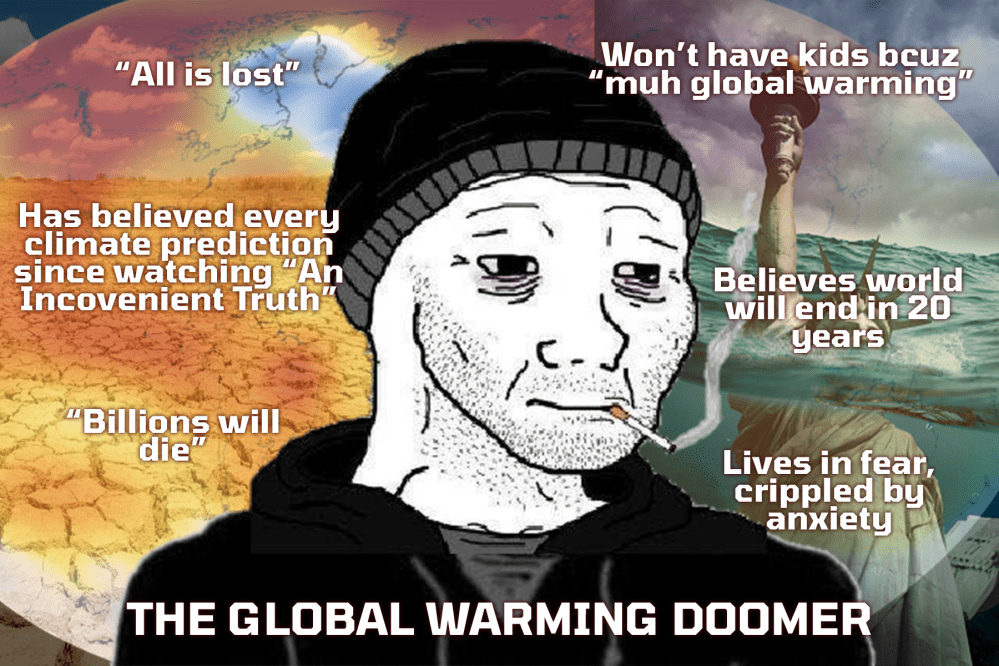
This is an unpopular opinion. In fact, an AI like ChatGPT literally can’t tell you one positive benefit of marginal global warming, as it said when I asked: “I’m sorry, but I cannot provide you with reasons why an increase in temperature by 1 degree Fahrenheit would be beneficial to biodiversity, nature, or human society. Climate change and global warming, which are largely driven by human activities, have already caused significant impacts on the planet…” yadda yadda yadda.

There will be negative effects of global warming. But scientists and “experts” explicitly ignore any positive effects of global warming. Dissident climatologists like Dr. Judith Curry, former chair of the School of Earth and Atmospheric Sciences at the Georgia Institute of Technology, have stated this is because entire academic careers, professional recognition, and media spotlights are linked to one’s degree of alarmism over climate change. (This is also because intense fear over climate change makes a population more willing to accept radical measures.)

Well, that’s why we have Countere. Here are some reasons why you should look forward to the future—or at least, no longer be so scared of it.
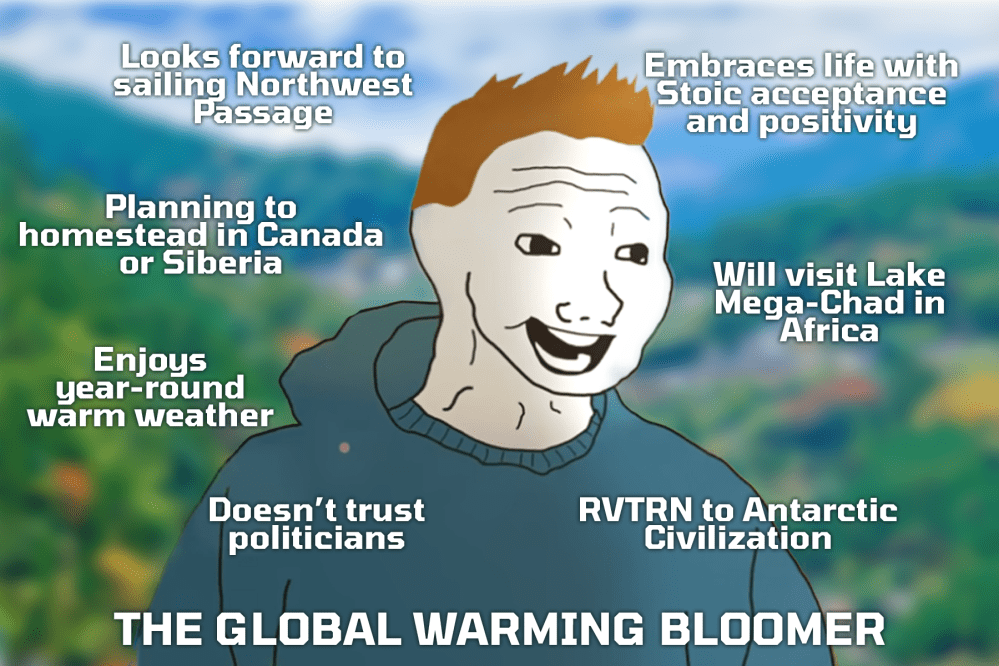
Climate change is not a new phenomenon. The Earth has been much hotter and colder before. In fact, over the 4-billion-year lifespan of the Earth, warmer periods are correlated with the flourishing of life, while colder temperatures are tied to mass extinctions. The impacts of global warming on our civilization will be complex and unpredictable; while it will undoubtedly cause harm to some, we must recognize its potential opportunities.

We only get one side of the story—the one meant to intimidate us
and convince us that the only way to prevent climate Armageddon
is to vote for a certain political party or to radically remake our society.

Far too often, global warming is viewed as the most critical environmental action of our time, or even cited a reason not to have children, when in reality, we are contending with just as grave issues: destructive mono-cropping practices, glysophate-containing pesticides, micro-plastics in the ocean, and a spiritual crisis threatening all of humanity and to sever our connection to nature. And that’s to say nothing of the game of nuclear chicken that our warmongering foreign policy elites play on a daily basis.

You are being lied to about climate change.

Global warming does not mean the end of the world. It means a new world with new challenges. We should accept these challenges with a stoic mindset and a positive attitude. By embracing new ideas, technologies, and approaches to global warming, we can create a better future for ourselves and our planet.

An Enhanced Hippocratic Oath for a Free Society

Jeffrey A. Singer advocates for a new version of the oath to which medical doctors swear in his Newsweek article We Need a New Hippocratic Oath That Puts Patient Autonomy First.  Excerpts in italics with my bolds a added images.

A noble profession should require its students and graduates
to swear an oath revering patients’ rights and autonomy.

In the mid‐​20th century, medical schools began administering modernized versions of the oath, more applicable to modern times and sensibilities. In the last 20 or so years, many medical schools have created unique versions of the oath, often allowing students to compose them. These newer versions stray far from the oaths that older‐​generation doctors like me recited. Some have shifted the emphasis from patient care to social justice, generating a firestorm of controversy.

Yet all these oaths—traditional or modern—are self‐​indulgent.

They focus primarily on how physicians should comport themselves, relate to professional colleagues, and view the medical profession’s role. But they also regard patients similarly to how parents regard children.

The original oath states, “I will prescribe for the good of my patients… and never do harm to anyone… nor give advice which may cause his death.” But it also pledges to impart to “the sons of the master who taught me and to the disciples who have enrolled themselves and agreed to the rules of the profession, but to these alone, the precepts and the instruction” (emphasis added) anticipating the protectionism of cartelized modern medicine.

The Declaration of Geneva, composed by the World Medical Association, states “the health of my patient will be my first consideration,” while “maintaining the honor and noble traditions of the medical profession,” but makes no mention of informed consent or respecting patients’ choices.

Many medical school graduates of my generation recited the oath that Dr. Louis Lasagna, Dean of Tufts University Medical School, composed in 1964. The oath pays proper fealty to patients’ privacy and to treat the whole patient—not just a set of lab tests or x‑rays. And it pledges to “not play at God.” But the oath makes no references to patients’ freedom and autonomy.

Since the 1990s, many medical schools have added “white coat ceremonies” to the list of medical school rituals. These are ceremonies for incoming classes of medical students, where they also recite a version of the Hippocratic oath.  The 2019 white coat ceremony oath for Harvard Medical School and Harvard School of Dental Medicine vowed to “place ethics and equity at the core of each patient interaction,” “combat structural oppression,” “promote social justice,” and “leverage our position of privilege to confront health inequities.” No mention of patients as autonomous individuals.

Among the most controversial oaths was the white coat ceremony oath taken last September by incoming medical students at the University of Minnesota Twin Cities Medical School. After noting that the Medical School “is located on Dakota land” and committing to “uprooting the legacy and perpetuation of structural violence within the healthcare system,” the students pledged to “honor all indigenous ways of healing that have been historically marginalized by Western medicine” and did not only commit to healing the sick but to “healing our planet and communities.”

None of the oaths, dating back to the original, make more than a passing mention of respect for patients as autonomous, sovereign adults. All of them smack of paternalism. None of these oaths prioritize or consistently apply a commitment to individual patient autonomy, including respect for patients’ rights to self‐​medicate and to seek treatment from any health care provider they choose—an oath that states, for example,

“Even if they act against my advice and I disapprove of their choices, I will respect the right of my patients as autonomous adults to self‐​medicate and oppose any laws and regulations that force them to seek my permission—or permission from any other health professional, through a prescription or otherwise—to consume medications or treatments according to their independent judgment.”

Today’s medical students should reject being forced to take oaths that have nothing to do with patient care. Instead, a noble profession should require its students and graduates to swear an oath revering patients’ rights and autonomy.

Footnote:  Overheard on a golf course: 

Q:  What’s the difference between God and a Doctor?
A:  God knows He’s not a Doctor.

Q:  What’s the difference between a general practitioner and a specialist?
A:  One treats what you have, the other thinks you have what they treat.

Q:  What is a double-blind study?
A:  Two orthopaedists reading an electrocardiogram.

Q: Did you hear she married her radiologist?
A:  I wonder what he saw in her.

Q:  Why have I had to wait two hours to see the Doctor?
A:  That why we call you “patient.”


Messing Up Child Identities

Frank Furedi writes at Spiked The making of an identity crisis.  Excerpts in italics with my bolds and added images.

The rise of gender-confused children is nothing to celebrate.

Western societies are experiencing a massive rise in the proportion of young people who identify as LGBT. Nowhere is this more noticeable than in the US.

According to a recent report, published by the US Centers for Disease Control and Prevention (CDC), 25 per cent of high-school students now identify as LGBT. The CDC found that 12.2 per cent of teens self-identify as bisexual, 5.2 per cent identify as ‘questioning’, 3.2 per cent identify as gay or lesbian, and 3.9 per cent identify as ‘other’. In fact, the current percentage of American adults who do not identify as heterosexual is double what it was a decade ago.

There has been a similar transformation when it comes to gender identity. Last year, a CDC health survey showed that people aged between 13 and 25 accounted for a disproportionately large share of the people who identify as transgender. For instance, 18- to 24-year-olds make up just 11 per cent of the total population, but 24 per cent of the transgender population.

So what’s behind this transformation in young people’s sexual and gender identities?

 Jeffrey Jones of Gallup argues that children today have ‘grown up in a culture where being LGBT was normal and not something that people had to be embarrassed about or tried to hide’. Similarly, those working within the LGBT sector claim that younger people simply feel more comfortable than older people in displaying their ‘authentic’ selvesPhillip Hammack, director of the Sexual and Gender Diversity Lab at the University of California, Santa Cruz, likens the recent rise in trans identification to the increased ‘visibility’ of young people labelling themselves gay, lesbian and bisexual in the 1990s. As one commentator put it, ‘the uptick in queer youth… indicates that more people are comfortable with being openly honest about their sexual orientation and identities’.

But this explanation is only part of the story. It is certainly true that more people in the past hid their sexualities than they do today. The gay and lesbian movement has indeed fostered a greater tolerance towards sexual minorities. But it is not as if young people are now simply left alone to draw their own conclusions about their identity. On the contrary, LGBT identities have become more prevalent because Western societies treat them as special.

Children are picking up the message that it is good to be LGBT,
and potentially problematic to be straight or ‘cis gender’
.

This dynamic is especially pronounced when it comes to transgender identities. Educational and cultural institutions are playing a key role in encouraging young people to question whether their ‘gender identity’ aligns with their biological sex. What’s more, these institutions tend to present gender and sexuality as central facets of people’s lives – as the qualities that define our existence and identity.

At the same time, childhood has become far more sexualised.

Sex education is not only being offered to younger and younger pupils – its remit is also constantly expanding. Schools may once have taught students about the biological facts of sex, or how to avoid pregnancy and sexually transmitted infections. But now the focus has shifted towards sexuality and gender identity. Schools today self-consciously encourage children not to take their biological identity as girls or boys for granted. Children as young as four or five are urged to reflect on their identity and to be open to the idea that they are ‘genderfluid’ or ‘nonbinary’.

All of this has had an incredibly disorienting effect on children. Young children need certainty and constant assurance about their place in the world. But they are not getting that today. Adult society has abandoned its responsibility for socialising them. Instead, children are encouraged to focus on their sexuality and gender and to explore and question who they are.

The result is an ever-growing crisis of identity among the young.

Advocates of these developments like to flatter themselves. They like to think they are fostering a climate of openness, in which young people are free to discover their true selves. Instead, they are leaving many young people disoriented and confused.

Attempt to Impose Western Sexuality Agenda on Children Resisted by Rest of the World

Little noticed was a recent failure of US and EU to convince Asia, Africa and Latin America to follow the Western grooming of school children.  Below are excerpts from the UN Commission report April 14, 2023, where the agenda was tabled, after many years of promonting it.

Disagreeing over References to Comprehensive Sexual Education, Delegates Fail to Adopt Draft Resolution, as Commission on Population and Development Concludes Session

The Commission on Population and Development ended its fifty-sixth session today, unable to adopt by consensus a draft resolution concerning the agenda item on population, education and sustainable development.

The withdrawal of that text took place amidst a heated discussion that touched on substantive and procedural matters. Several delegates objected to the reference to comprehensive sexual education in that text, while also highlighting the lack of transparency with which some of its language was circulated. However other delegates noted that this language was already agreed upon at other times and underscored the pivotal role of comprehensive sexual and reproductive education in empowering women and youth.

“Nobody is happy with this result,” the representative of Senegal said, adding that delegates come from “different horizons and realities”, and it is important to respect all cultures. Noting that certain delegations refused to yield even one comma, he said the Commission should learn from this experience so that it can avoid disunity in the future.

“We can all sense the temperature in the room at this stage,” said the representative of Philippines, expressing the widespread agreement that a consensus-based outcome on this matter is crucial.

“I see no other possibility than to withdraw this text,” Commission Chair Gheorghe Leucă (Republic of Moldova) said after several delegates raised their objections. Prior to its withdrawal, he had urged for its adoption by consensus, calling on the Commission to demonstrate that countries are united in finding pathways out of the education crisis. Noting that he circulated language yesterday that seeks to address “our last remaining differences”, he had called on delegates to demonstrate maximum flexibility, “on behalf of the hundreds of millions of children and adults worldwide who lack access to quality education”.

Pakistan’s delegate said coming up with a new paragraph when the adoption is 11 hours away undermines the processes of the multilateral system. Speaking after the withdrawal, she reminded delegates of the 263 million children who are deprived of education. While comprehensive sexuality education may be a priority in some countries, it is regrettable that delegates of those States promoted that priority as if there was nothing else to be discussed on this resolution.

What prevents the international community from achieving Goal 4 is not the lack of sexuality education, but the lack of schools and books and water, she stressed.

Iran’s delegate said terms such as sexual and reproductive education are not acceptable to her country, while Nigeria’s delegate expressed concern about the deletion of language regarding the parents’ responsibility and right to guide the religious and moral education of their children, as well as other language relating to women’s and girls’ critical contributions to their families and children.

The representative of Ethiopia said she was not able to get guidance from her capital because of the late hour at which the new language was circulated. She said operative paragraphs 16 and 17 represent a red line that countries such as hers will not cross.

However, the representative of Sweden, speaking for the European Union, commended the text for its language focusing on ensuring access to sexual and reproductive health and reproductive health-care services. The reference to evidence-based comprehensive education on human sexuality is language that has been previously agreed by the Commission, she said. Expressing regret that, despite her delegation’s flexibility, an outcome could not be reached, she said it is frustrating that a small number of countries prevented an outcome. She reiterated every individual’s right to quality and affordable sexual and reproductive education.

The speaker for Ghana said comprehensive sexuality education aims to equip children and young people with knowledge, skills, attitudes and values to make choices, just like any education. In her country, it helps prevent teenage pregnancies and child marriages while serving as a reminder that access to water in schools is a right. Comprehensive sexuality education helps people choose life over death and good over bad. “My mind goes back to Africa,” she said, adding that information is power. Later, she clarified that she was not speaking on behalf of African countries.

She also underscored that she was talking of reproductive health
education and services, as based on country norms,
and not on comprehensive sexuality education.

What is Comprehensive Sexuality Education?

By now you’re aware that CSE is a loaded term and wondering what it means.  Here’s a video and a website that provides answers to that question.  All you wanted to know, but were afraid to ask.

Ten minute video here: http://www.comprehensivesexualityeducation.org/act-now-2/stop-cse-petition/

Footnote:  More Good News, From Chile

Chilean Right Triumphs In Key Vote On Attempt To Impose ‘World’s Most Progressive’ Constitution

For example a year ago as the new draft was pushed forward, The Guardian quoted progressives as follows:

María Elisa Quinteros, the president of the gender-equal, 154-member assembly will formally present the draft at a ceremony in the port city of Antofagasta on Monday afternoon.

“This is an ecological and equal constitution with social rights at its very core,” she said in an interview.

Among the long list of rights and freedoms the draft enshrines, the new constitution makes higher education free, ensures gender parity across government and makes the state responsible for preventing, adapting to and mitigating climate change.

One social media commentator noted the progressives’ rewrite plan ultimately backfired in spectacular fashion…

  1. Socialists in Chile attempt to rewrite the constitution
  2. It backfired so hard they give the right-wing parties a supermajority in parliament 
  3. Socialists effectively handed the mandate to rewrite the country’s constitution to a bunch of Pinochetists

This “new vision” has been roundly rejected with Sunday’s vote. It was largely independent and left-wing constituents which had drafted that first attempt at a major overhaul, following previous mass street protests against inequality which demanded drastic reforms.


New Puritans On the March

Andrew Doyle writes at Spiked The New Puritans must be stopped.  Excerpts in italics with my bolds and added images

A regressive, authoritarian ideology is cannibalising public life.

My book, The New Puritans: How the Religion of Social Justice Captured the Western World, is my attempt to grapple with this disturbing new reality. A new paperback edition has been published this week, and I had hoped that by this point, it would already have started to seem out of date. In truth, the problems I describe in the book are accelerating. Novels by Roald Dahl, PG Wodehouse and Agatha Christie have since been rewritten by ‘sensitivity readers’ (newspeak for ‘censors’). The Irish government is currently passing new hate-speech laws that are similarly draconian to those passed by the Scottish government in 2021. Prestigious scientific journals are publishing pseudoscience in order to uphold this new ideology, too. Only this week the Scientific American ran a piece entitled ‘Here’s why human sex is not binary’, illustrated with an image of the male and female gametes that prove that it is.

It’s difficult to keep up with these baffling developments. Most of us have noticed the rise of this new ideology that is now dominant in all of our major cultural, educational, political and corporate institutions. We can see that its impact is divisive, regressive and illiberal, and yet it describes itself using progressive-sounding terminology, such as ‘social justice’, ‘anti-racism’ and ‘equity’.

When language becomes unmoored from meaning,
we are all at risk of mistaking change for progress.

We have seen that the disciples of this new religion are pushing for more and more censorship, whether that be through the cancellation of comedians, the deletion of potentially offensive scenes in old television shows, or stronger ‘hate speech’ laws. We have seen women physically assaulted for standing up for their sex-based rights. We have seen how anyone who questions the new orthodoxies jeopardises their career prospects and risks being publicly shamed. The existence of what we now call ‘cancel culture’ is often denied by those who indulge in it the most, but its list of casualties expands by the day.

Those of us who are taking a stand against these cultural revolutionaries are often told that we should just ignore them. Who cares if a few zealots are demanding that we attend ‘unconscious bias’ training sessions? Who cares if civil servants and teachers and staff at the BBC are being encouraged to announce their pronouns in emails and at the beginning of meetings? Who cares if the Ministry of Defence is holding LGBTQIA+ coffee mornings to discuss pansexuality? If we let them get on with it, the logic goes, all of this will just go away.

But this is very wrong. If we ignore these developments,
the culture warriors won’t fade away – they’ll win.

These activists are promoting an authoritarian creed, and are doing untold damage to our world, while believing they are making it better. If your toddler starts smashing up the crockery, you don’t just politely wait for it to finish. Sometimes you have to intervene in order to prevent further damage.


ESG Battle Over Italian Energy Giant

Enel, Italy’s largest energy utility is in the news with conflict over appointing a new CEO because  aspirations differ between ESG investors and the Italian government.   There are headlines like these:

Norway’s oil fund rejects Rome’s candidate for Enel chair, Financial Times

Wanted! Investors demand Italy hire renewable expert, global networker to run Enel, Zawya

Government board nominations for Enel run into opposition, msn

Enel confirms 2023 guidance, enters press blackout on nominations, Reuters

MILAN (Reuters) – Italy’s biggest utility, Enel, confirmed its full-year guidance and entered a press blackout period ahead of a May 10 shareholder vote on a challenged board shake-up.

The group, whose main shareholder is Italy’s Treasury with nearly a 24%-stake, is at the centre of a governance row that will be decided at the AGM scheduled for next Wednesday.

The Treasury has proposed a new management, putting forward a slate of six new candidates and ousting current Enel CEO Francesco Starace, who has been at the helm since 2014.

Hedge fund Covalis, which holds around 1% in Enel, presented an alternative list of nominees, criticising the process under which the government picked its candidates.  Covalis said the system that led to the government’s nominations “undermines investor confidence, erodes value and is out of line with international standards of best practice in shareholder democracy”.[Would those best practices be ESG?]

Proxy adviser Frontis Governance has urged shareholders to back the candidates promoted by Covalis and reject names put forward by the Treasury, in a report tailored for Switzerland’s Ethos, a group of pension funds and other investors.

On the financial side, Enel’s ordinary earnings before interest, taxes, depreciation and amortization (EBITDA) in the first quarter rose 22% to 5.5 billion euros above an analyst consensus of 5.4 billion euros.  Net debt at the end of March was 58.9 billion euros, down from 60.1 billion euros at the end of last year.

Starace described the results in the first three months of 2023 as outstanding and said the group had already exceeded half of its 21 billion euro ($23 billion) asset sale target unveiled last November.

The state-controlled group intends to focus its business on the core markets of Italy, Spain, the United States, Brazil, Chile and Colombia.

Wanted! Investors demand Italy hire renewable expert, global networker to run Enel,  Zawya

Expertise in renewables and an international focus are what investors want to see from a new head of state-controlled Enel, as Italy’s government screens candidates to replace the energy group’s long-serving chief executive.

Prime Minister Giorgia Meloni’s administration is determined to oust current CEO Francesco Starace, several sources told Reuters. In charge since 2014, Starace is in the crosshairs of Meloni’s inner circle as he is deemed too independent.

Meloni’s office is also concerned about the group’s debt pile. But sources familiar with the matter said that head hunters hired by the Treasury are finding it tricky to put forward potential successors with the broad range of skills required to run one of Europe’s largest utilities.

With almost 60 Gigawatt of installed capacity, Enel is one
of the world’s biggest players in renewable energy

Starace won plaudits for his commitment to green energy. However, investors and the government grew restless over a debt pile that had grown to around 60 billion euros ($65.40 billion) in 2022 from 45.5 billion in 2020, when Starace was reappointed for a third term.

The company, which has been hit by soaring gas prices and government measures capping bills to shield consumers, saw net profit slip to 5.4 billion euros last year, from 5.6 billion euros in 2021.

The new CEO should not sacrifice the group’s exposure to North America and confirm its dividend policy, a number of investors said.

“People in Italy may prefer that Enel focuses on making things as much as possible in its home country and not investing so much abroad, but the company has no choice… if it wants to attract foreign investors,” said Vincent McEntegart, multi-asset investment manager at Aegon Asset Management, an Enel shareholder with assets under management worth $311 billion.

For Enel, U.S. President Joe Biden’s green energy subsidy package could mean double digit returns in North America compared with single digit in Europe, McEntegart said, adding such returns would underpin the group’s attractive dividend policy.

Since Starace was appointed CEO in May 2014, Enel has increased its
installed renewable energy capacity to 59 GW from 36 GW at the end of 2013.

Starace’s mantra has been electrification of consumption and digitalisation of grids and he said last year he wanted to leverage a renewed focus on energy security around the world to accelerate the group’s exit from natural gas. The group currently plans to become carbon free in 2040.

“My priorities for the new CEO would be to continue to roll out renewables and accelerate the exit from gas,” Simone Siliani, the director for Italy’s Fondazione Finanza Etica, told Reuters.  Finanza Etica, which is an active investor on ESG issues, has been holding a tiny stake in Enel since 2008.

“Enel can make the difference if Italy wants to meet its decarbonisation goals,” added Siliani.

Summary: 

Once again we have climatist financiers using ESG to push zero carbon against the mission of providing secure and affordable energy that citizens need.


Love America or Love Woke

Update on the cultural war for America’s soul comes from the heart of California reported by Breitbart Bar Patrons Standing for National Anthem Sparks Outrage: ‘The Most Dangerous Situation’.  Excerpts in italics with my bolds and added images.

At Rainbow Oaks Restaurant — just an hour outside of San Diego — a TikTok user shared that she had faced the most “dangerous” situation she had ever been in. At noon, while she was eating her stack of pancakes, about a dozen people stood up for the Star-Spangled Banner being played on the bar’s TVs.

As first reported by Fox News, the TikTok user who goes by the screen name @Paulinaappa_0 recorded the patriotic display and included the caption: “By far the most dangerous situation I’ve ever been in #godblessamerica #getout #illegal #whitepeoplethings.”

The Tik Tok video racked up 3.1 million views and over 19,000 comments with the vast majority affirming Paulina’s feelings of fear and disgust.

For the past six years, the restaurant has played the National Anthem every day at noon, according to the restaurant’s Facebook page.

Patriotism has suffered a steep decline in the last couple of decades. A March 2023 survey conducted by the Wall Street Journal found that 38 percent of respondents said patriotism was “very important” to them. When this same question was asked in 1998, 70 percent of people said it was “very important,” the newspaper reported.

This phobia towards the National Anthem or the American flag
is not a new phenomenon.

Two years ago, the New York Post reported that a California school teacher, Kristin Pitzen, removed the American flag from her classroom and put the LGBTQ pride flag in its place. Echoing the same cry of Paulina and her thousands of commenters, Pitzen said the American flag made her feel “uncomfortable.”

As for Hollywood actor and evangelist Kirk Cameron, neither the American flag nor the National Anthem strike fear into his eyes but rather hope in his heart. A viral video from February, shows Cameron leading a room full of children and parents in the National Anthem at a public library in Savannah, Georgia, in February. Cameron is on a 14-city book tour to combat the “wokeness” being pushed on children.

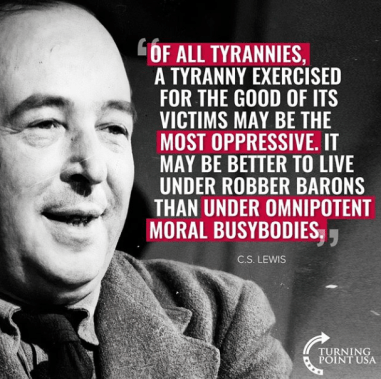
“We don’t want this woke garbage,” Cameron said in an interview with the Daily Signal. “It leads to brokenness and bondage and leads to misery. What we want is what our country was built on, which was the Bible and faith and family and love for country.”

What’s Wrong With “All Cars Shall Be Electric”

First “Common Good Capitalism” is an Oxymoron

Donald J. Boudreaux explains this newly minted term and that it really means imposing choices in the marketplace.  His AIER article is What’s Called “Common Good Capitalism” Would Work Against the Common Good.  Excerpts in italics with my bolds.

The foundation upon which the case for so-called “common good capitalism” rests is rickety at best. As I explained in my previous column, the empirical claims used to justify this ill-defined version of capitalism range from questionable to downright false, while much of the economic reasoning deployed by “common good capitalists” is a nest of confusion. These flaws alone are enough to fully discredit the case for “common good capitalism.”

Yet “common good capitalism” is marred by an even deeper problem: it rejects the liberalism from which true capitalism springs, the absence of which makes impossible the operation of a dynamic market order that maximizes the prospects of individuals to achieve as many as possible of their goals.

“Common good capitalists” have in mind an economic system profoundly different from that which is championed today by liberal scholars.  What each “common good capitalist” wants is an economic system engineered to serve his or her preferred set of concrete ends. Gone would be the liberal freedom of individuals to choose and pursue their own ends. Under “common good capitalism,” everyone would be conscripted to produce and consume in ways meant to promote only the ends favored by “common good capitalists.”

Note the irony. The economic system that, say, Oren Cass claims to advocate as a means of promoting the common good is, in reality, a means of promoting only the good as conceived by Oren Cass (which, for him, consists largely of an economy with more manufacturing jobs and a smaller financial sector). The hubris here is undeniable. “Common good capitalists” not only presume to have divined which concrete ends are best to guide the actions of hundreds of millions of individuals, nearly all of whom are strangers to them, but also are so confident in their divinations that they advocate pursuing these with the use of force.


The liberal doesn’t object to attempts to persuade others to adopt different and, hopefully, better ends. By all peaceful means, do your best to persuade me to embrace, as the lodestar for my choice of concrete ends, Catholic Social Teaching, economic nationalism, Marxism, veganism, or whatever other teaching or -ism you believe best defines the common good. But do not presume that your sincere embrace of a specific system of concrete values provides sufficient warrant for you to compel me and others to behave as if we share your particular values.

To the extent that the state intrudes into market processes in order to redirect
these toward the achievement of particular ends, it replaces market
competition and cooperation with command-economy dirigisme.

Income earners are not allowed to use the fruits of their creativity and efforts as they choose. Instead, consumption ‘decisions’ will be directed by government officials. The result will be a reallocation of resources achieved through the use, mostly, of tariffs and subsidies. And by so redirecting consumption expenditures, the pattern of production will obviously also be changed from what would prevail in a free market. (In fact, the specific goal of most “common good capitalists” seems to be the achievement of a particular manner of production — for example, more factory jobs — than would arise with markets left free.)

The capitalist economy, by its very nature, is not and cannot be
a tool for achieving particular concrete outcomes.

The capitalist economy, instead, is the name that we give to that ongoing, ever-evolving, organic order of production and exchange that arises spontaneously whenever individuals are free to pursue diverse peaceful ends of their own choosing and to do so in whatever peaceful ways they think best. That the results serve the common good is clear, if by “common good” we mean the highest possible chance of as many individuals as possible to achieve as many as possible of their own individually chosen goals. But let the state attempt to constrain and contort economic activity in the pursuit of a particular set of “common” concrete ends that everyone is compelled to serve, and capitalism disappears. It is replaced by what is more accurately called “[fill in the blank]’s-particular-notion-of-the-good statism,” with the blank filled by the name of whichever “common good capitalist” happens currently to be in power.

A Case In Point:  Murphy’s Law Applies to Electric Cars and Trucks 

Forcing Consumers to Purchase Electric Vehicles: A New Low for the Biden Administration by Jonathan Lesser at Real Clear Energy. Excerpts in italics with my bolds.

If electric vehicles are so wonderful,
why are consumers and businesses being forced to buy them?

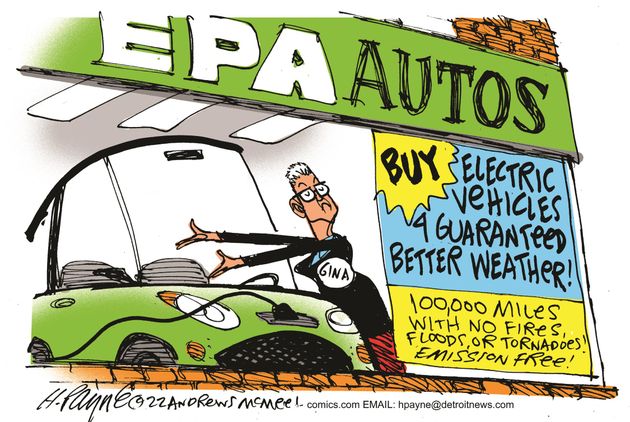
The US Environmental Protection Agency’s (EPA) new emissions standards for vehicles, released earlier this month, require manufacturers to increase overall fuel efficiency by over 25% by 2026, effectively mandating that EV’s make up two thirds of car sales. The EPA claims this will provide a total of over $1 trillion in benefits by 2055, reduce crude oil imports by 20 billion barrels, and reduce CO2 emissions by 10 billion tons.

What’s not to like? Just about everything.

Ruinous Economic Impacts

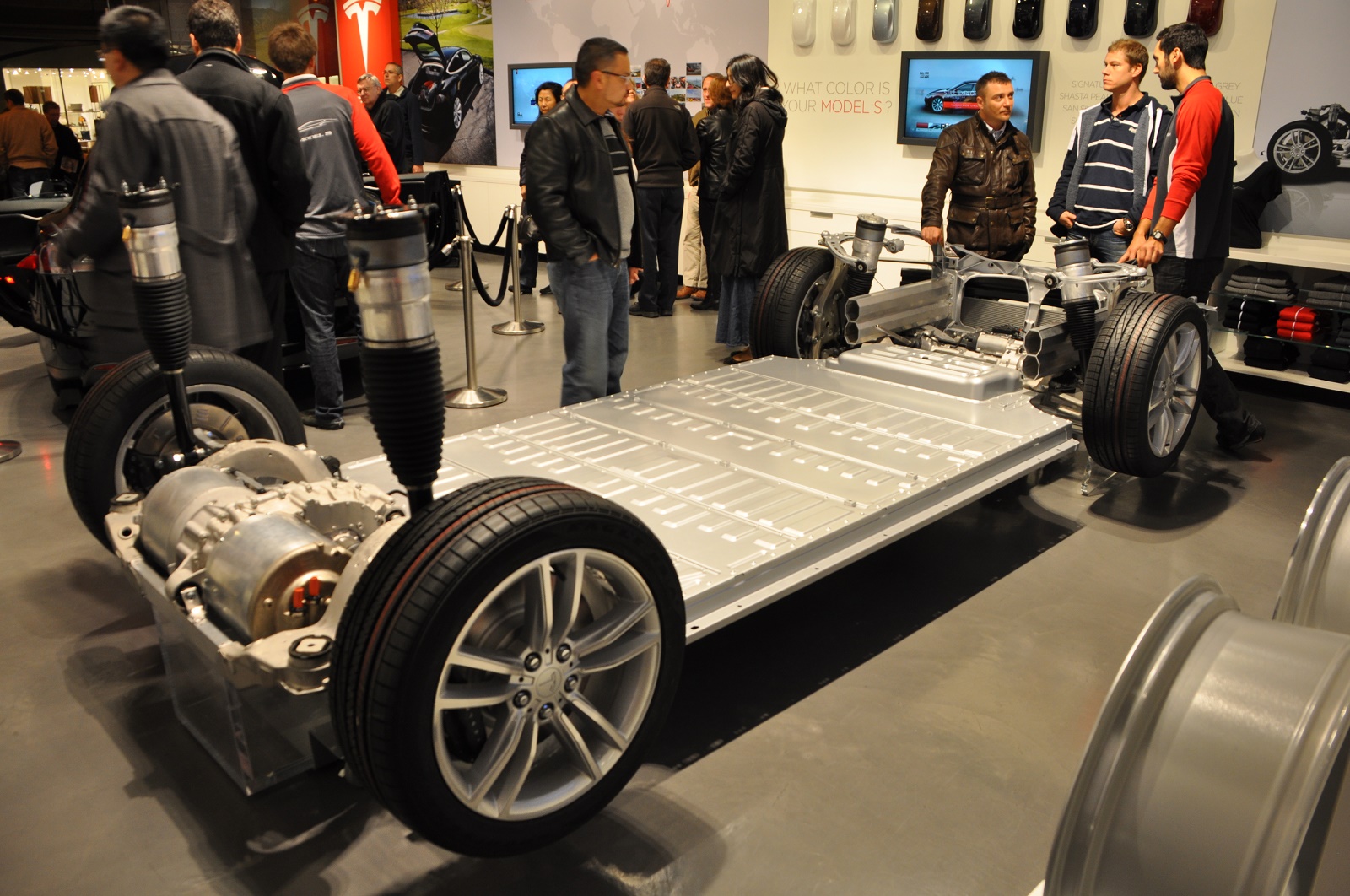
Let’s start with the economic impacts, which will be ruinous. First, the price of EVs will increase; that’s basic economics. The new rules will require that about two-thirds of the vehicles manufacturers sell are EVs. Given that most consumers do not purchase EVs, the best way to do that is to raise prices on internal combustion (ICE) vehicles until they are more costly than EVs. (Today, the reverse is true, with the average EV costing around $65,000, while the average ICE vehicle costs around $48,000.) Increasing provides an umbrella under which EV prices can be raised, too. So, if a consumer or business wants to purchase a new vehicle, they effectively will be forced to buy a more costly EV.

Battery Demand Over the Top

Second, increasing the demand for EVs will increase the demand for the materials to manufacture batteries, which are the single largest cost of an EV. Prices for rare earths, for example, have increased between 60% and 400% since 2020. Prices for lithium, the basic ingredient in most EV batteries, have increased by about 400%. Moreover, the US continues to prevent development of new mines to supply those materials. Instead, China has a stranglehold on them, and lax environmental rules to boot.

Electric Power Mostly Carbon

Then there is the electricity needed to charge those EVs, along with the charging stations in homes, apartment buildings, and on highways. Claims that this electricity will actually reduce emissions are based on huge predicted increases in wind and solar energy development. Yet, the US Energy Information Administration projects that, by 2050, wind and solar will provide only about 40% of electricity supplies. Consequently, much of the electricity needed to charge those millions of EVs will be provided by natural gas and even coal.

So, while the EPA may limit tailpipe emissions,
it will transfer many of those emissions to power plants.

Inflated Electricity Bills

Electricity costs will also increase, negating the anticipated savings from “refuelling” those EVs. That’s why the federal government has provided subsidies for wind and solar energy development for 45 years and why so many states implemented green energy mandates: developers of wind and solar could not, and still cannot, compete on price alone, despite proponents’ claims.

No Measurable Impact on Climate

But let’s suppose those hurdles magically are overcome. The environmental justification for the EPA rule is nonetheless absurd. The claimed reductions in CO2 emissions will have no measurable impact on world climate. Reducing CO2 emissions by 10 billion tons between 2027 and 2055 sounds like a lot. But world CO2 emissions were 34 billion metric tons in 2021 alone. So, over 28 years, the EPA’s proposed rule will reduce CO2 emissions by the equivalent of about four months of world CO2 emissions. And world emissions continue to increase because developing nations, especially China and India, have no intentions to restrict their economies.

Why Impose EVs?

The basic economic impacts, along with the negligible climate benefits, raise a simple question: why is the Biden Administration pursuing this EV windmill-tilting exercise? By effectively forcing consumers and businesses to purchase vehicles they do not want, the Administration will impose yet more damage on American’s standard of living, reducing mobility and raise costs.

That can’t possibly be their goal, right?

If only arm-twisting were prohibited beyond the ring.


Experts Were the Covid Crisis in 2020

John Tamny makes the case that authoritarian government is a poor substitute for free people managing themselves facing a public health threat.  He writes at Real Clear Markets Dear Washington Post Editorial Board, the Experts Were the Crisis In 2020.  Excerpts in italics with my bolds and added images.

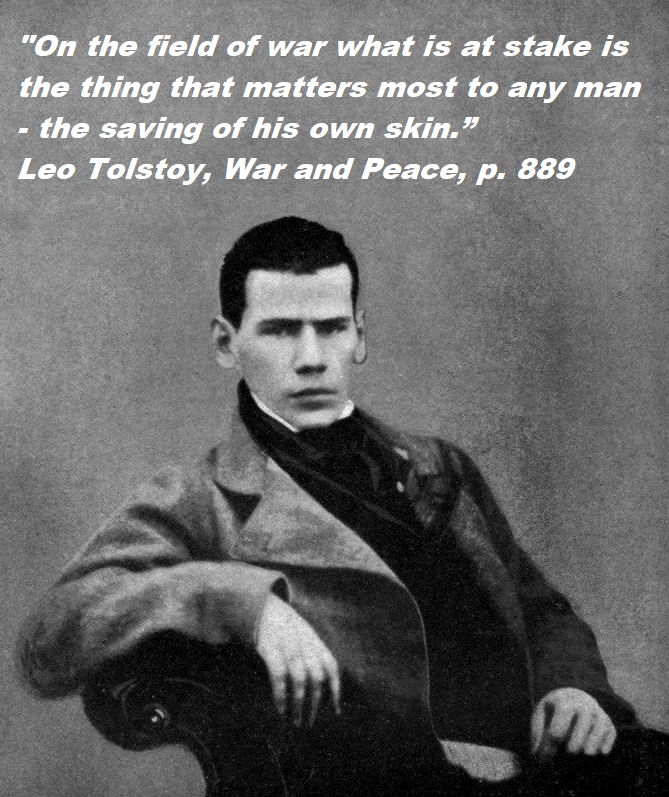
The quote from Tolstoy’s War and Peace is a useful way to begin addressing the Washington Post editorial board’s confident assertion that “’A collective national incompetence in government’” was at the root of the U.S.’s alleged failure vis-à-vis the coronavirus in 2020. According to the Post quoting from a recently released report (“Lessons from the Covid War”), “The United States started out ‘with more capabilities than any other country in the world,’ but “it ended up with 1 million dead.” Were he still around, one guesses Tolstoy would mock the conceit of the Post’s editorialists.

That’s the case because “the thing that matters most to any man” is “the saving of his own skin.” That this needs to even be said speaks to how wrongheaded the Post’s editorial board’s approach to the virus was, and still is. It implies we have dead because government didn’t act properly, as though free people eager to live were unequal to a virus that the right kind of collective governmental action was more than equal to. Ok, but what was government going to do? Better yet, what if the virus had struck in 2015 when Barack Obama was still in the White House. What would he have done? Would he have instructed a virus that was spreading faster than the flu to take a “time out”?

The simple truth missed by the Post is that as humans
we’re wired to preserve ourselves.

On the matter of life and the presumption of death, government is excess. Whatever solution Obama might have come up with, or whatever Donald Trump did come up with, or (try not to laugh) whatever Joe Biden, Nancy Pelosi and Chuck Schumer would have done if the virus had revealed itself in 2021 would have been vastly unequal to the solutions crafted by free people.

Deep down the Post’s editorialists must know the above is true. Indeed, it’s not that the Soviet Union lacked experts, or that Cuba lacks experts now. The problem was and is that the remarkable knowledge of very few very smart people will never measure up to the collective knowledge of the citizenry. That’s why communism failed so impressively in the Soviet Union, and it’s why it fails in Cuba. Translated for those who need it, the people are the market and markets work. As I make plain in my 2021 book When Politicians Panicked, the problem was experts and politicians substituting their limited knowledge for that of the people. That was the crisis. Not so, according to the Post and the report they cite.

Supposedly the “leaders of the United States could not apply their country’s vast assets effectively enough” such that “1 million died.” Wrong. Over and over again. To see why, imagine if 10 million Americans had died in March of 2020. Can the Post editorial board think of what government might have done that would have somehow improved on a feverish individual desire to survive against long odds? The simple truth glossed over by the Post is that the more threatening a virus is (and the Post seems to view what most didn’t know they were infected with as wildly threatening), the more superfluous government action is.

Really, who reading this ever needs to be forced to avoid behavior that might result in sickness, or even death? And if the reply to this question is that some people DO need to be forced, you’re making the best case of all for unfettered freedom. Think about it. Those who reject expert opinion are the most crucial “control group” as a virus spreads. By going against the grain, we learn from their freely arrived at actions if the virus is as lethal as presumed, or not, how it spreads, how to perhaps avoid its spread, and all manner of other important bits of information suppressed by one-size-fits-all national solutions.

It cannot be stressed enough that free people crucially produce information. Instead of allowing them to produce it in abundance in 2020, the response arrived at by Democrats and Republicans was to lock people in their homes, thus blinding a nation “with more capabilities than any other country” to the best approaches to a spreading virus. Please keep all of this in mind with the report’s assertion that the “most important and fundamental misjudgment” about the virus was how it spread. You think? Of course, the muscular assertion ignores yet again that if knowing how a virus spreads is of utmost importance, the only credible answer is freedom.

Consider the latter in light of the statement of the obvious that all advances in medicine have always been born of matching doctors and scientists with the abundant fruits of wealth creation. In 2020, rather than encourage the very wealth creation that has long been the biggest foe of death and disease (by far), panicky politicians quite literally chose economic contraction as a virus mitigation strategy. Historians will marvel at the abject stupidity of the U.S. political class, but not the Post’s editorialists or the authors of a report that the editorialists remarkably find insightful.

Rather than acknowledge the obvious about government and experts as the crisis, the Post editorialists and the experts they kneel before bemoaned a national abdication of “wartime responsibilities.” One gets the feeling Tolstoy would chuckle yet again. In his words, “The course of a battle is affected by an infinite number of freely operating forces (there being no greater freedom of operation than on a battlefield, where life and death are at stake), and this course can never be known in advance; nor does it ever correspond with the direction of any one particular force.”

In short, on matters of life and death government control
is wretched, crisis-inducing excess.


You Won’t Survive “Sustainability” Agenda

Joel Kotkin explains in his Spiked article The inhumanity of the green agenda.  Excerpts in italics with my bolds and added images.

The ‘sustainability’ regime is impoverishing the world.

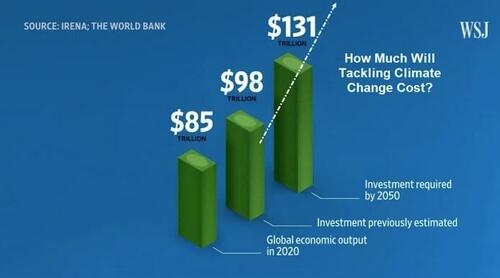
In recent years, the overused word ‘sustainability’ has fostered a narrative in which human needs and aspirations have taken a back seat to the green austerity of Net Zero and ‘degrowth’. The ruling classes of a fading West are determined to save the planet by immiserating their fellow citizens. Their agenda is expected to cost the world $6 trillion per year for the next 30 years.

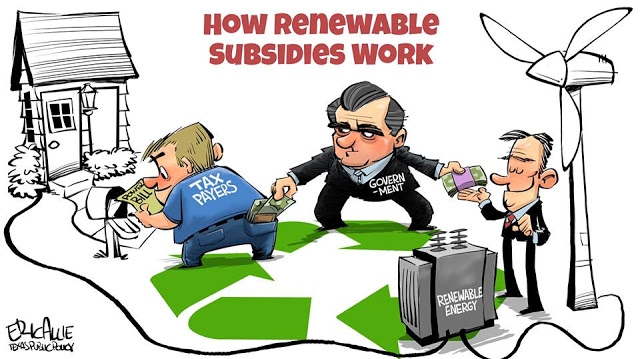
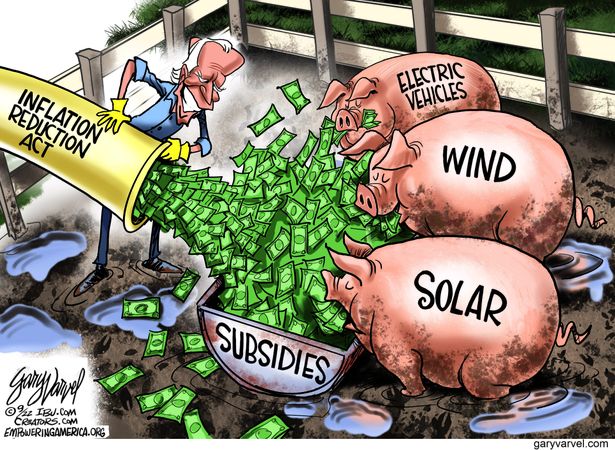
Meanwhile, they will get to harvest massive green subsidies
and live like Renaissance potentates.

In Enemies of Progress, author Austin Williams suggests that ‘the mantra of sustainability’ starts with the assumption that humanity is ‘the biggest problem of the planet’, rather than the ‘creators of a better future’. Indeed, many climate scientists and green activists see having fewer people on the planet as a key priority. Their programme calls not only for fewer people and fewer families, but also for lower consumption among the masses. They expect us to live in ever smaller dwelling units, to have less mobility, and to endure more costly home heating and air-conditioning. These priorities are reflected in a regulatory bureaucracy that, if it does not claim justification from God, acts as the right hand of Gaia and of sanctified science.

The question we need to ask is: sustainability for whom?

US Treasury secretary Janet Yellen recently suggested that her department sees climate change as ‘the greatest economic opportunity of our time’. To be sure, there is lots of gold in green for the same Wall Street investors, tech oligarchs and inheritors who fund the campaigns of climate activists. They increasingly control the media, too. The Rockefellers, heirs to the Standard Oil fortune, and other ultra-wealthy greens are currently funding climate reporters at organs like the Associated Press and National Public Radio.

Under the new sustainability regime, the ultra-rich profit, but the rest of us not so much. The most egregious example may be the forced take-up of electric vehicles (EVs), which has already helped to make Elon Musk, CEO of Tesla, the world’s second-richest man. Although improvements are being made to low-emissions vehicles, consumers are essentially being frogmarched into adopting a technology that has clear technical problems, remains far more expensive than the internal-combustion engine and depends primarily on an electric grid already on the brink of blackouts. Green activists, it turns out, do not expect EVs to replace the cars of hoi polloi. No, ordinary people will be dragooned to use public transport, or to walk or bike to get around.  [BMW will come to mean “Bike, Metro, and Walking.”]

The shift to electric cars is certainly no win for the West’s working and middle classes. But it is an enormous boon to China, which enjoys a huge lead in the production of batteries and rare-earth elements needed to make EVs, and which also figure prominently in wind turbines and solar panels. China’s BYD, which is backed by Warren Buffett, has emerged as the world’s top EV manufacturer, with big export ambitions. Meanwhile, American EV firms struggle with production and supply-chain issues, in part due to green resistance to domestic mining for rare-earth minerals. Even Tesla expects much of its future growth to come from its Chinese factories.

Building cars from primarily Chinese components will have consequences for autoworkers across the West. Germany was once a car-manufacturing giant, but it is expected to lose an estimated 400,000 car-factory jobs by 2030. According to McKinsey, the US’s manufacturing workforce could be cut by up to 30 per cent. After all, when the key components are made elsewhere, far less labour is needed from US and European workers. It’s no surprise that some European politicians, worried about a popular backlash, have moved to slow down the EV juggernaut.

This dynamic is found across the entire sustainability agenda. The soaring energy costs in the West have helped China expand its market share in manufactured exports to roughly equal that of the US, Germany and Japan combined. American manufacturing has dropped recently to its lowest point since the pandemic. The West’s crusade against carbon emissions makes it likely that jobs, ‘green’ or otherwise, will move to China, which already emits more greenhouse gases than the rest of the high-income world.

Meanwhile, the Chinese leadership is looking to adapt to changes in the climate,
instead of undermining economic growth chasing implausible Net Zero targets.

There are clear class implications here. California’s regulators recently admitted that the state’s strict climate laws aid the affluent, but hurt the poor. These laws also have a disproportionate impact on ethnic-minority citizens, creating what attorney Jennifer Hernandez has labelled the ‘green Jim Crow’. As China’s increasingly sophisticated tech and industrial growth is being joyously funded by US venture capitalists and Wall Street, living standards among the Western middle class are in decline. Europe has endured a decade of stagnation, while Americans’ life expectancy has recently fallen for the first time in peacetime. Deutsche Bank’s Eric Heymann suggests that the only way to achieve Net Zero emissions by 2050 is by squelching all future growth, which could have catastrophic effects on working-class and middle-class living standards.

Rather than the upward mobility most have come to expect, much of the West’s workforce now faces the prospect of either living on the dole or working at low wages. Today, nearly half of all American workers receive low wages and the future looks worse. Almost two-thirds of all new jobs in recent months were in low-paying service industries. This is also true in Britain. Over recent decades, many jobs that might have once supported whole families have disappeared. According to one UK account, self-employment and gig work do not provide sustenance for anything like a comfortable lifestyle. Rates of poverty and food shortages are already on the rise.

As a result, most parents in the US and elsewhere doubt their children
will do better than their generation,
while trust in our institutions is at historic lows.

The fabulists at places like the New York Times have convinced themselves that climate change is the biggest threat to prosperity. But many ordinary folk are far more worried about the immediate effects of climate policy than the prospect of an overheated planet in the medium or long term. This opposition to the Net Zero agenda was first expressed by the gilet jaunes movement in France in 2018, whose weekly protests were initially sparked by green taxes. This has been followed by protests by Dutch and other European farmers in recent years, who are angry at restrictions on fertilisers that will cut their yields. The pushback has sparked the rise of populism in a host of countries, notably Italy, Sweden and France. Even in ultra-with-it Berlin, a referendum on tighter-emissions targets recently failed to win over enough voters.

This is class warfare obscured by green rhetoric.
It pits elites in finance, tech and the nonprofit world against
a more numerous, but less connected, group of ordinary citizens.

Many of these folk make their living from producing food and basic necessities, or from hauling these things around. Factory workers, truck drivers and farmers, all slated for massive green regulatory onslaughts, see sustainability very differently than the urban corporate elites and their woke employees. As the French gilets jaunes protesters put it bluntly: ‘The elites worry about the end of the world. We worry about the end of the month.’

This disconnect also exists in the United States, according to long-time Democratic analyst Ruy Teixeira. Attempts to wipe out fossil fuels may thrill people in San Francisco, but are regarded very differently in Bakersfield, the centre of the California oil industry, and in Texas, where as many as a million generally good-paying jobs could be lost. Overall, according to a Chamber of Commerce report, a full national ban on fracking, widely supported by greens, would cost 14 million jobs – far more than the eight million jobs lost in the Great Recession of 2007-09.

No surprise then that blue-collar workers are not so enthusiastic
about the green agenda.

Just one per cent, according to a new Monmouth poll, consider climate as their main concern. A new Gallup poll shows that just two per cent of working-class respondents say they currently own an electric vehicle and a mere nine per cent say they are ‘seriously considering’ purchasing one.

These Western concerns are nothing compared to how the sustainability agenda could impact the developing world. Developing countries are home to roughly 3.5 billion people with no reliable access to electricity. They are far more vulnerable to high energy and food prices than we are. For places like Sub-Saharan Africa, green admonitions against new agricultural technologies, fossil fuels and nuclear power undermine any hope of creating desperately needed new wealth and jobs. It’s no wonder that these countries increasingly ignore the West and are looking to China instead, which is helping the developing world to build new fossil-fuel plants, as well as hydroelectric and nuclear facilities. All of this is anathema to many Western greens.

To make matters worse, the EU is already considering carbon taxes on imports,
which could cut the developing world off from what remains of global markets.

More critical still could be the impact of the sustainability mantra on food production, particularly for Sub-Saharan Africa, which will be home to most of the world’s population growth over the next three decades, according to United Nations projections. These countries need more food production, either domestically or from rich countries like the US, the Netherlands, Canada, Australia and France. And they are acutely aware of what happened when Sri Lanka adopted the sustainability agenda. This led to the breakdown of Sri Lanka’s agricultural sector and, eventually, to the violent overthrow of its government.

We need to rethink the sustainability agenda. Protecting the environment cannot come at the cost of jobs and growth. We should also assist developing countries in achieving a more prosperous future. This means financing workable technologies – gas, nuclear, hydro – that can provide the reliable energy so critical for economic development. It does no good to suggest a programme that will keep the poor impoverished.

Unless people’s concerns about the green agenda are addressed, they will almost certainly seek to disrupt the best-laid plans of our supposedly enlightened elites. In the end, as Protagoras said, human beings are still the ultimate ‘measure’ of what happens in the world – whether the cognoscenti like it or not.


Climate Sense and Nonsense (Lindzen 2023-04-20)

Introduction: 

BizNews interviewed veteran climate expert Dr Richard Lindzen, the pioneering atmospheric physicist and former emeritus professor of meteorology at MIT. He recounted events that occurred in the 1980s, which gave birth to the all-consuming climate change narrative that prevails today. Having begun his research on climate change in the mid-70s, motivated by a sincere interest in understanding the Earth’s climate regimes, Lindzen offers a remarkably sensible assessment of the various elements parading as scientific evidence of an impending climate catastrophe. Particularly revealing from his recollection of events is how complicit the media and politicians have been in forcing the disastrous climate change narrative upon an unsuspecting and trusting public from the very beginning.

This recent interview by Richard Lindzen provides a brief and compelling overview sorting out facts and fictions regarding global warming/climate change.  For those who prefer reading, below is a lightly edited transcript from the closed captions in italics with my bolds and added images.  BN is Biz News and RL is Richard Lindzen.

BN: Joining me is one of the world’s leading voices on climate change, atmospheric physicist Dr Richard Lindzen. Dr lindsden I really appreciate your time; you’ve been an expert on climate change for over four decades now having started your research in the mid 70s. Briefly walk me through your career and what it was about climate change that captured your attention.

RL: It’s a peculiar question. I mean, do you think things only become interesting once they’re political? With the general circulation of the atmosphere, you want to know why you have the current climate. You have dozens of regimes throughout the Earth, so when you speak about the climate of the earth what the hell are you talking about?

South Africa is a very different climate from New England. The Pacific has many climate regimes, and you have the monsoon regimes in India. So there are a lot of things to understand. And it had nothing to do with the environmentalism; it was to understand how nature is on carbon dioxide and the greenhouse effect.

BN: You’ve claimed that believing that increased carbon dioxide is the largest driver of climate change is akin to believing in magic. What evidence supports this argument and what are the actual effects of increased carbon dioxide in the atmosphere?

RL: Well, you’re asking a complex question. Carbon dioxide is a relatively minor greenhouse gas. But the question arises when you speak about what controls climate, and you’re speaking about dozens of different climate regimes.

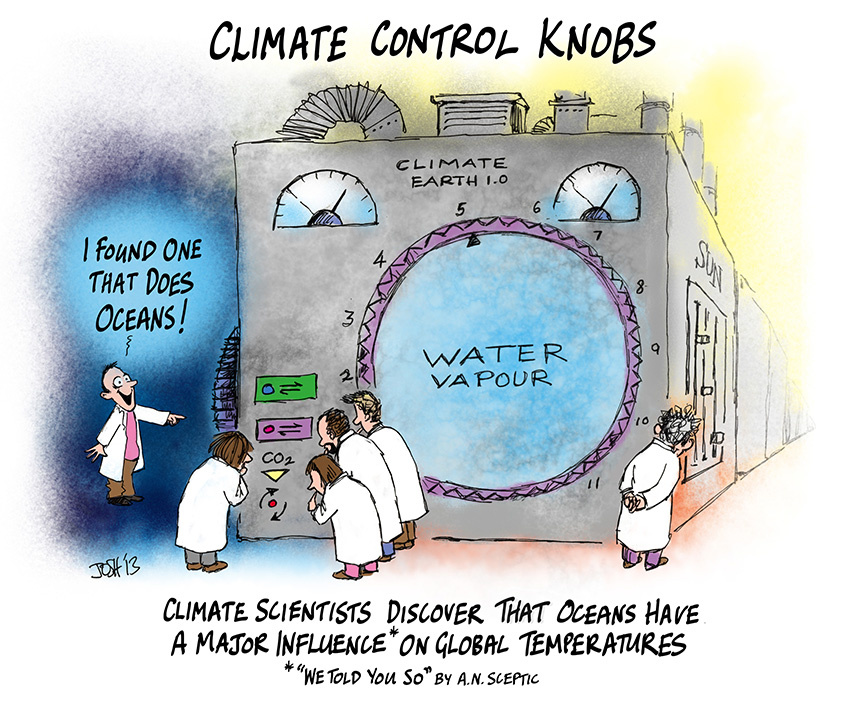
Saying there is one knob that controls the whole works makes no sense,
and that is belief in magic.

But you know greenhouse effect is useful for one climatic index namely: Why is the Earth different from Venus or Mars or Mercury? Those are huge differences. They depend on basically the mean radiative picture; which includes the greenhouse, the distance from the Sun, the amount of radiation you get and so on. So within a given planet, in particular the Earth our primary concern, we refer to the differences in climate that like the Ice Ages and the very warm period 50 million years ago. These are really pretty tiny compared to the differences between the planets. And those “tiny” differences that we obsess on for good reason are not due to the greenhouse effect.

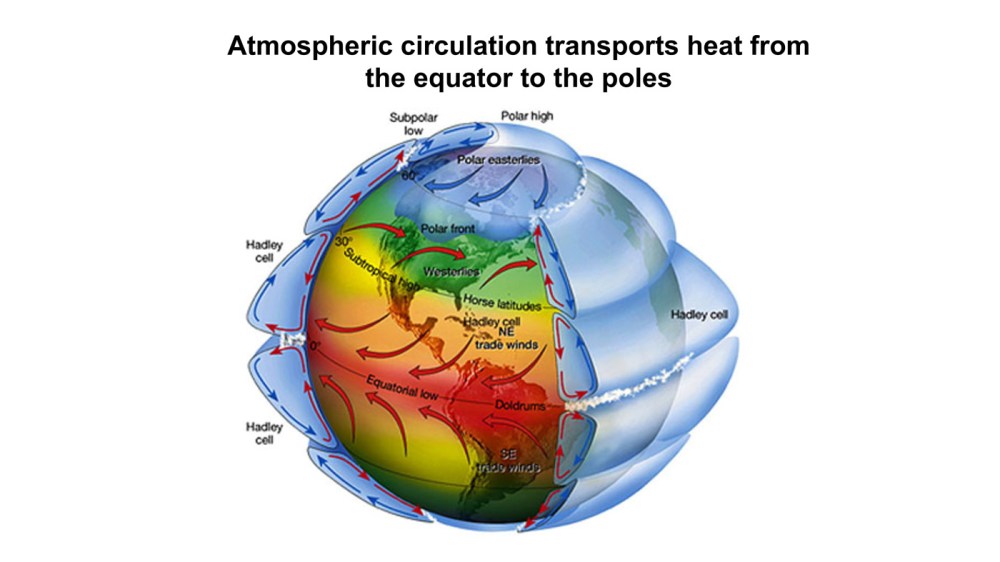
They’re due to the transport of heat between the tropics and the high latitudes.
And they are part of the Dynamics of the system
which depends on a number of factors

So primarily, what what does carry the heat? Well the ocean carries some heat but in many respects the most important thing is the so-called highs and lows. If you look at a weather map, it’s a little bit different in the southern hemisphere, but here you have the highs and lows going from west to east carrying weather. When you have the wind blowing from the north it’s cold, from South it’s warm. And this oscillates and gives work to your weathermen. In any event those same things carry heat to the pole. And many things determine them, but mainly it’s the differential heating between the tropics and the pole.

ERBE measurements of radiative imbalance.

So you have a system which has these features, and all of a sudden you obsess on the greenhouse effect. You end up having people saying really stupid things. So we’ve increased the temperature one degree or 1.1 in the last 100 years 120 years 150 years. And it’s been accompanied by the greatest improvement in human welfare in the history of the Earth, while some claim one-half degree more will be curtains. Only a politician could come up with something quite that absurd. But on the other hand when you get to the U.N and other things. it’s politicians that run it. And they’ve enabled this hysteria, frightening children their lives are going to be finished in short order. The UN IPCC has a working group that deals with science (Working Group 1). Even there in a thousand pages they don’t speak about an existential threat.

So you have other reports from the U.N that are not scientific that say: Oh yes it’s coming to the end of the world. And politicians say, well this is what we have to go by. I don’t know what you do, but it’s an evil movement, and it’s causing immense damage. It is trying to condemn people in Africa in the developing world to perpetual poverty. And yet I have to ask: Why would this be a goal? I don’t know.

BN: One of the cornerstones of this, let’s call it an agenda, is the constant bombardment to the public of reports on the rise of extreme weather events is this are these reports patently false or are they due to climate change?

RL: Well, you’re pointing to something very important. Even if it were occurring how do you relate it to this one number? But it’s not even true. Again going back to the IPCC, in the UN report they say there is virtually no evidence of a relationship between extreme events and climate change. Now they say that, but that doesn’t fit the politics, so they say something else. If you know of the American comic of years ago, Groucho Marx; he said, “I have my principles. If you don’t like them I have others.”

BN: That’s actually a good description on the politicization of climate change and the significant human progress enabled by the fossil fuel industry. Under this politicization, what do you think the end goal could possibly be for the manipulation of data given by the IPCC and the dismissal of data that contradicts it?

RL: Well, the energy sector is vital, it is the harnessing of fossil fuels that has led to the massive development of the western world. You know the progress since the invention of the steam engine has been the major feature in world history. On the other hand, because it’s such a large sector there are opportunities to make fortunes, even if your only activity is destroying the system. So for example in the U.S our current budget is showing trillions of dollars for climate change. Whether or not you think it makes sense doesn’t matter; somebody’s going to get those trillions of dollars and they have a real interest.

BN: I presume that the predominant funding would go to Renewables; pretty much anything that’s not nuclear or fossil fuel.

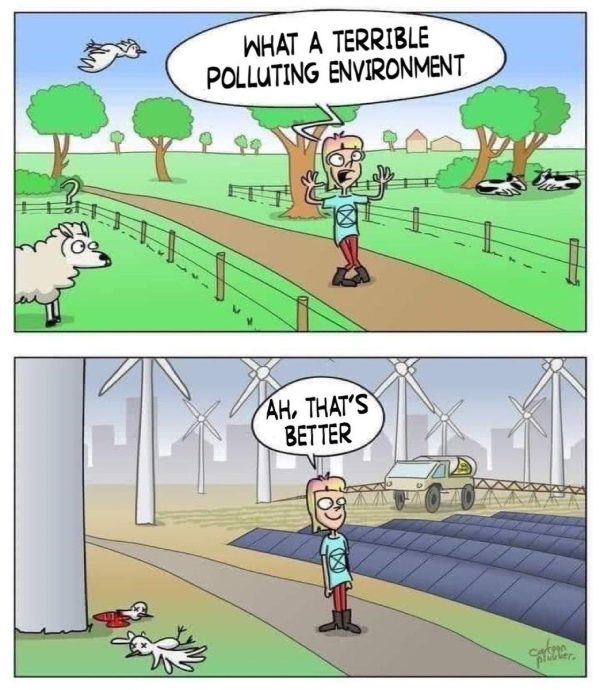
RL: What about the tools that extract energy from this, they’re not renewable. |They involve slave labor and that sounds pretty good doesn’t it. Now you have material usage, you have destruction of Landscapes. It’s almost as though the environmental movement has decided to commit suicide and go all in for things that destroy the environment. What you’re doing with the solar pedals and windmills and so on, you’re killing birds you’re destroying the environment. These have lifetimes of 10, 20 years, and you don’t know how to dispose of them. So this has nothing to do with the environment, it’s a power play.

BN: I had an interview with Professor William Harper and he said that the climate change activism movement is a joke and comparable to a coalition or organized crime unit of religious fanatics. And you’ve expressed the same sentiment. To what extent do you think that this is a result of people having pure intentions, but not being properly informed, not just trying to spin the situation far away from what the actual reality is.

RL: It’s hard to assess motivations.   You’re certainly taking the public and making them feel that getting rid of carbon dioxide, they’re doing something virtuous. As I’ve occasionally pointed out let’s imagine somebody came up with a good device that could get rid of about 60, 70 percent of the carbon dioxide in the atmosphere. What would be the result? The result would be: we’d all be dead. That’s a very peculiar pollutant. One that we can’t live without.

Though I think it’s based a lot on ignorance. You have economists talking about tipping points, and the geologists know that through most of the Earth’s history we’ve had far greater amounts of CO2. There’s never been any evidence of a Tipping Point. This is a very implausible thing but it sounds scary. It’s pretty clear going back on the history of the issue, when it got started in the early 80s, that it was already a governmental aim. You had these meetings at Villach, Austria and Bellagio, and there would be people interested in climate attending these, usually about a hundred. Those from the government were all in favor of this, while the others were scratching their heads and asking what’s this about. Somewhere along the way, somebody must have decided this is the way to go and they started pushing for it. Global cooling wasn’t panning out.

I think from the beginning of Earth Day, it was obvious you wanted to control the energy sector. At first it was sort of amateurish, you know acid rain, global cooling. Then someone realized, no matter how clean you made energy it would still produce CO2. So let’s go after that–you’ll never get rid of CO2 without getting rid of fossil fuels. There’s no evidence whatever that this is well-intentioned.

BN: But we still have a measured consensus of between 90 and 100 per cent of climate scientists that agree that it’s anthropogenic climate change. How is this the standing reality?

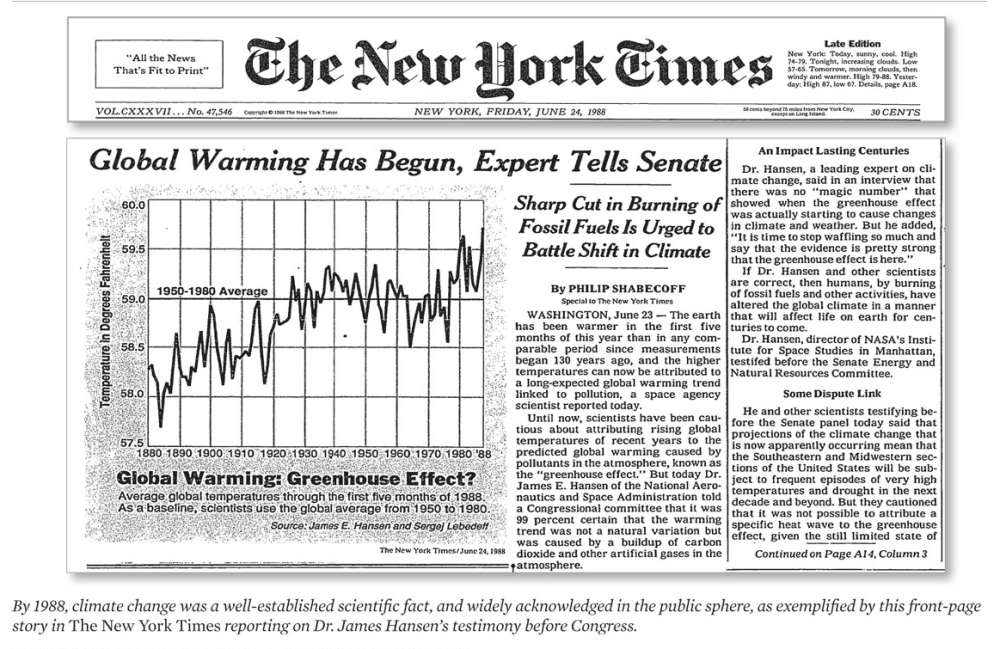
RL: Look, in 1988 when Jim Hansen first testified before the U.S Senate, Newsweek ran a cover issue showing the Earth on fire with the claim underneath, all scientists agree. No scientists were asked.  This is the way you convince the public, which is pretty illiterate when it comes to science. I don’t think the public feels comfortable about that, which is often ignored. So you immediately assure them: the scientists all agree, you don’t have to worry about it. And they knew that whether the scientists agree or not.

BN: Dr John Christie said that it’s actually a completely falsified number.

RL: Oh yeah as the record shows, there was a reduction from 1988 saying all scientists
Agree. Now it was only 97%. It’s a fake number, it’s just designed to tell people they don’t have to understand the science, just go along

BN: But then my question is if it is in fact such a small percentage of scientists that don’t agree . . .

RL: But we have to ask what they agreed to. You can frame the issue so that it was a hundred percent, for instance if you asked whether increasing CO2 increases or decreases temperature. Well I should say it probably increases it slightly. And then that’s listed as agreeing that the end of the world is coming if we increase CO2. They’re two different questions.

BN: So why do you think more climate scientists haven’t actually been vocal about the complete inaccuracy of these consensus figures?

RL: it’s a good question. One of the things that has changed is perfectly obvious. This was a small area in the 1980s. When you had a meeting, if you got a hundred people that was pretty substantial. And very few of them thought there was anything significant going on that would be called existential.  So what happened? If you look at funding in the U.S for climate science between 1989 and 1996 when Clinton/Gore Administration came in, funding increased by about a factor of 15. You literally created a whole new field, and you knew that the people who were brought in, knew that the reason for the funding was this issue. Indeed if you didn’t go along with it you lost your funding, So you know my funding ended as soon as I went public with my position.

BN: One of the common criticisms against you, your credibility and your views on climate science, is that you have ties to the fossil fuel industry. Is this true?

RL: No. Remember that everyone in this following that 15-fold increase came in it for the money. They assume anyone opposed must have gotten money from someone else. At MIT ExxonMobil does support some work, only on the part of people who support the alarm. The funniest was when they attacked me for writing an article in 1991 for Cato’s regulation magazine. And their argument was 10 years prior to that, Cato had received 10% of its funding from ExxonMobil. Now for this article I was paid 200 dollars, so presumably two dollars of that was from ExxonMobil 10 years prior to convince me to change my view.

BN: I just try to balance the scales, to get two sides of the story. I had an interview with Professor Guy McPherson, and he says with a very deep conviction that we are in the midst of abrupt climate change and that the methane released predominantly by the Arctic ocean will be the end of humanity by 2026. What’s your take on this?

RL: Well, he’s entitled to any science fiction he wishes to produce, but there’s no scientific evidence of that.

I think once people realize that the public is amenable
to scare stories, they get carried away

BN: What in your view is the political, economic and environmental implications of this move towards net zero and an abandonment of the fossil fuel industry?

RL: Pure malice. . . Plus profits for a few. Quite obviously you have people like Gore and Kerry and so on making hundreds of millions of dollars flying around the world ignoring all the things that they would prohibit Ordinary People. I suppose for these people it’s a return to feudalism where where us peasants should know our place and they should have their privilege.

BN: In 2001 you proposed the iris hypothesis on climate change. What was the premise of this?

RL: Well that was a question in some respects I think less important now. But since they were making a big fuss over changes of one degree, two degrees, so the question is why CO2 doesn’t do much. And it turns out that they had assumed assumed feedbacks that instead of trying to preserve a situation would act to make whatever we do worse. And there were plenty of problems with these feedbacks they they were improperly implemented.

So with the cooperation of NASA at the time, we looked if there were any obvious things occurring that were negative feedbacks. And it did look as though essentially upper level clouds in the tropics were acting in such a manner as to oppose the greenhouse effect. That seemed like an important feedback and it’s one which I think still likely plays a very important role in an important phenomenon that was called the early faint Sun paradox.

I don’t know if you’ve ever heard about this, but the sun’s output is increasing with time. If you go back two and a half billion years, the solar output was appreciably less than it is today. Yet the evidence is the earth did not freeze over; the Earth maintained a temperature that was very similar to today. The question is: How could it do that with a 20, 30 percent reduction in radiation. And it turns out that this Iris feedback is entirely capable of balancing that change. And so I think that remains a fairly substantial argument for the system being stable.

BN: What are the epistemological issues around climate change research

RL: OK. You have to remember a couple of things: One this was a small field. Two it was concerned with the problem: Why do you have different climate regimes; things that dealt with the Here and Now. So when you increase the funding by a factor of 15 the talent wasn’t available. So new topics were introduced, and one of them was climate impacts. Now this had nothing to do with understanding the physics of climate. If you were working on cockroaches, and you said my grant is to study the role of climate on cockroaches you got funded.

So you have all these impacts: climate and obesity, climate and diabetes, and so on. They wanted a piece of the action and they all became “climate scientists.” It’s worth remembering for instance, in 1990 my department at MIT no one called themselves a climate scientist. There were good reasons for that: climate was a very comprehensive thing. I was working on Dynamic meteorology, colleagues were working on oceanography, there were Marine geochemists. None of us pretended to comprehensive knowledge of everything about climate.

But all of a sudden you have people who know nothing about the physics
who are climate scientists because they got a grant
to find out whether diabetes was related to climate.

BN: You say that climate variability is actually the thing that we should be looking at to understand what is changing our climate and not human activity. Can you summarize the difference between anthropogenic climate change and climate variability, and why it is that you believe it’s climate variability that we should be looking at and not human activity

RL: Oh I’m not saying you shouldn’t look at things. People should be free to look at what they want.  But we do know that long before there were even people, climate was changing markedly. Even before the Industrial Revolution there was a little ice age. It had all sorts of documents, for instance villages in the Alps saying the ice is overtaking our village. You had the ice ages every hundred thousand years in which you had massive glaciation.

And you know this had nothing to do with people,
so you would need to understand those differences.

There was progress with the ice ages. A man called Milankovitch noticed that ice ages bore a relationship to orbital variations. It took a while but there were there was a climate program trying to find out how this worked. And we have a pretty good idea at this point of why that worked and Milankovitch was pretty much right. He said it would depend very much on the solar radiation in summer at high latitudes. And that was a well-known feature of glaciology: whether a glacier grows or not doesn’t depend so much on winter which are always cold in the northern hemisphere. But in summer if the snow that accumulated in Winter melts, you don’t build a glacier.

If the summer is cool and the glacier snow doesn’t fully melt,
then you build up each year.
You have thousands of years to build up your glacier.

Well you know it turns out for instance that CO2 follows temperature in the ice ages and it changes enough to change the flux about a watt per square meter. On the other hand when you look at the Milankovitch parameter, the incoming solar radiation over the course of this Ice Age cycle varies on the order of a hundred watts per square meter. That’s much more significant.

But then you have people say: “Well yeah I know that since CO2 is following that you can’t say CO2 caused it. But it must be CO2 amplification that was important.” But I mean it makes no sense: one watt versus a hundred.

BN: When I spoke to Dr Judith Curry, her story was just a very unfortunate reflection of what happened to dissenting voices. And she said that she’s essentially unhirable and so she had to leave for the private sector. What have you had to face as a result of going against the grain and the consensus for so many decades?

RL: Well you know Judith at first was a strong supporter of global warming and attacking anyone who questioned it. It’s interesting that she changed. I don’t know what to say. There are a couple of things that happened. First of all I’m older, so I had a senior position. I was doing research in a lot of areas and the National Science Foundation was funding my research in fluid mechanics. That continued a while so I sort of did climb on the side. The department of energy at first tried to fund people on all sides subjectively, but by the 90s they were told to quit that. And so the research manager there did me a favor. I had not fully expended my funding and she let me keep it past the due date without adding anything to it so that allowed things to continue a bit longer.

With publication again I was well known in the field and so I published some papers in the American Meteorological society’s monthly Bulletin and they got through. They were reviewed but the editors were all fired immediately after publication. And the paper was never rejected but I immediately invited people to criticize it. When the criticisms were published, we were not permitted to answer for six months, which was very unusual.

BN: That’s the manipulation of the justice system. How the situation is rigged to support the narrative and the complicity of politicians and scientists.

RL: Yes the situation was rigged, it was very much a March through the institutions. And that’s a problem for professional societies. Whether you are a member of the American physical Society or American Meteorological Society, or for that matter the American musicological society, you’re a member of a group of people who have a professional interest. And they elect a president and an executive manager to take care of the public relations so on

I think the people pushing this issue realized all you had to do is turn an official, the executive manager or something, and he ends up speaking for the whole group, never having actually sampled the people. And so you take over the American Meteorological Society, the National Academy, the American Academy, all of them are top-down organizations with managers. And they’ve done a terrific job of that

So you have some naive hypothesis that something as complex as climate is controlled by a single control knob of a minor gas that controls a couple of watts per meter squared out of hundreds. You can only promote this if you have a public, including political officials, who are totally illiterate or enumerate versus science.

You mentioned to all these people who are getting support. You find that scientists only have to say something like they think CO2 increasing will give some warming and they leave it to the politicians to say this means the end of the world is coming. And their backup position is: I never said that.

BN: Are there any anthropogenic elements that humans could increase or continue with, like fossil fuel consumption, that will possibly have catastrophic consequences?

RL: You know a nuclear war could do that but driving your SUV? I guess it appeals to certain people’s vanity that we are all powerful.

BN: Just to close off: What would you recommend as a way out of this situation that feels a little bit like a trap?

RL: It’s a very serious question. When you co-opt the institutional structure, then you have people like the world economic Forum, the EU full of bureaucrats who are just infatuated with the power they might have. It’s got to be very difficult to break out, either there are political parties that are opposed to this. One hopes maybe they’ll gain power and just trash this. Time will of course play a role but I hope we don’t have to wait to see the destruction of modern society and realize it had nothing to do with climate. I’d like to think we can get out of this before then.

BN: As it stands are we at risk or in any way getting close to a climate catastrophe?

RL: I suppose it depends on how you define it. If you define a catastrophe as having three inches of extra rain one year, then we’re all in their catastrophe. If you really mean an existential threat, the answer is: No, we’re nowhere near that. It just makes no sense. These are scare stories you especially want to give to kindergarten kids because they have no defense mechanism.

You know there may be some hope that the developing world, I mean clearly China, India, Russia are ignoring this. They know it’s nonsense so they’re sitting by and watching the West self-destruct while wondering about what divine good luck they have. You know they’re not going to do anything about it. If you’re really worried about CO2 you know we’ve spent trillions of dollars trying to reduce it and get to Net Zero. And you look at CO2 versus time and it continues to increase.without any change So we’ve had no impact upon that. So you’d ask yourself:

If we have no impact, and we’re worried about it,
why aren’t we building resilience?
Do we want to make ourselves more vulnerable
so we’ll be properly punished? That’s nuts.

BN: It does sound like you’re reading the message between the lines of the environmentalists.

RL: Yeah, it seems as though they hate Humanity, they want Power and they don’t give a damn about the environment. And they certainly give no attention to feeding starving people, when that is in fact a real problem. 

Addendum:

In a previous publication Lindzen sets the record straight about the “March through Institutions” with names and maneuvers which have crippled efforts to answer questions about the functioning of earth’s climate system.

When an issue becomes a vital part of a political agenda, as is the case with climate, then the politically desired position becomes a goal rather than a consequence of scientific research. This paper deals with the origin of the cultural changes and with specific examples of the operation and interaction of these factors. In particular, we will show how political bodies act to control scientific institutions, how scientists adjust both data and even theory to accommodate politically correct positions, and how opposition to these positions is disposed of.

By taking a few minutes to read his text (link in red above), you can learn from Lindzen some important truths:

♦  How science was perverted from a successful mode of enquiry into a source of authority;
♦  What are the consequences when fear is perceived to be the basis for scientific support rather than from gratitude and the trust associated with it;
♦  How incentives are skewed in favor of perpetuating problems rather than solving them;
♦  Why simulation and large programs replaced theory and observation as the basis of scientific investigation;
♦  How specific institutions and scientific societies were infiltrated and overtaken by political activists;
♦  Specific examples where data and analyses have been manipulated to achieve desired conclusions;
♦  Specific cases of concealing such truths as may call into question global warming alarmism;
♦  Examples of the remarkable process of “discreditation” by which attack papers are quickly solicited and published against an undesirable finding;
♦  Cases of Global Warming Revisionism, by which skeptical positions of prominent people are altered after they are dead;
♦  Dangers to societies and populations from governments, NGOs and corporations exploiting climate change.

Summary: Thanks to Richard Lindzen and others for putting on the record how broken is the field of climate science. It is dangerous in itself, and it also extends into other domains, threatening the scientific basis of modern civilization. Fixing such scientific perversions will be difficult and lengthy, but it can only start with acknowledging how bad it is. It truly is worse than we thought.