NIMBY Wars: Portland Bans Fossils Fuels! Or not.

Mayor Hales and Community Activists Celebrate Unanimous Fossil Fuel Infrastructure Ban.

Lots of cheerleaders celebrated when in 2015, the City of Portland Oregon passed a city ordinance against fossil fuel infrastructure. Resilience.org published today praising Portland as the “First U.S. City to Ban Fossil Fuel Expansion Offers Roadmap for Others”. A year ago the event was proclaimed: Portland Makes History with New Protections from Fossil Fuels Dec. 14, 2016. It was a successful blow by protesters motivated by NIMBY (Not In My Back Yard). Excerpts below with my bolds.

But there’s more to the story. In July 2017 came this story from the Oregonian:

Oregon’s Land Use Board of Appeals (LUBA) on Wednesday rejected Portland’s limits on the expansion of fossil fuel infrastructure in the city, saying the ordinance violated the commerce clause of the U.S. Constitution.

The Portland Business Alliance joined fuel suppliers to appeal to the state Land Use Board of Appeals. They cited a number of grounds for the appeal, but Wednesday’s decision was based on a violation of the commerce clause, which gives the federal government the right to regulate trade between states and other nations.

The city is considering an appeal to the State Court of Appeals.

“This decision is disappointing and goes against the interests of our community,” according to a statement issued by Mayor Ted Wheeler. “It is incumbent upon us to protect our residents from the enormous risks posed by fossil fuels. The City is reviewing the ruling and exploring our options, including an appeal. Additionally, we will continue to work with environmental, energy, and resiliency experts to ensure Portland remains a leader on these issues.”

Then in January 2018 comes a ruling from the Appeals court: Portland Ban On Fossil Fuel Terminals Is Constitutional

The Oregon Court of Appeals ruled Thursday that the Portland City Council did not violate the U.S. Constitution with a 2015 resolution that banned new fossil fuel terminals.

The court reversed a significant portion of an Oregon Land Use Board of Appeals ruling, which found the ban unconstitutional.

Portland’s use of zoning laws to ban the construction and expansion of fossil fuel terminals matters for a couple reasons.

In Oregon, tanks located in North Portland supply about 90 percent of the fossil fuels used statewide.

Nationally, the ordinance also tested a new strategy for left-leaning cities that want to limit fossil fuel use as a way to combat climate change.

“Other cities were looking to the city of Portland and what they had done as a potential model for other ordinances,” said attorney Maura Fahey with the Crag Law Center.

The text of the Oregon Court of Appeal ruling is at Columbia Pacific v. City of Portland

The review concerned the July ruling by Land Use Board of Appeals (LUBA), The arguments revolve around the federal commerce principle that states are not allowed to favor their own merchants by discriminating against out of state suppliers, or favor their consumers over out of state consumers. The court decided that Portland was not guilty of that result, and also considered a precedent from Pike (US Supreme Court case):

“Where the statute regulates even-handedly to effectuate a legitimate local public interest, and its effects on interstate commerce are only incidental, it will be upheld unless the burden on such commerce is clearly excessive in relation to the putative local benefits. If a legitimate local purpose is found, then the question becomes one of degree. And the extent of the burden that will be tolerated will of course depend on the nature of the local interest involved, and on whether it could be promoted as well with a lesser impact on interstate activities.”

LUBA concluded that the amendments impose burdens on interstate commerce that are clearly excessive in relation to the putative local benefits. Columbia Pacific, ___ Or LUBA at ___ (slip op at 92). We disagree and, in contrast, conclude that Columbia Pacific did not meet its burden to demonstrate that the claimed burdens on interstate commerce are clearly excessive in relation to the putative local benefits.

However, the judges left a door open regarding the public detriment due to restricting fossil fuels for consumers.

Before LUBA, Columbia Pacific argued that that finding was essential to the city’s decision not to allow expansion of existing bulk fossil-fuel terminals and that the specific finding that use of fossil fuels may “plateau and decline” with a continued shift to other modes of transportation, more fuel efficient vehicles, electric vehicles, and other carbon reduction strategies was not supported by an adequate factual base as required by Goal 2. Columbia Pacific, ___ Or LUBA at ___ (slip op at 55). LUBA agreed with Columbia Pacific, concluding that Finding 21 was “key support for the prohibition on any expansion of existing terminals to meet * ** local or regional needs” and its conclusion that fossil-fuel use “may plateau and decline” was “not supported by substantial evidence, and hence not supported by an adequate factual base.”

The Appeals court sided with the defendants on this aspect, noting that “the only evidence in the record projecting future fossil-fuel demand cited to us by either party or LUBA are trend-based forecasts indicating that demand will moderately increase over time.”

Will reasonable people come together and set aside irrational fears?  It remains to be seen.  From the Portland Business Journal

The Portland Business Alliance, in a statement to Willamette Week, said it hopes the city sees the ruling as “an opportunity to bring parties back to the table to revisit elements of the ordinance which, as originally adopted, significantly impact fuel access and affordability” throughout the region.

The Western States Petroleum Association, asked via email if it would appeal the new ruling, sent this statement from Oyango Snell, its general counsel:

The Columbia Pacific Building Trades Council and the Western States Petroleum Association and its members are disappointed with the Oregon Court of Appeals’ decision to allow an unconstitutional ban on new fossil fuel infrastructure in Portland. The Fossil Fuel Zoning Ordinance is not only a violation of Oregon and Portland City land use laws, but punishes consumers and businesses in the city and throughout Oregon, who rely on affordable fuel to power their homes, their businesses and the economy.

Here is what they are up against on the other side:


NIMBY in Canada:  Alberta and British Columbia go to war over pipeline expansion

In a similar power struggle, BC province, led by leftist Vancouverites has moved to prevent construction of the expanded Kinder-Morgan pipeline to move bitumen from Alberta to west coast seaports serving Asian customers.  Canadian federal authorities have signed off on this, with PM Trudeau telling the greens that if they liked his carbon tax, they have to swallow this because it is a package deal.

Ironically both provinces are governed by left wing NDP politicos, but despite (or perhaps because of that) the rhetoric is going over the top.  National Post reports
Could Alberta bring B.C. to its knees by shutting off the oil?
If they don’t like pipelines, let’s see if B.C. likes having a main supply of gasoline turned off.  This comes after the Alberta premier earlier threatened to stop importation of BC wines.

Next:  Attacks on energy access on the East Coast (New England) Payback Upon Climate Grasshoppers

For more on climate issues in courts of law:

Judiciary Climate Confusion

Critical Climate Intelligence for Jurists (and others)

Climate Law Alaska Update


How Much Energy Do We Need?


Masai warrior with cell phone.

A previous post Adapting Plants to Feed the World explored how much food will be needed for a future population if 3 billion additional middle-class appetites are added? This post discusses the issues regarding the obvious link between energy and poverty. Someone said, observing world life styles: “Where energy is scarce and expensive, people’s labor is cheap and they live in poverty. Where energy is cheap and reliable, people are well paid for their labor and have a higher standard of living.”

So the question of how much energy is important, particularly with the present huge disparity in energy access. Here are excerpts with my bolds from an article by Kris De Decker in Low-Tech Magazine How Much Energy Do We Need?

I appreciate the presentation of the issues, while disagreeing with some of the premises. For example, he assumes that societies using fossil fuels despoil their environments, when the facts contradict that notion. Not only are people more prosperous and live longer by using fossil fuels, they also enjoy cleaner air and sanitary drinking water. The author mistakenly conflates belief in global warming/climate change with environmental stewardship.

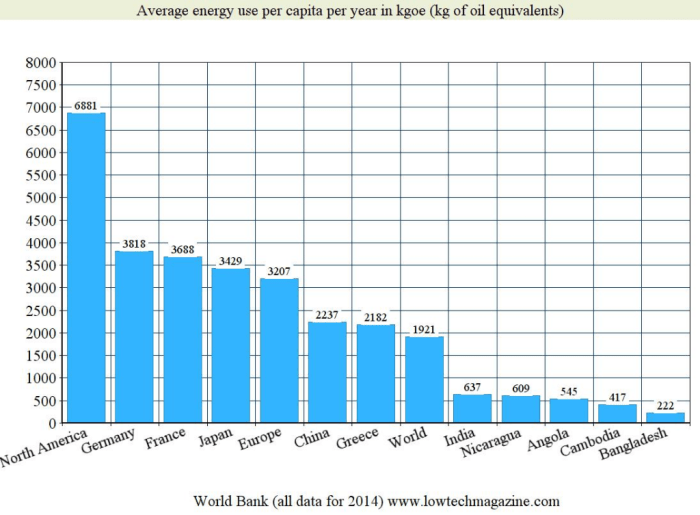
The article provides this graph illustrating the situation of energy disparity:
De Decker:  If we divide total primary energy use per country by population, we see that the average North American uses more than twice the energy of the average European (6,881 kgoe versus 3,207 kgoe, meaning kg of oil equivalent). Within Europe, the average Norwegian (5,818 kgoe) uses almost three times more energy than the average Greek (2,182 kgoe). The latter uses three to five times more energy than the average Angolan (545 kgoe), Cambodian (417 kgoe) or Nicaraguan (609 kgoe), who uses two to three times the energy of the average Bangladeshi (222 kgoe). [


These figures include not only the energy used directly in households, but also energy used in transportation, manufacturing, power production and other sectors. Such a calculation makes more sense than looking at household energy consumption alone, because people consume much more energy outside their homes, for example through the products that they buy.

Inequality not only concerns the quantity of energy, but also its quality. People in industrialised countries have access to a reliable, clean and (seemingly) endless supply of electricity and gas. On the other hand, two in every five people worldwide (3 billion people) rely on wood, charcoal or animal waste to cook their food, and 1.5 billion of them don’t have electric lighting. [6] These fuels cause indoor air pollution, and can be time- and labour-intensive to obtain. If modern fuels are available in these countries, they’re often expensive and/or less reliable.

As a Canadian I am not surprised that Norwegians use more energy than Greeks, considering winters in the two places. But I agree that standards of living are much higher on the left side compared to the right side, and energy access is a large part of the reason, though not the only one (governance?, free enterprise? rule of law?, work ethic? Etc.)

Aside: Henry Kissinger once observed: “If a country is not already a democracy when they discover oil, they stand little chance of becoming one.”

I don’t share the author’s fear of climate change which does permeate his discussion of the issues in raising up impoverished populations.

De Dekker goes on: However, while it’s recognised that part of the global population is using not enough energy, there is not the same discussion of people who are using too much energy. Nevertheless, solving the tension between demand reduction and energy poverty can only happen if those who use ‘too much’ reduce their energy use. Bringing the rest of the world up to the living standards and energy use of rich countries – the implicit aim of ‘human development’ – would solve the problem of inequality, but it’s not compatible with the environmental problems we face.

Between the upper boundary set by the carrying capacity of the planet, and a lower boundary set by decent levels of wellbeing for all lies a band of sustainable energy use, situated somewhere between energy poverty and energy decadence. [14] These boundaries not only imply that the rich lower their energy use, but also that the poor don’t increase their energy use too much. However, there is no guarantee that the maximum levels are in fact higher than the minimum levels.

To make matters worse, defining minimum and maximum levels is fraught with difficulty. On the one hand, when calculating from the top down, there’s no agreement about the carrying capacity of the planet, whether it concerns a safe concentration of carbon in the atmosphere, the remaining fossil fuel reserves, the measurements of ecological damage, or the impact of renewable energy, advances in energy efficiency, and population growth. On the other hand, for those taking a bottom-up approach, defining what constitutes a ‘decent’ life is just as debatable.

Needs and Wants

However, although distributing energy use equally across the global population may sound fair, in fact the opposite is true. The amount of energy that people ‘need’ is not only up to them. It also depends on the climate (people living in cold climates will require more energy for heating than those living in warm climates), the culture (the use of air conditioning in the US versus the siesta in Southern Europe), and the infrastructure (cities that lack public transport and cycling facilities force people into cars).

Differences in energy efficiency can also have a significant impact on the “need” for energy. For example, a traditional three-stone cooking fire is less energy efficient than a modern gas cooking stove, meaning that the use of the latter requires less energy to cook a similar meal. It’s not only the appliances that determine how much energy is needed, but also the infrastructure: if electricity production and transmission have relatively poor efficiency, people need more primary energy, even if they use the same amount of electricity at home.

To account for all these differences, most researchers approach the diagnosis of energy poverty by focusing on ‘energy services’, not on a particular level of energy use. [17] People do not demand energy or fuel per se – what they need are the services that energy provides. For example, when it comes to lighting, people do not need a particular amount of energy but an adequate level of light depending on what they are doing.

Some energy poverty indicators go one step further still. They don’t specify energy services, but basic human needs or capabilities (depending on the theory). In these modes, basic needs or capabilities are considered to be universal, but the means to achieve them are considered geographically and culturally specific. The focus of these needs-based indicators is on measuring the conditions of human well-being, rather than on specifying the requirements for achieving these outcomes. Examples of human basic needs are clean water and nutrition, shelter, thermal comfort, a non-threatening environment, significant relationships, education and healthcare.

Basic needs are considered to be universal, objective, non-substitutable (for example, insufficient food intake cannot be solved by increasing dwelling space, or the other way around), cross-generational (the basic needs of future generations of humans will be the same as those of present generations), and satiable (the contribution of water, calories, or dwelling space to basic needs can be satiated). This means that thresholds can be conceived where serious harm is avoided. ‘Needs’ can be distinguished from ‘wants’, which are subjective, evolving over time, individual, substitutable and insatiable. Focusing on basic needs in this way makes it possible to distinguish between ‘necessities’ and ‘luxuries’, and to argue that human needs, present and future, trump present and future ‘wants’.

Politically Correct Off-grid Electricity.

Focusing on energy services or basic needs can help to specify maximum levels of energy use. Instead of defining minimum energy service levels (such as 300 lumens of light per household), we could define maximum energy services levels (say 2,000 lumens of light per household). These energy service levels could then be combined to calculate maximum energy use levels per capita or household. However, these would be valid only in specific geographical and cultural contexts, such as countries, cities, or neighbourhoods – and not universally applicable. Likewise, we could define basic needs and then calculate the energy that is required to meet them in a specific context.

However, the focus on energy services or basic needs also reveals a fundamental problem. If the goods and services necessary for a decent life free from poverty are seen not as universally applicable, but as relative to the prevailing standards and customs of a particular society, it becomes clear that such standards evolve over time as technology and customary ways of life change. [11] Change over time, especially since the twentieth century, reveals an escalation in conventions and standards that result in increasing energy consumption. The ‘need satisfiers’ have become more and more energy-intensive, which has made meeting basic needs as problematic as fulfilling ‘wants’.

Summary

The author goes on to discuss energy demand reductions from efficiencies and substitutions, but cannot get around his fundamental dilemma: Needs are universal, objective, non-substitutable, cross-generational, and satiable. Wants are subjective, evolving over time, individual, substitutable and insatiable.

Some of the text reminded me of soviet era Romania. At Ceaușescu’s initiative in 1981, a “Rational Eating Programme” began, being a “scientific plan” for limiting the calorie intake for the Romanians, claiming that the Romanians were eating too much. It tried to reduce the calorie intake by 9-15 percent to 2,800-3,000 calories per day. In December 1983, a new dietary programme for 1984 set even lower allowances. That “austerity program” destroyed the economy, bringing down the ruler and regime.

In Biblical days they were wiser: “Do not muzzle an ox when he is treading out the grain.” Deuteronomy 25:4

People and their societies are dynamic, not static, as Matthew Kahn keeps reminding us. When their labor is enhanced with energy from fossil fuels, people are healthier, more productive and inventive in seeking, finding and using natural resources. Club of Rome’s notion of limits to growth failed to understand human resources, and today’s followers are equally blind.

Another wheel flies off Ontario’s green energy bus

Updating Ontario’s energy debacle shows that Toronto and Ottawa have now achieved the highest electricity rates in Canada.  And a new wheel falling off the bus has crushed 340 jobs.  Kelly McFarland reports the news in Another wheel flies off Ontario’s green energy bus, and lands on 340 workers.

When former premier Dalton McGuinty visited the new Siemens Canada plant in Tillsonburg in 2011, he brushed aside protesters and boasted that the plant was part of the Liberal alternative energy plan that would “put us at the forefront in North America.”

The plant made windmill blades. Windmills were the future. Clean energy was what McGuinty’s two-year-old Green Energy Act was all about. It would free the province of old, dirty manufacturing and introduce new, cutting-edge jobs that would make Ontario the envy of the world.

Just six years later the plant is closing. Management says big changes in the wind industry make it no longer viable. The cutting edge plant that was to help lead Ontario into the Valhalla of a clean energy future can’t survive in a market that wants bigger blades.

Siemens Wind Power chief executive David Hickey was careful not to blame the Liberal change in plans for the Tillsonburg closing, but plenty of others were happy to. Companies like Siemens come for the subsidies, and when the subsidies disappear, so do they, said independent industry analyst Tom Adams. Ontario has poured so much into its green energy dream the market is saturated, he said. Hickey said the market is shifting west: Alberta and Saskatchewan are “the key opportunities of the future.”

The impact of all this virtue signaling falls on ratepayers. The detailed accounting is presented in It’s official: Toronto and Ottawa are now the most expensive cities for electricity

Ontario’s electricity price increases were more than double the national average.
Postmedia News

To get a sense of how much more Ontarians pay compared to the rest of the country, consider a comparison of monthly electricity bills between Toronto and Montreal, Canada’s two largest cities. In 2016, the estimated average monthly electricity bill (including taxes) for Torontonians was $201, or roughly $2,400 for the year. Residents of Montreal only paid an estimated $83 per month, or just under $1,000 per year. That’s an extra $1,400 a year that Montrealers can spend on other priorities because of lower electricity prices.

A large part of the blame rests on poor policy choices at Queen’s Park. One such policy has been the government’s poorly structured long-term contracts for renewable energy generation, like wind and solar. These contracts place ever-increasing costs on consumers, despite the fact that renewables accounted for only 6.8 per cent of electricity generation in 2016.

The province’s phase-out of coal-fired electricity has also proved costly and unnecessary. Indeed, noted environmental economist Ross McKitrick found that Ontario could have achieved the same environmental benefits of the phase-out (at one-tenth the cost) by simply completing the retrofitting of Ontario’s coal-fired plants.

Another issue is the imbalance between the supply and demand of electricity in the province. When the province’s energy generation exceeds demand, it must be exported — quite often at a loss — leaving Ontario ratepayers to cover the difference.

Summary

Does anyone remember the last time anything positive emerged from Ontario’s electricity industry, battered and bruised from 13 years of Liberal government manhandling? Hydro rates so punitive the Liberals have applied layer on layer of subsidies, borrowing the money or pushing debt onto future generations to do so. An estimated $45 billion extra in future costs so the government can reduce consumer bills now, as it campaigns for re-election. Billions lost selling power at a loss to the U.S., which will now be made easier by approval of a power line under Lake Erie.

Liberal energy strategy was always predicated on the belief that politicians could dictate to the market and control the outcome. Despite overwhelming evidence that governments do badly when they try to remove the freedom from free enterprise, Wynne and McGuinty ploughed ahead in their determination to impose their vision on Canada’s biggest province and most important economy. The result has been a catalogue of disasters. The $2 billion smart meter program that proved a bust at reducing demand; the gas plant construction projects halted in mid-campaign to protect a few Liberal seats; the doubling of consumer electricity bills; the army of windmills marching across vast expanses of rural Ontario, defacing the landscape while producing pricey, unneeded power.

Climate Commandments (short list)

Bill Mckibben is founder of the 350.com movement and a leading prophet of climate doom. He has noticed all the virtue signaling by politicians and celebrities declaring “We are still in”, and is concerned that activists will mistake words for actions. His recent Rolling Stone article is:
How to Tell If Your Reps Are Serious About Climate Change
In the wake of Trump pulling the U.S. out of the Paris Agreement, how serious are your elected leaders about fighting back?

McKibben provides Three Commandments for true believer climatists:

1.  Thou shalt commit to converting to 100 percent renewable energy.

Gail Tverberg, Our Finite World:

In fact, I have come to the rather astounding conclusion that even if wind turbines and solar PV could be built at zero cost, it would not make sense to continue to add them to the electric grid in the absence of very much better and cheaper electricity storage than we have today. There are too many costs outside building the devices themselves. It is these secondary costs that are problematic. Also, the presence of intermittent electricity disrupts competitive prices, leading to electricity prices that are far too low for other electricity providers, including those providing electricity using nuclear or natural gas. The tiny contribution of wind and solar to grid electricity cannot make up for the loss of more traditional electricity sources due to low prices.

See also: Climateers Tilting and Windmills,

Renewables Devilish Details

2. Thou shalt work to keep remaining fossil fuels in the ground.

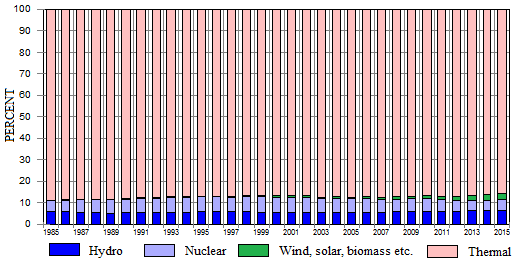
G20 total energy usage including thermal generation illustrating the magnitude of the problem the G20 countries still face in decarbonizing their energy sectors. (thermal refers to burning of fossil fuels)

Roger Andrews at Energy Matters:

While governments fixate on cutting emissions from the electricity sector, the larger problem of cutting emissions from the non-electricity sector is generally ignored. In this post I present data from the G20 countries, which between them consume 80% of the world’s energy, summarizing the present situation. The results show that the G20 countries obtain only 41.5% of their total energy from electricity and the remaining 58.5% dominantly from oil, coal and gas consumed in the non-electric sector (transportation, industrial processes, heating etc). So even if they eventually succeed in obtaining all their electricity from low-carbon sources they would still be getting more than half their energy from high-carbon sources if no progress is made in decarbonizing their non-electric sectors.

3. Thou shalt resist natural gas as the most dangerous fuel of all.

Methane Facts:

Natural Gas (75% methane) burns the cleanest with the least CO2 for the energy produced.

Leakage of methane is already addressed by efficiency improvements for its economic recovery, and will apparently be subject to even more regulations.

The atmosphere is a methane sink where the compound is oxidized through a series of reactions producing 1 CO2 and 2H20 after a few years.

GWP (Global Warming Potential) is CO2 equivalent heat trapping based on laboratory, not real world effects.

Any IR absorption by methane is limited by H2O absorbing in the same low energy LW bands.

Methane has been rising from 1.6ppm to 1.8ppm in 30 years (1980-2010), assuming that it has not stopped rising, this amounts to a doubling in 2-3 centuries. In other words, methane can never have any measurable effect on temperature, even if the IPCC radiative cooling theory were right.

There is no danger this century from natural or man-made methane emissions.

See More Methane Madness

An additional commandment comes from former UN climate chief Christiana Figueres:

4. Thou shalt bring emissions permanently lower by 2020.

Former UN climate chief: Only three years left to save the planet

The United Nation’s former global warming czar has published a paper claiming humanity only has three years left to avert dangerous global warming and meet the goals of the Paris climate accord.

To do that, Christiana Figueres says governments and businesses need to pony up $1.3 trillion a year by 2020 earmarked for “climate action” to decarbonize the global economy. That’s on top of boosting green energy and phasing out fossil fuels, mostly coal:

Clever as it is to substitute a 450 ppm target for 2C, the mathematics are daunting. Joe Romm:

We’re at 30 billion tons of carbon dioxide emissions a year — rising 3.3% per year — and we have to average below 18 billion tons a year for the entire century if we’re going to stabilize at 450 ppm. We need to peak around 2015 to 2020 at the latest, then drop at least 60% by 2050 to 15 billion tons (4 billion tons of carbon), and then go to near zero net carbon emissions by 2100.

And according to the IEA, the clock has already run out. From the 2011 IEA World Energy Outlook:

“If internationally co-ordinated action is not implemented by 2017, we project that all permissible CO2 emissions in the 450 Scenario will come from the infrastructure then existing, so that all new infrastructure from then until 2035 would need to be zero-carbon. This would theoretically be possible at very high cost, but probably not practicable in political terms.”

“If we do not change course, by 2015 over 90% of the permissible energy sector emissions to 2035 will already be locked in. By 2017, 100%.”

Maria van der Hoeven
Executive Director
International Energy Agency.
World Energy Outlook 2011

Background at How Climate Law Depends on Paris

Summary

These initiatives are outrageous to reasonable people, but are perfectly consistent with the agenda of people like McKibben and Figueres. A synopsis of the plan is in a post called The Climatist Manifesto

Mission: Deindustrialize Civilization

Goal: Drive industrial corporations into Bankruptcy

Strategy: Cut off the Supply of Cheap, Reliable Energy

Tactics:

  • Raise the price of fossil fuels
  • Force the power grid to use expensive, unreliable renewables
  • Demonize Nuclear energy
  • Spread fear of extraction technologies such as fracking
  • Increase regulatory costs on energy production
  • Scare investors away from carbon energy companies
  • Stop pipelines because they are too safe and efficient
  • Force all companies to account for carbon usage and risk

Escape the Green Box


Steve Goreham has published a new primer that unmasks “sustainable development” fallacies. Outside the Green Box is previewed at Master Resource. Excerpts below:

Green Doctrine of Sustainable Development

Modern society is beset by green ideology, possibly the greatest delusion in recent history. Schools teach children that carbon dioxide is a pollutant, that polar bears are endangered, that population growth is harmful, that pesticides cause cancer, that energy use is destroying the environment, that warm climate is bad for humanity, and that crude oil is all but exhausted. Further, we can save the planet if we change our light bulbs, plant a tree, forego eating meat, and drive a Prius.

Green ideology is embodied in the doctrine of environmental sustainable development. Sustainable development contends that the growth in human population, production, consumption, and energy use over the last 200 years is “unsustainable.” For 30 years, proponents of sustainable development have warned that without radical changes to modern society, our planet’s environment will be destroyed, with the resultant decline of human civilization. To avoid the coming catastrophe, companies are told that they must adopt sustainable business practices

Climate Change Ideology

Over the last 30 years, climate change ideology became the core of sustainable development and the green movement. Most scientific organizations, most leading universities, most of the Fortune 500 companies, faith-based organizations, and the majority of the news media have publicly endorsed this theory.

Climatists call carbon dioxide a “dirty pollutant,” call coal trains “death trains,” and brand those who don’t accept the ideology “climate deniers.” Thousands of energy and climate laws across hundreds of nations aim to reduce CO2 emissions from transportation, industry, agriculture, and even light bulbs.

But from Chapter 5, scientific data shows that natural forces, not human emissions, dominate Earth’s climate. Water vapor, not carbon dioxide or methane, is Earth’s dominant greenhouse gas. Human industry contributes less than two percent to the greenhouse effect. Earth’s temperatures 1,000 years ago were naturally warmer than today and have been gently cooling over the last 8,000 years.

Contrary to warnings, history shows that today’s storms, floods, and droughts are neither more frequent nor more intense than in past centuries. According to satellite data, surface temperatures show no significant warming over the last eighteen years, evidence that the world’s climate models are in error.

Summary

Much of government policy, academic thought, and public opinion stands on fears created and promulgated by environmental sustainable development. The philosophy that humans are too many, too polluting, climate destroying, and profligate wasters of natural resources holds today’s society in a powerful psychological grip. Thousands of energy and environmental laws are justified on these misconceptions.

Energy consumption is not a villain. Nations that consume the most energy per person discharge the lowest level of air and water pollutants per person. Low-cost energy provides economic growth and generates capital for pollution control. Carbon dioxide is not a pollutant. Hundreds of peer-reviewed studies show that increased levels of CO2 result in faster and larger plant growth. The recent rise in atmospheric CO2 is actually greening the Earth.

Steve Goreham is a speaker, author, and researcher of environmental issues and public policy. He holds an MBA from the University of Chicago and a BS/MS in Electrical Engineering from the University of Illinois. More at his website stevegoreham.com.  For example, he provides a synopsis of Climate Facts including these topics:

Temperature in Perspective
The Greenhouse Effect
Icecap Melting and Sea Level Rise?
Stronger Hurricanes and Storms?
Droughts and Floods?
Polar Bear Extinction?
Heat Waves?

The Sky is not our limit.

Trump’s EO on Energy Independence

Coal miners watch as Trump signs EO on Energy Independence.

What’s in it?  The text is hard to find.

First and most prominently, the executive order directs the Environmental Protection Agency to review the Clean Power Plan, one of Obama’s key regulatory actions to drive down greenhouse gas emissions in the electric power sector. Because an executive order cannot directly overturn a regulation, the EPA will have to come to a finding about whether the CPP should be revised or repealed.

The Supreme Court ruled in a 7-to-2 decision in June 2014 that the Obama administration’s Environmental Protection Agency is free to regulate carbon dioxide in the atmosphere, as long as the source of emissions in question is a traditional polluter, like a factory or a power plant, rather than a school or a shopping mall. The decision was largely written by conservative Justice Antonin Scalia. However, the Court also chastised the EPA for acting without a clear directive from Congress.

Some claim that the Supreme Court requires EPA to regulate greenhouse gases, but that is not correct. The Court ruled that CO2 can be considered a “pollutant” under the Clear Air Act, but EPA decides what, if anything to do about it. Expect lots of legal activity around this, including EPA seeking congressional legislation before regulating.

While determining the fate of the CPP could end up being a complex multi-year undertaking, the order also includes the following actions that can be carried out quickly:

  • Reversing Obama’s moratorium on new coal mining leases on federal lands;
  • Removing the consideration of greenhouse gases from permit reviews under the National Environmental Policy Act;
  • Formally abandoning Obama’s roadmap on how to achieve U.S. emissions reductions
  • Eliminating a tool for cost-benefit analysis in regulatory review called the “Social Cost of Carbon”

Finally, although Trump’s directive does not directly address American engagement in the Paris Agreement or other international climate agreements, it does have some implications for broader U.S. engagement in international climate policy. Rolling back the CPP would remove an important component of the American climate strategy and make it more difficult to achieve Obama’s U.S. climate targets. Other players, including big emitters like China, the European Union, and India, are aware of Trump’s stance on climate and will not be surprised by this action: most countries have committed to continuing to pursue their own goals in development as well as climate actions.

Thanks to Junk Science for putting up the full text (here)

Update March 29

Lots of freaking out by true believers.  Here is a balanced review of this EO.

Trump’s Executive Order On Energy: This Time, He Listened To The Lawyers

President Donald Trump’s executive order dismantling large chunks of Barrack Obama’s environmental legacy is a cleverly written document that avoids the pitfalls of Trump’s controversial orders on immigration. Unlike those orders, which have been suspended by federal courts, this one bears the clear stamp of experienced government lawyers and leaves the administration with a rich variety of tactical choices on how to eliminarte Obama-era regulations on fossil fuels.

Eliminating the previous administration’s legal memorandum could be a speedier way to get rid of the CPP, although it would still have to go through a notice and comment period as well as the inevitable legal challenges. The government wouldn’t have to delve as deeply into the scientific record, however, which the Obama administration provided in ample detail to justify its plan. Instead, the Trump administration would argue the CPP, which takes a systemwide approach toward reducing CO2 emissions, is based on an incorrect reading of federal law.

The order also calls for the elimination of the Interagency Working Group on Social Cost of Greenhouse Gases, as well as its findings on the cost of global warming, which it pegged at $42 a ton by 2020. Effective immediately, the administration will use Bush-era standards to judge the cost of carbon emissions.

Environmentalists and states can and will sue to try and force the administration to stick to the Obama-era goals for reducing CO2 emissions. But the EPA can only work with the tools Congress gave it, and Chevron deference allows the agency to determine how powerful those tools are. So it can simply say that federal statutes don’t give it the power to reorder the electric grid to cut emissions by 30%; perhaps the limit, by ordering existing plants to the highest levels of efficiency achievable with current technology, is a few percent. The agency can then argue further cuts have to come from Congress.

The Green Energy Money Pit

As we know, politicians are throwing money away on mad green energy schemes in Australia, Germany and Canada.  In the USA, bad examples are found in the left coast states of California and New York.

California Dreaming

From the LA Times: Californians are paying billions for power they don’t need
We’re using less electricity. Some power plants have even shut down. So why do state officials keep approving new ones?

At its 2001 launch, the Sutter Energy Center was hailed as the nation’s cleanest power plant. It generated electricity while using less water and natural gas than older designs.

A year ago, however, the $300-million plant closed indefinitely, just 15 years into an expected 30- to 40-year lifespan. The power it produces is no longer needed — in large part because state regulators approved the construction of a plant just 40 miles away in Colusa that opened in 2010.

Sutter Energy Center has been offline since 2016, after just 15 years of an expected 30- to 40-year lifespan. (David Butow / For The Times)

California has a big — and growing — glut of power, an investigation by the Los Angeles Times has found. The state’s power plants are on track to be able to produce at least 21% more electricity than it needs by 2020, based on official estimates. And that doesn’t even count the soaring production of electricity by rooftop solar panels that has added to the surplus. (my bold)

This translates into a staggering bill. Although California uses 2.6% less electricity annually from the power grid now than in 2008, residential and business customers together pay $6.8 billion more for power than they did then. The added cost to customers will total many billions of dollars over the next two decades, because regulators have approved higher rates for years to come so utilities can recoup the expense of building and maintaining the new plants, transmission lines and related equipment, even if their power isn’t needed. (my bold)

“We overbuilt the system because that was the way we provided that degree of reliability,” explained Michael Picker, president of the California Public Utilities Commission. “Redundancy is important to reliability.”

Some of the excess capacity, he noted, is in preparation for the retirement of older, inefficient power plants over the next several years. The state is building many new plants to try to meet California environmental standards requiring 50% clean energy by 2030, he said. (my bold)

“California has this tradition of astonishingly bad decisions,” said McCullough, the energy consultant. “They build and charge the ratepayers. There’s nothing dishonest about it. There’s nothing complicated. It’s just bad planning.”

Pacific Gas & Electric’s Colusa Generating Station has operated at well below its generating capacity — just 47% in its first five years. (Rich Pedroncelli / AP)

Sutter isn’t alone. Other natural gas plants once heralded as the saviors of California’s energy troubles have found themselves victims of the power glut. Independent power producers have announced plans to sell or close the 14-year-old Moss Landing power plant at Monterey Bay and the 13-year-old La Paloma facility in Kern County.

New York Blowing It in the Wind

From the New York Post: Cash in the Wind: New York’s Wind-power Giveaway

Gov. Cuomo doesn’t like nuclear energy.  Last month, he finalized a deal that will prematurely shutter the Indian Point Energy Center, the twin-reactor facility that supplies about 25 percent of New York City’s electricity.

Cuomo doesn’t like natural gas, either. In 2014, after a years-long moratorium, he banned fracking, the process used to get oil or gas from underground rock formations.

But there’s one thing the governor just loves: wind energy. Indeed, three days after the Indian Point closure was announced, Cuomo’s appointees at the New York State Energy Research and Development Authority provided details on $360 million in subsidies for a handful of renewable-energy projects.

Roughly 80 percent of that money will be doled out to two wind companies: Florida-based NextEra Energy Inc. and Illinois-based Invenergy.

Plus, when the new subsidies are combined with existing federal cash, the amount in subsidies Next­Era and Invenergy will be collecting will exceed the prevailing wholesale price of electricity in the state by nearly $13 per megawatt-hour.

Even more remarkable: those same subsidies, on an energy-equivalent basis — comparing the amount of energy we get from different sources — come to four times the current market price of natural gas. (my bold)

The companies will receive the NYSERDA subsidies over a period of 20 years. Given the size of their wind projects, which are about 101 megawatts and 106 megawatts, respectively, the two companies will likely collect about $286 million from the state over the next two decades. And remember, NextEra and Invenergy will collect those subsidies in addition to the cash they get for actually selling their product. (my bold)

I’ve heard of sweetheart deals, but this one deserves a medal.

It there no bottom to the green energy money pit?

Ontario Coal Phase-out: All Pain, No Gain


Thanks to Dr. Ross McKitrick for telling the story: It’s official—Ontario’s coal phase-out was all for nothing which appeared in the Financial Post, January 17, 2017.  Excerpts below.

The federal Liberal government plans to impose a national coal phase-out, based on the same faulty arguments used in Ontario, namely that such a move will yield significant environmental benefits and reduce health-care costs. One problem—those arguments never made sense, and now with the Ontario phase-out complete, we can verify not only that they were invalid but that the Ontario government knew it.

First, ample data at the time showed that coal use had little effect on Ontario air quality. Environment Canada’s emissions inventories showed that the Ontario power generation sector was responsible for only a tiny fraction (about one per cent) of provincial particulate emissions, a common measure of air pollution.

Taken together these reports provided a credible basis for predicting that a coal phase-out would only have a small effect on our air quality. They also showed, based on the results of retrofits then underway at the power plants, that the same air quality improvements could be obtained at a fraction of the cost by installing scrubbers on the smokestacks, rather than shutting the coal-fired plants down.

Second, the government’s claims about the health effects of phasing out coal were highly implausible. It stated (and continues to assert) that coal plant emissions cost the province more than $3 billion annually in health-care costs. But this was at a time when the total provincial health-care budget was only about $35 billion annually. In other words, they claimed that nearly one-tenth of all health-care spending was due to illnesses and mortality arising from power plants that, again, were responsible for only about one per cent of annual particulate emissions.

Dr. Aliakbari and I analysed data for the cities of Hamilton, Toronto and Ottawa over the 2002-2014 interval. Our statistical model allowed us to isolate the effects of declining Ontario coal use compared to changing emissions from other Canadian and U.S. sources and effects due to weather. In line with our expectations and the prior evidence, we found that phasing out coal was responsible for only very small changes in Ontario air pollution levels.

We did not look at greenhouse gases because they are not local air pollutants, only matter on a global level, and emissions could be offset by purchasing credits anywhere in the world. The climate issue was, and remains, a red herring in the discussion about the costs and benefits of eliminating coal.

Summary

Ontario is suffering a crisis of high and rising electricity costs that’s causing real, long-lasting damage to households and businesses. The province insists the pain is worth it because of the environmental improvements. The numbers show otherwise. Phasing out coal had almost no effect on Ontario’s air pollution levels—and the government at Queen’s Park knew this was likely to be the case. It has all been for nothing.


Ross McKitrick
Professor of Economics, University of Guelph

Two additional points

Firstly, in both the US and Canada, the real motivation is virtue-signalling, posing as fighters of climate change.  The US EPA is also infamous for bogus estimates of public health and air quality benefits to justify costly and onerous energy regulations.

When Ontario government rejected the anti-pollution scrubbers mentioned in the article above, Energy Minister Dwight Duncan said: “We’re not going to spend $1.6 billion on technology that doesn’t help climate change. That’s just dumb.”

Secondly, the result was worse than nothing. Ontario’s electricity rates are the fastest rising and among the highest in North America. Ratepayers are being mugged by the once friendly Reddy Kilowatt.

Ontario’s Hall of Pain

Ontario Climate Policy Refugees

Ontario Jammed by Rent-seekers and Ratepayers

Electrical Madness in Green Ontario


Pipeline Facts vs. Fears

This week Canadian PM Justin Trudeau announced federal approval for 2 pipeline projects:  Trans Mountain and Line 3 expansions.  From a press report (here):

Kinder Morgan’s Trans Mountain expansion has become a lightning rod for climate protests from coast to coast, with opponents from among Trudeau’s own caucus of Liberal MPs and his political ally, Vancouver Mayor Gregor Robertson.

Climate campaigners and indigenous groups immediately attacked the government decision as a betrayal, while B.C. Environment Minister Mary Polak issued an anodyne statement noting the province’s own environmental assessment of Trans Mountain continues.

The fight overshadowed quieter deliberations about Enbridge’s proposed replacement of Line 3, a half-century-old pipeline from Alberta to the United States that Trudeau approved Tuesday, effectively doubling its current working capacity.

Between the Trans Mountain and Line 3 expansions, the Liberals have approved the export of almost a million additional barrels of oil per day — and the production of between 23 and 28 million tonnes of additional greenhouse gases annually. Line 3 can actually handle another 155 million barrels per day, but Enbridge would have to apply for a new permit.

Trans Mountain Pipeline

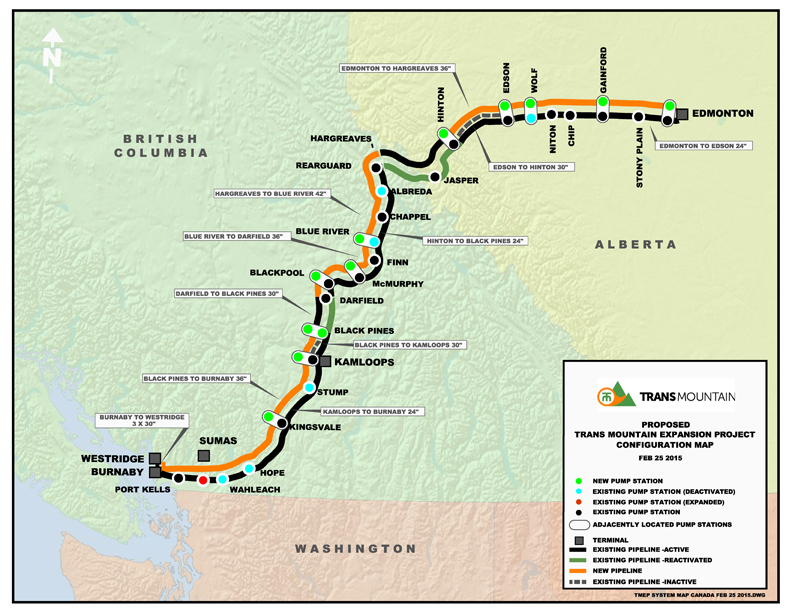
Description of Trans Mountain project is from NEB (National Energy Board) here

The Trans Mountain Expansion Project (TMX) is a proposal to expand the existing Trans Mountain pipeline system between Edmonton, AB and Burnaby, BC. It would include approximately 987 km of new pipeline, new and modified facilities, such as pump stations and tanks, and the reactivation of 193 km of existing pipeline.

The Westridge Marine Terminal would also be expanded. New pipeline segments would be added between Edmonton and Hinton, AB, Hargreaves, BC and Darfield, BC and Black Pines, BC and Burnaby, BC.

Some existing, but currently deactivated pipeline segments between Hinton, AB and Hargreaves, BC and Darfield and Black Pines, BC would be reactivated.

Line 3 pipeline

Line 3 would replace a decades-old conduit that runs from Hardisty, Alta., to Superior, Wisc., and double its capacity. (BNN Graphics)

What you need to know about Enbridge’s Line 3 pipeline project

From BNN news (here):
The Line 3 crude oil pipeline replacement project proposed by Calgary-based Enbridge Inc. has attracted little attention despite its potential to increase Canadian exports to the United States. Here are some facts about the plan:

— The $7.5-billion, 1,660-kilometre pipeline replacement project would be the most expensive in Enbridge history.
— The line is almost half a century old and its regulated maximum throughput has been reduced through pressure restrictions to about 390,000 barrels of oil per day.
— The replacement of the aging 34-inch diameter pipe with new 36-inch pipe will restore the original regulated capacity of 760,000 barrels per day, nearly doubling oil shipping potential.
— In April, the National Energy Board recommended approval of the Canadian part of the project with 89 conditions.
— Line 3 already has a U.S. presidential permit, unlike the higher-profile Keystone XL pipeline project which was rejected by the Obama administration a year ago. Line 3 still requires state regulator approvals.
— On the Canadian side of the border, Enbridge intends to spend $4.9 billion to replace Line 3 between Hardisty, Alta., and the Canada-U.S. border at Gretna, Man.
— On the U.S. side, it will spend US$2.6-billion to replace pipe between Neche, N.D., and its terminal in Superior, Wis., from which crude can be transported to refinery markets in Chicago, the U.S. Gulf Coast and the eastern U.S. and Canada.
— Decommissioning of the existing Line 3 pipe will begin after the replacement pipeline is in service. Product will be removed and the line will be cleaned but the pipe itself is to be left in the ground.

[Enbridge expected its full-year average volume on the Mainline network to exceed three million barrels per day in 2024, not much different than the 3.1 million barrels per day it achieved in 2023 prior to the Trans Mountain expansion project’s start-up.]

Pipelines Are Environmentally Friendly

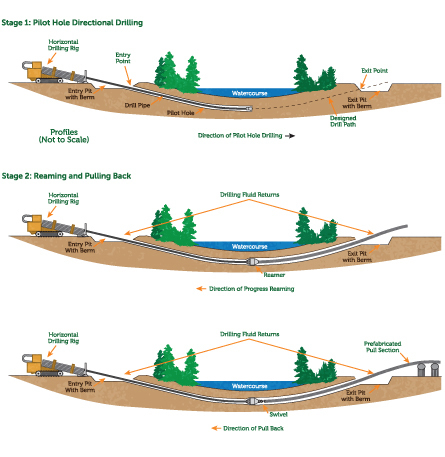
Going under: New trenchless technology means pipelines are installed without construction activity in the watercourse.

In both Canada and the United States, the oil pipeline industry has a remarkably good record of avoiding spills. Of the total volume of oil moved annually on federally regulated pipelines in Canada in 2015, 99.999% of the oil was delivered safely with no spills. Of the 1.4 billion barrels of oil transported, less than 400 were spilled. In the United States, the same 99.999% record of safe delivery applies. The number of accidents and incidents on crude oil pipelines has been declining for many years. Similarly, in Alberta, where most of the intra-provincial oil pipeline capacity is located, the number of pipeline incidents and spills has been stable or declining for at least 20 years.

Of course, it is not possible to entirely eliminate the risk of a spill, any more than it is possible in every other aspect of life to reduce risks to zero. This paper describes the consequences of a major spill near Marshall, Michigan in 2010. In one of the worst cases in twenty years, there were no injuries to people. The use of surface waters affected by the spill for drinking, irrigation and watering of livestock was interrupted for one month. 52 birds, 40 muskrats, 106 turtles and snakes and 42 fish died. The company responsible was required to pay almost $900 million in fines and other expenses to ensure that this does not happen again. From Friends of Science (here)

Pipeline Economics

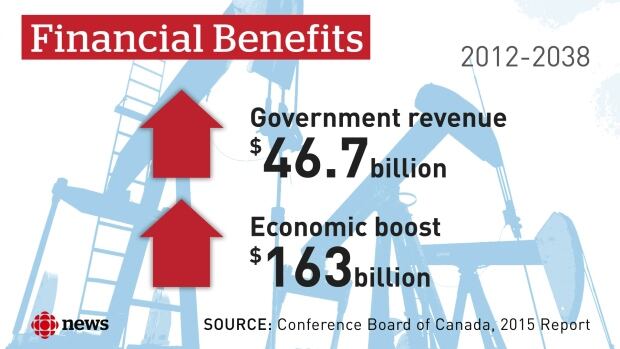
The financial benefits to governments and the economy of the Trans Mountain expansion include the development and planning of the project and the anticipated first 20 years of operation from 2018-38. The figures also include calculations such as the construction and operations of the pipeline, economic benefits of increased tanker activity, and oil company reinvestment.

The financial benefits to governments and the economy of the Trans Mountain expansion include the development and planning of the project and the anticipated first 20 years of operation from 2018-38. The figures also include calculations such as the construction and operations of the pipeline, economic benefits of increased tanker activity, and oil company reinvestment.

The vast majority of oil from Alberta and Saskatchewan is exported to the United States, instead of being transported to a coast and exported to other countries at world prices.

“We produce a very valuable resource and we don’t get full value for that resource,” he said. “It’s absolutely unconscionable that we don’t take the actions we need to move it so that Canadians receive the full value for the product.” – David Dodge former Bank of Canada Governor

‘We may like to think we can survive off making solar panels and medical devices, but we can’t.’- John Manley, Business Council of Canada

Millions of people depend upon the supply of refined oil products for transportation, industrial production, petrochemicals and the thousands of products and services that people use in our modern industrialized society. Further, hundreds of thousands of people work very hard to ensure that the transportation of crude oil and refined oil products moves across our lands with the utmost care given to oil spill prevention, preparedness and response. Comprehensive liability, compensation and governance regimes are in place to make sure that companies have a strong financial incentive to avoid spills and to clean them up as soon as possible if they do occur. Decisions about the permitting or construction of pipelines should be based on facts, not fear.

Anti-Pipeline Activism

None of these facts matter to unhinged people who fear fossil fuels must be left in the ground. And US funders are largely responsible for their activity. From National Post: The cash pipeline opposing Canadian oil pipelines

In 2015, Tides paid $4 million to 50 anti-pipeline groups. Of that, $750,000 went to U.S. organizations while $3.3 million was paid out in Canada. A total of $615,000 went to the four environmental groups involved in the development of the Notley government’s climate plan: STAND, formerly Forest Ethics; The Pembina Institute; Environmental Defence; and Equiterre. The largest single grant from Tides to a Canadian environmental organization was US$700,000 paid to The Sisu Institute, a low-profile non-profit based in Sointula, B.C. That was for an initiative called “Canada’s Road To Paris: Changing The Narrative.”

If the activists marching in protests and storming NEB hearings make the anti-pipeline campaign look like an amateur, grassroots movement, the reality is it’s anything but. Anti-pipeline activists say they’re protesting pipelines to “keep oil in the ground.” And yet, against Texas, where oil production has doubled, there’s no multi-million-dollar campaign.


Speaking Truth About Power

Recent Headlines have reported the Canadian federal government intends to eliminate coal for electrical production, replacing it with renewables. For example: Ottawa to phase out coal, aims for virtual elimination by 2030

Ontario is not part of this because they have already done it. How is that working out for Ontario? A cautionary tale follows.

Arrogant Ontario politicians thought they knew better than engineers how to manage the supply of electricity to the citizenry. Pursuing their dream of “green” energy, they enacted policies that have failed in every possible way: power costs are skyrocketing for businesses and residents, emissions reductions are outrageously expensive, and worst of all, more future renewables will increase CO2 emissions.

The Ontario Society of Professional Engineers (OSPE) are speaking the truth about power (not for the first time), and maybe finally the powers that be will wake up or be voted out of office. From OSPE presentation, Ontario’s Electricity Dilemma – Achieving Low Emissions at Reasonable Electricity Rates

The outline includes everything that a reasonable person needs to know.  Two of the most important sections are excerpted below

Why Are Electricity Rates Rising So Fast in Ontario?

The major drivers of rapidly rising rates in Ontario:

  • Incremental cost of wind/solar energy compared to displaced generation.
    Over 1 B$ in 2014, rising to over 3 B$ in 2021
  • Loses for curtailment and exporting at very low price.
  • Conservation and demand management programs have reduced financial value during periods of excess capacity (2013 Long Term Energy Plan predicts excess capacity will persist from 2009 to 2019).
  • Higher costs for refurbishment of older plants.
  • Higher costs for power system upgrades to accommodate renewables and Bruce A restart.

In the GTA (Greater Toronto Area) residential “energy” rates have risen about 70 to 90% in the 7 years since 2008 depending on when the utility switched you to TOU rates.

286fd-7_50286

Why Will Emissions Double as We Add Wind and Solar Plants?

Wind and Solar require flexible backup generation.

  • Nuclear is too inflexible to backup renewables without expensive engineering changes to the reactors.
  • Flexible electric storage is too expensive at the moment.
  • Consequently natural gas provides the backup for wind and solar in North America.
  • When you add wind and solar you are actually forced to reduce nuclear generation to make room for more natural gas generation to provide flexible backup.
  • Ontario currently produces electricity at less than 40 grams of CO2 emissions/kWh.
    Wind and solar with natural gas backup produces electricity at about 200 grams of CO2 emissions/kWh.
  • Therefore adding wind and solar to Ontario’s grid drives CO2 emissions higher.
    From 2016 to 2032 as Ontario phases out nuclear capacity to make room for wind and solar, CO2 emissions will double (2013 LTEP data).

In Ontario, with limited economic hydro and expensive storage, it is mathematically impossible to achieve low CO2 emissions and reasonable electricity prices without nuclear generation.

Truth about power falls on deaf ears

From Terence Corcoran at the Financial Post  Boondoggle: How Ontario’s pursuit of renewable energy broke the province’s electricity system

Paul Acchione, an OSPE engineer with long experience in the electricity industry, said the government was “hiring political scientists and environmentalists because they thought they were the experts.” As a result, the government has issued more than 100 ministerial directives that ignored the dramatic decline in demand and the realities of managing an electrical grid where new expensive supply was mushrooming all over the province.

Expensive wind and solar supply needs to be backed up by expensive new gas plants that in turn operate at a fraction of optimal capacity. The new capacity came at the wrong time of day or season, forcing curtailment in which producers were paid for electricity that wasn’t needed.

The result, Acchione said, is “everything costs more.”

Through the years, escalating government control was cheered on by a growing industrial complex of wind and solar promoters backed by a large contingent of financial firms, big name consultants, fee-collecting law firms and major corporations. All were anxious to play a lucrative role fulfilling renewable objectives.

The provincial auditor general last year delivered a devastating report on the Liberal green electricity campaign. The report estimated that by 2014, electricity consumers had “already paid a total of $37 billion, and they are expected to pay another $133 billion in Global Adjustment fees from 2015 to 2032.” That’s $170 billion over 30 years.

As for job creation, Rick Smith and company promised hundreds of thousands of new jobs. The government now claims 42,000, although it is widely conceded that job creation is minimal. The auditor general said the jobs appear to be mostly short-term subsidized jobs for workers installing wind turbines and solar panels.

Summary

The Ontario green electricity regime is a monumental failure. The costs to consumers are prohibitive and damaging the economy. The environmental and health benefits are debatable and likely non-existent. Worst of all, while the few jobs that have been created are mostly temporary, the high prices it foisted on consumers are permanent.

barrel-poison-7388531rev