Woke Tycoons Playing with Fire

Matthew Continetti writes at Washington Free Beacon The Wages of Woke.  Excerpts in italics with my bolds.
How the left uses corporate America to evade democracy

Time was, CEOs of mighty enterprises shied away from politics, especially hot-button social and cultural issues. They focused instead on the bottom line. They maximized shareholder value by delivering goods and services to customers. Some businessmen still operate by this principle. In doing so they provide not only for their employees and CEOs and board members but also for the institutions—pensions, individual retirement plans, index funds, hospitals, philanthropies—invested in their companies.

That is no longer enough for many of America’s richest and most powerful. Suddenly, corporate America has a conscience. Every week brings new examples of CEOs intervening in political, cultural, and social debate. In every instance, the prominent spokesmen for American business situate themselves comfortably on the left side of the political spectrum.

Shareholder capitalism finds itself under attack.
Not just from socialism but also from woke capitalism.

Apple employees march in the San Francisco Gay Pride Parade / Getty Images

These outbursts are not just virtue signaling. Nor is the left-wing tilt of corporate America merely a response to the “rising American electorate” of Millennial, Gen Z, and minority consumers. What is taking place is not a business story but a political one. What is known as “stakeholder capitalism” is another means by which elites circumvent democratic accountability.

Corporate managers find themselves at odds with at least 46 percent of the electorate. The divergence is not over jobs or products. It is over values. The global economy generates social inequalities as much as economic ones. Many of the winners of the global economy justify their gains by adopting the rhetoric, tastes, ideas, and affiliations of their cultural milieu. Their environment is inescapably center left.

Even so, the social justice agenda of corporate America is not only meant to appease voters, or even to placate Elizabeth Warren. Some of these businessmen really believe what they are saying. And they are beginning to understand that they have another way—through social position and market share—to impose their cultural priorities on a disagreeable public.

The trend began as a response to the Tea Party. In 2010 the “Patriotic Millionaires” began advocating for higher marginal tax rates. A few years later, when state legislatures passed laws opposed by pro-choice and LGBT groups, corporations threatened or waged economic boycotts. Large individual donations made up more than half of Hillary Clinton’s fundraising; for Donald Trump the number was 14 percent.
CEOs protested the implementation of President Trump’s travel ban in 2017. The following year, after two black men were arrested at a Philadelphia Starbucks, Howard Schultz closed stores nationwide so his more than 175,000 employees could be trained in diversity, equity, and inclusion. Earlier this summer, Nike pulled shoes featuring the Betsy Ross flag after Colin Kaepernick raised objections. Recently four major auto companies struck a deal with the state of California to preserve fuel economy standards the Trump administration opposes.

Business has provided ideological justification for its activities. In mid-August, a group of 181 members of the Business Roundtable, including the CEOs of Morgan Stanley, GM, Apple, and Amazon, issued a statement redefining the purpose of a corporation. “Generating long-term value for shareholders” is necessary but insufficient. In the words of Jamie Dimon, business must “push for an economy that serves all Americans.” A few weeks later, one of the Business Roundtable signatories, Walmart CEO Doug McMillon, announced that America’s largest retailer would end sales of ammunition for handguns and for some rifles. Once its current inventory is exhausted, of course.

stg090919dapr20190909124510

“We encourage our nation’s leaders to move forward and strengthen background checks and to remove weapons from those who have been determined to pose an imminent danger,” McMillon wrote. “We do not sell military-style rifles, and we believe the reauthorization of the Assault Weapons ban should be debated to determine its effectiveness.” Note the use of the first-person plural. Of Walmart’s 1.5 million employees, more than a few, one assumes, do not believe it is necessary to “strengthen background checks” or debate “the Assault Weapons ban.”

To whom does the “we” in McMillon’s statement refer? To everyone who thinks like he does.

“You have a business acting in a more enlightened and more agile way than government,” is how one MSNBC contributor enthusiastically described Walmart’s directive. Left unsaid is why government has not, in this case, been “enlightened” or “agile.” The reason is constitutional democracy. The electorate, like it or not, continues to put into office representatives opposed to gun registration and to a renewal of the Assault Weapons ban. And these representatives, in turn, have confirmed judges who believe the Second Amendment is just as important to self-government as the First and Fourteenth.

Much of Western politics for the last decade has involved elites figuring out new ways to ignore or thwart the voting public.

Barack Obama was following in the EU’s footsteps when he went ahead with Obamacare despite Scott Brown’s victory in Massachusetts in January 2010, and when he expanded his DACA program to the parents of illegal immigrants brought here as children despite Republican gains in the 2014 election and despite his own admission that he lacked authority.

James Comey’s towering ego and self-regard compelled him to interfere in the 2016 election with consequences we can only begin to reckon. Over the last two-and-a-half years, district judges and anonymous bureaucrats have impeded and obstructed the agenda of a duly elected chief executive. A few weeks ago a former governor of the Federal Reserve suggested in Bloomberg that the central bank should thwart Trump’s reelection. And in England, elite resistance to the results of the 2016 Brexit referendum and to the 2017 parliamentary invocation of Article 50 has brought the government into a crisis from which there seems no escape.

In such an environment, one begins to see the appeal of nongovernmental instruments of power. What might be rejected at the ballot box can be achieved through “nudging” in the market and in the third sector. If you can’t enact national gun control through Congress, why not leverage the economic and cultural weight of America’s largest corporations?

The market, we are told, is not a democracy.  Oh, but it is.

The market may be the ultimate democracy. “The picture of the prettiest girl that ever lived,” wrote Joseph Schumpeter, “will in the long run prove powerless to maintain the sales of a bad cigarette.” Woke capitalists remain accountable to consumers and to shareholders. The audiences of ESPN and of the NFL cratered when those institutions elevated politics over consumer demand. Hollywood’s anti-American offerings routinely flop. Public opinion, in the form of popular taste, rules. Shareholders of publicly traded companies are a type of electorate. The companies that do not satisfy customers will disappear. Or shareholders will demand changes to management to prevent such an outcome.

The politicization of firms is a double-edged sword. The responsible stakeholder CEOs may have the best of intentions. They might assume they are doing the right things not only by their companies but also by their societies. What they fail to understand is that corporations acting as surrogates of one element of society, or of one political party, will not be treated as neutral by other elements, by the other party. By believing their superior attitudes will save capitalism, our right-thinking elites are undermining its very legitimacy, and increasing the severity of the ongoing populist revolt.


Shale Energy Fuels US Economic Growth

Wyoming, Texas, and Pennsylvania ranked largest net energy suppliers in US

Bill Godsey brings the good news at TribLIVE From Pennsylvania to Texas, energy fuels economic growth.  Excerpts in italics with my bolds and images.

President Trump’s visit last month to an ethane cracker plant in Western Pennsylvania underscored a key fact that both political parties should be able to agree on: America’s remarkable shale renaissance is securing our country’s energy independence and bolstering industries throughout the economy.

It’s hard to argue that Royal Dutch Shell’s multibillion-dollar plant is anything less than proof of the impact prudent shale energy development is having. The facility will convert, or “crack,” ethane — a component of natural gas — to produce ethylene, which is widely used in plastics for all kinds of consumer goods that Americans rely on every day.

The Shell Pennsylvania Petrochemicals Complex near Pittsburgh will employ 1,000 electricians for more than a year, making it one of the largest projects in the IBEW. (International Brotherhood of Electrical Workers)

Because the plant’s operations require a steady feedstock of natural gas, Western Pennsylvania was a logical choice. Over the past 10 years, the state’s natural gas production has increased more than thirty-fold. Second only to Texas, Pennsylvania produced more than 18 billion cubic feet per day of natural gas through the first half of this year, or about 20% of total U.S. supply. That extraordinary output has been good for the state’s consumers, more than half of whom rely on gas as their primary heating fuel. And, as it turns out, it’s not bad for attracting business either.

For an area like Beaver County, the plant is a welcome answer to economic stagnation and population decline. The steel industry bust in the 1980s pushed unemployment in the region to nearly 30%, the effect of which is still widely evident. During construction, the Shell facility created about 6,000 jobs for skilled laborers, and it will establish another 600 permanent positions once operational. Those come amid the upcoming closures of a neighboring nuclear plant, which employs 850 workers, and a nearby coal power plant that will cost at least 200 jobs.

Pennsylvania is not the only state reaping the benefits of smart production, transportation and refining. ExxonMobil and SABIC recently announced Gulf Coast Growth Ventures, a similar plastics manufacturing facility in San Patricio, Texas. The project will create 6,000 construction jobs and more than 600 permanent positions. It is expected to generate $22 billion in economic activity during build-out, $50 billion in state revenue during the first six years and support as many as 3,500 jobs through increased demand for goods and services.

Across the country, developers are completing liquified natural gas export facilities, which provide both the demand to incentivize domestic production and keep consumer prices low and a valuable geo-political tool to support our allies abroad. The United States has supplied LNG shipments to 35 countries, from China to South Africa, which have helped stabilize prices here at home. Projects like the Port Arthur LNG terminal in Southeast Texas and Lake Charles LNG terminal in Louisiana will add even more capacity and create thousands of jobs and billions in economic activity in the process.

Yet, some activists refuse to acknowledge the value of shale energy production. They peddle a fiction that fossil fuels are incompatible with renewable resources and exploit every opportunity to disrupt infrastructure development, no matter how harmful to the systems in place to protect our communities and the environment.

These activists fail to acknowledge the success of shale energy and emerging technologies in reducing our environmental footprint while simultaneously allowing us to safely retrieve vital energy resources. Between 2005 and 2017, the United States cut CO2 emissions by 14%. During the same time, oil and natural gas production increased more than 80% and 50%, respectively.

While many activists push the notion of an immediate switch to so-called “green” fuels, that kind of shift is simply unrealistic. Renewables account for about 17% of electricity generation here in the U.S. Heating and cooling needs depend almost exclusively on traditional fuels, as do transportation demands.

Shale energy development, and the infrastructure deployment that’s happening to support it, is good for our country. It’s creating jobs, investing in our communities, protecting the environment and helping to reduce our carbon footprint. Achievements like the Shell ethane plant deserve support — and a fair shake.

Blaiming Hurricanes on Global Warming Denies the Facts

James Piereson writes at New Criterion An overblown hypothesis. Excerpts in italics with my bolds.

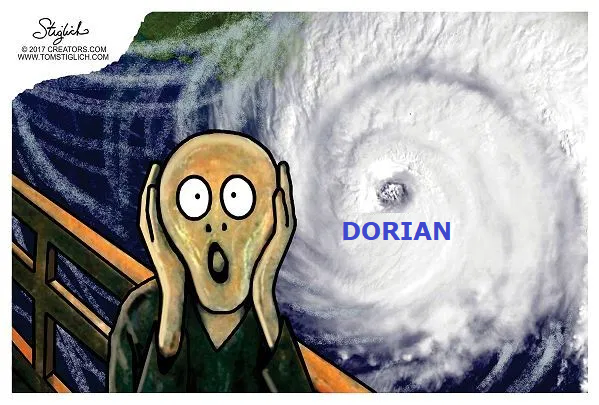
We are well into hurricane season with a dangerous storm lurking off the coast of Florida and now poised to make a run up the east coast of the United States. As happens every year at this time, the appearance of hurricanes provokes speculation about the role of climate change in the formation of these destructive storms.

Climate change theorists assert that warming ocean temperatures are increasing the number and strength of hurricanes that form and make landfall in the United States. As David Leonhardt writes this week in the New York Times, “The frequency of severe hurricanes in the Atlantic Ocean has roughly doubled over the last two decades, and climate change appears to be the reason.” He cites some statistics to support this conclusion, though his review of the facts is far from thorough.

As he notes, the underlying science holds that hurricanes develop in warm ocean waters in late summer, so that over time rising ocean temperatures will generate rising numbers of hurricanes, and stronger ones as well. According to scientists, average ocean temperatures have increased by about one degree Fahrenheit over the past one hundred to a hundred and fifty years, a finding that provides a foundation for the “hurricane hypothesis.” Thus, we hear the refrain that global warming is causing more storms with higher wind speeds, and that these storms last longer, are more destructive, and make landfall more often than in the past.

It is a plausible hypothesis and, unlike many claims in this area, is capable of being tested against the facts. The evidence for it turns out to be quite thin—at least in relation to the certainty with which it is usually expressed.

Looking at the historical data, one does not find a startling increase in hurricane activity in recent decades, and only modest evidence to suggest that hurricanes in the Atlantic basin are increasing either in number or severity.

The National Hurricane Center, a division of the National Weather Service, has compiled reliable information on hurricanes going back to the middle of the nineteenth century—though the information the nhc collects has grown much more reliable in recent decades with the development of satellite imagery and ever-more sensitive instruments with which to measure the strength and windspeeds of hurricanes. There is no shortage of information to test the claims about increasing hurricane activity.

1. Are hurricanes in the Atlantic Ocean increasing in frequency with the passage of time?

The modern era of hurricane tracking and measurement got underway about 1950. From 1950 through 2018, the Hurricane Research Division (HRD) tells us that on average 6.3 named hurricanes formed per year, with a high of fifteen storms in 2005 (the year of Katrina) and a low of two in 1982 and 2013. A named hurricane is one strong enough to be classified between 1 and 5 on the Saffir-Simpson Hurricane scale. Again, these are storms that formed in the Atlantic, but not all of them made landfall. Broken down decade by decade, the averages look like this:

1950-59: 6.9 per year
1960-69: 6.1 per year
1970-79: 5.0 per year
1980-89: 5.2 per year
1990-99: 6.4 per year
2000-09: 7.4 per year
2010-18: 7.0 per year

Conclusion: There has been a modest increase in the number of hurricanes formed per year since 2000, but these rates are not significantly higher than the long-term average and are very close to the rates experienced in the 1950s.

2. Are more hurricanes making landfall in the United States with the passage of time?

The HRD maintains an accurate list of hurricanes making landfall in the United States going back to 1851 and running through 2018. On average over this hundred-seventy-year period, between one and two hurricanes made landfall per year in the United States. The busiest years for hurricanes since 1950 were 1985, 2004, and 2005, as six named storms made landfall in each of these years. The busiest decade going back to 1850 was the 1940s, when twenty-six hurricanes made landfall; more recently, the busiest decade was between 2000 and 2009, when nineteen hurricanes made landfall.

Average by decade, 1950 to 2018: 15
Average by decade, 1990-2018: 15
Average by decade, 1950-1989: 15

Conclusion: There has been no long-term increase in the number of named hurricanes making landfall in the United States.

3, Are Atlantic hurricanes growing more powerful with the passage of time?

Over the hundred-seventy-year period, just four Category 5 hurricanes (the most powerful of all storms) have made landfall in the United States: The Labor Day hurricane that hit the Florida Keys in 1935; Hurricane Camille, which hit the Gulf coast in 1969; Hurricane Andrew, which hit south Florida in 1992; and Hurricane Michael, which hit Florida and Georgia in 2018. These events appear unrelated to changes in ocean temperatures.

The two most destructive storms to hit the USA occurred in 1900 (Galvaston) and 1926 (Miami), long before the era of rising ocean temperatures.

From 1950 to 2018, an average of 2.7 major hurricanes have formed per year in the Atlantic basin, with highs of eight major hurricanes in 1950 and seven in 2005. There were several years in the period, most recently in 2013 and 1994, when there were no major hurricanes in the Atlantic. (The HRD defines a major hurricane as a storm classified as 3, 4, or 5 on the Saffir-Simpson Scale.)

A total of twelve Category 4 and 5 hurricanes have made landfall in the United States since 1950, following no particular historical pattern or trend.

Conclusion: There has been a slight increase in the frequency of powerful hurricanes since 1990, but mostly in relation to the numbers of such storms from 1970 to 1989, a quiet period for hurricane formation. The frequency of powerful hurricanes from 2000 to 2018 (3.3 per year) mirrors the rates experienced from 1950 to 1969 (also 3.3 per year). Moreover, there is no pattern or trend in the frequency of Category 4 and 5 hurricanes making landfall over the 1950-2018 period.

How, then, in view of these data, should we assess the claims that Atlantic hurricanes are increasing in numbers and strength in recent decades in response to rising atmospheric and ocean temperatures, and are also making landfall at increasing rates?

There has been a modest increase in the frequency of Atlantic hurricanes in recent decades along with a slight increase in their strength from year to year, but no increase in the number of hurricanes making landfall in the United States and no increase since 1950 in the number of the most powerful hurricanes (Category 4 and 5 storms) to hit the U.S. mainland. Moreover, any trend that we find in the frequency and strength of hurricanes in the past few decades is mostly washed out when we compare those rates to the ones experienced in the 1950s and 1960s. This suggests that the frequency and strength, though perhaps increasing of late, are but loosely related to recent measured increases in Atlantic Ocean temperatures.

Update: EU Deep State Vs. Brexit

Christopher Caldwell writes at Claremont Review of Books insightfully about the Brexit struggle Why Hasn’t Brexit Happened?  Excerpts in italics with my bolds

Caldwell tells the story of how Britain and the EU got to this point, and makes two important points.  Almost inadvertently, the EU pact removed British sovereignty and the British constitution.  He explains:

In Britain as elsewhere in the world, the struggle has been unleashed by innovations in administration that have arisen since the Cold War. These shift power from electorates and parliaments to managers of information, inside government and out. From thousand-year-old constitutional ideas to five-year-old ones. From habeas corpus to gender identity. Because it was Britain that did the most to construct the ideal of liberty which is now being challenged, Brexit clarifies the constitutional stakes for the world as nothing else.

Many statesmen warned from the outset that British ideas of liberty would not survive a merger with the E.U. The most eloquent early diagnoses came from the Labour Party, not the Tories. That is because the fundamental disposition of the E.U. is to favor technocratic expertise over representative government, and the Tories have not generally been the British party that placed the highest priority on the passions of the masses. In 1962, as Tory Prime Minister Harold Macmillan was eying EEC membership, Labour leader Hugh Gaitskell warned, “[I]t does mean the end of Britain as an independent nation state.… It means the end of a thousand years of history. You may say ‘Let it end’ but, my goodness, it is a decision that needs a little care and thought.”

What Britain Lost in Joining the EU

Gaitskell was right, but it is only in recent years that people have begun to see exactly why he was right. It was always understood that joining the EEC in 1973 compromised Britain’s national sovereignty. All countries that joined had to acknowledge the supremacy of E.U. law over their own. This was a deadly serious thing if you reasoned the consequences to the end. For one thing, it deprived Britain’s monarchy of its (already somewhat vestigial) logic. Monarchs are not underlings: in joining the EEC, Britain could be said to have deposed its queen. Pro-E.U. politicians assured their voters that it wasn’t as serious as that. Britain, they said, had to give a little bit of its sovereignty up in order to receive the benefits of cooperation, the way it did in, say, NATO. Other European countries had done so without wrecking their systems.

But this was a false analogy, as the political scientist Vernon Bogdanor explains persuasively in his recent book, Beyond Brexit. NATO was a treaty. The EEC was a merger. What is more, the EEC that Britain joined had been designed by the major countries of continental Europe in line with their own traditions and interests. It was not in line with Britain’s. Britain had no institutions like the European Commission, an unelected body that could (and still does) initiate legislation. Britain’s politicians didn’t understand the rules intuitively and were less able to work the system. British political institutions were unsuitable as a “farm system” for training E.U. politicians.

And there was an even larger problem than the loss of national sovereignty, Bogdanor shows. The E.U. destroyed the system of parliamentary sovereignty at the heart of Britain’s constitution. For all its royalist trappings, Britain has traditionally been a much purer representative democracy than the United States, because it excludes courts from reviewing legislation on any grounds. British politicians tried to calm the public with assurances that, where British law and E.U. law clashed, British law would prevail. But the acknowledgement of E.U. legal supremacy in the treaties meant that E.U. law was British law.

In the 1980s, British judges began finding that parliamentary laws had been invalidated by later British laws—a normal and time-honored process, except that these new “British” laws had been imported into British statute books not by legislation but by Britain’s commitment to accept laws made on the continent. Bogdanor, who is a Remainer and a defender of human rights, does not necessarily condemn this development. But it meant that, through the back door, judicial review was being introduced into a constitutional culture that had never had it.

Quangos and foundations began designing cases—concerning migrants’ rights, gay rights, search-and-seizure—that unraveled the centuries-old fabric woven from the rights and duties of British citizenship. A new fabric began to be woven, based (as are all such systems in Europe) on post-Civil Rights Act American law and on the litigative ethos of the American bar.

In 1998, Labour Prime Minister Tony Blair passed the Human Rights Act, which swept into British law the European Convention on Human Rights (a pre-E.U. document dating from 1953). It also bound Britain to abide by decisions reached by the European Court of Human Rights, which sits in the French city of Strasbourg. Article 8.1 of the Convention (“Everyone has the right to respect for his private and family life, his home and his correspondence”) was supposed to protect people from the prying eyes of the state, as our Fourth Amendment does. But as the judge and scholar Jonathan (Lord) Sumption noted in a series of lectures this summer, it quickly became the “functional equivalent” of the due process clause of the American 14th Amendment—grounds for all kinds of judicial adventurism. 

The EU Empowers the Rich with Deep State Power

The transfer of competences from legislatures to courts is a superb thing for the rich, because of the way the constitution interacts with occupational sociology. Where the judiciary is drawn from the legal profession, and where the legal profession is credentialed by expensive and elite professional schools, judicialization always means a transfer of power from the country at large to the richest sliver of it. This is true no matter what glorious-sounding pretext is found to justify the shift—racial harmony, European peace, a fair shake for women. In a global age, judicial review is a tool that powerful people expect to find in a constitution, in the same way one might expect to find a hair dryer in a hotel room.

Most commentary on Brexit dismisses those who sought it as fantasists and the Parliament that debated it as a madhouse. “Bungle” is the favored verb in most articles on the subject, which generally explain that Britain’s difficult winter and spring illustrate what a misbegotten idea Brexit was in the first place. The Dutch diplomat Frans Timmermans, a veteran E.U. commissioner involved in negotiations, told the BBC that his British counterparts had been “running around like idiots.” European Council president Donald Tusk said, “I’ve been wondering what the special place in hell looks like for those who promoted Brexit without even a sketch of a plan of how to carry it safely.” Washington Post columnist Fareed Zakaria said in March, “Britain, famous for its prudence, propriety, and punctuality, is suddenly looking like a banana republic as it makes reckless decisions, misrepresents reality and now wants to change its own self-imposed deadline.”

But the reasons for the chaos of the past winter—and for the fact that Brexit has still not happened—lie elsewhere. Brexit is an epochal struggle for power, and an exemplary one. It pits a savvy elite against a feckless majority. There have been scares before for those who run the institutions of global “governance”—the rise of Syriza in Greece, with its attack on the common European currency, the election of Donald Trump, the nation-based immigration restrictions put forward by Italian interior minister Matteo Salvini and Hungarian president Viktor Orbán. But it is Brexit that has hit bedrock. If Brexit happens, our future will look one way. If not, it will look another. Those people who warn, as Zakaria does, that voting for Brexit has decreased Britain’s importance in the world—are they joking?

Only when the Leave side won the referendum did it become clear that the vote had been about not just a policy preference but also an identity. It raised the question for each voter of whether he considered himself an Englishman or a European, and of whether it was legitimate to be ruled by one power or the other. As such it made certain things explicit.

The main legacy of the European Union in the past three decades has been the suppression of democracy and sovereignty in the countries that belong to it. We can argue about whether this is the main purpose of the federation, but suppression of self-rule certainly counts as one of its purposes. Extinguishing national sovereignty was E.U. technocrats’ way of assuring that what Germany, Italy, and Spain set in motion in the 20th century would not repeat itself in the 21st. The architects of the Brussels order proclaimed this intention loudly until they discovered it cost them elections and support. The E.U.’s suspicion of nationalism is understandable. But its hostility to democracy is real.

The self-image of today’s E.U. elites is still that of protecting Europe from its historic dark side. They are confident history will regard them as the fathers of a Common European Home. In the imaginary biography he carries around inside his own head, a British builder of the European Union, whether a human rights lawyer or a hectoring journalist, will cast himself as one of the righteous heroes of his time, one of the enlightened. He is a man who “stood alone” to “fight for his principles” and so on. Maybe posterity will even see him as a European James Madison.

Many people in all member states have sought to puncture this kind of “Eurocrat” self-regard, but Britain’s anti-E.U. intellectuals have been particularly direct and pitiless. In mid-July, Robin Harris, a longtime adviser to Cold War Prime Minister Margaret Thatcher, wrote an article in the Telegraph urging Boris Johnson to carry out “a peaceful but revolutionary seizure of power by the British people from a supranational authority and a home-grown but deracinated, collaborationist elite.”

Imagine how it strikes a man who has spent decades working for the E.U. dream—Tony Blair or Donald Tusk, for instance—to see his work likened to “collaboration.” Special place in hell, indeed! Those who sought the Brexit referendum placed a proposition before the British electorate that these self-styled architects of “Europe,” these idealists, had been, all along, not Europe’s Madisons but its Quislings. Worse, when that proposition was placed before the British people, they assented to it.

The British Fight for Liberty

Brexit was not an “outburst” or a cry of despair or a message to the European Commission. It was an eviction notice. It was an explicit withdrawal of the legal sanction under which Brussels had governed Europe’s most important country. If it is really Britain’s wish to see its old constitutional arrangements restored, then this notice is open to emendation and reconsideration. But as things stand now, the Leave vote made E.U. rule over the U.K. illegitimate. Not illegitimate only when Brussels has been given one last chance to talk Britain out of it, but illegitimate now. What Britons voted for in 2016 was to leave the European Union—not to ask permission to leave the European Union. It is hard to see how Britain’s remaining in the E.U. would benefit either side.

And yet, given that Britain is the first country to issue such an ultimatum, given that pro-E.U. elites in other European countries have reason to fear its replication, given the moral ambitions of the E.U. project, given that the British who support Remain have transferred their sentiments and their allegiances across the channel, given the social disparity between those who rule the E.U. and most of those who want to leave it, how could the reaction of Britain’s establishment be anything but all-out administrative, judicial, economic, media, political, and parliamentary war? The battle against Brexit is being fought, Europe-wide, with all the weaponry a cornered elite has at its disposal.

It has proved sufficient so far.


Arctic Ice and NWP Update 2019 09 01

Update on Northwest Passage September 1, 2019

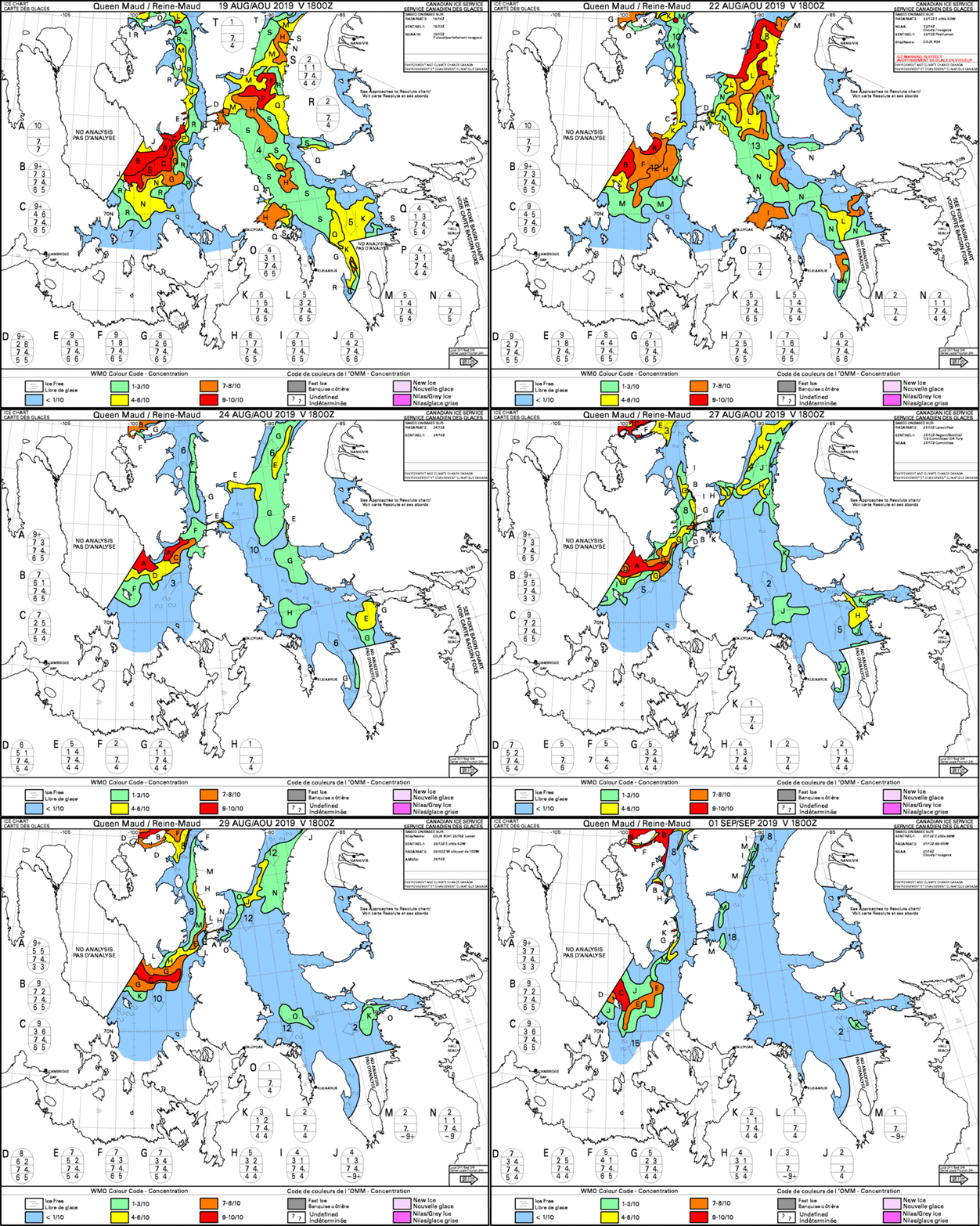
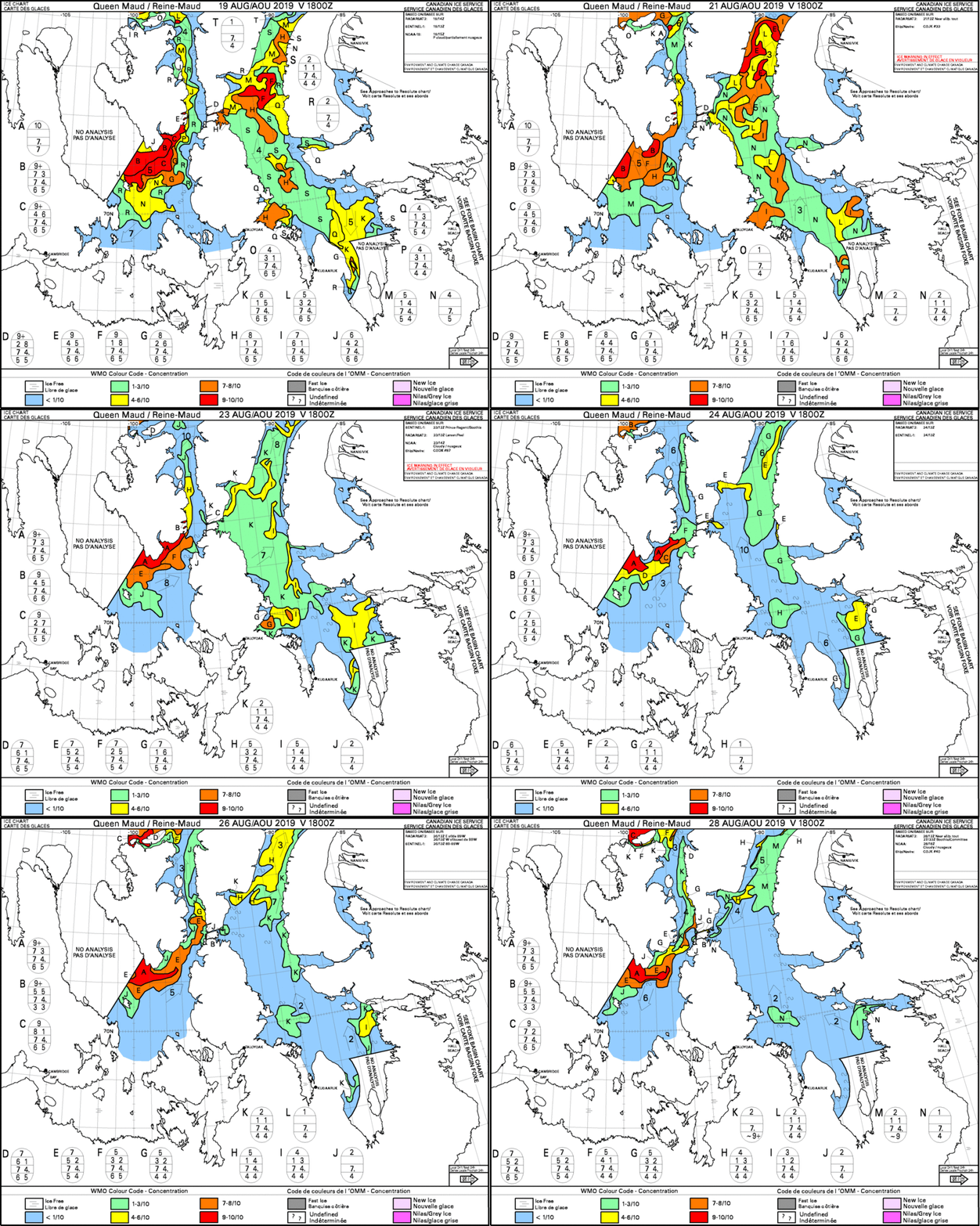
Background information is reprinted later on.  Above shows the last two weeks of shifting ice concentrations in the NWP choke point, Queen Maud region. Aug. 19 Prince Regent Inlet, top center was plugged, while Peel Sound, top left opened up and allowed passage.  In just a week or so, Prince Regent turned green (<3/10 covered) to blue.  At the same time thick ice dissipated in Franklin Strait, center left, opening the way SW. In just the last few days a tongue of thick ice has formed at the extreme top of Peel Sound, obstructing entrance from the north.

Note on the map right edge the reference to Foxe Basin, a body of open water south of Baffin Island.  The channel connecting into Gulf of Boothia is blocked most years, but was open in 2016, and passable now.  This is an alternate NWP route when Bellot Strait is also open.

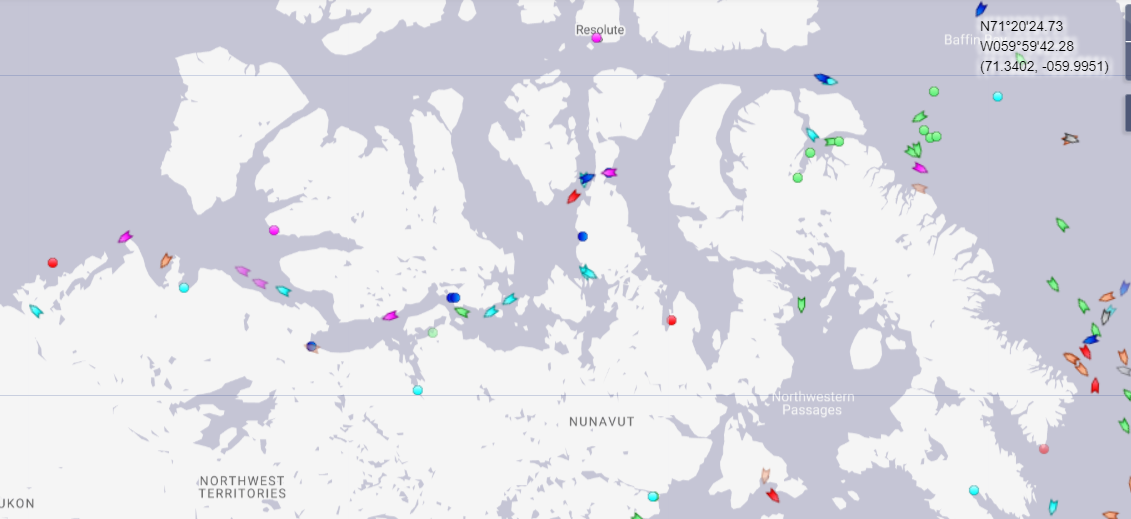
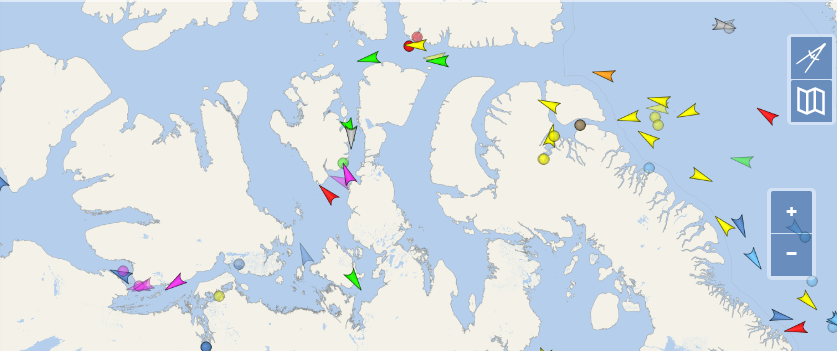
This is today’s map of vessels in the NWP.  Cargo ships in green, tugs in cyan, Passenger ships in blue, yachts in purple.  Note that Peel Sound was the preferred route earlier, now ships are using Bellot strait.

Less Artic Ice This year

The CAA region (Canadian Arctic Archipelago) shown above has much less ice this year, along with most of the Arctic ocean.

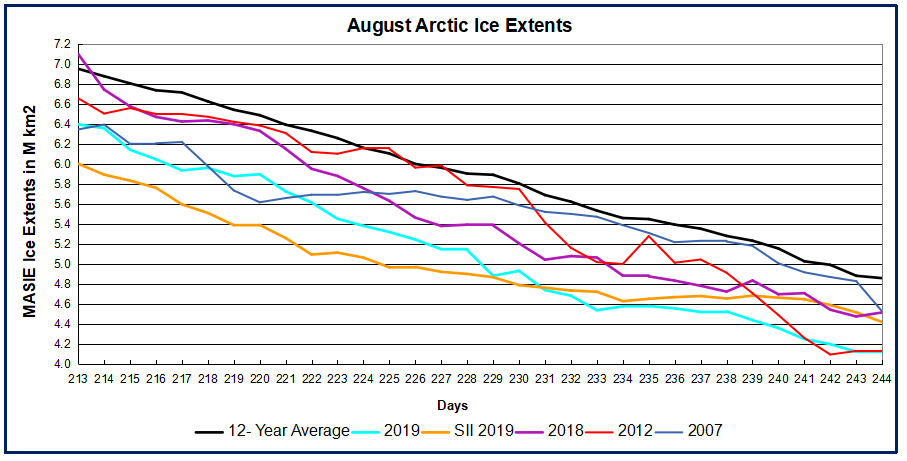
As the graph shows, MASIE ice extent this year is presently as low as 2012, year of the Great Arctic Cyclone.  SII is showing about 300k km2 more ice, and matching MASIE 2018 and 2007.  All are below the 12 year average at Sept. 1 (day 244).  The table below provides the numbers by regions.

Region 2019244 Day 244 Average 2019-Ave. 2018244 2019-2018
 (0) Northern_Hemisphere 4113725 4857617 -743892 4514946 -401222
 (1) Beaufort_Sea 362877 531979 -169101 529700 -166823
 (2) Chukchi_Sea 139335 219474 -80139 178633 -39299
 (3) East_Siberian_Sea 96512 356347 -259835 475647 -379135
 (4) Laptev_Sea 102556 172240 -69684 21366 81190
 (5) Kara_Sea 2479 40884 -38405 235 2244
 (6) Barents_Sea 23037 21055 1981 0 23037
 (7) Greenland_Sea 127514 171819 -44304 79706 47808
 (8) Baffin_Bay_Gulf_of_St._Lawrence 10485 27726 -17241 28385 -17900
 (9) Canadian_Archipelago 238187 307540 -69353 364406 -126219
 (10) Hudson_Bay 0 21905 -21905 23268 -23268
 (11) Central_Arctic 3010000 2985788 24211 2813056 196944

The NH ice extent is 744k km2 or 15% below average.  Most of the deficit is in the first four regions, BCE and Laptev.  CAA is almost 70k km2 or 23% below its average.  Other regions have smaller deficits and Central Arctic is in slight surplus.

Background:  The Outlook in 2007

From Sea Ice in Canada’s Arctic: Implications for Cruise Tourism by Stewart et al. December 2007. Excerpts in italics with my bolds.

Although cruise travel to the Canadian Arctic has grown steadily since 1984, some commentators have suggested that growth in this sector of the tourism industry might accelerate, given the warming effects of climate change that are making formerly remote Canadian Arctic communities more accessible to cruise vessels. Using sea-ice charts from the Canadian Ice Service, we argue that Global Climate Model predictions of an ice-free Arctic as early as 2050-70 may lead to a false sense of optimism regarding the potential exploitation of all Canadian Arctic waters for tourism purposes. This is because climate warming is altering the character and distribution of sea ice, increasing the likelihood of hull-penetrating, high-latitude, multi-year ice that could cause major pitfalls for future navigation in some places in Arctic Canada. These changes may have negative implications for cruise tourism in the Canadian Arctic, and, in particular, for tourist transits through the Northwest Passage and High Arctic regions.

The most direct route through the Northwest Passage is via Viscount Melville Sound into the M’Clure Strait and around the coast of Banks Island. Unfortunately, this route is marred by difficult ice, particularly in the M’Clure Strait and in Viscount Melville Sound, as large quantities of multi-year ice enter this region from the Canadian Basin and through the Queen Elizabeth Islands.

As Figure 5 illustrates, difficult ice became particularly evident, hence problematic, as sea-ice concentration within these regions increased from 1968 to 2005; as well, significant increases in multi-year ice are present off the western coast of Banks Island as well. Howell and Yackel (2004) illustrated that ice conditions within this region during the 1969–2002 navigation seasons exhibited greater severity from 1969 to1979 than from 1991 to 2002. This variability likely is a reflection of the extreme light-ice season present in 1998(Atkinson et al., 2006), from which the region has since recovered. Cruise ships could use the Prince of Wales Strait to avoid the choke points on the western coast of Banks Island, but entry is difficult; indeed, Howell and Yackel (2004) showed virtually no change in ease of navigation from 1969 to 2002.

An alternative, longer route through the Northwest Passage passes through either Peel Sound or the Bellot Strait. The latter route potentially could avoid hazardous multi-year ice in Peel Sound, but its narrow passageway makes it unfeasible for use by larger vessels. Regardless of which route is selected, a choke point remains in the vicinity of the Victoria Strait (Fig. 5). This strait acts as a drain trap for multi-year ice that has entered the M’Clintock Channel region and gradually advances south-ward (Howell and Yackel, 2004; Howell et al., 2006). While Howell and Yackel (2004) showed slightly safer navigation conditions from 1991 to 2002 compared to 1969 to 1990, they attributed this improvement to the anomalous warm year of 1998 that removed most of the multi-year ice in the region. From 2000 to 2005, when conditions began to recover from the 1998 warming, atmospheric forcing was insufficient to break up the multi-year ice that entered the M’Clintock Channel. Instead the ice became mobile, flowing southward into the Victoria Strait as the surrounding first-year ice broke up earlier (Howell et al., 2006).

During the past 20 years, cruises gradually have become an important element of Canadian Arctic tourism, and currently there seems to be consensus about the cruise industry’s inevitable growth, especially in the vicinity of Baffin Bay. However, we have stressed the likelihood that sea-ice hazards will continue to exist and will present ongoing navigational challenges to tour operators, particularly those operating in the western regions of the Canadian Arctic.

Fast Forward to Summer of 2018:  Northwest Passage Proved Impassable

August 23, 2018 . At least 22 vessels are affected and several have turned back to Greenland.

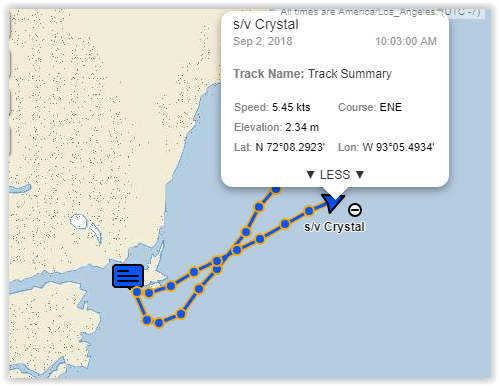
Reprinted from post on September 3, 2018:  News today from the Northwest Passage blog that S/V CRYSTAL has given up after hanging around Fort Ross hoping for a storm or melting to break the ice barrier blocking their way west.
20180902-1025_crystal

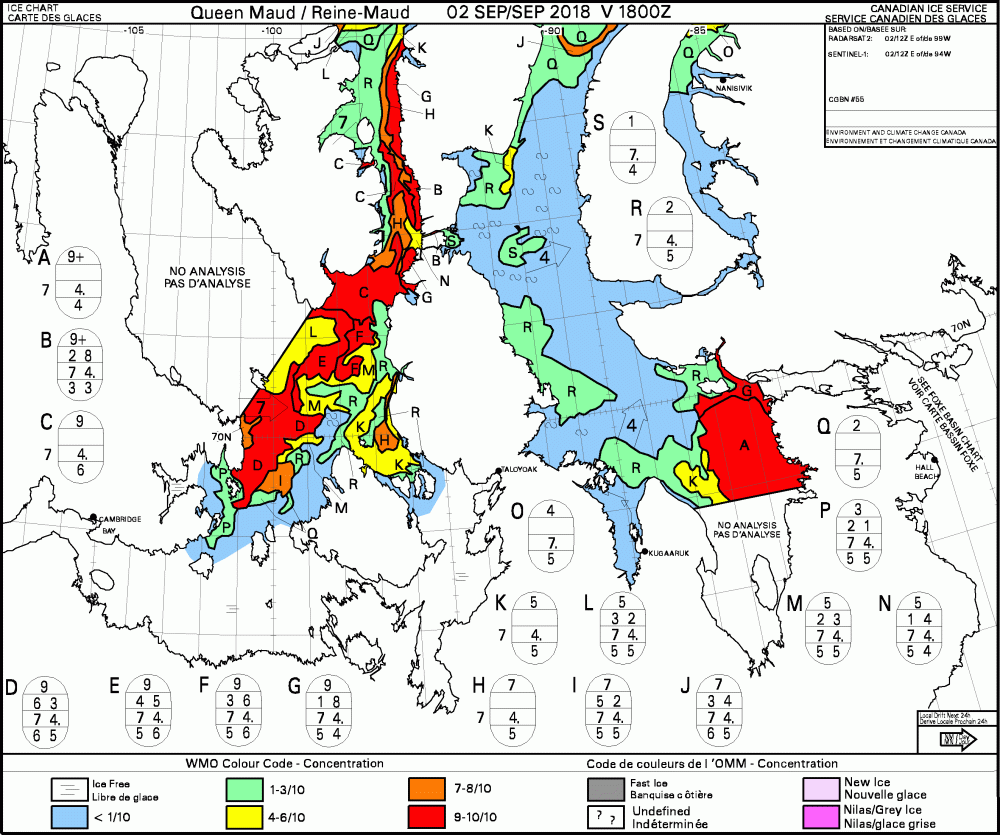
As the vessel tracker shows, they have been forced to Plan C, which is returning to Greenland and accept that the NW Passage is closed this year. The latest ice chart gave them no hope for getting through.  Note yachts can sail through green (3/10), so the hope is for red to yellow to green.  But that did not happen last year.
20180902180000_wis38ct_0010210949

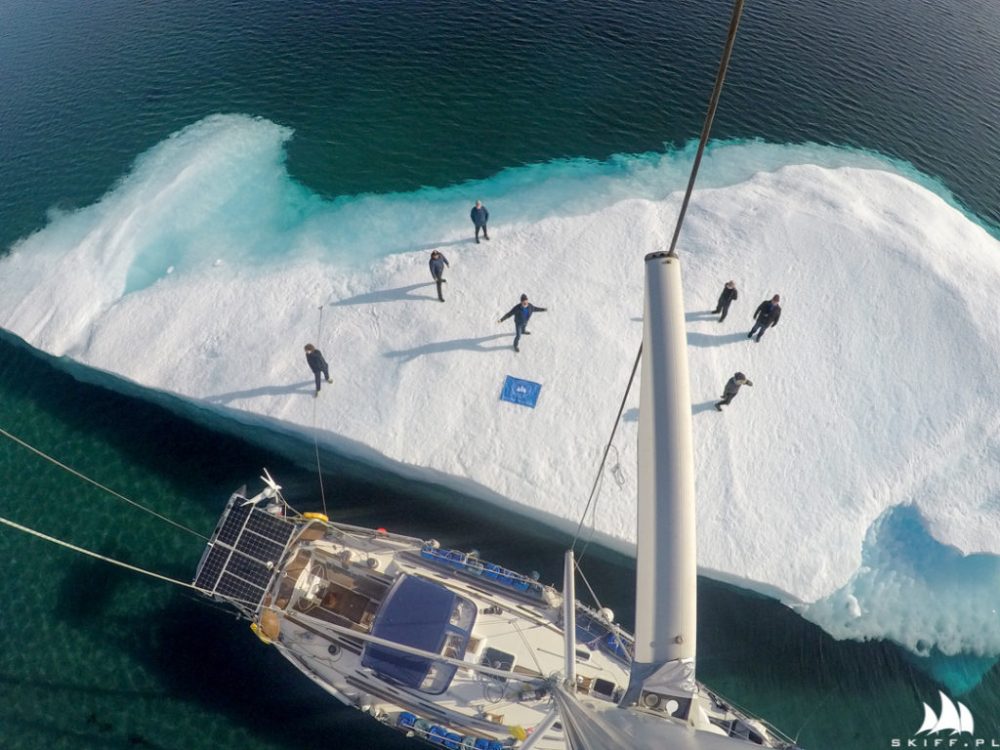
The image below shows the ice with which they were coping.
DCIM100GOPROGOPR5778.

More details at NW Passage blog 20180902 S/V CRYSTAL and S/V ATKA give up and retreat back to Greenland – Score ICE 3 vs YACHTS 0

Current Situation in Canadian Arctic Archipelago

The current ice map of Queen Maude region shows the difference between 2019 and last year.

Remembering that yachts need at most 1-3/10 ice conditions (light green), it is showing Peel Sound on the left side is open now, but was the obstruction last year.  Not shown but also important is open water in Barrow Strait allowing access to Peel Sound from the north.  Conversely, on the top right Prince Regent Inlet is plugged at the top and impassable for now, and perhaps for the year.

As reported at the Northwest Passage Blogspot, yachts are taking the Peel Sound route this year, rather than using Prince Regent Inlet and Bellot Strait, due to ice conditions. Excerpts in italics with my bolds.

Peel Sound, With Trepidation
by Randall
August 16, 2019
Days at Sea: 262
Over the last few days, charts have shown a significant reduction in ice concentrations in Peel, but there is still ice, lots of ice. One hundred miles into the Sound from the N, there is a band of 4-6/10ths ice that is sixty-five miles long and covers both the eastern and western shores. Another one hundred miles below that is a large band of 1-3/10ths ice. Below that there is open water, but it is threatened by the heavy ice feeding in from M’Clintock Channel.

Add to this an imminent change in the weather. Long range forecasts are calling for a switch from these long-running E winds to SW winds and then strong southerlies that could scramble the current ice configuration.
Add to this a paucity of anchorages in Peel. Two of the best on the W coast are icebound. The next, False Strait, is just above Bellot Strait and 165 miles from the opening.

In the evening I reach out to the ice guide, Victor Wejer, for a consult on anchorages. Mo needs a place to hide if things go badly. I show him the areas I’ve chosen.

“This is a subject I would like to avoid,” he replies. “It is not written in stone that you must take the entirety of Peel in one go, but it is the usual way. Read the Canadian Sailing Directions. The height of Somerset Island does weird things to the wind; it can go from calm to gale in an instant. Most of what look like anchorages on the chart are just not safe.”

“As to ice,” he continues, “this is also difficult. Peel is narrow and fed from M’Clintock. Most sailboat crews fight tooth and ice pole to get through. Consider that Matt Rutherford chose Prince Regent. But for you there may not be an option. Regent will not be clear for a long time; maybe not at all this year.”
By now four boats are through Peel, below Bellot Strait and on their way to Gjoa Haven. Yellow-hulled Breskell is one of them, but it has taken her four days to transit 200 miles, and I can tell from the way Olivier writes his encouraging emails that he has his doubts about doing it solo.

MO IS THROUGH THE ICE!
by Randall
August 19, 2019
1845 local
70 32S 97 27W
Larsen Sound
The Arctic

Just a quick note to report that Mo is through the ice and sailing fast on a N wind for Cambridge Bay, 235 miles SW.

I have been pushing to get to Alioth’s position for two days. She has a busted gear box and can’t make more than three knots under power. She has been hove to at the head of our last major ice plug waiting for an escort as she’d have to sail through, a tricky business.

We’ve all been sweating bullets over this last 30 miles of ice, and for four days I’ve been underway and hand steering for 18 to 20 hours a day through 3 – 5/10ths ice to get here. Only a few hours sleep a night this last week.

As it turns out, today was a piece of cake. We saw huge ice floes the size of city blocks but with wide lanes in between. Alioth and another boat, Mandregore, sailed downwind without trouble with Mo bringing up the rear under power just in case.

Why Climate Journalism Sucks

At MondayNote, Frederic Filloux writes The Hazards of Covering Climate Change.  Without taking sides he describes why media coverage of global warming/climate change is so incompetent.  Excerpts in italics with my bolds.

Zeal, political agendas, all kinds of excesses, but above all the intrinsic complexity of the issue, make the climate crisis extremely challenging to cover. Newsrooms should tackle the problem decisively.

Spending a few weeks in California this summer, I talked to many fellow journalists about the issue of covering the climate crisis. What I found is a yawning gap in the way it is approached.

In broad strokes, the coverage of climate change in Europe — especially in France — is loaded with negativism and finger-pointing while the US conversation seems more focused on finding broad, tech-driven, solutions. Neither is exempt from caricatures.

European ecology yields a political agenda which questions the relevance of the free market economy in a way that reminds of the Marxism activism in the ’70s. To many eco-activists, responding to the climate crisis requires a Malthusian approach, with all sorts of constraints on the way we travel, commute, eat, and consume that will involve some curtailing of individual liberties (as a French socialist leader put it a few weeks ago).

The buzzword is now “degrowth”. Economic contraction is the only way, never mind the collateral damages. Europe has its icons like Greta Thunberg, the young Swedish activist who preaches her doomsday prophecy with more whimsy than facts or knowledge.

The current ideological hodgepodge does not foster nuances: you are either with or against. For instance, questioning the media circus around the Swedish girl, and denouncing the cynicism of her handlers who uses her autism as a marketing tool, even if you agree with her on the fundamentals, will leave you categorized as part of the white, privileged, sexist dominant caste climate deniers.

Suggesting that French president Macron’s move to give up research on fourth-generation nuclear energy is a terrible decision (The French nuclear program allows France to emit only one-tenth of Germany’s CO2 per kWh of electricity), will also put you in the “climate-negationists” league, an elegant term alluding to Holocaust deniers.

On the matter of nuclear energy, the French press is doing such a terrible job that 86 percent of the 18–24 years old believe that the cooling towers of a nuclear plant spit out CO2 (it’s vapor).

As an American fellow journalist told me last week, “Europe succumbs to a kind of withdrawal while the United States is looking for tech solutions”. The fact is, by and large, the coverage of the climate crisis in the American media, is more proactive and less whining than the one in Europe, despite Donald Trump’s compulsive anti-environment stance. The tech and business press always seem eager to report on breakthroughs that could contain the crisis. As I observed in Silicon Valley last month, an unprecedented number of startups are working in the field. They range from optimizing the global food supply-chain to developing ways to save water (while just 130 miles south of San Francisco farmers continue to irrigate in the worse possible way) to make buildings greener. Venture capital investors are injecting billions of dollars in Greentech. While many European ecologists blame capitalism for the degradation of the planet (ignoring that the worse polluters are still in the former USSR and in China), entrepreneurship is in full swing in the United States, even if it sometimes comes with a dose of naïveté and unrealistic expectations.

Let’s get back to journalism.

By and large, newsrooms are not currently up to the task. Despite highly publicized initiatives taken by large publishers and noteworthy initiatives such as the #CoveringClimateNow partnership, the bulk of the coverage is terrible.

For the most part, it oscillates between an ideological stance and an irrational exuberance for technological promises. Approximation and caricature are rampant. Periodically, haste leads to false information that is quickly exploited by true climate deniers.

When covering the climate crisis, mistakes carry way more consequences than for any other beat.

The complexity of the subject makes it incompatible with the brevity of social media. Elizabeth Kolbert’s seminal piece in the New Yorker, The Sixth Extinction, published in 2009, could not have been chopped down into a tweetstorm. Reporters should be encouraged to embrace complexity. Unfortunately, they don’t have the time nor the training. That is also the consequences of newsrooms trends that often considered science journalism as a genre mineur

It is time for decisive actions. Given what’s at stake, J-schools must create specific curriculum aimed at feeding much-needed news desks that are currently non-existent in most newsrooms. Addressing the issue requires a multidisciplinary approach: rethinking the relation to cities, transportation, public policies, macro-economy, and innovation. If specific expertise is needed in newsrooms, it is definitely to cover this beat (plus, it can be a highly beneficial sector: the first outlet to become a reference in the field will reap substantial profits).


Climate Delusional Disorder (CDD)


WebMD tells What You Need to Know about this condition.  Delusions and Delusional Disorder. Excerpts in italics with my bolds.

Delusions are the main symptom of delusional disorder. They’re unshakable beliefs in something that isn’t true or based on reality. But that doesn’t mean they’re completely unrealistic. Delusional disorder involves delusions that aren’t bizarre, having to do with situations that could happen in real life, like being followed, poisoned, deceived, conspired against, or loved from a distance. These delusions usually involve mistaken perceptions or experiences. But in reality, the situations are either not true at all or highly exaggerated.

People with delusional disorder often can continue to socialize and function normally, apart from the subject of their delusion, and generally do not behave in an obviously odd or bizarre manner. This is unlike people with other psychotic disorders, who also might have delusions as a symptom of their disorder. But in some cases, people with delusional disorder might become so preoccupied with their delusions that their lives are disrupted.

What Are the Complications of Delusional Disorder?

  • People with delusional disorder might become depressed, often as the result of difficulties associated with the delusions.
  • Acting on the delusions also can lead to violence or legal problems. For example, a person with an erotomanic delusion who stalks or harasses the object of the delusion could be arrested.
  • Also, people with this disorder can become alienated from others, especially if their delusions interfere with or damage their relationships.

Treatment most often includes medication and psychotherapy (a type of counseling). Delusional disorder can be very difficult to treat, in part because those who have it often have poor insight and do not know there’s a psychiatric problem. Studies show that close to half of patients treated with antipsychotic medications show at least partial improvement.

Delusional disorder is typically a chronic (ongoing) condition, but when properly treated, many people can find relief from their symptoms. Some recover completely, while others have bouts of delusional beliefs with periods of remission (lack of symptoms).

Unfortunately, many people with this disorder don’t seek help. It’s often hard for people with a mental disorder to know they aren’t well. Or they may credit their symptoms to other things, like the environment. They also might be too embarrassed or afraid to seek treatment. Without treatment, delusional disorder can be a lifelong illness.

An example of CDD

H.Sterling Burnett and James Taylor write at Epoch Times United Nations Misleads About Food Production and Climate Change. Excerpts in italics with my bolds

There is no better way to describe the arguments contained in the U.N. Intergovernmental Panel on Climate Change’s (IPCC) new report, “Climate Change and Land,” released just in time to influence discussions at the United Nations’ 68th Civil Society Conference. Citing anecdotal evidence instead of hard data, IPCC’s new report paints a dark, disturbing picture about the current and future state of crop production and food availability.

“Climate change, including increases in frequency and intensity of extremes, has adversely impacted food security and terrestrial ecosystems as well as contributed to desertification and land degradation in many regions,” the report claims.

“Warming compounded by drying has caused yield declines in parts of Southern Europe. Based on indigenous and local knowledge, climate change is affecting food security in drylands, particularly those in Africa, and high mountain regions of Asia and South America,” the report continues.

Here, climate alarmists in the United Nations are doing nothing more than “pounding the table,” hoping fear will drive the public to demand “climate action now!”

Of course, the fake news media eagerly amplified the alarmist report. For example, an Aug. 8 NBC News headline reads, “Climate change could trigger a global food crisis, new U.N. report says.” Many other major media outlets published similar stories.

The biggest problem is the report’s thesis and “facts” are totally wrong—and that’s quite a problem!

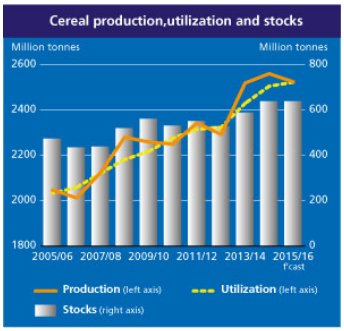
For instance, the United Nations’ own data shows farmers throughout the world are setting new production records virtually every year. In fact, the U.N. Food and Agriculture Organization reports new records were set in each of the past five years for global cereal production, which is composed of the Big Three food staples: corn, wheat, and rice.

Indeed, World-Grain.com reports in 2016 world cereal production broke records for the third straight year, exceeding the previous record yield, recorded in 2015, by 1.2 percent and topping the record yield in 2014 by 1.5 percent. These facts should not surprise anyone because hundreds of studies and experiments conclusively demonstrate plants do better under conditions of higher carbon dioxide and modestly warmer temperatures.

The ongoing record crop production perfectly illustrates the difference between the Climate Delusion perpetrated by IPCC and other government-funded alarmists and what is actually happening in the real world. To make the news gloomy, IPCC’s report nefariously engages in semantic tricks to give readers a false impression of declining global crop production. The report cites anecdotal evidence crop yields are declining in “parts” of Southern Europe, ignoring copious data showing crop yields are rising across the globe, including throughout Southern Europe.

Instead of highlighting this welcome development, IPCC focuses on what it claims are yield reductions in some small regions of Southern Europe. Readers who are not paying close attention will be led to believe, incorrectly, that crop yields are declining throughout Southern Europe. In reality, the exact opposite is true!

IPCC claims “indigenous and local knowledge” indicates food production is declining “in drylands” in Africa, Asia, and South America. However, such indigenous and local knowledge does not trump objective data, which are readily available to IPCC’s authors and show crop yields are increasing throughout Africa, Asia, and South America as a whole, including in dryland areas.

Tragically, IPCC’s misleading claims result in people who dare to point out crop production continues to set new records being accused of “denying” climate change and attacking science. Climate change is real and record crop production is in fact consistent with it. In fact, record crop production is partly due to climate change.

This is just the latest example of the ongoing Climate Delusion, as radical environmental activists, government bureaucrats, socialists, and a biased news media, looking to transform U.S. society, repeatedly make ridiculous climate claims with no basis in real environmental conditions. They hope the constant drumbeat of authoritative-sounding claims will fool people into stampeding politicians to give governments more power over the economy to combat the false climate crisis.

Fortunately, we can avoid this fate. Factual data showing the truth about global food supplies and other climate conditions are readily available to anyone willing to search the internet. Let’s hope the public accesses the facts. Enacting policies that restrict the use of abundant energy supplies will rob people of choice and harm the economy. This won’t hurt the global elite, but it will result in everyone else living poorer, more precarious lives.

See also Alarmists Anonymous

Northwest Passage Update 2019 08 28

Update on Northwest Passage Traffic August 29, 2019

Background information is reprinted later on.  Above shows the last 10 days of shifting ice concentrations in the NWP choke point, Queen Maud region. Aug. 19 Prince Regent Inlet, top center was plugged, while Peel Sound, top left opened up and allowed passage.  In just a week or so, Prince Regent turned green (<1/3 covered) to blue.  At the same time thick ice dissipated in Franklin Strait, center left, opening the way SW.

Note on the map right edge the reference to Foxe Basin, a body of open water south of Baffin Island.  The channel connecting into Gulf of Boothia is blocked most years, but was open in 2016, and passable now.  This is an alternate NWP route when Bellot Strait is also open.

This is today’s map of vessels in the NWP.  Cargo ships in yellow, Passenger ships in green, yachts in purple.  Note that Peel Sound is the preferred route this year.

Background:  The Outlook in 2007

From Sea Ice in Canada’s Arctic: Implications for Cruise Tourism by Stewart et al. December 2007. Excerpts in italics with my bolds.

Although cruise travel to the Canadian Arctic has grown steadily since 1984, some commentators have suggested that growth in this sector of the tourism industry might accelerate, given the warming effects of climate change that are making formerly remote Canadian Arctic communities more accessible to cruise vessels. Using sea-ice charts from the Canadian Ice Service, we argue that Global Climate Model predictions of an ice-free Arctic as early as 2050-70 may lead to a false sense of optimism regarding the potential exploitation of all Canadian Arctic waters for tourism purposes. This is because climate warming is altering the character and distribution of sea ice, increasing the likelihood of hull-penetrating, high-latitude, multi-year ice that could cause major pitfalls for future navigation in some places in Arctic Canada. These changes may have negative implications for cruise tourism in the Canadian Arctic, and, in particular, for tourist transits through the Northwest Passage and High Arctic regions.

The most direct route through the Northwest Passage is via Viscount Melville Sound into the M’Clure Strait and around the coast of Banks Island. Unfortunately, this route is marred by difficult ice, particularly in the M’Clure Strait and in Viscount Melville Sound, as large quantities of multi-year ice enter this region from the Canadian Basin and through the Queen Elizabeth Islands.

As Figure 5 illustrates, difficult ice became particularly evident, hence problematic, as sea-ice concentration within these regions increased from 1968 to 2005; as well, significant increases in multi-year ice are present off the western coast of Banks Island as well. Howell and Yackel (2004) illustrated that ice conditions within this region during the 1969–2002 navigation seasons exhibited greater severity from 1969 to1979 than from 1991 to 2002. This variability likely is a reflection of the extreme light-ice season present in 1998(Atkinson et al., 2006), from which the region has since recovered. Cruise ships could use the Prince of Wales Strait to avoid the choke points on the western coast of Banks Island, but entry is difficult; indeed, Howell and Yackel (2004) showed virtually no change in ease of navigation from 1969 to 2002.

An alternative, longer route through the Northwest Passage passes through either Peel Sound or the Bellot Strait. The latter route potentially could avoid hazardous multi-year ice in Peel Sound, but its narrow passageway makes it unfeasible for use by larger vessels. Regardless of which route is selected, a choke point remains in the vicinity of the Victoria Strait (Fig. 5). This strait acts as a drain trap for multi-year ice that has entered the M’Clintock Channel region and gradually advances south-ward (Howell and Yackel, 2004; Howell et al., 2006). While Howell and Yackel (2004) showed slightly safer navigation conditions from 1991 to 2002 compared to 1969 to 1990, they attributed this improvement to the anomalous warm year of 1998 that removed most of the multi-year ice in the region. From 2000 to 2005, when conditions began to recover from the 1998 warming, atmospheric forcing was insufficient to break up the multi-year ice that entered the M’Clintock Channel. Instead the ice became mobile, flowing southward into the Victoria Strait as the surrounding first-year ice broke up earlier (Howell et al., 2006).

During the past 20 years, cruises gradually have become an important element of Canadian Arctic tourism, and currently there seems to be consensus about the cruise industry’s inevitable growth, especially in the vicinity of Baffin Bay. However, we have stressed the likelihood that sea-ice hazards will continue to exist and will present ongoing navigational challenges to tour operators, particularly those operating in the western regions of the Canadian Arctic.

Fast Forward to Summer of 2018:  Northwest Passage Proved Impassable

August 23, 2018 . At least 22 vessels are affected and several have turned back to Greenland.

Reprinted from post on September 3, 2018:  News today from the Northwest Passage blog that S/V CRYSTAL has given up after hanging around Fort Ross hoping for a storm or melting to break the ice barrier blocking their way west.
20180902-1025_crystal

As the vessel tracker shows, they have been forced to Plan C, which is returning to Greenland and accept that the NW Passage is closed this year. The latest ice chart gave them no hope for getting through.  Note yachts can sail through green (3/10), so the hope is for red to yellow to green.  But that did not happen last year.
20180902180000_wis38ct_0010210949

The image below shows the ice with which they were coping.
DCIM100GOPROGOPR5778.

More details at NW Passage blog 20180902 S/V CRYSTAL and S/V ATKA give up and retreat back to Greenland – Score ICE 3 vs YACHTS 0

Current Situation in Canadian Arctic Archipelago

The current ice map of Queen Maude region shows the difference between 2019 and last year.

Remembering that yachts need at most 1-3/10 ice conditions (light green), it is showing Peel Sound on the left side is open now, but was the obstruction last year.  Not shown but also important is open water in Barrow Strait allowing access to Peel Sound from the north.  Conversely, on the top right Prince Regent Inlet is plugged at the top and impassable for now, and perhaps for the year.

As reported at the Northwest Passage Blogspot, yachts are taking the Peel Sound route this year, rather than using Prince Regent Inlet and Bellot Strait, due to ice conditions. Excerpts in italics with my bolds.

Peel Sound, With Trepidation
by Randall
August 16, 2019
Days at Sea: 262
Over the last few days, charts have shown a significant reduction in ice concentrations in Peel, but there is still ice, lots of ice. One hundred miles into the Sound from the N, there is a band of 4-6/10ths ice that is sixty-five miles long and covers both the eastern and western shores. Another one hundred miles below that is a large band of 1-3/10ths ice. Below that there is open water, but it is threatened by the heavy ice feeding in from M’Clintock Channel.

Add to this an imminent change in the weather. Long range forecasts are calling for a switch from these long-running E winds to SW winds and then strong southerlies that could scramble the current ice configuration.
Add to this a paucity of anchorages in Peel. Two of the best on the W coast are icebound. The next, False Strait, is just above Bellot Strait and 165 miles from the opening.

In the evening I reach out to the ice guide, Victor Wejer, for a consult on anchorages. Mo needs a place to hide if things go badly. I show him the areas I’ve chosen.

“This is a subject I would like to avoid,” he replies. “It is not written in stone that you must take the entirety of Peel in one go, but it is the usual way. Read the Canadian Sailing Directions. The height of Somerset Island does weird things to the wind; it can go from calm to gale in an instant. Most of what look like anchorages on the chart are just not safe.”

“As to ice,” he continues, “this is also difficult. Peel is narrow and fed from M’Clintock. Most sailboat crews fight tooth and ice pole to get through. Consider that Matt Rutherford chose Prince Regent. But for you there may not be an option. Regent will not be clear for a long time; maybe not at all this year.”

By now four boats are through Peel, below Bellot Strait and on their way to Gjoa Haven. Yellow-hulled Breskell is one of them, but it has taken her four days to transit 200 miles, and I can tell from the way Olivier writes his encouraging emails that he has his doubts about doing it solo.

MO IS THROUGH THE ICE!
by Randall
August 19, 2019
1845 local
70 32S 97 27W
Larsen Sound
The Arctic

Just a quick note to report that Mo is through the ice and sailing fast on a N wind for Cambridge Bay, 235 miles SW.

I have been pushing to get to Alioth’s position for two days. She has a busted gear box and can’t make more than three knots under power. She has been hove to at the head of our last major ice plug waiting for an escort as she’d have to sail through, a tricky business.

We’ve all been sweating bullets over this last 30 miles of ice, and for four days I’ve been underway and hand steering for 18 to 20 hours a day through 3 – 5/10ths ice to get here. Only a few hours sleep a night this last week.

As it turns out, today was a piece of cake. We saw huge ice floes the size of city blocks but with wide lanes in between. Alioth and another boat, Mandregore, sailed downwind without trouble with Mo bringing up the rear under power just in case.

El Nino’s Cold Tongue Baffles Climate Models


This post is prompted by an article published by Richard Seager et al. at AMS Journal Is There a Role for Human-Induced Climate Change in the Precipitation Decline that Drove the California Drought? Excerpts in italics with my bolds.

Overview

The recent California drought was associated with a persistent ridge at the west coast of North America that has been associated with, in part, forcing from warm SST anomalies in the tropical west Pacific. Here it is considered whether there is a role for human-induced climate change in favoring such a west coast ridge. The models from phase 5 of the Coupled Model Intercomparison Project do not support such a case either in terms of a shift in the mean circulation or in variance that would favor increased intensity or frequency of ridges. The models also do not support shifts toward a drier mean climate or more frequent or intense dry winters or to tropical SST states that would favor west coast ridges. However, reanalyses do show that over the last century there has been a trend toward circulation anomalies over the Pacific–North American domain akin to those during the height of the California drought.

Position of the Warm Pool in the western Pacific under La Niña conditions, and the convergence zone where the Warm Pool meets nutrient-enriched waters of the eastern equatorial Pacific. Tuna and their prey are most abundant in this convergence zone 21,48 (source: HadISST) 109 .

First we plot together the history of California winter precipitation and Arctic sea ice anomaly in terms of area covered by ice at the annual minimum month of September and also as the November through April winter average (Fig. 9, top). While all three are of course negative during the drought years there is no year to year relationship between these quantities. Next we composite 200-mb height anomalies, U.S. precipitation, and sea ice concentration for, during the period covered by sea ice data, the driest 15% of California winters and subtract the climatological winter values (Fig. 9, bottom). As in Seager et al. (2015), the composites show that when California is dry the entire western third of the United States tends to be dry and that there is a high pressure ridge located immediately off the west coast, which does not appear to be connected to a tropically sourced wave train. There also tends to be a trough over the North Atlantic, similar to winter 2013/14. There are notable localized sea ice concentration anomalies with increased ice in the Sea of Okohtsk, reduced ice in the Bering Sea, and increased ice in Hudson Bay and Labrador Sea, though the anomalies are small. These ice anomalies are consistent with atmospheric forcing. The Sea of Okhotsk and Hudson Bay/Labrador Sea anomalies appear under northerly flow that would favor cold advection and increased ice. The Bering Sea anomaly appears under easterly flow that would drive ice offshore. As shown by Seager et al. (2015), the dry California winters are also associated with North Pacific SST anomalies forced by the atmospheric wave train and the sea ice anomalies appear part of this feature rather than as causal drivers of the atmospheric circulation anomalies.

These analyses do not support the idea that variations in sea ice extent influence the prevalence of west coast ridges or dry winters in California.

Source: NASA

On the basis of the above analysis we conclude that the occurrence of persistent ridges at the west coast is more connected to SST anomalies than it is to sea ice anomalies. The CMIP5 model ensemble lends no support to the idea that ridge-inducing SST patterns become more likely as a result of rising GHGs. However, the models could be wrong so we next examine whether trends in observed SSTs lend any support to this idea. Trends were computed by straightforward linear least squares regression.

A number of features stand out in these trends regardless of the time period used.

  • Amid near-ubiquitous warming of the oceans the central equatorial Pacific stands out as a place that has not warmed.
  • The west–east SST gradient across the tropical Pacific has strengthened as the west Pacific has warmed.
  • Increased reanalysis precipitation over the Indian Ocean–Maritime Continent–tropical west Pacific and reduced reanalysis precipitation over the central equatorial Pacific Ocean were found.
  • Tropical geopotential heights have increased at all longitudes.
  • A trend toward a localized high pressure ridge extending from the subtropics toward Alaska across western North America.

These associations in the trends—a strengthened west–east SST gradient across the tropical Pacific and localized high pressure at the North American west coast—are in line with every piece of evidence based on observations and SST-forced models presented so far that there is a connection between drought-inducing circulation anomalies and tropical Pacific SSTs. The mediating influence is seen in the precipitation trends that show enhanced zonal gradients of tropical Indo-Pacific precipitation and a marked increase centered over the Maritime Continent region.

Conclusions and discussion

We have examined whether there is any evidence, observational and/or model based, that the precipitation decline that drove the California drought was contributed to by human-driven climate change. Findings are as follows:

  • The CMIP5 model ensemble provides no evidence for mean drying or increased prevalence of dry winters for California or a shift toward a west coast ridge either in the mean or as a more common event. They also provide no evidence of a shift in tropical SSTs toward a state with an increased west–east SST gradient that has been invoked as capable of forcing a west coast ridge and drought.
  • Analysis of observations-based reanalyses shows that west coast ridges, akin to that in winter 2013/14, are related to an increased west–east SST gradient across the tropical Pacific Ocean and have repeatedly occurred over past decades though as imperfect analogs.
  • SST-forced models can reproduce such ridges and their connection to tropical SST anomalies.  Century-plus-long reanalyses and SST-forced models indicate a long-term trend toward circulation anomalies more akin to that of winter 2013/14.
  • The trends of heights and SSTs in the reanalyses also show both an increased west–east SST gradient and a 200-mb ridge over western North America that, in terms of association between ocean and atmospheric circulation, matches those found via the other analyses on interannual time scales.
  • However, SST-forced models when provided the trends in SSTs create a 200-mb ridge over the central North Pacific and, in general, a circulation pattern that cannot be said to truly match that in reanalyses.

So can a case be made that human-driven climate change contributed to the precipitation drop that drives the drought? Not from the simulations of historical climate and projections of future climate of the CMIP5 multimodel ensemble.

These simulations show no current or future increase in the likelihood or extremity of negative precipitation, precipitation minus evaporation, west coast ridges, or ridge-forcing tropical SST patterns. However, when examining the observational record a case can be made that the climate system has been moving in a direction that favors both a ridge over the west coast, which has a limited similarity to that observed in winter 2013/14, the driest winter of the drought, and a ridge-generating pattern of increased west–east SST gradient across the tropical Pacific Ocean with warm SSTs in the Indo–west Pacific region. This observations-based argument then gets tripped up by SST-forced models, which know about the trends in SST but fail to simulate a trend toward a west coast ridge. On the other hand, idealized modeling indicates that preferential warming in the Indo–west Pacific region does generate a west coast ridge.

To make the argument we outline above requires rejecting the CMIP5 ensemble as a guide to how tropical climate responds to increased radiative forcing since this tropical ocean response is at odds with what they do. To do so follows in the footsteps of Kohyama and Hartmann (2017, p. 4248), who correctly point out that “El Niño–like mean-state warming is only a ‘majority decision’ based on currently available GCMs, most of which exhibit unrealistic nonlinearity of the ENSO dynamics” (see also Kohyama et al. 2017). The implications of changing tropical SST gradients would extend far beyond just California and include most regions of the world sensitive to ENSO-generated climate anomalies.

We believe that the current state of observational information, analysis of it, and climate modeling does not allow a confident rejection of the CMIP5 model responses and/or a confident assertion of human role in the precipitation drop of the California drought. We also believe that for the same reasons a human role cannot be excluded.

Comment:

The researchers set out to prove man-made global warming contributes to droughts in California, but their findings put them in a quandry.  The models include CO2 forcings, yet do not predict the conditions resulting in west coast droughts,   They have to admit the models are wrong in this respect (what else do the models get wrong?).  They cling to the hope that global warming can be tied to droughts, but have to admit there is no evidence from the failed models.

Postscript:

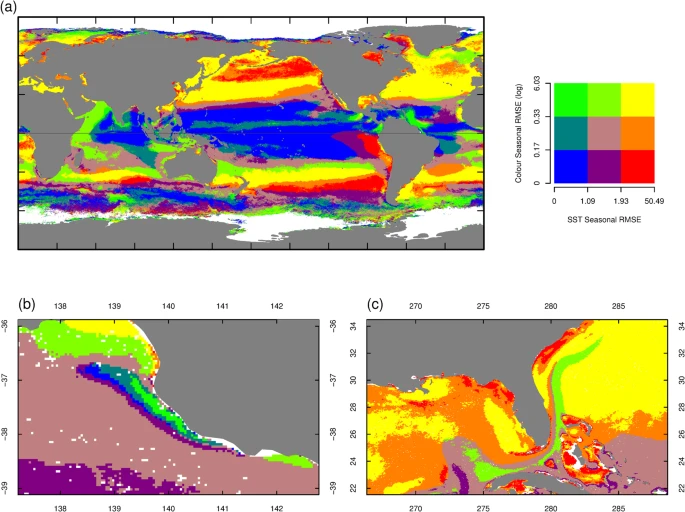
(a) Annual variation (Annual RMSE) of SST and Chl-a globally (units are °C/decade for SST and log(mg/m3/decade) for Chl-a). (b) The pattern of annual variation in the Bonney Upwelling, Southern Australia. (c) The pattern of annual variation in the the Florida Current, South East USA.


A separate study is Global patterns of change and variation in sea surface temperature and chlorophyll by Piers K. Dunstan et. al.

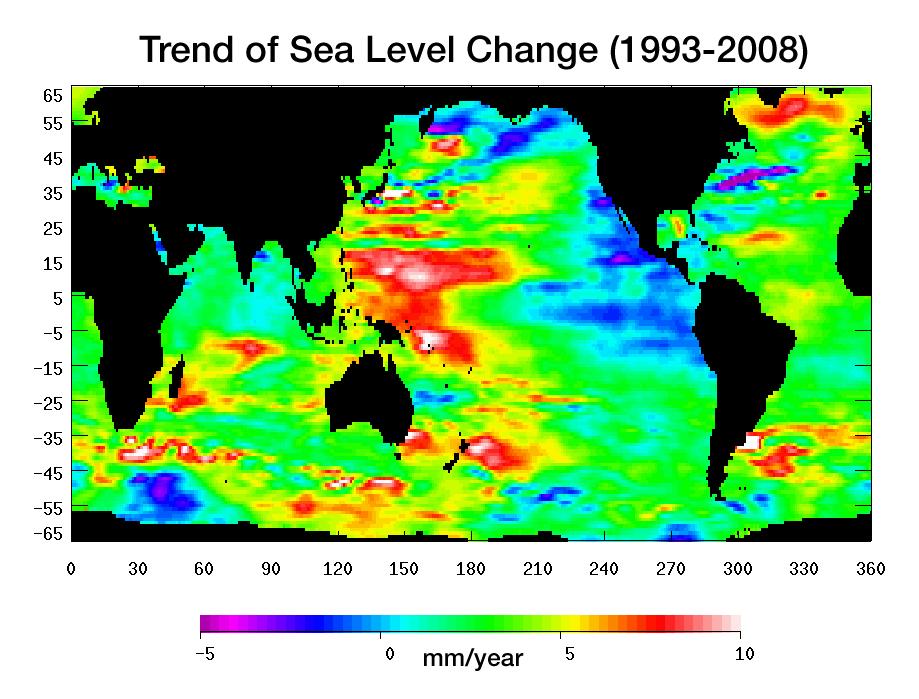
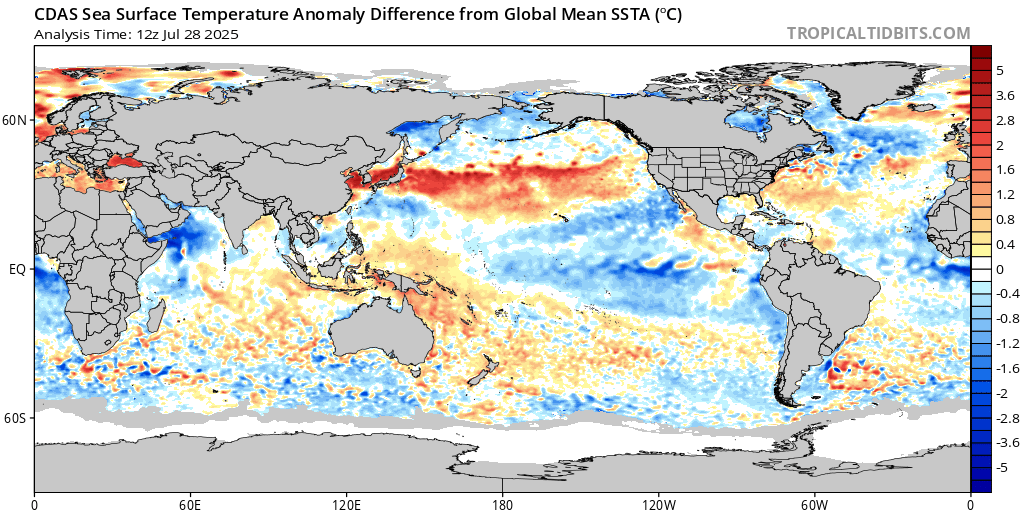
The blue tongue shows up as an equatorial pacific region that shows little variability over the 14 year period of study.  From the article:

The interaction between annual variation in SST and Chl-a provides insights into how and where linkages occur on annual time scales. Our analysis shows strong latitudinal bands associated with variation in seasonal warming (Fig. 4a). The equatorial Pacific, Indian and Atlantic Oceans are all characterised by very low annual RMSE for both SST and Chl-a. The mid latitudes of each ocean basin have higher variance in SST and/or Chl-a.

Closing the Endangered Species Piggy Bank

By Ronald W. Opsahl writes August 26, 2019, at Real Clear Policy Trump’s Environmental Reforms: Good for the Environment, Bad for Lawyers.  Excerpts in italics with my bolds.

Between 2016 and 2018, environmental groups filed over 170 lawsuits alleging violations of the Endangered Species Act, making the ESA one of the most abused environmental laws in the United States. On Monday, the Trump Administration announced much needed revisions to regulations of the ESA.

The response of leading environmentalist groups was entirely predictable. They immediately threatened lawsuits. Indeed, lawsuits make up the core business plan of many purported wildlife conservation groups. They sue the U.S. Fish and Wildlife Service (FWS) for alleged violations of the ESA, and often force agency decisions that do not actually benefit any species.

These groups then seek, and frequently succeed, to recover their attorneys’ fees from the federal government, drawing limited funding away from actual species conservation and into their war chests to fund additional ESA litigation. And the cycle goes on and on.

Major environmentalist groups not only earn money directly from litigation, but they also use lawsuits as a fundraising tool, rallying their donors by claiming to “fight” for endangered and threatened species in the courts, even when those lawsuits do little to promote actual conservation.

Big Environmentalism is doing brisk business these days. Since these groups essentially earn a living by abusing the ESA, they have a lot invested in the status quo. ESA reform is a genuine threat to their business model. They characterized Trump’s proposed reforms as a rollback of protections for species at risk of extinction, but it is actually a rollback of their lucrative legal work that terrifies them.

The Trump Administration is proposing three main changes. The change attracting the greatest criticism involves presenting the public with the economic impacts of listing decisions. It is true that listing decisions under the ESA are supposed to be based upon scientific evidence, without regard to economic impact. However, there is no prohibition on preparing and disclosing the potential economic impacts that would result from listing a species. In fact, officials are required by law to consider economic impacts whenever they designate a critical habitat for a species.

Environmentalists may want to keep the public blind to economic impacts, but that could hardly be said to be in the public’s interest. Too often, environmentalists seek critical habitat designations under the pretense of conserving species, but in fact their true intent is to prevent any resource development.

A second revision raising environmentalist ire is the elimination of its so-called “blanket rule,” which automatically affords threatened species the same protections granted to endangered species. Instead, going forward, FWS will evaluate the threats to newly listed threatened species, and tailor the conservation measures to each species’ needs.

Tailored conservation is smarter conservation. The National Marine Fisheries Service, the federal agency responsible for protecting marine species under the ESA, has never employed the “blanket rule” and has always tailored protections to species’ needs. Furthermore, the “blanket rule” is not provided for by the text of the ESA. Thus, the proposed changes would bring the government’s application of the ESA back into alignment with the Congress’ actual intent.

A third proposed revision to the regulations would clear up some disputed language in the law. Under the ESA, a species may be listed as threatened if it is at risk of becoming endangered in the “foreseeable future.” Previously, the term was undefined, leading to numerous lawsuits intended to force the agency to list species as threatened based upon little more than speculation.

Unfortunately, the weaponization of the ESA will continue until the law is fundamentally changed to eliminate the big dollar incentives that lead to endless litigation in the name of “species conservation.” More reform is needed to curb the rampant abuses of the law by environmental groups. Until then, the “sue and settle” approach will continue clogging up the courts, consuming vast federal resources in endless lawsuits, and taking those resources away from the real work of conservation.

Nevertheless, the proposed reforms are a step in the right direction. The Trump Administration’s ESA rule revision takes power out of the hands of lawyers and puts it back in the hands of scientists and trained wildlife management officials—where it belongs.

Ronald W. Opsahl is an attorney with Mountain States Legal Foundation, specializing in natural resources law, and is a trained wildlife biologist.