Climate Extrasensory Perception

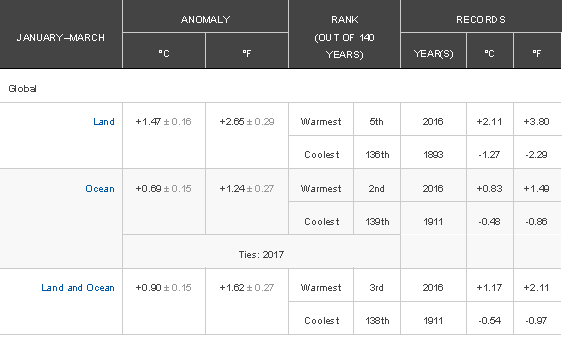
A recent post Climate Hearsay featured an article by Ross McKitrick noting how climatists rely on charts and graphs to alarm people about temperature changes too small for them to notice otherwise.  For example, NOAA each month presents temperature measurements globally and broken down in various ways.  To illustrate McKitrick’s point, let’s look at the results for Quarter 1 of 2019, January through March.  Source: Global Climate Report

So the chart informs us that for this 3 month period, the whole world had its third warmest year out of the last 140 years!  2016 was a full 0.27℃ hotter on average over those 90 days.  Well, maybe not, because the error range is given as +/- 0.15℃.  So the difference this year from the record year 2016 might have been only a few 0.01℃, and no way you could have noticed that.  In fact where I live in Montreal, it didn’t seem like a warm year at all.

McKitrick also makes the point that claiming a country like Canada warmed more than twice the global average proves nothing.  In a cooling period, any place on land will cool faster than the global surface which is 71% ocean.  Same thing goes for warming: land temps change faster. For example, consider NOAA’s first quarter report on the major continents.

Surprise, surprise: North American temperatures ranked 38th out of 110 years, more than 2℃ cooler than 2016.  That’s more like what I experienced, though many days were much colder.  And browse the list of other land places: it was not that warm anywhere except for Oceania, with the land mass mostly in Australia.

Summary

Global warming/climate change is one of those everywhere, elsewhere phenomena.  Taking masses of temperatures and averaging them into a GMT (Global Mean Temperature Anomaly) is an abstraction, not anyone’s reality.  And in addition, minute changes in that abstraction are too small for anyone to sense.  Yet, modern civilization is presumed to be in crisis over 1.5℃ of additional warming, which we apparently already got in Canada and we are much better for it.

Some people worry Global Warming is changing how fast the Earth spins. Have you noticed?

Footnote:

Mike Hulme is a leading voice striking a rational balance between concern about the planet and careful deliberation over policy choices.  I have posted several of his articles, for example on extreme weather attribution and on attempts to link armed conflicts with climate change.  Pertinent to this post, Hulme has spoken out on the obsession with global temperature anomalies: See Obsessing Over Global Temperatures

Global temperature does not cause anything to happen. It has no material agency. It is an abstract proxy for the aggregated accumulation of heat in the surface boundary layer of the planet. It is far removed from revealing the physical realities of meteorological hazards occurring in particular places. And forecasts of global temperature threshold exceedance are even further removed from actionable early warning information upon which disaster risk management systems can work.

Global temperature offers the ultimate view of the planet—and of meteorological hazard—from nowhere.

And he has warned about the emergency rhetoric now on full display in the streets of major cities.  See Against Emergency Countdown

But as we argued a few years ago, declaring a climate emergency invokes a state of exception that carries many inherent risks: the suspension of normal governance, the use of coercive rhetoric, calls for ‘desperate measures’, shallow thinking and deliberation, and even militarization. To declare an emergency becomes an act of high moral and political significance, as it replaces the framework of ordinary politics with one of extraordinary politics.

In contrast, a little less rhetorical heat will allow for more cool-headed policy development. What is needed is clear-headed pragmatism, but without the Sword of Damocles hanging over these heads. Climate Pragmatism calls for accelerating technology innovation, including nuclear energy, for tightening local air quality standards, for sector-, regional- and local-level interventions to alter development trajectories and for major investments in improving female literacy. Not desperate measures called forth by the unstable politics of a state of emergency, but right and sensible things to do. And it is never too late to do the right thing.


Urban Flooding: The Philadelphia Story

article11803.large_

A previous post (reprinted further on) took issue with climatists exploiting fear of flooding in Philly. This post adds more context disputing these attempts to blame urban flooding on sea level rise and to claim reducing CO2 emissions provides some sort of protection.

Background

Hydro engineers know that urban flooding is a complex problem with multiple factors beyond the effect from sea level. This paper by James Andrew Griffiths et al. presents the situation faced by all coastline cities: Modelling the impact of sea-level rise on urban flood probability in SE China. Excerpts in italics with my bolds

Estimating the likelihood of flooding in urban areas poses a greater challenge than in natural landscapes as land-surfaces are more heterogeneous and consist of many more runoff pathways. Data acquisition and process identification are also more difficult in urban areas as networks undergo more frequent and rapid change. To reduce complexity therefore, a lumped-parameter model can be used to represent hydrologically connected areas, rather than individual streets.

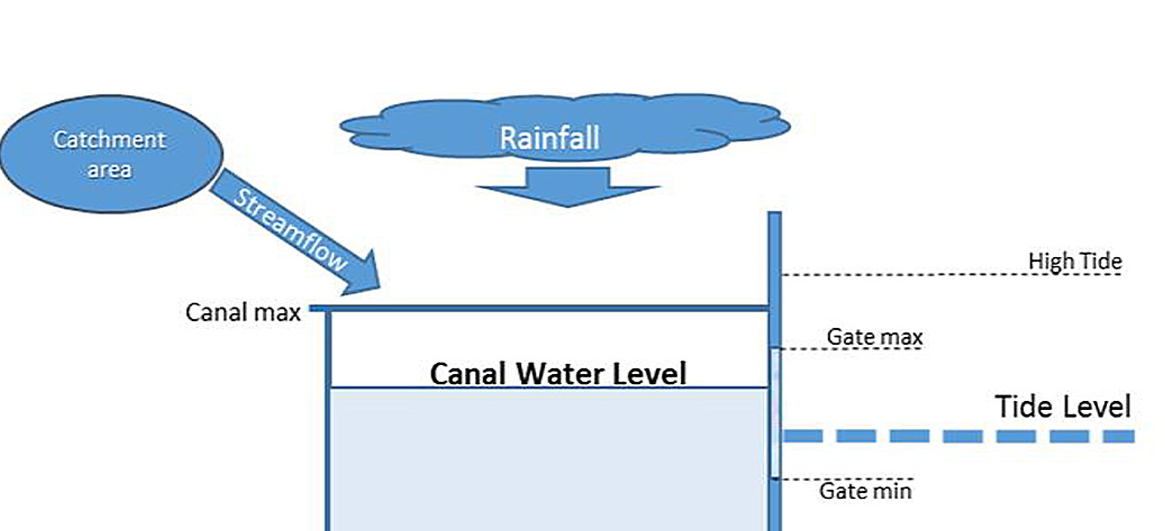
This diagram presents the typical situation.

The drainage systems of cities on China’s East coast generally consist of networks of channels or canals that are fed by streams from the surrounding catchments. The canal network is protected from tidal intrusion by a combination of sluice-gates, weirs and large flood-gates. Water is released from the system between high tides until a minimum water level is reached. If catchment runoff exceeds the rate of drainage from the system (for example during extreme rainfall) there is a risk of canal capacity exceedance and flooding. During normal operating conditions, a minimum water-level is preserved in canals to ensure sufficient water for irrigation, recreation or commercial use.

In summary, Urban drainage systems in coastal cities in SE China are characterized by often complex canal and sluice-gate systems that are designed to safely drain pluvial flooding whilst preventing tidal inundation. However, the risk of coastal flooding in the region is expected to increase over the next 50–100 years, as urban areas continue to expand and sea-levels are expected to rise. To assess the impact of projected sea-level rise on this type of urban drainage system, a one-dimensional model and decision support tool was developed. The model indicated that although sea-level rise represents a significant challenge, flood probability will continue to be most influenced by rainfall. Events that are significant enough to cause flooding will most likely be minimally impacted by changes to the tidal frame. However, it was found that a sea-level rise of up to 1.2 m by 2010 would result in increased drainage times and higher volumes of over-topping when flooding occurs.

Philadelphia is a Career Flood Fighter

Just like Rocky Balboa atop the Art Museum steps, Philadelphia has long contended with flood events and has always to be prepared.  There have been 65 Philly floods since 1769, most recently in 2014. The city floods when water level in the Schuylkill basin goes over 11 feet, according to Historical Floods: Schuylkill River at Philadelphia, Pennsylvania from NOAA.

The table below shows the most severe events, 15 in all from 1869 to 2014, along with the crest level in feet and the measured streamflow in cubic feet per second.

Date of Flood  Crest (ft)  Streamflow (cfs)  Category CO2 ppm
10/04/1869 17.00 135,000 Major 287.5
3/1/1902 14.80 98,000 Moderate 296.6
8/24/1933 14.70 96,200 Moderate 308.9
7/9/1935 14.10 82,000 Moderate 309.7
8/9/1942 13.10 71,500 Moderate 310.7
6/2/1946 14.57 94,600 Moderate 310.3
11/25/1950 14.32 89,800 Moderate 311.3
8/19/1955 14.32 90,100 Moderate 313.7
 9/13/1971 13.28 70,300 Moderate 326.4
6/23/1972 14.65 103,000 Moderate 327.5
1/19/1996 13.36 79,000 Moderate 362.6
9/17/1999 14.10 92,500 Moderate 368.4
10/1/2010 13.05 76,300 Moderate 389.2
8/28/2011 13.56 83,900 Moderate 391.2
5/1/2014 13.91 88,300 Moderate 397.2

I have also provided the CO2 atmospheric concentrations for the flood dates, as reported by NASA. Climatists advocate reducing CO2 emissions as a policy to prevent urban flooding. However, the correlation between CO2 in ppm and Philly flood crests is -.58 and -.42 with streamflow. So the severity of Philly flooding has decreased while CO2 has risen. Perhaps burning more fossil fuels would be the prudent action.

Why Philadelphia is Prone to Flooding

BillyPenn explains Why Philadelphia floods so easily when it rains. Excerpts in italics with my bolds.

Mahbubur Meenar, a professor of community and regional planning at Temple, says that much of the flooding we see happens because of the city’s drainage system. In about 2/3 of the city, stormwater and wastewater — whatever comes out of your house or office building — drains through the same system. This happens because, well, the city is old. It’s so old, and so ingrained in the city’s infrastructure that it would be prohibitively expensive, if not impossible, to change.

On normal days, the drainage system works fine. Wastewater goes through and is treated before making its way to one of the rivers. But rain throws a wrench into the process. It flows into the same drains and mixes with the wastewater. The extra water can rise and flow onto the streets. Litter and fallen leaves don’t help, either. They can gather in the drains and make it more likely for flooding.

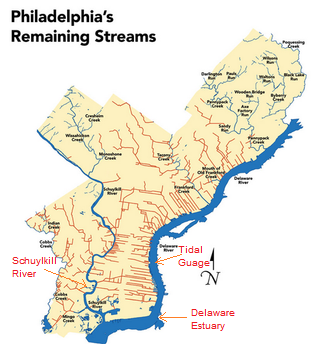
Another variable: Especially around Center City there are few natural resources that can capture water, i.e. streams and creeks. Nearly all of them have been filled in and turned into sewers. Dock Street is probably the best known example. That brick street in Society Hill used to be a creek. Dozens more have experienced the same fate, mostly in Center City and the neighborhoods closest to it. Check it out. The red lines indicate former bodies of water that have been filled in:

Creeks Flood Philly PHILLYH2O.ORG

If those creeks were still around, they could collect rainwater. Without them, stormwater lingers on the streets and has to go somewhere else — and in Philadelphia that’s through the drains where wastewater is already going.

“Depending on all these things,” Meenar said, “the road gets flooded.”

To some extent, there’s not much the Water Department can do. It can’t restore all of Philadelphia’s creeks or overhaul the city’s infrastructure, particularly in the oldest parts of the city where stormwater and wastewater drain together. But the Water Department is working on green stormwater infrastructure to combat the problem. There have been some inroads throughout the city’s neighborhoods — things like green roofs, rain gardens and even man-made wetlands. They are designed to collect stormwater.

The primary purpose of these measures actually has to do with keeping our rivers clean. Stormwater that hits Philly’s streets can pick up chemicals harmful to our rivers and to us if it ends up in our drinking water. By storing the stormwater for a while, it can be released into a system where it will be properly treated, rather than flowing directly into the Schuylkill or Delaware.

The secondary effect for green stormwater infrastructure is that it helps prevent flooding. Not all of the water is rushing into drains at once.

“They try to store water as long as possible and then slowly release it to the drain,” Meenar said.

So that’s how the City is dealing with flooding from rainstorms. Besides rain and severe storms, of course, Philadelphia’s 3,000 miles of leaky pipes can cause flooding, too. That’s an entirely different problem, though.

Previous Post:  Philly Under Water?  Not so Fast.

A previous post explained how local TV weatherpersons are being recruited to stoke public fears about global warming/climate change.  See Climate Evangelists Are Taking Over Your Local Weather Forecast

For example, just today Philadelphia NBC TV affiliate aired a segment declaring Climate Change Studies Show Philly Underwater. Previously Philly CBS station had their piece shown below.

All of this fearmongering over sea level rise is a coordinated campaign to terrorize coastal dwellers and landowners. UCS (Union of Concerned Scientists) together with Climate Central are collaborating to do a drip, drip, drip water torture treatment exploiting the public addiction to television.

Philadelphia, PA – Station ID: 8545240

What They Are Not Telling People

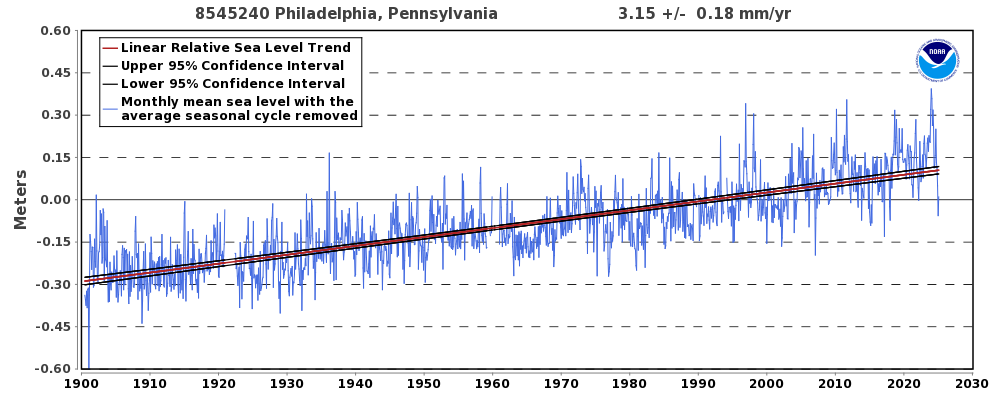
From NOAA Tides and currents comes this long record of service by the tidal guage at Philadelphia.

Climate Central in 2016 published Pennsylvania and the Surging Sea, including this forecast:

In records running back to 1900, Philadelphia has never seen waterfront flooding that reaches 4 feet above the local high tide line. But under a mid-range sea level rise scenario, floods within the Delaware Estuary exceeding 4 feet are more likely than not to take place by 2040, less than one 30-year mortgage cycle away. Under a low-range scenario, chances are just below even; and under a high-range scenario, they reach 3 in 4. At the other end of the spectrum, under high-range projections, there is roughly a 4 in 5 chance of floods above 9 feet by the end of the century.

Putting the projections together with the observational record gives this graph.
Both the record and projection are zero at year 2000.  If the past trend continues, a further rise of 30 cm would be observed by 2100.  If Climate Central model-based projection is true, the red line shows 122 cm rise by 2040, and 274 cm by 2100.  So alarmists are projecting in 20 years, Philadelphia will get four times the rise that occurred in the last 100 years.  Even now, in 2019, the projection is off by 50 cm, and observations are going down.

Not to worry, UCS provides this Disclaimer:

Neither the authors nor the Union of Concerned Scientists are responsible or liable for financial or reputational implications or damages to homeowners, insurers, investors, mortgage holders, municipalities, or other any entities. The content of this analysis should not be relied on to make business, real estate or other real world decisions without independent consultation with professional experts with relevant experience. The views expressed by individuals in the quoted text of this report do not represent an endorsement of the analysis or its results.

None of that uncertainty appears in the TV clips.  And even worse, computing technology and desktop publishing are being exploited not to empower people, but to terrify them.  An entire web page is devoted to Google Earth images photoshopped to show chunks of Philadelphia under water. Here’s what Philly could look like in 2100 if sea levels rise

Conclusion

More and more, the media are pushing people into the Hobbesian Choice.  Thomas Hobbes (1544–1631) believed that man must choose between living in a state of nature (a life which is “solitary, poor, nasty, brutish, and short”) or suffering under an arbitrary and absolute government.  And the media content forces another awful decision:  Either believe nothing (or the opposite) of what you read or see on TV, or go into full panic mode.

Footnote

The hottest temperatures ever reported in Phoenix came in January 2015, when Fox 10 weatherman Cory McCloskey faced a malfunctioning temperature map on live television. “Wow, 750 degrees in Gila Bend right now,” he said, without breaking a sweat. “And 1,270 in Ahwatukee. Now, I’m not authorized to evacuate, but this temperature seems pretty high.” More than 6 million people have watched the blooper on YouTube.

Equality vs. Freedom (American Dilemma)

Bryan Garsten writes an essay at the Tablet that assesses the deep tremors in today’s USA. And the tensions first described by Tocqueville are also on display in other western nations, though perhaps not in the same ways. The article is Will Tocqueville’s Dilemma Crash America? Excerpts in italics with my bolds.

Is equality a danger to freedom in a democratic United States?

The fundamental challenge that Tocqueville’s book poses to American dogma arises from his refusal to assume that equality and freedom are always mutually reinforcing. The American creed since the Declaration of Independence and especially since Lincoln has linked the two values, assuming that an increase in one naturally accompanies an increase in the other. Tocqueville suggested that we tend to ignore the threats that equality poses to freedom. Freedom was not, like equality, a naturally expanding feature of society. Nor was it a necessary consequence of equality of conditions.

It is too simple to say that Tocqueville presented equality and freedom as principles sometimes in tension with one another. His point was different. Equality was not merely a moral principle. Nor was it merely a material fact. More fundamentally, equality was a passion that gave rise to a certain dynamic in politics. Freedom, on the other hand, he portrayed as a set of skills and habits that required practice, an art that could be learned but also forgotten.

The danger of democratic life, Tocqueville thought, was that the passion for equality would lead us to stop practicing the art of freedom.

To see how equality works as a passion, we have to notice the fundamental effect of looking at any actual social world with the ideal of equality in mind. You will see mostly inequalities. In fact, it seems that the more inequalities we succeed in eliminating, the more remaining inequalities stand out and the more striking they become. As society becomes more equal, the pressure for yet more equality does not subside but instead grows stronger:

Democratic institutions awaken and flatter the passion for equality without ever being able to satisfy it entirely. Every day this complete equality eludes the hands of the people at the moment when they believe they have seized it, and it flees, as Pascal said, in an eternal flight; the people become heated in the search for this good, all the more precious as it is near enough to be known, far enough not to be tasted. The chance of succeeding stirs them, the uncertainty of success irritates them; they are agitated, they are wearied, they are embittered.

Societies characterized by the love of equality therefore have a particular revolutionary energy, which is always ready to upset its inheritances because of new inequities it identifies in them. But nature is constantly throwing up new inequalities—especially among intellects, Tocqueville remarked—and the nature of democracy is to set itself against these inequalities. Even without revolution, the pressure for equality presses into more and more spheres of society, eventually influencing not only laws but also relations between employers and workers, husbands and wives, parents and children; it exerts pressure on habits of thought and feeling, affects the sciences and the arts, the sort of history and poetry that people write, the sort of religion they practice and believe. The old saying, “the cure for the ills of democracy is more democracy,” captures the passion for equality but neglects, Tocqueville would say, the need to “instruct” democracy in the art of staying free.


Tocqueville admired Americans for having learned the art of freedom as well as they had. The most famous and perhaps most often quoted parts of his book are those about the settings in which Americans learn that art—the relatively small political venues in which citizens debated and deliberated and decided how to manage their communities. The ideal versions of such places that Tocqueville believed he had found were New England townships, juries, and the civic and political associations.

In the 1990s political scientists rediscovered Tocqueville and described the sort of skills, trust, and relationships that develop in these small social settings as “social capital.” Countries or regions where citizens engage in these sort of face-to-face interactions with one another were said to have more social capital, and political scientists have shown that these places tend to sustain more stable and successful forms of democracy.

Tocqueville himself did not use the economists’ language of “capital,” but instead the educator’s language of learning. He noted that through learning to work with others in the small and easily regulated context of a town, the citizen “habituates himself to the forms without which freedom proceeds only through revolutions, permeates himself with their spirit, gets a taste for order, understands the harmony of powers, and finally assembles clear and practical ideas on the nature of his duties as well as the extent of his rights.” The myriad small associations that Tocqueville noticed Americans loved to form drew individuals out of their private lives and accustomed them to what Tocqueville called “the reciprocal action of men upon one another.”

To identify democracy with the busyness of social life was to offer an alternative to the view that elections are the central feature of democracies. A Napoleonic program of plebiscites might claim to produce a government in some ways “representative” of the people, but it left individuals mostly passive, asleep in their civic lives, content to allow the state to act for them in between isolated and infrequent moments of voting. Equality frees individuals from the domination of families, estates, social orders, and churches, but it thereby risks producing a sea of individuals without strong ties to one another, held together only by a distant national government. Tocqueville thought the United States had avoided this result by giving “political life to each portion of the territory in order to multiply infinitely the occasions for citizens to act together and make them feel every day that they depend on one another.”

Tocqueville’s great hope in the first volume of Democracy in America was to put forward an argument that would show that “the free association of individuals could replace the individual power of nobles.” But what if the passion for equality swept away not only the nobles but also the practice of association that was meant to replace them?

It might be tempting to dismiss Tocqueville’s relevance today because we seem to observe precisely the opposite of what he did: Whereas he began with the constantly growing equality of material conditions, we have witnessed decades of growing inequality. But Tocqueville has a challenging view to offer on this point, too. In the second part of the second volume of Democracy in America, he offered a sustained analysis of how the democratic passion for equality (the subject of its first chapter) might well produce a tendency toward material inequalities and oligarchies, what he called “industrial aristocracy” (the subject of its last chapter).

Tocqueville argued that the passion for equality could weaken social ties, promote materialism, and fuel the inequities of capitalism. He explained that egalitarian sentiments lead us to ignore our links to our ancestors, since our lineage should not determine our fate, and also to sever ties to social superiors and inferiors. With these vertical chains broken, every individual family is more on its own. Each feels a new freedom and a new possibility of rising, but also a new vulnerability and insecurity. These hopes and fears lead us to devote most of our attention to securing the material comfort of our immediate family and friends, and so we embrace materialism and withdraw into a political passivity that Tocqueville called “individualism.”

Tocqueville insisted that old regime aristocrats felt compelled by laws and customs to take some care of their servants, that they were bound, however distantly, to their peasants by the land they shared and their regular interactions. The new industrial oligarchs would find themselves free of even these weak bonds. Tocqueville was not arguing for a return to feudalism; he was trying to show just how bad the new oligarchs would be. Workers and masters would see one another only at the factory and otherwise have no point of contact and certainly no sense of responsibility. “The manufacturing aristocracy of our day,” remarked Tocqueville, “after having impoverished and brutalized the men whom it uses, leaves them to be nourished by public charity in times of crisis. This results naturally from what precedes. Between worker and master relations are frequent, but there is no genuine association.”

Perhaps the state, by reducing material insecurity and regulating industry, could offer a partial escape from the logic of Tocqueville’s argument. But it would not fully counter the dynamic that concerned him unless it also somehow brought into existence the “genuine association” that he thought was necessary for true freedom. The more pessimistic second volume of Democracy in America presses us to worry, however, that a state powerful and centralized enough to effectively regulate the industrial economy would also, by virtue of its power and centralization, crowd out the local politics most conducive to the arts of association.

Can the love of equality and the mobile commercial world it creates be satisfactorily combined with the art of association and the art of freedom?

Can we escape this conundrum?  No sensible reader would suggest that a 19th-century aristocrat can answer this question for us. Instead, reading Tocqueville can keep us from forgetting the question, a question that neither major political party in America is now grappling with directly. Tocqueville felt politically homeless in his time, and his book may leave us feeling the same way in ours.

Philly Under Water? Not so Fast.


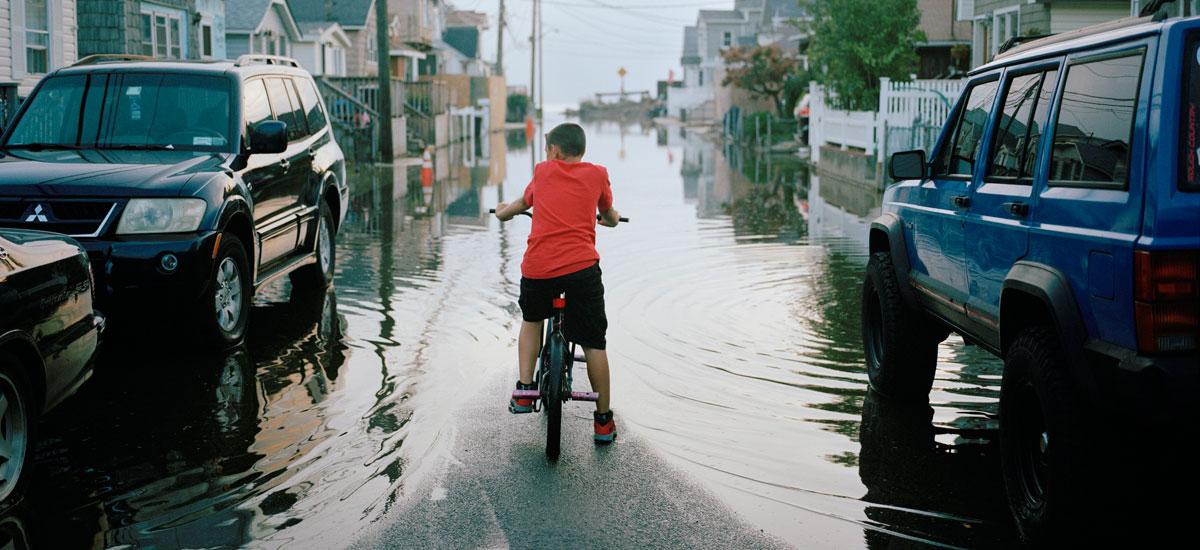
gw-sea-level-rise-boy-on-bike-looking-at-tidally-flooded-neighborhoodContext

A previous post explained how local TV weatherpersons are being recruited to stoke public fears about global warming/climate change.  See Climate Evangelists Are Taking Over Your Local Weather Forecast

For example, just today Philadelphia NBC TV affiliate aired a segment declaring Climate Change Studies Show Philly Underwater. Previously Philly CBS station had their piece shown below.

All of this fearmongering over sea level rise is a coordinated campaign to terrorize coastal dwellers and landowners. UCS (Union of Concerned Scientists) together with Climate Central are collaborating to do a drip, drip, drip water torture treatment exploiting the public addiction to television.

What They Are Not Telling People

From NOAA Tides and currents comes this long record of service by the tidal guage at Philadelphia.

Climate Central in 2016 published Pennsylvania and the Surging Sea, including this forecast:

In records running back to 1900, Philadelphia has never seen waterfront flooding that reaches 4 feet above the local high tide line. But under a mid-range sea level rise scenario, floods within the Delaware Estuary exceeding 4 feet are more likely than not to take place by 2040, less than one 30-year mortgage cycle away. Under a low-range scenario, chances are just below even; and under a high-range scenario, they reach 3 in 4. At the other end of the spectrum, under high-range projections, there is roughly a 4 in 5 chance of floods above 9 feet by the end of the century.

Putting the projections together with the observational record gives this graph.
Both the record and projection are zero at year 2000.  If the past trend continues, a further rise of 30 cm would be observed by 2100.  If Climate Central model-based projection is true, the red line shows 122 cm rise by 2040, and 274 cm by 2100.  So alarmists are projecting in 20 years, Philadelphia will get four times the rise that occurred in the last 100 years.  Even now, in 2019, the projection is off by 50 cm, and observations are going down.

Not to worry, UCS provides this Disclaimer:

Neither the authors nor the Union of Concerned Scientists are responsible or liable for financial or reputational implications or damages to homeowners, insurers, investors, mortgage holders, municipalities, or other any entities. The content of this analysis should not be relied on to make business, real estate or other real world decisions without independent consultation with professional experts with relevant experience. The views expressed by individuals in the quoted text of this report do not represent an endorsement of the analysis or its results.

None of that uncertainty appears in the TV clips.  And even worse, computing technology and desktop publishing are being exploited not to empower people, but to terrify them.  An entire web page is devoted to Google Earth images photoshopped to show chunks of Philadelphia under water. Here’s what Philly could look like in 2100 if sea levels rise

Conclusion

More and more, the media are pushing people into the Hobbesian Choice.  Thomas Hobbes (1544–1631) believed that man must choose between living in a state of nature (a life which is “solitary, poor, nasty, brutish, and short”) or suffering under an arbitrary and absolute government.  And the media content forces another awful decision:  Either believe nothing (or the opposite) of what you read or see on TV, or go into full panic mode.

Footnote

The hottest temperatures ever reported in Phoenix came in January 2015, when Fox 10 weatherman Cory McCloskey faced a malfunctioning temperature map on live television. “Wow, 750 degrees in Gila Bend right now,” he said, without breaking a sweat. “And 1,270 in Ahwatukee. Now, I’m not authorized to evacuate, but this temperature seems pretty high.” More than 6 million people have watched the blooper on YouTube.


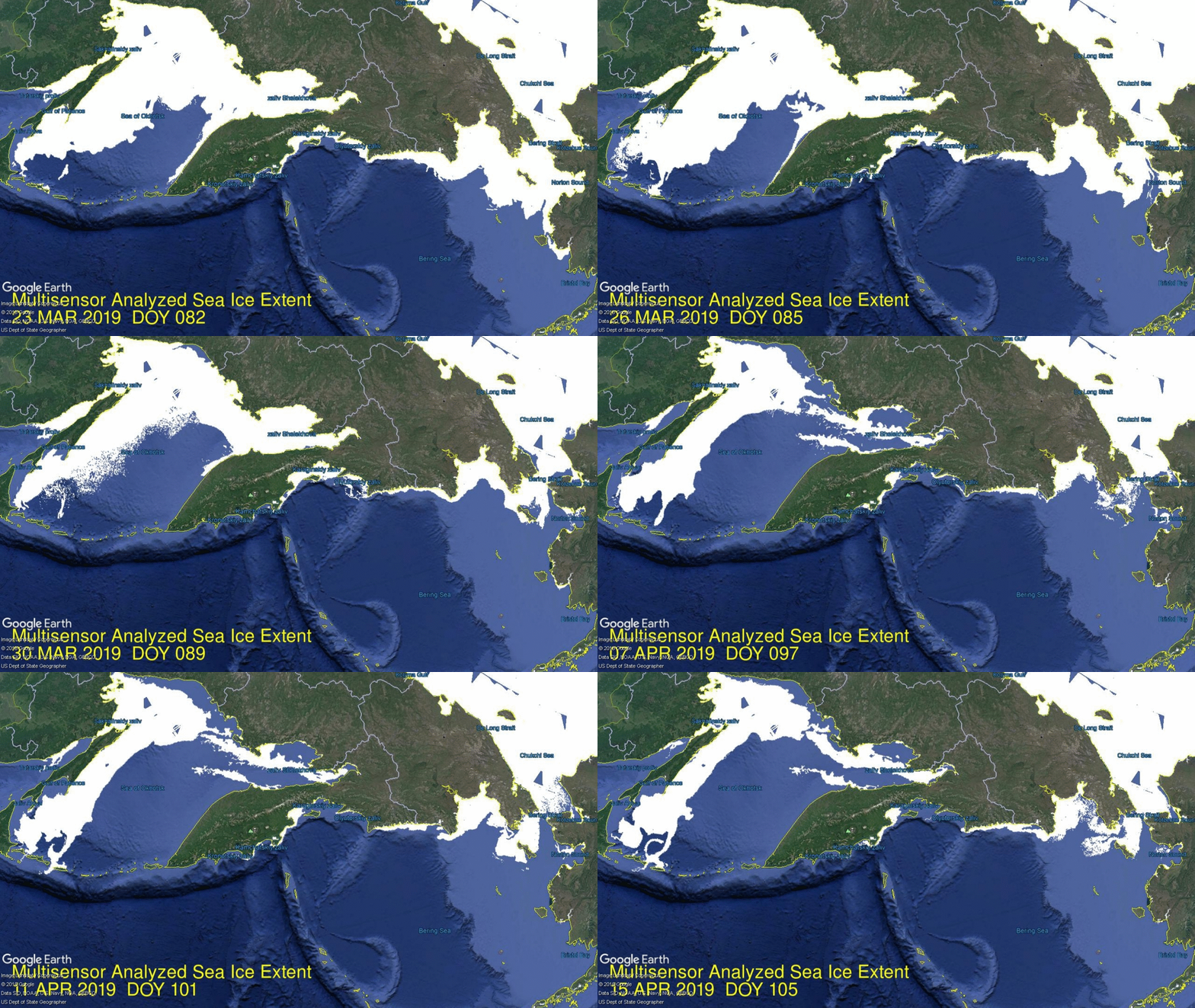
Bering Sea Ice Blues Mid April 2019

“Freedom’s Just Another Word for Nothing Left to Lose.” (Kris Kristofferson)

In April, Arctic ice extent is declining as usual with the notable exception of Bering Sea, along with ice retreating in nearby Okhotsk.  Bering still has some ice to lose, but at 178k km2 it is only 31% of the ice there January 27, the largest Bering extent this year.  It is unusual since the Bering ice is only 25% of the 12 year average for this date.  Nearby Chukchi Sea is hardly showing any open water, down only 10k km2 from its maximum.  Open water is also gaining in Okhotsk, the other Pacific basin, but ice extent there is still 6% above the 12-year average.

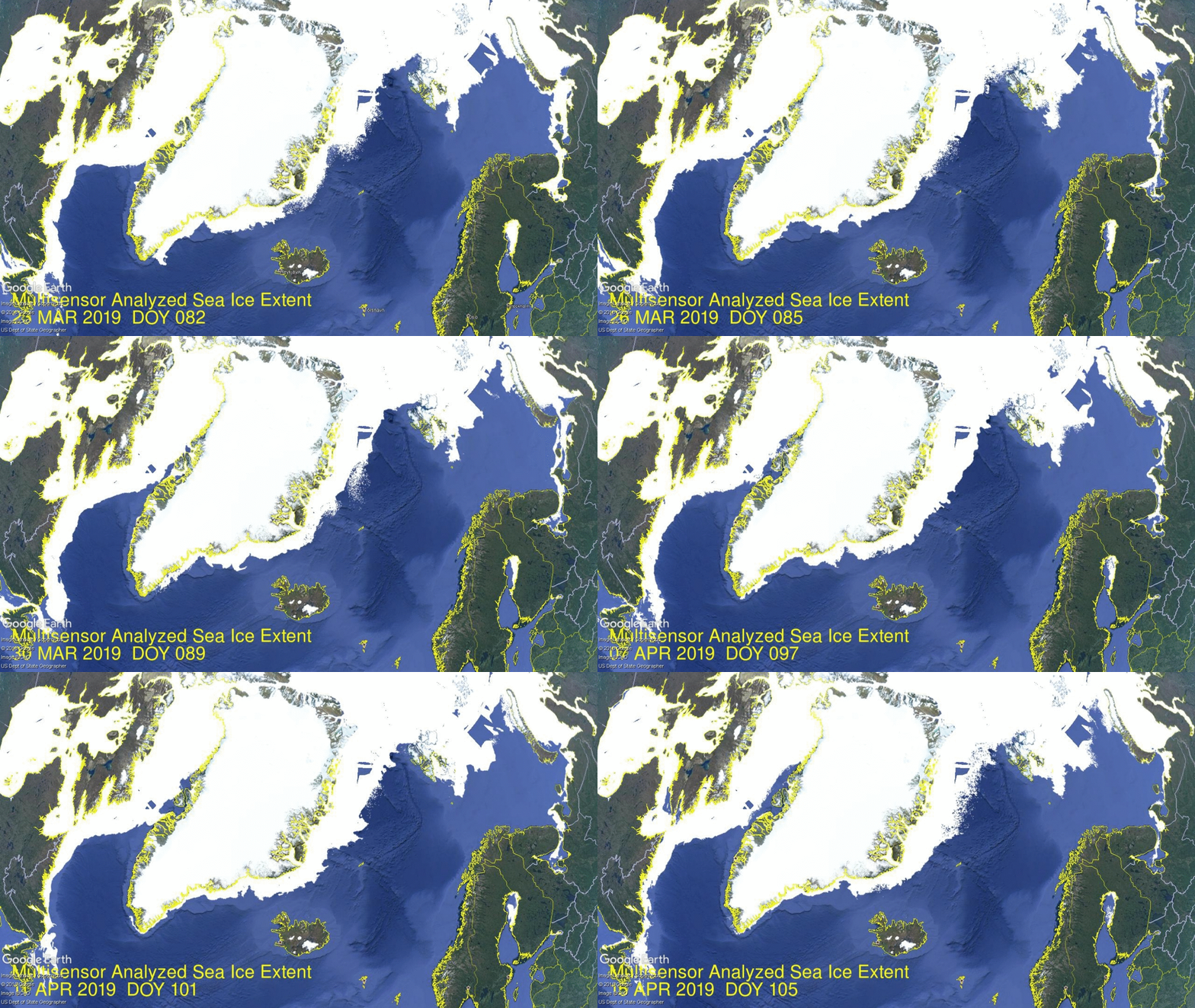
Elsewhere things are mostly typical with Russian and Canadian basins still frozen with high extents.  The other two places losing ice are Barents and Baffin Bay/Gulf of St. Lawrence shown below.
On the right side is Barents losing ice along the Russian coastline, while holding onto Svalbard.  On the left, water in Baffin Bay is pushing north along the western Greenland coast.  On the extreme left is open water taking over in Gulf of St. Lawrence

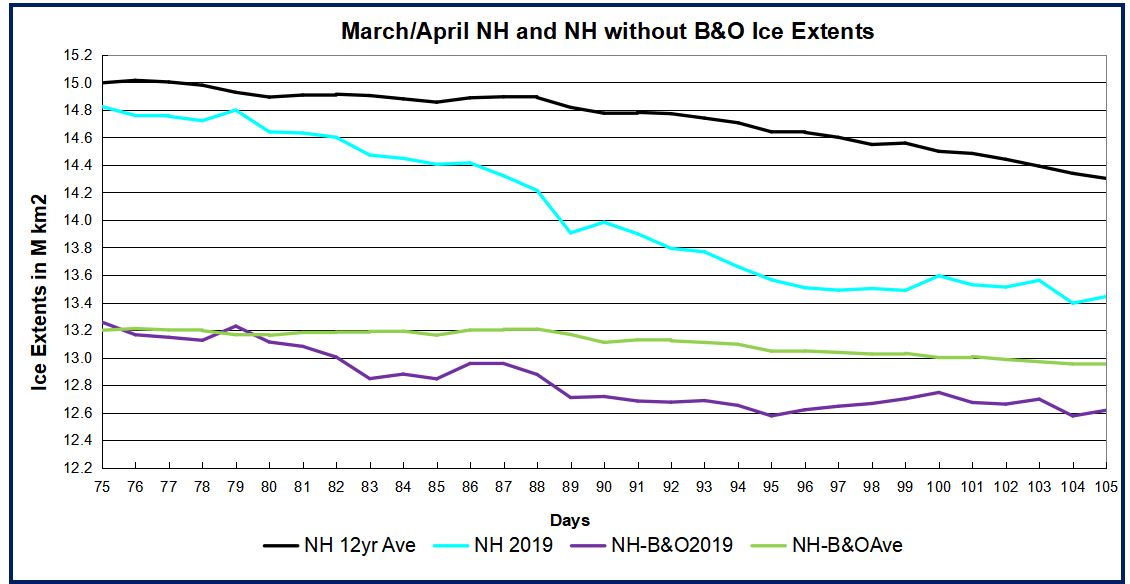
The graph below shows how the Arctic extent has faired since the March maximum compared to the 12 year average with and without the Pacific basins of Bering and Okhotsk.  The green line is the 12yr. average without B&O, while 2019 appears in purple when Bering and Okhotsk are excluded.
As of day 105, 2019 ice extent is 858k km2 below the 12yr. average, a gap of 6%.  529k km2 of that difference comes from the combined losses in Bering and Okhotsk.

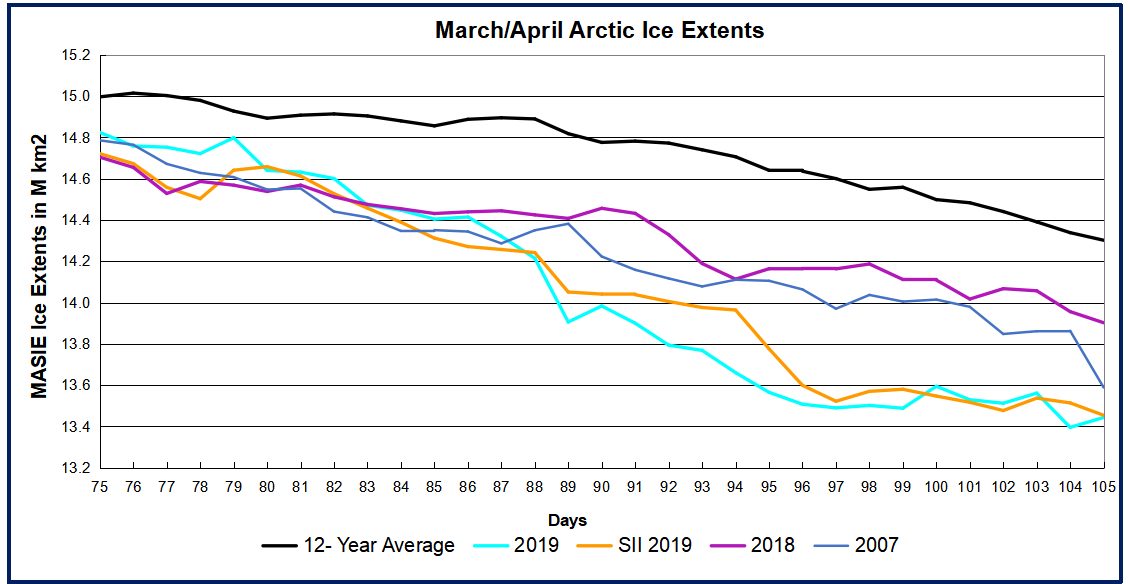
The graph below shows March/April 2019 compared to average and some years of interest.

All years are tracking below the 12-year average.  2019 MASIE and SII are the same and well below 2018, largely due to Pacific ice losses. 2007 is only slightly higher than 2019 at this point.  The table below shows ice extents by regions comparing 2019 with 12-year average (2007 to 2018 inclusive) and 2007.

Region 2019105 Day 105 
Average
2019-Ave. 2007105 2019-2007
 (0) Northern_Hemisphere 13443363 14301788 -858425 13588722 -145359
 (1) Beaufort_Sea 1070498 1069781 717 1068692 1806
 (2) Chukchi_Sea 955995 965240 -9245 961638 -5643
 (3) East_Siberian_Sea 1087137 1086417 721 1078666 8471
 (4) Laptev_Sea 897845 893203 4642 843501 54344
 (5) Kara_Sea 932750 922684 10066 890594 42156
 (6) Barents_Sea 586518 611095 -24577 439904 146614
 (7) Greenland_Sea 601126 652308 -51182 673585 -72458
 (8) Baffin_Bay_Gulf_of_St._Lawrence 1133317 1349987 -216669 1215526 -82208
 (9) Canadian_Archipelago 853337 852527 810 848812 4526
 (10) Hudson_Bay 1238689 1252970 -14281 1208588 30101
 (11) Central_Arctic 3241460 3236044 5416 3235648 5811
 (12) Bering_Sea 177335 714883 -537548 600281 -422946
 (13) Baltic_Sea 16987 48771 -31784 23534 -6547
 (14) Sea_of_Okhotsk 648664 640205 8459 491121 157543

Of course both of these basins will melt out long before the September minimum, along with the Russian shelf seas.

As indicated earlier, Bering supplies almost 2/3 of the deficit to average, with Baffin Bay providing most of the other 1/3. Of course both of these basins will melt out long before the September minimum, along with the Russian shelf seas.


Populist Wave Rolls Into Finland

Contextual Remarks

It is worth remembering that “populist” is a term used by the established elites to demean those expressing the plebes’ concerns and thereby forging political constituencies.  Christopher Caldwell explained:

“Le monde, the French newspaper of record, admitted last summer that readers had been complaining about the indiscriminate way its journalists flung around the word “populist.” It seemed to describe dozens of European and American political actors with nothing in common except the contempt in which Le Monde held them. The meaning of “populist” was nonetheless easy to decode. A dispatch in that same edition of Le Monde, about a new political alliance between populist governments in Italy, Austria, and Hungary, was titled: “Europe’s hard right lays down the law against migrants.” To call someone a populist is to insinuate that he is a fascist, but tentatively enough to spare the accuser the responsibility of supplying proof. If one sees things as Le Monde does, this is a good thing: populism is an extremism-in-embryo that needs to be named in order that it might better be fought. Others, though, will see populism as an invention of the very establishmentarians who claim to be fighting it, an empty word that allows them to shut down with taboos any political idea that they cannot defeat with arguments. In Europe, populism is becoming the great which-side-are-you-on question of our time.” For more see What is Populism?

Suffice it to say that the hoi polloi are on the march in many European nations and beyond, and the latest breakthrough in Finland adds disgust with climate policy to immigration concerns to forge a potent voter appeal.

Alex Kliment writes insightfully on the recent Finnish election in Finland at GezeroMedia: Finnish Populists Shift Aim From Browns to Greens.  Excerpts in italics with my bolds.

Anti-immigrant rhetoric has been a political winner for populist parties across Europe in recent years, but as the flow of new asylum-seekers wanes, Finland’s main right-wing outfit found a new way to win votes over the weekend.

In a national election defined largely by a polarizing debate over what to do about climate change, the euroskeptic nationalists of the Finns Party came in second place, just a hair behind the center-left Social Democrats. And they did it by taking square aim at climate policy.

Finland, of course, is on the front lines of climate change. A third of its territory lies above the Arctic Circle, where rapidly melting ice caps are transforming the environment both locally and globally.

But Finland is already one of the world’s most environmentally-friendly countries, and the Finns party’s message on this subject was simple: we’ve done enough.

Their beef isn’t with climate science itself, but with policy proposals like higher fuel taxes, electric vehicle requirements, and restrictions on meat consumption that impose short-term pain for uncertain longer-term gains.

The Finns Party says these measures disproportionately hurt working people, particularly their supporters in the countryside, and scare away foreign companies that may choose to invest in other countries that impose fewer environmental restrictions.

What’s more, Finns asks, why should a small country like Finland make more sacrifices to help the planet when progress depends almost entirely on actions taken by bigger polluters like China, the US, and India?

It’s unclear whether the Finns Party will have a role in the next Finnish government, but the party’s strong showing has drawn notice from other populist parties across the continent, which are hoping to make big gains in elections to the European Parliament next month.

The upshot: Several years on from the peak of the migrant crisis, Europe’s populist parties need new campaign issues that resonate with their voters. Climate policy – which often imposes clear economic and lifestyle sacrifices while promising fewer tangible benefits – may be the next ripe issue for anti-establishment politicians across Europe.

Background

Though Steve Bannon is currently out of Trump’s favor, he is nevertheless lucid and convincing on the subject of the populist wave from UK to Brazil, Eastern Europe, and two years ago the Trump election, so upsetting to those who know better than the rest of us.  Below is reprinted a previous 2016 post Trump Revolution World Outlook.

Lots of scorn, slurs and insults directed at Trump’s appointment of his chief advisor, Steve Bannon. The invective is so pervasive and intense, it exemplifies a new phenomenon in the global village: the Lie Swarm.  From the Streetwise Professor (here)

Bannon, and especially Trump, are primary targets of the Lie Swarm, especially since Trump had the temerity to actually prevail in the election. Don’t get me wrong–there is much about Trump to criticize. But there has been a kind of Gresham’s Law at work here: the bad criticism has driven out the good. Screeching “racist!” “Anti-Semite!” “Fascist!” on the basis of the most twisted and biased interpretation of the flimsiest evidence has overwhelmed substantive argument.

And the Swarm really hasn’t figured out that their attack will do little to get Trump supporters to change their minds. If anything, it will do the opposite, because the “deplorables” know that they are being attacked and smeared as much as Bannon and Trump. Furthermore, the Swarm seems hell-bent on living out Einstein’s definition of insanity: doing the same thing over and over, and expecting different results. Hillary’s whole campaign was based on personal attacks on Trump and his supporters, and she enlisted the Swarm in this endeavor.

Bannon in his own words

Martin Luther King said people should be judged by the quality of their character, not superficial identifiers like race, gender or religion. So someone like Steve Bannon should be evaluated by what he himself says and thinks, not by the words of others. And in fact if you listen with a mind to understand him, you discover why Trump values his advice on world realities and strategies to move America forward.

This Is How Steve Bannon Sees The Entire World is a transcript of an extended presentation by Steve Bannon from 2014, published at Buzzfeed (here). Some excerpts that struck me as particularly insightful.

Inclusive Capitalism Saved Us

That war (WWI) triggered a century of barbaric — unparalleled in mankind’s history — virtually 180 to 200 million people were killed in the 20th century, and I believe that, you know, hundreds of years from now when they look back, we’re children of that: We’re children of that barbarity. This will be looked at almost as a new Dark Age.

But the thing that got us out of it, the organizing principle that met this, was not just the heroism of our people. . . The underlying principle is an enlightened form of capitalism, that capitalism really gave us the wherewithal. It kind of organized and built the materials needed to support, whether it’s the Soviet Union, England, the United States, and eventually to take back continental Europe and to beat back a barbaric empire in the Far East.

That capitalism really generated tremendous wealth. And that wealth was really distributed among a middle class, a rising middle class, people who come from really working-class environments and created what we really call a Pax Americana. It was many, many years and decades of peace. And I believe we’ve come partly offtrack in the years since the fall of the Soviet Union and we’re starting now in the 21st century, which I believe, strongly, is a crisis both of our church, a crisis of our faith, a crisis of the West, a crisis of capitalism.

Modern Perversions of Capitalism

But there’s a strand of capitalism today — two strands of it, that are very disturbing.

One is state-sponsored capitalism. And that’s the capitalism you see in China and Russia. I believe it’s what Holy Father [Pope Francis] has seen for most of his life in places like Argentina, where you have this kind of crony capitalism of people that are involved with these military powers-that-be in the government, and it forms a brutal form of capitalism that is really about creating wealth and creating value for a very small subset of people. And it doesn’t spread the tremendous value creation throughout broader distribution patterns that were seen really in the 20th century.

The second form of capitalism that I feel is almost as disturbing, is what I call the Ayn Rand or the Objectivist School of libertarian capitalism. And, look, I’m a big believer in a lot of libertarianism. I have many many friends that’s a very big part of the conservative movement — whether it’s the UKIP movement in England, it’s many of the underpinnings of the populist movement in Europe, and particularly in the United States.

However, that form of capitalism is quite different when you really look at it to what I call the “enlightened capitalism” of the Judeo-Christian West. It is a capitalism that really looks to make people commodities, and to objectify people, and to use them almost — as many of the precepts of Marx — and that is a form of capitalism, particularly to a younger generation [that] they’re really finding quite attractive. And if they don’t see another alternative, it’s going to be an alternative that they gravitate to under this kind of rubric of “personal freedom.”

Crony Capitalism Gives Rise to a Populist Revolt

General Electric and these major corporations that are in bed with the federal government are not what we’d consider free-enterprise capitalists. We’re backers of entrepreneurial capitalists. They’re not. They’re what we call corporatist. They want to have more and more monopolistic power and they’re doing that kind of convergence with big government. And so the fight here — and that’s why the media’s been very late to this party — but the fight you’re seeing is between entrepreneur capitalism, and the Acton Institute is a tremendous supporter of, and the people like the corporatists that are closer to the people like we think in Beijing and Moscow than they are to the entrepreneurial capitalist spirit of the United States.

The underpinning of this populist revolt is the financial crisis of 2008. That revolt, the way that it was dealt with, the way that the people who ran the banks and ran the hedge funds have never really been held accountable for what they did, has fueled much of the anger in the tea party movement in the United States. . . In addition, I think you really need to go back and make banks do what they do: Commercial banks lend money, and investment banks invest in entrepreneurs and to get away from this trading — you know, the hedge fund securitization, which they’ve all become basically trading operations and securitizations and not put capital back and really grow businesses and to grow the economy.

I think it’s particularly more advanced in Europe than it is in the United States, but in the United States it’s getting pretty advanced — is that when you have this kind of crony capitalism, you have a different set of rules for the people that make the rules. It’s this partnership of big government and corporatists. I think it starts to fuel, particularly as you start to see negative job creation. If you go back, in fact, and look at the United States’ GDP, you look at a bunch of Europe. If you take out government spending, you know, we’ve had negative growth on a real basis for over a decade.

And that all trickles down to the man in the street. If you look at people’s lives, and particularly millennials, look at people under 30 — people under 30, there’s 50% really under employment of people in the United States, which is probably the most advanced economy in the West, and it gets worse in Europe.

So you can understand why middle class people having a tough go of it making $50 or $60 thousand a year and see their taxes go up, and they see that their taxes are going to pay for government sponsored bailouts, what you’ve created is really a free option. You say to this investment banking, create a free option for bad behavior. In otherwise all the upside goes to the hedge funds and the investment bank, and to the crony capitalist with stock increases and bonus increases. And their downside is limited, because middle class people are going to come and bail them out with tax dollars.

And that’s what I think is fueling this populist revolt. Whether that revolt is in the midlands of England, or whether it’s in Middle America. And I think people are fed up with it.

Secularization and the Rise of Islamic Fascism

The other (worrying) tendency is an immense secularization of the West. And I know we’ve talked about secularization for a long time, but if you look at younger people, especially millennials under 30, the overwhelming drive of popular culture is to absolutely secularize this rising iteration.

Now that call converges with something we have to face, and it’s a very unpleasant topic, but we are in an outright war against jihadist Islamic fascism. . .That war is expanding and it’s metastasizing to sub-Saharan Africa. We have Boko Haram and other groups that will eventually partner with ISIS in this global war, and it is, unfortunately, something that we’re going to have to face, and we’re going to have to face very quickly.

Because it is a crisis, and it’s not going away. You don’t have to take my word for it. All you have to do is read the news every day, see what’s coming up, see what they’re putting on Twitter, what they’re putting on Facebook, see what’s on CNN, what’s on BBC. See what’s happening, and you will see we’re in a war of immense proportions. It’s very easy to play to our baser instincts, and we can’t do that. But our forefathers didn’t do it either. And they were able to stave this off, and they were able to defeat it, and they were able to bequeath to us a church and a civilization that really is the flower of mankind, so I think it’s incumbent on all of us to do what I call a gut check, to really think about what our role is in this battle that’s before us.

I’m not justifying Vladimir Putin and the kleptocracy that he represents, because he eventually is the state capitalist of kleptocracy. However, we the Judeo-Christian West really have to look at what he’s talking about as far as traditionalism goes — particularly the sense of where it supports the underpinnings of nationalism — and I happen to think that the individual sovereignty of a country is a good thing and a strong thing. I think strong countries and strong nationalist movements in countries make strong neighbors, and that is really the building blocks that built Western Europe and the United States, and I think it’s what can see us forward.

Global Center-Right Populist Movement

Look, we believe — strongly — that there is a global tea party movement. We’ve seen that. We were the first group to get in and start reporting on things like UKIP and Front National and other center right. With all the baggage that those groups bring — and trust me, a lot of them bring a lot of baggage, both ethnically and racially — but we think that will all be worked through with time.

The central thing that binds that all together is a center-right populist movement of really the middle class, the working men and women in the world who are just tired of being dictated to by what we call the party of Davos. A group of kind of — we’re not conspiracy-theory guys, but there’s certainly — and I could see this when I worked at Goldman Sachs — there are people in New York that feel closer to people in London and in Berlin than they do to people in Kansas and in Colorado, and they have more of this elite mentality that they’re going to dictate to everybody how the world’s going to be run.

I will tell you that the working men and women of Europe and Asia and the United States and Latin America don’t believe that. They believe they know what’s best for how they will comport their lives. They think they know best about how to raise their families and how to educate their families. So I think you’re seeing a global reaction to centralized government, whether that government is in Beijing or that government is in Washington, DC, or that government is in Brussels.

And that center-right revolt is really a global revolt. I think you’re going to see it in Latin America, I think you’re going to see it in Asia, I think you’ve already seen it in India. Modi’s great victory was very much based on these Reaganesque principles, so I think this is a global revolt, and we are very fortunate and proud to be the news site that is reporting that throughout the world.

 

Climate Hearsay

global-warming

In a legal proceeding, a witness can only testify to what he or she personally experienced. Anything reported to them by others is dismissed as “hearsay”, not evidence by direct observation, but rather an opinion offered by someone else.

In the current public commotion over global warming, almost all the discourse is composed of hearsay.  Ross McKitrick explains that the alleged changes in temperatures are so small that no one can possibly notice. Thus, their concern over global warming can only come from repeating hearsay in the form of charts and graphs published by people with an axe to grind. His article in the Financial Post is Hold the panic: Canada just warmed 1.7 degrees and … thrived. Excerpts below in italics with my bolds.

A recent report, commissioned by Environment and Climate Change Canada (also known as the federal Department of the Environment), sparked a feverish bout of media coverage. Much of it keyed off the headline statement that Canada warmed “twice as fast” as the entire planet since 1948. If that is self-evidently a bad thing, what to make of the finding that the Canada’s Atlantic region warmed twice as fast as the Prairies? Or that Canadian winters warmed twice as fast as summers?

Saying Canada warmed twice as fast as the whole planet doesn’t prove anything

I’ll bet you didn’t know that the Maritimes warmed twice as fast as the Prairies. But now that I’ve told you, you might tell yourself it makes sense based on what you’ve seen or heard — that’s called confirmation bias. In fact, I was lying. It’s the other way around. The Prairies warmed almost three times faster than the Maritimes.

Would you have known either way? One of the psychological effects of a report like this, and the attendant media hype, is that it puts ideas in peoples’ heads. Tell everyone over and over that the climate is changing, and soon they will see proof of change everywhere. Rain, snow, wind, floods or dry spells; it will all seem to eerily confirm the theory, even though we have always had these things.

Most of what people are noticing, of course, are just natural weather events. Underneath, there are slow trends, both natural and (likely) human-caused. But they are small and hard to separate out without careful statistical analysis. A few years ago, climatologist Lennart Bengtsson remarked:

The warming we have had over the last 100 years is so small that if we didn’t have meteorologists and climatologists to measure it we wouldn’t have noticed it at all.

And so we get reports with charts and graphs to tell us about the changes we didn’t notice. Remember last summer when the media hyped a report from the Intergovernmental Panel on Climate Change warning that warming 1.5 degrees Celsius (compared to preindustrial times) was a disaster threshold we must avoid crossing at all costs? Now we learn that Canada warmed 1.7 degrees Celsius since 1948. Far from leaving the country a smoking ruin, we got wealthier and healthier, our population soared, and life improved by almost any measure of welfare you can imagine. If only every so-called catastrophe was like this.

We deal with lots of changes over time. Go back to Bengtsson’s thought experiment. Today’s 80-year-olds entered their teens in 1950. Ask them what changes they experienced over their lives and they will have plenty to say. Then ask if, where they live, the fall warmed more than spring did. Without peeking at the answer, most will have no idea. Yet, according to the federal government’s latest report, depending on the province, one likely warmed twice as fast as the other. Which one?

If you can’t tell without looking it up, that’s the point.

Alarming news headlines are always part of the ritual (though you’d have thought journalists would be a bit jaded by now, after all the hyperventilating Only-Ten-Years-Left blockbuster claims over the past 30 years). Saying Canada warmed twice as fast as the whole planet doesn’t prove anything. Pretty much any large country warmed faster than the global average, because countries are on land. Oceans cover 70 per cent of the Earth, and the way the system works, during a warming trend the land warms faster than the oceans. So the scary headline only confirms that we are on land.

The best antidote, if you find yourself alarmed by the press coverage, is to turn to chapter four of the Department of the Environment’s report and start reading. The section on the observed changes in 1948 is factual, data-focused and decidedly non-alarmist. But there are some points I would quibble about: 2016 was a strong El Niño year, so the end point of the data is artificially high.

Some of the report’s bright-red heat maps would probably look different if they stopped in, say, 2014. And most of the report’s comparisons start in 1948 to maximize data availability, but this boosts the warming rate compared to starting in the 1930s, which was a hot decade. When the authors talk about attributing changes to greenhouse gases versus natural variability, they don’t explain the deep uncertainties in such calculations. And they make projections about the century ahead without discussing how well — or how poorly — their models can long-term forecast.

If you want to learn about changes to the Canadian climate, read the report. But if you need to look at the report to know what changes you lived through, that tells you how much — or rather, how little — they mattered to you at the time.

Ross McKitrick is a professor of economics at the University of Guelph and senior fellow at the Fraser Institute.

Postscript:  No one under 20 years old has experienced a trend of warming temperatures.  Yet they are in the streets instead of classrooms demanding action (anything) to stop something they have never known.  Think about it.

The West vs. Africa: Energy Hypocrisy as Seen from Kenya

Suleiman Shahbal writes in Kenya at Standard Media Global warming: Why the West preaches water yet drinks wine.. Excerpts in italics with my bolds.

A few months ago I was with a group of Kenyan politicians in Abu Dhabi. Hosting us for a cup of coffee was my good friend Abdalla Nassir. Abdalla is a serial entrepreneur who owns 94 businesses, including the coffee shop. His 95th business is a steel mill that he was going to open in Djibouti, targeting the Ethiopian market of 80 million people.

I asked him why not in Kenya; the gateway to the Comesa market of 150 million people, to which he replied that the cost of power in Kenya is more than twice that of Djibouti and Ethiopia. One week later, I read that a glass company in Mtwapa had just closed down, with the loss of over 400 jobs. The reason? The high cost of power.

So what do we do? The quickest solution that everyone would like to come up with is solar or wind power. Both, ‘clean energy’. The problem is, what do you do when it doesn’t shine for three days? Or if there is no wind? You cannot run a hospital hoping for the sun to shine. Those baby incubators or that poor patient being operated on cannot depend on the weather being conveniently agreeable.

We are forced to look for dependable energy or, to use the lingo of the industry, ‘base load’. That leaves you with two energy sources – coal or gas. Coal is the cheapest. Gas prices are closely correlated to oil prices, which are very volatile and expensive. Remember that we have fewer industries and jobs because of cost. We have little choice but to go for the cheaper option. But the world doesn’t like coal. Why?

Affecting forests

In 2004, the world met in Copenhagen and came to the conclusion that global warming was a real threat to the planet. The world resolved not to allow global temperatures to rise above another 2 degrees.

Anything more would lead to catastrophic changes affecting forests, air, water and the environment. All true so far. No one doubts the disaster of global warming. The solution was either for the world to stop making any new coal plants or for the developed world to reduce their emissions by 10 per cent.

The developed world categorically refused. Such a drastic drop in emission would lead to loss of livelihoods and jobs, something they were not willing to take. So, let us force the poor Third World to stop starting such plants. Let the poor make the sacrifices. Who cares if they lose jobs or new companies? That’s why we have such a strong opposition to our coal power.

Shiekh Mohamed Al Maktoum is considered one of the most visionary leaders in the world. After all, he took the desert and transformed it into one of the world’s leading cities. He has all the gas and oil in the world, but he chose to build the Hassyn Coal Power Plant of 5,000 Megawatt. That is five times the one proposed in Kenya.

Do you think he is unwise to use coal when he has all the other alternatives? Turkey, one of Europe’s major economies, gets over 70 per cent of its power from coal and it is building a new one called Karabiga plant of over 1,500 megawatts. South Africa gets over 90 per cent of its power from coal. Do you think all these people are unwise?

Acceptable levels

Golda Meir, former Prime Minister of Israel once said: “there comes a time in every nation when they have to make sacrifices with their conscience and to make hard choices’’. Kenya is now at that cross point. Either we make that difficult choice and use the cheaper coal and create those jobs – or spend another 20 years dreaming of industralisation and job creation. Fortunately for Kenya, over 90 per cent of our power is from clean energy, mainly geothermal and hydro so the world can forgive us for trying to create jobs.

Chemicals can be deadly if used in excess. For example, 500mg of paracetamol (Panadol) will cure you, but 5,000 grams will kill you. That is the logic of chemistry. The same logic applies to all emissions from a coal plant, whether it be sulphur, carbon-dioxide or nitrogen. What is acceptable and what is not? The World Bank has set the standards that are acceptable and the proposed coal plant in Lamu meets all the requirements – and the day they don’t meet those standards then shut it down. No point arguing about the chemicals without stating the acceptable levels.

I am writing this in Lamu and I have to admit that I am one of the promoters of the coal plant. I am from Lamu, my family lives here and no one can claim to love this place more than I do. I would never do anything that would harm my people. However, there is no greater pollution than having millions of our youth remaining jobless and having their ambitions crushed through loss of hope. To quote Golda Meir, we need to make sacrifices with our conscience and bring the cheap power. Even if this annoys our rich friends.

Mr Shahbal is Chairman of Gulf Group of Companies

Summary

So wealthy elites in Europe and North America get to take virtuous postures on the imaginary problem of global warming, while Africans pay the price.  Racism anyone?  They are not asking for reparations, just letting them play by the same rules other nations used to build prosperous and healthy societies.

On Sexual Brains: Vive La Difference!

As Jordan Peterson has pointed out, an ideology takes a partial truth and asserts it as the whole truth, and nothing but the truth.  With global warming\climate change, we see how a complex, poorly understood natural system is reduced to a simplistic tweet:  “Ninety-seven percent of scientists agree: climate change is real, man-made and dangerous.”  That is the work of a small but dedicated group of ideologues who captured and overturned climate science so that it now only functions as a tool of political operatives.

The post shows how decades of painstaking work in neurological science are being attacked by gender ideologues, who cannot tolerate any biological differences between men and women.

Larry Cahill writes at Quillette Denying the Neuroscience of Sex Differences Excerpts in italics with my bolds.

For decades neuroscience, like most research areas, overwhelmingly studied only males, assuming that everything fundamental to know about females would be learned by studying males. I know — I did this myself early in my career. Most neuroscientists assumed that differences between males and females, if they exist at all, are not fundamental, that is, not essential for understanding brain structure or function. Instead, we assumed that sex differences result from undulating sex hormones (typically viewed as a sort of pesky feature of the female), and/or from different life experiences (“culture”). In either case, they were dismissable in our search for the fundamental. In truth, it was always a strange assumption, but so it was.

Gradually however, and inexorably, we neuroscientists are seeing just how profoundly wrong — and in fact disproportionately harmful to women — that assumption was, especially in the context of understanding and treating brain disorders. Any reader wishing to confirm what I am writing can easily start by perusing online the January/February 2017 issue of the Journal of Neuroscience Research, the first ever of any neuroscience journal devoted to the topic of sex differences in its entirety. All 70 papers, spanning the neuroscience spectrum, are open access to the public.

In statistical terms, something called effect size measures the size of the influence of one variable on another. Although some believe that sex differences in the brain are small, in fact, the average effect size found in sex differences research is no different from the average effect size found in any other large domain of neuroscience. So here is a fact: It is now abundantly clear to anyone honestly looking, that the variable of biological sex influences all levels of mammalian brain function, down to the cellular/genetic substrate, which of course includes the human mammalian brain.

The mammalian brain is clearly a highly sex-influenced organ. Both its function and dysfunction must therefore be sex influenced to an important degree. How exactly all of these myriad sex influences play out is often hard, or even impossible to pinpoint at present (as it is for almost every issue in neuroscience). But that they must play out in many ways, both large and small, having all manner of implications for women and men that we need to responsibly understand, is now beyond debate — at least among non-ideologues.

Recognizing our obligation to carefully study sex influences in essentially all domains (not just neuroscience), the National Institute of Health on January 25, 2016 adopted a policy (called “Sex as a Biological Variable,” or SABV for short) requiring all of its grantees to seriously incorporate the understanding of females into their research. This was a landmark moment, a conceptual corner turned that cannot be unturned.

But the remarkable and unprecedented growth in research demonstrating biologically-based sex influences on brain function triggered 5-alarm fire bells in those who believe that such biological influences cannot exist.

Since Simone de Beauvoir in the early 1950s famously asserted that “One is not born, but rather becomes, a woman,” and John Money at Johns Hopkins shortly thereafter introduced the term “gender” (borrowed from linguistics) to avoid the biological implications of the word “sex,” a belief that no meaningful differences exist in the brains of women and men has dominated U.S. culture. And God help you if you suggest otherwise! Gloria Steinem once called sex differences research “anti-American crazy thinking.” Senior colleagues warned me as an untenured professor around the year 2000 that studying sex differences would be career suicide. This new book by Rippon marks the latest salvo by a very small but vocal group of anti-sex difference individuals determined to perpetuate this cultural myth.

A book like this is very difficult for someone knowledgeable about the field to review seriously. It is so chock-full of bias that one keeps wondering why one is bothering with it. Suffice to say it is replete with tactics that are now standard operating procedure for the anti-sex difference writers. The most important tactic is a comically biased, utterly non-representative view of the enormous literature of studies ranging from humans to single neurons. Other tactics include magnifying or inventing problems with disfavored studies, ignoring even fatal problems with favored studies, dismissing what powerful animal research reveals about mammalian brains, hiding uncomfortable facts in footnotes, pretending not to be denying biologically based sex-influences on the brain while doing everything possible to deny them, pretending to be in favor of understanding sex differences in medical contexts yet never offering a single specific research example why the issue is important for medicine, treating “brain plasticity” as a magic talisman with no limitations that can explain away sex differences, presenting a distorted view of the “stereotype” literature and what it really suggests, and resurrecting 19th century arguments almost no modern neuroscientist knows of, or cares about. Finally, use a catchy name to slander those who dare to be good scientists and investigate potential sex influences in their research despite the profound biases against the topic (“neurosexists!”). These tactics work quite well with those who know little or nothing about the neuroscience.

The book is downright farcical when it comes to modern animal research, simply ignoring the vast majority of it. The enormous power of animal research, of course, is that it can establish sex influences in particular on mammalian brain function (such as sex differences in risk-taking, play behavior, and responses to social defeat as just three examples) that cannot be explained by human culture, (although they may well be influenced in humans by culture.) Rippon engages in what is effectively a denial of evolution, implying to her reader that we should ignore the profound implications of animal research (“Not those bloody monkeys again!”) when trying to understand sex influences on the human brain. She is right only if you believe evolution in humans stopped at the neck.

Rippon tries to convince you (and may even believe herself) that it is impossible to disentangle biology from culture when investigating sex differences in humans. This is false. I encourage the interested reader to see the discussion of the excellent work doing exactly this by a sociologist named J. Richard Udry in an article I wrote in 2014 for the Dana Foundation’s “Cerebrum,” free online.

Rippon does not mention Udry’s work, or its essential replication by Udry’s harshest critic, a leading sociologist who has described herself as a “feminist” who now “wrestles” with testosterone. (The Dana paper “Equal ≠ Same” also deconstructs the specious “brain plasticity” argument on which Rippon’s narrative heavily rests.)

Of course, Rippon is completely correct in arguing that neuroscientists (and the general public) should remember that “nature” interacts with “nurture,” and should not run wild with implications of sex difference findings for brain function and behavior. We must also reject the illogical conclusion that sex influences on the brain will mean that women are superior, or that men are superior. I genuinely do not know a single neuroscientist who disagrees with these arguments. But she studiously avoids an equally important truth: That neuroscientists should not deny that biologically-based sex differences exist and likely have important implications for understanding brain function and behavior, nor should they fear investigating them.

You may ask: What exactly are people like Rippon so afraid of? She cites potential misuse of the findings for sexist ends, which has surface plausibility. But by that logic we should also stop studying, for example, genetics. The potential to misuse new knowledge has been around since we discovered fire and invented the wheel. It is not a valid argument for remaining ignorant.

After almost 20 years of hearing the same invalid arguments (like Bill Murray in “Groundhog Day” waking up to the same song every day), I have come to see clearly that the real problem is a deeply ingrained, implicit, very powerful yet 100 percent false assumption that if women and men are to be considered “equal,” they have to be “the same.” Conversely, the argument goes, if neuroscience shows that women and men are not the same on average, then it somehow shows that they are not equal on average. Although this assumption is false, it still creates fear of sex differences in those operating on it. Ironically, forced sameness where two groups truly differ in some respect means forced inequality in that respect, exactly as we see in medicine today.

Women are not treated equally with men in biomedicine today because overwhelmingly they are still being treated the same as men (although this is finally changing). Yet astoundingly, and despite claiming she is not anti-sex difference, Rippon says “perhaps we should just stop looking for [sex] differences altogether?” Such dumbfounding statements from a nominal expert make me truly wonder whether the Rippons of the world even realize that, by constantly denying and trivializing and even vilifying research into biologically-based sex influences on the brain they are in fact advocating for biomedical research to retain its male subject-dominated status quo so disproportionately harmful to women.

So are female and male brains the same or different? We now know that the correct answer is “yes”: They are the same or similar on average in many respects, and they are different, a little to a lot, on average in many other respects. The neuroscience behind this conclusion is now remarkably robust, and not only won’t be going away, it will only grow. And yes, we, of course, must explore sex influences responsibly, as with all science. Sadly, the anti-sex difference folks will doubtless continue their ideological attacks on the field and the scientists in it.

Thus one can at present only implore thinking individuals to be wary of ideologues on both sides of the sex difference issue — those who want to convince you that men and women are always as different as Mars and Venus (and that perhaps God wants it that way), and those who want to convince you of the demonstrably false idea that the brains of women and men are for all practical purposes the same (“unisex”), that all differences between women and men are really due to an arbitrary culture (a “gendered world”), and that you are essentially a bad person if you disagree.

No one seems to have a problem accepting that, on average, male and female bodies differ in many, many ways. Why is it surprising or unacceptable that this is true for the part of our body that we call “brain”? Marie Curie said, “Nothing in life is to be feared, it is only to be understood. Now is the time to understand more, so that we may fear less.” Her sage advice applies perfectly to discussions about the neuroscience of sex differences in 2019.

Larry Cahill is a professor in the Department of Neurobiology and Behavior at the University of California, Irvine and an internationally recognized leader on the topic of sex influences on brain function.

Footnote:  This video uses humor to look at sexual brains based on observed human behavior “Why Men and Women Think Differently.)

See Also Gender Ideology and Science, including excerpts from Jordan Peterson

Warmists Epic History Fail

epic fail

Geologist Gregory Whitestone provides a climate history lesson for warmists who skipped history classes protesting against global warming.  His article at Town Hall is Ocasio-Cortez’s Climatology Lacks Historical Context. Excerpts in italics with my bolds. H/T Climate Depot.

When Sam Cooke sang “Don’t know much about history” in 1960 he could not have had U.S. Rep. Alexandria Ocasio-Cortez in mind, but only because she lives a half century later.

Whatever Ocasio-Cortez got from history classes during her time at Boston University, it wasn’t an appreciation of historical context because it is sorely lacking in her assertions about climate and its effect on humankind. She and others promoting the Green New Deal have the facts exactly backwards when they claim that warming temperatures are an existential threat to humanity.

Ocasio-Cortez recently warned in a House Oversight Committee hearing that the United States would have “blood on our hands” if legislation to tackle climate change was not passed. In questioning former Secretary of Defense Chuck Hagel, she alleged that “denial or even delaying in that action could cost us American life.”

Is that the case? Has increasing temperature been associated with negative impacts on the human condition? Common sense would seem to dictate that higher temperatures would lead to more drought and then to famine and ultimately to loss of life.

However, the story is different upon checking several thousands of years of extensive documentation covering the most recent warming trends to see how humans fared with temperatures like those predicted to occur by 2050 or 2100.

As it turns out, there is a great correlation between the rise and fall of temperature and the rise and fall of civilization, and the human experience is not the apocalypse you are being told to expect. Very consistently, throughout the last 3,500 years, humanity has prospered and thrived during warming periods, while the intervening colder periods witnessed crop failure, famine and mass depopulation. In fact, before climate science became politicized in the late 20th century, the warm eras were known as “Climate Optima” because both people and the Earth’s ecosystems benefited.

The last three warming trends corresponded with large advances in culture, science and technology. The Minoan (Bronze Age), Roman (Iron Age) and Medieval (High Middle Ages) periods were all much warmer than our current temperature and all benefited greatly from the rising temperature. Likely the most significant factor that allowed advances in civilization was a plentiful supply of food. Crops flourished and allowed time for the citizens of each culture to think, to dream and to invent.

Lucas van Valckenborch painted a cold winter landscape set near Antwerp, Belgium, in 1575, when Europe was in the midst of the Little Ice Age. Städel/Wikimedia Commons

Contrary to what we are being told by modern prophets of climate doom, it was the intervening cold that was devastating and led to the fall of empires and the collapse of civilizations. With names like the Greek Dark Ages, the Dark Ages and the Little Ice Age, these cold periods’ accompanying crop failure, famine, and mass depopulation were horrific for people.

The most recent and best documented cold period was the Little Ice Age (1250 – 1850 AD) which brought severe hardship, primarily in the northern latitudes. The combination of bitterly cold winters and cool, wet summers led to poor harvests, hunger and widespread death. Half the population of Iceland perished, and as much as one-third of humankind was decimated.

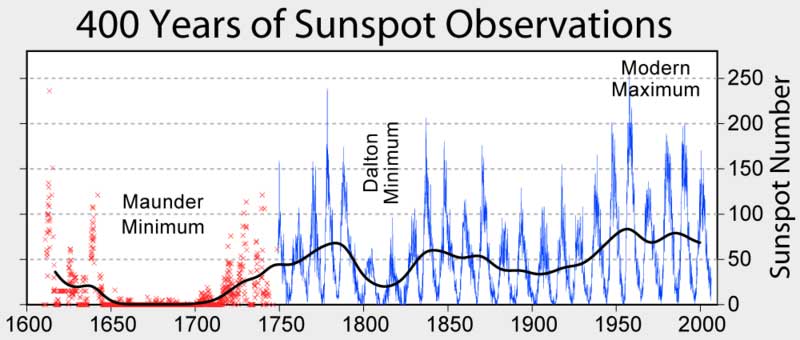
The worst cold of the Little Ice Age occurred in the late 17th century during a time known as the Maunder Minimum, which is linked to inactivity of the Sun. Based on the Central England Temperature record (the longest thermometer-based record) the depths of the cold were reached in the year 1695. For the next 40 years temperatures rose quickly and at several times the rate of warming measured in the 20th century.

The warming that began in the late 17th century continued for the next 300-plus years, ushering in an era of advancement unseen during any other period in humanity’s existence. It is what author W. Cleon Skousen called the “5,000 Year Leap” — five millennia of advances in communication, transportation, energy and exploration, and a doubling of the average length of human life, all condensed into less than 200 years. A myriad of factors were responsible, but it is certainly not clear that this progress would have occurred had Earth still been mired in the frigid temperatures of the Little Ice Age.

Last year, while Scott Pruitt was still the administrator of the EPA, he posed the question of how anyone could know what the ideal temperature of the Earth should be. Well known climate scientist Dr. Michael Mann of Penn State responded to Pruitt’s question by stating that the ideal temperature would be that which pre-dated the burning of fossil fuels. That temperature would put us squarely in the middle of the Little Ice Age’s devastating cold and history tells us that it turned out quite poorly.

History tells us that warming is very, very good, while cold is very, very bad.

Perhaps both Ocasio-Cortez and Mann should be labeled as “history deniers” for ignoring the true relationship between temperature and the human condition.

Footnote:  The obsession with a slight rise in average temperatures in the last 100 years is all the more remarkable for taking that warming totally out of context.
Any warming is good, even this small amount seen in the context of a year in the life of a typical American.  Moreover, the details of the statistics reveal that the rise is the result of cold months being warmer, while hotter months have cooled very slightly.  False Alarm.

Postscript (old soviet joke):  During soviet Russia era a professor addressed his history class, “I have good news and bad news about your final exam.  The good news is that all the questions are the same as last year.  The bad news:  Some of the answers are different.”