Arctic Ice May 11

cice_combine_thick_sm_en_20180511

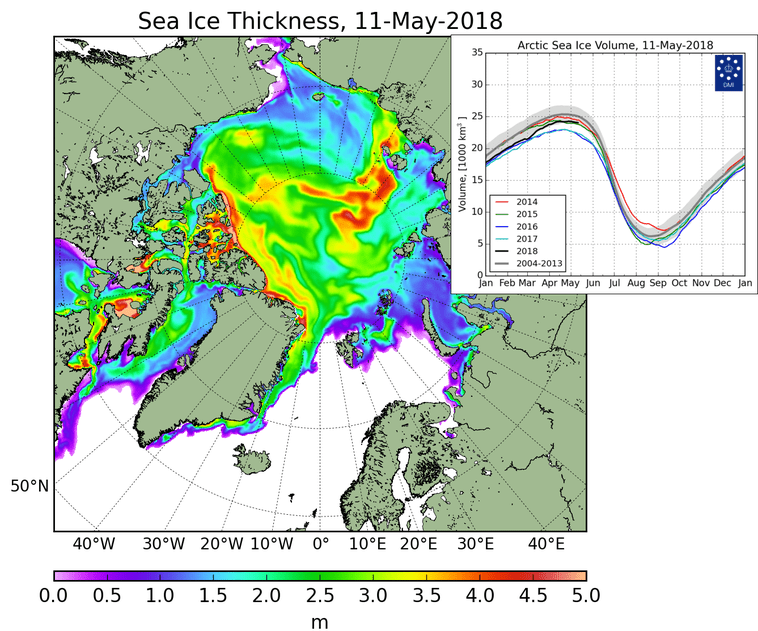
Sea Ice Thickness and Volume from DMI. H/T NoTricksZone

In May, ice extents are declining as usual, except for the early melting in Bering Sea.  The image above from DMI shows widespread thick ice across the Arctic core, likely to melt more slowly.  The graph above shows how much volume was added since March 2018, bringing it close to 2014, a particularly icy year.

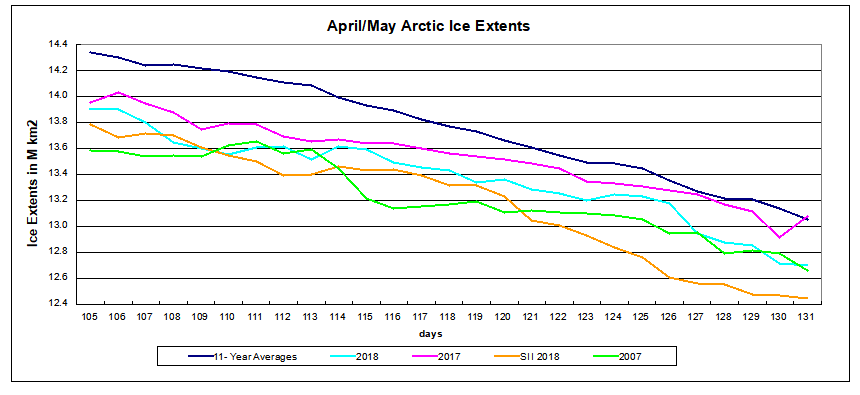
The graph below shows how the Arctic extent from MASIE has faired the last 26 days up to yesterday, compared to the 11 year average and to some years of interest.
NHday131
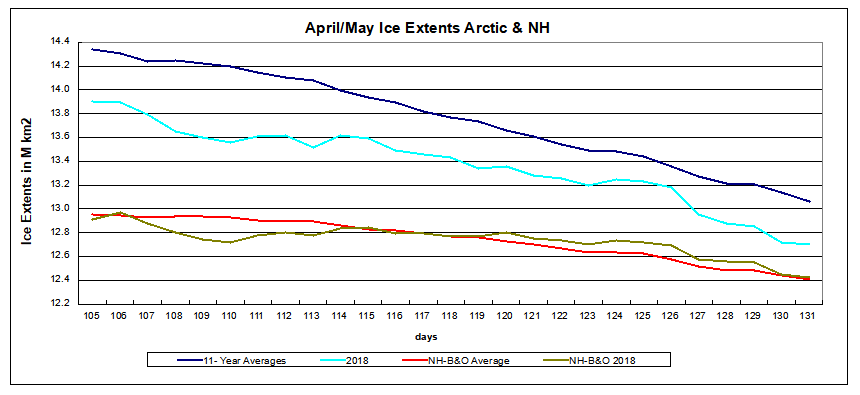
Note that 2017 is now matching the 11-year average, while 2018 and 2007 are tied ~360k km2 below average.  SII 2018 is tracking ~250k km2 lower at this point.  The graph below shows 2018 ice extents are matching the 11 year average once Bering and Okhotsk are excluded from the calculations.
NHday131less BO

The table shows regional ice extents compared to average and 2017.

Region 2018131 Day 131 
Average
2018-Ave. 2017131 2018-2017
 (0) Northern_Hemisphere 12701360 13058129 -356769 13075378 -374017
 (1) Beaufort_Sea 1070445 1047690 22755 1059451 10994
 (2) Chukchi_Sea 890598 950844 -60246 938716 -48117
 (3) East_Siberian_Sea 1087048 1083143 3906 1073762 13286
 (4) Laptev_Sea 896588 889502 7087 897845 -1256
 (5) Kara_Sea 925975 903277 22698 929156 -3182
 (6) Barents_Sea 530424 452492 77931 505439 24984
 (7) Greenland_Sea 460748 638101 -177353 710167 -249419
 (8) Baffin_Bay_Gulf_of_St._Lawrence 1264692 1146815 117877 1312382 -47690
 (9) Canadian_Archipelago 853109 844456 8653 851119 1990
 (10) Hudson_Bay 1255514 1207449 48065 1247480 8034
 (11) Central_Arctic 3173427 3233754 -60327 3248013 -74586
 (12) Bering_Sea 37974 412141 -374167 136049 -98075
 (13) Baltic_Sea 16848 9483 7365 11830 5018
 (14) Sea_of_Okhotsk 236246 236354 -108 152156 84090

Note the Bering accounts for the 2018 deficit to average.  Chukchi and Greenland Seas are down somewhat, but offset by  surpluses in Baffin Bay, Barents and Hudson Bay.  Compared to last year, the Bering deficit is much less, but Greenland Sea difference is much greater.

The Pacific basins of Bering and Okhotsk are the first to lose ice, and it will be interesting to see how the core Arctic Seas hold up this summer.  Barents is still up, but less dramatically than in April.  Chukchi is starting to open up, perhaps influenced by Bering.

Carbon Tax Hypocrisy, BC for example

BC Carbon Tax had little effect on emissions.

The Carbon Tax experiment in British Columbia is summarized by Kris Sims, the B.C. director of the Canadian Taxpayers Federation.  He writes in the Financial Post
B.C. tricked Canadian politicians into believing its carbon tax policy works. It doesn’t.  Excerpts below in italics with my bolds.

While Prime Minister Justin Trudeau’s government gets set to force a federal carbon tax on all of Canada’s provinces and territories, taxpayers across the country deserve to know what happened in the country’s carbon-tax test case, British Columbia.

The Trojan horse of the carbon tax was wheeled into the B.C. public square in 2008 with the government’s promise that it would somehow cost average people nothing and would be “revenue neutral.” But, that turned out to be a cautionary tale for the ages.

Revenue Neutral? Hah.

For years, the carbon-tax cheerleaders continued to laud the fee that’s been tacked on to carbon-emitting goods and services, urging the rest of the country to follow suit. It was touted as a magical formula that would somehow protect the environment and lower taxes all at once. Visions of hydrogen-powered buses and solar cars danced in the heads of the green bean counters. “Revenue neutral” they all sang.

Before the charade was abandoned entirely, this is what “revenue neutral” meant for the B.C. carbon tax: In 2016–17 the provincial government raked in $1.2 billion in the carbon tax from taxpayers. The amount is listed on page 68 in the budget document as a frame entitled: “Revenue Neutral Carbon Tax Plan.” Then, the government scraped together 17 sundry tax credits and stuffed them into the carbon-tax frame, making the tax sum balance out to zero. Abracadabra: “revenue neutral.” That’s all it meant.

It was a crass puppet show. Every provincial and federal budget includes tax credits for things like home renovations, children’s fitness programs, film incentives, and business training tax credits. In B.C., however, there is an uncommon carbon tax taken from people, so these very common credits were just repackaged to make the tax appear neutral on paper. As a senior B.C. government official admitted during last year’s budget lockup, “this was always just an accounting exercise.”

Raising the Cost of Living

The carbon tax is not an accounting exercise for B.C. families. It’s an expensive reality for any Canadian subjected to it.

Under the federal formula at $35 per tonne, the carbon tax costs a lot of money at the gas station, approximately 8.55 cents per litre of gasoline with the GST tacked onto it, and 10.06 cents per litre for diesel with the GST. To fill up an average Toyota Camry with a 70-litre fuel tank costs $6 in carbon tax. A Dodge Ram pick-up truck costs more than $10 in carbon tax and a Ford Super Duty Diesel costs more than $17 per fill up. For tractor-trailer trucks, it costs $45 in carbon taxes to fill up just one of those cylinder tanks with diesel. Canadians bought more than 40 billion litres of gasoline and more than 16 billion litres of diesel fuel in 2016. Multiply that volume by the carbon tax per litre and the government haul is crystal clear.

(Note: My spreadsheet shows 5 Billion dollars in tax for 2016, had those rates been in effect across Canada.  In the years 2008 to 2014, BC alone took in 5 Billion $ in carbon tax revenues.  At the current (since 2012) $30/ton rate, BC carbon tax revenues are projected to be $1.2 Billion per year.)

BC Emissions Higher Than Ever

It gets worse, though, because even with the carbon tax costing Canadians billions of dollars, it’s still not reducing emissions, according to environmentalists leading the carbon-tax charge. In January, the Sierra Club reported on the B.C. experiment: “emissions were higher in 2015 than in 2010 and have risen in four of the last five years. B.C.’s latest emissions data mark years of failure to reduce emissions by more than a token amount.” If taking billions of dollars away from Canadians doesn’t reduce emissions, then, what is the point of this forced carbon tax?

Carbon Tax Not Stopping Emissions? Raise the Ante.

When the forced federal carbon tax is set at $50 per tonne in 2022, that means that gasoline will have a carbon tax of 11.63 cents per litre. Will that be enough? Not according to the Environment Canada bureaucrats who told Environment Minister Catherine McKenna that the country needs a carbon tax of $100 per tonne by 2020 and a tax of $300 per tonne by 2050 to meet the government’s promises under the Paris climate agreement. That would be 23 cents per litre on gas in 2020 and then 70 cents per litre by 2050 — about $50 extra in today’s money to fill up the family sedan.

A Tax Against Life As We Know It

People need to use oil and gas. The carbon tax doesn’t make people “reduce their use” of this modern lifeblood, it just costs them a lot of money while not stopping the emissions. Our economy and our modern way of life depend on oil and gas. We use them to run our power stations, till our soil, plant our food, mine our minerals, mill our wood, heat our greenhouses, manufacture all of our goods and haul those goods and food to market.

We use oil and gas products to travel to school, work and the beach. Planes, automobiles and transit buses all use oil and gas, and they were manufactured and shipped to us using oil and gas. All of these actions of everyday life depend upon the miracle of hydrocarbons, so, the carbon tax is a tax on everything.

Carbon taxes don’t just make gasoline more expensive, they make life much more expensive.

Apr. 2018 Ocean Cooling Delayed

globpop_countries

The best context for understanding decadal temperature changes comes from the world’s sea surface temperatures (SST), for several reasons:

  • The ocean covers 71% of the globe and drives average temperatures;
  • SSTs have a constant water content, (unlike air temperatures), so give a better reading of heat content variations;
  • A major El Nino was the dominant climate feature in recent years.

HadSST is generally regarded as the best of the global SST data sets, and so the temperature story here comes from that source, the latest version being HadSST3.  More on what distinguishes HadSST3 from other SST products at the end.

The Current Context

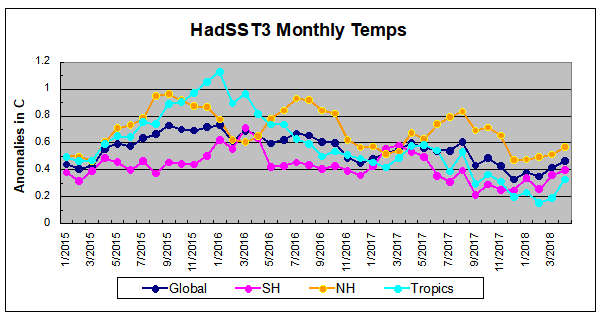
The chart below shows SST monthly anomalies as reported in HadSST3 starting in 2015 through April 2018.

HadSST042018

A global cooling pattern has persisted, seen clearly in the Tropics since its peak in 2016, joined by NH and SH dropping since last August. Upward bumps occurred last October, in January and again in March and April 2018.  Four months of 2018 now show slight warming since the low point of December 2017, led by steadily rising NH.  Only the Tropics are showing temps the lowest in this time frame, despite an anomaly rise of 0.14 in April. Globally, and in both hemispheres anomalies closely match April 2015.

Note that higher temps in 2015 and 2016 were first of all due to a sharp rise in Tropical SST, beginning in March 2015, peaking in January 2016, and steadily declining back below its beginning level. Secondly, the Northern Hemisphere added three bumps on the shoulders of Tropical warming, with peaks in August of each year. Also, note that the global release of heat was not dramatic, due to the Southern Hemisphere offsetting the Northern one.

With ocean temps positioned the same as three years ago, we can only wait and see whether the previous cycle will repeat or something different appears.  As the analysis belows shows, the North Atlantic has been the wild card bringing warming this decade, and cooling will depend upon a phase shift in that region.

A longer view of SSTs

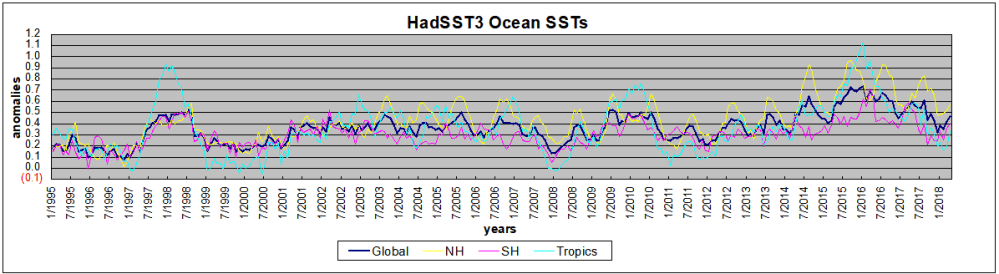
The graph below  is noisy, but the density is needed to see the seasonal patterns in the oceanic fluctuations.  Previous posts focused on the rise and fall of the last El Nino starting in 2015.  This post adds a longer view, encompassing the significant 1998 El Nino and since.  The color schemes are retained for Global, Tropics, NH and SH anomalies.  Despite the longer time frame, I have kept the monthly data (rather than yearly averages) because of interesting shifts between January and July.

HadSST95to042018

Open image in new tab for sharper detail.

1995 is a reasonable starting point prior to the first El Nino.  The sharp Tropical rise peaking in 1998 is dominant in the record, starting Jan. ’97 to pull up SSTs uniformly before returning to the same level Jan. ’99.  For the next 2 years, the Tropics stayed down, and the world’s oceans held steady around 0.2C above 1961 to 1990 average.

Then comes a steady rise over two years to a lesser peak Jan. 2003, but again uniformly pulling all oceans up around 0.4C.  Something changes at this point, with more hemispheric divergence than before. Over the 4 years until Jan 2007, the Tropics go through ups and downs, NH a series of ups and SH mostly downs.  As a result the Global average fluctuates around that same 0.4C, which also turns out to be the average for the entire record since 1995.

2007 stands out with a sharp drop in temperatures so that Jan.08 matches the low in Jan. ’99, but starting from a lower high. The oceans all decline as well, until temps build peaking in 2010.

Now again a different pattern appears.  The Tropics cool sharply to Jan 11, then rise steadily for 4 years to Jan 15, at which point the most recent major El Nino takes off.  But this time in contrast to ’97-’99, the Northern Hemisphere produces peaks every summer pulling up the Global average.  In fact, these NH peaks appear every July starting in 2003, growing stronger to produce 3 massive highs in 2014, 15 and 16, with July 2017 only slightly lower.  Note also that starting in 2014 SH plays a moderating role, offsetting the NH warming pulses. (Note: these are high anomalies on top of the highest absolute temps in the NH.)

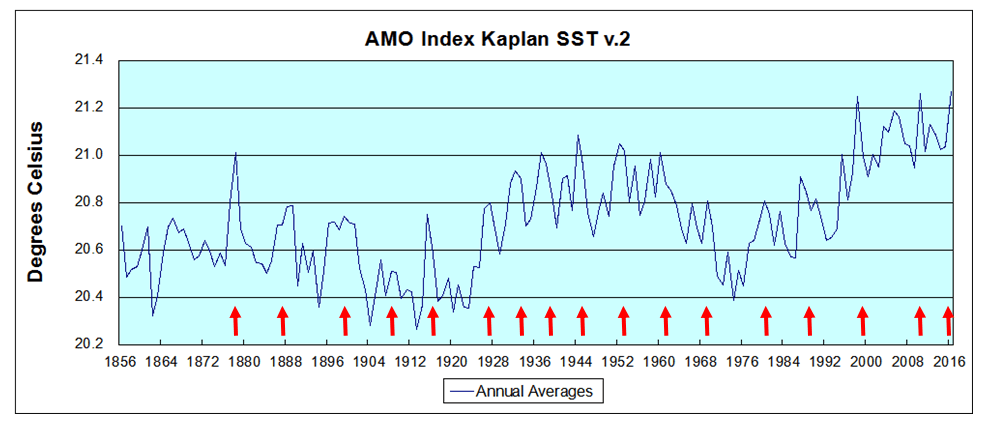
What to make of all this? The patterns suggest that in addition to El Ninos in the Pacific driving the Tropic SSTs, something else is going on in the NH.  The obvious culprit is the North Atlantic, since I have seen this sort of pulsing before.  After reading some papers by David Dilley, I confirmed his observation of Atlantic pulses into the Arctic every 8 to 10 years as shown by this graph:

The data is annual averages of absolute SSTs measured in the North Atlantic.  The significance of the pulses for weather forecasting is discussed in AMO: Atlantic Climate Pulse

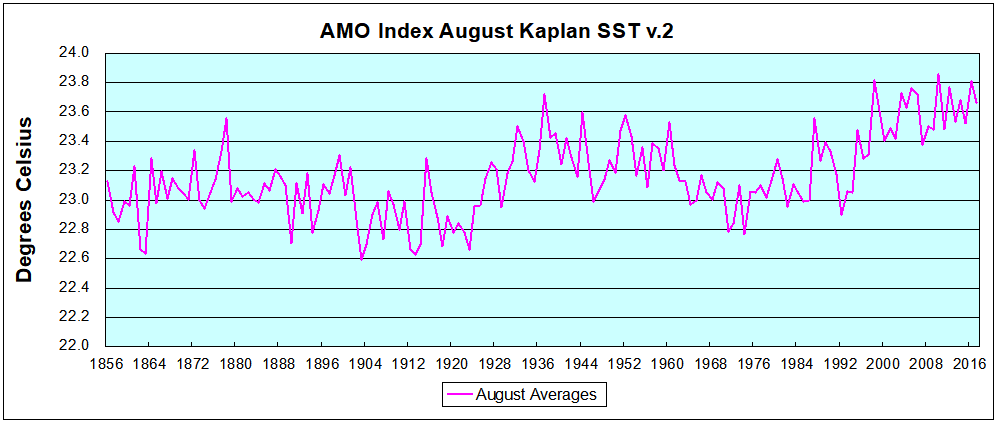
But the peaks coming nearly every July in HadSST require a different picture.  Let’s look at August, the hottest month in the North Atlantic from the Kaplan dataset.Now the regime shift appears clearly. Starting with 2003, seven times the August average has exceeded 23.6C, a level that prior to ’98 registered only once before, in 1937.  And other recent years were all greater than 23.4C.

Summary

The oceans are driving the warming this century.  SSTs took a step up with the 1998 El Nino and have stayed there with help from the North Atlantic, and more recently the Pacific northern “Blob.”  The ocean surfaces are releasing a lot of energy, warming the air, but eventually will have a cooling effect.  The decline after 1937 was rapid by comparison, so one wonders: How long can the oceans keep this up?

To paraphrase the wheel of fortune carnival barker:  “Down and down she goes, where she stops nobody knows.”  As this month shows, nature moves in cycles, not straight lines, and human forecasts and projections are tenuous at best.

einsteinalbert-integratesempirically800px

Postscript:

In the most recent GWPF 2017 State of the Climate report, Dr. Humlum made this observation:

“It is instructive to consider the variation of the annual change rate of atmospheric CO2 together with the annual change rates for the global air temperature and global sea surface temperature (Figure 16). All three change rates clearly vary in concert, but with sea surface temperature rates leading the global temperature rates by a few months and atmospheric CO2 rates lagging 11–12 months behind the sea surface temperature rates.”

Footnote: Why Rely on HadSST3

HadSST3 is distinguished from other SST products because HadCRU (Hadley Climatic Research Unit) does not engage in SST interpolation, i.e. infilling estimated anomalies into grid cells lacking sufficient sampling in a given month. From reading the documentation and from queries to Met Office, this is their procedure.

HadSST3 imports data from gridcells containing ocean, excluding land cells. From past records, they have calculated daily and monthly average readings for each grid cell for the period 1961 to 1990. Those temperatures form the baseline from which anomalies are calculated.

In a given month, each gridcell with sufficient sampling is averaged for the month and then the baseline value for that cell and that month is subtracted, resulting in the monthly anomaly for that cell. All cells with monthly anomalies are averaged to produce global, hemispheric and tropical anomalies for the month, based on the cells in those locations. For example, Tropics averages include ocean grid cells lying between latitudes 20N and 20S.

Gridcells lacking sufficient sampling that month are left out of the averaging, and the uncertainty from such missing data is estimated. IMO that is more reasonable than inventing data to infill. And it seems that the Global Drifter Array displayed in the top image is providing more uniform coverage of the oceans than in the past.

uss-pearl-harbor-deploys-global-drifter-buoys-in-pacific-ocean

USS Pearl Harbor deploys Global Drifter Buoys in Pacific Ocean


Plateau in Ocean Air Temps

Years ago, Dr. Roger Pielke Sr. explained why sea surface temperatures (SST) were the best indicator of heat content gained or lost from earth’s climate system.  Enthalpy is the thermodynamic term for total heat content in a system, and humidity differences in air parcels affect enthalpy.  Measuring water temperature directly avoids distorted impressions from air measurements.  In addition, ocean covers 71% of the planet surface and thus dominates surface temperature estimates.

More recently, Dr. Ole Humlum reported from his research that air temperatures lag 2-3 months behind changes in SST.  He also observed that changes in CO2 atmospheric concentrations lag behind SST by 11-12 months.  This latter point is addressed in a previous post Who to Blame for Rising CO2?

The April update to HadSST3 will appear later this month, but in the meantime we can look at lower troposphere temperatures (TLT) from UAHv.6 which are already posted for April. The temperature record is derived from microwave sounding units (MSU) on board satellites like the one pictured above.

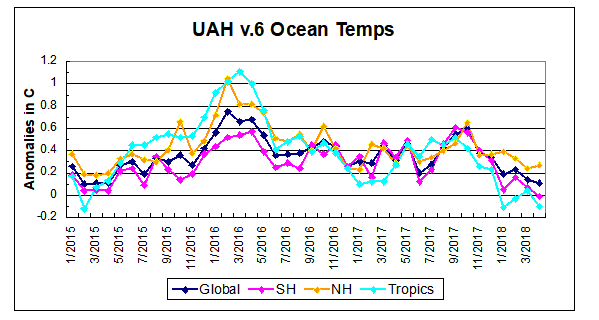
The UAH dataset includes temperature results for air above the oceans, and thus should be most comparable to the SSTs. The graph below shows monthly anomalies for ocean temps since January 2015.
The anomalies have reached the same levels as 2015.  Taking a longer view, we can look at the record since 1995, that year being an ENSO neutral year and thus a reasonable starting point for considering the past two decades.  On that basis we can see the plateau in ocean temps is persisting. Since last October all oceans have cooled, with upward bumps in Feb. 2018, now erased.

UAHv.6 TLT 
Monthly Ocean Anomalies
Ave. Since 1995 Ocean 4/2018
Global 0.13 0.11
NH 0.16 0.27
SH 0.11 -0.01
Tropics 0.12 -0.1

As of April 2018, global ocean temps are slightly below the average since 1995.  NH remains higher, but not enough to offset much lower temps in SH and Tropics (between 20N and 20S latitudes).

The details of UAH ocean temps are provided below.  The monthly data make for a noisy picture, but seasonal fluxes between January and July are important.

Click on image to enlarge.

The greater volatility of the Tropics is evident, leading the oceans through three major El Nino events during this period.  Note also the flat period between 7/1999 and 7/2009.  The 2010 El Nino was erased by La Nina in 2011 and 2012.  Then the record shows a fairly steady rise peaking in 2016, with strong support from warmer NH anomalies, before returning to the 22-year average.

Summary

TLTs include mixing above the oceans and probably some influence from nearby more volatile land temps.  They started the recent cooling later than SSTs from HadSST3, but are now showing the same pattern.  It seems obvious that despite the three El Ninos, their warming has not persisted, and without them it would probably have cooled since 1995.  Of course, the future has not yet been written.


Climate Answers Blowing in the Wind

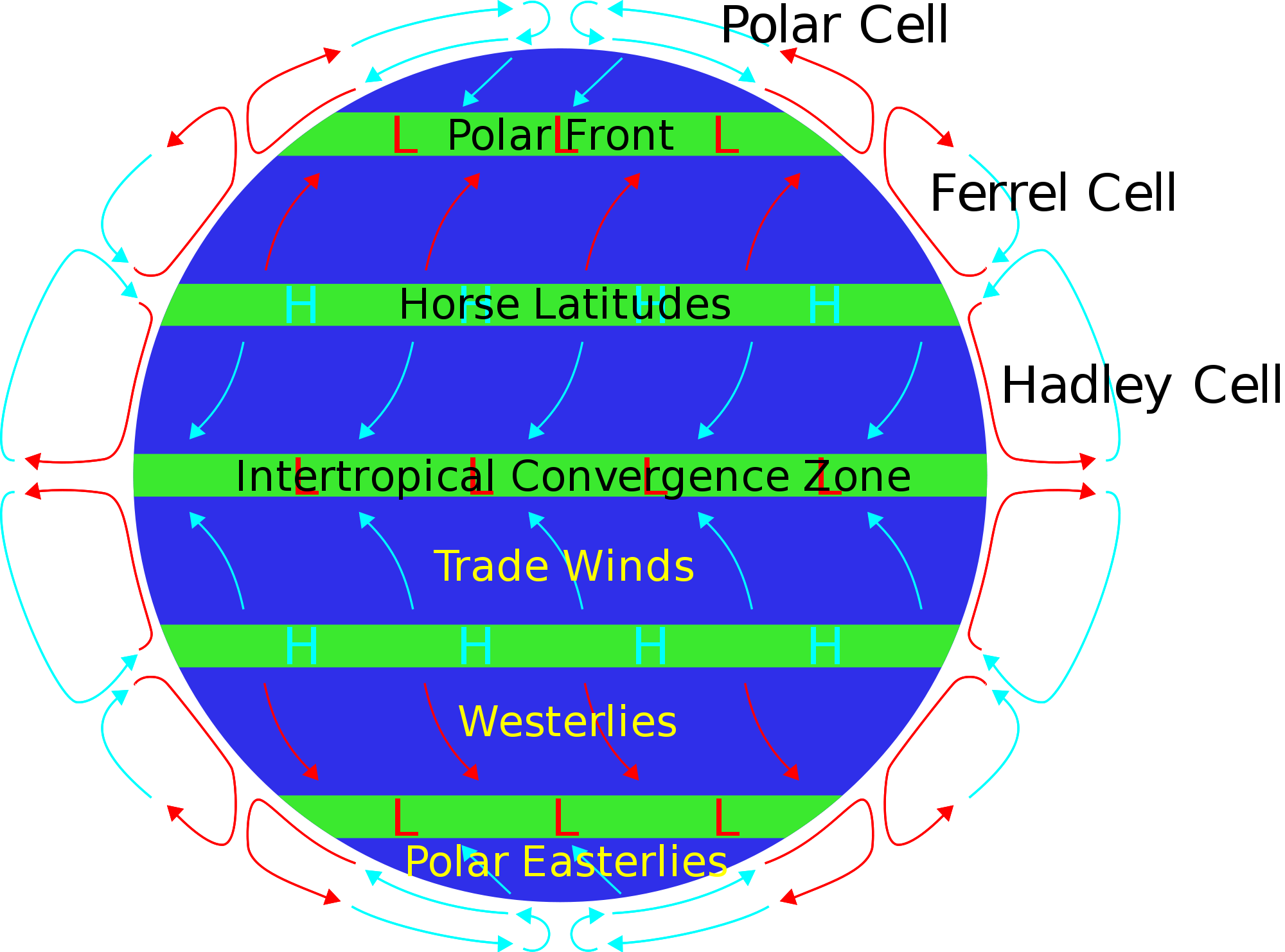
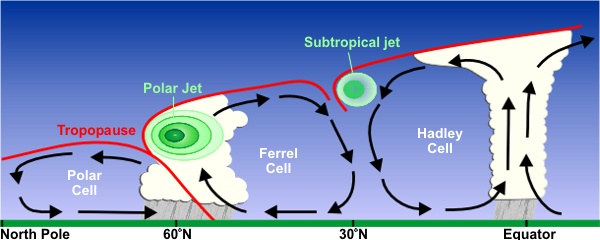
The subtropical jet streams are weaker and higher in the atmosphere at 10-16 kilometers above sea level. Jet streams wander laterally in quite dramatic waves and can exhibit huge changes in altitude. Breaks in the tropopause at the Polar, Hadley and Ferrel circulation cells cause the streams to form. The combination of circulation and Coriolis forces acting on the cell masses drive the phenomenon. The Polar jet, being at a lower altitude, strongly affects weather and aviation. It is most often found between the latitudes of 30 degrees and 60 degrees, while you can find the subtropical jets at 30 degrees. A jet stream is generally a few hundred kilometers wide and only about 5 kilometers high.

Fundamental questions and unknowns concerning natural climate change are presented in this 2007 essay Challenges to Our Understanding of the General Circulation: Abrupt Climate Change by Richard Seager and David S. Battisti. Excerpts in italics with my bolds.

The abrupt climate changes that occurred during the last glaciation and deglaciation are mind boggling both in terms of rapidity and magnitude. That winters in the British Isles could switch between mild, wet ones very similar to today and ones in which winter temperatures dropped to as much as 20◦C below freezing, and do so in years to decades, is simply astounding. No state-of-the-art climate model, of the kind used to project future climate change within the Intergovernmental Panel on Climate Change process, has ever produced a climate change like this.

The problem for dynamicists working in this area is that the period of instrumental observationsand model simulations of that period, do not provide even a hint that drastic climate reorganizations can occur.  Our understanding of the general circulation is based fundamentally on this period or, more correctly, on the last 50 years of it, a time of gradual climate change or, at best, more rapid changes of modest amplitude. So it is not surprising that our encyclopedia of knowledge of the general circulations contains many ideas of negative feedbacks between circulation features that may help explain climate variability but also stabilize the climate (Bjerknes 1964; Hazeleger et al. 2005; Shaffrey and Sutton 2004). The modern period has not been propitious for studying how the climate can run away to a new state. Because of this, our understanding has to be limited

The normal explanation of how such changes occurred is that deepwater formation in the Nordic Seas abruptly ceased or resumed forcing a change in ocean heat flux convergence and changes in sea ice. However, coupled GCMs only produce such rapid cessations in response to unrealistically large freshwater forcing and have not so far produced a rapid resumption.

The discussions of the spatial extent of abrupt climate changes in glacial times and during the last deglaciation should make it clear that the causes must be found in changes in the general circulations of the global, as opposed to regional, atmosphere and ocean circulation. The idea that the THC changes and directly impacts a small area of the globe, and that somehow most of the rest of the world piggy-backs along in a rather systematic and reliable way seems dubious.

Thus the problems posed by abrupt change in the North Atlantic region are:
1. How could sea ice extend so far south in winter during the stadials?
2. How, during the spring and summer of stadials, can there be such an enormous influx of heat as to melt the ice and warm the water below by close to 10◦C? If 50 m of water needs to be warmed up by this much in four months, it would take an average net surface heat flux of 150 Wm−2, more than twice the current average between early spring and midsummer and more than can be accounted for by any increase in summer solar irradiance (as during the Younger Dryas).
3. How can this stadial state of drastic seasonality abruptly shift into one similar to that of today with a highly maritime climate in western Europe? Remember that both states can exist in the presence of large ice sheets over North America and Scandinavia.

In thinking of ways to reduce the winter convergence of heat into the mid and high-latitude North Atlantic, we might begin with the storm tracks and mean atmosphere circulation. The Atlantic storm track and jet stream have a clear southwest-to-northeast trajectory, whereas the Pacific ones are more zonal over most of their longitudinal reach (Hoskins and Valdes 1990). If the Atlantic storm track and jet could be induced to take a more zonal track, akin to its Pacific cousin, the North Atlantic would cool.

Here we have argued that the abrupt changes must involve more than changes in the North Atlantic Ocean circulation. In particular it is argued that the degree of winter cooling around the North Atlantic must be caused by a substantial change in the atmospheric circulation involving a great reduction of atmospheric heat transport into the region. Such a change could, possibly, be due to a switch to a regime of nearly zonal wind flow across the Atlantic, denying western Europe the warm advection within stationary waves that is the fundamental reason for why Europe’s winters are currently so mild. Such a change in wind regime would, presumably, also cause a change in the North Atlantic Ocean circulation as the poleward flow of warm, salty waters from the tropics into the Nordic Seas is diverted south by the change in wind stress curl. This would impact the location and strength of deep water formation and allow sea ice to expand south.

The North Atlantic Oscillation (NAO) is is a largely atmospheric mode from fluctuations in the difference of atmospheric pressure at sea level (SLP) between the Icelandic low and the Azores high. Through fluctuations in the strength of the Icelandic low and the Azores high, it controls the strength and direction of westerly winds and location of storm tracks across the North Atlantic. It is part of the Arctic oscillation, and varies over time with no particular periodicity. Wikipedia

Recent Wind Research

A decade later we have further insight into the role of winds in climate change by means  of a paper discussed in this Futurity article Wind shifts may explain Europe’s ‘weird’ winters  Excerpts in italics with my bolds.

In the mid-1990s, scientists assembled the first century-long record of North Atlantic sea surface temperatures and quickly discovered a cycle of heating and cooling at the surface of the ocean. Each of these phases lasted for decades, even as temperatures warmed overall during the course of the century. Since this discovery, these fluctuations in ocean temperature have been linked to all manner of Northern Hemisphere climate disturbances, from Sahel drought to North Atlantic hurricanes.

Research also linked European climate variability to the temperature swings of its neighboring ocean in the spring, summer, and fall. Surprisingly, however, no imprint of the ocean’s variability could be found in Western Europe’s wintertime temperature record. This absence was especially puzzling in light of the fact that Europe’s mild winters are a direct consequence of its enviable location downwind of the North Atlantic.

Now, a study by researchers at McGill University and the University of Rhode Island suggests the answer to this puzzle lies in the winds themselves. The fluctuations in ocean temperature are accompanied by shifts in the winds. These wind shifts mean that air arrives in Western Europe via very different pathways in decades when the surface of the North Atlantic is warm, compared to decades when it is cool.
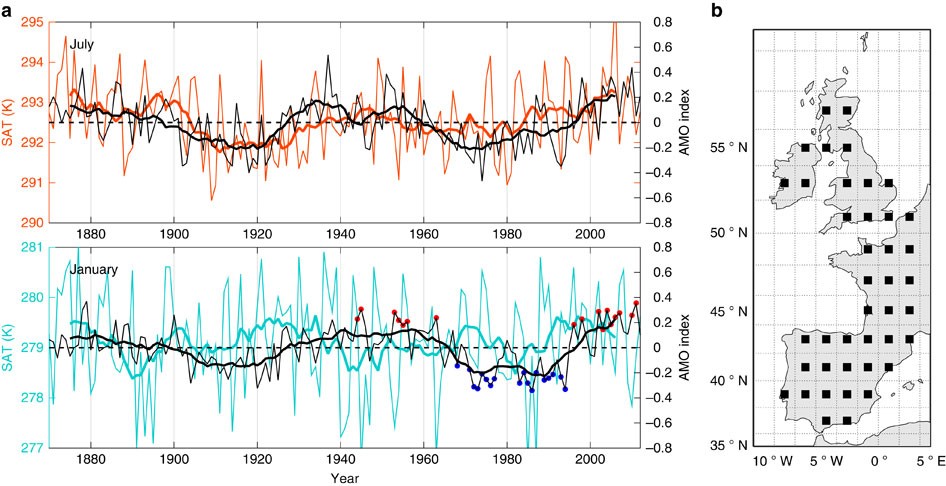
(a) Time series of the linearly detrended North Atlantic SST (black lines, referred to as the AMO index) and SAT averaged over western Europe ([36N 60N] × [10W 3E]; shown in coloured lines) in July (top panel) and January (bottom panel). Bold lines show 10-year running means. The correlation coefficient between the 10-year running mean of the detrended SAT and AMO index is 0.61 in July (statistically significant at 10% confidence level even after accounting for the reduced effective degrees of freedom due to autocorrelation of the time series) and −0.02 in January; these correlations are insensitive to the averaging region chosen for western Europe. The red circles on January plot indicate the AMO-positive years chosen for the composite analysis, whereas the blue circles indicate the AMO-negative years chosen. (b) Study region encompassing western Europe ([36N 60N] × [10W 3E]) and locations for the backtracked Lagrangian particle release (black squares).

The researchers studied the winds and their interaction with the ocean in a recently developed reconstruction of 20th-century climate. Their main approach was to launch virtual particles into the winds, and trace their journey for ten key days leading up to their arrival in Western Europe. They repeated this procedure using the wind field for each winter of the last 72 years, a period for which the winds of the North Atlantic have already been carefully documented and validated.

The new research reveals that in decades in which North Atlantic sea surface temperatures are elevated, winds deliver air to Europe disproportionately from the north.

In contrast, in decades of coolest sea surface temperature, swifter winds extract more heat from the western and central Atlantic before arriving in Europe. The researchers suggest the distinct atmospheric pathways hide the ocean oscillation from Europe in winter.

“It is often presumed that the cooler North Atlantic will quickly lead to cooling in Europe, or at least a slowdown in its rate of warming,” says Ayako Yamamoto, a PhD student at McGill University and lead author of the study. “But our research suggests that the dynamics of the atmosphere might stop this relative cooling from showing up in Europe in winter in the decades following an Atlantic cooling.”

The complete paper is The absence of an Atlantic imprint on the multidecadal variability of wintertime European temperature by Ayako Yamamoto & Jaime B. Palter Nature Communications (2016). Excerpts in italics with my bolds.
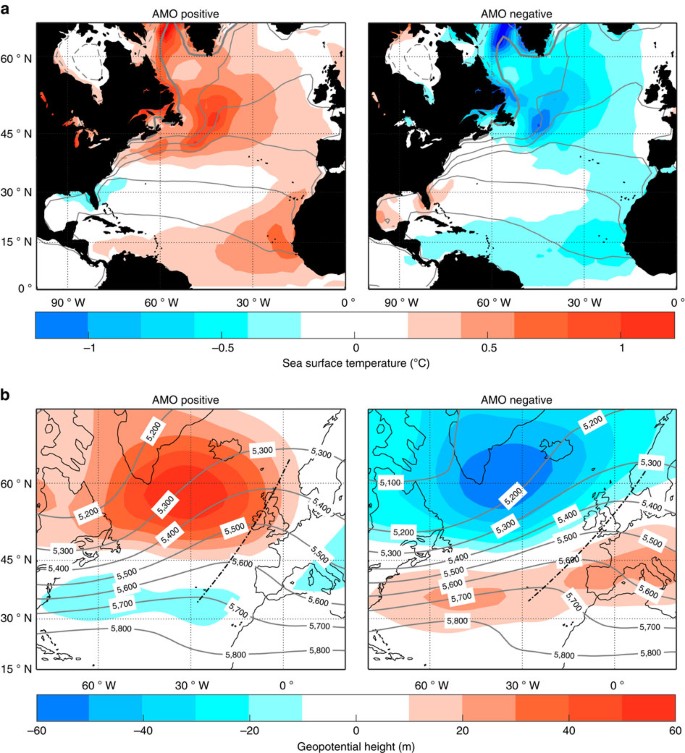
Figure 2: The spatial pattern of the AMO index and its relationship with the atmospheric flow in January. Composite maps of (a) sea surface temperature (SST) field and (b) 500 hPa geopotential height field (Z500) for AMO anomalously positive years (left panel) and negative years (right panel). The January mean field is shown in contours, and its departure from the 72-year climatology is represented by colour shading. The thick grey contour line in a denotes 0 °C, whereas thin (dashed) lines denote positive (negative) SST every 5 °C. The black dashed lines in b are drawn through the local maxima of the geopotential height field at each latitude, which is the point where the wind changes direction from south–westerly to north–westerly.

The large-scale atmospheric flow varies with the AMO index (Fig. 2b). The difference in the 500-hPa geopotential height (Z500) field, which is analogous to streamlines, shows that the direction of winds arriving in western Europe changes between the two AMO phases: winds are more northerly during the anomalous AMO-positive years, whereas they are more zonal during the AMO-negative years (Fig. 2b). The more tightly spaced isohypses during the AMO-negative years indicate a swifter flow relative to the AMO-positive years. Accordingly, the AMO-negative years see an elongated and more zonal January storm track (Supplementary Fig. 1), which is consistent with results from a free-running climate model7. Composite Z500 maps constructed with more complete sampling of the longer decadal periods associated with the AMO show similar, albeit weaker, anomaly patterns (Supplementary Fig. 2a).

In winter in the North Atlantic, SST is almost always warmer than the surface air temperature (SAT), so the ocean loses heat rapidly to the atmosphere over the entirety of the basin (that is, positive fluxes in our convention; Fig. 3b and Supplementary Fig. 3b). The fluxes over the warm Gulf Stream and its North Atlantic Current extension are generally a factor of five higher than found elsewhere. However, a view of the fluxes weighted by the fraction of time the particles spend in each location on their journey to western Europe (Fig. 3c and Supplementary Fig. 3c) suggests a reduced role of these strong flux regions in establishing western European wintertime temperature.

The difference in the number density of the particle positions between the composite AMO periods (Fig. 3d) shows a significant distinction in the preferred pathways, with the statistical significance increasing when results are separated by particles launched from northern and southern sub-regions of western Europe (Supplementary Fig. 3d). In the AMO-positive years, particles spend more of their 10-day trajectory recirculating locally to the southwest of Iceland. During the AMO-negative years, the pathways are anomalously long, and a greater number of trajectories originate from North America and the Arctic, before transiting over the Labrador Sea and mid-latitude North Atlantic.

The strengthening and lengthening of the storm track in sync with anomalously cooler North Atlantic SSTs has important implications for future climate. Given that decadal variability in North Atlantic SSTs may be driven partly by fluctuations in the strength of the AMOC10,11,12, our result suggests the possibility of a stabilizing feedback for ocean circulation: Cooler SSTs associated with a sluggish AMOC is linked with an atmospheric adjustment that enhances turbulent heat fluxes over oceanic convective regions in winter. These larger fluxes could possibly reinvigorate convection, deep water formation and the AMOC. Moreover, the observed link of the atmospheric circulation with the cool SST anomalies of the late 1970s to early 1990s is much like the predicted change of the storm track in response to a decline of the AMOC under global warming36. A weakened AMOC has long been thought to cause anomalous cooling in western Europe via a decline in oceanic heat transport and associated atmospheric feedbacks21. However, the changes we describe here in atmospheric Lagrangian trajectories and the heat fluxes along them could provide a mechanism that reduces the magnitude of European wintertime cooling on decadal time scales, even as they might stabilize the oceanic circulation.

The answer is blowin’ in the wind.  Bob Dylan


Seeing What We Presume

This remarkable arrow was designed by a scientist specializing in optical illusions.  In this case, no matter what you do, you can not make your brain see anything other than an arrow pointing right.  The reason is your brain processes the patterns on the object with only that perception possible.

It is the creation of Professor Kokichi Sugihara at Meiji University in Tokyo.  Professor Sugihara has a long history of designing mind-bending objects.  The mathematician provides some complex equations in his paper explaining how such an illusion is possible, but all you really need to know is that the always-right arrow uses forced perspective to exploit your brain’s penchant for finding right angles where there aren’t any.  It may seem like magic, but it’s really just your brain being too efficient in its quest to make order out of chaos.

This is a fun example, but it reminds us of the climate wars where perception bias is also hardwired. And it reminds us that any observer adds a frame of reference on top of objective reality.

Is This Cold the New Normal?

The video is a recent interview with Piers Corbyn of Weather Action making the case for a cooling climate over the next twenty years.  H/T to iceagenow for the link.  I made a loose transcription to express the main points made by Corbyn.

The sun rules the sea temperature and the sea temperature rules the climate.

The truth is the levels of CO2 in the atmosphere are beyond the control of man. And furthermore, the levels of CO2 themselves do not have any impact on climate.

All sides agree there are 50 times more CO2 in the ocean than in the air. The level between them and the saturation level in the atmosphere will be set by the ocean. Warm up the ocean a bit and more gas will come, cool it and more gas will be absorbed. Because oceanic CO2 is 50 times larger, anything man does to atmospheric levels does not matter. If man, or nature, or insects put more CO2 into the air, it will just go into the ocean, depending on the sea temperature. The equilibrium levels will follow Henry’s law of gas solubility.

What we have happening now is the start of a mini ice age. It began starting slowly around 2013, and the move is accelerating. In the immediate you can look at this winter and spring. We have had extreme snow, record low temperatures, all over the Northern Hemisphere.

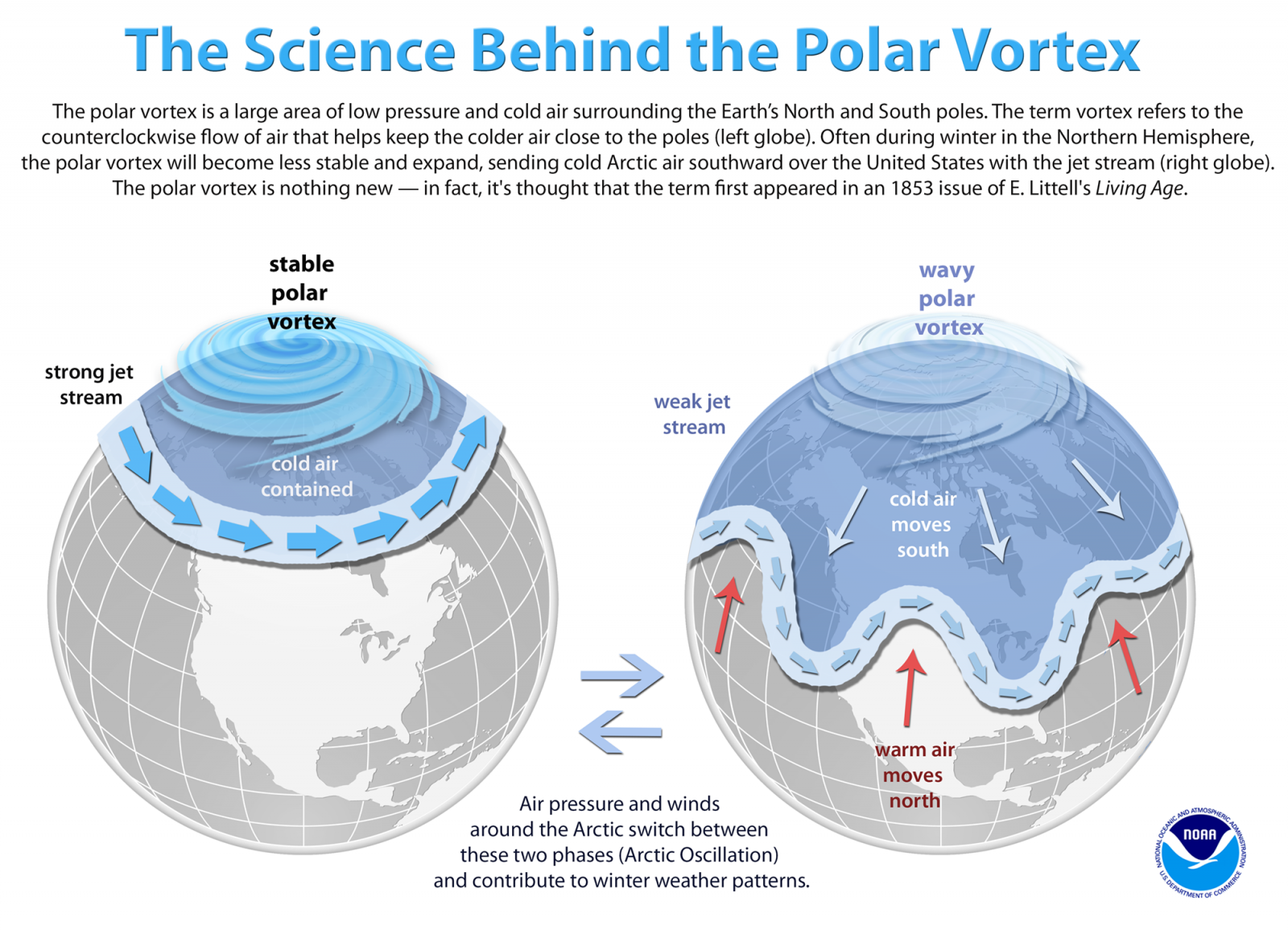
The main thing is the wild jet stream signifying onset of a mini ice age. Instead of staying in a high north zonal position associated with a warmer world, the jet stream has gotten wavy and descended into mid latitudes and lower, because of minimal solar activity.

North of the jet stream is colder air, and warmer air south of it. Under normal springtime conditions, the jet stream remains well North of the British Isles meaning warmer weather there. However presently the jet stream is both lower and extra wavy, meaning that loops bring cold arctic air over parts of NH. This behavior contradicts global warming theory, but confirms expectations of a mini ice age.

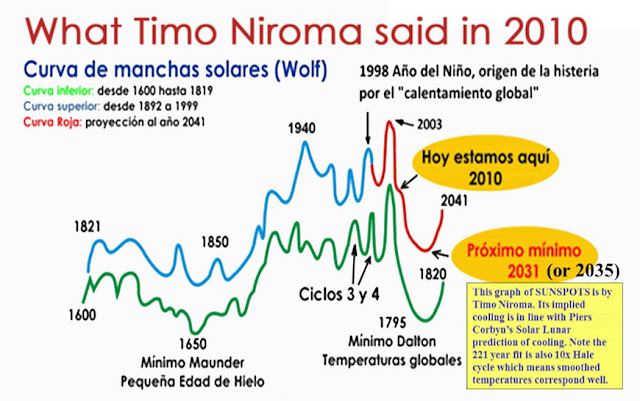
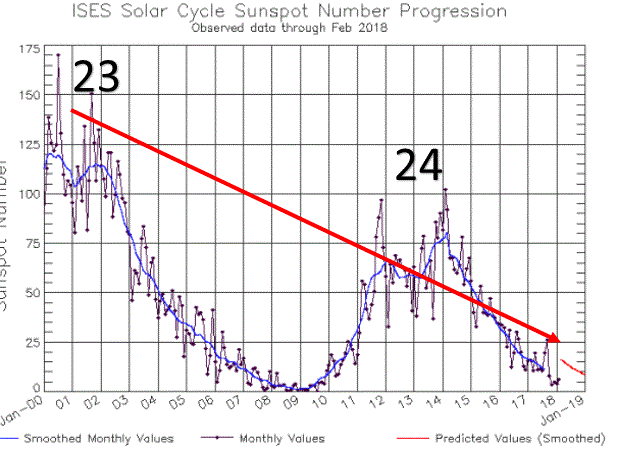
The graph compares average solar activity in the last 200 years with solar activity ten magnetic cycles previous to now. The correlation is impressive. We are at the knee of this curve, plus or minus three or four years. If the correlation holds, we are plunging into a mini ice age. So for the next two decades until about 2035 it will get cooler and cooler on average and there will more wild jet streams and weather. Growing seasons will be shorter and crop failures more frequent, resulting in economic difficulties.

The basic message is that the sun is controlling the climate, primarily by the sea. “The best thing to do now is to tell your politicians to stop believing nonsense, and to stop doing silly measures like the bird-killing machines of wind farms in order to save the planet (they say), but get rid of all those things, which cost money, and reduce electricity prices now.”

Summary

This winter and spring are inconsistent with global warming assumed to result from CO2.  The wild jet stream (polar vortex) bringing these conditions does fit with solar activity fluxes.  If the correlation holds, the planet will cool not warm.  Governments would serve their citizens by shifting priorities from controlling emissions to ensuring robust infrastructure and reliable, affordable energy.

The sun on April 30, 2018. From spaceweather.com


Can Justice Be Blind, But Not Illiterate?

Previous posts have discussed how the Judiciary seems unprepared for the mounting caseload of climate legal actions. Some background links are at the end, but this post is an update on two important court proceedings, thanks to Manhattan Contrarian Francis Menton. The essay is Complete Polarization In The World Of Politics: Climate Change Edition Excerpts in italics below with my bolds.

Menton provides examples of political polarization regarding climate, the first two being:

  • The polls showing Republicans and Democrats holding widely different opinions on climate concerns;
  • The recent confirmation battle over James Bridenstine, nominated to lead NASA, including GISS headed by climate alarmist Gavin Schmidt.

Then Menton gets into the contrary behavior of court decisions, two recent examples being:

  • Ruling involving Exxon’s countersuits against criminal investigations by several State Attorneys General;
  • Ruling involving Exxon’s legal claims against lawsuits from California cities.

And then we have the courts. You know — the places where the lady holding the scales of justice wears a blindfold to indicate that she won’t even peak to see whether politics would dictate a preferred result here. If you believe that, consider two recent results from two different courts.

As background, you probably are aware that the major oil companies, and most notably Exxon Mobil, have come under siege recently from government lawyers in deep blue jurisdictions, including the Attorneys General of New York (Schneiderman) and Massachusetts (Healey) and certain County and City Attorneys in California. In 2015 Schneiderman and Healey initiated what they claim to be “criminal” investigations, although three years in no charges have been filed (and no plausible potential charges have even been suggested). The Counties and Cities in California have brought civil lawsuits, sounding in common law “nuisance,” claiming potentially billions of dollars in damages from what they assert will be rising sea levels caused by climate change.

1. Exxon versus Attorneys General of New York and Massachusetts

In June 2016, Exxon tried a counterstrike by filing a lawsuit in federal court in Dallas, Texas seeking discovery against Schneiderman and Healey as to what it claimed was the political motives behind the supposed criminal investigation. Exxon supported its complaint with a litany detailing meetings between and among the AGs and climate activists, where the activists urged the AGs to use their powers to investigate oil companies. The Dallas judge (Kinkeade) initially issued an opinion containing some statements favorable to Exxon’s position, but then in March 2017 Judge Kinkeade transferred the case to the Southern District of New York. Transferring a case from one state to another is something that federal judges can do within the federal court system. Upon transfer, Exxon’s case came before Obama-appointee Valerie Caproni. On March 29 this year, Judge Caproni dismissed the case with an opinion that was highly critical of Exxon’s gambit. Key quote:

Exxon’s allegations that the AGs are pursuing bad faith investigations in order to violate Exxon’s constitutional rights are implausible and therefore must be dismissed for failure to state a claim.

From Judge Caponi’s Order (full text here) with my bolds.

Exxon contends the investigations are being conducted to retaliate against Exxon for its views on climate change and thus violate Exxon’s constitutional rights. The relief requested by Exxon in this case is extraordinary: Exxon has asked two federal courts—first in Texas, now in New York—to stop state officials from conducting duly-authorized investigations into potential fraud.

It has done so on the basis of extremely thin allegations and speculative inferences. The factual allegations against the AGs boil down to statements made at a single press conference and a collection of meetings with climate-change activists. Some statements made at the press conference were perhaps hyperbolic, but nothing that was said can fairly be read to constitute declaration of a political vendetta against Exxon.

2. Exxon versus California Cities and Counties

Meanwhile, in January of this year, Exxon initiated a similar gambit with regard to the California nuisance lawsuits. This time it brought its claim in the District Court of Tarrant County, Texas (Fort Worth) — that is, a state court, rather than a federal court. Like the previous case against Schneiderman and Healey, this complaint again seeks discovery against government lawyers responsible for the claims against the company; and also like the previous case, this one goes through the litany of efforts by activist environmental lawyers to induce the government agencies to use their powers to go after the oil companies. The new case also added a series of allegations from bond prospectuses of the California cities and counties seemingly in direct contradiction of their assertions in their complaints of imminent destructive sea level rise.

In this new Texas case, the California cities and counties did not “remove” to federal court (I don’t know why not), but rather moved to dismiss for lack of jurisdiction over them. The Fort Worth judge, Wallace, denied those motions in “Findings of Fact and Conclusions of Law” dated April 25. It’s fair to say that Judge Wallace’s conclusions are about the opposite of those of Judge Caproni on mostly the same allegations.

From the text of Judge Wallace Findings of Fact and Conclusions of Law  with my bolds.

ExxonMobil’s potential claims arise from an alleged conspiracy by California municipalities to suppress Texas-based speech and associational activities on climate policy that are out-of-step with the prevailing views of California public officials. According to ExxonMobil’s petition, the California municipalities alleged facts in their lawsuits against the Texas energy sector that are contradicted by contemporaneous disclosures to municipal bond investors. ExxonMobil seeks pre-suit discovery on whether the lawsuits were brought in bad faith as a pretext to suppress Texas-based speech and associational activities by members of Texas’s energy sector.

Findings of Fact
Pawa and Others Develop a Climate Change Strategy
State Attorneys General Adopt the Climate Change Strategy
State Attorneys General Conceal Ties to Pawa
State Attorneys General Target Texas-based Speech, Activities, and Property

Conclusions of Law
56. Texas has a substantial state interest in adjudicating claims concerning constitutional torts committed in Texas against Texas residents.

57.ExxonMobil has an inherent interest in obtaining convenient and effective relief by litigating its potential claims in Texas.

58.Exercising jurisdiction in this potential action would comport with the interstate judicial system’s interest in obtaining the most efficient resolution of controversies because ExxonMobil’s anticipated action encompasses claims and parties that are not part of the Potential Defendants’ California nuisance suits and ExxonMobil has objected to the exercise of personal jurisdiction in those suits.

59. Exercising jurisdiction in this potential action would support the shared interest of the several states in furthering substantive social policies because ExxonMobil’s anticipated action concerns a conspiracy to suppress and chill speech and associational activities of the Texas energy sector. Texas has an inherent interest in exercising jurisdiction over actions that concern the infringement of constitutional rights within its borders.

Menton Concludes: The issues for decision before the two judges were not completely congruent, but it’s fair to say that they viewed very similar matters from a completely opposite perspective based on the polarized political situation.

Anyway, I can’t wait for the California government lawyers and the environmental activists to get deposed by Exxon in their Texas case.

Background:

Judiciary Climate Confusion

Critical Climate Intelligence for Jurists (and others)

Persisting Arctic Ice April 30


In April, Arctic ice extent showed typical losses, with two exceptions.  Bering Sea has melted out ahead of schedule, while Barents Sea Ice is remarkably high this Spring. The image above shows Barents ice extents on day 120 from 2012 to 2018 (yesterday).  Note how both shelf ice and central ice are greater this year and last.  The graph below shows 2018 exceeds even 2014, the previous decadal high, stubbornly holding onto 700k km2.

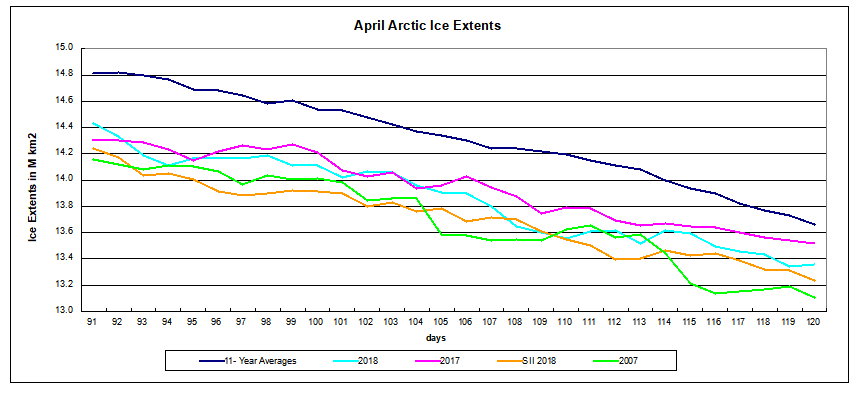
The graph below shows how the Arctic extent has faired in April compared to the 11 year average and to some years of interest.
Note that 2018 is close to 2017 and slightly below the 11-year average.  SII 2018 tracks about 200k km2 lower, while 2007 is another 200k behind.   The table below shows ice extents by regions comparing 2018 with 11-year average (2007 to 2017 inclusive) and 2017.

Region 2018120 Day 120 
Average
2018-Ave. 2017120 2018-2017
 (0) Northern_Hemisphere 13360026 13650051 -290025 13519865 -159839
 (1) Beaufort_Sea 1069887 1067233 2654 1070445 -558
 (2) Chukchi_Sea 897588 962679 -65091 960509 -62921
 (3) East_Siberian_Sea 1084975 1085634 -659 1083984 991
 (4) Laptev_Sea 895710 891029 4680 897556 -1846
 (5) Kara_Sea 934470 908342 26128 933484 986
 (6) Barents_Sea 710238 526176 184062 570066 140172
 (7) Greenland_Sea 589041 657057 -68015 678737 -89696
 (8) Baffin_Bay_Gulf_of_St._Lawrence 1249752 1242545 7206 1452133 -202382
 (9) Canadian_Archipelago 853109 845536 7573 853214 -106
 (10) Hudson_Bay 1258712 1239854 18857 1260903 -2192
 (11) Central_Arctic 3219128 3237929 -18801 3248013 -28885
 (12) Bering_Sea 58432 556317 -497885 256470 -198037
 (13) Baltic_Sea 35281 21596 13685 18836 16446
 (14) Sea_of_Okhotsk 501401 404448 96953 232763 268638

2018 is 290k km2 below average (2%) and 160k below last year.  The deficits are entirely due to Bering Sea, which is down 500k km2 to average and 200k to 2017.  OTOH both Okhotsk and Barents are showing large surpluses.  The graph below show April 2018 is on average once Bering and Okhotsk are removed form the calculations

The latest diesel-electric Ilya Muromets icebreaker of the Northern fleet began trials in the ice of the eastern Barents Sea. It approached the ice edge of average thickness, the Northern fleet said.  “The ice is from 50 to 100 centimeters thick in the area. Ice compaction is 9-10 points. Thus, trial conditions are favorable and correspond to the technical capabilities of the icebreaker. The trials are to continue until the end of the month and the icebreaker will return to Murmansk after them,” it said.  From http://www.navyrecognition.com

Pushing for Climate Diversity

Amidst all the concerns for social diversity, let’s raise a cry for scientific diversity. No, I am not referring to the gender or racial identities of people doing science, but rather acknowledging the diversity of climates and their divergent patterns over time. The actual climate realities affecting people’s lives are hidden within global averages and abstractions. A previous post Concurrent Warming and Cooling presented research findings that on long time scales maritime climates can shift toward inland patterns including both colder winters and warmer summers.

It occurred to me that Frank Lansner had done studies on weather stations showing differences depending on exposure to ocean breezes or not. That led me to his recent publication Temperature trends with reduced impact of ocean air temperature Lansner and Pederson March 21, 2018. Excerpts in italics with my bolds.

Abstract

Temperature data 1900–2010 from meteorological stations across the world have been analyzed and it has been found that all land areas generally have two different valid temperature trends. Coastal stations and hill stations facing ocean winds are normally more warm-trended than the valley stations that are sheltered from dominant oceans winds.

Thus, we found that in any area with variation in the topography, we can divide the stations into the more warm trended ocean air-affected stations, and the more cold-trended ocean air-sheltered stations. We find that the distinction between ocean air-affected and ocean air-sheltered stations can be used to identify the influence of the oceans on land surface. We can then use this knowledge as a tool to better study climate variability on the land surface without the moderating effects of the ocean.

We find a lack of warming in the ocean air sheltered temperature data – with less impact of ocean temperature trends – after 1950. The lack of warming in the ocean air sheltered temperature trends after 1950 should be considered when evaluating the climatic effects of changes in the Earth’s atmospheric trace amounts of greenhouse gasses as well as variations in solar conditions.

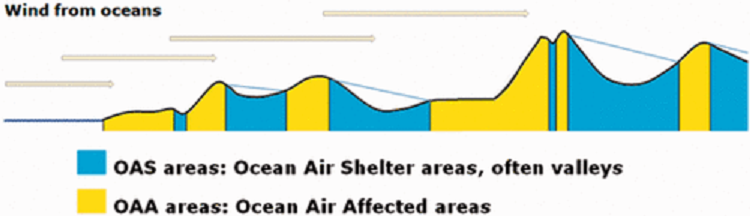
As a contrast to the OAS stations, we compare with what we designate as ocean air affected (OAA) stations, which are more exposed to the influence of the ocean, see Figure 1. The optimal OAA locations are defined as positions with potential first contact with ocean air. In general, stations where the location offers no shelter in the directions of predominant winds are best categorized as OAA stations.

Conversely, the optimal OAS area is a lower point surrounded by mountains in all directions. In this case, the existence of predominant wind directions is not needed. Only in locations with a predominant wind direction, the leeward side of the mountains can also form an OAS region.

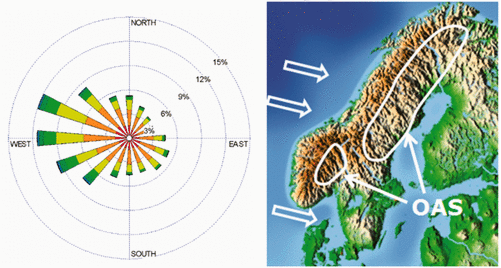
Figure 2. The optimal OAA and OAS locations with respect to dominating wind direction.

A total of 10 areas were chosen for this work to present the temperature trends of OAS areas (typically valley areas) and OAA areas from Scandinavia, Central Siberia, Central Balkan, Midwest USA, Central China, Pakistan/North India, the Sahel Area, Southern Africa, Central South America, and Southeast Australia. In this work, we have only considered an area as “OAS” or “OAA” if it comprises at least eight independent temperature sets. In the following, temperature data 1900–2010 from individual areas are discussed.

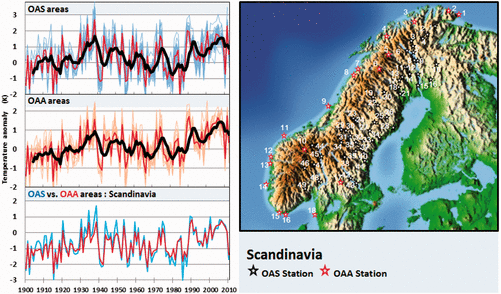
As an example, we show in Figure 3 the results for the Scandinavian area where we have used a total of 49 OAS stations and 18 OAA stations. The large number of stations available is due to the use of meteorological yearbooks as supplement to data sources such as ECA&D climate data and Nordklim database.

Figure 3. OAS and OAA temperature stations, Scandinavia.

The upper set of curves is from the OAS areas: Here the blue lines show one-year mean temperature averages for each temperature station, the red lines show the average of all stations of the area, and the thick black line is a five-year running mean of the station average. The reference period is 1951–1980. The middle set of curves is from the OAA areas. Here the orange lines show one-year mean temperature averages for each temperature station, the red lines show average of the stations of the area, and the thick black line is a five-year running mean of the station average. The reference period is 1951–1980.

On the lower set of curves labeled “OAS vs. OAA areas,” a comparison of the two data sets of stations is shown. The blue lines are the one-year average of OAS stations of the area and the red lines are the one-year average of OAA stations of the area. The reference period is 1995–2010. We note that these Scandinavian OAS stations are not well shielded from easterly winds.

Although easterly winds are not frequent (see Figure 2), the OAS area used cannot be characterized as an optimal OAS area. Despite this, we find a difference between the OAS and OAA area temperature data. While the general five-year running mean temperature curves (left panel in Figure 3) show resemblance in warming/cooling cycles, the OAA stations show less variation than the OAS stations.

We also find the absolute temperature anomalies for the Scandinavian OAS areas deviate from the OAA area with the OAS stations showing less warming than the OAA stations during the 20th century. For the years 1920–1950, we thus find temperatures in the OAS area to be up to 1 K warmer than temperature in the OAA area. In recent years, there is a closer agreement between OAS and OAA trends and even though the Scandinavian OAS data generally are warmer than OAA data for 1920–1950, we also note that in some very cold years, OAS temperatures are slightly colder than the OAA temperatures.

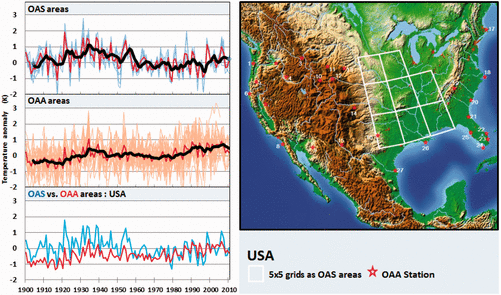
The paper presents all ten regions analyzed, but I will include here the USA example to see how it compares with other depictions of US regions. For example, see the map at the top shows the dramatic difference between temperature records in Eastern versus Western US stations. Here is the assessment from Lansner and Pederson. Note the topographical realities.

For the USA (Figure 6), we defined the OAS area as consisting of eight boxes, each of size 5° X 5°. The boxes were defined as 40–45N X 100–95 W, 40–45N  X 95–90W, 35– 40N X 100–95W, 35–40N X 95–90 W, 35–40N X 90–85W, 35–30N X 100– 95W, 35–30N X 95–90W, and 35–30N X 90–85W. A total of 236 temperature stations were used from this area. Full 5 X 5 grids were not found to be suited as OAA areas, but 27 stations indicated on the map were used for the OAA data set. All data were taken from GHCN v2 raw data. The OAS area in the US Midwest is well protected against westerly oceanic (Pacific) winds due to the Rocky Mountains. The US Midwest is also to some degree sheltered against easterly winds due to the Appalachian mountain range. Again the temperature trends from the OAS area as defined above show the 1920–1955 period in most years to be around 1 K warmer than temperature trends from the OAA areas.

Summation

Figure 13. OAS and OAA temperature averages, Northern Hemisphere.

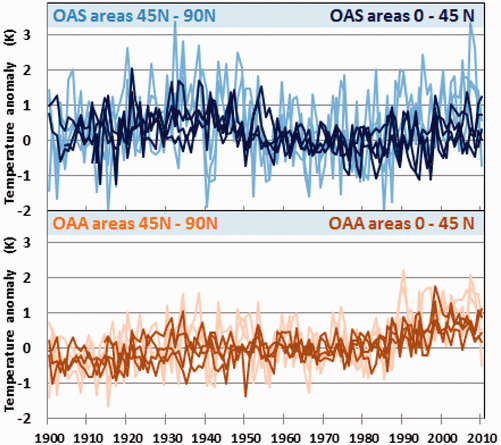
In Figure 13 we have combined average temperature trends for all seven NH OAS areas (blue curves) and OAA areas (brown curves) were areas are divided into low (0–45N) and high (45–90N) latitudes (dark colors are used for low and light colors for high latitudes). Both for the OAS areas and the OAA areas we see that the seven NH areas have similar development of temperature trends for 1900–2010. The larger variation in data from high latitudes (45–90N) is likely to reflect the Arctic amplification of temperature variations. OAS temperature stations further away from the Arctic (0–45N) seem to show less temperature increase during 1980–2010 than the OAS areas most affected by the Arctic (45– 90N). The NH OAS data all reveal a period of heating of the Earth surface 1920–1950 that the OAA data do not reflect well.

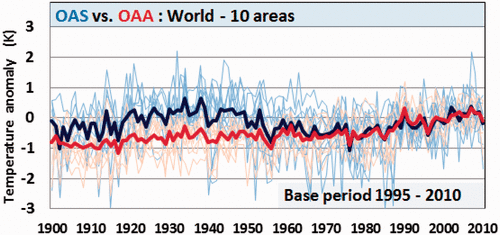
Figure 19. OAS and OAA temperatures, all regions.

Conclusion

Bromley et al. raise shifts in seasonality as a factor in climate change. Now Lansner and Pederson show differences in temperature trends due to ocean exposure, and also greater fluctuations with higher latitudes. Note that the cooling in the USA is replicated in the pattern shown worldwide in OAS regions. The key factor is the hotter temperatures prior to 1950s appearing in OAS records but not in OAA records.

Despite all the clamor about global warming (or recently global cooling since the hiatus), it all depends on where you are.  Recognizing the diversity of local and regional climates is the sort of climate justice I can support.

Footnote:

I do not subscribe to Arctic “Amplification” to explain latitudinal differences.  Since earth’s climate system is always working to transport energy from the equator to poles, any additional heat shows up in higher latitudes by meridional transport.  Previous posts have noted how anomalies give a distorted picture since temperatures are more volatile at higher (colder) NH latitudes.

See: Temperature Misunderstandings

Clive Best provides this animation of recent monthly temperature anomalies which demonstrates how most variability in anomalies occur over northern continents.