Barents Icicles 2017

A chart of Barents Ice Cycles looks a lot like the icicles above, except upside down since Barents Sea is usually all water by September. Notice the black lines in the graph below hitting bottom near zero.

Note also the anomalies in red are flat until 1998, then decline to 2007 and then flat again.

Why Barents Sea Ice Matters

Barents Sea is located at the gateway between the Arctic and North Atlantic. Previous posts (here and here) have discussed research suggesting that changes in Barents Sea Ice may signal changes in Arctic Sea Ice a few years later. As well, the studies point to changes in heat transport from the North Atlantic driving the Barents Sea Ice, along with changes in salinity of the upper layer. And, as suggested by Zakharov (here), there are associated changes in atmospheric circulations, such as the NAO (North Atlantic Oscillation).

Here we look at MASIE over the last decade and other datasets over longer terms in search for such patterns.

Observed Barents Sea Ice

Below is a more detailed look at 2017 compared with recent years.

This graph shows over the last 11 years, on average Barents sea ice starts declining beginning with April and melts out almost completely in September before recovering.  Some years, like 2014, the decline started much later and stopped with 100k km2 of ice persisting, resulting in the highest annual extent in the last decade.   Last year, 2016, was the opposite anomaly with much less ice than average all year.  2007 had the least Arctic ice overall in the last decade and was close to average in Barents during the summer months.

Note how exceptional is 2017 Barents ice extent.  It began extremely low in January and grew sharply to reach average by February, then dipped in March before rising strongly again in April.  It remains to be seen how much ice will grow, how late and how much will melt this year.


North Atlantic Meteorology in 2017

From AER comes more evidence of cooling in the North Atlantic and favorable conditions for ice formation there.

Dr. Judah Cohen provides his latest Arctic Oscillation and Polar Vortex Analysis and Forecast
on April 21, 2017.

  • Currently pressure/geopotential height anomalies are mostly positive on the North Pacific side of the Arctic but mostly negative across the North Atlantic side of the Arctic with mostly negative pressure/geopotential height anomalies across the mid-latitude ocean basins. This is resulting in a negative Arctic Oscillation (AO) but a positive North Atlantic Oscillation (NAO).
  • Despite the positive NAO, temperatures are below normal across western Eurasia including much of Europe as a strong block/high pressure has developed in the eastern North Atlantic with a cold, northerly flow downstream of the block across Europe.
  • The blocking high in the eastern North Atlantic is predicted to drift northward contributing to a negative bias to the AO and eventually the NAO over the next two weeks. Therefore, the pattern of cool temperatures across western Eurasia including Europe looks to continue into the foreseeable future.

Background on Barents from the Previous Post

Annual average BSIE (Barents Sea Ice Extent) is 315k km2, varying between 250k and 400k over the last ten years. The volatility is impressive, considering the daily Maximums and Minimums in the record. Average Max is 781k, ranging from 608k to 936k. Max occurs on day 77 (average) with a range from day 36 to 103. Average Min is 11k on day 244, ranging from 0k to 77k, and from days 210 to 278.

In fact, over this decade, there are not many average years. Five times BSIE melted to zero, two were about average, and 3 years much higher: 2006-7 were 2 and 3 times average, and 2014 was 7 times higher at 77k.

As for Maxes, only 1 year matched the 781k average. Four low years peaked at about 740k (2006,07,08 and 14), and the lowest year at 608k (2012). The four higher years start with the highest one, 936k in 2010, and include 2011, 13, and 15.

Comparing Barents Ice and NAO
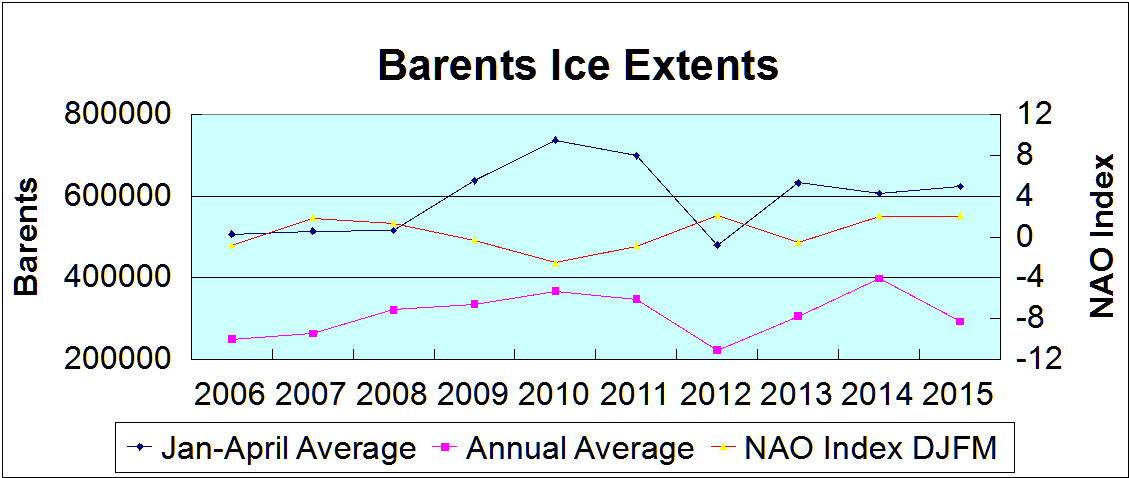
Barents Masierev

This graph confirms that Barents winter extents (JFMA) correlate strongly (0.73) with annual Barents extents. And there is a slightly less strong inverse correlation with NAO index (-0.64). That means winter NAO in its negative phase is associated with larger ice extents, and vice-versa.

Comparing Barents Ice and Arctic Annual
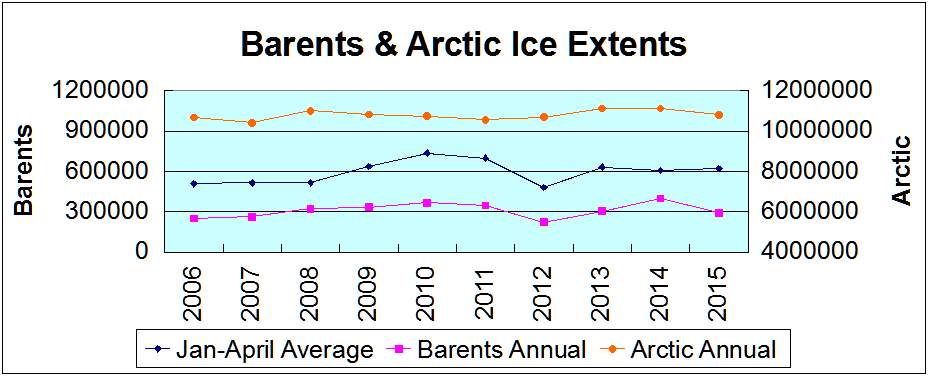
Barents and Arctic

Arctic Annual extents correlate with Barents Annuals at a moderately strong 0.46, but have only weaker associations with winter NAO or Barents winter averages. It appears that 2012 and 2015 interrupted a pattern of slowly rising extents.

NAO and Arctic Ice Longer Term

Fortunately there are sources providing an history of Arctic ice longer term and overlapping with the satellite era. For example:

Observed sea ice extent in the Russian Arctic, 1933–2006 Andrew R. Mahoney et al (2008)
http://seaice.alaska.edu/gi/publications/mahoney/Mahoney_2008_JGR_20thC_RSI.pdf
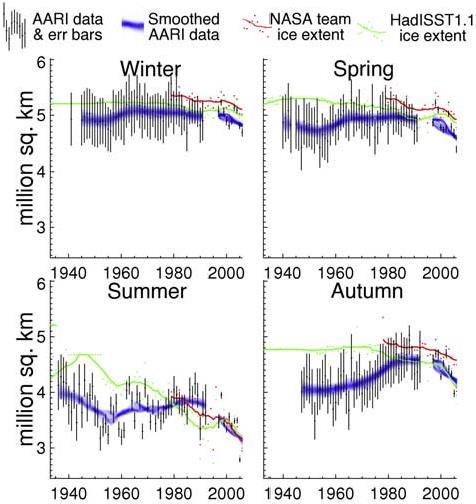
Russian Arctic Sea Ice to 2006

Mahoney et al say this about Arctic Ice oscillations:

We can therefore broadly divide the ice chart record into three periods. Period A, extending from the beginning of the record until the mid-1950s, was a period of declining summer sea ice extent over the whole Russian Arctic, though not consistently in every individual sea. . . Period B extended from the mid-1950s to the mid- 1980s and was a period of generally increasing or stable summer sea ice extent. For the Russian Arctic as a whole, this constituted a partial recovery of the sea ice lost during period A, though this is not the case in all seas. . . Period C began in the mid-1980s and continued to the end of the record (2006). It is characterized by a decrease in total and MY sea ice extent in all seas and seasons.

Comparing Arctic Ice with winter NAO index
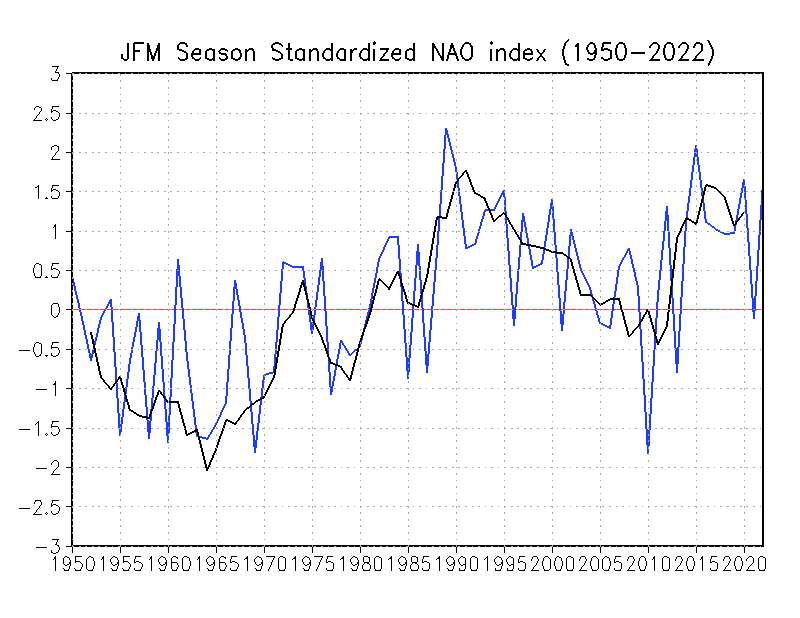
The standardized seasonal mean NAO index during cold season (blue line) is constructed by averaging the monthly NAO index for January, February and March for each year. The black line denotes the standardized five-year running mean of the index. Both curves are standardized using 1950-2000 base period statistics.

The graph shows roughly a 60 year cycle, with a negative phase 1950-1980 and positive 1980 to 2010. As described above, Arctic ice extent grew up to 1979, the year satellite ice sensing started, and declined until 2007. The surprising NAO uptick recently coincides with the anomalous 2012 and 2015 meltings.

As of January 2016 NAO went negative for the first time in months.  There appears to be some technical difficulties with more recent readings.

Summary

If the Barents ice cycle repeats itself over the next decades, we should expect Arctic ice extents to grow as part of a natural oscillation. The NAO atmospheric circulation pattern is part of an ocean-ice-atmosphere system which is driven primarily by winter changes in the North Atlantic upper water layer.
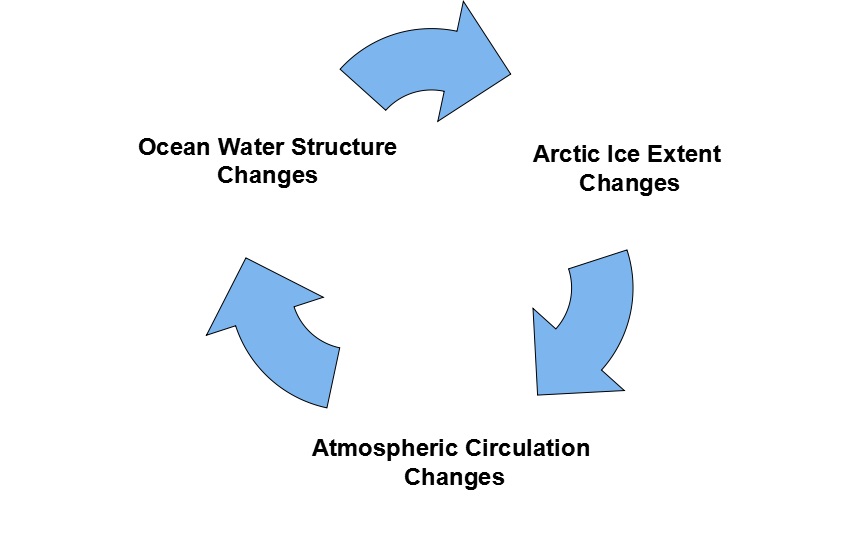
Self-Oscillating Sea Ice System

Self-Oscillating Sea Ice System  See here.


Data, Facts and Information


In following many blogs related to climate science, it seems that confusion reigns regarding some fundamentals of scientific thought and practice. So this post attempts to clarify three important scientific concepts: Data, Facts, and Information.

Show Me the Data

Data pertains to observations of happenings in the world, independent of the observer. In a court of law, a witness on the stand gives his or her observations. For example, I heard person x say this, or I saw person y do that. This is evidence all right, but it is not data.  And an artist or filmmaker can capture an event as evidence, but again it is not data in that format.

By definition, data is quantitative. And applying numbers to observations means using standard measurements so that these observations can be compared, contrasted, and replicated, as well as compiled with other similar observations. Each subject of study has one or more units of measurement pertinent to that inquiry. For example, observing a moving object requires distance and time, such as kilometers per minute, or rates of acceleration, such as meters per second per second, or m/s^2.

To summarize, data are a set of observations expressed in standard units of measurement.

What are the Facts

Taiichi Ohno was the central thinker behind the Toyota way of manufacturing. In his view facts are observed “in situ” by a knowledgeable and purposeful agent, an human expert. Facts are the result of direct observation of a process, product or part, including any measured data and the correct context for such data. Context means what relevant conditions, incidents, phenomena, and situations were occurring prior, during and after the data were collected.

In science a fact is a pattern detected in a data set. Thus, a fact is a finding, a meaning supported by data. And, importantly, a fact is particular to the place and time where the data was obtained. The pattern and meaning derives from interpreting the data (observations) in the specific place and time where the happenings occurred understanding the historical situation and context.

We hear a lot these days about fake news or facts in relation to political or cultural news. There, the spin and narratives overwhelm objective observations, and the report serves only to motivate audience acceptance or rejection of the subjects, the truth is irrelevant.  Unfortunately, fact “checking” has morphed into substituting one spin for another.

In science, facts are supported by data, but each fact represents a pattern in the data seen in the context of a specific place and time. So, for example, it can be a fact that civilian deaths in Syria have increased by x% in the past year. Importantly, facts depend on persons with deep knowledge of the particular place and time.

To summarize, a scientific fact is a pattern in data in the context of a specific place and time.

The Whole Truth and Nothing But the Truth

Information stands on facts, which themselves stand on data. Information consists of conclusions from weighing and judging the importance of various sets of facts regarding a situation. Based on the above, all the facts have a basis in data, but they are not equally significant. And the significance is relative to the concerns of the information analyst.

Information is not absolute, but serves to inform action. Facts are value-free, but information is not. Information draws on facts to form a conclusion as to the direction a situation is moving, out of a concern to intervene or not, according to the interests of the observers. In that sense, information is always actionable, or intends to be so.

As an example of this facet of information, consider media charges that someone is citing “alternate facts.” Now a fact is always true, meaning it is supported by data and corresponds to reality. Or it is not a fact, but a fiction not supported by data and in contradiction to reality.

In legal proceedings, frequently there are “alternate facts.” One party, say the prosecution, presents a set of facts comprising all the information supporting their explanation or theory of a criminal event. The defense presents an alternative explanation or theory of the event supported by other facts either ignored or discounted in the prosecution’s case. Such “alternate facts” are no less true, they simply form an alternate information convincing to those who place more weight on them.

A similar process goes on in scientific disputes where each side accuses the other of “cherry-picking” by referring only to those facts which support one theory. Honest science attempts to explain all relevant facts, and sometimes (e.g. Wave vs. Particle theories of light) holds competing theories in tension while a more comprehensive meta-theory can be formed and proved.

Information results from organizing data and facts into a perspective respecting the context of the facts and supporting humans’ need to anticipate the future. Forming theories of what to expect and how to respond or intervene is fundamental to human survival.

That’s the way I see it.

For a great example of how deep knowledge applied to data leads to a productive theory and discovery see Quebec Teen Studies Stars, Discovers Ancient Maya City

Fun Footnote:

Science depends on measuring things, so you need to know the correct units for what you are studying.

Below are some obscure measures for collecting data in special situations.

17. Quantity of beauty required to launch a single ship = 1 millihelen h/t vuurklip

Glaciermania

A stream flows through the toe of Kaskawulsh Glacier in Yukon’s Kluane National Park. In 2016, this channel allowed the glacier’s meltwater to drain in a different direction than normal, resulting in the Slims River’s water being rerouted to a different river system..

The Weather Network (who do a decent job on local weather forecasting) are currently raving about Glaciers:

You know climate change is getting serious when rivers are resorting to piracy.

Canadian geomorphologist Dr. Daniel Shugar and his team headed to the Yukon last year to study changes in the flow of the Slims River, only to find out the river was gone.

The Slims, which was fed by the Kaskawulsh glacier, has become the victim of the first case of what’s known as river piracy in modern recorded history.

The team’s investigation soon turned up the culprit – the retreat of the Kaskawulsh Glacier, which has been retreating thanks to more than a century of climate warming.

What Actually Happened

Prior to May of last year, the glacier had been supplying water to two watersheds and feeding multiple rivers; the Kaskawulsh River, which drains to the Pacific Ocean via the Alsek River, and the Slims, which flowed north to the Bering Sea via Kluane Lake.

During the last days of May 2016, melt water at the base of the glacier finally managed to eat through the thinning ice sheet, opening a new canyon and sending the Slims’ share of the water into the Kaskawulsh instead.

Thanks to this abrupt change, water from the glacier that used to flow north to the Bering Sea has changed direction and flows toward the Pacific, instead, leaving the Slims basin high and (mostly) dry.

And Now, the Leap of Faith

In the published paper lead author Daniel Shugar goes on to state:
Based on satellite image analysis and a signal-to-noise ratio as a metric of glacier retreat, we conclude that this instance of river piracy was due to post-industrial climate change.

And others can’t resist piling on:

“To me, it’s kind of a metaphor for what can happen with sudden change induced by climate,” said John Clague, who holds a chair in natural hazard research at Simon Fraser University and was a co-author on the report.

“Climate change is happening, is affecting us and it’s not just about far-off islands in the South Pacific. .  Climate change may bring new changes that we’re not even really thinking about.” said Shugar.

It’s a nice PR touch to call this “Piracy”, but they are “jumping the shark” by claiming humans did this by burning fossil fuels.

“Jumping the shark” is attempting to draw attention to or create publicity for something that is perceived as not warranting the attention, especially something that is believed to be past its peak in quality or relevance. The phrase originated with the TV series “Happy Days” when an episode had Fonzie doing a water ski jump over a shark. The stunt was intended to perk up the ratings, but it marked the show’s low point ahead of its demise.

Hyping a Glacier retreating to prove global warming/climate change looks to be a similarly desperate move. Most people sense that the dynamics of glaciers growing, shrinking and moving is much more complex than simply fingering CO2 as the culprit.

south-glacier-as-seen-during-its-1986-surge-photo-p-johnson-and-in-2005-photo-g

FIG. 3. South Glacier as seen during its 1986 surge (photo: P. Johnson) and in 2005 (photo: G. Flowers). To facilitate comparison, the black line in each photograph marks the same feature.

For context and scientific perspective we can turn to papers like this one:  Contemporary Glacier Processes and Global Change: Recent Observations from Kaskawulsh Glacier and the Donjek Range, St. Elias Mountains From the Abstract:
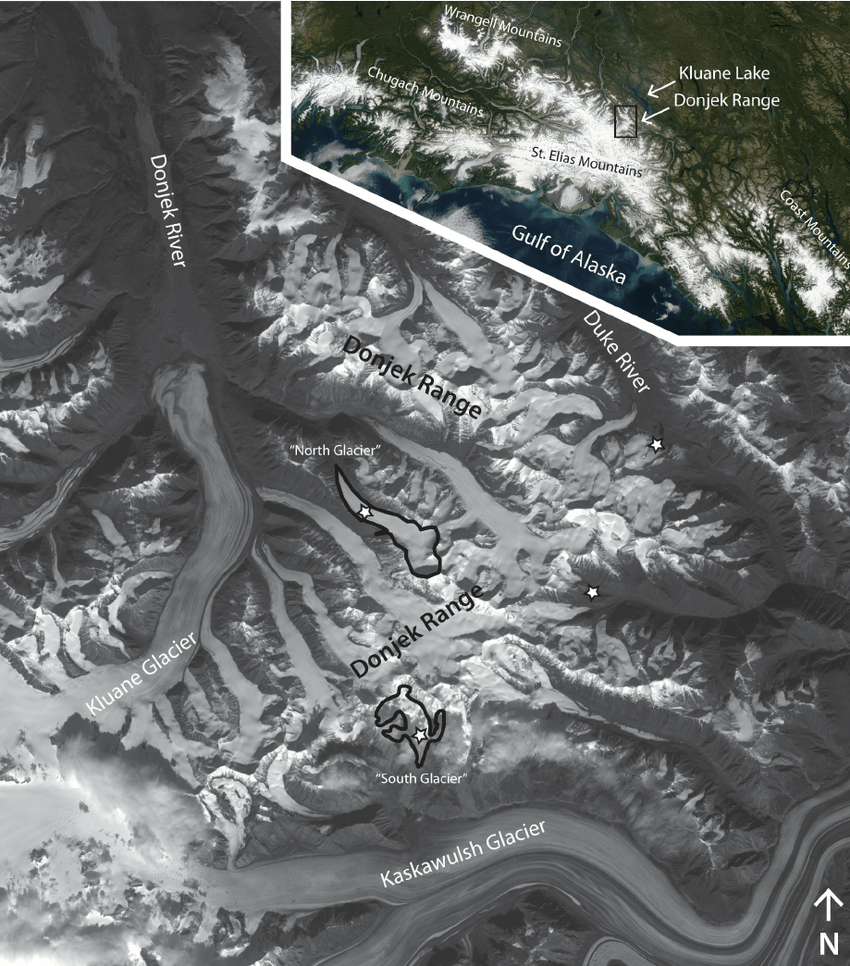
The scientific objectives of these projects are (1) to quantify recent area and volume changes of Kaskawulsh Glacier and place them in historical perspective, (2) to investigate the regional variability of glacier response to climate and the modulating inuence of ice dynamics, and (3) to characterize the hydromechanical controls on glacier sliding.

the-donjek-range-and-environs-geobase-r-image-8-september-2008-within-the-st-elias

FIG. 1. The Donjek Range and environs (Geobase ® image, 8 September 2008) within the St. Elias Mountains (NASA Aqua – MODIS image, 9 August 2003; North and South Glaciers are outlined, and locations of automatic weather stations operated since 2006 – 07 are marked with stars.

Excerpts (bolded text is my emphasis)

Kaskawulsh Glacier is ~70 km long from its shared accumulation area with the upper Hubbard Glacier, at an elevation of ~2500 m asl, to its terminus ~25 km southwest of the Kluane Lake Research Station, at ~820 m asl (Fig. 1). It provides the source of the Slims River, the primary water input for Kluane Lake to the northeast (which drains to the Bering Sea), and the source of the Kaskawulsh River to the southeast (which drains to the Gulf of Alaska).

One of the most iconic and best studied outlet glaciers of the St. Elias Mountains, Kaskawulsh Glacier was the focus of much glaciological research during the Icefield Ranges Research Project between the 1960s and early 1970s  and contemporary studies suggest that the glacier is temperate throughout. The current area of Kaskawulsh Glacier is ~1095 km2. Ice thicknesses range from 539 m near the topographic divide with the upper Hubbard Glacier and ~500 m at the confluence of the north and central arms at ~1750 m asl to 778 m at ~1600 m asl. The equilibrium line altitude is estimated from 2007 late summer satellite imagery as 1958 m asl, and it appears to have changed little since the 1970s.

The size of Kaskawulsh Glacier has varied considerably through time, with radiocarbon dating suggesting that it expanded by tens of kilometres into the Shakwak Valley (currently occupied by Kluane Lake) ~30 kya during the Wisconsinan Glaciation. In the historical past, Borns and Goldthwait (1966) mapped three sets of Little Ice Age moraines in the glacier forefield on the basis of distinctive variations in vegetation cover, morphology, and the ages of trees and shrubs.

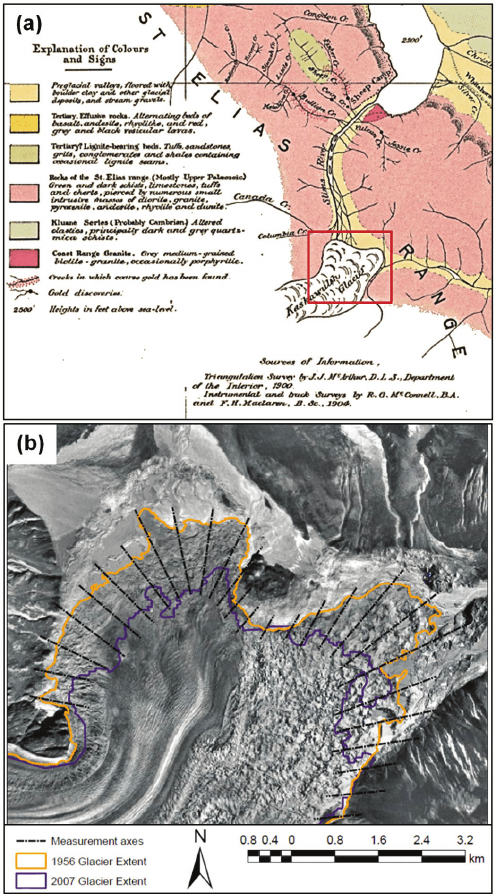
Kaskawulsh Glacier was advancing by the early 1500s and reached its maximum recent position by approximately AD 1680. A recent study based on tree-ring dates suggests that the Slims River lobe reached its greatest Little Ice Age extent in the mid-1750s, whereas the Kaskawulsh River lobe reached its maximum extent around 1717. However, it appears that the glacier did not start retreating from this position until the early to middle 1800s. The recent discovery of a Geological Survey of Canada map of the glacier terminus from 1900 to 1904 indicates that the glacier was still in a forward position at that time, suggesting that most of the terminus retreat occurred in the 20th century.

Recent studies conducted by researchers at the University of Alaska and the University of Ottawa indicate that ice losses from Kaskawulsh Glacier have continued through the latter half of the 20th century and first decade of the 21st century, although evidence for any recent acceleration in loss rates is equivocal.

Global Context

Of the 19 glacierized regions of the world outside of the ice sheets, the region including the St. Elias Mountains made the second highest glaciological contribution to global sea level during the period 1961 – 2000. Only Arctic Canada is expected to exceed this region in sea-level contribution over the 21st century.

The St. Elias Mountains exhibit high interannual variability in ice mass change, which is due in part to the abundance of surge-type and tidewater glaciers in different stages of their respective cycles. Ice dynamics can be a confounding influence when attempting to isolate the effects of climate as an external driver of glacier change. For example, a surge-type glacier in the “quiescent” phase of its cycle may retreat even in a stationary climate. Catastrophic retreat of a tidewater glacier may be triggered by climate, but it is largely controlled by glacier and fjord geometry. Similar “flow instabilities” exist at larger scales in the form of ice streams and marine ice-sheets or outlet glaciers, the dynamics of which dominate the mass balances (and therefore sea-level contributions) of large sectors of the modern ice sheets. Our ability to project future changes on short (sub-decadal to decadal) timescales therefore hinges on our understanding of internal glacier dynamics, as well as our ability to project future climate in a given region and relate climate to glacier surface mass balance.

The ice-walled canyon at the terminus of the Kaskawulsh River in the Yukon, with recently collapsed ice blocks, that now carries the vast majority of glacier-front water down the Kaskawulsh Valley toward the Gulf of Alaska and the Pacific Ocean instead of north along the Slims River toward the Bering Sea. (Jim Best/University of Illinois)

Whether climate has fundamentally altered the surging styles of Trapridge Glacier and South Glacier from the faster, shorter, more recognizable Alaskan style to the slower and more subtle Svalbard style is an interesting question. Many small poly-thermal glaciers, whose temperate ice content is largely controlled by meltwater entrapment and refreezing in the accumulation area, are expected to become colder under negative mass balance conditions. It is therefore conceivable that thermal evolution over the course of decades can play a role in altering surge style. However, there is some evidence that both types of surges may be preceded by a prolonged—and until recently, unrecognized—period of acceleration. Thus, a “slow surge” or “partial surge” may simply represent a truncation of the ordinary surge cycle that results from a deficit of mass, rather than a fundamental change in surge character. Mass deficits have manifested themselves differently on the well-studied and temperate Variegated Glacier, where the return interval between surges adapts itself in such a way that surges are triggered at a constant cumulative balance threshold. The nature and timing of future surges of the large glaciers in the St. Elias Mountains will be instructive as we seek a more coherent understanding of the influence of climate on surging.

Summary

So it is a familiar story. A complex naturally fluctuating situation, in this case glaciers, is abused by activists to claim support for their agenda. I have a lot of respect for glaciologists; it is a deep, complex subject, and the field work is incredibly challenging. And since “glacial” describes any process where any movement is imperceptible, I can understand their excitement over something happening all of a sudden.

But I do not applaud those pandering to the global warming/climate change crowd. They seem not to realize they debase their own field of study by making exaggerated claims and by “jumping the shark.”
The lead authur, Shugar, sounds like a Michael Mann wannabe, putting out sound bites to please the naive journalists. Maybe he thinks there is a Nobel prize in it if he plays his cards right.

Meanwhile real scientists are doing the heavy lifting and showing restraint and wisdom about the limitations of their knowledge.

The Kaskawulsh River, as it exits the lower terminus of Kaskawulsh Glacier and lakes. ‘ JIM BEST

NYT Readers Face Diversity


Imaginary Enemies

A lot of fuss is in the media about the New York Times hiring Bret Stephens from the Washington Post. Stephens won the 2013 Pulitzer Prize for commentary, is regarded as a conservative, and has written critically about Trump, as well as liberals. In particular he has poked fun repeatedly at the climatism hysteria. For this latter point, the climate faithful are up in arms about the prospect of Stephens columns appearing on pages of NYT (a kind of bible for liberals and environmentalists).

For sure Bret Stephens is as outspoken as Mark Steyn, but with his own preoccupations and style. To see what might be in store for NYT readers, let’s look at some excerpts of his commentary regarding global warming/climate change. Note: Washington Post has a paywall, so links to these articles go to blogsites where the full text is available.

In 2014 Stephens published Climate Prophets and Profiteers, which gives an idea where he is coming from.

It is now the dogma of the left that any hint of doubt when it comes to predictions of climate doom is evidence of greed, stupidity, moral turpitude or psychological derangement. “Climate denial” is intended to be the equivalent of Holocaust denial. And yet the only people who’ve predicted anything right so far are those who foresaw that the Kyoto Protocol would fail, that renewable energies didn’t really work, and that climate bureaucrats accountable to nobody but their own sense of virtue and taste for profit were a danger to everyone.

Rereading Mr. Kerry’s speech, I have to say he really does come across as a true believer. That it begins by citing Maurice Strong, the ultimate cynic, tells you what you need to know about where this strain of true belief leads.

On Climate Religion

In a November 2011 column The great global warming fizzle, Stephens described ‘the case of global warming’ as a ‘system of doomsaying prophecy and faith in things unseen’ that, like religion, ‘is susceptible to the earthly temptations of money, power, politics, arrogance and deceit.’

Consider the case of global warming, another system of doomsaying prophecy and faith in things unseen.

As with religion, it is presided over by a caste of spectacularly unattractive people pretending to an obscure form of knowledge that promises to make the seas retreat and the winds abate. As with religion, it comes with an elaborate list of virtues, vices and indulgences. As with religion, its claims are often non-falsifiable, hence the convenience of the term “climate change” when thermometers don’t oblige the expected trend lines. As with religion, it is harsh toward skeptics, heretics and other “deniers.” And as with religion, it is susceptible to the earthly temptations of money, power, politics, arrogance and deceit.

This week, the conclave of global warming’s cardinals are meeting in Durban, South Africa, for their 17th conference in as many years. The idea is to come up with a successor to the Kyoto Protocol, which is set to expire next year, and to require rich countries to pony up $100 billion a year to help poor countries cope with the alleged effects of climate change. This is said to be essential because in 2017 global warming becomes “catastrophic and irreversible,” according to a recent report by the International Energy Agency. (my bold)

Yet a funny thing happened on the way to the climate apocalypse. Namely, the financial apocalypse.

All this has been enough to put the Durban political agenda on hold for the time being. But religions don’t die, and often thrive, when put to the political sidelines. A religion, when not physically extinguished, only dies when it loses faith in itself.

On Climategate Emails

That’s where the Climategate emails come in. First released on the eve of the Copenhagen climate summit two years ago and recently updated by a fresh batch, the “hide the decline” emails were an endless source of fun and lurid fascination for those of us who had never been convinced by the global-warming thesis in the first place.

But the real reason they mattered is that they introduced a note of caution into an enterprise whose motivating appeal resided in its increasingly frantic forecasts of catastrophe. Papers were withdrawn; source material re-examined. The Himalayan glaciers, it turned out, weren’t going to melt in 30 years. Nobody can say for sure how high the seas are likely to rise—if much at all. Greenland isn’t turning green. Florida isn’t going anywhere.

The reply global warming alarmists have made to these dislosures is that they did nothing to change the underlying science, and only improved it in particulars. So what to make of the U.N.’s latest supposedly authoritative report on extreme weather events, which is tinged with admissions of doubt and uncertainty? Oddly, the report has left climate activists stuttering with rage at what they call its “watered down” predictions. If nothing else, they understand that any belief system, particularly ones as young as global warming, cannot easily survive more than a few ounces of self-doubt.

Meanwhile, the world marches on. On Sunday, 2,232 days will have elapsed since a category 3 hurricane made landfall in the U.S., the longest period in more than a century that the U.S. has been spared a devastating storm. Great religions are wise enough to avoid marking down the exact date when the world comes to an end. Not so for the foolish religions. Expect Mayan cosmology to take a hit to its reputation when the world doesn’t end on Dec. 21, 2012. Expect likewise when global warming turns out to be neither catastrophic nor irreversible come 2017.

And there is this: Religions are sustained in the long run by the consolations of their teachings and the charisma of their leaders. With global warming, we have a religion whose leaders are prone to spasms of anger and whose followers are beginning to twitch with boredom. Perhaps that’s another way religions die.

Climate Crisis as a Liberal Imaginary Enemy

Stephens fully disclosed his views at the time of Paris COP in Liberalism’s Imaginary Enemies In Paris, it’s easier to battle a climate crisis than confront jihadists on the streets.

Little children have imaginary friends. Modern liberalism has imaginary enemies.

Hunger in America is an imaginary enemy. Liberal advocacy groups routinely claim that one in seven Americans is hungry—in a country where the poorest counties have the highest rates of obesity. The statistic is a preposterous extrapolation from a dubious Agriculture Department measure of “food insecurity.” But the line gives those advocacy groups a reason to exist while feeding the liberal narrative of America as a savage society of haves and have nots.

The campus-rape epidemic—in which one in five female college students is said to be the victim of sexual assault—is an imaginary enemy. Never mind the debunked rape scandals at Duke and the University of Virginia, or the soon-to-be-debunked case at the heart of “The Hunting Ground,” a documentary about an alleged sexual assault at Harvard Law School. The real question is: If modern campuses were really zones of mass predation—Congo on the quad—why would intelligent young women even think of attending a coeducational school? They do because there is no epidemic. But the campus-rape narrative sustains liberal fictions of a never-ending war on women.

Institutionalized racism is an imaginary enemy. Somehow we’re supposed to believe that the same college administrators who have made a religion of diversity are really the second coming of Strom Thurmond. Somehow we’re supposed to believe that twice electing a black president is evidence of our racial incorrigibility. We’re supposed to believe this anyway because the future of liberal racialism—from affirmative action to diversity quotas to slavery reparations—requires periodic sightings of the ghosts of a racist past.

I mention these examples by way of preface to the climate-change summit that began this week in Paris. But first notice a pattern.

Dramatic crises—for which evidence tends to be anecdotal, subjective, invisible, tendentious and sometimes fabricated—are trumpeted on the basis of incompetently designed studies, poorly understood statistics, or semantic legerdemain. Food insecurity is not remotely the same as hunger. An abusive cop does not equal a bigoted police department. An unwanted kiss or touch is not the same as sexual assault, at least if the word assault is to mean anything.

Yet bogus studies and statistics survive because the cottage industries of compassion need them to be believed, and because mindless repetition has a way of making things nearly true, and because dramatic crises require drastic and all-encompassing solutions. Besides, the thinking goes, falsehood and exaggeration can serve a purpose if it induces virtuous behavior. The more afraid we are of the shadow of racism, the more conscious we might become of our own unsuspected biases.

And so to Paris.

I’m not the first to notice the incongruity of this huge gathering of world leaders meeting to combat a notional enemy in the same place where a real enemy just inflicted so much mortal damage.

Then again, it’s also appropriate, since reality-substitution is how modern liberalism conducts political business. What is the central liberal project of the 21st century, if not to persuade people that climate change represents an infinitely greater threat to human civilization than the barbarians—sorry, violent extremists—of Mosul and Molenbeek? Why overreact to a few hundred deaths today when hundreds of thousands will be dead in a century or two if we fail to act now?

Here again the same dishonest pattern is at work. The semantic trick in the phrase “climate change”—allowing every climate anomaly to serve as further proof of the overall theory. The hysteria generated by an imperceptible temperature rise of 1.7 degrees Fahrenheit since 1880—as if the trend is bound to continue forever, or is not a product of natural variation, or cannot be mitigated except by drastic policy interventions. The hyping of flimsy studies—melting Himalayan glaciers; vanishing polar ice—to press the political point. The job security and air of self-importance this provides the tens of thousands of people—EPA bureaucrats, wind-turbine manufacturers, litigious climate scientists, NGO gnomes—whose livelihoods depend on a climate crisis. The belief that even if the crisis isn’t quite what it’s cracked up to be, it does us all good to be more mindful about the environment.

And, of course, the chance to switch the subject. If your enemy is global jihad, then to defeat it you need military wherewithal, martial talents and political will. If your enemy is the structure of an energy-intensive global economy, then you need a compelling justification to change it. Climate dystopia can work wonders, provided the jihadists don’t interrupt too often.

Here’s a climate prediction for the year 2115: Liberals will still be organizing campaigns against yet another mooted social or environmental crisis. Temperatures will be about the same.

Bret Louis Stephens is an American journalist who won a Pulitzer Prize for commentary in 2013. He works for The Wall Street Journal as the foreign-affairs columnist and the deputy editorial page editor and is responsible for the editorial pages of its European and Asian editions.

Summary

Wow! A full-throated, articulate conservative and climate unbeliever writing columns for the New York Times. His views both on liberalism and on climatism will be repulsive to many of the readers, who profess to be “liberal thinkers” but who are closed to all but “our kind of people”. What will they allow Stephens to write about? Will he last longer than lukewarmist Roger Pielke Jr. did at 538 blog (one column)?

Stay tuned.

For Further Reading

In 2008 column Al Gore’s Doomsday Clock, Stephens wrote:

What manner the catastrophe might take isn’t yet clear, but the scenarios are grim: The climate crisis is getting worse faster than anticipated; global warming will cause refugee crises and destabilize entire nations…. And so on.

In 2009 Climategate: Follow the Money Stephens gave the subheading:

Climate change researchers must believe in the reality of global warming just as a priest must believe in the existence of God.

A week later in 2009 came Global warming and the psychology of true belief. This time Stephens wrote: ‘

Last week, I suggested that funding flows had much to do with climate alarmism. But deeper things are at work as well. One of those things, I suspect, is what I would call the totalitarian impulse.

In April 2010 came What’s the Next ‘Global Warming’? Herewith I propose a contest to invent the next panic.

Stephens declared that ‘global warming is dead, nailed into its coffin one devastating disclosure, defection and re-evaluation at a time.’ He predicted that this meant ‘that pretty soon we’re going to need another apocalyptic scare to take its place.’ He offered the wager that ‘within a few years ‘climate change’ will exercise global nerves about as much as overpopulation, toxic tampons, nuclear winters, ozone holes, killer bees, low sperm counts, genetically modified foods and mad cows do today.’


Easter Ice Hunt

As the photo shows, back in February 2017 you didn’t have to go looking for ice, it came after you. A convoy including icebreakers was trapped by ice in Chukchi, reported in Siberian Times and posted here as Arctic Ice Takes Revenge.

Now we are two weeks into April and about a month into the Arctic melt season. The hunt is on to see how ice extent reacts to the sun, warmer water and weather.

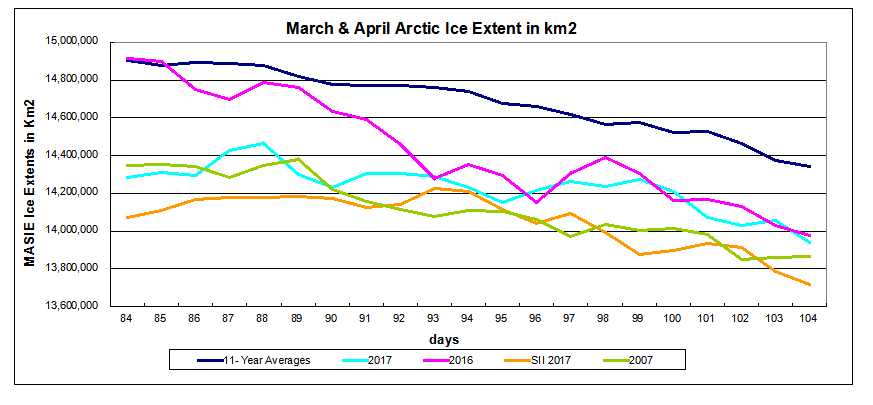
Firstly the graph shows that both this year and last have dipped below 14M km2, 400k km2 below average but still ahead of 2007. Day 104 refers to April 14.

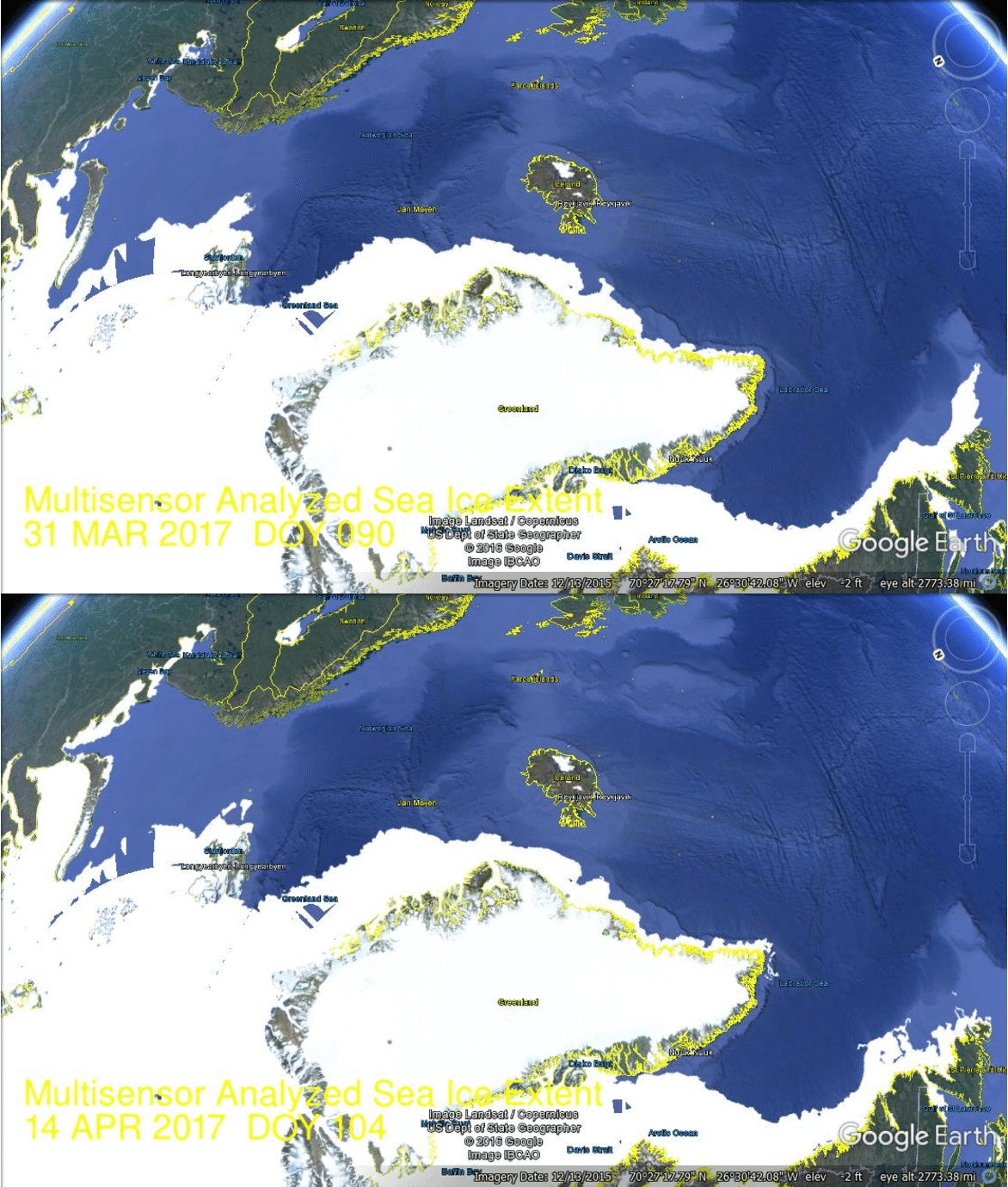
As noted before, the heart of the Arctic is still frozen solid, with changes in extent occurring mainly in the marginal seas that usually melt out by September. Comparing the last two weeks in the Atlantic side, we can see almost no change overall, with an unexpected small increase in Barents Sea.

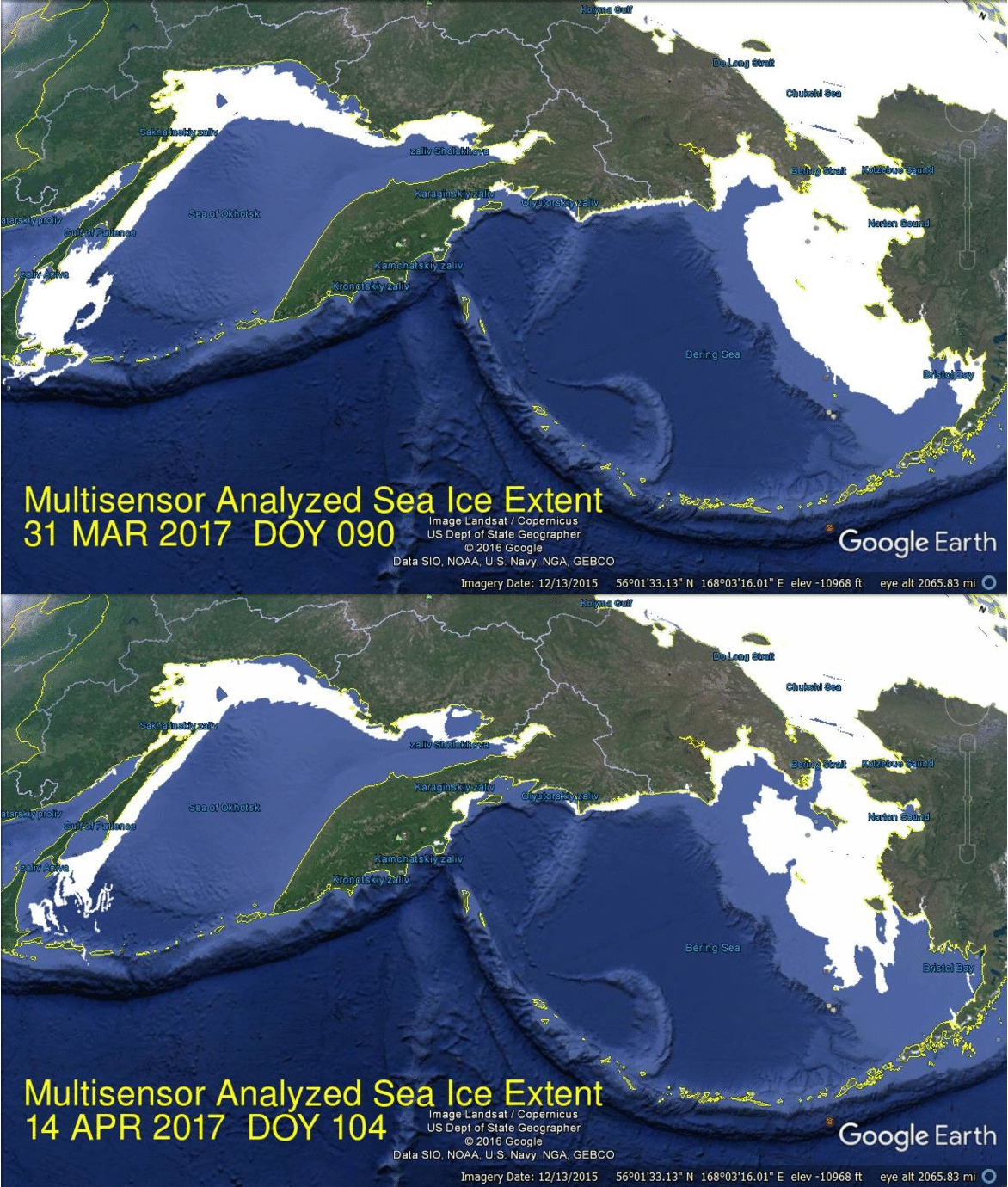
On the Pacific side is where the deficit to average appears in the melting of both Bering and Okhotsk Seas.

The table compares 2017 regional extents to average and to 2007.

Region 2017104 Day 104
Average
2017-Ave. 2007104 2017-2007
 (0) Northern_Hemisphere 13938957 14340901 -401944 13862996 75960
 (1) Beaufort_Sea 1068514 1068895 -382 1058157 10357
 (2) Chukchi_Sea 966006 964512 1494 960944 5062
 (3) East_Siberian_Sea 1085191 1085618 -427 1074001 11189
 (4) Laptev_Sea 892613 894687 -2073 866524 26090
 (5) Kara_Sea 928904 922891 6012 912398 16505
 (6) Barents_Sea 551153 603811 -52658 521344 29808
 (7) Greenland_Sea 698685 655565 43120 691751 6934
 (8) Baffin_Bay_Gulf_of_St._Lawrence 1436054 1316043 120010 1222152 213902
 (9) Canadian_Archipelago 853214 852229 985 846282 6933
 (10) Hudson_Bay 1257536 1243402 14135 1212987 44549
 (11) Central_Arctic 3246909 3232793 14116 3245148 1761
 (12) Bering_Sea 507510 794989 -287480 645687 -138177
 (13) Baltic_Sea 25977 50160 -24183 20075 5902
 (14) Sea_of_Okhotsk 417538 648579 -231042 576913 -159375

Clearly, Barents is down slightly to average but more than offset by surpluses in Baffin and Greenland. The 2017 differences from average and from 2007 arise from Bering and Okhotsk in the Pacific.

Summary

Despite what you may hear from alarmist sources, there is plenty of Arctic Ice if you know where to look for it.

Michelle Dispels CO2 Hysteria


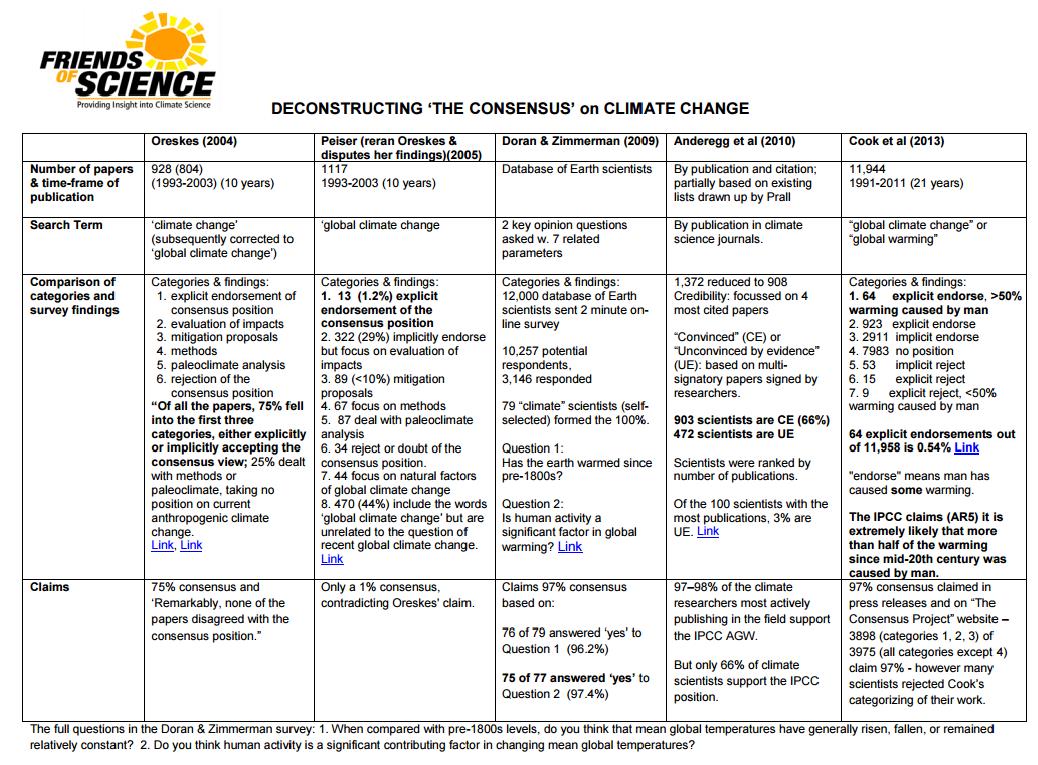
Thanks to a post at Friends of Science, I was alerted to an important declaration by Michelle. On March 17, 2017, Michelle Stirling presented “The Myth of the 97% Consensus” to the FreedomTalk.ca Annual Conference in Calgary, Alberta.

Because it’s not Michelle Obama speaking out, no one knows about it and few even care. Which tells you all you need to know about global warming/climate change.  It’s a social phenomenon, now completely detached from reason and science. It is not what you know, it’s how many friends know you that gives you impact regarding the climate. Celebrity and popularity are convincing, detailed facts and knowledge not so much.

At the end of this post is a synopsis and link showing how thoroughly Stirling debunks the “97% consensus”. Much of that will be familiar to readers, so the excerpts here will emphasize the way Michelle puts the whole climatism movement into socio-economic context.

Why Claim 97%? – Ultimate Social Proof

One feature that stands out in most of the claimed consensus studies, no matter how small the relevant sample, is the repeated figure of 97%. Many of the 97% consensus studies are co-authored or supported by social psychologists

The groundbreaking work of Cialdini (2007) demonstrated that humans are significantly motivated to comply according to ‘social proof’ – in other words, “if everyone agrees, that is proof enough so get on the bandwagon.” Just as social media ‘trending’ leads to more people following the story, social proofs work on the inherently gregarious nature of humans and our herd mentality. The 97% figure delivers two powerful psychological messages in one – i) ‘everyone’ agrees, and ii) you will be left out.

To compound the psychological impact upon the dissenting 3% of the population, climate bullying terms like ‘denier,’ and more recently various high-profile ‘witch hunts,’ even at the Presidential level, have been employed by activists. These actions activate physical and emotional pain centers in the victims, as found by Williams (2001), Kross et al (2011) on ostracism, making most people reluctant to speak up with any questions regarding the science, policy, cost or impact on industry. In practical terms, many dissidents have lost their jobs for daring to challenge ‘the consensus.’ Williams (2007) found that being ostracized was the ‘kiss of social death.’

A more nuanced study with clear definitions done by PBL Netherlands Environmental Assessment Agency reveals that out of 1,868 respondents, only 43% agreed with the IPCC definition: “It is extremely likely {95%+ certainty} that more than half of [global warming] from 1951 to 2010 was caused by [human activity].”

Clearly, van der Linden et al (2015), Ding et al (2011) Dunlap & McCright (2011) are correct in stating that consensus is an important tool and a gateway belief for acceptance of public policy on climate change. However, the question is, should we be making policy based on statistically manipulated consensus studies that lack clearly defined empirical parameters, or should public policy be based on actual scientific evidence?

The Cost of Delusion

Despite several surveys claiming that ‘consensus’ is a valuable driver of public acceptance of climate change, and expressions of dismay that a large percent of the public continue to reject the alleged ‘consensus’ and to question human-caused climate change claims in general, the foregoing demonstrates that ‘belief’ and ‘consensus’ are not grounds for action on climate change. If anything, such thinking is more likely to lead to extraordinary mass delusions, such as the Mississippi Scheme, the South-Sea Bubble, and Tulipomania, all three of which nearly bankrupted national economies of France, England and the Netherlands, respectively (Mackay 2008).

There has been a concerted effort to push the climate catastrophe perspective by well-funded foundations, philanthropies and institutional investors which are bound by the UN Principles for Responsible Investment to invest in renewables and clean-tech, despite clean-tech having been found to be a ‘noble way to lose money’ after several patient years of investment, according to past CIO of CalPERS in a Wall Street Journal interview of 2013. (my bold)

Indeed, a review of the performance of renewable energy companies is concerning – particularly the level of expectation and investment versus scope of real or possible failure. The electric vehicle company “A Better Place” cars was valued at some $2 billion in the fall of 2012, by the spring of 2013 it had gone bankrupt, valued only at $12 million, despite having had a raft of experienced Wall Street investors. More recently, Spain’s Abengoa began spectacular bankruptcy proceedings, also putting some 27,000 employees world-wide at risk of unemployment. (my bold)

Unusual new market instruments like the ‘yieldco’ has led to catastrophic financial outcomes, as in the case of SunEdison’s $16.1 billion bankruptcy filing.  Devonshire Research (Part II-May 2016)41 is claiming that the much-vaunted Tesla is reliant on subsidies: “Tesla is not a car, battery, or tech company; it is an experimental financial services company and should be regulated as such” and that “Tesla has engaged in aggressive accounting that calls to mind the experiences of Enron and WorldCom; its future is highly uncertain.” (my bold)

Recent research by Cambridge engineering professor Michael J. Kelly (2016) shows that wind and solar do not provide sufficient Energy Return on Energy Invested (EROI) to maintain even basic society, and that: “all the actions taken together until now to reduce our emissions of carbon dioxide will not achieve a serious reduction, and in some cases, they will actually make matters worse.”

Thus, there is an evident divide between evidence and ideologies when the concepts of ‘renewable’ and ‘sustainable’ are applied in the field, as well.

The Ethics of CO2 Hysteria

Climate change is often framed as a moral and ethical concern, thus one must question the ethics of those participating in peer-reviewed research who are psychology professionals but who employ such tactics, especially when the scientific evidence of global temperature rise does not support the Catastrophic Anthropogenic Global Warming theory. This discrepancy between the surveyed ‘beliefs’ and the physical evidence demonstrates that opinion-based ‘consensus’ surveys are scientifically worthless and are an improper and potentially dangerous basis for making climate change policy.

To date, much of the world’s diverse climate policy has been predicated upon public acceptance that there is an urgent crisis of human-caused global warming, but this claim is not supported by the temperature records. As noted by Tol in a response to the Grantham Research Institute: “The twenty-two studies cited above all agree that the impact of climate change is small relative to economic growth. This was found in studies by Professor William Nordhaus and Professor Samuel Fankhauser. It was confirmed by the Intergovernmental Panel on Climate Change from its Second Assessment Report, in a chapter led by the late Professor David Pearce, to its Fifth Assessment Report, in a chapter led by me. Even the highest estimate, the 20% upper bound by Lord Professor Nicholas Stern of Brentford, has that a century of climate change is not worse than losing a decade of economic growth.” [bold emphasis added]

Thus, even economic evidence does not support the ‘belief’ in human caused global warming; actual temperature data certainly does not support the claims of impending catastrophic climate change.


The evidence shows that the world runs on three cubic miles of oil equivalent energy every year, of which one cubic mile is oil. All renewable devices such as wind turbines and solar panels are manufactured using vast amounts of oil, natural gas and coal. As Vaclav Smil notes, ‘to get wind you need oil.’

Conclusion

Science is not a democratic undertaking. It is unfortunate that respected scientific journals continue to publish such papers without critical vetting as to whether the ‘consensus’ claims equate to the empirical evidence. Public policy on climate change should be evidence-based and carefully thought through in the context of longer time-scales, historical evidence and paleoclimatology.

There is no consideration that the study of 4 billion years of climate change, written in the strata of the earth, might make those scientists working with fossil fuel industries question the claims of Anthropogenic Global Warming proponents whose evidence relies on spotty temperature records of some 100 years, climate models and unproven theories.

While much good came of the original impetus of the “Law of the Atmosphere” in terms of reducing noxious pollutants, much economic and social harm is being done by the current hysteria focussed solely on carbon dioxide. France has learned that lesson the hard way, having incentivized diesel cars and trucks in order to reduce carbon dioxide, only to find its gem – the City of Lights – Paris – blackened with the worst air quality in the world thanks to a significant rise in soot and nitrogen oxide.

Consensus = nonsensus. We must look at the evidence over ideology.


Climate Lemmings

The excerpts above come from Michelle Stirling’s paper Consensus Nonsensus on 97%: Science is not a Democracy

Stirling’s presentation dissects the 97% consensus, powerpoint slides are here: The Myth of the 97% consensus

Fear Not for Permafrosty


The Permafrost Bogeyman is Back!

The Climate Scare of this Week is apparently melting permafrost.The Met Office warning on April 10:

Increased climate change risk to permafrost. Global warming will thaw about 20% more permafrost than previously thought, scientists have warned – potentially releasing significant amounts of greenhouse gases into the Earth’s atmosphere.

The researchers, from Sweden and Norway as well as the UK, suggest that the huge permafrost losses could be averted if ambitious global climate targets are met.

Lead-author Dr Sarah Chadburn of the University of Leeds said: “A lower stabilisation target of 1.5ºC would save approximately two million square kilometres of permafrost.

“Achieving the ambitious Paris Agreement climate targets could limit permafrost loss. For the first time we have calculated how much could be saved.”

The permafrost bogeyman has been reported before, been debunked, but will likely return again like a zombie that never dies. I have likened the climate false alarm system to a Climate Whack-A-Mole game because the scary notions keep popping up no matter how often you beat them down with reason and facts. So once again into the breach, this time on the subject of Permafrost.

Permafrost basics

I Travelled to the Arctic to Plunge a Probe Into the Melting Permafrost is a Motherboard article that aims to alarm but also provides some useful information.

The ground above the permafrost that freezes and thaws on an annual cycle is called the active layer. The uppermost segment is organic soil, because it contains all the roots and decomposing vegetation from the surface. Beneath the organic layer is the moist, clay-like mineral soil, which sits directly on top of the permafrost. The types of vegetation will influence the contents of the soil—but in return, the soil determines what can grow there.

Kholodov inserted probes into the layers of soil and the permafrost to measure its temperature, moisture content, and thermal conductivity. The air-filled organic layer is a much better insulator than the waterlogged mineral soil. So an ecosystem with a thicker organic layer, where there’s more vegetation, should provide better protection for the permafrost below.

On a warm morning in the boreal forests around Fairbanks, Loranty squeezed between two black spruce trees and motioned to all the woody debris scattered on the ground. “Here, where we have more trees and denser forests, we have shallower permafrost thaw depths.”

He grabbed a T-shaped depth probe and shoved it into the ground. It only sank about a handspan before it struck permafrost. “When you have trees, they provide shade,” he said, “and that prevents the ground from getting too warm in the summer.” So here, the permafrost is shallow, right beneath the surface.

Other vegetation, like moss, can also protect permafrost. “It’s fluffy, with lots of airspace, like a down coat,” Loranty explained, “and heat can’t move through it well, so it’s a good insulator.”

But 800km north on the tundra, close to the Arctic Ocean, there are no trees. It’s a less productive ecosystem than the forest and provides little insulation to the frozen ground. Here, low-lying shrubs, grasses, and lichens dominate underfoot. When I grabbed the depth probe and pushed it in, it sunk down a meter before it bottomed out because the permafrost was much deeper.

Permafrost Nittty Gritty

To really understand permafrost, it helps to listen to people dealing with Arctic infrastructure like roads. A thorough discussion and analysis is presented in Impacts of permafrost degradation on a road embankment at Umiujaq in Nunavik (Quebec), Canada By Richard Fortier, Anne-Marie LeBlanc, and Wenbing Yu

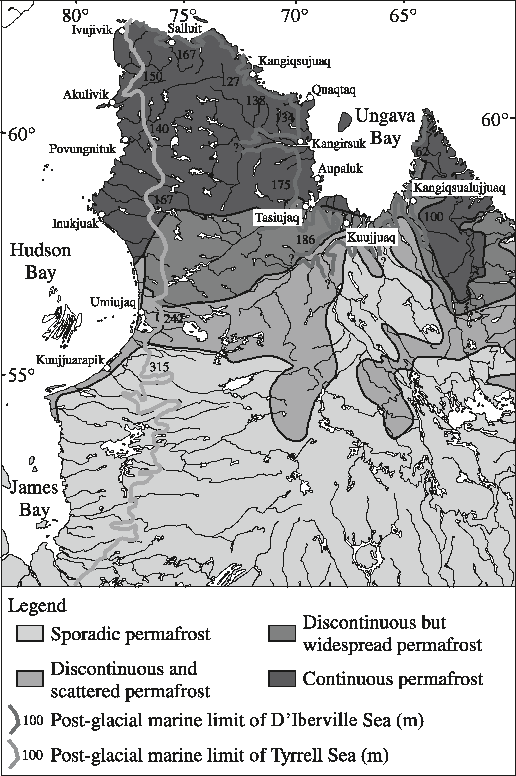
Fig. 1. Permafrost distribution and marine transgression in Nunavik (modified after Allard and Seguin 1987). Location of the 14 Inuit communities in Nunavik.

Following the retreat of the Wisconsin Ice Sheet about 7600–7300 years B.P. on the east coast of Hudson Bay (Hillaire–Marcel 1976; Allard and Seguin 1985) and about 7500– 7000 years B.P. in Ungava (Gray et al. 1980; Allard et al. 1989), the sea flooded a large band of coastline in Nunavik (Fig. 1). Glaciomarine sediments were then deposited in deep water in the Tyrrell and D’Iberville Seas (Fig. 1). Due to the isostatic rebound, once exposed to the cold atmosphere, the raised marine deposits were subsequently eroded and colonized by vegetation, and permafrost aggraded from sporadic permafrost to continuous permafrost with increasing latitude (Fig. 1).

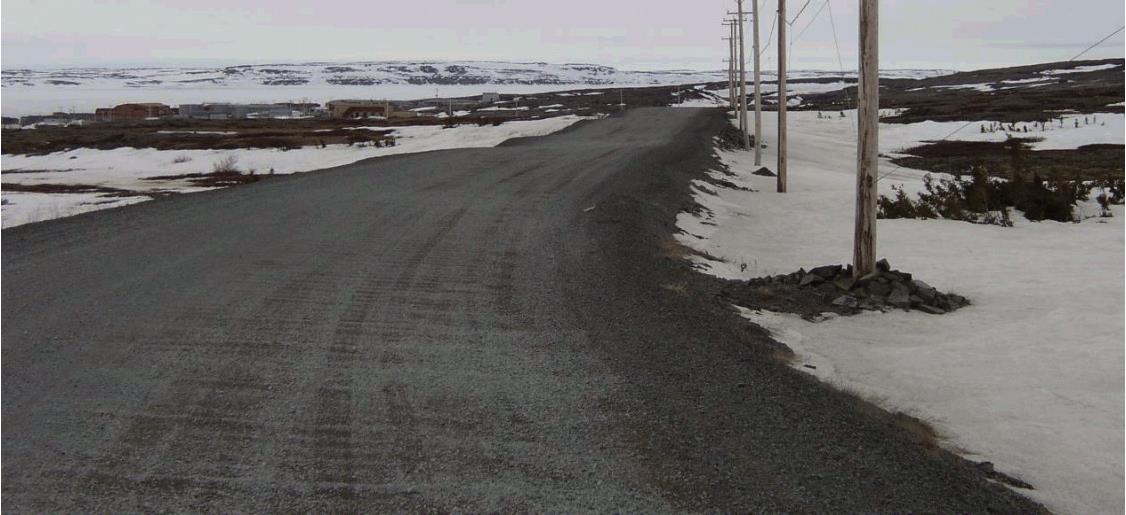
A case study is presented herein on recent thaw subsidence observed along the access road to the Umiujaq Airport in Nunavik (Quebec). In addition to the measurement of the subsidence, a geotechnical and geophysical investigation including a piezocone test, ground-penetrating radar (GPR) profiling, and electrical resistivity tomography (ERT) was carried out to characterize the underlying stratigraphy and permafrost conditions. In the absence of available ground temperature data for assessing the causes of permafrost degradation, numerical modeling of the thermal regime of the road embankment and subgrade was also undertaken to simulate the impacts of (i) an increase in air temperature observed recently in Nunavik and (ii) the thermal insulation effect of snow accumulating on the embankment shoulders and toes. The causes and effects of permafrost degradation on the road embankment are also discussed.

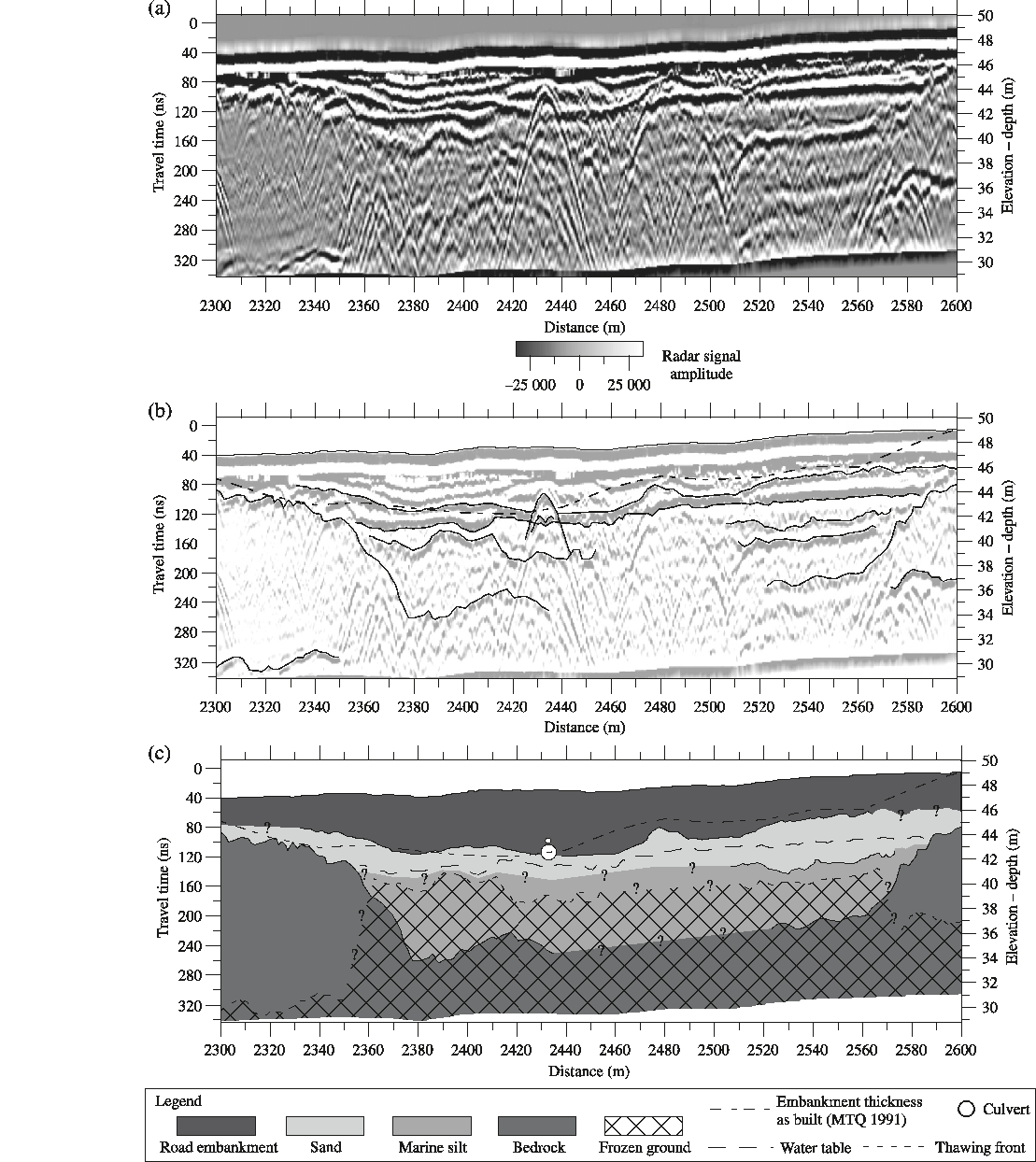
Fig. 11. (a) GPR reflection profile carried out on 14 July 2006 in the field with the 100 MHz antennas at a fixed offset of 1 m. (b) Major reflectors identified on the GPR reflection profile. (c) Cross section of the ground based on the combined interpretation of the GPR reflection profile and model of electrical resistivity (Fig. 12c). Note the vertical exaggeration (1:5).

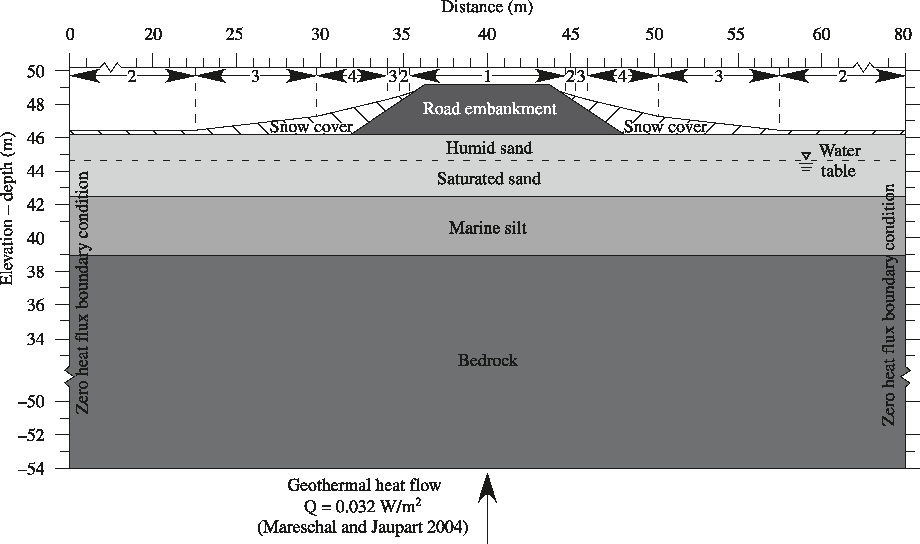
Values of thawing and freezing n-factors according to the surface conditions (Figs. 4 and 13) are given in Table 1. The gray road surface absorbs solar radiation in summer, inducing a higher surface temperature than air temperature and a higher thawing n-factor than the ones for the natural ground surface. The thawing n-factor is close to unity and the surface temperature is close to the air temperature in summer for the natural ground surface (ground surface boundaries Nos. 2, 3, and 4). Due to the absence of snow cover on the road surface, the freezing n-factor is close to unity. However, an increase in snow thickness leads to a decrease in the freezing n-factor (Fig. 13 and Table 1). We make the assumption that from one year to another there is no change in surface conditions due to climate variability and the thawing and freezing n-factors are constant.

Fig. 13. Cross section of the road embankment and subgrade showing the stratigraphy and boundary conditions used for the numerical modeling. The numbers between arrows refer to the ground surface boundaries (Table 1)

Only the governing equation of heat transfer by conduction taking into account the phase change problem was considered to simulate the permafrost warming and thawing underneath the road embankment. However, complex processes of heat transfer, groundwater flow, and thaw consolidation can take place in degrading permafrost. The development of a two dimensional numerical model of these coupled processes is needed to accurately predict the thaw subsidence based on the thaw consolidation properties of permafrost and to compare this prediction with the performance of the access road to Umiujaq Airport.

As expected from the design of thick road embankments in cold regions,the permafrost table has moved upward 0.9 m underneath the road embankment, preventing permafrost degradation (Fig. 14a). However, the permafrost is slightly warmer by a few tenths of degree Celsius underneath the road embankment than away from the road (Fig. 15). This increase in permafrost temperature due to the thermal effect of the road embankment makes the permafrost more vulnerable to any potential climate warming. The permafrost base in the bedrock has also moved upward 3.9 m for a permafrost thinning of 3 m (Fig. 15). This thawing taking place at the permafrost base does not induce any thaw settlement because the bedrock is thaw stable.

The subsidence is due to thaw consolidation taking place in a layer of ice-rich silt underneath a superficial sand layer. While the seasonal freeze–thaw cycles were initially restricted to the sand layer, the thawing front has now reached the thaw-unstable ice-rich silt layer. According to our numerical modeling, the increase in air temperature recently observed in Nunavik cannot be the sole cause of the observed subsidence affecting this engineering structure. The thick embankment also acts as a snow fence favoring the accumulation of snow on the embankment shoulders. The permafrost degradation is also due to the thermal insulation of the snow cover reducing heat loss in the embankment shoulders and toes.

Permafrost in Russia

Yakutsk Permafrost Institute Underground Lab

The Russians are seasoned permafrost scientists with Siberia as their preserve, and their observations are balanced by their long experience. The latest Russia report is from 2010.

We conclude the following based on initial analysis and interpretation of the data obtained in this project:

  • Most of the permafrost observatories in Russia show substantial warming of permafrost during the last 20 to 30 years. The magnitude of warming varied with location, but was typically from 0.5C to 2C at the depth of zero annual amplitude. This warming occurred predominantly between the 1970s and 1990s. There was no significant observed warming in permafrost temperatures in the 2000s in most of the research areas; some sites even show a slight cooling during the late 1990s and early 2000s.
  • Warming has resumed during the last two to three years at many locations predominantly near the coasts of the Arctic Ocean. Much less or no warming was observed during the 1980s and 1990s in the north of East Siberia. However, the last three years show significant permafrost warming in the eastern part of this region.
  • Permafrost is thawing in specific landscape settings within the southern part of the permafrost domain in the European North and in northwest Siberia. Formation of new closed taliks and an increase in the depth of preexisting taliks have been observed in this area during the last 20 to 30 years.

Methane Realism

An article in Scientific American raises several concerns about permafrost, but does add some realism:

First, while most of the methane is believed to be buried roughly 200 meters below the sea bed, only the top 25 meters or so of sea-bed are currently thawed, and thawing seems to have only progressed by about one meter in the last 25 years – a pace that suggests that the large bulk of the buried methane will stay in place for centuries to come.

Second, several thousand years ago, when orbital mechanics maximized Arctic warmth, the area around the North Pole is believed to have been roughly 4 degrees Celsius warmer than it is today and covered in less sea ice than today. Yet there’s no evidence of a massive amount of methane release in this time.

Third, the last time methane was released in vast quantities into the atmosphere – during the Paleocene-Eocene Thermal Maximum 56 million years ago – the process didn’t happen overnight. It took thousands of years.

Put those facts together, and we are probably not in danger of a methane time bomb going off any time soon.

Summary

The active layer of permafrost does vary from time to time and place to place. There was warming and some permafrost melting end of last century, but lately not so much. Any specific permafrost layer is influenced by many factors, including air temperatures, snow cover and vegetation, as well as the structure of the land, combining fill, sand, silt, ice and salinity mixtures on top of bedrock.

And nature includes negative feedbacks to permafrost melt. Any vegetation, even moss, growing in unfrozen soil provides insulation limiting further melting, as well as absorbing additional CO2. Reduced snowcover aids freezing and constrains later melting.

Rather than a permafrost bogeyman, we need a more people-friendly mascot. Consider our traditional nature friends loved by children and adults.

For example, Smokey the Bear

Rudolph the Reindeer

And the ever-popular Cola Bear

Introducing Permafrosty


Permafrosty is here!  Love him tender, and he’ll never let you down.

Additional Background on Permafrost in an earlier post The Permafrost Bogeyman


Fossil Fuels ≠ Global Warming

Previous posts addressed the claim that fossil fuels are driving global warming. This post updates that analysis with the latest numbers from BP Statistics and compares World Fossil Fuel Consumption (WFFC) with three estimates of Global Mean Temperature (GMT). More on both these variables below.

WFFC

2015 statistics are now available from BP for international consumption of Primary Energy sources. Statistical Review of World Energy.  H/T  Euan Mearns

The reporting categories are:
Oil
Natural Gas
Coal
Nuclear
Hydro
Renewables (other than hydro)

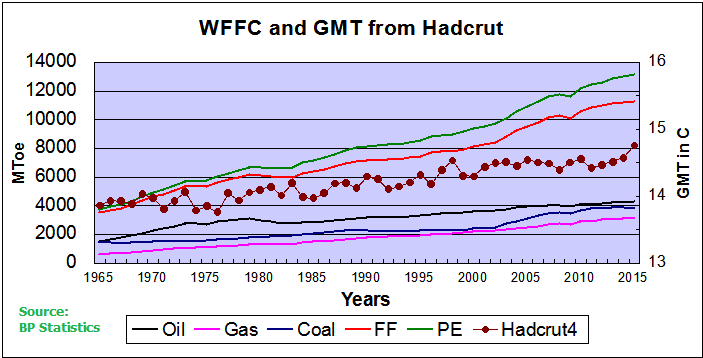
This analysis combines the first three, Oil, Gas, and Coal for total fossil fuel consumption world wide. The chart below shows the patterns for WFFC compared to world consumption of Primary Energy from 1965 through 2015.

The graph shows that Primary Energy consumption has grown continuously for 5 decades. Over that period oil, gas and coal (sometimes termed “Thermal”) averaged 90% of PE consumed, ranging from 94% in 1965 to 86% in 2015.  MToe is millions of tons of oil equivalents.

Global Mean Temperatures

Everyone acknowledges that GMT is a fiction since temperature is an intrinsic property of objects, and varies dramatically over time and over the surface of the earth. No place on earth determines “average” temperature for the globe. Yet for the purpose of detecting change in temperature, major climate data sets estimate GMT and report anomalies from it.

UAH record consists of satellite era global temperature estimates for the lower troposphere, a layer of air from 0 to 4km above the surface. HadSST estimates sea surface temperatures from oceans covering 71% of the planet. HADCRUT combines HadSST estimates with records from land stations whose elevations range up to 6km above sea level.

Both GISS LOTI (land and ocean) and HADCRUT4 (land and ocean) use 14.0 Celsius as the climate normal, so I will add that number back into the anomalies. This is done not claiming any validity other than to achieve a reasonable measure of magnitude regarding the observed fluctuations.

No doubt global sea surface temperatures are typically higher than 14C, more like 17 or 18C, and of course warmer in the tropics and colder at higher latitudes. Likewise, the lapse rate in the atmosphere means that air temperatures both from satellites and elevated land stations will range colder than 14C. Still, that climate normal is a generally accepted indicator of GMT.

Correlations of GMT and WFFC

The first graph compares to GMT estimates over the five decades from 1965 to 2015 from HADCRUT4, which includes HadSST3.

Over the last five decades the increase in fossil fuel consumption is dramatic and monotonic, steadily increasing by 220% from 3.5B to 11.3 B oil equivalent tons.  Meanwhile the GMT record from Hadcrut shows multiple ups and downs with an accumulated rise of 0.9C over 50 years, 6% of the starting value.

The second graph compares to GMT estimates from UAH6, and HadSST3 for the satellite era from 1979 to 2015, a period of 36 years.

In the satellite era WFFC has increased at a compounded rate of nearly 2% per year, for a total increase of 84% since 1979. At the same time, SSTs and  lower troposphere warming amounted to 0.5C, or 3.4% of the starting value.  The temperature rate of change is 0.1% per year, an order of magnitude less.  Even more obvious is the 1998 El Nino peak and flat GMT since.

Summary

The climate alarmist/activist claim is straight forward: Burning fossil fuels makes measured temperatures warmer. The Paris Accord further asserts that by reducing human use of fossil fuels, further warming can be prevented.  Those claims do not bear up under scrutiny.

It is enough for simple minds to see that two time series are both rising and to think that one must be causing the other. But both scientific and legal methods assert causation only when the two variables are both strongly and consistently aligned. The above shows a weak and inconsistent linkage between WFFC and GMT.

In legal terms, as long as there is another equally or more likely explanation for the set of facts, the claimed causation is unproven. The more likely explanation is that global temperatures vary due to oceanic and solar cycles. The proof is clearly and thoroughly set forward in the post Quantifying Natural Climate Change.

Background context for today’s post is at Claim: Fossil Fuels Cause Global Warming.

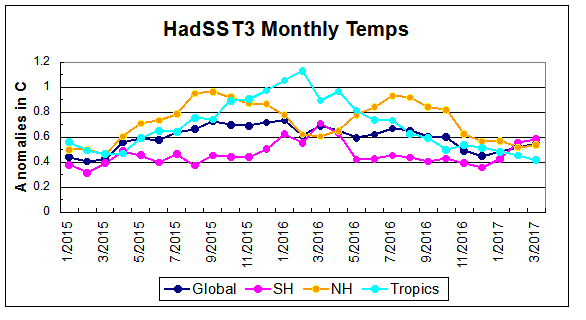
March Air and Sea Temps

The Pause that Refreshes!

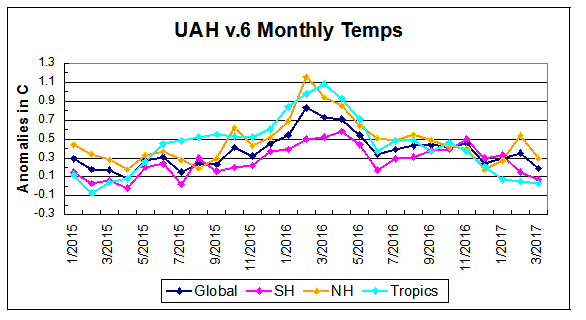
The recent El Nino is cooling down as shown clearly in both sea surface temperatures and lower troposphere air temperatures. The two relevant data sets are UAH v.6 and HadSST v3.1, both now providing averages for the month of March 2017.

The cooling pattern continues in the tropical seas while ocean temperatures in the Northern Hemisphere (NH) are  flat.  Southern Hemisphere (SH) oceans appear to be peaking and pulled the Global SST up a bit, but both are slightly below last March.

Air temperatures in the lower troposphere tell much the same story.  The greater volatility of air temperatures is evident, and we also see that the tropics (20N to 20S) and the NH (0 to 90N) are more closely aligned than are the comparable SSTs.  The downward trajectory of air temps is clear after an upward blip in the NH in February.

Enjoy the pause in warmer temperatures while we watch to see how cool it will get.

Climate Undamaged

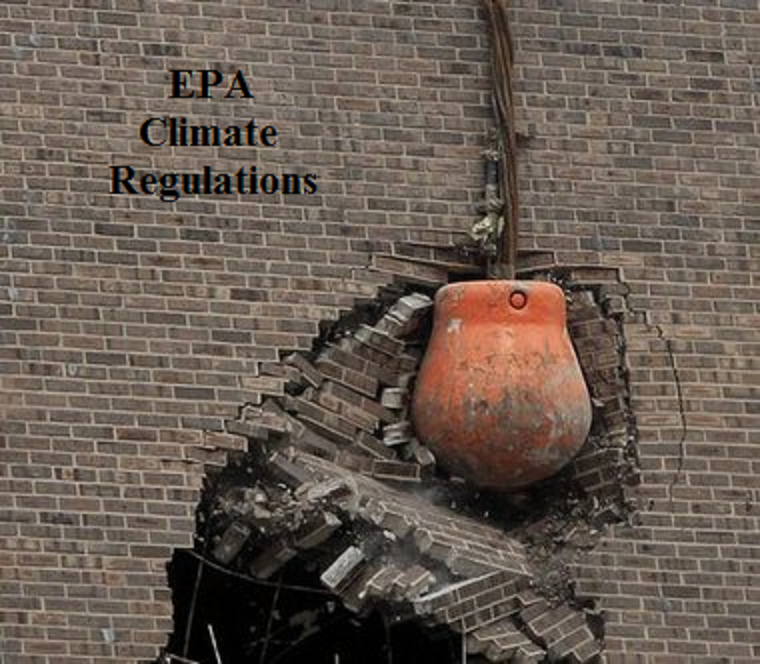
The fake news outrage over POTUS Executive Order this week obscured the fact that the wrecking ball is applied to a wall of regulations, not the climate or the planet, which are doing just fine, thank you very much.

Overlooked entirely is the fact that all government actions enacted or under consideration are projected to have a negligible effect on the climate.  So undoing them will hardly be noticed by the climate.  For example, some excerpts from a recent Wall Street Journal article:

The oddest criticism of Donald Trump’s climate action this week was the claim, mentioned almost triumphantly by every news source, that it would save few coal jobs. The economic and technological forces, especially the flood of low-carbon natural gas from fracking, are just too powerful.

Of course the news reports are right: “The regulatory changes are entirely outweighed by these technological changes, not to mention the price of natural gas or renewables,” Mark Muro of the Brookings Institution was quoted telling the New York Times .

So potent and large are these global forces that repealing the Obama rules, costly as they are, not only won’t affect coal jobs, it won’t affect climate.

Gina McCarthy, Mr. Obama’s EPA administrator, admitted as much when confronted, during a 2015 House hearing, with the fact that, by the agency’s own climate models, the effect would be only 1/100th of a degree Celsius. Instead, she said success should be measured in terms of “positioning the U.S. for leadership in an international discussion.”

Pile up all the government policies enacted or seriously on the table, and their net effect is zilch. A new McKinsey study, that would be hilarious if it weren’t so sad, points out that Germany’s switch to renewables has been a success by almost every metric except CO2 output—which is up instead of down. (my bold)

Rising energy prices to support this energy transition have had one measurable effect—more than 330,000 German households have had their electricity shut off in the past year from nonpayment of bills almost three times as high as those paid by U.S. households.

Germany, needless to add, is many greens’ idea of a country “positioned for leadership in international discussions.” (my bold)

No rational consideration, however, will abate the torrent of priestly imprecations hurled by green activists this week at Mr. Trump. The New York Times insists that Trumpian action “risks the planet”—plainly false since nothing either Mr. Trump or Mr. Obama did will make a difference to the planet. (my bold)

Tempest in a teapot (American English), or storm in a teacup (British English), is an idiom meaning a small event that has been exaggerated out of proportion.

The article is The Climate Yawns
Donald Trump is no more a planet wrecker than Barack Obama (as measured to the third decimal). By Holman W. Jenkins, Jr. At Wall Street Journal.  Full text below (with an image I added at the end.)

The oddest criticism of Donald Trump’s climate action this week was the claim, mentioned almost triumphantly by every news source, that it would save few coal jobs. The economic and technological forces, especially the flood of low-carbon natural gas from fracking, are just too powerful.

Then why, if you’re a Democrat, put yourself in that position in the first place to take blame for killing coal jobs? Why enact a costly regulation to do what the market was doing for free? When everybody else wanted to blame the Florida recount for his 2000 defeat, Al Gore was smart enough privately to blame gun control. When you lose your home state as presidential candidate, something is wrong. The same blundering ineptitude explains how the Obama alliance with the greens threw away first Congress and then a presidency.

Of course the news reports are right: “The regulatory changes are entirely outweighed by these technological changes, not to mention the price of natural gas or renewables,” Mark Muro of the Brookings Institution was quoted telling the New York Times .

So potent and large are these global forces that repealing the Obama rules, costly as they are, not only won’t affect coal jobs, it won’t affect climate.

Gina McCarthy, Mr. Obama’s EPA administrator, admitted as much when confronted, during a 2015 House hearing, with the fact that, by the agency’s own climate models, the effect would be only 1/100th of a degree Celsius. Instead, she said success should be measured in terms of “positioning the U.S. for leadership in an international discussion.”

Even so, many climate activists felt the need to walk back Ms. McCarthy’s concession by insisting Obama policies would have a measurable effect—on the amount of CO 2 released. Yes, the relative decrease would be tiny but measurable, though the climate effect would be zip. This is akin to medical researchers claiming a drug a success because it’s detectable in the bloodstream, not because it improves health.

And don’t get us started on the “social cost of carbon,” a mechanism of policy justification created by the Obama EPA to assign a dollar-value benefit to carbon abatement rules that, in total, will produce zero impact on climate.

Pile up all the government policies enacted or seriously on the table, and their net effect is zilch. A new McKinsey study, that would be hilarious if it weren’t so sad, points out that Germany’s switch to renewables has been a success by almost every metric except CO 2 output—which is up instead of down.

Rising energy prices to support this energy transition have had one measurable effect—more than 330,000 German households have had their electricity shut off in the past year from nonpayment of bills almost three times as high as those paid by U.S. households.

Germany, needless to add, is many greens’ idea of a country “positioned for leadership in international discussions.”

No rational consideration, however, will abate the torrent of priestly imprecations hurled by green activists this week at Mr. Trump. The New York Times insists that Trumpian action “risks the planet”—plainly false since nothing either Mr. Trump or Mr. Obama did will make a difference to the planet.

Literally no amount of money dissipated on climate policy is excessive to such people, because their shamanistic status is directly proportional to the social waste they can conjure. In the realm of religion are we called upon to perform symbolic actions whose purpose (and cost) is aimed at testifying to our membership in the elect.

The most poignant question, however, is what happened to Democrats? They were once a party whose members cared whether policy was efficient and produced benefits for the American people.

Democrats deserve a large share of the credit for the rescue of the failing U.S. economy of the 1970s by throwing out a host of perverse regulatory policies, not that they embrace or even acknowledge this legacy today—which is the problem.

Airline deregulation was born in Ted Kennedy’s administrative practice subcommittee. His aide, Stephen Breyer, now a Supreme Court justice, recalled a working-class Boston constituent asking why the senator was focused on airline issues when this voter could never afford to fly. “That is why,” said Kennedy.

The Democratic Party once had a brain where regulation was concerned, understanding that the ultimate purpose was a net public good, not an in-gathering of power to Washington for the benefit of lobbyists and influence peddlers.

It was not yet today’s Democratic Party of Chuck Schumer, who isn’t stupid and yet is associated with no body of policy thought or analysis. If he even has anybody on his staff deputized to think about the results of policy, it probably is the lowliest intern.

A wrecking ball of a president was the Trump electorate’s answer to this problem. It’s hard even now to say they were wrong. If he delivers nothing in the next four years, it is alarming to suspect that this likely would still be a better result than we would have gotten under Hillary Clinton.