Climatists Wrong-Footed

Trolling: The art of deliberately, cleverly, and secretly pissing people off, usually via the internet, using dialogue.

Update May 4 at the end

People may not have noticed that subtly, without fanfare, the climate battleground has shifted from the science to the policy. Like everyone else climatists were caught unawares by the election of US policymakers skeptical of the need to “fight climate change.”

But the surprising development is how activist tactics are still geared mainly to push on the claim of “settled science”, when that is not any more the focal point for the opposition. I don’t know who created the strategy for nominees, but in confirmation hearings, to a man and woman they all refrained from denying the science. Sanders and the other true-believing senators pressed hard to get heretical statements, but failed.

Now the activists have turned up the heat with science marches every weekend. Activists keep pushing on the science because their policy agenda is even less believable.

The marchers’ signs show they depend on three suppositions, like a three-legged stool:

  • Humans are making the planet warmer.
  • The warming is dangerous.
  • Government can stop it.

The first point is what alarmists claim is settled science, and where others have doubts about the data, the models and the theories. Expressing those doubts gets you labeled a denier. After years of alarmists refusing to debate that first point, they now want to talk about nothing else.  Apparently they think that only the first point matters; once that is admitted, everything else follows.

To their surprise, policymakers, and now even some journalists are shifting the ground to the other two wobbly legs, where the assertions have even less support.

A perceptive journalist writing for the LA Times sees how the game is changing.  Jonah Goldberg wrote yet another piece of independent thought coming from a previous uncritically warmist newsroom. Bret Stephens just trolled the left with his supposed climate change denialism. Excerpts below.

The most amusing show over the weekend was the collective case of the vapors across the liberal left establishment over Bret Stephens’ first column at the New York Times on the perils of certainty, particularly on the topic of climate change.

When someone says that he is not denying climate change and concedes that it is real, that is “classic climate change denialism”? Huh. What words do we have left for people who call the whole thing a “hoax”? In civil debates, when someone concedes much of your premise, the proper reaction is not to scream “liar!” or “heretic!”

And that brings me to the second, and more amusing, thing about all of this. You’ve been trolled, people.

As a fellow columnist, I doff my cap to you, sir.

It wasn’t hard to trick liberals into going off-sides. In the past, Stephens was a more acid-tongued critic of climate change research. But the column in question was a model of restraint that, when read by non-ideologues and non-combatants, must seem utterly reasonable, even a tad banal. Stefan Rahmstorf, a prominent German climate scientist, wrote a lengthy, sanctimonious letter explaining why he was cancelling his subscription to the New York Times. Nothing in the letter addressed anything Stephens wrote in his column.

The Washington Post’s Eric Wemple found it hard to constrain his dismay. “May it suffice to say, however, that the many, many people who care passionately for the planet found it an exercise in climate-change denialism.”

Wemple’s a clever fellow. I’m sure he understands Stephens’ point about the dangers of certainty, particularly based on sophisticated mathematical models that have been proven wrong in the past.

What I think sailed past Wemple and so “many, many people” was Stephens’ subtler point about the sanctimonious condescension of people who claim to be motivated solely by their passionate care for the planet.

Stephens’ heresy here isn’t in denying climate change; it’s in refusing to concede that one group of people has a total monopoly on defining not just the problem but the acceptable responses to it. Such dissent is not a crime against science; it’s a threat to a guild. And the guild took the bait.

Update May 4

Bret Stephens published a new post today that digs into the policy failures, specifically biofuels with references to other shortcomings, such as emissions trading. Climate of Unintended Consequences

In other words, the three central claims made in the Department of Energy paper quoted at the top of this column were misleading or wrong. Factually wrong. Wrong for the environment. Wrong for taxpayers. Wrong for the allocation of government funding and scientific research. Wrong for our energy mix. Wrong politically: Whatever else we conclude about ethanol, the one thing that won’t soon go away is the biofuel lobby in Washington.

And wrong for the reputation of climate science.

In recent years, some climate activists — Al Gore notably among them — have owned up to their biofuels mistake. More recently, we’ve seen some acknowledgment of other errors, having more to do with policy than science.

Thus, today there’s a keener appreciation that cap-and-trade regimes such as Europe’s ambitious Emissions Trading System have been costly failures, with one study suggesting the E.T.S. had “limited benefits and embarrassing consequences” in terms of emissions — at an estimated cost to consumers of some $280 billion.

There’s also been some acknowledgment that Germany’s Energiewende — the uber-ambitious “energy turn” embarked upon by Angela Merkel in 2010 — has been less than a model for others. The country is producing record levels of energy from wind and solar power, but emissions are almost exactly what they were in 2009. Meanwhile, German households pay nearly the highest electricity bills in Europe, all for what amounts to an illusion of ecological virtue.

Still, what acknowledgment there’s been has generally been belated, grudging and rarely self-reflective. What’s missing is an understanding of the harm that can be done when do-something impulses and eco-cure boosterism become turbocharged by government power and subsidized business.

The lessons are legion but, more often than not, unlearned. We need to make policy choices based less on moral self-regard and more on attention to real-world results.

April Arctic Ice Beats Expectations

Residents view the first iceberg of the season as it passes the South Shore, also known as “Iceberg Alley,” near Ferryland, Newfoundland, Canada, April 16, 2017. REUTERS/Jody Martin

The title of this post sounds contradictory to most of what the media is saying about Arctic ice being in a tailspin, setting records for low extents, etc. And reports of ice blocking Newfoundland also fly in the face of media claims.

I will let you in on a secret: Arctic Ocean ice is doing fine and well above the decadal average. The only place where ice is below normal is outside the Arctic Ocean, namely Bering and Okhotsk Seas in the Pacific. Claims of disappearing ice pertain not to the Arctic itself, but to marginal Pacific seas that will melt out anyway by September.

I noticed the pattern this April when it became obvious that including Bering and Okhotsk in the Arctic totals gives a misleading picture. For sure they are part of Northern Hemisphere (NH) total sea ice, but currently the Pacific is going its own way, not indicative of the sea ice in the Central and Atlantic Arctic.

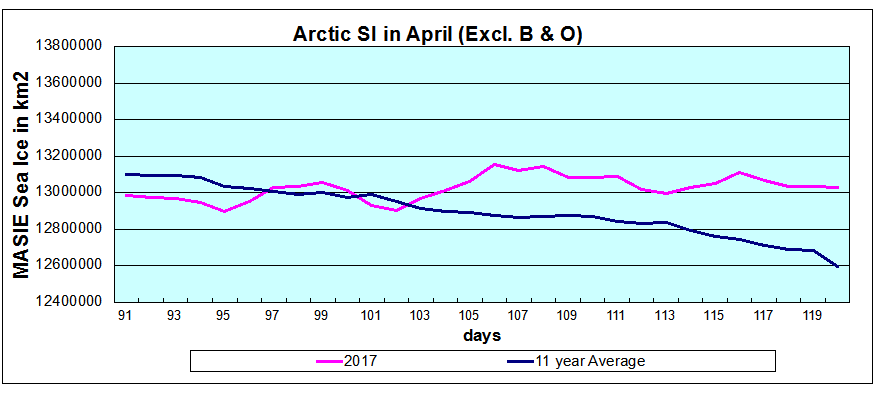
April 2017 is now complete. Focusing on the Arctic apart from Pacific marginal seas, remarkably the month ends with the same extent as it began at 13M km2. The graph below shows an early fluctuation down, followed by later gains and a gentle descent. May begins with the Arctic seas showing a surplus of ~400k km2 above average.

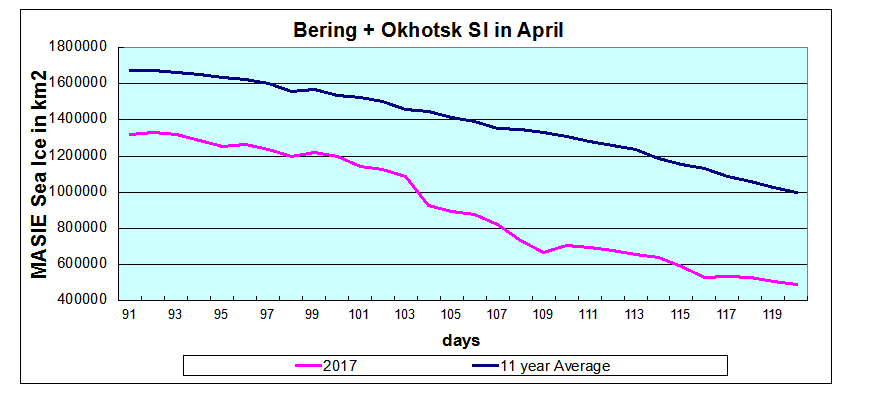
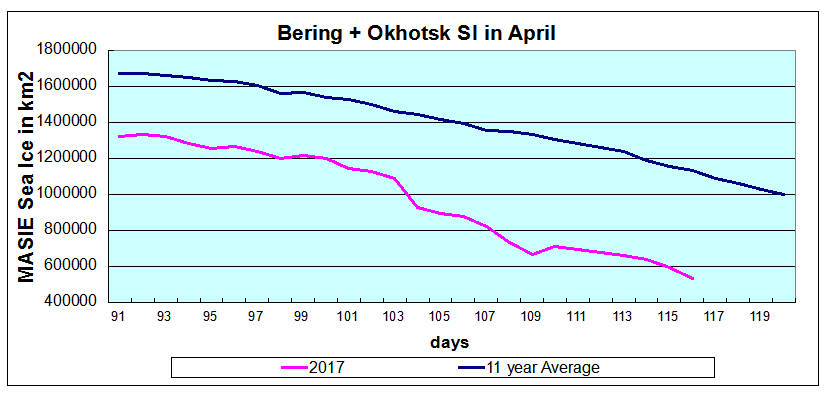
While the Arctic ocean ice is persisting, Bering and Okhotsk extents have retreated ahead of schedule, as the graph below shows.  Presently Bering and Okhotsk combined are 50% of decadal average, down by 500k km2.

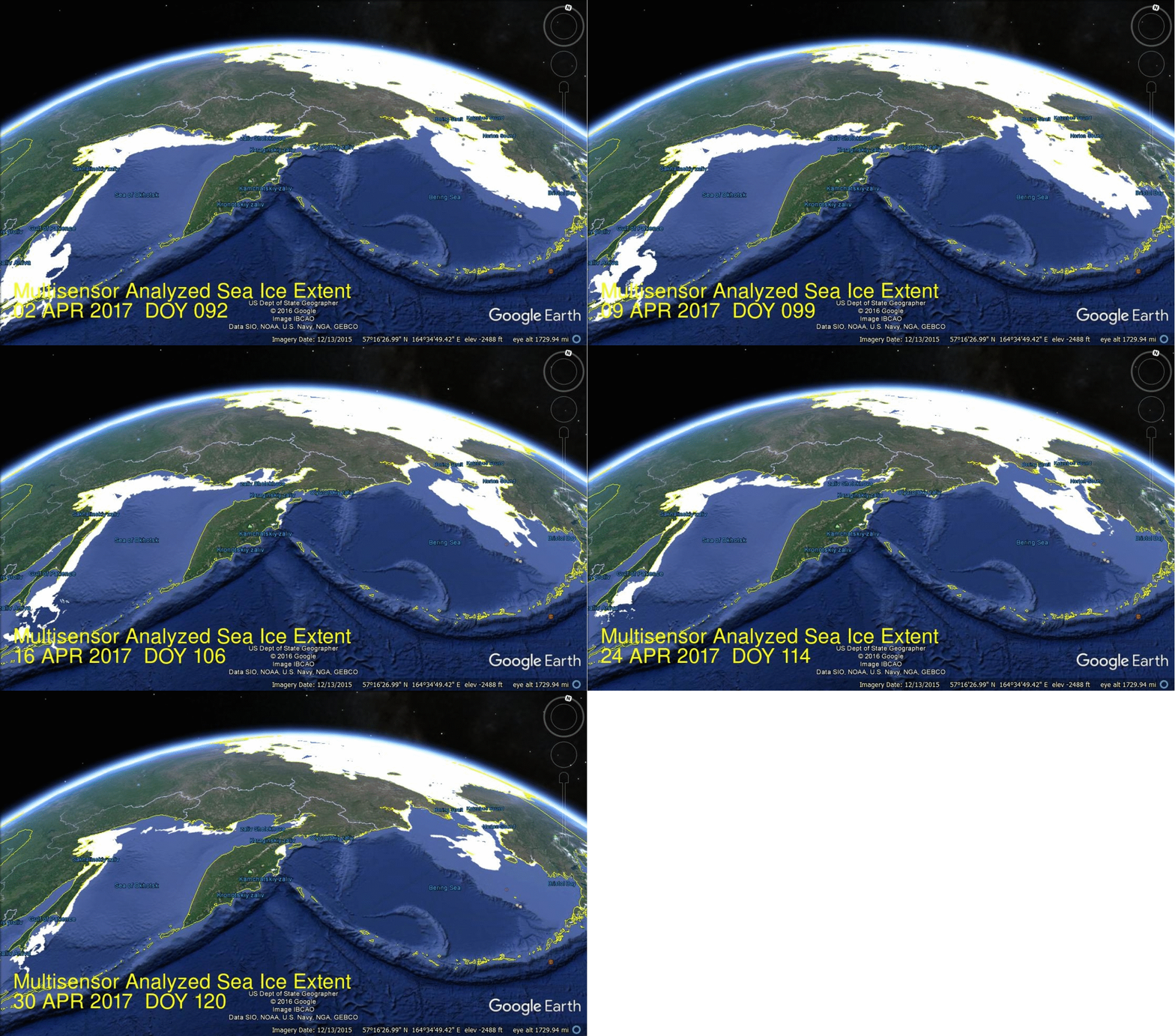
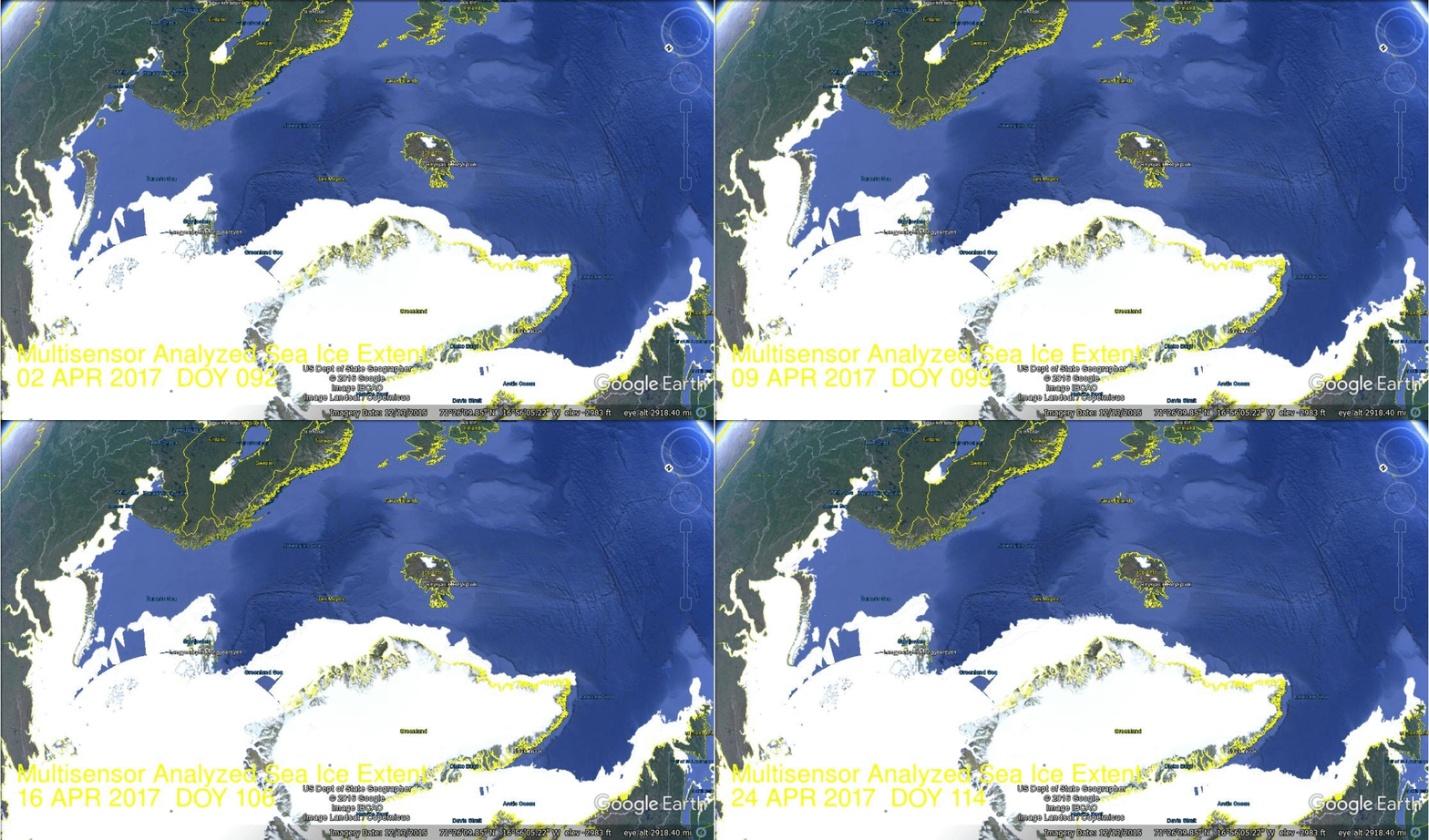
The distinctive Pacific pattern is evident in the images of changing ice extents this April.  First, see how ice in Bering and Okhotsk seas has retreated steadily this month.


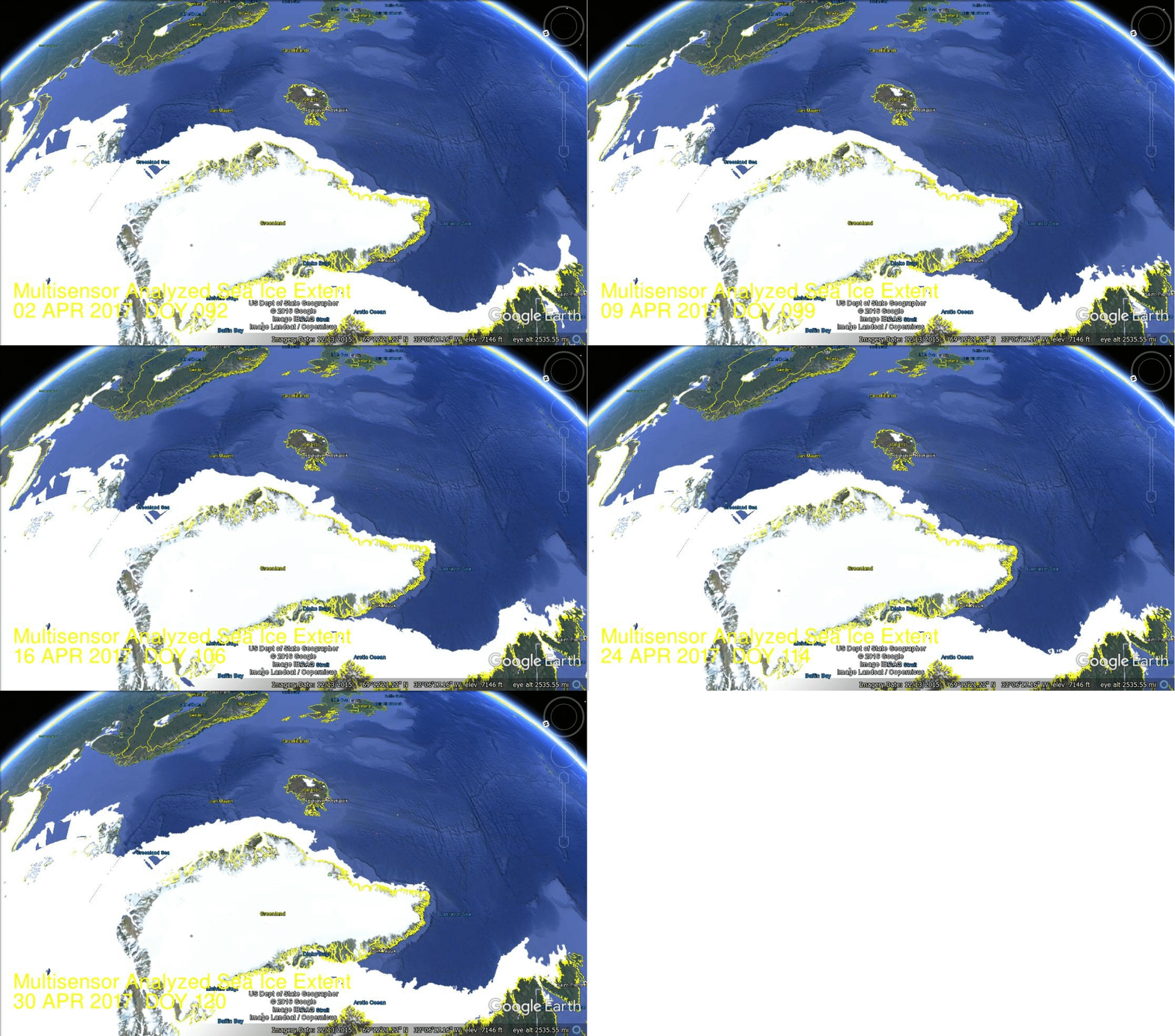
Meanwhile, on the Atlantic side ice has grown steadily.  Note the persistent ice blocking Newfoundland on the bottom right, and encasing Svalbard on the upper left.


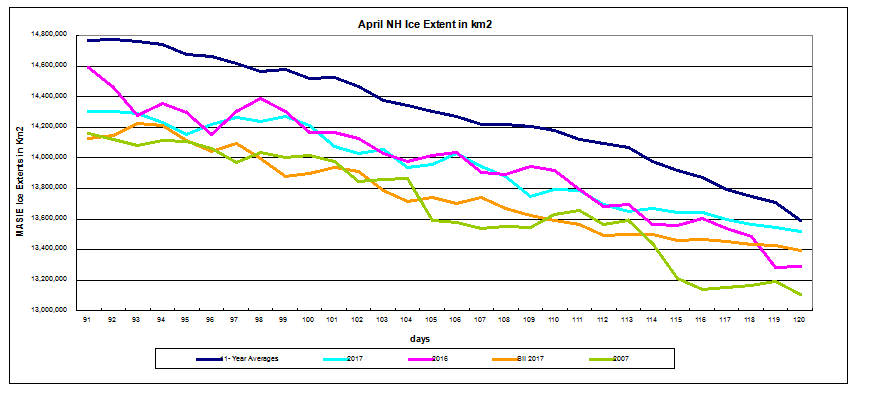
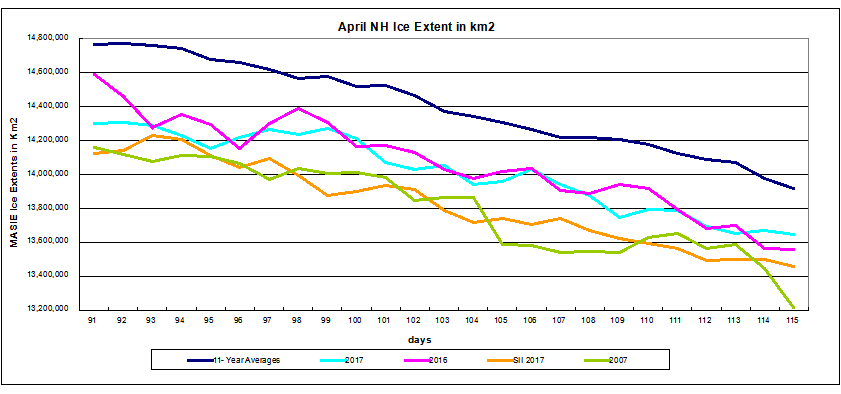
The Chart below shows the traditional view of NH ice extents, which includes the Pacific seas together with the Arctic seas.  2017 is only slightly lower than average on this basis, despite a deficit of 500k km2 in Bering and Okhotsk, which obscures the ice surpluses elsewhere.  Comparisons with Sea Ice Index (SII) and 2007 are also shown.

Summary

The details are important to form a proper perception of any natural process, including dynamics of sea ice waxing and waning. On closer inspection, the appearance of declining Arctic sea ice is actually another after effect of the recent El Nino and Blob phenomena, and quite restricted to the Pacific marginal seas.

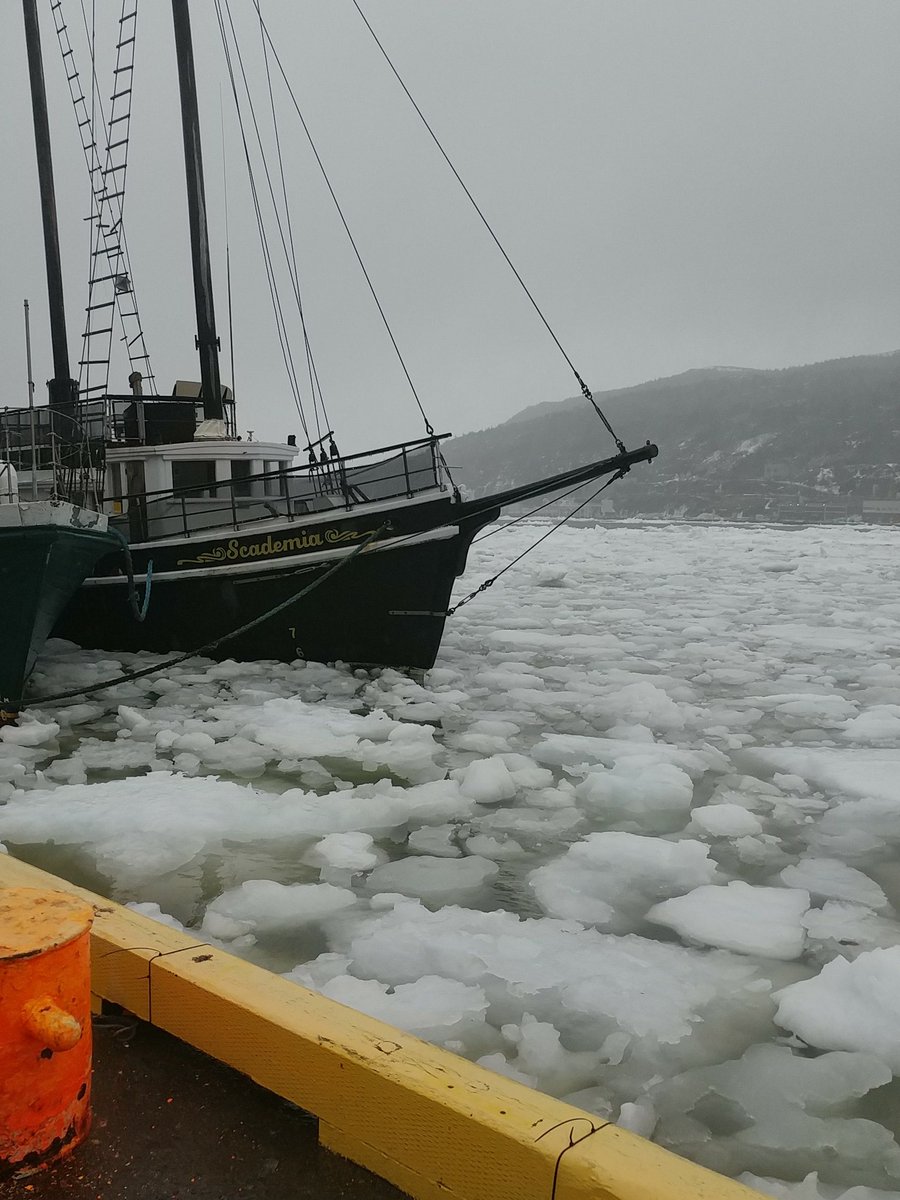
Meanwhile, on the Atlantic side of the Arctic, we have sightings and reports of ice surges along the coast of Newfoundland, such amounts not seen since the 1980s. Below an image of St. John’s harbour with tons of ice, provided by Ryan Simms.


And from Twillingate: “Basically it’s just an ocean of ice ahead of us.’ – Derrick Bath, Polar Venture

Derrick Bath’s Polar Venture has spent hours trying to make it through the ice near Twillingate. (Submitted by Danny Bath)

Climate Chaos


Foucault’s pendulum in the Panthéon, Paris

h/t tom0mason for inspiring this post, including his comment below

The Pendulum is Settled Science

I attended North Phoenix High School (Go Mustangs!) where students took their required physics class from a wild and crazy guy. Decades later alumni who don’t remember his name still reminisce about “the crazy science teacher with the bowling ball.”

To demonstrate the law of conservation of energy, he required each and every student to stand on a ladder in one corner of the classroom. Attached to a hook in the center of the rather high ceiling was a rope with a bowling ball on the other end. The student held the ball to his/her nose and then released it, being careful to hold still afterwards.

The 16 pound ball traveled majestically diagonally across the room and equally impressively returned along the same path. The proof of concept was established when the ball stopped before hitting your nose (though not by much).  In those days we learned to trust science and didn’t need to go out marching to signal some abstract virtue.

The equations for pendulums are centuries old and can predict the position of the ball at any point in time based on the mass of the object, length of the rope and starting position.

Pictured above is the currently operating Foucault pendulum that exactly follows these equations. While it had long been known that the Earth rotates, the introduction of the Foucault pendulum in 1851 was the first simple proof of the rotation in an easy-to-see experiment. Today, Foucault pendulums are popular displays in science museums and universities.

What About the Double Pendulum?

Trajectories of a double pendulum

Just today a comment by tom0mason at alerted me to the science demonstrated by the double compound pendulum, that is, a second pendulum attached to the ball of the first one. It consists entirely of two simple objects functioning as pendulums, only now each is influenced by the behavior of the other.

Lo and behold, you observe that a double pendulum in motion produces chaotic behavior. In a remarkable achievement, complex equations have been developed that can and do predict the positions of the two balls over time, so in fact the movements are not truly chaotic, but with considerable effort can be determined. The equations and descriptions are at Wikipedia Double Pendulum

Long exposure of double pendulum exhibiting chaotic motion (tracked with an LED)

But here is the kicker, as described in tomomason’s comment:

If you arrive to observe the double pendulum at an arbitrary time after the motion has started from an unknown condition (unknown height, initial force, etc) you will be very taxed mathematically to predict where in space the pendulum will move to next, on a second to second basis. Indeed it would take considerable time and many iterative calculations (preferably on a super-computer) to be able to perform this feat. And all this on a very basic system of known elementary mechanics.

And What about the Climate?

This is a simple example of chaotic motion and its unpredictability. How predictable is our climate with so many variables and feedbacks, some known some unknown? Consider that this planet’s weather/climate system is chaotic in nature with many thousands (millions?) of loosely coupled variables and dependencies, and many of these variables have very complex feedback features within them.

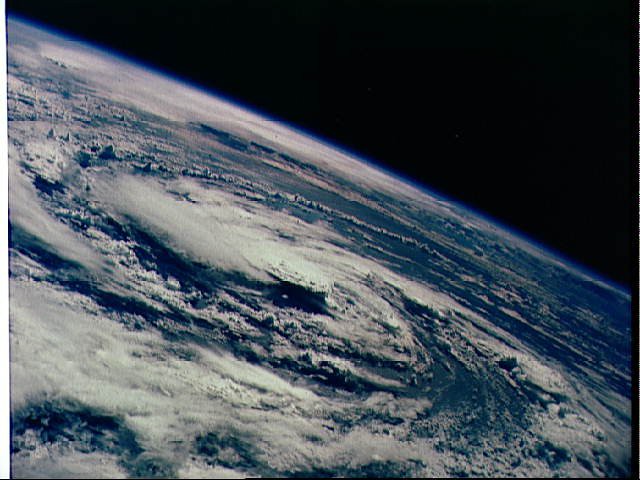
Hurricane Gladys, photographed from orbit by Apollo 7 in 1968 (Photo: NASA)

Summary

To quote the IPCC:

The climate system is a coupled non-linear chaotic system, and therefore the long-term prediction of future climate states is not possible. Rather the focus must be upon the prediction of the probability distribution of the system’s future possible states by the generation of ensembles of model solutions.

A recent National Review article draws the implications:
The range of predicted future warming is enormous — apocalyptism is unwarranted.

But as the IPCC emphasizes, the range for future projections remains enormous. The central question is “climate sensitivity” — the amount of warming that accompanies a doubling of carbon dioxide in the atmosphere. As of its Fifth Assessment Report in 2013, the IPCC could estimate only that this sensitivity is somewhere between 1.5 and 4.5°C. Nor is science narrowing that range. The 2013 assessment actually widened it on the low end, from a 2.0–4.5°C range in the prior assessment. And remember, for any specific level of warming, forecasts vary widely on the subsequent environmental and economic implications.

For now, though, navigating the climate debate will require translating the phrase “climate denier” to mean “anyone unsympathetic to the most aggressive activists’ claims.” This apparently includes anyone who acknowledges meaningful uncertainty in climate models, adopts a less-than-catastrophic outlook about the consequences of future warming, or opposes any facet of the activist policy agenda. The activists will be identifiable as the small group continuing to shout “Denier!” The “deniers” will be identifiable as everyone else.

Update May 2

Esteemed climate scientist Richard Lindzen ends a very fine recent presentation (here) with this description of the climate system:

I haven’t spent much time on the details of the science, but there is one thing that should spark skepticism in any intelligent reader. The system we are looking at consists in two turbulent fluids interacting with each other. They are on a rotating planet that is differentially heated by the sun. A vital constituent of the atmospheric component is water in the liquid, solid and vapor phases, and the changes in phase have vast energetic ramifications. The energy budget of this system involves the absorption and reemission of about 200 watts per square meter. Doubling CO2 involves a 2% perturbation to this budget. So do minor changes in clouds and other features, and such changes are common. In this complex multifactor system, what is the likelihood of the climate (which, itself, consists in many variables and not just globally averaged temperature anomaly) is controlled by this 2% perturbation in a single variable? Believing this is pretty close to believing in magic. Instead, you are told that it is believing in ‘science.’ Such a claim should be a tip-off that something is amiss. After all, science is a mode of inquiry rather than a belief structure.

Flow Diagram for Climate Modeling, Showing Feedback Loops

Inside a True Believer’s Mind

true-believer

At Slate Susan Matthews writes Bret Stephens’ First Column for the New York Times Is Classic Climate Change Denialism  It doesn’t outright reject the facts—which makes it all the more insidious.

Key Paragraphs (my bolding for emphasis)

But in reality, the goal of this column is not to help readers learn how to reason with people who are skeptical about climate change. Instead, the column reinforces the idea that those people might have a point. The New York Times push notification that went out Friday afternoon about the column said as much—“reasonable people can be skeptical about the dangers of climate change,” it read. That is not actually true, and nothing that Stephens writes makes a case for why it might be true. This column is not a lesson for people who want to advance good climate policy. Instead, it is a dog whistle to people who feel confused about climate change. It’s nothing more than textbook denialism.

The institutions Stephens questions in his column are not singular entities but entire ideas—scientists who may not see their biases, statistical models that might be skewed, liberals who may be so swayed by their ideology. His argument is convincing because the institutions he mentions can make mistakes. It’s true, there are some problems with how we use probabilities in science. We tend to be bad at distinguishing between correlation and causation. Sometimes our biases do get in the way. Stephens knows this, and he taps into it in his piece. “Much else that passes as accepted fact is really a matter of probabilities,” he suggests. You have to be an idiot or a zealot to believe climate change is certain, whispers the subtext.

The Credo

Regardless of what Stephens says in this column, and regardless of Clinton’s modeling failures, climate change is a terrible threat to life as we know it on this planet. Anyone who wants to honestly investigate the data will come to the same conclusion that the scientific establishment has—climate change is real, and dangerous. Our failures elsewhere—even in the disturbing wake of the election of Donald J. Trump—do not negate that. The questions are no longer whether and how but how soon and how bad. Climate change is happening, and “claiming total certainty about the science” does not “traduce the spirit of science.” Instead, it is a reasonable interpretation of the science at hand.

Don’t Give an Inch

What he is suggesting here is that the rational way to go forward with a conversation about climate change is to admit that climate change might not be certain. This is similar to the torturous logic he puts forward throughout the rest of the piece—the only way to be reasonable about this topic is to give in to those who are unreasonable about it. While he calmly insists he is the only logical person around, he is spewing complete bullshit.

Stephens article itself is excerpted at  NYT Opens Climate Can of Worms

Counting Climate Dollars: Who Controls the Debate?


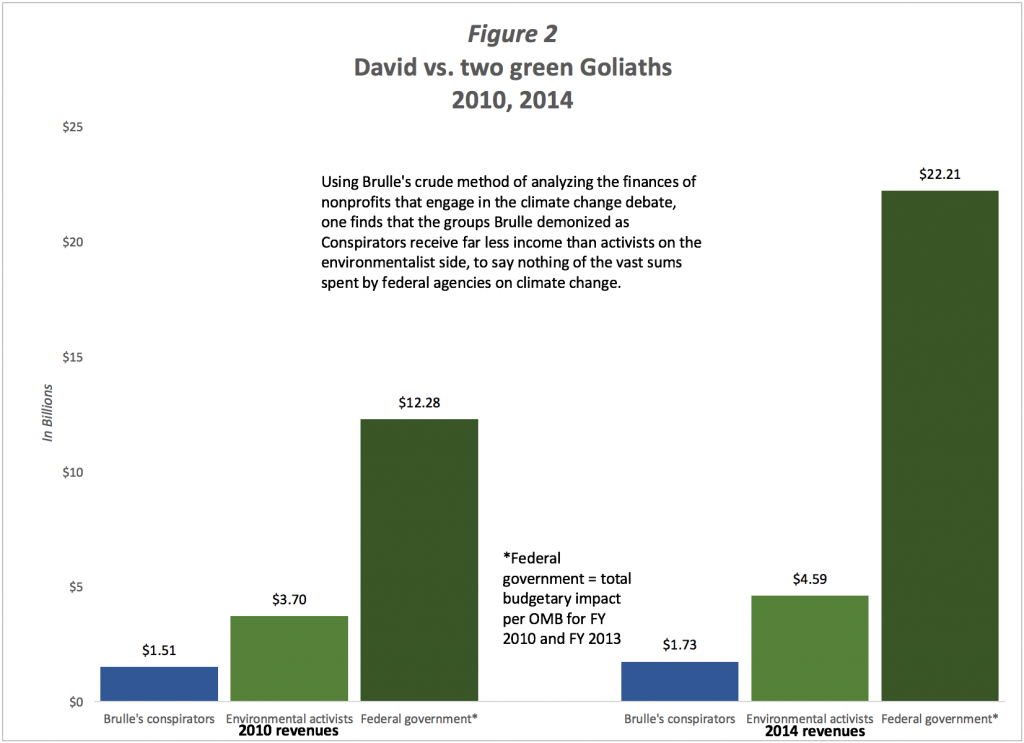
Thanks to an opinion piece in Washington Post, I discovered the work of a serious skeptical thinktank called Capital Research Center. This short video explains how global warming/climate change activists have repeatedly distorted how public communications on the issue are funded, and how dominant are the alarmist dollars.

The full study and numerous other resources are at Climate Dollars

The WP article is A Climate Hysteric’s Fake Enemies List which can also be accessed at Climate Dollars org. link above.


NYT Opens Climate Can of Worms


Fishermen often discovered how easy it was to open a can of bait worms, and how difficult it was to close them. Once the worms discovered an opportunity to escape, it became nearly impossible to keep them contained. Some experts say the metaphor is a modern extension of Pandora’s Box.

In a previous post NYT Readers Face Diversity I provided a background for New York Times newest columnist Bret Stephens, with emphasis on his climate change commentary.

Now his first column published in NYT appears Climate of Complete Certainty, an invitation to examine the facts about climate change. Excerpts below.

We live in a world in which data convey authority. But authority has a way of descending to certitude, and certitude begets hubris. From Robert McNamara to Lehman Brothers to Stronger Together, cautionary tales abound.

We ought to know this by now, but we don’t. Instead, we respond to the inherent uncertainties of data by adding more data without revisiting our assumptions, creating an impression of certainty that can be lulling, misleading and often dangerous. Ask Clinton.

With me so far? Good. Let’s turn to climate change.

Last October, the Pew Research Center published a survey on the politics of climate change. Among its findings: Just 36 percent of Americans care “a great deal” about the subject. Despite 30 years of efforts by scientists, politicians and activists to raise the alarm, nearly two-thirds of Americans are either indifferent to or only somewhat bothered by the prospect of planetary calamity.

Why? The science is settled. The threat is clear. Isn’t this one instance, at least, where 100 percent of the truth resides on one side of the argument?

Well, not entirely. As Andrew Revkin wrote last year about his storied career as an environmental reporter at The Times, “I saw a widening gap between what scientists had been learning about global warming and what advocates were claiming as they pushed ever harder to pass climate legislation.” The science was generally scrupulous. The boosters who claimed its authority weren’t.

Anyone who has read the 2014 report of the Intergovernmental Panel on Climate Change knows that, while the modest (0.85 degrees Celsius, or about 1.5 degrees Fahrenheit) warming of the Northern Hemisphere since 1880 is indisputable, as is the human influence on that warming, much else that passes as accepted fact is really a matter of probabilities. That’s especially true of the sophisticated but fallible models and simulations by which scientists attempt to peer into the climate future. To say this isn’t to deny science. It’s to acknowledge it honestly.

By now I can almost hear the heads exploding. They shouldn’t, because there’s another lesson here — this one for anyone who wants to advance the cause of good climate policy. As Revkin wisely noted, hyperbole about climate “not only didn’t fit the science at the time but could even be counterproductive if the hope was to engage a distracted public.”

Let me put it another way. Claiming total certainty about the science traduces the spirit of science and creates openings for doubt whenever a climate claim proves wrong. Demanding abrupt and expensive changes in public policy raises fair questions about ideological intentions. Censoriously asserting one’s moral superiority and treating skeptics as imbeciles and deplorables wins few converts.

None of this is to deny climate change or the possible severity of its consequences. But ordinary citizens also have a right to be skeptical of an overweening scientism. They know — as all environmentalists should — that history is littered with the human wreckage of scientific errors married to political power.

Conclusion

I’ve taken the epigraph for this column from the Polish poet Czeslaw Milosz, who knew something about the evils of certitude. Perhaps if there had been less certitude and more second-guessing in Clinton’s campaign, she’d be president. Perhaps if there were less certitude about our climate future, more Americans would be interested in having a reasoned conversation about it.

New York Post (here) covers the nastiness of responses to Stephens’ first column. Stephens compares the blowback to what he got from Trump fans: “After 20 months of being harangued by bullying Trump supporters, I’m reminded that the nasty left is no different. Perhaps worse,” Stephens tweeted Friday afternoon, as the hateful messages kept rolling in.  New York Times used to be a “safe space”, maybe now not so much.

Bret Stephens

Update April 30

A response to Stephens article at Slate  Inside a True Believer’s Mind

Footnote:

Whenever I see those graphs of climate models projections, it reminds me of worms escaping.

Climate Evangelists Are Taking Over Your Local Weather Forecast

The battle by alarmists for hearts and minds is extending to many fronts, including recruiting family doctors, and in the case of this post, media weather reporters. Surveys have shown the meteorologists are not more convinced of global warming/climate change than is the American public (a slight majority). But efforts have been underway to convert them and use their telecasts and columns to promote climatism.

A balanced and analytical report appears in Bloomberg (an interesting place for such independent thinking).  Climate Evangelists Are Taking Over Your Local Weather Forecast Excerpts below.

Amber Sullins gets a minute or two to tell up to two million people about some extremely complicated science, using the tools of her trade: a pleasant voice, a green screen, and small icons denoting sun, clouds, rain, and wind. She is the chief meteorologist at ABC15 News in Phoenix, so her forecasts mostly call for sunshine. Within this brief window, however, Sullins sometimes manages to go beyond the next five days. Far beyond.

Amber Sullins, weather reporter at ABC15 News in Phoenix.

“We know climate change could affect everything about the way we live in the future, from agriculture and tourism to productivity and local business,” she once noted. “But at what cost?”

It was a 35-second segment in a nightly newscast, a mundane moment preceding reports about three fallen firefighters in Washington state and a dangerous development for air travelers. But that climate-focused scene, and hundreds of others like it playing out at local news stations across the country, marks a major shift in the way Americans hear about climate change. The safe and familiar on-air meteorologist, with little notice by viewers, has become a public diplomat for global warming.

There are about 500 broadcasters like Sullins and Morales, who each receive regular data dumps and ready-to-use graphics from Climate Matters, an organization whose mission is to turn TV meteorologists into local climate educators. The program was founded in 2010 by Climate Central, a research-and-journalism nonprofit, with help from George Mason University, the American Meteorological Society, and others. Newscasters who participate are sent possible topics for climate-related segments every week, with TV-ready data and graphics pegged to large-scale meteorological events, such as unusually high heat or precipitation, local trends, or seasonal themes.

Two-thirds of 18- to 64-year-olds in the U.S. watch a news broadcast, either on TV or a digital device, at least once a week, according to 2015 research by the market research company SmithGeiger LLC. Nearly 40 percent of people within this wide age group watch broadcast news on daily basis, and the reliable presence of an on-air meteorologist is a huge part of the draw.

“Local TV news wouldn’t exist any more if it weren’t for the weathercasts,” says Ed Maibach, director of George Mason University’s Center for Climate Change Communication.

Part of meteorologists’ reluctance to talk about the climate stems from the treacherous tools of their trade. Meteorologists learn very quickly that weather models are messy. Some no doubt sour on finicky climate models because of this experience. If short-term weather models make mistakes, it may seem reasonable to assume that a model projecting into the next century is ridiculous.

“Meteorologists are used to looking at models and being burned,” says Paul Douglas, a former TV weatherman-turned-serial entrepreneur, who recently published a book on climate change and faith.

Sullins, 34, knows there’s tension in telling her viewers about conditions in the 22nd century when she is reluctant to commit to a two-week forecast. “I can’t tell you what the high temperature is going to be on July 4 of this year, today,” Sullins says. “I can’t possibly tell you that. But I can tell you, based on climate, that in July, here in Phoenix, it’s going to be over 100 degrees. That’s easy.”

Her point is that weather and climate are “two entirely different beasts.” It’s like the difference between someone’s mood and disposition, Sullins says. She wants viewers of the nightly news to spend more time thinking about the planet’s disposition.

Summary

The PR campaign continues and intensifies with simplistic soundbites to persuade people to fear the future, in order to advance the anti-fossil fuel agenda. It is a Chinese water torture program well-funded and essential to the climate crisis industry.

But note the logical fallacy in Sullins’ statement above. She says: “I can tell you, based on climate, that in July, here in Phoenix, it’s going to be over 100 degrees.” That’s not climate change, that’s climate stability, something we depend on despite the fear-mongering.

How will viewers respond to this?  Will ratings improve by watching weather people jumping the shark? (It didn’t work for “Happy Days” TV show).  Or will people resent the attempted brainwashing and switch channels?

Footnote:

The hottest temperatures ever reported in Phoenix came in January 2015, when Fox 10 weatherman Cory McCloskey faced a malfunctioning temperature map on live television. “Wow, 750 degrees in Gila Bend right now,” he said, without breaking a sweat. “And 1,270 in Ahwatukee. Now, I’m not authorized to evacuate, but this temperature seems pretty high.” More than 6 million people have watched the blooper on YouTube.


Arctic Ice Goes Above Average

Heavy ice is making it impossible for fishermen from the Twillingate area to get to their crab fishing grounds. It may not open up until mid-May. (Twitter/@jeddore1972) Source: CBC

The title of this post sounds contradictory to most of what the media is saying about Arctic ice being in a tailspin, setting records for low extents, etc. And reports of ice blocking Newfoundland also fly in the face of media claims.

I will let you in on a secret: Arctic Ocean ice is doing fine and well above the decadal average. The only place where ice is below normal is outside the Arctic Ocean, namely Bering and Okhotsk Seas in the Pacific. Claims of disappearing ice pertain not to the Arctic itself, but to marginal Pacific seas that will melt out anyway in September.

I noticed the pattern this April when it became obvious that including Bering and Okhotsk in the Arctic totals gives a misleading picture. For sure they are part of Northern Hemisphere (NH) total sea ice, but currently the Pacific is going its own way, not indicative of the sea ice in the Central and Atlantic Arctic.

Graphically, MASIE shows that, excluding Bering and Okhotsk, 2017 Arctic Ocean sea ice is well above the 11 year average. Note that 2017 Arctic ice started April 100k km2 below average, and has now opened up a lead of ~300k km2 above average.


The second graph shows clearly how this year Bering and Okhotsk are abnormally low, and diverging further from average. At this point, Bering and Okhotsk combined are down to half of the decadal average.


The distinctive Pacific pattern is evident in the images of changing ice extents this April.  First, see how ice in Bering and Okhotsk seas has retreated steadily this month.

Meanwhile, on the Atlantic side ice has grown steadily.

The Chart below shows the traditional view of NH ice extents, which includes the Pacific seas together with the Arctic seas.  2017 is lower than average on this basis, though the difference is entirely due to Bering and Okhotsk, and obscures the ice surpluses elsewhere.  Comparisons with Sea Ice Index (SII) and 2007 are also shown.


The table for April 25, day 115 compares 2017 with the average (2006 to 2016), and with 2007 as the lowest year of the decade.

Region 2017115 Day 115
Average
2017-Ave. 2007115 2017-2007
 (0) Northern_Hemisphere 13643262 13917128 -273866 13213059 430203
 (1) Beaufort_Sea 1070445 1066352 4093 1043881 26564
 (2) Chukchi_Sea 957018 965138 -8121 959562 -2544
 (3) East_Siberian_Sea 1087137 1086188 949 1081682 5456
 (4) Laptev_Sea 896694 893869 2825 881893 14801
 (5) Kara_Sea 931199 916361 14838 841716 89483
 (6) Barents_Sea 546729 560682 -13953 362007 184722
 (7) Greenland_Sea 692413 640185 52228 648670 43743
 (8) Baffin_Bay_Gulf_of_St._Lawrence 1481910 1274382 207528 1155621 326289
 (9) Canadian_Archipelago 853214 848182 5032 835797 17417
 (10) Hudson_Bay 1260903 1240376 20527 1192783 68120
 (11) Central_Arctic 3248013 3233561 14452 3232010 16003
 (12) Bering_Sea 305065 671415 -366349 539149 -234083
 (13) Baltic_Sea 23034 32044 -9010 18182 4852
 (14) Sea_of_Okhotsk 286734 484320 -197586 411649 -124915

Note that all the central arctic seas are solid.  Barents is nearly average and much higher than 2007.  Baffin Bay-St.Lawrence is much above average and 2007, as shown by the Newfoundland ice that is part of the region.  The Bering and Okhotsk deficits are also obvious.

Summary

The details are important to form a proper perception of any natural process, including dynamics of sea ice waxing and waning. On closer inspection, the appearance of declining Arctic sea ice is actually another after effect of the recent El Nino and Blob phenomena, and quite restricted to the Pacific marginal seas.

Meanwhile, on the Atlantic side of the Arctic, we have sightings and reports of ice surges along the coast of Newfoundland, such amounts not seen since the 1980s. Below an image of St. John’s harbour with tons of ice, provided by Ryan Simms.


And from Twillingate: “Basically it’s just an ocean of ice ahead of us.’ – Derrick Bath, Polar Venture

Derrick Bath’s Polar Venture has spent hours trying to make it through the ice near Twillingate. (Submitted by Danny Bath)

Mind-Blowing Science

Cometh the man; Francis Bacon’s insight was that the process of discovery was inherently algorithmic. Photo courtesy NPG/Wikipedia

In a refreshing relief from Science Marches promoting slogans and tenets of climate dogma, we have an insightful look into a fruitful future for the scientific endeavor.

The article is Science has outgrown the human mind and its limited capacities by Ahmed Alkhateeb, a molecular cancer biologist at Harvard Medical School. (bolded text is my emphasis)

It starts with a great quote:

The duty of man who investigates the writings of scientists, if learning the truth is his goal, is to make himself an enemy of all that he reads and … attack it from every side. He should also suspect himself as he performs his critical examination of it, so that he may avoid falling into either prejudice or leniency.
– Ibn al-Haytham (965-1040 CE)

First the author reminds readers of the current sorry state of scientific research:  overwhelming quantity of papers with diminishing quality (bogus findings, unreplicable studies, sloppy methodology, etc.). He then raises an intriguing question:

One promising strategy to overcome the current crisis is to integrate machines and artificial intelligence in the scientific process. Machines have greater memory and higher computational capacity than the human brain. Automation of the scientific process could greatly increase the rate of discovery. It could even begin another scientific revolution. That huge possibility hinges on an equally huge question: Can scientific discovery really be automated?

Alkhateeb gets to the point of Bacon’s forming the scientific process:

The Baconian method attempted to remove logical bias from the process of observation and conceptualisation, by delineating the steps of scientific synthesis and optimizing each one separately. Bacon’s vision was to leverage a community of observers to collect vast amounts of information about nature and tabulate it into a central record accessible to inductive analysis. In Novum Organum, he wrote: ‘Empiricists are like ants; they accumulate and use. Rationalists spin webs like spiders. The best method is that of the bee; it is somewhere in between, taking existing material and using it.’

The Baconian method is rarely used today. It proved too laborious and extravagantly expensive; its technological applications were unclear. However, at the time the formalization of a scientific method marked a revolutionary advance. Before it, science was metaphysical, accessible only to a few learned men, mostly of noble birth. By rejecting the authority of the ancient Greeks and delineating the steps of discovery, Bacon created a blueprint that would allow anyone, regardless of background, to become a scientist.

Bacon’s insights also revealed an important hidden truth: the discovery process is inherently algorithmic. It is the outcome of a finite number of steps that are repeated until a meaningful result is uncovered. Bacon explicitly used the word ‘machine’ in describing his method. His scientific algorithm has three essential components:

  • First, observations have to be collected and integrated into the total corpus of knowledge.
  • Second, the new observations are used to generate new hypotheses.
  • Third, the hypotheses are tested through carefully designed experiments.

If science is algorithmic, then it must have the potential for automation. This futuristic dream has eluded information and computer scientists for decades, in large part because the three main steps of scientific discovery occupy different planes. Observation is sensual; hypothesis-generation is mental; and experimentation is mechanical. Automating the scientific process will require the effective incorporation of machines in each step, and in all three feeding into each other without friction. Nobody has yet figured out how to do that.

Experimentation has seen the most substantial recent progress. For example, the pharmaceutical industry commonly uses automated high-throughput platforms for drug design.

Automated hypothesis-generation is less advanced, but the work of Don Swanson in the 1980s provided an important step forward. He demonstrated the existence of hidden links between unrelated ideas in the scientific literature; using a simple deductive logical framework, he could connect papers from various fields with no citation overlap. In this way, Swanson was able to hypothesise a novel link between dietary fish oil and Reynaud’s Syndrome without conducting any experiments or being an expert in either field.

The most challenging step in the automation process is how to collect reliable scientific observations on a large scale. There is currently no central data bank that holds humanity’s total scientific knowledge on an observational level. Natural language-processing has advanced to the point at which it can automatically extract not only relationships but also context from scientific papers. However, major scientific publishers have placed severe restrictions on text-mining. More important, the text of papers is biased towards the scientist’s interpretations (or misconceptions), and it contains synthesised complex concepts and methodologies that are difficult to extract and quantify.

Summary

Nevertheless, recent advances in computing and networked databases make the Baconian method practical for the first time in history. And even before scientific discovery can be automated, embracing Bacon’s approach could prove valuable at a time when pure reductionism is reaching the edge of its usefulness.

Such an approach would enable us to generate novel hypotheses that have higher chances of turning out to be true, to test those hypotheses, and to fill gaps in our knowledge. It would also provide a much-needed reminder of what science is supposed to be: truth-seeking, anti-authoritarian, and limitlessly free.


KISS for Climate Marchers

Keeping it simple, here’s the elevator speech for climate marchers, excerpted from a more lengthy article linked below.

Expect more craziness this weekend. Earth Day is Saturday. This year’s theme: Government must “do more” about climate change because “consequences of inaction are too high to risk.”

They make it sound so simple:

1) Man causes global warming.

2) Warming is obviously harmful.

3) Government can stop it.

Each claim is dubious or wrong.

1) Man’s greenhouse gases contribute to warming, but scientists don’t agree on how much. Of 117 climate models from the 1990s, 114 overpredicted warming.

2) Warming is harmful. Maybe.

But so far it’s been good: Over the last century, climates warmed, but climate-related deaths dropped. Since 1933, they fell by 98 percent. Life expectancy doubled.

Much of that is thanks to prosperity created by free markets. But some is due to warming. Cold kills more people than heat.

Carbon dioxide is also good for crop growth. Even The New York Times admits, “Plants have been growing at a rate far faster than at any other time in the last 54,000 years.”

3) Nothing we do today will stop global warming. The Obama regulations that Trump recently repealed, horrifying the Earth Day crowd, had a goal that amounted to a mere 1 percent reduction in global CO2. And that was just the goal.

Of course, some think any cut is better than nothing. But cuts are costly. They kill jobs, opportunity. All to accomplish… nothing the earth will notice.

If warming does become a problem, we’re better off if our economy is very strong when the science tells us clearly that action will make a difference.

We should be especially wary of expensive government projects given how often alarmists were wrong in the past.

The alarmists claim they’re marching for “science,” but they’re really marching for a left-wing religion.  Instead we should celebrate human progress and our ability to use energy to improve everyone’s quality of life.

Excerpts from Earth Day Dopes By John Stossel April 19, 2017

Background info: Data, Facts and Information