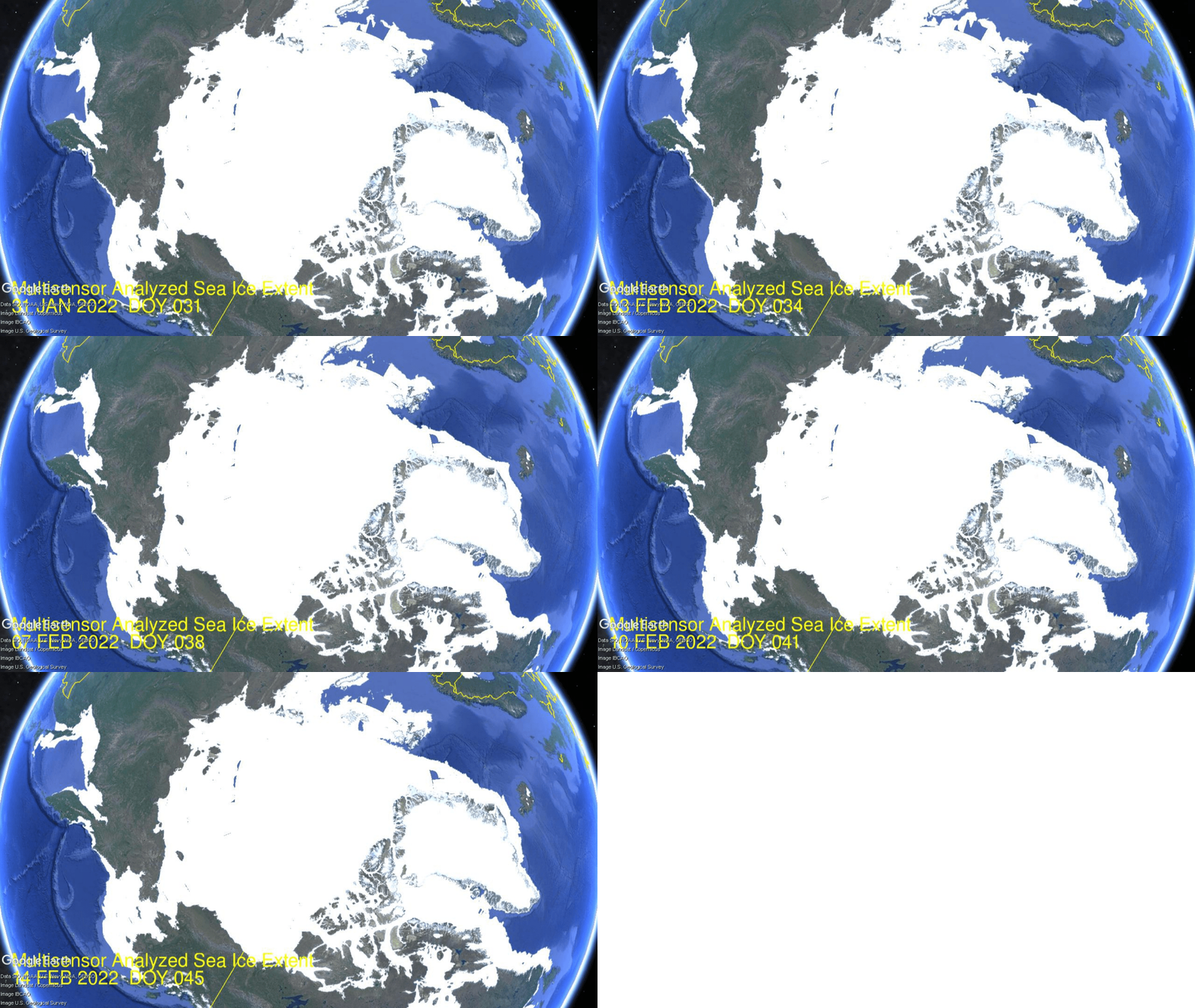
Arctic Ice Surplus Despite Bering/Okhotsk Seesaw Mid January


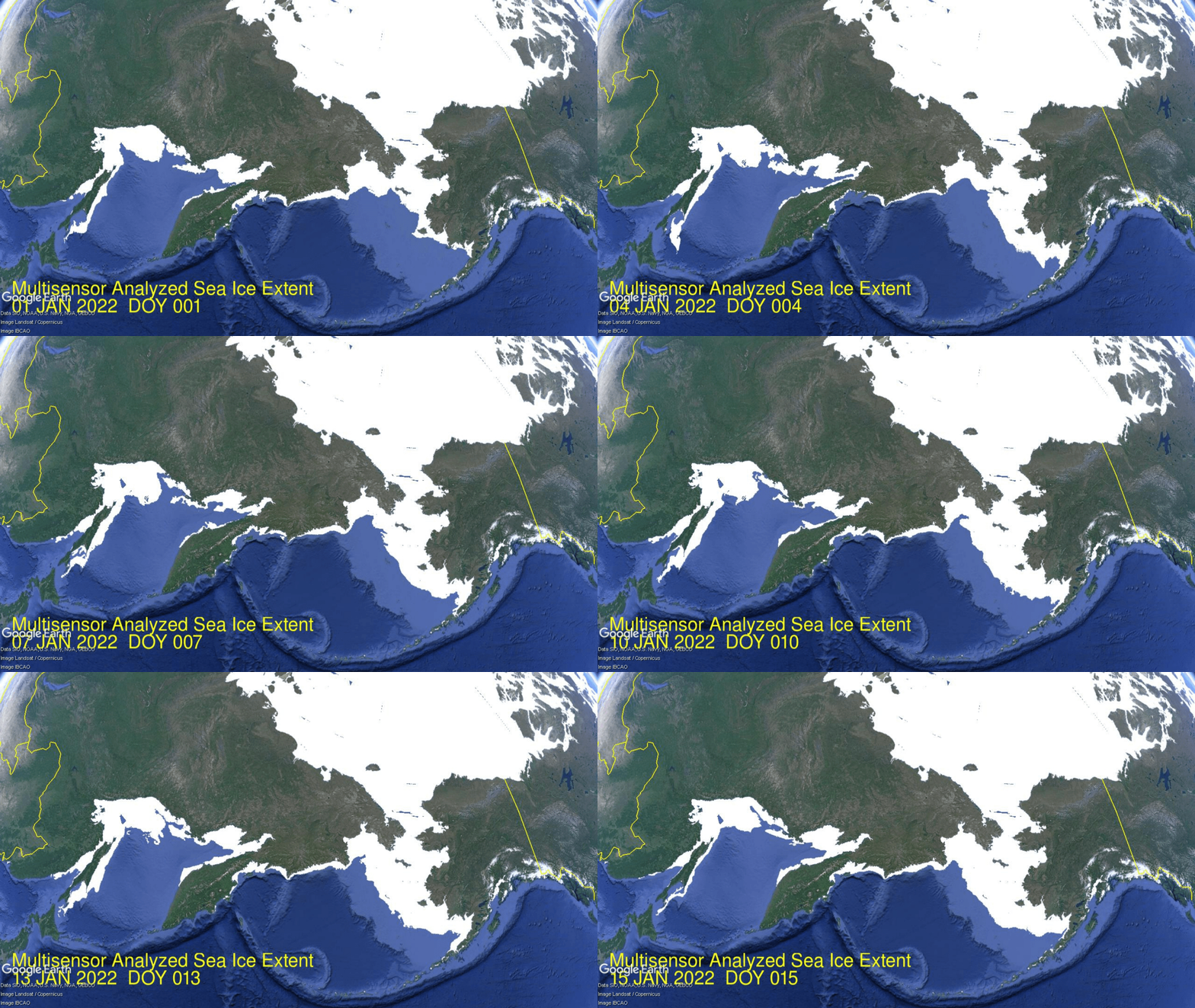
The animation focuses on the two Pacific basins since most of the ice action is seen there.  The seesaw refers to a frequent observation that Bering and Okhotsk Seas often alternate growing and receding ice extents during both melting and freezing seasons.  This month Bering on the right is seen adding ice steadily from 387k km2 to 664k km2, now at 104% of its last March maximum. Meanwhile Okhotsk on the left starts at 466k km2, waffles back and forth, growing to 554k km2 before retreating to match the beginning.

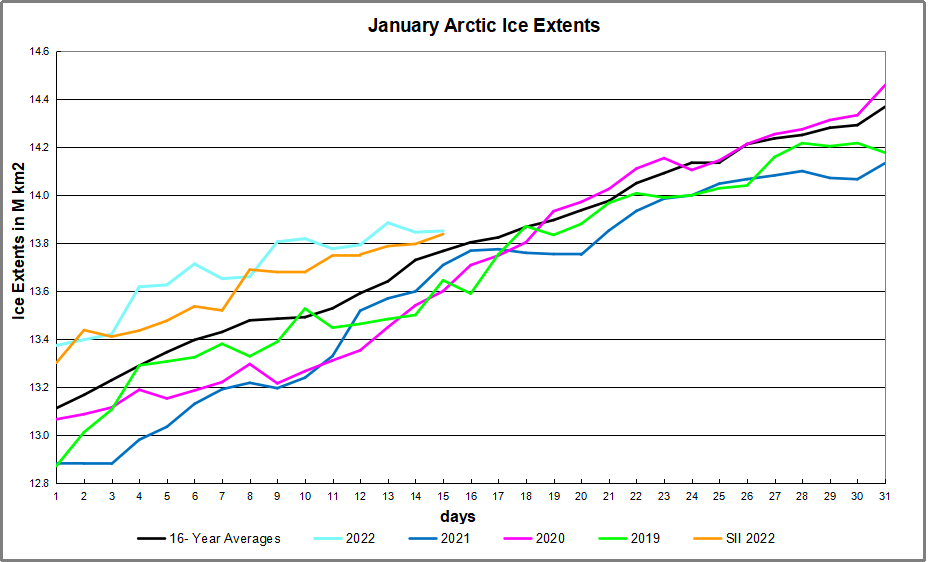
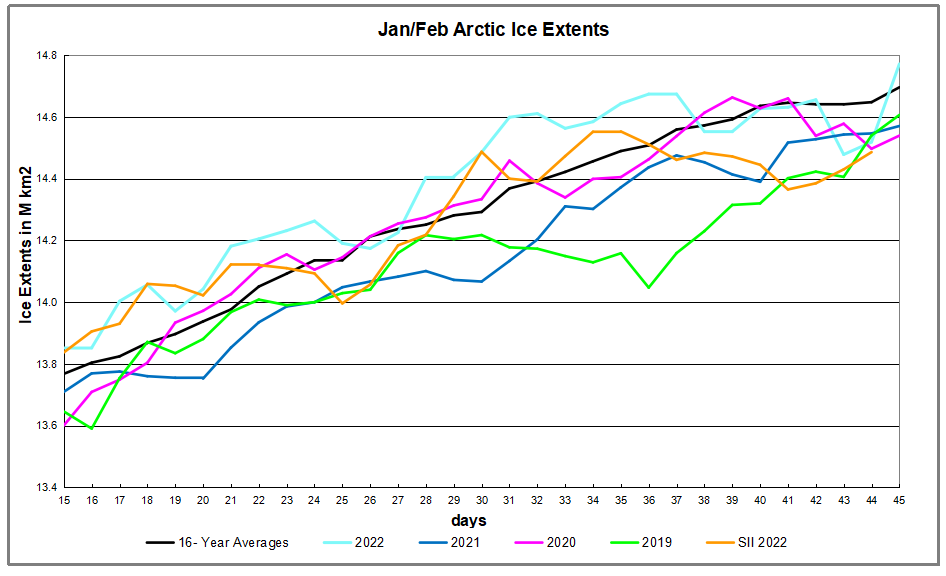
The graph below shows daily ice extents for January 2022 compared to 16 year averages, and some years of note.

The black line shows during January on average (2006 to 2021 inc.) Arctic ice extents increased ~1.3M km2 from ~13.1M km2 up to ~13.4M km2.  The 2022 cyan MASIE line started the year 261k km2 above average and on day 15 retained a surplus of 84k km2.  The Sea Ice Index in orange (SII from NOAA) started with the same deficit, then lagged behind in the first two weeks, before ending yesterday the same as MASIE. 2021 and 2020 started below average but made up most of the difference by mid month.

Why is this important?  All the claims of global climate emergency depend on dangerously higher temperatures, lower sea ice, and rising sea levels.  The lack of additional warming is documented in a post UAH Confirms Global Warming Gone End of 2021.

The lack of acceleration in sea levels along coastlines has been discussed also.  See Inside the Sea Level Scare Machine

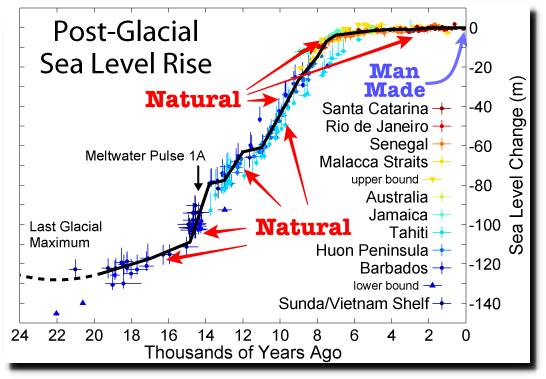
Also, a longer term perspective is informative:

post-glacial_sea_levelThe table below shows the distribution of Sea Ice on day 015 across the Arctic Regions, on average, this year and 2021.

Region 2022015 Day 15 Average 2022-Ave. 2021015 2022-2021
 (0) Northern_Hemisphere 13851226 13767662 83564 13709295 141931
 (1) Beaufort_Sea 1070776 1070247 529 1070689 87
 (2) Chukchi_Sea 966006 965889 117 966006 0
 (3) East_Siberian_Sea 1087137 1087131 6 1087120 17
 (4) Laptev_Sea 897827 897837 -10 897827 0
 (5) Kara_Sea 935023 908782 26242 860326 74697
 (6) Barents_Sea 710507 509307 201200 479880 230628
 (7) Greenland_Sea 584670 600334 -15664 649983 -65313
 (8) Baffin_Bay_Gulf_of_St._Lawrence 1084523 1158194 -73671 1060873 23650
 (9) Canadian_Archipelago 854685 853209 1476 854597 88
 (10) Hudson_Bay 1260903 1254880 6024 1260471 432
 (11) Central_Arctic 3199791 3209964 -10173 3183652 16140
 (12) Bering_Sea 664148 535155 128993 503676 160473
 (13) Baltic_Sea 44692 42101 2591 31534 13157
 (14) Sea_of_Okhotsk 466605 629910 -163305 765767 -299162

The overall surplus to average is 84k km2, (0.6%).  Note large surpluses of ice in Barents and Bering Seas. The main deficit to average is in Sea of Okhotsk, as noted at the top.

bathymetric_map_arctic_ocean

Illustration by Eleanor Lutz shows Earth’s seasonal climate changes. If played in full screen, the four corners present views from top, bottom and sides. It is a visual representation of scientific datasets measuring Arctic ice extents.

Arctic Ice New Year 2022

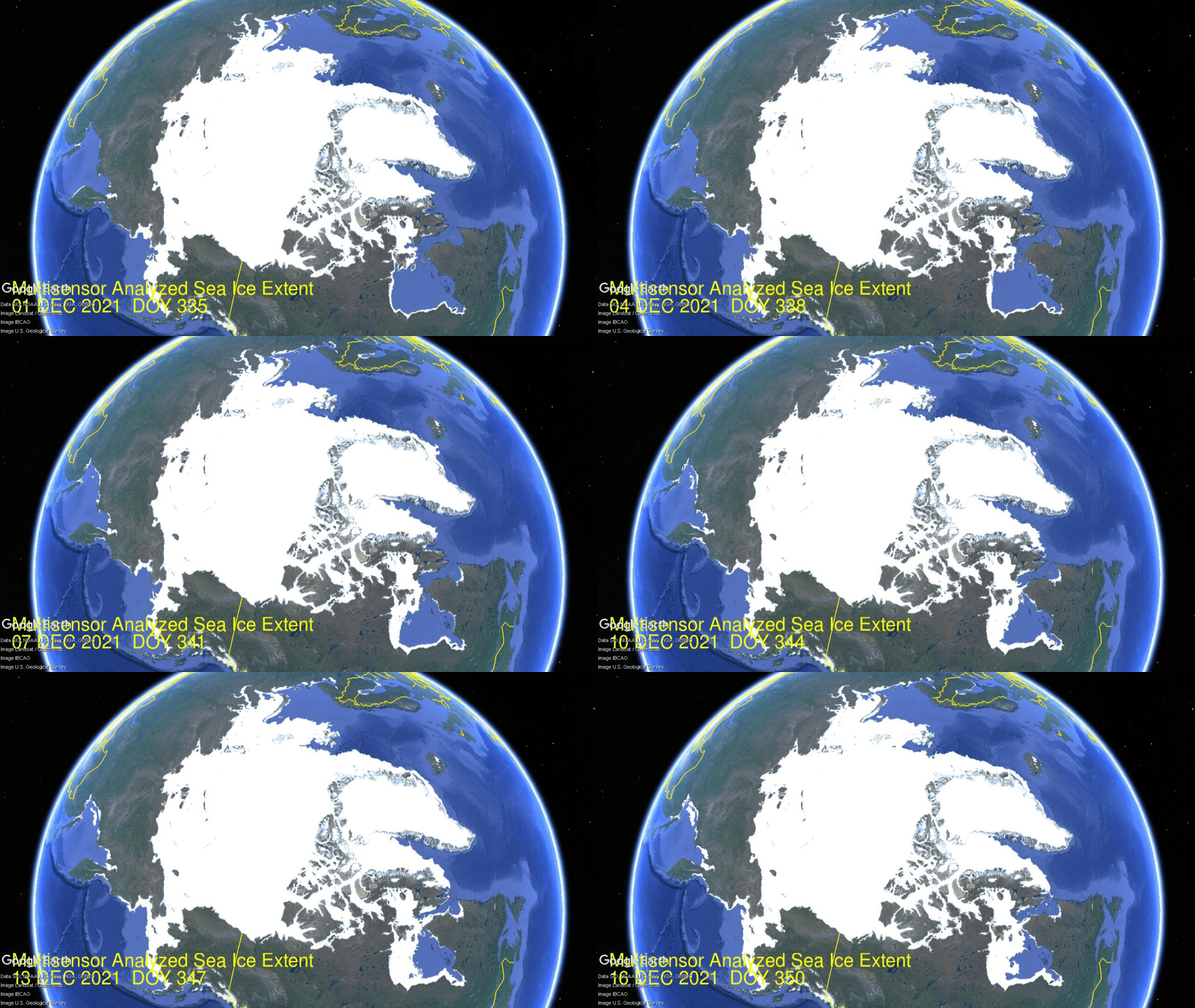
Remarkable Arctic ice recovery continued in December as seen in the animation below:
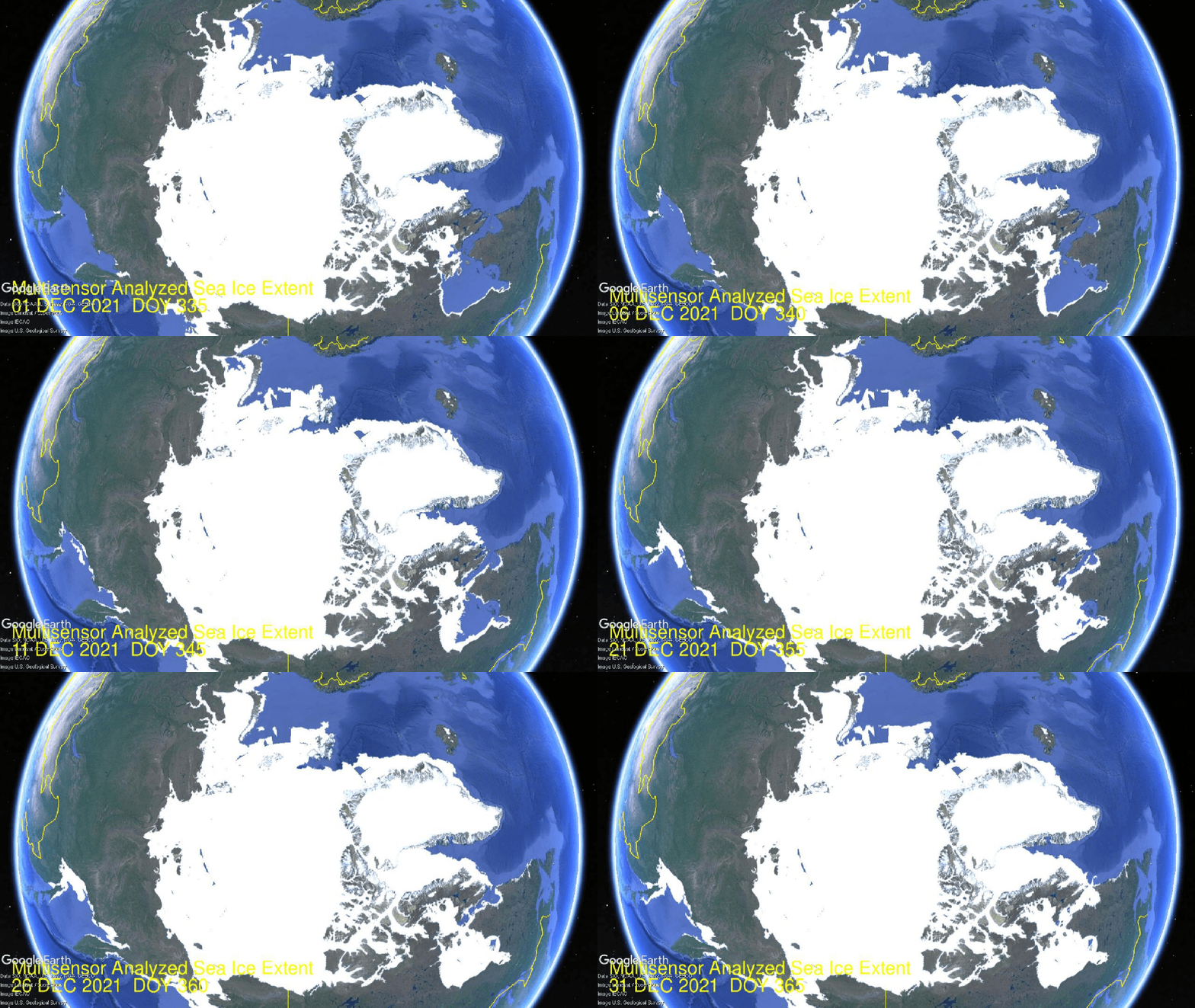
The month of December 2021 shows Hudson Bay (lower right) starting with only some shore ice and ending virtually ice covered, adding in that basin 925K km2, nearly a full Wadham. Just above Hudson, you can see the Gulf of St. Lawrence icing over, and Baffin Bay adding ice as well, adding 257k km2 to the total.

At the extreme left Okhotsk Sea also starts with shore ice and grows 435k km2, reaching down to Japan.  At the top Kara freezes over and Barents and Greenland Seas add ice to their margins. The graph below shows the December ice recovery
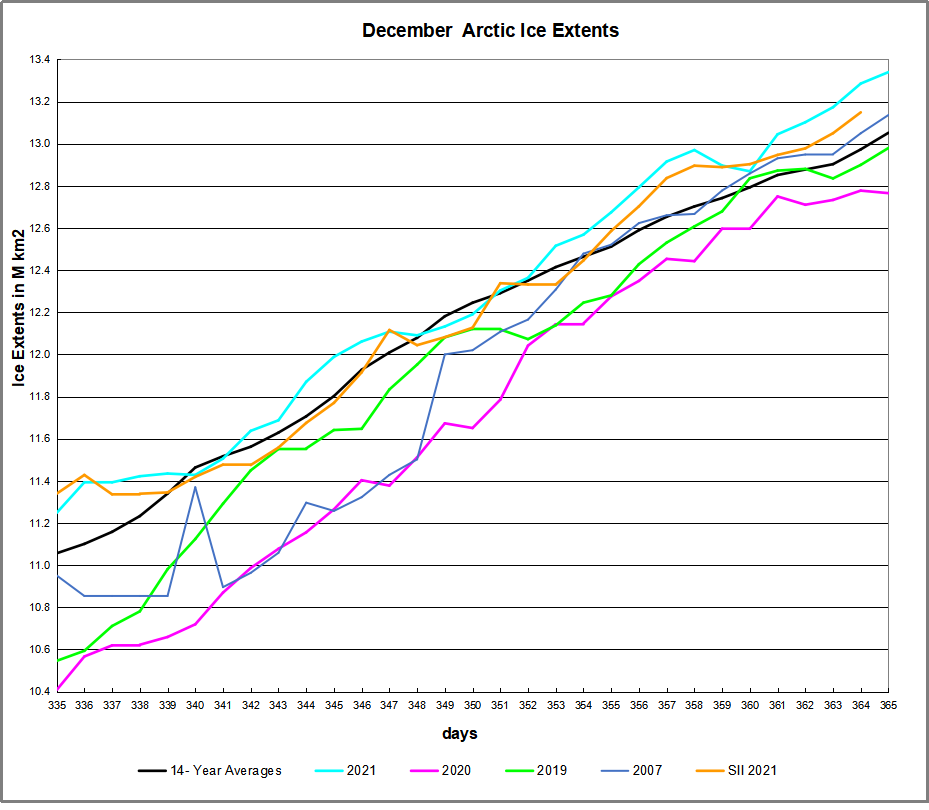
Note the average year adds 2M km2 and 2021 exceeded that by ~200k km2, maintaining its surplus position.  Other years starting far behind drew closer to average by the end.  SII has not yet reported its estimate of day 365.

The table below shows year-end ice extents in the various Arctic basins compared to the 14-year averages and some recent years.

Region 2021365 Day 365 Average 2021-Ave. 2020365 2021-2020
 (0) Northern_Hemisphere 13340119 13052148  287971  12765491 574628 
 (1) Beaufort_Sea 1070776 1070324  452  1070689 87 
 (2) Chukchi_Sea 966006 964420  1586  966006
 (3) East_Siberian_Sea 1087137 1087132  1087120 17 
 (4) Laptev_Sea 897827 897841  -14  897827
 (5) Kara_Sea 932872 883615  49256  879232 53640 
 (6) Barents_Sea 653611 423352  230260  371122 282489 
 (7) Greenland_Sea 620509 579341  41168  592839 27671 
 (8) Baffin_Bay_Gulf_of_St._Lawrence 873269 1003682  -130413  867509 5760 
 (9) Canadian_Archipelago 854685 853276  1409  854597 88 
 (10) Hudson_Bay 1245910 1236600  9311  1257919 -12009 
 (11) Central_Arctic 3221247 3203619  17628  3159881 61366 
 (12) Bering_Sea 358002 408726  -50724  249522 108481 
 (13) Baltic_Sea 61428 30674 30755  7986 53443 
 (14) Sea_of_Okhotsk 478257 382234  96023  479972 -1715 

This year’s ice extent is almost 300k km2 or 2% above average.  Only Baffin Bay and Bering Sea are in deficit to average, more than offset by surpluses elsewhere, especially in Kara, Barents and Okhotsk seas.

Comparing Arctic Ice at End of Years

At  the bottom is a discussion of statistics on year-end Arctic Sea Ice extents.  The values are averages of the last five days of each year.  End of December is a neutral point in the melting-freezing cycle, midway between September minimum and March maximum extents.
Background from Previous Post Updated to Year-End 2021

Some years ago reading a thread on global warming at WUWT, I was struck by one person’s comment: “I’m an actuary with limited knowledge of climate metrics, but it seems to me if you want to understand temperature changes, you should analyze the changes, not the temperatures.” That rang bells for me, and I applied that insight in a series of Temperature Trend Analysis studies of surface station temperature records. Those posts are available under this heading. Climate Compilation Part I Temperatures

This post seeks to understand Arctic Sea Ice fluctuations using a similar approach: Focusing on the rates of extent changes rather than the usual study of the ice extents themselves. Fortunately, Sea Ice Index (SII) from NOAA provides a suitable dataset for this project. As many know, SII relies on satellite passive microwave sensors to produce charts of Arctic Ice extents going back to 1979.  The current Version 3 has become more closely aligned with MASIE, the modern form of Naval ice charting in support of Arctic navigation. The SII User Guide is here.

There are statistical analyses available, and the one of interest (table below) is called Sea Ice Index Rates of Change (here). As indicated by the title, this spreadsheet consists not of monthly extents, but changes of extents from the previous month. Specifically, a monthly value is calculated by subtracting the average of the last five days of the previous month from this month’s average of final five days. So the value presents the amount of ice gained or lost during the present month.

These monthly rates of change have been compiled into a baseline for the period 1980 to 2010, which shows the fluctuations of Arctic ice extents over the course of a calendar year. Below is a graph of those averages of monthly changes during the baseline period. Those familiar with Arctic Ice studies will not be surprised at the sine wave form. December end is a relatively neutral point in the cycle, midway between the September Minimum and March Maximum.
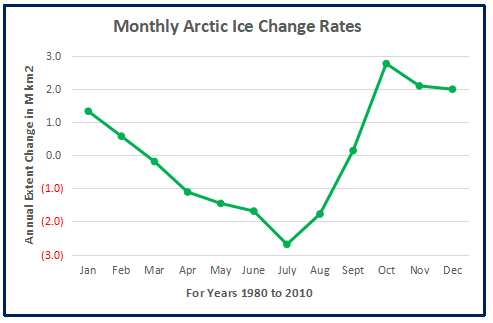
The graph makes evident the six spring/summer months of melting and the six autumn/winter months of freezing.  Note that June-August produce the bulk of losses, while October-December show the bulk of gains. Also the peak and valley months of March and September show very little change in extent from beginning to end.

The table of monthly data reveals the variability of ice extents over the last 4 decades.

The values in January show changes from the end of the previous December, and by summing twelve consecutive months we can calculate an annual rate of change for the years 1979 to 2021.


As many know, there has been a decline of Arctic ice extent over these 40 years, averaging 70k km2 per year. But year over year, the changes shift constantly between gains and losses.

Moreover, it seems random as to which months are determinative for a given year. For example, much ado was printed about June and July 2021 melting faster than expected resulting in higher losses of ice extents. But then the final 3 months of 2021 more than made up for those summer losses

As it happens in this dataset, October has the highest rate of adding ice. The table below shows the variety of monthly rates in the record as anomalies from the 1980-2010 baseline. In this exhibit a red cell is a negative anomaly (less than baseline for that month) and blue is positive (higher than baseline).
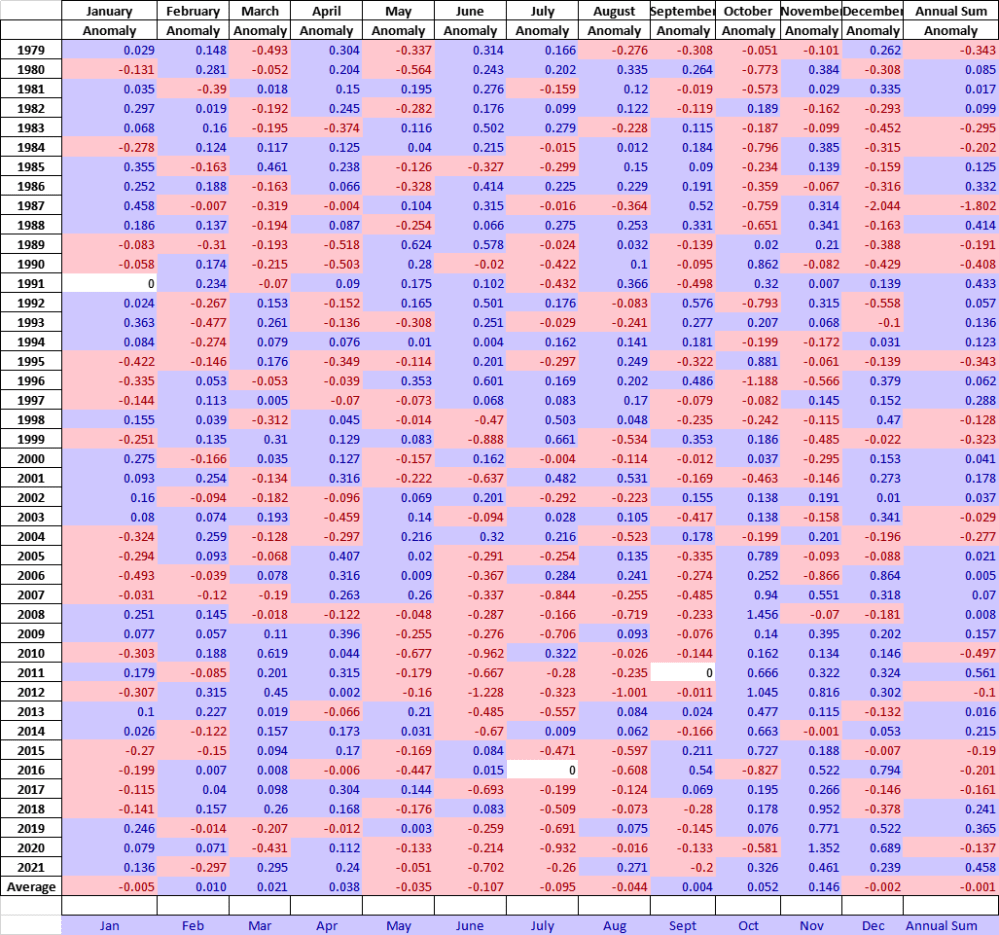
 

Note that the  +/ –  rate anomalies are distributed all across the grid, sequences of different months in different years, with gains and losses offsetting one another.  Yes, June 2021 lost more ice than the baseline, but about the same as 2017, and not as much as 2012. The gains in Oct.-Dec. 2021 were ~1M km2 above baseline, but were exceeded by the same months in 2019 and 2020.  The bottom line presents the average anomalies for each month over the period 1979-2021.  Note the rates of gains and losses mostly offset, and the average of all months in the bottom right cell is virtually zero.

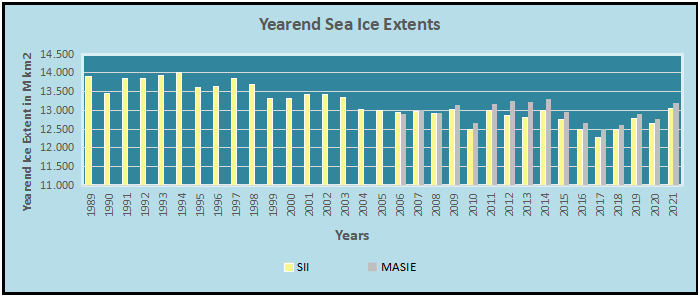
A final observation: The graph below shows the Yearend Arctic Ice Extents for the last 32 years.


Year-end Arctic ice extents (last 5 days of December) show three distinct regimes: 1988-1998, 1998-2010, 2010-2021. The average year-end extent 1989-2010 is 13.4M km2. In the last decade, 2011 was 13.0M km2, and six years later, 2017 was 12.3M km2. 2021 rose back to 13.06  So for all the the fluctuations, the net is zero, or a gain from 2010. Talk of an Arctic ice death spiral is fanciful.

These data show a noisy, highly variable natural phenomenon. Clearly, unpredictable factors are in play, principally water structure and circulation, atmospheric circulation regimes, and also incursions and storms. And in the longer view, today’s extents are not unusual.


Illustration by Eleanor Lutz shows Earth’s seasonal climate changes. If played in full screen, the four corners present views from top, bottom and sides. It is a visual representation of scientific datasets measuring Arctic ice extents.

 

All’s Well with Mid-Dec. Arctic Ice


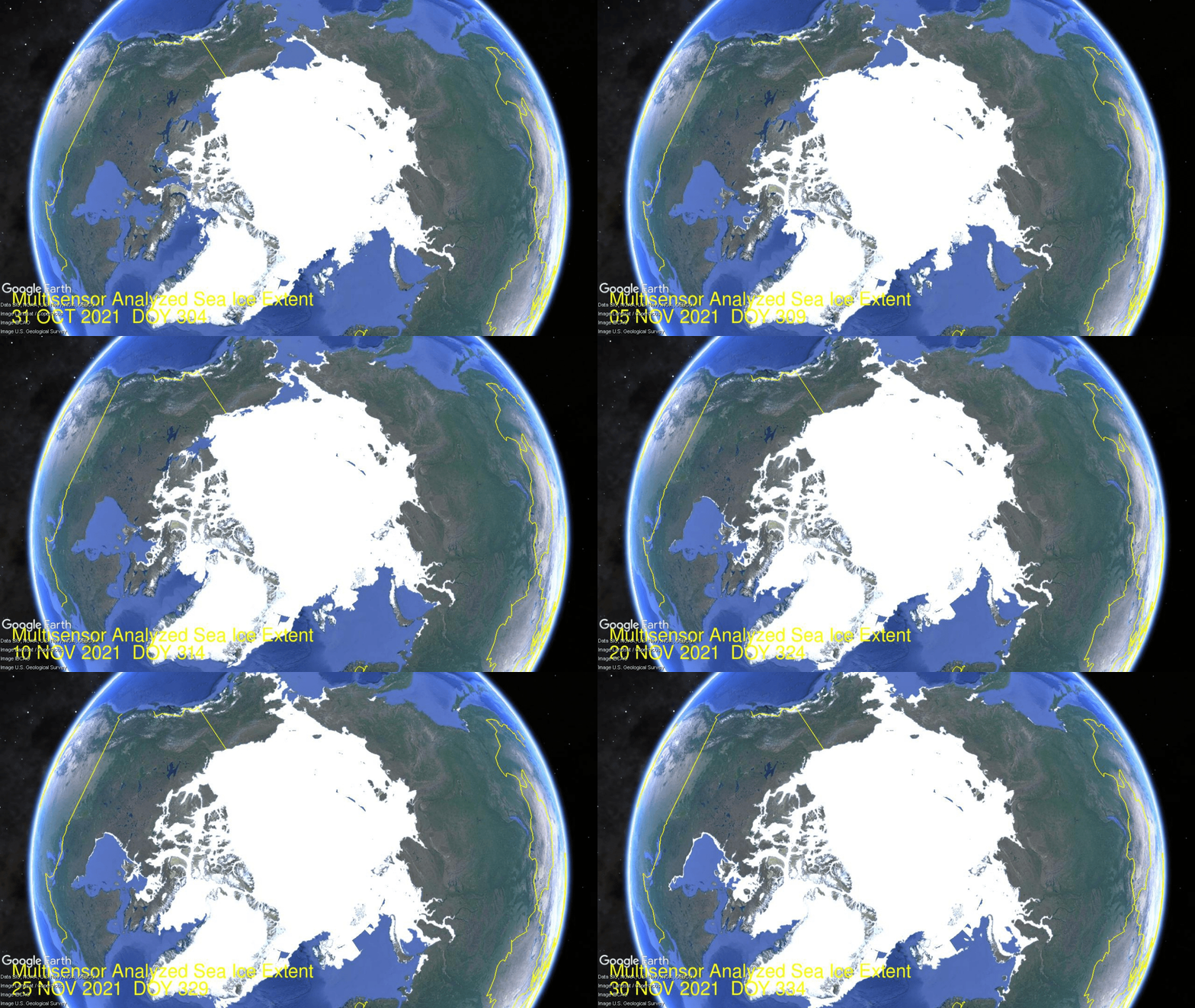
The image above shows recovery of Arctic sea ice extent over the first half of December 2021. As supported by the table later, the pace of refreezing for 2021 exceeded the 14-year average since mid-Nov. and ended close to average, and well above 2020.

The month began with the Arctic core as well as seas on the Eurasian and Can-Am sides (top and bottom) already ice-covered, so no additional extent came from there.  OTOH Hudson Bay (lower right) more than doubled extent, starting with only western shore ice and grew from 320k km2 to 780k km2, 62% of last March maximum.  On the Pacific side, Bering (bottom left) went down to 255k km2 before refreezing up to 426k m2, nearly half of its last max.  Okhotsk (far left) had very little ice to start but now has fast ice growing from the northern shore.

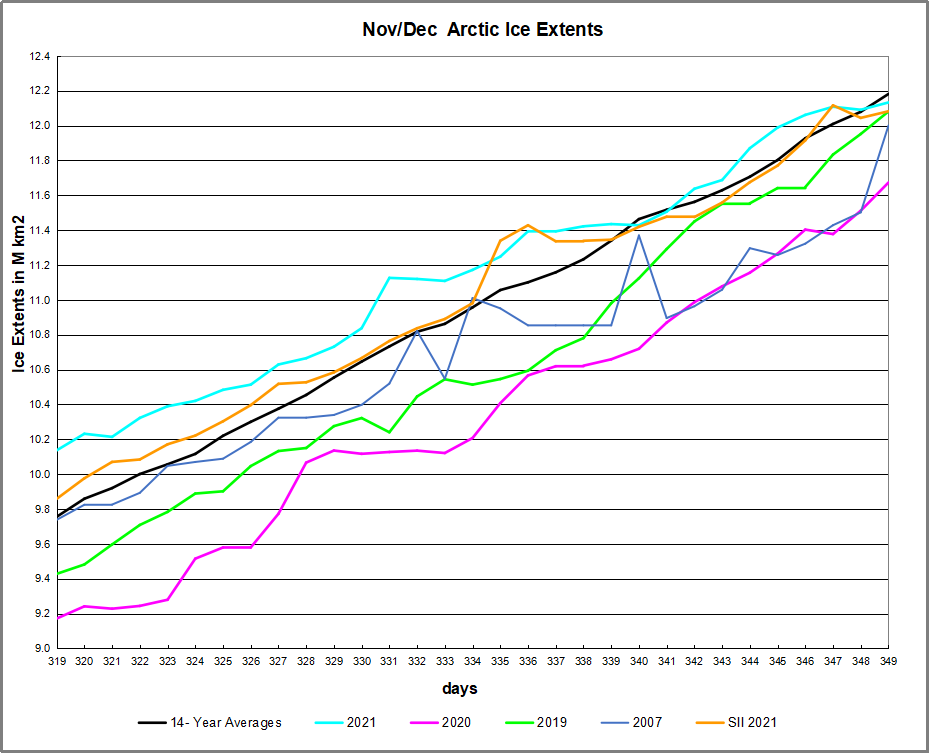
The graph below shows the ice extent growing mid-Nov. to mid-Dec compared to some other years and the 14 year average (2007 to 2020 inclusive).

Note that the  NH ice extent 14 year average increases 2.4M km2 during this period, up to 12.2M km2. MASIE 2021 tracked above average most of the period, returning to the mean at the end. Other years were also nearly average, except for 2020. SII was slightly lower than MASIE most of the time but ended nearly the same.

Region 2021349 Day 349 Average 2021-Ave. 2020349 2021-2020
 (0) Northern_Hemisphere 12132680 12181283  -48602  11673121 459559 
 (1) Beaufort_Sea 1070776 1070021  755  1070689 87 
 (2) Chukchi_Sea 966006 931960  34047  876648 89358 
 (3) East_Siberian_Sea 1087137 1086411  727  1086981 156 
 (4) Laptev_Sea 897827 897835  -8  897827
 (5) Kara_Sea 892744 840489  52255  608199 284545 
 (6) Barents_Sea 516037 337705  178332  266917 249119 
 (7) Greenland_Sea 476250 552837  -76587  571809 -95559 
 (8) Baffin_Bay_Gulf_of_St._Lawrence 782600 835808  -53209  790539 -7939 
 (9) Canadian_Archipelago 854685 853275  1411  854597 88 
 (10) Hudson_Bay 778083 1126491  -348408  1163833 -385750 
 (11) Central_Arctic 3192879 3204951  -12071  3207975 -15096 
 (12) Bering_Sea 426194 229742  196452  147408 278787 
 (13) Baltic_Sea 32463 11257 21206  400 32063 
 (14) Sea_of_Okhotsk 148537 192106  -43569  114474 34063 

The table shows where the ice is distributed compared to average. Hudson Bay shows a large deficit, along with smaller ones in Greenland Sea and Baffin Bay.  Offsetting are surpluses in Bering, Barents and Kara Seas.

Illustration by Eleanor Lutz shows Earth’s seasonal climate changes. If played in full screen, the four corners present views from top, bottom and sides. It is a visual representation of scientific datasets measuring Arctic ice extents.
Arctic Ice Aplenty Nov. 30, 2021

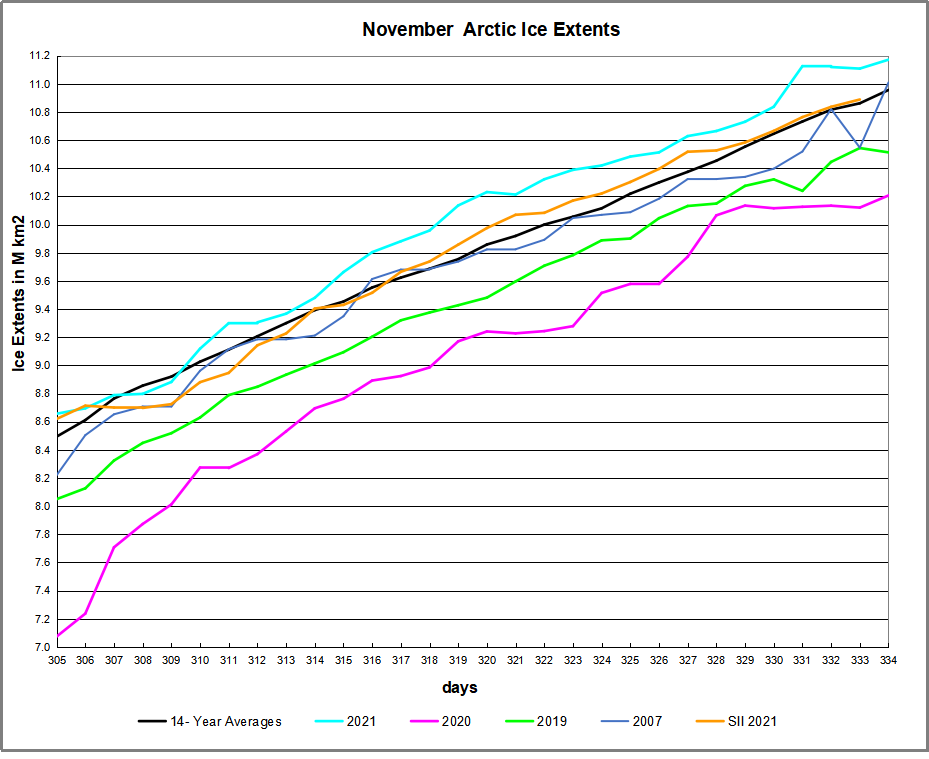
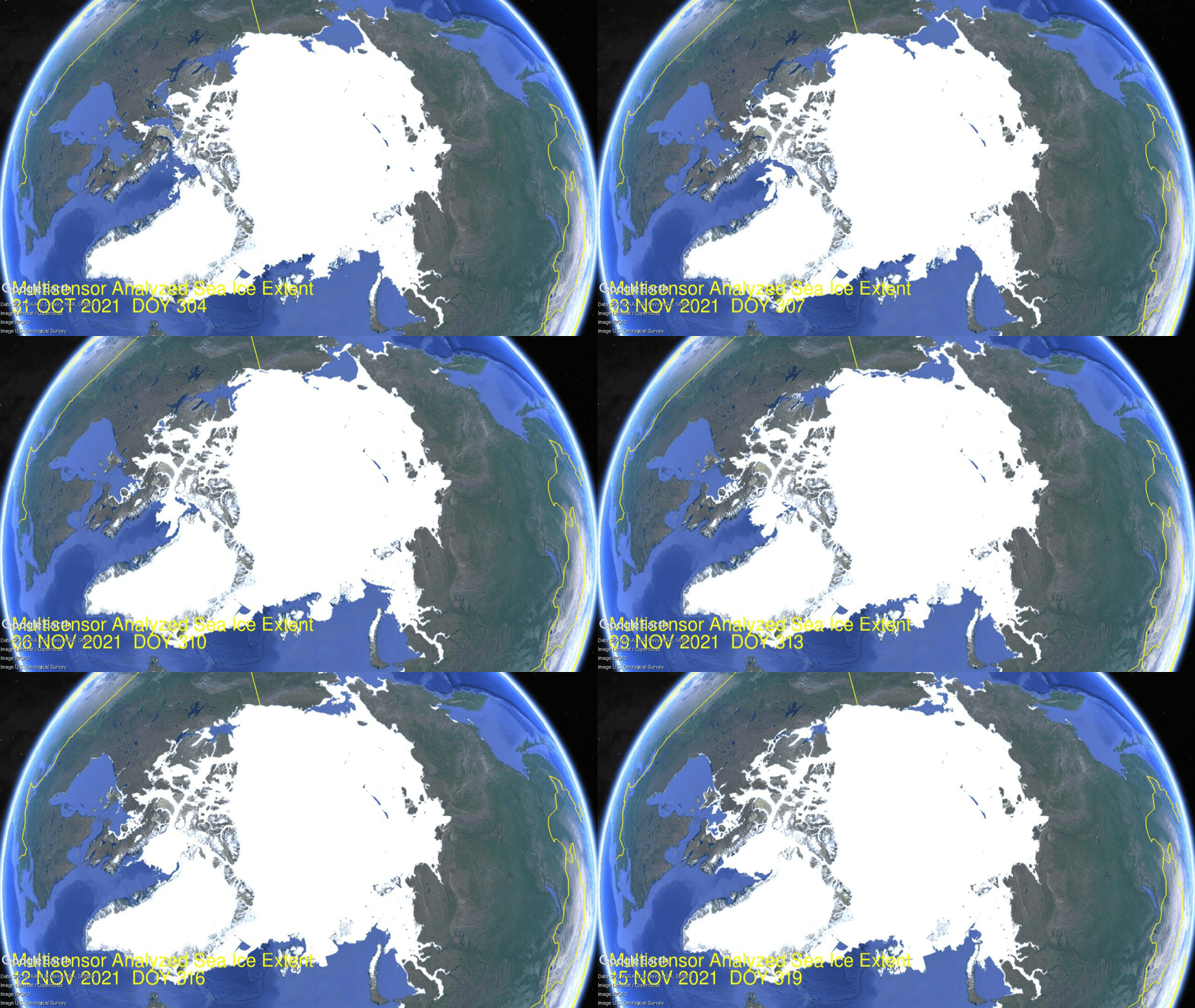
The animation shows Arctic ice extents from day 304 (end of October) to day 334, Nov.30, 2021. On the right side are the Euro-Russian seas already frozen over end of October.  At the bottom right Kara Sea fills in to >90%, while Barents (left of Kara) adds nearly 400k km2 to reach 60% of March maximum. Dramatically, at the top center Chukchi freezes over and Bering Sea grows ~300k km2 of ice extent.  On the far left Hudson Bay shows its delayed freezing this year, with some western shore ice appearing only in the last 10 days. Meanwhile, Baffin Bay (lower left) added 480k km2 of ice extent.  The graph below shows November daily ice extents for 2021 compared to 14 year averages, and some years of note.

The black line shows during November on average Arctic ice extents increase ~2.5M km2 from ~8.5M km2 up to ~11M km2.  The 2021 cyan MASIE line started the month 163k km2 above average and on day 334 showed a surplus of  196k km2.  The Sea Ice Index in orange (SII from NOAA) started with the same deficit, then lagged behind through the month, before ending ~200k km2 lower than MASIE. (No SII data yet for day 334). 2019 and 2020 were well below average at this stage of the ice recovery.

Why is this important?  All the claims of global climate emergency depend on dangerously higher temperatures, lower sea ice, and rising sea levels.  The lack of additional warming is documented in a post Adios, Global Warming

The lack of acceleration in sea levels along coastlines has been discussed also.  See USCS Warnings of Coastal Flooding

Also, a longer term perspective is informative:

post-glacial_sea_levelThe table below shows the distribution of Sea Ice on day 334 across the Arctic Regions, on average, this year and 2020.

Region 2021334 Day 334 Average 2021-Ave. 2020334 2021-2020
 (0) Northern_Hemisphere 11171831 10976208 195623 10207244 964587
 (1) Beaufort_Sea 1070776 1069252 1524 1070689 87
 (2) Chukchi_Sea 966006 781701 184305 601423 364584
 (3) East_Siberian_Sea 1087085 1082808 4277 1075464 11621
 (4) Laptev_Sea 897827 897818 9 897827 0
 (5) Kara_Sea 874105 789034 85071 470654 403451
 (6) Barents_Sea 445466 252273 193193 56772 388695
 (7) Greenland_Sea 468845 543650 -74805 577314 -108469
 (8) Baffin_Bay_Gulf_of_St._Lawrence 606454 680452 -73998 608255 -1802
 (9) Canadian_Archipelago 854668 853089 1579 854597 71
 (10) Hudson_Bay 307719 615274 -307555 803363 -495644
 (11) Central_Arctic 3208675 3195024 13651 3118738 89936
 (12) Bering_Sea 335645 140327 195318 39284 296361
 (13) Baltic_Sea 6666 3698 2969 0 6666
 (14) Sea_of_Okhotsk 34960 67733 -32773 31397 3563

The overall surplus to average is 196k km2, (2%).  Note the large surpluses of ice in Chukchi and Bering Seas, partly offset by deficits in Greenland Sea and Baffin bay. The largest deficit is Hudson Bay, a shallow basin that should freeze over in coming weeks, adding nearly 1M km2 when it does. Note that 2021 ice extent exceeds that of 2020 by almost a full Wadham, 965k km2, most of the surplus being in Chukchi, Bering, Kara and Barents Seas.

bathymetric_map_arctic_ocean

Illustration by Eleanor Lutz shows Earth’s seasonal climate changes. If played in full screen, the four corners present views from top, bottom and sides. It is a visual representation of scientific datasets measuring Arctic ice extents.

Arctic Ice Exceeds 10 Wadhams Mid. Nov. 2021


Arctic Ice Extent reaching 10 million km2 is a milestone marking recovery of half the ice lost last spring and summer.  Each year the max extent is ~15M km2 and the mid-September min is ~5M km2.  This year in just two months the ice gained back half the ice lost in the six months prior to mid September.  The metric 1 Wadham = 1Mkm2 ice extent is in recognition of the professor who declared the Arctic would be ice-free before 2011, by which he meant less than 1M km2 extent.

The animation shows Arctic ice extents this year for the last two weeks, from day 304 (Oct. 31) to day 319 (Nov. 15). Note on the right side, the Russian shelf seas (from top:  East Siberian, Laptev, Kara) were already ice covered.  At top center, Chukchi adds 200k km2 to reach 90% of max last March. Top left, Beaufort sea fills in to 98% of its March max. Center left is Canadian Arctic Archipelago adding 267k km2 to reach 96% of its max. Lower left shows Baffin Bay and Gulf of St. Lawrence adding 400k km2 up to 67% of its max. .At the bottom center Barents Sea grows 231k km2 to reach 63% of its max.

The graph below shows Oct./Nov. daily ice extents for 2021 compared to 14 year averages, and some years of note:

The black line shows during this period on average Arctic ice extents increase ~3.5M km2 from ~6.3M km2 up to ~9.8M km2.  The 2021 cyan MASIE line started the period ~400k km2 above average and on day 319 retained a surplus of ~380k km2.  The Sea Ice Index in orange (SII from NOAA) started with the same deficit, then lagged behind in the first two weeks, before ending ~200k km2 lower than MASIE (no data yet for yesterday). 2019 and 2020 were well below average at this stage of the ice recovery.

Why is this important?  All the claims of global climate emergency depend on dangerously higher temperatures, lower sea ice, and rising sea levels.  The lack of additional warming is documented in a post Adios, Global Warming

The lack of acceleration in sea levels along coastlines has been discussed also.  See USCS Warnings of Coastal Flooding

Also, a longer term perspective is informative:

post-glacial_sea_levelThe table below shows the distribution of Sea Ice on day 304 across the Arctic Regions, on average, this year and 2020.

Region 2021319 Day 319 Average 2021-Ave. 2020319 2021-2020
 (0) Northern_Hemisphere 10136298 9754986 381313 9171330 964968
 (1) Beaufort_Sea 1052365 1064248 -11883 1068490 -16125
 (2) Chukchi_Sea 868672 614315 254357 539677 328995
 (3) East_Siberian_Sea 1087137 1073635 13503 1078789 8349
 (4) Laptev_Sea 897827 897084 743 889358 8468
 (5) Kara_Sea 711109 637483 73626 450888 260220
 (6) Barents_Sea 286732 145188 141544 15590 271142
 (7) Greenland_Sea 404108 466229 -62120 502768 -98659
 (8) Baffin_Bay_Gulf_of_St._Lawrence 511295 532632 -21337 446719 64575
 (9) Canadian_Archipelago 824385 852284 -27899 854597 -30212
 (10) Hudson_Bay 155801 248736 -92935 256849 -101047
 (11) Central_Arctic 3216117 3168700 47417 3046118 169999

The overall surplus to average is 381k km2, (4%).  Note large surpluses of ice in Chukchi, Barents and Kara Seas, as well as Central Arctic. The main deficits to average are in Greenland Sea and Hudson Bay, the latter being a shallow basin that will freeze over quickly once it starts.  Note that 2021 ice extent exceeds that of 2020 by nearly a full Wadham,  most of the difference being in Chukchi, Kara, Barents and Central Arctic.

bathymetric_map_arctic_ocean

Illustration by Eleanor Lutz shows Earth’s seasonal climate changes. If played in full screen, the four corners present views from top, bottom and sides. It is a visual representation of scientific datasets measuring Arctic ice extents.

Arctic Ice Abounds October 2021


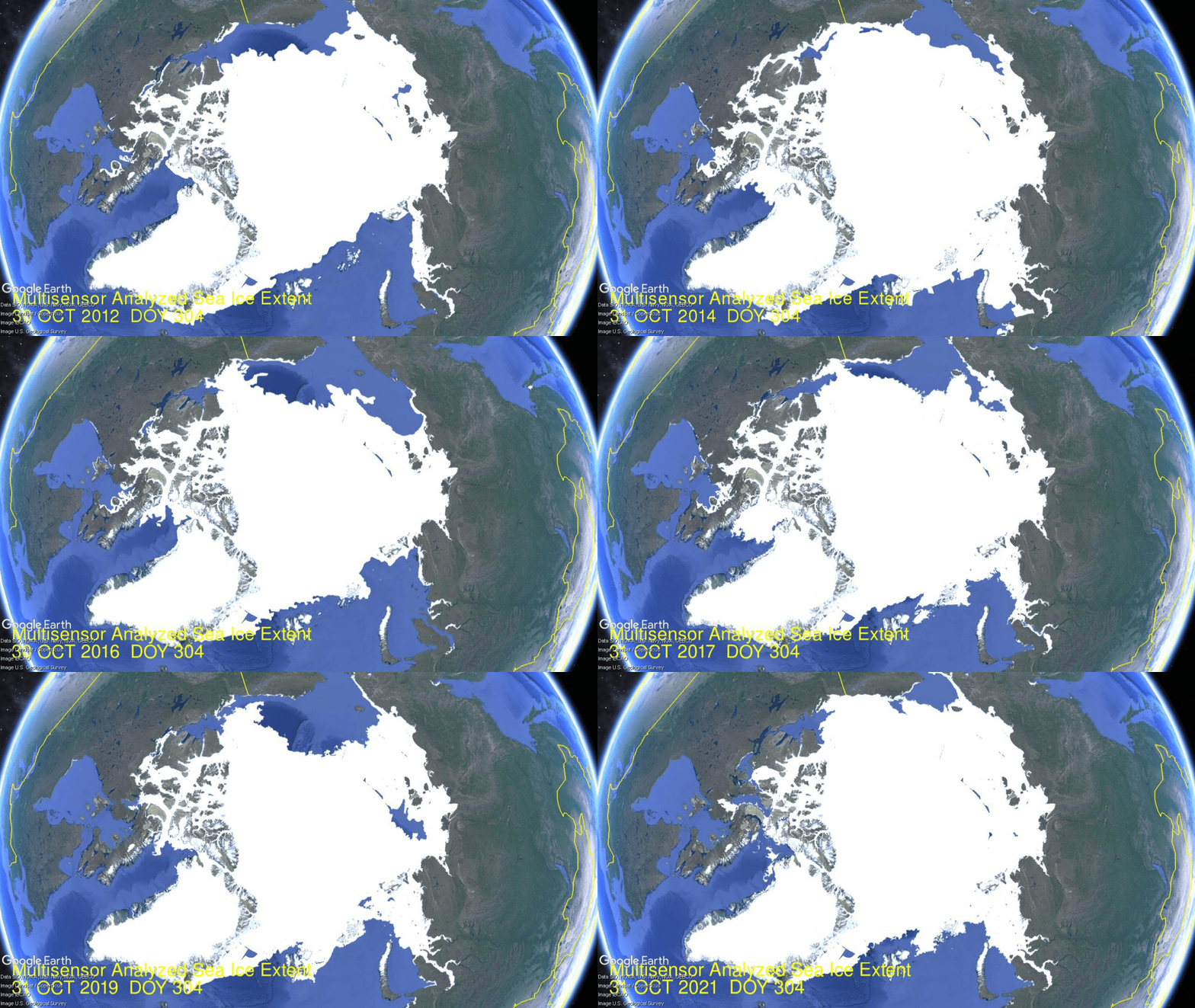
The animation shows Arctic ice extents on day 304 (end of October) for the years 2012 through yesterday 2021.  Note the variability from year to year on the CanAm (left side) with the Beaufort Sea at the top, Canadian Archipelago center left, and Baffin Bay, lower left between Greenland and Newfoundland. More noticeable are the Russian shelf seas fluctuations on the right side.  Some years, like 2020, there is still open water, but this year those seas are frozen over, including from the top Chukchi, East Siberian, Laptev, and Kara Seas down to bottom right.

The graph below shows October daily ice extents for 2021 compared to 14 year averages, and some years of note.

The black line shows during October on average Arctic ice extents increase ~3.4M km2 from ~4.9M km2 up to ~8.3M km2.  The 2021 cyan MASIE line started the month ~500k km2 above average and on day 304 retained a surplus of ~160k km2.  The Sea Ice Index in orange (SII from NOAA) started with the same deficit, then lagged behind in the last two weeks, before ending ~100k km2 lower than MASIE. 2019 and 2020 were well below average at this stage of the ice recovery.

Why is this important?  All the claims of global climate emergency depend on dangerously higher temperatures, lower sea ice, and rising sea levels.  The lack of additional warming is documented in a post Adios, Global Warming

The lack of acceleration in sea levels along coastlines has been discussed also.  See USCS Warnings of Coastal Flooding

Also, a longer term perspective is informative:

post-glacial_sea_levelThe table below shows the distribution of Sea Ice on day 304 across the Arctic Regions, on average, this year and 2020.

Region 2021304 Day 304 Average 2021-Ave. 2020304 2021-2020
 (0) Northern_Hemisphere 8528046 8369146 158900 6954249 1573797
 (1) Beaufort_Sea 982244 946489 35755 1044967 -62723
 (2) Chukchi_Sea 659384 436299 223085 369981 289403
 (3) East_Siberian_Sea 1086959 909416 177543 373761 713197
 (4) Laptev_Sea 894716 831110 63606 283776 610940
 (5) Kara_Sea 626536 444754 181781 269583 356952
 (6) Barents_Sea 55711 77133 -21422 14206 41505
 (7) Greenland_Sea 360759 415579 -54820 463525 -102766
 (8) Baffin_Bay_Gulf_of_St._Lawrence 107176 269121 -161945 232788 -125611
 (9) Canadian_Archipelago 557042 788762 -231720 802238 -245196
 (10) Hudson_Bay 5061 82352 -77292 73773 -68712
 (11) Central_Arctic 3160959 3158164 2794 3023876 137083

The overall surplus to average is 159k km2, (2%).  Note large surpluses of ice in BCE (Beaufort, Chukchi and East Siberian seas).  as well as in Laptev and Kara on the Russian coast. The main deficits to average are in Baffin Bay and CAA, more than offset by surpluses elsewhere. Note that 2021 ice extent exceeds that of 2020 by 1.6M km2, most of the difference being in East Siberian, Laptev and Kara Seas.

bathymetric_map_arctic_ocean

Illustration by Eleanor Lutz shows Earth’s seasonal climate changes. If played in full screen, the four corners present views from top, bottom and sides. It is a visual representation of scientific datasets measuring Arctic ice extents.

October Russian Arctic Flash Freezing

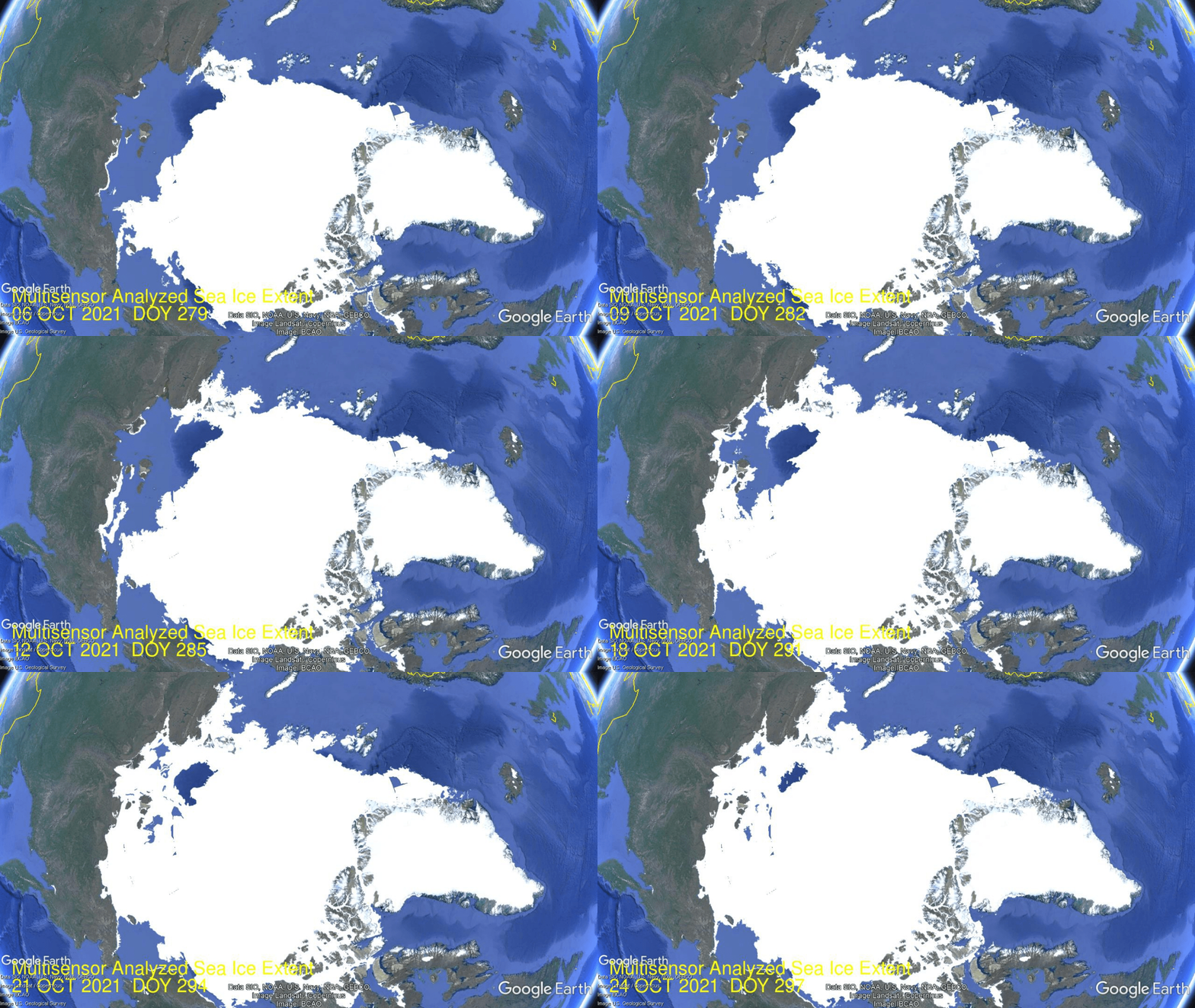
The animation shows on the left ice extending over the last 18 days all the way to the Russian shoreline, filling in East Siberian (lower), Laptev (middle) and Kara Seas (top).  Thus the North Sea Route is covered with ice at this time.

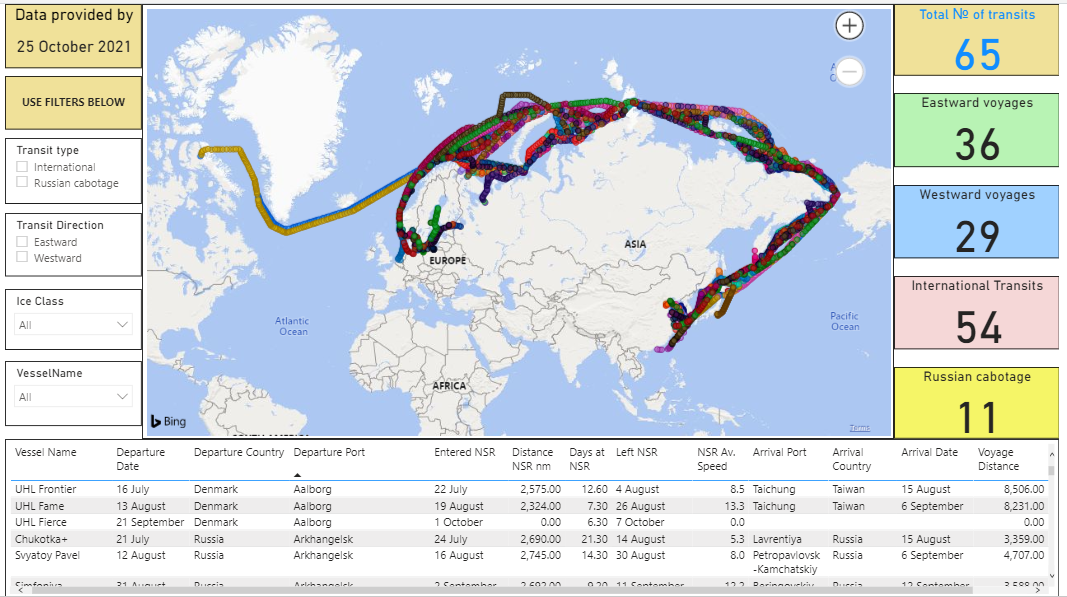
The chart above summarizes shipping traffic through the NSR in 2021, comprising 65 transits along the route between Asia on the right and Europe on the left.  Source: Northern Sea Route Information Office

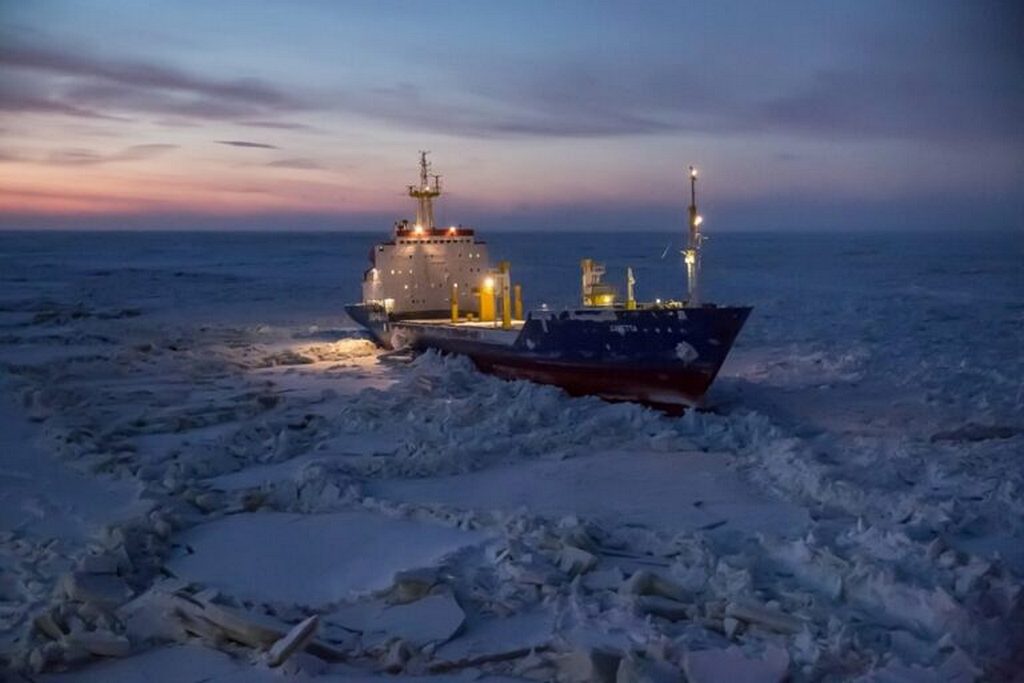
Russia has big plans for the NSR including a new class of container ships (above) designed specifically for the NSR. As explained in the Barents Observer, Russia is not counting on an ice-free Arctic shipping lane any time soon. Shipping on Northern Sea Route has course for 35 million tons in 2021. Excerpts in italics with my bolds.

There is considerable growth in shipments on Russia’s remote Arctic route, but shippers will have to boost deliveries by more than 100 percent in only two years if they are to reach the target set by the Kremlin.

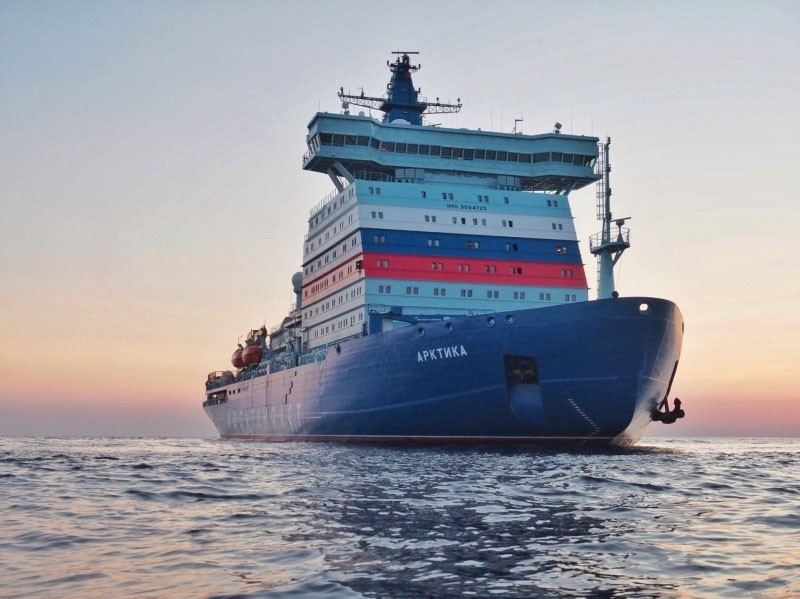
The Arktika is Russia’s first LK60 icebreaker. Photo: Rosatom

Moscow sees the Northern Sea Route as a top priority project that ultimately could open an alternative trade route between Asia and Europe. Several major nuclear-powered icebreakers are under construction, among them the first Lider-class ship.

The 80 million tons target for the Northern Sea Route was set by Vladimir Putin in his so-called May Decrees in 2018.  Russian state officials have since struggled to find ways to meet the ambitious goal.

According to Deputy Prime Minister Yuri Trutnev, a fleet of five LK60 (project 22220) icebreakers will be in operation by 2026 and by 2027 – the first Lider will sail in the Arctic waters. In a government meeting in early October this year, Trutnev outlined the need for as many as 30 new tankers, 40 bulk carriers and 22 container ships for Arctic shipping.

Year-round shipping on the route will start already in 2023-2024, he explained.

The graph below shows October refreezing is tracking about 400k km2 above the 14-year average.

SII is having technical difficulties and has not updated in more than a week.  Note also the much greater ice extent in 2021 compared to 2020, 2019, or 2007.


Arctic Ice Already Exceeds Six Wadhams

The images above come from MASIE showing ice extents starting day 266, the lowest daily extent in 2021. Over the last 18 days, Arctic ice has grown by 1 Wadham (1M km2) to now exceed 6 Wadhams, about 276k km2 greater than the 14-year average for day 284. At the bottom center Barents Sea ice reaches out to Iceland.  Svalbard bottom right becomes encircled by ice.  East Siberian Sea top right has ice connecting to the shore. Top center Beaufort and Chukchi seas are also adding ice rapidly.

The ice recovery since September minimum is shown in the graph below.

Day 260 was the 14 year average annual daily minimum at 4.39m km2. MASIE 2021 was 776k km2 above average, and SII was 427k km2 lower than MASIE.  Note that 2007, 2019 and 2020 weere much lower than average throughout the period. SII is again tracking MASIE since day 274.

Region 2021284 Day 284 Average 2021-Ave. 2007284 2021-2007
 (0) Northern_Hemisphere 6010191 5733557 276634 5134886 875305
 (1) Beaufort_Sea 787643 662884 124759 718210 69433
 (2) Chukchi_Sea 547815 242829 304986 60352 487463
 (3) East_Siberian_Sea 571575 434918 136657 311 571265
 (4) Laptev_Sea 164089 298559 -134470 409211 -245122
 (5) Kara_Sea 110917 80208 30710 128294 -17377
 (6) Barents_Sea 18 26816 -26797 14013 -13995
 (7) Greenland_Sea 221491 318518 -97027 423939 -202449
 (8) Baffin_Bay_Gulf_of_St._Lawrence 53199 77124 -23925 84058 -30859
 (9) Canadian_Archipelago 474565 531008 -56443 444876 29689
 (10) Hudson_Bay 119 9213 -9093 1936 -1817
 (11) Central_Arctic 3077617 3050338 27279 2848411 229206

The main deficits to average are in Laptev and Greenland Seas, and CA, offset by surpluses elsewhere, especially in BCE (Beaufort, Chukchi, East Siberian seas).

The Bigger Picture 

We have passed the annual Arctic ice extent minimum, which typically occurs on or about day 260 (mid September). Some take any year’s slightly lower minimum as proof that Arctic ice is dying, but the image above shows the Arctic heart is beating clear and strong.

Over this decade, the Arctic ice minimum has not declined, but since 2007 looks like fluctuations around a plateau. By mid-September, all the peripheral seas have turned to water, and the residual ice shows up in a few places. The table below indicates where ice is found in September. Numbers are area units of Mkm2 (millions of square kilometers).

Day 260 14 year
Arctic Regions 2007 2010 2012 2014 2015 2017 2018 2019 2020 2021 Average
Central Arctic Sea 2.67 3.16 2.64 2.98 2.93 3.07 2.91 2.97 2.50 2.95 2.90
BCE 0.50 1.08 0.31 1.38 0.89 0.84 1.16 0.46 0.65 1.55 0.89
LKB 0.29 0.24 0.02 0.19 0.05 0.26 0.02 0.11 0.01 0.13 0.16
Greenland & CAA 0.56 0.41 0.41 0.55 0.46 0.52 0.41 0.36 0.59 0.50 0.46
B&H Bays 0.03 0.03 0.02 0.02 0.10 0.07 0.05 0.01 0.02 0.04 0.04
NH Total 4.05 4.91 3.40 5.13 4.44 4.76 4.56 3.91 3.77 5.17 4.48

The table includes some early years of note along with the last 5 years compared to the 14 year average for five contiguous arctic regions. BCE (Beaufort, Chukchi and East Siberian) on the Asian side are quite variable as the largest source of ice other than the Central Arctic itself.   Greenland Sea and CAA (Canadian Arctic Archipelago) together hold almost 0.5M km2 of ice at annual minimum, fairly consistently.  LKB are the European seas of Laptev, Kara and Barents, a smaller source of ice, but a difference maker some years, as Laptev was in 2016.  Baffin and Hudson Bays are inconsequential as of day 260.

2021 stands out from lower ice years by the higher extents in Central Arctic, BCE and LKB, especially Kara Sea this year.

Resources:  Climate Compilation II Arctic Sea Ice

Plentiful Arctic Ice Sept. 2021

September daily extents are now fully reported and the 2021 September monthly results can be compared with those of the previous 14 years.  MASIE showed 2021 at 5.2M km2  and SII was close behind, reaching 4.9M for the month.  Analysis below shows that the 2021 Minimum was 1/2 Wadham ( 1M km2) higher than the 14 year average, and 1¼ Wadhams more than 2007

In August, 4.4M km2 was the median estimate for the September monthly average extent from the SIPN (Sea Ice Prediction Network) who use the reports from SII (Sea Ice Index), the NASA team satellite product from passive microwave sensors. The SII actual ice extent was 1/2 Wadham higher.

The graph below shows September comparisons through day 273 (Sept. 30).

Note that both MASIE and SII started the month higher than average, hit bottom earlier and then increased the surplus. SII tracked much lower up to ~400k km2 less than MASIE before ending just 143k km2 down.  The other years, 2007, 2019 and 2020 were much lower than average. The animation below shows the ice extents for day 273 each of the last 15 years.

The table shows ice extents in the regions for 2021, 14 year averages and 2007 for day 273. Averages refer to 2007 through 2020 inclusive.

Region 2021273 Day 273 Average 2021-Ave. 2007273 2021-2007
 (0) Northern_Hemisphere 5371075 4879409 491666 4086883 1284192
 (1) Beaufort_Sea 776885 542936 233948 498743 278142
 (2) Chukchi_Sea 485260 189321 295939 51 485209
 (3) East_Siberian_Sea 416429 299075 117355 311 416118
 (4) Laptev_Sea 58277 150394 -92117 235245 -176967
 (5) Kara_Sea 71952 23909 48043 15367 56585
 (6) Barents_Sea 18 15305 -15287 4851 -4833
 (7) Greenland_Sea 124689 241619 -116930 353210 -228522
 (8) Baffin_Bay_Gulf_of_St._Lawrence 59581 52823 6758 42247 17334
 (9) Canadian_Archipelago 441822 391718 50104 307135 134687
 (10) Hudson_Bay 2260 3832 -1572 1936 323
 (11) Central_Arctic 2932779 2967366 -34586 2626511 306268

Deficits in Laptev and Greenland Seas are more than offset by surpluses in Beaufort, Chukchi, and East Siberian Seas.  Extents in Kara and Canadian Archipelago are also well above average.   Overall, the NH ice extent is surplus by 492k km2 or 10% over 14 year average.

Summary

Earlier observations showed that Arctic ice extents were low in the 1940s, grew thereafter up to a peak in 1977, before declining.  That decline was gentle until 1996 which started a decade of multi-year ice loss through the Fram Strait.  There was also a major earthquake under the north pole in that period.  In any case, the effects and the decline ceased in 2007, 30 years after the previous peak.  Now we have a plateau in ice extents, which could be the precursor of a growing phase of the quasi-60 year Arctic ice oscillation.

For context, note that the average maximum has been 15M, so on average the extent shrinks to 30% of the March high before growing back the following winter.  In 2021 about 35% of the March maximum was retained, so the melt season losses were considerably less than in the past.

Background 

A commenter previously asked, where do they get their data? The answer is primarily from NIC’s Interactive Multisensor Snow and Ice Mapping System (IMS). From the documentation, the multiple sources feeding IMS are:

Platform(s) AQUA, DMSP, DMSP 5D-3/F17, GOES-10, GOES-11, GOES-13, GOES-9, METEOSAT, MSG, MTSAT-1R, MTSAT-2, NOAA-14, NOAA-15, NOAA-16, NOAA-17, NOAA-18, NOAA-N, RADARSAT-2, SUOMI-NPP, TERRA

Sensor(s): AMSU-A, ATMS, AVHRR, GOES I-M IMAGER, MODIS, MTSAT 1R Imager, MTSAT 2 Imager, MVIRI, SAR, SEVIRI, SSM/I, SSMIS, VIIRS

Summary: IMS Daily Northern Hemisphere Snow and Ice Analysis

The National Oceanic and Atmospheric Administration / National Environmental Satellite, Data, and Information Service (NOAA/NESDIS) has an extensive history of monitoring snow and ice coverage.Accurate monitoring of global snow/ice cover is a key component in the study of climate and global change as well as daily weather forecasting.

The Polar and Geostationary Operational Environmental Satellite programs (POES/GOES) operated by NESDIS provide invaluable visible and infrared spectral data in support of these efforts. Clear-sky imagery from both the POES and the GOES sensors show snow/ice boundaries very well; however, the visible and infrared techniques may suffer from persistent cloud cover near the snowline, making observations difficult (Ramsay, 1995). The microwave products (DMSP and AMSR-E) are unobstructed by clouds and thus can be used as another observational platform in most regions. Synthetic Aperture Radar (SAR) imagery also provides all-weather, near daily capacities to discriminate sea and lake ice. With several other derived snow/ice products of varying accuracy, such as those from NCEP and the NWS NOHRSC, it is highly desirable for analysts to be able to interactively compare and contrast the products so that a more accurate composite map can be produced.

The Satellite Analysis Branch (SAB) of NESDIS first began generating Northern Hemisphere Weekly Snow and Ice Cover analysis charts derived from the visible satellite imagery in November, 1966. The spatial and temporal resolutions of the analysis (190 km and 7 days, respectively) remained unchanged for the product’s 33-year lifespan.

As a result of increasing customer needs and expectations, it was decided that an efficient, interactive workstation application should be constructed which would enable SAB to produce snow/ice analyses at a higher resolution and on a daily basis (~25 km / 1024 x 1024 grid and once per day) using a consolidated array of new as well as existing satellite and surface imagery products. The Daily Northern Hemisphere Snow and Ice Cover chart has been produced since February, 1997 by SAB meteorologists on the IMS.

Another large resolution improvement began in early 2004, when improved technology allowed the SAB to begin creation of a daily ~4 km (6144×6144) grid. At this time, both the ~4 km and ~24 km products are available from NSIDC with a slight delay. Near real-time gridded data is available in ASCII format by request.

In March 2008, the product was migrated from SAB to the National Ice Center (NIC) of NESDIS. The production system and methodology was preserved during the migration. Improved access to DMSP, SAR, and modeled data sources is expected as a short-term from the migration, with longer term plans of twice daily production, GRIB2 output format, a Southern Hemisphere analysis, and an expanded suite of integrated snow and ice variable on horizon.

http://www.natice.noaa.gov/ims/ims_1.html

Footnote

Some people unhappy with the higher amounts of ice extent shown by MASIE continue to claim that Sea Ice Index is the only dataset that can be used. This is false in fact and in logic. Why should anyone accept that the highest quality picture of ice day to day has no shelf life, that one year’s charts can not be compared with another year?

MASIE is rigorous, reliable, serves as calibration for satellite products, and continues the long and honorable tradition of naval ice charting using modern technologies. More on this at my post Support MASIE Arctic Ice Dataset


Arctic Ice In Perspective 2021

With Arctic ice melting season winding down, warmists will again stoke fears about ice disappearing in the North. In fact, the pattern of Arctic ice seen in historical perspective is not alarming. People are over-thinking and over-analyzing Arctic Ice extents, and getting wrapped around the axle (or should I say axis).  So let’s keep it simple and we can all readily understand what is happening up North.

I have noticed at some other blogs people complain about my monthly Arctic ice updates focusing on extents starting in 2007. This post will show why that time period is entirely reasonable as a subject for analysis. I will use the ever popular NOAA dataset derived from satellite passive microwave sensors.  It sometimes understates the ice extents, but everyone refers to it and it is complete from 1979 to present.  Here’s what NOAA reports (in M km2):

We are frequently told that only the March maximums and the September minimums matter, since the other months are only transitional between the two.  So the graph above shows the mean ice extent, averaging the two months March and September. We have 8 more days to go in September 2021, so that number is a low-ball estimate (4.9M km2) that will likely go higher.

If I were adding this to the Ice House of Mirrors, the name would be The X-Ray Ice Mirror, because it looks into the structure of the time series.   For even more clarity and simplicity, here is the table:

NOAA NH Annual Average Ice Extents (in M km2).  Sea Ice Index v3.0 (here)

Year Average Change Rate of Change
1979 11.697
1996 11.353 -0.344 -0.020 per year
2007 9.405 -1.949 -0.177 per year
2021 9.773  +0.368 +0.026 per year

The satellites involve rocket science, but this does not.  There was a small loss of ice extent over the first 17 years, then a dramatic downturn for 11 years, 9 times the rate as before. That was followed by the current 14-year plateau with a slight gain comparable to the beginning loss.  All the fuss is over that middle period, and we know what caused it.  A lot of multi-year ice was flushed out through the Fram Strait, leaving behind more easily melted younger ice. The effects from that natural occurrence bottomed out in 2007.

Kwok et al say this about the Variability of Fram Strait ice flux:

The average winter area flux over the 18-year record (1978–1996) is 670,000 km2, ;7% of the area of the Arctic Ocean. The winter area flux ranges from a minimum of 450,000 km2 in 1984 to a maximum of 906,000 km2 in 1995. . .The average winter volume flux over the winters of October 1990 through May 1995 is 1745 km3 ranging from a low of 1375 km3 in the 1990 flux to a high of 2791 km3 in 1994.

https://www.researchgate.net/publication/261010602/download

Conclusion:

Some complain it is too soon to say Arctic Ice is recovering, or that 2007 is a true change point.  The same people were quick to jump on a declining period after 1996 as evidence of a “Death Spiral.”

Footnote:

No one knows what will happen to Arctic ice.

Except maybe the polar bears.

And they are not talking.

Except, of course, to the admen from Coca-Cola