April 2021 Resilient Arctic Ice


ArcApr2021 107 to 120

Previous posts noted how Arctic ice extents waxed and waned in response to the wavy Polar Vortex this year.  The animation above showed how the ice fluctuated over the last two weeks.  Okhhotsk upper left steadily lost ~225k km2, while Bering Sea lower left lost ~130k km2 in the first week then waffled around the same extent.  Barents at the top lost ~170k km2 early, then in the last 10 days gained back most of it. Greenland Sea middle right waffled down and up with little change up to yesterday.  Baffin Bay lower right produced the largest deficit on the Atlantic side ~180k km2.

The effect on NH total ice extents is presented in the graph below.Arctic2021120The graph above shows ice extent through April comparing 2021 MASIE reports with the 14-year average, other recent years and with SII.  The average April drops about 1.1M km2 of ice extent.  This year MASIE showed two sharp drops and two recoveries, the last one coming close to average day 118.  SII showed a less than average April loss of ~870k km2.  In the end MASIE 2021 matched 2020, and higher then 2007.

The table below shows the distribution of sea ice across the Arctic regions.

Region 2021120 Day 120 Average 2021-Ave. 2007120 2021-2007
 (0) Northern_Hemisphere 13311402 13551290  -239888  13108068 203334 
 (1) Beaufort_Sea 1058557 1068405  -9848  1059189 -632 
 (2) Chukchi_Sea 962680 954463  8217  949246 13434 
 (3) East_Siberian_Sea 1087137 1085503  1635  1080176 6961 
 (4) Laptev_Sea 897827 888936  8891  875661 22166 
 (5) Kara_Sea 915674 911257  4417  864664 51010 
 (6) Barents_Sea 572380 558256  14124  396544 175837 
 (7) Greenland_Sea 605335 649955  -44620  644438 -39103 
 (8) Baffin_Bay_Gulf_of_St._Lawrence 1004774 1231673  -226899  1147115 -142341 
 (9) Canadian_Archipelago 854597 848502  6095  838032 16565 
 (10) Hudson_Bay 1236512 1242200  -5687  1222074 14439 
 (11) Central_Arctic 3239759 3238255  1504  3241034 -1275 
 (12) Bering_Sea 426670 473606  -46936  475489 -48819 
 (13) Baltic_Sea 12293 20617.28786 -8324  14684 -2390 
 (14) Sea_of_Okhotsk 435360 376555  58804  295743 139617 

Overall NH extent March 31 was below average by 240k km2, or 2%.  With Bering deficit offset by Okhotsk surplus, the entire difference from average matches the Baffin Bay deficit. The onset of spring melt is as usual in most regions.

Zombie Melting Glacier Hype (again)

2035807-robert-frost-quote-some-say-the-world-will-end-in-fire-some-say-inAs we’ve seen many times before, this week Climate Crisis Central put out a scary story about glaciers melting, and captive news outlets dutifully amplified the narrative.  For example, from my news aggregator:

Global satellite data shows how much every glacier on Earth is melting Metro.co.uk

Researchers claim glacier melting has accelerated all around the world Slashgear

Our disappearing glaciers / World will lose 10% of glacier ice even if it hits climate targets The Guardian

A Massive Study of Nearly Every Glacier on Earth Just Revealed a Devastating Trend ScienceAlert

Glacier melt is speeding up, raising seas – study RTE

Global glacier melt is speeding up Swiss Info

Study of nearly every glacier on Earth shows ice loss is speeding up Live Science

Climate change: Accelerated global glacier mass loss in the twenty-first century(Nature) Nature Asia

Glacier melt is speeding up, raising seas: global study France 24

Expert reaction to study looking at global glacier mass loss in the 21st century Science Media Centre

Global glacier retreat has accelerated ETH Zurich

Glacier retreat leading to ‘humanitarian crisis’, says top scientist The Independent

World’s Glaciers Melting Faster Than Ever, With Alaska’s Rate Among ‘Highest on the Planet’ NBC Connecticut

Etc., Etc., Etc.

Yes glaciers individually and seasonally advance and retreat over time, and many people depend on the meltwater to survive. The hype is deceptive in several aspects. Typically, present glacier extents are put into hysterical rather than historical context. Also, the amounts of ice lost are never referenced to the total existing ice mass observed over time. Finally, the attribution of local temperature trends to fossil fuels emissions is presumed without evidence of causation. Some examples of sound scientific analyses provide an antidote to the glaciermania.

Alpine Glaciers Wax and Wane, Don’t Panic

06_infographic_wocc

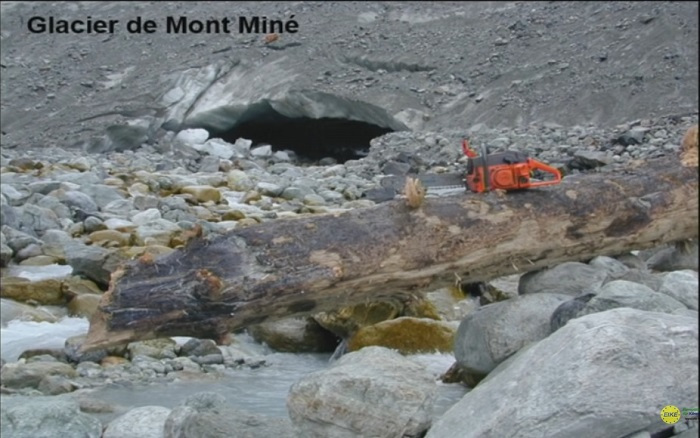
Prof. em. Christian Schlüchter is a geologist and has studied the glaciers of the Alps in great detail. He reports the findings of very old timber in and below glaciers and what those trees taught him about the glacial epochs of the Alps.  One of the most intuitive finds of Schlüchter’s is this huge tree trunk, found at a glacier tongue (see the most beautiful glacier snout behind!).
schluechterbaum

This place nowadays is clearly above the limit of vegetation and still there is this tree which attracted Schlüchter’s curiosity and fuelled his research: How old is it? Where and under what conditions has it grown and why is it here.

The key message from his slides is that all of these records were left in times when the alpine glacier extent was smaller than in 2005.

Warm periods: more life

The timberline was at least 300 meters higher which indicates a minimum of 1.8° C higher temperatures. An example of this gives Hannibal, who managed to cross the Alps with elephants because the higher regions were much less covered by ice than in recent centuries.

Warm periods: more civilization

As his summary, Schlüchter gave the following facts:

  • More than 50% of the last 11000 years alpine glaciers were smaller than 2005
  • This fact he baptized, “dominance of the Hannibalistic world”
  • Alpine glaciers have shown huge dynamics
  • Events of glacier growth were fast and short
  • The little ice age (from the end of the medieval warm period to about 1850) was the longest glacier extension since the last ice age 12000 years ago
  • Every warming followed an accelerated glacier growth

And more recent news Alpine glaciers are not going away:  Alps Winter Warming “Not Significant”…”Astonishing Contrast Between Official Measurements And Public Opinion”

Austrian researcher skeptic Günther Aigner examined 12 mountains stations across the Alps, spanning Switzerland, Germany and Austria, in order to find out how winter temperatures have developed over the past 50 years.  The temperature data from 12 mountain stations in the European Alps show no winter warming in over 30 years, contradicting alarmist claims.

For more on presentations at the 2019 Munich Climate Realism conference that was interrupted by Antifa thugs see post Munich Climate Conference 2019

Alaska Great for Picking Cherries

Alaska 2019 and 2020

Background from 2017 post Glaciermania

The Weather Network (who do a decent job on local weather forecasting) are currently raving about Glaciers:

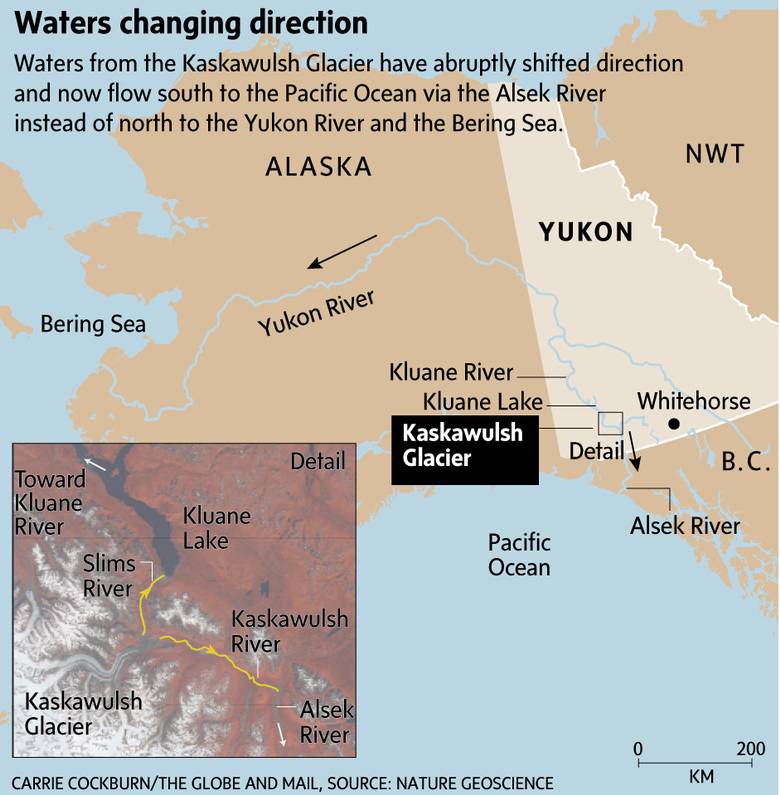
You know climate change is getting serious when rivers are resorting to piracy.

Canadian geomorphologist Dr. Daniel Shugar and his team headed to the Yukon last year to study changes in the flow of the Slims River, only to find out the river was gone.

The Slims, which was fed by the Kaskawulsh glacier, has become the victim of the first case of what’s known as river piracy in modern recorded history.

The team’s investigation soon turned up the culprit – the retreat of the Kaskawulsh Glacier, which has been retreating thanks to more than a century of climate warming.

What Actually Happened
web_0416-nw-na-climatemap

For context and scientific perspective we can turn to papers like this one:  Contemporary Glacier Processes and Global Change: Recent Observations from Kaskawulsh Glacier and the Donjek Range, St. Elias Mountains 

One of the most iconic and best studied outlet glaciers of the St. Elias Mountains, Kaskawulsh Glacier was the focus of much glaciological research during the Icefield Ranges Research Project between the 1960s and early 1970s  and contemporary studies suggest that the glacier is temperate throughout. The current area of Kaskawulsh Glacier is ~1095 km2. Ice thicknesses range from 539 m near the topographic divide with the upper Hubbard Glacier and ~500 m at the confluence of the north and central arms at ~1750 m asl to 778 m at ~1600 m asl. The equilibrium line altitude is estimated from 2007 late summer satellite imagery as 1958 m asl, and it appears to have changed little since the 1970s.

The size of Kaskawulsh Glacier has varied considerably through time, with radiocarbon dating suggesting that it expanded by tens of kilometres into the Shakwak Valley (currently occupied by Kluane Lake) ~30 kya during the Wisconsinan Glaciation. In the historical past, Borns and Goldthwait (1966) mapped three sets of Little Ice Age moraines in the glacier forefield on the basis of distinctive variations in vegetation cover, morphology, and the ages of trees and shrubs.

Kaskawulsh Glacier was advancing by the early 1500s and reached its maximum recent position by approximately AD 1680. A recent study based on tree-ring dates suggests that the Slims River lobe reached its greatest Little Ice Age extent in the mid-1750s, whereas the Kaskawulsh River lobe reached its maximum extent around 1717. However, it appears that the glacier did not start retreating from this position until the early to middle 1800s. The recent discovery of a Geological Survey of Canada map of the glacier terminus from 1900 to 1904 indicates that the glacier was still in a forward position at that time, suggesting that most of the terminus retreat occurred in the 20th century.

Recent studies conducted by researchers at the University of Alaska and the University of Ottawa indicate that ice losses from Kaskawulsh Glacier have continued through the latter half of the 20th century and first decade of the 21st century, although evidence for any recent acceleration in loss rates is equivocal.

Of the 19 glacierized regions of the world outside of the ice sheets, the region including the St. Elias Mountains made the second highest glaciological contribution to global sea level during the period 1961 – 2000. Only Arctic Canada is expected to exceed this region in sea-level contribution over the 21st century.

The St. Elias Mountains exhibit high interannual variability in ice mass change, which is due in part to the abundance of surge-type and tidewater glaciers in different stages of their respective cycles. Ice dynamics can be a confounding influence when attempting to isolate the effects of climate as an external driver of glacier change. 

About the Two Gorilla Glaciers
World Land Ice Mass

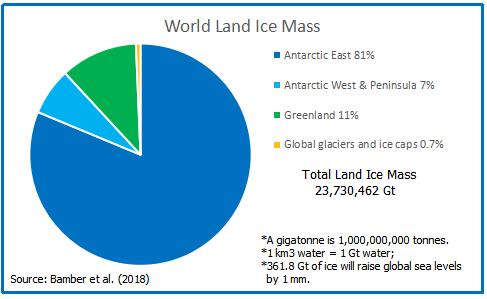
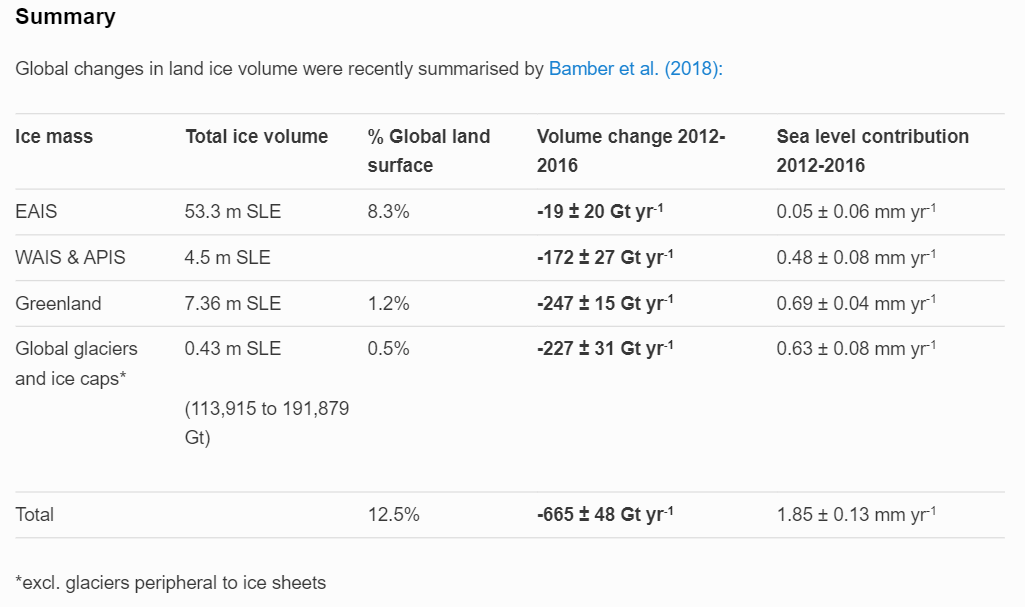
A webpage What is the global volume of land ice and how is it changing? at Antarctic Glaciers.org provides some basic statistics for perspective on land ice.  They provide this table:
World ice table AG org

Notice what they’ve done with this graphic.  A different measure of ice volume hides the proportion of ice melt, covering up how myopic and lop-sided is the alarmist case.  Let’s look at the same table revised with comparable metrics.
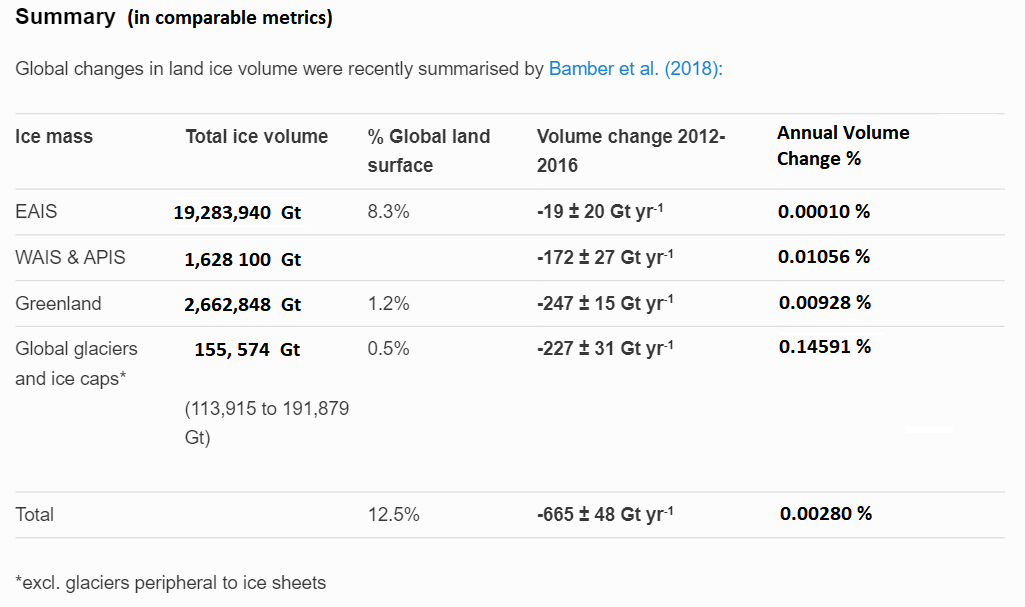
World ice table in Gt


Now the realities are obvious  99% of the world land ice is on top of Antarctica (88%) and Greenland (11%).  All the fuss in the media above concerns fluctuations in less than 1% of glacier mass.  Secondly, the bottom line is should present melt rates continue ( a big if ) the world would lose 3% of land ice in 1000 years.  Note also the wide range of estimates of the smallest category of glaciers, and also the uncertain reported volume change for East Antarctica.  Note that the melt rates are for 2012 to 2016, leaving out lower previous rates and periods when ice mass gained.

Add to this a recent analysis NASA Surface Station Data Show East Antarctica NOT WARMING Past 4 Decades…Cooling Trend.  

See also Blinded by Antarctica Reports

As for Greenland ice sheet, read the recent research at post  Oh No! Greenland Melts in Virtual Reality “Experiments”.  Excerpts below:

The scare du jour is about Greenland Ice Sheet (GIS) and how it will melt out and flood us all.  It’s declared that GIS has passed its tipping point, and we are doomed.  Typical is the Phys.org hysteria: Sea level rise quickens as Greenland ice sheet sheds record amount:  “Greenland’s massive ice sheet saw a record net loss of 532 billion tonnes last year, raising red flags about accelerating sea level rise, according to new findings.”
gis-smb-2017-to-2020

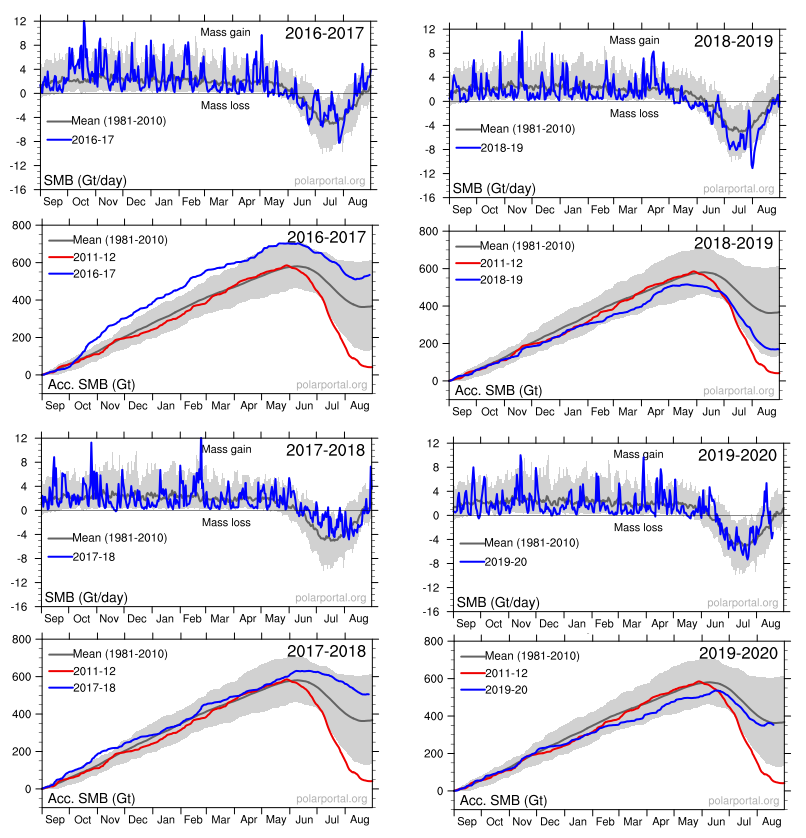
Panic is warranted only if you treat this as proof of an alarmist narrative and ignore the facts and context in which natural variation occurs. For starters, consider the last four years of GIS fluctuations reported by DMI and summarized in the eight graphs above.  Note the noisy blue lines showing how the surface mass balance (SMB) changes its daily weight by 8 or 10 gigatonnes (Gt) around the baseline mean from 1981 to 2010.  Note also the summer decrease between May and August each year before recovering to match or exceed the mean.

The other four graphs show the accumulation of SMB for each of the last four years including 2020.  Tipping Point?  Note that in both 2017 and 2018, SMB ended about 500 Gt higher than the year began, and way higher than 2012, which added nothing.  Then came 2019 dropping below the mean, but still above 2012.  Lastly, this year is matching the 30-year average.  Note also that the charts do not integrate from previous years; i.e. each year starts at zero and shows the accumulation only for that year.  Thus the gains from 2017 and 2018 do not result in 2019 starting the year up 1000 Gt, but from zero.

Summary

So it is a familiar story. A complex naturally fluctuating situation, in this case glaciers, is abused by activists to claim support for their agenda. I have a lot of respect for glaciologists; it is a deep, complex subject, and the field work is incredibly challenging. And since “glacial” describes any process where any movement is imperceptible, I can understand their excitement over something happening all of a sudden.

But I do not applaud those pandering to the global warming/climate change crowd. They seem not to realize they debase their own field of study by making exaggerated claims and by “jumping the shark.”

Meanwhile real scientists are doing the heavy lifting and showing restraint and wisdom about the limitations of their knowledge.
kyvp5x


Cool 2021 Spring Continues

imagehy1p

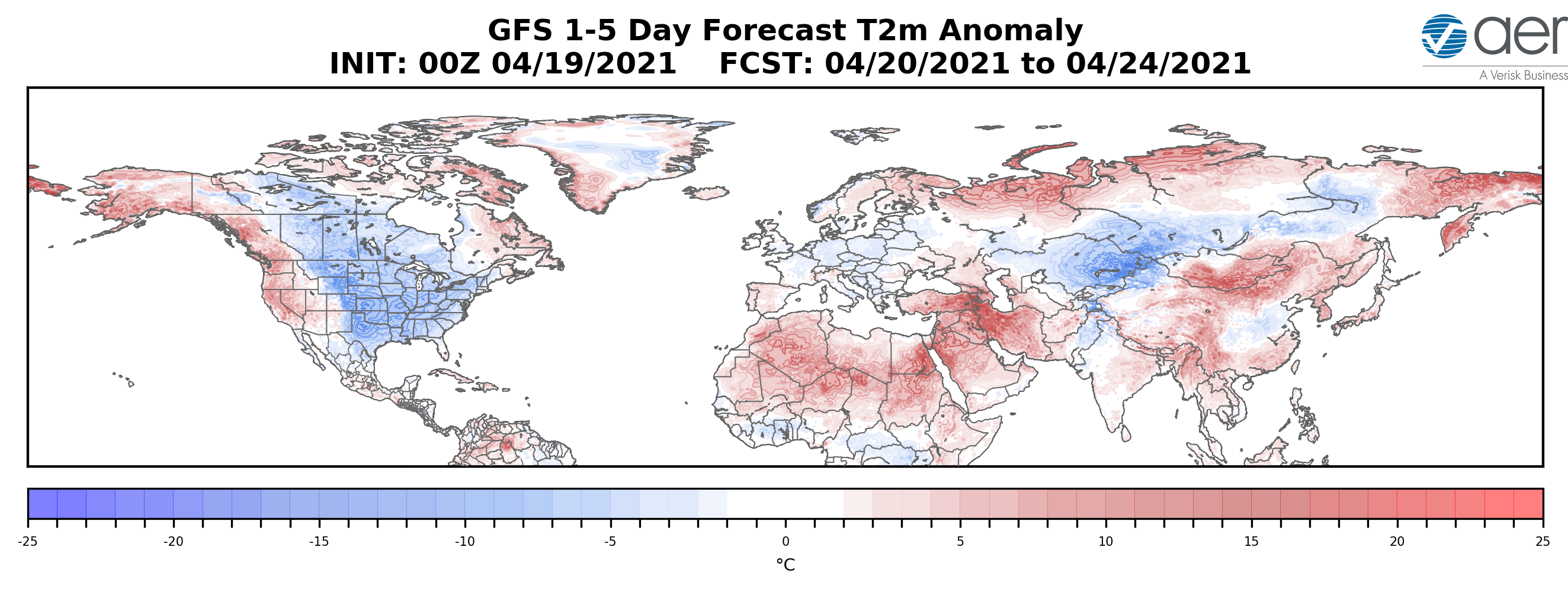
Dr. Judah Cohen provides a weather outlook based upon his study of the Arctic Oscillation at his blog Arctic Oscillation and Polar Vortex Analysis and Forecast April 19, 2021.  Excerpts in italics with my bolds.

The PV is in its waning days of the 2020/21 cold season and will likely be nearly or completely disappeared by the next blog update. This seems to me to be a clear dynamically assisted Final Warming as vertical Wave Activity Flux (WAFz and is proportional to poleward heat transport) has been active for at least a week now and is predicted to remain active for the next two weeks. A dynamic Final Warming can result in some cooler weather across the mid-latitudes; and in my opinion the snow and possibly record cold temperatures predicted for the Eastern US this week is related to the dynamic Final Warming. The PV is being stretched from Siberia to Canada that creates cross polar flow from Siberia to North America that drives cold air south across Canada and the US east of the Rockies. I do believe that this is a short-term impact only and will not have an influence on the summer weather across North America.

Europe has had an impressively cool April, relative to recent Aprils (probably the coolest April since 2013 and maybe even since 2003), which is directly attributable to Greenland blocking that has also extended into the North Atlantic for much of the month. There are no strong signs that the Greenland blocking will disappear any time soon, and as long as it persists, Europe can experience relatively cool temperatures. I see no obvious signs that the Greenland blocking is tied to PV variability and it is therefore more challenging for me to anticipate how long it will last. But it is likely that the streak of cool weather is dependent on the persistence of the Greenland blocking. If and when the Greenland blocking abates, European temperatures could start to climb.

As noted in previous posts, when cold Arctic air pushes south, it is replaced by warmer air contributing to ice melting.  To be clear, sea ice melts primarily because of sunshine directly, and indirectly by intruding sun-warmed water, mostly from the Atlantic by way of Barents Sea. The Arctic in summer daily receives more solar energy than does the equator.  Warmer air is a tertiary contributing factor.

ArcApril 099 to 110

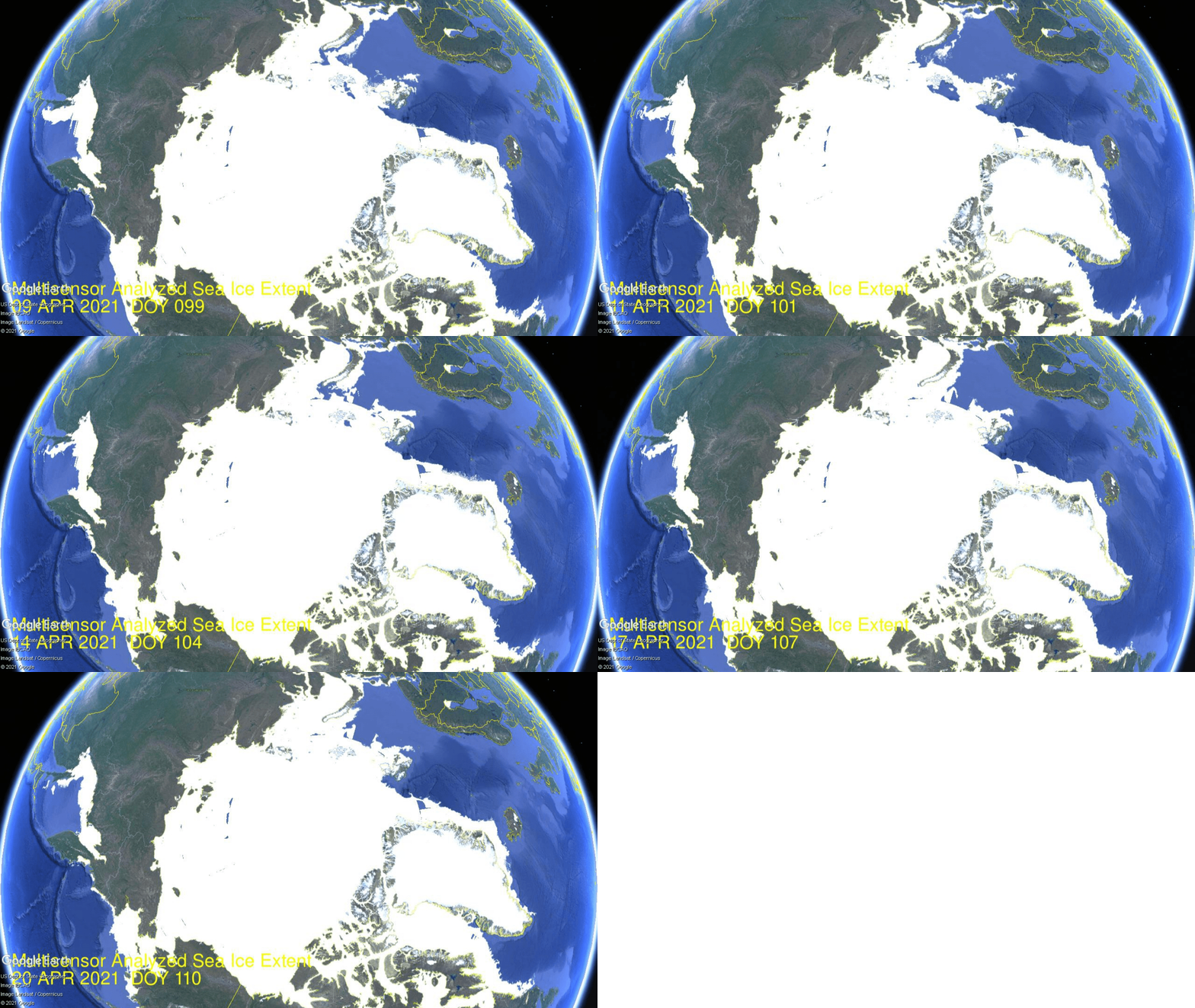
The animation shows Okhotsk upper left lost ~250k km2 of ice extent over the last 10 days.  Bering Sea lower left waffled with little change until losing ~60k km2 the last two days.  On the Atlantic side, Barents Sea upper right gained ~100k km2 over a week, then lost most of it ending about the same.  Greenland Sea middle right lost ~100k km2m, while Baffin Bay lower right waffled and lost very little.

Arctic2021110

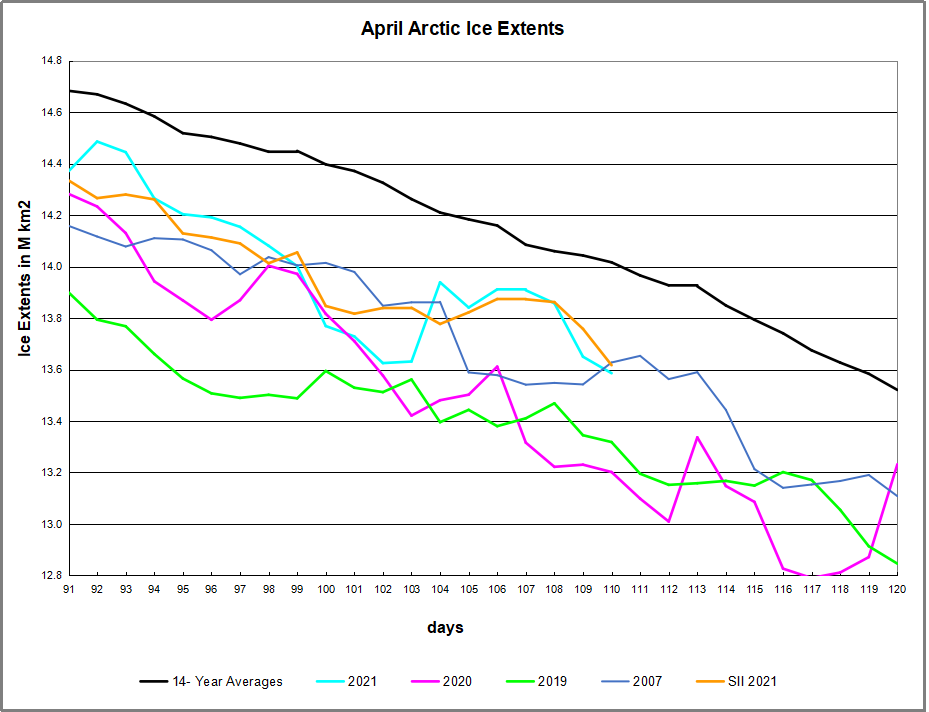
The overall impact on NH sea ice is shown in the graph above.  Firstly a drop starting April 10, then recovering April 14 and holding firm to draw near to average, before another drop the last two days.

Background Previous Post  Spring 2021: Warm is Cold, and Down is Up

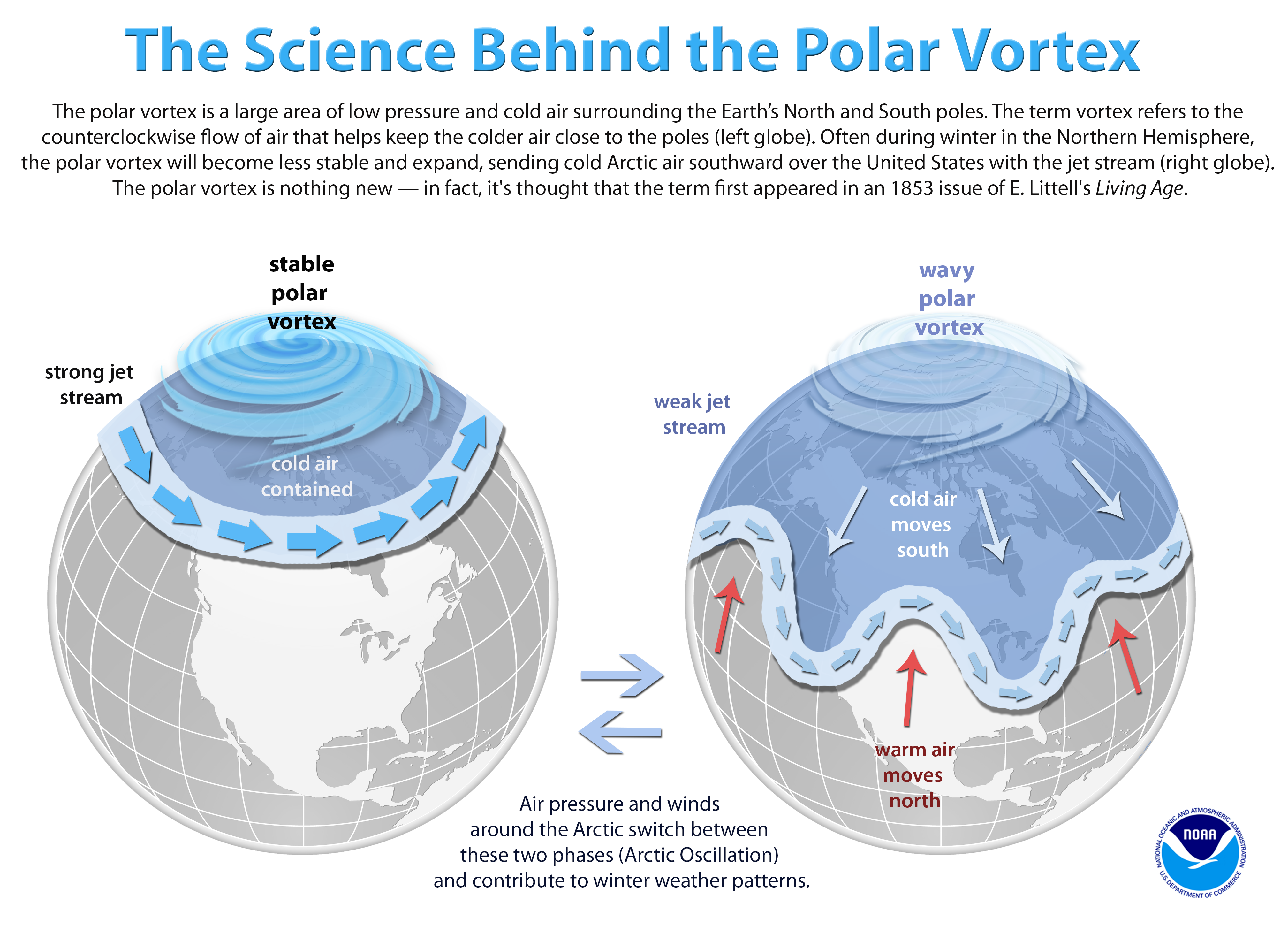
The cold Spring this year is triggering responses turning natural factors upside down and backwards, confusing causes and effects.  For example, this article at Science Daily Snow chaos in Europe caused by melting sea-ice in the Arctic.  The simplistic appeal to “climate change” is typical: “It is the loss of the Arctic sea-ice due to climate warming that has, somewhat paradoxically, been implicated with severe cold and snowy mid-latitude winters.”  In fact, as we shall see below, it is the wavy Polar Vortex causing both cold mid-latitudes from descending Arctic air, and melting ice from intrusions of warmer southern air.  Importantly, global warming theory asserts that adding CO2 causes the troposphere to warm and the stratosphere to cool.  What we are experiencing this Spring is an unstable Polar vortex due to events of Sudden Stratospheric Warming  (SSWs), not cooling.

Seasoned meteorologist Judah Cohen of AER shows the mechanism this way:

My colleagues, at AER and at selected universities, and I have found a robust relationship between two October Eurasian snow indices and the large-scale winter hemispheric circulation pattern known as the North Atlantic or Arctic Oscillation pattern (N/AO).

The N/AO is more highly correlated with or explains the highest variance of winter temperatures in eastern North America, Europe and East Asia than any other single or combination of atmospheric or coupled ocean-atmosphere patterns that we know of. Therefore, if we can predict the winter N/AO (whether it will be negative or positive) that provides the best chance for a successful winter temperature forecast in North America but certainly does not guarantee it.

He goes on to say that precipitation is the key, not air temperatures, and ENSO is a driving force:

As long as I have been a seasonal forecaster, I have always considered El Nino/Southern Oscillation (ENSO) as a better predictor of precipitation than temperature across the Eastern US. I think this is supported by the observational or statistical analysis as well as the skill or accuracy of the climate models.

There have been recent modeling studies that demonstrate that El Nino modulates the strength and position of the Aleutian Low that then favors stratospheric warmings and subsequently a negative winter N/AO that are consistent with our own research on the relationship between snow cover and stratospheric warmings. So the influence of ENSO on winter temperatures in the Mid-Atlantic and the Northeast may be greater than I acknowledge or that is represented in our seasonal forecast model.

Summary

As Cohen’s diagram shows, there is an effect from warming, but in the stratosphere. Global warming theory claims CO2 causes warming in the troposphere and cooling in the stratosphere. So whatever is going on, it is not due to CO2.

Cohen’s interview with the Washington Post.

its-easier-to-fool-people-than-to-convince-them-that-they-have-been-fooled


The current situation is described in Cohen’s most recent post at his Arctic Oscillation blog:

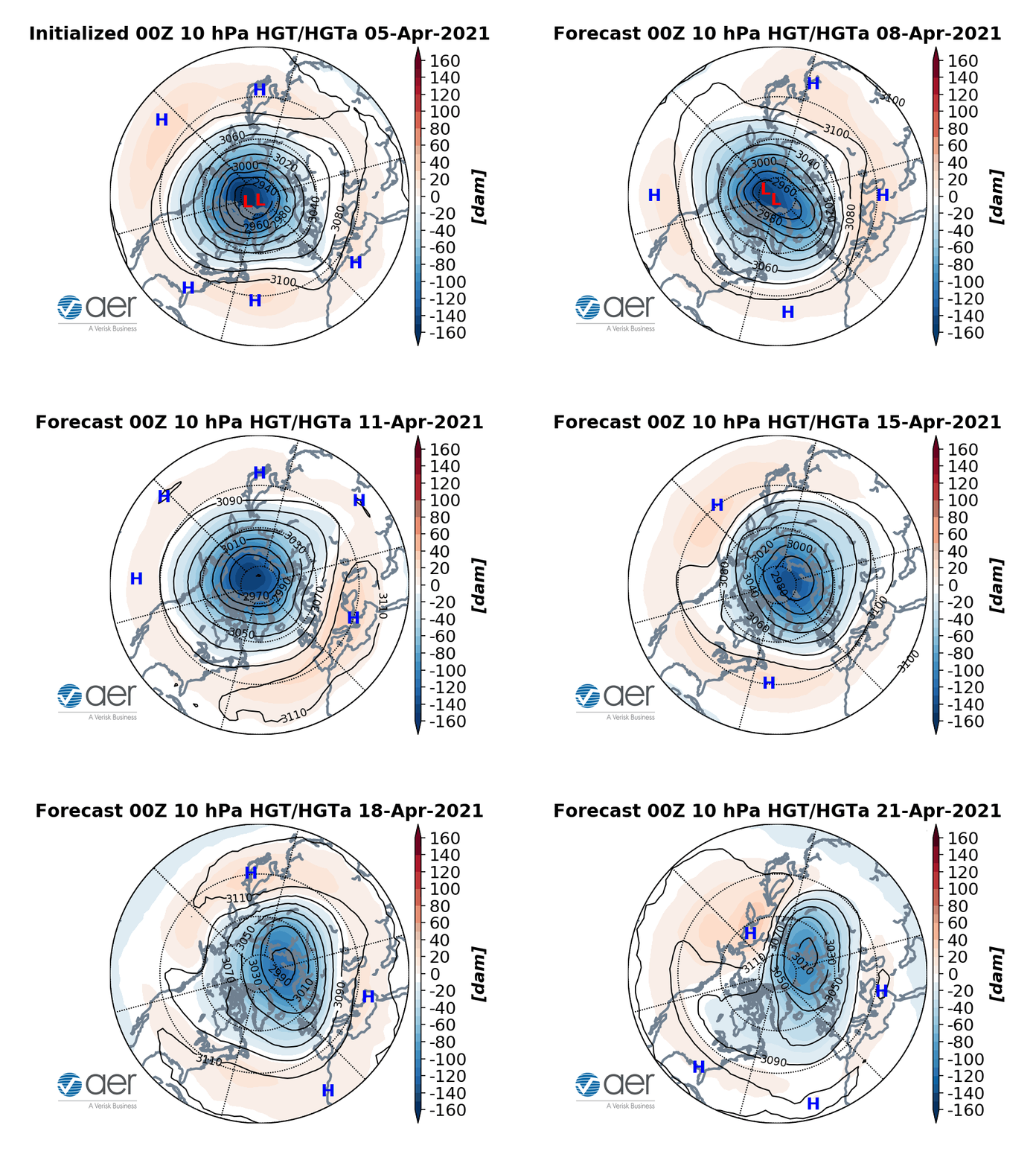
The stratospheric PV always disappear in the spring due to the increasing solar radiation in the polar stratosphere. However, during some springs in addition to the radiative warming of the polar stratosphere, there is also dynamic warming of the polar stratosphere due to the absorption of upwelling Wave Activity Flux (WAFz) from the troposphere. This occurred last spring, which did result in a cool May and even some rare snowfall in the Northeastern US. The predicted return of Ural blocking coupled with Northeast Asia/northern North Pacific troughing is conducive to more active WAFz. The latest PV animation (see Figure ii) shows the stratospheric PV filling (weakening) and meandering over the northern Asia in response to the more active WAFz. This could be the beginning of a dynamically assisted Final Warming that could result in a period of cooler temperatures in parts of the mid-latitudes.

imagesj5oh

Figure ii. Observed and predicted daily geopotential heights (dam; contours) and anomalies (shading) through April 21, 2021. The forecast is from the 00Z 5 April 2021 GFS ensemble.

Background is at post No, CO2 Doesn’t Drive the Polar Vortex 

graphic20-20polarvortex_explained_updated2001291920-204034x2912-1


Spring 2021: Warm is Cold, and Down is Up

The cold Spring this year is triggering responses turning natural factors upside down and backwards, confusing causes and effects.  For example, this article at Science Daily Snow chaos in Europe caused by melting sea-ice in the Arctic.  The simplistic appeal to “climate change” is typical: “It is the loss of the Arctic sea-ice due to climate warming that has, somewhat paradoxically, been implicated with severe cold and snowy mid-latitude winters.”  In fact, as we shall see below, it is the wavy Polar Vortex causing both cold mid-latitudes from descending Arctic air, and melting ice from intrusions of warmer southern air.  Importantly, global warming theory asserts that adding CO2 causes the troposphere to warm and the stratosphere to cool.  What we are experiencing this Spring is an unstable Polar vortex due to events of Sudden Stratospheric Warming  (SSWs), not cooling.

Seasoned meteorologist Judah Cohen of AER shows the mechanism this way:

My colleagues, at AER and at selected universities, and I have found a robust relationship between two October Eurasian snow indices and the large-scale winter hemispheric circulation pattern known as the North Atlantic or Arctic Oscillation pattern (N/AO).

The N/AO is more highly correlated with or explains the highest variance of winter temperatures in eastern North America, Europe and East Asia than any other single or combination of atmospheric or coupled ocean-atmosphere patterns that we know of. Therefore, if we can predict the winter N/AO (whether it will be negative or positive) that provides the best chance for a successful winter temperature forecast in North America but certainly does not guarantee it.

He goes on to say that precipitation is the key, not air temperatures, and ENSO is a driving force:

As long as I have been a seasonal forecaster, I have always considered El Nino/Southern Oscillation (ENSO) as a better predictor of precipitation than temperature across the Eastern US. I think this is supported by the observational or statistical analysis as well as the skill or accuracy of the climate models.

There have been recent modeling studies that demonstrate that El Nino modulates the strength and position of the Aleutian Low that then favors stratospheric warmings and subsequently a negative winter N/AO that are consistent with our own research on the relationship between snow cover and stratospheric warmings. So the influence of ENSO on winter temperatures in the Mid-Atlantic and the Northeast may be greater than I acknowledge or that is represented in our seasonal forecast model.

Summary

As Cohen’s diagram shows, there is an effect from warming, but in the stratosphere. Global warming theory claims CO2 causes warming in the troposphere and cooling in the stratosphere. So whatever is going on, it is not due to CO2.

Cohen’s interview with the Washington Post.

its-easier-to-fool-people-than-to-convince-them-that-they-have-been-fooled


The current situation is described in Cohen’s most recent post at his Arctic Oscillation blog:

The stratospheric PV always disappear in the spring due to the increasing solar radiation in the polar stratosphere. However, during some springs in addition to the radiative warming of the polar stratosphere, there is also dynamic warming of the polar stratosphere due to the absorption of upwelling Wave Activity Flux (WAFz) from the troposphere. This occurred last spring, which did result in a cool May and even some rare snowfall in the Northeastern US. The predicted return of Ural blocking coupled with Northeast Asia/northern North Pacific troughing is conducive to more active WAFz. The latest PV animation (see Figure ii) shows the stratospheric PV filling (weakening) and meandering over the northern Asia in response to the more active WAFz. This could be the beginning of a dynamically assisted Final Warming that could result in a period of cooler temperatures in parts of the mid-latitudes.

imagesj5oh

Figure ii. Observed and predicted daily geopotential heights (dam; contours) and anomalies (shading) through April 21, 2021. The forecast is from the 00Z 5 April 2021 GFS ensemble.

Background is at post No, CO2 Doesn’t Drive the Polar Vortex 

graphic20-20polarvortex_explained_updated2001291920-204034x2912-1


March 2021 Arctic Ice Persists

March Arctic ice 2007 to 2021

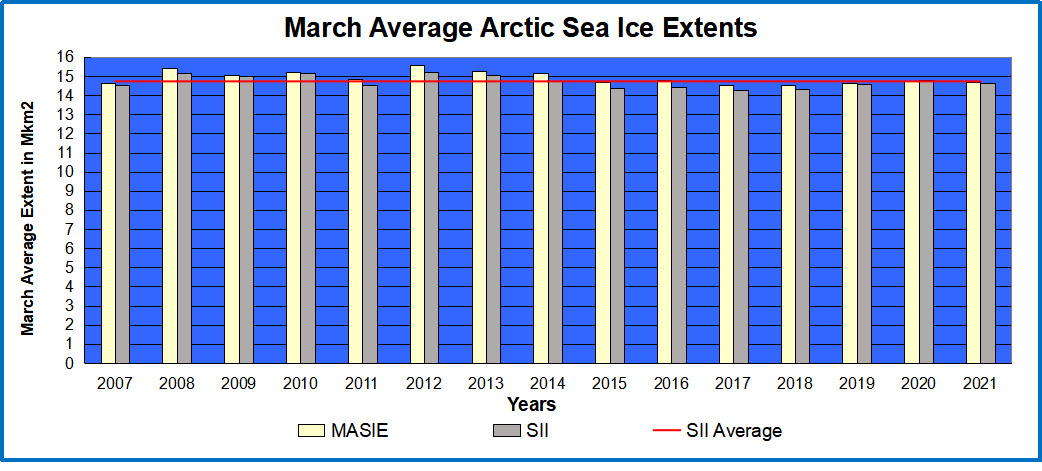
Previous posts showed 2021 Arctic Ice fell short of breaking the 15M km2 ceiling mid March due to a February Polar Vortex disruption.  As we shall see below, another smaller PV disruption is now occurring accelerating the normal spring melting season.  The graph above shows that the March monthly average has varied little since 2007, typically around the SII average of 14.7 M km2.  Of course there are regional differences as described later on.

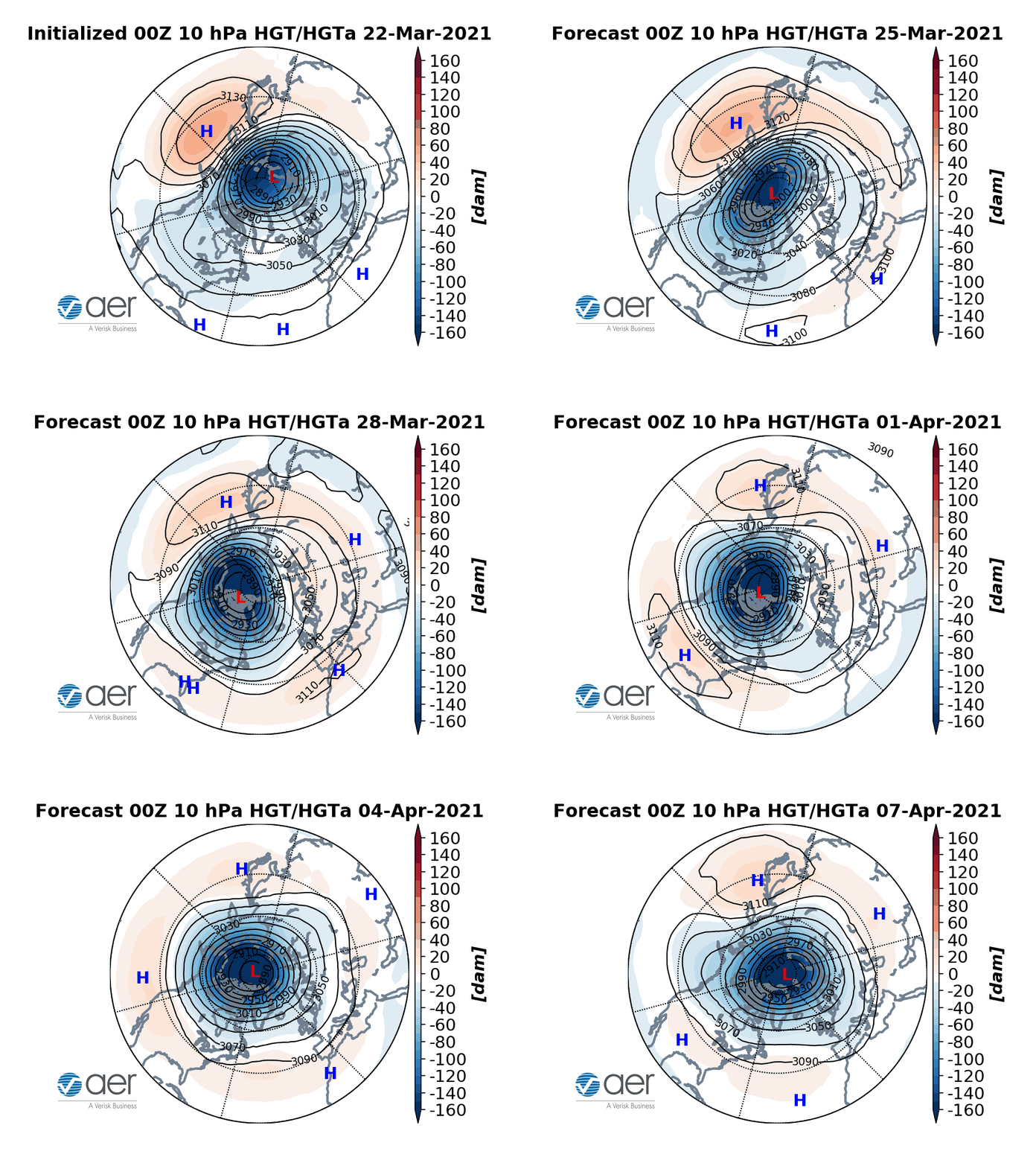
Dr. Judah Cohen at AER provides an image of how this latest PV disruption appears:

gfs_animation_010hpa_20210322_20210407

The High pressure areas were forecast to warm over the Pacific Arctic basins, and extending over to the European side, while the cold Low area is presently extending down into North America, bringing some snow on April 1 in Montreal (no joke).  The effect on Arctic Ice is shown in the animation below:

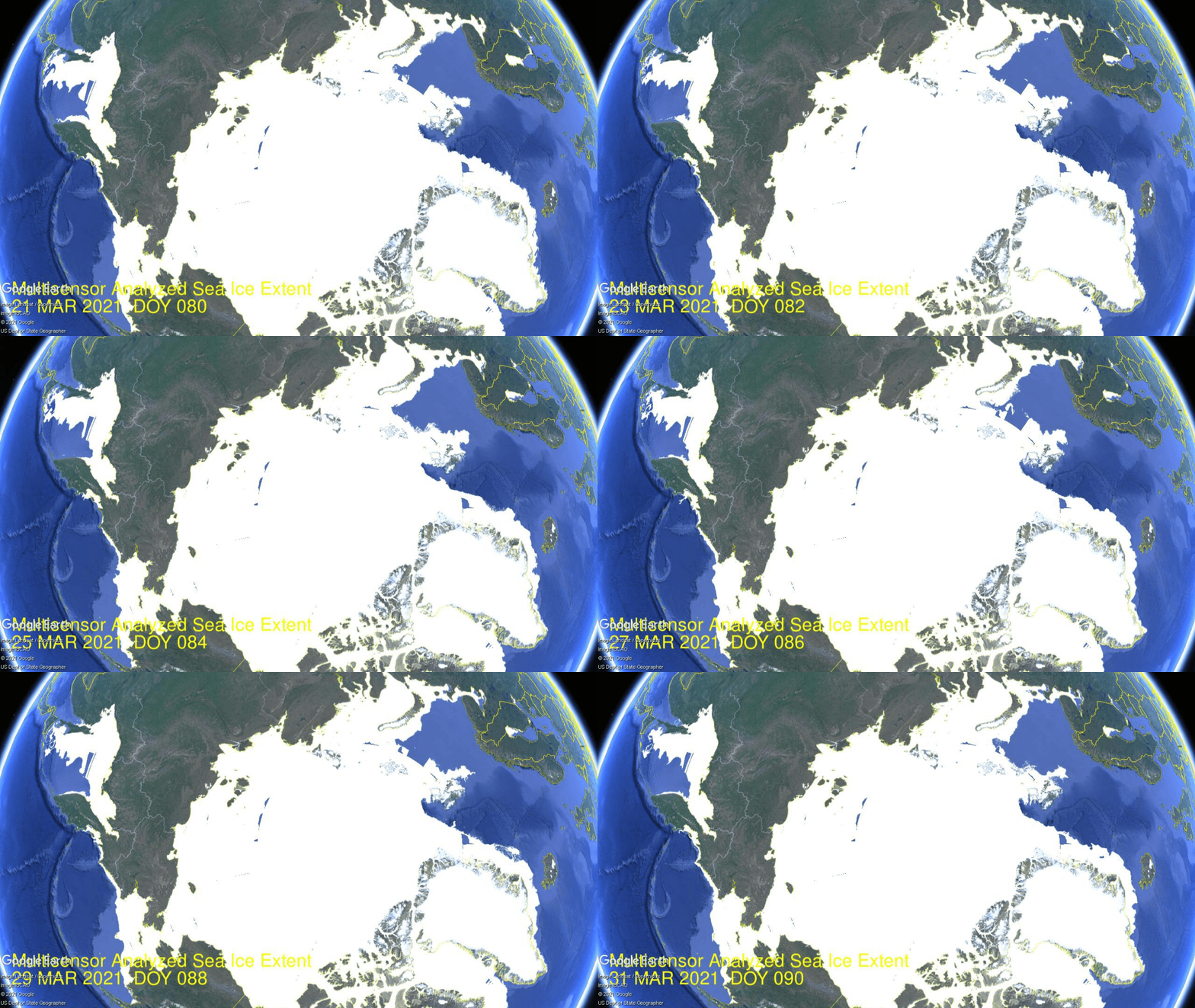
ArcticMarch2021 080 to 090

Over the last 10 days, Okhotsk upper left lost 180k km2 while Bering lower left lost half that with a slight recovery yesterday.  Barents Sea upper right lost 145k km2 over the same period.  The effect on NH total ice extents is presented in the graph below.

Arctic2021090

The graph above shows ice extent through March comparing 2021 MASIE reports with the 14-year average, other recent years and with SII.  After drawing close to average by day 80, 2021 ice extents dropped sharply and at March end matched both 2020 and 2007.  Despite losses from this PV event, the 2020 March monthly average ended up comparable to other years, as seen in the chart at the top.  In fact, the SII dataset of monthly gains and losses shows March 2021 gained slightly over end of February, compared to a 200k km2 loss for the average March.


The table below shows the distribution of sea ice across the Arctic regions.

Region 2021090 Day 090 Average 2021-Ave. 2007090 2021-2007
 (0) Northern_Hemisphere 14266634 14692014  -425380  14222916 43718 
 (1) Beaufort_Sea 1070689 1070177  512  1069711 978 
 (2) Chukchi_Sea 966006 964100  1907  966006
 (3) East_Siberian_Sea 1087137 1086134  1003  1074908 12229 
 (4) Laptev_Sea 897827 896838  989  884340 13487 
 (5) Kara_Sea 935023 916581  18442  892157 42866 
 (6) Barents_Sea 602392 649566  -47174  441970 160422 
 (7) Greenland_Sea 620574 658050  -37476  686312 -65739 
 (8) Baffin_Bay_Gulf_of_St._Lawrence 1243739 1438412  -194673  1217467 26272 
 (9) Canadian_Archipelago 854597 852959  1638  850127 4470 
 (10) Hudson_Bay 1260903 1254727  6176  1229995 30908 
 (11) Central_Arctic 3192844 3234463  -41619  3242237 -49393 
 (12) Bering_Sea 549939 736829  -186890  814788 -264849 
 (13) Baltic_Sea 33543 608741 -27331  45897 -12354 
 (14) Sea_of_Okhotsk 942085 861234  80850  794657 147428 

Overall NH extent March 31 was below average by 425k km2, or 3%.  The bulk of the deficit is seen in Bering and Baffin, along with Barents Sea.  Okhotsk remains above average in spite of recent losses.  The onset of spring melt is as usual in most regions.

Update: Two of Four Seasons Gone, Because Climate Change

Yale Climate Connections reports on the seepage of climatism into classical music:  Composers, scientists, designers update Vivaldi’s ‘Four Seasons’ for an era of climate change.  Excerpts in italics with my bolds.

Three hundred years ago, Vivaldi wrote “The Four Seasons.” It portrays the natural world, from birdsong to summer storms.

But the warming climate could radically alter the natural world by 2050, so a new version of “The Four Seasons” has been altered, too.

“We really wanted to walk that line between being too ridiculously catastrophic and kind of meaningfully changing this to make it sound what we think it might feel like to live in that time,” says Tim Devine of AKQA.

The design agency partnered with composers and scientists to develop an algorithm that translates projected environmental changes into musical changes. It allows them to create localized versions for any place where the piece is performed.

In the version played by Australia’s Sydney Symphony Orchestra, missing notes reflect declining bird populations, and the summer storm is more intense and prolonged.

For listeners, the result is familiar, but unsettling – and a warning about how the world could change if nothing is done to reduce global warming.

Background from previous Post–Spoof Becomes Woke Reality

From the NewsThump, Vivaldi’s Four Seasons reduced to Two in light of climate change.  Excerpts in italics with my bolds.

Antonio Vivaldi’s Four Seasons concerti will now consist of just two seasons, because that’s all there are these days.

The conductor of the London Philharmonic Orchestra Simon Williams commented, “The current generation doesn’t really understand the idea of four different seasons of weather, so in a bid to appeal to a modern audience we’ve updated the concerti to be more representative of 300 years of environmental damage.

“Overall, the suite will be much more discordant and unpredictable. The part representing winter will be doubled in length and feature woodwind solos to signify the yearly rising of floodwaters. A choir of scientists will sing the aria ‘Te Lo Abbiamo Detto’ (We Told You So).

Spring and autumn will be done away with altogether.

“Summer has also been greatly extended, as has the ‘languor caused by the heat’ bit, occasionally broken up strings phrases to represent next door’s kids on the trampoline.”

How quickly does a virtue-bestowing idea spread.  What was spoof news a year ago is now performed on stage.  And the musical score adjusted with the help of a computer warming model.

The World Since I Was Twelve

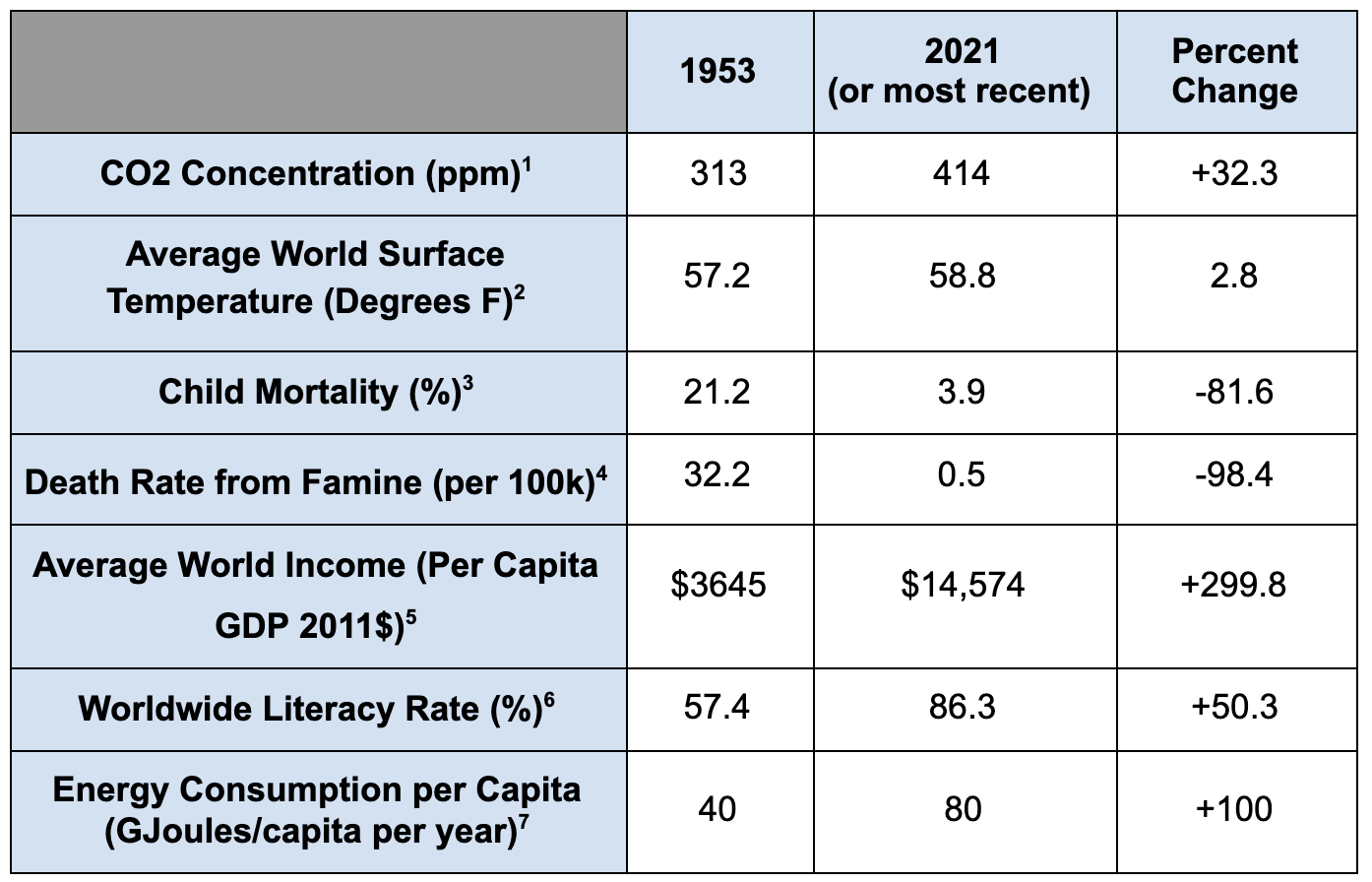
This is a reblog of  David Kreutzer’s article The World Since I Was Born at IER (Institute for Energy Research).  Excerpts in italics with my bolds.  My title change is due to me being a few years older than he.

Some climate Tweeters have taken to adorning their Twitter bios with the atmospheric CO2 concentration in the year of their birth. If there were room in my bio I would list that and some other stuff.

david-kreutzer-table

[Note: Superscript numbers refer to data sources linked in IER article.]

Since 1953, the increase in energy consumption may well be the primary driver of rising CO2 concentrations, but it has also been critical to the economic growth that drives phenomenally beneficial trends in virtually every metric of human wellbeing.

Rising energy consumption is almost certainly responsible for a portion of that 1.6 degree warming, but over the past century, the even greater warming has not been associated with any significant rising trends in world-wide hurricanes, tornadoes, floods, droughts, or wildfires.

My Comment:  As Alex Epstein and others have pointed out, the introduction of energy from fossil fuels made possible an extraordinary rise in human flourishing, shown in these graphs.

15-3.1

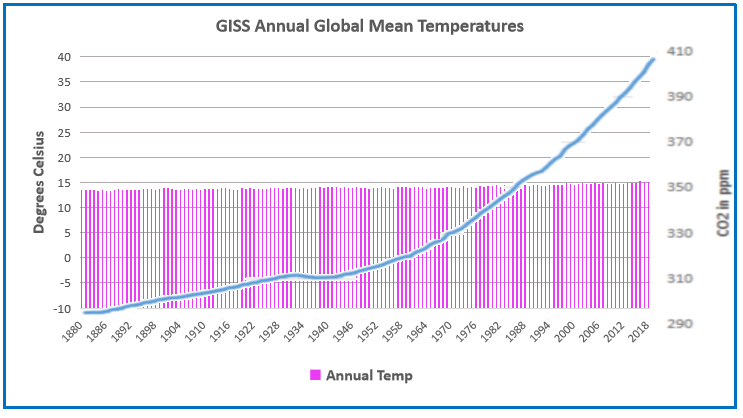
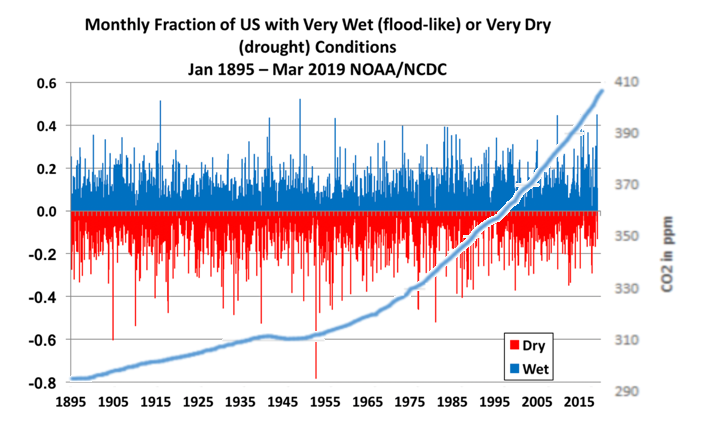
And in support of his concluding remark:

giss-gmt-to-2018-w-co2

us-wet-dry-co2rev-1

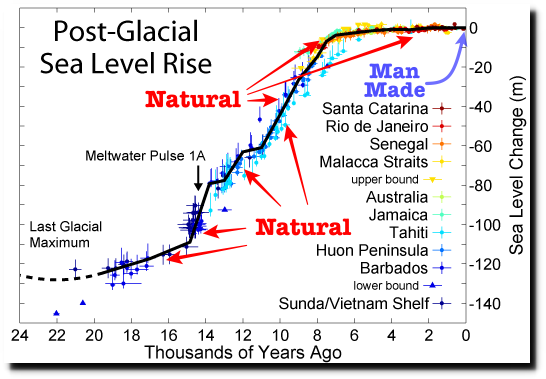
post-glacial_sea_level

Resource Document:  Advance Briefing for Glasgow COP 2021

March 25 Arctic Melt Season Ensues

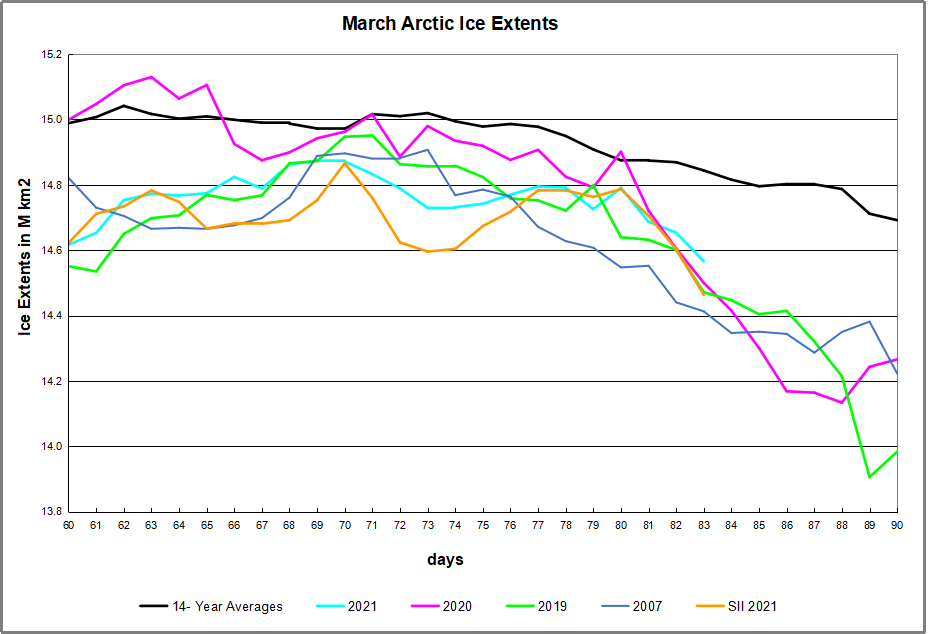
As anticipated in a previous post, Arctic ice extent appears to have peaked under the 15M km2 threshold.  An earlier discussion noted that the wavy Polar Vortex that froze Texas with cold Arctic air in February, allowed warmer southern air into Arctic regions, reducing ice extent.  The ice recovered afterward ( see March 1, 2021 Arctic Ice Recovers from PV Hit ), but 2021 was no longer going to reach 15M km2.  As shown by the graph below, ice extents this year did persist and draw close to the 14 year average, before beginning the melt season this week.

Arctic2021083

Starting March MASIE 2021 shows Arctic extents were about 400k km2 below average, but for the first 20 days added 200k while the average lost about 100k, reducing the difference to 85k km2 on day 80.  Now in the last 3 days the melt season has erased the gains in 2021 and restored the deficit to nearly 300k km2, 2% of the 14-year average.  SII reported mostly lower extents than MASIE, but presently the two are similar.  The table shows the distribution of ice over the Arctic regions.

Region 2021083 Day 083 Average 2021-Ave. 2007083 2021-2007
 (0) Northern_Hemisphere 14565743 14844057 -278315 14412819 152924
 (1) Beaufort_Sea 1070689 1070239 450 1069711 978
 (2) Chukchi_Sea 966006 965879 127 966006 0
 (3) East_Siberian_Sea 1087137 1087066 72 1087137 0
 (4) Laptev_Sea 897827 897599 228 897845 -18
 (5) Kara_Sea 935023 918802 16221 904153 30870
 (6) Barents_Sea 689316 649153 40163 472230 217086
 (7) Greenland_Sea 657096 631454 25642 609918 47178
 (8) Baffin_Bay_Gulf_of_St._Lawrence 1284957 1509201 -224244 1323453 -38496
 (9) Canadian_Archipelago 854597 853068 1529 852767 1830
 (10) Hudson_Bay 1260903 1260717 186 1259717 1186
 (11) Central_Arctic 3203492 3230083 -26591 3234061 -30569
 (12) Bering_Sea 592244 746974 -154730 883221 -290977
 (13) Baltic_Sea 46648 70687.87 -24040 70484 -23836
 (14) Sea_of_Okhotsk 1010021 938704 71317 765577 244443

Interestingly, both Okhotsk and Barents Seas peaked well above average, and are still in surplus after starting to retreat.  The main deficits are in Bering and Baffin Bay.  The central Arctic, Siberian and Canadian regions remain solidly frozen.

Background previous post Arctic Ice Moment of Truth 2021

For ice extent in the Arctic, the bar is set at 15M km2. The average peak in the last 14 years occurs on day 62 at 15.04M km2 before descending, though the average can still be above 15M at late as day 73.  Nine of the last 14 years were able to clear 15M, but recently only 2016 and 2020 ice extents cleared the bar at 15M km2; the others came up short. The actual annual peak ice extent day varied between day 59 (2016) to day 82 (2012).

The animation shows in two weeks how this year’s ice extents contracted and then regrew greater than before, coincidental with the wavy Polar Vortex (PV) first admitting warmer southern air and then keeping the cold air in.

As reported previously, most of the action was firstly in the Pacific, especially Sea of Okhotsk upper left, ice shrinking one week by 200k km2 and rapidly growing back 210k km2 ice extent the next.  Okhotsk ice is now 1.1M km2, 96% of 2020 max.  On the Atlantic side, Barents sea upper right lost 100k km2 retreating from Svalbard, then gained 120k km2 back.  Greenland Sea ice middle right lost 100k km2, and then gained 150k km2.  Barents now has 3% more ice than 2020 max, while Greenland sea ice is 85% of last year’s max.

Drift ice in Okhotsk Sea at sunrise.

For more on the Pacific basins see post Meet Bering and Okhotsk Seas

Mid March Arctic Ice Update

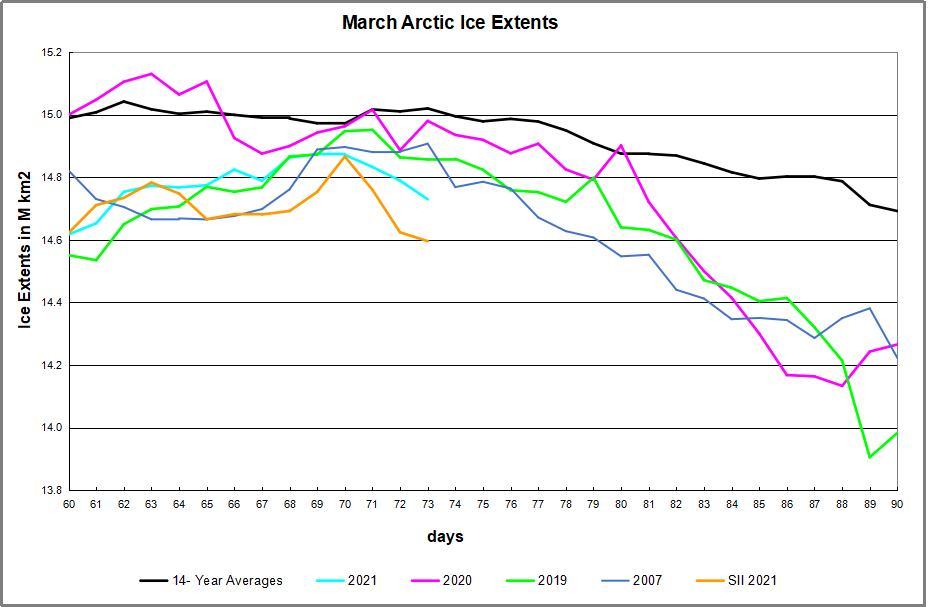
As anticipated in the previous post reprinted below, Arctic ice extent appears to have peaked under the 15M km2 threshold.  An earlier discussion at 2020 year end noted that March actually ends up with less ice extent than end of February, so the rest of the month is not likely to add any more ice.  Here is the graph for March including yesterday.

Arctic2021073

The graph shows this year did recover from a 400k km2 deficit to the 14-year average, to about 100k by day 70, and has now fallen back to almost 300k km2 down (2%).  It is also apparent that extent will likely decline in the next two weeks, by about 300k km2 on average, already matched by 2021.  Climatology uses SII March monthly average as the annual maximum, so that will come out lower as well.

Interestingly, both Okhotsk and Barents Seas peaked well above 2020, and are now starting to retreat, along with other marginal basins.  The central Arctic, Siberian and Canadian regions remain solidly frozen.

Background previous post Arctic Ice Moment of Truth 2021

For ice extent in the Arctic, the bar is set at 15M km2. The average peak in the last 14 years occurs on day 62 at 15.04M km2 before descending, though the average can still be above 15M at late as day 73.  Nine of the last 14 years were able to clear 15M, but recently only 2016 and 2020 ice extents cleared the bar at 15M km2; the others came up short. The actual annual peak ice extent day varied between day 59 (2016) to day 82 (2012).

The animation shows in two weeks how this year’s ice extents contracted and then regrew greater than before, coincidental with the wavy Polar Vortex (PV) first admitting warmer southern air and then keeping the cold air in.

As reported previously, most of the action was firstly in the Pacific, especially Sea of Okhotsk upper left, ice shrinking one week by 200k km2 and rapidly growing back 210k km2 ice extent the next.  Okhotsk ice is now 1.1M km2, 96% of 2020 max.  On the Atlantic side, Barents sea upper right lost 100k km2 retreating from Svalbard, then gained 120k km2 back.  Greenland Sea ice middle right lost 100k km2, and then gained 150k km2.  Barents now has 3% more ice than 2020 max, while Greenland sea ice is 85% of last year’s max.

All of this means that 2021 will be hard pressed to pass the 15M km2 threshold.  The graph below shows the situation evolving over the last two weeks anticipating the annual maximum to appear within the fortnight.

Note that Sea Ice Index (SII) went offline day 51 so the MASIE record alone shows the loss of ice extent ending day 56 and climbing up to the present.  The NH ice extent gap is at 244k km2, or 1.6%.  Since the 14 year average has already peaked, further growth will narrow the margin.  (Note that ice extent is affected also by winds piling up drift ice, as well as melting from intrusions of warmer air or water.)

Last year surpassed the average while other recent years were lower.  We shall see what this year does with only 10 days or so to make a difference.

Region 2021063 Day 063 Average 2021-Ave. 2007063 2021-2007
 (0) Northern_Hemisphere 14772617 15016830 -244214 14665491 107126
 (1) Beaufort_Sea 1070689 1070254 435 1069711 978
 (2) Chukchi_Sea 966006 964118 1888 966006 0
 (3) East_Siberian_Sea 1087120 1087134 -14 1087137 -17
 (4) Laptev_Sea 897827 897842 -15 897845 -18
 (5) Kara_Sea 935006 929650 5356 932067 2939
 (6) Barents_Sea 805710 649490 156220 626044 179666
 (7) Greenland_Sea 669651 625085 44566 616841 52809
 (8) Baffin_Bay_Gulf_of_St._Lawrence 1224508 1553901 -329393 1220513 3995
 (9) Canadian_Archipelago 854597 853148 1450 852767 1830
 (10) Hudson_Bay 1260471 1260567 -96 1256718 3753
 (11) Central_Arctic 3197627 3222365 -24738 3229824 -32197
 (12) Bering_Sea 631115 686765 -55650 660726 -29612
 (13) Baltic_Sea 65146 97873 -32727 104884 -39738
 (14) Sea_of_Okhotsk 1090295 1084593 5703 1129107 -38812

The main deficit to average is in Baffin Bay, partly offset by a surplus in Barents.  Smaller pluses and minuses are found in other regions.

Typically, Arctic ice extent loses 67 to 70% of the March maximum by mid September, before recovering the ice in building toward the next March.

What will the ice do this year?  Where will 2020 rank in the annual Arctic Ice High Jump competition?

Drift ice in Okhotsk Sea at sunrise.

For more on the Pacific basins see post Meet Bering and Okhotsk Seas

Arctic Ice Moment of Truth 2021

For ice extent in the Arctic, the bar is set at 15M km2. The average peak in the last 14 years occurs on day 62 at 15.04M km2 before descending, though the average can still be above 15M at late as day 73.  Nine of the last 14 years were able to clear 15M, but recently only 2016 and 2020 ice extents cleared the bar at 15M km2; the others came up short. The actual annual peak ice extent day varied between day 59 (2016) to day 82 (2012).

The animation shows in two weeks how this year’s ice extents contracted and then regrew greater than before, coincidental with the wavy Polar Vortex (PV) first admitting warmer southern air and then keeping the cold air in.

As reported previously, most of the action was firstly in the Pacific, especially Sea of Okhotsk upper left, ice shrinking one week by 200k km2 and rapidly growing back 210k km2 ice extent the next.  Okhotsk ice is now 1.1M km2, 96% of 2020 max.  On the Atlantic side, Barents sea upper right lost 100k km2 retreating from Svalbard, then gained 120k km2 back.  Greenland Sea ice middle right lost 100k km2, and then gained 150k km2.  Barents now has 3% more ice than 2020 max, while Greenland sea ice is 85% of last year’s max.

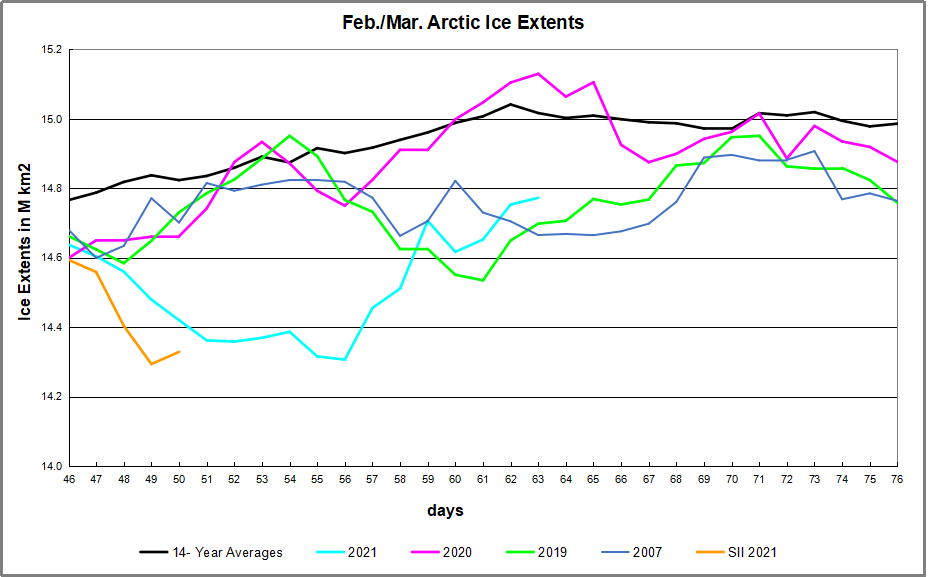
All of this means that 2021 will be hard pressed to pass the 15M km2 threshold.  The graph below shows the situation evolving over the last two weeks anticipating the annual maximum to appear within the fortnight.

Note that Sea Ice Index (SII) went offline day 51 so the MASIE record alone shows the loss of ice extent ending day 56 and climbing up to the present.  The NH ice extent gap is at 244k km2, or 1.6%.  Since the 14 year average has already peaked, further growth will narrow the margin.  (Note that ice extent is affected also by winds piling up drift ice, as well as melting from intrusions of warmer air or water.)

Last year surpassed the average while other recent years were lower.  We shall see what this year does with only 10 days or so to make a difference.

Region 2021063 Day 063 Average 2021-Ave. 2007063 2021-2007
 (0) Northern_Hemisphere 14772617 15016830 -244214 14665491 107126
 (1) Beaufort_Sea 1070689 1070254 435 1069711 978
 (2) Chukchi_Sea 966006 964118 1888 966006 0
 (3) East_Siberian_Sea 1087120 1087134 -14 1087137 -17
 (4) Laptev_Sea 897827 897842 -15 897845 -18
 (5) Kara_Sea 935006 929650 5356 932067 2939
 (6) Barents_Sea 805710 649490 156220 626044 179666
 (7) Greenland_Sea 669651 625085 44566 616841 52809
 (8) Baffin_Bay_Gulf_of_St._Lawrence 1224508 1553901 -329393 1220513 3995
 (9) Canadian_Archipelago 854597 853148 1450 852767 1830
 (10) Hudson_Bay 1260471 1260567 -96 1256718 3753
 (11) Central_Arctic 3197627 3222365 -24738 3229824 -32197
 (12) Bering_Sea 631115 686765 -55650 660726 -29612
 (13) Baltic_Sea 65146 97873 -32727 104884 -39738
 (14) Sea_of_Okhotsk 1090295 1084593 5703 1129107 -38812

The main deficit to average is in Baffin Bay, partly offset by a surplus in Barents.  Smaller pluses and minuses are found in other regions.

Typically, Arctic ice extent loses 67 to 70% of the March maximum by mid September, before recovering the ice in building toward the next March.

What will the ice do this year?  Where will 2020 rank in the annual Arctic Ice High Jump competition?

Drift ice in Okhotsk Sea at sunrise.

For more on the Pacific basins see post Meet Bering and Okhotsk Seas