Militant Medicine Breeds Bad Pandemic Policies

Perhaps you noticed how public health officials direct the war on coronavirus.  The generals obsess over “cases” and “deaths” while hiding numbers of “recoveries” and “cures.” The military paradigm has led pandemic policies seriously astray, as explained by Norman Doidge in his Tablet article Mad Science, Sane Science.  Excerpts in italics with my bolds.

There are more reasonable approaches to science and COVID-19 than the ‘eradication’ mentality that we lean on.

One cannot underestimate the extent to which modern medicine took up Bacon’s military metaphor of conquest and applied it to itself. This involved rejecting the ancient Hippocratic idea of healing, which—being part of that Greek worldview that saw us as of nature, and not against it—saw the physician as trying to work in alliance with nature, the patient (mind and body and spirit) and the patient’s family. But by the mid-1600s Thomas Sydenham, who became known as the “English Hippocrates,” saw medicine in a new way: “I attack the enemy within by means of cathartics and refrigerants, and by means of a diet”; he wrote, “a murderous array of disease has to be fought against, and the battle is not a battle for the sluggard …” Little has changed since. We see ourselves as engaged in endless wars: “The war against the virus,” “the war against cancer,” or against AIDS, “the war on drugs,” the “battle against heart disease,” we “combat” Alzheimer’s, and so on. As modern physicians came to see themselves as warriors and disease as “the enemy,” treatments became “weapons,” and drugs went from being healing potions to “magic bullets” and vaccines became “shots.”

We combat the enemy with “doctor’s orders,” from the medical “armamentarium,” or “arsenal” as we physicians call our bag of therapeutic tricks.

This military metaphor in medicine gives rise to a mentality that esteems invasive high-tech treatments as somehow more serious than less invasive ones—any collateral damage be damned. Of course, there is a time for a martial attitude in medicine, as, say, in emergencies: If a blood vessel in the brain bursts, the patient needs invasive surgery and a neurosurgeon with nerves of steel, to operate. But there are times when it sets us back. Today, rather than work with the patient as a key ally, we physicians often barely have time to listen to him or her speak. In this metaphor, the patient’s body is less an ally than the battlefield, and the patient is rendered passive, a helpless bystander, as he watches the confrontation that will determine his fate between the two great antagonists, the doctor (plus the scientific research establishment) and the disease (or pathogen). And of course, in the “war against the virus,” it is total “eradication” of such an enemy that is the goal. That, it would seem to us, Bacon’s offspring, as the only sensible approach.

As it turns out, so much of what ails us today are products of modern science and technology gone wild: lethal antibiotic-resistant organisms that our “total eradication of disease mentality” produced because we vastly overused the antibiotics we had (which, by the way, were originally natural products of nature, not the lab); pollution (of every element), chemicals in our baby food, toys, floors, and mattresses causing skyrocketing childhood illnesses; bioterrorism; loss of biodiversity affecting the food chain; fabulous totalitarian surveillance tools called cellphones, global networks that allow our enemies thousands of miles away to reach into the controls of our electrical grids, water systems, food delivery systems, banks, nuclear systems, computers, and control them, turning them on and off with a keystroke; 3D printers to make assault weapons in the basement, nuclear weapons to empower lunatics, industrialized death camps with cyanide showers, and, not to mention man-made environmental disruptions causing ecological catastrophes.
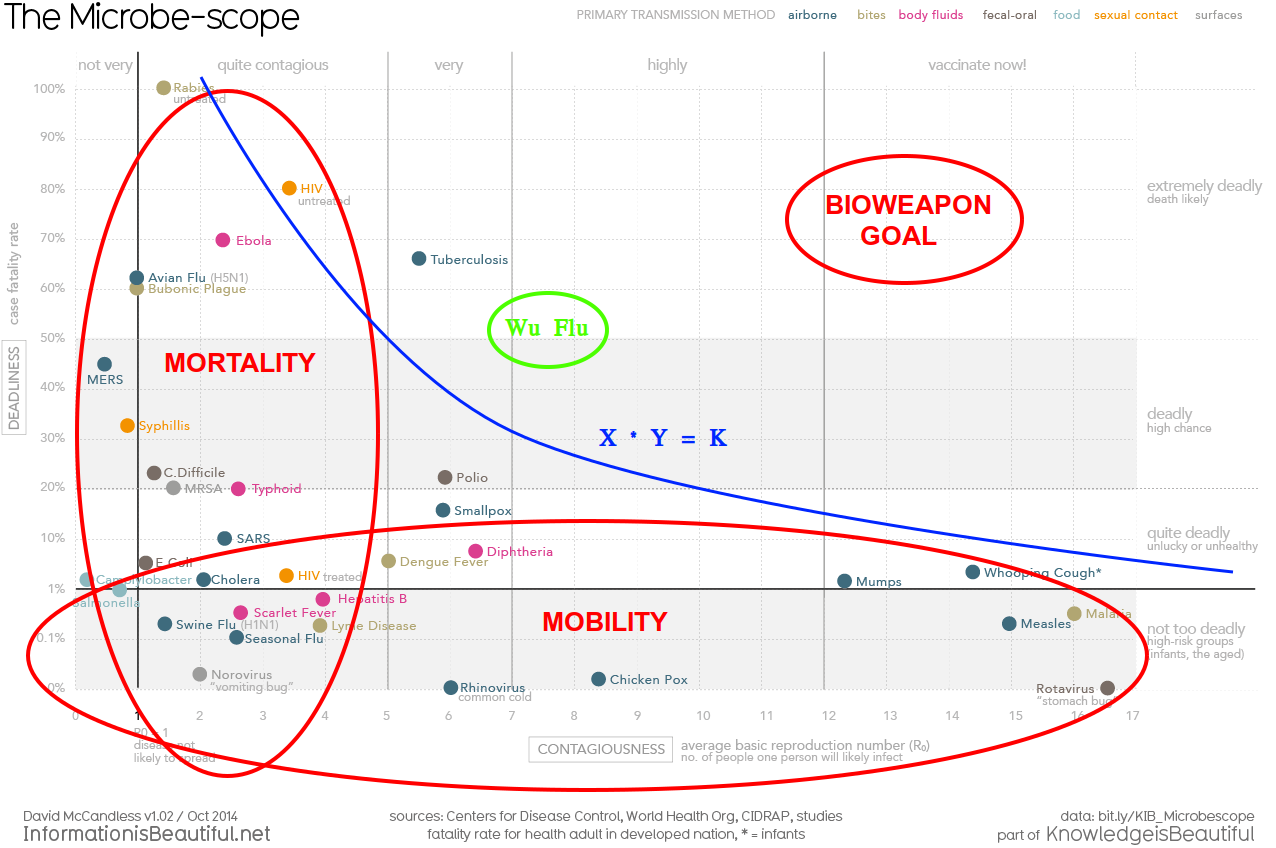
On this list of course, is also a pandemic that spread so rapidly because of air travel, and the “efficient” design of our urban centers which maximize overcrowding—and a microbe that may have originated in a lab known to be unsafe, and experimenting with bat viruses. “Just last year,” an article in Newsweek reported, “the National Institute for Allergy and Infectious Diseases, the organization led by Dr. Fauci, funded scientists at the Wuhan Institute of Virology and other institutions for work on gain-of-function research on bat coronaviruses.”

“Gain-of-function research” in this case means augmenting the virus’s contagiousness, and even lethality for the purpose of getting a head start on developing therapeutics or vaccines should it mutate in that direction. Such research is also the meat and potatoes germ-warfare research.. . . Whether or not Wuhan’s gain-of-function work involved creating an artificially enhanced coronavirus has been made almost impossible for outsiders to ascertain, because that lab’s government conveniently insisted it destroy its virus samples and records before an outside investigation could be done.

We are so reliably surprised and caught off guard by the unforeseen consequences of our technologies, and there are now so many serious cases of “science going wrong,” that it might be argued that, in practice, modern science (and the tech it produces) seems to be a machine designed to generate and maximize unintended consequences. And is hence, along with being powerful, also, quite often, ridiculous.

All of this is relevant to the current pandemic. In a way, there are three grand “strategies” to deal with a pandemic. But only one of them indulges the more lunatic strains of military metaphor in medicine.

  • The first strategy is never let it in.
  • The second, the approach most widely used at present, is to go to rather blunt lockdowns, while we develop therapeutics and vaccines to eradicate the virus.
  • The third is to resist lockdowns whenever possible, and instead focus on more differentiated measures than total societal closures, again while we develop therapeutics and vaccines to eradicate the virus.

If the virus doesn’t get in, people are not dying, there isn’t talk of eradication and the military metaphor isn’t used. That strategy has worked so far in Nauru, an island speck, in the paradise of Oceania, a country that is isolated, and small enough to walk across and around in one day, and which, along with Oceania’s Tuvalu, is tied for the record as being the least visited country in the world.

Even the relatively isolated, double-island paradise of New Zealand, was still too connected with the rest of the world to keep the virus out. When it did arrive there, New Zealand tried the second strategy, to eradicate it with a blunt lockdown.

The military metaphors began. Prime Minister Jacinda Ardern set the goal of “complete elimination of the virus.” France’s President Emmanuel Macron said, “We are at war … The enemy is there—invisible, elusive—and it is advancing.” Donald Trump described himself as “a wartime president.” War requires emergency measures, which require emergency powers, which demand the immediate suspension of civil liberties—with executives not bothering to go to legislatures because the enemy is coming at us “in waves,” and “surges,” is “killing us in droves.” We “hunker in our bunkers”—in total lockdown. Home’s the only place that’s safe. We must “mobilize” all society in immobility. Punish those who disobey orders. We do it, too, for the health care workers, the heroes on “the frontline,” who risked their lives.

But these undeniable similarities do not mean that medicine is war, any more than war is healing.

Perhaps the biggest problem with the military metaphor, is how it causes us to narrow our focus almost exclusively on “eradicating the virus,” and “cases of the infected.” This causes us to miss other important ways of dealing with it, that might help us survive it. Public health officials in the “the eradication mode” almost never mention how we can boost our immune systems with vitamins D and C, and zinc, exercise and weight loss. Not their focus. And the narrow focus on eradicating the virus is now causing serious “collateral” harm and death.

But it was not maliciousness but rather the virus eradication mindset that has caused much of the harm. That mindset has led many politicians, and also public health officials, to become oblivious to the death, illness, and devastation that have resulted from the lockdowns. Tedros’ own language speaks this obliviousness, when he says he knows people are “understandably frustrated with being confined to their homes” as though “frustration” is the extent of the problem. What is actually happening is that people’s worlds are collapsing. Fauci early on called the lockdown measure “inconvenient.”

Tedros and other lockdown supporters are almost all themselves employed, and working comfortably, many from home.

They are part of a class that has government, bureaucratic, educational, media, and corporate salaries, or are in Big Tech, which thrives in lockdown. With an often staggering indifference, they gloss over that fact that the measures they recommend “for all of us” are devastating to those working-class people, the poor, and small-business owners who are losing or have already lost their life savings, health insurance, health, and who are at risk of, or who have already been evicted from their apartments. By September we knew that nearly 60% of (mostly small) businesses that had been forced to close in lockdown were destroyed so their workers would have no jobs to return to. Many more have gone under since. They were closed by often illegal edicts, that left their large corporate competitors like Costco and Walmart open. Thus, instead of going to small widely separated community stores, that admitted a few at a time, people crowded into a few stores without social distancing—the complete reverse of a sensible, scientifically based policy. How did public health officials get away with destroying small business? This is war! Ignore that a meta-analysis of 10 countries and their regions, shows that during last spring, stringent stay and home and business closures did no better in slowing the virus than those that rely on voluntary measures (such as hand washing, social distancing, discouraging travel and large gatherings, successful case tracking, and testing). Gov. Andrew Cuomo’s own latest scientific statistics confirm that 74% of all New York COVID-19 transmission comes from indoor gatherings in private homes, and only 1.4% from in-restaurant dining (all set up for COVID now). The commander in chief says no to indoor restaurant dining in December. Now, even the WHO, which supported lockdowns, is claiming that closed Western economies are devastating poorer countries that are trading partners, and its special envoy for COVID-19, Dr. David Nabarro, has said the WHO anticipates a doubling of world poverty and a doubling of childhood malnutrition because of lockdowns.

The officials, blinded by the eradication at all costs mentality, discarded the practical wisdom required to respond to such a crisis, and endorsed an intervention that defies the standard public health practice of taking a holistic approach and always taking into account a measure’s total effects, and not just its immediate effects on the pathogen labeled as “the invisible enemy.”

“COVID denial” is real. So is “COVID-management-induced-devastation denial.”

What does a scientific approach look like, one that takes the best of our modern instruments that Bacon helped to facilitate, but which does not get us tangled up in the military metaphor, or make delusional attempts to artificially cut us off from the rest of nature?

That would be the approach of Janelle Ayres, Ph.D., a brilliantly original and constructive molecular and systems physiologist, and expert in both immunology and evolution, who heads two labs affiliated with the Salk Institute. Ayres’ work opens up a radically different approach to infectious disease—radical in the original sense of the word, meaning having to do with the root, i.e., the broader biological foundations of infectious disease and health in the “biome,” the sphere of living organisms in which we dwell, and which dwell within us. Thus, to my mind, her work has echoes with some of the ancient insights and intuitions about biological interconnectedness, though I’ve not seen her make this claim.

Ayres’ work is helping us reconceive our relationship to microbial organisms, including pathogens, and showing how they can, for instance, influence our evolution, and we theirs, and it gives us a much more detailed picture of how we actually survive serious infections. She happens to have written one of the best articles ever on COVID-19, that shows a breadth and depth of biological comprehension that is extremely rare among modern scientists who are often specialists in very circumscribed areas, who analyze things into ever smaller parts, and know an incredible amount about incredibly little. Ayres is both a first-rank specialist, and a big-think generalist.

She says, “The way we have been thinking about treating infectious diseases is that we have to annihilate the pathogens through vaccines and antimicrobials.” She completely reframes the problem, and challenges our thinking:

“Instead of asking how do we fight infections, we should be asking ‘how do we survive infections?’”

Changing that single word—“fight” to “survive”—transforms everything. Consider, for example, that new organisms, and strains are evolving all the time. A new coronavirus strain identified in December is said to be 70% more transmissible. Some new strains may be resistant to our existing vaccines and antivirals. Developing different antibiotics or vaccines to eradicate each of them, is not always possible, and when it is, generally takes a long time, and costs a fortune. But if, as is often the case, death is caused by our bodies’ own reactions to the infection, reactions which are very similar, regardless of the pathogen that caused them, learning to block the body from going into overdrive should help people survive multiple infections. As well, there is no reason to believe this approach will cause antibiotic-resistant, antiviral-resistant, or vaccine-resistant strains, because it is not targeting the pathogen per se.

In cooperative co-evolution, there is an incentive for us (or any infested animal) to develop methods to both prevent collateral damage to ourselves, as well as fix it when it occurs. That is the essence of the tolerance system. What Ayres and her colleagues are doing is describing these mechanisms—in minute molecular detail—in the body, and learning to read how organisms that are co-evolving with their hosts are communicating with them—sending signals back and forth. Ideally, the lab would ultimately learn how to use this information to enhance co-evolution in some way, to treat disease.

Ayres’ approach to COVID is not to minimize other approaches but point out that “if we can step beyond our focus on the virus,” there is much more we can learn. For instance, it was assumed early in the pandemic, that severe cases were caused by high viral load, and now we know it is the secondary collateral damage caused by our bodies that is the real killer.

Fewer and fewer medical schools now require the graduating physician to take the ancient Hippocratic oath, the first recorded articulation of medical ethics, that sanctified medical confidentiality and the idea that the doctor worked for his or her patient, and not a third party. How sad, how telling.

It is the same Hippocrates, who boiled all medicine down to two principles in his Epidemics Book I, “Practice two things in your dealing with disease: either help or do not harm the patient.”

And, in this light—of doing no harm, or at least far less—we might remember that we are part of nature, depend on it, it lives in us, and we have links to parts we think remote from us, that we often cannot even see. We might consider setting aside the utopian dream that always becomes a nightmare, because all too often we can’t conquer nature without conquering ourselves.

See Also:

The Virus Wars

Rx for Covid-fighting Politicians

Twelve Forgotten Principles of Public Health


Ending Wind and Solar Parasites

What’s the Problem with Electricity Rates?

This new Prager video explains (H/T Mark Krebs)

Background from Previous Post:

Norman Rogers writes at American Thinker What It Will Take for the Wind and Solar Industries to Collapse. Excerpts in italics with my bolds.

The solar electricity industry is dependent on federal government subsidies for building new capacity. The subsidy consists of a 30% tax credit and the use of a tax scheme called tax equity finance. These subsidies are delivered during the first five years.

For wind, there is subsidy during the first five to ten years resulting from tax equity finance. There is also a production subsidy that lasts for the first ten years.

The other subsidy for wind and solar, not often characterized as a subsidy, is state renewable portfolio laws, or quotas, that require that an increasing portion of a state’s electricity come from renewable sources. Those state mandates result in wind and solar electricity being sold via profitable 25-year power purchase contracts. The buyer is generally a utility with good credit. The utilities are forced to offer these terms in order to cause sufficient supply to emerge to satisfy the renewable energy quotas.

The rate of return from a wind or solar investment can be low and credit terms favorable because the investors see the 25-year contract by a creditworthy utility as a guarantee of a low risk of default. If the risk were to be perceived as higher, then a higher rate of return and a higher interest rate on loans would be demanded. That in turn would increase the price of the electricity generated.

The bankruptcy of PG&E, the largest California utility, has created some cracks in the façade. A bankruptcy judge has ruled that cancellation of up to $40 billion in long-term energy contracts is a possibility. These contracts are not essential or needed to preserve the supply of electricity because they are mostly for wind or solar electricity supply that varies with the weather and can’t be counted on. As a consequence, there has to exist and does exist the necessary infrastructure to supply the electricity needs without the wind or solar energy.

Probably the judge will be overruled for political reasons, or the state will step in with a bailout. Utilities have to keep operating, no matter what. Ditching wind and solar contracts would make California politicians look foolish because they have long touted wind and solar as the future of energy.

PG&E is in bankruptcy because California applies strict liability for damages from forest fires started by electric lines, no matter who is really at fault. Almost certainly the government is at fault for not anticipating the danger of massive fires and for not enforcing strict fire prevention and protection. Massive fire damage should be protected by insurance, not by the utility, even if the fire was started by a power line. The fire in question could just as well have been started by lightning or a homeless person. PG&E previously filed bankruptcy in 2001, also a consequence of abuse of the utility by the state government.

By far the most important subsidy is the renewable portfolio laws. Even if the federal subsidies are reduced, the quota for renewable energy will force price increases to keep the renewable energy industry in business, because it has to stay in business to supply energy to meet the quota. Other plausible methods of meeting the quota have been outlawed by the industry’s friends in the state governments. Nuclear and hydro, neither of which generates CO2 emissions, are not allowed. Hydro is not strictly prohibited — only hydro that involves dams and diversions. That is very close to all hydro. Another reason hydro is banned is that environmental groups don’t like dams.

For technical reasons, an electrical grid cannot run on wind or solar much more than 50% of the time. The fleet of backup plants must be online to provide adjustable output to compensate for erratic variations in wind or solar. Output has to be ramped up to meet early-evening peaks. Wind suffers from a cube power law, meaning that if the wind drops by 10%, the electricity drops by 30%. Solar suffers from too much generation in the middle of the day and not enough generation to meet early evening peaks in consumption.

When a “too much generation” situation happens, the wind or solar has to be curtailed. That means that the operators are told to stop delivering electricity. In many cases, they are not paid for the electricity they could have delivered. Some contracts require that they be paid according to a model that figures out how much they could have generated according to the recorded weather conditions. The more wind and solar, the more curtailments as the amount of erratic electricity approaches the allowable limits. Curtailment is an increasing threat, as quotas increase, to the financial health of wind and solar.

There is a movement to include batteries with solar installations to move excessive middle-of-the-day generation to the early evening. This is a palliative to extend the time before solar runs into the curtailment wall. The batteries are extremely expensive and wear out every five years.

Neither wind nor solar is competitive without subsidies. If the subsidies and quotas were taken away, no wind or solar operation outside very special situations would be built. Further, the existing installations would continue only as long as their contracts are honored and they are cash flow–positive. In order to be competitive, without subsidies, wind or solar would have to supply electricity for less than $20 per megawatt-hour, the marginal cost of generating the electricity with gas or coal. Only the marginal cost counts, because the fossil fuel plants have to be there whether or not there is wind or solar. Without the subsidies, quotas, and 25-year contracts, wind or solar would have to get about $100 per megawatt-hour for its electricity. That gap, between $100 and $20, is a wide chasm only bridged by subsidies and mandates.

The cost of using wind and solar for reducing CO2 emissions is very high. The most authoritative and sincere promoters of global warming loudly advocate using nuclear, a source that is not erratic, does not emit CO2 or pollution, and uses the cheapest fuel. One can buy carbon offsets for 10 or 20 times less than the cost of reducing CO2 emissions with wind or solar. A carbon offset is a scheme where the buyer pays the seller to reduce world emissions of CO2. This is done in a variety of ways by the sellers.

The special situations where wind and solar can be competitive are remote locations using imported oil to generate electricity. In those situations, the marginal cost of the electricity may be $200 per megawatt-hour or more. Newfoundland comes to mind — for wind, not solar.

Maintenance costs for solar are low. For wind, maintenance costs are high, and major components, such as propeller blades and gearboxes, may fail, especially as the turbines age. These heavy and awkward objects are located hundreds of feet above ground. There exists a danger that wind farms will fail once the inflation-protected subsidy of $24 per megawatt-hour runs out after ten years. At that point, turbines that need expensive repairs may be abandoned. Wind turbine graveyards from the first wind fad in the 1970s can be seen near Palm Springs, California. Wind farms can’t receive the production subsidy unless they can sell the electricity. That has resulted paying customers to “buy” the electricity.

Tehachapi’s dead turbines.

A significant financial risk is that the global warming narrative may collapse. If belief in the reality of the global warming threat collapses, then the major intellectual support for renewable energy will collapse. It is ironic that the promoters of global warming are campaigning to require companies to take into account the threat of global warming in their financial projections. If the companies do this in an honest manner, they also have to take into account the possibility that the threat will evaporate. My own best guess, after considerable technical study, is that it is near a sure thing that the threat of global warming is imaginary and largely invented by the people who benefit. Adding CO2 to the atmosphere has well understood positive effects for the growth of crops and the greening of deserts.

The conservative investors who make long-term investments in wind or solar may be underestimating the risks involved. For example, an article in Chief Investment Officer magazine stated that CalPERS, the giant California public employees retirement fund, is planning to expand investments in renewable energy, characterized as “stable cash flowing assets.” That article was written before the bankruptcy of PG&E. The article also stated that competition among institutional investors for top yielding investments in the alternative energy space is fierce.

Wind and solar are not competitive and never will be. They have been pumped up into supposedly solid investments by means of ill advised subsidies and mandates. At some point, the governments will wake up to the waste and foolishness involved. At that point, the value of these investments will collapse. It won’t be the first time that investment experts made bad investments because they don’t really understand what is going on.

Footnote:  There is also a report from GWPF on environmental degradation from industrial scale wind and solar:

Enough of Cancerous Cancel Culture


If you live and let live, you accept people who behave and think differently from you. The social fabric of the country is changing, but people must learn to live and let live. The opposite attitude is the current practice of denunciation,  the drive to cast into outer darkness anyone who thinks, talks or acts differently than some proscribed standard of political correctness.

This hateful, poisonous spirit sets family, friends and neighbors against one another and undermines our society and civilization.  So enough of the cancerous cancel culture; replace it with tolerance and respect for others.

A another similar expression was written by General John Stark and become the official motto of the state of New Hampshire:

The idea promoted with the NH motto and the Don’t Tread on Me phrase is simple, “leave me alone to live in peace, to do what I do best, and as long as my actions do not cause physical harm to others there is no need for your intervention. It is about free will, personal choice, and freedom without rulers or government overloads.

What is so dangerous about this current oppressive social climate is explained by Izabella Tabarovsky drawing on her experience of Soviet Russia to expose the cultural revolution currently attacking the roots of American civil society. Her article at the Tablet is The American Soviet Mentality. Excerpts in italics with my bolds.

Collective demonization invades our culture

Russians are fond of quoting Sergei Dovlatov, a dissident Soviet writer who emigrated to the United States in 1979: “We continuously curse Comrade Stalin, and, naturally, with good reason. And yet I want to ask: who wrote four million denunciations?” It wasn’t the fearsome heads of Soviet secret police who did that, he said. It was ordinary people.

Collective demonizations of prominent cultural figures were an integral part of the Soviet culture of denunciation that pervaded every workplace and apartment building. Perhaps the most famous such episode began on Oct. 23, 1958, when the Nobel committee informed Soviet writer Boris Pasternak that he had been selected for the Nobel Prize in literature—and plunged the writer’s life into hell. Ever since Pasternak’s Doctor Zhivago had been first published the previous year (in Italy, since the writer could not publish it at home) the Communist Party and the Soviet literary establishment had their knives out for him. To the establishment, the Nobel Prize added insult to grave injury.

None of those who joined the chorus of condemnation, naturally, had read the novel—it would not be formally published in the USSR until 30 years later. But that did not stop them from mouthing the made-up charges leveled against the writer. It was during that campaign that the Soviet catchphrase “ne chital, no osuzhdayu”—“didn’t read, but disapprove”—was born: Pasternak’s accusers had coined it to protect themselves against suspicions of having come in contact with the seditious material. Days after accepting the Nobel Prize, Pasternak was forced to decline it. Yet demonization continued unabated.

Some of the greatest names in Soviet culture became targets of collective condemnations—composers Dmitry Shostakovich and Sergei Prokofiev; writers Anna Akhmatova and Iosif Brodsky; and many others. Bouts of hounding could go on for months and years, destroying people’s lives, health and, undoubtedly, ability to create. (The brutal onslaught undermined Pasternak’s health. He died from lung cancer a year and a half later.) But the practice wasn’t reserved for the greats alone. Factories, universities, schools, and research institutes were all suitable venues for collectively raking over the coals a hapless, ideologically ungrounded colleague who, say, failed to show up for the “voluntary-obligatory,” as a Soviet cliché went, Saturday cleanups at a local park, or a scientist who wanted to emigrate. The system also demanded expressions of collective condemnations with regards to various political matters: machinations of imperialism and reactionary forces, Israeli aggression against peaceful Arab states, the anti-Soviet international Zionist conspiracy. It was simply part of life.

Twitter has been used as a platform for exercises in unanimous condemnation
for as long as it has existed.

Countless careers and lives have been ruined as outraged mobs have descended on people whose social media gaffes or old teenage behavior were held up to public scorn and judged to be deplorable and unforgivable. But it wasn’t until the past couple of weeks that the similarity of our current culture with the Soviet practice of collective hounding presented itself to me with such stark clarity. Perhaps it was the specific professions and the cultural institutions involved—and the specific acts of writers banding together to abuse and cancel their colleagues—that brought that sordid history back.

On June 3, The New York Times published an opinion piece that much of its progressive staff found offensive and dangerous. (The author, Republican Sen. Tom Cotton, had called to send in the military to curb the violence and looting that accompanied the nationwide protests against the killing of George Floyd.) The targets of their unanimous condemnation, which was gleefully joined by the Twitter proletariat, which took pleasure in helping the once-august newspaper shred itself to pieces in public, were New York Times’ opinion section editor James Bennet, who had ultimate authority for publishing the piece, though he hadn’t supervised its editing, and op-ed staff editor and writer Bari Weiss (a former Tablet staffer).

Weiss had nothing to do with editing or publishing the piece. On June 4, however, she posted a Twitter thread characterizing the internal turmoil at the Times as a “civil war” between the “(mostly young) wokes” who “call themselves liberals and progressives” and the “(mostly 40+) liberals” who adhere to “the principles of civil libertarianism.” She attributed the behavior of the “wokes” to their “safetyism” worldview, in which “the right of people to feel emotionally and psychologically safe trumps what were previously considered core liberal values, like free speech.”  See Update: Stories vs. Facts

It was just one journalist’s opinion, but to Weiss’ colleagues her semi-unflattering description of the split felt like an intolerable attack against the collective. Although Weiss did not name anyone in either the “woke” or the older “liberal” camp, her younger colleagues felt collectively attacked and slandered. They lashed out. Pretty soon, Weiss was trending on Twitter.

As the mob’s fury kicked into high gear, the language of collective outrage grew increasingly strident, even violent.

Goldie Taylor, writer and editor-at-large at The Daily Beast, queried in a since-deleted tweet why Weiss “still got her teeth.” With heads rolling at the Times—James Bennet resigned, and deputy editorial page editor James Dao was reassigned to the newsroom—one member of the staff asked for Weiss to be fired for having bad-mouthed “her younger newsroom colleagues” and insulted “all of our foreign correspondents who have actually reported from civil wars.” (It was unclear how she did that, other than having used the phrase “civil war” as a metaphor.)

Mehdi Hasan, a columnist with the Intercept, opined to his 880,000 Twitter followers that it would be strange if Weiss retained her job now that Bennet had been removed. He suggested that her thread had “mocked” her nonwhite colleagues. (It did not.) In a follow-up tweet Hasan went further, suggesting that to defend Weiss would make one a bad anti-racist—a threat based on a deeply manipulated interpretation of Weiss’ post, yet powerful enough to stop his followers from making the mistake.

All of us who came out of the Soviet system bear scars of the practice of unanimous condemnation, whether we ourselves had been targets or participants in it or not. It is partly why Soviet immigrants are often so averse to any expressions of collectivism: We have seen its ugliest expressions in our own lives and our friends’ and families’ lives. It is impossible to read the chastising remarks of Soviet writers, for whom Pasternak had been a friend and a mentor, without a sense of deep shame. Shame over the perfidy and lack of decency on display. Shame at the misrepresentations and perversions of truth. Shame at the virtue signaling and the closing of rank. Shame over the momentary and, we now know, fleeting triumph of mediocrity over talent.

In a collectivist culture, one hoped-for result of group condemnations is control—both over the target of abuse and the broader society. When sufficiently broad levels of society realize that the price of nonconformity is being publicly humiliated, expelled from the community of “people of goodwill” (another Soviet cliché) and cut off from sources of income, the powers that be need to work less hard to enforce the rules.

For the regular people—those outside prestigious cultural institutions—participation in local versions of collective hounding was not without its benefits, either. It could be an opportunity to eliminate a personal enemy or someone who was more successful and, perhaps, occupied a position you craved. You could join in condemning a neighbor at your cramped communal flat, calculating that once she was gone, you could add some precious extra square meters to your living space.

The mobs that perform the unanimous condemnation rituals of today do not follow orders from above. But that does not diminish their power to exert pressure on those under their influence.

Those of us who came out of the collectivist Soviet culture understand these dynamics instinctively. You invoked the “didn’t read, but disapprove” mantra not only to protect yourself from suspicions about your reading choices but also to communicate an eagerness to be part of the kollektiv—no matter what destructive action was next on the kollektiv’s agenda. You preemptively surrendered your personal agency in order to be in unison with the group. And this is understandable in a way: Merging with the crowd feels much better than standing alone.

Americans have discovered the way in which fear of collective disapproval breeds self-censorship and silence, which impoverish public life and creative work. The double life one ends up leading—one where there is a growing gap between one’s public and private selves—eventually begins to feel oppressive. For a significant portion of Soviet intelligentsia (artists, doctors, scientists), the burden of leading this double life played an important role in their deciding to emigrate.

Those who join in the hounding face their own hazards. The more loyalty you pledge to a group that expects you to participate in rituals of collective demonization, the more it will ask of you and the more you, too, will feel controlled. How much of your own autonomy as a thinking, feeling person are you willing to sacrifice to the collective? What inner compromises are you willing to make for the sake of being part of the group? Which personal relationships are you willing to give up?

From my vantage point, this cultural moment in these United States feels incredibly precarious.

The practice of collective condemnation feels like an assertion of a culture that ultimately tramples on the individual and creates an oppressive society. Whether that society looks like Soviet Russia, or Orwell’s Nineteen Eighty-Four, or Castro’s Cuba, or today’s China, or something uniquely 21st-century American, the failure of institutions and individuals to stand up to mob rule is no longer an option we can afford.

Comment:  Precarious, indeed.  For Background, See Patriotism vs. Multiculturalism

2021 Arctic Ice Seesaw

In January, most of the Arctic ocean basins are frozen over, and so the growth of ice extent slows down.  According to SII (Sea Ice Index) January on average adds 1.3M km2, and this month it was 1.4M.  (background is at Arctic Ice Year-End 2020).  The few basins that can grow ice this time of year tend to fluctuate and alternate waxing and waning, which appears as a see saw pattern in these images.

Here is the Atlantic seesaw with Barents and Baffin.

The animation above shows the Atlantic side with Barents on the left almost doubling in the last 3 weeks, from 365k km2 ice extent to 690k km2 yesterday (88% of last March maximmum).  Meanwhile Greenland Sea in the center between Iceland and Greenland started with 708k km2 and was 621k km2 yesterday.  Maximum ice extent in this basin was 783k km2 last year.  Baffin Bay below and to the right of Greenland waffles up and down a bit with little change (from 993k km2 to 1000k km2 with last year’s max 1550k).

And here is the Pacific seesaw with Bering and Okhotsk.

The most dramatic teeter-totter comes in the two Pacific basins of Bering Sea and Sea of Okhotsk, shown in the animation above. Okhotsk on the left in 3 weeks grew ice extent from 652k km2 to 900k yesterday, nearly 80% of 2020 max of 1140k km2.  Yet just a few days ago, Okhotsk was at 972k.  Meanwhile Bering Sea is seen fluctuating back and forth while gaining extent from 360k km2 up to 545k, 67% of last year’s max.

While the seesaws are tilting back and forth on the margins, the bulk of the Arctic is frozen solid. And with limited places where more extent can be added, the pace of overall growth has slowed.

The graph shows the 14-year average gain for January is 1.3M km2.  2020 matched the average while this and other recent years were lower.  SII shows lower extents most of the month before aligning with MASIE at the end. Presently 2021 is ~290k km2 or 2% deficit to average, or lagging about a week behind.

The polar bears have a Valentine Day’s wish for Arctic Ice.

welovearcticicefinal

And Arctic Ice loves them back, returning every year so the bears can roam and hunt for seals.

Footnote:

Seesaw accurately describes Arctic ice in another sense:  The ice we see now is not the same ice we saw previously.  It is better to think of the Arctic as an ice blender than as an ice cap, explained in the post The Great Arctic Ice Exchange.

Covid Rapid Tests Finally Out from Quebec Storage (200 Scientists Ask)

Our son is working mightily to keep his HVAC enterprise alive during the contagion.  Last week a key employee after visiting a pharmacy where a person tested positive was told to go home and get tested (took two days), and then stay home to wait for results (3 more days).  So a work week was lost and the business hobbled during that time.  So I wondered what happened to all those rapid covid tests that were purchased back in September.

The story came out in the Montreal Gazette January 14, 2021 Scientists publish open letter calling for Quebec to use rapid testing.  Excerpts in italics with my bolds.

“We have 1.2 million of those tests just sitting in a warehouse in Farnham,” Université de Montréal professor Roxane Borgès Da Silva says.

A group of 213 scientists, professors, health-care workers and patients published an open letter to the Legault government Thursday calling on Quebec to roll out rapid COVID-19 tests to curb outbreaks more quickly and to step up its communications strategy.

“We have 1.2 million of those tests just sitting in a warehouse in Farnham,” Roxane Borgès Da Silva, a professor with the Université de Montréal’s school of public health, said in an interview Wednesday night. “We have reached a point in the evolution of the pandemic where the health system is at the breaking point. It is time that we use every tool at our disposal.

In the letter, the signatories from institutions including the Université de Montréal, McGill, Laval, UQAM and the Institut national de santé publique du Québec (INSPQ), note the partial closure of businesses and restrictions on gatherings have failed to stem the increase in coronavirus cases, hospitalizations and deaths.

With a month-long curfew instituted Saturday, officials must take advantage of the expected decline in cases to counter the spread through better screening, which is “all the more important in a context where possible variants of the SARS-CoV-2 virus, which are more infectious, could spread in Quebec,” the letter reads.

Using rapid tests could help to identify positive cases more quickly, particularly those among asymptomatic patients and those who have been at so-called “super-spreader” events, the letter states

“In this regard, we believe that the simple and widely available access throughout the territory to rapid tests … allowing a result to be obtained in a few minutes could be a game-changer, especially in places of propagation.”

Quebec has been hesitant to use the tests widely because it fears their lack of sensitivity could clear people for COVID-19 when they actually have the virus. But Da Silva said the tests are close to 90-per-cent accurate when used on patients who are in an extremely contagious phase, which is crucial to stopping the most dangerous transmitters. The tests could be used at workplaces, high schools and CHSLDs, or be made available at pharmacies and doctors’ offices to allow the public to get tested quickly, Da Silva said.

As well, the signatories argue the government needs to do a better job of transmitting data and information to the public to improve citizens’ confidence in the science and improve compliance with regulations. They suggest using improved communication campaigns that appeal to the general public and using new strategies that incorporate humour and music.

More from CBC (here): 

The tests, which return a result in as little as 15 minutes, have variously been called a “game-changer” (Ontario Premier Doug Ford) and “less safe” as the gold-standard PCR lab test (Quebec Health Minister Christian Dubé, to Le Devoir).

The chair of McGill University’s bioengineering department, Dr. David Juncker, leans to the Ford end of the spectrum —provided the tests are used effectively. Right now they are not, he said, and it’s to the detriment of the broader testing effort.

“The current testing system isn’t very effective in terms of contact, trace and isolate … it’s too slow, it’s too cumbersome, it has too many delays. That’s one of the reasons we’re failing in containing the spread of the pandemic,” said Juncker, an expert on diagnostic testing.

The main area of concern for the provincial government — also voiced by federal officials — is the the rapid test’s lower accuracy, or sensitivity, and the risk of false negatives.

Those fears are overblown, in Juncker’s view, because the rapid tests can still help ferret out highly infectious people.

“If we just speak about diagnostic performance … the PCR test is the most effective one,” he said. “But if we think about what we want to use this for, as a public health tool that we want to use to contain and detect infectious individuals very quickly and isolate them very fast, that’s where rapid tests can be very helpful.”
Comment:  The need is to quickly identify people with enough viral load to infect others, and to become sick themselves.  Rapid tests excel at this when applied to people with symptoms that might or might not be Covid19.  Officials have been obsessed with PCR tests which are hyper-sensitive and show people as positive with too little load or even from a trace of dead virus.  Those false positives generate lots of fear and clog the system with people unnecessarily.

Background from Previous Post On Non-Infectious Covid Positives

Daniel Payne writes at Just the News Growing research indicates many COVID-19 cases might not be infectious at all. Excerpts in italics with my bolds.

Elevated ‘cycle thresholds’ may be detecting virus long after it is past the point of infection.

A growing body of research suggests that a significant number of confirmed COVID-19 infections in the U.S. — perhaps as many as 9 out of every 10 — may not be infectious at all, with much of the country’s testing equipment possibly picking up mere fragments of the disease rather than full-blown infections.

Yet a burgeoning line of scientific inquiry suggests that many confirmed infections of COVID-19 may actually be just residual traces of the virus itself, a contention that — if true — may suggest both that current high levels of positive viruses are clinically insignificant and that the mitigation measures used to suppress them may be excessive.

Background from previous post: New Better and Faster Covid Test

Kevin Pham reports on a breakthrough in coronavirus testing. Excerpts in italics with my bolds.

Another new test for COVID-19 was recently authorized — and this one could be a game-changer.

The Abbot Diagnostics BinaxNOW antigen test is a new point-of-care test that reportedly costs only $5 to administer, delivers results in as little as 15 minutes, and requires no laboratory equipment to perform. That means it can be used in clinics far from commercial labs or without relying on a nearby hospital lab.

That last factor is key. There are other quick COVID-19 tests on the market, but they have all required lab equipment that can be expensive to maintain and operate, and costs can be prohibitive in places that need tests most.

This kind of test is reminiscent of rapid flu tests that are ubiquitous in clinics. They’ll give providers tremendous flexibility in testing for the disease in not just clinics, but with trained and licensed medical professionals, in schools, workplaces, camps, or any other number of places.

So what’s new about this test? Most of the current tests detect viral RNA, the genetic material of SARS-CoV-2. This is a very accurate way of detecting the virus, but it requires lab equipment to break apart the virus and amplify the amount of genetic material to high enough levels for detection.

The BinaxNOW test detects antigens — proteins unique to the virus that are usually detectable whenever there is an active infection.

Abbott says it intends to produce 50 million tests per month starting in October. That’s far more than the number tested in July, when we were breaking new testing records on a daily basis with approximately 23 million tests recorded.

There’s a more important reason to be encouraged by this test coming available.  The viral load is not amplified by the test, so a positive is actually a person needing isolation and treatment.  As explained in a previous post below,  the PCR tests used up to now clutter up the record by showing as positive people with viral loads too low to be sick or to infect others.

Background from Previous Post The Truth About CV Tests

The peoples’ instincts are right, though they have been kept in the dark about this “pandemic” that isn’t.  Responsible citizens are starting to act out their outrage from being victimized by a medical-industrial complex (to update Eisenhower’s warning decades ago).  The truth is, governments are not justified to take away inalienable rights to life, liberty and the pursuit of happiness.  There are several layers of disinformation involved in scaring the public.  This post digs into the CV tests, and why the results don’t mean what the media and officials claim.

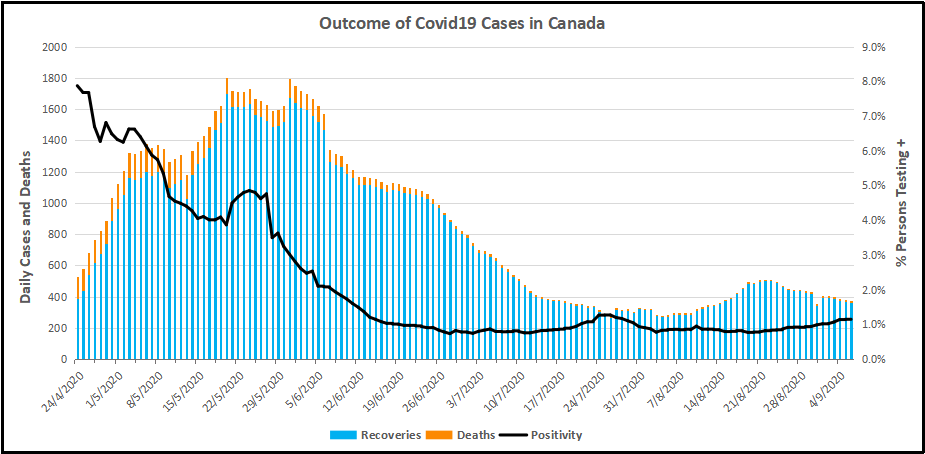
For months now, I have been updating the progress in Canada of the CV outbreak.  A previous post later on goes into the details of extracting data on tests, persons testing positive (termed “cases” without regard for illness symptoms) and deaths after testing positive.  Currently, the contagion looks like this.

The graph shows that deaths are less than 5 a day, compared to a daily death rate of 906 in Canada from all causes.  Also significant is the positivity ratio:  the % of persons testing positive out of all persons tested each day.  That % has been fairly steady for months now:  1% positive means 99% of people are not infected. And this is despite more than doubling the rate of testing.

But what does testing positive actually mean?  Herein lies more truth that has been hidden from the public for the sake of an agenda to control free movement and activity.  Background context comes from  Could Rapid Coronavirus Testing Help Life Return To Normal?, an interview at On Point with Dr. Michael Mina.  Excerpts in italics with my bolds. H/T Kip Hansen

A sign displays a new rapid coronavirus test on the new Abbott ID Now machine at a ProHEALTH center in Brooklyn on August 27, 2020 in New York City. (Spencer Platt/Getty Images)

Dr. Michael Mina:

COVID tests can actually be put onto a piece of paper, very much like a pregnancy test. In fact, it’s almost exactly like a pregnancy test. But instead of looking for the hormones that tell if somebody is pregnant, it looks for the virus proteins that are part of SA’s code to virus. And it would be very simple: You’d either swab the front of your nose or you’d take some saliva from under your tongue, for example, and put it onto one of these paper strips, essentially. And if you see a line, it means you’re positive. And if you see no line, it means you are negative, at least for having a high viral load that could be transmissible to other people.

An antigen is one of the proteins in the virus. And so unlike the PCR test, which is what most people who have received a test today have generally received a PCR test. And looking those types of tests look for the genome of the virus to RNA and you could think of RNA the same way that humans have DNA. This virus has RNA. But instead of looking for RNA like the PCR test, these antigen tests look for pieces of the protein. It would be like if I wanted a test to tell me, you know, that somebody was an individual, it would actually look for features like their eyes or their nose. And in this case, it is looking for different parts of the virus. In general, the spike protein or the nuclear capsid, these are two parts of the virus.

The reason that these antigen tests are going to be a little bit less sensitive to detect the virus molecules is because there’s no step that we call an amplification step. One of the things that makes the PCR test that looks for the virus RNA so powerful is that it can take just one molecule, which the sensor on the machine might not be able to detect readily, but then it amplifies that molecule millions and millions of times so that the sensor can see it. These antigen tests, because they’re so simple and so easy to use and just happen on a piece of paper, they don’t have that amplification step right now. And so they require a larger amount of virus in order to be able to detect it. And that’s why I like to think of these types of tests having their primary advantage to detect people with enough virus that they might be transmitting or transmissible to other people.”

The PCR test, provides a simple yes/no answer to the question of whether a patient is infected.
Source: Covid Confusion On PCR Testing: Maybe Most Of Those Positives Are Negatives.

Similar PCR tests for other viruses nearly always offer some measure of the amount of virus. But yes/no isn’t good enough, Mina added. “It’s the amount of virus that should dictate the infected patient’s next steps. “It’s really irresponsible, I think, to [ignore this]” Dr. Mina said, of how contagious an infected patient may be.

We’ve been using one type of data for everything,” Mina said. “for [diagnosing patients], for public health, and for policy decision-making.”

The PCR test amplifies genetic matter from the virus in cycles; the fewer cycles required, the greater the amount of virus, or viral load, in the sample. The greater the viral load, the more likely the patient is to be contagious.

This number of amplification cycles needed to find the virus, called the cycle threshold, is never included in the results sent to doctors and coronavirus patients, although if it was, it could give them an idea of how infectious the patients are.

One solution would be to adjust the cycle threshold used now to decide that a patient is infected. Most tests set the limit at 40, a few at 37. This means that you are positive for the coronavirus if the test process required up to 40 cycles, or 37, to detect the virus.

Any test with a cycle threshold above 35 is too sensitive, Juliet Morrison, a virologist at the University of California, Riverside told the New York Times. “I’m shocked that people would think that 40 could represent a positive,” she said.

A more reasonable cutoff would be 30 to 35, she added. Dr. Mina said he would set the figure at 30, or even less.

Another solution, researchers agree, is to use even more widespread use of Rapid Diagnostic Tests (RDTs) which are much less sensitive and more likely to identify only patients with high levels of virus who are a transmission risk.

Comment:  In other words, when they analyzed the tests that also reported cycle threshold (CT), they found that 85 to 90 percent were above 30. According to Dr. Mina a CT of 37 is 100 times too sensitive (7 cycles too much, 2^7 = 128) and a CT of 40 is 1,000 times too sensitive (10 cycles too much, 2^10 = 1024). Based on their sample of tests that also reported CT, as few as 10 percent of people with positive PCR tests actually have an active COVID-19 infection. Which is a lot less than reported.

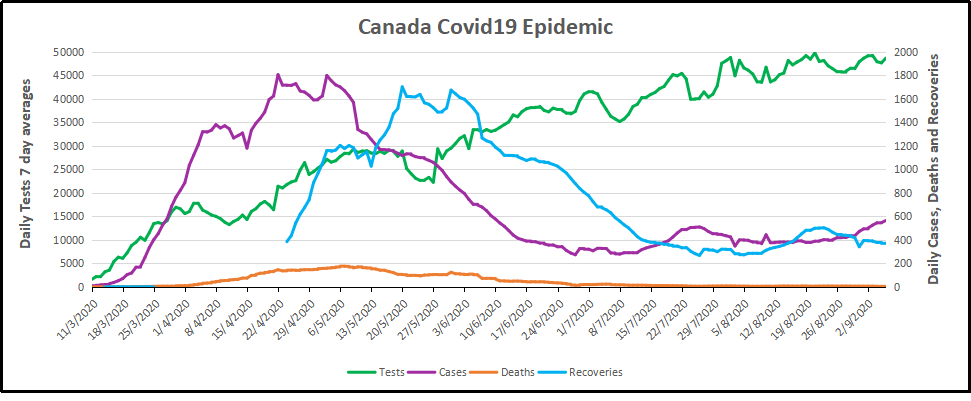
Here is a graph showing how this applies to Canada.

It is evident that increased testing has resulted in more positives, while the positivity rate is unchanged. Doubling the tests has doubled the positives, up from 300 a day to nearly 600 a day presently.  Note these are PCR results. And the discussion above suggests that the number of persons with an active infectious viral load is likely 10% of those reported positive: IOW up from 30 a day to 60 a day.  And in the graph below, the total of actual cases in Canada is likely on the order of 13,000 total from the last 7 months, an average of 62 cases a day.


Salla Finland Should Host 2032 Summer Olympics

The Big Issue reports Why a tiny town in Lapland is bidding to host the summer Olympics.  Excerpts in italics with my bolds.

The residents of the Finnish town Salla are making the most of climate change, saying they’d be the perfect host of the 2032 Olympics: “Warm heart, we have it. Warm place, coming soon.”

“Welcome to Salla, the coldest place in Finland,” says local mayor Erkki Parkkinen in a tongue-in-cheek video declaring its candidacy, as residents explain how by 2032 Salla would be the ideal host.

“In 12 years, ice will be gone and this will be a perfect lake,” says a man taking a dip in freezing water while eating an ice cream. “No more slippery ice, thanks global warming!” adds a skateboarder.

Salla may only have a population of around 3,000 people – who are greatly outnumbered by the reindeer in the area – but it has plenty of sporting facilities.

A map of the town has been created showing where activities happen. Today there is skating and curling on the frozen lake. By 2032, those will become the swimming and beach volleyball arenas.

Salla residents look forward to the impact climate change will bring

Like all other Olympic Games, branding is of prime importance. Salla’s logo has the yellow Olympic ring melting snow on a mountain. There’s also a mascot – Kesa the heat-exhausted reindeer.

Kesa, the heat exhausted reindeer is Salla’s Olympic mascot

Footnote:  Greta’s Fridays for the Future appears at the end of the video clip.  So she should go all in for Salla 2032 since she is certain the planet has a fever with a 12-year deadline.

Actually, the notion of Salla 2032 is not that far-fetched, since July average temperatures are 15 degrees Celsius, along with long days of sunshine.  Montreal hosted the 1976 summer games, and we have ice hotels in the winter and nearly as much snow as Moscow.  The comedy is about the remoteness and facilities, not about the weather.  But there is hope for Salla: in Canada our average temperatures have risen by 1.7 C over the last 70 years, and it has been a great boon for our health and prosperity, not to mention record-setting crops from more CO2 in the air.  Why not for Finland as well?

Biden’s Hostile Takeover Triggers Poison Pills

Poison Pill is a defensive mechanism technique prevalent in the corporate world to thwart a hostile takeover. It is a strategy used by the Target Company to avoid the hostile takeovers completely or at least slow down the acquiring process.(Source: financemanagement.com)

Rupert Darwall explains the traps and pitfalls in the way of the Biden agenda in his Epoch Times article Fettering Biden’s Administrative State.  Excerpts in italics with my bolds.

Trump-era rules will constrain the new president’s activism

The administrative state will get a new lease on life under President Joe Biden, but America’s administrative state is far more constrained than that of many other countries. Britain, for example, wrote its net-zero climate target into law after only a 90-minute debate in the House of Commons, without any examination of what the cost might be. Arguably the European Union is an administrative state, where the unelected European Commission proposes legislation, enforces it, and even levies billion-euro fines on companies without so much as a court hearing.

By contrast, executive-agency rulemaking in the United States is more circumscribed. Agencies must show cause, respect precedent, and demonstrate that their rulemaking is properly grounded in the relevant statute and in a factual record sufficiently compelling to refute any suggestion that their action was “arbitrary or capricious.” They should expect controversial rules to be able to withstand challenges in the courts.

In 2016, the Supreme Court stayed the Environmental Protection Agency’s Clean Power Plan promulgated by the Obama administration to decarbonize the electrical grid. On the last full day of the Trump administration, the U.S. Court of Appeals for the District of Columbia vacated the Obama plan’s successor, the Affordable Clean Energy plan, in a 2-1 opinion. The majority ruled that the EPA’s interpretation of the Clean Air Act had been too narrow; the dissenting judge—a Trump appointee—opined that both plans relied erroneously on the wrong provision of the Act to regulate greenhouse-gas emissions. These rulings illustrate just how difficult the EPA will find crafting a new rule to fulfill Biden’s promise to decarbonize the grid by 2035.[See post: Latest Court Ruling re EPA and CO2]

The new administration is constrained not only by the courts but also by the late-term rulemaking of its predecessor. It could use the 1996 Congressional Review Act to nullify recently finalized federal regulations with a simple majority vote in each house of Congress. But Republicans can inflict a political price. Last October, the Department of Labor finalized a financial factors rule. It requires managers of corporate pension plans to justify incorporation of environmental, social, and corporate governance (ESG) factors solely on the grounds of boosting risk-adjusted investment returns by reference to generally accepted investment theories.

Wall Street hated it when the rule was first proposed, but all it does is operationalize the requirement of the Employee Retirement Income Security Act (ERISA) of 1974 that plan managers perform their duties for the exclusive purpose of providing benefits to plan beneficiaries and defraying reasonable plan expenses. In reality, opponents of the rule oppose the exclusivity hardwired into ERISA that pension savings be invested with “eye single” to the interests of plan beneficiaries. A vote to nullify the rule would be a vote in favor of socializing retirees’ savings and deploy them for wider societal ends. For Republicans, it would be a debate worth having.

Similarly, congressional Republicans can gain politically by taking a stand opposing nullification of the EPA’s Jan. 3, 2021 transparency-in-science rule. This rule broadens and strengthens the agency’s 2018 transparency rule and aims to ensure that regulatory decisions are taken on the basis of robust, verifiable scientific studies. Polling shows that voters are more motivated to support environmental regulations when presented as protecting public health. This creates a market for studies linking pollution to public-health harms, however flimsy they might be. Environmental regulations mandating national standards on ozone and PM2.5 targeting fossil-fuel combustion are often based on epidemiological studies drawing on undisclosed data that can’t be re-analyzed to check for errors and sensitivity to assumptions.

A justification often made for this anti-scientific practice is safeguarding patient anonymity in such studies, lsomething for which the new rule provides. Covering up is never a good look, however, and the spectacle of the self-proclaimed party of science arguing for secret science and against transparency would demonstrate how deeply politicized the science used to justify environmental regulation has become.

The Trump administration left the best till last. With just one week to go, on Jan. 13, the Federal Register published an EPA regulation that quickly became known as the banana peel rule. Section 111(b) of the Clean Air Act states that the EPA Administrator shall include a category of sources that “causes, or contributes significantly” to pollution anticipated to endanger public health or welfare. The new rule defines the level deemed “significant.” At the rule’s chosen level of 3 percent of U.S. stationary-source greenhouse-gas emissions, the only category deemed significant is electrical power generation—a category that accounts for 43 percent of such emissions.

Should the Biden administration ditch the 3 percent threshold and use the Clean Air Act to enmesh more sectors in greenhouse-gas targets, it will be compelled to develop an objective rationale for doing so. This is far from straightforward, hence the “banana peel” epithet. As the Trump rule notes, greenhouse gases “do not have the local, near-term ramifications found with other pollutants;” their impact is based on “cumulative global loading.” Directly or by inference, significance must therefore be linked to global emissions (U.S. power station emissions account for 3.6 percent of global emissions) and how effectively they are regulated at a global level. It would be irrational to regulate domestic emissions if there were little prospect of global emissions falling, too.

As the Obama administration realized after the collapse of the Copenhagen climate conference in 2009, when China—along with India, South Africa, and Brazil—vetoed a global climate treaty, Beijing holds the key to a credible global greenhouse-gas regime. The 2014 U.S.-China climate accord negotiated by Presidents Obama and Xi paved the way for the Paris Agreement on climate the following year. Xi’s statement at the U.N. last September that China would aim for “carbon neutrality” before 2060 is widely seen as a climate gamechanger.

Writing in a January 2021 Foreign Policy essay, Ted Nordhaus and Seaver Wang argue that China’s climate diplomacy is part of a bigger geopolitical play—Beijing’s desire to “counterbalance rising Western concerns about China’s belligerent posture in the South China Sea, its saber-rattling toward Taiwan, its human-rights crackdown in Hong Kong, its genocidal assault on the Uyghur minority in northwestern China, and much more.” It would be naïve not to recognize the geostrategic and political trade-offs in elevating China as climate savior. In a break with the routine formulation of climate change as existential threat trumping all else, Nordhaus and Wang warn that “a world that succeeds in addressing climate change will not necessarily be a more equitable, inclusive, or humane one.”

On his last full day as Secretary of State, Mike Pompeo declared China’s persecution of the Uyghurs a crime against humanity. His successor agrees. During his confirmation hearing, Tony Blinken said that he supported Pompeo’s genocide finding, and that China poses “the most significant challenge” of any nation-state to the United States. China is playing for higher stakes than the climate. This reality confronts the new administration with its greatest dilemma: “saving the planet” requires appeasing Beijing. How the dilemma is resolved could well come to define Joe Biden’s presidency.

2020 Update: US Coasts Not Flooding as Predicted


Previous Post Updated with 2020 Statistics
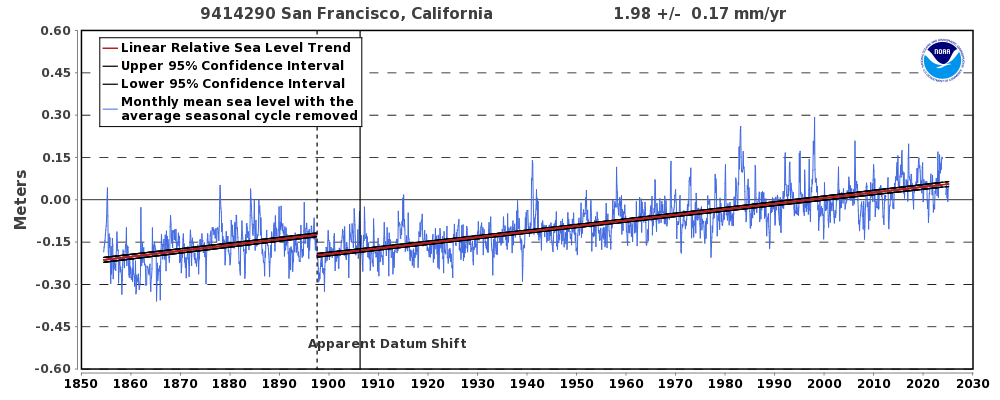
In 2018 climatists applied their considerable PR skills and budgets swamping the media with warnings targeting major coastal cities, designed to strike terror in anyone holding real estate in those places. Example headlines included:

Sea level rise could put thousands of homes in this SC county at risk, study says The State, South Carolina

Taxpayers in the Hamptons among the most exposed to rising seas Crain’s New York Business

Adapting to Climate Change Will Take More Than Just Seawalls and Levees Scientific American

The Biggest Threat Facing the City of Miami Smithsonian Magazine

What Does Maryland’s Gubernatorial Race Mean For Flood Management? The Real News Network

Study: Thousands of Palm Beach County homes impacted by sea-level rise WPTV, Florida

Sinking Land and Climate Change Are Worsening Tidal Floods on the Texas Coast Texas Observer

Sea Level Rise Will Threaten Thousands of California Homes Scientific American

300,000 coastal homes in US, worth $120 billion, at risk of chronic floods from rising seas USA Today

That last gets the thrust of the UCS study Underwater: Rising Seas, Chronic Floods, and the Implications for US Coastal Real Estate (2018)

Sea levels are rising. Tides are inching higher. High-tide floods are becoming more frequent and reaching farther inland. And hundreds of US coastal communities will soon face chronic, disruptive flooding that directly affects people’s homes, lives, and properties.

Yet property values in most coastal real estate markets do not currently reflect this risk. And most homeowners, communities, and investors are not aware of the financial losses they may soon face.

This analysis looks at what’s at risk for US coastal real estate from sea level rise—and the challenges and choices we face now and in the decades to come.

The report and supporting documents gave detailed dire warnings state by state, and even down to counties and townships. As example of the damage projections is this table estimating 2030 impacts:

State  Homes at Risk  Value at Risk Property Tax at Risk  Population in 
at-risk homes 
AL  3,542 $1,230,676,217 $5,918,124  4,367
CA  13,554 $10,312,366,952 $128,270,417  33,430
CT  2,540 $1,921,428,017 $29,273,072  5,690
DC  – $0 $0  –
DE  2,539 $127,620,700 $2,180,222  3,328
FL  20,999 $7,861,230,791 $101,267,251  32,341
GA  4,028 $1,379,638,946 $13,736,791  7,563
LA  26,336 $2,528,283,022 $20,251,201  63,773
MA  3,303 $2,018,914,670 $17,887,931  6,500
MD  8,381 $1,965,882,200 $16,808,488  13,808
ME  788 $330,580,830 $3,933,806  1,047
MS  918 $100,859,844 $1,392,059  1,932
NC  6,376 $1,449,186,258 $9,531,481  10,234
NH  1,034 $376,087,216 $5,129,494  1,659
NJ  26,651 $10,440,814,375 $162,755,196  35,773
NY  6,175 $3,646,706,494 $74,353,809  16,881
OR  677 $110,461,140 $990,850  1,277
PA  138 $18,199,572 $204,111  310
RI  419 $299,462,350 $3,842,996  793
SC  5,779 $2,882,357,415 $22,921,550  8,715
TX  5,505 $1,172,865,533 $19,453,940  9,802
VA  3,849 $838,437,710 $8,296,637  6,086
WA  3,691 $1,392,047,121 $13,440,420  7,320

The methodology, of course is climate models all the way down. They explain:

Three sea level rise scenarios, developed by the National Oceanic and Atmospheric Administration (NOAA) and localized for this analysis, are included:

  • A high scenario that assumes a continued rise in global carbon emissions and an increasing loss of land ice; global average sea level is projected to rise about 2 feet by 2045 and about 6.5 feet by 2100.
  • An intermediate scenario that assumes global carbon emissions rise through the middle of the century then begin to decline, and ice sheets melt at rates in line with historical observations; global average sea level is projected to rise about 1 foot by 2035 and about 4 feet by 2100.
  • A low scenario that assumes nations successfully limit global warming to less than 2 degrees Celsius (the goal set by the Paris Climate Agreement) and ice loss is limited; global average sea level is projected to rise about 1.6 feet by 2100.

Oh, and they did not forget the disclaimer:

Disclaimer
This research is intended to help individuals and communities appreciate when sea level rise may place existing coastal properties (aggregated by community) at risk of tidal flooding. It captures the current value and tax base contribution of those properties (also aggregated by community) and is not intended to project changes in those values, nor in the value of any specific property.

The projections herein are made to the best of our scientific knowledge and comport with our scientific and peer review standards. They are limited by a range of factors, including but not limited to the quality of property-level data, the resolution of coastal elevation models, the potential installment of defensive measures not captured by those models, and uncertainty around the future pace of sea level rise. More information on caveats and limitations can be found at http://www.ucsusa.org/underwater.

Neither the authors nor the Union of Concerned Scientists are responsible or liable for financial or reputational implications or damages to homeowners, insurers, investors, mortgage holders, municipalities, or other any entities. The content of this analysis should not be relied on to make business, real estate or other real world decisions without independent consultation with professional experts with relevant experience. The views expressed by individuals in the quoted text of this report do not represent an endorsement of the analysis or its results.

The need for a disclaimer becomes evident when looking into the details. The NOAA reference is GLOBAL AND REGIONAL SEA LEVEL RISE SCENARIOS FOR THE UNITED STATES NOAA Technical Report NOS CO-OPS 083

Since the text emphasizes four examples of their scenarios, let’s consider them here. First there is San Francisco, a city that sued oil companies over sea level rise. From tidesandcurrents comes this tidal gauge record
It’s a solid, long-term record providing more than a century of measurements from 1900 through 2020.  The graph below compares the present observed trend with climate models projections out to 2100.
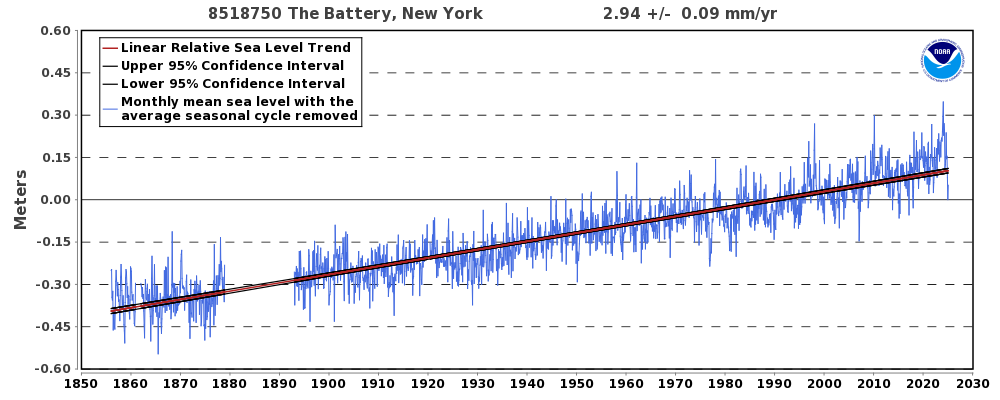
Since the record is set at zero in 2000, the difference in 21st century expectation is stark. Instead of  the existing trend out to around 20 cm, models project 2.5 meters rise by 2100.

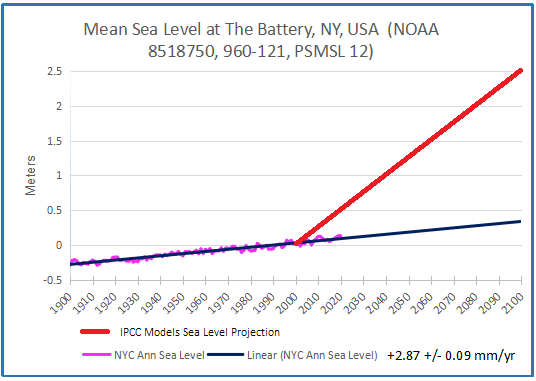
New York City is represented by the Battery tidal gauge:


Again, a respectable record with a good 20th century coverage.  And the models say:


The red line projects 2500 mm rise vs. 287 mm, almost a factor of 10 more.  The divergence is evident even in the first 20 years.

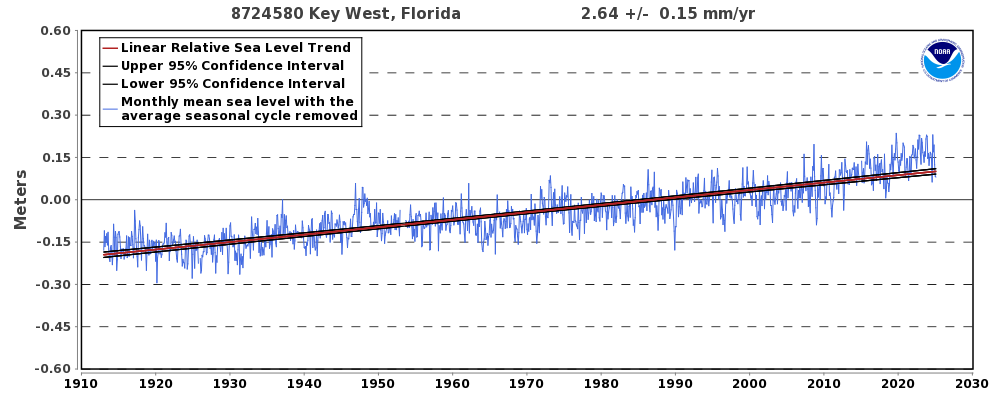
Florida comes in for a lot of attention, especially the keys, so here is Key West:


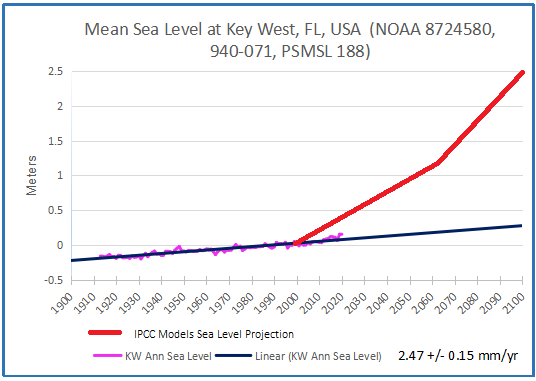
A similar pattern to NYC Battery gauge, and here is the projection:


The pattern is established: Instead of a rise of about 25 cm, the models project 250 cm.

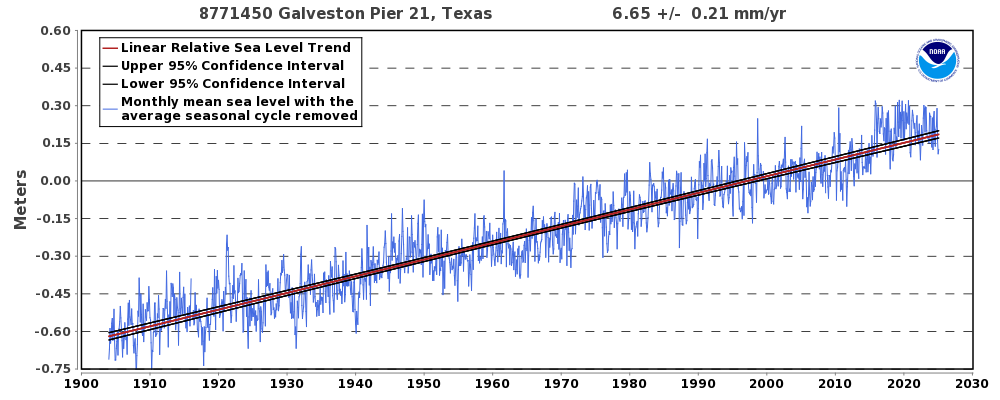
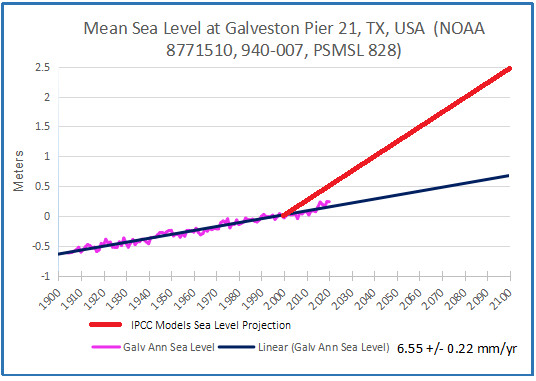
Finally, probably the worst case, and already well-known to all is Galveston, Texas:


The water has been rising there for a long time, so maybe the models got this one close.

The gap is less than the others since the rising trend is much higher, but the projection is still nearly four times the past.  Galveston is at risk, all right, but we didn’t need this analysis to tell us that.

A previous post Unbelievable Climate Models goes into why they are running so hot and so extreme, and why they can not be trusted.

Footnote Regarding Alarms in Other Places

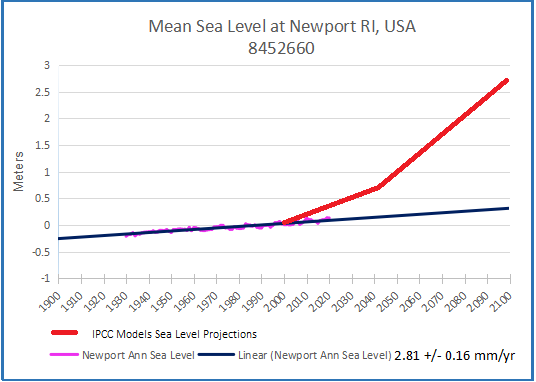
Recently there was a flap over future sea levels at Rhode Island, so I took a look at Newport RI, the best tidal gauge record there.  Same Story: Observed sea levels already well below projections that are 10 times the tidal gauge trend.

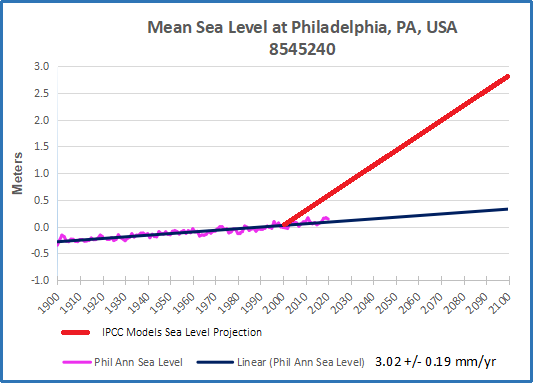
Another city focused upon urban flooding is Philadelphia.  As with other coastal settlements, claims of sea level rise from global warming are unfounded.

Philadelphia is a great example where a real concern will not be addressed by reducing CO2 emissions.  See Urban Flooding: The Philadelphia Story

Latest Court Ruling re EPA and CO2

There is the story of the court’s decision, and the back story told by one judge dissenting partly from the other two on the panel.  The overview comes from courthousenews DC Circuit Rejects Trump Rollback of Power Plant Emission Rules.  Excerpts in italics with my bolds.

Overview of Ruling on Affordable Clean Energy Rule

The federal appeals court’s 182-page opinion released Tuesday was unsigned, written by a mostly unanimous three-judge panel. U.S. Circuit Judge Justin Walker, a Trump appointee who joined the court just a month before the case was heard, penned only a partial dissent.

The panel found the outgoing president’s Affordable Clean Energy rule, adopted in 2019 as part of Trump’s effort to roll back what he considered anti-business regulations, is based on an “erroneous legal premise.” The ACE rule dropped all statewide emissions caps, giving state regulators greater autonomy and more time to reduce pollution.

The court held Tuesday that there is “no basis—grammatical, contextual, or otherwise—for the EPA’s assertion” about source-specific language in federal law that it claims limits its oversight of fossil fuel power sources.

While the ruling was welcomed by health and environmental groups, it only returns things to the status quo.  Litigation tied up Obama’s Clean Power Plan shortly after it was passed and it never took effect thanks to a Supreme Court stay in 2016.

The Trump effort to roll it back started in 2017 before culminating with the ACE rule in 2019. Now the ACE rule too will be bound up in legal purgatory, if not scrapped entirely by the incoming Biden administration.

Walker was joined on the panel by U.S. Circuit Judges Cornelia Pillard and Patricia Millett, both Obama appointees.  While the Trump appointee mostly concurred with his colleagues, Walker filed a partial dissent saying he took issue with both Obama and Trump’s regulatory efforts.

The Back Story–How We Got Here

Judge Walker wrote an interesting essay on the twists and turns with climate change, the EPA and CO2 emissions.  His statement is at the end of the court document (here).  Excerpts in italics with my bolds.

WALKER, Circuit Judge, concurring in part, concurring in the judgment in part, and dissenting in part: This case concerns two rules related to climate change. The EPA promulgated both rules under § 111 of the Clean Air Act.1

A major milestone in climate regulation, the first rule set caps for carbon emissions. Those caps would have likely forced shifts in power generation from higher-polluting energy sources (such as coal-fired power plants) to lower-emitting sources (such as natural gas or renewable energy sources). 2 That policy is called generation shifting.

Hardly any party in this case makes a serious and sustained argument that § 111 includes a clear statement unambiguously authorizing the EPA to consider off-site solutions like generation shifting. And because the rule implicates “decisions of vast economic and political significance,” Congress’s failure to clearly authorize the rule means the EPA lacked the authority to promulgate it.

The second rule repealed the first and partially replaced it with different regulations of coal-fired power plants. Dozens of parties have challenged both the repeal and the provisions replacing it.

In my view, the EPA was required to repeal the first rule and wrong to replace it with provisions promulgated under § 111. That’s because coal-fired power plants are already regulated under § 112, and § 111 excludes from its scope any power plants regulated under § 112. Thus, the EPA has no authority to regulate coal-fired power plants under§ 111.

Background Concerning EPA and Carbon Dioxide

In its clearest provisions, the Clean Air Act evinces a political consensus. For example, according to Massachusetts v. EPA, carbon dioxide is clearly a pollutant, and the Act’s § 202 unambiguously directs the EPA to curb pollution from new cars.

But for every carbon question answered in that case, many more were not even presented. For example, does the Clean Air Act force the electric-power industry to shift from fossil fuels to renewable resources? If so, by how much? And who will pay for it? Even if Congress could delegate those decisions, Massachusetts v. EPA does not say where in the Clean Air Act Congress clearly did so.

In 2009, Congress tried to supply that clarity through new legislation.

The House succeeded.
The President supported it.
But that effort stalled in the Senate.

Since climate change is real, man-made, and important, Congress’s failure to act was, to many, a disappointment. But the process worked as it was designed. In general, Senators from small states blocked legislation they viewed as adverse to their voters. And because small states have outsized influence in the Senate, no bill arrived on the President’s desk.

Nor have dozens of other climate-related bills introduced since then. So President Obama ordered the EPA to do what Congress wouldn’t. In 2015, after “years of unprecedented outreach and public engagement” — including 4.3 million public comments (about 4.25 million more than in Massachusetts v.EPA) — the EPA promulgated a rule aimed at “leading global efforts to address climate change.”

Entitled the Clean Power Plan, the EPA’s rule used the Clean Air Act’s § 111 to set limits for carbon emissions that would likely be impossible to achieve at individual coal-fired power plants because of costs, unavailable technologies, or a need to severely reduce usage. In that sense, the limits required generation shifting: shifting production from coal-fired power plants to facilities that use natural gas or renewable resources.

To be clear, the 2015 Rule did not expressly say, “Power plants must adopt off-site solutions.” But it did set strict emission limits in part by considering off-site solutions. And those emission limits would likely have been unachievable or too costly to meet if off-site solutions were off the table.

A political faction opposed generation shifting. It challenged the 2015 Rule in this Court, arguing that § 111 does not allow the EPA to consider off-site solutions when determining the best system of emission reduction. The faction included about twenty-four states, represented by many Senators who opposed the 2009 legislation. Conversely, a political faction of about eighteen states defended the rule. Many of their Senators had supported the stymied legislation.

At that litigation’s outset, our Court refused to stay the rule’s implementation. But in an unprecedented intervention, the Supreme Court did what this Court would not. And through its stay, the Supreme Court implied that the challengers would likely succeed on the case’s merits.

Taking the Supreme Court’s not-so-subtle hint, in 2019 President Trump’s EPA repealed the 2015 Rule and issued the Affordable Clean Energy Rule.

Like the rule it replaced, the 2019 Rule relies on the Clean Air Act’s § 111 to reduce carbon emissions. But unlike its predecessor, the 2019 Rule did not include generation shifting in its final determination of the best system of emission reduction.

A new faction then challenged the 2019 Rule. It looked a lot like the faction that had defended the 2015 Rule. Arrayed against that faction were many states and groups that had opposed the old rule. And so once again, politically diverse states and politically adverse special interest groups brought their political brawl into a judiciary designed to be apolitical.

In this latest round, the briefing’s word count exceeded a quarter of a million words. The oral argument lasted roughly nine hours. The case’s caption alone runs beyond a dozen pages. And yet, in all that analysis, hardly any of the dozens of petitioners or intervenors defending the 2015 Rule make a serious and sustained argument that § 111 includes a clear statement unambiguously authorizing the EPA to consider a system of emission reduction that includes off-site solutions or that § 111 otherwise satisfies the major-rules doctrine’s clear statement requirement. Neither does the EPA.

In light of that, I doubt § 111 authorizes the 2015 Rule — arguably one of the most consequential rules ever proposed by an administrative agency:
• It required a “more aggressive transformation in the domestic energy industry,” marking for President Obama a “major milestone for his presidency.”
• It aspired to reduce that industry’s carbon emissions by 32 percent — “equal to the annual emissions from more than 166 million cars.”
• Leaders of the environmental movement considered the rule “groundbreaking,” called its announcement “historic,” and labeled it a “critically important catalyst.”

The potential costs and benefits of the 2015 Rule are almost unfathomable. Industry analysts expected wholesale electricity’s cost to rise by $214 billion. The cost to replace shuttered capacity? Another $64 billion. (“A billion here, a billion there, and pretty soon you’re talking real money.”)

True, you can dismiss that research as industry-funded. But the EPA itself predicted its rule would cost billions of dollars and eliminate thousands of jobs.

On the benefits side of the ledger, the White House labeled the 2015 Rule a “Landmark,” and the President called it “the single most important step America has ever taken in the fight against global climate change.” With that in mind, calculating the rule’s benefits requires a sober appraisal of that fight’s high stakes. According to the rule’s advocates, victory over climate change will:

  • lower ocean levels;
  • preserve glaciers;
  • reduce asthma;
  • make hearts healthier;
  • slow tropical diseases;
  • abate hurricanes;
  • temper wildfires;
  • reduce droughts;
  • stop many floods;
  • rescue whole ecosystems; and
  • save from extinction up to “half the species on earth.”

These are, to put it mildly, serious issues. Lives are at stake. And even though it’s hard to put a dollar figure on the net value on what many understandably consider invaluable, the EPA tried: $36 billion, it said, give or take about a $10- billion margin of error.

So say what you will about the cost-benefit analysis behind generation shifting, it’s hardly a minor question.

Minor questions do not forestall consequences comparable to “the extinction event that wiped out the dinosaurs 65 million years ago.” Minor questions are not analogous to “Thermopylae, Agincourt, Trafalgar, Lexington and Concord, Dunkirk, Pearl Harbor, the Battle of the Bulge, Midway and Sept. 11.” Minor rules do not inspire “years of unprecedented outreach and public engagement.” Minor rules are not “the single most important step America has ever taken in the fight against global climate change.” Minor rules do not put thousands of men and women out of work. And minor rules do not calculate $10 billion in net benefits as their margin of error.

Rather, the question of how to make this “the moment when the rise of the oceans began to slow and our planet began to heal” — and who should pay for it — requires a “decision[] of vast economic and political significance.” That standard is not mine. It is the Supreme Court’s. And no cocktail of factors informing the major-rules doctrine can obscure its ultimate inquiry: Does the rule implicate a “decision[] of vast economic and political significance”?

Proponents of the 2015 Rule say it doesn’t. They have to. If it did, it’s invalid — because a clear statement is missing. And according to the Supreme Court, that is exactly what a major rule requires.

To be sure, if we frame a question broadly enough, Congress will have always answered it. Does the Clean Air Act direct the EPA to make our air cleaner? Clearly yes. Does it require at least some carbon reduction? According to Massachusetts v. EPA, again yes.

But how should the EPA reduce carbon emissions from power plants? And who should pay for it? To those major questions, the Clean Air Act’s answers are far from clear.

I admit the Supreme Court has proceeded with baby steps toward a standard for its major-rules doctrine. But “big things have small beginnings.” And even though its guidance has been neither sweeping nor precise, the Supreme Court has at least drawn this line in the sand: Either a statute clearly endorses a major rule, or there can be no major rule.

Moreover, if Congress merely allowed generation shifting (it didn’t), but did not clearly require it, I doubt doing so was constitutional. For example, imagine a Congress that says, “The EPA may choose to consider off-site solutions for its best system of emission reduction, but the EPA may choose not to consider off-site solutions.” In that instance, Congress has clearly delegated to the EPA its legislative power to determine whether generation shifting should be part of the best system of emission reduction — a “decision[] of vast economic and political significance.”

Such delegation might pass muster under a constitution amended by “moments” rather than the “reflection and choice” prescribed by Article V. But if ever there was an era when an agency’s good sense was alone enough to make its rules good law, that era is over.

Congress decides what major rules make good sense. The Constitution’s First Article begins, “All legislative Powers herein granted shall be vested in a Congress of the United States, which shall consist of a Senate and House of Representatives.” And every “law” must “pass[] the House of Representatives and the Senate” and “be presented to the President.” Thus, whatever multi-billion-dollar regulatory power the federal government might enjoy, it’s found on the open floor of an accountable Congress, not in the impenetrable halls of an administrative agency — even if that agency is an overflowing font of good sense.

Over time, the Supreme Court will further illuminate the nature of major questions and the limits of delegation. And under that case law, federal regulation will undoubtedly endure. So will federal regulators. Administrative agencies are constitutional, and they’re here to stay.

Beyond that, I leave it for others to predict what the Supreme Court’s emerging jurisprudence may imply for those agencies’ profiles. Here, regardless of deference and delegation doctrines, the regulation of coal-fired power plants under § 111 is invalid for a more mundane reason: A 1990 amendment to the Clean Air Act forbids it.

The Clean Air Act Amendments of 1990 prohibit the EPA from subjecting power plants to regulation under § 111 if they are already regulated under § 112. The 2015 Rule and the 2019 Rule rely on § 111 for the authority to regulate coal-fired power plants. Because the EPA already regulates those coal-fired power plants under § 112, the rules are invalid.

This case touches on some of administrative law’s most consequential, unresolved issues. What is the reach of Massachusetts v. EPA? What is the meaning of a major question? What are the limits of congressional delegation?

My comment:  I much appreciate Judge Walker’s reprise of the historical journey.  After earning my degree in organic chemistry, I am still offended that a bunch of  lawyers refer to CO2 as a “pollutant” as though it were an artificial chemical rather than the stuff of life.  And it annoys me that the American Lung Association fronted this legal attack, as though CO2 was causing breathing problems in addition to a bit of warming during our present ice age. And that list of ailments solved by reducing CO2 emissions rivals any snake oil poster ever printed.

Observers noted that this ruling produces a kind of limbo: Obama’s Clean Power Plan is out of order, and now Trumps Affordable Clean Energy program is shot down.  Likely Biden will try to return to CPP as though Trump never happened, but the same objections will still be raised.  Clearly Judge Walker sees the issue headed for the Supreme Court as the stakes are too high for anyone else.  After their lack of courage on the 2020 election scandal, who knows what the Supremes will do.

Footnote: See post The Poisonous Tree of Climate Change

The roots of this poisonous tree are found in citing the famous Massachusetts v. E.P.A. (2007) case decided by a 5-4 opinion of Supreme Court justices (consensus rate: 56%). But let’s see in what context lies that reference and whether it is a quotation from a source or an issue addressed by the court. The majority opinion was written by Justice Stevens, with dissenting opinions from Chief Justice Roberts and Justice Scalia. All these documents are available at sureme.justia.com Massachusetts v. EPA, 549 U.S. 497 (2007).  The linked post summarized the twisted logic that was applied.