Climate Hearsay

global-warming

In a legal proceeding, a witness can only testify to what he or she personally experienced. Anything reported to them by others is dismissed as “hearsay”, not evidence by direct observation, but rather an opinion offered by someone else.

In the current public commotion over global warming, almost all the discourse is composed of hearsay.  Ross McKitrick explains that the alleged changes in temperatures are so small that no one can possibly notice. Thus, their concern over global warming can only come from repeating hearsay in the form of charts and graphs published by people with an axe to grind. His article in the Financial Post is Hold the panic: Canada just warmed 1.7 degrees and … thrived. Excerpts below in italics with my bolds.

A recent report, commissioned by Environment and Climate Change Canada (also known as the federal Department of the Environment), sparked a feverish bout of media coverage. Much of it keyed off the headline statement that Canada warmed “twice as fast” as the entire planet since 1948. If that is self-evidently a bad thing, what to make of the finding that the Canada’s Atlantic region warmed twice as fast as the Prairies? Or that Canadian winters warmed twice as fast as summers?

Saying Canada warmed twice as fast as the whole planet doesn’t prove anything

I’ll bet you didn’t know that the Maritimes warmed twice as fast as the Prairies. But now that I’ve told you, you might tell yourself it makes sense based on what you’ve seen or heard — that’s called confirmation bias. In fact, I was lying. It’s the other way around. The Prairies warmed almost three times faster than the Maritimes.

Would you have known either way? One of the psychological effects of a report like this, and the attendant media hype, is that it puts ideas in peoples’ heads. Tell everyone over and over that the climate is changing, and soon they will see proof of change everywhere. Rain, snow, wind, floods or dry spells; it will all seem to eerily confirm the theory, even though we have always had these things.

Most of what people are noticing, of course, are just natural weather events. Underneath, there are slow trends, both natural and (likely) human-caused. But they are small and hard to separate out without careful statistical analysis. A few years ago, climatologist Lennart Bengtsson remarked:

The warming we have had over the last 100 years is so small that if we didn’t have meteorologists and climatologists to measure it we wouldn’t have noticed it at all.

And so we get reports with charts and graphs to tell us about the changes we didn’t notice. Remember last summer when the media hyped a report from the Intergovernmental Panel on Climate Change warning that warming 1.5 degrees Celsius (compared to preindustrial times) was a disaster threshold we must avoid crossing at all costs? Now we learn that Canada warmed 1.7 degrees Celsius since 1948. Far from leaving the country a smoking ruin, we got wealthier and healthier, our population soared, and life improved by almost any measure of welfare you can imagine. If only every so-called catastrophe was like this.
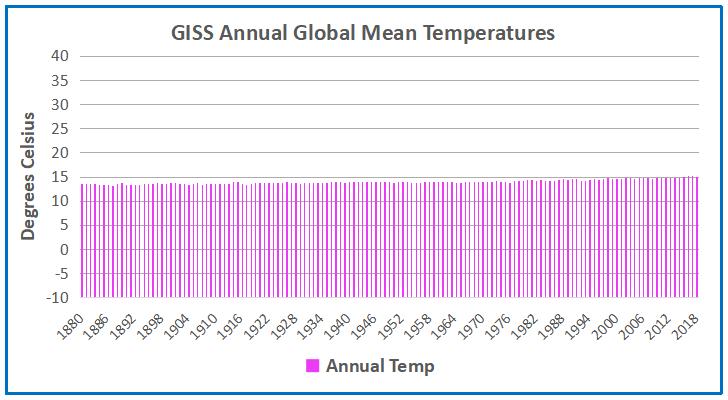
We deal with lots of changes over time. Go back to Bengtsson’s thought experiment. Today’s 80-year-olds entered their teens in 1950. Ask them what changes they experienced over their lives and they will have plenty to say. Then ask if, where they live, the fall warmed more than spring did. Without peeking at the answer, most will have no idea. Yet, according to the federal government’s latest report, depending on the province, one likely warmed twice as fast as the other. Which one?

If you can’t tell without looking it up, that’s the point.

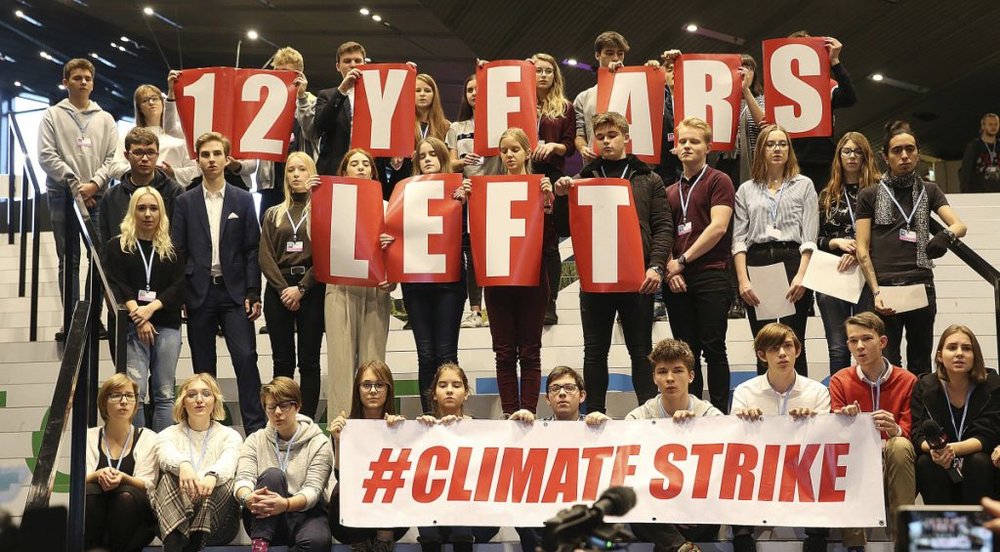
Alarming news headlines are always part of the ritual (though you’d have thought journalists would be a bit jaded by now, after all the hyperventilating Only-Ten-Years-Left blockbuster claims over the past 30 years). Saying Canada warmed twice as fast as the whole planet doesn’t prove anything. Pretty much any large country warmed faster than the global average, because countries are on land. Oceans cover 70 per cent of the Earth, and the way the system works, during a warming trend the land warms faster than the oceans. So the scary headline only confirms that we are on land.

The best antidote, if you find yourself alarmed by the press coverage, is to turn to chapter four of the Department of the Environment’s report and start reading. The section on the observed changes in 1948 is factual, data-focused and decidedly non-alarmist. But there are some points I would quibble about: 2016 was a strong El Niño year, so the end point of the data is artificially high.

Some of the report’s bright-red heat maps would probably look different if they stopped in, say, 2014. And most of the report’s comparisons start in 1948 to maximize data availability, but this boosts the warming rate compared to starting in the 1930s, which was a hot decade. When the authors talk about attributing changes to greenhouse gases versus natural variability, they don’t explain the deep uncertainties in such calculations. And they make projections about the century ahead without discussing how well — or how poorly — their models can long-term forecast.

If you want to learn about changes to the Canadian climate, read the report. But if you need to look at the report to know what changes you lived through, that tells you how much — or rather, how little — they mattered to you at the time.

Ross McKitrick is a professor of economics at the University of Guelph and senior fellow at the Fraser Institute.

Postscript:  No one under 20 years old has experienced a trend of warming temperatures.  Yet they are in the streets instead of classrooms demanding action (anything) to stop something they have never known.  Think about it.
Nudging a Climate Illiterate

Mark Hendrickson writes at The Epoch Times March 28, 2019 Open Letter to a Journalist About His Paper’s Position on Climate Change Mark patiently lays out information and context for someone to think more deeply about superficial opinions on global warming/climate change. Excerpts in italics with my bolds and added images.
Commentary

Mark Trumbull, Staff Reporter
The Christian Science Monitor
Boston, MA 02115

Dear Mr. Trumbull,

Last month, in your introductory remarks to The Christian Science Monitor Daily online news stories, you addressed the issue of the Monitor’s coverage of climate change. Your challenge is how to report when you and your Monitor colleagues believe that “human emissions of CO2 are triggering dangerous climatic conditions” while some of your readers do not.

You wrote, “Part of good journalism is to seek out a range of viewpoints rather than just present a story through one lens. But a corollary journalistic responsibility is to weigh the credibility and relevance of viewpoints.” I agree wholeheartedly, and I hope you will follow through in fairly reporting opinions with which you may personally disagree.

Climate change science does not lend itself to facile conclusions. The science itself is complex, many relationships are imperfectly understood, and then there is the daunting challenge of predicting the future. As I have written elsewhere, in fields like economics and climate change, there is no such thing as expertise about the future. In the words of a report from the Inter-governmental Panel on Climate Change (IPCC)—which your paper accepts as arguably the most credible authority that espouses the catastrophist position—“The climate system is a coupled nonlinear chaotic system, and therefore the long-term prediction of future climate states is not possible.”

Your statement that there is a “strong consensus within the climate science profession that human emissions are now the leading factor affecting changes in Earth’s climate” is almost correct, but not quite. Some climate skeptics object to the use of the word “consensus.” They state (correctly, I believe) that “consensus” is more appropriate in politics, where majorities shape reality, than in science, where what a majority may believe to be true today may be disproven tomorrow. You, however, used the word “consensus” correctly, because your supporting hyperlink takes the reader to a story about the political consensus that has been forged at the U.N. through the reports of the IPCC.

It is important to understand that the IPCC is a political organization (after all, it is the Inter-governmental Panel), not a scientific body. I can cite a number of quotes from scientists who have done work for the IPCC, but disagreed with the published “consensus.” The political nature of the IPCC and its reports is underscored by Appendix A of the Principles Governing IPCC work. It authorizes the few dozen political appointees who actually write the Summary for Policymakers to alter what scientists have written in order to conform to what the Summary states.

Hundreds of peer-reviewed articles every year differ from the official pronouncements of the IPCC. There is not so much a “strong consensus within the climate science profession” in general that human activity is causing a dangerous climate as there is a “strong consensus” within the extensive but not all-encompassing government-employed climate science clique.

Journalists often ask those who dissent from the official position of the IPCC if they receive or have received remuneration from fossil fuel companies. The ugly insinuation, of course, is that a person receiving compensation from a conventional energy company is automatically suspected of being a paid propagandist. Is it not equally as plausible that a scientist funded by government grants might tailor his findings so as not to risk losing a valuable source of income? There should be symmetry here, treating people on both sides of the issue with equal respect, instead of proceeding from the unfounded assumption that those receiving money from nongovernmental sources are not trustworthy while those receiving government funds are.

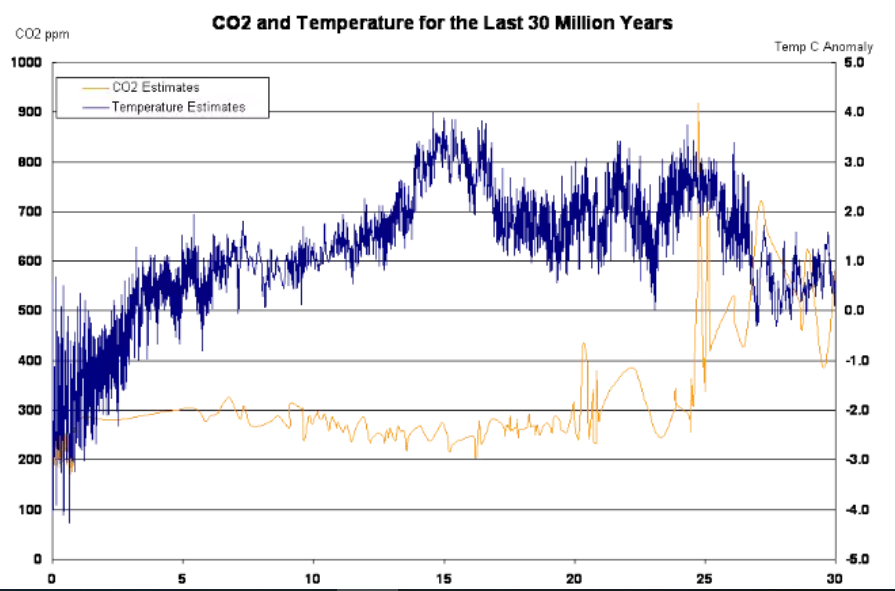
Regarding your assertion that “human emissions are now the leading factor affecting changes in Earth’s climate.” That assertion would have more credibility if it were proven that carbon dioxide is, in fact, the principal driver of global temperatures. However, when one looks at the historical record, one encounters a couple of inconvenient facts: 1) over hundreds of millions of years, graphs plotting global temperatures and atmospheric CO2 show no fixed relation or meaningful correlation; 2) the Vostok ice core graph shows the two variables following similar paths over the past several hundred thousand years, but with changes in CO2 lagging behind changes in temperature by 800 to 1,000 years, and effect cannot precede cause in a temporal universe.

Space prevents me from discussing other unresolved issues—the numerous measuring limitations and errors; the logarithmic scale of how much heat CO2 can “trap”; the fact that CO2 concentrations before the modern increase were dangerously low (plant life would cease to exist if the concentration fell much below 150–170 ppm, whereas it will flourish optimally nearer 1,000 ppm); whether warmer temperatures, on the whole, are better or worse for humans than cold.

I would urge the Monitor’s reporters to not rely so heavily on the scientists employed by the IPCC. Very subtly, the dangerous perception has set in that these are “the best scientists in the world.” I am not saying that there aren’t many fine scientists employed by Uncle Sam and contracted for by the IPCC, but to assume that if the government employs them, that stamps them as the best is unfounded. Politicians have no special power to identify which scientists’ output comes closest to the truth, but they are shrewd enough to pick scientists whose work can be used in support of pre-determined political agendas.

I hope none of your reporters is allied with the Society of Environmental Journalists—a group dedicated to censoring dissent. It does appear that your principal environmental reporter has become over-reliant on the eminently quotable Dr. Katherine Hayhoe, director of the Climate Science Center at Texas Tech University, and a lead author for the IPCC.

Dr. Hayhoe is very, very skilled at verbal manipulation. Take, for example, this cleverly constructed straw man: “[Climate] science is so old and so basic that to deny that science, we would have to be denying basic thermodynamics … and basic fluid dynamics that explains how airplanes fly. And there’s not a lot of politicians and pundits claiming that airplanes don’t fly.”

Brilliant! Unfortunately, it is also disingenuous. Skeptics about the catastrophist scenario aren’t rejecting the basic laws of physics; they don’t deny that Earth’s climate is volatile; they don’t deny that CO2 is a greenhouse gas or that human consumption of fossil fuels is increasing its concentration in the atmosphere.

There remain important disagreements about the degree of climate change, the impact those changes will have, whether any benefits that can be gained by retooling our lives would exceed the costs of making those changes, and other issues with public policy implications that need to be studied and discussed. I hope that the Monitor will contribute to these needed discussions by reporting today’s minority positions as well as the most popular ones.

Mark Hendrickson is an adjunct professor of economics and sociology at Grove City College. He is the author of several books, including “The Big Picture: The Science, Politics, and Economics of Climate Change.”

See Also:  Climate Reductionism

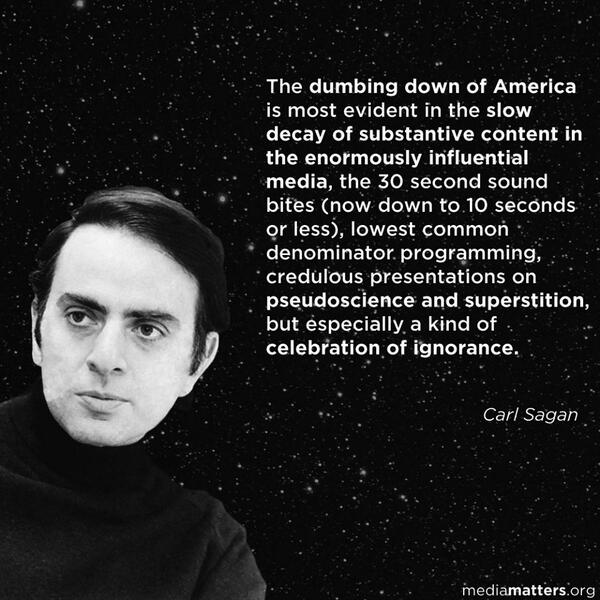
Media Dumbing Down Truth

And he said that even before Twitter.

The phrase “Survey Says!” comes from the popular TV game show Family Feud, which has aired continuously since 1976 and spawned multiple regional adaptations in 50 international markets.  The program ranks among the top five most popular syndicated television shows in the US. In 2013, TV Guide ranked Family Feud third in its list of the 60 greatest game shows of all time.

What’s the fuss all about? Everyone knows that contestants compete to see who can correctly guess the answers to questions given by a random sample of the public. Consider the import of that: Points are awarded not according to the factual answer, but according to your estimate of what others think is the factual answer. To succeed, you must set aside any of your factual knowledge on the topic, and instead guess what ordinary people guessed when questioned.

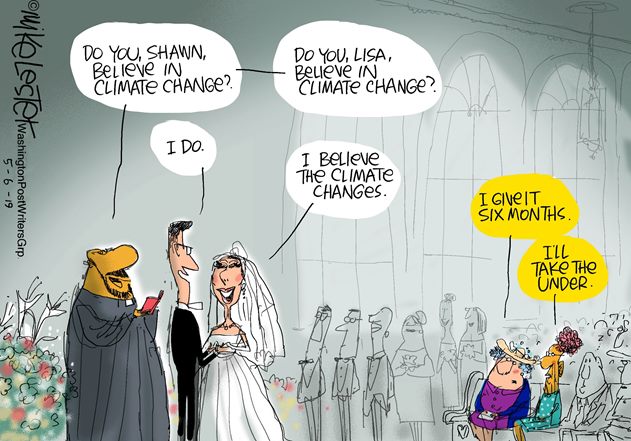
Could there be any more striking display of social proof? Winners of the game are the ones who are most tuned in to the common denominator of public awareness on a range of topics active in social discourse. And to the degree that issues might be controversial, you can imagine a future game show like this:

OK, that cartoon cuts too close to the Progressive bone, so would never be aired on mainstream TV. But it does point to the emotional undertow of all of this. A strong sense of public acceptability, or political correctness is key to guessing what the survey says.

Turning to the scientific issue of the day, let’s consider how to interpret results of an ongoing survey regarding global warming/climate change. First a digression.

Global Warming Vs. Climate Change

A recent article in Grist was entitled: Move over, polar bears: Climate change has a new symbol. Excerpts in italics with my bolds.

Climate change has a new symbol, and it’s not melting ice floes or charismatic megafauna. Last week, researchers at Yale University and the University of Westminster published an analysis showing that Americans increasingly connect climate change with real-life, actually-happening weather. And, given the crazy heat waves, wild hurricanes, and downright bizarre disasters 2018 has already brought us, people are probably thinking about climate change a lot more.

Researchers asked survey respondents what their knee-jerk, top of mind associations were with the phrases “climate change” and “global warming.” In 2003, when the survey began, many people pictured melting polar ice and glaciers.

That was all well and good, Anthony Leiserowitz, coauthor of the analysis and director of the Yale Program on Climate Change Communication, tells Grist. “But for all of the millions of Americans who have that image come to mind, none of them live on the shores of the Arctic Ocean, in Antarctica, or next to a glacier,” he says. “It reinforces the sense that this is far away.

But that’s beginning to change. In the past decade, the analysis shows, the number of associations of climate change with weather has quadrupled. “It’s now one of the highest or most likely first associations that people have,” Leiserowitz says.

He attributes this change in part to the development of projects like Climate Matters, a program run by nonprofit Climate Central, which trains TV meteorologists to incorporate climate change data into their forecasts. The program landed in the news recently when a group of Republican senators — including notorious climate denier James Inhofe — called it a form of “propagandizing” and called for an investigation of its grants from the National Science Foundation.

Big extreme weather disasters are one of those times where Americans all collectively focus on an issue or set of events that have a direct connection to climate change,” Leiserowitz says. “They’re teachable moments.”

As for polar bears? “As a communications icon, it’s pretty much tapped,” Leiserowitz says. “We’ve got to expand the tent — and that means helping people connect to this issue for reasons that might be quite different from yours.”

The Grist article is biased toward alarm and obscures the actual rationale. Yes, the Arctic is far away and extreme weather events are closer and more personally threatening. But the real problem was the Polar bears represented victims of warming.  Inconveniently, Arctic ice failed to melt away in the last 12 years, making a joke of the Polar bear balancing on an ice cube.  For “climate change” something else was required: nearer, scarier and more reliable.  There will never be a complete lack of extreme weather to fill the media time and space with alarms, though we were in the doldrums prior to Hurricane Harvey.

Global Warming. And the Survey Says What?

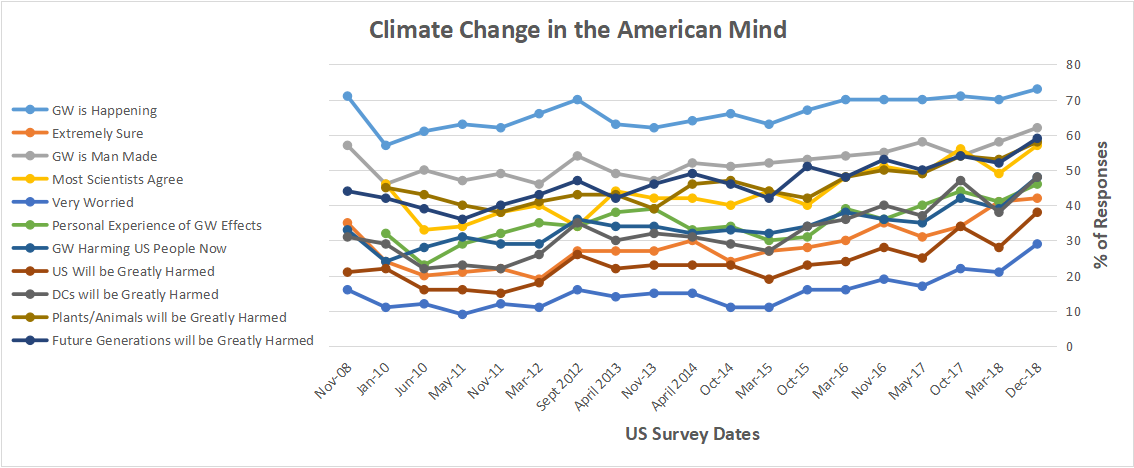
Click on image to enlarge.

A previous post went into details on the Yale/George Mason survey Climate Change in the American Mind. See: Climate is a State of Mind.  I will only do an overview here to make the link to dumbing America down on this topic. Above is a graph showing the core questions and patterns of responses over the years.

First, I commend the surveyors for keeping the questions on the topic “Global Warming” rather than switching to the totally vacuous “Climate Change.” At least, GW has some content, I.e. expecting temperatures to rise in the future.

But the whole exercise is like a game show. Here is the introduction given to participants:
Recently, you may have noticed that global warming has been getting some attention in the news. Global warming refers to the idea that the world’s average temperature has been increasing over the past 150 years, may be increasing more in the future, and that the world’s climate may change as a result.

So we have a news buzzword, “Global Warming” and people are asked what they think, but really they are giving reactions based on what they have seen and heard in the media. And to remove the matter even further from intelligence, many of the questions are about emotions.

How worried are you about global warming?

How strongly do you feel each of the following emotions when you think about the issue of global warming?
Interested
Disgusted
Helpless
Hopeful
Afraid
Angry
Outraged

To summarize, Survey Says:

What He Said:   “Ninety-seven percent of scientists agree: climate change is real, man-made and dangerous.” (Obama tweet).  The survey could be reduced to one question:  Do you agree with this tweet?

Summary

Opinion polling is a media tactic to raise public concern about an issue: conduct a survey, then publicize the results, further raising attention to the topic. Rinse, repeat, and keep repeating so that the public alarm rises with every iteration. Except with global warming, it hasn’t gone up that much. Maybe the battle for hearts and minds is not totally mindless.

Footnote Re Cortez and the End of the World

Statistician Bjorn Lomborg: Ocasio-Cortez was ‘wildly wrong’ on climate ‘doomsday’.  Yet AOC was just saying what many people believe. Shallow, apocalyptic reporting on global warming has made us all panicky, more likely to embrace poor climate policies and less likely to think about the price tag. The truth is comparatively boring: According to the United Nations climate-science panel’s latest major report, if we do absolutely nothing to stop climate change, the impact will be the equivalent to a reduction in our ­incomes of between 0.2 percent and 2 percent five decades from now. Yet by the 2070s, personal incomes will be some 300 percent to 500 percent higher than they are today. Far from the “end of the world,” the impact of warming is what we’d expect from roughly a single economic recession taking place over the next half century…

By 2100, even if hurricanes were to get twice as bad as they are now, increased prosperity and ­resilience mean the cost will have halved to 0.02 percent of GDP. What’s more, the UN panel finds there is no observable increase in hurricane frequency. Likewise, extreme weather is killing fewer people now than at any point in the last 100 years: In the 1920s, extreme weather killed about half a million people annually. Now, despite there being four times as many people, it kills fewer than 20,000 each year. If the world isn’t ending, and the impact of global warming by 2030 is much less than 0.2 percent to 2 percent of GDP, then we need to start comparing costs with benefits

Green fretting about Armageddon is nothing new, of course. In the 1960s, mainstream environmentalists worried that the world was running out of food. In the 1980s, acid rain was going to ­destroy the planet’s forests. There were good reasons for concern, but a panicked response led to a poor, overly expensive response…We need to make sure our solution doesn’t cost more than the problem. If we look at the science and stop believing the end of the world is nigh, our decisions will be much smarter.

Climate Is a State of Mind

A recent survey by Yale and George Mason activists is another reminder that “climate change” is actually a branch of environmental psychology. Consider that “climate” is an human construct, defined as the pattern of weather we remember in our living space over seasons and years. And “climate change” is therefore an added belief that our expectations about future weather are uncertain and unreliable. And so, attitude surveys are a suitable way to explore an issue that is wholly a matter of public opinion, IOW a state of mind rather than a state of nature.

The survey is appropriately entitled: Climate Change in the American Mind. Title is link to the website for the 2018 edition, with earlier results back to 2008.

The resources there are informative, including articles expressing both satisfactions and disappointments with the levels of belief and concern expressed by survey participants. The compliant mass media cherry pick various findings, giving headlines like these.

“We’ve entered a new era” of climate concern, survey finds CBS

Americans Believe in Climate Change, But Not Climate Action NYmag

Yale Poll: Climate Change ‘Personally Important’ to Record Number of Americans EcoWatch

Most Americans Don’t Know Vast Majority Of Scientists Agree On Climate Change CleanTechnica

Most Americans now worry about climate change—and want to fix it National Geographic

Poll Shows Most People Believe ‘Global Warming is Happening’ necn

Survey reveals 70% of Americans favour the environment over economic growth ClimateAction

promotional-product-facts-brain

What is the American Mindset according to the Survey?

So beyond details of particular responses, what can we learn from this series of polls about the American state of mind regarding global warming/climate change?

The specific questions and response patterns are at Appendix I: Data Tables & Sample Demographics

There are a lot of questions asked and answered, including exploring a complete range of feelings people have on the issue. I will summarize the central questions and the pattern of responses over the last decade.

Click on image to enlarge.

The core set of global warming beliefs are listed on the left.  The marked lines show the % of responses each one achieved over the years.  For example, over 50% agreed to four of them in 2018: GW is happening, GW is man made, Future generations will be greatly harmed and Most scientists agree.  Other patterns are also of interest.  Personal experience of GW effects is reported by almost 50%, while only 30% are very worried.  Indeed, people are less concerned about harm to themselves or even the US, then they are fearful for Developing Countries (DCs) and for Future Generations.

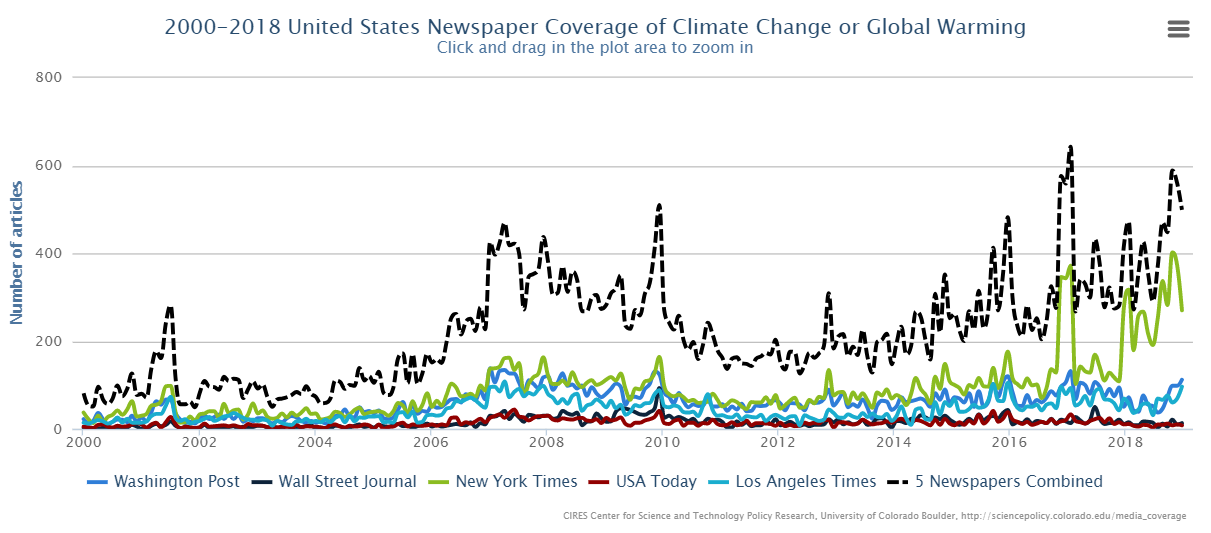
Notice there is a general curve to most of the answer time series.  Beliefs are only slightly higher in 2018 than they were in 2008.  In general, the %s were flat or declining in this decade until starting to rise again around 2014.  This points to the linkage between the opinions held by the public and the emphasis promoted in the mass media.  Compare the curvature in the above graph with this chart of climate change coverage in leading US newpapers.

The chart and research and research come from International Collective on Environment, Culture & Politics, AKA ICECaP.  Note the peaks in 2007-8 at the time of IPCC AR4 and Al Gore’s Inconvenient Truth flick, and in 2009-10 around the time of the Copenhagen COP.  The Climategate emails were also in the news in 2010, but for some reason newspapers were less interested in that aspect, the topic dropped in coverage.

The spike in 2013 coincides with Obama’s SOTU speech featuring climate change as the “defining issue of our time.”  The rise in climate change coverage in recent years is a more complex matter.

Climate journalists (like most all journalists) have been obsessed with trashing Donald Trump, and climate change is mentioned often as a subset of Trump complaints.  Consider this chart from Media Matters.

See that huge spike in the middle? That’s from June 1, 2017, when President Donald Trump announced that he intended to pull the U.S. out of the Paris climate agreement. No other day in the last three years saw anywhere near that much coverage. When Trump stages an event related to climate change, the media snap to attention. The rest of the time it’s like, “Climate what?”

That aligns with what Media Matters found when we looked at climate coverage on broadcast TV news programs in 2017: Trump dominated the news segments about climate change. Researchers at the University of Colorado Boulder, in the International Collective on Environment, Culture & Politics, reached a similar conclusion when they analyzed TV news coverage from November of this year: “In US television coverage of climate change or global warming in November 2018, ‘Trump’ was explicitly invoked over fourteen times more frequently than the words ‘science’ or ‘scientists’ together and nearly four times more frequently than the word ‘climate’ itself.”

A research group at the University of Colorado-Boulder, the International Collective on Environment, Culture and Politics (ICE CaPs), produced the findings that illustrate how much climate coverage has been driven by President Donald Trump. It examined coverage last year in five major American newspapers: The Washington Post, The Wall Street Journal, The New York Times, USA Today, and the Los Angeles Times. In the 4,117 stories in those papers that mentioned “climate change” or “global warming,” the word “Trump” appeared 19,184 times — an average of nearly 4.7 times per article.

mle190506c20190506011552

Summary

To summarize, Survey Says:

What He Said:   “Ninety-seven percent of scientists agree: climate change is real, man-made and dangerous.” (Obama tweet).  The survey could be reduced to one question:  Do you agree with this tweet?

There is not much upward movement in public belief in global warming/climate change.  There is increased attention from the left-leaning media as part of their general dislike of the Trump administration. One more time, who made global warming into a political rather than a scientific issue?

Your Climate Beliefs Are About to be Nudged

Social psychologists are coming to the fore as the mad scientists of our age. Case in point is a recently published guide for intervening in public discourse regarding global warming/climate change. The title is a link to the paper Leveraging cognitive consistency to nudge conservative climate change beliefs by Gehlbach et al. December 12, 2018. Excerpts below with my bolds, followed by my modest suggestion for improvement.

The Rationale (Abstract)

People feel motivated to maintain consistency across many domains in life. When it comes to climate change, many find themselves motivated to maintain consistency with others, e.g., by doubting climate change to cohere with friends’ and neighbors’ beliefs. The resulting climate skepticism has derailed discussions to address the issue collectively in the United States. To counteract these social consistency pressures, we developed a cognitive consistency intervention for climate skeptics. We first demonstrated that most people share substantial faith in a variety of scientific findings, across disciplines ranging from medicine to astronomy. Next, we show that conservative participants who first acknowledge several general contributions of science subsequently report significantly stronger beliefs in climate science (as compared to conservatives who are asked only about their climate science beliefs). These findings provide an encouraging proof-of-concept for how an inclusive climate conversation might be initiated across the political divide.

The Methodology

Below are the two sets of questions put to participants, firstly on mainstream fields of science, and secondly on assertions from climate scientists.

Instructions: Please give us your opinions and thoughts about the contributions of different branches of science. (Responses on a scale of 1 to 7: 1 meaning Not at all, 7 meaning Extremely or Completely)

To what degree do you think the science of astronomy has helped us identify what other planets exist in our solar system?

How helpful do you think medical science is in advancing society’s understanding of what makes people sick?

How confident are you that the field of engineering is advanced enough to keep you safe when traveling on bridges?

How certain are you that physicists‘ theory of gravity accurately explains why objects fall when dropped?

How useful is neuroscience in helping understand the role of different areas of the brain?

To what degree do you agree with public health experts that smoking causes cancer?

How credible is the medical data that germs are a primary cause of disease?

Instructions: Please give us your opinions regarding different aspects of what scientists have concluded about climate change and global warming. (Responses on a scale of 1 to 7: 1 meaning Not at all, 7 meaning Extremely or Completely)

With how much precision has the science of climate change been able to identify the causes behind rising sea levels?

How helpful do you think climate science is in advancing society’s understanding of why the earth is getting hotter?

How confident are you that climate science is right in their theory of how greenhouse gases
trap heat?

How certain are you that global warming explains many of the new weather patterns we are seeing today?

To what extent do you agree with climate experts that humans burning fossil fuels is the major cause of our changing climate?

How useful are climate models in helping to predict how many species are likely to go extinct in the coming years?

How accurately do you think climate scientists will predict the exact number of degrees the average global temperature will change between now and the year 2050?*

How credible is the climate science data that ocean temperatures are rising?

(*Note. Questioners put the next to last question as a trap. They expected people answering honestly to be skeptical on that one.)

Results

For science in general, researchers found that regardless of social attitudes and self-identifying along a liberal/conservative axis, people of all stripes averaged about 6 on the 7 point scale. In other words, generally people expressed “very much” or “a great deal” of confidence or certainty in the assertions from various fields of science. When people were presented only the questions on global warming/climate change, the responses differed accordingly to social/political leanings:

A spotlight analysis (Spiller, Fitzsimons, Lynch, & McClelland, 2013)—with 95% confidence intervals—examining each possible political orientation shows that the treatment had a small effect on politically moderate participants’ climate science beliefs; the impact was larger formore conservative participants.

They found that liberals were accepting of global warming assertions at the same level as other scientific fields, 6 out of 7, meaning “very much” or “a great deal” of conviction. While conservatives averaged 4 out of 7, a so-so response meaning “somewhat” credible or helpful.

The big news was that conservatives could be nudged toward greater acceptance of climate assertions if they were first questioned about other science fields (where they accept at a 6 level), followed by the climate questions. In that treatment, they become more certain about climate, the theory being cognitive dissonance arises when accepting in many fields, but skeptical in one.

Nudging is a Two-Way Street

Armed with these insights, let’s see if we can nudge people toward using their critical intelligence on scientific matters. All we need are some slight improvements in the questions. Below are my proposed questionnaires to help the public with these issues.

Instructions: Please give us your opinions and thoughts about the contributions of different branches of science. (Responses on a scale of 1 to 7: 1 meaning Not at all, 7 meaning Extremely or Completely)

To what degree do you think that astrology has helped us identify how other planets affect our lives?

How helpful do you think nutritional science is in advancing society’s understanding of what are healthy and unhealthy foods?

How confident are you that the field of engineering is advanced enough to keep you safe riding in a driverless car?

How certain are you that physicists’ big bang theory accurately explains the origins of the universe?

How useful is neuroscience in helping understand human consciousness and autonomy?

To what degree do you agree with public health experts that smoking causes cancer in non-smokers?

How credible is the medical data that genes are a primary cause of disease?

(*Note. Questioners put the first question as a trap. They expect honest responders to know the difference between astrology and astronomy.)

Instructions: Please give us your opinions regarding different aspects of what scientists have concluded about climate change and global warming. (Responses on a scale of 1 to 7: 1 meaning Not at all, 7 meaning Extremely or Completely)

With how much precision has the science of climate change been able to identify the causes behind rising sea levels?

How helpful do you think climate science is in advancing society’s understanding of why the earth got hotter for awhile and then stopped?

How confident are you that climate science is right in their theory of how greenhouse gases
trap heat?

How certain are you that global warming explains many of the new weather patterns we are seeing today?

To what extent do you agree with climate experts that humans burning fossil fuels is the major cause of our changing climate?

How useful are climate models in helping to predict how many species are likely to go extinct in the coming years?

How accurately do you think climate scientists have measured the degrees of warming since 1850, the end of the Little Ice Age?*

How credible is the climate science data that ocean temperatures are rising?

(*Note. Questioners put the next to last question as a trap. They expect people to be fairly certain on that one.)

Summary

Note that none of this is about scientific reasoning. It is all about adding climate assertions into a broader set of beliefs engendered by scientists. In other words, this is not an attempt to factually prove global warming/climate change, but rather an exercise in social manipulation. As I have remarked before, Leonard Cohen explains poetically why social proof is an uncertain guide to the truth.

Lyrics:

Everybody knows that the dice are loaded
Everybody rolls with their fingers crossed
Everybody knows that the war is over
Everybody knows the good guys lost
Everybody knows the fight was fixed
The poor stay poor, the rich get rich
Thats how it goes
Everybody knows

Everybody knows that the boat is leaking
Everybody knows that the captain lied
Everybody got this broken feeling
Like their father or their dog just died
Everybody talking to their pockets
Everybody wants a box of chocolates
And a long stem rose
Everybody knows

Everybody knows that you love me baby
Everybody knows that you really do
Everybody knows that you’ve been faithful
Ah give or take a night or two
Everybody knows you’ve been discreet
But there were so many people you just had to meet
Without your clothes
And everybody knows

Everybody knows, everybody knows
Thats how it goes
Everybody knows

And everybody knows that its now or never
Everybody knows that its me or you
And everybody knows that you live forever
Ah when you’ve done a line or two
Everybody knows the deal is rotten
Old black joe’s still pickin’ cotton
For your ribbons and bows
And everybody knows

And everybody knows that the plague is coming
Everybody knows that its moving fast
Everybody knows that the naked man and woman
Are just a shining artifact of the past
Everybody knows the scene is dead
But there’s gonna be a meter on your bed
That will disclose
What everybody knows

And everybody knows that you’re in trouble
Everybody knows what you’ve been through
From the bloody cross on top of calvary
To the beach of Malibu
Everybody knows its coming apart
Take one last look at this sacred heart
Before it blows
And everybody knows

Everybody knows, everybody knows
Thats how it goes
Everybody knows

Footnote:

I doubt Leonard Cohen had climate change in mind when he wrote this masterpiece. But he did have a pertinent poetic insight; namely, that social proof is an unreliable guide to the truth.

“Hottest Year” Misdirection

Once again Joe Public comes out smarter than politically correct opinion surveyors, fact checkers and journalists.  The latest evidence of elite blindness comes from a smart-alecky reporter writing at GlobalNews Survey says Canadians think Earth beat its heat record in only 10 of the last 18 years. They’re wrong Excerpts in italics with my bolds.

Ipsos polling agency released “Perils of Perception” on Wednesday.

It’s an annual international survey conducted in 37 countries that looks at whether respondents have accurate, or inaccurate ideas about major issues.

This one ranked Canada 11th out of 37 countries when it came to accurate understandings of major issues.

One area of misunderstanding — climate change.

The survey found that Canadians are underestimating the number of years that the planet Earth has set heat records over the last two decades.  Canadians estimated that Earth set heat records in 10 out of the last 18 years.

It also found that Canadians are overestimating the share of energy that they consume from renewable resources.

I’ll save the renewables issue for another day. (See Exaggerating  Green Energy Supply) This post will show the reporter’s dog ate his homework, because there are large holes in his information.  He didn’t do professional due diligence so I will investigate to put the record straight for him and anyone else misled by the press.

What Ipsos Asked and Thought Was the Right Answer

Q. The World Meteorological Organization collects annual global temperatures, to see whether they are rising or falling across the world. How many of the last 18 years have been the hottest for the world as a whole since they began collecting data in 1961?

A.  17 of the past 18 years have been the hottest since records began. However, every country in the study underestimates the global temperature rise over the past 18 years. The average estimate across the study was 9 years.

Misdirection #1  Framing the Question to Exclude Undesired Data

Note the question context:  The World Meteorological Organization collects annual global temperatures (. . . began collecting data in 1961), to see whether they are rising or falling across the world. When you go looking for the data, WMO directs you to three datasets produced by others:  Hadcrut (UK Met Office), NOAA (US agency) and Gistemp (NASA, US agency).  So the frame serves to exclude satellite-based datasets, and limit the expected answer to three land+ocean products.  And as many will know, those records go back to late 1800s, far earlier than 1961.  Apparently, the surveyors wanted to put anyone off from thinking temperatures were warmer in the 1930s or 40s.

Misdirection #2  Failing to Do the Math

Getting data right now out of US federal agencies is problematic since websites are shut down.  It seems many federal employees are taking leave in order to help reduce the government deficit.  Fortunately, the Met Office has a site ( here) providing the relevant annual global temperature anomalies from the three sources. I compiled a table which makes the asked for comparisons.

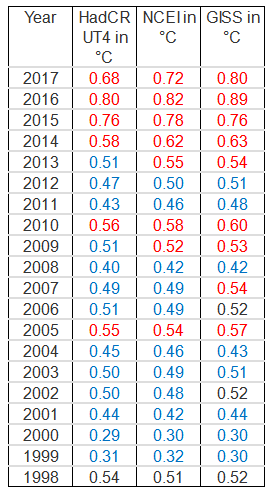
The table shows 1998 was the hottest of all preceding years in the record, with slightly different values in the three datasets.  Years in blue were cooler than 1998, while years in red were reported hotter than 1998.  The math says in the last two decades, compared to the previous record year 1998, there were 6 hotter years in Hadcrut4, 8 hotter years in NOAA (NCEI), and 9 hotter years in GISS. Considering “hottest” to mean hotter than all previous years, the table shows exactly 5 hottest years in the last 18 years, with 2016 setting the record.

Ipsos says 17 of the last 18 were the hottest. Really?  Epic Fail: That so-called “correct” answer is three times too high!  Around the world people said 9, and that’s much closer to the truth. Canadians said 10, perhaps biased higher by all the fake news around.

Misdirection #3  Failing to Do the Statistics

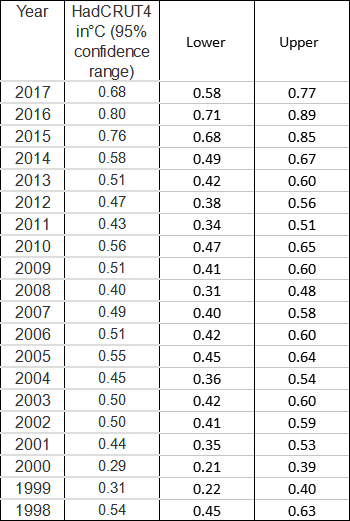
Now it may have occurred to you that some of the hotter years were not much warmer.  When you consider the 95% confidence intervals, some years fall out of the list.  For example, Hadcrut also provides each year a calculation of the upper and lower bounds on the error range, combining bias, measurement uncertainty and coverage uncertainty.

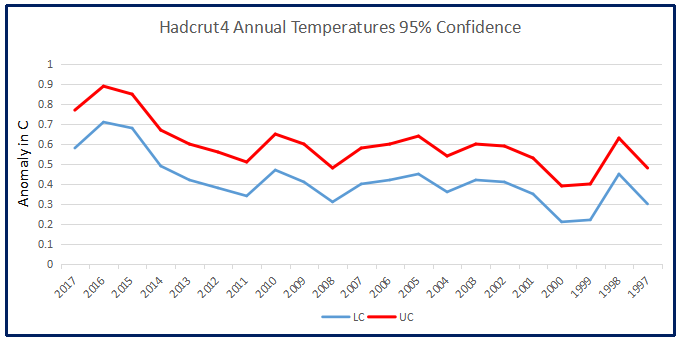
As the table shows, they estimate about +/- 0.09 for a typical year.  So for  1998, they say with 95% confidence the true anomaly lies between 0.45C and 0.63C.  Graphically the error range looks like this:

The chart shows that after considering the estimated uncertainty, it is actually the last three years that were hotter than 1998 in Hadcrut4.  The other land+ocean datasets have similar uncertainties and results (five hotter years in NOAA and GISS).

When it comes to UAH satellite dataset, we have this analysis:
University of Alabama Huntsville  Summary:
Globally, 2016 edged out 1998 by +0.02 C to become the warmest year in the 38-year satellite temperature record, according to scientists. Because the margin of error is about 0.10 C, this would technically be a statistical tie, with a higher probability that 2016 was warmer than 1998. The main difference was the extra warmth in the Northern Hemisphere in 2016 compared to 1998. Source: https://www.sciencedaily.com/releases/2017/01/170104130257.htm

No wonder they wanted UAH excluded.  And others say the confidence ranges are much larger than these estimates, which consider processing uncertainties not including errors of the instruments themselves.

Such characterizations are absurd, according to Richard Lindzen, a meteorology professor at MIT and one of the world’s foremost skeptics that global warming represents an existential threat.

“It’s typical misleading nonsense,” Lindzen said in an e-mail. “We’re talking about less than a tenth of degree with an uncertainty of about a quarter of a degree. Moreover, such small fluctuations – even if real – don’t change the fact that the trend for the past 20 years has been much less than models have predicted.”


Climate Change Chumps

Definition “chump”: A foolish or easily deceived person.

Why are so many people taken in by climate alarms? The question is often on my mind, especially when tens of thousands attend UN conferences like Katowice, or when hearing the caterwauling in the media over the climate scare of the week. Last night while watching a football game, my escape from the issue was interrupted by a commercial break that included a flaming earth on the screen for a few seconds. It was an ad for Discovery Channel including the image above.

[Old joke:  I don’t know if they are using subliminal advertising, but yesterday I went and bought a tractor.]

And in a flash I realized how several factors are driving warming suckers into a fearful frenzy.

Firstly, The power of images over words and thinking.
A picture is worth a thousand words. (Sometimes attributed to Chinese)
The Asian attribution is doubtful, but Confucius did say something similar:
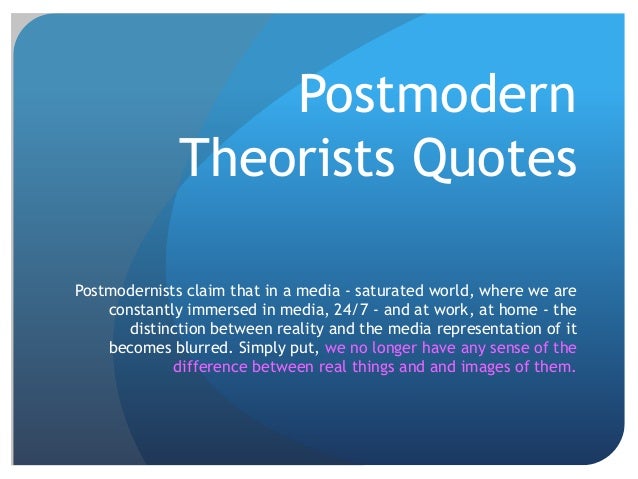
Second, We are immersed in imaging technology, entrancing the public. I have no interest in post modern philosophers, but in this sense they are onto something perverse: We are mistaking images for realities.

Third, Pied Pipers are using the media to put us under their spell.
A key point in the fable is the piper’s ability to put a spell on the children, and thereby rob the village of their future.  And he did this to get leverage over the council when they refused to pay for exterminating the rats. Our children have been brainwashed with environmental activism since preschool, and educators have taken Confucius to heart:  The process goes beyond preaching, to videos, posters and projects.

Fourth, Our embrace of mass and social media makes us suckers for fake news, including climate claims.

Note that the majority are not confident to discern fake from real news.  Even worse, today’s “fact checkers” operate out of spin rooms.

Fifth, Social proof is now all that matters.

Climate lemmings rushing over the cliff.

Finally, the drumbeat of climate alarms imprints ever more deeply a false assumption.

It doesn’t matter if any particular climate claim is false or exaggerated, the communications continuously reinforce the underlying myth of the Garden of Eden:  Nature is perfect and eternal so long as humans don’t mess it up.

The reality is more subtle and complex.  Humans are also a force of nature, and with our self-awareness we have the ability and responsibility to add order and purpose to the rest of nature.  Go to Kyoto and watch the landscapers labor for hours to fashion an exquisite Japanese garden, the fruition of collaboration between humans, plants, water and rocks.  Humans can and do improve on nature by taming destructive natural forces to preserve and enhance living structures.

The UN IPCC process is a blind alley, a path to nowhere.  It plays upon fears and guilt feelings.  Worse, it distracts from rational programs of actual environmental stewardship.  I fear it will only get worse in the next 12 years:


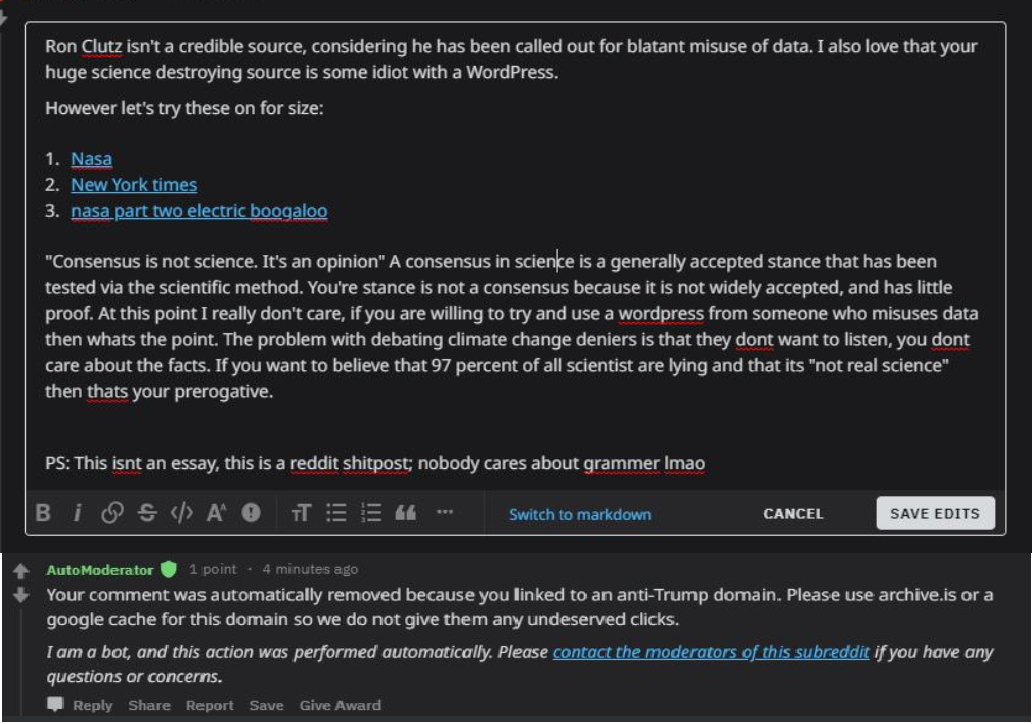
Whoa! I’ve been Bot-censored.

Today someone linked to one of my posts on a thread at reddit:

slinkydink2 14 hours ago
·
More grammatical errors and an emoji face. Am I talking to a 9 year old? Consensus is not science. It’s an opinion. The scientific theory has not been and cannot be applied to your global warning bullshit.

Spez: Even though I know you won’t read it (or understand it if you do) here’s an article from last month saying the models are bullshit and that Solar activity is the largest factor.

https://rclutz.wordpress.com/2018/10/22/2018-update-best-climate-model-inmcm5/

That was followed by:

13 hours ago
Your comment was automatically removed because you linked to an anti-Trump domain. Please use archive.is or a google cache for this domain so we do not give them any undeserved clicks.

I am a bot, and this action was performed automatically. Please contact the moderators of this subreddit if you have any questions or concerns.

The censorship statement was presented this way:

Wow! So much for free speech on the internet.  And the irony for being censored as an anti-Trump domain, which itself seems like a spoof.  The content referring to climate sources does ring true as climatist suppression of alternate information and views.  Apparently, you are an idiot if you know too much and see through the alarmist house of cards.

Wavering Public Belief in Global Warming

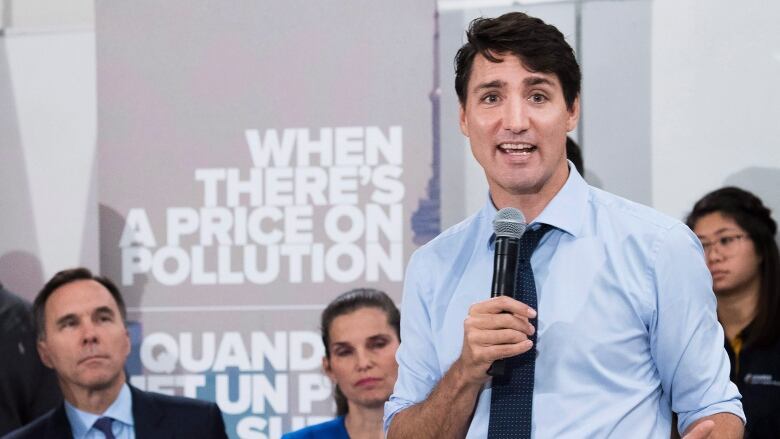
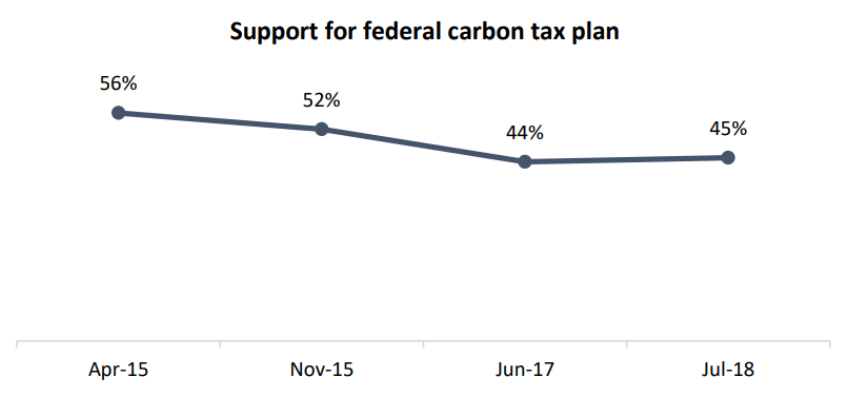
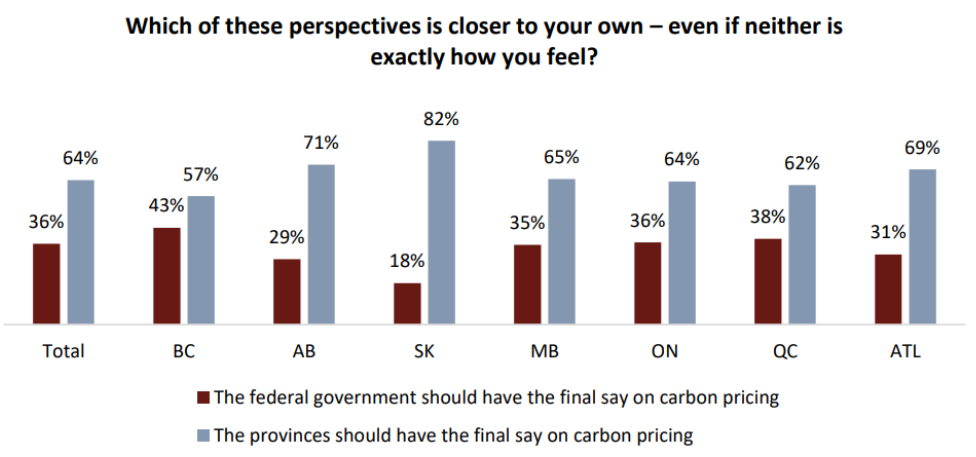
Canadian Prime Minister Justin Trudeau is announcing his national carbon tax even while the Canadian public is having second and third thoughts about global warming and human causation. An Angus Reid poll this summer shows how belief in the need for such a policy is wavering. The report is Carbon conflict: two-thirds of Canadians say provinces should have the final say on pricing

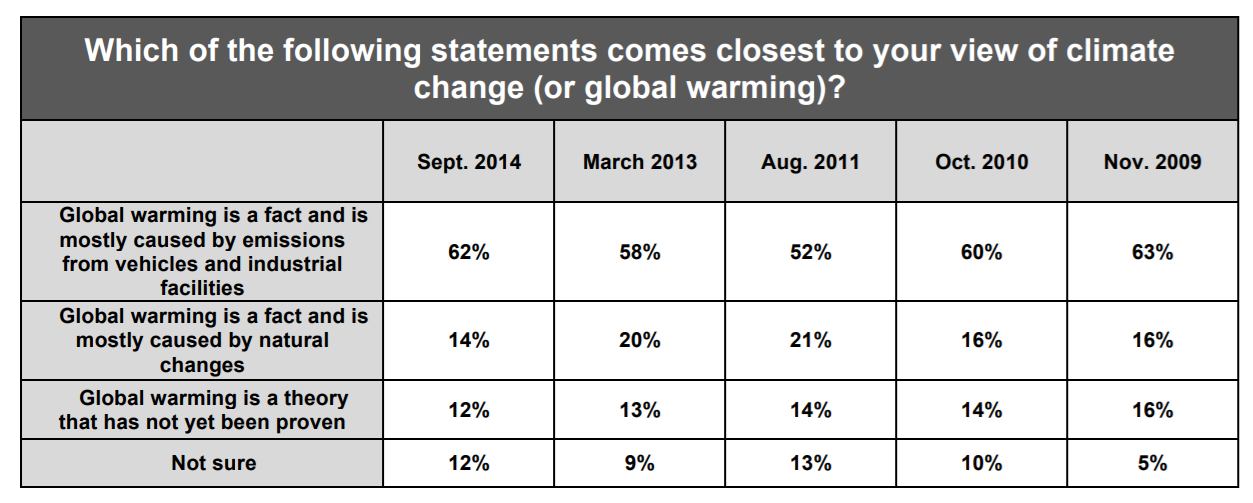
Before getting into the federal/provincial tug of war, let’s consider the basic belief. Angus Reid has been asking Canadians the same question since 2009, with these responses.

Open image in new tab to enlarge.

Note in 2009 63% believed that “global warming is a fact and mostly caused by humans”. That dropped down to 52%, then came back to 62% in 2014 when the Obama administration was beating the climate change drum for all it was worth. In Canada Trudeau’s Liberal party led in the polls on the way to winning power in October 2015.

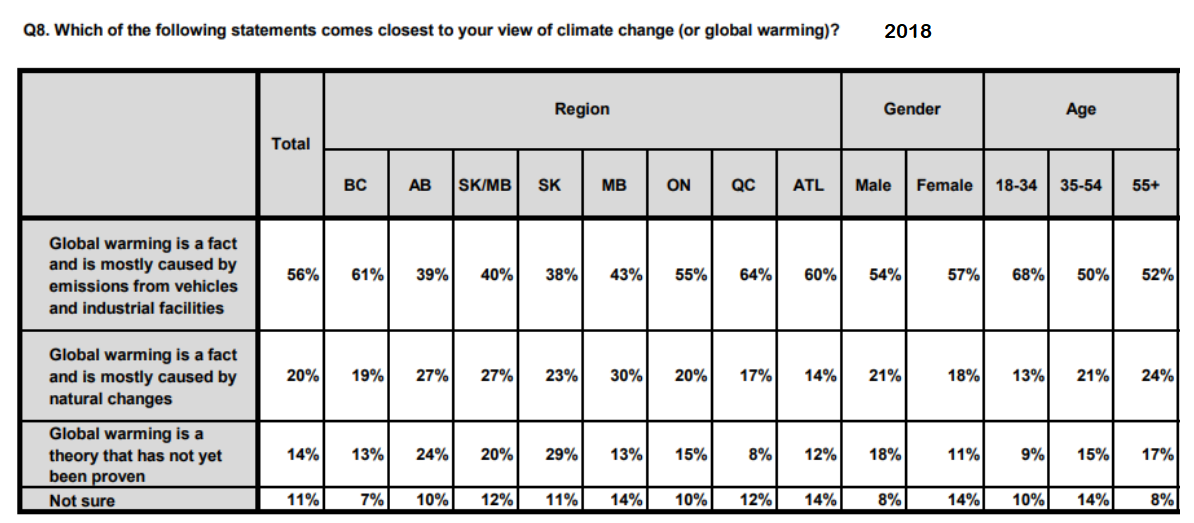
Now let’s consider the polling in July of 2018.
Belief in man-made global warming is back down to 56% in the context of Trump’s skepticism and the Paris Accord proving ineffectual. This first 2018 chart includes regional and age distributions showing that younger people (<35 yrs old) are much more often believers, becoming more skeptical (50/50) with age. Ironically, that young cohort has not witnessed any actual warming in their adult lives.

The three largest cities in Canada are Vancouver, Toronto and Montreal.  Not surprisingly, belief is strongest in the provinces of B.C., Ontario and Quebec, along with Atlantic region. The prairie provinces are definitely not on side.
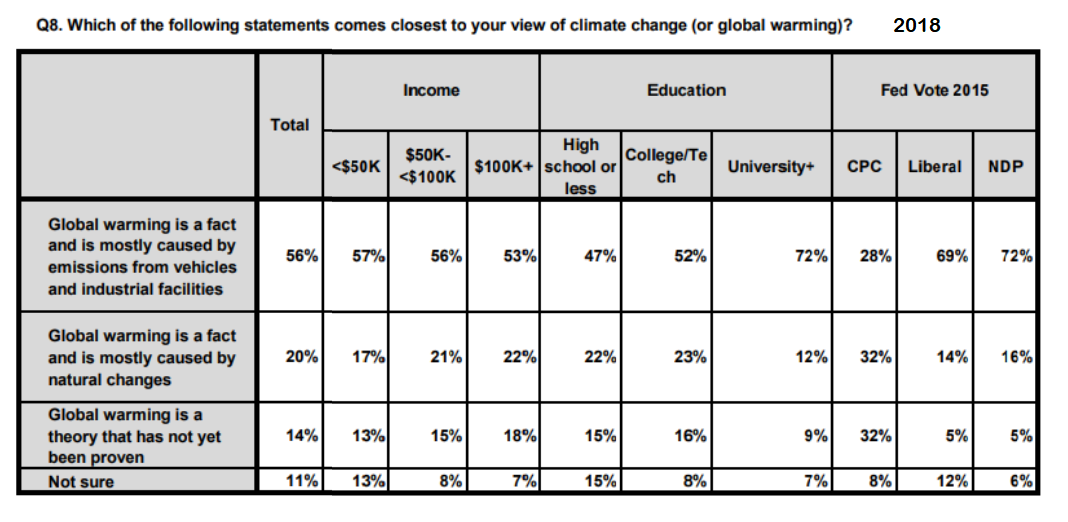
Another table shows that income level is not a driver, except for the more wealthy being somewhat surer of their opinions. However, global warming belief is strongly associated with university education, and with voting for left-wing parties (in Canada Liberal and NDP). It seems the educational system is aligned with left wing views on many things, including the climate.

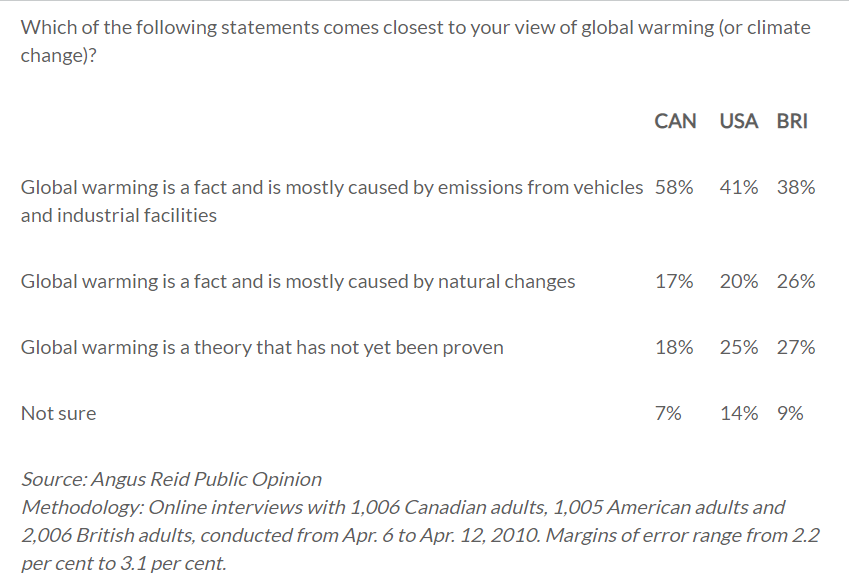
Angus Reid asked the same questions of Canadian, British and American citizens in 2010, with these results in the context of Obama mania and the Copenhagen COP drama.
In 2010 the majority of Americans and Brits were not global warming believers, compared to Canadians.  Note that Americans and Brits are more likely to say global warming is either natural or an unproven theory. More recent polls in those two countries continue to show the same pattern.

Political Implications

As the article title suggested, the landscape is not favorable for the Liberal’s tax plan.  For example
Moreover, both Ontario and Quebec have recently elected business-oriented provincial premiers, with Alberta likely to follow suit in the next election on or before May 31, 2019.  That may explain this result. Angus Reid observed that those who want no tax at all opted for provincial jurisdiction.

EU Sub Committee Aims to Open Closed Climate Minds

It wasn’t supposed to be this way.  The EU bureaucratic wheels were turning and needed a routine submission from the Committee on Agriculture and Rural Development as input for the Committee on the Environment, Public Health and Food Safety regarding a programme rule change.

The Rapporteur for opinion happened to be UKIP member John Stuart Agnew, who actually knows something about climate matters and agriculture, and drafted a submission accordingly.  The full document is here,( H/T WUWT)  and his case is put admirably.  Excerpts below in italics with my bolds.

The LIFE program is due for renewal in 2020. It has hitherto used its funding to act as a test bed for small projects which are expected to improve the environment. Examples have included management techniques to improve numbers of wild species or maintenance of wetlands. The success of such innovations can be quantified and demonstrated. The funding comes direct from Brussels.

If such projects are successful, they become popular with farmers who then make these investments using the Pillar 2 grants from their member states. The addition of the words ‘Climate Action’ in the present LIFE regime has added an entirely new concept to the way that taxpayer’s money should be used. The term has also occurred in the latest proposal from Commissioner Hogan on CAP reform. The addition of the term ‘Climate Action’ coincides with a 60% increase to the budget of the LIFE Programme. What is conspicuously missing are definitions of the actions required and the outcomes that are desired.

If the words ‘Climate Action’ had been substituted with the words ‘Pollution Action’, then it would be possible to measure air, soil and water pollution and measure the effectiveness of strategies to alleviate these problems, against a target figure for each of the three elements. A war to reduce pollution can be won, using the weapons of technology and legislation. A war against the world’s weather will never end, because ‘victory’ cannot be defined.

The Rapporteur has met the team of four from the Commission who between them have had varying levels of input into this proposal. The Rapporteur asked them what outcome would be considered desirable, as a consequence of financial investment. The answer was – ‘a reduction in CO2 emissions’.

By mentioning the concept that reducing CO2 levels will serve to take action against an unsatisfactory climate, the Commission is ignoring the factors that really do change our climate.
1. The galaxy: in the form of Cosmic Ray fluctuations. Can induce changes of 10 o C over millions of years.
2. The solar system: Gravitational pulls can induce changes of 2-3 o C.
3. The sun: Its variations of orbit and tilt along with its five separate documented cycles can the cause earth’s temperature to vary by up to 5o C.
4. Ocean Currents.
5. The ‘Greenhouse’ gas: Water Vapour, in the form of cloud cover.

The other Greenhouse gases, CO2, Methane and Nitrous Oxide have a negligible effect on our climate. CO2 is, however, an irreplaceable plant food. Methane degrades into CO2 and H2O; NOx gases eventually change into Nitrates.

If the effect of CO2 levels on our climate is negligible, the effect of human activity on changing those CO2 levels is also negligible.

The two world maps below perfectly demonstrate this.

Calculated areas of higher CO2 concentrations due to human emissions

– Actual areas of higher CO2 concentration
– SCIAMACHY observations on the ENVISAT satellite (agree with Japan’s IBUKU data)

The predictions of the experts and the measurements by satellite are contradictory. The total absence of CO2 hotspots over Europe indicates there is no problem for the Commission to solve. The only potential risk of a major CO2 event in Europe is an erupting volcano.

The naturally high concentrations of CO2 above our natural rainforests create an interesting dilemma for those who want one without the other. This is not made any easier when it is realised that rainforests are also major emitters of methane and water vapour.

Ever since the Rapporteur joined the Parliament in 2009, it has been fashionable for MEPs in AGRI and ENVI to work the phrase “tackling Climate Change” into their speeches. It sounds worthy and virtuous. It is based on predictions made in the 1980s of rapidly rising world temperatures and sea levels that never ultimately occurred. The Commission has listened to these speeches as opposed to observing the reality. At some stage somebody has to say “The king isn’t wearing an invisible suit, he’s just not wearing any clothes!” The Rapporteur is presenting this opportunity to his colleagues.

Some MEPs have been elected solely because of their antipathy to CO2. They will not change their views.

The Rapporteur urges other colleagues though to reflect on the fact that the precedent of ‘Climate Action’ in the LIFE Programme is setting the stage for ‘Climate Action’ in agriculture, where 40% of future budgets is destined to be spent fighting CO2, one of agriculture’s greatest friends.

The Rapporteur has amended the proposal to delete all references to “clean energy” as this implies “CO2 free” energy, as well as the references to ‘climate change mitigation’ but incorporated the term ‘climate change adaptation’ into the text of the legislative proposal. There is a big difference. We need to prepare for the next ‘Maunder Minimum’ or mini ice age – which might last 200-300 years. Some solar physicists believe this cycle has technically already started.

Footnote Regarding Future Cooling

Both the Pacific (PDO) and the Atlantic (AMO) are due for a cooling phase. If that happens coincidental with diminished solar input (indicated by the lower sunspot proxy), we are looking at planetary cooling as suggested by some solar physicists.

The situation reminds of governmental failure in North America to manage the educational system to match demographic shifts. The bureaucratic response comes too late to cope with the current reality. After WWII came the baby boom, and many schools became overcrowded and new ones built. Then the sexual revolution and female liberation produced a baby bust due to smaller families, so schools emptied with surplus capacity. Just as the government got serious about closing schools came the baby echo, unanticipated by the authorities. Despite smaller families, there were many more of them, these being the married adult boomers. Echo babies were a new pulse of children hitting a school system undergoing downsizing in response to the previous baby bust.

Similarly, the climatists would have us assume endless warming and require cessation of reliable affordable energy just as we enter a mini ice age.