Cynical Climate Politics

Lots of politicians in the US are grinding the climate ax, but the most cynical play of the climate card is on display in Canada. At Financial Post Gwyn Morgan describes how PM Trudeau is relying on global warming to escape electoral disaster in upcoming federal elections. His article: In choosing to mislead Canadians on climate change, the Liberals are basing their election campaign on a known lie. After describing a list of Trudeau missteps and failures widely criticized in the media, Morgan gets into the climate ploy. Excerpts intalics with my bolds.

So how does a government that can’t campaign on its record go about gaining re-election? By building its campaign around an issue where voters can see them as heroes fighting to save the planet against uncaring opponents. That issue is climate change and their weapon to fight it is carbon taxation. Winning re-election with this strategy requires convincing voters there’s a “climate emergency.” And so on April 1, the day the federal carbon tax kicked in on provinces unwilling to impose a tax that met the Liberals’ requirements, the federal Department of Environment and Climate Change released a supposedly independent report claiming “Canada is warming twice as fast as the rest of the world.”

[Note: Friends of Science deconstructed that report in post Climate Change NOT as Advertised, and Ross McKitrick dispelled the logic in Climate Hearsay ]

From now until the election, Canadians will hear Trudeau and his cabinet members blame every weather event, wet, dry, cold or warm on climate change. And the urgent need for a carbon tax to stop it. When the prime minister recently visited flood-ravaged areas in Quebec, he called the floods “the new reality of climate change.” But experts attribute the recent flooding to one of the longest, coldest, highest-snowfall winters on record. Isn’t climate change supposed to be about global warming?

Convincing Canadians of the need for carbon taxation is just the first element of the Liberals’ re-election strategy. Their most powerful — and cynical — tactic is their promise to give most taxpayers a bigger carbon-tax refund than what they will supposedly pay in carbon taxes. How is that possible? The answer is that individuals will get the refunds, while businesses bear the full cost. In other words, tax the job creators and use that money to bribe the voters.

The principal gladiators leading the Liberal carbon-tax forces are Trudeau and his eco-passionate environment minister, Catherine McKenna. The defenders opposing them in the carbon-tax coliseum are the premiers of Alberta, Saskatchewan, Manitoba, Ontario and New Brunswick, along with federal Conservative leader Andrew Scheer. Scheer will have most of the spears trained on him. McKenna recently accused him of “having no climate plan.” But unlike the Liberals, Scheer’s climate plan needs to be based on the fundamental fact that Canadians could all move to Mars tomorrow and it would have virtually zero impact on global climate change. Here’s why.

Many Canadians have been led to believe (with the help of Liberal misinformation) that oil is a sunset industry. But the consensus of authoritative forecasts sees growth in developing countries pushing world oil demand from the current 100 million barrels per day to at least 110 million by 2030. Here’s the question Canadians should be asking: If world oil demand is going up anyway, why should Canada cede the market for our most important export to Russia, Iran, Nigeria and Saudi Arabia — countries that don’t care about the environment and have horrendous human rights records? At the same time, hundreds of coal-fired power plants are under construction in China, India and Southeast Asia. (Vietnam, one of the smallest countries in that region, has new coal plants under construction that could end up producing more carbon dioxide emissions than all of Canada.)

As good little scout Canada struggles mightily to meet its commitments under the Paris climate accord, the vast majority of nations on the planet have already given up on the pact. Last year, global greenhouse gas emissions grew by an estimated 2.7 per cent. So if Canada’s economy had simply ceased to exist, our 1.6 per cent of global emissions would have been replaced in just seven months.

These are irrefutable facts. So the decision by the Trudeau Liberals to base their election campaign on the assertion that reducing our country’s relatively tiny emissions will help fight climate change can only be explained in one of two ways. First, Trudeau and his team are breathtakingly unaware of facts anyone can learn through an afternoon of Googling. Second, they choose to mislead Canadians in a desperate bid for re-election. That would mean they choose to base their election campaign on a known lie.

So what should Canada actually do about climate change? The clearest answer was recently offered by a man in hip waders, who was filling sandbags to help with the flooding in Central Canada. When he was asked by a reporter what should be done to prevent the floods, he said this: “Well, there’s all this talk about climate change, but I don’t see what Canada can do about that when China and other countries keep burning more. If that’s going to cause more floods, we’d better figure out how we can be ready for them.”

That’s the most common-sense analysis I’ve heard. Instead of throwing away billions of dollars subsidizing costly and impractical “green power” and handing taxpayer money to buyers of electric cars, let’s redirect those billions to risk mitigation and homeowner compensation. In the case of floods, dikes and dams need to be improved where practical. Homeowners in unprotected flood plains should also be offered the full replacement cost to move, as Alberta did after the floods of 2013. After all, it’s flawed government zoning that put people in the flood plain and created the problem; it’s only fair to homeowners that government make things right. Forest-fire risk can be mitigated by underbrush removal, regulatory setback distances and fire-resistant building materials.

A Conservative climate-change mitigation strategy based on the common-sense words of that flood worker would make Canadians much better prepared for climate change. And it has the added benefit of actually telling Canadians the truth about the climate-change challenge. That would be Andrew Scheer’s most important difference from Justin Trudeau.

Gwyn Morgan is the retired founding CEO of Encana Corp.

Footnote:

A master class in exploiting global warming for political gain was portrayed in the British comedy series Yes Prime Minister

Transcript of video is at Yes PM Pokes Fun at Climatism

Call Me a Carbon Polluter? See You in Court.

Program Statement October 23, 2018:Canada’s plan ensures that polluters pay for their carbon emissions in every province

Justin Trudeau justified the federal carbon tax this way:

“The core of putting a price on pollution is exactly that. Making sure that pollution is no longer free. You’re making something you don’t want more expensive. We don’t want pollution, so we’re putting a price on it.”

Brian Lilly writes at Canoe Carbon tax court battle, advantage Ontario. Excerpts in italics with my bolds.

Last week the Ontario and federal governments battled it out in court on the carbon tax and it was the tale of two very different stories.

The opening arguments laid out by lawyers representing the opposing sides showed where they wanted to put their emphasis.

The lawyer for the Government of Ontario argued that the law was unconstitutional while the lawyer for the Government of Canada argued climate change was real, urgent and needed action taken.

One was a legal argument, the other emotional.

Given that judges are human, either could carry the day and anyone saying they know which side will win is fooling you.

Decades of following court cases have taught me that judges are unpredictable.

When he opened his arguments, Josh Hunter, deputy director for the constitutional law branch for Ontario, argued that the Greenhouse Gas Pollution Pricing Act violated federalism and the constitution.

Hunter was clear to say the Ontario government was not challenging whether climate change was real or action needed to be taken, they were challenging how the federal government was attempting to reach their goals.

“What this reference is about is whether Parliament can impose its solution to the problem on the provinces,” Hunter said. “Or whether in a federal country, the provinces have the flexibility under the constitution to choose what best meets their local circumstances as they work together to combat climate change.”

The argument from Ontario is pretty simple and rooted in legal concepts. Whether the judges buy those legal concepts remains to be seen, though I think they should.

The federal act imposing a carbon tax on some provinces and not others is a violation of our federal system, as well as an attempt by the federal government to encroach on provincial jurisdiction and, effectively, a violation of the “no taxation without representation” concept that has been part of our system dating back to Magna Carta.

Did you know the act setting up this system grants to cabinet and cabinet alone the ability to set the rate of the carbon tax and to adjust it as they see fit without passing another vote in Parliament?

Whatever you think of the carbon tax or climate change, that should be enough to have this act and the tax that goes with it declared unconstitutional.

For their part the feds admitted this act does infringe on provincial jurisdiction but then said that it does so minimally and therefore should be allowed.

Besides, they argued, against no one in the room, climate change is real!

“We know that climate change is an urgent threat to humanity,” said federal lawyer Sharlene Telles-Langdon.

“The accumulation of greenhouse gases in the atmosphere causes global warming which is causing climate change and the associated national and international risks to human health and well-being.”

I’m not saying that Telles-Langdon, the general counsel for Justice Canada, didn’t argue constitutional reasons for upholding the law, but she put the urgency of climate change front and centre at every turn.

That is a policy discussion and not a constitutional one, which tells me that even the feds think they have a weak argument on the constitution and want to win on emotion.

What didn’t help the federal argument was the release of the annual report from the federal government on greenhouse gas emissions by the province.

It showed Ontario had reduced GHG emissions by 22% since 2005. Without a carbon tax Ontario is most of the way to meeting its part of Canada’s target of 30% below 2005 levels by 2030.

British Columbia, the province that has had a carbon tax since 2008 and we are told is the model all should follow, is only down 1.5% since 2005.

As a whole Canada is up by 2%.

The question before the court is not one of the impact of climate change or the best way for governments to combat it — those are policy discussions.

The question before the court is one of constitutionality and on that front Justin Trudeau and his Liberals have failed.

Let’s hope the courts are guided by law and the constitution and not emotion or political inclination.

Footnote:

Ross McKitrick explains that economists do favor carbon taxes over cap-and-trade schemes, but on the condition that the tax replaces other fees, taxes and regulations intended to reduce emissions. That condition is never respected by Canada and other nations enacting such. McKitrick writes at Fraser Institute: Trudeau government carbon-pricing plan not in line with Nobel Prize-winning analysis

Canada has a patchwork of highly inefficient regulations with marginal compliance costs, in many cases well in excess of the conventional estimates of the benefits of greenhouse gas emission reductions. But rather than repealing the inefficient regulations and replacing them with a carbon tax, the federal plan involves adding even more regulations to the mix—then sticking a carbon tax on top. This looks nothing like what economists have recommended.

In fact the economics literature provides no evidence this would be an efficient approach, and some evidence it would be worse than regulations alone.

See also:  CO2 ≠ Pollutant


About Canadian Warming: Just the Facts

Just in time for the Trudeau carbon tax taking effect, we have all the media trumpeting “Canada Warming Twice as Fast as Global Rate–Effectively Irreversible.”  That was written by some urban-dwelling climate illiterates who are woefully misinformed.  Let’s help them out with some facts surprising to people who don’t get out much.  Unfortunately ignored this week was an informative CBC publication that could have spared us “fake news” spewing across the land, from Bonavista to Vancouuver Island, as the song says.

Surprising Facts About Canada are presented in a CBC series 10 Strange Facts About Canada’s Climate  Excerpts below provide highlights in italics with my bolds.

Through blistering cold winters to hot muggy summers; torrential rain, blinding snowstorms, deadly tornados and scorching drought, Canadians experience some of the planet’s most diverse weather systems.  [ Uh oh, averaging all of that could be a problem]

Canada is as tall as it is wide, creating a wide range of climate conditions.

Canada has the largest latitude range of any country on the planet. Our southern border lies at the same latitude as northern California, while our northern edge reaches right to the top of the world. It’s rarely the same season in the same place at the same time. In early April, the Arctic may still be in the throes of a frigid winter, while the south can experience summer-like temperatures. No doubt, our weather forecasters are the busiest in the world!

Canada has an ‘iceberg alley’.

Pieces of glaciers from the coast of Greenland are picked up by the Labrador Current, a counter-clockwise vortex of waters in the North Atlantic Ocean. Those broken pieces become icebergs that float in the sea off northeast Newfoundland where Fogo Island lies. Navigating the area is risky for ships; in fact this is where the mighty Titanic sank in 1912. But it’s a boon to tourism. Iceberg seekers flock to the area to watch (safely) from the shore and boast about drinking 10,000-year-old fresh water taken from an iceberg floating in the ocean.

Cold Weather Niagara Falls

Niagra Falls (the Canadian side)

Canada is (really) cold.

It’s certainly not surprising to most Canadians that we are tied with Russia for the title of ‘coldest nation in the world.’ Over our vast country, we have an average daily temperature of -5.6C. This is deadly cold. More of us — about 108 — die from exposure to extreme cold than from any other natural event. And that’s not counting Canadian wildlife who are more susceptible to Canada’s icy climate than we are.

Calgary Golfer February 9, 2016.

Every winter, southern Alberta is the ‘Chinook’ capital.

For six months — from November to May — warm dry winds rush down the slope of the Rocky Mountains towards southern Alberta. Often moving at hurricane-force speeds of 120 km per hour, they can bring astonishing temperature changes and melt ice within a couple of hours. In 1962 Pincher Creek saw a record temperature rise of 41C, from -19 to 22 in just one hour. Chinook is also known as the ‘ice-eater’ among locals who appreciate the break from winter that the winds provide.

Newfoundland is the foggiest place in the world.

At the Grand Banks off Newfoundland, the cold water from the Labrador Current from the north meets the warmer Gulf Stream from the south. The result is a whopping 206 days of fog a year. In the summer, it’s foggy 84 per cent of the time! It’s also the richest fishery in the world, the fog is a serious hazard to ships in the region.

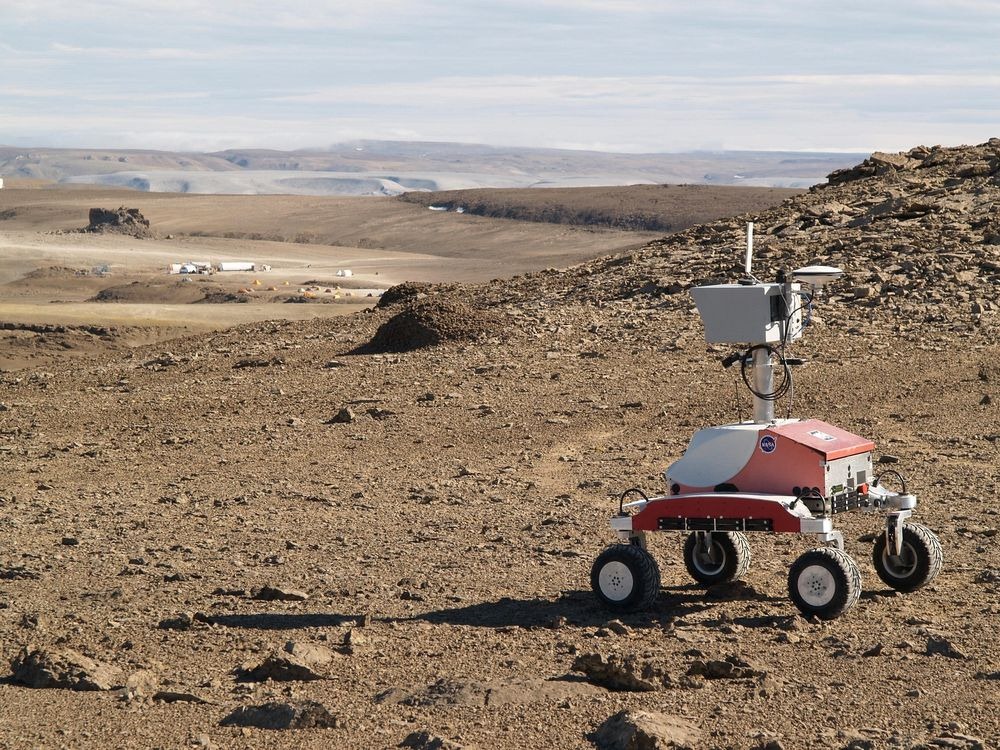
View of the Haughton-Mars Project Research Station (HMPRS) on Devon Island, Nunavut, Arctic Canada

Canada’s North is actually a desert

Canada’s North is very cold and dry with very little precipitation, ranging from 10-20 cm a year. Temperatures average below freezing most of the year. Together, they limit the diversity of plants and animals found in the North. And it’s huge: this polar desert covers one seventh of Canada’s total land mass.

In 1816, Canada didn’t have a summer.

If winter in Canada weren’t bad enough, in 1816 the country’s eastern population were sledding in June and thawing water cisterns in July. Trees shed their leaves and there were reports of migratory birds dropping dead in the streets.

Over in Europe, the weird weather stoked anti-American sentiment. People opposed to emigration said that North America was inhospitable and getting colder every year.

Representation of Mount Tambora 1815 eruption in Indonesia.

Ironically, as eastern Canada stayed cool, the Arctic warmed, creating flotillas of icebergs off the coasts of Nova Scotia and Newfoundland. At the time, it was thought that the icebergs were the cause of the cooling, like a giant glass of iced lemonade. What was the real reason? In 1815, the Tambora volcano erupted in Indonesia, spewing tonnes of ash and dust into the air. Less sunlight reached the earth and this caused the planet’s surface to cool. The volcanic eruption changed the climate in different ways around the world, but Eastern Canadians were treated to the summer that just didn’t come.

The Prairies face brutal temperature extremes.

It’s no surprise that Regina, Saskatchewan — which lies smack in the middle of Canada’s prairies — lays claim to both the country’s lowest recorded temperature, -50C on January 1, 1885 and the highest, 43.3C on July 5, 1937. Without the moderating effects of a large body of water, Canada’s Prairies are vulnerable to some of the worst weather Canada has to offer.

Hopewell Rocks at the Bay of fundy. Photo: gregstokinger

The Bay of Fundy has the largest tides in the world.

Twice each day, 160 billion tonnes of seawater flow in and out of this small area in Nova Scotia — more than the combined flow of the world’s freshwater rivers. The tides reach a peak of 16 metres (as high as a five-storey building) and take about six hours to come in. The most extreme tides in the Bay occur twice each month when the earth, moon and sun are in alignment and together they create a larger-than-usual gravitational pull on the ocean, creating a “spring tide” (not to be confused with the season spring).

Lightning over Lake St. Clair Photo: seebest

Windsor is the thunderstorm capital of Canada.

Hot, humid air from the Gulf of Mexico funnels up through Windsor and the Western Basin of Lake Erie creating the perfect conditions for thunderstorms. About 251 lightning flashes per 100 square kilometres happen every year when small pieces of frozen raindrops collide within thunderclouds. The clouds fill with electrical charges that are eventually funnelled to the ground as lightning.

Summary

With all that going on, all the variety of temperature, precipitation, weather events and seasonalities, no one noticed it had warmed much, and would be grateful if it had.  With all the alarms sounding about the Arctic meltdown in the last decades, let’s consider the best long-service stations in the far north.

According to the “leaked report”, Canada’s annual average temperature over land has warmed 1.7 C when looking at the data since 1948. But that claim is misleading when recent data is considered.

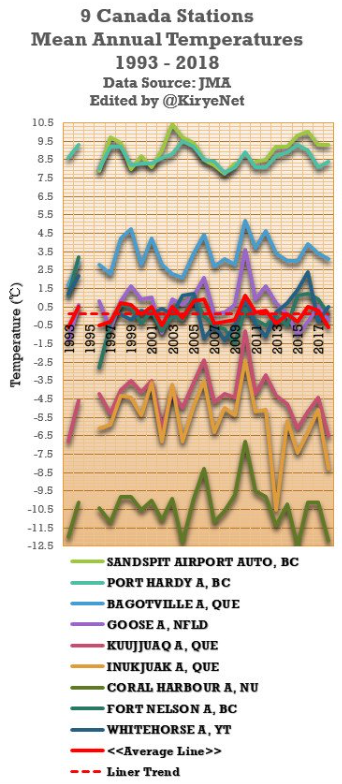
Over the past 25 years, since scientists began to warn that the planet was warming in earnest, there has not been any warming when one looks at the untampered data provided by the Japan meteorology Agency (JMA) that were measured by 9 different stations across Canada. These 9 stations have the data dating back to around 1983 or 1986, so I used their datasats.

Looking at the JMA database and plotting the stations with longer term recording, we have the following chart:

Though temperatures over Canada no doubt have risen over the past century, there has not been any real warming in over 25 years. Rather, there’s been slight cooling, though not statistically significant. Clearly there hasn’t been any Canadian warming recently.

So it is misleading — to say the least — to give the impression that Canada warming has been accelerating. Thanks to Kirye for posting this at No Tricks Zone

See also Cold Summer in Nunavut

Get a Second Opinion Before Climate Surgery


Myron Ebell writes March 28, 2019 in the Sacramento Bee PRO: Climate Science Needs a Critical Review by Skeptical Experts Excerpts in italics with my bolds.

Is global warming a looming catastrophe? President Donald Trump has often said he doesn’t think so even while his administration continues to release official reports warning that it is.

The president will soon find out who is right by convening a high-level commission to do a critical review of the fourth National Climate Assessment issued last November and other government reports.

Surprisingly, most of the climate science funded by the federal government has never been subjected to the kind of rigorous and exhaustive review that is common practice for other important scientific issues and major engineering projects.

For example, when NASA was putting men on the moon, every piece of equipment and every calculation were scrutinized from every possible angle simply because if anything went wrong the mission would fail.

Serious problems and shortcomings with official climate science have been raised repeatedly in the past by highly qualified scientists such as Princeton’s brilliant physics professor William Happer only to be ignored or dismissed by the federal agencies in charge of producing the reports.

Yet the conclusions and predictions made in these official climate science reports are the basis for proposed energy policies that could cost trillions of dollars in less than a decade and tens of trillions of dollars over several decades.

Given the magnitude of the potential costs involved, taking on trust the bureaucratic processes that have led to official consensus is simply foolish. Thus the review to be undertaken by the proposed President’s Commission on Climate Security is long overdue.

To mention only three major issues among many that need to be scrutinized:

First, the computer models used have predicted far more warming than has occurred over the past 40 years. Why have such models failed and why are they still used are important questions.

Second, predictions of the various negative impacts of warming, such as sea level rise, are derived from highly unrealistic scenarios; and positive impacts, such as less ferocious winter storms, are minimized or ignored. What would a more honest accounting of all the possible impacts of climate change look like?

Third, surface temperature data sets appear to have been manipulated to show more warming in the past century than has occurred. The new commission should insist that the debate be based on scrupulously reliable data.

Since news of the proposed review leaked out in February, a furious campaign to stop it has been mounted by the federal climate bureaucracy and their allies in the climate industrial complex.

On the surface, this seems puzzling. If the alarmists are confident that the science contained in the official reports is spot on, they should welcome a review that would finally put to rest the doubts that have been raised.

On the other hand, their opposition suggests that the science behind the climate consensus is highly suspect and cannot withstand critical review. In other words, they’ve been peddling junk and are about to be found out.

A press release from one alarmist pressure group was headlined: “58 Senior Military and National Security Leaders Denounce NSC Climate Panel.”

Denouncing an expert review seems a most inappropriate response, and especially to one that is designed to be open and subject to further review by other experts, such as the National Academies of Science.

I wonder if environmental pressure groups have ever denounced doing another environmental review of projects – for example, the Keystone XL pipeline – they are trying to stop.

Two prominent promoters of global warming alarmism recently published an op-ed in which they accused the Trump administration of using “Stalinist tactics” to try to discredit the climate science consensus.

Let’s hope that they’re not as ignorant about science as they are about history. It’s the enforcers of climate orthodoxy and opponents of open debate who are using Stalinist tactics.

Senator Lee Mocks GND

Sen. Mike Lee mocks Green New Deal in speech featuring tauntauns, giant sea horses and babies is an article at KSL.com.  A video clip is above to appreciate his standup delivery.  Text from the speech is reprinted below in italics with my bolds.

Sen. Mike Lee offered what he considers a serious solution to climate change Tuesday in an often flippant speech about the Green New Deal on the Senate floor: babies.

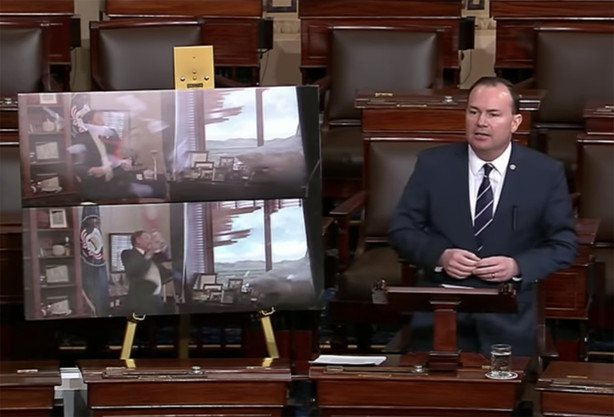
The Utah Republican mocked the Democratic proposal with images of a machine-gun wielding Ronald Reagan riding a dinosaur, tauntauns from “Star Wars,” Gov. Gary Herbert fending off sharks with a tennis racket, and Hawaiians on giant sea horses — not to mention some bad puns.

“The solution to climate change is not this unserious resolution that we’re considering this week in the Senate, but the serious business of human flourishing — the solution to so many of our problems, at all times and in all places, is to fall in love, get married and have some kids,” Lee said.

His speech came ahead of a failed vote in the Senate to begin debate on a sweeping resolution to combat climate change called the Green New Deal. Freshman Rep. Alexandria Ocasio-Cortez,-D, N.Y., and Sen. Ed Markey, D-Mass., introduced the legislation.

Lee said problems of human imagination are not solved by more laws, but by more humans.

“More babies will mean more forward-looking adults, the sort we need to tackle long-term, large-scale problems,” he said. “American babies, in particular, are likely going to be wealthier, better educated, and more conservation-minded than children raised in still-industrializing countries.”

Lee said the plan essentially calls for the elimination of all airplanes and all cows.

Sen. Mike Lee speaks on Senate floor Tuesday, March 26, 2019. (Photo: Sen. Mike Lee, YouTube)

Without airplanes, how would people get around the vast expanses of Alaska?  Tauntauns, Lee said, showing a picture of Luke Skywalker aboard one of the fictional snow lizards found roaming the wintry, windswept plains of Hoth.

“Not only are tauntauns carbon-neutral, but according to one report ‘a long time ago’ and ‘far, far away,’ they may even be fully recyclable for their warmth on especially cold nights,” Lee said, referencing a scene in “Star Wars: The Empire Strikes Back” where Han Solo slices open the beast with his lightsaber so a hypothermic Luke Skywalker can crawl inside.

Unable to fly, Hawaiians, Lee said, would have to ride giant sea horses to reach the mainland. “Under the Green New Deal, this is probably Hawaii’s best bet,” he said.

“But honestly, I think you’ve got to remember if they think the cows smell bad, just wait ’til they get a whiff of the sea horses,” he said.

Reducing the nation’s 94 million cows to zero means no more milk, cheese, steak or hamburgers, he said.

“Over the state work period last week, I visited some farms to find out for myself what Utah’s own bovine community thinks of the Green New Deal,” Lee said.

“Every cow I talked to said the same thing: ‘Boo.'”

Sen. Mike Lee speaks on the Senate floor Tuesday, March 26, 2019. (Photo: Sen. Mike Lee, YouTube)

Climate change hit home in Utah when sharks crashed through the window in Herbert’s state Capitol office in the made-for-TV flick “Sharknado: The 4th Awakens,” Lee said.

Displaying a painting depicting the climactic battle of the Cold War with Reagan packing a machine gun and a rocket launcher while riding atop a dinosaur with the American flag in the background, Lee said there was no such fight. The Cold War, he said, was won without firing a shot.

The image has as much to do with overcoming Soviet communism in the 20th century as the Green New Deal has to do with overcoming climate change in the 21st century, he said.

“The aspirations of the proposal have been called radical and extreme,” Lee said. “But mostly they are ridiculous.”

Stop Fake Science. Approve the PCCS!

John Droz makes some good points writing at Town Hall.Stop Fake Science. Approve the PCCS! Excerpts in italics with my bolds, images and header questions.

Shouldn’t We Get Independent Advice Before We Spend Trillions of Dollars?

Not to date myself, but in my day the “$64,000 Question” represented a lot of money!

Today I’m proposing to you a $64 Trillion question: “Should the United States conduct a full, independent expert scientific investigation into the models and studies that say we face a serious risk of manmade global warming, climate change and extreme weather disasters?”

That independent expert investigation is what’s being proposed by Dr. Will Happer, President Trump’s Senior Director for Emerging Technologies, in the National Security Council. Specifically, a brand new Presidential Committee on Climate Science (PCCS) will do this analysis. The decision about launching the PCCS will be made in the next few days. America’s support for President Trump is urgently needed.

(For the sake of brevity – and to use the most commonly employed term – when I say “global warming,” I mean all the climate changes that are supposedly caused by fossil fuel use and other human activities.)

$64 Trillion is actually at the lower end of estimates of what it will cost the USA over the next decade to replace all our fossil fuel use with (supposedly) green, renewable, sustainable wind, solar and biofuel energy – in order to (supposedly) stabilize Earth’s climate (which has never been stable).

Many say the obvious answer to this $64 Trillion question is YES, of course. However, many other parties are saying NO. What are the arguments against the PCCS, and do they hold water?

If the case for alarm is so convincing, what’s the problem?

1) It’s a waste of money to have this PCCS investigation. If the US was about to spend an enormous amount of money – such as $64 trillion or more – would you say an investigation costing one-billionth(!) of that monumental expenditure would be a waste of money? That’s what we are talking about here.

2) It’s a waste of time. President Trump has already stated that (without new facts confirming that we actually face imminent manmade climate chaos) he’s not going to do anything consequential about global warming. So since the USA is in a holding period on this issue, how is any time being wasted?

In fact, since the President is asking for an independent investigation, the end result could be that the PCCS would recommend that Mr. Trump take a different global warming policy position, and actually support action against fossil fuels. One would think those clamoring for exactly that would be ecstatic!

3) Human responsibility for climate change and extreme weather has already been scientifically resolved. That is simply not so. A genuine scientific assessment has four necessary components. It must be: a) comprehensive, b) objective, c) transparent, and d) empirical. There has never been a true scientific assessment of global warming claims, anywhere on the planet.


How about the many scientists who have valid questions about the evidence?

What about the position of 97% of the world’s scientists? That’s a good question, because we constantly hear that virtually the entire scientific community agrees that humans are causing climate catastrophes.

Fact one: there never has been a survey of the world’s 2+ million scientists on anything – certainly not on this vital issue, which is being used to demand the immediate end to all use of fossil fuels that today provide over 80% of all the energy the United States and entire world use.

Fact two: There may indeed be a majority of certain subsets of scientists who hold an opinion about global warming. However, many who support climate cataclysm claims receive government or other grants that would be terminated if they began to “question the science of global warming.” And not one of them has ever conducted a genuine, evidence-based scientific analysis of the global warming matter.

Fact three: Science is never determined by a vote. Do you think that Einstein’s Theory of Relativity was accepted due to a poll? Or was it because his theory survived extensive scientific scrutiny?

What about the UN Intergovernmental Panel on Climate Change’s voluminous Assessment Reports?

Another good question. However, if we compare the reports to the four necessary requirements for Real Science, as practiced for centuries, they actually fail on at least three of the four criteria that I just presented a few paragraphs ago!

If the global warming cataclysm proponents’ scientific arguments were as unassailable as they say they are, then those scientists should relish this high-profile opportunity to publicly upstage the skeptics and prove to the world that “dangerous manmade climate change” is real.

On the other hand, those alarmist scientists might fail spectacularly. They might be shown to have no real-world evidence to back up their computer models and assertions. I submit that they are scared to death this would happen. That is why they oppose the PCCS so stridently.

How about our long history of coping with changes in climate and weather extremes?

4) Global Warming is a national security threat. This is another three-card-Monte trick being played on the technically-challenged public. Multiple studies have shown there is little correlation between extreme weather events (e.g. hurricanes, tornadoes, floods) and global warming. Moreover, our military – indeed our entire country and civilization – have been dealing with these problems for centuries, and today we have far better technologies to do so than ever before.

On the other hand, one of the key “solutions” to Global Warming (industrial wind energy), has a well-documented history of interfering with the missions and operational readiness of our military. Where is the outcry against that?

What’s wrong with asking questions about actions being promoted?

5) President Trump is acting irrationally regarding global warming. Surprisingly, President Trump, as a skeptic, is actually taking a more scientific position than many scientists who hold PhDs. Skepticism is the primary pillar of Real Science. So being labeled a “skeptic” is high praise to real scientists.
Unless we pay close attention, it may not be apparent that America’s Left is frequently in favor of exactly the opposite of what they are now saying. For example:

* The people who say they want more unity – are actually instigating divisiveness.

* The people who say they are protectors of the environment – are actually doing the most to ravage the environment, by demanding energy systems that require far more land, far more raw materials, and far more environmental damage than fossil fuels have ever caused.

* The people who say immediate, extraordinary, highly disruptive changes are needed to prevent global warming catastrophe – are promoting feeble, inadequate solutions: like wind and solar energy.

So when these same people clamor that they want President Trump to reverse his position on global warming (and the Paris Climate Accord – in reality they actually want President Trump to continue with his present climate policies and skepticism. Why is that?

Because they think that will give them political ammunition to use against him in the 2020 election.

 Shouldn’t we try to separate private interests from the public good?

The bottom line is very simple. President Trump should be applauded for proposing the PCCS, and for being open-minded enough to reconsider global warming claims – before our nation accepts them as gospel … and rushes headlong into disrupting our energy, economy, living standards and lives … probably for no climate benefit whatsoever.

We citizens need to support him against the very vocal (and often very self-interested) people and organizations that strongly oppose the Presidential Committee on Climate Science. We need to take immediate action to support President Trump on this vitally important initiative.

Send him a quick note. Real, evidence-based climate science demands that we have this PCCS review. So does the future of our country and our children.

Realistic Alternative to Green New Deal


Alex Berezow takes up the challenge from factually-challenged AOC in his article at American Council on Science and Health Okay, Alexandria Ocasio-Cortez. Here’s An Alternative To Green New Deal Excerpts in italics with my bolds.

Does all that sound ridiculously arrogant and scientifically illiterate? Of course it does. Yet, that’s basically how new Congresswoman Alexandria Ocasio-Cortez (AOC) has responded to the critics of her Green New Deal. We’re all idiots. She’s a visionary.  

AOC’s remark to “come up with your own ambitious, on-scale proposal” is precisely the sort of uneducated statement a person who knows literally nothing about a topic says. It’s reminiscent of the anti-vaxxers who say, “If vaccines are so safe, show me the evidence!” There are entire research papers and books dedicated to energy policy. AOC just hasn’t bothered to read any of them.

As it turns out, the solution to climate change isn’t all that complicated. It won’t be accomplished in 12 years; we couldn’t even rebuild the World Trade Center in 12 years. But it can be done. I wrote a brief, 550-word article that gives a general outline. If even that’s too long, here’s the TL;DR version. [ I had to look it up; TL:DR means Too Long; Didn’t Read]

  1. Start building Generation IV nuclear power plants right now. Not next year. Not tomorrow. Right now. They are meltdown-proof and the best source of carbon-free energy on the planet. Research suggests that the entire world could be on nuclear power within 25 years.
  2. In the meantime, phase out coal while embracing natural gas. Natural gas burns cleaner than coal. If you object to this, then do #1 faster.
  3. Upgrade our energy infrastructure with a smart grid, smart meters, better capacitors, and better transmission lines. All of this is necessary if we want to rely at least in part on solar and wind. (But solar and wind aren’t really necessary; see #1.)
  4. Invest in solar and fusion power research. Current solar technology is too inefficient. The breakthrough we’ve been seeking in solar hasn’t happened yet, but it could. Similarly, fusion is theoretically the best source of energy (even better than nuclear), but scientists haven’t figured this one out yet. It turns out that recreating the sun on earth is kind of hard.
  5. As our energy infrastructure improves, electric car technology will improve along with it, making fossil fuels largely obsolete. (Airplanes might always need fossil fuels, though, much to AOC’s chagrin.)

That’s it. It’s not a sexy plan, but it’s a realistic one. We could actually accomplish this, but so far, there has been no political will whatsoever to do it. Oddly, the biggest opponents are environmentalists, people like Alexandria Ocasio-Cortez.

Climate Science: “Heads, We Win. Tails, You Lose.”

Another display of monotonic Climate Science is the uproar over a proposed White House panel of scientists to review and advise on statements about climate change appearing in various and sundry Federal Executive Branch organizations. Witness the sanctimonious John Kerry: Disband Your Climate Denial Panel, Mr. President.

Like spoiled children thwarted, warmists are throwing a tantrum at the prospect of being held accountable for parroting climate nostrums. After all, before now they have had no challenges to anything they say.  So they are outraged; Outraged, I say! Sen. Schumer says he pledges to defund the panel to silence them

Lost in the uproar over forming a red team to peer review climate science pronouncements on behalf of the WH is the existence of the Climate Blue Team operating uncontested for many years at NOAA Climate.gov. Having had the field to themselves for so long, the idea of another viewpoint seems unthinkable and wrong.

Introducing the Climate Blue Team (formed in 2010)

The Leaders

The Team General Manager is Thomas Karl, infamous for his hurried adjustment of the NOAA sea surface temperature dataset in order to erase the inconvenient “pause” this century. For the background on his actions prior to retiring see Bob Tisdale’s Open Letter to Tom Karl of NOAA/NCEI Regarding “Hiatus Busting” Data

Karl is joined by Richard Rosen who pushed for a NOAA press release to challenge Chris Landsea’s study on the issue of hurricane intensity and climate change, since it “takes a position that is supportive of the Bush administration’s view on the issue.” He also published a paper The economics of mitigating climate change: What can we know?, which concluded:  “Because of these serious technical problems, policymakers should not base climate change mitigation policy on the estimated net economic impacts computed by integrated assessment models. Rather, mitigation policies must be forcefully implemented anyway given the actual physical climate change crisis, in spite of the many uncertainties involved in trying to predict the net economics of doing so.”

Wayne Higgins heads up NOAA’s Program Office and is on the record attributing extreme weather events to man-made global warming: “So where we’ve looked forward decades, even out to a century and using those climate models with scenarios in which we actually ramp up the levels of greenhouse gases, we are able to confirm that human-induced climate change is something that is occurring now and that is actually likely to continue in the future,” he said.

Eileen Shea led NOAA’s Climate Services program and sings from the same hymnbook:
“No scientist worth their salt will blame any individual event on climate change, but these storms are certainly being exacerbated by climate change, partly because hurricanes, especially, take their energy from the ocean, their energy and their moisture from the ocean, and the warm the water, the stronger the hurricane can grow. And the more expansive the warm water, the further the hurricane can go and stay strong.” Shea is one of the many climate scientists working in Asheville, sometimes referred to as “climate city.” For them, the debate over climate change has been long-settled.

Ko Barrett is Deputy Director of NOAA’s Office of Oceanic and Atmospheric Research Office and also a Vice Chair of the IPCC. In the latter role, she led the effort to produce SR15, the call to prevent 1.5C of warming. “This is the first time the IPCC has undertaken a focused report on the processes that drive change and the resulting impacts to oceans and the frozen parts of our planet,” said IPCC Vice-Chair Ko Barrett. “There is a huge volume of scientific information for us to assess, which can help policy makers to better understand the changes we are seeing and the risks to lives and livelihoods that may occur with future change.”

Louisa Koch is NOAA Director of Education. “Not only does such coordination minimize duplication among these programs, but the overall effort is enhanced also because each agency brings a complementary mission-driven focus to this complex, large-scale issue,” added Louisa Koch, director of education for NOAA. Why should the public care? Put simply, climate change affects everyone on Earth. Climate is “changing in ways that are going to impact society across the board,” said Louisa Koch, the director of NOAA’s Office of Education. “Communities need to understand what changes they are going to experience most intensely and how that’s going to impact them.”

The Blue Team Panel of Players

NOAA has a science panel comprising the players that review papers and articles, and ensure the warmist viewpoint is protected and reinforced. The Head Coach appears to be Wayne Higgins (above)

Jessica Blunden: Even though it was a relatively quiet hurricane year in the Atlantic, there were 36 major tropical cyclones worldwide – 15 more than average, said NOAA climate scientist Jessica Blunden, co-editor of the report published Tuesday in the Bulletin of the American Meteorological Society. And at the heart of the records is that all three major heat-trapping greenhouse gases – carbon dioxide, methane and nitrous oxide – hit record highs in 2015, Blunden said. “This impacts people. This is real life,” Blunden said.  ‘Earth’s fever rises’: New report shows many symptoms of climate change

Tim Boyer: “From this [study] we can better understand the effects of natural and man-made variability to the climate system,” said co-author Tim Boyer of NOAA’s Ocean Climate Laboratory. “Decision-makers can gauge what needs to be done to ameliorate the situation, or, if not that, to plan for the consequences of the excess heat.” The study was published in the journal Science Advances. The findings are important because the world’s oceans provide one of the best records of the excess energy trapped on Earth by increased greenhouse gases, largely from the burning of fossil fuels. As the seas heat up from climate change, the water expands and rises, causing coastal flooding and, in Antarctica, ice shelves to disintegrate.

Christopher Burt is a lucky man. As with others fascinated by weather records, his once obscure passion has been thrust into one of the central conversations of our time. Burt’s audience is surprisingly large. On average, 10,000 people a day read his postings on Weather Underground. Though he writes about all sorts of weather extremes, heat records are one of his greatest passions.

In 2010, two climate-change researchers using computer modeling and calculations of human cooling capacities predicted that large parts of the earth may become uninhabitable during heat waves in future centuries. The study was based on a scenario of rapid global warming and was probably a bit shrill in its view of the consequences—mass migrations and war—but the science was solid and easy to believe. After all, large parts of the planet are already uninhabitable, at least for some percentage of the population some percentage of the time. And the heat waves are hitting harder, and coming more frequently than ever before.

Leo Donner: Donner has also served as a reviewer for the Intergovernmental Panel on Climate Change, whose reports help world leaders make decisions on dealing with the issue. The research scientist will discuss some IPCC conclusions, such as how humans have increased greenhouse gases through agricultural activity, burning fossil fuels and decimating forests in the Amazon. “One conclusion of the IPCC is that most of the observed change in global temperature is the result of human activity,” Donner said.

NOAA Scientist David Fahey in Boulder: a Lead Author of National Climate Assessment: The government’s National Climate Assessment cited human influence as the “dominant cause of the observed warming since the mid-20th century.” The report affirms that climate change is driven almost entirely by human action, warns of a worst-case scenario where seas could rise as high as eight feet by the year 2100, and details climate-related damage across the United States that is already unfolding as a result of an average global temperature increase of 1.8 degrees Fahrenheit since 1900. When it comes to rapidly escalating levels of greenhouse gases in the atmosphere, the report states, “there is no climate analog for this century at any time in at least the last 50 million years.”

Alarmist All Star Katharine Hayhoe is a professor in the department of political science at Texas Tech University and director of its Climate Science Center. She was a lead author on the Climate Science Special Report, part of the fourth US National Climate Assessment. She writes books, produces videos, documentaries and gives interviews to raise awareness of climate change concerns. Katherine Hayhoe: “The most important thing is to accelerate the realization that we have to act. This means connecting the dots to show that the impacts are not distant any more. They are here and they affect our lives. It means weaning ourselves off fossil fuels, which is challenged by the fact that the majority of the world’s richest companies have made their money from the fossil fuel economy, so the majority of the wealth and power remains in their hands.” “Climate change is a long term trend superimposed over natural variability. There will be good and bad years, just like there are for a patient with a long term illness, but it isn’t going away. To stabilize climate change, we have to eliminate our carbon emissions. And we’re still a long way away from that.”

Sarah Kapnick is a scientists at NOAA’s Geophysical Fluid Dynamics Laboratory.
Global warming is going to steal away some of those postcard-perfect weather days in the future, according to a first-of-its-kind projection of nice weather. “The changes are more dramatic in parts of the developing world, where you have high concentrations of populations,” said NOAA climate scientist and co-author Sarah Kapnick.

Rick Lumpkin, director of NOAA’s Global Drifter Program: “Because the drifters provide a ground-truth of currents, they are great for combining with satellite observations to study climate-scale problems.” The oceans, the true keepers of climate change, may meet our grimmest estimates.

High Scoring Meteorologist Jeff Masters co-founded Weather Underground: “The Climate Has Shifted to a New State Capable of Delivering Rare & Unprecedented Weather Events.” Stronger hurricanes, bigger floods, more intense heat waves, and sea level rise have been getting many of the headlines with regards to potential climate change impacts, but drought should be our main concern. Drought is capable of crashing a civilization. We’ve set in motion a dangerous boulder of climate change that is rolling downhill, and it is too late to avoid major damage when it hits full-force several decades from now. However, we can reduce the ultimate severity of the damage with strong and rapid action.

Richard Rood is a Professor in the Department of Atmospheric, Oceanic and Space Sciences at the University of Michigan where he teaches atmospheric science and climate dynamics.
If we stop our emissions today, we won’t go back to the past. The Earth will warm. And since the response to warming is more warming through feedbacks associated with melting ice and increased atmospheric water vapor, our job becomes one of limiting the warming. If greenhouse gas emissions are eliminated quickly enough, within a small number of decades, it will keep the warming manageable and the Paris Agreement goals could be met. It will slow the change – and allow us to adapt. Rather than trying to recover the past, we need to be thinking about best possible futures.”

Scott Weaver is a Research Meteorologist at NOAA.s Climate Prediction Center and member of the Environmental Defense Fund (EDF).  “Today’s Climate Science Special Report is our most comprehensive and definitive look yet at the massive amount of sound scientific research on climate change, and it’s conclusions are inescapable – climate change is happening right now, it’s hurting American families, and it will get worse unless we act,” said EDF Senior Climate Scientist Scott Weaver. “This report should put any doubts about the existence or the severity of climate change to rest. We cannot afford to ignore this threat.”

Kandis Wyatt, Designated Federal Officer for US Climate Change Impact Reports, eg. 2014:
“Climate change, once considered an issue for a distant future, has moved firmly into the present. Corn producers in Iowa, oyster growers in Washington State, and maple syrup producers in Vermont are all observing climate-related changes that are outside of recent experience. So, too, are coastal planners in Florida, water managers in the arid Southwest, city dwellers from Phoenix to New York, and Native Peoples on tribal lands from Louisiana to Alaska. This National Climate Assessment concludes that the evidence of human-induced climate change continues to strengthen and that impacts are increasing across the country.”

Summary

What hypocrisy to criticize skeptics for finally attempting to organize and claim a bit of airtime to tell the other side of the story. Apparently the case for man-made global warming is so weak, no objections can be allowed.

Not much of a game without an opponent.

See Also Kelly Craft Vs. Monotonic Climate Science

Kelly Craft Vs. Monotonic Climate Science

Update February 24, 2019

Now that Kelly Craft, US Ambassador to Canada is Trump’s nominee for UN Ambassador, let’s return to the interview for which she will again be persecuted by climate alarmists/activists.

The Greek word for “one tone” is monotonia, which is the root for both monotone and the closely-related word monotonous, which means “dull and tedious.” Monotone is a droning, unchanging tone. A continuous sound, especially someone’s voice, that doesn’t rise and fall in pitch, is a monotone. Nothing can put you to sleep quite as effectively as a teacher talking in a monotone.

Monotonic climate science was on full display as journalists, pundits and tweeters freaked out over a comment by the new US ambassador to Canada.  Her offense:  saying there were two sides on the climate issue and she respects them both.

The story from CBC:  The new U.S. ambassador to Canada said Monday that she believes “both sides” of climate change science.

In an interview with Canada’s CBC News, Kelly Knight Craft said that she believes there is “accurate” science on “both sides” but did not specify what sides she was referring to.

“I believe there are sciences on both sides that are accurate,” Craft said. “Both sides have their own results from their studies, and I appreciate and respect both sides of the science.”

President Trump appointed Craft, a prominent GOP fundraiser, to the ambassadorship earlier this year.

Craft told CBC that even though Trump has pledged to pull the United States out of the Paris climate agreement, she thinks the U.S. can “absolutely” fight climate climate change.

“We all have the same goal, and that is to better our environment and to maintain the environment,” she said. “I feel like our administration has been on top of this regardless of whether or not they’d be pulling out.”

It is true Ambassador Craft had the look of a deer in the headlights.  She is from Kentucky where one doesn’t encounter sanctimonious warmists as frequently as in Ottawa, and especially not ones determined to get a “gotcha” quote from her.
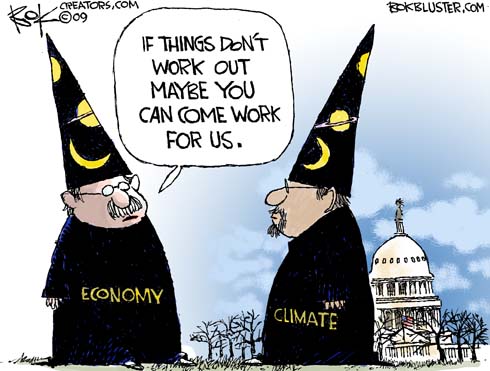
All the comments at alarmist websites dissed her for thinking the issue could have two differing points of view. Going further, they repeatedly claim “science” does not have two sides, not now, not ever. And, of course, she offends them by saying she respects people on both sides of the matter. As an Ambassador, she sought common ground by pointedly not mentioning the specifics of how the US is actually reducing its CO2 emissions while Canada has not.

The damage here goes beyond climate science to the degradation of all scientific disciplines.  These smug journalists and their audiences know that on all kinds of issues reasonable people can disagree.  But somehow they have been brainwashed with the notion that science is a catechism with only one right answer.  That idea is false and a threat to modern civilization.

They hear only about Jim Hansen, Al Gore, Mike Mann and their ilk, and think their pronouncements are universally and eternally true.  Many, many scientists see things differently. Hard as it is to go from simplicity to complexity, let us enlighten these folks to some of the other sides of climate science .  First, meet Richard Muller who shares some concerns and not others.  Below in italics is his answer to a question raised on Quora:   What are some widely cited studies in the news that are false?

Answer by Richard Muller, Professor of Physics at UC Berkeley.

That 97% of all climate scientists accept that climate change is real, large, and a threat to the future of humanity. That 97% basically concur with the vast majority of claims made by Vice President Al Gore in his Nobel Peace Prize winning film, An Inconvenient Truth.

The question asked in typical surveys is neither of those. It is this: “Do you believe that humans are affecting climate?” My answer would be yes. Humans are responsible for about a 1 degree Celsius rise in the average temperature in the last 100 years. So I would be included as one of the 97% who believe.

Yet the observed changes that are scientifically established, in my vast survey of the science, are confined to temperature rise and the resulting small (4-inch) rise in sea level. (The huge “sea level rise” seen in Florida is actually subsidence of the land mass, and is not related to global warming.) There is no significant change in the rate of storms, or of violent storms, including hurricanes and volcanoes. The temperature variability is not increasing. There is no scientifically significant increase in floods or droughts. Even the widely reported warming of Alaska (“the canary in the mine”) doesn’t match the pattern of carbon dioxide increase–it may have an explanation in terms of changes in the northern Pacific and Atlantic currents. Moreover, the standard climate models have done a very poor job of predicting the temperature rise in Antarctica, so we must be cautious about the danger of confirmation bias.

My friend Will Happer believes that humans do affect the climate, particularly in cities where concrete and energy use cause what is called the “urban heat island effect.” So he would be included in the 97% who believe that humans affect climate, even though he is usually included among the more intense skeptics of the IPCC. He also feels that humans cause a small amount of global warming (he isn’t convinced it is as large as 1 degree), but he does not think it is heading towards a disaster; he has concluded that the increase in carbon dioxide is good for food production, and has helped mitigate global hunger. Yet he would be included in the 97%.

The problem is not with the survey, which asked a very general question. The problem is that many writers (and scientists!) look at that number and mischaracterize it. The 97% number is typically interpreted to mean that 97% accept the conclusions presented in An Inconvenient Truth by former Vice President Al Gore. That’s certainly not true; even many scientists who are deeply concerned by the small global warming (such as me) reject over 70% of the claims made by Mr. Gore in that movie (as did a judge in the UK; see the following link: Gore climate film’s nine ‘errors‘).

The pollsters aren’t to blame. Well, some of them are; they too can do a good poll and then misrepresent what it means. The real problem is that many people who fear global warming (include me) feel that it is necessary to exaggerate the meaning of the polls in order to get action from the public (don’t include me).

There is another way to misrepresent the results of the polls. Yes, 97% of those polled believe that there is human caused climate change. How did they reach that decision? Was it based on a careful reading of the IPCC report? Was it based on their knowledge of the potential systematic uncertainties inherent in the data? Or was it based on their fear that opponents to action are anti-science, so we scientists have to get together and support each other. There is a real danger in people with Ph.D.s joining a consensus that they haven’t vetted professionally.

I like to ask scientists who “believe” in global warming what they think of the data. Do they believe hurricanes are increasing? Almost never do I get the answer “Yes, I looked at that, and they are.” Of course they don’t say that, because if they did I would show them the actual data! Do they say, “I’ve looked at the temperature record, and I agree that the variability is going up”? No. Sometimes they will say, “There was a paper by Jim Hansen that showed the variability was increasing.” To which I reply, “I’ve written to Jim Hansen about that paper, and he agrees with me that it shows no such thing. He even expressed surprise that his paper has been so misinterpreted.”

A really good question would be: “Have you studied climate change enough that you would put your scientific credentials on the line that most of what is said in An Inconvenient Truth is based on accurate scientific results? My guess is that a large majority of the climate scientists would answer no to that question, and the true percentage of scientists who support the statement I made in the opening paragraph of this comment, that true percentage would be under 30%. That is an unscientific guestimate, based on my experience in asking many scientists about the claims of Al Gore.

Then esteemed climate scientist Richard Lindzen, in a short video introduces you to more sides to the climate change issue:

Summary

Science in general, and climate science in particular is not monotonic, but polyphonic.  There are and have always been differing voices and tones in the search for objective truth.  Only the illiterate think otherwise.

Climate Red Team Forming

Reuters has the story White House readies panel to question security risks of climate by Timothy Gardner.  Excerpts below with my bolds.

The White House is readying a presidential panel that would question U.S. military and intelligence reports showing human-driven climate change poses risks to national security, according to a document seen by Reuters on Wednesday.

The effort comes as President Donald Trump seeks to expand U.S. production of crude oil, natural gas, and coal, and unwind regulatory hurdles on doing so.

The panel, to be formed by an executive order by Trump, would be headed by William Happer, a retired Princeton University physics professor currently on the White House’s National Security Council.

Happer disagrees with mainstream climate science and believes that emissions of the main greenhouse gas that scientists blame for climate change – carbon dioxide – benefits the planet by helping plants grow.

The document calls into question U.S. government reports that say climate change poses risks to national security, including the 2019 Worldwide Threat Assessment from the office of the Director of National Intelligence (DNI), Dan Coats.

“These scientific and national security judgments have not undergone a rigorous independent and adversarial scientific peer review to examine the certainties and uncertainties of climate science, as well as implications for national security,” the document said.

The annual DNI report, issued in January, said droughts, floods, wildfires and rising seas made worse by climate change and environmental degradation pose global threats to infrastructure and security.

In January, the Department of Defense said climate change was a national security issue and listed 79 domestic bases at risk from floods, drought, encroaching deserts, wildfires and in Alaska, thawing permafrost.

Rhode Island is home to three military bases, threatened by computer model sea level projections.

U.S. officials have also said that climate change can burden the military by increasing the number of global humanitarian missions in which it participates.

The White House is holding a meeting on Feb. 22 in the situation room to discuss an upcoming executive order by Trump to set up the committee, made up of 12 or fewer people, said the document, dated Feb. 14. The document was first reported by the Washington Post.

Trump has repeatedly cast doubt on the science of climate change, arguing that the causes and impacts are not yet settled. As a temporary blast of frigid cold hit the Midwest last month he said on Twitter “What the Hell is going on with Global Wa(r)ming. Please come back fast, we need you!”

Happer, who does not have a background in climate, has served on the NSC since 2018 as deputy assistant to the president for emerging technologies, and complained that carbon dioxide emissions have been maligned, a position strongly opposed by a vast majority of climate scientists. [Gardner misleads and betrays his own ignorance with this editorial comment.  In fact Happer is a radiative energy expert]

Happer said on CNBC in 2014 that the “demonization of carbon dioxide is just like the demonization of the poor Jews under Hitler.”

Francesco Femia, the co-founder of the Center for Climate & Security, a non-profit research and policy group, called the panel a “sham committee” that could put a chill on further analysis of climate risks from some members of military and intelligence agencies.

“I am worried there will be a reticence among some in the future to include those risks in their public reports for fear of having to deal with this political committee in the White House, because ultimately the heads of departments and agencies serve at the pleasure of the president,” Femia said.

Gardner quotes someone concerned that people might become accountable for their repeating climate nostrums unsupported by facts. Had Gardner done his homework he would have been informed by this William Happer Interview where his expertise is obvious, though contrary to Gardner’s beliefs.

Climatists have long operated their “rapid response” network to denigrate any and all who questioned the climate catechism.  No doubt they will not resist countering the panel’s pronouncements.  Let the games begin.