2023 April Arctic Ice Melt Abates

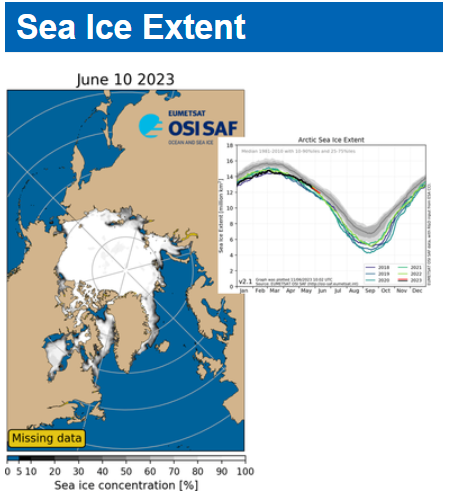
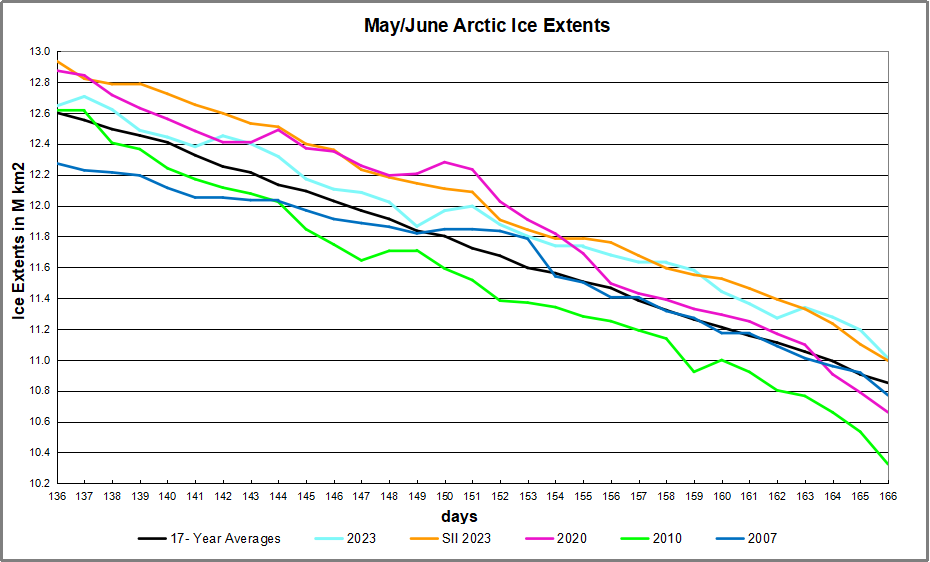
The graph shows that coming out of the annual March maximum, April 2023 began 238k km2 lower than the 17 year average.  SII even showed extents ~200k km2 lower than MASIE on April 1.  However, after two weeks both indices tracked with the average until month end.  According to MASIE, the typical April loses 1100 km2, but this year lost only 918k km2.  SII shows a loss of only 590k km2 during April. Meanwhile, other years, especially 2007 were losing ice much more rapidly than average.  

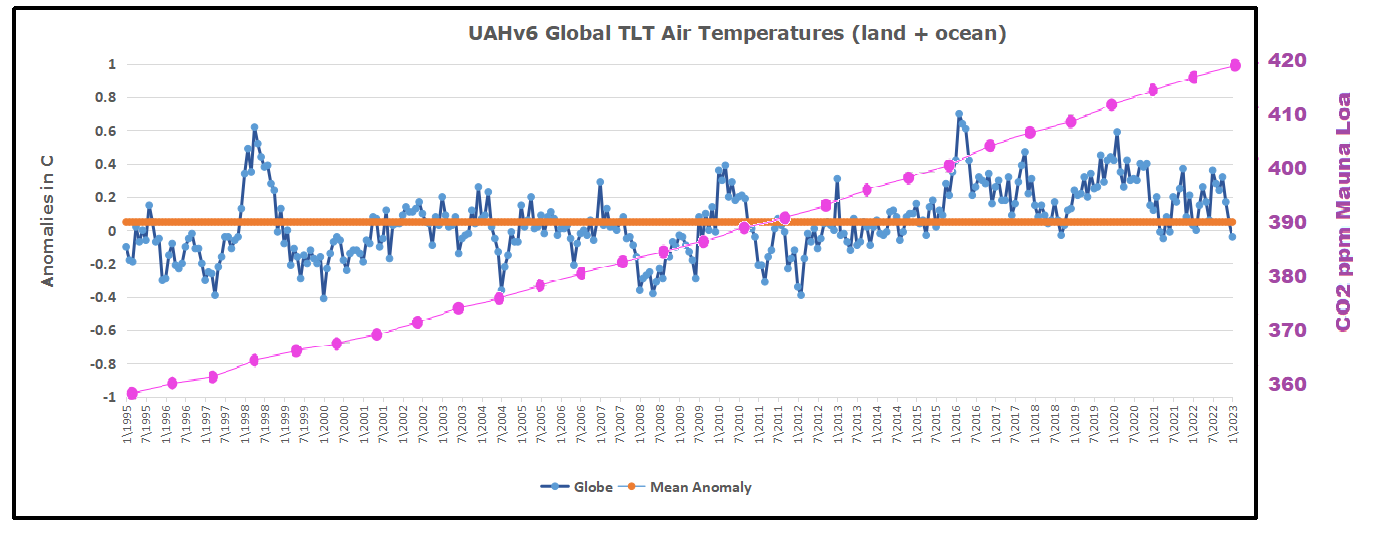
Why is this important?  All the claims of global climate emergency depend on dangerously higher temperatures, lower sea ice, and rising sea levels.  The lack of additional warming is documented in a post Satellite Temps Hit Bottom: February 2023.

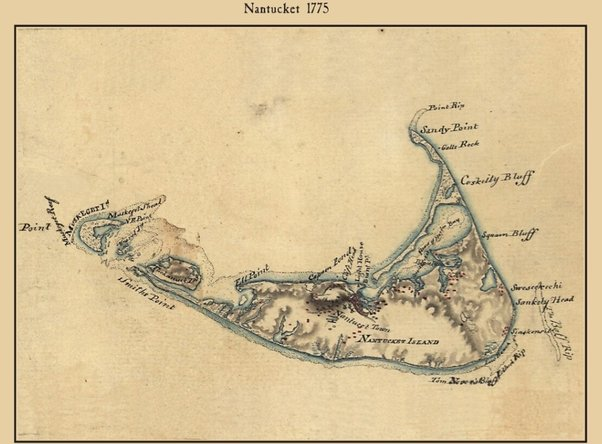
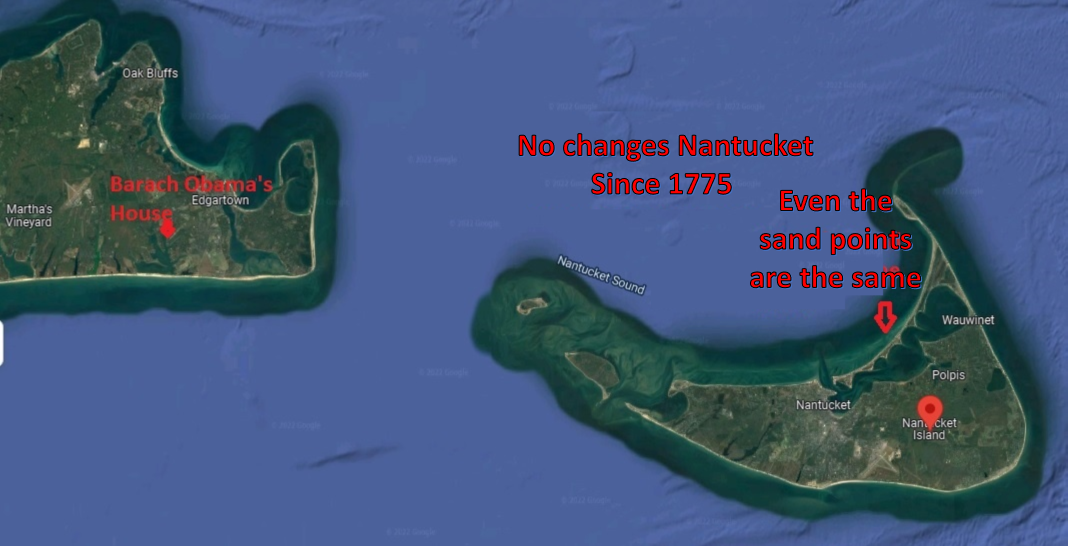
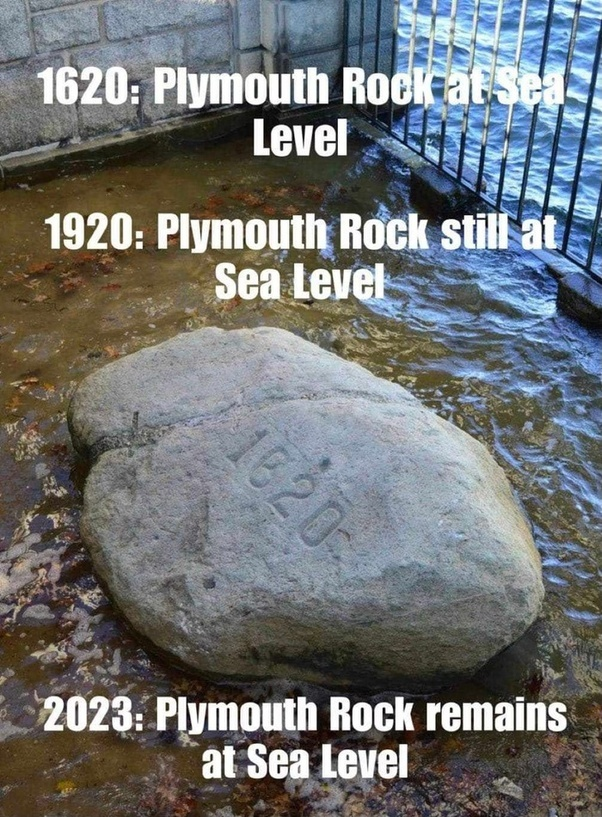
The lack of acceleration in sea levels along coastlines has been discussed also.  See USCS Warnings of Coastal Floodings

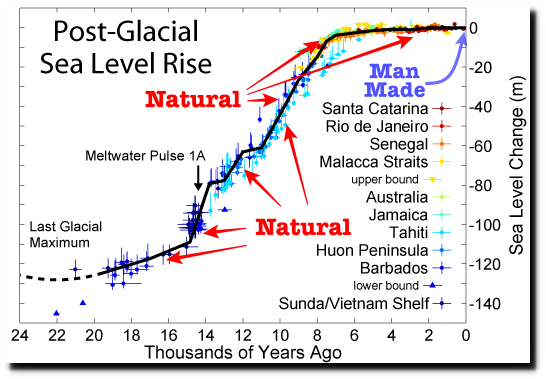
Also, a longer term perspective is informative:

post-glacial_sea_level
The table below shows the distribution of Sea Ice across the Arctic Regions, on average, this year and 2007.

Region 2023120 Day 120 Average 2023-Ave. 2007120 2023-2007
 (0) Northern_Hemisphere 13446987 13514506  -67519  13108068 338919 
 (1) Beaufort_Sea 1070966 1067918  3048  1059189 11777 
 (2) Chukchi_Sea 966006 956111  9895  949246 16760 
 (3) East_Siberian_Sea 1087137 1085582  1555  1080176 6961 
 (4) Laptev_Sea 897845 890425  7420  875661 22184 
 (5) Kara_Sea 933170 912998  20172  864664 68506 
 (6) Barents_Sea 415992 553986  -137994  396544 19449 
 (7) Greenland_Sea 761413 648178  113235  644438 116975 
 (8) Baffin_Bay_Gulf_of_St._Lawrence 1123308 1207572  -84264  1147115 -23807 
 (9) Canadian_Archipelago 854843 848924  5918  838032 16810 
 (10) Hudson_Bay 1249469 1238384  11085  1222074 27396 
 (11) Central_Arctic 3239670 3230693  8977  3241034 -1364 
 (12) Bering_Sea 491550 473366  18184  475489 16061 
 (13) Baltic_Sea 32086 20744  11342  14684 17402 
(14) Sea_of_Okhotsk 321714 376553  -54840  295743 25971 

Overall, the extent is slightly below average by 68k km2, or 0.5%.  The main deficits are in Barents, Baffin and Okhotsk, partly offset by a surplus in Greenland Sea.


Mid April Arctic Ice Recovery


The animation compares Arctic ice extents for day 105 for some years between 2007 and 2023.  2011 was close to the 17-year average, while 2007 was one of the lowest in the record.  The images show extensive variation in the Pacific (left) basins of Bering and Okhotsk, where typically the most open water appears. There are also fluctuations on the Atlantic side, Barents (top right) as well as Greenland Sea and Baffin Bay.  Overall there was recovery from 2007 to 2011, then some years of lesser extents before 2023 returns to the 17 year average, as shown in the table later below.

Over the last 30 days, there were gains and then losses, mostly in the Pacific basins.  The effect on NH total ice extents is presented in the graph below.  

The average ice loss is 787k km2 for this period.  While 2023 started 235k km2 in deficit, yesterday it nearly matched the 17-year average. SII showed even lower ice extents in mid March, before matching MASIE at the end.

The table below shows the distribution of sea ice across the Arctic regions.

Region 2023105 Day 105 Average 2023-Ave. 2007105 2023-2007
 (0) Northern_Hemisphere 14088856 14121549  -32693  13588722 500134 
 (1) Beaufort_Sea 1070966 1069753  1214  1068692 2274 
 (2) Chukchi_Sea 966006 964603  1403  961638 4369 
 (3) East_Siberian_Sea 1087137 1085478  1659  1078666 8471 
 (4) Laptev_Sea 897845 893275  4570  843501 54344 
 (5) Kara_Sea 933845 922316  11529  890594 43251 
 (6) Barents_Sea 609466 608807  659  439904 169562 
 (7) Greenland_Sea 716828 649460  67368  673585 43243 
 (8) Baffin_Bay_Gulf_of_St._Lawrence 1212523 1283822  -71300  1215526 -3003 
 (9) Canadian_Archipelago 854843 852840  2002  848812 6031 
 (10) Hudson_Bay 1260903 1246319  14585  1208588 52315 
 (11) Central_Arctic 3247017 3232496  14521  3235648 11369 
 (12) Bering_Sea 642984 647468  -4484  600281 42703 
 (13) Baltic_Sea 35258 45036  -9779  23534 11723 
(14) Sea_of_Okhotsk 550081 614303  -64222  491121 58960 

Overall NH extent March 31 was below average by 33k km2, or 0.2%.  The two largest deficits are Sea of Okhotsk and Baffin Bay, partly offset by a surplus in Greenland Sea.  The onset of spring melt is as usual in most regions, with slight surpluses nearly everywhere.


Notes on Florida Torrential Rainfall and Ft. Lauderdale

Concerning reports that 25 inches of rain fell in one day on Fort Lauderdale, some historical context is provided by the Florida Climate Center article Anticipating Heavy Rain in Florida.  Excerpts in italics with my bolds.

Abstract

Florida is situated within a part of the United States where torrential rain is a common occurrence. Torrential rain is here defined as at least 3 inches in a single day. Rain of at least this magnitude is far more frequent along Florida’s coasts than in its interior. The Panhandle and the Gold Coast experience such weather events more than elsewhere in the state. Except for North Florida, rainstorms are heavily concentrated in the warm months. Mid- latitude low pressure systems, that pass over or near North Florida in the winter, often produce heavy rain. As a consequence that part of the state has no seasonal concentration.

The distribution of torrential rain throughout the state is much more uneven during years when they are most frequent than when few such storms occur. During the 51 years of daily observations for 48 weather stations no cyclical pattern of torrential rain was discerned. However, when data were organized by Enso phase it was shown that during the La Niña phase torrential rainfall, especially of 5 inches or more in a day, was more frequent than during the phase named El Niño. This was most true of South Florida stations.

Florida lies within a broad region along the Gulf and Atlantic coastal plains of the southeastern U.S. that experiences frequent episodes of torrential rain (Map 1). Torrential rain in Florida is here defined as three inches or more in one calendar day. Rain of this magnitude contributes approximately ten percent of the total precipitation that falls on the state, more in some parts of it, less in others. Along the coasts of both northwestern and southeastern Florida torrential rain makes the heaviest contribution, while in the interior of the peninsula it contributes the least. For several decades a Florida weather station held the nations record for the most rain to fall in a 24-hour period. Yankeetown, a small fishing port on the northwestern side of the peninsula, during September 5th, 1950 was swamped by 38.7 inches of rain. The village retained the national record until July 25th-26th, 1979 when 43 inches fell on Alvin, Texas, situated between Houston and Galveston. This record still stands.

Torrential rain, since it is usually accompanied by intense atmospheric turbulence, has the potential of causing much property damage, as well as the destruction of agricultural crops and livestock. Florida is especially vulnerable to flooding because it is both low and flat. Although the sandy soils of the Peninsula are capable of absorbing water rapidly, their ability to absorb large amounts is limited because the water table is normally very close to the surface. Most of the state’s densely populated areas are situated on the shore of either the Atlantic Ocean or the Gulf of Mexico, and are especially vulnerable to rainstorms. Not only are such storms more frequent than in the interior of the state, but a large share of the urban area is covered by pavement and roofs, which concentrate runoff into low areas. Most of Florida’s cities today have adequate storm drainage systems to meet the demands of a sudden intense downpour, but flooding, sometimes on a major scale, does occur.

The reader should be aware that the amount of daily precipitation, especially from the cooperative weather stations, which constitute the majority, is not necessarily that which fell between one midnight and another. Cooperative weather stations usually depend heavily on non-professional volunteers who read the gauges when it is convenient, hopefully each day at a time agreed upon. Few are read at or near midnight. Only a small number of Florida stations record hourly precipitation. Consequently, a rainstorm may begin during one calendar day and end in another. The total rainfall of the storm would then be shared by two days, and although it may be higher than three inches, if no calendar day had a total of three inches it would not be counted.

It should be noted that the monthly frequencies of torrential rain, if graphed, do not conform to a bell shaped curve, increasing to a peak in the hottest month of the year. Instead, the curve is bi-modal, there being two peaks, one in June and the other in September. It is presumed that the June peak is the result of the state then coming strongly under the influence of the intertropical convergence zone, and the September peak is due to the greater frequency in that month of tropical low pressure systems such as tropical storms reaching the state.

Note Fort Lauderdale is in a torrential rain hotspot just north of Miami.

South Florida gets a significant part of its torrential rain during Springtime.

The ENSO (El Niño Southern Oscillation) phenomenon, which has been given much justified attention in recent years, is now generally regarded as being able to influence climate over a huge area of the world. It would be irresponsible to ignore the possibility that it could influence the frequency of Florida rainstorms. To ascertain if there is a relationship the three phases of Enso (El Niño, La Niña, and the neutral phase) the frequency of rainstorms were calculated by ENSO phase (Table 4). There does appear to be a relationship, and it doesn’t seem to be spurious. The share of the 48 Florida weather stations that reported no torrential rainstorms during a year is somewhat higher during the El Niño phase than the other two. The share of stations that reported only one storm during the years of the El Niño phase also was higher than the share of those that were reported in the La Niña phase. Thereafter, except for the shares of the ‘four storm’ category, the La Niña phase produced more torrential storms than the El Niño phase. In South Florida, It has become generally accepted that in La Niña years precipitation is generally wetter than during the El Niño phase. From the data we might conclude that weather controls that become important during this phase also promote a higher frequency of torrential rain. The neutral phase of Enso has little to no effect upon the frequency of Florida’s rainstorms, some neutral years producing many more episodes of torrential rain than others.

In conclusion it would be derelict not to address the issue of the relationship between the frequency of torrential rain in Florida and global warming. In studies of the consequence of global warming on climate the possibility of greater climatic extremes has been predicted, including storms that could produce large amounts of precipitation. This is usually based on the assumption among other factors, that the temperature of the water of the oceans would rise, heating the air above them, increasing evaporation and the air’s ability to hold water vapor and consequently its ability to produce more powerful rainstorms.

Table 5: Number of times 48 Florida weather stations
experienced at least 3″ of rainfall for
five decades between 1950 and 1999.

To ascertain if Florida has been experiencing an increase in the number of storms that produce torrential rain the torrential storm data for the 48 stations within the state which became the primary data source for this study were divided into the five decades between 1950 and 1999 (Table 5). When the average for the 50-year period is compared to the frequency by decade no trend is discovered. When the frequency in earlier decades is compared with the later ones there also appears to be no trend. For example, between 1950 and 1969, during that 20-year period there were 684 episodes at the 48 Florida weather stations in which 3 inches or more rain fell in one day, while in the 20-year period between 1980 and 1999 there were 695 episodes, a difference of only eleven episodes. The frequency of episodes during the year was also examined. An examination reveals, for example, that there were 23 stations between 1950 and 1969 that reported five episodes during the 20-year period, and between 1980 and 1999 the number fell to 20. Such a small drop does not suggest an increase in torrential rain over time.


Confirmed: Climate Models Too Hot to Trust

Ross McKitrick reports on a new study confirming the chart above.  His Financial Post article is The important climate study you won’t hear about.  Excerpts in italics with my bolds and added images

The study is Mid-Tropospheric Layer Temperature Record Derived From Satellite Microwave Sounder Observations With Backward Merging Approach by Cheng-Zhi Zou at JGR Atmospheres.

The Significance

Ross McKitrick: 

In the end the two (satellite) series were similar but RSS has consistently exhibited more warming than UAH. Then a little more than a decade ago, the group at NOAA headed by Zou produced a new data product called STAR (Satellite Applications and Research). They used the same underlying microwave retrievals but produced a temperature record showing much more warming than either UAH or RSS, as well as all the weather balloon records. It came close to validating the climate models, although in my paper with Christy we included the STAR data in the satellite average and the models still ran too hot. Nonetheless it was possible to point to the coolest of the models and compare them to the STAR data and find a match, which was a lifeline for those arguing that climate models are within the uncertainty range of the data.

Until now. In their new paper Zou and his co-authors rebuilt the STAR series based on a new empirical method for removing time-of-day observation drift and a more stable method of merging satellite records. Now STAR agrees with the UAH series very closely — in fact it has a slightly smaller warming trend. The old STAR series had a mid-troposphere warming trend of 0.16 degrees Celsius per decade, but it’s now 0.09 degrees per decade, compared to 0.1 in UAH and 0.14 in RSS. For the troposphere as a whole they estimate a warming trend of 0.14 C/decade.

Figure 14 Global mean Temperature Total Troposphere (TTT, TMT adjusted by TLS) time series (blue lines) and its smoothed time series (red lines). The locally weighted regression method (Cleveland, 1979) is used for the smoothing. Both TMT and TLS for TTT generation are from STAR V5.0.


Beware the Ice of March 2023

Previous posts showed 2023 Arctic Ice did break the 15M km2 ceiling early March peaking just two days after the 17 year average. So there is plenty of Arctic drift ice for sailers to be aware. The graph above shows that the March monthly average has varied little since 2007, typically around the SII average of 14.7 M km2.  Of course there are regional differences as described later on.

Dr. Judah Cohen at AER summarizes the situation:

If you can believe it, the major disruption of the polar vortex (PV) and is referred to as a major sudden stratospheric warming (SSW) from mid-February is still influencing the weather even into April. Relatively cold temperatures have become more widespread across Northern Europe and should continue. Northern Asia has been surprisingly quite mild but colder temperatures are predicted across Siberia for April (see Figures 6 and 9). Across North America it seems to be more what you see is what you get, no end in sight of the pattern that began in November – cold west and mild east.

The High pressure areas were forecast to warm over the Pacific Arctic basins, and extending over to the European side, while the cold Low area is presently extending down into North America, bringing some snow and freezing rain on April 1 in Montreal (no joke). There’s also ice for Montrealers to beware. The effect on Arctic Ice extents is shown in the animation below:

Over the last 31 days, there were gains and then losses, mostly in the Pacific basins.  Okhotsk upper left lost 360k km2 (now at 90% of max) while Bering lower left lost 135k m2 to be 60% of max.  Baffin Bay lower right lost 420k km2 over the same period.  Meanwhile, Greenland Sea center right gained 70k km2 to reach 105% of its max.  The effect on NH total ice extents is presented in the graph below.

The graph above shows ice extent through March comparing 2023 MASIE reports with the 17-year average, other recent years and with SII.  After surpassing average on day 64, 2023 ice extents dropped sharply and at March end matched both 2018 and 2021.  SII showed lower extents throughout, but ended with a small deficit to MASIE.

The table below shows the distribution of sea ice across the Arctic regions.

Region 2023090 Day 90 Average 2023-Ave. 2018090 2023-2018
 (0) Northern_Hemisphere 14393146 14613608  -220462  14456459 -63313 
 (1) Beaufort_Sea 1070966 1070154  812  1069836 1131 
 (2) Chukchi_Sea 966006 964029  1977  964121 1885 
 (3) East_Siberian_Sea 1087137 1086163  974  1087137
 (4) Laptev_Sea 897845 897010  835  897845
 (5) Kara_Sea 933984 919079  14905  934790 -806 
 (6) Barents_Sea 718169 651091  67078  790204 -72034 
 (7) Greenland_Sea 816301 650261  166039  533694 282607 
 (8) Baffin_Bay_Gulf_of_St._Lawrence 1202833 1402909  -200077  1380945 -178112 
 (9) Canadian_Archipelago 854843 853082  1760  853109 1734 
 (10) Hudson_Bay 1260903 1254610  6293  1259857 1047 
 (11) Central_Arctic 3248013 3233036  14977  3202650 45363 
 (12) Bering_Sea 505101 724369  -219269  277469 227632 
 (13) Baltic_Sea 60959 62776  -1818  99317 -38359 
(14) Sea_of_Okhotsk 763690 834337  -70647  1097524 -333834 

Overall NH extent March 31 was below average by 220k km2, or 1.5%.  The two major deficits are Bering Sea and Baffin Bay, partly offset by a surplus in Greenland Sea.  The onset of spring melt is as usual in most regions.


CO2 Fluxes Not What IPCC Telling You

The latest rebuttal of IPCC CO2 hysteria comes from Peter Stallinga in his 2023 publication Residence Time vs. Adjustment Time of Carbon Dioxide in the Atmosphere.  Excerpts in italics with my bolds and added comments and images.

1. Introduction

One of the major points in discussion of the anthropogenic global warming (AGW) scenario is the time the added carbon dioxide (CO2) stays in the atmosphere. In an extensive study, Solomon concluded that the residence time of carbon atoms in the atmosphere is of the order of 10 years [1], see Table 1. Such a short time would undermine the prime tenet of AGW, since a molecule of CO2  will not have time to contribute to any greenhouse effect before it disappears to sinks where it cannot do any thermal harm.

However, some claim that the residence time (the amount of time a molecule on average spends in the atmosphere before it disappears from it) is not relevant for this discussion; what matters is the adjustment time (or relaxation time or (re)-equilibration time), the time it takes for a new equilibrium to establish, the time constant seen in the observed transient, and, allegedly, these two are different. In a recent work, Cawley explains it as [3]

natural fluxes into and out of the atmosphere are closely balanced and, hence, comparatively small anthropogenic fluxes can have a substantial effect on atmospheric concentrations.

In the current work, we use these exact two concepts, with turnover time called residence time. We also focus on first-order systems mentioned here by the IPCC. We discuss the difference between residence time on the one hand, and adjustment time on the other hand, and test the hypothesis that the adjustment time can be longer than the residence time by mathematical methods. After having addressed this core point, we perform a calculation based on the available data to see how they fit.

2. Residence Time and Adjustment Time (Methods, Data, Results and Analysis)

Figure 1. Two-box model of the carbon dioxide cycle. The top box represents the atmosphere, with a total carbon dioxide mass of 3403 Gt. Humans add 38 Gt per year to the system. Nature adds Fn+ and takes away Fn− to a sink represented by the bottom box. That sink has a total CO2 mass equal to S. The residence time in the atmosphere, τa is well known and estimated to be 5 years, the residence time in the sink τs is not well known.

In what follows, we will use a simple two-box first-order model, see Figure 1. The atmosphere has a mass of carbon dioxide equal to A. CO2 molecules can be captured into a sink and this occurs at a certain rate, a fraction of the molecules being trapped per time unit. Each individual molecule has a certain probability to be captured over time. In other words, a molecule has a residence time τa in the atmosphere (also sometimes called the ’turnover time’), which is the reciprocal of the rate, ka. Likewise, in the sink, there is a carbon dioxide mass equal to S, where molecules have a residence time τs; an individual molecule has a certain probability over time to be released by the sink into the atmosphere, or a rate ks.

Humans add an extra flux into the atmosphere labeled Fh. On the basis of this, we can determine the adjustment time τ of the atmosphere in terms of the residence times. This requires solving a simple mathematical differential equation; we do not have to worry at this moment about the thermodynamics and explain why the reaction constants are what they are. The questions we ask are, if we add an amount of carbon dioxide ΔA to it:

    • What are the new equilibrium values of A and S?
    • How long does it take to establish this new equilibrium?

Figure 2. (a) A two-box simulation of atmosphere (A) and sink (S) of Figure 1.

Before injection of 100 into the atmosphere, the atmosphere-sink system was in equilibrium at 100 each, with the residence ‘times’ in both atmosphere and sink 1000 iterations. At each iteration A/τa is moved from atmosphere to sink and S/τs moved from sink to atmosphere. As can be seen, the observed adjustment time (relaxation time) of the system is 500 iterations, as predicted by Equation (9). After 500 iterations, the surplus quantity in the atmosphere relative to the new equilibrium has been reduced to 1/e, a level indicated by a horizontal dashed line. Further, a half-life can be defined, a time at which half of the transient amplitude has passed, t1/2=τln(2)= 347. This is indicated by a dotted line. (b) The adjustment time τ, as a function of the sink residence time τs, normalized by the atmospheric residence time τa. The dot indicates the value of the plot in (a), τs=τa, resulting in τ=τa/2 .

As can be seen, the adjustment time is shorter than the atmospheric residence time
for all values of the sink residence time, with, for large τs,
the adjustment time τ approaching the atmospheric residence time τa.

We, thus, refute the claim of the climate-skeptics-skeptics [skepticalscience.com] that:

“individual carbon dioxide molecules have a short life time of around 5 years in the atmosphere. However, when they leave the atmosphere, they are simply swapping places with carbon dioxide in the ocean. The final amount of extra CO2 that remains in the atmosphere stays there on a time scale of centuries.”

Their flawed reasoning is that the adjustment time (relaxation time) is the mass perturbation in the atmosphere divided by the flux balance, and, so goes the reasoning, while fluxes can be great (and the residence time short), the balance is close to zero and the relaxation time can then approach infinity.

3. Scenarios

We can now do a more detailed analysis based on the available data.

Table 2. Carbon dioxide facts, with the natural outflux Fn− derived from the mass in the atmosphere and the residence time. Other important parameters, influx Fn+, sink mass S, and sink residence time τs are less well known and should be considered adjustable.

The residence time in the atmosphere can be estimated quite well from the above-ground atomic bomb tests [1], which makes us happy that these at least served the purpose of advancing atmospheric science, if nothing else. The best estimate is about τa= 5 years [9]. Other references mention different times, with the IPCC mentioning the shortest (4 years) in their 5th Assessment Report (p. 1457 of Ref. [4]), showing that this value is not settled yet; we will use 5 years in this work. The equilibrium amount of carbon dioxide in the atmosphere is open for debate, but, for this purpose, we might use the consensus value of 280 ppm (A∗= 2250 Gt). To estimate the amount of CO2 in the sink is very difficult. However, there seems to be a general view that it is fifty times more than in the atmosphere, S=50A=113,400 Gt (relatively unchanged since pre-industrial times). Using the combination of these values does not allow for consistent bookkeeping, as the reader can easily verify. Something has to yield. In what follows, we will try out some scenarios based on specific assumptions.

3.1. Scenario: Pre-Industrial Atmosphere Was at Equilibrium

First we assume that the pre-industrial level of 280 ppm was indeed an equilibrium value with influx equal to outflux in the absence of human flux, as we are wont to believe, but that the mass in the sink S and the residence time τs in the sink are unknown.

Figure 4. Above-ground atomic-bomb explosions produced a lot of 14 C that stopped in the 1960s. From a fit (dashed line) of data from 1965, we find an adjustment time of τ = 14.0 a, and an amplitude of ΔA = 740, with a final value of A′∞ = 30. This enables stating that the sink must be at least 24 times larger than the atmosphere. Data from Enting (blue) found in a work of Perruchoud [11] and Nydal et al. [10] (green), extracted with WebPlotDigitizer [12].

It seems that the idea of the pre-industrial level stable at 280 ppm (with Fn+=Fn−at 280 ppm) is untenable. It seems very likely that the sink was already off-balance and emitting amounts of carbon dioxide at the beginning of the industrial era and the increase in the atmospheric CO2 at any time in human history is not solely due to human activity. This would also explain the large pre-Mauna-Loa values found with chemical methods summarized by Beck [13] and Slocum [14]. For instance, values of 500 ppm have been observed around 1940. Ignoring these facts, on the other hand, would be equivalent to throwing entire generations of scientists under the bus.

[Comment:  CO2 higher concentrations prior to 20th century are also indicated by use of plant stomata as paleo proxies for CO2 estimations.]


3.2. Scenario: The Sink Is Fifty Times Larger Than the Atmosphere

Next, we adopt the assumption that the sink at this moment really has 50 times more carbon than the atmosphere, in other words, S=50A= 170,000 Gt, and release the restriction that the atmosphere was stable at 280 ppm; in pre-industrial times there can have been a flux imbalance.

We see indeed a tremendous outgassing from the sink in pre-industrial times. The system was far from equilibrium, with an imbalance being a net influx of F∗n+−F∗n−= 207 Gt/a. Where, at the moment, there is a net natural flux of 18 Gt/a out of the atmosphere, in pre-industrial times, in this two-box first-order model with a sink 50 times larger than the atmosphere, there was a net natural influx of 207 Gt/a.

Somewhere, we must have passed the equilibrium value and,
considering the above numbers,  this value must be
rather close to today’s concentration of 420 ppm.

3.3. Scenario: Residence Time in the Sink Is Much Larger Than in the Atmosphere

If we only assume that the residence time in the sink is much larger than in the atmosphere, τs≫τa, then we can get a good idea of what has happened to our anthropogenic contribution to the carbon in the atmosphere, Fh, based on the two-box model.

Figure 3. (a) Yearly global CO 2 emissions from fossil fuels. (b) Cumulative emissions (integral of left plot). The yellow curve is the remainder of the anthropogenic CO 2 in the atmosphere if we assume a residence time in the sink much longer than the 5-year residence time in the atmosphere; in this case τs=50τa was used. (Source of data: Our World In Data [8]).

Figure 3 shows the yearly carbon dioxide emissions into the atmosphere (left panel; data source: Our World In Data [8]). The total amount so far emitted is 1696.5 Gt. The right panel shows the cumulative emissions, ∑yeariFh(i). If at every year we apply the fluxes according to Equation (1), then we can see at each year how much of the anthropogenic CO2 is still in the atmosphere. The right panel of Figure 3 shows this for τs=50τa.

We see that only 202.3 Gt of the total injected 1696.5 Gt is still in the atmosphere.

In these years, the amount of CO2 in the atmosphere has risen from 280 ppm (2268 Gt) to 420 ppm (3403 Gt), an increment of 1135 Gt. Of these, 202.3 Gt (17.8%) would be attributable to humans and the rest, 932.7 Gt (82.2%), must be from natural sources.

In view of this, curbing carbon emissions seems rather fruitless;
even if we destroy the fossil-fuel-based economy (and human wealth with it),
we would only delay the inevitable natural scenario by a couple of years.

3.4. Scenario: Abandoning Constant Residence Times

We have seen here how the first-order-kinetics two-box model results in conclusions contrary to data. We could, of course, change our model. We could abandon the idea of first-order kinetics (where flux is proportional to mass), but that would be problematic to justify with physics.

We could also add more boxes to the system, distinguishing the sinks, or differentiating between deep ocean and shallow ocean, dissolved carbon dioxide gas, CO2 (aq), and dissolved organic carbon (sea-shells), or between CO2 disappearing in the oceans and being sequestered in biological matter on land, etc.

However, we expect the most likely improvement to the model to come from
abandoning the idea that the residence times τa and τs are constant.

They, in fact, are very much dependent on temperature. As an example, the ratio between the two that tells us the concentrations (and, thus, the masses) between carbon dioxide in the atmosphere and in the sink, if we assume this sink to be the oceans, is governed by Henry’s Law, and this concentration ratio is then dependent on temperature.

When including such effects, we might even conclude that the entire concentration of carbon dioxide in the atmosphere is fully governed by such environmental parameters and fully independent of human injections into the system. A is simply a function of many parameters, including the temperature T, but not Fh. It is as if the relaxation time is extremely short and any disturbances introduced by humans, or by other means, rapidly disappear, rapidly reaching the equilibrium determined by nature.

This fits very nicely with the recent finding that the stalling of the economy and the accompanying severe reduction in carbon emissions during the Covid pandemic had no visible impact on the dynamics of the atmosphere whatsoever [15]. The result of that research, the hypothesis that the carbon dioxide increments in the atmosphere were fully due to natural causes and not humans, fits the experimental data very well, and the hypothesis that humans are fully responsible for the increments can equally be rejected scientifically. This then also agrees with the conclusions of Segalstad that “The rising atmospheric CO2 is the outcome of rising temperature rather than vice versa” [16].

The pre-industrial atmosphere might indeed have been in equilibrium,
and we are currently also in, or close to, equilibrium.
That seems to us to be the most likely scenario.

Once we admit the possibility of non-anthropogenic sources of carbon dioxide, we can start finding out what they might be. Examples such as volcanic sources, planetary and solar cycles spring to mind. It might well be that the climate puzzle is solved in such areas as the link between solar activity and seismic activity and climate [17].

This is, however, not the focus of this work. We conclude here by summarizing the major findings of this analysis using a first-order-kinetics two-box model:

(1) The adjustment time is never larger than the residence time and is less than 5 years.

(2) The idea of the atmosphere being stable at 280 ppm in pre-industrial times is untenable.

(3) Nearly 90% of all anthropogenic carbon dioxide has already been removed from the atmosphere.

Footnote:  Human CO2 Emissions Flat Last Decade

Annual total global CO2 emissions – from fossil and land-use change – between 2000 and 2021 for both the 2020 and 2021 versions of the Global Carbon Project’s Global Carbon Budget. Shaded area shows the estimated one-sigma uncertainty for the 2021 budget. Data from the Global Carbon Project; chart by Carbon Brief using Highcharts.

Previously, the GCP data showed global CO2 emissions increasing by an average of 1.4 GtCO2 per year between 2011 and 2019 – prior to Covid-related emissions declines. The new revised dataset shows that global CO2 emissions were essentially flat – increasing by only 0.1GtCO2 per year from 2011 and 2019. When 2020 and 2021 are included, the new GCP data actually shows slightly declining global emissions over the past decade, though this should be treated with caution due to the temporary nature of Covid-related declines. Source: Global CO2 emissions have been flat for a decade, new data reveals

[Comment: Note the earlier chart above showing MLO atmospheric CO2 rising continuously while human emissions were flat.]

Arctic Ice Moment of Truth 2023

For ice extent in the Arctic, the bar is set at 15M km2. The average peak in the last 17 years occurs on day 62 at 14.986M km2 before descending, though some years the extent can be above 15M much later.  Ten of the last 17 years were higher than 15M, and recently 2020, 2022 and now 2023 ice extents cleared the bar at 15M km2. The actual day of annual peak ice extent varied between day 59 (2016) to day 82 (2012).

All of this means that 2023 peaked while passing the 15M km2 threshold two days later than average.  The graph below shows the situation evolving over the last four weeks anticipating the annual maximum.

The NH ice extent gap on day 77 is at 269k km2, or 1.8%.  After the day 62 peak, 2023 extents declined sharply until day 71 before recovering to reduce the deficit. (Note that ice extent is affected also by winds piling up drift ice, as well as melting from intrusions of warmer air or water.) SII has shown lower extents throughout this period, averaging 250k km2 less than MASIE.

March monthly average extents in recent years have been below average. While average extents will decline furher, we shall see what this year does with only two weeks left to make a difference.

Region 2023077 Day 77 Average 2023-Ave. 2018077 2023-2018
 (0) Northern_Hemisphere 14649553 14918812 -269258 14528206 121348
 (1) Beaufort_Sea 1070966 1070266 700 1070445 521
 (2) Chukchi_Sea 966006 965801 206 966006 0
 (3) East_Siberian_Sea 1087137 1087109 29 1087137 0
 (4) Laptev_Sea 897845 897837 7 897845 0
 (5) Kara_Sea 934539 922767 11771 934807 -268
 (6) Barents_Sea 605659 637818 -32159 689702 -84043
 (7) Greenland_Sea 835991 617943 218048 514678 321313
 (8) Baffin_Bay_Gulf_of_St._Lawrence 1249789 1546282 -296493 1399951 -150162
 (9) Canadian_Archipelago 854843 853118 1724 853109 1734
 (10) Hudson_Bay 1260903 1259573 1330 1257207 3696
 (11) Central_Arctic 3243341 3217827 25514 3131403 111939
 (12) Bering_Sea 739914 760728 -20814 445480 294434
 (13) Baltic_Sea 67881 80745 -12864 127449 -59568
(14) Sea_of_Okhotsk 822356 982054 -159698 1136990 -314633

The main deficit to average is in Baffin Bay and Sea of Okhotsk, partly offset by a surplus in Greenland Sea. Smaller pluses and minuses are found in other regions.

Typically, Arctic ice extent loses 67 to 70% of the March maximum by mid September, before recovering the ice in building toward the next March.

What will the ice do this year?  Where will 2023 rank in the annual Arctic maximum competition?

Drift ice in Okhotsk Sea at sunrise.

For more on the Pacific basins see post Meet Bering and Okhotsk Seas

Multiple Choice Question re Green Energy

Jack Hellner poses the issue in his American Thinker article. A single multiple choice question for the ‘green’ energy pushers.  Excerpts in italics with my bolds and added images.

Here is one burning question for scientists, entertainers, journalists, politicians,
bureaucrats, and others who claim they can control the climate:

Which of the following has caused the reservoirs to fill up rapidly in California and elsewhere in the West?

A. The Paris Climate accord.

B. The misnamed “Inflation Reduction Act” in which the Democrats claimed they can control the climate by handing out huge amounts of money to “green” pushers.

C. All the United Nations gabfests where people fly in private jets to stump about the need to cut emissions.

D. Shuttering coal and natural gas utility plants.

E. Transitioning the peasants to cricket and mealworms as “food” to control cow flatulence.

F. Making people buy inefficient, expensive, impractical electric cars powered by the dangerous, highly-flammable pollutant lithium.

G. Sequestering CO2, a clear, innocuous, non-pollutant gas that makes plants thrive and allows the world to be fed.

H. Record rain and snow that came cyclically and naturally.

(I’m sure you guessed, but the correct answer is: H.)

According to scientists, this winter’s downpour in California and other western states turned out to be a positive, as it brought relief to the drought-ridden environments:

All the moisture has helped alleviate dry conditions in many parts of the western U.S. Even major reservoirs on the Colorado River are trending in the right direction.

Of course, the scientific “experts” who somehow failed to predict this record rain and snow, warned of the “stubborn” aridity:

But climate experts caution that the favorable drought maps represent only a blip on the radar as the long-term effects of a stubborn drought persist.

Here is a hint: The Sahara Desert used to be fertile until around 9,000 years ago. A stubborn drought has persisted since then and it was not caused by oil, coal, CO2, cars, methane, or any of the other things “climate experts” blame for causing droughts, flooding, too much snow, too little snow and whatever else with which they want to scare the public.

Why should we trust scientists or anyone else whose dire predictions of doom and gloom on the climate or global warming have been 100% wrong the last hundred years?

Everyone should understand that scientists and others who push the “green” agenda make a lot of money pretending they can control the climate. They would have their spigot of money cranked off if they told the truth that the climate is and has always changed cyclically and naturally. As always, follow the money.

The same people who claim they can control the climate:
    1. Apparently lack the ability to properly regulate banks…and then blame Trump for the problem.
    2. Can’t control or tell the truth about the crisis at the borders…and then blame Trump for the problem.
    3. Can’t tell the truth or control the “spread” of COVID. Why would anyone trust the so-called “experts” at the CDC and the WHO who spread so much misinformation about COVID and destroyed so many businesses and people with their government edicts?
    4. Told so many lies about Obamacare, including the “you can keep your doctor” and “keep your plan” shticks, premiums would go down substantially fib, and that it would lower the deficit. And most of the media still says how great it is.
    5. Can’t educate children — no matter how much money they throw at it — to read or do math at grade level. 

Yet we are told that these people can control temperatures, sea levels, and storm activity forever if we just give them trillions of dollars and allow them to destroy industries that produce reasonably priced energy and thousands of other products that have greatly improved our quality and length of life.

They have trouble predicting the climate a few days out and did not predict the record amount of rain and snow in California this year but supposedly they can predict temperatures within one degree one hundred years out, with all the natural variables?

Does it sound remotely intelligent to believe these people?


How to Break the Climate Spell

Getty Images

Mark Imisides advises climate skeptics to reconsider how to dispute claims from climate believers in his Spectator Australia article Changing climate change: debunking the global colossus.  Excerpts in italics with my bolds and added images.

How is it that despite the scientific case for a climate apocalypse comprehensively collapsing some 20 years ago, we have seen a 16-year-old girl (at the time) being invited to address the United Nations, weeping children marching in our streets, and a federal election outcome in which this issue dominated the political landscape?

Where did we go wrong? And by ‘we’ I’m referring to those of us termed sceptics – people who understand the science, and the house of cards that comprises the notion of Anthropogenic Climate Change.

Put simply, we must learn the art of the polemic. The art of rhetoric. We must recognise that there’s no point in having evidence on our side if we don’t know how to use it.

We begin with this proposition. There is no case for reducing our carbon footprint unless all four of these statements are true:

  1. The world is warming.
  2. We are causing it.
  3. It’s a bad thing.
  4. We can do something about it.

No rational person can have any problem with this, and if they do, we need to find out why.

Here’s where we have to decide which of these points we want to contest. Remember, you only have to falsify one of them for the whole thing to collapse like a house of cards.

Most sceptics, in my view, pick the wrong fight. They do this by attempting to prosecute the case based on one of the first two points. This is a mistake.

Here’s why.

Arguments about whether the world is warming revolve around competing graphs: ‘My graph shows it’s warming. If your graph shows it isn’t, then it’s wrong – no it isn’t – yes it is – no it isn’t…’  This argument also looks at Urban Heat Island Effects, and examines manipulation of data by government agencies.  This is a poor approach to take because:

  • You’re never going to prove your graph is right.
  • You can be very easily and quickly discredited as a conspiracy theorist (Brian Cox did this to Malcolm Roberts on Q&A a few years ago). People just do not believe that government agencies would manipulate data.
  • We should not fear a warming world. Records began at the end of the last ice age, so it’s only natural that the world is warming. And the current temperatures are well within historical averages.

Source: Syun-Ichi Akasofu, Two Natural Components of the Recent Climate Change: (1) The Recovery from the Little Ice Age (A Possible Cause of Global Warming) and (2) The Multi-decadal Oscillation (The Recent Halting of the Warming):

As for arguments about whether we are causing the warming, this is even more problematic. The various contributions to global temperatures are extremely complex, involving a deep understanding of atmospheric physics and thermodynamics. With a PhD in Chemistry, this is much closer to my area of expertise than Joe Public, but I am very quickly out of my depth. I recognise most of the terms and concepts involved, but know just enough to know how little I know.

Sadly, many people on both sides of the debate don’t understand how little they know, nor how complex the subject of atmospheric physics is, and it is nothing short of comical seeing two people debating about a subject of which both of them are blissfully ignorant.

The bottom line is this – they simply don’t change anyone’s minds – ever.

Having seen these arguments used for years, and having used them myself, I cannot point to a single person that has said, ‘Oh yes! I see it now…’ The whole point of arguing, or debating, is to change someone’s mind (including, at times, your own). If that isn’t happening, then it’s futile to continue with the same approach.

I think the reason both these approaches fail that most people do not believe that all these experts, and the government, can be wrong. You say the world isn’t warming? Oh, I’m sure you have the wrong graph. You say that CO2 is not responsible? Oh, I’m sure the government scientists know more than you do.

This then brings us to the third point. Why is a warmer world a bad thing?

This is even more tempting than the first two points, as it’s so easy to prove that a warming world, so far from being a crisis, is actually a good thing. The reason for this is that, unlike with the first two points, they don’t have to look at a complex scientific argument. They just have to look at the weather. Are cyclones and hurricanes increasing? Are droughts increasing? Are flooding events increasing?

Regretfully, it is impossible to get people to even look at this. Even worse, they seem oblivious to the simple concept of cause and effect. We see this in that they simply can’t see that droughts and floods are opposites, and the same cause cannot produce exactly opposite effects. Astonishingly, they somehow think that charts that plot these extreme events are somehow manipulated, even when they come from a primary source such as the BOM, and that there really is a ‘climate crisis’.

Where does that leave us? Well, before we adopt Catweazle’s mantra of ‘nothing works’, there is one more point – point 4 (can we do anything about it?).

Most people will have seen the address of Konstantin Kisin at an Oxford Union debate, where he prosecuted this case to great effect. He pointed out, in simple terms, that as the UK only contributes 2 per cent to the global CO2 budget, anything they did will have negligible effect, and that global CO2 levels will be determined by people in Africa and Asia. He then pointed out that people in these countries ‘didn’t give a sh*t’ about climate change, as all they want to do is feed and clothe their children, and they don’t care how much CO2 that produces.

Finally, he pointed out that Xi Jinping knows that the way to ensure that he isn’t rolled in a revolution, as happened to so many other leaders in former communist regimes, is to ensure prosperity for the Chinese people. And indispensable to that goal is cheap, reliable, power, which is the reason that China is now building lots more coal-fired power plants – in 2021 alone they built 25 GW of capacity – equivalent to 25 x 1000MW plants.

By all accounts, his speech was well-received, with many people turning to his side. The beauty of prosecuting this case, as opposed to the other three, is that people don’t have to look at any evidence. They don’t even have to look at the weather.

The argument is at the same time simple, compelling, and irresistible. The question is this: will we see a major political party with the courage to take it on?

That part remains to be seen. But what is certain is this – the definition of insanity is doing the same thing and expecting different outcomes. If, for twenty years we’ve been telling people either that the world isn’t warming, or if it is we aren’t causing it, or if it is warmer but there’s no climate crisis, and not a single person has been persuaded by our arguments, then we have the brains of a tomato if we think anything is going to change.

Konstantin Kisin’s talk, and in particular the way it was received, fill me with hope that I haven’t had in years. It fills me with hope that if the case is prosecuted wisely, the climate change colossus can be brought to a grinding halt, politicians will unashamedly take on energy security as a political mantra, and the notion of climate change will at last be exposed as the unscientific, anti-human, regressive, apocalyptic cult that it is.


David Dilley: Signals of Global Cooling

Tom Nelson interviewed David Dilley last month and the video is above.  For those who prefer reading I provide below a transcript from the closed captions, along with the key exhibits from the presentation.

Synopsis: Between the two oceans cooling down and the natural global cooling cycle coming down we’re going to see a big dip in the temperatures worldwide during the next 10, 15 years. The cold cycle’s going to take about 20 years to bottom out. We’re going to be in an extremely cold period during that time, colder than the 1960s and 50s here in the United States. So it’s going to be very cold.

TN: I have David Dilly here, and David could you tell us a little bit about yourself?

DD: I’m a meteorologist, climatologist, for which I have about 52 years of experience, and I’m still trying to figure that out because I’m only 30 years old. But but I’ve been in the business a long time. I was a weather officer in the Air Force in the National Weather Service. Then I left to set up my own company called Global Weather Oscillations; the easiest way to remember it is global weather cycles.com.

So we’re going to take a look today at something that NOAA is really talking about: the Carbon Dioxide and Climate Cycles. They’re just talking about today’s carbon dioxide values as far as the fossil fuel is concerned. You’re not going to see this out there anywhere on the web. It’s 78% of the atmospheric gases is nitrogen of all things, 21% is oxygen, 0.9 is argon that is 99.99 percent the atmospheric gases. That doesn’t leave much that’s just about all of what we call dry air. To be non-dry air includes the greenhouse gases. The greenhouse gases now are variable regarding how much of it is water vapor how much of it is carbon dioxide. Water vapor is anywhere from one to four percent of the atmospheric gases, that’s quite a bit. It can be zero percent of the Arctic and Antarctic because that’s a desert, but it can be all the way up to four percent. So one to four percent we’ll say.

Carbon dioxide of all things it’s a trace gas it’s less than .05%, a lot less than than water vapor. less than .05 now to put it in perspective, let’s just look at the greenhouse gases here and what we see is water vapor we’re gonna do the average of it two percent that’s 20 000 parts per million. Natural carbon dioxide what I’m going to show you later on in the presentation is 380 parts per million.

Now NOAA and the IPCC say it (natural CO2) is down around 285 parts per million,
we’re going to show you that’s false.

And so the natural is point zero four percent of the atmospheric gases, while fossil fuel I’m going to show you it’s only 35 parts per million; that’s point zero zero four percent or four one thousands of a one percent. And do you think that can cause climate change?

Of course not.  We go down to Vostok in the Antarctic and there is a very deep frozen lake where they drill down fifteen thousand eight five hundred and eighty eight feet down to the bottom. That’s a long ways down over 500 000 years. So I take core samples and with the core samples they figure out how how much it is carbon dioxide what the temperatures are. These are approximate, but what they they get from a core sample is a an estimate of the temperatures and carbon dioxide during the past 500 000 years.

If we go back say 450 000 years, the red line is temperature. So what happened, we came quickly just in a few thousand years out of a deep Ice Age into a interglacial warm period. You can see the temperatures really slid up and the ice cores estimate the carbon dioxide to be right around 280 parts per million. Then we slide down out of the warm period into a deep Ice Age and you can see that the carbon dioxide is actually staying up high there. If carbon dioxide caused global warming, why did the temperatures drop; it does not make sense.

Eventually the carbon dioxide goes down because it’s being absorbed by the oceans. The oceans keep absorbing it over the course of a hundred thousand years. Then when you come up on your next interglacial warm period 338 000 years ago, the temperature goes up and the carbon dioxide is released from the oceans back into the atmosphere. And you can see the carbon dioxide lags behind the temperature rise and actually when you hit the peak of the temperature back 338 000 years ago, the carbon dioxide does not Peak out until 7000 years later. It takes quite a while but carbon dioxide peaked out at 298 parts per million. But look at that temperature then dropping quickly into an ice age while carbon dioxide is at its peak.

That’s proof right there the carbon dioxide does not cause global warming.

As we come over on the right hand side of the graphic this is about 18 000 years ago. It’s 11 000 years ago we came out of the glacial period, we warmed up quickly, we got up to about to 190 parts per million.

Then we started to take records in Hawaii in the 1950s and the instruments there said: Wow, all of a sudden now we’re up to 412 parts per million. We’ve never been that high before.  This is what we’re going to investigate: what is going on with the glacial periods and also the core samples. This is a graphic of the carbon dioxide. The peak of The inter glacial warm periods is every 120 000 years ago we’re going back 800 000 years.

Now do we have other research that will confirm what I’m saying. This is about a year ago and they’ve been adding papers to it and this corrects NOAA’s calculations of the rise in carbon dioxide since 1850. It’s in a radiation safety Journal Health physics journal and this is the name of the paper itself. The authors are professors of radiological Sciences. They’re retired and that’s a big thing because if you’re not retired, if you’re at a university, you can’t do research like this because of federal grants and everything. You have to wait until you’re retired and then you can do real science when they were working they were at the department of physics at University of Massachusetts. It’s Kenneth Skrable, George Chabot, and Clayton French and here is what they found.

This is extremely important. Since 1850 the red here is saying the increase due to fossil fuel,  and they’re showing all of that is the increase due to fossil fuel. Now how do we determine that well up on a high mountain in Hawaii we have a infrared spectrometer since 1958 it’s been been taking measurements of atmospheric carbon dioxide. However three Isotopes of Carbon are 12, 13 and 14. and the spectrometer is taking the total of all three. It’s not separating what is natural from what is fossil fuel.

Because the ice core samples say we’ve never been above 300 parts per million
NOAA is assuming that the rise above 300 parts per million is all fossil fuel.

An assumption is all it is. It’s assumed by trying to take averages of how much CO2 is taken back in by the oceans how much of it is a given not from industry. Taking those assumptions some physicists made a formula to determine how much is fossil fuel and how much is natural going back all the way back to 1750. These red lines again are what NOAA says is the increase by fossil fuel.

Well their formula separates the carbon 12, 13 and 14 to determine what is what and this is their findings as I switched everything over to green. Green is the natural increase in carbon dioxide all the way up to 1958. Now remember it’s a paper going back to 2018, but it says the increase has been from 280 parts per million up to 408 and NOAA says it is all from fossil fuel. This research paper says No, it is nearly 80% natural just like what I showed on my formulations, eighty percent natural, onlyabout 20% industrial. That’s not enough to cause climate change.

[Note: My synopsis of Skrable et al. is On CO2 Sources and Isotopes.]

Now I’m going to show you one last paper that will also verify the findings and this is using a different method fossilized plant leaflets and as you can see in this picture there’s little cells in there they call these stomata cells which are like the lungs in a human being. So they look at the fossilized plant leaflets and unlike the ice core samples where you’re taking an average over one thousand or four thousand years, the fossilized plant leaflets can give you the exact year going back the past thousand years so you can determine each year what is going on.

So the stomata cells are like the lungs in a human being or in animals but he’d found that if the leaflet has a lot of stomata cells it means a lot less carbon dioxide in the air at that time. When CO2 is plentiful, plants don’t need more oxygen lung power to get the carbon dioxide; if it has fewer cells that means there was a lot of carbon dioxide in the air.

And the beautiful thing about plant life taking in carbon dioxide is the byproduct is oxygen which we drastically need. What the plant stomata cells show during the past 1200 years: back in 800 A.D it says we were way up to 375 parts per million natural carbon dioxide and then dipped way down to 325 in one thousand A.D. Then it dipped way down to 230 and it dipped up down, up down, up down up, down. In year 2010 it was up at 375 parts per million.

Let’s look at the plant stomata that could be pretty darn real and also if you take a mean value of the plant stomata over the course of a thousand years you come out 301 parts per million. The main value of ice cores over a thousand year period 297 parts per million really darn close to being the same as now. Let’s take the plant stomata readings of the atmospheric carbon dioxide and overlay it onto our global warming and cooling Cycles during the past 1200 years. We have had six global warming Cycles during the past 1200 years as noted here in the red. This is back around 850 A.D and then you can see it cools down then we warm up again, cool down warm up cool way down and so on for six global warming cycles. People don’t talk about that but we have had six of them.

When we overlay the plant stomata atmospheric carbon dioxide, guess what: We see a perfect fit. The high values in carbon dioxide peak on global warming cycles, so that brings a lot more credibility into the plants stomata cells for recording carbon dioxide.

So putting it all together we since 1850 NOAA and the IPCC say that the rise in atmospheric carbon dioxide is 100% due to fossil fuel and human activity. The three studies I just showed you and the corrections I made on the ice core samples all show it’s 80% natural rise. Far too little fossil fuel effects to cause climate change, it is almost all natural.

Here we are today over here on the right the average is a global cooling cycle comes about every 230 years and the global cooling cycles last for a good 100, 150 years. So here we are right now, average for the return of the global cooling cycle is 230 years and the last global cooling cycle began in 1794. Add 230 to that and you calculate the year 2024.

This is 2023. so we should be sliding into a global cooling cycle, a natural global cooling cycle.

And we have signals that it is beginning. Global warming Cycles begin in the Arctic and the Antarctic when they warm up over the course of 20, 30 years or so. And as the Arctic and Antarctic warm up there’s less cold air available through the mid-latitudes. So over time the mid-latitudes warm up so that’s where global warming spreads.

In the next phase, global cooling also begins at the Arctic and the Antarctic.

What has happened just this past year, the spring and summer in the Arctic was the coldest on record. You had that during a global warming period, so that’s a signal that the Arctic is drastically cooling down. In 2021 the Antarctic had the coldest winter on record. How you have two records like that if you’re not sliding into global cooling? There’s more cold air available and it’s going to cool down the mid-latitudes and that starts our global cooling cycle. And we’re coming into that right now. Winter 2020 was a third coldest January and February on record from Alaska through Central Northern Canada into Greenland.  Antarctica as I indicated winter of 2021 coldest on record. Arctic 2022 coldest spring and summer on record since 1958, and the most Arctic Ice extent in 8 to 16 years. 

The real main point is carbon dioxide increase is mainly natural, it is not causing a global warming cycle. It’s a natural global warming cycle and we’re sliding back into a natural global cooling cycle.

TN: If you had to make a prediction what would you think of the cooling between now and 2050. Do you think it will cool between now and 2050 are you fairly confident?

DD: Actually we’re going to see a pretty good cool down here into January. The whole atmospheric circulation is beginning to change the La Nina out in the Pacific is now fading it’s going to be gone here by mid to end of January, and we can see changes in the atmospheric circulation going on now.
The cold air in Canada is going to start making its way down more into the United States during late January.

For this year we do see the drastic change and what we’re going to see really well through 2050 or so. The IPCC and NOAA say that the oceans are going to rise anywhere from eight to 26 inches during that time period. I say it may rise an inch, maybe not even that much because we’re going into a global cooling cycle now. The poles are cooling down.

Pacific Ocean has phases going back to the year 1580. For past 500 years we’ve seen these warm phase and cold phase Cycles in the Pacific Ocean which last for anywhere from about 25 to 40 years. The Pacific has been in a 40-year warm cycle which ties the record going back uh 500 years. Pacific is sliding into a cold or a cool phase ocean water cycle, and that’s going to help to cool down ,especially up around Alaska. And the Atlantic Ocean will be going into a cool phase of its own right after 2030 or so.

Between the two oceans cooling down and the natural global cooling cycle coming in
we’re going to see a big dip in the temperatures worldwide during the next 10 to 15 years.

The global warming cycle took about a 20-year period to peek out warming from about the year 2000 up to about 2021 so it took 20 years to hit the peak; the cold cycle is going to take about 20 years to bottom out also at the coldest and that’s going to be around 2040 or so. Unitil the late 2030s so we’re going to be in an extremely cold period during that time, colder than the 1960s and 50s here in the United States.

TN: Is there any sort of a simple explanation as to what causes that 230 year cycle that you mentioned?

DD: The simple explanation is our glacial periods and interglatial periods become about every 120 000 years are due to the Earth path around the Sun; where the Earth swings out further away from the Sun and also the tilt of the earth also changes.

New data out is showing that we’ve actually been cooling down during the past five to six years. So this is all looking like we are already going gradually into a global cooling Cycle. But we’re going to see a more dramatic change in the cooling cycle.

What NOAA and IPCC are doing, their science is political science while we’re looking here today at real science. There’s a huge difference. Keep your eyes open the next few years and all of a sudden in a few years people are going to be saying: Wait a minute, what are we doing here? We’re down the wrong path we need to wake up.

Comment:

The underlying issue is the assumption that the future can only be warmer than the present. Once you accept the notion that CO2 makes the earth’s surface warmer (an unproven conjecture), then temperatures can only go higher since CO2 keeps rising. The present plateau in temperatures is inconvenient, but actual cooling would directly contradict the CO2 doctrine. Some excuses can be fabricated for a time, but an extended period of cooling undermines the whole global warming mantra.

It’s not a matter of fearing a new ice age. That will come eventually, according to our planet’s history, but the warning will come from increasing ice extent in the Northern Hemisphere. Presently infrastructures in many places are not ready to meet a return of 1950s weather, let alone something unprecedented.

Public policy must include preparations for cooling since that is the greater hazard. Cold harms the biosphere: plants, animals and humans. And it is expensive and energy intensive to protect life from the ravages of cold. Society can not afford to be in denial about the prospect of the current temperature plateau ending with cooling.

Background Post: By the Numbers: CO2 Mostly Natural

See Also: What If It’s Global Cooling, Not Warming?