Polar Bear Pelt Product Review

Having sold our house, we have moved into an apartment.  In the course of settling in, we came across these wonderful polar bear pelts to serve as throws upon our new recliner sofa.  They are soft, warm and go along with our color scheme.  And I can confirm that petroleum age polar bear pelts made of 100% polyester are superior to natural ones in all respects.


Shale Energy Fuels US Economic Growth

Wyoming, Texas, and Pennsylvania ranked largest net energy suppliers in US

Bill Godsey brings the good news at TribLIVE From Pennsylvania to Texas, energy fuels economic growth.  Excerpts in italics with my bolds and images.

President Trump’s visit last month to an ethane cracker plant in Western Pennsylvania underscored a key fact that both political parties should be able to agree on: America’s remarkable shale renaissance is securing our country’s energy independence and bolstering industries throughout the economy.

It’s hard to argue that Royal Dutch Shell’s multibillion-dollar plant is anything less than proof of the impact prudent shale energy development is having. The facility will convert, or “crack,” ethane — a component of natural gas — to produce ethylene, which is widely used in plastics for all kinds of consumer goods that Americans rely on every day.

The Shell Pennsylvania Petrochemicals Complex near Pittsburgh will employ 1,000 electricians for more than a year, making it one of the largest projects in the IBEW. (International Brotherhood of Electrical Workers)

Because the plant’s operations require a steady feedstock of natural gas, Western Pennsylvania was a logical choice. Over the past 10 years, the state’s natural gas production has increased more than thirty-fold. Second only to Texas, Pennsylvania produced more than 18 billion cubic feet per day of natural gas through the first half of this year, or about 20% of total U.S. supply. That extraordinary output has been good for the state’s consumers, more than half of whom rely on gas as their primary heating fuel. And, as it turns out, it’s not bad for attracting business either.

For an area like Beaver County, the plant is a welcome answer to economic stagnation and population decline. The steel industry bust in the 1980s pushed unemployment in the region to nearly 30%, the effect of which is still widely evident. During construction, the Shell facility created about 6,000 jobs for skilled laborers, and it will establish another 600 permanent positions once operational. Those come amid the upcoming closures of a neighboring nuclear plant, which employs 850 workers, and a nearby coal power plant that will cost at least 200 jobs.

Pennsylvania is not the only state reaping the benefits of smart production, transportation and refining. ExxonMobil and SABIC recently announced Gulf Coast Growth Ventures, a similar plastics manufacturing facility in San Patricio, Texas. The project will create 6,000 construction jobs and more than 600 permanent positions. It is expected to generate $22 billion in economic activity during build-out, $50 billion in state revenue during the first six years and support as many as 3,500 jobs through increased demand for goods and services.

Across the country, developers are completing liquified natural gas export facilities, which provide both the demand to incentivize domestic production and keep consumer prices low and a valuable geo-political tool to support our allies abroad. The United States has supplied LNG shipments to 35 countries, from China to South Africa, which have helped stabilize prices here at home. Projects like the Port Arthur LNG terminal in Southeast Texas and Lake Charles LNG terminal in Louisiana will add even more capacity and create thousands of jobs and billions in economic activity in the process.

Yet, some activists refuse to acknowledge the value of shale energy production. They peddle a fiction that fossil fuels are incompatible with renewable resources and exploit every opportunity to disrupt infrastructure development, no matter how harmful to the systems in place to protect our communities and the environment.

These activists fail to acknowledge the success of shale energy and emerging technologies in reducing our environmental footprint while simultaneously allowing us to safely retrieve vital energy resources. Between 2005 and 2017, the United States cut CO2 emissions by 14%. During the same time, oil and natural gas production increased more than 80% and 50%, respectively.

While many activists push the notion of an immediate switch to so-called “green” fuels, that kind of shift is simply unrealistic. Renewables account for about 17% of electricity generation here in the U.S. Heating and cooling needs depend almost exclusively on traditional fuels, as do transportation demands.

Shale energy development, and the infrastructure deployment that’s happening to support it, is good for our country. It’s creating jobs, investing in our communities, protecting the environment and helping to reduce our carbon footprint. Achievements like the Shell ethane plant deserve support — and a fair shake.

Update: EU Deep State Vs. Brexit

Christopher Caldwell writes at Claremont Review of Books insightfully about the Brexit struggle Why Hasn’t Brexit Happened?  Excerpts in italics with my bolds

Caldwell tells the story of how Britain and the EU got to this point, and makes two important points.  Almost inadvertently, the EU pact removed British sovereignty and the British constitution.  He explains:

In Britain as elsewhere in the world, the struggle has been unleashed by innovations in administration that have arisen since the Cold War. These shift power from electorates and parliaments to managers of information, inside government and out. From thousand-year-old constitutional ideas to five-year-old ones. From habeas corpus to gender identity. Because it was Britain that did the most to construct the ideal of liberty which is now being challenged, Brexit clarifies the constitutional stakes for the world as nothing else.

Many statesmen warned from the outset that British ideas of liberty would not survive a merger with the E.U. The most eloquent early diagnoses came from the Labour Party, not the Tories. That is because the fundamental disposition of the E.U. is to favor technocratic expertise over representative government, and the Tories have not generally been the British party that placed the highest priority on the passions of the masses. In 1962, as Tory Prime Minister Harold Macmillan was eying EEC membership, Labour leader Hugh Gaitskell warned, “[I]t does mean the end of Britain as an independent nation state.… It means the end of a thousand years of history. You may say ‘Let it end’ but, my goodness, it is a decision that needs a little care and thought.”

What Britain Lost in Joining the EU

Gaitskell was right, but it is only in recent years that people have begun to see exactly why he was right. It was always understood that joining the EEC in 1973 compromised Britain’s national sovereignty. All countries that joined had to acknowledge the supremacy of E.U. law over their own. This was a deadly serious thing if you reasoned the consequences to the end. For one thing, it deprived Britain’s monarchy of its (already somewhat vestigial) logic. Monarchs are not underlings: in joining the EEC, Britain could be said to have deposed its queen. Pro-E.U. politicians assured their voters that it wasn’t as serious as that. Britain, they said, had to give a little bit of its sovereignty up in order to receive the benefits of cooperation, the way it did in, say, NATO. Other European countries had done so without wrecking their systems.

But this was a false analogy, as the political scientist Vernon Bogdanor explains persuasively in his recent book, Beyond Brexit. NATO was a treaty. The EEC was a merger. What is more, the EEC that Britain joined had been designed by the major countries of continental Europe in line with their own traditions and interests. It was not in line with Britain’s. Britain had no institutions like the European Commission, an unelected body that could (and still does) initiate legislation. Britain’s politicians didn’t understand the rules intuitively and were less able to work the system. British political institutions were unsuitable as a “farm system” for training E.U. politicians.

And there was an even larger problem than the loss of national sovereignty, Bogdanor shows. The E.U. destroyed the system of parliamentary sovereignty at the heart of Britain’s constitution. For all its royalist trappings, Britain has traditionally been a much purer representative democracy than the United States, because it excludes courts from reviewing legislation on any grounds. British politicians tried to calm the public with assurances that, where British law and E.U. law clashed, British law would prevail. But the acknowledgement of E.U. legal supremacy in the treaties meant that E.U. law was British law.

In the 1980s, British judges began finding that parliamentary laws had been invalidated by later British laws—a normal and time-honored process, except that these new “British” laws had been imported into British statute books not by legislation but by Britain’s commitment to accept laws made on the continent. Bogdanor, who is a Remainer and a defender of human rights, does not necessarily condemn this development. But it meant that, through the back door, judicial review was being introduced into a constitutional culture that had never had it.

Quangos and foundations began designing cases—concerning migrants’ rights, gay rights, search-and-seizure—that unraveled the centuries-old fabric woven from the rights and duties of British citizenship. A new fabric began to be woven, based (as are all such systems in Europe) on post-Civil Rights Act American law and on the litigative ethos of the American bar.

In 1998, Labour Prime Minister Tony Blair passed the Human Rights Act, which swept into British law the European Convention on Human Rights (a pre-E.U. document dating from 1953). It also bound Britain to abide by decisions reached by the European Court of Human Rights, which sits in the French city of Strasbourg. Article 8.1 of the Convention (“Everyone has the right to respect for his private and family life, his home and his correspondence”) was supposed to protect people from the prying eyes of the state, as our Fourth Amendment does. But as the judge and scholar Jonathan (Lord) Sumption noted in a series of lectures this summer, it quickly became the “functional equivalent” of the due process clause of the American 14th Amendment—grounds for all kinds of judicial adventurism. 

The EU Empowers the Rich with Deep State Power

The transfer of competences from legislatures to courts is a superb thing for the rich, because of the way the constitution interacts with occupational sociology. Where the judiciary is drawn from the legal profession, and where the legal profession is credentialed by expensive and elite professional schools, judicialization always means a transfer of power from the country at large to the richest sliver of it. This is true no matter what glorious-sounding pretext is found to justify the shift—racial harmony, European peace, a fair shake for women. In a global age, judicial review is a tool that powerful people expect to find in a constitution, in the same way one might expect to find a hair dryer in a hotel room.

Most commentary on Brexit dismisses those who sought it as fantasists and the Parliament that debated it as a madhouse. “Bungle” is the favored verb in most articles on the subject, which generally explain that Britain’s difficult winter and spring illustrate what a misbegotten idea Brexit was in the first place. The Dutch diplomat Frans Timmermans, a veteran E.U. commissioner involved in negotiations, told the BBC that his British counterparts had been “running around like idiots.” European Council president Donald Tusk said, “I’ve been wondering what the special place in hell looks like for those who promoted Brexit without even a sketch of a plan of how to carry it safely.” Washington Post columnist Fareed Zakaria said in March, “Britain, famous for its prudence, propriety, and punctuality, is suddenly looking like a banana republic as it makes reckless decisions, misrepresents reality and now wants to change its own self-imposed deadline.”

But the reasons for the chaos of the past winter—and for the fact that Brexit has still not happened—lie elsewhere. Brexit is an epochal struggle for power, and an exemplary one. It pits a savvy elite against a feckless majority. There have been scares before for those who run the institutions of global “governance”—the rise of Syriza in Greece, with its attack on the common European currency, the election of Donald Trump, the nation-based immigration restrictions put forward by Italian interior minister Matteo Salvini and Hungarian president Viktor Orbán. But it is Brexit that has hit bedrock. If Brexit happens, our future will look one way. If not, it will look another. Those people who warn, as Zakaria does, that voting for Brexit has decreased Britain’s importance in the world—are they joking?

Only when the Leave side won the referendum did it become clear that the vote had been about not just a policy preference but also an identity. It raised the question for each voter of whether he considered himself an Englishman or a European, and of whether it was legitimate to be ruled by one power or the other. As such it made certain things explicit.

The main legacy of the European Union in the past three decades has been the suppression of democracy and sovereignty in the countries that belong to it. We can argue about whether this is the main purpose of the federation, but suppression of self-rule certainly counts as one of its purposes. Extinguishing national sovereignty was E.U. technocrats’ way of assuring that what Germany, Italy, and Spain set in motion in the 20th century would not repeat itself in the 21st. The architects of the Brussels order proclaimed this intention loudly until they discovered it cost them elections and support. The E.U.’s suspicion of nationalism is understandable. But its hostility to democracy is real.

The self-image of today’s E.U. elites is still that of protecting Europe from its historic dark side. They are confident history will regard them as the fathers of a Common European Home. In the imaginary biography he carries around inside his own head, a British builder of the European Union, whether a human rights lawyer or a hectoring journalist, will cast himself as one of the righteous heroes of his time, one of the enlightened. He is a man who “stood alone” to “fight for his principles” and so on. Maybe posterity will even see him as a European James Madison.

Many people in all member states have sought to puncture this kind of “Eurocrat” self-regard, but Britain’s anti-E.U. intellectuals have been particularly direct and pitiless. In mid-July, Robin Harris, a longtime adviser to Cold War Prime Minister Margaret Thatcher, wrote an article in the Telegraph urging Boris Johnson to carry out “a peaceful but revolutionary seizure of power by the British people from a supranational authority and a home-grown but deracinated, collaborationist elite.”

Imagine how it strikes a man who has spent decades working for the E.U. dream—Tony Blair or Donald Tusk, for instance—to see his work likened to “collaboration.” Special place in hell, indeed! Those who sought the Brexit referendum placed a proposition before the British electorate that these self-styled architects of “Europe,” these idealists, had been, all along, not Europe’s Madisons but its Quislings. Worse, when that proposition was placed before the British people, they assented to it.

The British Fight for Liberty

Brexit was not an “outburst” or a cry of despair or a message to the European Commission. It was an eviction notice. It was an explicit withdrawal of the legal sanction under which Brussels had governed Europe’s most important country. If it is really Britain’s wish to see its old constitutional arrangements restored, then this notice is open to emendation and reconsideration. But as things stand now, the Leave vote made E.U. rule over the U.K. illegitimate. Not illegitimate only when Brussels has been given one last chance to talk Britain out of it, but illegitimate now. What Britons voted for in 2016 was to leave the European Union—not to ask permission to leave the European Union. It is hard to see how Britain’s remaining in the E.U. would benefit either side.

And yet, given that Britain is the first country to issue such an ultimatum, given that pro-E.U. elites in other European countries have reason to fear its replication, given the moral ambitions of the E.U. project, given that the British who support Remain have transferred their sentiments and their allegiances across the channel, given the social disparity between those who rule the E.U. and most of those who want to leave it, how could the reaction of Britain’s establishment be anything but all-out administrative, judicial, economic, media, political, and parliamentary war? The battle against Brexit is being fought, Europe-wide, with all the weaponry a cornered elite has at its disposal.

It has proved sufficient so far.


Closing the Endangered Species Piggy Bank

By Ronald W. Opsahl writes August 26, 2019, at Real Clear Policy Trump’s Environmental Reforms: Good for the Environment, Bad for Lawyers.  Excerpts in italics with my bolds.

Between 2016 and 2018, environmental groups filed over 170 lawsuits alleging violations of the Endangered Species Act, making the ESA one of the most abused environmental laws in the United States. On Monday, the Trump Administration announced much needed revisions to regulations of the ESA.

The response of leading environmentalist groups was entirely predictable. They immediately threatened lawsuits. Indeed, lawsuits make up the core business plan of many purported wildlife conservation groups. They sue the U.S. Fish and Wildlife Service (FWS) for alleged violations of the ESA, and often force agency decisions that do not actually benefit any species.

These groups then seek, and frequently succeed, to recover their attorneys’ fees from the federal government, drawing limited funding away from actual species conservation and into their war chests to fund additional ESA litigation. And the cycle goes on and on.

Major environmentalist groups not only earn money directly from litigation, but they also use lawsuits as a fundraising tool, rallying their donors by claiming to “fight” for endangered and threatened species in the courts, even when those lawsuits do little to promote actual conservation.

Big Environmentalism is doing brisk business these days. Since these groups essentially earn a living by abusing the ESA, they have a lot invested in the status quo. ESA reform is a genuine threat to their business model. They characterized Trump’s proposed reforms as a rollback of protections for species at risk of extinction, but it is actually a rollback of their lucrative legal work that terrifies them.

The Trump Administration is proposing three main changes. The change attracting the greatest criticism involves presenting the public with the economic impacts of listing decisions. It is true that listing decisions under the ESA are supposed to be based upon scientific evidence, without regard to economic impact. However, there is no prohibition on preparing and disclosing the potential economic impacts that would result from listing a species. In fact, officials are required by law to consider economic impacts whenever they designate a critical habitat for a species.

Environmentalists may want to keep the public blind to economic impacts, but that could hardly be said to be in the public’s interest. Too often, environmentalists seek critical habitat designations under the pretense of conserving species, but in fact their true intent is to prevent any resource development.

A second revision raising environmentalist ire is the elimination of its so-called “blanket rule,” which automatically affords threatened species the same protections granted to endangered species. Instead, going forward, FWS will evaluate the threats to newly listed threatened species, and tailor the conservation measures to each species’ needs.

Tailored conservation is smarter conservation. The National Marine Fisheries Service, the federal agency responsible for protecting marine species under the ESA, has never employed the “blanket rule” and has always tailored protections to species’ needs. Furthermore, the “blanket rule” is not provided for by the text of the ESA. Thus, the proposed changes would bring the government’s application of the ESA back into alignment with the Congress’ actual intent.

A third proposed revision to the regulations would clear up some disputed language in the law. Under the ESA, a species may be listed as threatened if it is at risk of becoming endangered in the “foreseeable future.” Previously, the term was undefined, leading to numerous lawsuits intended to force the agency to list species as threatened based upon little more than speculation.

Unfortunately, the weaponization of the ESA will continue until the law is fundamentally changed to eliminate the big dollar incentives that lead to endless litigation in the name of “species conservation.” More reform is needed to curb the rampant abuses of the law by environmental groups. Until then, the “sue and settle” approach will continue clogging up the courts, consuming vast federal resources in endless lawsuits, and taking those resources away from the real work of conservation.

Nevertheless, the proposed reforms are a step in the right direction. The Trump Administration’s ESA rule revision takes power out of the hands of lawyers and puts it back in the hands of scientists and trained wildlife management officials—where it belongs.

Ronald W. Opsahl is an attorney with Mountain States Legal Foundation, specializing in natural resources law, and is a trained wildlife biologist.

Global Virtue Replaces Local Accountability

Victor Davis Hanson writes at American Greatness Cosmic Injustice. The article comprises an extensive list of political escape artists, who raise abstract global concerns to distract from their incompetence facing real local problems and suffering. Excerpts in italics with my bolds.

Politicians ignore felonies in their midst, preferring to hector the misdemeanors of the universe

One of the weirdest characteristics of our global politicians and moral censors is their preference to voice cosmic justice rather than to address less abstract sin within their own purview or authority. These progressive virtue mongers see themselves as citizens of the world rather than of the United States and thus can impotently theorize about problems elsewhere when they cannot solve those in their own midst.

Mayors Preach Empathy While NYC Deteriorates

Big-city mayors are especially culpable when it comes to ignoring felonies in their midst, preferring to hector the misdemeanors of the universe. Notice how New York Mayor Bill De Blasio lords over the insidious deterioration of his city while he lectures on cosmic white supremacy.

Mayor Michael Bloomberg used to sermonize to the nation about gun-control, global warming, the perils of super-sized soft drinks, smoking, and fatty-foods in his efforts to virtue signal his moral fides—even as his New York was nearly paralyzed by the 2010 blizzard that trapped millions of his city’s residents in their homes due to inept and incompetent city efforts to remove snow. Or is the “Bloomberg syndrome” worse than that—in the sense that sounding saintly in theory psychologically compensates for being powerless in fact? Or is it a fashion tic of the privileged to show abstract empathy?

Governor Schwarzenegger Goes Green While California Goes Down

In the last years of Arnold Schwarzenegger’s governorship, Arnold more or less gave up on the existential crises of illegal immigration, sanctuary cities, soaring taxes, water shortages, decrepit roads and bridges, homelessness, plummeting public school performance, and a huge exodus out of state of middle-class Californians.

Instead he began to lecture the state, the nation, and indeed the world on the need for massive wind and solar projects and assorted green fantasies. His old enemies, jubilant that they had aborted his early conservative reform agenda, began to praise him both for his green irrelevancies and for his neutered conservatism—to the delight of the outgoing Arnold who was recalibrating his return to celebrity Hollywood.

Where Were the Sheriffs When Shooters Came

More recently, we often see how local sheriffs become media-created philosophers eager to blame supposed national bogeymen for mass shootings in their jurisdictions— killings that sometimes are at least exacerbated by the utter incompetence of local law enforcement chiefs.

Do we remember the horrific 2011 Tucson shooter, the mass-murdering ghoul who mowed down 19 people, killing six and severely wounding Representative Gabby Giffords (D-Ariz.)? Pima County Sheriff Clarence W. Dupnik, without any evidence, immediately claimed that conservative anti-government hate speech had set off the unhinged shooter.

One might have thought from Dupnik’s loud blame-game commentary that supposed outgunned deputies on duty had shot it out with the killer in a running gun battle, and that he was furious that talk radio or right-wingers had somehow impeded him from getting enough bullets or guns to his men to protect the victims from such a right-wing ideologue.

Hardly. This shooter had devoured both the Communist Manifesto and Mein Kampf. He was mentally unstable, drug addled, and without coherent views on contemporary issues, and thus no foot soldier in some vast right-wing conspiracy or any other conspiracy. He was certainly less connected to the Right than the Washington, D.C. shooter who tried to take out much of the Republican House leadership in 2017 was connected to the Left.

Again, no matter. The ubiquitous Dupnik in his efforts to translate his own incompetence and failure to secure the area where Giffords was to speak into media-driven celebrity, in cheap fashion blasted the Tea Party, critics of President Obama, and, of course, Rush Limbaugh as the culprits.

In truth, security in the supermarket parking lot where Giffords and others were shot was nearly nonexistent, a fact Dupnik never really addressed. He seemed unworried that he had not sent out deputies to ensure a U.S. congresswoman’s safety while conducting an open-air meeting with her constituents.

Florida Sheriff Scott Israel sought national media attention for trying to connect the horrific Parkland Florida mass shooting at Marjory Stoneman Douglas High School (17 dead), which took place in his jurisdiction, to the National Rifle Association and Republican politicians in general. But it was Israel’s own Broward County Sheriff’s Office that responded slowly to the killings. In some cases, Israel’s officers exhibited timidity and refused to enter the building to confront the deranged mass shooter.

Before Israel lectured an international television audience on the evils of lax gun laws he might have at least ensured that his own sheriffs were willing to risk their lives to protect the endangered innocent.

Dot-Com Wealthy Live High Above the Disasters on Their Doorsteps

If we sometimes wonder why for years saintly Apple, Facebook, and Google have thrived in a sea of homelessness, amid pot-holed streets lined with strapped employees living in their cars, a good indication might be that the cosmic social justice so often voiced as penance by their woke multibillionaire bosses exempts them from worrying about the disasters in their midst.

Pope Francis Calls for Open Borders from Behind Vatican Walls

Pope Francis recently lambasted a number of European countries and leaders for their apparent efforts to secure their national borders against massive illegal immigration from North Africa and the Middle East. Francis plugged European ecumenicalism and seemed to dismiss the populist and nationalist pushback of millions of Europeans, who see the EU as both anti-democratic and a peril to their own traditions and freedoms as citizens.

However, before Francis chastised the continent for its moral failings, he might have explained to Italians or Greeks worried over their open borders why the Vatican enjoys massive walls to keep the uninvited out and yet why other European countries should not emulate the nation-state Vatican’s successful preemptive fortifications.

Better yet, the pope might have taken a more forceful stance against the decades-long and ongoing legal dilemmas of hundreds of global Catholic Clergy, who have proven to be pedophiles and yet were not turned over to law enforcement. The cosmic idea of a United Europe is easy to preach about, but reining in what is likely an epidemic of child-molesting clergy is messy. Francis’s frequent abstract moralizing is quite at odds with either his inability or unwillingness to reform pathways to the priesthood, some of whose members have ruined thousands of lives.

Politicians Unwilling to Address Concrete Crises

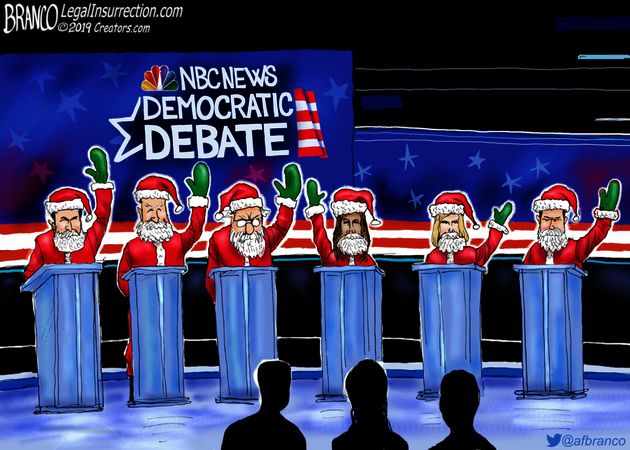
What was lacking in the recent Democratic debates were concrete answers to real problems—as opposed to candidates’ nonstop cosmic virtue signaling. It is easy to blast “white supremacy” and “the gun culture” from a rostrum. But no one on stage seemed to care about the great challenge of our age, the inner-city carnage that takes thousands of young African-American lives each year. The inner-city murdering is tragically almost exclusively a black-on-black phenomenon (even rare interracial homicides are disproportionally committed by African-Americans) that occurs in progressive-run cities with strict gun control laws.

When leaders virtue signal about global or cosmic sin, it is often proof they have no willingness or power to address any concrete crisis. The public tires of such empty platitudes because they also see the culpable trying to divert attention from their own earthly failure by loudly appealing to a higher moral universe.

More mundanely, there is the role of hypocrisy: elites themselves never suffer the consequences of their own ethical inaction while the public never sees any benefit from their moral rhetoric. Illegal immigration is not a personal issue for Pope Francis, and most Europeans have more concrete things to worry about than lectures on populism and nationalism.

Disconnected from Real World Dangers

In the same fashion, New Yorkers in 2011 were worried more about the piles of snow on the sidewalks than they felt threatened by 32-ounce Cokes—while realizing that no snow blocked either the Bloomberg official or private residence.

Note a recent inexplicable Zogby poll that indicated 51 percent of blacks and Hispanics might support Donald Trump. How would such a supposedly counterintuitive result even be possible?

I have a suggestion: minority communities live first-hand with the violence and dangers of the gang gun culture. More policing and incarceration of guilty felons improve their lives. Secure borders mean fewer drug dealers and cartel smugglers in local communities, fewer schools swamped with non-English speakers, and social services not overwhelmed with impoverished non-Americans.

These can all be real concerns for beleaguered minorities. Yet they are virtue-signaled away by progressive elites whose own power and money allow them to navigate around the consequences of their own liberal fantasies that fall on distant others.

Add in a booming economy, rising incomes, and low unemployment for minorities, and the world of shrill yelling on the debate stage about “white privilege” seems some sort of an irrelevant fixation of the elite and privileged, akin to showing off a Gucci bag or Porsche Cayenne—but otherwise nothing to do with dangerous streets, wrecked schools, whizzing bullets, and social services that are becoming inoperative.

The next time a legislator, mayor, or governor rails about plastic straws or the Paris Climate Accord, be assured that his state’s roads are clogged, his public schools failing—and he is clueless or indifferent about it.

Too Many People, or Too Few?

A placard outside the UN headquarters in New York City, November 2011

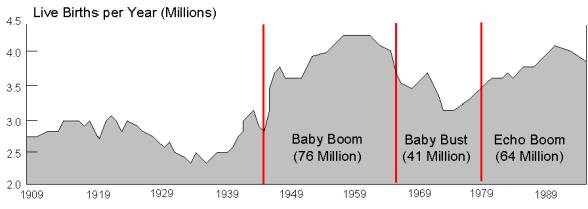
Some years ago I read the book Boom, Bust and Echo. It described how planners for public institutions like schools and hospitals often fail to anticipate demographic shifts. The authors described how in North America, the baby Boom after WWII overcrowded schools, and governments struggled to build and staff more facilities. Just as they were catching up came the sexual revolution and the drop in fertility rates, resulting in a population Bust in children entering the education system. Now the issue was to close schools and retire teachers due to overcapacity, not easy to do with sentimental attachments. Then as the downsizing took hold came the Echo. Baby boomers began bearing children, and even at a lower birth rate, it still meant an increased cohort of students arriving at a diminished system.
The story is similar to what is happening today with world population. Zachary Karabell writes in Foreign Affairs The Population Bust: Demographic Decline and the End of Capitalism as We Know It. Excerpts in italics with my bolds.

For most of human history, the world’s population grew so slowly that for most people alive, it would have felt static. Between the year 1 and 1700, the human population went from about 200 million to about 600 million; by 1800, it had barely hit one billion. Then, the population exploded, first in the United Kingdom and the United States, next in much of the rest of Europe, and eventually in Asia. By the late 1920s, it had hit two billion. It reached three billion around 1960 and then four billion around 1975. It has nearly doubled since then. There are now some 7.6 billion people living on the planet.

Just as much of the world has come to see rapid population growth as normal and expected, the trends are shifting again, this time into reverse. Most parts of the world are witnessing sharp and sudden contractions in either birthrates or absolute population. The only thing preventing the population in many countries from shrinking more quickly is that death rates are also falling, because people everywhere are living longer. These oscillations are not easy for any society to manage. “Rapid population acceleration and deceleration send shockwaves around the world wherever they occur and have shaped history in ways that are rarely appreciated,” the demographer Paul Morland writes in The Human Tide, his new history of demographics. Morland does not quite believe that “demography is destiny,” as the old adage mistakenly attributed to the French philosopher Auguste Comte would have it. Nor do Darrell Bricker and John Ibbitson, the authors of Empty Planet, a new book on the rapidly shifting demographics of the twenty-first century. But demographics are clearly part of destiny. If their role first in the rise of the West and now in the rise of the rest has been underappreciated, the potential consequences of plateauing and then shrinking populations in the decades ahead are almost wholly ignored.

The mismatch between expectations of a rapidly growing global population (and all the attendant effects on climate, capitalism, and geopolitics) and the reality of both slowing growth rates and absolute contraction is so great that it will pose a considerable threat in the decades ahead. Governments worldwide have evolved to meet the challenge of managing more people, not fewer and not older. Capitalism as a system is particularly vulnerable to a world of less population expansion; a significant portion of the economic growth that has driven capitalism over the past several centuries may have been simply a derivative of more people and younger people consuming more stuff. If the world ahead has fewer people, will there be any real economic growth? We are not only unprepared to answer that question; we are not even starting to ask it.

BOMB OR BUST?
At the heart of The Human Tide and Empty Planet, as well as demography in general, is the odd yet compelling work of the eighteenth-century British scholar Thomas Malthus. Malthus’ 1798 Essay on the Principle of Population argued that growing numbers of people were a looming threat to social and political stability. He was convinced that humans were destined to produce more people than the world could feed, dooming most of society to suffer from food scarcity while the very rich made sure their needs were met. In Malthus’ dire view, that would lead to starvation, privation, and war, which would eventually lead to population contraction, and then the depressing cycle would begin again.

Yet just as Malthus reached his conclusions, the world changed. Increased crop yields, improvements in sanitation, and accelerated urbanization led not to an endless cycle of impoverishment and contraction but to an explosion of global population in the nineteenth century. Morland provides a rigorous and detailed account of how, in the nineteenth century, global population reached its breakout from millennia of prior human history, during which the population had been stagnant, contracting, or inching forward. He starts with the observation that the population begins to grow rapidly when infant mortality declines. Eventually, fertility falls in response to lower infant mortality—but there is a considerable lag, which explains why societies in the modern world can experience such sharp and extreme surges in population. In other words, while infant mortality is high, women tend to give birth to many children, expecting at least some of them to die before reaching maturity. When infant mortality begins to drop, it takes several generations before fertility does, too. So a woman who gives birth to six children suddenly has six children who survive to adulthood instead of, say, three. Her daughters might also have six children each before the next generation of women adjusts, deciding to have smaller families.

The population bust is going global almost as quickly as the population boom did in the twentieth century.  The burgeoning of global population in the past two centuries followed almost precisely the patterns of industrialization, modernization, and, crucially, urbanization. It started in the United Kingdom at the end of the nineteenth century (hence the concerns of Malthus), before spreading to the United States and then France and Germany. The trend next hit Japan, India, and China and made its way to Latin America. It finally arrived in sub-Saharan Africa, which has seen its population surge thanks to improvements in medicine and sanitation but has not yet enjoyed the full fruits of industrialization and a rapidly growing middle class.

With the population explosion came a new wave of Malthusian fears, epitomized by the 1968 book The Population Bomb, by Paul Ehrlich, a biologist at Stanford University. Ehrlich argued that plummeting death rates had created an untenable situation of too many people who could not be fed or housed. “The battle to feed all of humanity is over,” he wrote. “In the 1970’s the world will undergo famines—hundreds of millions of people are going to starve to death in spite of any crash programs embarked on now.”

Ehrlich’s prophecy, of course, proved wrong, for reasons that Bricker and Ibbitson elegantly chart in Empty Planet. The green revolution, a series of innovations in agriculture that began in the early twentieth century, accelerated such that crop yields expanded to meet humankind’s needs. Moreover, governments around the world managed to remediate the worst effects of pollution and environmental degradation, at least in terms of daily living standards in multiple megacities, such as Beijing, Cairo, Mexico City, and New Delhi. These cities face acute challenges related to depleted water tables and industrial pollution, but there has been no crisis akin to what was anticipated.

Doesn’t anyone want my Green New Deal?

Yet visions of dystopic population bombs remain deeply entrenched, including at the center of global population calculations: in the forecasts routinely issued by the United Nations. Today, the UN predicts that global population will reach nearly ten billion by 2050. Judging from the evidence presented in Morland’s and Bricker and Ibbitson’s books, it seems likely that this estimate is too high, perhaps substantially. It’s not that anyone is purposely inflating the numbers. Governmental and international statistical agencies do not turn on a dime; they use formulas and assumptions that took years to formalize and will take years to alter. Until very recently, the population assumptions built into most models accurately reflected what was happening. But the sudden ebb of both birthrates and absolute population growth has happened too quickly for the models to adjust in real time. As Bricker and Ibbitson explain,

“The UN is employing a faulty model based on assumptions that worked in the past but that may not apply in the future.”

Population expectations aren’t merely of academic interest; they are a key element in how most societies and analysts think about the future of war and conflict. More acutely, they drive fears about climate change and environmental stability—especially as an emerging middle class numbering in the billions demands electricity, food, and all the other accoutrements of modern life and therefore produces more emissions and places greater strain on farms with nutrient-depleted soil and evaporating aquifers. Combined with warming-induced droughts, storms, and shifting weather patterns, these trends would appear to line up for some truly bad times ahead.

Except, argue Bricker and Ibbitson, those numbers and all the doomsday scenarios associated with them are likely wrong. As they write,

“We do not face the challenge of a population bomb but a population bust—a relentless, generation-after-generation culling of the human herd.”

Already, the signs of the coming bust are clear, at least according to the data that Bricker and Ibbitson marshal. Almost every country in Europe now has a fertility rate below the 2.1 births per woman that is needed to maintain a static population. The UN notes that in some European countries, the birthrate has increased in the past decade. But that has merely pushed the overall European birthrate up from 1.5 to 1.6, which means that the population of Europe will still grow older in the coming decades and contract as new births fail to compensate for deaths. That trend is well under way in Japan, whose population has already crested, and in Russia, where the same trends, plus high mortality rates for men, have led to a decline in the population.

What is striking is that the population bust is going global almost as quickly as the population boom did in the twentieth century. Fertility rates in China and India, which together account for nearly 40 percent of the world’s people, are now at or below replacement levels. So, too, are fertility rates in other populous countries, such as Brazil, Malaysia, Mexico, and Thailand. Sub-Saharan Africa remains an outlier in terms of demographics, as do some countries in the Middle East and South Asia, such as Pakistan, but in those places, as well, it is only a matter of time before they catch up, given that more women are becoming educated, more children are surviving their early years, and more people are moving to cities.

Both books note that the demographic collapse could be a bright spot for climate change. Given that carbon emissions are a direct result of more people needing and demanding more stuff—from food and water to cars and entertainment—then it would follow that fewer people would need and demand less. What’s more, larger proportions of the planet will be aging, and the experiences of Japan and the United States are showing that people consume less as they age. A smaller, older population spells some relief from the immense environmental strain of so many people living on one finite globe.

The Reinvention of Chess

That is the plus side of the demographic deflation. Whether the concomitant greening of the world will happen quickly enough to offset the worst-case climate scenarios is an open question—although current trends suggest that if humanity can get through the next 20 to 30 years without irreversibly damaging the ecosystem, the second half of the twenty-first century might be considerably brighter than most now assume.

The downside is that a sudden population contraction will place substantial strain on the global economic system.

Capitalism is, essentially, a system that maximizes more—more output, more goods, and more services. That makes sense, given that it evolved coincidentally with a population surge. The success of capitalism in providing more to more people is undeniable, as are its evident defects in providing every individual with enough. If global population stops expanding and then contracts, capitalism—a system implicitly predicated on ever-burgeoning numbers of people—will likely not be able to thrive in its current form. An aging population will consume more of certain goods, such as health care, but on the whole aging and then decreasing populations will consume less. So much of consumption occurs early in life, as people have children and buy homes, cars, and white goods. That is true not just in the more affluent parts of the world but also in any country that is seeing a middle-class surge.

The future world may be one in which capitalism at best frays and at worst breaks down completely.
But what happens when these trends halt or reverse? Think about the future cost of capital and assumptions of inflation. No capitalist economic system operates on the presumption that there will be zero or negative growth. No one deploys investment capital or loans expecting less tomorrow than today. But in a world of graying and shrinking populations, that is the most likely scenario, as Japan’s aging, graying, and shrinking absolute population now demonstrates. A world of zero to negative population growth is likely to be a world of zero to negative economic growth, because fewer and older people consume less. There is nothing inherently problematic about that, except for the fact that it will completely upend existing financial and economic systems. The future world may be one of enough food and abundant material goods relative to the population; it may also be one in which capitalism at best frays and at worst breaks down completely.

The global financial system is already exceedingly fragile, as evidenced by the 2008 financial crisis. A world with negative economic growth, industrial capacity in excess of what is needed, and trillions of dollars expecting returns when none is forthcoming could spell a series of financial crises. It could even spell the death of capitalism as we know it. As growth grinds to a halt, people may well start demanding a new and different economic system. Add in the effects of automation and artificial intelligence, which are already making millions of jobs redundant, and the result is likely a future in which capitalism is increasingly passé.

If population contraction were acknowledged as the most likely future, one could imagine policies that might preserve and even invigorate the basic contours of capitalism by setting much lower expectations of future returns and focusing society on reducing costs (which technology is already doing) rather than maximizing output.

But those policies would likely be met in the short term by furious opposition from business interests, policymakers, and governments, all of whom would claim that such attitudes are defeatist and could spell an end not just to growth but to prosperity and high standards of living, too. In the absence of such policies, the danger of the coming shift will be compounded by a complete failure to plan for it.

Different countries will reach the breaking point at different times. Right now, the demographic deflation is happening in rich societies that are able to bear the costs of slower or negative growth using the accumulated store of wealth that has been built up over generations. Some societies, such as the United States and Canada, are able to temporarily offset declining population with immigration, although soon, there won’t be enough immigrants left. As for the billions of people in the developing world, the hope is that they become rich before they become old. The alternative is not likely to be pretty: without sufficient per capita affluence, it will be extremely difficult for developing countries to support aging populations.

So the demographic future could end up being a glass half full, by ameliorating the worst effects of climate change and resource depletion, or a glass half empty, by ending capitalism as we know it. Either way, the reversal of population trends is a paradigm shift of the first order and one that is almost completely unrecognized. We are vaguely prepared for a world of more people; we are utterly unprepared for a world of fewer. That is our future, and we are heading there fast.

See also Control Population, Control the Climate. Not.

Supremes May Rein In Agency Lawmaking

This post consists of a legal discussion regarding undesirable outcomes from some Supreme Court rulings that gave excessive deference to Executive Branch Agency regulators. Relying on the so called “Chevron Deference” can result in regulations going beyond what congress intended by their laws.

Professor Mike Rappaport writes at Law and Liberty Replacing Chevron with a Sounder Interpretive Regime. Excerpts in italics with my bolds

The Issue

The need for a new interpretive arrangement to replace Chevron is demonstrated by a climate change example cited at the end.

Importantly, this new arrangement would significantly limit agencies from using their legal discretion to modify agency statutes to combat new problems never envisioned by the enacting Congress. For example, when the Clean Air Act was passed, no one had in mind it would be addressed to anything like climate change. Yet, the EPA has used Chevron deference to change the meaning of the statute so that it can regulate greenhouse gases without Congress having to decide whether and in what way that makes sense.

Such discretion gives the EPA enormous power to pursue its own agenda without having to secure the approval of the legislative or judicial branches.

Background and Proposals

One of the most important questions within administrative law is whether the Supreme Court will eliminate Chevron deference. But if Chevron deference is eliminated, as I believe it should be, a key question is what should replace it. In my view, there is a ready alternative which makes sense as a matter of law and policy. Courts should not give agencies Chevron deference, but should provide additional weight to agency interpretations that are adopted close to the enactment of a statute or that have been followed for a significant period of time.

Chevron deference is the doctrine that provides deference to an administrative agency when it interprets a statute that it administers. In short, the agency’s interpretation will only be reversed if a court deems the interpretation unreasonable rather than simply wrong. Such deference means that the agency can select among the (often numerous) “reasonable” interpretations of a statute to pursue its agenda. Moreover, the agency is permitted to change from one reasonable interpretation to another over time based on its policy views. In conjunction with the other authorities given to agencies, such as the delegation of legislative power, Chevron deference constitutes a key part of agency power.

There is, however, a significant chance that the Supreme Court may eliminate Chevron deference. Two of the leaders of this movement are Justices Thomas and Gorsuch. But Chief Justice Roberts as well as Justices Alito and Kavanaugh have also indicated that they might be amenable to overturning Chevron. For example, in the Kisor case from this past term, which cut back on but declined to overturn the related doctrine of Auer deference, these three justices all joined opinions that explicitly stated that they thought Chevron deference was different from Auer deference, suggesting that Chevron might still be subject to overruling.

But if Chevron deference is eliminated, what should replace it? The best substitute for Chevron deference would be the system of interpretation employed in the several generations prior to the enactment of the Administrative Procedure Act. Under that system, as explained by Aditya Bamzai in his path-breaking article, judges would interpret the statute based on traditional canons of interpretation, including two—contemporaneous exposition and customary practice—that provide weight to certain agency interpretations.

Under the canon of contemporaneous exposition, an official governmental act would be entitled to weight as an interpretation of a statute (or of the Constitution) if it were taken close to the period of the enactment of the provision. This would apply to government acts by the judiciary and the legislature as well as those by administrative agencies. Thus, agency interpretations of statutes would be entitled to some additional weight if taken at the time of the statute’s enactment.

This canon has several attractive aspects. First, it has a clear connection to originalism. Contemporaneous interpretations are given added weight because they were adopted at the time of the law’s enactment and therefore are thought to be more likely to offer the correct interpretation—that is, one attuned to the original meaning. Second, this canon also promotes the rule of law by both providing notice to the public of the meaning of the statute and limiting the ability of the agency to change its interpretation of the law.

The second canon is that of customary practice or usage. Under this framework, an interpretation of a government actor in its official capacity would be entitled to weight if it were consistently followed over a period of time. Thus, the agency interpretation would receive additional weight if it became a regular practice, even if were not adopted at the time of statutory enactment.

The canon of customary practice has a number of desirable features. While it does not have a connection to originalism, it does, like contemporaneous exposition, promote the rule of law. Once a customary interpretation has taken hold, the public is better able to rely on the existing interpretation and the government is more likely to follow that interpretation.

Second, the customary interpretation may also be an attractive interpretation. That the interpretation has existed over a period of time suggests that it has not created serious problems of implementation that have led courts or the agency to depart from it. While the customary interpretation may not be the most desirable one as a matter of policy, it is unlikely to be very undesirable.

This traditional interpretive approach also responds to one of the principal criticisms of eliminating Chevron deference: that it will give significant power to a judiciary that lacks expertise and can abuse its authority. I don’t agree with this criticism, since I believe that judges are expert at interpreting statutes and are subject to less bias than agencies that exercise not merely executive power, but also judicial and legislative authority.

But even if one believed that the courts were problematic, this arrangement would leave the judiciary with much less power than a regime that provides no weight to agency interpretations. The courts would often be limited by agency interpretations that accorded with the canons—interpretations adopted when the statute was enacted or that were customarily followed. Since those interpretations would be given weight, the courts would often follow them. But while these interpretations would limit the courts, they would not risk the worst dangers of Chevron deference. This interpretive approach would not allow an agency essentially free reign to change its interpretation over time in order to pursue new programs or objectives. Once the interpretation is in place, the agency would not be able to secure judicial deference if it changed the interpretation.

Importantly, this new arrangement would significantly limit agencies from using their legal discretion to modify agency statutes to combat new problems never envisioned by the enacting Congress. For example, when the Clean Air Act was passed, no one had in mind it would be addressed to anything like climate change. Yet, the EPA has used Chevron deference to change the meaning of the statute so that it can regulate greenhouse gases without Congress having to decide whether and in what way that makes sense. Such discretion gives the EPA enormous power to pursue its own agenda without having to secure the approval of the legislative or judicial branches.

In short, if Chevron deference is eliminated, there is a traditional and attractive interpretive approach that can replace it. Hopefully, the Supreme Court will take the step it refused to take in Kisor and eliminate an unwarranted form of deference.

Economics #1 Law vs. Politics #1 Law

Dan Sanchez writes at Real Clear Markets ‘Free Everything’ and Thomas Sowell’s First Law of Politics. Excerpts in italics with my bolds.

The other night, a politician criticized Bernie Sanders and Elizabeth Warren for offering voters “free everything and impossible promises.” Remarkably, the critique came, not from a Republican fiscal conservative, but from a fellow Democrat during a primary debate. John Delaney, a former congressman from Maryland, said such policies were based on “fairy-tale economics.”

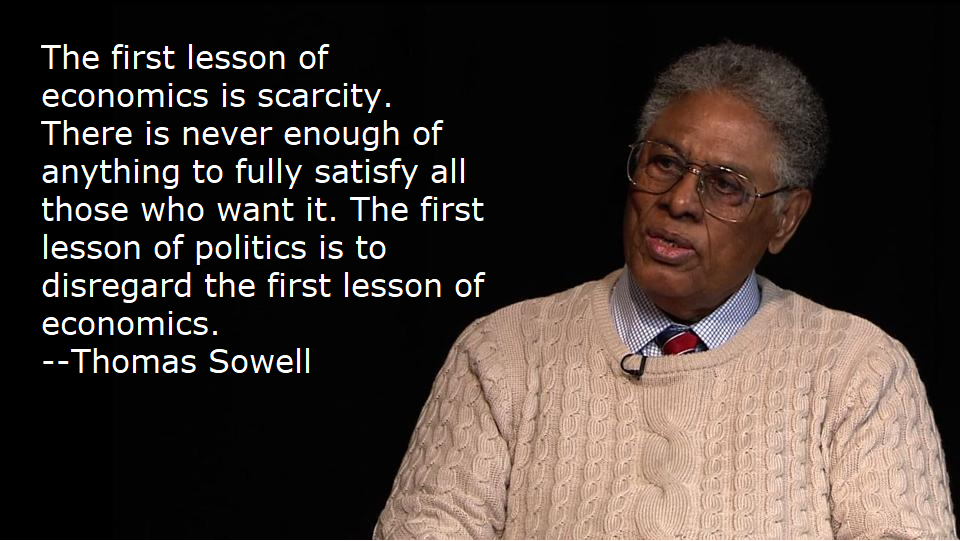
As economist Thomas Sowell wrote, “The first lesson of economics is scarcity: there is never enough of anything to fully satisfy all those who want it. The first lesson of politics is to disregard the first lesson of economics.”

So it was surprising to see a presidential candidate give a nod to the first lesson of economics and lay off the first lesson of politics for a moment.

The word “free” slips freely from the lips of Sanders and Warren: free health care (“Medicare for All”) and free college are two of their most popular promises. But in a sense, something is only “free” when it is not scarce: when there is so much of it to go around that Group A can use it as much as they want without diminishing Group B’s ability to do the same. Economists call that “superabundance.” In most cases, air is “free.” My intake of oxygen doesn’t meaningfully deprive anyone else of anything.

Health care and education are not “free” in that sense. Pills and pencils, surgeries and lectures, are scarce. The same pill can’t be swallowed by two people. And the material and labor that go into producing those things are also scarce. Resources cannot be endlessly lavished on one area without making other uses of those resources impossible. To think otherwise would indeed be “fairy-tale economics.”

When scarcity is a factor, “how can we afford this?” is a key question, and “we can’t” is a possible answer.

But to a politician like Elizabeth Warren, such an answer is unacceptable, even baffling. When the debate moderator asked Warren to respond to Delaney’s critique, she said (emphasis added):

“I don’t understand why anybody goes to all the trouble of running for president of the United States just to talk about what we really can’t do and shouldn’t fight for. I don’t get it.”

She doesn’t get it because she’s following Sowell’s first law of politics. Disregarding scarcity is simply best practice in her profession. Scarcity may limit what you can deliver on, but it doesn’t limit what you can offer. And voters have a poor track record on holding politicians accountable to their promises. So if you’re running to win, it often pays to out-promise your competitors, even if that means veering into fairy-tale territory. Letting pesky realities like scarcity get in the way of that can be political suicide, as I’m guessing Delaney will find out soon.

To be fair, the same individuals who tend to be gullible as voters are typically savvy as customers. When they are let down by a business, they readily take their money elsewhere. That is how they hold entrepreneurs accountable. That is why entrepreneurs are concerned, not just with promises, but with delivery. And that is why entrepreneurs abide by Sowell’s first law of economics: why they take scarcity seriously.

Because customers hold them accountable, entrepreneurs also do a much better job than politicians at alleviating scarcity through efficient, value-creating production. Entrepreneurial projects do fail, but then they go away when their customers do, clearing the stage for something better.

Since government projects are financed by involuntary “customers” (taxpayers), they are ultimately unaccountable and “free” to fail indefinitely.

That is why entrepreneurs give us goods and services that are amazing and yet widely affordable (even “free” to the user, when ad-supported), while politicians give us programs that are “free” but perpetually struggling and unsatisfactory.

For example, in the realm of education, think about how much learning happens on YouTube and through podcasts these days: and how much those platforms have grown and progressed as educational resources in just a few years. Compare that to the decades of frustrated attempts to reform public schools.

And in health care, contrast the customer service of walk-in health clinics at CVS and Walgreens versus the Veterans Administration.

Keep these track records in mind when politicians promise vast expansions of “free” education and health care. These sectors are indeed crying out for reform. But count on accountable entrepreneurs, not unaccountable politicians, to deliver.

Dan Sanchez is the Director of Content at the Foundation for Economic Education (FEE) and the editor-in-chief of FEE.org. He co-hosts the weekly web show FEEcast, serving as the resident “explainer.”

Eco Footprint Nonsense

Michael Shellenberger writes at Forbes Why Earth Overshoot Day And The Ecological Footprint Are Pseudoscientific Nonsense. Excerpts in italics with my bolds.

Starting today through the end of the year, humankind will start consuming more resources than our planet can sustainably produce, according to the Global Footprint Network (GFN), which has been organizing such days since 1986.

“Humanity is using nature 1.75 times faster than our planet’s ecosystems can regenerate,” says the group. “This is akin to using 1.75 Earths.”

Rich nations use up resources faster than poor ones, GFN says. The US, Australia, Denmark and Canada use up their resources before the end of March, while Cuba, Nicaragua, Iraq, and Ecuador don’t do so until December.

“Earth Overshoot Day” is based on something called the “Ecological Footprint,” which is used by the World Wildlife Fund, the United Nations Environment Program, the United Nations Development Program’s Human Development Report, and the International Union for Conservation of Nature.

But is the Ecological Footprint good science? It’s not.

Six years ago I helped debunk Earth Overshoot Day and the Ecological Footprint calculation it’s based upon in a paper for the peer-reviewed scientific journal, PLOS Biology called “Does the Shoe Fit? Real vs. Imagined Footprints.”

We broke down the six measures that comprise the Ecological Footprint and found that five of the six, including food and forestry, were either in balance or surplus. The only thing out-of-balance were humankind’s carbon emissions.

But solving that problem doesn’t require that rich nations become poor — or that poor nations remain poor — but simply that we move toward energy sources that don’t produce carbon emissions, a process known as “decarbonization.”

And the only two cases of nations significantly decarbonizing their energy supplies, France and Sweden, did so not by becoming poor but rather by becoming far richer thanks to the use of nuclear energy. Today, France spends little more than half as much as Germany to produce electricity that produces one-tenth of the carbon emissions, thanks to nuclear.

How did the creators of the Ecological Footprint hide what they had done? By assuming that the only way to solve climate change was by expanding forest cover to absorb all industrial carbon emissions.

In other words, the Ecological Footprint converts emissions of carbon dioxide into a land-use category, thereby ignoring all the other ways of absorbing or never emitting CO2.

It gets worse. Different forests absorb carbon dioxide at different rates over time. But the Ecological Footprint arbitrarily chooses a single number to represent the rate of carbon uptake for all forests around the world for all time. The Ecological Footprint method is best known as “garbage in, garbage out.”

The implication of the Ecological Footprint is thus either that everyone in wealthy developed nations like the US, Europe, and Australia should try to live like Cubans and Nicaraguans, or that we should convert all of the world’s old-growth forests to fast-growing tree farms.

When we published our paper in 2013, it was widely covered in the media, including by Scientific American, New Science, and Le Monde, but that hasn’t stopped the European Commission and other governmental bodies from recognizing “Earth Overshoot Day” on social media.

The Ecological Footprint and Earth Overshoot Day were created at the same time that Western European nations and the United Nations embraced a neo-Malthusian approach to environmental problems.

Ironically, the UN promoted the use of wood fuels over nuclear. In a 1987 report called “Our Common Future,” the UN denounced nuclear energy and insisted that poor nations should use wood fuel more sustainably. “The wood-poor nations must organize their agricultural sectors to produce large amounts of wood and other plant fuels.”

The lead author of “Our Common Future” was Gro Brundtland, former Prime Minister of Norway, a nation which just a decade earlier had become fabulously wealthy thanks to its abundant oil and gas reserves.

Figures like Brundtland promoted the idea that poor nations didn’t need to consume much energy, which turned out to be howlingly wrong. Energy consumption is as tightly coupled to per capita GDP today as it was when today’s rich nations were themselves poor.

There is no rich nation that depends primarily on wood for energy, just as there is no poor nation that depends primarily on fossil fuels or nuclear.

The Ecological Footprint has as much scientific merit as astrology, phrenology, and flat-earth theories. It’s time to treat the Ecological Footprint as the pseudoscientific theory it is.

Ecological Footprint theory is pseudoscience on par with astrology, phrenology, and flat earth theories. SHUTTERSTOCK

Footnote:

Steve Maley wrote at Quora on When Global Warming Began:

Global Warming began in Muncie, Indiana on June 17, 1953 at 2:30 in the afternoon. It was a Tuesday.

Up until that time, weather was “average” all the time.

That is, except for the Dust Bowl, the Little Ice Age, Medieval Warm Period, etc.

Up until then, people had ideal, sustainable lifestyles. 90% of men spent all day in the fields looking at the backsides of two mules. Their spare time was spent chopping wood in hopes they could make it through another winter.

Women stayed at home and had babies. They had to have 8–10 because 2 or 3 of them wouldn’t live to see their 10th birthday.

Farm to Table was a thing. Since nobody had any money, it was a choice between raising your own food or starving.

Yes, it was an idyllic lifestyle. Damn fossil fuels screwed it all up.

How? By changing the atmosphere. Gases other than CO2 used to be 99.97% of the air we breathe. Now it’s 99.96%.

The horror.

Dangers of the Echo Chamber

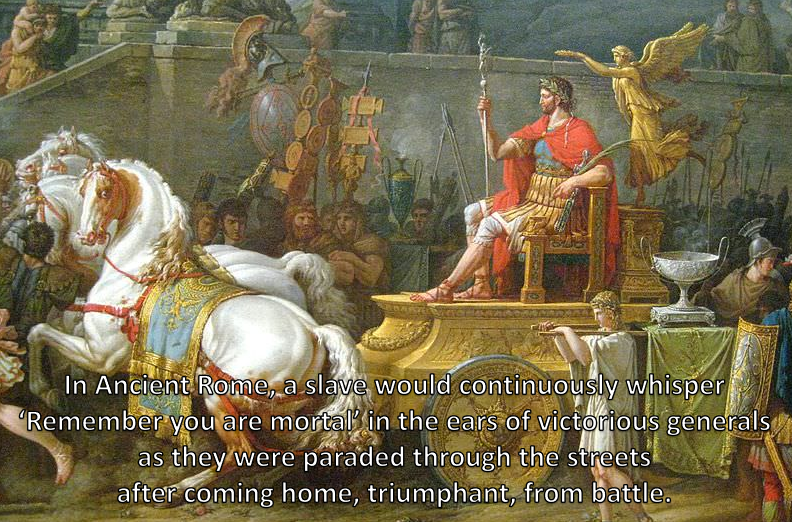
In a modern example of winning, yet being clueless without the slave’s reminder, we have Andrew Klaven writing at the Daily Wire about the downfalls of partisan triumphalism: Clueless Chuck Todd And The Democrats. Excerpts in italics with my bolds.

This week, we witnessed a delightfully comic demonstration of why it’s not such a good thing for the Democratic Party to own at least 90 percent of the communication apparatus in America. The mainstream news media is nearly all Democrat. Hollywood blacklists you if you’re not Democrat. The universities, publishing companies and most of the music industry are populated by Democrats. So Democrats, wrapped in a smothering blanket of mirrors, their own ideas reflected back to them endlessly, begin to develop the wholly ridiculous idea that their absurd version of reality is reality in fact.


As a result, when Robert Mueller released a report revealing that Donald Trump had not colluded with the Russians to steal the election, and that, by any normal legal standard, he had to be considered not guilty of attempting to obstruct justice, the Democrats felt justified in thinking the report provided them with grounds for impeachment. After all, the news media agreed. The late-night comics all agreed. The experts wrote op-eds and they agreed. Even search engines and social media highlighted all the agreement.

So why wasn’t the public demanding impeachment too? Weren’t they watching the news? Weren’t they listening to the late-night comedians? Weren’t they reading the articles by professors? How could they be so blind as to think that a report clearing Trump had cleared Trump?

The Democrats’ answer: it must be because reading the report was too hard for ordinary folks. Maybe if Mueller testified to what was in the report, then the public would see what the Democrats saw all around them: in the news, on the comedy shows, in the academic op-eds and online.

So Mueller testified.

“We found insufficient evidence of the president’s culpability,” he said.

“At any time during your investigation was your investigation curtailed or stopped or hindered?” he was asked.

“No,” he said.

In the eloquent phraseology of Donald Trump: “No collusion, no obstruction.”

Only a Democratic Party swathed and smothered in media mirrors could have been shocked to hear Mueller declare that what was in the Mueller report was in the Mueller report.

Which brings me back to Chuck Todd, the pure spirit of Cluelessness in the Clueless Holy of Holies in the land of Clueless. Todd diagnosed the Democrats’ problem thusly: “The fact is we are living in this 21st century new type of asymmetrical media warfare that we’re in. And you have a propaganda machine on the right. And that’s what it is. It’s a full-fledged propaganda machine on the right that the Democrats haven’t figured out how to combat very well yet.”

I would feel better about the news media if I thought Todd was just a liar, but, no, I think he is actually clueless. Because as an American journalist he is, just like the Democrats, surrounded by people who reflect and echo his ideas. There’s no one near him to ask: What propaganda machine, Chuck? Aside from one cable station — Fox News — what network, what newspaper, what university, what comedian or movie-maker or search engine or social media does anything but spew left-wing propaganda all day every day? There’s no one to demand he produce his evidence. There’s no one to require him to show his work.

Every once in a while, they ought to visit the rest of us, here in Reality. It might keep them from making such utter fools of themselves.