April 2021 Resilient Arctic Ice


ArcApr2021 107 to 120

Previous posts noted how Arctic ice extents waxed and waned in response to the wavy Polar Vortex this year.  The animation above showed how the ice fluctuated over the last two weeks.  Okhhotsk upper left steadily lost ~225k km2, while Bering Sea lower left lost ~130k km2 in the first week then waffled around the same extent.  Barents at the top lost ~170k km2 early, then in the last 10 days gained back most of it. Greenland Sea middle right waffled down and up with little change up to yesterday.  Baffin Bay lower right produced the largest deficit on the Atlantic side ~180k km2.

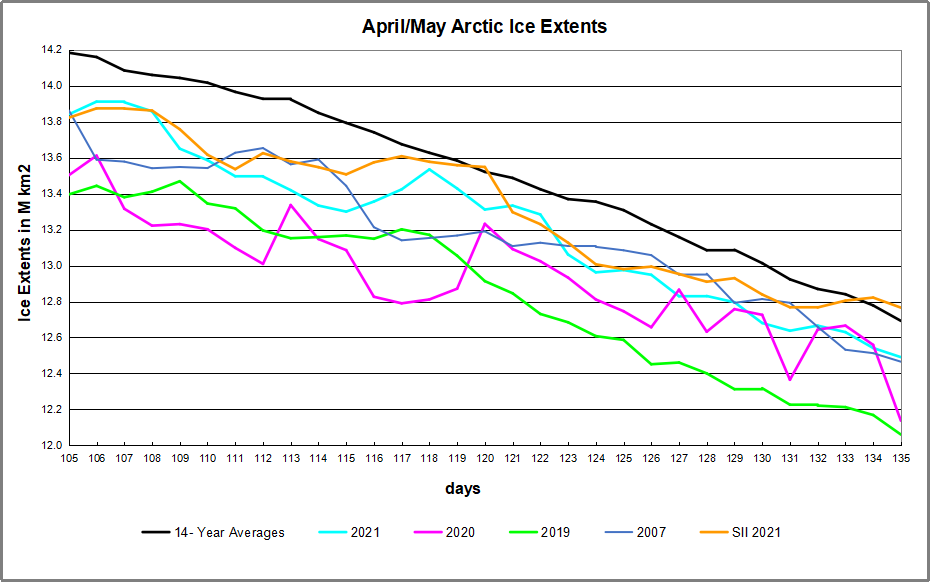
The effect on NH total ice extents is presented in the graph below.Arctic2021120The graph above shows ice extent through April comparing 2021 MASIE reports with the 14-year average, other recent years and with SII.  The average April drops about 1.1M km2 of ice extent.  This year MASIE showed two sharp drops and two recoveries, the last one coming close to average day 118.  SII showed a less than average April loss of ~870k km2.  In the end MASIE 2021 matched 2020, and higher then 2007.

The table below shows the distribution of sea ice across the Arctic regions.

Region 2021120 Day 120 Average 2021-Ave. 2007120 2021-2007
 (0) Northern_Hemisphere 13311402 13551290  -239888  13108068 203334 
 (1) Beaufort_Sea 1058557 1068405  -9848  1059189 -632 
 (2) Chukchi_Sea 962680 954463  8217  949246 13434 
 (3) East_Siberian_Sea 1087137 1085503  1635  1080176 6961 
 (4) Laptev_Sea 897827 888936  8891  875661 22166 
 (5) Kara_Sea 915674 911257  4417  864664 51010 
 (6) Barents_Sea 572380 558256  14124  396544 175837 
 (7) Greenland_Sea 605335 649955  -44620  644438 -39103 
 (8) Baffin_Bay_Gulf_of_St._Lawrence 1004774 1231673  -226899  1147115 -142341 
 (9) Canadian_Archipelago 854597 848502  6095  838032 16565 
 (10) Hudson_Bay 1236512 1242200  -5687  1222074 14439 
 (11) Central_Arctic 3239759 3238255  1504  3241034 -1275 
 (12) Bering_Sea 426670 473606  -46936  475489 -48819 
 (13) Baltic_Sea 12293 20617.28786 -8324  14684 -2390 
 (14) Sea_of_Okhotsk 435360 376555  58804  295743 139617 

Overall NH extent March 31 was below average by 240k km2, or 2%.  With Bering deficit offset by Okhotsk surplus, the entire difference from average matches the Baffin Bay deficit. The onset of spring melt is as usual in most regions.

Cool 2021 Spring Continues

imagehy1p

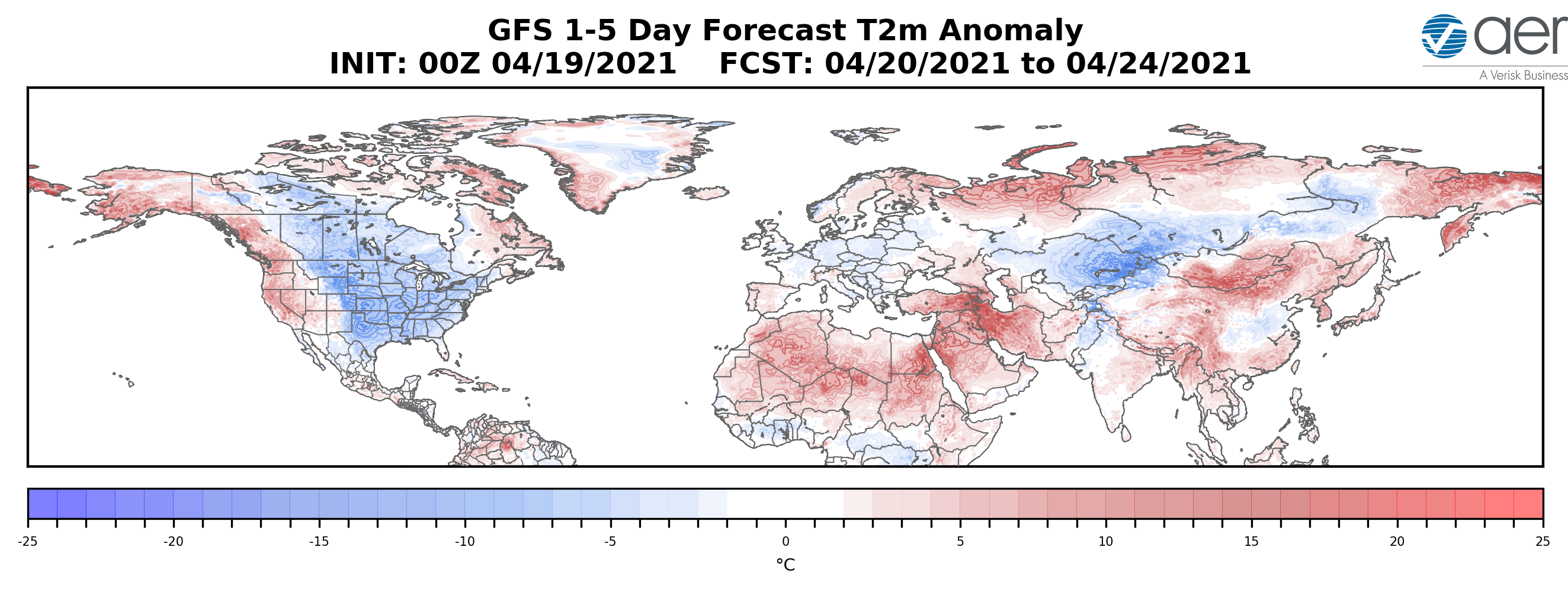
Dr. Judah Cohen provides a weather outlook based upon his study of the Arctic Oscillation at his blog Arctic Oscillation and Polar Vortex Analysis and Forecast April 19, 2021.  Excerpts in italics with my bolds.

The PV is in its waning days of the 2020/21 cold season and will likely be nearly or completely disappeared by the next blog update. This seems to me to be a clear dynamically assisted Final Warming as vertical Wave Activity Flux (WAFz and is proportional to poleward heat transport) has been active for at least a week now and is predicted to remain active for the next two weeks. A dynamic Final Warming can result in some cooler weather across the mid-latitudes; and in my opinion the snow and possibly record cold temperatures predicted for the Eastern US this week is related to the dynamic Final Warming. The PV is being stretched from Siberia to Canada that creates cross polar flow from Siberia to North America that drives cold air south across Canada and the US east of the Rockies. I do believe that this is a short-term impact only and will not have an influence on the summer weather across North America.

Europe has had an impressively cool April, relative to recent Aprils (probably the coolest April since 2013 and maybe even since 2003), which is directly attributable to Greenland blocking that has also extended into the North Atlantic for much of the month. There are no strong signs that the Greenland blocking will disappear any time soon, and as long as it persists, Europe can experience relatively cool temperatures. I see no obvious signs that the Greenland blocking is tied to PV variability and it is therefore more challenging for me to anticipate how long it will last. But it is likely that the streak of cool weather is dependent on the persistence of the Greenland blocking. If and when the Greenland blocking abates, European temperatures could start to climb.

As noted in previous posts, when cold Arctic air pushes south, it is replaced by warmer air contributing to ice melting.  To be clear, sea ice melts primarily because of sunshine directly, and indirectly by intruding sun-warmed water, mostly from the Atlantic by way of Barents Sea. The Arctic in summer daily receives more solar energy than does the equator.  Warmer air is a tertiary contributing factor.
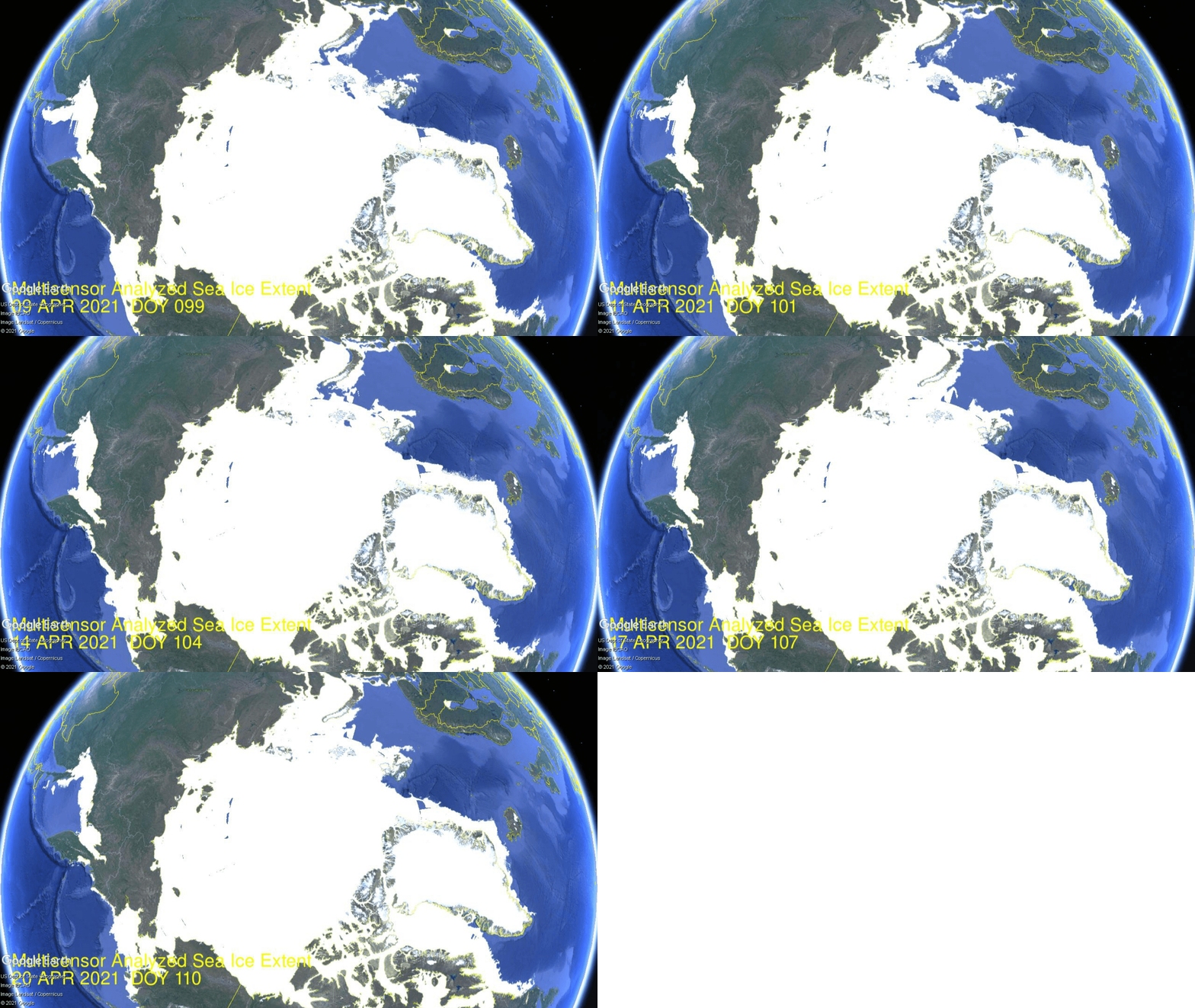
ArcApril 099 to 110

The animation shows Okhotsk upper left lost ~250k km2 of ice extent over the last 10 days.  Bering Sea lower left waffled with little change until losing ~60k km2 the last two days.  On the Atlantic side, Barents Sea upper right gained ~100k km2 over a week, then lost most of it ending about the same.  Greenland Sea middle right lost ~100k km2m, while Baffin Bay lower right waffled and lost very little.
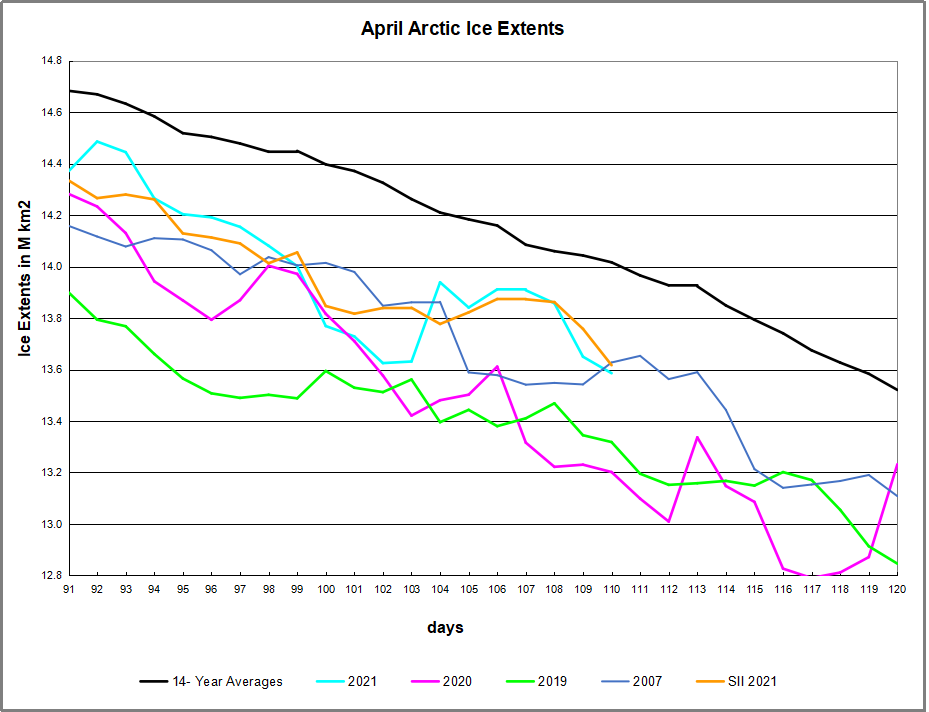
Arctic2021110

The overall impact on NH sea ice is shown in the graph above.  Firstly a drop starting April 10, then recovering April 14 and holding firm to draw near to average, before another drop the last two days.

Background Previous Post  Spring 2021: Warm is Cold, and Down is Up

The cold Spring this year is triggering responses turning natural factors upside down and backwards, confusing causes and effects.  For example, this article at Science Daily Snow chaos in Europe caused by melting sea-ice in the Arctic.  The simplistic appeal to “climate change” is typical: “It is the loss of the Arctic sea-ice due to climate warming that has, somewhat paradoxically, been implicated with severe cold and snowy mid-latitude winters.”  In fact, as we shall see below, it is the wavy Polar Vortex causing both cold mid-latitudes from descending Arctic air, and melting ice from intrusions of warmer southern air.  Importantly, global warming theory asserts that adding CO2 causes the troposphere to warm and the stratosphere to cool.  What we are experiencing this Spring is an unstable Polar vortex due to events of Sudden Stratospheric Warming  (SSWs), not cooling.

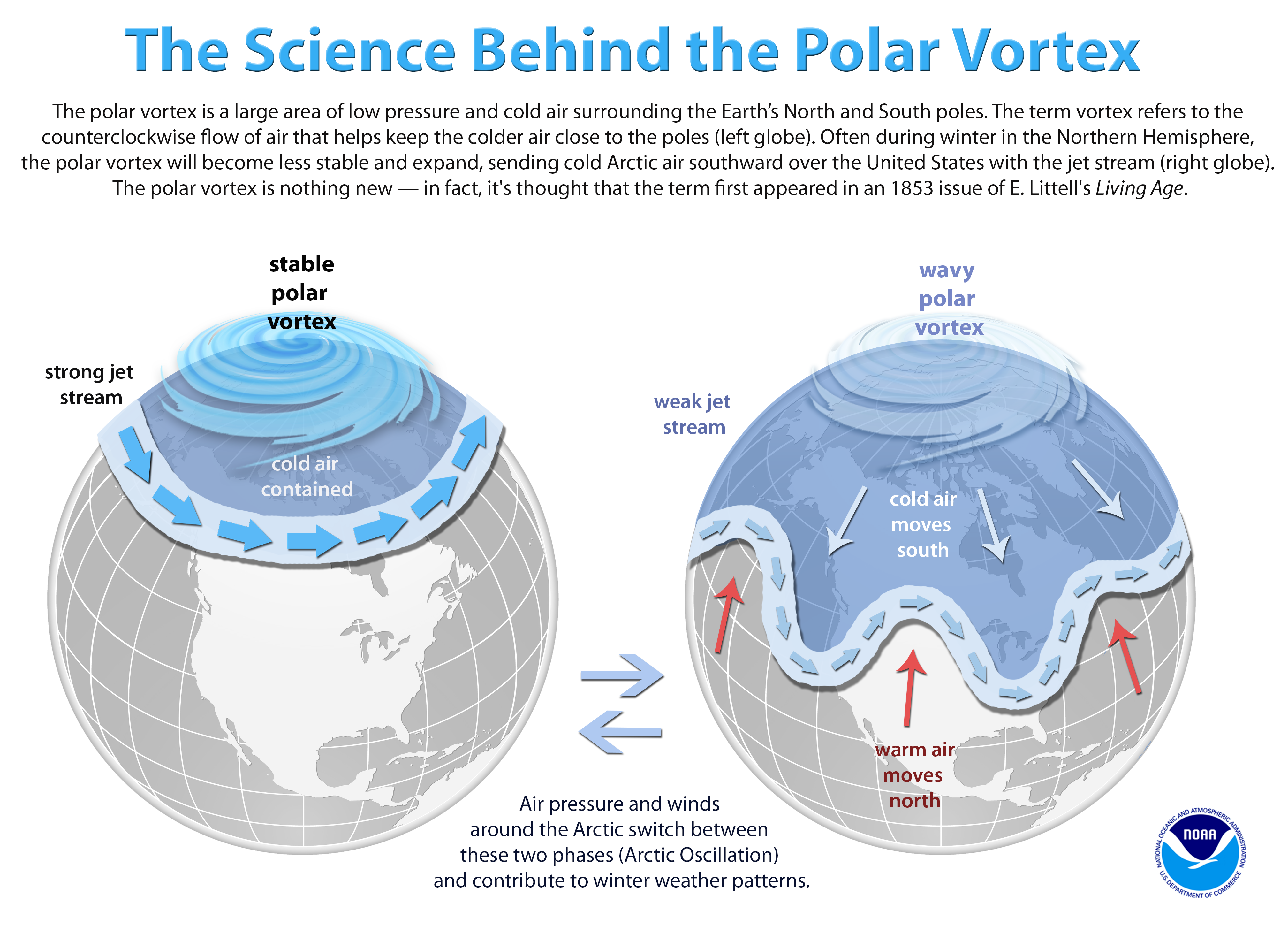
Seasoned meteorologist Judah Cohen of AER shows the mechanism this way:

My colleagues, at AER and at selected universities, and I have found a robust relationship between two October Eurasian snow indices and the large-scale winter hemispheric circulation pattern known as the North Atlantic or Arctic Oscillation pattern (N/AO).

The N/AO is more highly correlated with or explains the highest variance of winter temperatures in eastern North America, Europe and East Asia than any other single or combination of atmospheric or coupled ocean-atmosphere patterns that we know of. Therefore, if we can predict the winter N/AO (whether it will be negative or positive) that provides the best chance for a successful winter temperature forecast in North America but certainly does not guarantee it.

He goes on to say that precipitation is the key, not air temperatures, and ENSO is a driving force:

As long as I have been a seasonal forecaster, I have always considered El Nino/Southern Oscillation (ENSO) as a better predictor of precipitation than temperature across the Eastern US. I think this is supported by the observational or statistical analysis as well as the skill or accuracy of the climate models.

There have been recent modeling studies that demonstrate that El Nino modulates the strength and position of the Aleutian Low that then favors stratospheric warmings and subsequently a negative winter N/AO that are consistent with our own research on the relationship between snow cover and stratospheric warmings. So the influence of ENSO on winter temperatures in the Mid-Atlantic and the Northeast may be greater than I acknowledge or that is represented in our seasonal forecast model.

Summary

As Cohen’s diagram shows, there is an effect from warming, but in the stratosphere. Global warming theory claims CO2 causes warming in the troposphere and cooling in the stratosphere. So whatever is going on, it is not due to CO2.

Cohen’s interview with the Washington Post.

its-easier-to-fool-people-than-to-convince-them-that-they-have-been-fooled


The current situation is described in Cohen’s most recent post at his Arctic Oscillation blog:

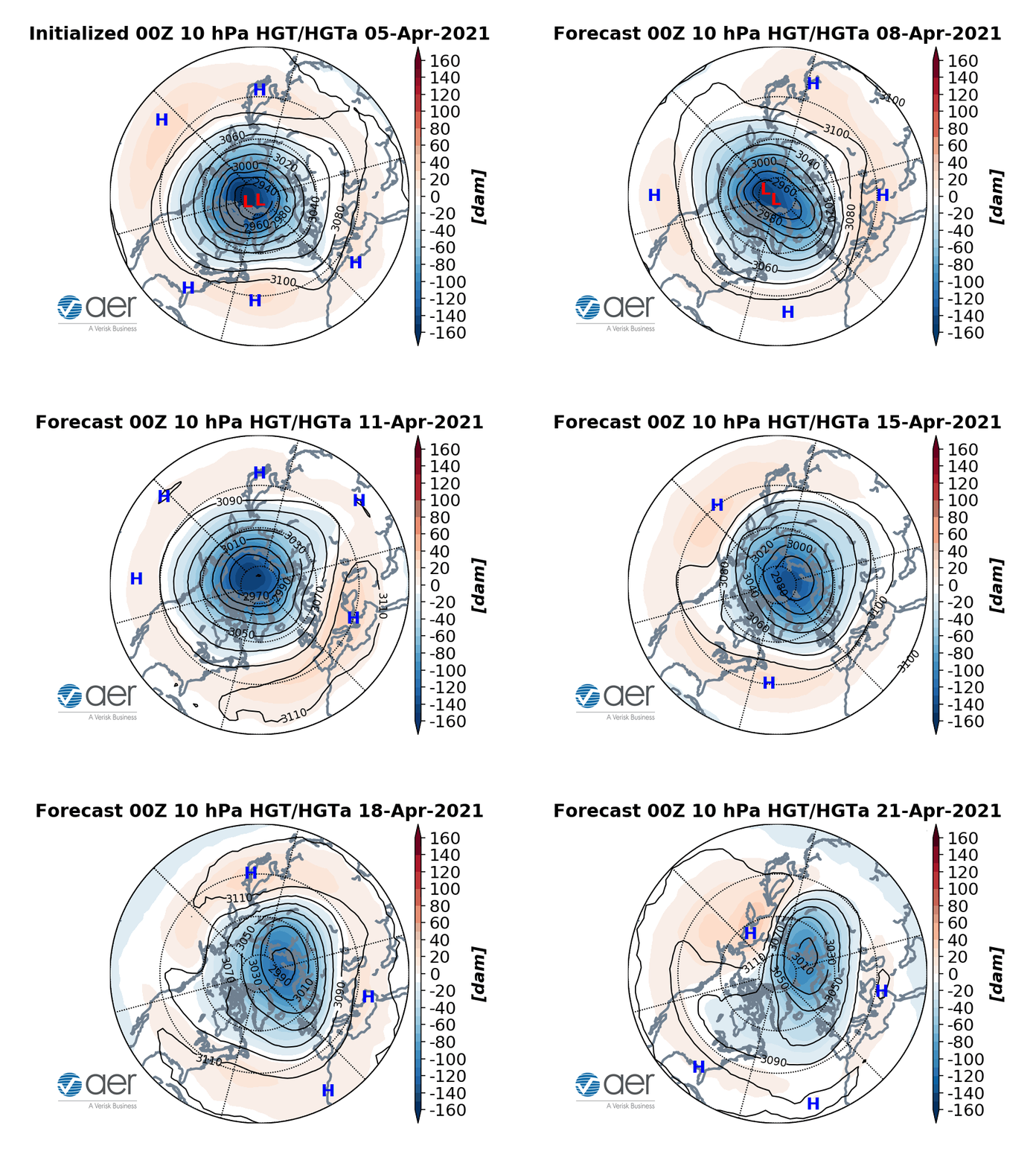
The stratospheric PV always disappear in the spring due to the increasing solar radiation in the polar stratosphere. However, during some springs in addition to the radiative warming of the polar stratosphere, there is also dynamic warming of the polar stratosphere due to the absorption of upwelling Wave Activity Flux (WAFz) from the troposphere. This occurred last spring, which did result in a cool May and even some rare snowfall in the Northeastern US. The predicted return of Ural blocking coupled with Northeast Asia/northern North Pacific troughing is conducive to more active WAFz. The latest PV animation (see Figure ii) shows the stratospheric PV filling (weakening) and meandering over the northern Asia in response to the more active WAFz. This could be the beginning of a dynamically assisted Final Warming that could result in a period of cooler temperatures in parts of the mid-latitudes.
imagesj5oh

Figure ii. Observed and predicted daily geopotential heights (dam; contours) and anomalies (shading) through April 21, 2021. The forecast is from the 00Z 5 April 2021 GFS ensemble.

Background is at post No, CO2 Doesn’t Drive the Polar Vortex 
graphic20-20polarvortex_explained_updated2001291920-204034x2912-1


Spring 2021: Warm is Cold, and Down is Up

The cold Spring this year is triggering responses turning natural factors upside down and backwards, confusing causes and effects.  For example, this article at Science Daily Snow chaos in Europe caused by melting sea-ice in the Arctic.  The simplistic appeal to “climate change” is typical: “It is the loss of the Arctic sea-ice due to climate warming that has, somewhat paradoxically, been implicated with severe cold and snowy mid-latitude winters.”  In fact, as we shall see below, it is the wavy Polar Vortex causing both cold mid-latitudes from descending Arctic air, and melting ice from intrusions of warmer southern air.  Importantly, global warming theory asserts that adding CO2 causes the troposphere to warm and the stratosphere to cool.  What we are experiencing this Spring is an unstable Polar vortex due to events of Sudden Stratospheric Warming  (SSWs), not cooling.

Seasoned meteorologist Judah Cohen of AER shows the mechanism this way:

My colleagues, at AER and at selected universities, and I have found a robust relationship between two October Eurasian snow indices and the large-scale winter hemispheric circulation pattern known as the North Atlantic or Arctic Oscillation pattern (N/AO).

The N/AO is more highly correlated with or explains the highest variance of winter temperatures in eastern North America, Europe and East Asia than any other single or combination of atmospheric or coupled ocean-atmosphere patterns that we know of. Therefore, if we can predict the winter N/AO (whether it will be negative or positive) that provides the best chance for a successful winter temperature forecast in North America but certainly does not guarantee it.

He goes on to say that precipitation is the key, not air temperatures, and ENSO is a driving force:

As long as I have been a seasonal forecaster, I have always considered El Nino/Southern Oscillation (ENSO) as a better predictor of precipitation than temperature across the Eastern US. I think this is supported by the observational or statistical analysis as well as the skill or accuracy of the climate models.

There have been recent modeling studies that demonstrate that El Nino modulates the strength and position of the Aleutian Low that then favors stratospheric warmings and subsequently a negative winter N/AO that are consistent with our own research on the relationship between snow cover and stratospheric warmings. So the influence of ENSO on winter temperatures in the Mid-Atlantic and the Northeast may be greater than I acknowledge or that is represented in our seasonal forecast model.

Summary

As Cohen’s diagram shows, there is an effect from warming, but in the stratosphere. Global warming theory claims CO2 causes warming in the troposphere and cooling in the stratosphere. So whatever is going on, it is not due to CO2.

Cohen’s interview with the Washington Post.

its-easier-to-fool-people-than-to-convince-them-that-they-have-been-fooled


The current situation is described in Cohen’s most recent post at his Arctic Oscillation blog:

The stratospheric PV always disappear in the spring due to the increasing solar radiation in the polar stratosphere. However, during some springs in addition to the radiative warming of the polar stratosphere, there is also dynamic warming of the polar stratosphere due to the absorption of upwelling Wave Activity Flux (WAFz) from the troposphere. This occurred last spring, which did result in a cool May and even some rare snowfall in the Northeastern US. The predicted return of Ural blocking coupled with Northeast Asia/northern North Pacific troughing is conducive to more active WAFz. The latest PV animation (see Figure ii) shows the stratospheric PV filling (weakening) and meandering over the northern Asia in response to the more active WAFz. This could be the beginning of a dynamically assisted Final Warming that could result in a period of cooler temperatures in parts of the mid-latitudes.

imagesj5oh

Figure ii. Observed and predicted daily geopotential heights (dam; contours) and anomalies (shading) through April 21, 2021. The forecast is from the 00Z 5 April 2021 GFS ensemble.

Background is at post No, CO2 Doesn’t Drive the Polar Vortex 
graphic20-20polarvortex_explained_updated2001291920-204034x2912-1


March 2021 Arctic Ice Persists

March Arctic ice 2007 to 2021

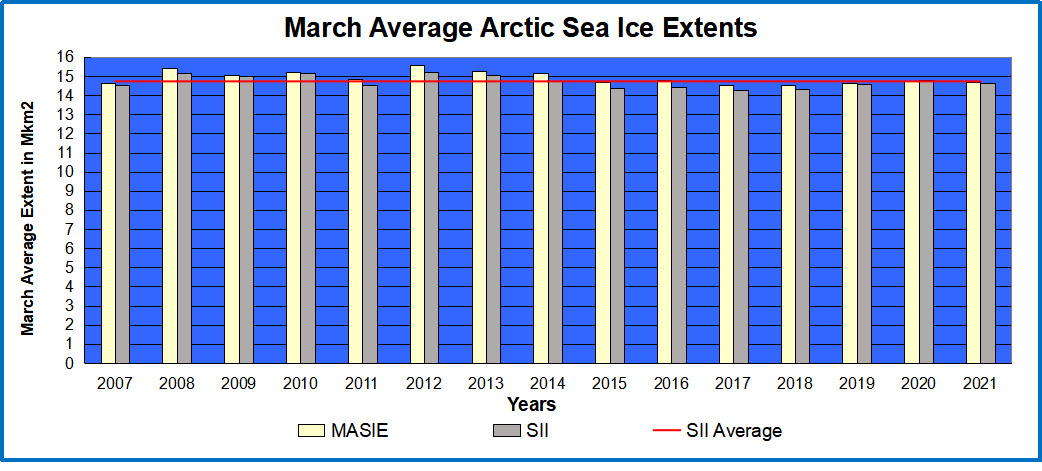
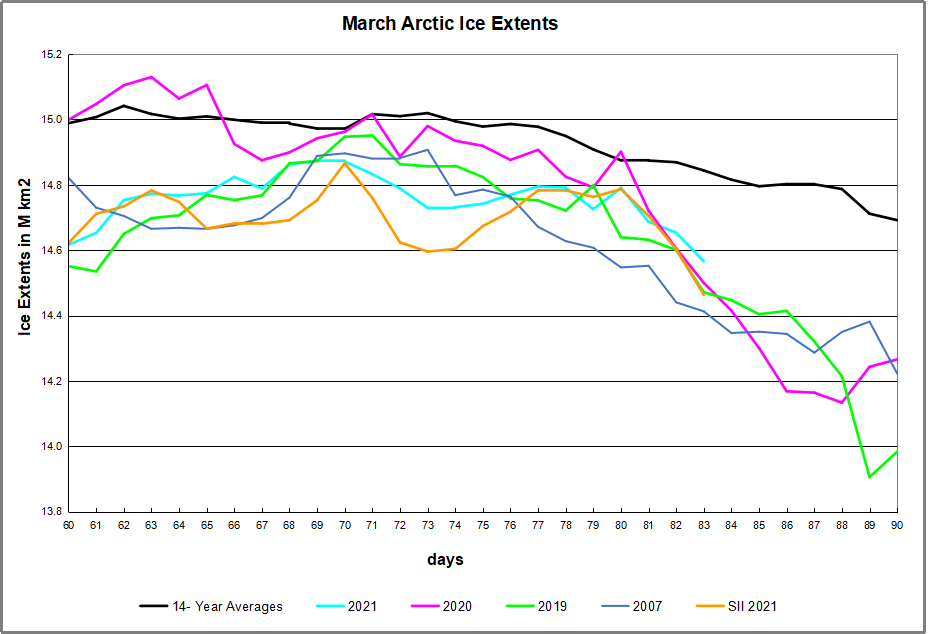
Previous posts showed 2021 Arctic Ice fell short of breaking the 15M km2 ceiling mid March due to a February Polar Vortex disruption.  As we shall see below, another smaller PV disruption is now occurring accelerating the normal spring melting season.  The graph above shows that the March monthly average has varied little since 2007, typically around the SII average of 14.7 M km2.  Of course there are regional differences as described later on.

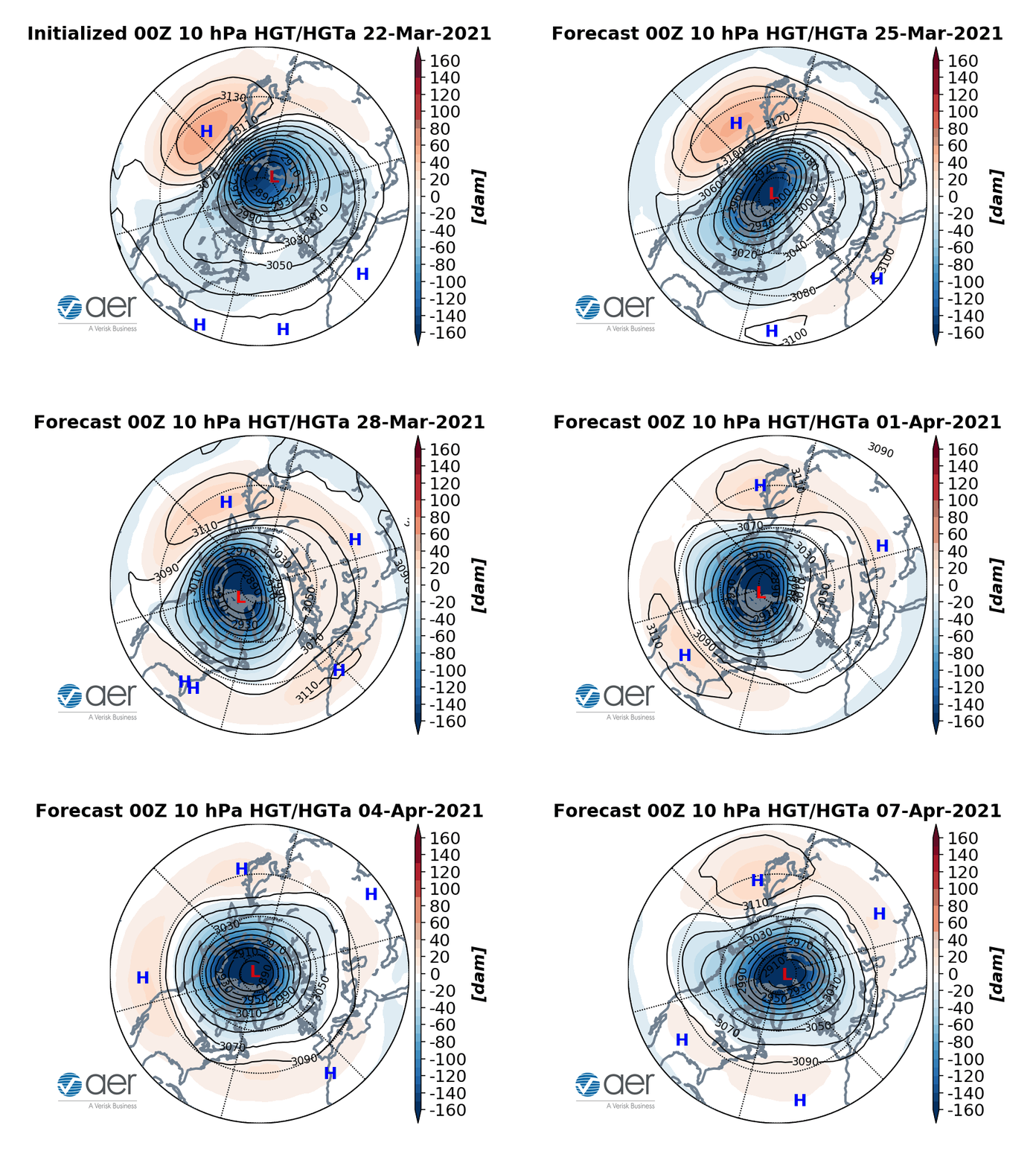
Dr. Judah Cohen at AER provides an image of how this latest PV disruption appears:

gfs_animation_010hpa_20210322_20210407

The High pressure areas were forecast to warm over the Pacific Arctic basins, and extending over to the European side, while the cold Low area is presently extending down into North America, bringing some snow on April 1 in Montreal (no joke).  The effect on Arctic Ice is shown in the animation below:

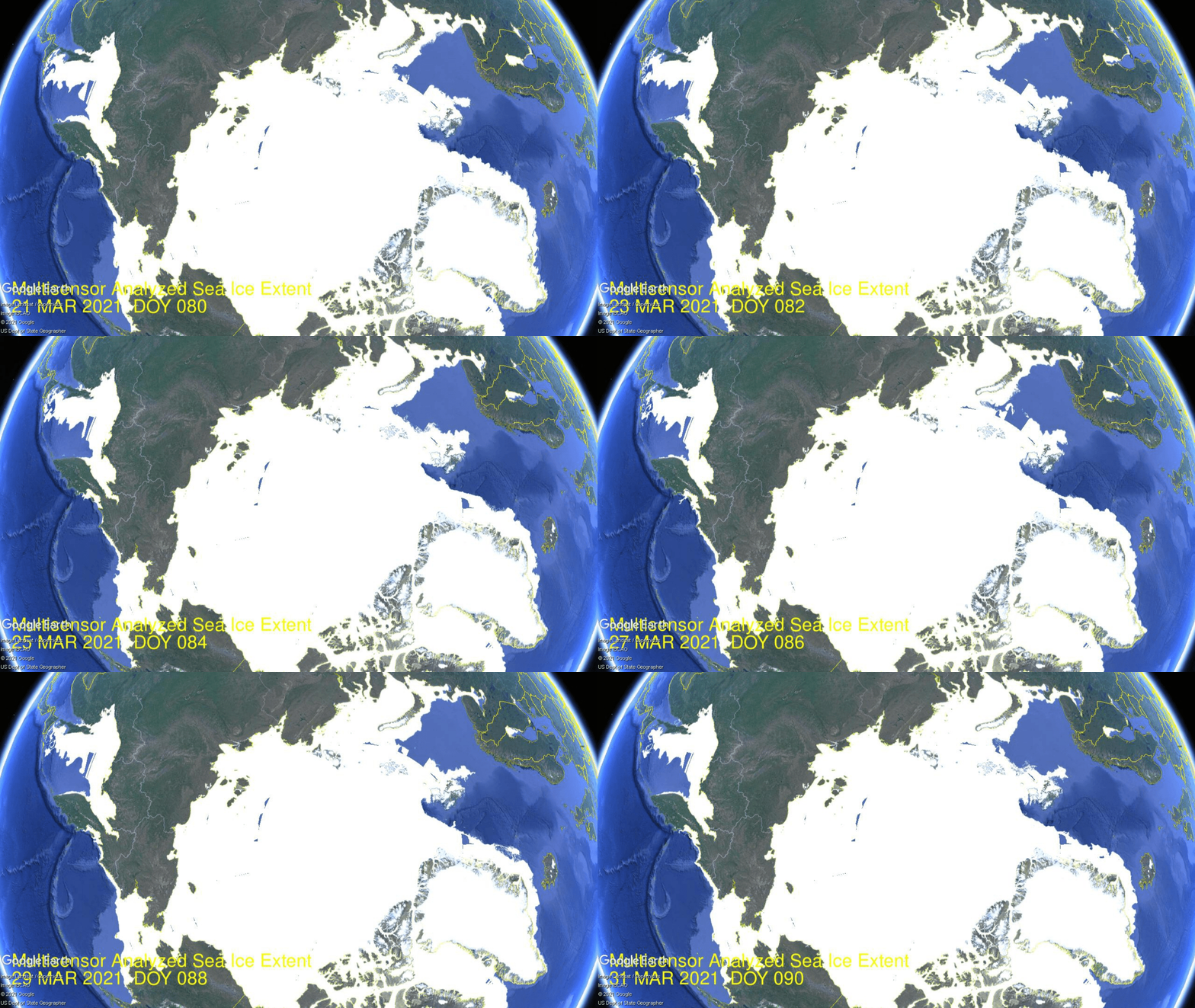
ArcticMarch2021 080 to 090

Over the last 10 days, Okhotsk upper left lost 180k km2 while Bering lower left lost half that with a slight recovery yesterday.  Barents Sea upper right lost 145k km2 over the same period.  The effect on NH total ice extents is presented in the graph below.

Arctic2021090

The graph above shows ice extent through March comparing 2021 MASIE reports with the 14-year average, other recent years and with SII.  After drawing close to average by day 80, 2021 ice extents dropped sharply and at March end matched both 2020 and 2007.  Despite losses from this PV event, the 2020 March monthly average ended up comparable to other years, as seen in the chart at the top.  In fact, the SII dataset of monthly gains and losses shows March 2021 gained slightly over end of February, compared to a 200k km2 loss for the average March.


The table below shows the distribution of sea ice across the Arctic regions.

Region 2021090 Day 090 Average 2021-Ave. 2007090 2021-2007
 (0) Northern_Hemisphere 14266634 14692014  -425380  14222916 43718 
 (1) Beaufort_Sea 1070689 1070177  512  1069711 978 
 (2) Chukchi_Sea 966006 964100  1907  966006
 (3) East_Siberian_Sea 1087137 1086134  1003  1074908 12229 
 (4) Laptev_Sea 897827 896838  989  884340 13487 
 (5) Kara_Sea 935023 916581  18442  892157 42866 
 (6) Barents_Sea 602392 649566  -47174  441970 160422 
 (7) Greenland_Sea 620574 658050  -37476  686312 -65739 
 (8) Baffin_Bay_Gulf_of_St._Lawrence 1243739 1438412  -194673  1217467 26272 
 (9) Canadian_Archipelago 854597 852959  1638  850127 4470 
 (10) Hudson_Bay 1260903 1254727  6176  1229995 30908 
 (11) Central_Arctic 3192844 3234463  -41619  3242237 -49393 
 (12) Bering_Sea 549939 736829  -186890  814788 -264849 
 (13) Baltic_Sea 33543 608741 -27331  45897 -12354 
 (14) Sea_of_Okhotsk 942085 861234  80850  794657 147428 

Overall NH extent March 31 was below average by 425k km2, or 3%.  The bulk of the deficit is seen in Bering and Baffin, along with Barents Sea.  Okhotsk remains above average in spite of recent losses.  The onset of spring melt is as usual in most regions.

March 25 Arctic Melt Season Ensues

As anticipated in a previous post, Arctic ice extent appears to have peaked under the 15M km2 threshold.  An earlier discussion noted that the wavy Polar Vortex that froze Texas with cold Arctic air in February, allowed warmer southern air into Arctic regions, reducing ice extent.  The ice recovered afterward ( see March 1, 2021 Arctic Ice Recovers from PV Hit ), but 2021 was no longer going to reach 15M km2.  As shown by the graph below, ice extents this year did persist and draw close to the 14 year average, before beginning the melt season this week.

Arctic2021083

Starting March MASIE 2021 shows Arctic extents were about 400k km2 below average, but for the first 20 days added 200k while the average lost about 100k, reducing the difference to 85k km2 on day 80.  Now in the last 3 days the melt season has erased the gains in 2021 and restored the deficit to nearly 300k km2, 2% of the 14-year average.  SII reported mostly lower extents than MASIE, but presently the two are similar.  The table shows the distribution of ice over the Arctic regions.

Region 2021083 Day 083 Average 2021-Ave. 2007083 2021-2007
 (0) Northern_Hemisphere 14565743 14844057 -278315 14412819 152924
 (1) Beaufort_Sea 1070689 1070239 450 1069711 978
 (2) Chukchi_Sea 966006 965879 127 966006 0
 (3) East_Siberian_Sea 1087137 1087066 72 1087137 0
 (4) Laptev_Sea 897827 897599 228 897845 -18
 (5) Kara_Sea 935023 918802 16221 904153 30870
 (6) Barents_Sea 689316 649153 40163 472230 217086
 (7) Greenland_Sea 657096 631454 25642 609918 47178
 (8) Baffin_Bay_Gulf_of_St._Lawrence 1284957 1509201 -224244 1323453 -38496
 (9) Canadian_Archipelago 854597 853068 1529 852767 1830
 (10) Hudson_Bay 1260903 1260717 186 1259717 1186
 (11) Central_Arctic 3203492 3230083 -26591 3234061 -30569
 (12) Bering_Sea 592244 746974 -154730 883221 -290977
 (13) Baltic_Sea 46648 70687.87 -24040 70484 -23836
 (14) Sea_of_Okhotsk 1010021 938704 71317 765577 244443

Interestingly, both Okhotsk and Barents Seas peaked well above average, and are still in surplus after starting to retreat.  The main deficits are in Bering and Baffin Bay.  The central Arctic, Siberian and Canadian regions remain solidly frozen.

Background previous post Arctic Ice Moment of Truth 2021

For ice extent in the Arctic, the bar is set at 15M km2. The average peak in the last 14 years occurs on day 62 at 15.04M km2 before descending, though the average can still be above 15M at late as day 73.  Nine of the last 14 years were able to clear 15M, but recently only 2016 and 2020 ice extents cleared the bar at 15M km2; the others came up short. The actual annual peak ice extent day varied between day 59 (2016) to day 82 (2012).

The animation shows in two weeks how this year’s ice extents contracted and then regrew greater than before, coincidental with the wavy Polar Vortex (PV) first admitting warmer southern air and then keeping the cold air in.

As reported previously, most of the action was firstly in the Pacific, especially Sea of Okhotsk upper left, ice shrinking one week by 200k km2 and rapidly growing back 210k km2 ice extent the next.  Okhotsk ice is now 1.1M km2, 96% of 2020 max.  On the Atlantic side, Barents sea upper right lost 100k km2 retreating from Svalbard, then gained 120k km2 back.  Greenland Sea ice middle right lost 100k km2, and then gained 150k km2.  Barents now has 3% more ice than 2020 max, while Greenland sea ice is 85% of last year’s max.

Drift ice in Okhotsk Sea at sunrise.

For more on the Pacific basins see post Meet Bering and Okhotsk Seas

Mid March Arctic Ice Update

As anticipated in the previous post reprinted below, Arctic ice extent appears to have peaked under the 15M km2 threshold.  An earlier discussion at 2020 year end noted that March actually ends up with less ice extent than end of February, so the rest of the month is not likely to add any more ice.  Here is the graph for March including yesterday.

Arctic2021073

The graph shows this year did recover from a 400k km2 deficit to the 14-year average, to about 100k by day 70, and has now fallen back to almost 300k km2 down (2%).  It is also apparent that extent will likely decline in the next two weeks, by about 300k km2 on average, already matched by 2021.  Climatology uses SII March monthly average as the annual maximum, so that will come out lower as well.

Interestingly, both Okhotsk and Barents Seas peaked well above 2020, and are now starting to retreat, along with other marginal basins.  The central Arctic, Siberian and Canadian regions remain solidly frozen.

Background previous post Arctic Ice Moment of Truth 2021

For ice extent in the Arctic, the bar is set at 15M km2. The average peak in the last 14 years occurs on day 62 at 15.04M km2 before descending, though the average can still be above 15M at late as day 73.  Nine of the last 14 years were able to clear 15M, but recently only 2016 and 2020 ice extents cleared the bar at 15M km2; the others came up short. The actual annual peak ice extent day varied between day 59 (2016) to day 82 (2012).

The animation shows in two weeks how this year’s ice extents contracted and then regrew greater than before, coincidental with the wavy Polar Vortex (PV) first admitting warmer southern air and then keeping the cold air in.

As reported previously, most of the action was firstly in the Pacific, especially Sea of Okhotsk upper left, ice shrinking one week by 200k km2 and rapidly growing back 210k km2 ice extent the next.  Okhotsk ice is now 1.1M km2, 96% of 2020 max.  On the Atlantic side, Barents sea upper right lost 100k km2 retreating from Svalbard, then gained 120k km2 back.  Greenland Sea ice middle right lost 100k km2, and then gained 150k km2.  Barents now has 3% more ice than 2020 max, while Greenland sea ice is 85% of last year’s max.

All of this means that 2021 will be hard pressed to pass the 15M km2 threshold.  The graph below shows the situation evolving over the last two weeks anticipating the annual maximum to appear within the fortnight.

Note that Sea Ice Index (SII) went offline day 51 so the MASIE record alone shows the loss of ice extent ending day 56 and climbing up to the present.  The NH ice extent gap is at 244k km2, or 1.6%.  Since the 14 year average has already peaked, further growth will narrow the margin.  (Note that ice extent is affected also by winds piling up drift ice, as well as melting from intrusions of warmer air or water.)

Last year surpassed the average while other recent years were lower.  We shall see what this year does with only 10 days or so to make a difference.

Region 2021063 Day 063 Average 2021-Ave. 2007063 2021-2007
 (0) Northern_Hemisphere 14772617 15016830 -244214 14665491 107126
 (1) Beaufort_Sea 1070689 1070254 435 1069711 978
 (2) Chukchi_Sea 966006 964118 1888 966006 0
 (3) East_Siberian_Sea 1087120 1087134 -14 1087137 -17
 (4) Laptev_Sea 897827 897842 -15 897845 -18
 (5) Kara_Sea 935006 929650 5356 932067 2939
 (6) Barents_Sea 805710 649490 156220 626044 179666
 (7) Greenland_Sea 669651 625085 44566 616841 52809
 (8) Baffin_Bay_Gulf_of_St._Lawrence 1224508 1553901 -329393 1220513 3995
 (9) Canadian_Archipelago 854597 853148 1450 852767 1830
 (10) Hudson_Bay 1260471 1260567 -96 1256718 3753
 (11) Central_Arctic 3197627 3222365 -24738 3229824 -32197
 (12) Bering_Sea 631115 686765 -55650 660726 -29612
 (13) Baltic_Sea 65146 97873 -32727 104884 -39738
 (14) Sea_of_Okhotsk 1090295 1084593 5703 1129107 -38812

The main deficit to average is in Baffin Bay, partly offset by a surplus in Barents.  Smaller pluses and minuses are found in other regions.

Typically, Arctic ice extent loses 67 to 70% of the March maximum by mid September, before recovering the ice in building toward the next March.

What will the ice do this year?  Where will 2020 rank in the annual Arctic Ice High Jump competition?

Drift ice in Okhotsk Sea at sunrise.

For more on the Pacific basins see post Meet Bering and Okhotsk Seas

Arctic Ice Moment of Truth 2021

For ice extent in the Arctic, the bar is set at 15M km2. The average peak in the last 14 years occurs on day 62 at 15.04M km2 before descending, though the average can still be above 15M at late as day 73.  Nine of the last 14 years were able to clear 15M, but recently only 2016 and 2020 ice extents cleared the bar at 15M km2; the others came up short. The actual annual peak ice extent day varied between day 59 (2016) to day 82 (2012).

The animation shows in two weeks how this year’s ice extents contracted and then regrew greater than before, coincidental with the wavy Polar Vortex (PV) first admitting warmer southern air and then keeping the cold air in.

As reported previously, most of the action was firstly in the Pacific, especially Sea of Okhotsk upper left, ice shrinking one week by 200k km2 and rapidly growing back 210k km2 ice extent the next.  Okhotsk ice is now 1.1M km2, 96% of 2020 max.  On the Atlantic side, Barents sea upper right lost 100k km2 retreating from Svalbard, then gained 120k km2 back.  Greenland Sea ice middle right lost 100k km2, and then gained 150k km2.  Barents now has 3% more ice than 2020 max, while Greenland sea ice is 85% of last year’s max.

All of this means that 2021 will be hard pressed to pass the 15M km2 threshold.  The graph below shows the situation evolving over the last two weeks anticipating the annual maximum to appear within the fortnight.

Note that Sea Ice Index (SII) went offline day 51 so the MASIE record alone shows the loss of ice extent ending day 56 and climbing up to the present.  The NH ice extent gap is at 244k km2, or 1.6%.  Since the 14 year average has already peaked, further growth will narrow the margin.  (Note that ice extent is affected also by winds piling up drift ice, as well as melting from intrusions of warmer air or water.)

Last year surpassed the average while other recent years were lower.  We shall see what this year does with only 10 days or so to make a difference.

Region 2021063 Day 063 Average 2021-Ave. 2007063 2021-2007
 (0) Northern_Hemisphere 14772617 15016830 -244214 14665491 107126
 (1) Beaufort_Sea 1070689 1070254 435 1069711 978
 (2) Chukchi_Sea 966006 964118 1888 966006 0
 (3) East_Siberian_Sea 1087120 1087134 -14 1087137 -17
 (4) Laptev_Sea 897827 897842 -15 897845 -18
 (5) Kara_Sea 935006 929650 5356 932067 2939
 (6) Barents_Sea 805710 649490 156220 626044 179666
 (7) Greenland_Sea 669651 625085 44566 616841 52809
 (8) Baffin_Bay_Gulf_of_St._Lawrence 1224508 1553901 -329393 1220513 3995
 (9) Canadian_Archipelago 854597 853148 1450 852767 1830
 (10) Hudson_Bay 1260471 1260567 -96 1256718 3753
 (11) Central_Arctic 3197627 3222365 -24738 3229824 -32197
 (12) Bering_Sea 631115 686765 -55650 660726 -29612
 (13) Baltic_Sea 65146 97873 -32727 104884 -39738
 (14) Sea_of_Okhotsk 1090295 1084593 5703 1129107 -38812

The main deficit to average is in Baffin Bay, partly offset by a surplus in Barents.  Smaller pluses and minuses are found in other regions.

Typically, Arctic ice extent loses 67 to 70% of the March maximum by mid September, before recovering the ice in building toward the next March.

What will the ice do this year?  Where will 2020 rank in the annual Arctic Ice High Jump competition?

Drift ice in Okhotsk Sea at sunrise.

For more on the Pacific basins see post Meet Bering and Okhotsk Seas

March 1, 2021 Arctic Ice Recovers from PV Hit


Update March 1, 2021 to previous post

This update is to note a dramatic effect on Okhotsk Sea ice coincidental with the Polar Vortex (PV) event that froze Texas and other midwestern US states mid-February.  When Arctic air extends so far south due to the weak and wavy vortex, warmer air replaces the icy air in Arctic regions.  In this case, the deficits to sea ice extent appeared mostly in the Sea of Okhotsk in the Pacific and Barents Sea in the Atlantic.  After a sharp drop, ice extents are again building toward the Arctic annual maximum, typically mid-March.

The animation above shows the drop and recovery in the last two weeks.  In the Pacific, the PV did little to Bering Sea ice on the lower left, ending the month up about 50k km2.  More dramatic was the PV effect in Okhotsk upper left, where 200k km2 of ice was lost in 5 days, followed by gaining it all back plus some new ice to reach a new high for the year at 95% of 2020 March maximum.  In the Atlantic Barents Sea upper right first retreats from Svalbard, before refreezing.  Middle right Greenland Sea ice is seen receding and then growing, while bottom right Baffin Bay shows a similar pattern. Barents Sea ice was higher than last year,  before losing 175k km2 during the PV, then recovering some back ending the month at 95% of March 2020 maximum.

The graph below shows the February drop and recovery.

Note both MASIE and SII showing a peak of 14.6M km2 nearing the 14-year average on day 46.  Something went wrong with SII, which has not updated its record since day 50.  MASIE has continued, showing losses down to day 56, followed by a sharp rise ending the month at 14.7M km2, a new max for the year.

Some comments from Dr. Judah Cohen Feb. 15 from his AER blog Arctic Oscillation and Polar Vortex Analysis and Forecasts  Excerpts in italics with my bolds.

I have been writing how the stratospheric PV disruption that has been so influential on our weather since mid-January has been unusual and perhaps even unique in the observational record, so I guess then it should be no surprise that it’s ending is also highly unusual. I was admittedly skeptical, but it does seem that the coupling between the stratospheric PV and the tropospheric circulation is about to come to an abrupt end.

The elevated polar cap geopotential height anomalies (PCHs) related to what I like to refer to the third and final PV disruption at the end of January/early February quickly propagates to the surface and even amplifies, peaking this past weekend. And as I have argued, it is during spikes in PCH when severe winter is most likely across the NH mid-latitudes, as demonstrated in Cohen et al. (2018).

But rather than the typical gradual influence from the stratospheric PV disruption over many weeks, maybe akin to the drip, drip, drip of a leaky faucet, the entire signal dropped all at once like an anchor. This also likely contributed to the severity of the current Arctic outbreak in the Central US that is generational and even historical in its severity. But based on the forecast the PV gave all it had all at once, and the entire troposphere-stratosphere-troposphere coupling depicted in Figure ii is about to abruptly end in the next few days.

I am hesitant to bring analogs before 2000 but the extreme cold in Texas did remind me of another winter that brought historic Arctic outbreaks including cold to Texas – January 1977. It does appear that the downward influence from the stratospheric PV to the surface came to an abrupt end at the end of January 1977 . . . Relative to normal, January 1977 was the coldest month for both Eurasia and the US when stratosphere-troposphere coupling was active. But the relative cold did persist in both the Eastern US and northern Eurasia in February post the stratosphere-troposphere coupling. By March the cold weather in the Eastern US was over but persisted for northern Eurasia.

See also No, CO2 Doesn’t Drive the Polar Vortex

Background from Previous Post

In January, most of the Arctic ocean basins are frozen over, and so the growth of ice extent slows down.  According to SII (Sea Ice Index) January on average adds 1.3M km2, and this month it was 1.4M.  (background is at Arctic Ice Year-End 2020).  The few basins that can grow ice this time of year tend to fluctuate and alternate waxing and waning, which appears as a see saw pattern in these images.

Two weeks into February Arctic ice extents are growing faster than the 14-year average, such that they are approaching the mean.  The graph below shows the ice recovery since mid-January for 2021, the 14-year average and several recent years.

The graph shows mid January a small deficit to average, then slow 2021 growth for some days before picking up the pace in the latter weeks.  Presently extents are slightly (1%) below average, close to 2019 and 2020 and higher than 2018.

February Ice Growth Despite See Saws in Atlantic and Pacific

As noted above, this time of year the Arctic adds ice on the fringes since the central basins are already frozen over.  The animation above shows Barents Sea on the right (Atlantic side) grew in the last two weeks by 175k km2 and is now 9% greater than the maximum last March.  Meanwhile on the left (Pacific side)  Bering below and Okhotsk above wax and wane over this period. Okhotsk is seen growing 210k km2 the first week, and giving half of it back the second week.  Bering waffles up and down ending sightly higher in the end.

The table below presents ice extents in the Arctic regions for day 44 (Feb. 13) compared to the 14 year average and 2018.

Region 2021044 Day 044 Average 2021-Ave. 2018044 2021-2018
 (0) Northern_Hemisphere 14546503 14678564 -132061 14140166 406337
 (1) Beaufort_Sea 1070689 1070254 435 1070445 244
 (2) Chukchi_Sea 966006 965691 315 965971 35
 (3) East_Siberian_Sea 1087120 1087134 -14 1087120 0
 (4) Laptev_Sea 897827 897842 -15 897845 -18
 (5) Kara_Sea 934988 906346 28642 874714 60274
 (6) Barents_Sea 837458 563224 274235 465024 372434
 (7) Greenland_Sea 645918 610436 35482 529094 116824
 (8) Baffin_Bay_Gulf_of_St._Lawrence 1057623 1487547 -429924 1655681 -598058
 (9) Canadian_Archipelago 854597 853146 1451 853109 1489
 (10) Hudson_Bay 1260471 1260741 -270 1260838 -367
 (11) Central_Arctic 3206263 3211892 -5630 3117143 89120
 (12) Bering_Sea 559961 674196 -114235 319927 240034
 (13) Baltic_Sea 116090 94341 21749 76404 39686
 (14) Sea_of_Okhotsk 1027249 930357 96892 911105 116144
 (15) Yellow_Sea 9235 28237 -19002 33313 -24078
 (16) Cook_Inlet 223 11137 -10914 11029 -10806

The table shows that Bering defict to average is offset by surplus in Okhotsk.  Baffin Bay show the largest deficit, mostly offset by surpluses in Barents, Kara and Greenland Sea.

The polar bears have a Valentine Day’s wish for Arctic Ice.

welovearcticicefinal

And Arctic Ice loves them back, returning every year so the bears can roam and hunt for seals.

Footnote:

Seesaw accurately describes Arctic ice in another sense:  The ice we see now is not the same ice we saw previously.  It is better to think of the Arctic as an ice blender than as an ice cap, explained in the post The Great Arctic Ice Exchange.

Feb. 2021 Polar Vortex Hits Okhotsk Ice


Update Feb. 19, 2021 to previous post

This update is to note a dramatic effect on Okhotsk Sea ice coincidental with the Polar Vortex event that froze Texas and other midwestern US states.  When Arctic air extends so far south due to the weak and wavy vortex, warmer air replaces the icy air in Arctic regions.  In this case, the deficits to sea ice extent appear mostly in the Sea of Okhotsk in the Pacific.

The graph below shows a sharp drop in ice extent the last three days.

A closer look into the regions shows that Okhotsk peaked at 1.1M km2 on day 37, and lost 217k km2 down to 0.9M km2 yesterday.  That loss along with Bering flat extent makes up 70% of the present deficit to average.

Some comments from Dr. Judah Cohen Feb. 15 from his AER blog Arctic Oscillation and Polar Vortex Analysis and Forecasts  Excerpts in italics with my bolds.

I have been writing how the stratospheric PV disruption that has been so influential on our weather since mid-January has been unusual and perhaps even unique in the observational record, so I guess then it should be no surprise that it’s ending is also highly unusual. I was admittedly skeptical, but it does seem that the coupling between the stratospheric PV and the tropospheric circulation is about to come to an abrupt end.

The elevated polar cap geopotential height anomalies (PCHs) related to what I like to refer to the third and final PV disruption at the end of January/early February quickly propagates to the surface and even amplifies, peaking this past weekend. And as I have argued, it is during spikes in PCH when severe winter is most likely across the NH mid-latitudes, as demonstrated in Cohen et al. (2018).

But rather than the typical gradual influence from the stratospheric PV disruption over many weeks, maybe akin to the drip, drip, drip of a leaky faucet, the entire signal dropped all at once like an anchor. This also likely contributed to the severity of the current Arctic outbreak in the Central US that is generational and even historical in its severity. But based on the forecast the PV gave all it had all at once, and the entire troposphere-stratosphere-troposphere coupling depicted in Figure ii is about to abruptly end in the next few days.

I am hesitant to bring analogs before 2000 but the extreme cold in Texas did remind me of another winter that brought historic Arctic outbreaks including cold to Texas – January 1977. It does appear that the downward influence from the stratospheric PV to the surface came to an abrupt end at the end of January 1977 . . . Relative to normal, January 1977 was the coldest month for both Eurasia and the US when stratosphere-troposphere coupling was active. But the relative cold did persist in both the Eastern US and northern Eurasia in February post the stratosphere-troposphere coupling. By March the cold weather in the Eastern US was over but persisted for northern Eurasia.

See also No, CO2 Doesn’t Drive the Polar Vortex

Background from Previous Post

In January, most of the Arctic ocean basins are frozen over, and so the growth of ice extent slows down.  According to SII (Sea Ice Index) January on average adds 1.3M km2, and this month it was 1.4M.  (background is at Arctic Ice Year-End 2020).  The few basins that can grow ice this time of year tend to fluctuate and alternate waxing and waning, which appears as a see saw pattern in these images.

Two weeks into February Arctic ice extents are growing faster than the 14-year average, such that they are approaching the mean.  The graph below shows the ice recovery since mid-January for 2021, the 14-year average and several recent years.

The graph shows mid January a small deficit to average, then slow 2021 growth for some days before picking up the pace in the latter weeks.  Presently extents are slightly (1%) below average, close to 2019 and 2020 and higher than 2018.

February Ice Growth Despite See Saws in Atlantic and Pacific

As noted above, this time of year the Arctic adds ice on the fringes since the central basins are already frozen over.  The animation above shows Barents Sea on the right (Atlantic side) grew in the last two weeks by 175k km2 and is now 9% greater than the maximum last March.  Meanwhile on the left (Pacific side)  Bering below and Okhotsk above wax and wane over this period. Okhotsk is seen growing 210k km2 the first week, and giving half of it back the second week.  Bering waffles up and down ending sightly higher in the end.

The table below presents ice extents in the Arctic regions for day 44 (Feb. 13) compared to the 14 year average and 2018.

Region 2021044 Day 044 Average 2021-Ave. 2018044 2021-2018
 (0) Northern_Hemisphere 14546503 14678564 -132061 14140166 406337
 (1) Beaufort_Sea 1070689 1070254 435 1070445 244
 (2) Chukchi_Sea 966006 965691 315 965971 35
 (3) East_Siberian_Sea 1087120 1087134 -14 1087120 0
 (4) Laptev_Sea 897827 897842 -15 897845 -18
 (5) Kara_Sea 934988 906346 28642 874714 60274
 (6) Barents_Sea 837458 563224 274235 465024 372434
 (7) Greenland_Sea 645918 610436 35482 529094 116824
 (8) Baffin_Bay_Gulf_of_St._Lawrence 1057623 1487547 -429924 1655681 -598058
 (9) Canadian_Archipelago 854597 853146 1451 853109 1489
 (10) Hudson_Bay 1260471 1260741 -270 1260838 -367
 (11) Central_Arctic 3206263 3211892 -5630 3117143 89120
 (12) Bering_Sea 559961 674196 -114235 319927 240034
 (13) Baltic_Sea 116090 94341 21749 76404 39686
 (14) Sea_of_Okhotsk 1027249 930357 96892 911105 116144
 (15) Yellow_Sea 9235 28237 -19002 33313 -24078
 (16) Cook_Inlet 223 11137 -10914 11029 -10806

The table shows that Bering defict to average is offset by surplus in Okhotsk.  Baffin Bay show the largest deficit, mostly offset by surpluses in Barents, Kara and Greenland Sea.

The polar bears have a Valentine Day’s wish for Arctic Ice.

welovearcticicefinal

And Arctic Ice loves them back, returning every year so the bears can roam and hunt for seals.

Footnote:

Seesaw accurately describes Arctic ice in another sense:  The ice we see now is not the same ice we saw previously.  It is better to think of the Arctic as an ice blender than as an ice cap, explained in the post The Great Arctic Ice Exchange.

Feb. 2021 Arctic Ice Stays the Course

In January, most of the Arctic ocean basins are frozen over, and so the growth of ice extent slows down.  According to SII (Sea Ice Index) January on average adds 1.3M km2, and this month it was 1.4M.  (background is at Arctic Ice Year-End 2020).  The few basins that can grow ice this time of year tend to fluctuate and alternate waxing and waning, which appears as a see saw pattern in these images.

Two weeks into February Arctic ice extents are growing faster than the 14-year average, such that they are approaching the mean.  The graph below shows the ice recovery since mid-January for 2021, the 14-year average and several recent years.

The graph shows mid January a small deficit to average, then slow 2021 growth for some days before picking up the pace in the latter weeks.  Presently extents are slightly (1%) below average, close to 2019 and 2020 and higher than 2018.

February Ice Growth Despite See Saws in Atlantic and Pacific

As noted above, this time of year the Arctic adds ice on the fringes since the central basins are already frozen over.  The animation above shows Barents Sea on the right (Atlantic side) grew in the last two weeks by 175k km2 and is now 9% greater than the maximum last March.  Meanwhile on the left (Pacific side)  Bering below and Okhotsk above wax and wane over this period. Okhotsk is seen growing 210k km2 the first week, and giving half of it back the second week.  Bering waffles up and down ending sightly higher in the end.

The table below presents ice extents in the Arctic regions for day 44 (Feb. 13) compared to the 14 year average and 2018.

Region 2021044 Day 044 Average 2021-Ave. 2018044 2021-2018
 (0) Northern_Hemisphere 14546503 14678564 -132061 14140166 406337
 (1) Beaufort_Sea 1070689 1070254 435 1070445 244
 (2) Chukchi_Sea 966006 965691 315 965971 35
 (3) East_Siberian_Sea 1087120 1087134 -14 1087120 0
 (4) Laptev_Sea 897827 897842 -15 897845 -18
 (5) Kara_Sea 934988 906346 28642 874714 60274
 (6) Barents_Sea 837458 563224 274235 465024 372434
 (7) Greenland_Sea 645918 610436 35482 529094 116824
 (8) Baffin_Bay_Gulf_of_St._Lawrence 1057623 1487547 -429924 1655681 -598058
 (9) Canadian_Archipelago 854597 853146 1451 853109 1489
 (10) Hudson_Bay 1260471 1260741 -270 1260838 -367
 (11) Central_Arctic 3206263 3211892 -5630 3117143 89120
 (12) Bering_Sea 559961 674196 -114235 319927 240034
 (13) Baltic_Sea 116090 94341 21749 76404 39686
 (14) Sea_of_Okhotsk 1027249 930357 96892 911105 116144
 (15) Yellow_Sea 9235 28237 -19002 33313 -24078
 (16) Cook_Inlet 223 11137 -10914 11029 -10806

The table shows that Bering defict to average is offset by surplus in Okhotsk.  Baffin Bay show the largest deficit, mostly offset by surpluses in Barents, Kara and Greenland Sea.

The polar bears have a Valentine Day’s wish for Arctic Ice.

welovearcticicefinal

And Arctic Ice loves them back, returning every year so the bears can roam and hunt for seals.

Footnote:

Seesaw accurately describes Arctic ice in another sense:  The ice we see now is not the same ice we saw previously.  It is better to think of the Arctic as an ice blender than as an ice cap, explained in the post The Great Arctic Ice Exchange.