Climate Reparations a Lose-Lose-Lose Deal

https://video-api.wsj.com/api-video/player/v3/iframe.html?guid=E6B05E12-0E60-4B80-A8A2-565460ABABF5

At the recently concluded UN climate summit, wealthy nations agreed to pay climate reparations to poor countries. Unfortunately, this could ultimately be a bad deal even for the recipients, if the West expects developing nations to forego fossil fuels that would help them to develop and get more resilient towards natural disasters. Bjorn Lomborg also discussed the topic on The Journal Editorial Report with Wall Street Journal editor Paul Gigot.

The link to the video clip of the interview is in red above, and below a lightly edited transcript of the conversation.  PG refers to Paul Gigot and BL to Bjorn Lomborg.  Transcript is in italics with my bolds and added images.

PG: The COP27 conference in Egypt wrapped up last week with President Biden signing on to a climate reparations plan. Under the agreement wealthy countries would pay into a new fund to compensate poor countries for supposed damage caused by rich country use of fossil fuels. The move represents a major reversal in U.S. policy with the Biden administration’s climate envoy John Kerry dismissing the idea just weeks ago, saying that a compensation fund was “just not happening.”

Let’s bring in Bjorn Lomborg, President of the Copenhagen Consensus Center and a visiting fellow at the Hoover Institution. He’s also author of the book False Alarm: How Climate Change Panic Costs Us Trillions, Hurts the Poor and Fails to Fix the Planet.

Welcome back, Bjorn. So first of all, what do you make of climate reparations fund idea? Is it a good idea, or not?

BL: No it’s mostly a bad idea. Look, there’s a lot of different things you can think about it. But first and foremost, if you step back, we’ve been trying to solve climate, which is a real issue, for what, 30 years now. It’s the 27th Conference. And now we’re basically moving from fixing climate–Which would obviously entail, How do we get technologies out so people actually cut their carbon emissions–to now saying, no, let’s just make it about money.
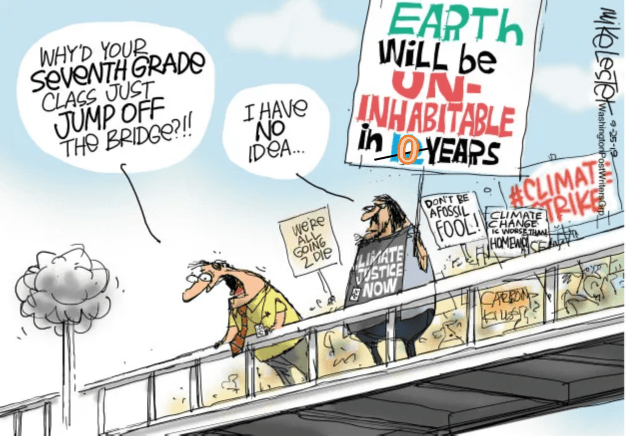
The second part is, of course, this is payback for the incredible amount of exaggeration that’s been going on for the last 30 years. If you tell everyone that this is terribly dangerous and it’ll endanger basically the survival of the human race. Don’t be surprised when most people are gonna say, “Well then, you know, give me some money, for putting me in this dangerous situation.” That’s not the right way to look at this. The economic estimates show that global warming will be a problem; we’re talking about perhaps 4% of GDP by the end of the century, not a wipe out.

And then the really damaging thing is that much of this money, if it at all materializes, it will be spent on rich countries paying poor countries not to use fossil fuels. Which essentially means not developing. And of course that will leave them undeveloped. That will leave them in poverty. And why is it that these countries like Pakistan are vulnerable to flooding? Remember most of Pakistani floods came from bad governance, lots of bad infrastructure and lots of people. It’s because they’re vulnerable, because they’re poor. So leaving them poor is the worst way to help fix the problem of climate change.

So this will leave the world worse off, and of course leave rich countries with a huge bill.

PG: I find your arguments compelling, Bjorn, but then why did the Europeans decide, in the first instance, to change their minds on this, to go ahead and endorse this reparations fund. And that isolated the U.S., which I gather felt then they couldn’t be isolated and had to go along. Why did the Europeans insist on this?

BL: It’s hard to tell. My gut feeling, and I wasn’t there, my gut feeling is they realized that nothing was coming out of the Sharm El-Sheikh meeting of the COP 27. So we need to have some sort of success. So let’s say yes to this, which the developing world was very strongly pushing. Look if you go to all of these meeting, and virtually nothing comes out of it; if there’s the possibility of getting trillions out of it, I can understand why a lot of leaders would sign up for basically free money.

But the reality is, much of this could end up not happening, because remember the U.S. Congress has to appropriate: That does not seem plausible. The New York Times said, “We now have a fund but there is no money in it. So it seems likely this will not come true. Most countries are not feeling very flush right now. I can’t imagine most countries saying, “ Sure, let ‘s pay another couple of trillion dollars to the developing world.

First and foremost let’s remember that if this actually happened, it would likely prevent poor countries from using fossil fuels, which is one of the key ways to get out of poverty. Remember China dramatically industrialized by using lots and lots of fossil fuels, and almost lifted a billion people out of poverty. That’s an amazing achievement. And most people in the developing world want to do the exact same thing. So in a sense, we are setting all of ourselves up for really bad outcomes in the future.

PG: There’s kind of a guilt tax quality to this, where the West is supposed to pay for the sin of having actually developed first, and for being prosperous in part by using fossil fuels. But China isn’t tapped to pay into this fund at all. And it’s building coal plants at a rapid pace, to the point where its projected new plants are going to dwarf all of the U.S. current coal production by 2025. How can China remain out of all of this?

BL: Well, first of all, because that would be really convenient for China. They are categorized as a developing country in the UNFCCC agreement that encompasses the COP negotiations. And of course, it you’re China, you wanna stay that way. I think it’s also fair to say that China has still only historically emitted only about half of what the U.S. or Europe has done. So there is some justification to this. But we have to very clearly separate the fact that you could make the argument that a little bit of reparations make philosophical sense.

But if you start in letting that genie out of the bottle, you’ll make the whole conversation about that, and forgetting to actually fix climate change.

Which is about making green energy much cheaper in the future through innovation. That’s what we should be focusing on if we actually want to fix this. And secondly, you’ll also have this situation where India, China and almost everyone else is not going to pay into this potentially enormous cost.

Summation

Climate reparations is a move in which rich nations lose, poor nations lose and energy innovation loses,  And as noted previously, the winners will be lawyers and accountants, as well as sovereign hydrocarbon producers.

Climate Loss and Damage, Legal House of Cards


Fed’s Powell Speaks on Climate with Forked Tongue

Rupert Darwall explains the hypocrisy in his Real Clear Energy article The Fed’s Jay Powell Is Trying to Have It Both Ways on Climate Change.  Excerpts in italics with my bolds.

Fed-speak, Alan Greenspan once explained, was about practicing the art of constructive ambiguity. Testifying to Congress as Fed chairman, Greenspan would resolve a sentence in a deliberately obscure way that made it incomprehensible, “but nobody was quite sure I wasn’t saying something profound when I wasn’t.”

Speaking on Tuesday at a symposium on central bank independence in Sweden, Greenspan’s latest successor avoided ambiguity as he spoke about the Fed’s need to stick to its assigned policy goals of maximizing employment and price stability and not getting diverted to pursuing other objectives. “In a well-functioning democracy, important public policy decisions should be made, in almost all cases, by the elected branches of government,” Chair Jerome Powell declared. “It is essential that we stick to our statutory goals and authorities, and that we resist the temptation to broaden our scope to address other important social issues of the day.”

If that wasn’t clear enough, the current Fed chair noted that climate policies could have significant effects on companies, industries, regions, and nations: “Decisions about policies to directly address climate change should be made by the elected branches of government and thus reflect the public’s will as expressed through elections.” Without explicit congressional authorization, it would not be appropriate for the Fed to use monetary policy or its supervisory tools to promote a greener economy, Powell suggested. “We are not, and will not be a ‘climate policymaker.’”

But before supporters of limited government, separation of powers, and rolling back the administrative state stand up to applaud, they should remember that Powell has an indirect climate-policy tool: as part of its supervisory responsibilities, the Fed will require banks to understand and manage the financial risks of climate change. Yet at the same time, Powell would have us believe that the Fed’s supervisory decisions are “not influenced by political considerations.”

Climate “stress tests” are one of the principal tools used by the European Central Bank in furtherance of what its president Christine Lagarde openly proclaims as part of its mandate. “Our planet is burning and we central bankers could look on our mandate and pretend that it is for others to act and that we should simply be followers. I don’t think so,” Lagarde said at a June 2021 Green Swan conference of central bankers and regulators.

For its climate stress tests, the Bank of England uses the most extreme climate scenario developed by the Intergovernmental Panel on Climate Change. It then takes this projection about climate at the end of this century and telescopes eighty years of extreme climate change into three decades. The result is a physical impossibility. That a central bank believes it necessary to engage in such behavior demonstrates two things: that climate change does not represent a genuine threat to financial stability—if it did, the Bank would have used a plausible climate scenario—and that climate stress tests are indeed a tool of climate policy. Unlike the Fed, the Bank of England does have an explicit climate policy mandate. When he was Chancellor of the Exchequer, Rishi Sunak expanded the Bank’s remit to support the government’s goal of achieving “balanced growth that is also environmentally sustainable and consistent with the transition to a net zero economy.”

The Fed’s lack of a similar climate mandate proved no obstacle to Powell, however, when he spoke at the same Green Swan conference as Lagarde. The conference had been convened by the Network for the Greening of the Financial System (NGFS) to develop proposals for a more sustainable economy, financial sector, and society. “There’s a lot to like about climate stress tests,” Powell told the meeting. Not much constructive ambiguity there.

The NGFS is a club of central banks and financial regulators formed by the Banque de France in December 2017 on the second anniversary of the Paris climate agreement. Its aim is to strengthen “the global response required to meet the goals of the Paris agreement and to enhance the role of the financial system.” It also seeks “to manage risks and to mobilize capital for green and low-carbon investments in the broader context of environmentally sustainable development.” These objectives have no place in the Fed’s formal mandate.

Powell’s notion of an apolitical Fed tightly hewing to its congressional mandate
is belied by the central bank’s decision to join the NGFS.

Even more devastating to Powell’s claim of the Fed eschewing political considerations is the timing of that move: December 15, 2020, six weeks after Joe Biden defeated Donald Trump. The Fed cannot have it both ways. It cannot truthfully claim that its supervisory decisions are untainted by political considerations and remain a member of the NGFS. It was a mistake for the Fed to have joined the NGFS in the first place. If Powell wants to be believed, the Fed should quit the club.

See Also Financial Systems Have Little Risk from Climate

ESG Fell to Earth in 2022

Rupert Darwall writes at Real Clear Energy 2022: The Year ESG Fell to Earth.  Excerpts in italics with my bolds and added images.  H/T Tyler Durden

The year 2022 brings an end to an era of illusions: a year that saw the end of the post–Cold War era and the return of geopolitics; the first energy crisis of the enforced energy transition to net zero; and the year that brought environmental, social, and governance (ESG) investing down to earth with a thump—for the year to date, BlackRock’s ESG Screened S&P 500 ETF lost 22.2% of its value, and the S&P 500 Energy Sector Index rose 54.0%. The three are linked. By restricting investment in production of oil and gas by Western producers, ESG increases the market power of non-Western producers, thereby enabling Putin’s weaponization of energy supplies. Net zero—the holy grail of ESG—has turned out to be Russia’s most potent ally.  [Note: GOP House members are now advised to refer to Wind and Solar as “Not Green, Not Clean, and Empowering to China and Russia.”]

It wasn’t only a bad year for ESG on the stock market. Earlier this month, Vanguard announced that it was quitting Glasgow Financial Alliance for Net Zero (NZAM), set up by former governor of the Bank of England Mark Carney a little over a year ago. “We have decided to withdraw from NZAM so that we can provide the clarity our investors desire about the role of index funds and about how we think about material risks, including climate-related risks,” the world’s second-largest asset manager said.

Two months ago, Alex Edmans, coauthor of the latest edition of the standard textbook on the principles of corporate finance and professor of finance at the London Business School, published a paper titled “The End of ESG”—without a question mark. Edmans criticizes what has become the primary justification for ESG: the claim that business can generate higher returns for investors by tackling climate change. Since governments are democratically elected by a country’s citizens, they are best placed to address externalities, whereas investors disproportionately represent the elites. “If ESG is pursued for its externalities, companies and investors should be very clear that it may be at the expense of value,” Edmans says.

October also saw the publication of Terrence Keeley’s Sustainable, where the former BlackRock senior executive penned what amounts to a requiem for ESG. Rather than “doing well by doing good,” the logic of Keeley’s case, as I reviewed for RealClear Books, is that investors in conventional ESG investment products are likely to end up not doing very well and leave investors feeling good, not doing good.

It has not all been going one way. In May, HSBC terminated Stuart Kirk, its global head of research at HSBC’s asset-management arm, for voicing some hard truths about ESG. Earlier this month, HSBC announced that it will stop financing new oil and gas fields, putting the West’s third-largest bank on Putin’s side in Russia’s energy war on the West.

What is now a negative factor disadvantaging the West in a world increasingly characterized by East–West geopolitical tensions originated after a period when the United Nations had been fostering a horizontal global division between a rich North and an exploited South. As University of Pennsylvania’s professor Elizabeth Pollman records in her June 2022 paper “The Origins and Consequences of the ESG Moniker,” through the 1970s and early 1980s, the UN promoted the New International Economic Order that called for the regulation of transnational corporations on the alleged grounds that they were widening the gap between developed and developing countries.

The 2008 financial crisis subsequently turbocharged the uptake of ESG. Having caused the financial crisis, Wall Street was going to redeem itself by saving the world from a planetary catastrophe. Without climate change, ESG would have vastly less salience. Although marketed as a climate risk analysis tool, ESG is no such thing.

In reality, it’s about investors and debt providers driving the decarbonization
of Western companies and sunsetting its oil and gas companies.

According to ESG doctrine, there are two types of climate financial risk—physical risk and transition risk—and it’s straightforward to demonstrate that both are spurious. Take the Bank of England. For its climate stress tests, the Bank of England uses a scenario derived from the Intergovernmental Panel on Climate Change’s (IPCC) extreme and physically implausible RCP8.5 climate scenario. Roger Pielke, Jr., professor of environmental studies at the University of Colorado–Boulder, and Justin Ritchie have documented how use of the RCP8.5 scenario represents “a stubborn commitment to error,” with its absurd projection of a sixfold growth in per-capita coal consumption to 2100, based on erroneous reports in the late 1980s of virtually unlimited coal deposits in Siberia and China. The Bank of England compounds implausibility with impossibility by taking the RCP8.5 pathway of 4 degrees by the turn of the century and telescoping it into a 3.3-degree Celsius rise by 2050.

Central banks resorting to these types of games constitutes strong evidence that
climate physical risk is a nonissue for financial stability.

Similarly, climate transition risk and the stranded assets trope defy economic and financial logic. If you restrict the flow of capital into a sector producing stuff that people want and are willing to pay for, the price of the output of a capital-embargoed sector will rise, as will the value of its invested capital. This, in essence, is what has been happening in energy and capital markets over the past year and explains why ESG as an investment strategy does not work. In the absence of draconian government policies to suppress demand for oil and natural gas, ESG policies strangling the supply of capital to Western oil and gas producers have two effects: they push up the price of hydrocarbons; and they displace supply from Western producers to neutral or hostile ones, with major detriment to the economies and security interests of the West.

Although the disintegration of ESG as an investment strategy became unmistakable in 2022, its existence as a political doctrine will continue until it is challenged and defeated politically.

This is already happening in Red states such as Florida, Texas, West Virginia, and Utah. It also requires concerted leadership at a national level to get central bankers and financial regulators to quit playing covert climate policy and to shame banks such as HSBC into switching their support from Russia in the energy wars by dropping their anti–oil and gas financing policies. Defeating ESG not a case of “who cares wins” but “who fights wins.”

See Also

ESG Funds Buy Russian Over Canadian Oil

ESG Movement Threatens Us All


Green Energy Profiteering Scam

J.B. Shurk writes at Gatestone Institute The Green Energy Profiteering Scam.  H/T Tyler Durden.  Excerpts in italics with my bolds and added images.

“Green” Profits Can Only Rise if Citizens’ Freedoms Fall

In free markets, commodities bought and sold possess perceived value. When a buyer and seller reach an agreed upon price for any product, there is a “meeting of the minds.” The value of any natural raw material is proportional to its scarcity. The more of it there is, and the more easily it can be obtained, the less value it holds. A vendor who sells ordinary rocks cannot make a living when his product is found freely all over the ground. If he transacts in gold or silver, diamonds or rubies, however, his hard-to-find “rocks” are worth a small fortune.

If only there were a way to turn ordinary rocks into valuable commodities!

There are, in fact, two well-known ways to do so. An unscrupulous vendor could simply paint ordinary rocks gold and pretend that common minerals are rare, and an unsuspecting customer might never be the wiser. Through fraud, the seller can hijack the perceived value of his goods and undermine the agreed “meeting of the minds” between himself and any deceived customer. His “precious” rocks actually hold no value but provide him with ill-gotten gains. Over time, however, this type of fraud does not last. More discerning customers eventually catch on to the ruse, and that information is shared among prospective buyers. And unless he is quick to move on to a new town with new buyers yet to be deceived, old swindled customers are likely to end his livelihood or much worse. Engaging in fraud comes with serious personal risks.

There is another, safer way, however, to turn ordinary rocks into valuable commodities. The vendor could petition the king of the realm for the exclusive right to gather and sell ordinary rocks. If granted such an extraordinary license — whereby ordinary rocks may only be possessed if first stamped with the vendor’s mark — then an abundantly available natural resource becomes scarce overnight. What was once free now costs whatever the vendor and the king’s tax-collecting chancery decide to charge for the use of regulated rocks. Perhaps citizens with special status or recognized allegiance to the king will still get their rocks for next to nothing. Yet the classical mechanics of supply and demand still come into play for everyone else. Even if the price charged for an officially sanctioned rock is kept low, its value on secondary markets is determined entirely by the scarcity of available vendor-stamped rocks.

How much are licensed rocks worth if they are the only ones that may be legally owned? When a king and vendor conspire to make only a small fraction of available rocks “legal,” then their manufactured “unavailability” makes them extremely valuable. Legally imposed scarcity comes with much fewer personal risks. Licensed monopoly on high-demand commodities is a license to print money.

From this lens, it is easy to see why so many investors love
government intervention in energy markets.

  • When governments limit drilling and mining for hydrocarbons in the ground, they manufacture scarcity.
  • When only certain wealthy individuals and companies can afford artificially expensive hydrocarbon energies as regular business costs, then budding entrepreneurs and small firms can no longer compete. Those at the peak of society’s wealth pyramid have a much easier time staying on top when the same natural sources of hydrocarbon energy once used to amass fortunes are now denied to those who would do the same.
  • A war on “fossil fuels” is a superb tactic for protecting private market share. It is a profitable ideological cause for fattening government revenues. And it is a constant source of income for environmental “nonprofits” and other special interests….
  • Can plastics, heating oil, and most synthetic materials found around a home be magically manufactured without petroleum?

  • Can the global population stave off famine and starvation if farmers are forced to overhaul agricultural and livestock production methods in order to abide by “green” laws limiting the use or release of carbon dioxide, methane, nitrogen, and phosphate — molecules and compounds essential to basic farming and high crop yield fertilizers?
  • Ideology hijacks the market’s natural direction toward an objective and transparent “meeting of the minds.” There is an unspoken but unmistakable fraud. Until governments, including hostile adversaries such as Russia and the United States, conspired to limit the use of hydrocarbon energy and “go green,” the idea that anybody could turn a profit from the wind or sun would have seemed as absurd as a vendor selling rocks freely available all around us.

  • Are electric vehicles as powerful as their internal combustion engine counterparts? Can wind and solar energies really provide nations with reliable power grids robust enough to avoid rolling blackouts? Can plastics, heating oil, and most synthetic materials found around a home be magically manufactured without petroleum?

Pictured: An electric car at a charging station in Berlin, Germany. (Photo by Carsten Koall/Getty Images)

Will not these “green” initiatives wind up looking remarkably similar to the example of the unscrupulous vendor above who learned how to swindle his customers by treating common minerals as rare and painting ordinary rocks gold — or perhaps now, a resplendent green?

Is that not what the imposition of Environmental, Social, Governance (ESG) standards upon markets accomplishes? Is ESG not a concerted effort to warp trading markets with acutely political aims that seek to reward companies and capital investments for their pledged commitment to ideological beliefs rather than their likelihood for generating future profits?

When boardrooms and investors distort free markets by treating stocks and other assets as more valuable than they really are, simply because they are painted a shiny “green,” then ESG overvaluation turns misguided yet “politically correct” fantasies into gold.  Government-enforced environmentalism has created its own class of “green” billionaires. Whenever and wherever governments have mandated that citizens purchase certain goods or suffer legal consequences, the producers of those goods have made financial killings.

Anyone once blissfully unaware of that kind of crummy crony capitalism surely learned a thing or two watching global vaccine mandates drive up pharmaceutical industry profits, while government-granted indemnification clauses rendered vaccine makers free from financial liability for any resulting injuries.

When governments subsidize entire industries, force citizens to purchase those industries’ products, and protect those industries from the legal consequences of their products’ harm, then money flows into the pockets of those with ownership stakes.

Does that sound remarkably similar to another political philosophy that is predicated on the abolition of all private property? What is that old saying somewhat apocryphally credited to Vladimir Lenin? “The capitalists will sell us the rope with which we will hang them.” Or perhaps today it is the “green” capitalists who make money by rendering food and fuel scarce, virtue-signaling “green” advocates who cheer the one-sided transaction, and the increasingly impoverished Western citizens who end up worse off than ever.

This much is certain: irrespective of prevailing politically correct Western “wisdom” and the current environmental “madness of crowds,” should the hydrocarbon bedrock of the global economy be traded for worthless “green” rocks, neither wealthy capitalists nor poor citizens will long survive.

SEC Not Climate Change Enforcer

It should junk its proposed disclosure rule, which is clearly unconstitutional
as per West Virginia v. EPA.

The Supreme Court’s June decision in West Virginia v. Environmental Protection Agency was a shot across the bow of the administrative state. The decision implicates many executive and independent agencies’ rulemakings, but perhaps none more so than the Securities and Exchange Commission’s proposed climate-disclosure rule. The proposal would convert the federal securities regulator into a greenhouse-gas enforcer looking over the shoulders of exchange-listed companies’ directors. Much like the EPA regulation the justices struck down, the new SEC proposal would exceed the authority Congress granted to the agency. If the SEC were wise, it would rethink its rule, lest it face a similar fate in court and see its rulemaking effort thrown into the regulatory waste bin.

Writing for a 6-3 majority in West Virginia, Chief Justice John Roberts invalidated the EPA’s Clean Power Plan under the “major questions” doctrine, which limits an agency’s power to act on issues of “economic and political significance” without clear authorization from Congress.

The court’s doctrine is a species of the separation of powers—specifically the nondelegation principle, which bars the legislature from giving lawmaking power to the executive branch. James Madison argued the point forcefully in the Federalist Papers and in the First Congress. The early Supreme Court let Congress allow the executive to “fill up the details” of “general provisions” of legislation but emphasized that “important subjects . . . must be entirely regulated by the legislature itself.”

In keeping with this principle, the modern Supreme Court has refused to allow administrative agencies “to ‘work around’ the legislative process” to resolve questions “of great political significance,” as Justice Neil Gorsuch noted in his West Virginia concurrence. Court decisions over the past three decades have blocked agencies’ efforts to resolve policy disputes without clear congressional authorization. Those cases range from regulating tobacco to changing telecommunications rate regulation—and, during the Covid pandemic forestalling tenant evictions and broadly mandating vaccines.

The SEC’s regulation is of a piece with those the court has struck down. We warned in a June 16 comment letter to the agency that Congress never assigned the SEC the task of overseeing environmental concerns.

Yet that’s exactly what it sets out to do in its climate rule.

As GOP-appointed SEC Commissioner Hester Peirce noted in a March dissent, the agency is attempting to mandate that companies disclose a host of “climate-related risks; climate-related effects on strategy, business model, and outlook; board and management oversight of climate-related issues; processes for identifying, assessing, and managing climate risks; plans for [climate change] transition; financial statement metrics related to climate; greenhouse gas emissions; and climate targets and goals.”

By sweeping upstream and downstream contractors into its proposed rule, the SEC seeks to regulate companies that aren’t traded on public stock exchanges and therefore should be wholly outside the commission’s regulatory reach. The proposed rule would casually toss aside the “materiality” standard, which limits mandated disclosures to financially material information.

The proposed rule would also implicitly reallocate power from corporate boards and order them to bring climate-related risks to the fore of company priorities—in direct conflict with longstanding state corporate law. Though Congress could pre-empt state law concerning corporate governance, an agency on its own has no such power.

In other words, the SEC’s proposal contravenes foundational principles of separation of powers and federalism. As Justice Gorsuch observed in West Virginia, the major-questions doctrine comes into play “when an agency seeks to intrude into an area that is the particular domain of state law.” The Supreme Court made clear 45 years ago in Santa Fe Industries v. Green (1977) that “absent a clear indication of federal intent, the Court should be reluctant to federalize the substantial portion of the law of corporations that deals with transactions in securities, particularly where established state policies of corporate regulation would be overridden.”

The SEC didn’t acknowledge or seriously engage any of these issues in its 490-page proposal. Though the agency lacks environmental expertise, it employs talented legal minds who understand these legal constraints and could have counseled against venturing beyond delegated authority. If such advice was given, it evidently wasn’t heeded.

But perhaps that will soon change. West Virginia v. EPA provides the SEC with the incentive to revise its approach and focus on the parameters of its authority before finalizing its proposed climate rule, which the agency initially suggested would be released in October. It may well be that the SEC needs to update the guidance on climate-change disclosures it issued over a decade ago. But in doing so, it needs to follow the law—and leave the big issues to the legislative branch, as the Constitution requires.

Mr. Sharfman is a senior corporate governance fellow with the RealClearFoundation. Mr. Copland is a senior fellow and director of legal policy at the Manhattan Institute and author of “The Unelected: How an Unaccountable Elite Is Governing America.”


ESG Investing Results: Go Woke, Go Broke

This post has two parts.  First, an update on how nations pursuing high ESG scores have destroyed their prosperity.  Second, an interesting effort by a Canadian MP to empower shareholders against woke managers following the ESG pied piper.

Capital Activist poster.

Gabriella Hoffman writes at Townhall ESG’s Toxic Brand Isn’t Salvageable.  Excerpts in italics with my bolds and added images.

As American consumers and investors start souring on Environment, Social, and Governance (ESG) principles being injected into both the public and private sectors, its loudest defenders say a rebrand will salvage its toxic image.

Its dedicated followers reassure us the product they’re selling — forcibly aligning business values with progressive virtue signaling — is good and noble. They tell us, however, that it’s just not sold well, despite being a popular set of beliefs.

Conceived in October 2005 at a U.N. Who Cares Wins Conference, this pervasive movement has glitzy public relations campaigns along with huge financial and political backing. Alas, no rebrand can salvage ESG given its disastrous real-world impact, ruinous effects on businesses, and growing disapproval among the American public.

Notably, the scoring mechanism associated with ESG is flawed and corresponds to imminent economic decline. Wherever high scores are found, countries have experienced great political instability and corresponding financial ruin.

The nations of Sri Lanka, Ghana, and the Netherlands have all experienced turmoil and boast high ESG scores — 98.1, 97.1, and  90.7, respectively. All these nations, coincidentally, banned fertilizer. 

Sri Lanka was the poster child for ESG investment and has suffered the brunt of these principles. Their most recent prime minister just resigned in shame, following months of protests and unrest stemming from the country committing to net-zero carbon emissions by 2050 and halving its nitrogen use. 

Ghana also took the “E” prong too much to heart, with its government agreeing to raise $5 billion with international capital with Green, Social and Sustainability (GSS) Bonds. Now experiencing runaway inflation, largely due to these GSS bonds, the country is hoping to be bailed out by the International Monetary Fund (IMF).

The Netherlands similarly adopted a new continent-wide Sustainable Finance Disclosure Regulation (SFDR) to boost ESG investment and is now experiencing one of the highest inflation rates in the European Union. This was precipitated by the Dutch government approving a multi-year $21 billion plan to sharply cut ammonia and nitrogen emissions 50% by 2030 which requires one-third of farmers to kill off their herds and shut down indefinitely.

As countries languish with the adoption of ESG policies, private companies should be skeptical of flirting with these high-risk values. All three prongs result in companies losing profit without any measurable social impact.

Imagine that. Prioritizing ESG performance over financial returns doesn’t pay dividends.  Accordingly, consumers and investors are turning against this movement of woke corporatism. 

The Brunswick Group found only 36% of voters “agree unequivocally that companies should speak out on social issues.” A May 2022 Daily Wire/Echelon Insights poll found investors overwhelmingly reject companies pushing social causes over profit. Of the 1,000 respondents polled, 66% of those polled said investors should opt out of ESG-style investments. Gallup similarly recorded that investors still largely prefer performance factors over political or social factors when considering investing opportunities. 

A Modest Reform to Empower Shareholders Against ESG Investing

The National Post reports: The Conservative MP who’s fed up with the menace of woke corporations.  Excerpts in italics with my bolds.

A Calgary MP is set to propose a uniquely Canadian solution to the problem of ‘woke capital’

Up until now, the backlash against woke corporations has mostly come from south of the border. But that’s about to change, as one courageous Conservative MP is set to propose a uniquely Canadian solution to the problem of “woke capital.”

Corporations are generally considered woke when they engage in social activism that is beyond the scope of their business purpose. It is controversial because it is inherently undemocratic when wealthy officers and directors exploit the unique legal status of a corporation in order to marshal significant resources toward their preferred political agendas.

Canadians have had reasons to worry about woke capital for years: ESG (environmental, social and governance) investment policies have undercut our oil and gas industry; businesses have embraced Black Lives Matter, despite serious concerns about the group’s ethics; and multinational corporations have imported American culture wars into our country.

At last, a Canadian MP is pushing back. Conservative Tom Kmiec, who has represented the riding of Calgary Shepard since 2015, is proposing a new bill designed to hold powerful officers and directors accountable.  Kmiec is currently drafting a private member’s bill to amend Section 122 of the Canada Business Corporations Act (CBCA), which is focused on the duty of care that officers and directors owe to their shareholders.

If passed, it would ensure that officers and directors prioritize the interests of shareholders above political agendas that are unrelated to the company’s business purpose.

A summary of Kmiec’s bill, which was obtained by the National Post, explains that it would be “considered a breach in the duty of care owed to shareholders when directors and officers of a large distributing corporation (a company with a total market value of shares above $100 million) make activist statements, including in relation to public policy or social issues, that is not directly related to the business the corporation carries out and that could reasonably be expected to reduce the value of shares.”

Wisely, the bill would not prevent companies from making statements on political or social issues, but would require a firm’s board of directors to seek approval from shareholders first. Kmiec’s office hopes that such a mechanism will “make corporations think twice before opining on something beyond their stated corporate purpose.”

Legislation that promises to protect democracy from corporate power is bound to make some people uncomfortable. The proposed changes to the CBCA promise to loosen the grip that woke liberals have over corporate Canada, which will receive push-back from some quarters. Some critics will also argue that businesses should be free to be activists and governments shouldn’t have a say in the matter.

For its part, Kmiec’s office argues that the bill is in fact pro-business by being pro-shareholder, since, at the moment, “Shareholders have no say over these statements and, if backlash occurs, are left on the hook suffering with pecuniary losses through no fault of their own.”

Asked for additional comment on what motivated him to tackle the issue of undue corporate influence, Kmiec said, “My constituents do not want big business like Bell or TD Bank to dictate or weigh in on political and social issues they have no business in. Nobody wants to be lectured about social justice by their bank or their retailer or their grocer. What matters in Calgary Shepard differs from what matters on Bay Street.”

The bill is expected to be tabled later this month when Parliament returns. Although few private member’s bills actually become law in this country, and there is no guarantee that the bill will even be debated or voted on, it will hopefully allow Kmiec’s ideas to get the attention they deserve.


ESG Woke Social Credit System for Global Government

From Think Civics ESG Is A Globalist ‘Scam’ Meant To Usher In ‘One World Government’.  Excerpts in italics with my bolds.

James Lindsay, author of “Race Marxism” and other books challenging woke narratives, has taken environmental, social, and governance (ESG) scores into his crosshairs, calling ESG a weapon in the hands of “social justice warriors” to shake down corporations and a tool in the hands of those seeking to impose “one world government.”

Lindsay told NTD’s “The Nation Speaks” program in a recent interview that the ESG scoring system was initially conceived as a way for investors to track the likelihood that a corporation would be a good bet for investment over the long term.

“In the early 2000s, a few very socially minded socially activist investors got together and thought up this idea that, well, it’s probably the case that companies that are bad at environmental policy, bad with social responsibility, and bad corporate governance are going to be bad bets in long term investment,” he said.

Lindsay believes the ESG concept was suspect from the very beginning and it’s unclear whether higher scores translated into good long-term profitability for participating corporations.  Lack of transparency in how ESG scores are determined is an open door for abuse, Lindsay further contended.

Worse still, he argued that, over time, ESG scores have been hijacked
and “weaponized” by “social justice warriors.”

“They have the leverage to be able to use this like a … financial gun to the head of any corporation that doesn’t do what it wants them to do,” he said, calling it a “blatant weaponization.”

“In fact, it’s racketeering is what it is, is just criminal racketeering, using what looks like a responsible measurement tool as the mechanism. So nobody’s directly responsible for engaging in what is really a mob shakedown of corporations,” he argued.

Even more troubling is Lindsay’s argument that ESG fits into a “broader global agenda” that he said wants to make the West energy poor—to the benefit of countries like China—and as a way of social control.

“They want to implement the exact same control system because they see that it works to control people in China,” adding that, in his view, the “power elite” in the West “often do want to control people.”

“And so they would be using that as a tool to try to get toward one world government,” Lindsay said.

Insider Intelligence estimates that, in 2022, there was $41 trillion in ESG assets under management worldwide.   By 2025, this figure is expected to climb to $50 trillion.

Authored by Cindy Drukier and Tom Ozimek via The Epoch Times

See Also Federal Climatists Target US Personal Pension Funds

…


Elitist Lies About Inflation

The editors at Issues and Insights reveal false and misleading statements by a leading elitist spokesperson, US Treasury Secretary Janet Yellen.  The article is  See If You Can Follow Yellen’s Bouncing Inflation Ball.  Excerpts in italics with my bolds.

Treasury Secretary Janet Yellen said over the weekend that we’re going to have to “put up with inflation for a while longer,” which means that she has now held just about every possible — and almost always wrong — position on an issue about which she is supposedly an expert. Is it any wonder nobody trusts elites anymore?

Yellen was on CNBC over the weekend and, when asked whether inflation had peaked, said:

“Well, it may have peaked, but … I think the shocks emanating from this unjustified attack on Ukraine will prolong inflationary pressures. So, the outlook is uncertain. As you know, the Fed is taking steps to bring inflation down, but I think we will have to put up with high inflation for a while longer.”

Let’s leave aside Yellen’s dubious claim that Russia’s invasion of Ukraine has had any meaningful impact on inflation. Why would it? Iraq’s invasion of Kuwait, which was far more disruptive to the global oil market, bumped oil prices up for a short period but had no broader inflationary effect.

The Putin-is-to-blame for skyrocketing prices is one of team Biden’s big lies
meant to deflect blame. But the press never calls them on it.

No, what’s really troubling is the fact that Biden’s Treasury secretary has been so utterly clueless about inflation since joining his cabinet.

Let’s look at what Yellen has claimed about inflation since early last year and the actual results. The chart shows what inflation was doing when she made these statements.

  1. February 2021: “I’ve spent many years studying inflation and worrying about inflation, and I can tell you, we have the tools to deal with that risk if it materializes.”
  2. March 2021: “I don’t think it’s a significant risk. And if it materializes, we’ll certainly monitor for it, but we have tools to address it.”
  3. May 2021: “I don’t think there’s going to be an inflationary problem, but if there is, the Fed can be counted on.”
  4. June 2021: “Supply bottlenecks have developed that have caused inflation. I believe that they’re transitory, but that doesn’t mean they’ll go away over the next several months.”
  5. October 2021: “I don’t think we’re about to lose control of inflation.”
  6. November 2021: “If we want to get inflation down, I think continuing to make progress against the pandemic is the most important thing we can do.”
  7. January 2022: “If we’re successful in controlling the pandemic, I expect inflation to diminish over the course of the year and hopefully revert to normal levels by the end of the year around 2%.”
  8. February 2022: “I think people heard ‘transitory,’ and to them it meant a couple of months. Maybe a better word could have been chosen.”
  9. March 2022: “We’re likely to see another year in which 12-month inflation numbers remain very uncomfortably high.”

Keep in mind who we are talking about here. Yellen has a sterling resume. A doctorate in economics from Yale. Professorships at Harvard and the University of California, Berkeley. On the faculty of the London School of Economics. President of the Western Economic Association and vice president of the American Economic Association. Head of the Council of Economic Advisors under President Bill Clinton. President of the Federal Reserve Bank of San Francisco. Chairwoman of the Federal Reserve.

So how in the world can her pronouncements about inflation under President Joe Biden be as reliable as the weather forecast? Is her understanding of economics tainted by liberal ideology? Is she just doing the bidding of an incompetent and desperate Biden administration?

Does it matter? Yellen is a shining example of why so many in this country
feel betrayed by the people who claim lordship over them.


#1 Security Threat: Net Zero Asset Managers

Rupert Darwall writes at Real Clear Energy Woke Investors Threaten the West’s Security.  Excerpts in italics with my bolds and added images.

In an era of rising geopolitical tensions, it is folly
to let Wall Street determine the nation’s energy policy.

As the West grapples with the energy implications of a hostile Sino-Russian alliance, the steering group of the Net-Zero Asset Owner Alliance, whose members manage over $10.4 trillion of assets, issued a statement urging Western governments not to sacrifice climate goals for energy security. “The world is still heading for an excess of fossil fuel-based energy use that will vastly exceed the carbon budget needed to meet the 1.5° Celsius Paris agreement goal. This trend must be halted,” the United Nations-backed alliance said in its April 8 statement, arguing that “the national security argument for accelerating the net-zero transition has strengthened considerably.”

What, one might ask, is the standing of asset managers to opine on national security matters? They have no expertise in this domain. It turns out that their understanding of the economics of energy policy is defective, too.

The Net-Zero Asset Owner Alliance claims that development of new oil and gas reserves will lock in fossil fuel subsidies, exacerbating market distortions. In fact, the International Energy Agency (IEA) in its 2021 net-zero report states that under its net-zero pathway, tax revenues from oil and gas retail sales fall by about 40% over the next twenty years. “Managing this decline will require long-term fiscal planning and budget reforms,” the IEA warns. Similarly, Britain’s Office of Budget Responsibility estimates that net zero policies will result in the loss of tax receipts representing 1.6% of GDP. So much for the fossil fuel subsidy myth.

If fossil fuels were heavily subsidized, eliminating them would mean fossil fuel subsidies disappear. Instead, it’s tax revenues that would melt away to zero.

The net-zero investors cite figures for the decline in solar and wind energy costs. These numbers are based on so-called levelized cost of energy (LCOE), a metric that aims to measure a plant’s lifetime costs. Wind and solar power are intermittent, but LCOE metrics exclude the costs of intermittency, which increase the more wind and solar are put on the grid. Because wind and solar output responds to weather and not to demand, the value of this output declines the more installed wind and solar capacity is available. It was for these reasons that MIT professor of economics Paul Joskow concluded in a foundational 2011 paper that using LCOE metrics to compare intermittent and dispatchable generating technologies, such as coal and natural gas, is a “meaningless exercise.”  [ See proper energy costing here: Cutting Through the Fog of Renewable Power Costs ]

Wind and solar investors don’t need to understand the economics of the grid to make money – they are shielded from the intermittency costs their investments inflict on the rest of the grid, which is one reason why their views on energy policy can be taken with a pinch of salt. Their economic illiteracy does, however, make it easy for them to subscribe to the green fairy tale of 100% renewables. They’re not responsible for keeping the lights on – that depends on traditional power plants staying fueled up and ready to spin, which is what Germany can’t do without Russian gas. Adopt the net-zero alliance’s call for no new fossil-fuel investment, and the cost of energy is bound to spiral. And if the lights go out, politicians – not woke investors – get the blame.

Investors’ opinions on energy and national security would matter less if they didn’t have political power. Bloomberg opinion writer Matt Levine argues that asset managers of giant funds form a parallel system of government that exercises overlapping legislative powers with those of governments. These government-by-asset-managers, as Levine calls them, tell companies to do things they think are good for society as a whole, “making big collective decisions about how society should be run, not just business decisions but also decisions about the environment and workers’ rights and racial inequality and other controversial political topics.”

Foremost among these areas is climate policy. Although the Biden administration has set a net-zero goal, Congress has not legislated it, and it lacks the force of law. The absence of legislation passed by democratically accountable legislators, however, presents no barrier to government-by-asset-managers legislating climate policy for the companies in which they invest. “Investors are making net zero commitments for themselves and demanding that companies issue greenhouse gas reduction targets and transition plans for meeting those targets,” says the Reverend Kirsten Snow Spalding of the not-for-profit Ceres Investor Network on Climate Risk and Sustainability.

Neither Spalding nor the Net-Zero Asset Owner Alliance make a case that forcing net-zero targets on companies will boost investor returns, demonstrating that this is not about investors’ traditional concerns – making money – but about pursuing politics by other means. In this, the Securities and Exchange Commission (SEC) is working hand in glove with woke climate investors. Commenting on the SEC’s newly proposed rule on climate-risk disclosure, Spalding says that for investors who have committed zero emissions by 2050, “this draft rule is absolutely critical.”

Unlike elected politicians, woke climate investors are not accountable for the effects of their climate policies: They exercise power without responsibility. This arrangement weakens America’s ability to respond to the geopolitical challenges of a revanchist Russia and an expansionist China. “We are on a war footing – an emergency,” Energy Secretary Jennifer Granholm declared at the CERA energy conference in Houston last month. “We have to responsibly increase short-term supply where we can right now to stabilize the market and to minimize harm to American families.” Addressing oil executives in the audience, Granholm told them: “I hope your investors are saying these words to you as well: In this moment of crisis, we need more supply . . . right now, we need oil and gas production to rise to meet current demand.”

As Granholm suggested, woke investors have been trying to do the opposite. Despite the war in Ukraine, there has been no let-up in investor pressure on oil and gas companies to scale down their operations. Whatever criticisms might be made of the Biden administration’s handling of the war in Ukraine, it is responsible for taking the awesome decisions that war involves. Investors, by contrast, have no responsibility for the nation’s security and America’s ability to lead the West. By helping investors impose their desired energy policies on American oil and gas companies, the SEC is undermining the national security prerogatives of the Biden administration and eroding America’s ability to meet the challenges of a dangerous world. The SEC is playing in a domain that it has no business being in.

Investors Resisting Corporate Climate Activism

Jerry Bowyer writes at Real Clear Markets Return-Focused Investors Are Starting to Notice the Politicization of Corporations.   Excerpts in italics with my bolds and added images.

We monitor and analyze proposals placed before shareholders for annual meetings held by publicly traded companies for funds, financial advisors and individual stockholders. For far too long, investors who are actually focused on returns have thrown annual proxies into the wastebasket while highly organized activist groups motivated chiefly by political considerations have been using shares as a mechanism to promote their own particular brand of social change. Recently, however, return-focused investors have begun to notice the degree to which a small minority has been politicizing corporate life, and a backlash has clearly formed against that.

One of the main issues has been increasing attempts to use shareholder engagement against fossil fuel usage, which came to a head last year when three anti-oil board members were elected to board seats at Exxon, a major oil company (Activist firm Engine No. 1 claims third Exxon board seat (cnbc.com)). A small activist fund received some assists in this campaign from a number of government employee pension funds and Blackrock. There was understandable backlash from public pension plans of energy-producing states, which received media coverage. Blackrock executives have tried to walk back some of the more heated rhetoric from CEO Larry Fink when dealing with energy-friendly clients.

Climatists storming the Exxon Bastion, here seen without their shareholder disguises.

What we are seeing so far in the early phase of this year’s annual shareholder meeting season is a spate of proposals, typically from political activist groups, pushing more aggressive anti-carbon measures. We’re also seeing investors rejecting such proposals. For example, as of this writing, the tentative vote counts for Royal Bank of Canada show shareholders voting down all of the items placed on the ballot by activists, including several having to do with fossil fuels. This is consistent with the pattern we’ve seen so far.

We’ll leave aside self-imposed fossil fuel divestment plans put forward by management under the moniker “Climate Action Plan”, as we’ve dealt with that issue here (How “sustainable investing” emboldens Putin | Analysis News (christianpost.com)). This analysis is focused on activists’ recent attempts to go even further in opposition to fossil fuels. In general, management teams have opposed these types of proposals, but it is arguable that they are somewhat responsible for bringing them about: advocates frequently cite public statements about environmental commitments and statements about the risks of climate change made by the company and argue that they are simply asking the company to live up to its public posturing.

Managers of these companies are beginning to see that public political pronouncements
do not assuage, but rather embolden, activist demands.

Let’s look at some of the proposals which are showing up on proxies this year:

♦  Annual Advisory Vote Policy on the Bank’s Environmental and Climate Change Action Plan and Objectives

Climate action plans in general have not been rigorously shown to be of benefit to shareholders, nor even to reduce GHG emissions (since nothing prevents other banks from financing the fossil fuels companies which would be de-banked by the proposed plan). So adding an extra level of institutional pressure to managers in the form of automatic annual votes is not warranted. If there is adequate support for a vote in any given year, shareholders of even modest scale can place it on the ballot.

♦  Annual Advisory Vote Policy on the Bank’s Environmental and Climate Change Action Plan

The proposal fails to make a rigorous case for shareholder benefit. The proposal is ostensibly modeled on the Paris Accords, but the Paris Accords are a proposal for regulations which governments would impose on industry, not for limitations which industry would impose on itself. When businesses, for example banks, limit customers on some basis other than profitability, that likely subtracts from shareholder value. And the limitation fails to decrease carbon emissions unless there are broad global restrictions on carbon emissions. Such arbitrary (from a revenue point of view) restriction of potential customers for banking services doesn’t shrink emissions, it simply transfers that business opportunity to other companies and countries. 

♦  Set Up a Climate Change and Environment Committee.

The proposal is for the board to set up a standalone committee focusing exclusively on environmental issues. The support statements tend to be thinly argued, doing little more than asserting that climate change is an important issue and navigating it is a matter of some complexity. In some cases boards of directors have argued against such resolutions by pointing out that there are several committees already which deal with environmental issues, including risk committees. To the degree that environmental issues are specifically of shareholder concern and not just general social concern, it is because of the potential risks, therefore environmental concerns seem most properly housed in the risk committee where they typically reside. There, environmental risks can be analyzed in relation to all risks, not elevated above them as a unique concern above all other risks.

♦  Avoid Bank Participation in Pollution-Intensive Asset Privatizations

When we have seen this proposal it has come from a labor union which tends to engage on political issues. This appears to be an anti-privatization measure with an environmental element added perhaps to get broader support. Financing of privatization is a standard banking practice because it is of potential benefit to shareholders. Whether privatization is beneficial or detrimental to society as a whole is a matter of long debate. In addition, in the case we’ve seen, the proponents make no argument to establish that an operation currently operated by government, which produces environmental impact, would become more environmentally harmful if it were transferred to the private sector, and so it provides no environmental reason why banks should not engage in the otherwise profitable business of financing such transfers.

♦  Update the Bank’s Criteria for Sustainable Finance to Preclude Fossil Fuel Activity and Projects Opposing Indigenous Peoples

This resolution was submitted by an activist group, Investors for Paris Compliance, on behalf of two shareholders (this is a common practice in regards to ESG proxy proposals). This proposal strongly overreaches standard climate plans, in that it precludes, rather than just reduces, investment in certain energy sources. In addition, the inclusion of the indigenous peoples element seems tangential to the main issues. Per comments made live at the shareholder’s meeting for Royal Bank of Canada, this is not about situations in which indigenous people actually own the property and therefore can legally block the projects. The rhetoric has instead invoked situations in which indigenous peoples opposed development on land they did not own, and were arrested for protesting on the property of others. It can reasonably be postulated that this is an attempt to bolster the anti-fossil fuels agenda by tapping into the indigenous people’s cause which is currently quite prominent in Canadian politics.

It seems plausible that the politicization of corporate governance in and around climate change may well have gone farther than corporate managers, in this case, Canadian banks, are willing to go in terms of sacrificing profit for the protection of alleged “reputational risk”. Even more interesting is the fact that a largely Canadian investor base also seem unenthusiastic about such proposals.

Jerry Bowyer is the President of Bowyer Research, an economic and financial research and consulting firm.